

Spending at least 120 minutes a week in nature is associated with good health and wellbeing
Open accessThe DOI matches its Crossref record; 51 of the 51 references it cites were found in a registry or an index; 12 of the 35 sources its claims cite were checked for support.
Abstract
Study of weekly nature exposure and self-reported health and wellbeing in a nationally representative sample.
Overview
CoChat Summary
## TL;DR
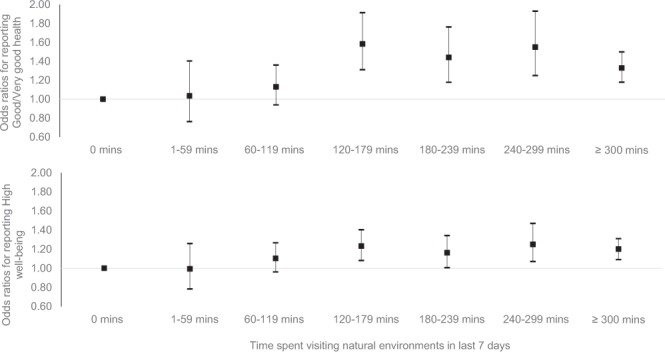
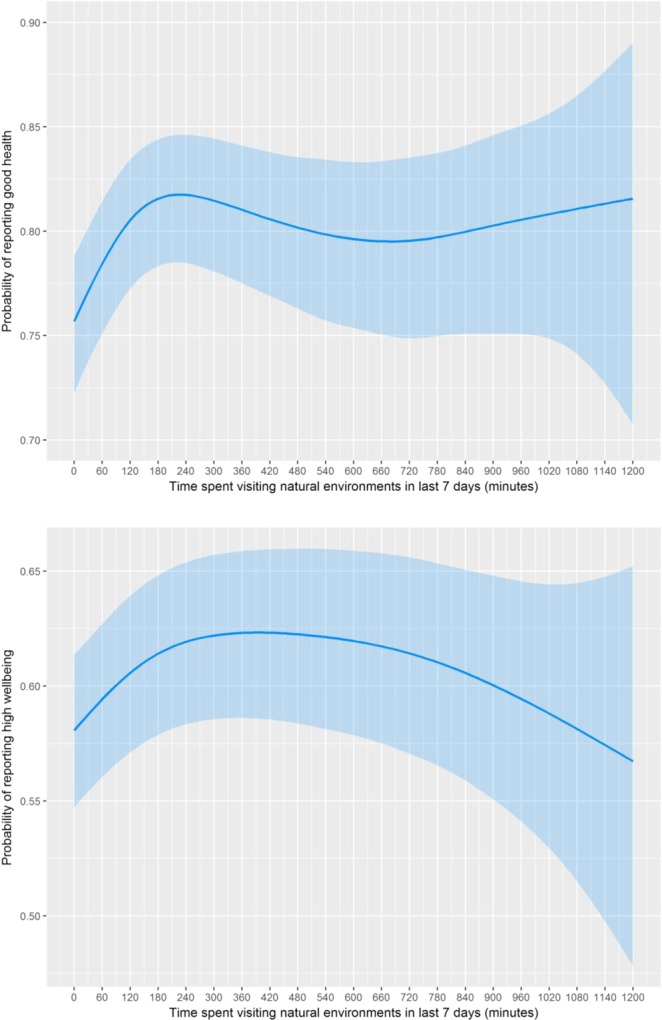
Using a nationally representative sample of adults in England (n = 19,806 weighted; n = 20,264 total sample), the paper finds that spending at least 120 minutes per week in natural environments is associated with higher odds of self-reported good health and high well-being. The association appears to level off around 200–300 minutes per week, and the authors caution that the study is cross-sectional and cannot establish causality.
## Key findings
- In adjusted binomial logistic regression models, the association with good health and high well-being became significant only at ≥120 minutes per week in nature; for example, at 120–179 minutes, ORs were 1.59 [1.31–1.92] for health and 1.23 [1.08–1.40] for well-being, compared with 0 minutes.
- The positive association was strongest up to about 200 minutes per week for health and 300 minutes per week for well-being, after which the relationship flattened or declined in spline analyses.
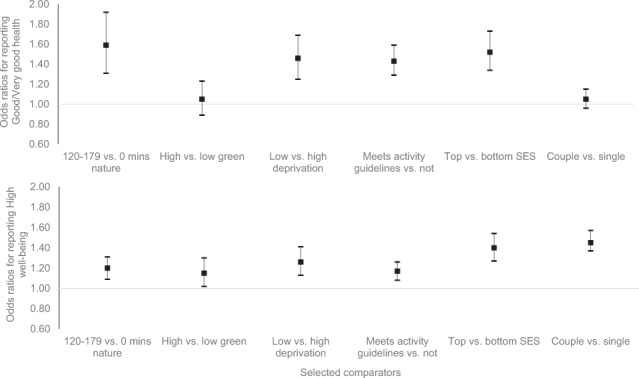
- The pattern was reported as consistent across key groups, including older adults and people with long-term health issues/disability; the paper also reports that the ≥120-minute “threshold” was seen across many stratified analyses.
- It did not matter how the 120 minutes were accumulated: additional analyses found no difference in health or well-being between one 120+ minute visit, two 60+ minute visits, or three or more ≤40 minute visits.
## Methods
- Design: Secondary analysis of a repeat cross-sectional survey; the study used survey weights to represent the adult population of England.
- Sample/data: Adults from Waves 6 and 7 of the Monitor of Engagement with the Natural Environment (MENE) survey (n = 20,264 total; n = 19,806 estimation sample for adjusted models; n = 19,808 for adjusted models with missing area-level data excluded).
- Main analysis: Survey-weighted binomial logistic regressions predicting binary health and well-being outcomes from weekly nature-contact duration categories; models adjusted for area- and individual-level covariates, with sensitivity analyses using splines and ordinal/continuous outcome specifications, plus a priori stratified analyses.
## Limitations
- The authors explicitly state the study is observational and cross-sectional, so they cannot rule out reverse causality or make causal claims.
- They note the weekly exposure estimate was based on one randomly selected visit in the last week, and that the data rely on self-reports, which may reduce accuracy.
- They caution that the apparent ≥120-minute threshold may partly reflect clustering of responses around hour marks and the way the data were categorized; this is an evident limitation from the text, alongside the very small variance explained by nature contact (about 1% in unadjusted models).
Model-written summary. Check it against the paper before relying on it.
Integrity signals
Registry
Cites
Statistics
Figures
Verification
Claims the paper makes
8 Valid · 1 Not valid · 15 Not checked · 60 Own results and interpretations
The cited sources support only part of this claim — read each source’s verdict below.
In the paper
“In other words, direct exposure, or more specifically in the current context, recreational time spent in natural environments per week, cannot accurately be inferred from neighbourhood greenspace near the home.”
§ Spending at least 120 minutes a week in nature is associated with good health and wellbeing > Introduction
What the sources say
- Partly supportedcites [23] Hillsdon, M., Coombes, E., Griew, P. & Jones, A. An assessment of the relevance of the home neighbourhood for understanding environmental influences on physical activity: how far from home do people roam? Int J Behav Nutr Phy 12, 100 (2015). sourceExperimental — accuracy not yet measured
The Conclusions and Discussion report that much outdoor physical activity occurs beyond the proximal home neighbourhood, so nearby neighbourhood characteristics may poorly represent the environments people use. The paper does not establish this specifically for weekly recreational time in natural environments or for neighbourhood greenspace; the Discussion says the researchers did not know which activities participants undertook. (LLM, conf=0.88)
- Could not verifycites [24] Sijtsma, F. J., de Vries, S., van Hinsberg, A. & Diederiks, J. Does ‘grey’ urban living lead to more ‘green’ holiday nights? A Netherlands Case Study. Landscape Urban Plan 105, 250–257 (2012). sourceExperimental — accuracy not yet measured
Our copy of Sijtsma et al. (2012) contains only repository/metadata records plus the Abstract; no body sections (Introduction, Methods, Discussion) are indexed. The Abstract (p. n/a) describes a GIS model of 'recreational shortages' — the shortage of locally available green space for recreational walking — linked to holiday nights away from home, but nowhere states that recreational time spent in natural environments per week cannot be inferred from neighbourhood greenspace near the home. Four searches (inference from neighbourhood greenspace, shortage of locally available green space for recreational walking, exposure vs. actual use, compensating behaviour/limitations) returned only the same abstract and citation blocks, so the claim's point is not addressed in the text we hold. (LLM, conf=0.65)
plain- Asserted: passes — The authors put it forward as true.
- Checkable: passes — It can be checked against evidence.
- Load-bearing: passes — The paper’s conclusions depend on it.
- Based: passes — The paper gives a reason why it holds.
- Partly supported
The cited sources support only part of this claim — read each source’s verdict below.
In the paper
“People travel beyond their local neighbourhoods to access recreational nature experiences, and indeed in our own data those who lived in the least green areas had higher odds of spending ≥120 mins in nature than those living in greener neighbourhoods (Appendix C).”
§ Spending at least 120 minutes a week in nature is associated with good health and wellbeing > Discussion
What the sources say
- Partly supportedcites [23] Hillsdon, M., Coombes, E., Griew, P. & Jones, A. An assessment of the relevance of the home neighbourhood for understanding environmental influences on physical activity: how far from home do people roam? Int J Behav Nutr Phy 12, 100 (2015). sourceExperimental — accuracy not yet measured
The Results report that 60.5% of recorded outdoor physical activity occurred beyond an 800 m home-neighbourhood boundary, and the Conclusions say adults undertook most outdoor physical activity outside their proximal home neighbourhood (page not provided). The paper does not establish that people travelled beyond their neighbourhoods specifically to access recreational nature experiences; it measured where activity occurred, not its purpose or whether it took place in nature. (LLM, conf=0.86)
plain- Asserted: passes — The authors put it forward as true.
- Checkable: passes — It can be checked against evidence.
- Load-bearing: passes — The paper’s conclusions depend on it.
- Based: passes — The paper gives a reason why it holds.
- Partly supported
Every source the paper cites for this claim was checked and supports it.
In the paper
“Research into shinrin-yoku (Japanese “forest bathing”)35, for instance, suggested that various psycho-physiological benefits can be gained from merely sitting passively in natural vs. urban settings.”
§ Spending at least 120 minutes a week in nature is associated with good health and wellbeing > Discussion
What the sources say
- Supportedcites [35] Park, B. J., Tsunetsugu, Y., Kasetani, T., Kagawa, T. & Miyazaki, Y. The physiological effects of Shinrin-yoku (taking in the forest atmosphere or forest bathing): evidence from field experiments in 24 forests across Japan. Environ Health Prev 15, 18–26 (2010). source
The Experimental design (p. 2) says subjects sat on chairs to view forest or city landscapes. The physiological results (p. 4) report more favorable stress-related measures after forest viewing, while the psychological results (p. 7) report better mood scores than after city viewing. (LLM, conf=0.93)
hedgedstates a possible cause- Asserted: passes — The authors put it forward as true.
- Checkable: passes — It can be checked against evidence.
- Load-bearing: passes — The paper’s conclusions depend on it.
- Based: passes — The paper gives a reason why it holds.
- Supported
Every source the paper cites for this claim was checked and supports it.
In the paper
“Experimental research, however, indicates that some benefits cannot be due solely to physical activity.”
§ Spending at least 120 minutes a week in nature is associated with good health and wellbeing > Discussion
What the sources say
- Supportedcites [35] Park, B. J., Tsunetsugu, Y., Kasetani, T., Kagawa, T. & Miyazaki, Y. The physiological effects of Shinrin-yoku (taking in the forest atmosphere or forest bathing): evidence from field experiments in 24 forests across Japan. Environ Health Prev 15, 18–26 (2010). source
The Experimental design (p. 2) reports no difference in exercise load between forest and city walks. The Results (p. 4) also report physiological benefits from viewing forest landscapes while seated, supporting the conclusion that physical activity alone cannot explain some benefits. (LLM, conf=0.93)
hedgedstates a cause- Asserted: passes — The authors put it forward as true.
- Checkable: passes — It can be checked against evidence.
- Load-bearing: passes — The paper’s conclusions depend on it.
- Based: passes — The paper gives a reason why it holds.
- Supported
The cited sources support only part of this claim — read each source’s verdict below.
In the paper
“Impoverished local opportunities need not be a barrier to nature exposure23,24.”
§ Spending at least 120 minutes a week in nature is associated with good health and wellbeing > Discussion
What the sources say
- Partly supportedcites [23] Hillsdon, M., Coombes, E., Griew, P. & Jones, A. An assessment of the relevance of the home neighbourhood for understanding environmental influences on physical activity: how far from home do people roam? Int J Behav Nutr Phy 12, 100 (2015). sourceExperimental — accuracy not yet measured
The Results and Conclusions (page numbers unavailable) show that adults undertook much of their outdoor physical activity beyond their proximal home neighbourhood, supporting the idea that nearby opportunities do not define where people go. The paper does not establish that those destinations provided nature exposure or that impoverished local nature opportunities were not a barrier to it. (LLM, conf=0.78)
- Partly supportedcites [24] Sijtsma, F. J., de Vries, S., van Hinsberg, A. & Diederiks, J. Does ‘grey’ urban living lead to more ‘green’ holiday nights? A Netherlands Case Study. Landscape Urban Plan 105, 250–257 (2012). sourceExperimental — accuracy not yet measured
Our copy of Sijtsma et al. (2012) holds only the repository record — the Abstract plus bibliographic metadata, with no body sections (searches on 'recreational shortage', 'nature exposure', 'compensating behaviour', 'discussion/conclusion' all returned the same abstract and citation blocks). The Abstract does support the compensatory mechanism behind the claim: 'the higher the greyness of the living environment – i.e. the higher the shortage of locally available green space for recreational walking – the more people spend nights away from home', with ~20% of holiday nights of the greyest residents related to that shortage. But the source measures holiday nights away from home and frames the shortage as a cost of agglomeration for well-being; it nowhere asserts 'nature exposure' or that a local shortage is not a barrier to nature contact, so the claim's generalisation to 'nature exposure' goes beyond what this source states. (LLM, conf=0.72)
plain- Asserted: passes — The authors put it forward as true.
- Checkable: passes — It can be checked against evidence.
- Load-bearing: unclear — It is unclear whether the paper’s conclusions depend on it.
- Based: passes — The paper gives a reason why it holds.
- Partly supported
21 more claims · 1 with their cited sources checked
Create a free account to see all 84 claims and to verify the 9 references still open.
- It may state two separate claims as one. 18
- Probably not a substantial claim. 46
Claims other papers make about this one
Each is checked against this paper’s own text: does it say what the citing paper says it does?
The cited source says what the claim attributes to it.
In the citing paper
“spending at least 120 min a week in nature was associated with good health [82].”
From EAACI Guidelines on the Importance of Green Space in Urban Environments for Allergy and Asthma Prevention (2026) · cites this paper as [82]
Citations
Cites
Hartig, T., Mitchell, R., de Vries, S., & Frumkin, H. (2014) · Annual Review of Public Health · doi:10.1146/annurev-publhealth-032013-182443 · Cited by 3,638
Self-citationEffect of exposure to natural environment on health inequalities: an observational population study
Mitchell, R., & Popham, F. (2008) · The Lancet · doi:10.1016/s0140-6736(08)61689-x · Cited by 2,099
Green space, urbanity, and health: how strong is the relation?
Maas, J., Verheij, R. A., Groenewegen, P. P., de Vries, S., & Spreeuwenberg, P. (2006) · Journal of Epidemiology and Community Health · doi:10.1136/jech.2005.043125 · Cited by 1,976
The Science of Mind Wandering: Empirically Navigating the Stream of Consciousness
Smallwood, J., & Schooler, J. W. (2015) · Annual Review of Psychology · doi:10.1146/annurev-psych-010814-015331 · Cited by 1,685
Barton, J., & Pretty, J. (2010) · Environmental Science & Technology · doi:10.1021/es903183r · Cited by 1,592
Miilunpalo, S., Vuori, I., Oja, P., Pasanen, M., & Urponen, H. (1997) · Journal of Clinical Epidemiology · doi:10.1016/s0895-4356(97)00045-0 · Cited by 1,473
Thompson Coon, J., Boddy, K., Stein, K., Whear, R., Barton, J., & Depledge, M. H. (2011) · Environmental Science & Technology · doi:10.1021/es102947t · Cited by 1,391
Self-citationNature Contact and Human Health: A Research Agenda
Frumkin, H., Bratman, G. N., Breslow, S. J., Cochran, B., Kahn Jr, P. H., Lawler, J. J., Levin, P. S., Tandon, P. S., Varanasi, U., Wolf, K. L., et al. (2017) · Environmental Health Perspectives · doi:10.1289/ehp1663 · Cited by 1,237
What are the benefits of interacting with nature?
Keniger, L., Gaston, K., Irvine, K., & Fuller, R. (2013) · International Journal of Environmental Research and Public Health · doi:10.3390/ijerph10030913 · Cited by 1,204
Research works printed but not linked: 1
- Stigsdotter, U. & Grahn, P. What makes a garden a healing garden. J Thera Hort 13, 60–69 (2002).
Cited by
Items 301–400 of 1,105
Cobreros, C., Mendoza-Ruvalcaba, N. M., Flores-García, M., & Roggema, R. (2023) · Sustainability · doi:10.3390/su15075703 · Cited by 25
Pfeifer, E., Pothmann, K., Claaßen, S., & Wittmann, M. (2023) · Progress in brain research · doi:10.1016/bs.pbr.2022.12.010 · Cited by 20
Opportunities for Biodiversity Conservation via Urban Ecosystem Regeneration
Perry, G., & Cox, R. D. (2024) · Diversity · doi:10.3390/d16030131 · Cited by 19
“Certainly, time spent in natural settings is known to benefit human physical and mental health [61].”
BackgroundThe nature buffer: the missing link in climate change and mental health research
Dillman-Hasso, N. H. (2021) · Journal of Environmental Studies and Sciences · doi:10.1007/s13412-021-00669-2 · Cited by 20
Does Spending Time in Nature Help Students Cope with the COVID-19 Pandemic?
Desrochers, J., Bell, A. L., Nisbet, E. K. L., & Zelenski, J. M. (2022) · Sustainability · doi:10.3390/su14042401 · Cited by 23
“…reported how much time they spent, on average, in places such as green spaces (local parks, woodlands, nature areas), blue spaces (beaches, coasts, canals, lakefronts), and countryside spaces (farmlands, hills) during a typical week of the pandemic (the assessment of places was adapted from [11]).”
BackgroundDoes having children or a dog influence visits to urban green spaces?
Garrido‐Cumbrera, M., Braçe, O., Suárez‐Cáceres, G. P., & Correa-Fernández, J. (2020) · Landscape Research · doi:10.1080/01426397.2020.1808966 · Cited by 18
“In addition, spending more time in nature each week is associated with good health and well-being (White et al., 2019).”
BackgroundEnvironmental performance indicators for the urban coastal environment of Singapore
Chng, L. C., Chou, L. M., & Huang, D. (2021) · Regional Studies in Marine Science · doi:10.1016/j.rsma.2021.102101 · Cited by 18
Baek, J., Jung, J., Shin, H., Kim, S., Sung, S.-Y., Park, S., Hahm, S., Cho, H.-Y., & Lee, M.-G. (2022) · International Journal of Environmental Research and Public Health · doi:10.3390/ijerph19084863 · Cited by 21
“Previous studies have reported that greater exposure to nature has a positive effect on human cognition and emotion [6], and physical activity in an environment such as a forest or grassland has a much more positive effect on mental health than indoor exercise [7,8].”
BackgroundCurcuruto, M., Williams, S., Brondino, M., & Bazzoli, A. (2023) · International Journal of Environmental Research and Public Health · doi:10.3390/ijerph20032249 · Cited by 25
“The existing literature presents a significant body of evidence that exposure to nature and the outdoors is important for human health and wellbeing [52] and that employees with greater access to natural spaces are more engaged at work [53].”
BackgroundRosa, C. D., Chaves, T. S., Collado, S., & Harper, N. J. (2023) · Journal of Adventure Education & Outdoor Learning · doi:10.1080/14729679.2023.2196638 · Cited by 20
“This has led researchers and practitioners to encourage people to spend time in natural environments as a way to enhance their wellbeing (White et al., 2019).”
How human health and well-being depends on healthy marine habitats in the Mediterranean: A review
Lloret, J., García-de-Vinuesa, A., & Demestre, M. (2024) · Heliyon · doi:10.1016/j.heliyon.2024.e24329 · Cited by 23
Poli, L., Greco, G., Gabriele, M., Pepe, I., Centrone, C., Cataldi, S., & Fischetti, F. (2024) · Journal of Functional Morphology and Kinesiology · doi:10.3390/jfmk9040183 · Cited by 23
“This aligns with the broader literature highlighting the benefits of natural environments on psychological well-being and motivation (Twohig-Bennett and Jones, 2018; White et al., 2019) [10,11].”
BackgroundInfluentialWu, W., Tan, W., Chen, W. Y., & Wang, R. (2024) · Cities · doi:10.1016/j.cities.2024.105496 · Cited by 18
Xu, S. T., Murrell, G. A. C., Golding, S. E., Brockett, B., Gatersleben, B., Scarles, C., White, E., Willis, C., & Wyles, K. J. (2021) · Frontiers in Psychology · doi:10.3389/fpsyg.2021.701769 · Cited by 27
Masterton, W., Park, K. J., Carver, H., & Parkes, T. (2021) · Health & Place · doi:10.1016/j.healthplace.2021.102669 · Cited by 16
Almusaed, A., Almssad, A., & Najar, K. (2022) · Advances in Civil Engineering · doi:10.1155/2022/8545787 · Cited by 28
Lemieux, C. J., Lazarescu, C., Reining, C. E., Groulx, M. W., Lem, M., Astell‐Burt, T., & Feng, X. (2025) · Wellbeing Space and Society · doi:10.1016/j.wss.2025.100251 · Cited by 19
“As part of the broader social prescribing framework, nature prescriptions are stated to offer a holistic, preventative model of care that complements mainstream medical treatments, promoting a more integrated and sustainable approach to public health (Jimenez et al., 2021; White et al., 2019).”
Cinderby, S., Archer, D., Mehta, V. K., Neale, C., Opiyo, R. O., Pateman, R. M., Muhoza, C., Adelina, C., & Tuhkanen, H. (2021) · Frontiers in Sociology · doi:10.3389/fsoc.2021.729453 · Cited by 19
“This 2 h threshold links to recommended “doses” of greenspace use (White et al., 2019) found in other studies from the Global North.”
BackgroundBrondino, M., Signore, F., Zambelli, A., Ingusci, E., Pignata, S., Manuti, A., Giancaspro, M. L., Falco, A., Girardi, D., Guglielmi, D., et al. (2022) · International Journal of Environmental Research and Public Health · doi:10.3390/ijerph19063724 · Cited by 24
Sari, M., Fatimah, I. S., Pratiwi, P. I., & Sulistyantara, B. (2023) · Journal of Contemporary Urban Affairs · doi:10.25034/ijcua.2023.v7n1-1 · Cited by 27
Litleskare, S., & Calogiuri, G. (2023) · Frontiers in Public Health · doi:10.3389/fpubh.2023.1138915 · Cited by 17
“For instance, it was estimated that spending at least 120 minutes in nature during a regular week is associated with higher levels of self-rated health and satisfaction with life (19).”
BackgroundLenda, M. L., Skórka, P., Jaźwa, M., Lin, H., Nȩcka, E., Tryjanowski, P., Moroń, D., Knops, J. M. H., & Possingham, H. P. (2023) · Ecology and Society · doi:10.5751/es-14374-280313 · Cited by 21
The dynamic impact of COVID-19 pandemic on park visits: A longitudinal study in the United States
Wu, X., Chen, W. Y., Zhang, K., & Lü, Y. (2023) · Urban forestry & urban greening · doi:10.1016/j.ufug.2023.128154 · Cited by 15
Buckley, R., Cooper, M., & Zhong, L. (2024) · People and Nature · doi:10.1002/pan3.10723 · Cited by 20
Chen, T.-L., & Li, Y.-E. (2024) · Journal of Urban Management · doi:10.1016/j.jum.2024.11.016 · Cited by 15
Smartphones within Psychological Science
Ellis, D. A. (2020) · Cambridge University Press eBooks · doi:10.1017/9781108671408 · Cited by 15
Varanasi, U. (2020) · Ecopsychology · doi:10.1089/eco.2020.0011 · Cited by 15
“…reaching the conclusion that 2-hour exposure per { See natureandhealth.uw.edu week in nature (green space) is enough to elicit healthful benefits (White et al., 2019), to forest bathing (immersion) studies emphasizing the importance of communing with nature (Hansen, Jones, & Tocchini, 2017; Li,…”
McDougall, C. W., Elliott, L. R., White, M. P., Grellier, J., Bell, S., Bratman, G. N., Nieuwenhuijsen, M. J., Lima, M. L., Ojala, A., Cirach, M., et al. (2024) · Journal of Environmental Psychology · doi:10.1016/j.jenvp.2024.102479 · Cited by 18
Self-citationLee, M., Lee, Y., & Lee, C. (2025) · Journal of Environmental Management · doi:10.1016/j.jenvman.2025.125449 · Cited by 15
The Restorative Environment and Salutogenesis: Complementary Concepts Revisited
von Lindern, E., Lymeus, F., & Hartig, T. (2022) · Springer eBooks · doi:10.1007/978-3-030-79515-3_35 · Cited by 22
Self-citationChristie, M., & Elliott, D. L. (2023) · Sport in Society · doi:10.1080/17430437.2023.2233428 · Cited by 17
“However, there is a growing belief that BE might offer some-thing unique (Foley and Kistemann 2015; Britton et al. 2020; Thompson and Wilkie 2021) and in fact be superior to GE (Haeffner et al. 2017; Grellier et al. 2017; White et al. 2019; Loureiro et al. 2021).”
BackgroundMajeed, H., Baumann, S., & Majeed, H. (2023) · Scientific Reports · doi:10.1038/s41598-023-49088-z · Cited by 16
Bucht, C., Bachner, J., & Spengler, S. (2024) · PLoS ONE · doi:10.1371/journal.pone.0296327 · Cited by 22
A Nature-Based Intervention and Mental Health of Schoolchildren: A Cluster Randomized Clinical Trial
Loose, T., Fuoco, J., Malboeuf‐Hurtubise, C., Ayotte‐Beaudet, J., Gauvin, L. I., Chadi, N., Ouellet‐Morin, I., Mâsse, B. R., Côté, S. M., & Geoffroy, M. (2024) · JAMA Network Open · doi:10.1001/jamanetworkopen.2024.44824 · Cited by 20
Online but not remote: Adapting field‐based ecology laboratories for online learning
Richter, C. F., Lortie, C. J., Kelly, T., Filazzola, A., Nunes, K. A., & Sarkar, R. (2020) · Ecology and Evolution · doi:10.1002/ece3.7008 · Cited by 16
“Furthermore, the impacts of learning in a field setting extend beyond academics and provide mental and physical benefits for our students (McKinnon et al., 2016; White et al., 2019).”
BackgroundPrice, M., Hidalgo, J. E., Bird, Y. M., Bloomfield, L. S. P., Buck, C., Cerutti, J., Dodds, P. S., Fudolig, M. I., Gehman, R. M., Hickok, M., et al. (2023) · Contemporary Clinical Trials · doi:10.1016/j.cct.2023.107338 · Cited by 21
“There is evidence for a dose response relationship in that more time in green spaces is associated with larger increases in positive affect [22,23].”
Longitudinal analysis of happiness changes in nature-based travel
Jung, S.-S., Shin, H., & Lee, H. (2025) · Annals of Tourism Research · doi:10.1016/j.annals.2025.104017 · Cited by 16
Janeka, P., Foellmer, J., Martínez, J. A., Schrammeijer, E. A., Hertig, E., van Rompay, T. J. L., Cerrone, D., Sawungrana, A., & Anthonj, C. (2025) · Wellbeing Space and Society · doi:10.1016/j.wss.2025.100304 · Cited by 16
Hartanto, A., Teo, N. L. A., Lua, V. Y. Q., Tay, K. J. Y., Chen, N. R. Y., & Majeed, N. M. (2023) · Experimental Psychology (formerly Zeitschrift für Experimentelle Psychologie) · doi:10.1027/1618-3169/a000578 · Cited by 15
Smith, F. M., & Turner, W. (2023) · Wellbeing Space and Society · doi:10.1016/j.wss.2023.100158 · Cited by 19
Time perception in naturalistic and urban immersive virtual reality environments
Mioni, G., & Pazzaglia, F. (2023) · Journal of Environmental Psychology · doi:10.1016/j.jenvp.2023.102105 · Cited by 16
Connection to nature for sustainable development at universities—What should be done?
Kleespies, M. W., & Dierkes, P. W. (2023) · Frontiers in Sustainability · doi:10.3389/frsus.2023.1249328 · Cited by 19
A study of the role of indoor nature on solidarity and group identity during remote work
Bianchi, E., Bloomfield, L. S. P., Bencharit, L. Z., Altaf, B., Sawe, N. A., Murnane, E. L., Landay, J. A., & Billington, S. L. (2023) · Building and Environment · doi:10.1016/j.buildenv.2023.110909 · Cited by 15
Schmidt, J. M., Porter, J. T., Rivera‐Amill, V., & Appleyard, C. B. (2023) · AJP Advances in Physiology Education · doi:10.1152/advan.00125.2023 · Cited by 20
Yoon, H., & Jeon, J. Y. (2024) · Virtual Reality · doi:10.1007/s10055-024-01087-9 · Cited by 20
“In response to these issues, there is a growing demand for improving health and happiness in urban life, prompting a re-examination of the importance of contact with nature (Hartig et al. 2014; White et al. 2019).”
Outdoor Activity Associated with Higher Self-Reported Emotional Well-Being During COVID-19
Fernandez, M. P., Ernst, K. C., Bron, G. M., Berry, K. L., Diuk‐Wasser, M. A., & Hayden, M. H. (2022) · EcoHealth · doi:10.1007/s10393-022-01598-4 · Cited by 17
“Strong evidence supports a relationship between time spent in natural environments and an improved sense of well-being, including recovery from stress and mental fatigue (Park et al. 2010; Pearson and Craig 2014; White et al. 2016, 2019; Frumkin et al. 2017).”
BackgroundWalker, H. J., Jena, A., McEwan, K., Evans, G., & Campbell, S. (2023) · Forests · doi:10.3390/f14010092 · Cited by 16
Fian, L., White, M. P., Thaler, T., Arnberger, A., Elliott, L. R., & Friesenecker, M. (2023) · Urban forestry & urban greening · doi:10.1016/j.ufug.2023.127977 · Cited by 14
Self-citationPicascia, S., & Mitchell, R. (2021) · Health & Place · doi:10.1016/j.healthplace.2021.102729 · Cited by 13
Zheng, Y., Hamm, N., Lin, T., Liu, J., Zhou, T., Ren, X., Bai, X., Geng, H., Zhang, J., Jia, Z., et al. (2025) · Urban forestry & urban greening · doi:10.1016/j.ufug.2025.128808 · Cited by 16
Stangierska, D., Fornal-Pieniak, B., Szumigała, P. P., Widera, K., Żarska, B., & Szumigała, K. O. (2023) · International Journal of Environmental Research and Public Health · doi:10.3390/ijerph20021242 · Cited by 20
Gainsburg, I., Roy, S., & Lee, J. (2023) · Scientific Reports · doi:10.1038/s41598-023-34338-x · Cited by 15
Zhang, R., Chen, H., Liu, L., Wang, F., & Yang, Z. (2024) · Journal of Adolescence · doi:10.1002/jad.12330 · Cited by 18
Bressane, A., Ferreira, M. E. G., Garcia, A. J. D. S., & Medeiros, L. C. D. C. (2024) · International Journal of Environmental Research and Public Health · doi:10.3390/ijerph21070937 · Cited by 18
“Moreover, White et al. [51] also support this finding, suggesting that while green space suitability is important, the specific features and quality of these spaces significantly impact their effectiveness in reducing stress.”
ResultBressane, A., Pinto, J. P. D. C., Goulart, A. P. G., & Medeiros, L. C. D. C. (2024) · Health & Place · doi:10.1016/j.healthplace.2024.103335 · Cited by 19
Jensen, J. K., Olsson, J. A., von Post, M., & Isaksson, C. (2024) · People and Nature · doi:10.1002/pan3.10702 · Cited by 16
Uchiyama, Y., Kyan, A., Sato, M., Ushimaru, A., Minamoto, T., Kiyono, M., Harada, K., & Takakura, M. (2024) · Journal of Environmental Management · doi:10.1016/j.jenvman.2024.122676 · Cited by 16
Biodiversity-rich recreational areas near cities as a nature-based mental health solution
Xia, C., Hu, S., Hu, Z., Yan, Y., & Carrasco, L. R. (2025) · Nature Cities · doi:10.1038/s44284-025-00251-9 · Cited by 15
Logan, M. J., Metzger, M. J., & Hollingdale, J. (2021) · Scottish Geographical Journal · doi:10.1080/14702541.2021.1945670 · Cited by 14
“These findings concur with previous research indicating that being in woodlands is particularly conducive to active and engaged exercise (Goodenough & Waite, 2020) and that connecting with nature contributes positively to both physical and mental health (O’Brien & Morris, 2014; White et al., 2019).”
ResultLindsay, R. K., Carmichael, C., Allen, P. M., Fossey, M. J., Godier-McBard, L. R., Butler, L., Trott, M., Pardhan, S., Tully, M. A., Wilson, J. J., et al. (2022) · International Journal of Environmental Research and Public Health · doi:10.3390/ijerph19084730 · Cited by 12
Playground Design: Contribution to Duration of Stay and Implications for Physical Activity
Cohen, D. A., Talarowski, M., Han, B., Williamson, S. L., Galfond, E., Young, D. R., Eng, S., & McKenzie, T. L. (2023) · International Journal of Environmental Research and Public Health · doi:10.3390/ijerph20054661 · Cited by 15
Kindermann, G., Domegan, C. T., Britton, E., Carlin, C. M., Mashinchi, M. I., & Ojo, A. (2021) · Sustainability · doi:10.3390/su13179553 · Cited by 13
Jalali, N., Sahu, K. S., Oetomo, A., & Morita, P. P. (2022) · JMIR mhealth and uhealth · doi:10.2196/28811 · Cited by 13
“The duration of staying at home for each individual is linked to physical and mental health [47-49].”
BackgroundAllgood, B., Mann, T., Round, C., Wall, K., Musikanski, L., & Talmage, C. A. (2022) · Community Development · doi:10.1080/15575330.2022.2034026 · Cited by 13
“, 2018), they experience greater wellbeing in nature (Louv, 2019; White et al., 2019), and they can experience a nature deficit”
BackgroundJong, M., Stub, T., Mulder, E., & Jong, M. (2022) · International Journal of Environmental Research and Public Health · doi:10.3390/ijerph191912012 · Cited by 13
“Health benefits are seen as a result of spending as little as two hours per week in a natural environment [7].”
BackgroundMilitary veterans’ motivation and barriers to outdoor recreation participation
Herrmann, T. S., Bettmann, J. E., Sweeney, C., Marchand, W. R., Carlson, J. K., & Hanley, A. W. (2022) · Leisure Studies · doi:10.1080/02614367.2022.2125556 · Cited by 16
“Research suggests that spending time outdoors in a natural environment improves overall health and well-being (Beyer et al., 2014; Twohig-Bennett & Jones, 2018; White et al., 2019).”
BackgroundIndoor Generation Era. Risks and challenges
Pruszyński, J., Cianciara, D., Włodarczyk-Pruszyńska, I., Górczak, M., & Padzińska-Pruszyńska, I. B. (2023) · Journal of Education Health and Sport · doi:10.12775/jehs.2023.48.01.002 · Cited by 14
McAnirlin, O., Browning, M. H. E. M., Fasolino, T. K., Okamoto, K., Sharaievska, I., Thrift, J. R., & Pope, J. K. (2024) · Wellbeing Space and Society · doi:10.1016/j.wss.2024.100212 · Cited by 14
Ramanpong, J., Tsao, C., Yin, J., Wu, C., Huang, Y.-C., & Yu, C.-P. (2025) · Urban forestry & urban greening · doi:10.1016/j.ufug.2025.128667 · Cited by 14
Exploring the Characteristics of Physical Exercise in Students and the Path of Health Education
Peng, X., & Tang, L. (2021) · Frontiers in Psychology · doi:10.3389/fpsyg.2021.663922 · Cited by 18
“White et al. (2019) studied the links between recreational natural contact and self-reported health and well-being over the past 7 days.”
BackgroundLehberger, M., & Sparke, K. (2023) · Journal of Environmental Psychology · doi:10.1016/j.jenvp.2023.102089 · Cited by 9
Whomsley, S. R. C. (2021) · European Psychologist · doi:10.1027/1016-9040/a000435 · Cited by 11
Ho, P. L., Li, T. W., Liu, H., Yeung, T. F., & Hou, W. K. (2022) · International Journal of Environmental Research and Public Health · doi:10.3390/ijerph19073931 · Cited by 15
dos Santos, A. P. R., Souza, J. N. V. A., Silva, B. R. V. S., Costa, E. C., Oliveira, M. C. D. P., de Aquino, J. M., dos Santos, M. A. M., de Barros, M. V. G., da Silva, L. M. P., & Correia, M. A. D. V. (2022) · Revista Brasileira de Atividade Física & Saúde · doi:10.12820/rbafs.27e0266 · Cited by 11
Weng, Y., Chen, Q., Lin, X., Chi, Y., & Li, K. (2025) · Frontiers in Public Health · doi:10.3389/fpubh.2025.1667502 · Cited by 17
Burn, A. S., & Passmore, J. (2022) · International Coaching Psychology Review · doi:10.53841/bpsicpr.2022.17.1.21 · Cited by 13
Simović, I., Tomičević-Dubljević, J., Tošković, O., Vujcic, M., & Živojinović, I. (2023) · Forests · doi:10.3390/f14040765 · Cited by 15
Pochwatko, G., Kopeć, W., Świdrak, J., Jaskulska, A., Skorupska, K., Karpowicz, B., Masłyk, R., Grzeszczuk, M., Barnes, S., Borkiewicz, P., et al. (2023) · Proceedings - International Symposium on Mixed and Augmented Reality, ISMAR · doi:10.1109/ismar59233.2023.00033 · Cited by 17
“It has been shown that exposure to natural environments, even in virtual form, can effectively reduce stress, improve mood, and enhance overall well-being [2,51].”
BackgroundSong, T., Xu, L., Zhao, F., & Du, Y. (2024) · Journal of Building Engineering · doi:10.1016/j.jobe.2024.108992 · Cited by 10
From a dark place to a blue space: open water swimming transformed our lives
Christie, M., & Elliott, D. (2024) · Sport in Society · doi:10.1080/17430437.2024.2357231 · Cited by 14
“OWS can offer many of the benefits associated with exposure to natural environments as well as those derived from being physically active (Haeffner et al. 2017; Grellier et al. 2017; White et al. 2019; Denton and Aranda 2020; Loureiro et al. 2021; Thompson and Wilkie 2021).”
Nature-based mental health: research and implementation agenda
Buckley, R., Zhang, Z. J., Underdahl, S., et al. (2024) · The Lancet Planetary Health · doi:10.1016/s2542-5196(24)00166-9 · Cited by 10
Liljegren, M., Bengtsson, A., Lindahl, G., & Wijk, H. (2024) · HERD Health Environments Research & Design Journal · doi:10.1177/19375867241276296 · Cited by 16
Integrating Forest Ecosystem Services into Health Strategies to Improve Human Well-Being
Liu, Y., Wang, C., Liu, Y., Feng, T., Wang, E., Yang, L., Niu, Q., & Mao, X. (2024) · Forests · doi:10.3390/f15111872 · Cited by 12
Zhang, Z., Wang, X., & Jiang, M. (2025) · Land · doi:10.3390/land14010122 · Cited by 15
The Effects of Soundscape Interactions on the Restorative Potential of Urban Green Spaces
Fei, X., Wu, Y., Dong, J., & Kong, D. (2025) · Sustainability · doi:10.3390/su17062674 · Cited by 14
“Through experimental research, they found that living in a natural outdoor environment can help individuals recover to some extent from mental stress [6].”
Alcock, I., Sheffield, D., White, P. C. L., & Richardson, M. (2025) · People and Nature · doi:10.1002/pan3.70040 · Cited by 18
“…there are differences across studies and outcome metrics used, there is evidence from many studies that both forms of nature exposure are associated with better mental health and well-being (e.g. White et al., 2019 ), and also with environmental attitudes and behaviours (e.g. Alcock et al., 2020 ).”
Self-citationMcGavock, J., Brunton, N. M., Klaprat, N. D., Swanson, A., Pancoe, D., Manley, E., Weerasinghe, A., Booth, G. L., Russell, K. F., Rosella, L. C., et al. (2019) · International Journal of Environmental Research and Public Health · doi:10.3390/ijerph16193627 · Cited by 16
“It is well established that being outdoors, particularly when connected to nature, reduces blood pressure [35] and improves mental wellness [36,37].”
BackgroundParks: A vital community condition
Muqueeth, S. (2021) · Parks Stewardship Forum · doi:10.5070/p537151742 · Cited by 12
Anchor of cultural forest services in the national forest policies of Central European countries
Hochmalová, M., Červená, T., Purwestri, R. C., Hájek, M., & Sloup, R. (2021) · Central European Forestry Journal · doi:10.2478/forj-2021-0013 · Cited by 13
The island effect: Spatial effects on mental wellbeing and residence on remote Scottish islands
Halliday, K., Clemens, T. L., & Dibben, C. J. L. (2022) · Wellbeing Space and Society · doi:10.1016/j.wss.2022.100098 · Cited by 14
Integrating positive psychology and spirituality in the context of climate change
Bellehumeur, C. R., Bilodeau, C., & Kam, C. (2022) · Frontiers in Psychology · doi:10.3389/fpsyg.2022.970362 · Cited by 19
“, 2010), wellbeing, and mental health (Zelenski and Nisbet, 2014; White et al., 2019), on emotional responses, beliefs, attitudes, and pro-environmental behaviors (Kaplan, 1995; Nisbet et al.”
BackgroundWajchman-Świtalska, S., Grabowska-Chenczke, O., Woźniak, M., & Bałaj, B. (2022) · Forests · doi:10.3390/f13101569 · Cited by 10
Schamilow, S., Santonja, I., Weitzer, J., Strohmaier, S., Klösch, G., Seidel, S., Schernhammer, E. S., & Papantoniou, K. (2023) · Clocks & Sleep · doi:10.3390/clockssleep5030027 · Cited by 15
Mental gravity: Modelling the embodied self on the physical environment
Kent, L. (2024) · Journal of Environmental Psychology · doi:10.1016/j.jenvp.2024.102245 · Cited by 11
Brimblecombe, P. (2019) · City and Environment Interactions · doi:10.1016/j.cacint.2019.100005 · Cited by 10
O’Halloran, C., & Silver, M. W. (2021) · Frontiers in Marine Science · doi:10.3389/fmars.2021.714831 · Cited by 10
The (a)typical burden of COVID-19 pandemic scenario in Autism Spectrum Disorder
Fumagalli, L., Nicoli, M., Villa, L. M., Riva, V., Vicovaro, M., & Casartelli, L. (2021) · Scientific Reports · doi:10.1038/s41598-021-01907-x · Cited by 14
Pijpker, R., Veen, E. J., Vaandrager, L., Koelen, M. A., & Bauer, G. F. (2022) · Frontiers in Psychology · doi:10.3389/fpsyg.2022.785697 · Cited by 12
“Besides being exposed to the natural environment, the “dosage” of time being in nature matters as well; for example, a recent study showed that 120 min per week yields the optimum effect for our general health and wellbeing (White et al., 2019).”
BackgroundBörger, T., Maccagnan, A., White, M. P., Elliott, L. R., & Taylor, T. (2022) · American Journal of Agricultural Economics · doi:10.1111/ajae.12328 · Cited by 15
Self-citationMead, J., Fisher, Z., Tree, J. J., Wong, P. T. P., & Kemp, A. H. (2020) · doi:10.31234/osf.io/z2pxg · Cited by 10
“In fact, individuals who spend 2 hours a week in nature display improved wellbeing (White et al., 2019).”
Background
Metadata
- Authors
- White, M. P., Alcock, I., Grellier, J., Wheeler, B. W., Hartig, T., Warber, S. L., Bone, A., Depledge, M. H., & Fleming, L. E.
- Affiliations
- University of Exeter (GB)
- Uppsala University (SE)
- Corresponding author
- White, Mathew P.
- ORCID
- Venue
- Scientific Reports
- Published
- 2019-06-13
- Volume
- 9
- Issue
- 1
- Pages
- 7730-7730
- ISSN
- 2045-2322 (ISSN-L)
- PMC
- PMC6565732
- OpenAlex
- W2952548366
- Cited by
- 1,125
- References
- 51
- Citations by year
- 2026: 186 · 2025: 168 · 2024: 170 · 2023: 181 · 2022: 138 · 2021: 164 · 2020: 94 · 2019: 23
- FWCI
- 45.19
- Type
- journal article
- Language
- en
- Open access
- gold
- doi.org
- Licence
- cc-by
- creativecommons.org/licenses/by/4.0 (tdm)
- creativecommons.org/licenses/by/4.0 (vor)
- Locations
- Scientific Reports (publishedVersion, cc-by)
- PubMed Central (publishedVersion, cc-by)
- PubMed (publishedVersion)
- KTH Publication Database DiVA (KTH Royal Institute of Technology) (submittedVersion, other-oa)
- DOAJ (DOAJ: Directory of Open Access Journals) (submittedVersion)
- Figshare (submittedVersion, cc-by)
- Open Research Exeter (University of Exeter) (submittedVersion, cc-by)
- Funders
- DH | National Institute for Health Research (HPRU: Environmental Change & Health)
- Topics
- Social Sciences › Urban Studies › Urban Green Space and Health
- Social Sciences › Business, Management and Accounting › Tourism, Leisure and Hospitality Management › Recreation, Leisure, Wilderness Management
- Health Sciences › Medicine › Public Health, Environmental and Occupational Health › Physical Activity and Health
- Keywords
- nature contact, exposure-response relationship, self-reported health, well-being, green spaces, older adults, chronic disease
- MeSH terms
- Adolescent, Adult, Environment, Female, Health, Humans, Male, Middle Aged, Residence Characteristics, Exercise, Walking, Young Adult, Self Report
About these checks
Registry, retraction, Cites and statistics results are computed, not judged, with one exception: a printed reference that no index lists is read once by a model before it counts as a citation error. Claims are extracted by a model and kept only when their quote appears verbatim in the text; each cited source is then checked, with a model’s help, for whether it says what the claim relies on. Those verdicts can be wrong — read the claim’s quote and the cited source before relying on one.
The claim verdicts this report counts are experimental: their accuracy is not yet measured.
A language model drew the claims from the paper on 2026-10-10, under version 3 of the claim definition (model deepseek-v4.1-flash, prompt extract-v3).
A second model labelled each claim on 2026-10-10 (model jev-1.13-20260917, definition revision gold-guideline-v0.2).
Cited sources are checked with a language model’s help (gpt-6-sol and qwen3.8-omni-flash).
Statistics and arithmetic are recomputed, not judged.
Confidence bands are shown only for fields calibrated on our annotated test set. None is calibrated yet, so no band is shown.
What counts as a claim ›How we measure confidence ›How we check this ›
Are you an author, or do you see a problem with this page? Request a review
Data sources
Bibliographic data: Semantic Scholar, OpenAlex, Crossref.
Contains information from the Semantic Scholar Academic Graph Datasets, made available under the ODC Attribution License (ODC-BY 1.0).
Semantic Scholar’s data is described in: Kinney, R., et al. (2023). The Semantic Scholar Open Data Platform. arXiv:2301.10140.
