

Spending at least 120 minutes a week in nature is associated with good health and wellbeing
Open accessThe DOI matches its Crossref record; 51 of the 51 references it cites were found in a registry or an index; 12 of the 35 sources its claims cite were checked for support.
Abstract
Study of weekly nature exposure and self-reported health and wellbeing in a nationally representative sample.
Overview
CoChat Summary
## TL;DR
Using a nationally representative sample of adults in England (n = 19,806 weighted; n = 20,264 total sample), the paper finds that spending at least 120 minutes per week in natural environments is associated with higher odds of self-reported good health and high well-being. The association appears to level off around 200–300 minutes per week, and the authors caution that the study is cross-sectional and cannot establish causality.
## Key findings
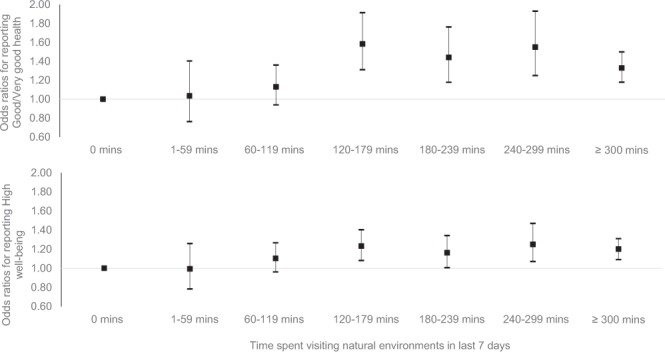
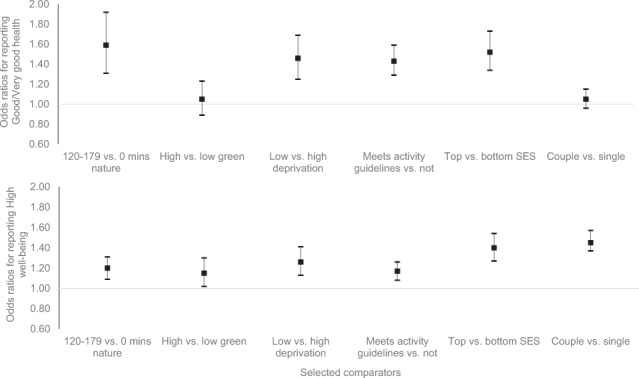
- In adjusted binomial logistic regression models, the association with good health and high well-being became significant only at ≥120 minutes per week in nature; for example, at 120–179 minutes, ORs were 1.59 [1.31–1.92] for health and 1.23 [1.08–1.40] for well-being, compared with 0 minutes.
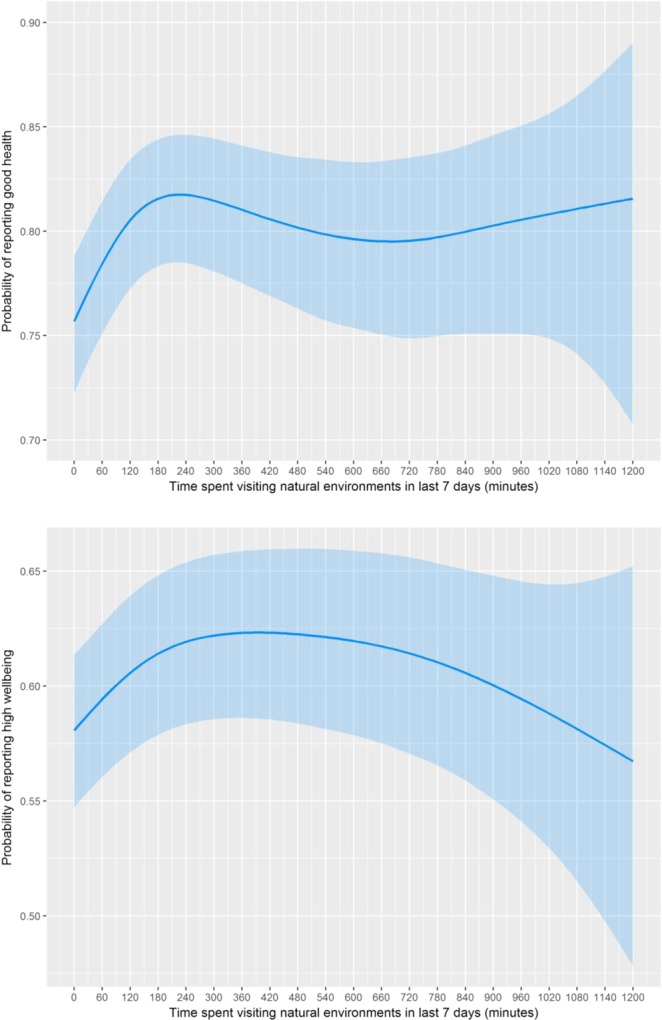
- The positive association was strongest up to about 200 minutes per week for health and 300 minutes per week for well-being, after which the relationship flattened or declined in spline analyses.
- The pattern was reported as consistent across key groups, including older adults and people with long-term health issues/disability; the paper also reports that the ≥120-minute “threshold” was seen across many stratified analyses.
- It did not matter how the 120 minutes were accumulated: additional analyses found no difference in health or well-being between one 120+ minute visit, two 60+ minute visits, or three or more ≤40 minute visits.
## Methods
- Design: Secondary analysis of a repeat cross-sectional survey; the study used survey weights to represent the adult population of England.
- Sample/data: Adults from Waves 6 and 7 of the Monitor of Engagement with the Natural Environment (MENE) survey (n = 20,264 total; n = 19,806 estimation sample for adjusted models; n = 19,808 for adjusted models with missing area-level data excluded).
- Main analysis: Survey-weighted binomial logistic regressions predicting binary health and well-being outcomes from weekly nature-contact duration categories; models adjusted for area- and individual-level covariates, with sensitivity analyses using splines and ordinal/continuous outcome specifications, plus a priori stratified analyses.
## Limitations
- The authors explicitly state the study is observational and cross-sectional, so they cannot rule out reverse causality or make causal claims.
- They note the weekly exposure estimate was based on one randomly selected visit in the last week, and that the data rely on self-reports, which may reduce accuracy.
- They caution that the apparent ≥120-minute threshold may partly reflect clustering of responses around hour marks and the way the data were categorized; this is an evident limitation from the text, alongside the very small variance explained by nature contact (about 1% in unadjusted models).
Model-written summary. Check it against the paper before relying on it.
Integrity signals
Registry
Cites
Statistics
Figures
Verification
Claims the paper makes
8 Valid · 1 Not valid · 15 Not checked · 60 Own results and interpretations
The cited sources support only part of this claim — read each source’s verdict below.
In the paper
“In other words, direct exposure, or more specifically in the current context, recreational time spent in natural environments per week, cannot accurately be inferred from neighbourhood greenspace near the home.”
§ Spending at least 120 minutes a week in nature is associated with good health and wellbeing > Introduction
What the sources say
- Partly supportedcites [23] Hillsdon, M., Coombes, E., Griew, P. & Jones, A. An assessment of the relevance of the home neighbourhood for understanding environmental influences on physical activity: how far from home do people roam? Int J Behav Nutr Phy 12, 100 (2015). sourceExperimental — accuracy not yet measured
The Conclusions and Discussion report that much outdoor physical activity occurs beyond the proximal home neighbourhood, so nearby neighbourhood characteristics may poorly represent the environments people use. The paper does not establish this specifically for weekly recreational time in natural environments or for neighbourhood greenspace; the Discussion says the researchers did not know which activities participants undertook. (LLM, conf=0.88)
- Could not verifycites [24] Sijtsma, F. J., de Vries, S., van Hinsberg, A. & Diederiks, J. Does ‘grey’ urban living lead to more ‘green’ holiday nights? A Netherlands Case Study. Landscape Urban Plan 105, 250–257 (2012). sourceExperimental — accuracy not yet measured
Our copy of Sijtsma et al. (2012) contains only repository/metadata records plus the Abstract; no body sections (Introduction, Methods, Discussion) are indexed. The Abstract (p. n/a) describes a GIS model of 'recreational shortages' — the shortage of locally available green space for recreational walking — linked to holiday nights away from home, but nowhere states that recreational time spent in natural environments per week cannot be inferred from neighbourhood greenspace near the home. Four searches (inference from neighbourhood greenspace, shortage of locally available green space for recreational walking, exposure vs. actual use, compensating behaviour/limitations) returned only the same abstract and citation blocks, so the claim's point is not addressed in the text we hold. (LLM, conf=0.65)
plain- Asserted: passes — The authors put it forward as true.
- Checkable: passes — It can be checked against evidence.
- Load-bearing: passes — The paper’s conclusions depend on it.
- Based: passes — The paper gives a reason why it holds.
- Partly supported
The cited sources support only part of this claim — read each source’s verdict below.
In the paper
“People travel beyond their local neighbourhoods to access recreational nature experiences, and indeed in our own data those who lived in the least green areas had higher odds of spending ≥120 mins in nature than those living in greener neighbourhoods (Appendix C).”
§ Spending at least 120 minutes a week in nature is associated with good health and wellbeing > Discussion
What the sources say
- Partly supportedcites [23] Hillsdon, M., Coombes, E., Griew, P. & Jones, A. An assessment of the relevance of the home neighbourhood for understanding environmental influences on physical activity: how far from home do people roam? Int J Behav Nutr Phy 12, 100 (2015). sourceExperimental — accuracy not yet measured
The Results report that 60.5% of recorded outdoor physical activity occurred beyond an 800 m home-neighbourhood boundary, and the Conclusions say adults undertook most outdoor physical activity outside their proximal home neighbourhood (page not provided). The paper does not establish that people travelled beyond their neighbourhoods specifically to access recreational nature experiences; it measured where activity occurred, not its purpose or whether it took place in nature. (LLM, conf=0.86)
plain- Asserted: passes — The authors put it forward as true.
- Checkable: passes — It can be checked against evidence.
- Load-bearing: passes — The paper’s conclusions depend on it.
- Based: passes — The paper gives a reason why it holds.
- Partly supported
Every source the paper cites for this claim was checked and supports it.
In the paper
“Research into shinrin-yoku (Japanese “forest bathing”)35, for instance, suggested that various psycho-physiological benefits can be gained from merely sitting passively in natural vs. urban settings.”
§ Spending at least 120 minutes a week in nature is associated with good health and wellbeing > Discussion
What the sources say
- Supportedcites [35] Park, B. J., Tsunetsugu, Y., Kasetani, T., Kagawa, T. & Miyazaki, Y. The physiological effects of Shinrin-yoku (taking in the forest atmosphere or forest bathing): evidence from field experiments in 24 forests across Japan. Environ Health Prev 15, 18–26 (2010). source
The Experimental design (p. 2) says subjects sat on chairs to view forest or city landscapes. The physiological results (p. 4) report more favorable stress-related measures after forest viewing, while the psychological results (p. 7) report better mood scores than after city viewing. (LLM, conf=0.93)
hedgedstates a possible cause- Asserted: passes — The authors put it forward as true.
- Checkable: passes — It can be checked against evidence.
- Load-bearing: passes — The paper’s conclusions depend on it.
- Based: passes — The paper gives a reason why it holds.
- Supported
Every source the paper cites for this claim was checked and supports it.
In the paper
“Experimental research, however, indicates that some benefits cannot be due solely to physical activity.”
§ Spending at least 120 minutes a week in nature is associated with good health and wellbeing > Discussion
What the sources say
- Supportedcites [35] Park, B. J., Tsunetsugu, Y., Kasetani, T., Kagawa, T. & Miyazaki, Y. The physiological effects of Shinrin-yoku (taking in the forest atmosphere or forest bathing): evidence from field experiments in 24 forests across Japan. Environ Health Prev 15, 18–26 (2010). source
The Experimental design (p. 2) reports no difference in exercise load between forest and city walks. The Results (p. 4) also report physiological benefits from viewing forest landscapes while seated, supporting the conclusion that physical activity alone cannot explain some benefits. (LLM, conf=0.93)
hedgedstates a cause- Asserted: passes — The authors put it forward as true.
- Checkable: passes — It can be checked against evidence.
- Load-bearing: passes — The paper’s conclusions depend on it.
- Based: passes — The paper gives a reason why it holds.
- Supported
The cited sources support only part of this claim — read each source’s verdict below.
In the paper
“Impoverished local opportunities need not be a barrier to nature exposure23,24.”
§ Spending at least 120 minutes a week in nature is associated with good health and wellbeing > Discussion
What the sources say
- Partly supportedcites [23] Hillsdon, M., Coombes, E., Griew, P. & Jones, A. An assessment of the relevance of the home neighbourhood for understanding environmental influences on physical activity: how far from home do people roam? Int J Behav Nutr Phy 12, 100 (2015). sourceExperimental — accuracy not yet measured
The Results and Conclusions (page numbers unavailable) show that adults undertook much of their outdoor physical activity beyond their proximal home neighbourhood, supporting the idea that nearby opportunities do not define where people go. The paper does not establish that those destinations provided nature exposure or that impoverished local nature opportunities were not a barrier to it. (LLM, conf=0.78)
- Partly supportedcites [24] Sijtsma, F. J., de Vries, S., van Hinsberg, A. & Diederiks, J. Does ‘grey’ urban living lead to more ‘green’ holiday nights? A Netherlands Case Study. Landscape Urban Plan 105, 250–257 (2012). sourceExperimental — accuracy not yet measured
Our copy of Sijtsma et al. (2012) holds only the repository record — the Abstract plus bibliographic metadata, with no body sections (searches on 'recreational shortage', 'nature exposure', 'compensating behaviour', 'discussion/conclusion' all returned the same abstract and citation blocks). The Abstract does support the compensatory mechanism behind the claim: 'the higher the greyness of the living environment – i.e. the higher the shortage of locally available green space for recreational walking – the more people spend nights away from home', with ~20% of holiday nights of the greyest residents related to that shortage. But the source measures holiday nights away from home and frames the shortage as a cost of agglomeration for well-being; it nowhere asserts 'nature exposure' or that a local shortage is not a barrier to nature contact, so the claim's generalisation to 'nature exposure' goes beyond what this source states. (LLM, conf=0.72)
plain- Asserted: passes — The authors put it forward as true.
- Checkable: passes — It can be checked against evidence.
- Load-bearing: unclear — It is unclear whether the paper’s conclusions depend on it.
- Based: passes — The paper gives a reason why it holds.
- Partly supported
21 more claims · 1 with their cited sources checked
Create a free account to see all 84 claims and to verify the 9 references still open.
- It may state two separate claims as one. 18
- Probably not a substantial claim. 46
Claims other papers make about this one
Each is checked against this paper’s own text: does it say what the citing paper says it does?
The cited source says what the claim attributes to it.
In the citing paper
“spending at least 120 min a week in nature was associated with good health [82].”
From EAACI Guidelines on the Importance of Green Space in Urban Environments for Allergy and Asthma Prevention (2026) · cites this paper as [82]
Citations
Cites
Hartig, T., Mitchell, R., de Vries, S., & Frumkin, H. (2014) · Annual Review of Public Health · doi:10.1146/annurev-publhealth-032013-182443 · Cited by 3,638
Self-citationEffect of exposure to natural environment on health inequalities: an observational population study
Mitchell, R., & Popham, F. (2008) · The Lancet · doi:10.1016/s0140-6736(08)61689-x · Cited by 2,099
Green space, urbanity, and health: how strong is the relation?
Maas, J., Verheij, R. A., Groenewegen, P. P., de Vries, S., & Spreeuwenberg, P. (2006) · Journal of Epidemiology and Community Health · doi:10.1136/jech.2005.043125 · Cited by 1,976
The Science of Mind Wandering: Empirically Navigating the Stream of Consciousness
Smallwood, J., & Schooler, J. W. (2015) · Annual Review of Psychology · doi:10.1146/annurev-psych-010814-015331 · Cited by 1,685
Barton, J., & Pretty, J. (2010) · Environmental Science & Technology · doi:10.1021/es903183r · Cited by 1,592
Miilunpalo, S., Vuori, I., Oja, P., Pasanen, M., & Urponen, H. (1997) · Journal of Clinical Epidemiology · doi:10.1016/s0895-4356(97)00045-0 · Cited by 1,473
Thompson Coon, J., Boddy, K., Stein, K., Whear, R., Barton, J., & Depledge, M. H. (2011) · Environmental Science & Technology · doi:10.1021/es102947t · Cited by 1,391
Self-citationNature Contact and Human Health: A Research Agenda
Frumkin, H., Bratman, G. N., Breslow, S. J., Cochran, B., Kahn Jr, P. H., Lawler, J. J., Levin, P. S., Tandon, P. S., Varanasi, U., Wolf, K. L., et al. (2017) · Environmental Health Perspectives · doi:10.1289/ehp1663 · Cited by 1,237
What are the benefits of interacting with nature?
Keniger, L., Gaston, K., Irvine, K., & Fuller, R. (2013) · International Journal of Environmental Research and Public Health · doi:10.3390/ijerph10030913 · Cited by 1,204
Research works printed but not linked: 1
- Stigsdotter, U. & Grahn, P. What makes a garden a healing garden. J Thera Hort 13, 60–69 (2002).
Cited by
Items 801–900 of 1,105
Neues aus der Stoffwechselforschung 2019: Eine „altmetrische“ Darstellung
Jörg, R., & Itariu, B.-K. (2020) · Journal für Klinische Endokrinologie und Stoffwechsel · doi:10.1007/s41969-020-00093-x
The Public Perception of Urban Stormwater Ponds as Environmental Amenities
Heller, C. (2020) · uO Research (University of Ottawa) · doi:10.20381/ruor-24582 · Cited by 3
“A UK study reported that individuals who spend a minimum of 120 minutes per week in nature for recreation have better self-reported health and well-being 8 compared to those who spend less time in nature (White et al., 2019).”
BackgroundInfluentialColàs, R. H., Waite, S., Morgan, A., Pont, X. B., Pimenta, R. C., Corbino, M., Eskelinen, M., Vila, M. T. G., Haukka, A., Colom, M. L., et al. (2020) · Documenta Universitaria eBooks · doi:10.33115/b/9788499845265 · Cited by 1
Nutrir la afinidad por la naturaleza
Colàs, R. H., Waite, S., Morgan, A., Pont, X. B., Pimenta, R. C., Corbino, M., Eskelinen, M., Vila, M. T. G., Haukka, A., Colom, M. L., et al. (2020) · Documenta Universitaria eBooks · doi:10.33115/b/9788499845258
Fomentar connexions amb la natura
Colàs, R. H., Waite, S., Morgan, A., Pont, X. B., Pimenta, R. C., Corbino, M., Eskelinen, M., Vila, M. T. G., Haukka, A., Colom, M. L., et al. (2020) · Documenta Universitaria eBooks · doi:10.33115/b/9788499845241
環境・社会・経済が織りなす持続可能な社会の実現:自然と人々の健康と作業に焦点を当てて
青山, 真. (2020) · Medical Entomology and Zoology · doi:10.32191/jjos.14.002
Housing, wellbeing and COVID-19
Iriss, & Bocioaga, A. (2021) · doi:10.31583/esss.20210201
Dendle, K. (2021) · Queensland University of Technology · doi:10.5204/thesis.eprints.208389
Murphy, B. R. (2021) · Fisheries · doi:10.1002/fsh.10596
Zusková, K. (2021) · Health Problems of Civilization · doi:10.5114/hpc.2021.104859
“What is a dose of green exercise from a longer time perspective? People need to spend at least two hours per week in blue-green spaces according to a study of more than 20,000 persons; otherwise, their well-being decreases significantly [23].”
BackgroundGupta, A., & Saha, L. (2021) · medRxiv · doi:10.1101/2021.06.28.21259631
Does Environment has any role in recovery from COVID-19 pandemic? A case study from India.Preprint
Gupta, A., & Saha, L. (2021) · Research Square · doi:10.21203/rs.3.rs-665840/v1
“Scanty studies have been carried out on the importance of freshen air for the melioration of human health and to elude any convalescence (Cragg et al., 2016; Kampa and Castanas, 2008; Manisalidis et al., 2020; White et al., 2019).”
BackgroundGupta, A. (2021) · Research Square · doi:10.21203/rs.3.rs-711922/v1
The body healing phenomenon: learning, teaching and living through a pandemic
Gibson, P., & Bale, A. (2021) · Compass Journal of Learning and Teaching · doi:10.21100/compass.v14i2.1206
Why I . . . volunteer as a Royal Parks ranger
Oxtoby, K. (2021) · BMJ · doi:10.1136/bmj.n2158
A decision support tool for optimising blue space design and management for health
Diener, A., Martuzzi, M., Palermo, F., Mancini, L., Coppini, G., & Braubach, M. (2021) · Routledge eBooks · doi:10.4324/9780429056161-12
Tackling Inequalities to Unleash the Full Potential of Planetary Health
de Paula, N. (2021) · Springer eBooks · doi:10.1007/978-981-16-3754-4_6
The Value of Outdoor Physical Therapy Exercises
Panfiloiu, C. (2021) · DOAJ (DOAJ: Directory of Open Access Journals)
Rehling, J. (2021) · Open Access at Essex (University of Essex) · Cited by 1
Miranda, M. G. (2021) · RiuNet (Universitat Politècnica de València) · doi:10.4995/thesis/10251/176000 · Cited by 1
The Prevalence of Litter Foraging Among UK Birds Lessons Learned From A Citizen Science ProjectPreprint
Schalz, S., Horrod-Wilson, W. D., & Chauhan, K. (2021) · bioRxiv (Cold Spring Harbor Laboratory) · doi:10.1101/2021.11.16.468840
“Citizen science’s impacts on mental health and wellbeing for many people and particularly those of young people is of paramount importance (White et al., 2019).”
BackgroundMapping nationally and globally at-risk species to identify hotspots for (and gaps in) conservationPreprint
Hardouin, M. E., & Hargreaves, A. L. (2021) · bioRxiv (Cold Spring Harbor Laboratory) · doi:10.1101/2021.11.29.470436
紙芝居をよすがに昔へ還るお年寄りたち (特集 高齢者と子どものポルカ)
本多, 千. (2012) · 子どもの文化
Khwaja, M. (2021) · BDJ In Practice · doi:10.1038/s41404-021-0973-3
(2021) · Emerald Group Publishing Limited eBooks · doi:10.1108/978-1-80043-660-220211011
Ellis, D. A. (2020) · Cambridge University Press eBooks · doi:10.1017/9781108671408.008
Ellis, D. A. (2020) · Cambridge University Press eBooks · doi:10.1017/9781108671408.001
Ellis, D. A. (2020) · Cambridge University Press eBooks · doi:10.1017/9781108671408.004
Ellis, D. A. (2020) · Cambridge University Press eBooks · doi:10.1017/9781108671408.002
Ellis, D. A. (2020) · Cambridge University Press eBooks · doi:10.1017/9781108671408.009
Ellis, D. A. (2020) · Cambridge University Press eBooks · doi:10.1017/9781108671408.007
Roberts, N. S. (2021) · MDPI eBooks · doi:10.3390/books978-3-0365-0259-5
Openneer, E., & André, G. (2020) · Vakblad Sociaal Werk · doi:10.1007/s12459-020-0822-1
Ellis, D. A. (2020) · Cambridge University Press eBooks · doi:10.1017/9781108671408.010
Healthy Living Lifestyles: Land and Sea
Farzad, R., Scharf, B. J., Davis, J. E., Duncan, L., & Anderson, J. (2022) · EDIS · doi:10.32473/edis-fs441-2022
Beyond us: Building collective wellbeingPreprint
Lambert, L., Warren, M. A., Waldrop, R. J., Alsubaiei, S., Eubanks, A., & Fisher, J. L. (2022) · doi:10.31234/osf.io/p34vz
Klimawandel und Gesundheit: Auswirkungen und Anpassungsmöglichkeiten
Mertes, H. (2022) · Zeitschrift für Komplementärmedizin · doi:10.1055/a-1897-4182
Gilbourne, C. A., Scarry, A., Tierney, A. C., & Connor, E. M. O. (2022) · Research Square · doi:10.21203/rs.3.rs-2230809/v1
Measuring Outcomes of Occupational Therapy Facilitated in Natural Settings with Young Children
Smith, A., Dale, D., Saini, B., Peters, Z., & Laccone, A. (2022) · Dominican Scholar (Dominican University of California) · doi:10.33015/dominican.edu/2023.ot.06 · Cited by 1
“…for developing gross and fine motor coordination, problem-solving, risk-taking, creativity, a stronger immune system, and socialization with peers (Bento & Dias, 2017; Bradley & Male, 2017; Li, et al. 2019; McCurdy et al., 2010; Park Figueroa, 2020; Schaaf et al., 2015; White et al., 2019).”
BackgroundOnline but not remote: Adapting field-based ecology laboratories for online learning
Richter, C. F., Lortie, C. J., Kelly, T., et al. (2023) · doi:10.32920/21976790.v1
Online but not remote: Adapting field-based ecology laboratories for online learning
Richter, C. F., Lortie, C. J., Kelly, T., Filazzola, A., Nunes, K. A., & Sarkar, R. (2023) · doi:10.32920/21976790
Resurrecting Gaia: Harnessing the Free Energy Principle to Preserve Life as We Know ItPreprint
Montgomery, C., & Hipólito, I. (2023) · doi:10.31234/osf.io/5tm9w
Ottinger, M. A., & Geiselman, C. (2023) · Elsevier eBooks · doi:10.1016/b978-0-323-89873-7.00008-9 · Cited by 1
Gan, D., Alkaher, I., Assaf, N., et al. (2023) · International explorations in outdoor and environmental education · doi:10.1007/978-3-031-29257-6_3
Beyond the Picture: An Analysis of Emotional Attachment in Relation to Meaningful Natural Spaces.
Fahey, E. (2023) · Open Access Victoria University of Wellington | Te Herenga Waka (Figshare) · doi:10.26686/wgtn.23394719 · Cited by 2
Well-Being in the Museums: The ASBA Project Research ProtocolPreprint
Banzi, A., Ferrara, V., Folgieri, R., Lucchiari, C., Riva, M. A., Sironi, V. A., & Vanutelli, M. E. (2023) · SSRN Electronic Journal · doi:10.2139/ssrn.4476434
Decision: Personalised ecology and the future of biodiversity — R0/PR6
Gaston, K. J., Phillips, B. B., & Soga, M. (2023) · Cambridge Prisms Extinction · doi:10.1017/ext.2023.15.pr6
Review: Personalised ecology and the future of biodiversity — R0/PR2
Gaston, K. J., Phillips, B. B., & Soga, M. (2023) · Cambridge Prisms Extinction · doi:10.1017/ext.2023.15.pr2
Author comment: Personalised ecology and the future of biodiversity — R1/PR7
Gaston, K. J. (2023) · Cambridge Prisms Extinction · doi:10.1017/ext.2023.15.pr7
Recommendation: Personalised ecology and the future of biodiversity — R1/PR10
Gaston, K. J., Phillips, B. B., & Soga, M. (2023) · Cambridge Prisms Extinction · doi:10.1017/ext.2023.15.pr10
Review: Personalised ecology and the future of biodiversity — R0/PR4
Gaston, K. J., Phillips, B. B., & Soga, M. (2023) · Cambridge Prisms Extinction · doi:10.1017/ext.2023.15.pr4
Review: Personalised ecology and the future of biodiversity — R0/PR3
Gaston, K. J., Phillips, B. B., & Soga, M. (2023) · Cambridge Prisms Extinction · doi:10.1017/ext.2023.15.pr3
Author comment: Personalised ecology and the future of biodiversity — R0/PR1
Gaston, K. J. (2022) · Cambridge Prisms Extinction · doi:10.1017/ext.2023.15.pr1
Review: Personalised ecology and the future of biodiversity — R1/PR8
Gaston, K. J., Phillips, B. B., & Soga, M. (2023) · Cambridge Prisms Extinction · doi:10.1017/ext.2023.15.pr8
Recommendation: Personalised ecology and the future of biodiversity — R0/PR5
Gaston, K. J., Phillips, B. B., & Soga, M. (2023) · Cambridge Prisms Extinction · doi:10.1017/ext.2023.15.pr5
Review: Personalised ecology and the future of biodiversity — R1/PR9
Gaston, K. J., Phillips, B. B., & Soga, M. (2023) · Cambridge Prisms Extinction · doi:10.1017/ext.2023.15.pr9
Decision: Personalised ecology and the future of biodiversity — R1/PR11
Gaston, K. J., Phillips, B. B., & Soga, M. (2023) · Cambridge Prisms Extinction · doi:10.1017/ext.2023.15.pr11
PENGARUH TERAPI NATURAL RESTORATIVE ENVIRONMENT (NRE) TERHADAP KECEMASAN : STUDI LITERATUR
Islami, R. F., Hartiti, T., & Rejeki, S. M. (2023) · Jurnal Keperawatan dan Kesehatan Masyarakat Cendekia Utama · doi:10.31596/jcu.v12i1.1424
Effect of the COVID-19 Pandemic and Subsequent Social Distancing on Individual's Mental Health
Salih, S. A., Ismail, S. B., Najm, A. A., & Ismail, N. (2023) · Pertanika journal of social science & humanities · doi:10.47836/pjssh.31.3.08
Confidence and mastery in mothering occupations
Odgers, S. (2023) · doi:10.34074/thes.6056 · Cited by 1
(2023) · Vandenhoeck & Ruprecht eBooks · doi:10.13109/9783666400209.145
WALKING AND RUNNING IN THE CONTEXT OF THEIR IMPACT ON BRAIN HEALTH AND COGNITIVE FUNCTION
Tretyakova, V. D. (2023) · PERSONALITY IN A CHANGING WORLD HEALTH ADAPTATION DEVELOPMENT · doi:10.23888/humj2023113277-296 · Cited by 2
Stuart, S., Plummer, R., Dale, G., & Hutson, G. (2023) · Journal of Outdoor Recreation Education and Leadership · doi:10.18666/jorel-2023-11659
FOREST, HEALTH AND TOURISM: DEVELOPING SUSTAINABLE HEALTH TOURISM OFFERS IN LOCAL FORESTS
Steckenbauer, G. C., Markov, S., & Pippirs, C. (2023) · Tourism in South East Europe .../Tourism in Southern and Eastern Europe · doi:10.20867/tosee.07.25
Yeung, H., & Lee, K. (2023) · Annual European Real Estate Society Conference (ERES) · doi:10.15396/eres2023_87
Mendes, T. C. D. O., Santos, F. A. S., Menezes, W. R., de Moura, D. T. B., Camelo, E. C. M., do Nascimento, T. H. C. R., & dos Santos, P. F. B. B. (2023) · Revista Extensão & Sociedade · doi:10.21680/2178-6054.2023v15n1id30434
Adil, J. J. G., & Napoles, M. A. R. (2023) · International Journal For Multidisciplinary Research · doi:10.36948/ijfmr.2023.v05i06.9454 · Cited by 2
“In a study by the University of Exeter, researchers found that individuals who spent time in nature had lower stress levels and were likely to report good health (White et al., 2019).”
BackgroundDesrochers, J. (2023) · Carleton University's Institutional Repository (MacOdrum Library, Carleton University) · doi:10.22215/etd/2023-15774 · Cited by 1
Planejamento de atividades de campo: ciclo da água no ensino contextualizado das Geociências
de Negreiros, A. R. A., do Amaral, R. F., & Silva, C. P. A. E. (2023) · Terrae Didatica · doi:10.20396/td.v19i00.8673730
Anwendungsfelder und praktische Einblicke in die Arbeit mit Virtual Reality
Werning, E. (2023) · Springer eBooks · doi:10.1007/978-3-662-67893-0_5
เรองเลาการทองเทยวแบบกางเตนทสแนวทางการจดการทองเทยวอยางยงยน
Insawang, W. P., & ศิริวงศ์, พ. (2023) · Journal of Liberal Arts RMUTT · doi:10.60101/jla.2023.4.2.3201
Journalistic media and adolescents in the COVID-19 pandemic: a documental analysis
Oliveira, M. C. D. P., Costa, E. C., da Silva, L. M. P., Barbosa, L. N. V., de Barros, M. V. G., Filho, J. H. C. M., & Correia, M. A. D. V. (2023) · Revista Paulista de Pediatria · doi:10.1590/1984-0462/2024/42/2023041 · Cited by 2
Integrating nature and workplaces in a post-COVID-19 world: building back better
Allen, J., Lloyd, R., & Skelly, C. (2023) · Cities & Health · doi:10.1080/23748834.2023.2294647
“One observational study found that spending at least 120 minutes per week is needed to produce any meaningful improvements in self-reported health and subjective wellbeing (White et al .”
BackgroundTaylor, R. (2024) · Visual Communication Quarterly · doi:10.1080/15551393.2023.2300775
An Ecological Restoration Experiment on a High School Campus
Alexander, H. M., Schwarting, J., & Betson, N. R. (2024) · The American Biology Teacher · doi:10.1525/abt.2024.86.1.10
Norz, A., & Schneider, V. (2024) · OSF Preprints (OSF Preprints) · doi:10.31219/osf.io/vkrc7
Lovan, P., Graefe, B., Porter, A. W., Szapocznik, J., Penedo, F. J., Messiah, S. E., & Prado, G. J. (2024) · Research Square · doi:10.21203/rs.3.rs-3871238/v1
Senn, N., & Holguera, J. G. (2022) · Médecine & Hygiène eBooks · doi:10.3917/mh.senn.2022.01.0370 · Cited by 1
Climate Crises: Helping Families Mitigate, Adapt, and Transition During Disruption
Sturm, D. C., Metz, A. L., Daniels, J. A., & Stauffer, M. D. (2021) · Wiley eBooks · doi:10.1002/9781394266470.ch19 · Cited by 1
How Could Environmental Education Benefit from Digitalization?
Lazić, M., Hanić, A., & Kojić, M. (2024) · Advances in electronic government, digital divide, and regional development book series · doi:10.4018/979-8-3693-3567-3.ch011
de Mello, E. C., Mendes, E. L., Neto, O. B., et al. (2024) · Journal of Bodywork and Movement Therapies · doi:10.1016/j.jbmt.2023.09.008
Takayama, N., Kimata, T., Ochiai, H., Kimura, R., Sakai, K., & Amano, R. (2024) · 日本林學會誌 · doi:10.4005/jjfs.106.13
Jin, Y., Yu, Z., Yang, G., Yao, X., hu, M., Remme, R. P., van Bodegom, P. M., Morpurgo, J., Huang, Y., Wang, J., et al. (2024) · SSRN Electronic Journal · doi:10.2139/ssrn.4792622
Introducing a New Model of Wellbeing: Applications to the General Public and Student Population.
Mead, J. (2023) · Cronfa (Swansea University) · doi:10.23889/suthesis.66119 · Cited by 2
Natural Heritage as a Tool to Promote Wellbeing and Quality of Life
Ferrari, S., Iaffaldano, N., & Bianco, S. L. (2024) · CABI eBooks · doi:10.1079/9781800621411.0017
Study on the Evolution of Genetic Resources of Domestic Animals in Romania
Sandu, M., Străteanu, A. G., & Udrea, L. (2024) · Annals of "Valahia" University of Târgovişte. Agriculture · doi:10.2478/agr-2024-0009
Studierendengesundheit und das Potenzial der Gesundheitsressource Naturerfahrung
Laemmert, P., Laemmert, P., & Tittlbach, S. A. (2024) · Public Health Forum · doi:10.1515/pubhef-2024-0005
Lecaër, F., & Roques, O. (2024) · Management & Avenir Santé · doi:10.3917/mavs.010.0102 · Cited by 1
Challenges for monitoring artificial turf expansion with satellite remote sensing
Crowson, M., Williams, J., Sharma, J., & Pettorelli, N. (2024) · Environmental Monitoring and Assessment · doi:10.1007/s10661-024-12724-w
“…of ecological importance for wild-life conservation (Pettorelli et al., 2022), and healthy urban ecosystems are crucial to human well-being (e.g., White et al., 2019), with most people getting their share of nature from these ecosystems (United Nations, Department of Economic and Social Affairs,…”
Uher, I., Vašková, H., Poráčová, J., Cimboláková, I., Kůchelová, Z., Buková, A., & Bernasovská, J. (2024) · Frontiers in Psychology · doi:10.3389/fpsyg.2024.1389340
“Modern man spends more than 87% of his time indoors, with an average of 2.5 h outdoors, half of which is often after sunset (White et al., 2019).”
BackgroundInfluentialA SOUTH AFRICAN PERSPECTIVE ON HOME GARDENS: PROMOTING SUSTAINABILITY AND RESILIENCE POST COVID-19
Oosthuizen, D., Marumo-Ngwenya, K., & Kearney, J. (2023) · Malaysian Journal of Sustainable Agricultural · doi:10.26480/mjsa.02.2023.113.118
Luci, A. R., Cortés, J., Benavides, P., & Carmody, S. (2022) · Revista Portuguesa de Pedagogia · doi:10.14195/1647-8614_56_16 · Cited by 1
Santé verte et bleue : les bénéfices de l’expérience de nature sur la santé globale
d’Erm, D. P. (2024) · HEGEL - HEpato-GastroEntérologie Libérale · doi:10.3917/heg.142.0195 · Cited by 1
Li, K., Abidin, N. A. Z., & Mohamad, D. (2024) · IOP Conference Series Earth and Environmental Science · doi:10.1088/1755-1315/1394/1/012012
“It also provides urban residents with opportunities for close contact with nature, enabling them to benefit from the restorative effects of natural landscapes, enhancing positive emotions, and bringing health benefits [28][29][30].”
Metadata
- Authors
- White, M. P., Alcock, I., Grellier, J., Wheeler, B. W., Hartig, T., Warber, S. L., Bone, A., Depledge, M. H., & Fleming, L. E.
- Affiliations
- University of Exeter (GB)
- Uppsala University (SE)
- Corresponding author
- White, Mathew P.
- ORCID
- Venue
- Scientific Reports
- Published
- 2019-06-13
- Volume
- 9
- Issue
- 1
- Pages
- 7730-7730
- ISSN
- 2045-2322 (ISSN-L)
- PMC
- PMC6565732
- OpenAlex
- W2952548366
- Cited by
- 1,125
- References
- 51
- Citations by year
- 2026: 186 · 2025: 168 · 2024: 170 · 2023: 181 · 2022: 138 · 2021: 164 · 2020: 94 · 2019: 23
- FWCI
- 45.19
- Type
- journal article
- Language
- en
- Open access
- gold
- doi.org
- Licence
- cc-by
- creativecommons.org/licenses/by/4.0 (tdm)
- creativecommons.org/licenses/by/4.0 (vor)
- Locations
- Scientific Reports (publishedVersion, cc-by)
- PubMed Central (publishedVersion, cc-by)
- PubMed (publishedVersion)
- KTH Publication Database DiVA (KTH Royal Institute of Technology) (submittedVersion, other-oa)
- DOAJ (DOAJ: Directory of Open Access Journals) (submittedVersion)
- Figshare (submittedVersion, cc-by)
- Open Research Exeter (University of Exeter) (submittedVersion, cc-by)
- Funders
- DH | National Institute for Health Research (HPRU: Environmental Change & Health)
- Topics
- Social Sciences › Urban Studies › Urban Green Space and Health
- Social Sciences › Business, Management and Accounting › Tourism, Leisure and Hospitality Management › Recreation, Leisure, Wilderness Management
- Health Sciences › Medicine › Public Health, Environmental and Occupational Health › Physical Activity and Health
- Keywords
- nature contact, exposure-response relationship, self-reported health, well-being, green spaces, older adults, chronic disease
- MeSH terms
- Adolescent, Adult, Environment, Female, Health, Humans, Male, Middle Aged, Residence Characteristics, Exercise, Walking, Young Adult, Self Report
About these checks
Registry, retraction, Cites and statistics results are computed, not judged, with one exception: a printed reference that no index lists is read once by a model before it counts as a citation error. Claims are extracted by a model and kept only when their quote appears verbatim in the text; each cited source is then checked, with a model’s help, for whether it says what the claim relies on. Those verdicts can be wrong — read the claim’s quote and the cited source before relying on one.
The claim verdicts this report counts are experimental: their accuracy is not yet measured.
A language model drew the claims from the paper on 2026-10-10, under version 3 of the claim definition (model deepseek-v4.1-flash, prompt extract-v3).
A second model labelled each claim on 2026-10-10 (model jev-1.13-20260917, definition revision gold-guideline-v0.2).
Cited sources are checked with a language model’s help (gpt-6-sol and qwen3.8-omni-flash).
Statistics and arithmetic are recomputed, not judged.
Confidence bands are shown only for fields calibrated on our annotated test set. None is calibrated yet, so no band is shown.
What counts as a claim ›How we measure confidence ›How we check this ›
Are you an author, or do you see a problem with this page? Request a review
Data sources
Bibliographic data: Semantic Scholar, OpenAlex, Crossref.
Contains information from the Semantic Scholar Academic Graph Datasets, made available under the ODC Attribution License (ODC-BY 1.0).
Semantic Scholar’s data is described in: Kinney, R., et al. (2023). The Semantic Scholar Open Data Platform. arXiv:2301.10140.
