

Spending at least 120 minutes a week in nature is associated with good health and wellbeing
Open accessThe DOI matches its Crossref record; 51 of the 51 references it cites were found in a registry or an index; 12 of the 35 sources its claims cite were checked for support.
Abstract
Study of weekly nature exposure and self-reported health and wellbeing in a nationally representative sample.
Overview
CoChat Summary
## TL;DR
Using a nationally representative sample of adults in England (n = 19,806 weighted; n = 20,264 total sample), the paper finds that spending at least 120 minutes per week in natural environments is associated with higher odds of self-reported good health and high well-being. The association appears to level off around 200–300 minutes per week, and the authors caution that the study is cross-sectional and cannot establish causality.
## Key findings
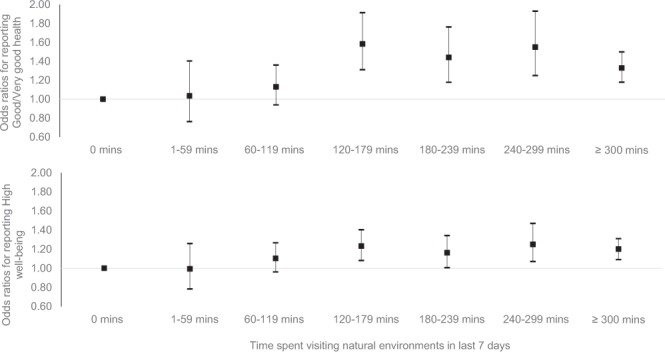
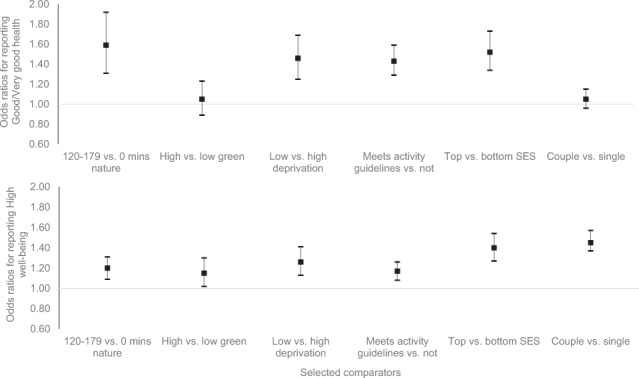
- In adjusted binomial logistic regression models, the association with good health and high well-being became significant only at ≥120 minutes per week in nature; for example, at 120–179 minutes, ORs were 1.59 [1.31–1.92] for health and 1.23 [1.08–1.40] for well-being, compared with 0 minutes.
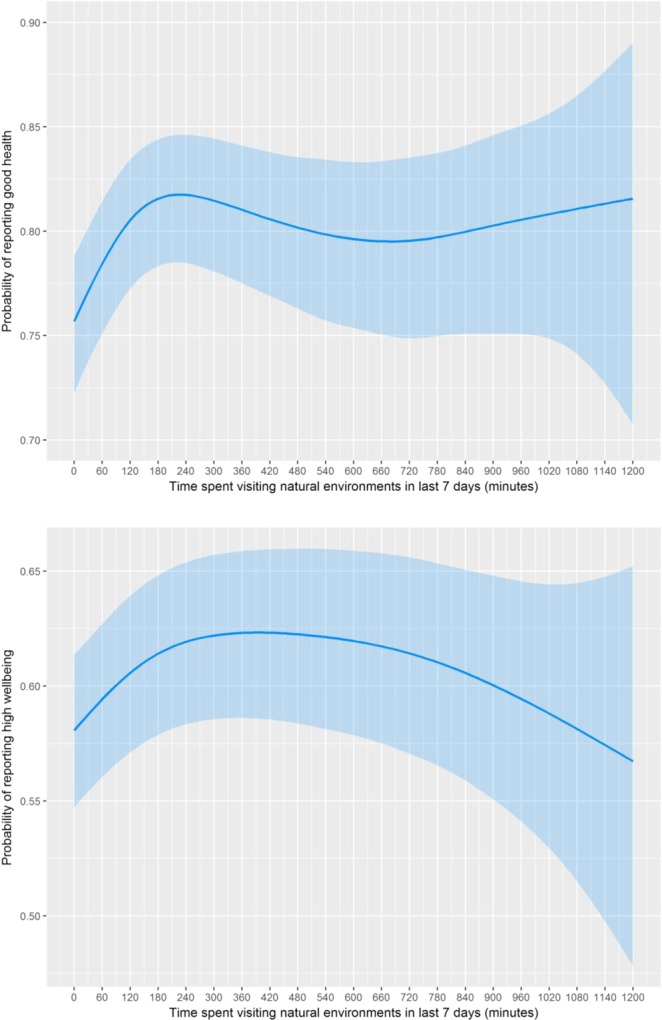
- The positive association was strongest up to about 200 minutes per week for health and 300 minutes per week for well-being, after which the relationship flattened or declined in spline analyses.
- The pattern was reported as consistent across key groups, including older adults and people with long-term health issues/disability; the paper also reports that the ≥120-minute “threshold” was seen across many stratified analyses.
- It did not matter how the 120 minutes were accumulated: additional analyses found no difference in health or well-being between one 120+ minute visit, two 60+ minute visits, or three or more ≤40 minute visits.
## Methods
- Design: Secondary analysis of a repeat cross-sectional survey; the study used survey weights to represent the adult population of England.
- Sample/data: Adults from Waves 6 and 7 of the Monitor of Engagement with the Natural Environment (MENE) survey (n = 20,264 total; n = 19,806 estimation sample for adjusted models; n = 19,808 for adjusted models with missing area-level data excluded).
- Main analysis: Survey-weighted binomial logistic regressions predicting binary health and well-being outcomes from weekly nature-contact duration categories; models adjusted for area- and individual-level covariates, with sensitivity analyses using splines and ordinal/continuous outcome specifications, plus a priori stratified analyses.
## Limitations
- The authors explicitly state the study is observational and cross-sectional, so they cannot rule out reverse causality or make causal claims.
- They note the weekly exposure estimate was based on one randomly selected visit in the last week, and that the data rely on self-reports, which may reduce accuracy.
- They caution that the apparent ≥120-minute threshold may partly reflect clustering of responses around hour marks and the way the data were categorized; this is an evident limitation from the text, alongside the very small variance explained by nature contact (about 1% in unadjusted models).
Model-written summary. Check it against the paper before relying on it.
Integrity signals
Registry
Cites
Statistics
Figures
Verification
Claims the paper makes
8 Valid · 1 Not valid · 15 Not checked · 60 Own results and interpretations
The cited sources support only part of this claim — read each source’s verdict below.
In the paper
“In other words, direct exposure, or more specifically in the current context, recreational time spent in natural environments per week, cannot accurately be inferred from neighbourhood greenspace near the home.”
§ Spending at least 120 minutes a week in nature is associated with good health and wellbeing > Introduction
What the sources say
- Partly supportedcites [23] Hillsdon, M., Coombes, E., Griew, P. & Jones, A. An assessment of the relevance of the home neighbourhood for understanding environmental influences on physical activity: how far from home do people roam? Int J Behav Nutr Phy 12, 100 (2015). sourceExperimental — accuracy not yet measured
The Conclusions and Discussion report that much outdoor physical activity occurs beyond the proximal home neighbourhood, so nearby neighbourhood characteristics may poorly represent the environments people use. The paper does not establish this specifically for weekly recreational time in natural environments or for neighbourhood greenspace; the Discussion says the researchers did not know which activities participants undertook. (LLM, conf=0.88)
- Could not verifycites [24] Sijtsma, F. J., de Vries, S., van Hinsberg, A. & Diederiks, J. Does ‘grey’ urban living lead to more ‘green’ holiday nights? A Netherlands Case Study. Landscape Urban Plan 105, 250–257 (2012). sourceExperimental — accuracy not yet measured
Our copy of Sijtsma et al. (2012) contains only repository/metadata records plus the Abstract; no body sections (Introduction, Methods, Discussion) are indexed. The Abstract (p. n/a) describes a GIS model of 'recreational shortages' — the shortage of locally available green space for recreational walking — linked to holiday nights away from home, but nowhere states that recreational time spent in natural environments per week cannot be inferred from neighbourhood greenspace near the home. Four searches (inference from neighbourhood greenspace, shortage of locally available green space for recreational walking, exposure vs. actual use, compensating behaviour/limitations) returned only the same abstract and citation blocks, so the claim's point is not addressed in the text we hold. (LLM, conf=0.65)
plain- Asserted: passes — The authors put it forward as true.
- Checkable: passes — It can be checked against evidence.
- Load-bearing: passes — The paper’s conclusions depend on it.
- Based: passes — The paper gives a reason why it holds.
- Partly supported
The cited sources support only part of this claim — read each source’s verdict below.
In the paper
“People travel beyond their local neighbourhoods to access recreational nature experiences, and indeed in our own data those who lived in the least green areas had higher odds of spending ≥120 mins in nature than those living in greener neighbourhoods (Appendix C).”
§ Spending at least 120 minutes a week in nature is associated with good health and wellbeing > Discussion
What the sources say
- Partly supportedcites [23] Hillsdon, M., Coombes, E., Griew, P. & Jones, A. An assessment of the relevance of the home neighbourhood for understanding environmental influences on physical activity: how far from home do people roam? Int J Behav Nutr Phy 12, 100 (2015). sourceExperimental — accuracy not yet measured
The Results report that 60.5% of recorded outdoor physical activity occurred beyond an 800 m home-neighbourhood boundary, and the Conclusions say adults undertook most outdoor physical activity outside their proximal home neighbourhood (page not provided). The paper does not establish that people travelled beyond their neighbourhoods specifically to access recreational nature experiences; it measured where activity occurred, not its purpose or whether it took place in nature. (LLM, conf=0.86)
plain- Asserted: passes — The authors put it forward as true.
- Checkable: passes — It can be checked against evidence.
- Load-bearing: passes — The paper’s conclusions depend on it.
- Based: passes — The paper gives a reason why it holds.
- Partly supported
Every source the paper cites for this claim was checked and supports it.
In the paper
“Research into shinrin-yoku (Japanese “forest bathing”)35, for instance, suggested that various psycho-physiological benefits can be gained from merely sitting passively in natural vs. urban settings.”
§ Spending at least 120 minutes a week in nature is associated with good health and wellbeing > Discussion
What the sources say
- Supportedcites [35] Park, B. J., Tsunetsugu, Y., Kasetani, T., Kagawa, T. & Miyazaki, Y. The physiological effects of Shinrin-yoku (taking in the forest atmosphere or forest bathing): evidence from field experiments in 24 forests across Japan. Environ Health Prev 15, 18–26 (2010). source
The Experimental design (p. 2) says subjects sat on chairs to view forest or city landscapes. The physiological results (p. 4) report more favorable stress-related measures after forest viewing, while the psychological results (p. 7) report better mood scores than after city viewing. (LLM, conf=0.93)
hedgedstates a possible cause- Asserted: passes — The authors put it forward as true.
- Checkable: passes — It can be checked against evidence.
- Load-bearing: passes — The paper’s conclusions depend on it.
- Based: passes — The paper gives a reason why it holds.
- Supported
Every source the paper cites for this claim was checked and supports it.
In the paper
“Experimental research, however, indicates that some benefits cannot be due solely to physical activity.”
§ Spending at least 120 minutes a week in nature is associated with good health and wellbeing > Discussion
What the sources say
- Supportedcites [35] Park, B. J., Tsunetsugu, Y., Kasetani, T., Kagawa, T. & Miyazaki, Y. The physiological effects of Shinrin-yoku (taking in the forest atmosphere or forest bathing): evidence from field experiments in 24 forests across Japan. Environ Health Prev 15, 18–26 (2010). source
The Experimental design (p. 2) reports no difference in exercise load between forest and city walks. The Results (p. 4) also report physiological benefits from viewing forest landscapes while seated, supporting the conclusion that physical activity alone cannot explain some benefits. (LLM, conf=0.93)
hedgedstates a cause- Asserted: passes — The authors put it forward as true.
- Checkable: passes — It can be checked against evidence.
- Load-bearing: passes — The paper’s conclusions depend on it.
- Based: passes — The paper gives a reason why it holds.
- Supported
The cited sources support only part of this claim — read each source’s verdict below.
In the paper
“Impoverished local opportunities need not be a barrier to nature exposure23,24.”
§ Spending at least 120 minutes a week in nature is associated with good health and wellbeing > Discussion
What the sources say
- Partly supportedcites [23] Hillsdon, M., Coombes, E., Griew, P. & Jones, A. An assessment of the relevance of the home neighbourhood for understanding environmental influences on physical activity: how far from home do people roam? Int J Behav Nutr Phy 12, 100 (2015). sourceExperimental — accuracy not yet measured
The Results and Conclusions (page numbers unavailable) show that adults undertook much of their outdoor physical activity beyond their proximal home neighbourhood, supporting the idea that nearby opportunities do not define where people go. The paper does not establish that those destinations provided nature exposure or that impoverished local nature opportunities were not a barrier to it. (LLM, conf=0.78)
- Partly supportedcites [24] Sijtsma, F. J., de Vries, S., van Hinsberg, A. & Diederiks, J. Does ‘grey’ urban living lead to more ‘green’ holiday nights? A Netherlands Case Study. Landscape Urban Plan 105, 250–257 (2012). sourceExperimental — accuracy not yet measured
Our copy of Sijtsma et al. (2012) holds only the repository record — the Abstract plus bibliographic metadata, with no body sections (searches on 'recreational shortage', 'nature exposure', 'compensating behaviour', 'discussion/conclusion' all returned the same abstract and citation blocks). The Abstract does support the compensatory mechanism behind the claim: 'the higher the greyness of the living environment – i.e. the higher the shortage of locally available green space for recreational walking – the more people spend nights away from home', with ~20% of holiday nights of the greyest residents related to that shortage. But the source measures holiday nights away from home and frames the shortage as a cost of agglomeration for well-being; it nowhere asserts 'nature exposure' or that a local shortage is not a barrier to nature contact, so the claim's generalisation to 'nature exposure' goes beyond what this source states. (LLM, conf=0.72)
plain- Asserted: passes — The authors put it forward as true.
- Checkable: passes — It can be checked against evidence.
- Load-bearing: unclear — It is unclear whether the paper’s conclusions depend on it.
- Based: passes — The paper gives a reason why it holds.
- Partly supported
21 more claims · 1 with their cited sources checked
Create a free account to see all 84 claims and to verify the 9 references still open.
- It may state two separate claims as one. 18
- Probably not a substantial claim. 46
Claims other papers make about this one
Each is checked against this paper’s own text: does it say what the citing paper says it does?
The cited source says what the claim attributes to it.
In the citing paper
“spending at least 120 min a week in nature was associated with good health [82].”
From EAACI Guidelines on the Importance of Green Space in Urban Environments for Allergy and Asthma Prevention (2026) · cites this paper as [82]
Citations
Cites
Hartig, T., Mitchell, R., de Vries, S., & Frumkin, H. (2014) · Annual Review of Public Health · doi:10.1146/annurev-publhealth-032013-182443 · Cited by 3,638
Self-citationEffect of exposure to natural environment on health inequalities: an observational population study
Mitchell, R., & Popham, F. (2008) · The Lancet · doi:10.1016/s0140-6736(08)61689-x · Cited by 2,099
Green space, urbanity, and health: how strong is the relation?
Maas, J., Verheij, R. A., Groenewegen, P. P., de Vries, S., & Spreeuwenberg, P. (2006) · Journal of Epidemiology and Community Health · doi:10.1136/jech.2005.043125 · Cited by 1,976
The Science of Mind Wandering: Empirically Navigating the Stream of Consciousness
Smallwood, J., & Schooler, J. W. (2015) · Annual Review of Psychology · doi:10.1146/annurev-psych-010814-015331 · Cited by 1,685
Barton, J., & Pretty, J. (2010) · Environmental Science & Technology · doi:10.1021/es903183r · Cited by 1,592
Miilunpalo, S., Vuori, I., Oja, P., Pasanen, M., & Urponen, H. (1997) · Journal of Clinical Epidemiology · doi:10.1016/s0895-4356(97)00045-0 · Cited by 1,473
Thompson Coon, J., Boddy, K., Stein, K., Whear, R., Barton, J., & Depledge, M. H. (2011) · Environmental Science & Technology · doi:10.1021/es102947t · Cited by 1,391
Self-citationNature Contact and Human Health: A Research Agenda
Frumkin, H., Bratman, G. N., Breslow, S. J., Cochran, B., Kahn Jr, P. H., Lawler, J. J., Levin, P. S., Tandon, P. S., Varanasi, U., Wolf, K. L., et al. (2017) · Environmental Health Perspectives · doi:10.1289/ehp1663 · Cited by 1,237
What are the benefits of interacting with nature?
Keniger, L., Gaston, K., Irvine, K., & Fuller, R. (2013) · International Journal of Environmental Research and Public Health · doi:10.3390/ijerph10030913 · Cited by 1,204
Research works printed but not linked: 1
- Stigsdotter, U. & Grahn, P. What makes a garden a healing garden. J Thera Hort 13, 60–69 (2002).
Cited by
Items 501–600 of 1,105
Schaller, H., & Karing, C. (2024) · Ecopsychology · doi:10.1089/eco.2024.0004 · Cited by 9
“However, other studies reported optimal durations of nature contact of 200 – 300 min weekly (and not more) for improved health and well-being or 20 – 30 min for decreased cortisol levels with increasing cortisol levels in case of exceedance (Hunter et al., 2019; White et al., 2019).”
Wang, J., Wang, Y., Dong, Q., Yao, W., Sun, L., Zhao, H., & Fei, F. (2025) · Building and Environment · doi:10.1016/j.buildenv.2025.112850 · Cited by 6
Fisu, A. A., Syabri, I., & Andani, I. G. A. (2025) · Cities · doi:10.1016/j.cities.2025.105889 · Cited by 5
Sia, A., Soh, M. C. K., Lee, W. M., Poon, H. J., & Er, K. B. H. (2025) · Urban forestry & urban greening · doi:10.1016/j.ufug.2025.128806 · Cited by 8
Uchiyama, Y., Kyan, A., Sato, M., Ushimaru, A., Minamoto, T., Harada, K., Takakura, M., Kohsaka, R., Kiyono, M., Tsurumi, T., et al. (2025) · Landscape and Urban Planning · doi:10.1016/j.landurbplan.2025.105377 · Cited by 7
Shen, X., Liu, B., Yin, J., Patuano, A., Tang, S., & Yang, F. (2025) · Building and Environment · doi:10.1016/j.buildenv.2025.113204 · Cited by 6
Assessing the impact of exposure to nature on food perception and choice behaviour
Spence, C. J., & Pillay, M. (2025) · Appetite · doi:10.1016/j.appet.2025.108213 · Cited by 12
Connectedness as a Mental Health Pillar: To Self, Others, and the World
Merlo, G., Pereira-Sánchez, V., Lee, W., Wong, W., & Morales, M. J. (2025) · Psychiatric Annals · doi:10.3928/00485713-20250613-03 · Cited by 7
An overview of advances in soil microbial diversity of urban environment
Yan, B., Lu, Q., Song, X., & Li, J. (2022) · Biodiversity Science · doi:10.17520/biods.2022186 · Cited by 6
Alexander, M., & Machado, L. (2024) · Cognitive Processing · doi:10.1007/s10339-024-01177-1 · Cited by 8
“…no interaction was found between exercise and environment nor were there any benefits to affect, which contradicts other studies that indicate exercise in a natural environment should additionally benefit cognition and affect (Berman et al. 2008; Leppämäki et al. 2002; White et al. 2019a, b).”
BackgroundMethodResultInfluentialPicanço, A., Arroz, A. M. M., Tsafack, N., Sánchez, A. F., Pereira, E., Benedictis, M. D., Amorim, I. R., Melo, M. D. L., & Gabriel, R. M. D. A. (2024) · Frontiers in Psychology · doi:10.3389/fpsyg.2024.1290066 · Cited by 7
Benvegnù, G., Semenzato, M., Urbani, A., Zanlorenzi, I., Cibin, M., & Chiamulera, C. (2024) · Frontiers in Psychology · doi:10.3389/fpsyg.2024.1356446 · Cited by 6
“Second, nature exposure limited to a single 1-h walk, without following sessions, does not allow us to make predictions about the relationship to exposure time or frequency dependency of the effect (White et al., 2019).”
BackgroundRedvers, N., Hartmann‐Boyce, J., & Tonkin-Crine, S. K. (2024) · International Journal of Environmental Research and Public Health · doi:10.3390/ijerph21060806 · Cited by 9
Hiemstra, S. R., Naaldenberg, J., de Jonge, A., & Vaandrager, L. (2024) · Health Promotion International · doi:10.1093/heapro/daae127 · Cited by 7
“In addition, spending time in nature can have a positive impact on health and well-being (Hartig et al ., 2014; Martyn and Brymer, 2016; White et al ., 2019, 2023; Martin et al ., 2020; Konijnendijk et al ., 2023).”
BackgroundBrydges, C. R., Thérond, A., & Norris, T. W. (2025) · Frontiers in Psychiatry · doi:10.3389/fpsyt.2024.1516729 · Cited by 11
Alexander, G. K., & Brooks, V. (2021) · Collegian Journal of the Royal College of Nursing Australia · doi:10.1016/j.colegn.2021.03.001 · Cited by 5
Reese, R. F., Holden, C. J., Hall, C. A., & Wingrove, T. (2022) · Measurement and Evaluation in Counseling and Development · doi:10.1080/07481756.2021.2022984 · Cited by 6
“Time spent in nature had significant implications for physical and mental wellbeing (White et al., 2019).”
BackgroundSelf-Rated Health Among Italian Immigrants Living in Norway: A Cross-Sectional Study
Terragni, L., Rossi, A., Miscali, M., & Calogiuri, G. (2022) · Frontiers in Public Health · doi:10.3389/fpubh.2022.837728 · Cited by 6
“Spending at least 120min in contact with nature during a regular week was associated with a greater likelihood of reporting better SRH and Subjective well-being in a sample representative of the English population, with even greater benefits for longer exposure times (107).”
BackgroundSchönbach, D. M. I., Tiscareno-Osorno, X., Macintyre, T. E., Smith, S. W., MacIntyre, D., & Demetriou, Y. (2022) · PLoS ONE · doi:10.1371/journal.pone.0272344 · Cited by 9
Furnishing a Recreational Forest—Findings from the Hallerwald Case Study
Cervinka, R., Spletzer, M. S., & Haluza, D. (2023) · Forests · doi:10.3390/f14040836 · Cited by 5
Training Strategies to Optimize Cardiovascular Durability and Life Expectancy.
O’Keefe, J. H., O’Keefe, E. L., Eckert, R., & Lavie, C. J. (2023) · PubMed Central · Cited by 6
Indoor environment quality and occupant productivity pre-applying COVID-19 measures
Abdelmajeed, S. H., Alayis, M. M. H., & Amin, A. Z. (2023) · Cogent Social Sciences · doi:10.1080/23311886.2023.2223398 · Cited by 9
“The study of (White et al., 2019) and (Núñez-González et al., 2020) highlighted the role of the benefits of reactiveness time with natural environments and improving mental health.”
BackgroundMisje, M., Ask, T., Skouen, J. S., Anderson, B., & Magnussen, L. H. (2023) · Physiotherapy Theory and Practice · doi:10.1080/09593985.2023.2227967 · Cited by 6
“However, other approaches such as being out in nature and doing aerobic exercises can also have an impact on well-being and health (Booth et al.,2017; White et al., 2019).”
Gardening and Garden Therapy as a Resource for Human Psychological Well-Being
Andzaurova, P. O., & Кимовна, Н.-Б. С. (2023) · Вестник Российского университета дружбы народов. Серия: Психология и педагогика · doi:10.22363/2313-1683-2023-20-2-331-351 · Cited by 5
Isibor, P. O., Ogochukwu, O. O., Kayode-Edwards, I. I., Agbontaen, D. O., Ifebem-Ezima, I.-A. M., Bilewu, O. F., Onuselogu, C. C., Akinduti, P. A., Obafemi, Y. D., & Oniha, M. I. (2024) · Brazilian Journal of Biology · doi:10.1590/1519-6984.270857 · Cited by 5
Carr, V. W., & Hughes, J. (2023) · Biological Conservation · doi:10.1016/j.biocon.2023.110287 · Cited by 6
Liem, D. G., & Woo, Y. C. (2024) · Appetite · doi:10.1016/j.appet.2024.107382 · Cited by 8
Bianchi, E., Bloomfield, L. S. P., Altaf, B., Sawe, N. A., Murnane, E. L., & Billington, S. L. (2024) · Ecopsychology · doi:10.1089/eco.2023.0069 · Cited by 6
“One study found that those who spent at least 2 h per week in nature had higher life satisfaction (White et al., 2019).”
The creative arts therapies and the climate crisis: Toward a framework for intentional engagement
McLaughlin, H., & Seabrook, D. (2025) · The Arts in Psychotherapy · doi:10.1016/j.aip.2025.102255 · Cited by 14
Reuben, A., & Himschoot, E. A. (2021) · Parks Stewardship Forum · doi:10.5070/p537253244 · Cited by 10
“These findings from a population-representative survey of approximately 20,000 United Kingdom (UK) citizens held after adjustment for individuallevel measures of age, sex, socioeconomic status, health problems and disabilities, and physical activity, as well as for measures of individuals’ neighborhood quality, greene…”
BackgroundInfluentialFehnker, L., Pearson, D. M., & Howland, P. J. (2021) · Earth · doi:10.3390/earth2030021 · Cited by 5
Kylén, M., von Koch, L., Wottrich, A. W., & Elf, M. (2022) · Health & Place · doi:10.1016/j.healthplace.2022.102852 · Cited by 7
“Access to parks and green areas is essential for individuals’ health and well-being and has been proposed to lead to healthier populations (White et al., 2019; Douglas et al., 2017; Shanahan et al., 2016).”
Gunko, R., Rapeli, L., & Karell, P. (2022) · Sustainability · doi:10.3390/su14159496 · Cited by 6
McManus, P. (2022) · Oxford Open Infrastructure and Health · doi:10.1093/ooih/ouac001 · Cited by 5
From Grey to Green: Guidelines for Designing Health-Promoting Correctional Environments
Stevens, J., Wagenfeld, A., & Toews, B. (2022) · Palgrave studies in prisons and penology · doi:10.1007/978-3-031-11972-9_22 · Cited by 6
The effects of green space on college students’ mood
Vleet, Z. V., Anup, K. C., Lee, K. J., & Fernandez, M. (2023) · Journal of American College Health · doi:10.1080/07448481.2023.2252931 · Cited by 9
Measuring urban economic resilience of two tropical cities, using impulse response analysis
Chaiechi, T., & Nguyen, T. Q. (2021) · doi:10.47260/bae/814 · Cited by 7
The Human-Canine Bond: A Heart's Best Friend
O’Keefe, J. H., O’Keefe, E. L., & Lavie, C. J. (2019) · Mayo Clinic Proceedings Innovations Quality & Outcomes · doi:10.1016/j.mayocpiqo.2019.07.009 · Cited by 8
“Recently, a large cross-sectional study found that >120 min/wk spent in a natural outdoor environment was associated with higher reported levels of health and well-being.(6) Higher levels of PA, exercise, and fitness not only improves CVD outcomes but also curb anxiety, hostility, depression, and emotional distress.”
BackgroundHealth-Promoting Nature-Based Paradigms in Urban Planning
Grahn, P., Stoltz, J., Skärbäck, E., & Bengtsson, A. R. (2023) · Encyclopedia · doi:10.3390/encyclopedia3040102 · Cited by 9
Fisk, I., & Hamilton-Giachritsis, C. E. (2024) · Ecopsychology · doi:10.1089/eco.2023.0034 · Cited by 8
“Research has illuminated numerous benefits of exposure to nature in a variety of settings and populations (Jordan, 2015; White et al., 2019).”
How do different values affect pro-environmental behaviours and happiness?
Choon, S.-W., Tan, S., & Ong, H. (2024) · Issues and Perspectives in Business and Social Sciences · doi:10.33093/ipbss.2024.4.1.2 · Cited by 6
Liljegren, M., Bengtsson, A., Lindahl, G., et al. (2024) · Journal of Aging and Environment · doi:10.1080/26892618.2024.2422411 · Cited by 4
“According to White et al. (2019), to obtain positive health effects, older adults need to be offered at least 120 minutes of outdoor stays per week.”
Rosa, C. D., Larson, L. R., Collado, S., Geiger, S. J., Profice, C. C., & Menuchi, M. R. T. P. (2025) · Scientific Reports · doi:10.1038/s41598-025-89156-0 · Cited by 5
‘Race the Wild’: Encountering Non-human Life Through the Gamification of Wildlife Movement
Sandbrook, C. G., Tait, E., & Adams, W. M. (2025) · Conservation and Society · doi:10.4103/cs.cs_122_22 · Cited by 5
Exploring the link between subjective well-being, nature enjoyment, and physical contact with nature
Liao, P., Shaw, D., Chen, L., & Lin, C. (2025) · Journal of Environmental Psychology · doi:10.1016/j.jenvp.2025.102617 · Cited by 8
Nature Exposure and Subjective Well-Being: The Mediating Roles of Connectedness to Nature and Awe
Zhou, M., Ying, L., Xu, Z., Zhang, R., & Liu, X. (2025) · Sustainability · doi:10.3390/su17125406 · Cited by 11
Zhang, Q., Xu, M., & Han, Y. (2025) · Energy and Buildings · doi:10.1016/j.enbuild.2025.116545 · Cited by 6
Williams, H., Andersen, Z. J., Boogaard, H., Brage, S., Browning, M. H. E. M., Cai, Y. S., Chen, X., deSouza, P., Dzhambov, A. M., Fenech, B., et al. (2025) · Environmental Research · doi:10.1016/j.envres.2025.123150 · Cited by 6
Mamirkulova, G., & Menhas, R. (2026) · Frontiers in Psychology · doi:10.3389/fpsyg.2026.1767661 · Cited by 6
Effects of Forest Bathing on Blood Pressure and Heart Rate in Older Adults in Mexico
Chávez, M. G. G., Curiel, A., de Alba-García, J. G., Borja-Arreola, M., Moreno-Ramírez, D., & Santos-Zamora, E. (2024) · Forests · doi:10.3390/f15071254 · Cited by 5
Exploring the Nature-Creativity Connection Across Different Settings: A Scoping Review
Vella‐Brodrick, D., Lewis, K. J., & Gilowska, K. (2024) · Educational Psychology Review · doi:10.1007/s10648-024-09964-0 · Cited by 12
“The amount of time (dose) spent in natural environments can also impact wellbeing with at least two hours a week of nature being necessary for benefits (White et al., 2019).”
Potential of location-based games in increasing adolescents’ well-being and connection with nature
Puhakka, R. (2025) · Annals of Leisure Research · doi:10.1080/11745398.2025.2467933 · Cited by 6
“Spending at least two hours a week in nature was shown to be associated with good health and well-being (White et al. 2019).”
Adapting to change: Visitor patterns in national parks across the pandemic timeline
Geng, D. C., Chen, M., Seely, H., Harshaw, H. W., Gaston, C., Wu, W., & Wang, G. (2025) · Trees Forests and People · doi:10.1016/j.tfp.2025.100874 · Cited by 6
Guo, W., Schwanen, T., Brand, C., & Chai, Y. (2025) · Health & Place · doi:10.1016/j.healthplace.2025.103477 · Cited by 7
Brambilla, E., Stendal, K., Sundling, V., & Calogiuri, G. (2025) · JMIR Serious Games · doi:10.2196/63424 · Cited by 10
Fisher, J. C., Dallimer, M., Austen, G. E., Irvine, K. N., Aizlewood, S. G., King, P. M., Jackson, H. A., Fish, R. D., & Davies, Z. G. (2025) · Nature Ecology & Evolution · doi:10.1038/s41559-025-02765-w · Cited by 8
“46) and ally research in this field with that with investigating how different levels of, and interactions between, multiple effect traits influence regulating and provisioning ecosystem service benefits 21,22 .”
Nature as Medicine: A One Health Approach to Global Health Challenges
Miani, A., & Shang, J. (2025) · International Journal of Environmental Medicine · doi:10.3390/ijem1010002 · Cited by 4
Woodcock, J., Tatah, L., Anciães, P. R., Andersen, Z. J., Bardhan, R., Chen, X., de Nazelle, A. J., Gehring, U., Gößling, S., Helbich, M., et al. (2025) · Current Environmental Health Reports · doi:10.1007/s40572-025-00505-7 · Cited by 8
Hampejs, V., Wala, A., Tran, U. S., Pahl, S., Egger, J. A. M., Voracek, M., & White, M. P. (2026) · Journal of Environmental Psychology · doi:10.1016/j.jenvp.2026.102918 · Cited by 6
Self-citationUnderstanding Threats to Young Children’s Green Space Access in Unlicensed Daycare Centers in Japan
Rupprecht, C. D. D., & Cui, L. (2020) · International Journal of Environmental Research and Public Health · doi:10.3390/ijerph17061948 · Cited by 5
“Given the overwhelmingly strong evidence for the benefits of urban greening for health [2,58,59] as well as adaptation to climate change [60], local and regional governments should strongly invest in GS as a public health policy aimed (not only) at children.”
BackgroundGENÇ, N., Bulut, Z., & Yılmaz, G. (2022) · Tourism and Recreation · doi:10.53601/tourismandrecreation.1130460 · Cited by 4
Loose, T., Côté, S. M., Malboeuf‐Hurtubise, C., Ayotte‐Beaudet, J., Lessard, G., Chadi, N., Gauvin, L. I., Ouellet‐Morin, I., & Geoffroy, M. (2023) · BMC Public Health · doi:10.1186/s12889-023-15033-y · Cited by 8
“2 one hour visits or one 2 h visits) per week for 12 weeks (transportation included), which is in line with recent guidelines recommending a minimum of 2 h per week in nature [16].”
BackgroundTeixeira, A. S., Gabriel, R., Martinho, J., Oliveira, I., Santos, M., Pinto, G. S. M., & Moreira, H. (2023) · International Journal of Environmental Research and Public Health · doi:10.3390/ijerph20043647 · Cited by 8
Holland, A. B., Cohen, A., Faerman, A., NELSON, T. A., Wright, B., Kumar, R. G., Ngan, E., Herrera, S., & Juengst, S. B. (2023) · Dialogues in Health · doi:10.1016/j.dialog.2023.100129 · Cited by 5
“Although these are hard to quantify, self-report measures have been previously used for estimating time in nature [7,54], attitudes toward spending time in nature [55], and the cognitive, emotional, and experiential connection to nature [56].”
MethodAlmeida, I., Lopes, C., Pedroso, R., & Gaspar, R. (2023) · PsyEcology Bilingual Journal of Environmental Psychology · doi:10.1080/21711976.2023.2182525 · Cited by 7
Bittencourt, R. N., Junior, J. C. F. D. M., & Pedroso, M. V. (2023) · SMAD Revista Eletrônica Saúde Mental Álcool e Drogas (Edição em Português) · doi:10.11606/issn.1806-6976.smad.2023.195671 · Cited by 7
Gittins, H., Dandy, N., Wynne‐Jones, S., & Morrison, V. (2023) · Wellbeing Space and Society · doi:10.1016/j.wss.2023.100160 · Cited by 9
Harris, C. B., Oliveira, A. W., Levy, B. L. M., Berkowitz, A. R., & Bowser, C. (2023) · The Journal of Environmental Education · doi:10.1080/00958964.2023.2216160 · Cited by 6
Stocco, A., Tabacchi, C., Barbiero, G., & Pranovi, F. (2023) · One Ecosystem · doi:10.3897/oneeco.8.e111973 · Cited by 8
Supporting Wellness, Resilience, and Community With Forest Therapy
Abookire, S. A., Ayala, S. G., & Shadick, N. A. (2024) · Global Advances in Integrative Medicine and Health · doi:10.1177/27536130241246503 · Cited by 5
Jiaqing, O., Aspden, T., Thomas, A. G., Chang, L., Ho, M. R., Li, N. P., & van Vugt, M. (2024) · Heliyon · doi:10.1016/j.heliyon.2024.e34997 · Cited by 5
The Physical Activity Environment, Nature-Relatedness and Wellbeing
Furjes-Crawshaw, J., Heke, I., Jowett, T. W. D., & Rehrer, N. J. (2025) · International Journal of Environmental Research and Public Health · doi:10.3390/ijerph22020299 · Cited by 10
Stone, A., Cheng, T., & Coplan, R. J. (2025) · Health & Place · doi:10.1016/j.healthplace.2025.103499 · Cited by 5
Longman, D. P., Hedger, S. C. V., McEwan, K., Griffin, E., Hannon, C., Harvey, I., Kikuta, T., Nickels, M., O’Donnell, E., Pham, V. A., et al. (2025) · Scientific Reports · doi:10.1038/s41598-025-11469-x · Cited by 17
Climate Change & Well-Being: The Role for Health Promotion Professionals
Johnson, S. S., Constible, J., Knowlton, K., Gifford, B., Roberts, J. D., Ada, M. S. D., & Jetté, S. (2020) · American Journal of Health Promotion · doi:10.1177/0890117120970334a · Cited by 12
“In 2019, corporations purchased a record high amount of clean energy, surpassing the 2018 total amount by 44%.(29) Over 260 global companies have pledged to go 100% renewable energy (see https://www.”
Towards a Natural Social Contract
Huntjens, P. (2021) · Springer eBooks · doi:10.1007/978-3-030-67130-3_3 · Cited by 6
Immich, G., & Schuh, A. (2021) · Physical Medicine and Rehabilitation - International · doi:10.26420/physmedrehabilint.2021.1179 · Cited by 6
“Latest research recommend at least 120 minutes visit a forest/nature environment a week for positive impact [33].”
BackgroundEFFECT OF OUTDOOR EDUCATION AND STAY IN NATURE ON PUPILS 'PHYSICAL AND PSYCHICAL HEALTH
Kroufek, R., Nepraš, K., Musil, J., & Filipová, L. (2021) · EduPort · doi:10.21062/edp.2022.001 · Cited by 5
“Dvě hodiny pobytu v přírodě pak byly identifikovány jako minimální čas, vedoucí ke zlepšení zdraví i osobní pohody jedince (White et al., 2019).”
Lymeus, F. (2022) · Landscape and Urban Planning · doi:10.1016/j.landurbplan.2022.104403 · Cited by 6
Afonseca, L., Watanabe, R. N., & Duarte, M. (2022) · PeerJ · doi:10.7717/peerj.13192 · Cited by 6
“is essential to achieve good health and wellbeing (White et al., 2019; Cunningham et al., 2020), particularly when meeting physical activity guidelines associated with a reduced risk for severe COVID-19 outcomes (Sallis et al.”
BackgroundPrimary and secondary care approach to paediatric mental health conditions: a novel model of care
Power, E., Taaffe, S., McLoughlin, P., & Sharif, F. (2022) · BMJ Paediatrics Open · doi:10.1136/bmjpo-2021-001285 · Cited by 4
Gittins, H., Dandy, N., Wynne‐Jones, S., & Morrison, V. (2022) · Wellbeing Space and Society · doi:10.1016/j.wss.2022.100125 · Cited by 7
Clark, M. (2023) · Global culture and sport series · doi:10.1007/978-3-031-14387-8_24 · Cited by 4
Healing the suffering of the lonely heart
O’Keefe, J. H., O’Keefe, E. L., Baklanov, D. V., & Lavie, C. J. (2020) · Heart · doi:10.1136/heartjnl-2020-317041 · Cited by 4
Thrive: The Purpose of Schools in a Changing World
Hannon, V., & Peterson, A. (2021) · Cited by 4
The Healing Power of Nature on the Brain: Healing in Green Spaces and Blue Spaces
Brewer‐Smyth, K. (2022) · Springer eBooks · doi:10.1007/978-3-031-08801-8_15 · Cited by 5
Fernández, M. D. P., Bron, G. M., Kache, P. A., Tsao, J. I., Bartholomay, L. C., Hayden, M. H., Ernst, K. C., Berry, K. L., & Diuk‐Wasser, M. A. (2021) · Research Square · doi:10.21203/rs.3.rs-502309/v1 · Cited by 6
Heat Resilience and Severe & Persistent Mental Illness
Green, S., Rosenbaum, D., & Beder, M. (2023) · The Canadian Journal of Psychiatry · doi:10.1177/07067437231220797 · Cited by 5
Sung, M. (2023) · Journal of people, plants, and environment · doi:10.11628/ksppe.2023.26.4.403 · Cited by 4
“The virus drastically affected people's lifestyles, as it introduced the concept of working from home and social distancing, all of which reduced the possibility of enjoying the benefits of nature (Hung and Chang, 2021; White et al., 2019).”
BackgroundThe Renewing Biodiversity Longitudinal Survey ( ReBLS ): Protocol for a panel study
Phillips, B. B., Garrett, J. K., Elliott, L. R., Lovell, R., Kibowski, F., Lamont, R. A., & Gaston, K. J. (2025) · People and Nature · doi:10.1002/pan3.70014 · Cited by 5
“Analyses of these surveys have provided numerous insights, not only for the associations be - tween nature and health (de Bell et al., 2020 ; White et al., 2016, 2019) and pro-environmental behaviour (Alcock et al., 2020 ), but also, for example, evidence for social variance in participation in…”
Patrício, K. P., Antonelli, V. R., Peres, V. S., Nunes, H. R. D. C., Silva, L. P., & Leão, E. R. (2025) · Contribuciones a las Ciencias Sociales · doi:10.55905/revconv.18n.4-206 · Cited by 3
Association between early childhood outdoor activity and anxiety symptoms in preschoolers
Wu, J., Zhang, Y., Yang, Y., Qiu, S.-Y., Zhou, Q., Li, J., Zhang, J.-Y., Xian, D., Zhou, F., Zhao, Z., et al. (2025) · BMC Psychiatry · doi:10.1186/s12888-025-06831-2 · Cited by 10
“Furthermore, spending a minimum of 120 min/week in nature is associated with lower anxiety and higher happiness levels [40].”
Felisberti, F. M., Párraga, C. A., & Harrison, N. (2025) · Empirical Studies of the Arts · doi:10.1177/02762374251334989 · Cited by 4
“…as a strong predictor of affective ratings for photos and paintings with nature scenes, which is in lign with previous studies demonstrating that regular recreational engagement with nature was associated with positive health and wellbeing outcomes across all age groups (White et al., 2019).”
Ciftcioglu, G. C. (2025) · Socio-Ecological Practice Research · doi:10.1007/s42532-025-00218-z · Cited by 3
“Numerous studies have demonstrated the close relationship between ESs and HWB (Fagerholm et al. 2020, p 219; White et al. 2019, p 1; van den Bosch and Ode Sang 2017, pp 374–376; Sangha et al. 2022, p 7–9).”
Wells, N. M., Tralins, J., Li, D., Mateer, T. J., Eldermire, E., Ohm, H. L. R., Lantz, J. F., & Kibbee, M. R. (2025) · Journal of Environmental Psychology · doi:10.1016/j.jenvp.2025.102619 · Cited by 5
Does behaving green influence how we feel? pro-environmental behaviour and subjective well-being
Pinho, M. (2025) · BMC Psychology · doi:10.1186/s40359-025-03442-0 · Cited by 6
Yu, F., Lu, C., & Guo, Z. (2025) · Healthcare · doi:10.3390/healthcare13233047 · Cited by 5
Du, Y., Ren, Y., Orak, N. H., & Yan, H. (2025) · Cities · doi:10.1016/j.cities.2025.106732 · Cited by 4
Jones, F., Fisher, J. C., Austen, G. E., Irvine, K. N., Dallimer, M., Croager, L., Nawrath, M., Fish, R. D., & Davies, Z. (2025) · Journal of Environmental Psychology · doi:10.1016/j.jenvp.2025.102897 · Cited by 6
Chen, X., Hoek, G., Frijters, P., Dyer, G. M. C., Gössling, S., Khomenko, S., Khreis, H., Kolb, E., Mueller, N., Staatsen, B. A. M., et al. (2026) · Environment International · doi:10.1016/j.envint.2026.110067 · Cited by 4
Self-citation
Metadata
- Authors
- White, M. P., Alcock, I., Grellier, J., Wheeler, B. W., Hartig, T., Warber, S. L., Bone, A., Depledge, M. H., & Fleming, L. E.
- Affiliations
- University of Exeter (GB)
- Uppsala University (SE)
- Corresponding author
- White, Mathew P.
- ORCID
- Venue
- Scientific Reports
- Published
- 2019-06-13
- Volume
- 9
- Issue
- 1
- Pages
- 7730-7730
- ISSN
- 2045-2322 (ISSN-L)
- PMC
- PMC6565732
- OpenAlex
- W2952548366
- Cited by
- 1,125
- References
- 51
- Citations by year
- 2026: 186 · 2025: 168 · 2024: 170 · 2023: 181 · 2022: 138 · 2021: 164 · 2020: 94 · 2019: 23
- FWCI
- 45.19
- Type
- journal article
- Language
- en
- Open access
- gold
- doi.org
- Licence
- cc-by
- creativecommons.org/licenses/by/4.0 (tdm)
- creativecommons.org/licenses/by/4.0 (vor)
- Locations
- Scientific Reports (publishedVersion, cc-by)
- PubMed Central (publishedVersion, cc-by)
- PubMed (publishedVersion)
- KTH Publication Database DiVA (KTH Royal Institute of Technology) (submittedVersion, other-oa)
- DOAJ (DOAJ: Directory of Open Access Journals) (submittedVersion)
- Figshare (submittedVersion, cc-by)
- Open Research Exeter (University of Exeter) (submittedVersion, cc-by)
- Funders
- DH | National Institute for Health Research (HPRU: Environmental Change & Health)
- Topics
- Social Sciences › Urban Studies › Urban Green Space and Health
- Social Sciences › Business, Management and Accounting › Tourism, Leisure and Hospitality Management › Recreation, Leisure, Wilderness Management
- Health Sciences › Medicine › Public Health, Environmental and Occupational Health › Physical Activity and Health
- Keywords
- nature contact, exposure-response relationship, self-reported health, well-being, green spaces, older adults, chronic disease
- MeSH terms
- Adolescent, Adult, Environment, Female, Health, Humans, Male, Middle Aged, Residence Characteristics, Exercise, Walking, Young Adult, Self Report
About these checks
Registry, retraction, Cites and statistics results are computed, not judged, with one exception: a printed reference that no index lists is read once by a model before it counts as a citation error. Claims are extracted by a model and kept only when their quote appears verbatim in the text; each cited source is then checked, with a model’s help, for whether it says what the claim relies on. Those verdicts can be wrong — read the claim’s quote and the cited source before relying on one.
The claim verdicts this report counts are experimental: their accuracy is not yet measured.
A language model drew the claims from the paper on 2026-10-10, under version 3 of the claim definition (model deepseek-v4.1-flash, prompt extract-v3).
A second model labelled each claim on 2026-10-10 (model jev-1.13-20260917, definition revision gold-guideline-v0.2).
Cited sources are checked with a language model’s help (gpt-6-sol and qwen3.8-omni-flash).
Statistics and arithmetic are recomputed, not judged.
Confidence bands are shown only for fields calibrated on our annotated test set. None is calibrated yet, so no band is shown.
What counts as a claim ›How we measure confidence ›How we check this ›
Are you an author, or do you see a problem with this page? Request a review
Data sources
Bibliographic data: Semantic Scholar, OpenAlex, Crossref.
Contains information from the Semantic Scholar Academic Graph Datasets, made available under the ODC Attribution License (ODC-BY 1.0).
Semantic Scholar’s data is described in: Kinney, R., et al. (2023). The Semantic Scholar Open Data Platform. arXiv:2301.10140.
