

Spending at least 120 minutes a week in nature is associated with good health and wellbeing
Open accessThe DOI matches its Crossref record; 51 of the 51 references it cites were found in a registry or an index; 12 of the 35 sources its claims cite were checked for support.
Abstract
Study of weekly nature exposure and self-reported health and wellbeing in a nationally representative sample.
Overview
CoChat Summary
## TL;DR
Using a nationally representative sample of adults in England (n = 19,806 weighted; n = 20,264 total sample), the paper finds that spending at least 120 minutes per week in natural environments is associated with higher odds of self-reported good health and high well-being. The association appears to level off around 200–300 minutes per week, and the authors caution that the study is cross-sectional and cannot establish causality.
## Key findings
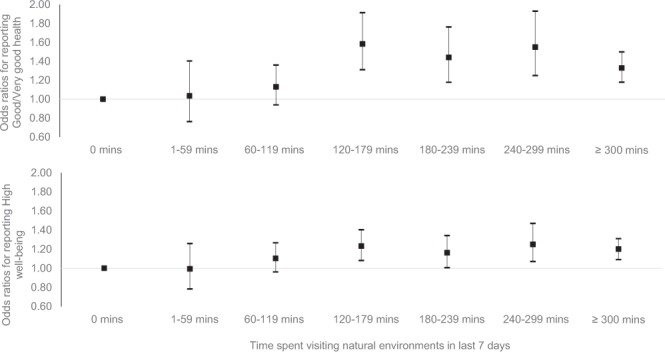
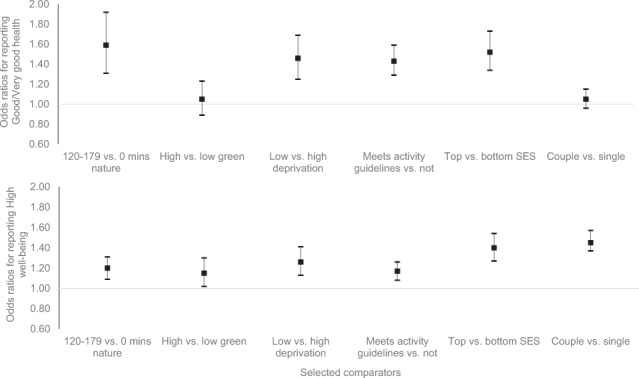
- In adjusted binomial logistic regression models, the association with good health and high well-being became significant only at ≥120 minutes per week in nature; for example, at 120–179 minutes, ORs were 1.59 [1.31–1.92] for health and 1.23 [1.08–1.40] for well-being, compared with 0 minutes.
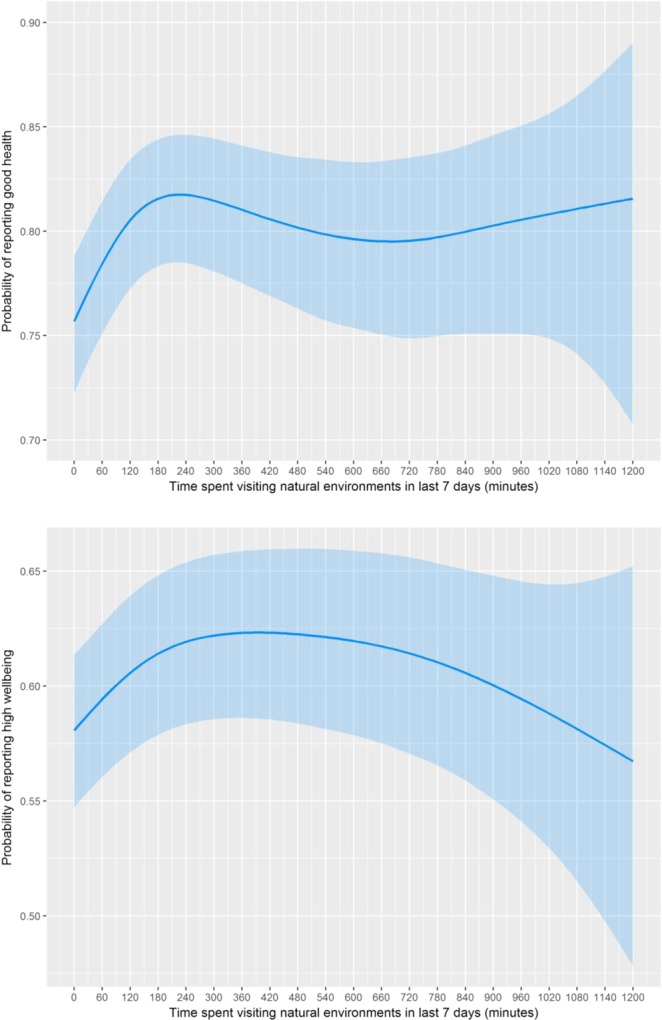
- The positive association was strongest up to about 200 minutes per week for health and 300 minutes per week for well-being, after which the relationship flattened or declined in spline analyses.
- The pattern was reported as consistent across key groups, including older adults and people with long-term health issues/disability; the paper also reports that the ≥120-minute “threshold” was seen across many stratified analyses.
- It did not matter how the 120 minutes were accumulated: additional analyses found no difference in health or well-being between one 120+ minute visit, two 60+ minute visits, or three or more ≤40 minute visits.
## Methods
- Design: Secondary analysis of a repeat cross-sectional survey; the study used survey weights to represent the adult population of England.
- Sample/data: Adults from Waves 6 and 7 of the Monitor of Engagement with the Natural Environment (MENE) survey (n = 20,264 total; n = 19,806 estimation sample for adjusted models; n = 19,808 for adjusted models with missing area-level data excluded).
- Main analysis: Survey-weighted binomial logistic regressions predicting binary health and well-being outcomes from weekly nature-contact duration categories; models adjusted for area- and individual-level covariates, with sensitivity analyses using splines and ordinal/continuous outcome specifications, plus a priori stratified analyses.
## Limitations
- The authors explicitly state the study is observational and cross-sectional, so they cannot rule out reverse causality or make causal claims.
- They note the weekly exposure estimate was based on one randomly selected visit in the last week, and that the data rely on self-reports, which may reduce accuracy.
- They caution that the apparent ≥120-minute threshold may partly reflect clustering of responses around hour marks and the way the data were categorized; this is an evident limitation from the text, alongside the very small variance explained by nature contact (about 1% in unadjusted models).
Model-written summary. Check it against the paper before relying on it.
Integrity signals
Registry
Cites
Statistics
Figures
Verification
Claims the paper makes
8 Valid · 1 Not valid · 15 Not checked · 60 Own results and interpretations
The cited sources support only part of this claim — read each source’s verdict below.
In the paper
“In other words, direct exposure, or more specifically in the current context, recreational time spent in natural environments per week, cannot accurately be inferred from neighbourhood greenspace near the home.”
§ Spending at least 120 minutes a week in nature is associated with good health and wellbeing > Introduction
What the sources say
- Partly supportedcites [23] Hillsdon, M., Coombes, E., Griew, P. & Jones, A. An assessment of the relevance of the home neighbourhood for understanding environmental influences on physical activity: how far from home do people roam? Int J Behav Nutr Phy 12, 100 (2015). sourceExperimental — accuracy not yet measured
The Conclusions and Discussion report that much outdoor physical activity occurs beyond the proximal home neighbourhood, so nearby neighbourhood characteristics may poorly represent the environments people use. The paper does not establish this specifically for weekly recreational time in natural environments or for neighbourhood greenspace; the Discussion says the researchers did not know which activities participants undertook. (LLM, conf=0.88)
- Could not verifycites [24] Sijtsma, F. J., de Vries, S., van Hinsberg, A. & Diederiks, J. Does ‘grey’ urban living lead to more ‘green’ holiday nights? A Netherlands Case Study. Landscape Urban Plan 105, 250–257 (2012). sourceExperimental — accuracy not yet measured
Our copy of Sijtsma et al. (2012) contains only repository/metadata records plus the Abstract; no body sections (Introduction, Methods, Discussion) are indexed. The Abstract (p. n/a) describes a GIS model of 'recreational shortages' — the shortage of locally available green space for recreational walking — linked to holiday nights away from home, but nowhere states that recreational time spent in natural environments per week cannot be inferred from neighbourhood greenspace near the home. Four searches (inference from neighbourhood greenspace, shortage of locally available green space for recreational walking, exposure vs. actual use, compensating behaviour/limitations) returned only the same abstract and citation blocks, so the claim's point is not addressed in the text we hold. (LLM, conf=0.65)
plain- Asserted: passes — The authors put it forward as true.
- Checkable: passes — It can be checked against evidence.
- Load-bearing: passes — The paper’s conclusions depend on it.
- Based: passes — The paper gives a reason why it holds.
- Partly supported
The cited sources support only part of this claim — read each source’s verdict below.
In the paper
“People travel beyond their local neighbourhoods to access recreational nature experiences, and indeed in our own data those who lived in the least green areas had higher odds of spending ≥120 mins in nature than those living in greener neighbourhoods (Appendix C).”
§ Spending at least 120 minutes a week in nature is associated with good health and wellbeing > Discussion
What the sources say
- Partly supportedcites [23] Hillsdon, M., Coombes, E., Griew, P. & Jones, A. An assessment of the relevance of the home neighbourhood for understanding environmental influences on physical activity: how far from home do people roam? Int J Behav Nutr Phy 12, 100 (2015). sourceExperimental — accuracy not yet measured
The Results report that 60.5% of recorded outdoor physical activity occurred beyond an 800 m home-neighbourhood boundary, and the Conclusions say adults undertook most outdoor physical activity outside their proximal home neighbourhood (page not provided). The paper does not establish that people travelled beyond their neighbourhoods specifically to access recreational nature experiences; it measured where activity occurred, not its purpose or whether it took place in nature. (LLM, conf=0.86)
plain- Asserted: passes — The authors put it forward as true.
- Checkable: passes — It can be checked against evidence.
- Load-bearing: passes — The paper’s conclusions depend on it.
- Based: passes — The paper gives a reason why it holds.
- Partly supported
Every source the paper cites for this claim was checked and supports it.
In the paper
“Research into shinrin-yoku (Japanese “forest bathing”)35, for instance, suggested that various psycho-physiological benefits can be gained from merely sitting passively in natural vs. urban settings.”
§ Spending at least 120 minutes a week in nature is associated with good health and wellbeing > Discussion
What the sources say
- Supportedcites [35] Park, B. J., Tsunetsugu, Y., Kasetani, T., Kagawa, T. & Miyazaki, Y. The physiological effects of Shinrin-yoku (taking in the forest atmosphere or forest bathing): evidence from field experiments in 24 forests across Japan. Environ Health Prev 15, 18–26 (2010). source
The Experimental design (p. 2) says subjects sat on chairs to view forest or city landscapes. The physiological results (p. 4) report more favorable stress-related measures after forest viewing, while the psychological results (p. 7) report better mood scores than after city viewing. (LLM, conf=0.93)
hedgedstates a possible cause- Asserted: passes — The authors put it forward as true.
- Checkable: passes — It can be checked against evidence.
- Load-bearing: passes — The paper’s conclusions depend on it.
- Based: passes — The paper gives a reason why it holds.
- Supported
Every source the paper cites for this claim was checked and supports it.
In the paper
“Experimental research, however, indicates that some benefits cannot be due solely to physical activity.”
§ Spending at least 120 minutes a week in nature is associated with good health and wellbeing > Discussion
What the sources say
- Supportedcites [35] Park, B. J., Tsunetsugu, Y., Kasetani, T., Kagawa, T. & Miyazaki, Y. The physiological effects of Shinrin-yoku (taking in the forest atmosphere or forest bathing): evidence from field experiments in 24 forests across Japan. Environ Health Prev 15, 18–26 (2010). source
The Experimental design (p. 2) reports no difference in exercise load between forest and city walks. The Results (p. 4) also report physiological benefits from viewing forest landscapes while seated, supporting the conclusion that physical activity alone cannot explain some benefits. (LLM, conf=0.93)
hedgedstates a cause- Asserted: passes — The authors put it forward as true.
- Checkable: passes — It can be checked against evidence.
- Load-bearing: passes — The paper’s conclusions depend on it.
- Based: passes — The paper gives a reason why it holds.
- Supported
The cited sources support only part of this claim — read each source’s verdict below.
In the paper
“Impoverished local opportunities need not be a barrier to nature exposure23,24.”
§ Spending at least 120 minutes a week in nature is associated with good health and wellbeing > Discussion
What the sources say
- Partly supportedcites [23] Hillsdon, M., Coombes, E., Griew, P. & Jones, A. An assessment of the relevance of the home neighbourhood for understanding environmental influences on physical activity: how far from home do people roam? Int J Behav Nutr Phy 12, 100 (2015). sourceExperimental — accuracy not yet measured
The Results and Conclusions (page numbers unavailable) show that adults undertook much of their outdoor physical activity beyond their proximal home neighbourhood, supporting the idea that nearby opportunities do not define where people go. The paper does not establish that those destinations provided nature exposure or that impoverished local nature opportunities were not a barrier to it. (LLM, conf=0.78)
- Partly supportedcites [24] Sijtsma, F. J., de Vries, S., van Hinsberg, A. & Diederiks, J. Does ‘grey’ urban living lead to more ‘green’ holiday nights? A Netherlands Case Study. Landscape Urban Plan 105, 250–257 (2012). sourceExperimental — accuracy not yet measured
Our copy of Sijtsma et al. (2012) holds only the repository record — the Abstract plus bibliographic metadata, with no body sections (searches on 'recreational shortage', 'nature exposure', 'compensating behaviour', 'discussion/conclusion' all returned the same abstract and citation blocks). The Abstract does support the compensatory mechanism behind the claim: 'the higher the greyness of the living environment – i.e. the higher the shortage of locally available green space for recreational walking – the more people spend nights away from home', with ~20% of holiday nights of the greyest residents related to that shortage. But the source measures holiday nights away from home and frames the shortage as a cost of agglomeration for well-being; it nowhere asserts 'nature exposure' or that a local shortage is not a barrier to nature contact, so the claim's generalisation to 'nature exposure' goes beyond what this source states. (LLM, conf=0.72)
plain- Asserted: passes — The authors put it forward as true.
- Checkable: passes — It can be checked against evidence.
- Load-bearing: unclear — It is unclear whether the paper’s conclusions depend on it.
- Based: passes — The paper gives a reason why it holds.
- Partly supported
21 more claims · 1 with their cited sources checked
Create a free account to see all 84 claims and to verify the 9 references still open.
- It may state two separate claims as one. 18
- Probably not a substantial claim. 46
Claims other papers make about this one
Each is checked against this paper’s own text: does it say what the citing paper says it does?
The cited source says what the claim attributes to it.
In the citing paper
“spending at least 120 min a week in nature was associated with good health [82].”
From EAACI Guidelines on the Importance of Green Space in Urban Environments for Allergy and Asthma Prevention (2026) · cites this paper as [82]
Citations
Cites
Hartig, T., Mitchell, R., de Vries, S., & Frumkin, H. (2014) · Annual Review of Public Health · doi:10.1146/annurev-publhealth-032013-182443 · Cited by 3,638
Self-citationEffect of exposure to natural environment on health inequalities: an observational population study
Mitchell, R., & Popham, F. (2008) · The Lancet · doi:10.1016/s0140-6736(08)61689-x · Cited by 2,099
Green space, urbanity, and health: how strong is the relation?
Maas, J., Verheij, R. A., Groenewegen, P. P., de Vries, S., & Spreeuwenberg, P. (2006) · Journal of Epidemiology and Community Health · doi:10.1136/jech.2005.043125 · Cited by 1,976
The Science of Mind Wandering: Empirically Navigating the Stream of Consciousness
Smallwood, J., & Schooler, J. W. (2015) · Annual Review of Psychology · doi:10.1146/annurev-psych-010814-015331 · Cited by 1,685
Barton, J., & Pretty, J. (2010) · Environmental Science & Technology · doi:10.1021/es903183r · Cited by 1,592
Miilunpalo, S., Vuori, I., Oja, P., Pasanen, M., & Urponen, H. (1997) · Journal of Clinical Epidemiology · doi:10.1016/s0895-4356(97)00045-0 · Cited by 1,473
Thompson Coon, J., Boddy, K., Stein, K., Whear, R., Barton, J., & Depledge, M. H. (2011) · Environmental Science & Technology · doi:10.1021/es102947t · Cited by 1,391
Self-citationNature Contact and Human Health: A Research Agenda
Frumkin, H., Bratman, G. N., Breslow, S. J., Cochran, B., Kahn Jr, P. H., Lawler, J. J., Levin, P. S., Tandon, P. S., Varanasi, U., Wolf, K. L., et al. (2017) · Environmental Health Perspectives · doi:10.1289/ehp1663 · Cited by 1,237
What are the benefits of interacting with nature?
Keniger, L., Gaston, K., Irvine, K., & Fuller, R. (2013) · International Journal of Environmental Research and Public Health · doi:10.3390/ijerph10030913 · Cited by 1,204
Research works printed but not linked: 1
- Stigsdotter, U. & Grahn, P. What makes a garden a healing garden. J Thera Hort 13, 60–69 (2002).
Cited by
Items 401–500 of 1,105
Biosphere functional integrity for people and PlanetPreprint
Mohamed, A., DeClerck, F., Verburg, P. H., Obura, D. O., Abrams, J. F., Zafra-Calvo, N., Rocha, J., Estrada-Carmona, N., Fremier, A., Jones, S. K., et al. (2022) · bioRxiv (Cold Spring Harbor Laboratory) · doi:10.1101/2022.06.24.497294 · Cited by 12
“30%) [19-30] (total 50 studies) <300 m (mean: 311m±6.”
Virtual Nature and Psychological Outcomes: A Systematic ReviewPreprint
Spano, G., Theodorou, A., Reese, G., Carrus, G., Sanesi, G., & Panno, A. (2022) · doi:10.31219/osf.io/8ux9a · Cited by 10
Haahtela, T., O'Mahony, L., Traidl‐Hoffmann, C., Akdis, M., Ceylan, O., Chaslaridis, P., Damialis, A., Del Giacco, S., Lauerma, A., Nadeau, K. C., et al. (2026) · Allergy · doi:10.1111/all.70182 · Cited by 9
Vanhöfen, J., Stuck, K., Haag, R., Härtel, T., & Randler, C. (2025) · Landscape and Urban Planning · doi:10.1016/j.landurbplan.2025.105456 · Cited by 13
López, L. M., & Díaz, A. B. F. (2022) · Designs · doi:10.3390/designs6020035 · Cited by 9
Development of flower meadows in an urbanized environment
Rózová, Z., Pástorová, A., & Kuczman, G. (2023) · Ochrana prírody Slovenska/Ekológia · doi:10.2478/eko-2023-0025 · Cited by 10
Lamatungga, K. E., Pichlerová, M., Halamová, J., Kanovský, M., Tamatam, D., Ježová, D., & Pichler, V. (2024) · Frontiers in Forests and Global Change · doi:10.3389/ffgc.2024.1287266 · Cited by 10
Mindful Eco-Wellness: Steps Toward Personal and Planetary Health
Barrett, B. P., Walters, S., Checovich, M. M., Grabow, M., Middlecamp, C., Wortzel, B., Tetrault, K., Riordan, K. M., & Goldberg, S. B. (2024) · Global Advances in Integrative Medicine and Health · doi:10.1177/27536130241235922 · Cited by 18
Tate, W., Chawla, L., Sachs, A. L., Litt, J., & Razani, N. (2024) · Ecopsychology · doi:10.1089/eco.2023.0064 · Cited by 13
“Consistent with this perspective, therehasbeen active research to determine the ‘‘dose’’ of time in nature required to deliver health gains (White et al., 2019).”
León, L. D. O., Thompson, R. L., Wyka, K., & Huang, T. T. ‐. (2024) · Journal of Racial and Ethnic Health Disparities · doi:10.1007/s40615-024-02095-w · Cited by 11
Rivera, E., Arundell, L., Parker, K. E., Veitch, J., Salmon, J., Ridgers, N. D., Timperio, A. F., Sahlqvist, S., & Loh, V. H. Y. (2024) · Health Promotion International · doi:10.1093/heapro/daae137 · Cited by 10
“A pre-pandemic cross-sectional study found that spending at least 120 min/week in nature was associated with higher well-being among adults compared with those with no nature contact (White et al ., 2019).”
BackgroundQu, S., Li, H., Wu, J., & Zhao, B. Q. (2025) · Sustainability · doi:10.3390/su17052269 · Cited by 11
Darcy, P. M., Armitt, H. A., Hurd, A., Paton, L. W., White, P. C. L., & Coventry, P. A. (2025) · Health & Social Care in the Community · doi:10.1155/hsc/2016261 · Cited by 14
Contact with Nature as Essential to the Human Experience: Reflections on Pandemic Confinement
Kazdin, A. E., & González, P. V. (2021) · Nature and Culture · doi:10.3167/nc.2020.160204 · Cited by 32
MarsGarden: Designing an ecosystem for a sustainable multiplanetary future
Hinterman, E. D., Moccia, A., Baber, S., Maffia, F., Sciarretta, S., Smith, T. M., Stamler, N., Nowak, H., Lukic, J., Sumini, V., et al. (2022) · Acta Astronautica · doi:10.1016/j.actaastro.2022.03.011 · Cited by 9
Chung, Y.-H., Chen, S., Lee, C.-L., Wu, C.-W., & Chang, Y.-S. (2022) · International Journal of Environmental Research and Public Health · doi:10.3390/ijerph192215251 · Cited by 12
Sârbu, E. A., Marici, M., Bostan, S., & Gavrilă-Ardelean, L. (2023) · International Journal of Environmental Research and Public Health · doi:10.3390/ijerph20021434 · Cited by 14
Convergence Analysis of Cross-Province Human Well-Being in China: A Spatiotemporal Perspective
Jiang, L., Chen, Y., Liang, W., & Zhang, B. (2023) · International Journal of Environmental Research and Public Health · doi:10.3390/ijerph20031858 · Cited by 14
In situ psycho-cognitive assessments support self-determined urban green exercise time
Tomasso, L. P., Spengler, J. D., Catalano, P. J., Chen, J. T., & Laurent, J. G. C. (2023) · Urban forestry & urban greening · doi:10.1016/j.ufug.2023.128005 · Cited by 12
“Nineteenth-century landscape architect and public health practitioner Frederick Law Olmsted recommended city dwellers spend two hours per week in urban parks (Olmsted, 1882), an amount identical to the 120-minute target for weekly nature time found 150 years later (White et al., 2019).”
Liu, W., Chambers, T. J., Clevenger, K. A., Pfeiffer, K. A., Rzotkiewicz, Z., Park, H., & Pearson, A. L. (2024) · PLoS ONE · doi:10.1371/journal.pone.0299943 · Cited by 9
Exploring autonomous and controlled motivations for nature contact to maximise health benefits
Astell‐Burt, T., Navakatikyan, M., White, M. P., & Feng, X. (2024) · People and Nature · doi:10.1002/pan3.10639 · Cited by 13
Self-citationUsing nature-based citizen science initiatives to enhance nature connection and mental health
Oh, R. R. Y., Suárez‐Castro, A. F., Fuller, R. A., Tervo, M., Rozario, K., Peters, B., Chowdhury, S., von Gönner, J., Friedrichs‐Manthey, M., Berger, A., et al. (2025) · Frontiers in Environmental Science · doi:10.3389/fenvs.2025.1461601 · Cited by 16
“Prior studies such as White et al. (2019) and Souter-Brown et al. (2021) have demonstrated that even brief nature-based interventions, such as reading a paragraph or spending 30-min in nature, can elicit notable changes in emotions, supporting our use of SPANE.”
Sahlin, E., Johansson, B., Karlsson, P.-O., Loberg, J. M., Niklasson, M., & Grahn, P. (2019) · International Journal of Environmental Research and Public Health · doi:10.3390/ijerph16244929 · Cited by 14
Law, M., Minissale, G., Lambert, A. J., Nater, U. M., Skoluda, N., Ryckman, N. A., Tahara‐Eckl, L. T., Bandzo, M., & Broadbent, E. (2020) · Frontiers in Psychology · doi:10.3389/fpsyg.2019.03092 · Cited by 12
An Analysis of Current Sustainability of Mexican Cities and Their Exposure to Climate Change
Estrada, F., Velasco, J. A., Arroyo, A., & Calderón-Bustamante, Ó. (2020) · Frontiers in Environmental Science · doi:10.3389/fenvs.2020.00025 · Cited by 12
Affective reactions to losses and gains in biodiversity: Testing a prospect theory approach
White, M. P., Bratman, G. N., Pahl, S., Young, G. R., Cracknell, D., & Elliott, L. R. (2020) · Journal of Environmental Psychology · doi:10.1016/j.jenvp.2020.101502 · Cited by 14
Self-citationJůza, R., Jarský, V., Riedl, M., Zahradník, D., & Sisak, L. (2020) · Forests · doi:10.3390/f12010013 · Cited by 9
Tashiro, A., Nakaya, T., Nagata, S., & Aida, J. (2020) · Environmental Research · doi:10.1016/j.envres.2020.110372 · Cited by 9
Sharma‐Brymer, V., Brymer, E., Willis, R., & Leach, M. (2024) · Frontiers in Psychology · doi:10.3389/fpsyg.2024.1352374 · Cited by 10
Knowing and experiencing the benefits: Factors influencing restoration evoked by nature photographs
Menzel, C., Gessler, M., Hoffmann, S. S. C., & Kenst, S. (2024) · Journal of Environmental Psychology · doi:10.1016/j.jenvp.2024.102322 · Cited by 10
Sulandari, S., Coats, R. O., Taufik, T., & Johnson, J. (2024) · The Journals of Gerontology Series B · doi:10.1093/geronb/gbae085 · Cited by 16
“Second, our data support findings from previous studies suggesting the physical and/or social environment affects older people’s quality of life (Garner & Holland, 2020; Tiraphat et al., 2017) and well-being (Cramm & Nieboer, 2015; MacKerron & Mourato, 2013; White et al., 2019).”
ResultLandscape structure influences the spatial distribution of urban bird attractiveness
Suárez‐Castro, A. F., Oh, R. R. Y., TULLOCH, A. I. T., Bonn, A., Fuller, R. A., & Rhodes, J. R. (2024) · Landscape Ecology · doi:10.1007/s10980-024-01950-9 · Cited by 11
“Despite the wealth of research demonstrating the positive impact of nature interactions on human health and wellbeing (Sandifer et al. 2015; White et al. 2019), there is still a lack of empirical evidence concerning how changes in species assemblages influence the potential of people to interact…”
A natural fit: exposure to nature influences regulatory focus
Fatemi, H., & Wan, J. (2024) · European Journal of Marketing · doi:10.1108/ejm-01-2022-0054 · Cited by 10
Alaimo, K., Coringrato, E., Lacy, K., Hébert, J. R., & Beavers, A. W. (2024) · People and Nature · doi:10.1002/pan3.10696 · Cited by 13
The impact of nature-based learning on student health: a scoping review
Langelier, M.-È., Fortin, J. A., Gauthier-Boudreau, J., Larouche, A., Mercure, C., Bergeron‐Leclerc, C., Simard, S., Cherblanc, J., Brault, M., Laprise, C., et al. (2025) · Journal of Outdoor and Environmental Education · doi:10.1007/s42322-024-00189-x · Cited by 13
Residential tree canopy configuration and mortality in 6 million Swiss adults: a longitudinal study
Chi, D., Manoli, G., Lin, B. B., Aerts, R., Yang, J., Hahs, A. K., Richards, D. R., Meili, N., Zhu, Y., Qiu, Y., et al. (2025) · The Lancet Planetary Health · doi:10.1016/s2542-5196(25)00022-1 · Cited by 13
de Vries, S., Baliatsas, C., Verheij, R. A., & Dückers, M. (2025) · Environment International · doi:10.1016/j.envint.2025.109450 · Cited by 10
Baja, K. (2021) · Routledge eBooks · doi:10.4324/9781003030720-6 · Cited by 8
Expanding the Mind–Body–Environment Connection to Enhance the Development of Cultural Humility
Soulé, I., Littzen, C. O. R., Vermeesch, A. L., & Garrigues, L. (2022) · International Journal of Environmental Research and Public Health · doi:10.3390/ijerph192013641 · Cited by 15
Vilhelmson, B., Thulin, E., & Elldér, E. (2022) · BMC Public Health · doi:10.1186/s12889-022-14554-2 · Cited by 9
“Spending time in these domains also intersects with other important aspects of sustainable living, for example, walking and biking can replace car use [17] and spending time in nature and gardening are associated with better mental health and subjective wellbeing [18].”
BackgroundQuantifying stress level reduction induced by urban greenery perception
Llaguno-Munitxa, M., Edwards, M., Grade, S., Meulen, M. V., Letesson, C., Agudo-Sierra, E., Altomonte, S., Lacroix, É., Bogosian, B., Kris, M., et al. (2022) · IOP Conference Series Earth and Environmental Science · doi:10.1088/1755-1315/1122/1/012021 · Cited by 14
“For example, a recent study that evaluated 20,000 participants reported that spending 120 minutes a week in nature is associated with good health and well-being [13].”
BackgroundNature Contact as a Health Behavior: Steps to Maturing the Field
Maddock, J. E., & Razani, N. (2024) · Ecopsychology · doi:10.1089/eco.2024.0046 · Cited by 11
“One recent study from the United Kingdom found a significant benefit from 2 h a week of self-reported time spent in nature (White et al., 2019).”
Biophilic Urbanism Across Scales: Enhancing Urban Nature Through Experience and Design
Lefosse, D. C., Naghibi, M., Luo, S., & van Timmeren, A. (2025) · Land · doi:10.3390/land14051112 · Cited by 13
Marcus, C. C., & Shepley, M. M. (2025) · Elsevier eBooks · doi:10.1016/b978-0-443-23536-8.00015-0 · Cited by 8
Nursing Strategies to Help Children Cope with Eco-Anxiety
Rasmussen, J. (2023) · MCN The American Journal of Maternal/Child Nursing · doi:10.1097/nmc.0000000000000928 · Cited by 11
Once upon a time: the impact of storytelling on connecting people to natural landscapes
Hughes, K., & Moscardo, G. M. (2023) · Environmental Education Research · doi:10.1080/13504622.2023.2246695 · Cited by 12
“…common underlying rationale for many of these public education programs assumes that spending time in or looking at natural landscapes is inherently rewarding (White et al. 2019) and helps people to build attachment to important heritage landscapes (Pirchio et al. 2021; Scannell and Gifford 2017).”
BackgroundMothering occupations: A review identifying mothering occupations
Odgers, S., Thomas, Y., & Tokolahi, E. (2023) · Australian Occupational Therapy Journal · doi:10.1111/1440-1630.12921 · Cited by 12
Spending Time in Nature: The Overlooked Health Behavior
Maddock, J. E., & Johnson, S. S. (2023) · American Journal of Health Promotion · doi:10.1177/08901171231210806 · Cited by 15
Furlong, R., Harvey, C., Holland, F., & Hallam, J. L. (2024) · Urban forestry & urban greening · doi:10.1016/j.ufug.2024.128646 · Cited by 8
Kou, M., Li, X., Ma, H., Wang, X., Heianza, Y., Manson, J. E., & Qi, L. (2025) · European Journal of Epidemiology · doi:10.1007/s10654-025-01225-w · Cited by 8
“However, the bidirectional association between life satisfaction and CVH, including blood pressure [28], BMI [29], and physical activity [ 30] suggests shared risk factors for CVD [2].”
Hvid, L. G., Steenberg, J. L., Roy, F., & Skovgaard, L. (2025) · Annals of Physical and Rehabilitation Medicine · doi:10.1016/j.rehab.2025.101985 · Cited by 8
Yim, D.-H., & Kwon, Y.-S. (2025) · Cities · doi:10.1016/j.cities.2025.106165 · Cited by 10
Effects of video-based natural restorative environments on mental health: a systematic review
Han, D., & Sabran, K. (2025) · BMC Public Health · doi:10.1186/s12889-025-21730-7 · Cited by 10
Effects of restorative environments on mental health and its cognitive neural mechanisms
Wang, P., Lin, J., & Lin, W. (2025) · Frontiers in Forests and Global Change · doi:10.3389/ffgc.2025.1651800 · Cited by 9
Characterizing personalized ecologies
Gaston, K. J. (2024) · Journal of Zoology · doi:10.1111/jzo.13158 · Cited by 11
Urban green space provision: the case for policy‐based solutions to support human health
Williams, C. R., Byrne, C., Evenden, S., Soebarto, V. I., Caddy‐Retalic, S., Williams, C., Tefera, Y., Feng, X., & Lowe, A. J. (2024) · The Medical Journal of Australia · doi:10.5694/mja2.52569 · Cited by 12
“21 Increased urban greening facilitates resilience to heat by providing shade and evaporative cooling.”
Grilli, G., Barbierato, E., Capecchi, I., & Sacchelli, S. (2021) · Journal of Environmental Planning and Management · doi:10.1080/09640568.2021.1885354 · Cited by 10
“More recently, a study in England found that spending 120min per week in nature is sufficient to enjoy good health and a good level of well-being (White et al. 2019).”
BackgroundWhy Green and Blue Spaces Matter More Than Ever
Foley, R., & Garrido‐Cumbrera, M. (2021) · Global perspectives on health geography · doi:10.1007/978-3-030-70179-6_37 · Cited by 11
Lundine, M. A., & Trembanis, A. C. (2021) · Remote Sensing · doi:10.3390/rs13183770 · Cited by 9
“When Carolina Bays are left in their natural state, they can provide natural habitat for various plant and animal fauna [59–62]; they can provide an outlet for stormwater during floods [63]; they can sequester atmospheric carbon [64], and as richly natural features they can offer aesthetic, recreational, and even ther…”
BackgroundSome Impacts on Health and Wellbeing from School-Based Outdoor Learning
Waite, S., & Aronsson, J. (2022) · Springer eBooks · doi:10.1007/978-3-031-04108-2_9 · Cited by 10
Lu, Y., Wang, J., Chen, J., Yan, Y., Zeng, H., Zhang, B., Ma, H., & Hu, T. (2022) · Forests · doi:10.3390/f13111966 · Cited by 7
Christensen, B. K., & Kennedy, R. E. (2023) · Oxford University Press eBooks · doi:10.1093/oso/9780197567579.003.0009 · Cited by 7
Resurrecting Gaia: harnessing the Free Energy Principle to preserve life as we know it
Montgomery, C., & Hipólito, I. (2023) · Frontiers in Psychology · doi:10.3389/fpsyg.2023.1206963 · Cited by 8
Broadening the foundation for the study of childhood connectedness to nature
Beery, T. H., Djerf, H., Wünsche, T. U., & Fridberg, M. (2023) · Frontiers in Environmental Science · doi:10.3389/fenvs.2023.1225044 · Cited by 11
Exploring the Quality of Open Public Spaces in Historic Jeddah
Imam, A., Helmi, M. R., Alkadi, A., & Hegazy, I. (2023) · ACE Arquitectura Ciudad y Entorno · doi:10.5821/ace.18.52.12123 · Cited by 14
“For instance, White et al. (White et al, 2018) found that exposure to pleasurable environments, such as parks and gardens, can improve mental health and overall wellbeing.”
BackgroundCalogiuri, G., Petersen, E., Rossi, A., & Terragni, L. (2023) · BMC Public Health · doi:10.1186/s12889-023-16375-3 · Cited by 8
“The multivariate logistic regression showed that Language proficiency, as a general indicator of the immigrants’ acculturation, was a highly significant predictor of both SRH and SWL.”
BackgroundMethodInfluentialDoğayla Uyumlu Mekânlar: Biyofilik Tasarımın Bibliyometrik Değerlendirmesi
ÖZĞAN, A. O., & ALUÇLU, İ. (2023) · İDEALKENT · doi:10.31198/idealkent.1350785 · Cited by 7
A Hunter-Gatherer Exercise Prescription to Optimize Health and Well-Being in the Modern World
O’Keefe, E. L., & Lavie, C. J. (2020) · Journal of Science in Sport and Exercise · doi:10.1007/s42978-020-00091-0 · Cited by 8
Ouf, T. A., Makram, A., & Abdel-Razek, S. A. (2021) · Advances in Science, Technology & Innovation/Advances in science, technology & innovation · doi:10.1007/978-3-030-65181-7_36 · Cited by 9
Roberts, J. D., Ada, M. S. D., & Jetté, S. (2020) · American Journal of Health Promotion · doi:10.1177/0890117120970334d · Cited by 8
Derrien, M. M., Bratman, G. N., Cerveny, L. K., Levy, C., Blahna, D. J., Frank, P., & Serio, N. (2024) · Social Science & Medicine · doi:10.1016/j.socscimed.2024.116764 · Cited by 7
Nordin, S., Liljegren, M., Nilsson, M., Bengtsson, A., & Wijk, H. (2024) · Frontiers in Dementia · doi:10.3389/frdem.2024.1470691 · Cited by 9
Patchen, A. K., Edwards, A., Rakow, D. A., & Meredith, G. R. (2024) · Frontiers in Public Health · doi:10.3389/fpubh.2024.1483862 · Cited by 17
Nature-Based Meditation Reduces Depressive Rumination and Stress in Adolescents and Young Adults
Owens, M., & Bunce, H. L. I. (2025) · Psychiatry International · doi:10.3390/psychiatryint6020036 · Cited by 8
Ahnesjö, J., Karlsson, P. S., & Bergman, P. (2022) · PLoS ONE · doi:10.1371/journal.pone.0275886 · Cited by 7
Hayward, D., Smith, H., & Moltow, D. (2023) · Journal of Outdoor and Environmental Education · doi:10.1007/s42322-023-00127-3 · Cited by 9
“In addition, connecting with nature has been shown to play an important part in health and well-being (e.g., White et al., 2019).”
BackgroundHuman experiences in dense and open woodland; the role of different danger threats
Gatersleben, B., & Andrews, M. (2023) · Trees Forests and People · doi:10.1016/j.tfp.2023.100428 · Cited by 7
Understanding older adults’ participation in outdoor adventure activities: a scoping review
Smith, E. S., & Dalmer, N. K. (2023) · Journal of Adventure Education & Outdoor Learning · doi:10.1080/14729679.2023.2295842 · Cited by 8
“The health benefits of spending time in natural environments have also been highlighted as of late (Eigenschenk et al., 2019; White et al., 2019; Wicks et al., 2022) and this has contributed to the increasing scholarly work regarding physical activity in natural environments, including outdoor…”
Dennis, D., Henderson‐Wilson, C., Watson, J., & Lawson, J. T. (2024) · Sustainability · doi:10.3390/su16031077 · Cited by 12
Echeverry-Gálvis, M. Á., Téllez-Colmenares, N., Uribe, L. R., Cortes-Cano, J. S., Estela, F. A., & Rico‐Guevara, A. (2024) · Ornitología colombiana · doi:10.59517/oc.e576 · Cited by 6
“…moved into rural areas, and outdoor activities such as nature - based tourism and birdwatching (Kellert 1985, Horn & Johansen 2013, Jaung & Carrasco 2022, Vimal 2022) have been increasingly emphasized for their positive impact on human health and well - being (Kim et al. 1997, White et al. 2019).”
BackgroundThe impact of urban design on mental well-being by integrating green spaces in Doha City, Qatar
Patel, S., Jabbour, N., John, D., Ahmad, A. M., Furlan, R., Al-Matwi, R. S., & Isaifan, R. J. (2024) · Journal of Infrastructure Policy and Development · doi:10.24294/jipd.v8i3.3147 · Cited by 7
Existential Well-Being in Nature: A Cross-Cultural and Descriptive Phenomenological Approach
Baklien, B., Marthoenis, M., & Thurston, M. N. (2024) · Journal of Medical Humanities · doi:10.1007/s10912-024-09846-0 · Cited by 10
“…linked to health and eudaimonic well-being (relating to a meaningful life in terms of fulfillment and purpose, again as conceptualized by Westerhof and Keyes [2010; Martin et al. 2020]), while spending two hours a week in nature has been related to better health and well-being (White et al. 2019).”
BackgroundGlover, S., Cleland, C., Trott, M., & Hunter, R. F. (2024) · Environmental Research Health · doi:10.1088/2752-5309/ad44cc · Cited by 17
Bellehumeur, C. R., & Carignan, L.-M. (2024) · Frontiers in Psychiatry · doi:10.3389/fpsyt.2024.1377205 · Cited by 10
Developing a new tool to capture the nature dose to reduce loneliness and improve quality of life
Sachs, A. L., Masó-Aguado, M., Bach, A., Opačin, N., Hill, N., Cattaneo, L., Coll‐Planas, L., Johnson, K., Hidalgo, L., Daher, C., et al. (2024) · MethodsX · doi:10.1016/j.mex.2024.102969 · Cited by 7
“Researchers have suggested that as little as 10 min periodically [ 15 ] up to 120 min total per week are sufficient for receiving health and wellbeing benefits from nature exposure [ 16 ].”
BackgroundKlimakrise, Natur und Psychotherapie
Pfeifer, E. (2024) · Psychotherapie-Wissenschaft · doi:10.30820/1664-9583-2024-2-39 · Cited by 5
Mitchell, S. B., Chapman, B. L., Hayes, R. A., Bonnici, H., Banks, H. A., Mareva, S., & Hardwick, R. (2024) · BMC Health Services Research · doi:10.1186/s12913-024-11541-8 · Cited by 6
Elsadek, M., Yinan, L., Makvandi, M., & Deshun, Z. (2024) · Environment and Behavior · doi:10.1177/00139165241305895 · Cited by 8
“…to natural environments, including parks, forests, and gardens, has been associated with a wide range of benefits, including stress reduction, increased happiness, faster recovery from surgery, and a decreased risk of vascular diseases (Elsadek et al., 2020; Ulrich, 1984; White et al., 2019).”
Feeling Nature: Measuring perceptions of biophilia across global biomes using visual AI
Lefosse, D. C., Duarte, F., Sanatani, R. P., Kang, Y., van Timmeren, A., & Ratti, C. (2025) · npj Urban Sustainability · doi:10.1038/s42949-025-00192-1 · Cited by 13
“…studies on psychological restoration in nature examined various environmental features that foster biophilic effects, highlighting the relational values between humans and nature 28 and the diverse qualities of nature 8 that contribute to personal well-being 4 and environmental restoration 9 .”
Shoshani, A., & Hen, R. (2025) · Computers in Human Behavior · doi:10.1016/j.chb.2025.108707 · Cited by 8
Feng, J., Chen, C., Qiao, H., & Xie, S. (2025) · Land · doi:10.3390/land14061175 · Cited by 12
Reed, A. C., Haldane, V. E., Mincer, J., McDermott, E., & Rawlyk, B. (2021) · The Journal of Climate Change and Health · doi:10.1016/j.joclim.2021.100040 · Cited by 8
Strengths and gaps of climate change perceptions in the Beijing metropolis
Tian, Y., Liu, F., Jim, C. Y., Wang, T., Liu, X., Luan, J., & Yan, M. (2023) · Climate Services · doi:10.1016/j.cliser.2023.100350 · Cited by 5
Gray, C. E., Kahn, P. H., Lawler, J. J., Tandon, P. S., Bratman, G. N., Perrins, S. P., Lin, Y., & Boyens, F. (2023) · Land · doi:10.3390/land12071303 · Cited by 6
Chung, Y.-H., Chen, S., Lee, C.-L., & Chang, Y.-S. (2023) · EXPLORE · doi:10.1016/j.explore.2023.09.009 · Cited by 8
Pritchard, T., Feng, X., Walsan, R., & Astell‐Burt, T. (2024) · Urban forestry & urban greening · doi:10.1016/j.ufug.2024.128448 · Cited by 6
Ahmed, S. M., Mishra, G. D., Moss, K. M., Mouly, T. A., Yang, I. A., & Knibbs, L. D. (2022) · Environmental Research · doi:10.1016/j.envres.2022.113759 · Cited by 8
Klimawandel, Biodiversitätsverlust und Verschmutzung: Folgen für die Psychiatrie
Karl, S., & Meyer‐Lindenberg, A. (2023) · Der Nervenarzt · doi:10.1007/s00115-023-01523-2 · Cited by 6
Guzmán, L. A., Cantillo-Garcia, V. A., Criado, A., Sarmiento, O. L., & Moncada, C. (2025) · Cities · doi:10.1016/j.cities.2025.106460 · Cited by 9
Trudel, S. M., Winter, E. L., & Guerrera, M. P. (2024) · Global Advances in Integrative Medicine and Health · doi:10.1177/27536130241246788 · Cited by 6
Metadata
- Authors
- White, M. P., Alcock, I., Grellier, J., Wheeler, B. W., Hartig, T., Warber, S. L., Bone, A., Depledge, M. H., & Fleming, L. E.
- Affiliations
- University of Exeter (GB)
- Uppsala University (SE)
- Corresponding author
- White, Mathew P.
- ORCID
- Venue
- Scientific Reports
- Published
- 2019-06-13
- Volume
- 9
- Issue
- 1
- Pages
- 7730-7730
- ISSN
- 2045-2322 (ISSN-L)
- PMC
- PMC6565732
- OpenAlex
- W2952548366
- Cited by
- 1,125
- References
- 51
- Citations by year
- 2026: 186 · 2025: 168 · 2024: 170 · 2023: 181 · 2022: 138 · 2021: 164 · 2020: 94 · 2019: 23
- FWCI
- 45.19
- Type
- journal article
- Language
- en
- Open access
- gold
- doi.org
- Licence
- cc-by
- creativecommons.org/licenses/by/4.0 (tdm)
- creativecommons.org/licenses/by/4.0 (vor)
- Locations
- Scientific Reports (publishedVersion, cc-by)
- PubMed Central (publishedVersion, cc-by)
- PubMed (publishedVersion)
- KTH Publication Database DiVA (KTH Royal Institute of Technology) (submittedVersion, other-oa)
- DOAJ (DOAJ: Directory of Open Access Journals) (submittedVersion)
- Figshare (submittedVersion, cc-by)
- Open Research Exeter (University of Exeter) (submittedVersion, cc-by)
- Funders
- DH | National Institute for Health Research (HPRU: Environmental Change & Health)
- Topics
- Social Sciences › Urban Studies › Urban Green Space and Health
- Social Sciences › Business, Management and Accounting › Tourism, Leisure and Hospitality Management › Recreation, Leisure, Wilderness Management
- Health Sciences › Medicine › Public Health, Environmental and Occupational Health › Physical Activity and Health
- Keywords
- nature contact, exposure-response relationship, self-reported health, well-being, green spaces, older adults, chronic disease
- MeSH terms
- Adolescent, Adult, Environment, Female, Health, Humans, Male, Middle Aged, Residence Characteristics, Exercise, Walking, Young Adult, Self Report
About these checks
Registry, retraction, Cites and statistics results are computed, not judged, with one exception: a printed reference that no index lists is read once by a model before it counts as a citation error. Claims are extracted by a model and kept only when their quote appears verbatim in the text; each cited source is then checked, with a model’s help, for whether it says what the claim relies on. Those verdicts can be wrong — read the claim’s quote and the cited source before relying on one.
The claim verdicts this report counts are experimental: their accuracy is not yet measured.
A language model drew the claims from the paper on 2026-10-10, under version 3 of the claim definition (model deepseek-v4.1-flash, prompt extract-v3).
A second model labelled each claim on 2026-10-10 (model jev-1.13-20260917, definition revision gold-guideline-v0.2).
Cited sources are checked with a language model’s help (gpt-6-sol and qwen3.8-omni-flash).
Statistics and arithmetic are recomputed, not judged.
Confidence bands are shown only for fields calibrated on our annotated test set. None is calibrated yet, so no band is shown.
What counts as a claim ›How we measure confidence ›How we check this ›
Are you an author, or do you see a problem with this page? Request a review
Data sources
Bibliographic data: Semantic Scholar, OpenAlex, Crossref.
Contains information from the Semantic Scholar Academic Graph Datasets, made available under the ODC Attribution License (ODC-BY 1.0).
Semantic Scholar’s data is described in: Kinney, R., et al. (2023). The Semantic Scholar Open Data Platform. arXiv:2301.10140.
