

Challenges and opportunities in quantum optimization
Open accessThe DOI matches its Crossref record; 268 of the 268 references it cites were found in a registry or an index.
Abstract
Quantum computers have demonstrable ability to solve problems at a scale beyond brute-force classical simulation. Interest in quantum algorithms has developed in many areas, particularly in relation to mathematical optimization — a broad field with links to computer science and physics. In this Review, we aim to give an overview of quantum optimization. Provably exact, provably approximate and heuristic settings are first explained using computational complexity theory, and we highlight where quantum advantage is possible in each context. Then, we outline the core building blocks for quantum optimization algorithms, define prominent problem classes and identify key open questions that should be addressed to advance the field. We underscore the importance of benchmarking by proposing clear metrics alongside suitable optimization problems, for appropriate comparisons with classical optimization techniques, and discuss next steps to accelerate progress towards quantum advantage in optimization. This Review discusses quantum optimization, focusing on the potential of exact, approximate and heuristic methods, core algorithmic building blocks, problem classes and benchmarking metrics. The challenges for quantum optimization are considered, and next steps are suggested for progress towards achieving quantum advantage. Quantum computing is advancing rapidly, and quantum optimization is a promising area of application. Quantum optimization algorithms — whether provably exact, provably approximate or heuristic — offer opportunities to demonstrate quantum advantage. Systematic benchmarking is crucial to guide research, track progress and further advance understanding of quantum optimization. Theoretical research and empirical research using real hardware can complement each other, in the move towards demonstrating quantum advantage. Quantum computing is advancing rapidly, and quantum optimization is a promising area of application. Quantum optimization algorithms — whether provably exact, provably approximate or heuristic — offer opportunities to demonstrate quantum advantage. Systematic benchmarking is crucial to guide research, track progress and further advance understanding of quantum optimization. Theoretical research and empirical research using real hardware can complement each other, in the move towards demonstrating quantum advantage.
Overview
CoChat Summary
TL;DR
This review provides an overview of quantum optimization, framing where quantum advantage may be possible across exact, approximate, and heuristic settings. It also argues that better benchmarking and clearer metrics are needed to compare quantum and classical optimization fairly.
Key findings
- The paper states that quantum computers have “demonstrable ability” to solve problems beyond brute-force classical simulation.
- It distinguishes three settings for quantum optimization: provably exact, provably approximate, and heuristic, and says computational-complexity theory is used to explain where quantum advantage may be possible in each.
- The review identifies core building blocks of quantum optimization algorithms, defines prominent problem classes, and highlights key open questions to advance the field.
- The authors emphasize benchmarking as a central need and propose clear metrics and suitable optimization problems for comparison with classical optimization techniques.
Methods
- Review article, not an original empirical study.
- The paper synthesizes quantum optimization through computational-complexity theory, algorithmic building blocks, problem classes, and benchmarking considerations.
- It does not report a study sample or new data; instead, it provides a conceptual overview and agenda for the field.
Limitations
- The paper itself does not report experimental results or a primary dataset, because it is a review.
- It implies a field-wide limitation: benchmarking is not yet sufficiently clear or standardized for appropriate comparisons with classical optimization techniques.
Model-written summary. Check it against the paper before relying on it.
Integrity signals
Registry
Cites
Statistics
Figures
Verification
Claims the paper makes
0 Valid · 3 Not valid · 0 Not checked · 9 Own results and interpretations
A result the paper reports from its own data — it cites no other source for it, so there is none to check. The quote shows it is in the paper.
In the paper
“and identify key open questions that should be addressed to advance the field.”
A result the paper reports from its own data — it cites no other source for it, so there is none to check. The quote shows it is in the paper.
In the paper
“and we highlight where quantum advantage is possible in each context.”
The paper states this without a source or data behind it here, so there is nothing to check it against. The quote shows it is in the paper.
In the paper
“We underscore the importance of benchmarking”
What the paper did — it cites no source for this, so there is none to check. The quote shows it is in the paper.
In the paper
“Then, we outline the core building blocks for quantum optimization algorithms,”
What the paper did — it cites no source for this, so there is none to check. The quote shows it is in the paper.
In the paper
“define prominent problem classes”
7 more claims
Create a free account to see all 12 claims and every source verdict.
Citations
Cites
Optimization by Simulated Annealing
Kirkpatrick, S., Gelatt, C. D., & Vecchi, M. P. (1983) · Science · doi:10.1126/science.220.4598.671 · Cited by 45,134
Stochastic relaxation, gibbs distributions, and the bayesian restoration of images.
Geman, S., & Geman, D. (1984) · IEEE Transactions on Pattern Analysis and Machine Intelligence · doi:10.1109/tpami.1984.4767596 · Cited by 17,949 · cited 1×
“Gibbs sampling generates sample sequences from complex probability distributions, for example, by using a Markov-chain Monte Carlo algorithm 242 .”
Reducibility among Combinatorial Problems
Karp, R. M. (1972) · Complexity of Computer Computations · doi:10.1007/978-1-4684-2001-2_9 · Cited by 11,511
A fast quantum mechanical algorithm for database search
Grover, L. K. (1996) · Proceedings of the twenty-eighth annual ACM symposium on Theory of computing - STOC '96 · doi:10.1145/237814.237866 · Cited by 8,830 · cited 2×
“Grover’s search 1 , quantum annealing, adiabatic quantum optimization 2,3 and the quantum approximate optimization algorithm (QAOA) 4 provided a promising start, but it has become clear that more is needed to realize a practical quantum advantage in optimization.”
Algorithms for quantum computation: discrete logarithms and factoring
Shor, P. W. (2002) · Proceedings 35th Annual Symposium on Foundations of Computer Science · doi:10.1109/sfcs.1994.365700 · Cited by 8,713 · cited 1×
“Shor’s algorithm 239 leverages QPE to achieve an exponential speedup over the best-known classical algorithms for factoring and related problems 222,223 .”
A variational eigenvalue solver on a photonic quantum processor
Peruzzo, A., McClean, J., Shadbolt, P., Yung, M.-H., Zhou, X.-Q., Love, P. J., Aspuru-Guzik, A., & O’Brien, J. L. (2014) · Nature Communications · doi:10.1038/ncomms5213 · Cited by 4,552 · cited 1×
“VQAs are a family of search algorithms, originally proposed for quantum chemistry applications 255 , which utilize parameterized quantum states and cost functions to iteratively optimize parameters and find good solutions 4,256–258 .”
Goemans, M. X., & Williamson, D. P. (1995) · Journal of the ACM · doi:10.1145/227683.227684 · Cited by 3,587 · cited 2×
“For instance, semidefinite programming relaxations — as used in the famous Goemans-Williamson algorithm for the maximum-cut problem 64,253 or in more general variants for the quadratic unconstrained binary optimization problem 254 — may profit from quantum semidefinite-programming solvers.”
Variational quantum algorithms
Cerezo, M., Arrasmith, A., Babbush, R., Benjamin, S. C., Endo, S., Fujii, K., McClean, J. R., Mitarai, K., Yuan, X., Cincio, L., et al. (2021) · Nature Reviews Physics · doi:10.1038/s42254-021-00348-9 · Cited by 3,385
Optimal Control and Viscosity Solutions of Hamilton-Jacobi-Bellman Equations
Bardi, M., & Capuzzo-Dolcetta, I. (1997) · Birkhäuser Boston eBooks · doi:10.1007/978-0-8176-4755-1 · Cited by 2,758
Ising formulations of many NP problems
Lucas, A. (2014) · Frontiers in Physics · doi:10.3389/fphy.2014.00005 · Cited by 2,512 · cited 6×
“In the case that certain groups of decision variables are not correlated, QUBOs can be decomposed trivially into smaller sub-QUBOs to be solved independently.”
InfluentialGlobal Optimization with Polynomials and the Problem of Moments
Lasserre, J. B. (2001) · SIAM Journal on Optimization · doi:10.1137/s1052623400366802 · Cited by 2,474 · cited 1×
“Similarly, using moment or sum-of-squares techniques 134,135 , MIP can be reformulated to infinite-dimensional linear programming, with an SDP relaxation in a dimension much higher than n + d and sometimes 136 exponential in n + d .”
Probing many-body dynamics on a 51-atom quantum simulator
Bernien, H., Schwartz, S., Keesling, A., Levine, H., Omran, A., Pichler, H., Choi, S., Zibrov, A. S., Endres, M., Greiner, M., et al. (2017) · Nature · doi:10.1038/nature24622 · Cited by 2,460
Quantum annealing in the transverse Ising model
Kadowaki, T., & Nishimori, H. (1998) · Physical Review E · doi:10.1103/physreve.58.5355 · Cited by 2,339 · cited 4×
“, in which ω ∈[2,2.373) is the unknown optimal matrix exponent for multiplication 97 .”
InfluentialQuantum simulations with ultracold quantum gases
Bloch, I., Dalibard, J., & Nascimbène, S. (2012) · Nature Physics · doi:10.1038/nphys2259 · Cited by 2,339
Barren plateaus in quantum neural network training landscapes
McClean, J. R., Boixo, S., Smelyanskiy, V. N., Babbush, R., & Neven, H. (2018) · Nature Communications · doi:10.1038/s41467-018-07090-4 · Cited by 2,329
Decomposition Principle for Linear Programs
Dantzig, G. B., & Wolfe, P. (1960) · Operations Research · doi:10.1287/opre.8.1.101 · Cited by 2,315 · cited 1×
“133).”
Noisy intermediate-scale quantum algorithms
Bharti, K., Cervera-Lierta, A., Kyaw, T. H., Haug, T., Alperin-Lea, S., Anand, A., Degroote, M., Heimonen, H., Kottmann, J. S., Menke, T., et al. (2022) · Reviews of Modern Physics · doi:10.1103/revmodphys.94.015004 · Cited by 2,231
The theory of variational hybrid quantum-classical algorithms
McClean, J. R., Romero, J., Babbush, R., & Aspuru-Guzik, A. (2016) · New Journal of Physics · doi:10.1088/1367-2630/18/2/023023 · Cited by 2,227 · cited 1×
“VQAs are a family of search algorithms, originally proposed for quantum chemistry applications 255 , which utilize parameterized quantum states and cost functions to iteratively optimize parameters and find good solutions 4,256–258 .”
Approximation algorithms for combinatorial problems
Johnson, D. S. (1974) · Journal of Computer and System Sciences · doi:10.1016/s0022-0000(74)80044-9 · Cited by 2,197
A quantum engineer's guide to superconducting qubits
Krantz, P., Kjaergaard, M., Yan, F., Orlando, T. P., Gustavsson, S., & Oliver, W. D. (2019) · Applied Physics Reviews · doi:10.1063/1.5089550 · Cited by 2,004 · cited 1×
“However, there is a risk that there is also a classical method (or one could be developed) that takes advantage of the special problem structure or that the instances are of no practical value.”
Some optimal inapproximability results
Håstad, J. (2001) · Journal of the ACM · doi:10.1145/502090.502098 · Cited by 1,902
Quantum annealing with manufactured spins
Johnson, M. W., Amin, M. H. S., Gildert, S., Lanting, T., Hamze, F., Dickson, N., Harris, R., Berkley, A. J., Johansson, J., Bunyk, P., et al. (2011) · Nature · doi:10.1038/nature10012 · Cited by 1,891 · cited 1×
“The problems chosen should be sufficiently hard for state-of-the-art classical solvers to leave a margin for quantum methods, but”
A Quantum Approximate Optimization Algorithm
Farhi, E., Goldstone, J., & Gutmann, S. (2014) · arXiv · doi:10.48550/arxiv.1411.4028 · Cited by 1,789
Dongarra, J. J., Moler, C. B., Bunch, J. R., & Stewart, G. W. (1979) · Society for Industrial and Applied Mathematics eBooks · doi:10.1137/1.9781611971811 · Cited by 1,738
Computational Complexity: A Modern Approach
Arora, S., & Barak, B. (2009) · doi:10.1017/cbo9780511804090 · Cited by 1,690
Quantum amplitude amplification and estimation
Brassard, G., Høyer, P., Mosca, M., & Tapp, A. (2002) · Contemporary Mathematics · doi:10.1090/conm/305/05215 · Cited by 1,680
Quantum simulations with trapped ions
Blatt, R., & Roos, C. F. (2012) · Nature Physics · doi:10.1038/nphys2252 · Cited by 1,629
Albash, T., & Lidar, D. A. (2018) · Reviews of Modern Physics · doi:10.1103/revmodphys.90.015002 · Cited by 1,546
Born, M., & Fock, V. (1928) · Zeitschrift f�r Physik · doi:10.1007/bf01343193 · Cited by 1,494
Strengths and Weaknesses of Quantum Computing
Bennett, C. H., Bernstein, E., Brassard, G., & Vazirani, U. (1997) · SIAM Journal on Computing · doi:10.1137/s0097539796300933 · Cited by 1,470 · cited 1×
“Although, in general, this is the best that can be hoped for 228 , the advantage is often less pronounced in practical problem classes in which brute-force search is not the best classical algorithm.”
Clark, B. N., Colbourn, C. J., & Johnson, D. S. (1990) · Discrete Mathematics · doi:10.1016/0012-365x(90)90358-o · Cited by 1,429 · cited 1×
“Here, we suggest an empirical approach to identify more generally applicable quantum heuristics and less formal problem structures in which these heuristics have an advantage in certain instances.”
Simulated Quantum Computation of Molecular Energies
Aspuru-Guzik, A., Dutoi, A. D., Love, P. J., & Head-Gordon, M. (2005) · Science · doi:10.1126/science.1113479 · Cited by 1,418
Classical and Quantum Computation
Kitaev, A., Shen, A., & Vyalyi, M. (2002) · Graduate Studies in Mathematics · doi:10.1090/gsm/047 · Cited by 1,387
Error Mitigation for Short-Depth Quantum Circuits
Temme, K., Bravyi, S., & Gambetta, J. M. (2017) · Physical Review Letters · doi:10.1103/physrevlett.119.180509 · Cited by 1,379
On the computational complexity of Ising spin glass models
Barahona, F. (1982) · Journal of Physics A: Mathematical and General · doi:10.1088/0305-4470/15/10/028 · Cited by 1,306 · cited 4×
“For a fixed n , these matrices form a convex cone 138 , but even the test of membership in this cone is NP-hard 139 .”
InfluentialA review of multi-objective optimization: Methods and its applications
Gunantara, N. (2018) · Cogent Engineering · doi:10.1080/23311916.2018.1502242 · Cited by 1,150
Polynomial time approximation schemes for Euclidean traveling salesman and other geometric problems
Arora, S. (1998) · Journal of the ACM · doi:10.1145/290179.290180 · Cited by 1,137 · cited 1×
“If the problem is restricted to the Euclidean TSP (in which all points are in the d -dimensional space d R and edge weights equal their Euclidean distances), then, remarkably, there exists an explicit PTAS to solve such TSP instances 31 .”
Observation of a many-body dynamical phase transition with a 53-qubit quantum simulator
Zhang, J., Pagano, G., Hess, P. W., Kyprianidis, A., Becker, P., Kaplan, H., Gorshkov, A. V., Gong, Z.-X., & Monroe, C. (2017) · Nature · doi:10.1038/nature24654 · Cited by 1,079
Trotzky, S., Chen, Y.-A., Flesch, A., McCulloch, I. P., Schollwöck, U., Eisert, J., & Bloch, I. (2012) · Nature Physics · doi:10.1038/nphys2232 · Cited by 1,058
On the Adiabatic Theorem of Quantum Mechanics
Kato, T. (1950) · Journal of the Physical Society of Japan · doi:10.1143/jpsj.5.435 · Cited by 1,055
Evidence for the utility of quantum computing before fault tolerance
Kim, Y., Eddins, A., Anand, S., Wei, K. X., van den Berg, E., Rosenblatt, S., Nayfeh, H., Wu, Y., Zaletel, M., Temme, K., et al. (2023) · Nature · doi:10.1038/s41586-023-06096-3 · Cited by 1,050 · cited 1×
“We have highlighted key problem classes in optimization, reviewed existing algorithms and suggested new research directions.”
Cost function dependent barren plateaus in shallow parametrized quantum circuits
Cerezo, M., Sone, A., Volkoff, T., Cincio, L., & Coles, P. J. (2021) · Nature Communications · doi:10.1038/s41467-021-21728-w · Cited by 1,047
Exploring the many-body localization transition in two dimensions
Choi, J.-Y., Hild, S., Zeiher, J., Schauß, P., Rubio-Abadal, A., Yefsah, T., Khemani, V., Huse, D. A., Bloch, I., & Gross, C. (2016) · Science · doi:10.1126/science.aaf8834 · Cited by 979
Giovannetti, V., Lloyd, S., & Maccone, L. (2008) · Physical Review Letters · doi:10.1103/physrevlett.100.160501 · Cited by 935 · cited 1×
“Although concrete proposals to build QRAM exist 106,107 , a scalable fault-tolerant implementation is yet to be found 108–110 , making this at best a long-term prospect.”
Quantum Algorithm Providing Exponential Speed Increase for Finding Eigenvalues and Eigenvectors
Abrams, D. S., & Lloyd, S. (1999) · Physical Review Letters · doi:10.1103/physrevlett.83.5162 · Cited by 817 · cited 1×
“QPE estimates eigenphases of unitary operators 234,235 , enabling the calculation of eigenvalues for specific matrices and the solving of Hamiltonian-related problems 236–238 .”
Noise-Induced Barren Plateaus in Variational Quantum Algorithms
Wang, S., Fontana, E., Cerezo, M., Sharma, K., Sone, A., Cincio, L., & Coles, P. J. (2020) · arXiv · doi:10.48550/arxiv.2007.14384 · Cited by 791
Noise-induced barren plateaus in variational quantum algorithms
Wang, S., Fontana, E., Cerezo, M., Sharma, K., Sone, A., Cincio, L., & Coles, P. J. (2021) · Nature Communications · doi:10.1038/s41467-021-27045-6 · Cited by 773
From the Quantum Approximate Optimization Algorithm to a Quantum Alternating Operator Ansatz
Hadfield, S., Wang, Z., O’Gorman, B., Rieffel, E. G., Venturelli, D., & Biswas, R. (2019) · Algorithms · doi:10.3390/a12020034 · Cited by 772 · cited 1×
“The quantum alternating operator ansatz 79,80 generalizes the QAOA to much wider classes of problems and encodings, in particular to problems with hard constraints.”
Self-citationMiniZinc: Towards a Standard CP Modelling Language
Nethercote, N., Stuckey, P. J., Becket, R., Brand, S., Duck, G. J., & Tack, G. (2007) · Lecture Notes in Computer Science · doi:10.1007/978-3-540-74970-7_38 · Cited by 764 · cited 1×
“Empirical studies do not replace theoretical research, but rather they complement each other.”
Theory of Quantum Annealing of an Ising Spin Glass
Santoro, G. E., Martoňák, R., Tosatti, E., & Car, R. (2002) · Science · doi:10.1126/science.1068774 · Cited by 734
Motta, M., Sun, C., Tan, A. T. K., O’Rourke, M. J., Ye, E., Minnich, A. J., Brandão, F. G. S. L., & Chan, G. K.-L. (2020) · Nature Physics · doi:10.1038/s41567-019-0704-4 · Cited by 709 · cited 3×
“A heuristic based on time evolution is quantum imaginary time evolution (QITE) 68,69 .”
QAPLIB – A Quadratic Assignment Problem Library
Burkard, R. E., Karisch, S. E., & Rendl, F. (1997) · Journal of Global Optimization · doi:10.1023/a:1008293323270 · Cited by 654 · cited 1×
“To conclude, use of quantum hardware is already critical in accelerating progress towards quantum advantage.”
Childs, A. M., Kothari, R., & Somma, R. D. (2017) · SIAM Journal on Computing · doi:10.1137/16m1087072 · Cited by 646
Quantum annealing: A new method for minimizing multidimensional functions
Finnila, A. B., Gomez, M. A., Sebenik, C., Stenson, C., & Doll, J. D. (1994) · Chemical Physics Letters · doi:10.1016/0009-2614(94)00117-0 · Cited by 644
Defining and detecting quantum speedup
Rønnow, T. F., Wang, Z., Job, J., Boixo, S., Isakov, S. V., Wecker, D., Martinis, J. M., Lidar, D. A., & Troyer, M. (2014) · Science · doi:10.1126/science.1252319 · Cited by 601
Connecting Ansatz Expressibility to Gradient Magnitudes and Barren Plateaus
Holmes, Z., Sharma, K., Cerezo, M., & Coles, P. J. (2022) · PRX Quantum · doi:10.1103/prxquantum.3.010313 · Cited by 570
Aaronson, S. (2015) · Nature Physics · doi:10.1038/nphys3272 · Cited by 567
Variational ansatz-based quantum simulation of imaginary time evolution
McArdle, S., Jones, T., Endo, S., Li, Y., Benjamin, S. C., & Yuan, X. (2019) · npj Quantum Information · doi:10.1038/s41534-019-0187-2 · Cited by 557 · cited 5×
“Similar to the quantum adiabatic algorithm, QITE assumes an initial state ψ ⟩ 0 ∣”
InfluentialGibbs states and the set of solutions of random constraint satisfaction problems
Krz̧akała, F., Montanari, A., Ricci-Tersenghi, F., Semerjian, G., & Zdeborová, L. (2007) · Proceedings of the National Academy of Sciences · doi:10.1073/pnas.0703685104 · Cited by 546 · cited 1×
“Its significance in optimization, particularly in classical Markov-chain Monte Carlo algorithms, extends to solving problems such as constraint satisfaction 243 .”
Ising machines as hardware solvers of combinatorial optimization problems
Mohseni, N., McMahon, P. L., & Byrnes, T. (2022) · Nature Reviews Physics · doi:10.1038/s42254-022-00440-8 · Cited by 543 · cited 1×
“176.”
Self-citationQuantum Computation by Adiabatic Evolution
Farhi, E., Goldstone, J., Gutmann, S., & Sipser, M. (2000) · arXiv · doi:10.48550/arxiv.quant-ph/0001106 · Cited by 536 · cited 4×
“The first quantum-computing approach proposed for solving unconstrained discrete-optimization problems was the quantum annealing algorithm 2,3,44 .”
InfluentialQuantum-Enhanced Machine Learning
Dunjko, V., Taylor, J. M., & Briegel, H. J. (2016) · Physical Review Letters · doi:10.1103/physrevlett.117.130501 · Cited by 460 · cited 1×
“…oracular access to the task environment have been explored: for example, where coherent access to a unitary encoding the transition function is possible 149 , or where the environment closely mimics classical reinforcement-learning settings, allows only actions as inputs and has memory 150 .”
Self-citationTheory of variational quantum simulation
Yuan, X., Endo, S., Zhao, Q., Li, Y., & Benjamin, S. C. (2019) · Quantum · doi:10.22331/q-2019-10-07-191 · Cited by 458
Practical Augmented Lagrangian Methods for Constrained Optimization
Birgin, E. G., & Martínez, J. M. (2014) · Society for Industrial and Applied Mathematics eBooks · doi:10.1137/1.9781611973365 · Cited by 441 · cited 1×
“Such Lagrangian methods are well understood 130,131 , but global-convergence results are limited by very restrictive conditions, in general, or require some form of backtracking 132 .”
Quantum optimization of maximum independent set using Rydberg atom arrays
Ebadi, S., Keesling, A., Cain, M., Wang, T. T., Levine, H., Bluvstein, D., Semeghini, G., Omran, A., Liu, J.-G., Samajdar, R., et al. (2022) · Science · doi:10.1126/science.abo6587 · Cited by 430 · cited 1×
“The problems chosen should be sufficiently hard for state-of-the-art classical solvers to leave a margin for quantum methods, but”
Training Variational Quantum Algorithms Is NP-Hard
Bittel, L., & Kliesch, M. (2021) · Physical Review Letters · doi:10.1103/physrevlett.127.120502 · Cited by 398
The Traveling Salesman Problem: A Computational Study
Cook, W. J., Applegate, D. L., Bixby, R. E., & Chvátal, V. (2011) · Princeton University Press eBooks · doi:10.1515/9781400841103 · Cited by 390
On the copositive representation of binary and continuous nonconvex quadratic programs
Burer, S. (2009) · Mathematical Programming · doi:10.1007/s10107-008-0223-z · Cited by 388 · cited 1×
“Finally, a mathematically elegant reformulation of an MIP problem results in a linear programme over the dual of the cone of copositive matrices 137 .”
A Quantum Algorithm for Finding the Minimum
Durr, C., & Hoyer, P. (1996) · arXiv · doi:10.48550/arxiv.quant-ph/9607014 · Cited by 359
Site-resolved measurement of the spin-correlation function in the Fermi-Hubbard model
Parsons, M. F., Mazurenko, A., Chiu, C. S., Ji, G., Greif, D., & Greiner, M. (2016) · Science · doi:10.1126/science.aag1430 · Cited by 337
Architectures for a quantum random access memory
Giovannetti, V., Lloyd, S., & Maccone, L. (2008) · Physical Review A · doi:10.1103/physreva.78.052310 · Cited by 306 · cited 1×
“Although concrete proposals to build QRAM exist 106,107 , a scalable fault-tolerant implementation is yet to be found 108–110 , making this at best a long-term prospect.”
Temme, K., Osborne, T. J., Vollbrecht, K. G., Poulin, D., & Verstraete, F. (2011) · Nature · doi:10.1038/nature09770 · Cited by 305
Quantum Bridge Analytics I: a tutorial on formulating and using QUBO models
Glover, F., Kochenberger, G., & Du, Y. (2019) · 4OR · doi:10.1007/s10288-019-00424-y · Cited by 298
Quantum bridge analytics I: a tutorial on formulating and using QUBO models
Glover, F., Kochenberger, G., Hennig, R., & Du, Y. (2022) · Annals of Operations Research · doi:10.1007/s10479-022-04634-2 · Cited by 297 · cited 2×
“36); however, although always possible, this might come at a substantial cost in terms of additional binary variables and a dramatic increase in non-zero terms in the cost matrix in equation (5) — that is, it often maps an otherwise sparse matrix Q to a dense one.”
Experimental signature of programmable quantum annealing
Boixo, S., Albash, T., Spedalieri, F. M., Chancellor, N., & Lidar, D. A. (2013) · Nature Communications · doi:10.1038/ncomms3067 · Cited by 293 · cited 1×
“Hence, quantum annealing research tends to focus on empirical studies of the behaviour of the algorithm in ideal 47 and noisy computational settings 48,49 .”
Wolsey, L. (2020) · Wiley eBooks · doi:10.1002/9781119606475 · Cited by 292
A survey of recent advances in SAT-based formal verification
Prasad, M. R., Biere, A., & Gupta, A. (2005) · International Journal on Software Tools for Technology Transfer · doi:10.1007/s10009-004-0183-4 · Cited by 279
Obstacles to State Preparation and Variational Optimization from Symmetry Protection
Bravyi, S., Kliesch, A., Koenig, R., & Tang, E. (2019) · arXiv · doi:10.48550/arxiv.1910.08980 · Cited by 279
Obstacles to Variational Quantum Optimization from Symmetry Protection
Bravyi, S., Kliesch, A., Koenig, R., & Tang, E. (2020) · Physical Review Letters · doi:10.1103/physrevlett.125.260505 · Cited by 278 · cited 2×
“57), which uses a quantum computer to produce a sequence of reduced problem instances.”
Warm-starting quantum optimization
Egger, D. J., Mareček, J., & Woerner, S. (2021) · Quantum · doi:10.22331/q-2021-06-17-479 · Cited by 269
Self-citationImproving Variational Quantum Optimization using CVaR
Barkoutsos, P. K., Nannicini, G., Robert, A., Tavernelli, I., & Woerner, S. (2020) · Quantum · doi:10.22331/q-2020-04-20-256 · Cited by 263 · cited 1×
“For example, the conditional value at risk 74,75 does not average over the objective values corresponding to all samples obtained from measuring a quantum state, but sorts them and only takes the average over the best α -fraction of samples, for a predefined α ∈ [0, 1].”
Self-citationLinear Level Lasserre Lower Bounds for Certain k-CSPs
Schoenebeck, G. (2008) · 2008 49th Annual IEEE Symposium on Foundations of Computer Science · doi:10.1109/focs.2008.74 · Cited by 261
Evaluating the evidence for exponential quantum advantage in ground-state quantum chemistry
Lee, S., Lee, J., Zhai, H., Tong, Y., Dalzell, A. M., Kumar, A., Helms, P., Gray, J., Cui, Z.-H., Liu, W., et al. (2023) · Nature Communications · doi:10.1038/s41467-023-37587-6 · Cited by 241 · cited 1×
“QPE estimates eigenphases of unitary operators 234,235 , enabling the calculation of eigenvalues for specific matrices and the solving of Hamiltonian-related problems 236–238 .”
Demonstration of a Scaling Advantage for a Quantum Annealer over Simulated Annealing
Albash, T., & Lidar, D. A. (2018) · Physical Review X · doi:10.1103/physrevx.8.031016 · Cited by 238 · cited 1×
“Hence, quantum annealing research tends to focus on empirical studies of the behaviour of the algorithm in ideal 47 and noisy computational settings 48,49 .”
Farhi, E., Goldstone, J., Gutmann, S., & Zhou, L. (2022) · Quantum · doi:10.22331/q-2022-07-07-759 · Cited by 227 · cited 1×
“52,53).”
Bifurcation-based adiabatic quantum computation with a nonlinear oscillator network
Goto, H. (2016) · Scientific Reports · doi:10.1038/srep21686 · Cited by 226 · cited 1×
“The problem instances chosen may be crafted, random or real-world problems.”
Farhi, E., Goldstone, J., Gutmann, S., & Zhou, L. (2019) · arXiv · doi:10.48550/arxiv.1910.08187 · Cited by 226
A Faster Cutting Plane Method and its Implications for Combinatorial and Convex Optimization
Lee, Y. T., Sidford, A., & Wong, S. C.-W. (2015) · 2015 IEEE 56th Annual Symposium on Foundations of Computer Science · doi:10.1109/focs.2015.68 · Cited by 224 · cited 1×
“, in which ω ∈[2,2.373) is the unknown optimal matrix exponent for multiplication 97 .”
InfluentialThe quadratic knapsack problem—a survey
Pisinger, D. (2007) · Discrete Applied Mathematics · doi:10.1016/j.dam.2006.08.007 · Cited by 215 · cited 1×
“This includes research on exact algorithms, approximations and heuristics, as well as answering more general questions such as about the potential of quantum optimization in the average case in contrast to the worst case.”
Benchmarking in Optimization: Best Practice and Open Issues
Bartz-Beielstein, T., Doerr, C., Berg, D. V. D., Bossek, J., Chandrasekaran, S., Eftimov, T., Fischbach, A., Kerschke, P., La Cava, W., Lopez-Ibanez, M., et al. (2020) · arXiv · doi:10.48550/arxiv.2007.03488 · Cited by 214
Poulin, D., & Wocjan, P. (2009) · Physical Review Letters · doi:10.1103/physrevlett.103.220502 · Cited by 207 · cited 2×
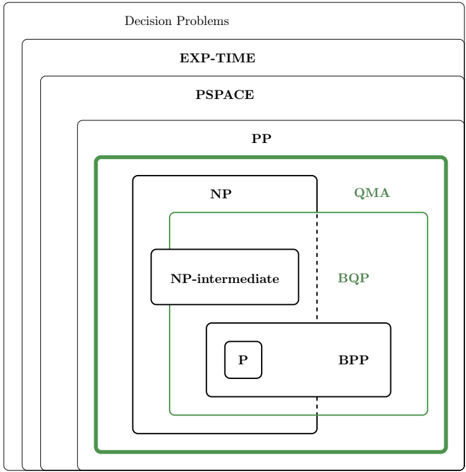
“…for Quantum Merlin–Arthur, and is a complexity class, containing P and NP, of problems that are in general not believed to be efficiently solvable by quantum computers), quantum Gibbs sampling 246 has a crucial role in various optimization algorithms, such as discrete and convex optimization.”
Real- and Imaginary-Time Evolution with Compressed Quantum Circuits
Lin, S.-H., Dilip, R., Green, A. G., Smith, A., & Pollmann, F. (2021) · PRX Quantum · doi:10.1103/prxquantum.2.010342 · Cited by 206
Cook, W. J., Cunningham, W. H., Pulleyblank, W. R., & Schrijver, A. (1997) · Wiley eBooks · doi:10.1002/9781118033142 · Cited by 203
The Numerical Solution of Systems of Polynomials Arising in Engineering and Science
Sommese, A. J., & Wampler, C. W. (2005) · WORLD SCIENTIFIC eBooks · doi:10.1142/9789812567727 · Cited by 203
The Multidimensional Knapsack Problem: Structure and Algorithms
Puchinger, J., Raidl, G. R., & Pferschy, U. (2010) · INFORMS Journal on Computing · doi:10.1287/ijoc.1090.0344 · Cited by 200 · cited 1×
“By contrast, there exist problems with fewer than 100 variables that are difficult to tackle classically 12,13 .”
Quantum gradient descent and Newton’s method for constrained polynomial optimization
Rebentrost, P., Schuld, M., Wossnig, L., Petruccione, F., & Lloyd, S. (2019) · New Journal of Physics · doi:10.1088/1367-2630/ab2a9e · Cited by 196 · cited 2×
“Although the algorithm may admit a polylog( n ) complexity, amplifying the 0 state at the end of the gradient procedure can cost O (2 T ) and an efficient circuit may be constructed only for special cases 118,120 or could be approximated via pre-training a parameterized quantum circuit.”
Self-citationA concise review of Rydberg atom based quantum computation and quantum simulation*
Wu, X., Liang, X., Tian, Y., Yang, F., Chen, C., Liu, Y.-C., Tey, M. K., & You, L. (2021) · Chinese Physics B · doi:10.1088/1674-1056/abd76f · Cited by 192
Real- and Imaginary-Time Evolution with Compressed Quantum Circuits
Lin, S.-H., Dilip, R., Green, A. G., Smith, A., & Pollmann, F. (2021) · UCL Discovery (University College London) · Cited by 192
Quantum agents in the Gym: a variational quantum algorithm for deep Q-learning
Skolik, A., Jerbi, S., & Dunjko, V. (2022) · Quantum · doi:10.22331/q-2022-05-24-720 · Cited by 191 · cited 1×
“For example, it has been proved 154,155 that there exists task environments with a super-polynomial advantage for quantum reinforcement-learning algorithms (with respect to finding optimal policies and optimal q -functions), unless the discrete logarithm problem has an efficient classical solution.”
Self-citationEfficient Long-Range Entanglement Using Dynamic Circuits
Bäumer, E., Tripathi, V., Wang, D. S., Rall, P., Chen, E. H., Majumder, S., Seif, A., & Minev, Z. (2024) · PRX Quantum · doi:10.1103/prxquantum.5.030339 · Cited by 191 · cited 1×
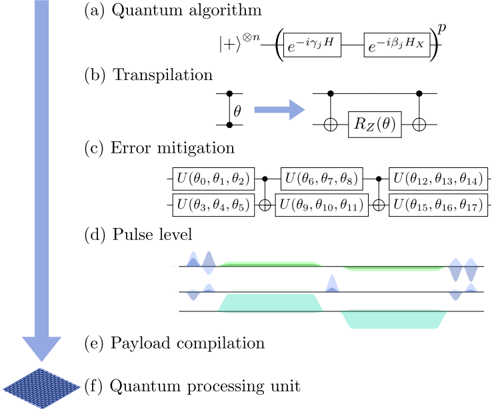
“…is evolving quickly, and Review article model-independent benchmarks are better suited for comparability and compatibility between different generations of hardware, enabling leverage of new features that might not have been available in earlier generations, such as dynamic quantum circuits 178 .”
XY mixers: Analytical and numerical results for the quantum alternating operator ansatz
Wang, Z., Rubin, N. C., Dominy, J. M., & Rieffel, E. G. (2020) · Physical Review A · doi:10.1103/physreva.101.012320 · Cited by 190 · cited 12×
“The relationship between solving a QUBO and finding the ground state of a Hamiltonian is fundamental to many quantum optimization algorithms.”
InfluentialSmoothed analysis: an attempt to explain the behavior of algorithms in practice
Spielman, D. A., & Teng, S.-H. (2009) · Communications of the ACM · doi:10.1145/1562764.1562785 · Cited by 189
Quantum Computational Complexity
Watrous, J. (2009) · Encyclopedia of Complexity and Systems Science · doi:10.1007/978-0-387-30440-3_428 · Cited by 189
Minimum cost flows, MDPs, and ℓ 1 -regression in nearly linear time for dense instances
van den Brand, J., Lee, Y. T., Liu, Y. P., Saranurak, T., Sidford, A., Song, Z., & Wang, D. (2021) · ACM Symposium on Theory of Computing (STOC) · doi:10.1145/3406325.3451108 · Cited by 180
How powerful is adiabatic quantum computation?
van Dam, W., Mosca, M., & Vazirani, U. (2001) · Proceedings 42nd IEEE Symposium on Foundations of Computer Science · doi:10.1109/sfcs.2001.959902 · Cited by 175 · cited 1×
“The amount of time needed to ensure that quantum annealing produces optimal solutions is proportional to the minimum gap in the eigenspectrum of the quantum Hamiltonian during the evolution process, which is known to shrink exponentially with n for many interesting optimization problems 46 .”
Quantum gradient descent for linear systems and least squares
Kerenidis, I., & Prakash, A. (2020) · Physical Review A · doi:10.1103/physreva.101.022316 · Cited by 171 · cited 1×
“In high-dimensional situations, the availability of the quantum linear-systems algorithm and of quantum linear-algebra methods motivates the direct quantum implementation of gradient descent over O (polylog( n )) qubits 118,119 to provide descriptions of stationary points of non-convex functions.”
Noisy intermediate-scale quantum (NISQ) algorithms
Bharti, K., Cervera-Lierta, A., Kyaw, T. H., Haug, T., Alperin-Lea, S., Anand, A., Degroote, M., Heimonen, H., Kottmann, J. S., Menke, T., et al. (2021) · arXiv · doi:10.48550/arxiv.2101.08448 · Cited by 166
New Inapproximability Bounds for TSP
Karpiński, M., Lampis, M., & Schmied, R. (2013) · Journal of Computer and System Sciences · doi:10.1007/978-3-642-45030-3_53 · Cited by 161
On the computational complexity of membership problems for the completely positive cone and its dual
Dickinson, P. J. C., & Gijben, L. (2013) · Computational Optimization and Applications · doi:10.1007/s10589-013-9594-z · Cited by 159 · cited 4×
“For a fixed n , these matrices form a convex cone 138 , but even the test of membership in this cone is NP-hard 139 .”
InfluentialApplication-Oriented Performance Benchmarks for Quantum Computing
Lubinski, T., Johri, S., Varosy, P., Coleman, J., Zhao, L., Necaise, J., Baldwin, C. H., Mayer, K., & Proctor, T. (2021) · arXiv · doi:10.48550/arxiv.2110.03137 · Cited by 159
Digital Annealer for High-Speed Solving of Combinatorial optimization Problems and Its Applications
Matsubara, S., Takatsu, M., Miyazawa, T., Shibasaki, T., Watanabe, Y., Takemoto, K., & Tamura, H. (2020) · 2020 25th Asia and South Pacific Design Automation Conference (ASP-DAC) · doi:10.1109/asp-dac47756.2020.9045100 · Cited by 156 · cited 1×
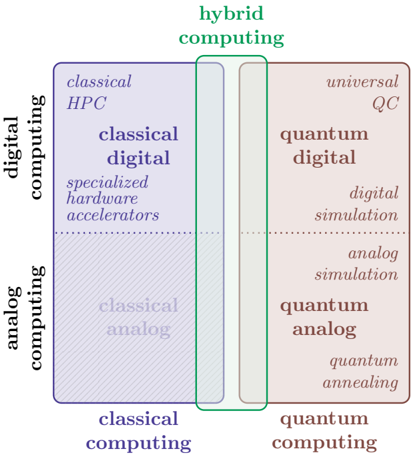
“Well-known examples of this type of technology are the Fujitsu Digital Annealer 182,183 , which is based on a hardware-accelerated”
Application-Oriented Performance Benchmarks for Quantum Computing
Lubinski, T., Johri, S., Varosy, P., Coleman, J., Zhao, L., Necaise, J., Baldwin, C. H., Mayer, K., & Proctor, T. (2023) · IEEE Transactions on Quantum Engineering · doi:10.1109/tqe.2023.3253761 · Cited by 154 · cited 1×
“Previous work has focused on application-centric quantum-hardware benchmarking frameworks that employ optimization problems as an exemplary use-case 163–166 .”
Quantum walk speedup of backtracking algorithms
Montanaro, A. (2018) · Theory of Computing · doi:10.4086/toc.2018.v014a015 · Cited by 154
Grover Adaptive Search for Constrained Polynomial Binary Optimization
Gilliam, A., Woerner, S., & Gonciulea, C. (2021) · Quantum · doi:10.22331/q-2021-04-08-428 · Cited by 153 · cited 2×
“As in unconstrained discrete optimization, Grover search can be leveraged to achieve a quadratic speedup over brute-force search 77 .”
Self-citationde Werra, D. (1981) · North-Holland mathematics studies · doi:10.1016/s0304-0208(08)73478-9 · Cited by 149
Arora, S., Hazan, E., & Kale, S. (2005) · Annual Symposium on Foundations of Computer Science · doi:10.1109/sfcs.2005.35 · Cited by 148 · cited 1×
“The first quantum algorithms for SDP were first-order methods, based on the multiplicative weights update (MWU) frame work 91 .”
Progress in mathematical programming solvers from 2001 to 2020
Koch, T., Berthold, T., Pedersen, J., & Vanaret, C. (2022) · EURO Journal on Computational Optimization · doi:10.1016/j.ejco.2022.100031 · Cited by 146
Self-citationFault-Tolerant Resource Estimation of Quantum Random-Access Memories
Matteo, O. D., Gheorghiu, V., & Mosca, M. (2020) · IEEE Transactions on Quantum Engineering · doi:10.1109/tqe.2020.2965803 · Cited by 144
SupermarQ: A Scalable Quantum Benchmark Suite
Tomesh, T., Gokhale, P., Omole, V., Ravi, G. S., Smith, K. N., Viszlai, J., Wu, X.-C., Hardavellas, N., Martonosi, M. R., & Chong, F. T. (2022) · arXiv · doi:10.48550/arxiv.2202.11045 · Cited by 143
Quantum Speed-Ups for Solving Semidefinite Programs
Brandao, F. G. S. L., & Svore, K. M. (2017) · 2017 IEEE 58th Annual Symposium on Foundations of Computer Science (FOCS) · doi:10.1109/focs.2017.45 · Cited by 142 · cited 1×
“Initial results had a run time of mns ~ poly( )) ε , in which s is the row sparsity of the input matrices and O ~ ignores poly-logarithmic factors in all variables 92,93 .”
Variational Thermal Quantum Simulation via Thermofield Double States
Wu, J., & Hsieh, T. H. (2019) · Physical Review Letters · doi:10.1103/physrevlett.123.220502 · Cited by 139
SupermarQ: A Scalable Quantum Benchmark Suite
Tomesh, T., Gokhale, P., Omole, V., Ravi, G. S., Smith, K. N., Viszlai, J., Wu, X.-C., Hardavellas, N., Martonosi, M. R., & Chong, F. T. (2022) · 2022 IEEE International Symposium on High-Performance Computer Architecture (HPCA) · doi:10.1109/hpca53966.2022.00050 · Cited by 139
Quantum gradient descent and Newton’s method for constrained polynomial optimization
Rebentrost, F. P., & Lloyd, S. (2019) · DSpace@MIT (Massachusetts Institute of Technology) · Cited by 130
What Works Best When? A Systematic Evaluation of Heuristics for Max-Cut and QUBO
Dunning, I., Gupta, S., & Silberholz, J. (2018) · INFORMS Journal on Computing · doi:10.1287/ijoc.2017.0798 · Cited by 128 · cited 1×
“156–161.”
Self-citationBenchmarking the quantum approximate optimization algorithm
Willsch, M., Willsch, D., Jin, F., De Raedt, H., & Michielsen, K. (2020) · Quantum Information Processing · doi:10.1007/s11128-020-02692-8 · Cited by 128 · cited 1×
“166–175.”
Bapst, V., Foini, L., Krzakala, F., Semerjian, G., & Zamponi, F. (2013) · Physics Reports · doi:10.1016/j.physrep.2012.10.002 · Cited by 127 · cited 1×
“However, QAA may be an effective heuristic in non-adiabatic implementations 44,168,169,174,230–233 .”
Variational Quantum Gibbs State Preparation with a Truncated Taylor Series
Wang, Y., Li, G., & Wang, X. (2021) · Physical Review Applied · doi:10.1103/physrevapplied.16.054035 · Cited by 124
Bapst, V., Foini, L., Krząkała, F., Semerjian, G., & Zamponi, F. (2012) · HAL · Cited by 123
Grover Mixers for QAOA: Shifting Complexity from Mixer Design to State Preparation
Bartschi, A., & Eidenbenz, S. (2020) · 2020 IEEE International Conference on Quantum Computing and Engineering (QCE) · doi:10.1109/qce49297.2020.00020 · Cited by 122 · cited 1×
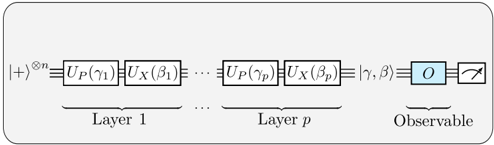
“Alternatively, one can also directly replace the mixing Hamiltonian H X in equation (2), for example, for Hamming-weight constraints by an XY -model Hamiltonian 81,82 , or by a Grover-based 83,84 Hamiltonian.”
Froleyks, N., Heule, M. J. H., Iser, D.-I. M., Järvisalo, M., & Suda, M. (2021) · Artificial Intelligence · doi:10.1016/j.artint.2021.103572 · Cited by 121
Shaydulin, R., Li, C., Chakrabarti, S., DeCross, M., Herman, D., Kumar, N., Larson, J., Lykov, D., Minssen, P., Sun, Y., et al. (2024) · Science Advances · doi:10.1126/sciadv.adm6761 · Cited by 120 · cited 2×
“Still, combining Grover Search with other quantum or classical algorithms can lead to an overall quadratic speedup in specific cases 209 .”
A (slightly) improved approximation algorithm for metric TSP
Karlin, A. R., Klein, N., & Gharan, S. O. (2021) · ACM SIGACT Symposium on Theory of Computing (STOC) · doi:10.1145/3406325.3451009 · Cited by 118 · cited 1×
“For example, there are empirical investigations into whether quantum algorithms can achieve better approximation ratios (a measure of how close an approximate solution is to optimality) than classical methods 23–26 .”
Biamonte, J. D. (2008) · Physical Review A · doi:10.1103/physreva.77.052331 · Cited by 115 · cited 1×
“…naturally formulated as a QUBO, and most unconstrained discrete-optimization problems can be mapped to QUBOs 34–37 , for example, by replacing integer variables with a suitable encoding 38,39 or by converting higher-order polynomial terms to additional binary variables and quadratic terms 40,41 .”
Aharonov, D., & Naveh, T. (2002) · arXiv (Cornell University) · doi:10.48550/arxiv.quant-ph/0210077 · Cited by 111
Convex optimization using quantum oracles
van Apeldoorn, J., Gilyén, A., Gribling, S., & de Wolf, R. (2020) · Quantum · doi:10.22331/q-2020-01-13-220 · Cited by 110 · cited 1×
“Here mild quantum speedups (and no-go results) are known 89,90 .”
Self-citationBenchmarking the quantum approximate optimization algorithm
Willsch, M., Willsch, D., Jin, F., Raedt, H. A. D., & Michielsen, K. F. L. (2020) · RWTH Publications (RWTH Aachen) · Cited by 109
Grover's Quantum Algorithm Applied to Global Optimization
Baritompa, W. P., Bulger, D. W., & Wood, G. R. (2005) · SIAM Journal on Optimization · doi:10.1137/040605072 · Cited by 108 · cited 1×
“Multiple approaches lead to exact quantum optimization algorithms, such as Grover (adaptive) search 225–227 and the quantum adiabatic algorithm (QAA).”
Guest column: the quantum PCP conjecture
Aharonov, D., Arad, I., & Vidick, T. (2013) · ACM SIGACT News · doi:10.1145/2491533.2491549 · Cited by 104
Understanding Quantum Tunneling through Quantum Monte Carlo Simulations
Isakov, S. V., Mazzola, G., Smelyanskiy, V. N., Jiang, Z., Boixo, S., Neven, H., & Troyer, M. (2016) · Physical Review Letters · doi:10.1103/physrevlett.117.180402 · Cited by 103
Self-citationMaxCut quantum approximate optimization algorithm performance guarantees for p>1
Wurtz, J., & Love, P. (2021) · Physical Review A · doi:10.1103/physreva.103.042612 · Cited by 103 · cited 1×
“50).”
The overlap gap property: A topological barrier to optimizing over random structures
Gamarnik, D. (2021) · Proceedings of the National Academy of Sciences · doi:10.1073/pnas.2108492118 · Cited by 103
Quantum tomography using state-preparation unitaries
van Apeldoorn, J., Cornelissen, A., Gilyén, A., & Nannicini, G. (2023) · Society for Industrial and Applied Mathematics eBooks · doi:10.1137/1.9781611977554.ch47 · Cited by 103
Self-citationQuantum algorithms and lower bounds for convex optimization
Chakrabarti, S., Childs, A. M., Li, T., & Wu, X. (2020) · Quantum · doi:10.22331/q-2020-01-13-221 · Cited by 101 · cited 1×
“Here mild quantum speedups (and no-go results) are known 89,90 .”
Benchmarking Quantum Coprocessors in an Application-Centric, Hardware-Agnostic, and Scalable Way
Martiel, S., Ayral, T., & Allouche, C. (2021) · IEEE Transactions on Quantum Engineering · doi:10.1109/tqe.2021.3090207 · Cited by 100
QUARK: A Framework for Quantum Computing Application Benchmarking
Finžgar, J. R., Ross, P., Hölscher, L., Klepsch, J., & Luckow, A. (2022) · IEEE International Conference on Quantum Computing and Engineering (QCE) · doi:10.1109/qce53715.2022.00042 · Cited by 100 · cited 1×
“177 with respect to the solution quality and time-to-solution, which is a good baseline for an optimization benchmark.”
Hybrid quantum-classical algorithms for approximate graph coloring
Bravyi, S., Kliesch, A., Koenig, R., & Tang, E. (2022) · Quantum · doi:10.22331/q-2022-03-30-678 · Cited by 99 · cited 1×
“Recent works 58–61 have generalized recursive quantum approaches to problems beyond MAXCUT and to circuit ansatz beyond the QAOA.”
Quantum optimization with a novel Gibbs objective function and ansatz architecture search
Li, L., Fan, M., Coram, M., Riley, P., & Leichenauer, S. (2020) · Physical Review Research · doi:10.1103/physrevresearch.2.023074 · Cited by 98 · cited 1×
“Another cost function is the Gibbs objective function 76 .”
A Quantum Interior Point Method for LPs and SDPs
Kerenidis, I., & Prakash, A. (2020) · ACM Transactions on Quantum Computing · doi:10.1145/3406306 · Cited by 94
Benchmarking Quantum Annealing Controls with Portfolio Optimization
Grant, E., Humble, T. S., & Stump, B. (2021) · Physical Review Applied · doi:10.1103/physrevapplied.15.014012 · Cited by 90
Quantum Resources Required to Block-Encode a Matrix of Classical Data
Clader, B. D., Dalzell, A. M., Stamatopoulos, N., Salton, G., Berta, M., & Zeng, W. J. (2022) · IEEE Transactions on Quantum Engineering · doi:10.1109/tqe.2022.3231194 · Cited by 90
Quantum Hamiltonian complexity in thermal equilibrium
Bravyi, S. B., Chowdhury, A. C. N., Gosset, D., & Wocjan, P. (2022) · Nature Physics · doi:10.1038/s41567-022-01742-5 · Cited by 89 · cited 1×
“Believed to be at least QMA-hard 244,245 (in which QMA stands for Quantum Merlin–Arthur, and is a complexity class, containing P and NP, of problems that are in general not believed to be efficiently solvable by quantum computers), quantum Gibbs sampling 246 has a crucial role in various…”
How Much Structure Is Needed for Huge Quantum Speedups?Preprint
Aaronson, S. (2022) · arXiv (Cornell University) · doi:10.48550/arxiv.2209.06930 · Cited by 89
On the Representation of Boolean and Real Functions as Hamiltonians for Quantum Computing
Hadfield, S. (2021) · ACM Transactions on Quantum Computing · doi:10.1145/3478519 · Cited by 86
Self-citationVidick, T., & Watrous, J. (2016) · Foundations and Trends® in Theoretical Computer Science · doi:10.1561/0400000068 · Cited by 85
Quantum SDP-Solvers: Better upper and lower bounds
van Apeldoorn, J., Gilyén, A., Gribling, S., & de Wolf, R. (2020) · Quantum · doi:10.22331/q-2020-02-14-230 · Cited by 82 · cited 2×
“Initial results had a run time of mns ~ poly( )) ε , in which s is the row sparsity of the input matrices and O ~ ignores poly-logarithmic factors in all variables 92,93 .”
Self-citationBasso, J., Gamarnik, D., Mei, S., & Zhou, L. (2022) · Annual Symposium on Foundations of Computer Science · doi:10.1109/focs54457.2022.00039 · Cited by 80 · cited 1×
“Empirical studies do not replace theoretical research, but rather they complement each other.”
Quantum-Informed Recursive Optimization Algorithms
Finžgar, J. R., Kerschbaumer, A., Schuetz, M. J. A., Mendl, C. B., & Katzgraber, H. G. (2024) · PRX Quantum · doi:10.1103/prxquantum.5.020327 · Cited by 80 · cited 1×
“Recent works 58–61 have generalized recursive quantum approaches to problems beyond MAXCUT and to circuit ansatz beyond the QAOA.”
Implementing Pure Adaptive Search with Grover's Quantum Algorithm
Bulger, D. W., Baritompa, W. P., & Wood, G. R. (2003) · Journal of Optimization Theory and Applications · doi:10.1023/a:1023061218864 · Cited by 79
Zero-temperature quantum annealing bottlenecks in the spin-glass phase
Knysh, S. (2016) · Nature Communications · doi:10.1038/ncomms12370 · Cited by 79
Faster exact solution of sparse MaxCut and QUBO problems
Rehfeldt, D., Koch, T., & Shinano, Y. (2023) · Mathematical Programming Computation · doi:10.1007/s12532-023-00236-6 · Cited by 77 · cited 2×
“In fact, it is not uncommon for many problems — such as the Euclidean TSP, or Steiner tree problems in graphs — that pre-processing is able to remove 95% of the variables and, hence, substantially reduce the problem size and resource requirements 179,180 .”
Self-citationQuantum-enhanced greedy combinatorial optimization solver
Dupont, M., Evert, B., Hodson, M. J., Sundar, B., Jeffrey, S., Yamaguchi, Y., Feng, D., Maciejewski, F. B., Hadfield, S., Alam, M. S., et al. (2023) · Science Advances · doi:10.1126/sciadv.adi0487 · Cited by 77
Self-citationBenchmarking a quantum annealing processor with the time-to-target metric
King, J., Yarkoni, S., Nevisi, M. M., Hilton, J. P., & McGeoch, C. C. (2015) · arXiv · doi:10.48550/arxiv.1508.05087 · Cited by 77 · cited 1×
“However, QAA may be an effective heuristic in non-adiabatic implementations 44,168,169,174,230–233 .”
Self-citationConstrained optimization via quantum Zeno dynamics
Herman, D., Shaydulin, R., Sun, Y., Chakrabarti, S., Hu, S., Minssen, P., Rattew, A. G., Yalovetzky, R., & Pistoia, M. (2023) · Communications Physics · doi:10.1038/s42005-023-01331-9 · Cited by 75 · cited 1×
“Another approach is to leverage quantum Zeno dynamics to repeatedly project the state back to the feasible subspace 85 .”
The Quantum Approximate Optimization Algorithm Needs to See the Whole Graph: A Typical Case
Farhi, E., Gamarnik, D., & Gutmann, S. (2020) · arXiv (Cornell University) · doi:10.48550/arxiv.2004.09002 · Cited by 75
Quantum Hamiltonian DescentPreprint
Leng, J., Hickman, E., Li, J., & Wu, X. (2023) · arXiv (Cornell University) · doi:10.48550/arxiv.2303.01471 · Cited by 75
Ground-state statistics from annealing algorithms: quantum versus classical approaches
Matsuda, Y., Nishimori, H., & Katzgraber, H. G. (2009) · New Journal of Physics · doi:10.1088/1367-2630/11/7/073021 · Cited by 74 · cited 1×
“Hence, quantum annealing research tends to focus on empirical studies of the behaviour of the algorithm in ideal 47 and noisy computational settings 48,49 .”
Quantum Interior Point Methods for Semidefinite Optimization
Augustino, B., Nannicini, G., Terlaky, T., & Zuluaga, L. F. (2023) · Quantum · doi:10.22331/q-2023-09-11-1110 · Cited by 74 · cited 1×
“…introduces a run time dependence on the condition number of the Newton linear system, which, unfortunately, goes to ∞ as optimality is approached — although these two issues can be partly dealt with by IPMs that allow inexact search directions 103 and by iterative refinement techniques 104,105 .”
Self-citationA Class of Hard Small 0-1 Programs
Cornuéjols, G., & Dawande, M. (1999) · INFORMS journal on computing · doi:10.1287/ijoc.11.2.205 · Cited by 73
Transferability of optimal QAOA parameters between random graphs
Galda, A., Liu, X., Lykov, D., Alexeev, Y., & Safro, I. (2021) · 2021 IEEE International Conference on Quantum Computing and Engineering (QCE) · doi:10.1109/qce52317.2021.00034 · Cited by 72
Quantum Speedups for Exponential-Time Dynamic Programming Algorithms
Ambainis, A., Balodis, K., Iraids, J., Kokainis, M., Prūsis, K., & Vihrovs, J. (2019) · Proceedings of the Thirtieth Annual ACM-SIAM Symposium on Discrete Algorithms · doi:10.1137/1.9781611975482.107 · Cited by 70 · cited 2×
“141 first uses dynamic programming to compute the shortest paths through sets of cities that contain up to 24% of all cities and then uses Grover’s search to find the shortest combination of those paths that visits all of the cities and returns to the starting point.”
Self-citationApproximate Solutions of Combinatorial Problems via Quantum Relaxations
Fuller, B., Hadfield, C. F., Glick, J. R., Imamichi, T., Itoko, T., Thompson, R. J., Jiao, Y., Kagele, M., Blom, A. W., Raymond, R., et al. (2024) · IEEE Transactions on Quantum Engineering · doi:10.1109/tqe.2024.3421294 · Cited by 69 · cited 1×
“Another family of near-term compatible approximation algorithms for MAXCUT is given by quantum random access optimization 62,63 .”
Self-citationDigital-Analog Quantum Simulation of Spin Models in Trapped Ions
Arrazola, I., Pedernales, J. S., Lamata, L., & Solano, E. (2016) · Scientific Reports · doi:10.1038/srep30534 · Cited by 68 · cited 1×
“The problems chosen should be sufficiently hard for state-of-the-art classical solvers to leave a margin for quantum methods, but”
Geometry of the copositive and completely positive cones
Dickinson, P. J. C. (2011) · Journal of Mathematical Analysis and Applications · doi:10.1016/j.jmaa.2011.03.005 · Cited by 66
Exact and efficient Lanczos method on a quantum computer
Kirby, W., Motta, M., & Mezzacapo, A. (2023) · Quantum · doi:10.22331/q-2023-05-23-1018 · Cited by 66 · cited 1×
“QPE is also valuable for optimization when a problem is encoded into non-diagonal Hamiltonians 240,241 .”
Gamarnik, D., Jagannath, A., & Wein, A. S. (2024) · SIAM Journal on Computing · doi:10.1137/22m150263x · Cited by 66
Pirnay, N., Ulitzsch, V. Q., Wilde, F., Eisert, J., & Seifert, J. (2024) · Science Advances · doi:10.1126/sciadv.adj5170 · Cited by 66
Temperature Scaling Law for Quantum Annealing Optimizers
Albash, T., Martin-Mayor, V., & Hen, I. (2017) · Physical Review Letters · doi:10.1103/physrevlett.119.110502 · Cited by 65 · cited 1×
“However, QAA may be an effective heuristic in non-adiabatic implementations 44,168,169,174,230–233 .”
The Quadratic Unconstrained Binary Optimization Problem
(2022) · Springer eBooks · doi:10.1007/978-3-031-04520-2 · Cited by 65
Low autocorrelation binary sequences
Packebusch, T., & Mertens, S. (2016) · Journal of Physics A: Mathematical and Theoretical · doi:10.1088/1751-8113/49/16/165001 · Cited by 64 · cited 2×
“For instance, to enable practical advantages, there should be a move away from relying on QRAM for designing quantum optimization algorithms with rigorous quantum speedups: although the QRAM model has led to elegant results, its physical realization remains a distant possibility at best.”
Classical benchmarking of zero noise extrapolation beyond the exactly-verifiable regimePreprint
Anand, S., Temme, K., Kandala, A., & Zaletel, M. P. (2023) · arXiv (Cornell University) · doi:10.48550/arxiv.2306.17839 · Cited by 63
Readiness of Quantum Optimization Machines for Industrial Applications
Perdomo-Ortiz, A., Feldman, A., Ozaeta, A., Isakov, S. V., Zhu, Z., O’Gorman, B., Katzgraber, H. G., Diedrich, A., Neven, H., de Kleer, J., et al. (2019) · Physical Review Applied · doi:10.1103/physrevapplied.12.014004 · Cited by 62
Optimization Applications as Quantum Performance Benchmarks
Lubinski, T., Coffrin, C., McGeoch, C., Sathe, P., Apanavicius, J., & Neira, D. E. B. (2023) · arXiv · doi:10.48550/arxiv.2302.02278 · Cited by 62
Self-citationTight Lipschitz Hardness for optimizing Mean Field Spin Glasses
Huang, B., & Sellke, M. (2022) · Annual Symposium on Foundations of Computer Science · doi:10.1109/focs54457.2022.00037 · Cited by 61
Golden, J. K., Bärtschi, A., O’Malley, D., & Eidenbenz, S. (2023) · IEEE International Conference on Quantum Computing and Engineering (QCE) · doi:10.1109/qce57702.2023.00063 · Cited by 61 · cited 1×
“Alternatively, one can also directly replace the mixing Hamiltonian H X in equation (2), for example, for Hamming-weight constraints by an XY -model Hamiltonian 81,82 , or by a Grover-based 83,84 Hamiltonian.”
Self-citationBridging Classical and Quantum with SDP initialized warm-starts for QAOA
Tate, R., Farhadi, M., Herold, C., Mohler, G., & Gupta, S. (2020) · arXiv · doi:10.48550/arxiv.2010.14021 · Cited by 61
Self-citationNew inapproximability bounds for TSP
Karpinski, M., Lampis, M., & Schmied, R. (2015) · Journal of Computer and System Sciences · doi:10.1016/j.jcss.2015.06.003 · Cited by 61
Wack, A., Paik, H., Javadi-Abhari, A., Jurcevic, P., Faro, I., Gambetta, J. M., & Johnson, B. R. (2021) · arXiv · doi:10.48550/arxiv.2110.14108 · Cited by 61
Multiblock ADMM Heuristics for Mixed-Binary Optimization on Classical and Quantum Computers
Gambella, C., & Simonetto, A. (2020) · IEEE Transactions on Quantum Engineering · doi:10.1109/tqe.2020.3033139 · Cited by 60 · cited 2×
“Similarly, decomposition algorithms (such as splitting, or the alternating direction method of multipliers) for MIP often solve the QUBO subproblem using a quantum computer 125,126 , while solving the continuous subproblem classically.”
Optimization Applications as Quantum Performance Benchmarks
Lubinski, T., Coffrin, C., McGeoch, C., Sathe, P., Apanavicius, J., Bernal Neira, D., & Quantum Economic Development Consortium(QED-C) Collaboration (2024) · ACM Transactions on Quantum Computing · doi:10.1145/3678184 · Cited by 59 · cited 2×
“Previous work has focused on application-centric quantum-hardware benchmarking frameworks that employ optimization problems as an exemplary use-case 163–166 .”
Self-citationNear-optimal Quantum algorithms for multivariate mean estimation
Cornelissen, A., Hamoudi, Y., & Jerbi, S. (2022) · ACM Symposium on Theory of Computing (STOC) · doi:10.1145/3519935.3520045 · Cited by 58 · cited 1×
“The lower bounds for this problem have been established for a more general setting 152 and they show that these quadratic improvements cannot be improved further.”
Quantum algorithm for tree size estimation, with applications to backtracking and 2-player games
Ambainis, A., & Kokainis, M. (2017) · ACM Symposium on Theory of Computing (STOC) · doi:10.1145/3055399.3055444 · Cited by 57 · cited 1×
“…earlier works 78,121 consider the speedup in the case of locating all optima (measured against the classical cost of finding all optima), whereas others 122,123 consider the speedup of obtaining one optimum (out of possibly multiple ones), measured against the classical cost of finding one optimum.”
Self-citationFaster quantum and classical SDP approximations for quadratic binary optimization
Brandão, F. G. S. L., Kueng, R., & França, D. S. (2022) · Quantum · doi:10.22331/q-2022-01-20-625 · Cited by 57
Bridging Classical and Quantum with SDP initialized warm-starts for QAOA
Tate, R., Farhadi, M., Herold, C., Mohler, G., & Gupta, S. (2023) · ACM Transactions on Quantum Computing · doi:10.1145/3549554 · Cited by 57 · cited 1×
“Some variants adjust the QAOA to warm-start it from solutions obtained by classical algorithms, for example, by leveraging classical SDP relaxations and adjusting the QAOA mixers 54,55 .”
Self-citationThe Quantum Alternating Operator Ansatz on Maximum k-Vertex Cover
Cook, J., Eidenbenz, S., & Bartschi, A. (2020) · 2020 IEEE International Conference on Quantum Computing and Engineering (QCE) · doi:10.1109/qce49297.2020.00021 · Cited by 55 · cited 1×
“Alternatively, one can also directly replace the mixing Hamiltonian H X in equation (2), for example, for Hamming-weight constraints by an XY -model Hamiltonian 81,82 , or by a Grover-based 83,84 Hamiltonian.”
Self-citationUndecidability and hardness in mixed-integer nonlinear programming
Liberti, L. (2018) · RAIRO - Operations Research · doi:10.1051/ro/2018036 · Cited by 53 · cited 1×
“In general, non-convex optimization can be defined as: x ∈ n R Many variants are undecidable 115 , especially in the cases of periodic functions f , or sufficiently non-smooth functions, but k th order critical points of non-convex functions can be studied.”
Quantum speedup of branch-and-bound algorithms
Montanaro, A. (2020) · Physical Review Research · doi:10.1103/physrevresearch.2.013056 · Cited by 53
Andrist, R. S., Schuetz, M. J. A., Minssen, P., Yalovetzky, R., Chakrabarti, S., Herman, D., Kumar, N., Salton, G., Shaydulin, R., Sun, Y., et al. (2023) · Physical Review Research · doi:10.1103/physrevresearch.5.043277 · Cited by 52 · cited 1×
“Here, we suggest an empirical approach to identify more generally applicable quantum heuristics and less formal problem structures in which these heuristics have an advantage in certain instances.”
Quantum Approximate Optimization with Hard and Soft Constraints
Hadfield, S., Wang, Z., Rieffel, E. G., O'Gorman, B., Venturelli, D., & Biswas, R. (2017) · Proceedings of the Second International Workshop on Post Moores Era Supercomputing · doi:10.1145/3149526.3149530 · Cited by 51 · cited 1×
“The quantum alternating operator ansatz 79,80 generalizes the QAOA to much wider classes of problems and encodings, in particular to problems with hard constraints.”
Self-citationQuantum Algorithms for Mixed Binary Optimization Applied to Transaction Settlement
Braine, L., Egger, D. J., Glick, J., & Woerner, S. (2021) · IEEE Transactions on Quantum Engineering · doi:10.1109/tqe.2021.3063635 · Cited by 51
Self-citationBounds on approximating Max k XOR with quantum and classical local algorithms
Marwaha, K., & Hadfield, S. (2022) · Quantum · doi:10.22331/q-2022-07-07-757 · Cited by 49
Self-citation
Research works printed but not linked: 26
- Applegate, D. L., Bixby, R. E., Chvátal, V. & Cook, W. J. On the solution of traveling salesman problems. Doc. Math. 3, 645–656 (1998).
- Cook, W. J. In Pursuit of the Traveling Salesman: Mathematics at the Limits of Computation (Princeton Univ. Press, 2012).
- Crama, Y., Elloumi, S., Lambert, A. & Rodriguez-Heck, E. Quadratization and convexification in polynomial binary optimization. Preprint at https://hal.science/hal-03795395 (2022).
- Chou, C.-N., Love, P. J., Sandhu, J. S. & Shi, J. Limitations of local quantum algorithms on random MAX-k-XOR and beyond. In Proc. 49th International Colloquium on Automata, Languages, and Programming (eds Bojańczyk, M. et al.) 41:1–41:20 (Leibniz International Proceedings in Informatics, 2022).
- Garg, A., Kothari, R., Netrapalli, P. & Sherif, S. No quantum speedup over gradient descent for non-smooth convex optimization. In Proc. 12th Innovations in Theoretical Computer Science Conference (Leibniz International Proceedings in Informatics, 2021).
- Garg, A., Kothari, R., Netrapalli, P. & Sherif, S. Near-optimal lower bounds for convex optimization for all orders of smoothness. In Proc. Advances in Neural Information Processing Systems 34 (eds Ranzato, M. et al.) 29874–29884 (NeurIPS, 2021).
- Grötschel, M., Lovász, L. & Schrijver, A. Geometric Algorithms and Combinatorial Optimization Vol. 2 (Springer, 2012).
- Brandão, F. G. S. L. et al. Quantum SDP solvers: large speed-ups, optimality, and applications to quantum learning. In Proc. 46th International Colloquium on Automata, Languages, and Programming (eds Baier, C. et al.) 27 (Leibniz International Proceedings in Informatics, 2019).
- van Apeldoorn, J. & Gilyén, A. Improvements in quantum SDP-solving with applications. In Proc. 46th International Colloquium on Automata, Languages, and Programming (Leibniz International Proceedings in Informatics, 2019).
- van Apeldoorn, J. A Quantum View on Convex Optimization. PhD thesis, Univ. Amsterdam (2020).
- Chakraborty, S., Gilyén, A. & Jeffery, S. The power of block-encoded matrix powers: improved regression techniques via faster Hamiltonian simulation. In Proc. 46th International Colloquium on Automata, Languages, and Programming 33:1–33:14 (Leibniz International Proceedings in Informatics, 2019).
- Zhang, C. & Li, T. Quantum lower bounds for finding stationary points of nonconvex functions. In International Conference on Machine Learning 41268–41299 (PMLR, 2023).
- Gambella, C., Simonetto, A., Mevissen, M. & Marecek, J. Mixed-binary constrained optimization on quantum computers. US patent 16/395,560 (2020).
- Bertsekas, D. P. Constrained Optimization and Lagrange Multiplier Methods (Academic Press, 2014).
- Gaspers, S. & Li, J. Z. Quantum algorithms for graph coloring and other partitioning, covering, and packing problems. In Proc. 51st International Colloquium on Automata, Languages, and Programming 69:1–69:20 (Leibniz International Proceedings in Informatics, 2024).
- Kļevickis, V., Prūsis, K. & Vihrovs, J. Quantum speedups for treewidth. In Proc. 17th Conference on the Theory of Quantum Computation, Communication and Cryptography (eds Gall, F. L. & Morimae, T.) 11:1–11:18 (Leibniz International Proceedings in Informatics, 2022).
- Cornelissen, A. J. Quantum gradient estimation and its application to quantum reinforcement learning. Master thesis, TU Delft (2018).
- Jerbi, S., Cornelissen, A., Ozols, M. & Dunjko, V. Quantum policy gradient algorithms. In Proc. 18th Conference on the Theory of Quantum Computation, Communication and Cryptography (eds Fawzi, O. & Walter, M.) 13:1–13:24 (Leibniz International Proceedings in Informatics, 2023).
- Jerbi, S., Gyurik, C., Marshall, S., Briegel, H. & Dunjko, V. Parametrized quantum policies for reinforcement learning. In Proc. Advances in Neural Information Processing Systems (eds Ranzato, M. et al.) 28362–28375 (NeurIPS, 2021).
- Jain, R. The Art of Computer Systems Performance Analysis: Techniques for Experimental Design, Measurement, Simulation, and Modeling (Wiley, 1991).
- Müller, M., Whitney, B., Henschel, R. & Kumaran, K. in Encyclopedia of Parallel Computing (ed. Padua, D.) 1886–1893 (Springer, 2011).
- Applegate, D. L., Bixby, R. E., Chvatál, V. & Cook, W. J. The Traveling Salesman Problem: A Computational Study (Princeton Univ. Press, 2006).
- Tsukamoto, S., Takatsu, M., Matsubara, S. & Tamura, H. An accelerator architecture for combinatorial optimization problems. Fujitsu Sci. Tech. J. 53, 8–13 (2017).
- Nocedal, J. & Wright, S. J. Numerical Optimization 2nd edn (Springer, 2006).
- Bonnans, J., Gilbert, J., Lemarechal, C. & Sagastizábal, C. Numerical Optimization: Theoretical and Practical Aspects (Springer, 2006).
- Nielsen, M. A. & Chuang, I. L. Quantum Computation and Quantum Information (Cambridge Univ. Press, 2000).
Cited by
Rishiwal, V., Agarwal, U., Yadav, M., Tanwar, S., Garg, D., & Guizani, M. (2025) · IEEE Internet of Things Journal · doi:10.1109/jiot.2025.3535414 · Cited by 79
“For example, QML can enhance the routing efficiency in intelligent transportation systems or optimize energy usage in smart grids, leading to more sustainable and efficient IoT operations [92], [93].”
Towards large-scale quantum optimization solvers with few qubits
Sciorilli, M., Borges, L., Patti, T. L., García-Martín, D., Camilo, G., Anandkumar, A., & Aolita, L. (2025) · Nature Communications · doi:10.1038/s41467-024-55346-z · Cited by 47
Quinton, F. A., Myhr, P. A. S., Barani, M., Crespo del Granado, P., & Zhang, H. (2025) · Scientific Reports · doi:10.1038/s41598-025-96220-2 · Cited by 46
Provable bounds for noise-free expectation values computed from noisy samples
Barron, S. V., Egger, D. J., Pelofske, E., Bärtschi, A., Eidenbenz, S., Lehmkuehler, M., & Woerner, S. (2024) · Nature Computational Science · doi:10.1038/s43588-024-00709-1 · Cited by 25
Self-citationDemonstration of Weighted-Graph Optimization on a Rydberg-Atom Array Using Local Light Shifts
de Oliveira, A. G., Diamond-Hitchcock, E., Walker, D. M., Wells-Pestell, M. T., Pelegrí, G., Picken, C., Malcolm, G. P. A., Daley, A. J., Bass, J., & Pritchard, J. D. (2025) · PRX Quantum · doi:10.1103/prxquantum.6.010301 · Cited by 53
Metadata
- Authors
- Abbas, A., Ambainis, A., Augustino, B., Bärtschi, A., Buhrman, H., Coffrin, C., Cortiana, G., Dunjko, V., Egger, D. J., Elmegreen, B. G., Franco, N., Fratini, F., Fuller, B., Gacon, J., Gonciulea, C., Gribling, S., Gupta, S., Hadfield, S., Heese, R., Kircher, G., Kleinert, T., Koch, T., Korpas, G., Lenk, S., Marecek, J., Markov, V., Mazzola, G., Mensa, S., Mohseni, N., Nannicini, G., O’Meara, C., Tapia, E. P., Pokutta, S., Proissl, M., Rebentrost, P., Sahin, E., Symons, B. C. B., Tornow, S., Valls, V., Woerner, S., Wolf-Bauwens, M. L., Yard, J., Yarkoni, S., Zechiel, D., Zhuk, S., & Zoufal, C.
- Affiliations
- QuSoft (NL)
- University of Latvia (LV)
- Massachusetts Institute of Technology (US)
- Los Alamos National Laboratory (US)
- Centrum Wiskunde & Informatica (NL)
- E.ON (Germany) (DE)
- Leiden University (NL)
- IBM Research - Zurich (CH)
- IBM (United States) (US)
- Fraunhofer Institute for Cognitive Systems (DE)
- Wells Fargo (United States) (US)
- Tilburg University (NL)
- Ames Research Center (US)
- Fraunhofer Institute for Industrial Mathematics (DE)
- Zuse Institute Berlin (DE)
- Athena Research and Innovation Center In Information Communication & Knowledge Technologies (GR)
- Deutsches Zentrum für Luft- und Raumfahrt e. V. (DLR) (DE)
- University of Zurich (CH)
- Science and Technology Facilities Council (GB)
- University of Southern California (US)
- Centre for Quantum Technologies (SG)
- Universität der Bundeswehr München (DE)
- IBM (Ireland) (IE)
- University of Waterloo (CA)
- Data:Lab Munich (Germany) (DE)
- ORCID
- Abbas, Amira
- Ambainis, Andris
- Augustino, Brandon
- Bärtschi, Andreas
- Coffrin, Carleton
- Cortiana, Giorgio
- Dunjko, Vedran
- Egger, Daniel J.
- Elmegreen, Bruce G.
- Franco, Nicola
- Fratini, Filippo
- Fuller, Bryce
- Gacon, Julien
- Gonciulea, Constantin
- Gribling, Sander
- Gupta, Swati
- Hadfield, Stuart
- Heese, Raoul
- Kircher, Gerhard
- Kleinert, Thomas
- Koch, Thorsten
- Korpas, Georgios
- Lenk, Steve
- Marecek, Jakub
- Markov, Vanio
- Mazzola, Guglielmo
- Mensa, Stefano
- Mohseni, Naeimeh
- Nannicini, Giacomo
- O’Meara, Corey
- Pokutta, Sebastian
- Proissl, Manuel
- Rebentrost, Patrick
- Sahin, Emre
- Symons, Benjamin C. B.
- Tornow, Sabine
- Valls, Víctor
- Woerner, Stefan
- Wolf-Bauwens, Mira L.
- Yard, Jon
- Yarkoni, Sheir
- Zhuk, Sergiy
- Zoufal, Christa
- Venue
- Nature Reviews Physics
- Published
- 2024-10-28
- Volume
- 6
- Issue
- 12
- Pages
- 718-735
- ISSN
- 2522-5820 (ISSN-L)
- OpenAlex
- W4403834027
- Semantic Scholar
- e8d07023d5a8dde24bd388b230aee85805d4ec04
- Cited by
- 201
- References
- 228
- Citations by year
- 2026: 83 · 2025: 115 · 2024: 3
- FWCI
- 6.87
- Type
- journal article
- Language
- en
- Open access
- Licence
- other-oa
- www.springernature.com/gp/researchers/text-and-data-mining (tdm)
- www.springernature.com/gp/researchers/text-and-data-mining (vor)
- Locations
- Nature Reviews Physics (publishedVersion)
- Research portal (Tilburg University) (publishedVersion, other-oa)
- UvA-DARE (University of Amsterdam) (publishedVersion, cc-by)
- elib (German Aerospace Center) (acceptedVersion)
- arXiv (Cornell University) (submittedVersion, cc-by)
- Centrum Wiskunde & Informatica (CWI), the national research institute for mathematics and computer science in the Netherlands (submittedVersion)
- RePEc: Research Papers in Economics (submittedVersion)
- HAL (submittedVersion)
- Leiden Repository (Leiden University) (submittedVersion)
- SDL (submittedVersion)
- Fraunhofer-Publica (Fraunhofer-Gesellschaft) (submittedVersion, cc-by)
- Fraunhofer-Publica (Fraunhofer-Gesellschaft) (submittedVersion)
- Science and Technology Facilities Council (submittedVersion)
- arXiv (Cornell University) (cc-by)
- Funders
- National Science Foundation (2229099)
- Amazon Web Services
- Innovation, Science and Economic Development Canada
- Government of Canada
- National Research Foundation
- National Research Foundation Singapore
- Institut Périmètre de physique théorique
- Natural Sciences and Engineering Research Council of Canada (rgpin-2018-04742, ALLRP-569582-21, 04742, RGPIN 2018)
- Topics
- Physical Sciences › Computer Science › Artificial Intelligence › Quantum Computing Algorithms and Architecture
- Physical Sciences › Computer Science › Artificial Intelligence › Metaheuristic Optimization Algorithms Research
- Physical Sciences › Physics and Astronomy › Atomic and Molecular Physics, and Optics › Quantum Information and Cryptography
- Keywords
- quantum optimization, quantum advantage, quantum algorithms, heuristic optimization, benchmarking metrics, problem classes, combinatorial optimization
About these checks
Registry, retraction, Cites and statistics results are computed, not judged, with one exception: a printed reference that no index lists is read once by a model before it counts as a citation error. Claims are extracted by a model and kept only when their quote appears verbatim in the text; each cited source is then checked, with a model’s help, for whether it says what the claim relies on. Those verdicts can be wrong — read the claim’s quote and the cited source before relying on one.
A language model drew the claims from the paper on 2026-09-25 (prompt extract-v1).
Statistics and arithmetic are recomputed, not judged.
Confidence bands are shown only for fields calibrated on our annotated test set. None is calibrated yet, so no band is shown.
What counts as a claim ›How we measure confidence ›How we check this ›
Are you an author, or do you see a problem with this page? Request a review
Data sources
Bibliographic data: Semantic Scholar, OpenAlex, Crossref.
Contains information from the Semantic Scholar Academic Graph Datasets, made available under the ODC Attribution License (ODC-BY 1.0).
Semantic Scholar’s data is described in: Kinney, R., et al. (2023). The Semantic Scholar Open Data Platform. arXiv:2301.10140.
