

Exposure to opposing views on social media can increase political polarization
Open accessThe DOI matches its Crossref record; 60 of the 60 references it cites were found in a registry or an index.
Abstract
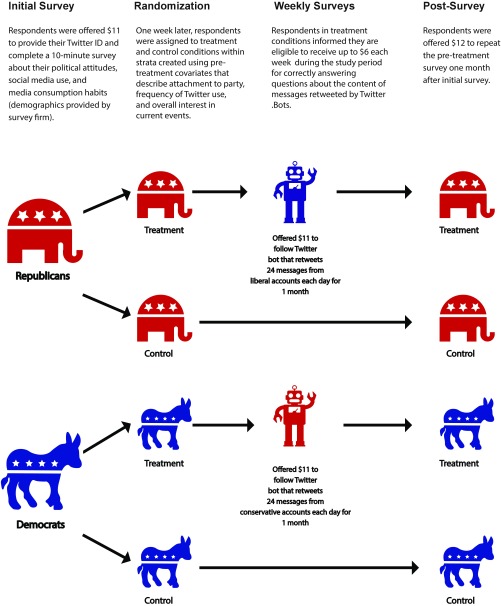
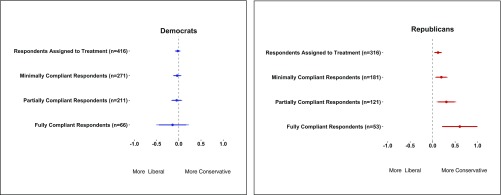
Significance: Social media sites are often blamed for exacerbating political polarization by creating “echo chambers” that prevent people from being exposed to information that contradicts their preexisting beliefs. We conducted a field experiment that offered a large group of Democrats and Republicans financial compensation to follow bots that retweeted messages by elected officials and opinion leaders with opposing political views. Republican participants expressed substantially more conservative views after following a liberal Twitter bot, whereas Democrats’ attitudes became slightly more liberal after following a conservative Twitter bot—although this effect was not statistically significant. Despite several limitations, this study has important implications for the emerging field of computational social science and ongoing efforts to reduce political polarization online.
Overview
The claims and statistics of this paper haven’t been checked yet.
Free: it reads the open-access text and checks the first 5 claims that cite a source we can check. Create a free account to check every claim.
Integrity signals
Registry
Cites
Statistics
Figures
Verification
Claims the paper makes
The claims and statistics of this paper haven’t been checked yet.
Free: it reads the open-access text and checks the first 5 claims that cite a source we can check. Create a free account to check every claim.
Claims other papers make about this one
Each is checked against this paper’s own text: does it say what the citing paper says it does?
The cited source doesn’t support the claim as written.
In the citing paper
“Supporting this, Bail et al. [2] further challenge the polarization assumption, showing that social media use can increase exposure to non-partisan content.”
From A systematic review of echo chamber research: comparative analysis of conceptualizations, operationalizations, and varying outcomes (2025) · cites this paper as [2]
Checked by a reasoning model — may be wrong.
Experimental — accuracy not yet measuredThe source backs part of the claim, not all of it — or backs it for a different population, condition or comparison.
In the citing paper
“For instance, it is neither clear what level of homophily in social networks is desirable or undesirable in a democratic society, nor is it clear how to interpret the results of certain studies on polarization69,130, whose findings depend on whether one assumes that social media have increased or decreased exposure to opposing views relative to some offline benchmark.”
From A systematic review of worldwide causal and correlational evidence on digital media and democracy (2022) · cites this paper as [69]
Experimental — accuracy not yet measuredThe source backs part of the claim, not all of it — or backs it for a different population, condition or comparison.
In the citing paper
“Even without being designed to shift opinions, it has been found that algorithms may contribute to political polarization by reinforcing divisive opinions [9, 24, 32].”
From Co-Writing with Opinionated Language Models Affects Users’ Views (2023) · cites this paper as [9]
Experimental — accuracy not yet measuredThe source backs part of the claim, not all of it — or backs it for a different population, condition or comparison.
In the citing paper
“Entrar en contacto con contenido contra-actitudinal puede generar una resistencia emocional y una sensación de amenaza que terminen polarizando igualmente al individuo (Bail et al., 2018;Dahlgren, 2022).”
From Política, uso de medios y polarización afectiva en España (2024) · cites this paper as Bail et al., 2018
Experimental — accuracy not yet measuredThe source backs part of the claim, not all of it — or backs it for a different population, condition or comparison.
In the citing paper
“Experimental approaches show e.g., how distorted meta-representations of outgroups on digital platforms can result in disaffection across ideological groups (Bail et al. 2018, Banks et al. 2021).”
From When debates break apart: discursive polarization as a multi-dimensional divergence emerging in and through communication (2023) · cites this paper as Bail et al. 2018
Experimental — accuracy not yet measured
18 more claims about this paper
Create a free account to see every claim other papers make about this one.
Self-check
Percentages, sums and reported differences re-computed from the paper’s own numbers.
The self-check needs the paper’s full text.
Citations
Cites
Birds of a Feather: Homophily in Social Networks
McPherson, M., Smith-Lovin, L., & Cook, J. M. (2001) · Annual Review of Sociology · doi:10.1146/annurev.soc.27.1.415 · Cited by 18,567 · cited 1×
“Despite initial optimism that social media might enable people to consume more heterogeneous sources of information about current events, there is growing concern that such forums exacerbate political polarization because of social network homophily, or the well-documented tendency of people to form social network tie…”
BackgroundA meta-analytic test of intergroup contact theory.
Pettigrew, T. F., & Tropp, L. R. (2006) · Journal of personality and social psychology · doi:10.1037/0022-3514.90.5.751 · Cited by 9,708 · cited 1×
“A vast literature indicates contact between opposing groups can challenge stereotypes that develop in the absence of positive interactions between them (30).”
BackgroundLord, C. G., Ross, L., & Lepper, M. R. (1979) · Journal of Personality and Social Psychology · doi:10.1037/0022-3514.37.11.2098 · Cited by 4,583
Liberals and conservatives rely on different sets of moral foundations.
Graham, J., Haidt, J., & Nosek, B. A. (2009) · Journal of Personality and Social Psychology · doi:10.1037/a0015141 · Cited by 4,560
Motivated Skepticism in the Evaluation of Political Beliefs
Taber, C. S., & Lodge, M. (2006) · American Journal of Political Science · doi:10.1111/j.1540-5907.2006.00214.x · Cited by 4,344
Lazer, D., Pentland, A., Adamic, L., Aral, S., Barabási, A.-L., Brewer, D., Christakis, N., Contractor, N., Fowler, J., Gutmann, M., et al. (2009) · Science · doi:10.1126/science.1167742 · Cited by 3,365
Exposure to ideologically diverse news and opinion on Facebook
Bakshy, E., Messing, S., & Adamic, L. A. (2015) · Science · doi:10.1126/science.aaa1160 · Cited by 3,245
When Corrections Fail: The Persistence of Political Misperceptions
Nyhan, B., & Reifler, J. (2010) · Political Behavior · doi:10.1007/s11109-010-9112-2 · Cited by 3,173
Fear and loathing across party lines: New evidence on group polarization
Iyengar, S., & Westwood, S. J. (2015) · American Journal of Political Science · doi:10.1111/ajps.12152 · Cited by 2,452
Uncivil Agreement: How Politics Became Our Identity
Mason, L. (2018) · doi:10.7208/chicago/9780226524689.001.0001 · Cited by 1,985
Research works printed but not linked: 1
- Sunstein C 2001 Echo Chambers, Bush v. Gore, Impeachment, and Beyond Princeton Univ Press Princeton
Cited by
Items 901–1,000 of 1,010
Nationalism, Populism and Global Social Media
Adriani, R. (2019) · Glocalism Journal of Culture Politics and Innovation · doi:10.12893/gjcpi.2019.2.2 · Cited by 6
Kemmelmeier, M., Nesbitt, I. S., & Erhart, R. S. (2021) · Analyses of Social Issues and Public Policy · doi:10.1111/asap.12246 · Cited by 5
Lu, Y., & Lee, J. K. (2021) · The Social Science Journal · doi:10.1080/03623319.2021.1937469 · Cited by 3
“While exposure to diverse viewpoints offline is found to enhance political tolerance and mutual understanding (Mutz, 2006), exposure to counter-attitudinal information on social media is likely to further polarize people’s opinions (Bail et al., 2018; Lee et al., 2014).”
Self-citationAssaults on Freedom of Speech: Why Social Studies Must Defend the First Amendment
Moore, J. R. (2021) · The Social Studies · doi:10.1080/00377996.2021.1949258 · Cited by 3
“The first amendment and modern communication technologies Political polarization is abetted by the rise of social media that allows individuals to reside in virtual “echo chambers” where they are not exposed to dissenting views which hardens their preexisting beliefs (Bail et al., 2018).”
BackgroundLong tail metaphysics: The epistemic crisis and intellectual freedom
Hartman‐Caverly, S. (2021) · IFLA Journal · doi:10.1177/03400352211057146 · Cited by 5
“Empirical studies have found that exposing media users to opposing political views or even editorial corrections can be counterproductive, strengthening their preexisting beliefs or trust in the original faulty reporting (Bail et al., 2018; Lenker, 2016).”
BackgroundSentinel node approach to monitoring online COVID-19 misinformation
Osborne, M., Malloy, S. S., Nisbet, E. C., Bond, R. M., & Tien, J. H. (2022) · Scientific Reports · doi:10.1038/s41598-022-12450-8 · Cited by 8
Linder, W., & Mueller, S. (2021) · Springer eBooks · doi:10.1007/978-3-030-63266-3_4 · Cited by 3
A variational-autoencoder approach to solve the hidden profile task in hybrid human-machine teams
Pescetelli, N., Reichert, P., & Rutherford, A. (2022) · PLoS ONE · doi:10.1371/journal.pone.0272168 · Cited by 6
Racialized policing in the social media age
Cheng, T. (2022) · Proceedings of the National Academy of Sciences · doi:10.1073/pnas.2216978119 · Cited by 3
“However, these relationships may reconstitute online audiences that already align with police goals (20)—disguising unequal protection under legitimacy’s cloak (21).”
BackgroundPolarization in Personalized Recommendations: Balancing Safety and Accuracy
El-Moutaouakkil, Z., Lechiakh, M., & Maurer, A. (2022) · Lecture notes in computer science · doi:10.1007/978-3-031-21743-2_53 · Cited by 6
Torres-Echeverry, N. (2023) · Theory and Society · doi:10.1007/s11186-022-09509-w · Cited by 5
“1 3 2015; Gentzkow & Shapiro, 2011), political polarization (Bail et al., 2018; Boxell et al., 2017), misinformation and fake news (Woolley & Howard, 2018), cyberattacks on elections (Bail et al.”
BackgroundGori, L., Sacco, P. L., Teti, E., & Triveri, F. (2023) · International Journal of Business Communication · doi:10.1177/23294884231156903 · Cited by 4
“They seem to be ideally designed to exploit at best the two principles highlighted by Shiller: an endless repetition and rever-beration of contents that “go viral” (Pressgrove et al., 2018), and a tendency to polarize users in terms of their values and social orientations (Bail et al., 2018).”
BackgroundMarler, W., & Hargittai, E. (2023) · Socius Sociological Research for a Dynamic World · doi:10.1177/23780231231157685 · Cited by 4
“Incivility, echo chambers, and misinformation are among the challenges cited, typically focused on news and politics (Allcott et al. 2019; Anderson et al. 2014; Bail et al. 2018).”
BackgroundInfluentialAn organizational form framework to measure and interpret online polarization
Phillips, S. C., & Carley, K. M. (2023) · Information Communication & Society · doi:10.1080/1369118x.2023.2240580 · Cited by 5
“For example, the role of echo chambers and intergroup contact in increasing polarization between communities online is highly contested (Bail et al., 2018; Barberá, 2020; Sunstein, 2018).”
BackgroundPartisan Epistemology and Misplaced Trust
Millar, B. (2023) · Episteme · doi:10.1017/epi.2023.46 · Cited by 4
“For instance, Bail et al .”
Depolarization Without Reconciliation
Talisse, R. B. (2023) · Critical Review · doi:10.1080/08913811.2023.2285116 · Cited by 6
Netflix y la cultura de la cancelación: análisis a través de change.org
Medina, T. D. L. Í. Y., & Cabezas-Clavijo, Á. (2024) · INDEX COMUNICACIÓN · doi:10.62008/ixc/14/01netfli · Cited by 3
Sindermann, C., Montag, C., & Elhai, J. D. (2024) · Journal of Media Psychology Theories Methods and Applications · doi:10.1027/1864-1105/a000417 · Cited by 5
Murthy, S. V. N., Ramesh, P. S., Padmaja, P., Lal, B., Reddy, G. J., & Chinthamu, N. (2024) · Entertainment Computing · doi:10.1016/j.entcom.2024.100659 · Cited by 4
Policy influence and influencers online and off
Kotkaniemi, A., Ylä‐Anttila, T., & Chen, T. H. Y. (2024) · Policy Studies Journal · doi:10.1111/psj.12535 · Cited by 6
Buder, J., & Said, N. (2024) · New Media & Society · doi:10.1177/14614448241247214 · Cited by 6
“…experience of cognitive dissonance (Matz and Wood, 2005) or perceived norm violations (Hsu et al., 2021) which may lead to replies that use offensive speech (Lyu, 2023); there is also evidence that experiencing uncongenial information may play a role in attitude polarization (Bail et al., 2018).”
Mapping Racial and Ethnic Variation in Climate Belief Networks
Stewart, E. M., Rivera-Kientz, K., & Dacey, T. (2024) · Sociology of Race and Ethnicity · doi:10.1177/23326492241259404 · Cited by 6
The Fitness-Validation Model of Propagandist Persuasion and the 5Ds of Propaganda
Adam‐Troian, J. (2024) · Journal of Media Psychology Theories Methods and Applications · doi:10.1027/1864-1105/a000442 · Cited by 4
Heiler, P. (2024) · Journal of Econometrics · doi:10.1016/j.jeconom.2024.105856 · Cited by 17
“Beam et al. (2018) show that, over the course of the US 2016 presidential election campaign, attitudes towards political opponents remained relatively stable.”
BackgroundZichettella, B., Weeks, B. E., & Hasell, A. (2024) · International Journal of Public Opinion Research · doi:10.1093/ijpor/edae051 · Cited by 5
Cognitive dissonance, political participation, and changes in policy preferences
González, T. A., Capozza, F., & Granic, G. D. (2022) · Journal of Economic Psychology · doi:10.1016/j.joep.2024.102774 · Cited by 12
Moore, R. C., Dahlke, R., Forberg, P. L., & Hancock, J. T. (2024) · Proceedings of the ACM on Human-Computer Interaction · doi:10.1145/3687057 · Cited by 8
“However, past research using digital trace data has not found evidence of strong Hawthorne Effects [13, 100], and the prevalence of website visits in our data with sensitive material, such as pornography sites, suggests that this self-censorship likely did not occur at a significant scale.”
Walker, A. C., Fugelsang, J. A., & Koehler, D. J. (2024) · Cognition · doi:10.1016/j.cognition.2024.106012 · Cited by 7
Kluge, A., & Lévy, J. (2025) · Cortex · doi:10.1016/j.cortex.2024.12.020 · Cited by 3
Wu-Ouyang, B., & Hu, Y. (2025) · Journalism & Mass Communication Quarterly · doi:10.1177/10776990241313183 · Cited by 6
“Given the extensive research that holds a pessimistic view that social media prevent people from having diverse values and being open-minded (Bail et al., 2018; Lee & Choi, 2020), this study argued otherwise by showing that social media can at least act against authoritarian orientations in those…”
Selvanathan, H. P., Leidner, B., Syropoulos, S., Louis, W. R., Adelman, L., Baka, A., Bauer, C., Blikmans, M., Becker, M., Berán, E., et al. (2025) · Group Processes & Intergroup Relations · doi:10.1177/13684302241309554 · Cited by 5
“This possibility aligns with research on political polarization, which shows that exposure to opposing views can cause partisans to become more entrenched in their preexisting views (Bail et al., 2018).”
Disinformation Linking Migration and Crime in Spain: Classic Moral Panics in a New Digital Ecosystem
Aguerri, J. C., Llinares, F. M., & Sande, S. S. (2025) · European Journal on Criminal Policy and Research · doi:10.1007/s10610-025-09620-5 · Cited by 12
Network-based computational communication
Huang, M. D., Wang, J.-L., & Zhang, Z.-K. (2025) · Europhysics Letters (EPL) · doi:10.1209/0295-5075/ade337 · Cited by 3
Injusticia testimonial utilizada como arma
Almagro, M., Osorio, J., & Fernández, N. V. (2021) · Las Torres de Lucca International Journal of Political Philosophy · doi:10.5209/ltdl.76462 · Cited by 5
Chan, C., Zhu, J. Y., Chow, C. S.-L., & Fu, K. (2019) · Journal of Computational Social Science · doi:10.1007/s42001-019-00043-x · Cited by 2
Directionality of information flow and echoes without chambers
Kim, S. (2019) · PLoS ONE · doi:10.1371/journal.pone.0215949 · Cited by 4
Viable Threat on News Reading: Generating Biased News Using Natural Language Models
Gupta, S., Nguyen, H. H., Yamagishi, J., & Echizen, I. (2020) · Workshop on Natural Language Processing and Computational Social Science (NLP+CSS) · doi:10.18653/v1/2020.nlpcss-1.7 · Cited by 5
Meinungsbildung in und mit sozialen Medien
Stark, B., Magin, M., & Geiß, S. (2020) · Springer Reference Sozialwissenschaften · doi:10.1007/978-3-658-03895-3_23-1 · Cited by 6
Attitude Change in Immersive Virtual Environments
Nikolaou, A. (2021) · IEEE Conference on Virtual Reality and 3D User Interfaces Abstracts and Workshops (VRW) · doi:10.1109/vrw52623.2021.00242 · Cited by 3
“I draw this assumption based on recent scholarship demonstrating that even less immersive media, for example social media, can increase polarization when users are exposed to opposite views [15].”
BackgroundDigital Media and Social Movements: Obstacles to Building a Global Media Ethic
Rohlinger, D. A., & DeLucchi, C. (2021) · Springer eBooks · doi:10.1007/978-3-319-32103-5_27 · Cited by 4
Olteanu, A., Rabitz, F., & Nalivaikė, A. (2021) · Punctum International Journal of Semiotics · doi:10.18680/hss.2021.0004 · Cited by 2
“Recently, other media, particularly social media, display a much more stringent affective polarization in American politics (e.g., Bail et al. 2018; Stjernfelt and Laurizen 2020: 40).”
BackgroundPescetelli, N., Barkoczi, D., & Cebrián, M. (2022) · Studies in computational intelligence · doi:10.1007/978-3-030-93413-2_3 · Cited by 4
Jungherr, A. M., & Posegga, O. (2023) · Springer eBooks · doi:10.1007/978-3-658-31480-4_54-1 · Cited by 4
Big Data for Sociological Research
Radford, J. P., & Lazer, D. M. J. (2019) · Wiley eBooks · doi:10.1002/9781119429333.ch24 · Cited by 4
A Model of Polarization on Social Media Caused by Empathy and RepulsionPreprint
Hirakura, N., Aida, M., & Kawashima, K. (2020) · arXiv (Cornell University) · doi:10.48550/arxiv.2011.08141 · Cited by 3
“The repulsive reaction is called the backfire effect in psychology [2], and one report has confirmed the backfire effect of social media use [3].”
Gu, C., Papautsky, E. L., Boyd, A. D., & Zulueta, J. (2021) · The American Journal of Bioethics · doi:10.1080/15265161.2021.1926586 · Cited by 3
“They can also exacerbate political polarization, spread misinformation, and perpetuate cyberbullying (Bail et al. 2018).”
BackgroundDoes Interaction on Social Media Increase or Moderate Extremeness?Preprint
Shanthikumar, D. M., Wang, Q., & Wu, S. (2020) · SSRN Electronic Journal · doi:10.2139/ssrn.3879175 · Cited by 3
Public Health Communication and Engagement on Social Media during the COVID-19 Pandemic (Preprint)Preprint
Teichmann, L., Bridgman, A., Nossek, S., Loewen, P. J., Owen, T., Ruths, D. A., & Zhilin, O. (2020) · doi:10.2196/preprints.23248 · Cited by 5
Rasmussen, S. H. R., & Petersen, M. B. (2022) · PsyArXiv (OSF Preprints) · doi:10.31234/osf.io/vzu4q · Cited by 5
Sindermann, C., Kannen, C., & Montag, C. (2022) · Data in Brief · doi:10.1016/j.dib.2022.108326 · Cited by 3
Brüggemann, M., & Meyer, H. (2022) · doi:10.31219/osf.io/5d4vq · Cited by 3
Meyer, H., Pröschel, L., & Brüggemann, M. (2023) · doi:10.31219/osf.io/nd68z · Cited by 3
High-Profile Crime and Perceived Public Safety: Evidence From Cologne’s New Year’s Eve in 2015Preprint
Lange, M., & Schmidt-Catran, A. W. (2024) · SSRN Electronic Journal · doi:10.2139/ssrn.4690076 · Cited by 4
Dey, S. K., & Dey, S. (2024) · SSRN Electronic Journal · doi:10.2139/ssrn.4704485 · Cited by 3
Mohliver, A. C., & Raines, G. W. (2024) · SSRN Electronic Journal · doi:10.2139/ssrn.4923070 · Cited by 5
Political polarization is about feelings, not facts
Talisse, R. B. (2019) · doi:10.64628/aai.dwn5sc6e4 · Cited by 3
Cross-Partisan Interactions on Twitter
Çetinkaya, Y. M., Ghafouri, V., Suarez-Tangil, G., Such, J., & Elmas, T. (2025) · Proceedings of the International AAAI Conference on Web and Social Media · doi:10.1609/icwsm.v19i1.35819 · Cited by 16
Treuillier, C., Castagnos, S., & Brun, A. (2024) · ACM Symposium on Applied Computing · doi:10.1145/3605098.3635972 · Cited by 4
“The role of diversity in NRS regarding polarization decrease is highly discussed and even highlights a potential strengthening of polarisation [28].”
The critical role of emotional communication for motivated reasoning
Wolf, I., & Schröder, T. (2024) · Scientific Reports · doi:10.1038/s41598-024-81605-6 · Cited by 7
Mitigating group polarization through positive and neutral comment bots
Liu, M., Wu, Y. C., & Li, W. (2025) · Physica A Statistical Mechanics and its Applications · doi:10.1016/j.physa.2025.130580 · Cited by 2
Argumentation strategies in party competition
Hafer, C., Izzo, F., & Landa, D. (2025) · American Journal of Political Science · doi:10.1111/ajps.12983 · Cited by 4
Pamirzad, Q. H., Susyall, G. A., & Hakimi, A. B. (2025) · Journal of Information Communication and Ethics in Society · doi:10.1108/jices-01-2025-0013 · Cited by 2
Hybrid transformer-based recommender system for political news
Vercoutere, S., Pessemier, T. D., & Martens, L. (2025) · Journal of Intelligent Information Systems · doi:10.1007/s10844-025-00951-7 · Cited by 3
“For example, Bail et al. (2018) found that increased exposure to opposing political views on social media could sometimes reinforce users’ pre-existing beliefs, particularly among conservative users.”
Revers, M., & Coleman, S. R. (2025) · American Journal of Cultural Sociology · doi:10.1057/s41290-025-00264-w · Cited by 5
“Polarization in and through communication is a yet under-researched area, though a number of studies focused on the polarizing effects of exposure to diverse and divided encounters on social media (e.g., Bail et al. 2018; Banks et al. 2021).”
Heide‐Jørgensen, T., Eady, G., & Rasmussen, A. (2025) · Science Advances · doi:10.1126/sciadv.adv7864 · Cited by 6
“…can also short-circuit productive debate: Research finds that exposure to out-partisans on social media increases polarization on political issues ( 9 ), that out-partisan animosity drives social media engagement ( 26 ), and that political discussion among family members from opposing political…”
Twitter polarity and computational propaganda: the case of the Woman, Life, Freedom movement in Iran
Rahbari, M. M., Blanchard, P., & Safari, H. (2025) · Journal of Information Technology & Politics · doi:10.1080/19331681.2025.2537270 · Cited by 3
Breaking the Loop: Causal Learning to Mitigate Echo Chambers in Social Networks
Yu, D., Li, Q., Huo, H., & Xu, G. (2025) · ACM Transactions on Information Systems · doi:10.1145/3757738 · Cited by 3
“…echo chambers generally fall into two directions: (1) adjusting content-ranking algorithms to promote exposure to diverse viewpoints across all users [32, 47, 49, 60] or (2) intervening in network structures by connecting isolated communities to encourage cross-group interactions [4, 11].”
Xing, Y., & Zhang, Z. (2025) · Social Media + Society · doi:10.1177/20563051251357872 · Cited by 6
“However, the same affordances that foster collective engagement may simultaneously exacerbate polarization (Bail et al., 2018).”
Zhu, Y. E., & Scherr, S. (2025) · Information Communication & Society · doi:10.1080/1369118x.2025.2539299 · Cited by 2
“For example, Bail et al. (2018) found when Democrats and Republicans were incentivized to engage with opposing viewpoints, Republicans tended to express even stronger conservative views, while Democrats slightly bolstered their liberal beliefs.”
Li, H., Wang, Q., & Wu, Y. (2025) · Mathematics · doi:10.3390/math13193062 · Cited by 4
The Role of Networks in Policing
Ouellet, M., & Hashimi, S. (2025) · Annual Review of Criminology · doi:10.1146/annurev-criminol-032924-115731 · Cited by 2
Social Media Information Operations
Zaman, T. R., & Chen, Y.-S. (2025) · doi:10.1287/educ.2025.0289 · Cited by 2
Buesa, C. B., de Moraes, J. C., & Arf, L. M. G. (2025) · Ámbitos Revista Internacional de Comunicación · doi:10.12795/ambitos.2025.i68.01 · Cited by 3
Andrade, C. F. O., Espinal, E. A., & Benoit, W. L. (2025) · Communication Studies · doi:10.1080/10510974.2025.2574004 · Cited by 4
“…“echo chambers” where users predominantly interact with like-minded individuals (Fränken & Pilditch, 2020), it also facilitates exposure to diverse political content, as users may follow candidates for various reasons, including information-seeking or monitoring opponents (Bail et al., 2018).”
Yuniar, A. D., Ananda, K. S., & Kamarudin, S. B. (2025) · Media Asia · doi:10.1080/01296612.2025.2582030 · Cited by 2
“For example, research has shown that political content on platforms like WhatsApp and Facebook often circulates within homogenous networks, intensifying polarization and reducing the potential for meaningful engagement with opposing views (Bail et al., 2018).”
Zhang, S., Ke, Q., Zhang, L., Zhang, X., & Li, A. (2025) · Computers in Human Behavior · doi:10.1016/j.chb.2025.108865 · Cited by 4
From ‘Neurons to Nations’: Neurocognitive foundations of nationalism
O’Mara, S. M. (2025) · Neuroscience & Biobehavioral Reviews · doi:10.1016/j.neubiorev.2025.106482 · Cited by 2
The effect of charismatic influencers on polarization online: An agent-based modeling approach
Betts, J. M., Bliuc, A., & Courtney, D. S. (2025) · Technology in Society · doi:10.1016/j.techsoc.2025.103179 · Cited by 4
Information Exposure on Social Media and Fear of Civil War: Global Survey Evidence
Guan, M. (2025) · International Journal of Public Opinion Research · doi:10.1093/ijpor/edaf060 · Cited by 2
Zhang, S., FeldmanHall, O., Hétu, S., & Otto, A. R. (2025) · eLife · doi:10.7554/elife.102800.3 · Cited by 4
Agent-based insight into eco-choices: Simulating the fast fashion shift
Soboleva, D. A., & Sánchez, A. (2025) · Ecological Economics · doi:10.1016/j.ecolecon.2025.108824 · Cited by 3
Negotiating extremism: Thematic engagement capacity for red pill conversations on Reddit
Lapan, E., Ophir, Y., Wang, R., Semenov, A., Kountz, K., & Walter, D. (2025) · New Media & Society · doi:10.1177/14614448251400345 · Cited by 3
A Cognitive-Network Framework for Democratic Resilience
Rodríguez, R., Kumar, K. V. R., & Srinivas, J. (2026) · Chinese Political Science Review · doi:10.1007/s41111-025-00331-0 · Cited by 3
“Network science demonstrates how social structure changes during democratic stress, with increased fragmentation and reduced bridge ties creating echo chambers that amplify polarization (Bail et al. 2018 ; Garimella et al. 2018 ).”
CEO Activism and Corporate Reputation: How Authenticity and CSR Mitigate Stakeholder Misalignment
Li, L. Z., & Soule, S. A. (2026) · Journal of Management Studies · doi:10.1111/joms.70060 · Cited by 3
Computational Text Analysis for Building and Testing Social Theory
Bodell, M. H., Keuschnigg, M., Macanovic, A., & Menshikova, A. (2026) · KZfSS Kölner Zeitschrift für Soziologie und Sozialpsychologie · doi:10.1007/s11577-026-01065-w · Cited by 5
“Prominent examples include Bail et al.’s (2018) experiment on how exposure to ideologically misaligned online messages can radicalize the political opinions of recipients.”
PolicySim: An LLM-Based Agent Social Simulation Sandbox for Proactive Policy Optimization
Huang, R. L., Tang, N., Xu, J., Cao, Y., Tu, Q., Guo, S., Zheng, B., Liu, H. J., & Yang, Y. (2026) · International World Wide Web Conference (WWW) · doi:10.1145/3774904.3792555 · Cited by 20
Opinion dynamics: Statistical physics and beyond
Starnini, M., Baumann, F., Galla, T., Garcia, D., Íñiguez, G., Karsai, M., Lorenz, J., & Sznajd-Weron, K. (2026) · Reviews of Modern Physics · doi:10.1103/j1zg-ddqv · Cited by 73
From Transformers Come Themes: Evaluating BERTopic for Qualitative Analysis of Social Media Data
Kaur, A., & Wallace, J. (2025) · International Conference on Human-Engaged Computing (ICHEC) · doi:10.1145/3786995.3786997 · Cited by 4
“In supporting these tasks, unsupervised topic modelling techniques have proven useful across a wide array of domains, including journalism [53], health and medicine [34, 37, 38, 45, 49, 81], urban planning [44], political science [13], and information systems [74].”
Political polarization in low- and middle-income countries
Larreguy, H., & Tiburcio, E. (2026) · Nature Human Behaviour · doi:10.1038/s41562-026-02507-3 · Cited by 6
“For example, exposure to ideologically opposing views through a Twitter bot heightened political polarization among American users within just one month 20 .”
Bose, M., & Burnett, C. M. (2021) · PS Political Science & Politics · doi:10.1017/s104909652100144x · Cited by 2
“…were on the issues—and the hyper-pluralization of media sources in general would seem likely culprits in fostering an environment in which information is both received and perceived differently (Lee et al. 2014; Spohr 2017; Tucker et al. 2018) and even increases polarization (Bail et al. 2018).”
BackgroundIdeología, polarización afectiva y análisis del discurso
Fernández, N., & Almagro, M. (2022) · Bajo Palabra · doi:10.15366/bp2022.31.008 · Cited by 9
Digitalisierung als grundlegender Veränderungsprozess der politischen Kommunikation
Vowe, G. (2022) · Springer eBooks · doi:10.1007/978-3-658-26233-4_9 · Cited by 2
Neubaum, G. (2022) · Springer eBooks · doi:10.1007/978-3-658-26233-4_57 · Cited by 2
Ideology, knowledge, and the assessment of science policy agencies
Haglin, K., & Vedlitz, A. (2023) · Science and Public Policy · doi:10.1093/scipol/scad020 · Cited by 3
Falsehood and satire on social media: does partisan-motivated reasoning influence fake news sharing?
Wu, Y., & Garrison, B. (2023) · Communication Research and Practice · doi:10.1080/22041451.2023.2217074 · Cited by 5
Partisan Identity, Counter-Attitudinal Information, and Selective Criticism in India
Majumdar, R. (2023) · Political Behavior · doi:10.1007/s11109-023-09878-7 · Cited by 4
“…and attitude polarization in the face of incongruent information, culminating in a substantial body of evidence that suggests that partisans may develop more extreme opinions in response to information or arguments that reflect poorly on their party (Taber and Lodge 2006; Bail et al. 2018).”
Stronger Than Yesterday: Investigating Peoples' Experiences of View Strengthening on Social Media
Beall, S., Makri, S., & McKay, D. (2023) · Proceedings of the Association for Information Science and Technology · doi:10.1002/pra2.767 · Cited by 8
“Our study replicates previous findings that exposure to opposing views facilitated view strengthening (Bail, et al., 2018, Lee, et al., 2022), confirming that social media may be a driver of polarization, albeit indirectly and not in the way previously thought.”
BackgroundResultSadri, S. R., & Roberts, C. D. (2023) · Journalism Practice · doi:10.1080/17512786.2023.2279339 · Cited by 5
“…both mainstream and alternative outlets—can more nar-rowly identify the cognitive and identity variables that may contribute to what is widely evidenced to be an increasingly homogenous range of news media engagement in strongly politically-affiliated users (Bail et al. 2018; Chan 2017).”
Two crises – framing messages about the crisis on the Polish-Belarusian border
Szylko-Kwas, J. (2023) · Res Rhetorica · doi:10.29107/rr2023.4.7 · Cited by 4
Americans misperceive the frequency and format of political debate
Bailey, E. R., White, M., Iyengar, S. S., & Akinola, M. (2024) · Scientific Reports · doi:10.1038/s41598-024-55131-4 · Cited by 2
“The functionality of X, in particular the use of hashtags, allows for “instantaneous debate and commentary about virtually every subject under the sun” 11–13 .”
Background
Metadata
- Authors
- Bail, C. A., Argyle, L. P., Brown, T. W., Bumpus, J. P., Chen, H., Hunzaker, M. B. F., Lee, J., Mann, M., Merhout, F., & Volfovsky, A.
- Affiliations
- Duke University (US)
- Brigham Young University (US)
- New York University (US)
- Corresponding author
- Bail, Christopher A.
- ORCID
- Venue
- Proceedings of the National Academy of Sciences
- Publisher
- National Academy of Sciences
- Published
- 2018-08-28
- Volume
- 115
- Issue
- 37
- Pages
- 9216-9221
- ISSN
- 0027-8424 (ISSN-L)
- 1091-6490
- PMC
- PMC6140520
- OpenAlex
- W2889127731
- Semantic Scholar
- c1cb4725a7fb0df77c52d6d2792e87d588178715
- Cited by
- 1,863
- References
- 56
- Citations by year
- 2026: 275 · 2025: 272 · 2024: 248 · 2023: 292 · 2022: 264 · 2021: 228 · 2020: 181 · 2019: 96 · 2018: 7
- FWCI
- 278.82
- Type
- journal article
- Language
- en
- Open access
- hybrid
- doi.org
- Licence
- Locations
- Proceedings of the National Academy of Sciences (publishedVersion, cc-by-nc-nd)
- Europe PMC (PubMed Central) (publishedVersion, cc-by-nc-nd)
- PubMed Central (publishedVersion, cc-by-nc-nd)
- PubMed (publishedVersion)
- RePEc: Research Papers in Economics (submittedVersion)
- Funders
- Russell Sage Foundation (E0267)
- Topics
- Social Sciences › Communication › Social Media and Politics
- Social Sciences › Sociology and Political Science › Media Influence and Politics
- Social Sciences › Sociology and Political Science › Misinformation and Its Impacts
- Keywords
- political polarization, echo chambers, social media, Twitter bots, ideological change, financial incentives, computational social science, partisanship, social policy attitudes
- MeSH terms
- Political Activism, Democracy, Female, Humans, Male, United States, Social Media
About these checks
Registry, retraction, Cites and statistics results are computed, not judged, with one exception: a printed reference that no index lists is read once by a model before it counts as a citation error. Claims are extracted by a model and kept only when their quote appears verbatim in the text; each cited source is then checked, with a model’s help, for whether it says what the claim relies on. Those verdicts can be wrong — read the claim’s quote and the cited source before relying on one.
Statistics and arithmetic are recomputed, not judged.
Confidence bands are shown only for fields calibrated on our annotated test set. None is calibrated yet, so no band is shown.
What counts as a claim ›How we measure confidence ›How we check this ›
Are you an author, or do you see a problem with this page? Request a review
Data sources
Bibliographic data: Semantic Scholar, OpenAlex, Crossref.
Contains information from the Semantic Scholar Academic Graph Datasets, made available under the ODC Attribution License (ODC-BY 1.0).
Semantic Scholar’s data is described in: Kinney, R., et al. (2023). The Semantic Scholar Open Data Platform. arXiv:2301.10140.
