

Exposure to opposing views on social media can increase political polarization
Open accessThe DOI matches its Crossref record; 60 of the 60 references it cites were found in a registry or an index.
Abstract
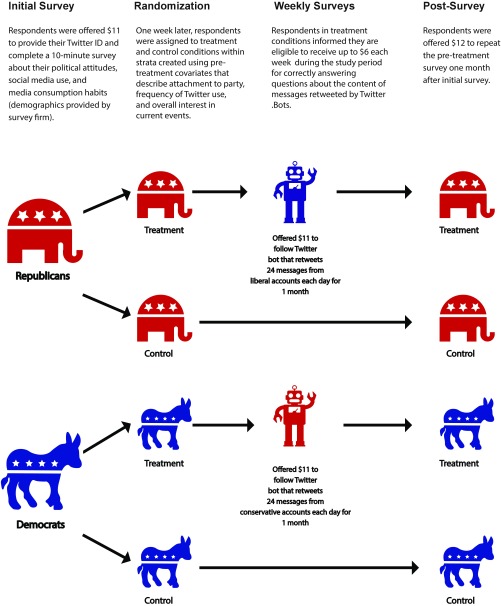
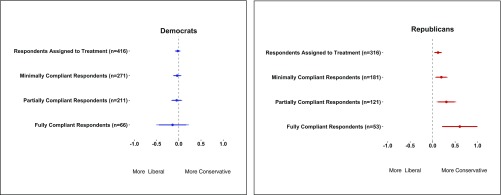
Significance: Social media sites are often blamed for exacerbating political polarization by creating “echo chambers” that prevent people from being exposed to information that contradicts their preexisting beliefs. We conducted a field experiment that offered a large group of Democrats and Republicans financial compensation to follow bots that retweeted messages by elected officials and opinion leaders with opposing political views. Republican participants expressed substantially more conservative views after following a liberal Twitter bot, whereas Democrats’ attitudes became slightly more liberal after following a conservative Twitter bot—although this effect was not statistically significant. Despite several limitations, this study has important implications for the emerging field of computational social science and ongoing efforts to reduce political polarization online.
Overview
The claims and statistics of this paper haven’t been checked yet.
Free: it reads the open-access text and checks the first 5 claims that cite a source we can check. Create a free account to check every claim.
Integrity signals
Registry
Cites
Statistics
Figures
Verification
Claims the paper makes
The claims and statistics of this paper haven’t been checked yet.
Free: it reads the open-access text and checks the first 5 claims that cite a source we can check. Create a free account to check every claim.
Claims other papers make about this one
Each is checked against this paper’s own text: does it say what the citing paper says it does?
The cited source doesn’t support the claim as written.
In the citing paper
“Supporting this, Bail et al. [2] further challenge the polarization assumption, showing that social media use can increase exposure to non-partisan content.”
From A systematic review of echo chamber research: comparative analysis of conceptualizations, operationalizations, and varying outcomes (2025) · cites this paper as [2]
Checked by a reasoning model — may be wrong.
Experimental — accuracy not yet measuredThe source backs part of the claim, not all of it — or backs it for a different population, condition or comparison.
In the citing paper
“For instance, it is neither clear what level of homophily in social networks is desirable or undesirable in a democratic society, nor is it clear how to interpret the results of certain studies on polarization69,130, whose findings depend on whether one assumes that social media have increased or decreased exposure to opposing views relative to some offline benchmark.”
From A systematic review of worldwide causal and correlational evidence on digital media and democracy (2022) · cites this paper as [69]
Experimental — accuracy not yet measuredThe source backs part of the claim, not all of it — or backs it for a different population, condition or comparison.
In the citing paper
“Even without being designed to shift opinions, it has been found that algorithms may contribute to political polarization by reinforcing divisive opinions [9, 24, 32].”
From Co-Writing with Opinionated Language Models Affects Users’ Views (2023) · cites this paper as [9]
Experimental — accuracy not yet measuredThe source backs part of the claim, not all of it — or backs it for a different population, condition or comparison.
In the citing paper
“Entrar en contacto con contenido contra-actitudinal puede generar una resistencia emocional y una sensación de amenaza que terminen polarizando igualmente al individuo (Bail et al., 2018;Dahlgren, 2022).”
From Política, uso de medios y polarización afectiva en España (2024) · cites this paper as Bail et al., 2018
Experimental — accuracy not yet measuredThe source backs part of the claim, not all of it — or backs it for a different population, condition or comparison.
In the citing paper
“Experimental approaches show e.g., how distorted meta-representations of outgroups on digital platforms can result in disaffection across ideological groups (Bail et al. 2018, Banks et al. 2021).”
From When debates break apart: discursive polarization as a multi-dimensional divergence emerging in and through communication (2023) · cites this paper as Bail et al. 2018
Experimental — accuracy not yet measured
18 more claims about this paper
Create a free account to see every claim other papers make about this one.
Self-check
Percentages, sums and reported differences re-computed from the paper’s own numbers.
The self-check needs the paper’s full text.
Citations
Cites
Birds of a Feather: Homophily in Social Networks
McPherson, M., Smith-Lovin, L., & Cook, J. M. (2001) · Annual Review of Sociology · doi:10.1146/annurev.soc.27.1.415 · Cited by 18,567 · cited 1×
“Despite initial optimism that social media might enable people to consume more heterogeneous sources of information about current events, there is growing concern that such forums exacerbate political polarization because of social network homophily, or the well-documented tendency of people to form social network tie…”
BackgroundA meta-analytic test of intergroup contact theory.
Pettigrew, T. F., & Tropp, L. R. (2006) · Journal of personality and social psychology · doi:10.1037/0022-3514.90.5.751 · Cited by 9,708 · cited 1×
“A vast literature indicates contact between opposing groups can challenge stereotypes that develop in the absence of positive interactions between them (30).”
BackgroundLord, C. G., Ross, L., & Lepper, M. R. (1979) · Journal of Personality and Social Psychology · doi:10.1037/0022-3514.37.11.2098 · Cited by 4,583
Liberals and conservatives rely on different sets of moral foundations.
Graham, J., Haidt, J., & Nosek, B. A. (2009) · Journal of Personality and Social Psychology · doi:10.1037/a0015141 · Cited by 4,560
Motivated Skepticism in the Evaluation of Political Beliefs
Taber, C. S., & Lodge, M. (2006) · American Journal of Political Science · doi:10.1111/j.1540-5907.2006.00214.x · Cited by 4,344
Lazer, D., Pentland, A., Adamic, L., Aral, S., Barabási, A.-L., Brewer, D., Christakis, N., Contractor, N., Fowler, J., Gutmann, M., et al. (2009) · Science · doi:10.1126/science.1167742 · Cited by 3,365
Exposure to ideologically diverse news and opinion on Facebook
Bakshy, E., Messing, S., & Adamic, L. A. (2015) · Science · doi:10.1126/science.aaa1160 · Cited by 3,245
When Corrections Fail: The Persistence of Political Misperceptions
Nyhan, B., & Reifler, J. (2010) · Political Behavior · doi:10.1007/s11109-010-9112-2 · Cited by 3,173
Fear and loathing across party lines: New evidence on group polarization
Iyengar, S., & Westwood, S. J. (2015) · American Journal of Political Science · doi:10.1111/ajps.12152 · Cited by 2,452
Uncivil Agreement: How Politics Became Our Identity
Mason, L. (2018) · doi:10.7208/chicago/9780226524689.001.0001 · Cited by 1,985
Research works printed but not linked: 1
- Sunstein C 2001 Echo Chambers, Bush v. Gore, Impeachment, and Beyond Princeton Univ Press Princeton
Cited by
Items 501–600 of 1,010
May, A. C., & Czymara, C. S. (2023) · Nations and Nationalism · doi:10.1111/nana.12985 · Cited by 19
“, 2020), social media (Bail et al., 2018), interpersonal communication (Schmitt-Beck, 2003) or other”
BackgroundLocal Newspaper Decline and Political Polarization – Evidence from a Multi-Party Setting
Ellger, F., Hilbig, H., Riaz, S., & Tillmann, P. (2024) · British Journal of Political Science · doi:10.1017/s0007123424000243 · Cited by 28
“Related evidence on the polarizing effects of ideologically extreme information that is either congruent or incongruent with prior attitudes has been shown by Levendusky (2013b), Taber and Lodge (2006), and Bail et al. (2018).”
Packer, R. M. A., Wade, A., & Neufuss, J. (2024) · Pets · doi:10.3390/pets1030032 · Cited by 15
Content dynamics and emotional engagement in online zero waste communities: a longitudinal study
Achuthan, K., & Khobragade, S. (2025) · Cities · doi:10.1016/j.cities.2025.106119 · Cited by 17
Ideology and polarization set the agenda on social media
Loru, E., Galeazzi, A., Bonetti, A., Sangiorgio, E., Marco, N. D., Cinelli, M., Falkenberg, M., Baronchelli, A., & Quattrociocchi, W. (2025) · Scientific Reports · doi:10.1038/s41598-025-19776-z · Cited by 37
“This behavior reinforces echo chambers and exacerbates polarization [8, 38, 39], in an environment where the value of news content is no longer determined solely by its intrinsic quality [40].”
la Roi, C., Dijkstra, J. K., Kretschmer, T., Savickaitė, R., & Veenstra, R. (2020) · Journal of Youth and Adolescence · doi:10.1007/s10964-020-01298-8 · Cited by 14
Recuero, R. (2019) · Comunicação, Mídia e Consumo · doi:10.18568/cmc.v16i47.2013 · Cited by 34
Disinformation creep: ADOS and the strategic weapon-ization of breaking news
Nkonde, M., Rodriguez, M. Y., Cortana, L., Mukogosi, J. K., King, S., Serrato, R., Martinez, N., Drummer, M., Lewis, A., & Malik, M. M. (2021) · Harvard Kennedy School Misinformation Review · doi:10.37016/mr-2020-52 · Cited by 12
RetractedThe Coevolution of Social Networks and Cognitive Dissonance
Whitaker, R. M., Colombo, G. B., Turner, L. D., Dunham, Y. C., Doyle, D., Roy, E. M., & Giammanco, C. A. (2021) · IEEE Transactions on Computational Social Systems · doi:10.1109/tcss.2021.3090833 · Cited by 14
“In combination, these factors can contribute to echo-chambers (e.g., [6], [33]) that amplify polarisation, as reinforced by selective exposure [43], [70], [4], [31].”
BackgroundA Framework to Understand Attitudes towards Immigration through Twitter
Freire-Vidal, Y., Graells-Garrido, E., & Rowe, F. (2021) · Applied Sciences · doi:10.3390/app11209689 · Cited by 18
Users’ polarisation in dynamic discussion networks: The case of refugee crisis in Sweden
Kopacheva, E., & Yantseva, V. (2022) · PLoS ONE · doi:10.1371/journal.pone.0262992 · Cited by 20
“Yet, some of the studies have also provided evidence that crossideological exposure in online discussions can actually increase users’ polarisation [12].”
ResultBeugelsdijk, S., van Herk, H., & Maseland, R. (2022) · JCMS Journal of Common Market Studies · doi:10.1111/jcms.13342 · Cited by 16
“What is more, in interactions with groups holding opposing identities, people adjust their attitudes and behaviours to move even further away from the positions of opposite reference groups (Bail et al., 2018; Liu and Srivastava, 2015).”
BackgroundElgesem, D., & Brüggemann, M. (2022) · European Journal of Communication · doi:10.1177/02673231221116179 · Cited by 14
“This polarising consequence of interaction with adversaries is also found in studies of social media (Bail et al. 2018).”
BackgroundInfluentialSocial scientific research on the American West: current debates, novel methods, and new directions
Burow, P. B., McConnell, K., & Farrell, J. (2019) · Environmental Research Letters · doi:10.1088/1748-9326/ab4030 · Cited by 14
“…uncovering the financial connections between industry and lobbying (Farrell 2016a, 2016b, 2019), as well as via online social networks (i.e. Twitter, Facebook) that have created echo-chambers and can foster greater polarization within the public (Farrell 2015a, Bail et al 2018, Jasny et al 2018).”
BackgroundIs There a Role for Adversariality in Teaching Critical Thinking?
Bailin, S., & Battersby, M. (2020) · Topoi · doi:10.1007/s11245-020-09713-2 · Cited by 22
Does Exposure to Diverse Perspectives Mitigate Biases in Crowdwork? An Explorative Study
Duan, X., Ho, C.-J., & Yin, M. (2020) · Proceedings of the AAAI Conference on Human Computation and Crowdsourcing · doi:10.1609/hcomp.v8i1.7474 · Cited by 20
“All rights reserved. there are mixed empirical evidence showing that long-term, repeated interactions to opposing views could result in either more (Bail et al. 2018) or less (Guilbeault, Becker, and Centola 2018) biased belief.”
BackgroundChanging channels? A comparison of Fox and MSNBC in 2012, 2016, and 2020
Lanning, K., Wetherell, G. A., Warfel, E. A., & Boyd, R. L. (2021) · Analyses of Social Issues and Public Policy · doi:10.1111/asap.12265 · Cited by 18
Helgason, B. A., & Effron, D. A. (2022) · Journal of Experimental Social Psychology · doi:10.1016/j.jesp.2022.104308 · Cited by 12
Reaching the bubble may not be enough: news media role in online political polarization
Kobellarz, J. K., Broćić, M., Graeml, A. R., Silver, D. L., & Silva, T. H. (2022) · EPJ Data Science · doi:10.1140/epjds/s13688-022-00357-3 · Cited by 22
“Rather than moderating viewpoints, however, exposure to counter-attitudinal information can backfire, reinforcing commitment to prior beliefs [22].”
BackgroundEmerging trends: Unfair, biased, addictive, dangerous, deadly, and insanely profitable
Church, K., Schoene, A. M., Ortega, J. E., Chandrasekar, R., & Kordoni, V. (2022) · Natural Language Engineering · doi:10.1017/s1351324922000481 · Cited by 23
“2017; Ferrara 2017; Bail et al .”
Does Human-algorithm Feedback Loop Lead to Error Propagation? Evidence from Zillow’s Zestimate
Fu, R., Jin, G. Z., & Liu, M. (2022) · National Bureau of Economic Research · doi:10.3386/w29880 · Cited by 20
Algorithmic transparency and assessing effects of algorithmic ranking
Eckles, D. (2022) · doi:10.31235/osf.io/c8za6 · Cited by 12
Field experiments on social mediaPreprint
Mosleh, M., Pennycook, G., & Rand, D. G. (2021) · PsyArXiv (OSF Preprints) · doi:10.31234/osf.io/dgmc2 · Cited by 15
Liberals Engage With More Diverse Policy Topics and Toxic Content Than Conservatives on Social MediaPreprint
Chang, H.-C. H., Druckman, J. N., Ferrara, E., & Willer, R. (2023) · OSF Preprints (OSF Preprints) · doi:10.31219/osf.io/x59qt · Cited by 18
Hakkarainen, V., & Lazurko, A. (2025) · Sustainability Science · doi:10.1007/s11625-025-01717-4 · Cited by 15
“…stance may be motivated by fears of losing the perceived credibility of scientific institutions in a world of increasing misinformation, political polarisation and unpredictable shifts to funding and support for research (Bail et al. 2018; Rutledge 2020; Goldman et al. 2020; Levin et al. 2021).”
Enhanced ability of information gathering may intensify disagreement among groups
Sayama, H. (2020) · Physical review. E · doi:10.1103/physreve.102.012303 · Cited by 16
Designing for Engaging with News using Moral Framing towards Bridging Ideological Divides
Wang, J., Zhang, A. X., & Karger, D. R. (2022) · Proceedings of the ACM on Human-Computer Interaction · doi:10.1145/3492861 · Cited by 13
“Research shows that exposure to opposing views on social media can in some occasions increase political polarization [10, 50].”
BackgroundThe effect of traditional media consumption and internet use on environmental attitudes in Europe
Babutsidze, Z., Blankenberg, A., & Chai, A. (2023) · Journal of Evolutionary Economics · doi:10.1007/s00191-023-00810-0 · Cited by 14
Influence of Facebook algorithms on political polarization tested
García, D. (2023) · Nature · doi:10.1038/d41586-023-02325-x · Cited by 18
A Call to Maximize the Social Impact of Our Research: An Effective Altruism Approach
Kassirer, S., Levine, E. E., & Kouchaki, M. (2023) · Academy of Management Perspectives · doi:10.5465/amp.2022.0045 · Cited by 12
“…researching social movements even though there already exists a large literature on social movements and collective action in our field (e.g., Bail et al., 2018; Briscoe, Chin, & Hambrick, 2014; DeCelles, Sonenshein, & King, 2020; Kim, Shin, Oh, & Jeong, 2007; King, 2008; Weber, Heinze, &…”
BackgroundBursts of communication increase opinion diversity in the temporal Deffuant model
Zarei, F., Gandica, Y., & Rocha, L. E. C. (2024) · Scientific Reports · doi:10.1038/s41598-024-52458-w · Cited by 18
“Attempting to mitigate large gaps may be more damaging because lacking common ground may encourage individuals to push back if facing opposite views 48 .”
BackgroundThe Social Dynamics Approach to mediated communication
Roos, C. A., Koudenburg, N., & Postmes, T. (2024) · European Review of Social Psychology · doi:10.1080/10463283.2024.2322905 · Cited by 15
“…correlate with online polarisation, for example, selective exposure, that is, a lack of exposure to cross-cutting opinions (e.g., Mutz, 2006, but see; Bail et al., 2018), exposure to uncivil online discussion (e.g., Hwang et al., 2014) or dissemination of fake news and misinformation (e.g.,…”
Stance detection in Arabic with a multi-dialectal cross-domain stance corpus
Charfi, A., Bessghaier, M., Atalla, A., Akasheh, R., Al-Emadi, S. A., & Zaghouani, W. (2024) · Social Network Analysis and Mining · doi:10.1007/s13278-024-01335-5 · Cited by 20
“At a broader level, polarization detection facilitates a deeper understanding of social media communities by pinpointing the presence of propaganda and radicalism (Bail et al. 2018).”
The confrontation effect: When users engage more with ideology-inconsistent content online
Mochon, D., & Schwartz, J. A. (2024) · Organizational Behavior and Human Decision Processes · doi:10.1016/j.obhdp.2024.104366 · Cited by 21
How Radio Affects Violent Conflict: New Evidence from Rwanda
Nzitatira, H. N., Billing, T., & Edgerton, J. F. (2024) · American Sociological Review · doi:10.1177/00031224241278905 · Cited by 15
“Müller and Schwarz focused on social media, but their study importantly illustrates the role of epistemic authorities in propagating content that can affect violence (see also Bail et al. 2018).”
Lee, I., & Tipoe, E. (2024) · British Educational Research Journal · doi:10.1002/berj.4081 · Cited by 14
Breder, K., & Bockting, W. O. (2025) · Journal of Family Theory & Review · doi:10.1111/jftr.12609 · Cited by 13
Relational AI: Facilitating Intergroup Cooperation with Socially Aware Conversational Support
Claggett, E. L., Kraut, R. E., & Shirado, H. (2025) · CHI Conference on Human Factors in Computing Systems · doi:10.1145/3706598.3713757 · Cited by 29
“However, when individuals have already reinforced their biases within their in-groups, simply exposing them to different views does not eliminate these biases and may even entrench them further, as demonstrated by Bail et al. in a field experiment on X [8].”
Characterizing the Social Media News Sphere through User Co-Sharing Practices
Samory, M., Abnousi, V. K., & Mitra, T. (2020) · Proceedings of the International AAAI Conference on Web and Social Media · doi:10.1609/icwsm.v14i1.7327 · Cited by 17
“For example, attempts to directly confront extreme political or conspiratorial views may prove counterproductive (Bail et al. 2018; Peter and Koch 2016; Lewandowsky et al. 2012).”
BackgroundWriter movements between news outlets reflect political polarization in media
Hagar, N., Wachs, J., & Horvát, E.-Á. (2021) · New Media & Society · doi:10.1177/14614448211027173 · Cited by 20
“Second, cross-cutting perspectives sometimes create unintended consequences, causing the recipient to become less receptive to opposing views (Bail et al., 2018).”
BackgroundValiavska, A., & Smith-Frigerio, S. (2022) · Health Communication · doi:10.1080/10410236.2022.2063497 · Cited by 16
Rindzevičiūtė, E. (2022) · International Journal of Cultural Policy · doi:10.1080/10286632.2022.2137151 · Cited by 26
Denotative and connotative management of uncertainty: A computational dual-process model
Hoey, J., MacKinnon, N. J., & Schröder, T. (2021) · Judgment and Decision Making · doi:10.1017/s1930297500008652 · Cited by 21
“It is also in line with experiments showing how the effects of increased ambiguity may result in more political polarization (Bail et al., 2018).”
ResultCreate an IPCC-like body to harness benefits and combat harms of digital tech
Bak-Coleman, J. B., Bergstrom, C. T., Jacquet, J., Mickens, J. W., Tüfekçi, Z., & Roberts, J. T. (2023) · Nature · doi:10.1038/d41586-023-01606-9 · Cited by 15
Toward a Formal Model for Group Polarization in Social Networks
Alvim, M. S., Knight, S., & Valencia, F. (2019) · Lecture notes in computer science · doi:10.1007/978-3-030-31175-9_24 · Cited by 19
When pull turns to shove: A continuous-time model for opinion dynamics
Sabin-Miller, D., & Abrams, D. M. (2020) · Physical Review Research · doi:10.1103/physrevresearch.2.043001 · Cited by 21
“Furthermore, we were able to simulate the experiment of Bail et al. [38] and found similar dynamics under counterattitudinal perturbation.”
InfluentialHow Do You Define a Problem Like Influence
Pamment, J., & Wanless, A. (2019) · Lund University Publications (Lund University) · Cited by 11
Reuver, M., Mattis, N. M., Sax, M., Verberne, S., Tintarev, N., Helberger, N., Möller, J. E., Vrijenhoek, S., Fokkens, A. S., & van Atteveldt, W. (2021) · Workshop on NLP for Positive Impact (NLP4PI) · doi:10.18653/v1/2021.nlp4posimpact-1.6 · Cited by 20
Opinion Evolution in Divided Community
Weron, T., & Szwabiński, J. (2022) · Entropy · doi:10.3390/e24020185 · Cited by 12
“The bias may contribute to overconfidence in personal beliefs and can maintain or strengthen them in the face of contrary evidence, which leads to polarization [5].”
BackgroundResultHopfer, S., Phillips, K. K.-D., Weinzierl, M., Vasquez, H. E., Alkhatib, S., & Harabagiu, S. M. (2022) · Frontiers in Digital Health · doi:10.3389/fdgth.2022.819228 · Cited by 16
“Disseminating accurate, yet culturally resonant vaccine information is critical in light of the polarized social media environment, particularly around vaccination ( 10–12).”
BackgroundWisnewski-Parks, G. (2020) · Southern Communication Journal · doi:10.1080/1041794x.2020.1765006 · Cited by 14
“Online exposure to opposing views on social media presents more complexities than traditional media (Bail et al., 2018).”
BackgroundЗахарченко, А., Maksimtsova, Y., Iurchenko, V., Shevchenko, V., & Федушко, С. (2019) · arXiv (Cornell University) · doi:10.48550/arxiv.1909.01681 · Cited by 23
“On the other hand, Dubois and Blank found out that the higher a person’s level of political interest the less likely they are to be in an echo chamber [20].”
BackgroundKnudsen, E. M., & de Bolsée, O. J. (2019) · Geoscience Communication · doi:10.5194/gc-2-83-2019 · Cited by 11
“Furthermore, the rise of social media has meant that everyone can act as journalists and editors in choosing what to post, where algorithms make sure to share posts from those with similar opinions, thus creating filter bubbles (Pariser, 2011; Alvermann, 2017; Bail et al., 2018).”
BackgroundThe Zoom solution: Promoting effective cross-ideological communication online
Binnquist, A. L., Dolbier, S. Y., Dieffenbach, M. C., & Lieberman, M. D. (2022) · PLoS ONE · doi:10.1371/journal.pone.0270355 · Cited by 15
“While some research has shown that viewing oppositional media can increase people’s polarization [41], it appears that face-to-face conversations may have an advantage when it comes to engaging with the other side.”
BackgroundExperimental studies of conflict: Challenges, solutions, and advice to junior scholars
Minson, J. A., Bendersky, C., Dreu, C. K. W. D., Halperin, E., & Schroeder, J. (2023) · Organizational Behavior and Human Decision Processes · doi:10.1016/j.obhdp.2023.104257 · Cited by 14
“Researchers have also experimentally manipulated participants ’ exposure to Facebook posts and Twitter threads (Bail et al., 2018; Levy 2021; Mosleh et al., 2022).”
BackgroundEmotion, Affective Polarization, and Online Communication
Fischer, S. A., & Lelkes, Y. (2023) · Oxford University Press eBooks · doi:10.1093/oso/9780197520536.003.0021 · Cited by 13
Rasmussen, S. H. R., & Petersen, M. B. (2023) · PNAS Nexus · doi:10.1093/pnasnexus/pgad382 · Cited by 23
“When effect-esti-mates are small, and when timing is not explicitly modeled (e.g. (71)), we urge caution in interpreting the results.”
Beyond Trade-offs: Unveiling Fairness-Constrained Diversity in News Recommender Systems
Treuillier, C., Castagnos, S., Özgöbek, Ö., & Brun, A. (2024) · ACM Conference on User Modeling, Adaptation and Personalization (UMAP) · doi:10.1145/3627043.3659571 · Cited by 13
“Regarding NRS, although widely discussed, the role of diversity in NRS regarding polarization decrease remains disputed [1, 12].”
Heltzel, G., & Laurin, K. (2024) · Psychological Science · doi:10.1177/09567976241258149 · Cited by 24
“Or does repeated exposure to Twitter’s political discourse make negativity seem acceptable and opponents intolerable (Wilson et al., 2020), radicalizing even moderates into polarized extremists (Bail et al., 2018)?”
Affective polarization is uniformly distributed across American States
Holliday, D. E., Lelkes, Y., & Westwood, S. J. (2024) · PNAS Nexus · doi:10.1093/pnasnexus/pgae310 · Cited by 15
Social bots spoil activist sentiment without eroding engagement
LI, L. C., Vásárhelyi, O., & Vedres, B. (2024) · Scientific Reports · doi:10.1038/s41598-024-74032-0 · Cited by 22
Lin, H. Y., Jiang, X., Lee, J., Wang, Y., & Kim, Y. (2025) · Media Psychology · doi:10.1080/15213269.2024.2445031 · Cited by 13
“When they are exposed to extreme opposing views, partisans also refute them in ways that increase the perceived distance between groups and encourage polarization (Bail et al., 2018; Zhu et al., 2024).”
Self-citationCharting multidimensional ideological polarization across demographic groups in the USA
Ojer, J., Carcamo, D. P., Pastor‐Satorras, R., & Starnini, M. (2025) · Nature Human Behaviour · doi:10.1038/s41562-025-02251-0 · Cited by 29
Detecting Social Media Manipulation in Low-Resource Languages
Haider, S., Luceri, L., Deb, A., Badawy, A., Peng, N., & Ferrara, E. (2023) · International World Wide Web Conference (WWW) · doi:10.1145/3543873.3587615 · Cited by 20
Méndez, A. R. (2021) · Sintaxis · doi:10.36105/stx.2021n7.02 · Cited by 12
Persily, N., & Tucker, J. A. (2020) · Cambridge University Press eBooks · doi:10.1017/9781108890960.002 · Cited by 11
Rational inference strategies and the genesis of polarization and extremism
Kvam, P. D., Alaukik, A., Mims, C. E., Martemyanova, A., & Baldwin, M. W. (2022) · Scientific Reports · doi:10.1038/s41598-022-11389-0 · Cited by 17
Online polarization and cross-fertilization in multi-cleavage societies: the case of Spain
Rodríguez-Casañ, R., García-Vidal, E., Grimaldi, D., Carrasco-Farré, C., Vaquer-Estalrich, F., & Vila‐Francés, J. (2022) · Social Network Analysis and Mining · doi:10.1007/s13278-022-00909-5 · Cited by 17
“2021), while others believe the opposite (Bail et al. 2018; Prior 2013) and claim for a more aggravation of the political atmosphere.”
BackgroundResultTurel, O. (2023) · Behaviour and Information Technology · doi:10.1080/0144929x.2023.2248282 · Cited by 18
“One risk of fake news is its contribution to polarization (Bail et al. 2018), which re fl ects growing di ff erence in slant between groups.”
Rebalancing Social Feed to Minimize Polarization and Disagreement
Cinus, F., Gionis, A., & Bonchi, F. (2023) · ACM International Conference on Information and Knowledge Management (CIKM) · doi:10.1145/3583780.3615025 · Cited by 23
“However, directly targeting and minimizing polarization can be problematic, as it may infringe upon users’ freedom of expression and foster opposite effects [4].”
BackgroundA focus shift in the evaluation of misinformation interventions
Tay, L. Q., Lewandowsky, S., Hurlstone, M. J., Kurz, T., & Ecker, U. K. H. (2023) · Harvard Kennedy School Misinformation Review · doi:10.37016/mr-2020-124 · Cited by 15
“Second, there are different potential outcome variables, such as levels of false belief or polarization (also see Bail et al., 2018).”
BackgroundInternet connectivity and domestic terrorism in democracies
Hunter, L. Y., Griffith, C. E., & Warren, T. (2020) · International Journal of Sociology · doi:10.1080/00207659.2020.1757297 · Cited by 9
“Conversely, researchers have found that internet users may develop more extreme views as they encounter users with opposing ideologies (Bail et al. 2018).”
BackgroundNapoli, P. M. (2021) · Policy & Internet · doi:10.1002/poi3.253 · Cited by 10
Weaponized testimonial injustice
Almagro, M., Osorio, J., & Fernández, N. V. (2021) · Las Torres de Lucca International Journal of Political Philosophy · doi:10.5209/ltdl.76461 · Cited by 13
“A recent empirical study (Bail et al., 2018), to mention one example, showed that being exposed, through Twitter, to the opinions of someone who is sympathetic to an opposed political ideology makes us more polarized, rather than less.”
BackgroundBenjamin Netanyahu as a mobilizing symbol in ethno-class divisions among Jewish Israelis, 2009–2021
Sorek, T., & Ceobanu, A. M. (2021) · Ethnic and Racial Studies · doi:10.1080/01419870.2021.1981968 · Cited by 13
“One could argue that this gap reflects the proliferation of media choices, and especially the polarization effect of social media (Bail et al. 2018), which its emergence as a major force overlapped with some years of Netanyahu’s rule.”
BackgroundThe Case for Establishing a Collective Perspective to Address the Harms of Platform Personalization
Gordon-Tapiero, A., Wood, A., & Ligett, K. (2022) · ACM Symposium on Computer Science and Law (CSLAW) · doi:10.1145/3511265.3550450 · Cited by 15
“Scholars, politicians, and the media have sounded the alarm regarding platforms’ role in creating echo chambers [111], or filter bubbles, in which users have little or no exposure to opinions or even news reports that contradict their beliefs [12].”
BackgroundSocial Bots and Social Media Manipulation in 2020: The Year in ReviewPreprint
Chang, H.-C. H., Chen, E., Zhang, M., Murić, G., & Ferrara, E. (2021) · Handbook of Computational Social Science, Volume 1 · doi:10.48550/arxiv.2102.08436 · Cited by 51
“Although disambiguation by means of specific campaign-related hashtags is not perfect, prior studies investigating political polarization has shown that the vast majority of users posting campaign-specific hashtags align with the same political party [73, 74].”
Interventions to Reduce Partisan AnimosityPreprint
Hartman, R., Blakey, W., Womick, J., Bail, C. A., Finkel, E. J., Han, H. C., Sarrouf, J., Schroeder, J., Sheeran, P., Bavel, J. J. V., et al. (2022) · doi:10.31234/osf.io/ha2tf · Cited by 10
Self-citationMeasuring social response to different journalistic techniques on Facebook
Schmidt, A. L., Peruzzi, A., Scala, A., Cinelli, M., Pomerantsev, P., Applebaum, A., Gaston, S., Fusi, N., Peterson, Z., Severgnini, G., et al. (2020) · Humanities and Social Sciences Communications · doi:10.1057/s41599-020-0507-3 · Cited by 10
“Furthermore, exposure to opposing views can even increase polarization (Bail et al., 2018).”
BackgroundScarcity-driven monetization of digital content
Kanuri, V. K., & Pattabhiramaiah, A. (2022) · Frontiers in Research Metrics and Analytics · doi:10.3389/frma.2022.995202 · Cited by 13
“Specifically, one downside of exposing people to divergent viewpoints may be that it can catalyze a polarizing backlash that further hardens any pre-existing ideological positions (Bail et al., 2018).”
BackgroundLee, S., & Cho, J. (2023) · Computers in Human Behavior · doi:10.1016/j.chb.2023.107672 · Cited by 29
Surfing to the political extremes: Digital media, social media, and policy attitude polarization
Gainous, J., & Wagner, K. M. (2023) · Social Science Quarterly · doi:10.1111/ssqu.13273 · Cited by 12
A high-dimensional approach to measuring online polarization
Phillips, S. C., Uyheng, J., & Carley, K. M. (2023) · Journal of Computational Social Science · doi:10.1007/s42001-023-00227-6 · Cited by 19
“Other work empirically shows the opposite occurs—communication across groups increases polarization between ideological groups as people defend their pre-existing position [31, 32].”
BackgroundPartisan styles of self-presentation in U.S. Twitter bios
Essig, L. W., & DellaPosta, D. (2024) · Scientific Reports · doi:10.1038/s41598-023-50810-0 · Cited by 15
“While active Twitter users are not representative of the population as a whole, Twitter itself is an important object of study in its own right as a context where social interactions amplify polarization 10,28,44,45 .”
Cantone, G. G., Tomaselli, V., & Mazzeo, V. (2024) · Quality & Quantity · doi:10.1007/s11135-024-01981-z · Cited by 40
Political ideology, emotion response, and confirmation bias
Dickinson, D. L. (2024) · Economic Inquiry · doi:10.1111/ecin.13253 · Cited by 19
In Defense of ‘Surveillance Capitalism’
Königs, P. (2024) · Philosophy & Technology · doi:10.1007/s13347-024-00804-1 · Cited by 18
Complex systems perspective in assessing risks in artificial intelligence
Kondor, D., Hafez, V., Shankar, S., Wazir, R., & Karimi, F. (2024) · Philosophical Transactions of the Royal Society A Mathematical Physical and Engineering Sciences · doi:10.1098/rsta.2024.0109 · Cited by 18
“…depending on the context, AI systems could have positive or negative effects on political discourse and, thus, collective decision-making [20,50,90,91]; building on such understanding will also be important in evaluating possible regulation and interventions related to the direct use of AI in the…”
How AI sources can increase openness to opposing views
Lu, L., Tormala, Z. L., & Duhachek, A. (2025) · Scientific Reports · doi:10.1038/s41598-025-00791-z · Cited by 25
Jozaghi, E. (2025) · Canadian Public Administration · doi:10.1111/capa.70020 · Cited by 12
A relative approach to opinion formation
Chan, K. M. D., Duivenvoorden, R., Flache, A., & Mandjes, M. (2022) · Journal of Mathematical Sociology · doi:10.1080/0022250x.2022.2036142 · Cited by 13
“…empirical field studies have aimed to test the possibility of boomer-ang effects and find at least some support for opinion shifts away from the position of a source of influence, possibly caused by a boomerang effect (Bail et al., 2018; Kozitsin, 2021; Levendusky, 2013; Liu & Srivastava, 2015).”
dos Santos, M. A. (2023) · Dados · doi:10.1590/dados.2023.66.2.287 · Cited by 22
The effects of social media on domestic terrorism
Hunter, L. Y., Biglaiser, G., McGauvran, R. J., & Collins, L. (2023) · Behavioral Sciences of Terrorism and Political Aggression · doi:10.1080/19434472.2022.2160001 · Cited by 15
“Also, researchers contend that online media polarization a ff ects political polarization and possible extremism in important ways (Bail et al., 2018).”
Tweet Trajectory and AMPS-based Contextual Cues can Help Users Identify Misinformation
Zade, H., Woodruff, M., Johnson, E., Stanley, M., Zhou, Z., Huynh, M. T., Acheson, A. E., Hsieh, G., & Starbird, K. (2023) · Proceedings of the ACM on Human-Computer Interaction · doi:10.1145/3579536 · Cited by 17
“Corrective labels while usually useful, sometimes are known to cause a backfire effect in the users who come across the labels, i.e., strengthen their belief towards the misconception that the label is trying to rectify [5, 70, 82].”
BackgroundEcho Tunnels: Polarized News Sharing Online Runs Narrow but Deep
Mok, L., Inzlicht, M., & Anderson, A. (2023) · Proceedings of the International AAAI Conference on Web and Social Media · doi:10.1609/icwsm.v17i1.22177 · Cited by 19
“…that exposure to diverse viewpoints may help reduce extreme attitudes (Bakshy, Messing, and Adamic 2015; Pariser 2011; Sunstein 2018), other studies also show that cross-cutting and outgroup content may actually increase polarization (Bail et al. 2018; Rathje, Van Bavel, and van der Linden 2021).”
BackgroundOnline Interaction Turns the Congeniality Bias Into an Uncongeniality Bias
Buder, J., Zimmermann, A., Buttliere, B., Rabl, L., Vogel, M., & Huff, M. (2023) · Psychological Science · doi:10.1177/09567976231194590 · Cited by 12
Explaining Search Result Stances to Opinionated People
Wu, Z., Draws, T., Cau, F. M., Barile, F., Rieger, A., & Tintarev, N. (2023) · Communications in computer and information science · doi:10.1007/978-3-031-44067-0_29 · Cited by 12
De-sounding echo chambers: Simulation-based analysis of polarization dynamics in social networks
Donkers, T., & Ziegler, J. (2023) · Online Social Networks and Media · doi:10.1016/j.osnem.2023.100275 · Cited by 18
Going Viral: Researching Safely on Social Media
Vallury, K. D., Baird, B., Miller, E., & Ward, P. (2021) · Journal of Medical Internet Research · doi:10.2196/29737 · Cited by 13
“The absence of facial and social cues and gestures on the web that would otherwise be present in face-to-face interactions and the real or perceived anonymity that web-based interactions can afford increase the potential for interpersonal conflicts and escalation of arguments [15-17].”
BackgroundLiu, S., Mäs, M., Xia, H., & Flache, A. (2022) · Advances in Complex Systems · doi:10.1142/s0219525922500114 · Cited by 13
Metadata
- Authors
- Bail, C. A., Argyle, L. P., Brown, T. W., Bumpus, J. P., Chen, H., Hunzaker, M. B. F., Lee, J., Mann, M., Merhout, F., & Volfovsky, A.
- Affiliations
- Duke University (US)
- Brigham Young University (US)
- New York University (US)
- Corresponding author
- Bail, Christopher A.
- ORCID
- Venue
- Proceedings of the National Academy of Sciences
- Publisher
- National Academy of Sciences
- Published
- 2018-08-28
- Volume
- 115
- Issue
- 37
- Pages
- 9216-9221
- ISSN
- 0027-8424 (ISSN-L)
- 1091-6490
- PMC
- PMC6140520
- OpenAlex
- W2889127731
- Semantic Scholar
- c1cb4725a7fb0df77c52d6d2792e87d588178715
- Cited by
- 1,863
- References
- 56
- Citations by year
- 2026: 275 · 2025: 272 · 2024: 248 · 2023: 292 · 2022: 264 · 2021: 228 · 2020: 181 · 2019: 96 · 2018: 7
- FWCI
- 278.82
- Type
- journal article
- Language
- en
- Open access
- hybrid
- doi.org
- Licence
- Locations
- Proceedings of the National Academy of Sciences (publishedVersion, cc-by-nc-nd)
- Europe PMC (PubMed Central) (publishedVersion, cc-by-nc-nd)
- PubMed Central (publishedVersion, cc-by-nc-nd)
- PubMed (publishedVersion)
- RePEc: Research Papers in Economics (submittedVersion)
- Funders
- Russell Sage Foundation (E0267)
- Topics
- Social Sciences › Communication › Social Media and Politics
- Social Sciences › Sociology and Political Science › Media Influence and Politics
- Social Sciences › Sociology and Political Science › Misinformation and Its Impacts
- Keywords
- political polarization, echo chambers, social media, Twitter bots, ideological change, financial incentives, computational social science, partisanship, social policy attitudes
- MeSH terms
- Political Activism, Democracy, Female, Humans, Male, United States, Social Media
About these checks
Registry, retraction, Cites and statistics results are computed, not judged, with one exception: a printed reference that no index lists is read once by a model before it counts as a citation error. Claims are extracted by a model and kept only when their quote appears verbatim in the text; each cited source is then checked, with a model’s help, for whether it says what the claim relies on. Those verdicts can be wrong — read the claim’s quote and the cited source before relying on one.
Statistics and arithmetic are recomputed, not judged.
Confidence bands are shown only for fields calibrated on our annotated test set. None is calibrated yet, so no band is shown.
What counts as a claim ›How we measure confidence ›How we check this ›
Are you an author, or do you see a problem with this page? Request a review
Data sources
Bibliographic data: Semantic Scholar, OpenAlex, Crossref.
Contains information from the Semantic Scholar Academic Graph Datasets, made available under the ODC Attribution License (ODC-BY 1.0).
Semantic Scholar’s data is described in: Kinney, R., et al. (2023). The Semantic Scholar Open Data Platform. arXiv:2301.10140.
