

Exposure to opposing views on social media can increase political polarization
Open accessThe DOI matches its Crossref record; 60 of the 60 references it cites were found in a registry or an index.
Abstract
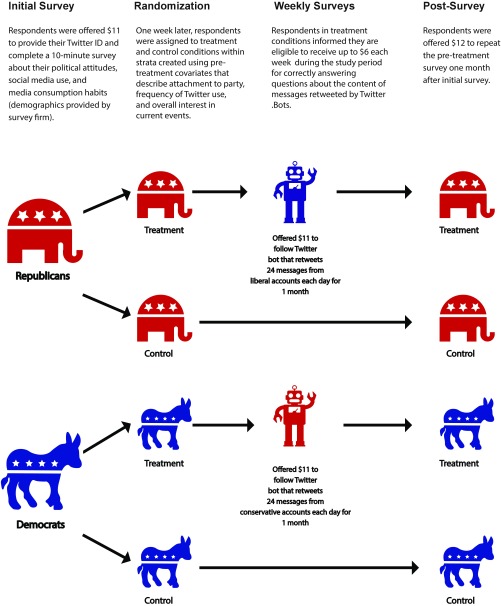
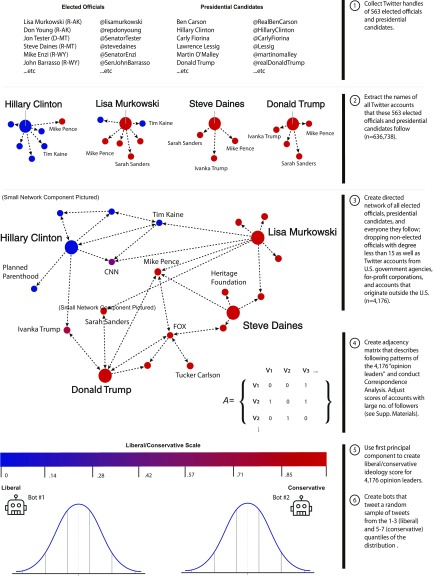
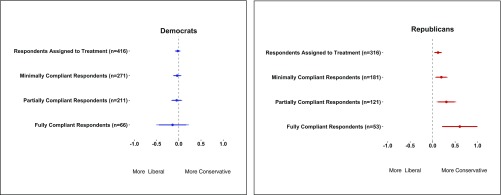
Significance: Social media sites are often blamed for exacerbating political polarization by creating “echo chambers” that prevent people from being exposed to information that contradicts their preexisting beliefs. We conducted a field experiment that offered a large group of Democrats and Republicans financial compensation to follow bots that retweeted messages by elected officials and opinion leaders with opposing political views. Republican participants expressed substantially more conservative views after following a liberal Twitter bot, whereas Democrats’ attitudes became slightly more liberal after following a conservative Twitter bot—although this effect was not statistically significant. Despite several limitations, this study has important implications for the emerging field of computational social science and ongoing efforts to reduce political polarization online.
Overview
The claims and statistics of this paper haven’t been checked yet.
Free: it reads the open-access text and checks the first 5 claims that cite a source we can check. Create a free account to check every claim.
Integrity signals
Registry
Cites
Statistics
Figures
Verification
Claims the paper makes
The claims and statistics of this paper haven’t been checked yet.
Free: it reads the open-access text and checks the first 5 claims that cite a source we can check. Create a free account to check every claim.
Claims other papers make about this one
Each is checked against this paper’s own text: does it say what the citing paper says it does?
The cited source doesn’t support the claim as written.
In the citing paper
“Supporting this, Bail et al. [2] further challenge the polarization assumption, showing that social media use can increase exposure to non-partisan content.”
From A systematic review of echo chamber research: comparative analysis of conceptualizations, operationalizations, and varying outcomes (2025) · cites this paper as [2]
Checked by a reasoning model — may be wrong.
Experimental — accuracy not yet measuredThe source backs part of the claim, not all of it — or backs it for a different population, condition or comparison.
In the citing paper
“For instance, it is neither clear what level of homophily in social networks is desirable or undesirable in a democratic society, nor is it clear how to interpret the results of certain studies on polarization69,130, whose findings depend on whether one assumes that social media have increased or decreased exposure to opposing views relative to some offline benchmark.”
From A systematic review of worldwide causal and correlational evidence on digital media and democracy (2022) · cites this paper as [69]
Experimental — accuracy not yet measuredThe source backs part of the claim, not all of it — or backs it for a different population, condition or comparison.
In the citing paper
“Even without being designed to shift opinions, it has been found that algorithms may contribute to political polarization by reinforcing divisive opinions [9, 24, 32].”
From Co-Writing with Opinionated Language Models Affects Users’ Views (2023) · cites this paper as [9]
Experimental — accuracy not yet measuredThe source backs part of the claim, not all of it — or backs it for a different population, condition or comparison.
In the citing paper
“Entrar en contacto con contenido contra-actitudinal puede generar una resistencia emocional y una sensación de amenaza que terminen polarizando igualmente al individuo (Bail et al., 2018;Dahlgren, 2022).”
From Política, uso de medios y polarización afectiva en España (2024) · cites this paper as Bail et al., 2018
Experimental — accuracy not yet measuredThe source backs part of the claim, not all of it — or backs it for a different population, condition or comparison.
In the citing paper
“Experimental approaches show e.g., how distorted meta-representations of outgroups on digital platforms can result in disaffection across ideological groups (Bail et al. 2018, Banks et al. 2021).”
From When debates break apart: discursive polarization as a multi-dimensional divergence emerging in and through communication (2023) · cites this paper as Bail et al. 2018
Experimental — accuracy not yet measured
18 more claims about this paper
Create a free account to see every claim other papers make about this one.
Self-check
Percentages, sums and reported differences re-computed from the paper’s own numbers.
The self-check needs the paper’s full text.
Citations
Cites
Birds of a Feather: Homophily in Social Networks
McPherson, M., Smith-Lovin, L., & Cook, J. M. (2001) · Annual Review of Sociology · doi:10.1146/annurev.soc.27.1.415 · Cited by 18,567 · cited 1×
“Despite initial optimism that social media might enable people to consume more heterogeneous sources of information about current events, there is growing concern that such forums exacerbate political polarization because of social network homophily, or the well-documented tendency of people to form social network tie…”
BackgroundA meta-analytic test of intergroup contact theory.
Pettigrew, T. F., & Tropp, L. R. (2006) · Journal of personality and social psychology · doi:10.1037/0022-3514.90.5.751 · Cited by 9,708 · cited 1×
“A vast literature indicates contact between opposing groups can challenge stereotypes that develop in the absence of positive interactions between them (30).”
BackgroundLord, C. G., Ross, L., & Lepper, M. R. (1979) · Journal of Personality and Social Psychology · doi:10.1037/0022-3514.37.11.2098 · Cited by 4,583
Liberals and conservatives rely on different sets of moral foundations.
Graham, J., Haidt, J., & Nosek, B. A. (2009) · Journal of Personality and Social Psychology · doi:10.1037/a0015141 · Cited by 4,560
Motivated Skepticism in the Evaluation of Political Beliefs
Taber, C. S., & Lodge, M. (2006) · American Journal of Political Science · doi:10.1111/j.1540-5907.2006.00214.x · Cited by 4,344
Lazer, D., Pentland, A., Adamic, L., Aral, S., Barabási, A.-L., Brewer, D., Christakis, N., Contractor, N., Fowler, J., Gutmann, M., et al. (2009) · Science · doi:10.1126/science.1167742 · Cited by 3,365
Exposure to ideologically diverse news and opinion on Facebook
Bakshy, E., Messing, S., & Adamic, L. A. (2015) · Science · doi:10.1126/science.aaa1160 · Cited by 3,245
When Corrections Fail: The Persistence of Political Misperceptions
Nyhan, B., & Reifler, J. (2010) · Political Behavior · doi:10.1007/s11109-010-9112-2 · Cited by 3,173
Fear and loathing across party lines: New evidence on group polarization
Iyengar, S., & Westwood, S. J. (2015) · American Journal of Political Science · doi:10.1111/ajps.12152 · Cited by 2,452
Uncivil Agreement: How Politics Became Our Identity
Mason, L. (2018) · doi:10.7208/chicago/9780226524689.001.0001 · Cited by 1,985
Research works printed but not linked: 1
- Sunstein C 2001 Echo Chambers, Bush v. Gore, Impeachment, and Beyond Princeton Univ Press Princeton
Cited by
Items 301–400 of 1,010
Sacred Alters: The Effects of Ego Network Structure on Religious and Political Beliefs
Facciani, M. J., & Brashears, M. E. (2019) · Socius Sociological Research for a Dynamic World · doi:10.1177/2378023119873825 · Cited by 29
Political isolation in America
Lee, B., & Bearman, P. (2020) · Network Science · doi:10.1017/nws.2020.9 · Cited by 26
“In contrast to the role of online exposure to opposing views which generates “backfire effects” that solidify existing attitudes (Bail et al., 2018), individuals exposed to diverse beliefs in their offline interpersonal networks becomemore tolerant (Pattie & Johnston, 2008).”
BackgroundComparative Media Regulation in the United States and Europe
Fukuyama, F., & Grotto, A. (2020) · Cambridge University Press eBooks · doi:10.1017/9781108890960.010 · Cited by 43
Ramos, G., Vieites, Y., Jacob, J., & Andrade, E. B. (2020) · Revista de Administração Pública · doi:10.1590/0034-761220200162x · Cited by 35
Consensus Dynamics and Opinion Formation on Hypergraphs
Neuhäuser, L., Lambiotte, R., & Schaub, M. T. (2022) · Understanding complex systems · doi:10.1007/978-3-030-91374-8_14 · Cited by 44
Exposure to Extremely Partisan News from the Other Political Side Shows Scarce Boomerang Effects
Casas, A., Menchen-Trevino, E., & Wojcieszak, M. (2023) · Political Behavior · doi:10.1007/s11109-021-09769-9 · Cited by 26
“Also, Bail et al. (2018) found that conservative (not liberal) Twitter users polarized after one month of following a bot sharing 24 messages a day from out-group political elites.”
BackgroundMethodResultInfluentialGill, H. (2022) · Journal of Broadcasting & Electronic Media · doi:10.1080/08838151.2022.2087653 · Cited by 36
“…contribute to affective polarization, which is in line with the previous experimental results that indicated how exposure to dissonant views may not enhance tolerance for the ideological outgroups when the cross-cutting messages themselves are uncivil (Bail et al., 2018; Gervais, 2019).”
BackgroundResultInfluentialSuccess-driven opinion formation determines social tensions
Chica, M., Perc, M., & Santos, F. C. (2024) · iScience · doi:10.1016/j.isci.2024.109254 · Cited by 26
News Sharing on Social Media: Mapping the Ideology of News Media, Politicians, and the Mass Public
Eady, G., Bonneau, R., Tucker, J. A., & Nagler, J. (2024) · Political Analysis · doi:10.1017/pan.2024.19 · Cited by 41
“These approaches for understanding the ideological ecosystem on social media have spurred a wealth of important applied research concerning a wide range of online political behaviors (e.g., Bail et al. 2018; Pennycook et al. 2021).”
Politik in der digitalen Gesellschaft: Zentrale Problemfelder und Forschungsperspektiven
Hofmann, J., Kersting, N., Ritzi, C., & Schünemann, W. J. (2019) · transcript Verlag eBooks · doi:10.14361/9783839448649 · Cited by 44
Personalized Interventions for Online Moderation
Cresci, S., Trujillo, A., & Fagni, T. (2022) · ACM Conference on Hypertext and Social Media (HT) · doi:10.1145/3511095.3536369 · Cited by 41
“Recent studies measured limited or no effects at all [3, 11, 24], and showed that some interventions even exacerbated the very issues they aimed to solve [1, 6, 21, 29].”
BackgroundMessina, J. P. (2023) · doi:10.1093/oso/9780197581902.001.0001 · Cited by 28
Knowledge through social networks: Accuracy, error, and polarisation
Hahn, U., Merdes, C. J., & von Sydow, M. (2024) · PLoS ONE · doi:10.1371/journal.pone.0294815 · Cited by 38
Polarization, abstention, and the median voter theorem
Jones, M. I., Sirianni, A., & Fu, F. (2022) · Humanities and Social Sciences Communications · doi:10.1057/s41599-022-01056-0 · Cited by 50
A Transformer-based Framework for Neutralizing and Reversing the Political Polarity of News Articles
Liu, R., Jia, C., & Vosoughi, S. (2021) · Proceedings of the ACM on Human-Computer Interaction · doi:10.1145/3449139 · Cited by 44
“Partisans often selectively expose themselves to opposite political views that actually reinforces their pre-existing political beliefs [5, 80].”
BackgroundSindermann, C., Kannen, C., & Montag, C. (2021) · New Media & Society · doi:10.1177/14614448211061729 · Cited by 25
“…empirical studies investigating associations between the heterogeneity of participants’ information environments on social media and associations with (extreme) political attitudes reveal inconsistent results (Bail et al., 2018; Barberá, 2015; Heatherly et al., 2017; Lee et al., 2014; Levy, 2021).”
ResultSSLE: A framework for evaluating the “Filter Bubble” effect on the news aggregator and recommenders
Han, H., Wang, C., Zhao, Y., Shu, M., Wang, W., & Min, Y. (2022) · World Wide Web · doi:10.1007/s11280-022-01031-4 · Cited by 36
“Despite the ease of access to information, there are mounting concerns about the recommendation algorithms providing the audience with the filtered channels of information [3, 9, 15].”
BackgroundIncivility in Congressional Tweets
Ballard, A. M. O., DeTamble, R., Dorsey, S., Heseltine, M., & Johnson, M. (2022) · American Politics Research · doi:10.1177/1532673x221109516 · Cited by 47
“Further, since polarized politics and incivility are correlated (Su et al., 2018) and uncivil appeals draw sharp distinctions between in- and out-group members (Ost, 2004), uncivil rhetoric helps crystallize existing partisan attitudes (Bail et al., 2018).”
BackgroundBecoming an Ideologue: Social Sorting and the Microfoundations of Polarization
Rawlings, C. M. (2022) · Sociological Science · doi:10.15195/v9.a13 · Cited by 38
“For example, Bail et al. (2018) found that Republicans are more likely than Democrats to display an ideological backlash when following opposing viewpoints on social media.”
Online Political Advertising in the United States
Fowler, E. F., Franz, M. M., & Ridout, T. N. (2020) · Cambridge University Press eBooks · doi:10.1017/9781108890960.007 · Cited by 42
Understanding anti-immigration sentiment spreading on Twitter
Nasuto, A., & Rowe, F. (2024) · PLoS ONE · doi:10.1371/journal.pone.0307917 · Cited by 42
Coupled infectious disease and behavior dynamics. A review of model assumptions
Reitenbach, A., Sartori, F., Banisch, S., Golovin, A., Valdez, A. S. C., Kretzschmar, M., Priesemann, V., & Mäs, M. (2024) · Reports on Progress in Physics · doi:10.1088/1361-6633/ad90ef · Cited by 33
“While empirical research testing this assumption is not conclusive, recent findings from research on online social networks documented repulsion in online communication settings [12, 91, 97, 144].”
Opinion Dynamics Theory Considering Trust and Suspicion in Human Relations
Ishii, A. (2019) · Lecture notes in business information processing · doi:10.1007/978-3-030-21711-2_15 · Cited by 54
Drifting Further Apart? How Exposure to Media Portrayals of Muslims Affects Attitude Polarization
Schmuck, D., Heiss, R., & Matthes, J. (2020) · Political Psychology · doi:10.1111/pops.12664 · Cited by 30
A Laplacian approach to stubborn agents and their role in opinion formation on influence networks
Baumann, F., Sokolov, I. M., & Tyloo, M. (2020) · Physica A Statistical Mechanics and its Applications · doi:10.1016/j.physa.2020.124869 · Cited by 29
“on climate change [28], or an increased opinion heterogeneity promoting social polarization around controversial topics [29, 30].”
BackgroundPaudel, B., & Bernstein, A. (2021) · International World Wide Web Conference (WWW) · doi:10.1145/3442381.3449970 · Cited by 31
How does selective exposure affect partisan polarisation? Media consumption on electoral campaigns
Dueñas, J. M. R., & Tejero, M. L. V. (2021) · Journal of International Communication · doi:10.1080/13216597.2021.1899957 · Cited by 31
“Regarding the findings of social media and the internet selective exposure, scholars conclude in the same sense: exposure to contrary opinions on social networks increases political polarisation or radicalisation of political positions (Bail et al. 2018; Koehler 2014).”
BackgroundSchumann, S., Thomas, F., Ehrke, F., Bertlich, T., & Dupont, J. C. (2022) · Information, Communication & Society · doi:10.1080/1369118x.2021.1907435 · Cited by 24
“…to an ongoing scientific discourse: The claim that social media users are immersed in homogenous filter bubbles that facilitate polarization is popular (Bail et al., 2018; Pariser, 2011; Sunstein, 2018) but has been questioned (Flaxman, Goel, & Rao, 2016; Zuiderveen Borgesius et al., 2016).”
BackgroundDoes perceived social mobility shape attitudes toward government and family educational investment?
Wen, F., & Witteveen, D. (2021) · Social Science Research · doi:10.1016/j.ssresearch.2021.102579 · Cited by 30
Coscia, M., & Rossi, L. (2022) · PLoS ONE · doi:10.1371/journal.pone.0263184 · Cited by 27
“In the context of [26], Republican voters reported substantially more conservative views after being exposed to liberal messages, while the opposite effect was not observed in a significant way.”
BackgroundParti, K., Dearden, T. E., & E.Hawdon, J. (2022) · Victims & Offenders · doi:10.1080/15564886.2022.2036655 · Cited by 30
“These findings are in line with observed general trends (Bail et al., 2018; Boxell et al., 2017; Marks et al., 2019) pointing to the polarizing effect of the internet.”
ResultAdherence to Misinformation on Social Media Through Socio-Cognitive and Group-Based Processes
Efstratiou, A., & Cristofaro, E. D. (2022) · Proceedings of the ACM on Human-Computer Interaction · doi:10.1145/3555589 · Cited by 38
“Further, rational accounts cannot explain why people’s existing views can become more ingrained when encountering opposing information [8], or why observable events seemingly evoke identity-protective judgments [29].”
BackgroundRisks from self-referential peer review echo chambers developing in research fields
Unerman, J. (2020) · The British Accounting Review · doi:10.1016/j.bar.2020.100910 · Cited by 28
Biases in Information Selection and Processing: Survey Evidence from the Pandemic
Faia, E., Fuster, A., Pezone, V., & Zafar, B. (2021) · National Bureau of Economic Research · doi:10.3386/w28484 · Cited by 30
The great refusal: The west, the rest, and the new regulations on homosexuality, 1970–2015
Ferguson, J. L. (2022) · American Journal of Sociology · doi:10.1086/723107 · Cited by 23
“Bail et al. (2018) creatively combine network analytic techniques and negative binomial regression to predict diffusion of Google search terms within country dyads.”
Weighing the costs: the epistemic dilemma of no-platforming
Peters, U., & Nottelmann, N. (2021) · Synthese · doi:10.1007/s11229-021-03111-w · Cited by 29
Quantum-Mechanical Modelling of Asymmetric Opinion Polarisation in Social Networks
Maksymov, I. S., & Pogrebna, G. (2024) · Information · doi:10.3390/info15030170 · Cited by 31
“[8].”
BackgroundMethodResultInfluentialRegulating high-reach AI: On transparency directions in the Digital Services Act
Söderlund, K., Engström, E., Haresamudram, K., Larsson, S., & Strimling, P. (2024) · Internet Policy Review · doi:10.14763/2024.1.1746 · Cited by 45
The Great Ban: Efficacy and Unintended Consequences of a Massive Deplatforming Operation on Reddit
Cima, L., Trujillo, A., Avvenuti, M., & Cresci, S. (2024) · ACM Web Science Conference (WebSci) · doi:10.1145/3630744.3663608 · Cited by 47
“Indeed, recent research has shown that some interventions yielded mixed [14, 29] or no effects at all [8], and in some cases, some even resulted in unintended and undesired consequences [1, 23].”
BackgroundLiu, N., Hu, X. E., Savas, Y., Baum, M., Berinsky, A. J., Chaney, A. J. B., Lucas, C., Mariman, R., Benedictis-Kessner, J. D., Guess, A. M., et al. (2025) · Proceedings of the National Academy of Sciences · doi:10.1073/pnas.2318127122 · Cited by 61
The evolution of polarization in the legislative branch of government
Lu, X., Gao, J., & Szymanski, B. K. (2019) · Journal of The Royal Society Interface · doi:10.1098/rsif.2019.0010 · Cited by 24
Deliberation Enhances the Confirmation Bias in Politics
Dickinson, D. L. (2020) · Games · doi:10.3390/g11040057 · Cited by 27
Clustering and stubbornness regulate the formation of echo chambers in personalised opinion dynamics
Botte, N., Ryckebusch, J., & Rocha, L. E. C. (2022) · Physica A Statistical Mechanics and its Applications · doi:10.1016/j.physa.2022.127423 · Cited by 30
Munyaka, I. N. S., Hargittai, E., & Redmiles, E. M. (2022) · Journal of Online Trust and Safety · doi:10.54501/jots.v1i4.62 · Cited by 26
The Double-Edged Sword of Banning Extremists from Social MediaPreprint
Jackson, S. (2019) · SocArXiv (OSF Preprints) · doi:10.31235/osf.io/2g7yd · Cited by 30
Modeling Confirmation Bias and Peer Pressure in Opinion Dynamics
Liu, L., Wang, X., Chen, X., Tang, S., & Zheng, Z. (2021) · Frontiers in Physics · doi:10.3389/fphy.2021.649852 · Cited by 23
“A prominent case for the former effect, social polarization, is the political polarization in the USA, where Republicans are more likely to reject statements supporting Democrats as false and vice versa [7].”
BackgroundClaudy, M., Parkinson, M., & Aquino, K. F. (2024) · Technological Forecasting and Social Change · doi:10.1016/j.techfore.2024.123384 · Cited by 30
Bosse, S., & Engel, U. (2019) · Sensors · doi:10.3390/s19204356 · Cited by 22
“Most notably, especially in simulations that are capable of dynamically adapting to changing preconditions at the agent level, a ff ord the opportunity to develop realistic scenarios in use-fields where the level of behavioural change per unit of time is rather high than low.”
BackgroundConclusion: The Challenges and Opportunities for Social Media Research
Persily, N., & Tucker, J. A. (2020) · Cambridge University Press eBooks · doi:10.1017/9781108890960.014 · Cited by 24
Grön, K., & Nelimarkka, M. (2020) · Proceedings of the ACM on Human-Computer Interaction · doi:10.1145/3415175 · Cited by 28
“[8] show that recommending content from the opposite perspective can increase political polarization, while others suggest that such backfiring might not occur [113].”
BackgroundCan Crowdsourcing Rescue the Social Marketplace of Ideas?
Yasseri, T., & Menczer, F. (2023) · Communications of the ACM · doi:10.1145/3578645 · Cited by 45
Haupt, M. R., Cuomo, R. E., Li, J., Nali, M. C., & Mackey, T. K. (2022) · Computers in Human Behavior Reports · doi:10.1016/j.chbr.2022.100235 · Cited by 28
Darius, P. (2022) · Social Network Analysis and Mining · doi:10.1007/s13278-022-00958-w · Cited by 22
“4 Even the assumption that exposure to a more diverse set of information and political views may reduce polarization is questionable or even counterfactual (Bail et al. 2018).”
Backgroundde Bruin, D., van Baar, J. M., Rodríguez, P. L., & FeldmanHall, O. (2023) · Science Advances · doi:10.1126/sciadv.abq5920 · Cited by 29
Consensus formation among mobile agents in networks of heterogeneous interaction venues
Mikaberidze, G., Chowdhury, S. N., Hastings, A., & D’Souza, R. M. (2023) · Chaos Solitons & Fractals · doi:10.1016/j.chaos.2023.114298 · Cited by 28
Echo chamber effects in the climate change blogosphere
van Eck, C. W., Mulder, B. C., & van der Linden, S. (2021) · Environmental Communication · doi:10.1080/17524032.2020.1861048 · Cited by 25
A theoretical framework for polarization as the gradual fragmentation of a divided society
Bliuc, A., Betts, J. M., Vergani, M., Bouguettaya, A., & Cristea, M. (2024) · Communications Psychology · doi:10.1038/s44271-024-00125-1 · Cited by 50
“…and outgroup members occur, and disagreement is expected, exposure to the outgroup ’ s alternative collective narrative can reinforce conviction in the group narrative with the associated values and norms that differentiate the ingroup from the outgroup, thereby increasing polarization 105 .”
BackgroundCivic Solitude: Why Democracy Needs Distance
Talisse, R. B. (2024) · doi:10.1093/9780197752197.001.0001 · Cited by 24
Public sentiment and engagement on cybersecurity: Insights from Reddit discussions
Achuthan, K., Khobragade, S., & Kowalski, R. M. (2024) · Computers in Human Behavior Reports · doi:10.1016/j.chbr.2024.100573 · Cited by 25
Tvinnereim, E. M., Lægreid, O. M., & Fløttum, K. (2019) · Energy Research & Social Science · doi:10.1016/j.erss.2019.101357 · Cited by 23
Feyerabend and manufactured disagreement: reflections on expertise, consensus, and science policy
Shaw, J. (2020) · Synthese · doi:10.1007/s11229-020-02538-x · Cited by 32
Talisse, R. B. (2021) · Oxford University Press eBooks · doi:10.1093/oso/9780192893338.003.0012 · Cited by 27
Polarization of Opinions on COVID-19 Measures: Integrating Twitter and Survey Data
Reiter-Haas, M., Klösch, B., Hadler, M., & Lex, E. (2022) · Social Science Computer Review · doi:10.1177/08944393221087662 · Cited by 29
Oswald, L., & Bright, J. (2022) · Environmental Communication · doi:10.1080/17524032.2022.2071314 · Cited by 38
“Our study also contributes to the literature on modern climate change skepticism (e.g. Brüggemann et al., 2020; Kaiser & Puschmann, 2017; Lewandowsky et al., 2019) and mechanisms of online polarization (e.g. Bail et al., 2018; Nordbrandt, 2020).”
BackgroundResultDoes polarizing personality matter in influencer marketing? Evidence from Instagram
Beheshti, M. K., Gopinath, M., Ashouri, S., & Zal, S. (2023) · Journal of Business Research · doi:10.1016/j.jbusres.2023.113804 · Cited by 28
Conversational agents enhance women's contribution in online debates
Hadfi, R., Okuhara, S., Haqbeen, J. A., Sahab, S., Ohnuma, S., & Itō, T. (2023) · Scientific Reports · doi:10.1038/s41598-023-41703-3 · Cited by 36
“There is qualitative progress in the area, with realistic, quasi-meaningful conversational systems such as ChatGPT 19 , but the impacts of such large language models (LLMs) are still scrutinized 74,75 .”
BackgroundCrowdsourced audit of Twitter’s recommender systems
Bouchaud, P., Chavalarias, D., & Panahi, M. (2023) · Scientific Reports · doi:10.1038/s41598-023-43980-4 · Cited by 21
Diving into the divide: a systematic review of cognitive bias-based polarization on social media
Xing, Y., Zhang, Z., Storey, V. C., & Koohang, A. A. (2024) · Journal of Enterprise Information Management · doi:10.1108/jeim-09-2023-0459 · Cited by 43
Cerro, C. C. D. (2024) · Applied Network Science · doi:10.1007/s41109-024-00679-3 · Cited by 59
“Yet, previous research on social media platforms (Bail et al. 2018) have found that when partisans get exposed to a diverse media diet this promotes national identity reinforcement, or repulsive influence in social simulation terms (Macy et al. 2003; Jager and Amblard 2005).”
BackgroundMedia Coverage of Immigration and the Polarization of Attitudes
Schneider-Strawczynski, S., & Valette, J. (2024) · American Economic Journal Applied Economics · doi:10.1257/app.20230300 · Cited by 70
Lee, F. L. F., Liang, H., & Tang, G. K. Y. (2019) · International journal of communication · Cited by 42
Roos, C. A., Postmes, T., & Koudenburg, N. (2020) · Group Processes & Intergroup Relations · doi:10.1177/1368430220935989 · Cited by 28
“Email: c.a.roos@rug.nl have pointed to the uncivil tone in online discussions as one of the instigators of this trend (e.g., Bail et al., 2018; Davis, 2009; Weber Shandwick et al., 2013).”
BackgroundCognitive Authority and the Constraint of Attitude Change in Groups
Rawlings, C. M. (2020) · American Sociological Review · doi:10.1177/0003122420967305 · Cited by 28
“The model includes backlash effects as a special case when attitude systems are highly constrained, such that individuals are likely not only to ignore influences but to further embrace their preexisting attitudes (Bail et al. 2018).”
BackgroundCrawford, J. T., & Ruscio, J. (2021) · Psychological Science · doi:10.1177/0956797620972367 · Cited by 20
“Unfortunately, some efforts to decrease polarization have even been counterproductive (e.g., exposure to counterattitudinal information on social media; Bail et al., 2018).”
BackgroundAffective polarization and dynamics of information spread in online networks
Lerman, K., Feldman, D., He, Z., & Rao, A. (2024) · npj Complexity · doi:10.1038/s44260-024-00008-w · Cited by 55
“Some issues show random bursts of re-sharing, consistent with being driven by the news cycle, while others persist over longer periods of time, re fl ecting how their emotional salience to ideological divisions helps focus attention of polarized groups.”
Perceived threats from social bots: The media's role in supporting literacy
Schmuck, D., & von Sikorski, C. (2020) · Computers in Human Behavior · doi:10.1016/j.chb.2020.106507 · Cited by 24
Separating Polarization from Noise: Comparison and Normalization of Structural Polarization Measures
Salloum, A., Chen, T. H. Y., & Kivelä, M. (2022) · Proceedings of the ACM on Human-Computer Interaction · doi:10.1145/3512962 · Cited by 20
“’s study that found increasing exposure to opposing views increased political polarization [5].”
BackgroundAlgorithmic Assortative Matching on a Digital Social Medium
Vargas, K. L., Runge, J., & Zhang, R. (2022) · Information Systems Research · doi:10.1287/isre.2022.1135 · Cited by 27
Efstratiou, A., Blackburn, J., Caulfield, T., Stringhini, G., Zannettou, S., & Cristofaro, E. D. (2023) · Proceedings of the International AAAI Conference on Web and Social Media · doi:10.1609/icwsm.v17i1.22138 · Cited by 41
The Psychological and Social Foundations of Ideological Belief Systems
Federico, C. M., & Malka, A. (2023) · Oxford University Press eBooks · doi:10.1093/oxfordhb/9780197541296.013.16 · Cited by 57
How Partisan Online Environments Shape Communication with Political Outgroups
Shmargad, Y., & Klar, S. (2019) · International journal of communication · Cited by 30
Rho, E. H. R., & Mazmanian, M. (2019) · Proceedings of the ACM on Human-Computer Interaction · doi:10.1145/3359299 · Cited by 28
“Prior research shows that not only are people turned off by partisanship in news coverage, but that hyper-partisanship is linked with less motivation to engage with social issues [2, 46].”
BackgroundWojcieszak, M., Sobkowicz, P., Yu, X., & Bulat, B. (2021) · The International Journal of Press/Politics · doi:10.1177/19401612211004418 · Cited by 32
“Previous studies on polarization tend to find small (e.g., Bail et al. 2018; Wojcieszak and Garrett 2018) or null effects (e.g., Yu et al. 2021).”
BackgroundAuthor Clustering and Topic Estimation for Short TextsPreprint
Tierney, G., Bail, C. A., & Volfovsky, A. (2021) · arXiv (Cornell University) · doi:10.48550/arxiv.2106.09533 · Cited by 25
“Literature on echo chambers on social media platforms document this phenomenon (Bakshy et al., 2015; Bail et al., 2018).”
BackgroundSelf-citationDaume, S., Galaz, V., & Bjersér, P. (2023) · Social Media + Society · doi:10.1177/20563051231168370 · Cited by 19
“…(Kubin & von Sikorski, 2021), a general phenomenon that is documented for a broad range of domains and subjects, including issues such as elections (Bail et al., 2018), vaccinations (Mønsted & Lehmann, 2022), food (Garcia et al., 2019), or most recently the Covid-19 pandemic (Cinelli et al., 2020).”
BackgroundXie, Z., Li, S., & Li, W. (2025) · Computers in Human Behavior · doi:10.1016/j.chb.2025.108561 · Cited by 21
After the Digital Tornado: Networks, Algorithms, Humanity
Werbach, K., Marsden, C. T., Cohen, J. E., Wu, T., Hosanagar, K., Miller, A. P., Mayer-Schönberger, V., Kluttz, D. N., Kohli, N., Mulligan, D. K., et al. (2020) · Cambridge University Press eBooks · doi:10.1017/9781108610018 · Cited by 38
Peng, Y., & Tian, Y. (2021) · New Media & Society · doi:10.1177/1461444821991559 · Cited by 23
“Cross-cutting exposure sometimes backfires and pulls people toward the more extreme ends (Bail et al., 2018; but see Guess and Coppock, 2018).”
BackgroundLi, L., Ma, Z., Lee, H., & Lee, S. (2021) · International Journal of Disaster Risk Reduction · doi:10.1016/j.ijdrr.2021.102142 · Cited by 31
Shao, W., & Hao, F. (2021) · International Journal of Public Health · doi:10.3389/ijph.2021.1604037 · Cited by 22
“The popularity of social media such as Twitter among voters also contributes to increasing polarization [16].”
BackgroundMiro, C. J., & Toff, B. (2022) · The International Journal of Press/Politics · doi:10.1177/19401612211072696 · Cited by 36
“…the site does not necessarily mean users are engaging with sources in good faith — they may be counter-arguing (Bright et al. 2020), which may motivate further extremism (Bail et al. 2018), or not (Mutz 2002) — we examine users ’ discursive practices in conversations where links are shared ( RQ3 .”
LPClass: Lightweight Personalized Sensor Data Classification in Computational Social Systems
Yu, Q., & Sun, L. (2022) · IEEE Transactions on Computational Social Systems · doi:10.1109/tcss.2022.3156792 · Cited by 22
“T HE study on social sciences covers a wide range of research and industry areas, including political science, anthropology, economy, sociology, and psychology [1].”
BackgroundPescetelli, N., Barkoczi, D., & Cebrián, M. (2022) · Applied Network Science · doi:10.1007/s41109-022-00488-6 · Cited by 30
“Modeling trust and perceived expertise could potentially explain recent evidence suggesting that disagreement may some-times entrench people further in their decisions (Bail et al. 2018; Harris et al. 2016).”
BackgroundInfluentialJahani, E., Gallagher, N. M., Merhout, F., Cavalli, N., Guilbeault, D., Leng, Y., & Bail, C. A. (2022) · Scientific Reports · doi:10.1038/s41598-022-23673-0 · Cited by 26
Self-citationQuantifying participation biases on social media
Pokhriyal, N., Valentino, B. A., & Vosoughi, S. (2023) · EPJ Data Science · doi:10.1140/epjds/s13688-023-00405-6 · Cited by 28
“Our modeling framework’s ability to quantify participation bias can pave the way to understanding the mechanisms of political polarization [57], how it interacts with the algorithmic mechanisms of content visibility on Twitter [54], and with offline participation [55].”
BackgroundOnline conspiracy communities are more resilient to deplatforming
Monti, C., Cinelli, M., Valensise, C. M., Quattrociocchi, W., & Starnini, M. (2023) · PNAS Nexus · doi:10.1093/pnasnexus/pgad324 · Cited by 45
“Online social media, where users can easily join communities around shared narratives (9 – 13), may form the ideal incubator for the growing of such conspiracy communities (14, 15).”
BackgroundSocial Media Effects on Public Trust in the European Union
Kıratlı, O. S. (2023) · Public Opinion Quarterly · doi:10.1093/poq/nfad029 · Cited by 36
“level broadband access (Lelkes, Sood, and Iyengar 2017) and individual social media use (Bail et al. 2018; Allcott et al. 2020) have been found to increase partisan hostility and polarization.”
BackgroundExposure to social bots amplifies perceptual biases and regulation propensity
Yan, H. Y., Yang, K.-C., Shanahan, J. E., & Menczer, F. (2023) · Scientific Reports · doi:10.1038/s41598-023-46630-x · Cited by 28
“While the severity of the threats posed by bots is still debated 15 , research has demonstrated critical consequences of bot exposure 16,17 .”
BackgroundUnderstanding Fake News: Technology, Affects, and the Politics of the Untruth
Maldonado, M. A. (2019) · Historia y Comunicación Social · doi:10.5209/hics.66298 · Cited by 23
Kelm, O., Neumann, T., Behrendt, M., Brenneis, M., Gerl, K., Marschall, S., Meißner, F., Harmeling, S., Vowe, G., & Ziegele, M. (2023) · Computers in Human Behavior Reports · doi:10.1016/j.chbr.2023.100343 · Cited by 37
Metadata
- Authors
- Bail, C. A., Argyle, L. P., Brown, T. W., Bumpus, J. P., Chen, H., Hunzaker, M. B. F., Lee, J., Mann, M., Merhout, F., & Volfovsky, A.
- Affiliations
- Duke University (US)
- Brigham Young University (US)
- New York University (US)
- Corresponding author
- Bail, Christopher A.
- ORCID
- Venue
- Proceedings of the National Academy of Sciences
- Publisher
- National Academy of Sciences
- Published
- 2018-08-28
- Volume
- 115
- Issue
- 37
- Pages
- 9216-9221
- ISSN
- 0027-8424 (ISSN-L)
- 1091-6490
- PMC
- PMC6140520
- OpenAlex
- W2889127731
- Semantic Scholar
- c1cb4725a7fb0df77c52d6d2792e87d588178715
- Cited by
- 1,863
- References
- 56
- Citations by year
- 2026: 275 · 2025: 272 · 2024: 248 · 2023: 292 · 2022: 264 · 2021: 228 · 2020: 181 · 2019: 96 · 2018: 7
- FWCI
- 278.82
- Type
- journal article
- Language
- en
- Open access
- hybrid
- doi.org
- Licence
- Locations
- Proceedings of the National Academy of Sciences (publishedVersion, cc-by-nc-nd)
- Europe PMC (PubMed Central) (publishedVersion, cc-by-nc-nd)
- PubMed Central (publishedVersion, cc-by-nc-nd)
- PubMed (publishedVersion)
- RePEc: Research Papers in Economics (submittedVersion)
- Funders
- Russell Sage Foundation (E0267)
- Topics
- Social Sciences › Communication › Social Media and Politics
- Social Sciences › Sociology and Political Science › Media Influence and Politics
- Social Sciences › Sociology and Political Science › Misinformation and Its Impacts
- Keywords
- political polarization, echo chambers, social media, Twitter bots, ideological change, financial incentives, computational social science, partisanship, social policy attitudes
- MeSH terms
- Political Activism, Democracy, Female, Humans, Male, United States, Social Media
About these checks
Registry, retraction, Cites and statistics results are computed, not judged, with one exception: a printed reference that no index lists is read once by a model before it counts as a citation error. Claims are extracted by a model and kept only when their quote appears verbatim in the text; each cited source is then checked, with a model’s help, for whether it says what the claim relies on. Those verdicts can be wrong — read the claim’s quote and the cited source before relying on one.
Statistics and arithmetic are recomputed, not judged.
Confidence bands are shown only for fields calibrated on our annotated test set. None is calibrated yet, so no band is shown.
What counts as a claim ›How we measure confidence ›How we check this ›
Are you an author, or do you see a problem with this page? Request a review
Data sources
Bibliographic data: Semantic Scholar, OpenAlex, Crossref.
Contains information from the Semantic Scholar Academic Graph Datasets, made available under the ODC Attribution License (ODC-BY 1.0).
Semantic Scholar’s data is described in: Kinney, R., et al. (2023). The Semantic Scholar Open Data Platform. arXiv:2301.10140.
