

Exposure to opposing views on social media can increase political polarization
Open accessThe DOI matches its Crossref record; 60 of the 60 references it cites were found in a registry or an index.
Abstract
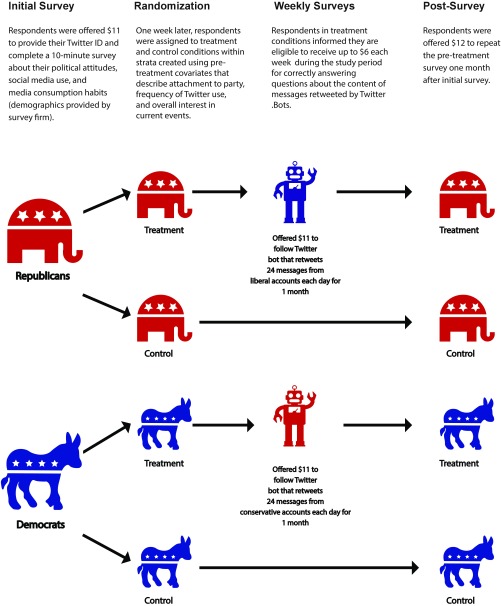
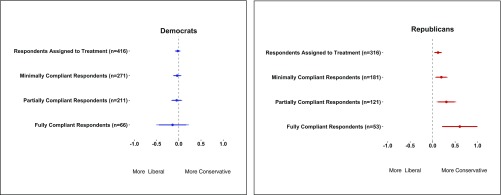
Significance: Social media sites are often blamed for exacerbating political polarization by creating “echo chambers” that prevent people from being exposed to information that contradicts their preexisting beliefs. We conducted a field experiment that offered a large group of Democrats and Republicans financial compensation to follow bots that retweeted messages by elected officials and opinion leaders with opposing political views. Republican participants expressed substantially more conservative views after following a liberal Twitter bot, whereas Democrats’ attitudes became slightly more liberal after following a conservative Twitter bot—although this effect was not statistically significant. Despite several limitations, this study has important implications for the emerging field of computational social science and ongoing efforts to reduce political polarization online.
Overview
The claims and statistics of this paper haven’t been checked yet.
Free: it reads the open-access text and checks the first 5 claims that cite a source we can check. Create a free account to check every claim.
Integrity signals
Registry
Cites
Statistics
Figures
Verification
Claims the paper makes
The claims and statistics of this paper haven’t been checked yet.
Free: it reads the open-access text and checks the first 5 claims that cite a source we can check. Create a free account to check every claim.
Claims other papers make about this one
Each is checked against this paper’s own text: does it say what the citing paper says it does?
The cited source doesn’t support the claim as written.
In the citing paper
“Supporting this, Bail et al. [2] further challenge the polarization assumption, showing that social media use can increase exposure to non-partisan content.”
From A systematic review of echo chamber research: comparative analysis of conceptualizations, operationalizations, and varying outcomes (2025) · cites this paper as [2]
Checked by a reasoning model — may be wrong.
Experimental — accuracy not yet measuredThe source backs part of the claim, not all of it — or backs it for a different population, condition or comparison.
In the citing paper
“For instance, it is neither clear what level of homophily in social networks is desirable or undesirable in a democratic society, nor is it clear how to interpret the results of certain studies on polarization69,130, whose findings depend on whether one assumes that social media have increased or decreased exposure to opposing views relative to some offline benchmark.”
From A systematic review of worldwide causal and correlational evidence on digital media and democracy (2022) · cites this paper as [69]
Experimental — accuracy not yet measuredThe source backs part of the claim, not all of it — or backs it for a different population, condition or comparison.
In the citing paper
“Even without being designed to shift opinions, it has been found that algorithms may contribute to political polarization by reinforcing divisive opinions [9, 24, 32].”
From Co-Writing with Opinionated Language Models Affects Users’ Views (2023) · cites this paper as [9]
Experimental — accuracy not yet measuredThe source backs part of the claim, not all of it — or backs it for a different population, condition or comparison.
In the citing paper
“Entrar en contacto con contenido contra-actitudinal puede generar una resistencia emocional y una sensación de amenaza que terminen polarizando igualmente al individuo (Bail et al., 2018;Dahlgren, 2022).”
From Política, uso de medios y polarización afectiva en España (2024) · cites this paper as Bail et al., 2018
Experimental — accuracy not yet measuredThe source backs part of the claim, not all of it — or backs it for a different population, condition or comparison.
In the citing paper
“Experimental approaches show e.g., how distorted meta-representations of outgroups on digital platforms can result in disaffection across ideological groups (Bail et al. 2018, Banks et al. 2021).”
From When debates break apart: discursive polarization as a multi-dimensional divergence emerging in and through communication (2023) · cites this paper as Bail et al. 2018
Experimental — accuracy not yet measured
18 more claims about this paper
Create a free account to see every claim other papers make about this one.
Self-check
Percentages, sums and reported differences re-computed from the paper’s own numbers.
The self-check needs the paper’s full text.
Citations
Cites
Birds of a Feather: Homophily in Social Networks
McPherson, M., Smith-Lovin, L., & Cook, J. M. (2001) · Annual Review of Sociology · doi:10.1146/annurev.soc.27.1.415 · Cited by 18,567 · cited 1×
“Despite initial optimism that social media might enable people to consume more heterogeneous sources of information about current events, there is growing concern that such forums exacerbate political polarization because of social network homophily, or the well-documented tendency of people to form social network tie…”
BackgroundA meta-analytic test of intergroup contact theory.
Pettigrew, T. F., & Tropp, L. R. (2006) · Journal of personality and social psychology · doi:10.1037/0022-3514.90.5.751 · Cited by 9,708 · cited 1×
“A vast literature indicates contact between opposing groups can challenge stereotypes that develop in the absence of positive interactions between them (30).”
BackgroundLord, C. G., Ross, L., & Lepper, M. R. (1979) · Journal of Personality and Social Psychology · doi:10.1037/0022-3514.37.11.2098 · Cited by 4,583
Liberals and conservatives rely on different sets of moral foundations.
Graham, J., Haidt, J., & Nosek, B. A. (2009) · Journal of Personality and Social Psychology · doi:10.1037/a0015141 · Cited by 4,560
Motivated Skepticism in the Evaluation of Political Beliefs
Taber, C. S., & Lodge, M. (2006) · American Journal of Political Science · doi:10.1111/j.1540-5907.2006.00214.x · Cited by 4,344
Lazer, D., Pentland, A., Adamic, L., Aral, S., Barabási, A.-L., Brewer, D., Christakis, N., Contractor, N., Fowler, J., Gutmann, M., et al. (2009) · Science · doi:10.1126/science.1167742 · Cited by 3,365
Exposure to ideologically diverse news and opinion on Facebook
Bakshy, E., Messing, S., & Adamic, L. A. (2015) · Science · doi:10.1126/science.aaa1160 · Cited by 3,245
When Corrections Fail: The Persistence of Political Misperceptions
Nyhan, B., & Reifler, J. (2010) · Political Behavior · doi:10.1007/s11109-010-9112-2 · Cited by 3,173
Fear and loathing across party lines: New evidence on group polarization
Iyengar, S., & Westwood, S. J. (2015) · American Journal of Political Science · doi:10.1111/ajps.12152 · Cited by 2,452
Uncivil Agreement: How Politics Became Our Identity
Mason, L. (2018) · doi:10.7208/chicago/9780226524689.001.0001 · Cited by 1,985
Research works printed but not linked: 1
- Sunstein C 2001 Echo Chambers, Bush v. Gore, Impeachment, and Beyond Princeton Univ Press Princeton
Cited by
Items 201–300 of 1,010
Uyheng, J., & Carley, K. M. (2019) · Lecture notes in computer science · doi:10.1007/978-3-030-21741-9_16 · Cited by 42
“Born for a Storm”: Hard-Right Social Media and Civil Unrest
Karell, D., Linke, A. M., Holland, E. C., & Hendrickson, E. (2023) · American Sociological Review · doi:10.1177/00031224231156190 · Cited by 73
“These shared platforms salvage the possibility of serendipitous exposure to other attitudes, which can help decrease animosity to those with opposing political views (Levy 2021; but see Bail et al. 2018).”
BackgroundPeralta, A. F., Neri, M., Kertész, J., & Íñiguez, G. (2021) · Physical review. E · doi:10.1103/physreve.104.044312 · Cited by 76
Cognitive cascades: How to model (and potentially counter) the spread of fake news
Rabb, N., Cowen, L., de Ruiter, J. P., & Scheutz, M. J. (2022) · PLoS ONE · doi:10.1371/journal.pone.0261811 · Cited by 58
“This captures the illusory truth [23, 70] and mere-exposure effects [86].”
BackgroundOnline engagement with 2020 election misinformation and turnout in the 2021 Georgia runoff election
Green, J., Hobbs, W., McCabe, S., & Lazer, D. M. J. (2022) · Proceedings of the National Academy of Sciences · doi:10.1073/pnas.2115900119 · Cited by 76
Public Health Communication and Engagement on Social Media during the COVID-19 PandemicPreprint
Teichmann, L., Nossek, S., Bridgman, A., Loewen, P. J., Owen, T., Ruths, D. A., & Zhilin, O. (2020) · OSF Preprints (OSF Preprints) · doi:10.31219/osf.io/7hypj · Cited by 48
Zhu, Q., Weeks, B. E., & Kwak, N. (2021) · New Media & Society · doi:10.1177/14614448211061336 · Cited by 61
“Yet, there is evidence that exposure to disagreement is not always beneficial; disagreement can backfire and increase attitude polarization (Bail et al., 2018; Kim, 2015), but it is unclear whether such processes extend to incidental exposure to disagreement and emotional polarization.”
BackgroundInfluentialThe drivers of online polarization: Fitting models to data
Valensise, C. M., Cinelli, M., & Quattrociocchi, W. (2023) · Information Sciences · doi:10.1016/j.ins.2023.119152 · Cited by 61
“Along this path, several studies focused on polarization dynamics [3] especially about vaccines [26,40] or about the climate change debate [21].”
BackgroundStart Generating: Harnessing Generative Artificial Intelligence for Sociological Research
Davidson, T. (2024) · Socius Sociological Research for a Dynamic World · doi:10.1177/23780231241259651 · Cited by 78
Fake News Is Real: The Significance and Sources of Disbelief in Mainstream Media in Trump’s America
Lee, T., & Hosam, C. (2020) · Sociological Forum · doi:10.1111/socf.12603 · Cited by 64
Comparative analysis of social bots and humans during the COVID-19 pandemic
Chang, H.-C. H., & Ferrara, E. (2022) · Journal of Computational Social Science · doi:10.1007/s42001-022-00173-9 · Cited by 46
“Social media platforms Misinformation in particular has been identified as both a symptom and cause for growing polarization within the United States [5, 6], which motivates research on identifying the actors and narratives around these issues.”
BackgroundMethodThe cost of a divided America: an experimental study into destructive behavior
Mill, W., & Morgan, J. (2022) · Experimental Economics · doi:10.1007/s10683-021-09737-4 · Cited by 43
“Political polarization is a widespread global phenomenon (Carothers and Donohue 2019), with consequences of great interest to the public and social scientists (Bail et al. 2018; Dixit and Weibull 2007).”
InfluentialBliuc, A., Smith, L. G. E., & Moynihan, T. (2020) · Group Processes & Intergroup Relations · doi:10.1177/1368430220942567 · Cited by 47
“On the contrary, exposure to diverse and, in particular, opposing views of an ideological outgroup can be seen as another pathway to polarisation – that is, polarisation via intergroup interaction (Bail et al., 2018; Pauwels & Schils, 2016).”
BackgroundOnline communities come with real-world consequences for individuals and societies
Oksanen, A., Celuch, M., Oksa, R., & Savolainen, I. (2024) · Communications Psychology · doi:10.1038/s44271-024-00112-6 · Cited by 78
Strategies for integrating disparate social information
Molleman, L., Tump, A. N., Gradassi, A., Herzog, S. M., Jayles, B., Kurvers, R. H. J. M., & van den Bos, W. (2020) · Proceedings of the Royal Society B Biological Sciences · doi:10.1098/rspb.2020.2413 · Cited by 47
“In these (often controversial) contexts, the integration of disparate social information may be further hampered due to ‘motivated reasoning’ [56] or when observed individuals belong to an out-group [57,58].”
BackgroundThe New Structural Transformation of the Public Sphere
Stewart, E. M., & Hartmann, D. (2020) · Sociological Theory · doi:10.1177/0735275120926205 · Cited by 64
“The resurgence of populist and nationalist movements (Bonikowski 2017; Ingelhart and Norris 2017), political polarization and conflict (Bail et al. 2018; Iyengar and Westwood 2015), concern about leaders’ respect for democratic norms in the pursuit of public appeals (Hahl, Kim, and Zuckerman Sivan…”
BackgroundInfluentialBots and Computational Propaganda: Automation for Communication and Control
Woolley, S. (2020) · Cambridge University Press eBooks · doi:10.1017/9781108890960.006 · Cited by 60
Political correctness and the alt-right: The development of extreme political attitudes
Moss, J., & O'Connor, P. J. (2020) · PLoS ONE · doi:10.1371/journal.pone.0239259 · Cited by 71
Argumentative Conversational Agents for Online Discussions
Hadfi, R., Haqbeen, J. A., Sahab, S., & Itō, T. (2021) · Journal of Systems Science and Systems Engineering · doi:10.1007/s11518-021-5497-1 · Cited by 62
Brown, G. D. A., Lewandowsky, S., & Huang, Z. (2022) · Psychological Review · doi:10.1037/rev0000342 · Cited by 54
“Back fi re effects have been seen when the relevant new information takes the form of empirical facts (Bail et al., 2018; Gollust et al., 2009; Nyhan et al., 2013; Nyhan & Rei fl er, 2010; Redlawsk, 2002) or when the information is in the form of a social norm.”
BackgroundDigital Technology, Politics, and Policy-Making
Gilardi, F. (2022) · Cambridge University Press eBooks · doi:10.1017/9781108887304 · Cited by 57
Leveraging Structured Trusted-Peer Assessments to Combat Misinformation
Jahanbakhsh, F., Zhang, A. X., & Karger, D. R. (2022) · Proceedings of the ACM on Human-Computer Interaction · doi:10.1145/3555637 · Cited by 48
“Related are studies reporting that exposure to opposing views can exacerbate polarization [8, 18, 109].”
The Algorithmic Management of Polarization and Violence on Social MediaPreprint
Stray, J., Iyer, R., & Larrauri, H. P. (2023) · SSRN Electronic Journal · doi:10.2139/ssrn.4429558 · Cited by 66
Network segregation and the propagation of misinformation
Stein, J., Keuschnigg, M., & van de Rijt, A. (2023) · Scientific Reports · doi:10.1038/s41598-022-26913-5 · Cited by 51
“…platform’s act of exposing individuals to ideologi-cally opposed alters by diversifying users’ networks could backfire at a psychological level—e.g., inciting further polarization of attitudes 10,37,38 —our result suggests that it would lower the prevalence of misinformation in the system overall.”
BackgroundPeople believe political opponents accept blatant moral wrongs, fueling partisan divides
Puryear, C., Kubin, E., Schein, C., Bigman, Y., Ekstrom, P. D., & Gray, K. J. (2024) · PNAS Nexus · doi:10.1093/pnasnexus/pgae244 · Cited by 45
“Research from contact theory has long demonstrated the potential for intergroup contact to reduce prejudice (34), but many cross-partisan interactions are highly negative (35, 36) — a form of contact which often backfires and increases prejudice (37).”
BackgroundBoulianne, S., Hoffmann, C. P., & Bossetta, M. (2024) · New Media & Society · doi:10.1177/14614448241262415 · Cited by 84
“Online interactions on Twitter with cross-partisans can further fuel partisanship (Bail et al., 2018).”
Asymmetric Polarization on Twitter and the 2018 Brazilian Presidential Elections
Soares, F. B., Recuero, R., & Zago, G. (2019) · Proceedings of the 10th International Conference on Social Media and Society · doi:10.1145/3328529.3328546 · Cited by 38
“In fact, when exposure to opposing occurs, it serves to further increase the isolation of echo chambers [2].”
BackgroundStudying human attention on the Internet
Lazer, D. (2020) · Proceedings of the National Academy of Sciences · doi:10.1073/pnas.1919348117 · Cited by 38
“The paper uses panel data of Twitter users coupled with 2 survey waves from 2017, collected for other purposes (4), with the following question: Is exposure to Russian trollcontent associated with political polarization (captured by an array of attitudinal and behavioral measures)?”
MethodFacts and Where to Find Them: Empirical Research on Internet Platforms and Content Moderation
Keller, D., & Leerssen, P. (2020) · Cambridge University Press eBooks · doi:10.1017/9781108890960.011 · Cited by 63
van Baar, J. M., & FeldmanHall, O. (2022) · American Psychologist · doi:10.1037/amp0000814 · Cited by 38
Tóth, F., Mihelj, S., Štětka, V., & Kondor, K. (2022) · The International Journal of Press/Politics · doi:10.1177/19401612211072552 · Cited by 53
“An experimental study of Twitter users in the USA, which examined the ideological impact of exposure to cross-cutting views (Bail et al. 2018) reached a similar conclusion, but also pointed to the impact of political orientation.”
BackgroundResultAhmed, S., & Rasul, M. E. (2023) · Scientific Reports · doi:10.1038/s41598-023-42614-z · Cited by 57
“The adverse effects of social media in impacting mental health 74,75 , incivility 76–78 , and political polarization 79,80 are widely discussed.”
BackgroundOn the impossibility of breaking the echo chamber effect in social media using regulation
Avin, C., Daltrophe, H., & Lotker, Z. (2024) · Scientific Reports · doi:10.1038/s41598-023-50850-6 · Cited by 58
Rau, J. P., & Stier, S. (2019) · Zeitschrift für Vergleichende Politikwissenschaft · doi:10.1007/s12286-019-00429-1 · Cited by 68
“3 erläutert, eingeschränkt (im Webseitenbereich) oder unklar (in SNS).6 Studien auf der Wirkungsebene zeigen, dass politische SNS-Nutzung Polarisierung prinzipiell verstärken kann (Bail et al. 2018).”
BackgroundOverdoing Democracy: Why We Must Put Politics in its Place
Talisse, R. B. (2019) · doi:10.1093/oso/9780190924195.001.0001 · Cited by 317
Reducing Political Dehumanization by Pairing Facts With Personal Experiences
Kubin, E., Gray, K. J., & von Sikorski, C. (2023) · Political Psychology · doi:10.1111/pops.12875 · Cited by 47
Falkenberg, M., Zollo, F., Quattrociocchi, W., Pfeffer, J., & Baronchelli, A. (2024) · Nature Communications · doi:10.1038/s41467-024-53868-0 · Cited by 75
“However, the richness and availability of social media data has made it an invaluable forum for studying the mechanisms of polarization 15,29 – 31 , depolarization 32,33 , its evolution over time 16,34 , and for testing potential interventions and countermeasures 18 .”
The Government's Dividend: Complex Perceptions of Social Media Misinformation in China
Lu, Z., Jiang, Y., Lu, C., Naaman, M., & Wigdor, D. (2020) · CHI Conference on Human Factors in Computing Systems · doi:10.1145/3313831.3376612 · Cited by 45
“Fact checking is far from a panacea, and multiple previous efforts had pointed out some of the challenges and limitations in changing existing beliefs [2, 26, 34, 38].”
BackgroundHaupt, M. R., Li, J., & Mackey, T. K. (2021) · Big Data & Society · doi:10.1177/20539517211013843 · Cited by 43
“However, the messaging for these approaches should be met with caution, as past research has shown that users who follow bots with opposite political ideologies to their own beliefs can instead lead to increased polarization (Bail et al., 2018).”
BackgroundStarryThoughts: Facilitating Diverse Opinion Exploration on Social Issues
Kim, H., Kim, H., Jo, K. J., & Kim, J. (2021) · Proceedings of the ACM on Human-Computer Interaction · doi:10.1145/3449140 · Cited by 35
“Prior research suggests that the mere exposure of diverse opinions might not immediately mitigate polarization [5].”
BackgroundDesigning recommender systems to depolarize
Stray, J. (2022) · First Monday · doi:10.5210/fm.v27i5.12604 · Cited by 76
Chen, Y., & Luping, W. (2022) · Computers in Human Behavior · doi:10.1016/j.chb.2022.107202 · Cited by 47
Hagemann, L., & Abramova, O. (2023) · Internet Research · doi:10.1108/intr-12-2021-0885 · Cited by 50
A Systematic Review of Worldwide Causal and Correlational Evidence on Digital Media and DemocracyPreprint
Lorenz-Spreen, P., Oswald, L., Lewandowsky, S., & Hertwig, R. (2021) · doi:10.31235/osf.io/p3z9v · Cited by 35
Reranking partisan animosity in algorithmic social media feeds alters affective polarization
Piccardi, T., Saveski, M., Jia, C., Hancock, J., Tsai, J. L., & Bernstein, M. S. (2025) · Science · doi:10.1126/science.adu5584 · Cited by 117
“However, large-scale field experiments aimed at reducing polarization by intervening on the feed algorithm—for example, by increasing exposure to out-party content—have found both a decrease ( 35 ) and an increase ( 36 ) in polarization.”
A tale of two swamps: Transformations of a metaphorical frame in online partisan media
Burgers, C. F., Fa, M. J. T., & de Graaf, A. (2019) · Journal of Pragmatics · doi:10.1016/j.pragma.2018.12.018 · Cited by 42
“Thus, the nature of these transformations is often connected to the basic building blocks of narratives (Bal, 2009; Mandler and Johnson, 1977).”
BackgroundLin, H., Wang, Y., Lee, J., & Kim, Y. (2023) · Journal of Computer-Mediated Communication · doi:10.1093/jcmc/zmad022 · Cited by 34
Self-citationBeyond emotional similarity: The role of situation-specific motives.
Goldenberg, A., García, D., Halperin, E., Zaki, J., Kong, D., Golarai, G., & Gross, J. J. (2020) · Journal of Experimental Psychology General · doi:10.1037/xge0000625 · Cited by 39
“To achieve this goal we used a list of 4,176 public figures and organizations whose political affiliations were evaluated in a recent study by Bail and colleagues (see Bail et al., 2018).”
BackgroundMethodThe Effect of Expressive Biosignals on Empathy and Closeness for a Stigmatized Group Member
Liu, F., Kaufman, G. F., & Dabbish, L. (2019) · Proceedings of the ACM on Human-Computer Interaction · doi:10.1145/3359303 · Cited by 38
“While these platforms provide opportunities and outlets for people to share their experiences, the audience who will read or respond to those stories may not necessarily be able to connect with or understand them–as evidenced by known challenges in polarization, harassment, implicit biases online [4, 30, 41].”
BackgroundBiases in Information Selection and Processing: Survey Evidence from the Pandemic
Faia, E., Fuster, A., Pezone, V., & Zafar, B. (2024) · The Review of Economics and Statistics · doi:10.1162/rest_a_01187 · Cited by 53
“A study implementing an information treatment experiment close in spirit to our second survey is Bail et al. (2018). 5”
BackgroundWu, S., & Resnick, P. (2021) · Proceedings of the International AAAI Conference on Web and Social Media · doi:10.1609/icwsm.v15i1.18105 · Cited by 34
Entropy and complexity unveil the landscape of memes evolution
Valensise, C. M., Serra, A. O. G., Galeazzi, A., Etta, G., Cinelli, M., & Quattrociocchi, W. (2021) · Scientific Reports · doi:10.1038/s41598-021-99468-6 · Cited by 49
Social media communication during natural disasters and the impact on the agricultural market
Platania, F., Hernandez, C. T., & Arreola, F. (2022) · Technological Forecasting and Social Change · doi:10.1016/j.techfore.2022.121594 · Cited by 39
Polarized Graph Neural Networks
Fang, Z., Xu, L., Song, G., Long, Q., & Zhang, Y. (2022) · International World Wide Web Conference (WWW) · doi:10.1145/3485447.3512187 · Cited by 47
“Recent surveys on social networks also confirm that being exposed to heterogeneous information can increase attitude polarization [2, 16].”
BackgroundA New Social Conflict on Globalisation-Related Issues in Germany? A Longitudinal Perspective
Teney, C., & Rupieper, L. K. (2023) · KZfSS Kölner Zeitschrift für Soziologie und Sozialpsychologie · doi:10.1007/s11577-023-00884-5 · Cited by 48
“Indeed, both traditional media (Czymara and Dochow 2018) and social media (Bail et al. 2018) have been shown to play an important role in shaping attitudes towards globalisation-related issues as well as for their perceived salience.”
BackgroundDoes affective polarization contribute to democratic backsliding in America?
Druckman, J. N., Green, D. P., & Iyengar, S. (2023) · The ANNALS of the American Academy of Political and Social Science · doi:10.1177/00027162241228952 · Cited by 33
“…to the proattitudinal news) implies that echo chambers and the lack of counterattitudinal exposure can contribute to affective polarization (c.f., Bail et al. 2018). taken together, the evidence suggests that the technologically enhanced information environment contributes to affective…”
BackgroundDemocratic Creative Destruction? The Effect of a Changing Media Landscape on Democracy
Nielsen, R. K., & Fletcher, R. (2020) · Cambridge University Press eBooks · doi:10.1017/9781108890960.008 · Cited by 65
Shin, J. (2020) · Social Media + Society · doi:10.1177/2056305120981039 · Cited by 42
“Using field experiments, Bail et al. (2018) observed that when social media users are exposed to opposing political views, they become even more extreme in their views.”
Using Administrative Records and Survey Data to Construct Samples of Tweeters and Tweets
Hughes, A. G., McCabe, S., Hobbs, W., Remy, E., Shah, S., & Lazer, D. M. J. (2021) · Public Opinion Quarterly · doi:10.1093/poq/nfab020 · Cited by 43
Tweeting ourselves to death: the cultural logic of digital capitalism
Törnberg, P., & Uitermark, J. (2022) · Media, Culture & Society · doi:10.1177/01634437211053766 · Cited by 33
“This has been confirmed by experimental research showing that Democrats and Republicans who agreed to be exposed to views from the other side did not revise or moderate their positions; the Republicans even hardened their views (Bail et al., 2018).”
ResultBergquist, P., Marlon, J. R., Goldberg, M. H., Gustafson, A., Rosenthal, S. A., & Leiserowitz, A. (2022) · Thinking & Reasoning · doi:10.1080/13546783.2022.2030407 · Cited by 37
“This suggests that the use of a simple metaphor (a blanket) and linking global warming with human industrial activities can help Americans better understand the human causes of global warming (Bales et al., 2015).”
BackgroundInfluentialHumans’ Bias Blind Spot and Its Societal Significance
Pronin, E., & Hazel, L. (2023) · Current Directions in Psychological Science · doi:10.1177/09637214231178745 · Cited by 33
“Psychological bias can exacerbate political polarization, not just in the echo chambers of social media and the one-sided stream of cable news but even when people are exposed to opposing views (e.g., Bail et al., 2018).”
Hate multiverse spreads malicious COVID-19 content online beyond individual platform controlPreprint
Velásquez, N., Leahy, R., Restrepo, N. J., Lupu, Y., Sear, R. F., Gabriel, N., Jha, O., Goldberg, B., & Johnson, N. F. (2020) · arXiv (Cornell University) · doi:10.48550/arxiv.2004.00673 · Cited by 33
“It is known that such clusters are where people develop, and coordinate around, narratives [9] -- in contrast to platforms like Twitter that have no pre-built community tool and are instead designed for broadcasting short messages [7-9].”
BackgroundIdeology and Composition Among an Online Crowd: Evidence from Wikipedians
Greenstein, S. M., Gu, G., & Zhu, F. (2020) · Management Science · doi:10.1287/mnsc.2020.3661 · Cited by 39
“In addition, prior studies show that people’s beliefs become more reinforced when they encounter information that is aligned with their prior beliefs (e.g., Van Alstyne and Brynjolfsson 2005, Gilbert et al. 2009, Bakshy et al. 2015, Lee et al. 2015, Garimella et al. 2018).”
BackgroundDepolarization of echo chambers by random dynamical nudge
Currin, C. B., Vera, S. V., & Khaledi‐Nasab, A. (2022) · Scientific Reports · doi:10.1038/s41598-022-12494-w · Cited by 46
“There, unlike our RDN, researchers used messages from high-profile political elites (instead of randomly chosen opinions) 61 .”
BackgroundResultInfluentialThe social media discourse of engaged partisans is toxic even when politics are irrelevant
Mamakos, M., & Finkel, E. J. (2023) · PNAS Nexus · doi:10.1093/pnasnexus/pgad325 · Cited by 53
“However, a major study demonstrated that the political extremity of American partisans actually increased after people were assigned to see social-media posts from opposing partisans (26).”
BackgroundKantian Ethics and the Attention Economy: Duty and Distraction
Aylsworth, T., & Castro, C. (2024) · Springer eBooks · doi:10.1007/978-3-031-45638-1 · Cited by 37
Self-induced consensus of Reddit users to characterise the GameStop short squeeze
Mancini, A., Desiderio, A., Clemente, R. D., & Cimini, G. (2022) · Scientific Reports · doi:10.1038/s41598-022-17925-2 · Cited by 55
Ludwig, K., Grote, A., Iana, A., Alam, M., Paulheim, H., Sack, H., Weinhardt, C., & Müller, P. (2023) · Social Science Computer Review · doi:10.1177/08944393221149290 · Cited by 55
“Political orientation was found to be a crucial factor when it comes to message effects on political polarization (e.g., Bail et al., 2018).”
BackgroundIntergroup psychological interventions: The motivational challenge.
Landry, A., & Halperin, E. (2025) · American Psychologist · doi:10.1037/amp0001289 · Cited by 38
Group Epistemology and Structural Factors in Online Group Polarization
Boyd, K. M. (2020) · Episteme · doi:10.1017/epi.2020.47 · Cited by 32
“…remedies proposed for polarization on Facebook, which often posit that exposing users to information that they would not normally be exposed to can mitigate polarization effects (e.g. Munson et al. 2013; Garimella et al. 2017; although Bail et al. (2018) suggest that this strategy can backfire).”
BackgroundDynamics of Opinion Polarization
Biondi, E., Boldrini, C., Passarella, A., & Conti, M. (2023) · IEEE Transactions on Systems Man and Cybernetics Systems · doi:10.1109/tsmc.2023.3268758 · Cited by 49
Luo, H., Meng, X., Zhao, Y., & Cai, M. (2023) · Telematics and Informatics · doi:10.1016/j.tele.2023.102051 · Cited by 38
Doing your own research and other impossible acts of epistemic superheroism
Buzzell, A., & Rini, R. A. (2022) · Philosophical Psychology · doi:10.1080/09515089.2022.2138019 · Cited by 38
“But efforts to tweak the algorithm to decrease polarization (by deliberately exposing users to out-group content) in fact increased polarization (Bail et al., 2018).”
BackgroundSuk, J., Zhang, Y., Yue, Z., Wang, R., Dong, X., Yang, D., & Lian, R. (2023) · Communication Research · doi:10.1177/00936502231154146 · Cited by 35
“When exposed to counter-attitudinal information and viewpoints on social media, opinionated people can develop stronger or even more extreme views over time (Bail et al., 2018).”
BackgroundAd Delivery Algorithms: The Hidden Arbiters of Political Messaging
Ali, M., Sapiezynski, P., Korolova, A., Mislove, A., & Rieke, A. (2019) · arXiv · doi:10.48550/arxiv.1912.04255 · Cited by 30
“warn against overexposing users to messaging from politicians they do not support as it appears to increase, rather than decrease their partisanship [6].”
BackgroundTien, J. H., Eisenberg, M. C., Cherng, S. T., & Porter, M. A. (2020) · Applied Network Science · doi:10.1007/s41109-019-0223-3 · Cited by 41
The responsiveness of criminal networks to intentional attacks: Disrupting darknet drug trade
Duxbury, S., & Haynie, D. L. (2020) · PLoS ONE · doi:10.1371/journal.pone.0238019 · Cited by 39
“As an example, social media giants like Facebook and Twitter have recently struggled to insulate their online platforms against the spread of political propaganda [34], and online markets like eBay routinely grapple with opinion spamming through fake sales reviews [35].”
BackgroundMorales, P. R., & Cointet, J. (2021) · ACM Conference on Recommender Systems (RecSys) · doi:10.1145/3460231.3478851 · Cited by 43
“…approaches (topological and geometrical) have been influenced by the political setting of the US of binary social classification of users as Democrat-or Republican-leaning [3], and user representation in a single (one-dimensional) attitudinal scale ranging from liberal to conservative views [7].”
BackgroundDesigning Digital Participatory Budgeting Platforms: Urban Biking Activism in Madrid
Menéndez-Blanco, M., & Bjørn, P. (2022) · Computer Supported Cooperative Work (CSCW) · doi:10.1007/s10606-022-09443-6 · Cited by 41
The Costs of Polarizing a Pandemic: Antecedents, Consequences, and Lessons
Van Bavel, J. J., Pretus, C., Rathje, S., Pärnamets, P., Vlasceanu, M., & Knowles, E. D. (2024) · Perspectives on Psychological Science · doi:10.1177/17456916231190395 · Cited by 29
“…randomized control trials suggest that exposure to certain political elites and news sources on social media can play a role in both increasing (Bail et al., 2018) and decreasing (Levy, 2021) polarization—and that social media algorithms can limit exposure to counter-attitu-dinal news and thus…”
Brady, W. J., & Van Bavel, J. J. (2021) · doi:10.31219/osf.io/dgt6u · Cited by 28
What Can I Do? How to Use Social Media to Improve Democratic Society
Vraga, E. K. (2019) · Political Communication · doi:10.1080/10584609.2019.1610620 · Cited by 31
“In fact, exposure to our opponents can increase polarization by encouraging people to develop arguments to rebut the ideas they wish to discredit (Bail et al., 2018; Taber & Lodge, 2006).”
BackgroundHarnessing social tipping dynamics: A systems approach for accelerating decarbonization
Eker, S., Wilson, C., Höhne, N., McCaffrey, M. S., Monasterolo, I., Niamir, L., & Zimm, C. (2024) · One Earth · doi:10.1016/j.oneear.2024.05.012 · Cited by 42
“45 People who are exposed to opposing views stick to their own view more strongly 50 ; hence, advocacy activities enhance value polarization and reinforce the norm change feed-backs on both sides.”
BackgroundDecentralizing electoral campaigns? New-old parties, grassroots and digital activism
Lobera, J., & Portos, M. (2020) · Information Communication & Society · doi:10.1080/1369118x.2020.1749697 · Cited by 38
Comparing tweet sentiments in megacities using machine learning techniques: In the midst of COVID-19
Yao, Z., Yang, J., Liu, J., Keith, M., & Guan, C. (2021) · Cities · doi:10.1016/j.cities.2021.103273 · Cited by 34
“Bail et al. (2018) have mentioned that social media could create either “ echo chambers ” effects or backfire effects that exacerbate opinion polarization.”
Perspective-Taking to Reduce Affective Polarization on Social Media
Saveski, M., Gillani, N., Yuan, A., Vijayaraghavan, P., & Roy, D. (2022) · Proceedings of the International AAAI Conference on Web and Social Media · doi:10.1609/icwsm.v16i1.19343 · Cited by 28
User Tampering in Reinforcement Learning Recommender Systems
Kasirzadeh, A., & Evans, C. (2023) · Proceedings of the AAAI/ACM Conference on AI Ethics and Society · doi:10.1145/3600211.3604669 · Cited by 61
“to a high volume of content from the politically opposite side can often amplify user polarization [5, 6].”
BackgroundUniversities as peculiar organizations
Eaton, C., & Stevens, M. L. (2020) · Sociology Compass · doi:10.1111/soc4.12768 · Cited by 38
Mobile Internet and Political PolarizationPreprint
Melnikov, N. (2021) · SSRN Electronic Journal · doi:10.2139/ssrn.3937760 · Cited by 54
“, Facebook), primarily on the question of whether social media algorithms create so-called “echo chambers,” where social media users are disproportionately exposed to like-minded news content (e.g., Bakshy, Messing and Adamic, 2015; Barberá, 2015; Halberstam and Knight, 2016; Bail et al., 2018; Beam, Hutchens and Hmie…”
BackgroundInfluentialPapakyriakopoulos, O., Engelmann, S., & Winecoff, A. (2023) · CHI Conference on Human Factors in Computing Systems · doi:10.1145/3544548.3580644 · Cited by 42
“Prior research studies illustrate that social media platforms have transformative effects on political communication, albeit intense debates about whether and how design features influence the quality of discourse among users [11, 13, 84, 119, 120].”
BackgroundZhang, J. S., Tan, C., & Lv, Q. (2019) · Proceedings of the ACM on Human-Computer Interaction · doi:10.1145/3359295 · Cited by 34
“However, recent studies on the “backfire” effect suggest that exposure to opposing groups in online platforms can exacerbate political polarization [2, 3, 52, 71].”
BackgroundResultInfluentialThe effects of recursive communication dynamics on belief updating
Pescetelli, N., & Yeung, N. (2020) · Proceedings of the Royal Society B Biological Sciences · doi:10.1098/rspb.2020.0025 · Cited by 38
“[27] found that being exposed to disagreeing opinions can polarize individual beliefs even further.”
BackgroundKeuchenius, A., Törnberg, P., & Uitermark, J. (2021) · PLOS ONE · doi:10.1371/journal.pone.0256696 · Cited by 27
Semantic Web technologies and bias in artificial intelligence: A systematic literature review
Lobo, P. R., Daga, E., Alani, H., & Fernández, M. (2022) · Semantic Web · doi:10.3233/sw-223041 · Cited by 49
“Recently, a research project presented a similar approach to assess confirmation bias and other similar group phenomena that occur when analysing, visualising and disseminating information on the Internet (group polarisation [8] and the belief echo chamber [60]).”
BackgroundMicroblogging Replies and Opinion Polarization: A Natural Experiment
Lu, Y., Wu, J., Tan, Y., & Chen, J. (2022) · MIS Quarterly · doi:10.25300/misq/2022/15455 · Cited by 35
A goldilocks critique of the hot cognition perspective on climate change skepticism
Hennes, E. P., Kim, T., & Remache, L. J. (2020) · Current Opinion in Behavioral Sciences · doi:10.1016/j.cobeha.2020.03.009 · Cited by 30
Measuring Online Political Dialogue: Does Polarization Trigger More Deliberation?
Serrano-Contreras, I.-J., Marin, J. G., & Luengo, Ó. G. (2020) · Media and Communication · doi:10.17645/mac.v8i4.3149 · Cited by 41
“To reflect that, some authors coined the concept of ‘echo chambers’ (Bail et al., 2018).”
BackgroundCross-platform social dynamics: an analysis of ChatGPT and COVID-19 vaccine conversations
Alipour, S., Galeazzi, A., Sangiorgio, E., Avalle, M., Bojić, L., Cinelli, M., & Quattrociocchi, W. (2023) · Scientific Reports · doi:10.1038/s41598-024-53124-x · Cited by 36
“Thus, conducting a quantitative comparison between the COVID-19 infodemic and the evolution of the ChatGPT discussions can help understand the differences and similarities in the impact of these two events on the online information ecosystem.”
BackgroundMultidimensional political polarization in online social networks
Peralta, A. F., Morales, P. R., Kertész, J., & Íñiguez, G. (2024) · Physical Review Research · doi:10.1103/physrevresearch.6.013170 · Cited by 49
“As in [1, 3, 5], we rely on the fact that Correspondence Analysis (CA) [7] principal components of P approximate ideal point estimation [8].”
Metadata
- Authors
- Bail, C. A., Argyle, L. P., Brown, T. W., Bumpus, J. P., Chen, H., Hunzaker, M. B. F., Lee, J., Mann, M., Merhout, F., & Volfovsky, A.
- Affiliations
- Duke University (US)
- Brigham Young University (US)
- New York University (US)
- Corresponding author
- Bail, Christopher A.
- ORCID
- Venue
- Proceedings of the National Academy of Sciences
- Publisher
- National Academy of Sciences
- Published
- 2018-08-28
- Volume
- 115
- Issue
- 37
- Pages
- 9216-9221
- ISSN
- 0027-8424 (ISSN-L)
- 1091-6490
- PMC
- PMC6140520
- OpenAlex
- W2889127731
- Semantic Scholar
- c1cb4725a7fb0df77c52d6d2792e87d588178715
- Cited by
- 1,863
- References
- 56
- Citations by year
- 2026: 275 · 2025: 272 · 2024: 248 · 2023: 292 · 2022: 264 · 2021: 228 · 2020: 181 · 2019: 96 · 2018: 7
- FWCI
- 278.82
- Type
- journal article
- Language
- en
- Open access
- hybrid
- doi.org
- Licence
- Locations
- Proceedings of the National Academy of Sciences (publishedVersion, cc-by-nc-nd)
- Europe PMC (PubMed Central) (publishedVersion, cc-by-nc-nd)
- PubMed Central (publishedVersion, cc-by-nc-nd)
- PubMed (publishedVersion)
- RePEc: Research Papers in Economics (submittedVersion)
- Funders
- Russell Sage Foundation (E0267)
- Topics
- Social Sciences › Communication › Social Media and Politics
- Social Sciences › Sociology and Political Science › Media Influence and Politics
- Social Sciences › Sociology and Political Science › Misinformation and Its Impacts
- Keywords
- political polarization, echo chambers, social media, Twitter bots, ideological change, financial incentives, computational social science, partisanship, social policy attitudes
- MeSH terms
- Political Activism, Democracy, Female, Humans, Male, United States, Social Media
About these checks
Registry, retraction, Cites and statistics results are computed, not judged, with one exception: a printed reference that no index lists is read once by a model before it counts as a citation error. Claims are extracted by a model and kept only when their quote appears verbatim in the text; each cited source is then checked, with a model’s help, for whether it says what the claim relies on. Those verdicts can be wrong — read the claim’s quote and the cited source before relying on one.
Statistics and arithmetic are recomputed, not judged.
Confidence bands are shown only for fields calibrated on our annotated test set. None is calibrated yet, so no band is shown.
What counts as a claim ›How we measure confidence ›How we check this ›
Are you an author, or do you see a problem with this page? Request a review
Data sources
Bibliographic data: Semantic Scholar, OpenAlex, Crossref.
Contains information from the Semantic Scholar Academic Graph Datasets, made available under the ODC Attribution License (ODC-BY 1.0).
Semantic Scholar’s data is described in: Kinney, R., et al. (2023). The Semantic Scholar Open Data Platform. arXiv:2301.10140.
