

Exposure to opposing views on social media can increase political polarization
Open accessThe DOI matches its Crossref record; 60 of the 60 references it cites were found in a registry or an index.
Abstract
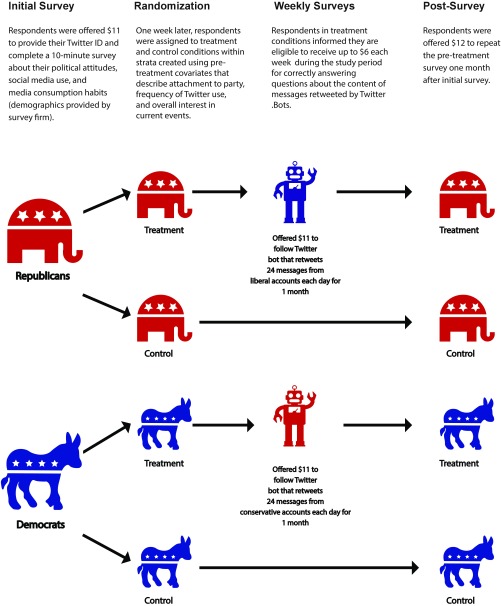
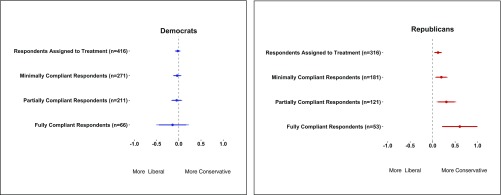
Significance: Social media sites are often blamed for exacerbating political polarization by creating “echo chambers” that prevent people from being exposed to information that contradicts their preexisting beliefs. We conducted a field experiment that offered a large group of Democrats and Republicans financial compensation to follow bots that retweeted messages by elected officials and opinion leaders with opposing political views. Republican participants expressed substantially more conservative views after following a liberal Twitter bot, whereas Democrats’ attitudes became slightly more liberal after following a conservative Twitter bot—although this effect was not statistically significant. Despite several limitations, this study has important implications for the emerging field of computational social science and ongoing efforts to reduce political polarization online.
Overview
The claims and statistics of this paper haven’t been checked yet.
Free: it reads the open-access text and checks the first 5 claims that cite a source we can check. Create a free account to check every claim.
Integrity signals
Registry
Cites
Statistics
Figures
Verification
Claims the paper makes
The claims and statistics of this paper haven’t been checked yet.
Free: it reads the open-access text and checks the first 5 claims that cite a source we can check. Create a free account to check every claim.
Claims other papers make about this one
Each is checked against this paper’s own text: does it say what the citing paper says it does?
The cited source doesn’t support the claim as written.
In the citing paper
“Supporting this, Bail et al. [2] further challenge the polarization assumption, showing that social media use can increase exposure to non-partisan content.”
From A systematic review of echo chamber research: comparative analysis of conceptualizations, operationalizations, and varying outcomes (2025) · cites this paper as [2]
Checked by a reasoning model — may be wrong.
Experimental — accuracy not yet measuredThe source backs part of the claim, not all of it — or backs it for a different population, condition or comparison.
In the citing paper
“For instance, it is neither clear what level of homophily in social networks is desirable or undesirable in a democratic society, nor is it clear how to interpret the results of certain studies on polarization69,130, whose findings depend on whether one assumes that social media have increased or decreased exposure to opposing views relative to some offline benchmark.”
From A systematic review of worldwide causal and correlational evidence on digital media and democracy (2022) · cites this paper as [69]
Experimental — accuracy not yet measuredThe source backs part of the claim, not all of it — or backs it for a different population, condition or comparison.
In the citing paper
“Even without being designed to shift opinions, it has been found that algorithms may contribute to political polarization by reinforcing divisive opinions [9, 24, 32].”
From Co-Writing with Opinionated Language Models Affects Users’ Views (2023) · cites this paper as [9]
Experimental — accuracy not yet measuredThe source backs part of the claim, not all of it — or backs it for a different population, condition or comparison.
In the citing paper
“Entrar en contacto con contenido contra-actitudinal puede generar una resistencia emocional y una sensación de amenaza que terminen polarizando igualmente al individuo (Bail et al., 2018;Dahlgren, 2022).”
From Política, uso de medios y polarización afectiva en España (2024) · cites this paper as Bail et al., 2018
Experimental — accuracy not yet measuredThe source backs part of the claim, not all of it — or backs it for a different population, condition or comparison.
In the citing paper
“Experimental approaches show e.g., how distorted meta-representations of outgroups on digital platforms can result in disaffection across ideological groups (Bail et al. 2018, Banks et al. 2021).”
From When debates break apart: discursive polarization as a multi-dimensional divergence emerging in and through communication (2023) · cites this paper as Bail et al. 2018
Experimental — accuracy not yet measured
18 more claims about this paper
Create a free account to see every claim other papers make about this one.
Self-check
Percentages, sums and reported differences re-computed from the paper’s own numbers.
The self-check needs the paper’s full text.
Citations
Cites
Birds of a Feather: Homophily in Social Networks
McPherson, M., Smith-Lovin, L., & Cook, J. M. (2001) · Annual Review of Sociology · doi:10.1146/annurev.soc.27.1.415 · Cited by 18,567 · cited 1×
“Despite initial optimism that social media might enable people to consume more heterogeneous sources of information about current events, there is growing concern that such forums exacerbate political polarization because of social network homophily, or the well-documented tendency of people to form social network tie…”
BackgroundA meta-analytic test of intergroup contact theory.
Pettigrew, T. F., & Tropp, L. R. (2006) · Journal of personality and social psychology · doi:10.1037/0022-3514.90.5.751 · Cited by 9,708 · cited 1×
“A vast literature indicates contact between opposing groups can challenge stereotypes that develop in the absence of positive interactions between them (30).”
BackgroundLord, C. G., Ross, L., & Lepper, M. R. (1979) · Journal of Personality and Social Psychology · doi:10.1037/0022-3514.37.11.2098 · Cited by 4,583
Liberals and conservatives rely on different sets of moral foundations.
Graham, J., Haidt, J., & Nosek, B. A. (2009) · Journal of Personality and Social Psychology · doi:10.1037/a0015141 · Cited by 4,560
Motivated Skepticism in the Evaluation of Political Beliefs
Taber, C. S., & Lodge, M. (2006) · American Journal of Political Science · doi:10.1111/j.1540-5907.2006.00214.x · Cited by 4,344
Lazer, D., Pentland, A., Adamic, L., Aral, S., Barabási, A.-L., Brewer, D., Christakis, N., Contractor, N., Fowler, J., Gutmann, M., et al. (2009) · Science · doi:10.1126/science.1167742 · Cited by 3,365
Exposure to ideologically diverse news and opinion on Facebook
Bakshy, E., Messing, S., & Adamic, L. A. (2015) · Science · doi:10.1126/science.aaa1160 · Cited by 3,245
When Corrections Fail: The Persistence of Political Misperceptions
Nyhan, B., & Reifler, J. (2010) · Political Behavior · doi:10.1007/s11109-010-9112-2 · Cited by 3,173
Fear and loathing across party lines: New evidence on group polarization
Iyengar, S., & Westwood, S. J. (2015) · American Journal of Political Science · doi:10.1111/ajps.12152 · Cited by 2,452
Uncivil Agreement: How Politics Became Our Identity
Mason, L. (2018) · doi:10.7208/chicago/9780226524689.001.0001 · Cited by 1,985
Research works printed but not linked: 1
- Sunstein C 2001 Echo Chambers, Bush v. Gore, Impeachment, and Beyond Princeton Univ Press Princeton
Cited by
Items 701–800 of 1,010
Structure Balance and Opinions Dynamic in Signed Social Network
Li, Z., & Tang, X. (2023) · Journal of Systems Science and Complexity · doi:10.1007/s11424-023-1482-8 · Cited by 6
“The social structure balance theory can explain the mounting two-polarization phenomenon in US political ecology [19, 20] , which is consistent with the conclusion of the Hopfield computing model [21, 22] .”
ResultPolarized opinion states in static networks driven by limited information horizons
Pérez-Martínez, H., Mingueza, F. B., Soriano‐Paños, D., Gómez‐Gardeñes, J., & Floría, L. M. (2023) · Chaos Solitons & Fractals · doi:10.1016/j.chaos.2023.113917 · Cited by 10
“These results show that access to opposing opinions can prevent the polarization process as long as agents remain willing to consider other points of view [52, 16].”
BackgroundDu, J., & Zhu, X. (2023) · Journal of Environmental Policy & Planning · doi:10.1080/1523908x.2023.2269381 · Cited by 7
“…chambers ’ in various controversial issues (e.g. gun control, vaccination, abortion) and various online platforms (e.g. Face-book, Twitter, Reddit), as a result of selective exposure, dissonance avoidance, and ideological segregation (Bail et al., 2018; Cinelli et al., 2021; King et al., 2017).”
BackgroundWho Captures the Value from Organizational Ratings?: Evidence from Public Schools
Hasan, S., & Kumar, A. (2024) · Strategy Science · doi:10.1287/stsc.2023.0113 · Cited by 9
Using social impact games to overcome intractable conflicts: the case of Fact Finders and PeaceMaker
Kampf, R., & Nicolaidou, I. A. (2024) · Information Communication & Society · doi:10.1080/1369118x.2024.2331770 · Cited by 6
From Echo Chambers to Digital Campfires
Törnberg, A., & Törnberg, P. (2024) · Routledge eBooks · doi:10.4324/9781003472148-5 · Cited by 11
Ponce, M. L., Ibáñez, D. B., & Gonzales, H. M. S. (2024) · Revista ICONO14 · doi:10.7195/ri14.v22i2.2078 · Cited by 15
The influence of coordinated behavior on toxicity
Loru, E., Cinelli, M., Tesconi, M., & Quattrociocchi, W. (2024) · Online Social Networks and Media · doi:10.1016/j.osnem.2024.100289 · Cited by 12
“Problems include the fast spread of false information [7, 8, 9, 10, 11], more division among groups [12, 13, 14, 15, 16], and harmful behaviors online [17, 18, 19].”
BackgroundDo hurricanes cause storm on the stock market? The case of US energy companies
Horváth, R., Kalistová, A., Lyócsa, Š., Miškufová, M., & Moravcová, M. (2024) · International Review of Financial Analysis · doi:10.1016/j.irfa.2024.103816 · Cited by 10
Raemdonck, N. V., Picone, I., & Pierson, J. (2025) · Social Media + Society · doi:10.1177/20563051251319066 · Cited by 18
“We know that exposure to dissenting views can increase “partisan sorting,” forcing people to choose a side (Bail et al., 2018; Törnberg, 2022).”
Discord in the voter model for complex networks
Vendeville, A., Zhou, S., & Guedj, B. (2024) · Physical review. E · doi:10.1103/physreve.109.024312 · Cited by 7
Molpeceres, A. M. V., Domínguez-García, R., & Curiel, C. P. (2022) · Revista Mediterránea de Comunicación · doi:10.14198/medcom.21833 · Cited by 6
Ji, Y., & Wan, C. (2023) · Internet Research · doi:10.1108/intr-12-2021-0878 · Cited by 6
The Propagation of Misinformation in Social Media: A Cross-platform Analysis
Rogers, R. (2023) · Amsterdam University Press eBooks · doi:10.1515/9789048554249 · Cited by 9
Impact of Social/Traditional Media on Political Polarization
Goyal, S., & Goyal, M. (2023) · Journal of Student Research · doi:10.47611/jsrhs.v12i2.4296 · Cited by 10
Bioethics and artificial intelligence: between deliberation on values and rational choice theory
Bustamante, B. J. P., Riaño-Moreno, J. C., Clavijo-Montoya, H. A., Cárdenas-Galindo, M. A., & Campos-Figueredo, W. D. (2023) · Frontiers in Robotics and AI · doi:10.3389/frobt.2023.1140901 · Cited by 12
“Then, it sets a simple operation of connecting and removing contacts and products on social media (active way), establishing preferential connections with groups and products among people who share the same core of interests and values (echo chambers), resulting in cycles of self-affirmation, confirmation, and amplifi…”
BackgroundKozitsin, I. (2023) · Computers · doi:10.3390/computers12090178 · Cited by 6
“However, this never happened—social networks are divided into conflicting groups of individuals espousing similar views, so that people in these groups (aka echo-chambers) rarely have access to challenging messages, preferring to consume information that aligns with their opinions [4].”
BackgroundA Graph-Based Context-Aware Model to Understand Online Conversations
Agarwal, V., Young, A. P., Joglekar, S. P., & Sastry, N. R. (2023) · ACM Transactions on the Web · doi:10.1145/3624579 · Cited by 13
“As many of these debates concern topics of societal importance, such as health and politics, it is crucial to be able to model these debates accurately and at scale, so that we can better understand and control for phenomena such as the spread of hate [18, 26, 29, 32], fake news [5, 27], how best to moderate political…”
BackgroundModeling communication asymmetry and content personalization in online social networks
Galante, F., Vassio, L., Garetto, M., & Leonardi, E. (2023) · Online Social Networks and Media · doi:10.1016/j.osnem.2023.100269 · Cited by 10
“Usually the approach is either through observational data [5][2][31] or controlled sociological experiments[35][36].”
BackgroundRight-Wing Twitter Users in France Exhibit Growing Homophily Compared With Left and Center Users
Gurchani, U. (2024) · Social Media + Society · doi:10.1177/20563051241234689 · Cited by 7
“However, some literature on the group composition and extremity of opinions has contested the above results and shown that group composition is not a reliable predictor of an increase in the extremity of opinions (Bail et al., 2018; Vidmar, 1970).”
BackgroundResultOptimal Engagement-Diversity Tradeoffs in Social Media
Baumann, F., Halpern, D., Procaccia, A. D., Rahwan, I., Shapira, I., & Wüthrich, M. (2024) · International World Wide Web Conference (WWW) · doi:10.1145/3589334.3645713 · Cited by 10
“In fact, an influential paper casts doubt on the very idea that eliminating echo chambers and showing more diverse information sources leads to reduced polarization [Bail et al., 2018].”
BackgroundNarratives and opinion polarization: a survey experiment
Antinyan, A., Bassetti, T., Corazzini, L., & Pavesi, F. (2024) · Scientific Reports · doi:10.1038/s41598-024-70012-6 · Cited by 13
Depolarizing within the Comfort of Your Party: Experimental Evidence from Online Workshops
Blair, R., Gottlieb, J., Schenk, M., & Woods, C. (2025) · Political Communication · doi:10.1080/10584609.2025.2469097 · Cited by 6
“…the experimental literature, some attempts to bring outpartisans into direct contact reduce cross-party animosity (Binnquist et al., 2022; Levendusky & Stecula, 2021; Santoro & Broockman, 2022; Tausch et al., 2024) while others seem to backfire (Bail et al., 2018; Enos, 2014; Jahani et al., 2020).”
Graph limit for interacting particle systems on weighted random graphs
Ayi, N., & Duteil, N. P. (2026) · Mathematical Models and Methods in Applied Sciences · doi:10.1142/s0218202526500223 · Cited by 6
Mobile Phone Data for Children on the Move: Challenges and Opportunities
Sekara, V., Omodei, E., Healy, L., Beise, J., Hansen, C., You, D., Blume, S., & García–Herranz, M. (2019) · Springer eBooks · doi:10.1007/978-3-030-12554-7_3 · Cited by 11
The Promise and Perils of Voice
Moy, P. (2020) · Journal of Communication · doi:10.1093/joc/jqz049 · Cited by 9
Ylä-Anttila, T. (2020) · Populism · doi:10.1163/25888072-02021043 · Cited by 13
Digitalisierung als grundlegender Veränderungsprozess der politischen Kommunikation
Vowe, G. (2020) · Springer eBooks · doi:10.1007/978-3-658-26242-6_9-1 · Cited by 12
Hwang, T. (2017) · Cambridge University Press eBooks · doi:10.1017/9781108890960.012 · Cited by 13
Bridging polarised Twitter discussions: the interactions of the users in the middle
Lorentzen, D. G. (2020) · Aslib Journal of Information Management · doi:10.1108/ajim-05-2020-0154 · Cited by 6
Do Polarization Narratives Apply to Politics on the Periphery? The Case of Atlantic Canada
McLay, R., & Ramos, H. (2021) · Frontiers in Sociology · doi:10.3389/fsoc.2021.655880 · Cited by 12
Aligning Multidimensional Worldviews and Discovering Ideological Differences
Milbauer, J., Mathew, A., & Evans, J. A. (2021) · Conference on Empirical Methods in Natural Language Processing (EMNLP) · doi:10.18653/v1/2021.emnlp-main.396 · Cited by 20
Valdez, D., Jozkowski, K. N., Haus, K. R., ten Thij, M., Crawford, B. L., Montenegro, M., Lo, W., Turner, R. C., & Bollen, J. (2022) · Pilot and Feasibility Studies · doi:10.1186/s40814-022-01078-0 · Cited by 7
“These findings align with public opinion literature that speaks to the political polarization in the USA and the growing ideological distance between political parties [40].”
ResultBao, T., Wei, L., & Yu, Y. (2022) · Journal of Behavioral and Experimental Economics · doi:10.1016/j.socec.2022.101947 · Cited by 6
Bernard, S., Rahman, I., Liu, S., & Nanu, L. (2022) · Journal of Global Hospitality and Tourism · doi:10.5038/2771-5957.1.2.1009 · Cited by 6
“It is also customary for people to endorse information that is aligned with their worldviews and ignore opposing information to form polarized groups (Bail et al., 2018; Baronchelli, 2018; Zollo et al., 2017).”
BackgroundJob Done? Future Modeling Challenges After 20 Years of Work on Bounded-Confidence Models
Liu, S., Mäs, M., Xia, H., & Flache, A. (2023) · Journal of Artificial Societies and Social Simulation · doi:10.18564/jasss.5137 · Cited by 5
Kryvoshein, V. V. (2023) · Futurity of Social Sciences. · doi:10.57125/fs.2023.09.20.02 · Cited by 16
Tweeting for peace: Experimental evidence from the 2016 Colombian Plebiscite
Gallego, J., Martínez, J. D. S., Munger, K., & Vásquez, M. (2019) · Electoral Studies · doi:10.1016/j.electstud.2019.102072 · Cited by 11
Meta-cognition and resistance to political persuasion: evidence from a three-wave panel study
Vitriol, J. A., Lavine, H. G., & Borgida, E. (2020) · Social Influence · doi:10.1080/15534510.2020.1760129 · Cited by 9
“, Twitter) failed to induce persuasion effects, but instead led to increased polarization and entrenchment in preexisting preferences (Bail et al., 2018).”
BackgroundPolarization in the contemporary political and media landscapePreprint
Wilson, A. E., Parker, V., & Feinberg, M. (2020) · OSF Preprints (OSF Preprints) · doi:10.31219/osf.io/ebp3z · Cited by 27
Using Twitter Data to Monitor Immigration SentimentPreprint
Rowe, F. (2021) · OSF Preprints (OSF Preprints) · doi:10.31219/osf.io/sf7u4 · Cited by 9
Mobilization and Political Participation
Bridgman, A., & Stolle, D. (2022) · Oxford University Press eBooks · doi:10.1093/oxfordhb/9780198861126.013.41 · Cited by 6
Effects of Policy Communication Changes on Social Media: Before and After Policy Adjustment
Yue, Z., & Yu, G. (2025) · Systems · doi:10.3390/systems13040248 · Cited by 8
The Character of Connection: Platform Affordances and Connective Democracy
Shugars, S., & Ha, E. (2025) · Social Media + Society · doi:10.1177/20563051251332427 · Cited by 10
“Previous research on Twitter has found some evidence for cross-cutting political discourse, though these ties tend to be acrimonious in nature (Bail et al. 2018; Shugars and Beauchamp 2019).”
InfluentialDepolarizing power of anticonformity
Lipiecki, A., & Sznajd-Weron, K. (2025) · Expert Systems with Applications · doi:10.1016/j.eswa.2025.127879 · Cited by 6
Election methods and political polarization
Barbaro, S. (2025) · Mathematical Social Sciences · doi:10.1016/j.mathsocsci.2025.102417 · Cited by 5
Toyoda, K., Fukuma, T., Noda, K., Ichikawa, Y., Kambe, K., Masubuchi, Y., Someda, H., & Toriumi, F. (2025) · International World Wide Web Conference (WWW) · doi:10.1145/3701716.3717541 · Cited by 7
“Polarization in online discourse has emerged as a pressing societal issue, driven by the rapid evolution of digital information dissemination in modern society [2].”
Engagement with political videos on TikTok during the 2025 German federal election
Solovev, K., Drolsbach, C., Demirel, E., & Pröllochs, N. (2026) · EPJ Data Science · doi:10.1140/epjds/s13688-026-00632-7 · Cited by 16
Effects of Incidental Brief Exposure to News on News Knowledge While Scrolling Through Videos
Takano, M., Ogawa, Y., Taka, F., & Morishita, S. (2021) · IEEE Access · doi:10.1109/access.2021.3063484 · Cited by 5
“Additionally, although exposure to news depicting contrary attitudes to the user’s attitude has a null effect or an opposite effect [18], [28], this effect is reduced in the case of incidental exposure [23].”
BackgroundThe straw man effect: Partisan misrepresentation in natural language
Yeomans, M. (2021) · Group Processes & Intergroup Relations · doi:10.1177/13684302211014582 · Cited by 8
“Our analysis of the extremity of partisans’ imitations may even provide a mechanism for a potential backfire effect of intergroup contact (similar to Bail et al., 2018).”
BackgroundVarea, B. N., Gabaldón, M. P., & Chávez, M. (2023) · Revista Latina de Comunicación Social · doi:10.4185/rlcs-2023-1899 · Cited by 9
The attitudinal space framework: Embracing the multidimensionality of attitudinal diversity
Arbieu, U., Albrecht, J., Böhning‐Gaese, K., Lehnen, L., Schleuning, M., & Mueller, T. (2023) · iScience · doi:10.1016/j.isci.2023.107340 · Cited by 7
“For instance, one of themost debated aspects of polarization is the formation of echo chambers on social networks, whereby patterns of information sharing reinforce preexisting attitudes.(63) However, although the ASF does not directly tap into drivers and consequences of polarization, it offers important and novel av…”
BackgroundDaume, S., Bjersér, P., & Galaz, V. (2023) · Current Opinion in Environmental Sustainability · doi:10.1016/j.cosust.2023.101384 · Cited by 12
Shamir, A., Oser, J. L., & Grinberg, N. (2023) · The International Journal of Press/Politics · doi:10.1177/19401612231213291 · Cited by 7
“Some recent work indicates that exposure to political content through online social networks may serve to increase political polarization (Bail et al., 2018; Garrett et al., 2014; Shmargad and Klar, 2020).”
BackgroundDo Differences in Values Influence Disagreements in Online Discussions?
van der Meer, M., Vossen, P. T. J. M., Jonker, C. M., & Murukannaiah, P. K. (2023) · Conference on Empirical Methods in Natural Language Processing (EMNLP) · doi:10.18653/v1/2023.emnlp-main.992 · Cited by 28
“Further, questions arise on how to control for disagreement to enhance reciprocity (Esau and Friess, 2022), and how too much exposure to opposing views drives polarization (Bail et al., 2018).”
BackgroundResponsible Opinion Formation on Debated Topics in Web Search
Rieger, A., Draws, T., Mattis, N. M., Maxwell, D., Elsweiler, D., Gadiraju, U., McKay, D., Bozzon, A., & Pera, M. S. (2024) · Lecture notes in computer science · doi:10.1007/978-3-031-56066-8_32 · Cited by 12
Khan, S. O., Ghafourian, T., & Patil, S. (2024) · Proceedings of the ACM on Human-Computer Interaction · doi:10.1145/3637403 · Cited by 7
Kim, J., & Rojas, H. (2024) · Communication Studies · doi:10.1080/10510974.2024.2392909 · Cited by 10
“…partisan media have been shown to polarize people’s feelings about in-party and out-party members and drive them to be more ideologically extreme (Bail et al., 2018; Hmielowski et al., 2020; Suk et al., 2020, 2022), which can extend to their perceptions of the extremity of both ingroup and…”
A Bibliometric Analysis on the Topic of Social Policy
Carradore, M. (2024) · Social Sciences · doi:10.3390/socsci13100524 · Cited by 12
Post-hoc Evaluation of Nodes Influence in Information Cascades: The Case of Coordinated Accounts
Marco, N. D., Brunetti, S., Cinelli, M., & Quattrociocchi, W. (2025) · ACM Transactions on the Web · doi:10.1145/3700644 · Cited by 14
Breaking the bubble: A case study on the echo chamber effect in Instagram
Dutta, S., Arivazhagan, R., & Pradeep, E. (2025) · Journal of Information Technology Teaching Cases · doi:10.1177/20438869251326279 · Cited by 10
Accountability in Developing Democracies: The Impact of the Internet, Social Media, and Polarization
Larreguy, H., & Raffler, P. (2025) · Annual Review of Political Science · doi:10.1146/annurev-polisci-033123-015559 · Cited by 15
A Behavior Analytic Perspective on Treatment of Problem Gaming and Problem Social Media Use
Hassan, M., & Kyonka, E. G. E. (2021) · The Psychological Record · doi:10.1007/s40732-021-00465-y · Cited by 8
“Other individuals may find that their connections to friends and family are worsened (Bail et al., 2018).”
BackgroundRui, J. R., Cui, X., Xu, Q., & Yu, N. (2021) · Cyberpsychology Journal of Psychosocial Research on Cyberspace · doi:10.5817/cp2021-3-2 · Cited by 6
“Prior research revealed that exposure to different opinions might not change individuals’ opinion (Bail et al., 2018; Catapano et al., 2019).”
BackgroundResultModeling Polarization Caused by Empathetic and Repulsive Reaction in Online Social Network
Hirakura, N., Aida, M., & Kawashima, K. (2022) · IEICE Transactions on Communications · doi:10.1587/transcom.2021ebp3150 · Cited by 6
“In psychology this is called the backfire effect [10], and there is a report that confirms the backfire effect in social media users [11].”
Affective polarization and political engagement in the United States: what factors matter?
Ali, M., & Altawil, A. (2022) · Atlantic Journal of Communication · doi:10.1080/15456870.2022.2076856 · Cited by 11
“The contemporary media and political environment, which drive polarization, especially during the presidency of Donald Trump, calls for further examination of affective polarization in the U.S. (Bail et al., 2018; Weiss, 2018).”
BackgroundModelling online debates with argumentation theory
Young, A. P., Joglekar, S. P., Agarwal, V., & Sastry, N. R. (2022) · ACM SIGWEB Newsletter · doi:10.1145/3533274.3533278 · Cited by 6
“…from the news to philosophical beliefs, but the risks of weak or even absent moderation can lead to hate speech (e.g. [Cinelli et al. 2021]), fake news (e.g. [Hanselowski et al. 2018]), polarisation (e.g. [Bail et al. 2018]), and the emergence of echo chambers (e.g. [Garimella et al. 2018]).”
BackgroundNetwork loss following the 2016 Presidential Election among LGBTQ+ adults
Facciani, M., & McKay, T. (2022) · Applied Network Science · doi:10.1007/s41109-022-00474-y · Cited by 6
Attempts to encourage diplomacy in online interactions: Three informative failures
Roos, C. A., Postmes, T., & Koudenburg, N. (2022) · Acta Psychologica · doi:10.1016/j.actpsy.2022.103661 · Cited by 7
Collective wisdom in polarized groups
Bak-Coleman, J. B., Tokita, C. K., Morris, D. H., Rubenstein, D. I., & Couzin, I. D. (2022) · Collective Intelligence · doi:10.1177/26339137221104788 · Cited by 5
“Future work is required in politically-charged contexts and incorporate the potential for “blowback” wherein information across the aisle increases partisanship or ideological conviction for one or both groups (Bail et al., 2018).”
BackgroundZhang, Y., Tian, Z., Zhou, Z., Huang, J., & Zhu, A. Y. F. (2023) · Frontiers in Psychology · doi:10.3389/fpsyg.2022.1065059 · Cited by 8
“, those with a strong intention to consume political news) are interested in not only like-minded information but also attitude-inconsistent views (Weeks et al., 2016; Bail et al., 2018; Peacock et al., 2021).”
BackgroundLi, Q., Bond, R. M., & Garrett, R. K. (2023) · Journal of Communication · doi:10.1093/joc/jqad017 · Cited by 9
Social media use and polarized redistributive attitudes: a comparative and causal perspective
Jung, H., & Lee, S. (2023) · Information Communication & Society · doi:10.1080/1369118x.2023.2214597 · Cited by 7
“Many scholars agree that political polarization has increased in relation to social media use (Bail et al., 2018; Dimitrova et al., 2014; Flaxman et al., 2016; Iyengar & Hahn, 2009; Iyengar et al., 2019; Lee, Nanz, & Heiss, 2022; Levendusky, 2013; Zhuravskaya et al., 2020).”
BackgroundOnline Platforms and the Fair Exposure Problem under Homophily
Schoeffer, J., Ritchie, A., Naggita, K., Monachou, F., Finocchiaro, J., & Juarez, M. (2023) · Proceedings of the AAAI Conference on Artificial Intelligence · doi:10.1609/aaai.v37i10.26404 · Cited by 9
Moland, M., & Michailidou, A. (2023) · Political Studies Review · doi:10.1177/14789299231183574 · Cited by 6
“…decrease in trust in democratic institutions, academic researchers have typically remained more sceptical of this relationship’s causal direction (Bail et al., 2018; Bode, 2016: 37; Gil de Zúñiga et al., 2017; Hameleers, 2020; Iosifidis and Nicoli, 2021; Kiratli, pre-print, 2023; Strömbäck et…”
BackgroundEriksson, M. (2023) · Journal of Contingencies and Crisis Management · doi:10.1111/1468-5973.12498 · Cited by 13
Wang, W., & Huang, Y. (2024) · Communication and the Public · doi:10.1177/20570473241246290 · Cited by 7
“Paradoxically, exposure to divergent views may even reinforce existing opinion polarization (Bail et al., 2018).”
Online versus offline: Which networks spur protests?
Potrafke, N., & Rösel, F. (2024) · Journal of Economic Behavior & Organization · doi:10.1016/j.jebo.2024.106856 · Cited by 6
Information parity in complex networks
Viol, A., Vuksanović, V., & Hövel, P. (2020) · Physica A Statistical Mechanics and its Applications · doi:10.1016/j.physa.2020.125233 · Cited by 5
Open to Debate: Reducing Polarization by Approaching Political Argument as Negotiation
Iwry, J. (2021) · Negotiation Journal · doi:10.1111/nejo.12370 · Cited by 9
Luo, Z. (2021) · Information Communication & Society · doi:10.1080/1369118x.2021.2021272 · Cited by 9
“To makes matters worse, as scholars have found, exposure to opposing opinions intensifies preexisting polarization (Bail et al., 2018).”
BackgroundInvestigating Social Media Induced Polarization on National Education Policy 2020
Sharma, B., & Vasuja, K. (2022) · Springer eBooks · doi:10.1007/978-981-16-5268-4_8 · Cited by 7
Zafrilla, P. J. P. (2022) · Opinião Pública · doi:10.1590/1807-0191202228133 · Cited by 14
Nordbrandt, M. (2022) · Frontiers in Political Science · doi:10.3389/fpos.2022.921188 · Cited by 5
“With regard to empirical research, evidence of a “backfire effect” (Bail et al., 2018) associated with counter-attitudinal information has been mixed.”
BackgroundInfluentialİLİ, B. (2023) · Etkileşim · doi:10.32739/etkilesim.2023.6.12.230 · Cited by 8
The politics of blame: Mass media messages and political violence during peace negotiations
Armoudian, M., & Milne, B. J. (2019) · Journalism · doi:10.1177/1464884919860280 · Cited by 8
“But in some experimental settings, partisans in the United States became more polarized after exposure to oppositional messages (Bail et al., 2018; Newman et al., 2017).”
BackgroundHan, J., Lee, Y., Lee, J., & Cha, M. (2019) · Workshop on Noisy User-generated Text (W-NUT) · doi:10.18653/v1/d19-5548 · Cited by 7
“” Notably, because a recent study indicated that being exposed to opposing views can sometimes backfire and further increase polarization (Bail et al., 2018).”
BackgroundSelf-citationHackerNets: Visualizing Media Conversations on Internet of Things, Big Data, and Cybersecurity
Van, H. N., Nguyen, H. N., Hewett, R., & Dang, T. (2019) · IEEE International Conference on Big Data (BigData) · doi:10.1109/bigdata47090.2019.9006417 · Cited by 7
“The growth of social media use brings new opportunities in various aspects: Communicating and understanding local communities and people [15], conducting business [16], as well as research in social science, health and medicine [17], [18].”
BackgroundSpitz, A., Abu-Akel, A. M., & West, R. (2021) · International World Wide Web Conference (WWW) · doi:10.1145/3442381.3450019 · Cited by 7
“Other research has, however, shown that these interventions tend to not be effective, possibly due to confirmation bias [42], where people tend to quickly dismiss divergent opinions when they are too far removed from their own [4].”
BackgroundUsing Twitter to Track Immigration Sentiment During Early Stages of the COVID-19 PandemicPreprint
Rowe, F., Mahony, M., Graells-Garrido, E., Rango, M., & Sievers, N. (2021) · SocArXiv (OSF Preprints) · doi:10.31235/osf.io/pc3za · Cited by 5
Combs, A., Tierney, G., Guay, B., Merhout, F., Bail, C. A., Hillygus, D. S., & Volfovsky, A. (2022) · doi:10.31235/osf.io/cwgu5 · Cited by 5
Self-citationIntellectual humility’s effects on political polarization and engagement
Stroud, N. J., & Murray, C. (2025) · Human Communication Research · doi:10.1093/hcr/hqaf007 · Cited by 10
Online speech and communal conflict: Evidence from India
Schutte, S., Karell, D., & Barrett, R. (2025) · PNAS Nexus · doi:10.1093/pnasnexus/pgaf149 · Cited by 8
“A large literature suggests that social media use can have various negative political consequences, including increased ideological polarization (1, 2), accelerated spread of mis-and disinformation (3 – 5), and increased political violence in Western countries (6 – 10).”
Sonni, A. F. (2025) · Frontiers in Human Dynamics · doi:10.3389/fhumd.2025.1617919 · Cited by 11
Neyazi, T. A., Ee, T. K., & Kuru, O. (2025) · Social Science Computer Review · doi:10.1177/08944393251362247 · Cited by 14
“Similarly, studies have shown that exposure to opposing viewpoints on digital platforms can, paradoxically, deepen political divisions rather than bridge them (Bail et al., 2018; Garrett et al., 2019).”
Gajardo, J. M., & Mas, M. Y. L. (2025) · Societies · doi:10.3390/soc15100284 · Cited by 7
“As a result, speech that is punishable in some societies may fall under protected speech elsewhere [5,8].”
An overview of opinion polarization: models, drivers, and strategic solutions
Liu, S., Wu, Z., & Martínez, L. (2025) · Information Processing & Management · doi:10.1016/j.ipm.2025.104433 · Cited by 10
Intelligent Systems, Vulnerable Minds: A Framework for Radicalization to Violence in the Age of AI
Kunst, J. R., Obaidi, M., Gollwitzer, A., Brandtzæg, P. B., Hinrichs, Y., Saini, N., & Schroeder, D. T. (2026) · Personality and Social Psychology Review · doi:10.1177/10888683261430089 · Cited by 14
“Conversely, proposed off-ramps involving the algorithmic injection of diverse perspectives are more empirically established, but note that evidence of backfiring exists (Altay et al., 2025; Bail et al., 2018).”
Reactive Writers: How Co-Writing with AI Changes How We Engage with Ideas
Bhat, A., Quéré, M. A. L., Naaman, M., & Jakesch, M. (2026) · CHI Conference on Human Factors in Computing Systems · doi:10.1145/3772318.3791529 · Cited by 18
Svozil, M., Gronow, A., & Ocelík, P. (2025) · Environmental Communication · doi:10.1080/17524032.2025.2456230 · Cited by 6
“Furthermore, social media users are likely to be attuned to elite cues because users, especially those discussing political issues, tend to be more partisan than the population in general (Bail et al., 2018) and, therefore, potentially receptive to such cues.”
Metadata
- Authors
- Bail, C. A., Argyle, L. P., Brown, T. W., Bumpus, J. P., Chen, H., Hunzaker, M. B. F., Lee, J., Mann, M., Merhout, F., & Volfovsky, A.
- Affiliations
- Duke University (US)
- Brigham Young University (US)
- New York University (US)
- Corresponding author
- Bail, Christopher A.
- ORCID
- Venue
- Proceedings of the National Academy of Sciences
- Publisher
- National Academy of Sciences
- Published
- 2018-08-28
- Volume
- 115
- Issue
- 37
- Pages
- 9216-9221
- ISSN
- 0027-8424 (ISSN-L)
- 1091-6490
- PMC
- PMC6140520
- OpenAlex
- W2889127731
- Semantic Scholar
- c1cb4725a7fb0df77c52d6d2792e87d588178715
- Cited by
- 1,863
- References
- 56
- Citations by year
- 2026: 275 · 2025: 272 · 2024: 248 · 2023: 292 · 2022: 264 · 2021: 228 · 2020: 181 · 2019: 96 · 2018: 7
- FWCI
- 278.82
- Type
- journal article
- Language
- en
- Open access
- hybrid
- doi.org
- Licence
- Locations
- Proceedings of the National Academy of Sciences (publishedVersion, cc-by-nc-nd)
- Europe PMC (PubMed Central) (publishedVersion, cc-by-nc-nd)
- PubMed Central (publishedVersion, cc-by-nc-nd)
- PubMed (publishedVersion)
- RePEc: Research Papers in Economics (submittedVersion)
- Funders
- Russell Sage Foundation (E0267)
- Topics
- Social Sciences › Communication › Social Media and Politics
- Social Sciences › Sociology and Political Science › Media Influence and Politics
- Social Sciences › Sociology and Political Science › Misinformation and Its Impacts
- Keywords
- political polarization, echo chambers, social media, Twitter bots, ideological change, financial incentives, computational social science, partisanship, social policy attitudes
- MeSH terms
- Political Activism, Democracy, Female, Humans, Male, United States, Social Media
About these checks
Registry, retraction, Cites and statistics results are computed, not judged, with one exception: a printed reference that no index lists is read once by a model before it counts as a citation error. Claims are extracted by a model and kept only when their quote appears verbatim in the text; each cited source is then checked, with a model’s help, for whether it says what the claim relies on. Those verdicts can be wrong — read the claim’s quote and the cited source before relying on one.
Statistics and arithmetic are recomputed, not judged.
Confidence bands are shown only for fields calibrated on our annotated test set. None is calibrated yet, so no band is shown.
What counts as a claim ›How we measure confidence ›How we check this ›
Are you an author, or do you see a problem with this page? Request a review
Data sources
Bibliographic data: Semantic Scholar, OpenAlex, Crossref.
Contains information from the Semantic Scholar Academic Graph Datasets, made available under the ODC Attribution License (ODC-BY 1.0).
Semantic Scholar’s data is described in: Kinney, R., et al. (2023). The Semantic Scholar Open Data Platform. arXiv:2301.10140.
