

Exposure to opposing views on social media can increase political polarization
Open accessThe DOI matches its Crossref record; 60 of the 60 references it cites were found in a registry or an index.
Abstract
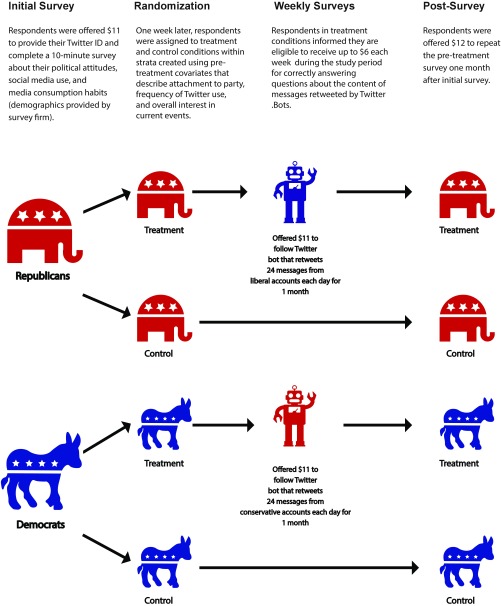
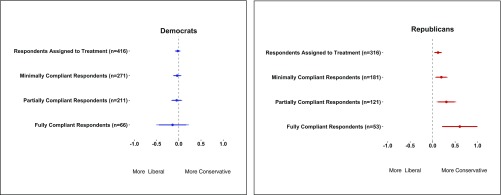
Significance: Social media sites are often blamed for exacerbating political polarization by creating “echo chambers” that prevent people from being exposed to information that contradicts their preexisting beliefs. We conducted a field experiment that offered a large group of Democrats and Republicans financial compensation to follow bots that retweeted messages by elected officials and opinion leaders with opposing political views. Republican participants expressed substantially more conservative views after following a liberal Twitter bot, whereas Democrats’ attitudes became slightly more liberal after following a conservative Twitter bot—although this effect was not statistically significant. Despite several limitations, this study has important implications for the emerging field of computational social science and ongoing efforts to reduce political polarization online.
Overview
The claims and statistics of this paper haven’t been checked yet.
Free: it reads the open-access text and checks the first 5 claims that cite a source we can check. Create a free account to check every claim.
Integrity signals
Registry
Cites
Statistics
Figures
Verification
Claims the paper makes
The claims and statistics of this paper haven’t been checked yet.
Free: it reads the open-access text and checks the first 5 claims that cite a source we can check. Create a free account to check every claim.
Claims other papers make about this one
Each is checked against this paper’s own text: does it say what the citing paper says it does?
The cited source doesn’t support the claim as written.
In the citing paper
“Supporting this, Bail et al. [2] further challenge the polarization assumption, showing that social media use can increase exposure to non-partisan content.”
From A systematic review of echo chamber research: comparative analysis of conceptualizations, operationalizations, and varying outcomes (2025) · cites this paper as [2]
Checked by a reasoning model — may be wrong.
Experimental — accuracy not yet measuredThe source backs part of the claim, not all of it — or backs it for a different population, condition or comparison.
In the citing paper
“For instance, it is neither clear what level of homophily in social networks is desirable or undesirable in a democratic society, nor is it clear how to interpret the results of certain studies on polarization69,130, whose findings depend on whether one assumes that social media have increased or decreased exposure to opposing views relative to some offline benchmark.”
From A systematic review of worldwide causal and correlational evidence on digital media and democracy (2022) · cites this paper as [69]
Experimental — accuracy not yet measuredThe source backs part of the claim, not all of it — or backs it for a different population, condition or comparison.
In the citing paper
“Even without being designed to shift opinions, it has been found that algorithms may contribute to political polarization by reinforcing divisive opinions [9, 24, 32].”
From Co-Writing with Opinionated Language Models Affects Users’ Views (2023) · cites this paper as [9]
Experimental — accuracy not yet measuredThe source backs part of the claim, not all of it — or backs it for a different population, condition or comparison.
In the citing paper
“Entrar en contacto con contenido contra-actitudinal puede generar una resistencia emocional y una sensación de amenaza que terminen polarizando igualmente al individuo (Bail et al., 2018;Dahlgren, 2022).”
From Política, uso de medios y polarización afectiva en España (2024) · cites this paper as Bail et al., 2018
Experimental — accuracy not yet measuredThe source backs part of the claim, not all of it — or backs it for a different population, condition or comparison.
In the citing paper
“Experimental approaches show e.g., how distorted meta-representations of outgroups on digital platforms can result in disaffection across ideological groups (Bail et al. 2018, Banks et al. 2021).”
From When debates break apart: discursive polarization as a multi-dimensional divergence emerging in and through communication (2023) · cites this paper as Bail et al. 2018
Experimental — accuracy not yet measured
18 more claims about this paper
Create a free account to see every claim other papers make about this one.
Self-check
Percentages, sums and reported differences re-computed from the paper’s own numbers.
The self-check needs the paper’s full text.
Citations
Cites
Birds of a Feather: Homophily in Social Networks
McPherson, M., Smith-Lovin, L., & Cook, J. M. (2001) · Annual Review of Sociology · doi:10.1146/annurev.soc.27.1.415 · Cited by 18,567 · cited 1×
“Despite initial optimism that social media might enable people to consume more heterogeneous sources of information about current events, there is growing concern that such forums exacerbate political polarization because of social network homophily, or the well-documented tendency of people to form social network tie…”
BackgroundA meta-analytic test of intergroup contact theory.
Pettigrew, T. F., & Tropp, L. R. (2006) · Journal of personality and social psychology · doi:10.1037/0022-3514.90.5.751 · Cited by 9,708 · cited 1×
“A vast literature indicates contact between opposing groups can challenge stereotypes that develop in the absence of positive interactions between them (30).”
BackgroundLord, C. G., Ross, L., & Lepper, M. R. (1979) · Journal of Personality and Social Psychology · doi:10.1037/0022-3514.37.11.2098 · Cited by 4,583
Liberals and conservatives rely on different sets of moral foundations.
Graham, J., Haidt, J., & Nosek, B. A. (2009) · Journal of Personality and Social Psychology · doi:10.1037/a0015141 · Cited by 4,560
Motivated Skepticism in the Evaluation of Political Beliefs
Taber, C. S., & Lodge, M. (2006) · American Journal of Political Science · doi:10.1111/j.1540-5907.2006.00214.x · Cited by 4,344
Lazer, D., Pentland, A., Adamic, L., Aral, S., Barabási, A.-L., Brewer, D., Christakis, N., Contractor, N., Fowler, J., Gutmann, M., et al. (2009) · Science · doi:10.1126/science.1167742 · Cited by 3,365
Exposure to ideologically diverse news and opinion on Facebook
Bakshy, E., Messing, S., & Adamic, L. A. (2015) · Science · doi:10.1126/science.aaa1160 · Cited by 3,245
When Corrections Fail: The Persistence of Political Misperceptions
Nyhan, B., & Reifler, J. (2010) · Political Behavior · doi:10.1007/s11109-010-9112-2 · Cited by 3,173
Fear and loathing across party lines: New evidence on group polarization
Iyengar, S., & Westwood, S. J. (2015) · American Journal of Political Science · doi:10.1111/ajps.12152 · Cited by 2,452
Uncivil Agreement: How Politics Became Our Identity
Mason, L. (2018) · doi:10.7208/chicago/9780226524689.001.0001 · Cited by 1,985
Research works printed but not linked: 1
- Sunstein C 2001 Echo Chambers, Bush v. Gore, Impeachment, and Beyond Princeton Univ Press Princeton
Cited by
Items 101–200 of 1,010
Benefits of Diverse News Recommendations for Democracy: A User Study
Heitz, L., Lischka, J. A., Birrer, A., Paudel, B., Tolmeijer, S., Laugwitz, L. L., & Bernstein, A. (2022) · Digital Journalism · doi:10.1080/21670811.2021.2021804 · Cited by 132
“Yet, exposure to counter-attitu-dinal news can also backfire, i.e., reinforce existing political positions, and thus potentially increase political polarization (Bail et al. 2018).”
BackgroundInfluentialThe effects of Facebook and Instagram on the 2020 election: A deactivation experiment
Allcott, H., Gentzkow, M. A., Mason, W., Wilkins, A. S., Barberá, P., Brown, T., Cisneros, J. C., Crespo-Tenorio, A., Dimmery, D., Freelon, D., et al. (2024) · Proceedings of the National Academy of Sciences · doi:10.1073/pnas.2321584121 · Cited by 170
Self-citationEmergence of Polarized Ideological Opinions in Multidimensional Topic Spaces
Baumann, F., Lorenz-Spreen, P., Sokolov, I. M., & Starnini, M. (2021) · Physical Review X · doi:10.1103/physrevx.11.011012 · Cited by 145
Self-Persuasion: Evidence from Field Experiments at International Debating Competitions
Schwardmann, P., Tripodi, E., & van der Weele, J. J. (2019) · American Economic Review · doi:10.1257/aer.20200372 · Cited by 148
Wojcieszak, M., Casas, A., Yu, X., Nagler, J., & Tucker, J. A. (2022) · Science Advances · doi:10.1126/sciadv.abn9418 · Cited by 90
“…work on distinct cognitive styles of political ideologues suggests that conservatives manifest cognitive styles such as dogmatism, rigidity, or uncertainty avoidance ( 56 ), which might predispose conservatives to shield away from and be more negative toward cross-cutting views [see ( 12 , 57 )].”
Conservative and liberal attitudes drive polarized neural responses to political content
Leong, Y. C., Chen, J., Willer, R., & Zaki, J. (2020) · Proceedings of the National Academy of Sciences · doi:10.1073/pnas.2008530117 · Cited by 108
Swiss Democracy: Possible Solutions to Conflict in Multicultural Societies
Linder, W., & Mueller, S. (2021) · Springer eBooks · doi:10.1007/978-3-030-63266-3 · Cited by 147
Characterizing polarization in online vaccine discourse—A large-scale study
Mønsted, B., & Lehmann, S. (2022) · PLOS ONE · doi:10.1371/journal.pone.0263746 · Cited by 88
“Furthermore, such polarization of communities may become self-perpetuating, because individuals avoid those not sharing their views [58], or because exposure to mainstream information might further entrench fringe viewpoints [59].”
BackgroundMotivated Attention in Climate Change Perception and Action
Luo, Y., & Zhao, J. (2019) · Frontiers in Psychology · doi:10.3389/fpsyg.2019.01541 · Cited by 99
Computational Social Science and the Study of Political Communication
Theocharis, Y., & Jungherr, A. M. (2020) · Political Communication · doi:10.1080/10584609.2020.1833121 · Cited by 135
“In a recent study, Bail et al. (2018) assess this hypothesis, but also go further and theorize the existence of a rival mechanism according to which such interactions have a backfire effect.”
BackgroundThe Effect of Social Media on Elections: Evidence from The United States
Fujiwara, T., Müller, K., & Schwarz, C. R. (2023) · Journal of the European Economic Association · doi:10.1093/jeea/jvad058 · Cited by 139
Fake news believability: The effects of political beliefs and espoused cultural values
Gupta, M., Dennehy, D., Parra, C. M., Mäntymäki, M., & Dwivedi, Y. K. (2022) · Information & Management · doi:10.1016/j.im.2022.103745 · Cited by 131
Troll and divide: the language of online polarization
Simchon, A., Brady, W. J., & Van Bavel, J. J. (2022) · PNAS Nexus · doi:10.1093/pnasnexus/pgac019 · Cited by 85
“The rise of misinformation has fueled an international health crisis during the COVID-19 pandemic, leading the World Health Organization to declare this an “info-demic” of misinformation.”
The prime psychological suspects of toxic political polarization
Moore-Berg, S. L., Hameiri, B., & Bruneau, E. (2020) · Current Opinion in Behavioral Sciences · doi:10.1016/j.cobeha.2020.05.001 · Cited by 83
Dynamics of Polarizing Rhetoric in Congressional Tweets
Ballard, A. M. O., DeTamble, R., Dorsey, S., Heseltine, M., & Johnson, M. (2022) · Legislative Studies Quarterly · doi:10.1111/lsq.12374 · Cited by 121
A new sociology of humans and machines
Tsvetkova, M., Yasseri, T., Pescetelli, N., & Werner, T. (2024) · Nature Human Behaviour · doi:10.1038/s41562-024-02001-8 · Cited by 189
“The bots are more influential when they are more numerous and connected to central actors.”
A new sociology of humans and machines
Tsvetkova, M., Yasseri, T., Pescetelli, N., & Werner, T. (2024) · arXiv · doi:10.48550/arxiv.2402.14410 · Cited by 83
“The bots are more influential when they are more numerous and connected to central actors.”
Understanding and avoiding misplaced efforts in conservation
Ford, A. T., Ali, A. H., Colla, S. R., Cooke, S. J., Lamb, C. T., Pittman, J. B., Shiffman, D. S., & Singh, N. J. (2021) · FACETS · doi:10.1139/facets-2020-0058 · Cited by 95
“Recent social trends have seen rising polarization in political affiliations and on key issues (Bail et al. 2018), along with the amplification of misinterpreted or false information in public discourse (Lazer et al. 2018).”
BackgroundLueders, A., Dinkelberg, A., & Quayle, M. (2022) · Acta Psychologica · doi:10.1016/j.actpsy.2022.103643 · Cited by 158
Velásquez, N., Leahy, R., Restrepo, N. J., Lupu, Y., Sear, R., Gabriel, N., Jha, O. K., Goldberg, B., & Johnson, N. F. (2021) · Scientific Reports · doi:10.1038/s41598-021-89467-y · Cited by 78
Fletcher, R., Kalogeropoulos, A., & Nielsen, R. K. (2023) · New Media & Society · doi:10.1177/14614448211027393 · Cited by 78
“Indeed, it may be that exposure to conflicting partisan views, rather than over-exposure to like-minded views, will offer a better explanation for the negative outcomes – like polarization – that are sometimes associated with distributed media use (Bail et al., 2018).”
BackgroundAligning AI Optimization to Community Well-Being
Stray, J. (2020) · International Journal of Community Well-Being · doi:10.1007/s42413-020-00086-3 · Cited by 115
Research on opinion polarization by big data analytics capabilities in online social networks
Xing, Y., Wang, X., Qiu, C., Li, Y., & He, W. (2022) · Technology in Society · doi:10.1016/j.techsoc.2022.101902 · Cited by 94
The network science of collective intelligence
Centola, D. M. (2022) · Trends in Cognitive Sciences · doi:10.1016/j.tics.2022.08.009 · Cited by 122
“partisan priming effects [8,89].”
Far-Right Online Radicalization: A Review of the Literature
Marwick, A. E., Clancy, B., & Furl, K. (2022) · doi:10.21428/bfcb0bff.e9492a11 · Cited by 114
The Past, Present, and Future of Experimental Methods in the Social Sciences
Mize, T. D., & Manago, B. (2022) · Social Science Research · doi:10.1016/j.ssresearch.2022.102799 · Cited by 76
The science of belief: A progress report
Porot, N., & Mandelbaum, E. (2020) · Wiley Interdisciplinary Reviews Cognitive Science · doi:10.1002/wcs.1539 · Cited by 108
Recuero, R., Soares, F. B., & Gruzd, A. A. (2020) · Proceedings of the International AAAI Conference on Web and Social Media · doi:10.1609/icwsm.v14i1.7324 · Cited by 115
“In this sense, echo chambers are common in social media political conversations, especially in polarized contexts (Bail et al., 2018).”
BackgroundModelling how social network algorithms can influence opinion polarization
de Arruda, H. F., Cardoso, F. M., de Arruda, G. F., Hernández, A. R., Costa, L. D. F., & Moreno, Y. (2021) · Information Sciences · doi:10.1016/j.ins.2021.12.069 · Cited by 96
Selective exposure partly relies on faulty affective forecasts
Dorison, C. A., Minson, J. A., & Rogers, T. (2019) · Cognition · doi:10.1016/j.cognition.2019.02.010 · Cited by 75
How Many People Live in Politically Partisan Online News Echo Chambers in Different Countries?
Fletcher, R., Robertson, C., & Nielsen, R. K. (2021) · Journal of Quantitative Description Digital Media · doi:10.51685/jqd.2021.020 · Cited by 120
“Although cross-cutting news exposure is often considered beneficial (Mutz, 2006), some research finds that it can increase polarization (Bail et al., 2018), so we leave this for future work.”
BackgroundAridor, G., Jiménez-Durán, R., Levy, R., & Song, L. (2024) · Journal of Economic Literature · doi:10.1257/jel.20241743 · Cited by 115
Political Discussions in Homogeneous and Cross-Cutting Communication Spaces
An, J., Kwak, H., Posegga, O., & Jungherr, A. (2019) · Proceedings of the International AAAI Conference on Web and Social Media · doi:10.1609/icwsm.v13i01.3210 · Cited by 72
The role of decision confidence in advice-taking and trust formation.
Pescetelli, N., & Yeung, N. (2021) · Journal of Experimental Psychology: General · doi:10.1037/xge0000960 · Cited by 73
Historical language records reveal a surge of cognitive distortions in recent decades
Bollen, J., ten Thij, M., Breithaupt, F. A., Barron, A. T. J., Rutter, L. A., Lorenzo‐Luaces, L., & Scheffer, M. (2021) · Proceedings of the National Academy of Sciences · doi:10.1073/pnas.2102061118 · Cited by 94
“The widespread adoption of communication technologies such as the internet, the World Wide Web, and social media (39–42) may have driven greater societal and political polarization (43, 44) at a global level (45).”
BackgroundChanging social attitudes with virtual reality: a systematic review and meta-analysis
Nikolaou, A., Schwabe, A., & Boomgaarden, H. G. (2022) · Annals of the International Communication Association · doi:10.1080/23808985.2022.2064324 · Cited by 104
“One line of this research investigates the in fl uence that media exert on social attitudes, from mass television, radio (Petty et al., 2008), and social media (Bail et al., 2018) to emerging technologies like Virtual Reality (Kalyanaraman & Bailenson, 2020).”
BackgroundPerils and Challenges of Social Media and Election Manipulation Analysis: The 2018 US Midterms
Deb, A., Luceri, L., Badaway, A., & Ferrara, E. (2019) · International World Wide Web Conference (WWW) · doi:10.1145/3308560.3316486 · Cited by 90
“Numerous studies concluded that social media can be a vehicle for political manipulation, citing factors such as the effect of fake news and disinformation [5, 9, 28, 29, 33, 46, 49, 51, 55], bots [7, 8, 41, 50, 53, 58, 59], polarization [3, 6], etc.”
BackgroundInterian, R., G. Marzo, R., Mendoza, I., & Ribeiro, C. C. (2023) · International Transactions in Operational Research · doi:10.1111/itor.13224 · Cited by 67
“[9] stated that this exposure to opposing views on social media may increase the polarization in some cases.”
BackgroundDemocratic Transparency in the Platform Society
Gorwa, R., & Ash, T. G. (2020) · Social Media and Democracy · doi:10.1017/9781108890960.013 · Cited by 64
Algorithmic Amplification of Politics on Twitter
Huszár, F., Ktena, S. I., O’Brien, C., Belli, L., Schlaikjer, A., & Hardt, M. (2022) · Proceedings of the National Academy of Sciences · doi:10.1073/pnas.2025334119 · Cited by 65
Recuero, R., Soares, F. B., & Zago, G. D. S. (2021) · Revista Contracampo · doi:10.22409/contracampo.v40i1.45611 · Cited by 178
Marlow, T., Miller, S., & Roberts, J. T. (2021) · Climate Policy · doi:10.1080/14693062.2020.1870098 · Cited by 64
“Current research suggests that this polarization is linked to the exposure to opposing views (Bail et al., 2018), which bots are known to produce.”
BackgroundMisinformation and Its Correction
Wittenberg, C., & Berinsky, A. J. (2020) · Social Media and Democracy · doi:10.1017/9781108890960.009 · Cited by 58
Chen, H., Kim, Y., & Chan, M. (2021) · Journal of Communication · doi:10.1093/joc/jqab046 · Cited by 73
“(Bail et al., 2018), while others note that it facilitates exposure to cross-cutting”
BackgroundSelf-citationCoordination patterns reveal online political astroturfing across the world
Schoch, D., Keller, F. B., Stier, S., & Yang, J. (2022) · Scientific Reports · doi:10.1038/s41598-022-08404-9 · Cited by 64
Does negatively toned language use on social media lead to attitude polarization?
Buder, J., Rabl, L., Feiks, M., Badermann, M., & Zurstiege, G. (2020) · Computers in Human Behavior · doi:10.1016/j.chb.2020.106663 · Cited by 84
Are knowledgeable voters better voters?
Hannon, M. (2022) · Politics Philosophy & Economics · doi:10.1177/1470594x211065080 · Cited by 89
The harmful effects of partisan polarization on health
Fraser, T., Aldrich, D. P., Panagopoulos, C., Hummel, D., & Kim, D. J. (2022) · PNAS Nexus · doi:10.1093/pnasnexus/pgac011 · Cited by 75
“Social media enables voters to learn about the political views of distant friends and acquaintances, which they may not have known otherwise, leading them to feel that partisan polarization is rising (54, 55).”
BackgroundEnvironmental Decision-Making in Times of Polarization
Judge, M., Kashima, Y., Steg, L., & Dietz, T. M. (2023) · Annual Review of Environment and Resources · doi:10.1146/annurev-environ-112321-115339 · Cited by 98
Yu, J., Bekerian, D. A., & Osback, C. (2024) · Encyclopedia · doi:10.3390/encyclopedia4040109 · Cited by 135
#lockdown: Network-Enhanced Emotional Profiling in the Time of COVID-19
Stella, M., Restocchi, V., & Deyne, S. D. (2020) · Big Data and Cognitive Computing · doi:10.3390/bdcc4020014 · Cited by 71
Duan, Z., Li, J., Lukito, J., Yang, K.-C., Chen, F., Shah, D. V., & Yang, S. (2022) · Human Communication Research · doi:10.1093/hcr/hqac012 · Cited by 80
“…information ecosystem and civic discourses (Ferrara et al., 2016) by promulgating conspiracy theories and misinformation (Starbird, 2019), distorting civic information (Alothali et al., 2018), spreading low-credibility content (Shao et al., 2018), and exacerbating polarization (Bail et al., 2018).”
Mattis, N. M., Masur, P. K., Möller, J. E., & van Atteveldt, W. (2022) · New Media & Society · doi:10.1177/14614448221104413 · Cited by 99
“Diverse viewpoints can also cause more critical information processing (Taber and Lodge, 2006) or active counter-arguing, which, in turn, increases political polarisation (Bail et al., 2018).”
BackgroundBroniatowski, D. A., Simons, J. R., Gu, J., Jamison, A. M., & Abroms, L. C. (2023) · Science Advances · doi:10.1126/sciadv.adh2132 · Cited by 62
Asymmetrical perceptions of partisan political bots
Yan, H. Y., Yang, K.-C., Menczer, F., & Shanahan, J. E. (2020) · New Media & Society · doi:10.1177/1461444820942744 · Cited by 70
“As one exception, Bail et al. (2018) showed in an experiment that even users who are aware that they are being exposed to bots with incongruent partisan personas become less trusting of members of the opposite party.”
BackgroundChen, A. Y., Nyhan, B. J., Reifler, J., Robertson, R. E., & Wilson, C. (2023) · Science Advances · doi:10.1126/sciadv.add8080 · Cited by 163
Brüggemann, M., & Meyer, H. (2023) · Communication Theory · doi:10.1093/ct/qtad012 · Cited by 89
Media and Policy Making in the Digital Age
Grossman, E. (2022) · Annual Review of Political Science · doi:10.1146/annurev-polisci-051120-103422 · Cited by 104
Credibility of climate change denial in social media
Samantray, A., & Pin, P. (2019) · Palgrave Communications · doi:10.1057/s41599-019-0344-4 · Cited by 60
Wade, J. T., Roth, P. L., Thatcher, J. B., & Dinger, M. (2020) · MIS Quarterly · doi:10.25300/misq/2020/14119 · Cited by 72
Sustaining Democracy: What We Owe to the Other Side
Talisse, R. B. (2021) · doi:10.1093/oso/9780197556450.001.0001 · Cited by 84
Hartmann, D., Wang, S. M., Pohlmann, L., & Berendt, B. (2025) · Journal of Computational Social Science · doi:10.1007/s42001-025-00381-z · Cited by 59
“…Suelflow et al. [191] which used measures like political affiliation, affective polarization, perceived polarization, contact to immigrants, and political interest. trace data experiments like the experiment by Bail et al. [8] measure the change of affiliation after the experiment through a survey.”
Are all Burned Out Parents Neglectful and Violent? A Latent Profile Analysis
Hansotte, L., Nguyen, N., Roskam, I., Stinglhamber, F., & Mikolajczak, M. (2020) · Journal of Child and Family Studies · doi:10.1007/s10826-020-01850-x · Cited by 80
Khanday, A. M. U. D., Rabani, S. T., Khan, Q. R., & Malik, S. H. (2022) · International Journal of Information Management Data Insights · doi:10.1016/j.jjimei.2022.100120 · Cited by 82
Segregated interactions in urban and online space
Dong, X., Morales, A. J., Jahani, E., Moro, E., Lepri, B., Bozkaya, B., Sarraute, C., Bar-Yam, Y., & Pentland, A. (2020) · EPJ Data Science · doi:10.1140/epjds/s13688-020-00238-7 · Cited by 78
Censoring Political Opposition Online: Who Does it and Why
Ashokkumar, A., Talaifar, S., Fraser, W. T., Landabur, R., Buhrmester, M., Gómez, Á., Paredes, B., & Swann, W. B. (2020) · Journal of Experimental Social Psychology · doi:10.1016/j.jesp.2020.104031 · Cited by 58
“, 2018) may not extend to online interactions (Bail et al., 2018).”
BackgroundHartmann, D., de Pereira, J. R. L., Streitbörger, C., & Berendt, B. (2025) · AI and Ethics · doi:10.1007/s43681-024-00595-3 · Cited by 58
“In recent years, there has been increasing public and academic concern about the influence of social media on public discourse, democratic processes, and institutions [7, 65].”
Make Reddit Great Again: Assessing Community Effects of Moderation Interventions on r/The_Donald
Trujillo, A., & Cresci, S. (2022) · Proceedings of the ACM on Human-Computer Interaction · doi:10.1145/3555639 · Cited by 55
“However, experiments carried out in the context of political polarization in the US suggested that exposing users to opposing views on social media can actually increase their political polarization, instead of reducing it [2].”
BackgroundInfluentialThe Polarization of Popular Culture: Tracing the Size, Shape, and Depth of the “Oil Spill”
Rawlings, C. M., & Childress, C. (2023) · Social Forces · doi:10.1093/sf/soad150 · Cited by 69
“…polarized, ranging on everything from more foundational items like cognitive processing styles and tolerance of uncertainty ( Jost 2017a, 2017b), to how much animus is felt for the partisan outgroup (Bail et al. 2018; Gift and Gift 2015; Iyengar, Sood, and Lelkes 2012; Kalmoe and Mason 2022).”
BackgroundThe simulation of judgment in LLMs
Loru, E., Nudo, J., Di Marco, N., Santirocchi, A., Atzeni, R., Cinelli, M., Cestari, V., Rossi-Arnaud, C., & Quattrociocchi, W. (2025) · Proceedings of the National Academy of Sciences · doi:10.1073/pnas.2518443122 · Cited by 57
McDermott, R., & Hatemi, P. (2020) · Proceedings of the National Academy of Sciences · doi:10.1073/pnas.2012021117 · Cited by 66
Makhortykh, M., & Bastian, M. (2020) · Media War & Conflict · doi:10.1177/1750635220906254 · Cited by 84
Echo Chambers on Social Media: A comparative analysisPreprint
Cinelli, M., Morales, G. D. F., Galeazzi, A., Quattrociocchi, W., & Starnini, M. (2020) · arXiv (Cornell University) · doi:10.48550/arxiv.2004.09603 · Cited by 58
“[11] Christopher A Bail, Lisa P Argyle, Taylor W Brown, John P Bumpus, Haohan Chen, MB Fallin Hunzaker, Jaemin Lee, Marcus Mann, Friedolin Merhout, and Alexander Volfovsky.”
BackgroundJaidka, K., Zhou, A. Y., Lelkes, Y., Egelhofer, J. L., & Lecheler, S. K. (2021) · Journal of Computer-Mediated Communication · doi:10.1093/jcmc/zmab019 · Cited by 88
Barrientos–Báez, A., Domínguez, D. C., & Yezers’ka, L. (2022) · Fonseca Journal of Communication · doi:10.14201/fjc.28294 · Cited by 53
Reducing political polarization in the United States with a mobile chat platform
Combs, A., Tierney, G., Guay, B., Merhout, F., Bail, C. A., Hillygus, D. S., & Volfovsky, A. (2023) · Nature Human Behaviour · doi:10.1038/s41562-023-01655-0 · Cited by 78
“…exhibited a 0.25-standard-deviation increase ( t = 2.50; n = 1,419; two-tailed P = 0.012; 95% CI, 0.055 to 0.457), and those in the incorrect-labels platforms are poorly suited to identifying such effects because the processes that lead people into such interactions are not random 16,37–39 .”
BackgroundInfluentialSelf-citationBelief Polarization in a Complex World: A Learning Theory Perspective
Haghtalab, N., Jackson, M. O., & Procaccia, A. D. (2020) · Proceedings of the National Academy of Sciences · doi:10.1073/pnas.2010144118 · Cited by 58
Political endorsement by Nature and trust in scientific expertise during COVID-19
Zhang, F. J. (2023) · Nature Human Behaviour · doi:10.1038/s41562-023-01537-5 · Cited by 68
Social Media, Messaging Apps, and Affective Polarization in the United States and Japan
Lee, S., Rojas, H., & Yamamoto, M. (2022) · Mass Communication and Society · doi:10.1080/15205436.2021.1953534 · Cited by 52
“Our examination is also consistent with existing research, which has mostly found a positive relationship between social media use and polarization (Bail et al., 2018; Himelboim et al., 2013; Lu et al., 2020).”
ResultZarouali, B., Makhortykh, M., Bastian, M., & Araujo, T. (2020) · European Journal of Communication · doi:10.1177/0267323120940908 · Cited by 70
“However, simply showing attitude-challenging news stories to the readers can lead to even higher polarization as the readers would feel confronted with opposing points of view (Babaei et al., 2018; Bail et al., 2018).”
Partisan Selective Engagement: Evidence from Facebook
Garz, M., Sörensen, J., & Stone, D. F. (2019) · Journal of Economic Behavior & Organization · doi:10.1016/j.jebo.2020.06.016 · Cited by 67
Prochaska, S., Duskin, K., Kharazian, Z., Minow, C., Blucker, S., Venuto, S., West, J. D., & Starbird, K. (2023) · Proceedings of the ACM on Human-Computer Interaction · doi:10.1145/3579616 · Cited by 77
“something that researchers have only an incomplete understanding of [7, 38, 69].”
BackgroundThe Kids Are Online: Teen Social Media Use, Civic Engagement, and Affective Polarization
Oden, A., & Porter, L. (2023) · Social Media + Society · doi:10.1177/20563051231186364 · Cited by 100
“At its worst, selective exposure reinforces ten-dencies to consume partisan news, limits cross-cutting democratic discourse, and amplifies extreme ideological positions online (Bail et al., 2018; Lorenzano et al., 2018; Qureshi et al., 2020; Wang & Song, 2020).”
BackgroundPropagated Preferences? Political Elite Discourses and Europeans’ Openness toward Muslim Immigrants
Czymara, C. S. (2019) · International Migration Review · doi:10.1177/0197918319890270 · Cited by 56
Using Twitter to track immigration sentiment during early stages of the COVID-19 pandemic
Rowe, F., Mahony, M., Graells-Garrido, E., Rango, M., & Sievers, N. (2021) · Data & Policy · doi:10.1017/dap.2021.38 · Cited by 69
“Social divisions have become increasingly aligned with partisan identities in recent years (Dennison and Geddes, 2019) and attributed to echo chambers – patterns of information – sharing that reinforce pre-existing beliefs by restricting exposure to opposing political views (Bail et al., 2018).”
BackgroundKirály, G., & Géring, Z. (2019) · Futures · doi:10.1016/j.futures.2019.03.004 · Cited by 57
Ability of detecting and willingness to share fake news
Arin, K. P., Mazrekaj, D., & Thum, M. (2023) · Scientific Reports · doi:10.1038/s41598-023-34402-6 · Cited by 101
“Variables (1) (2) (3) (4) (5) (6) (7) (8) (9) (10) (11) (12) (13) (14)”
We Need to Talk: How Cross-Party Dialogue Reduces Affective Polarization
Levendusky, M. S., & Stecula, D. A. (2023) · Cambridge University Press eBooks · doi:10.1017/9781009042192 · Cited by 47
The Concept of Democracy: An Essay on Conceptual Amelioration and Abandonment
Cappelen, H. (2023) · doi:10.1093/oso/9780198886518.001.0001 · Cited by 84
Munger, K., Egan, P. J., Nagler, J., Ronen, J., & Tucker, J. (2022) · British Journal of Political Science · doi:10.1017/s0007123420000198 · Cited by 47
From Belief Polarization to Echo Chambers: A Rationalizing Account
Begby, E. (2022) · Episteme · doi:10.1017/epi.2022.14 · Cited by 57
The Platformization of Violence: Toward a Concept of Discursive Toxicity on Social Media
Recuero, R. (2024) · Social Media + Society · doi:10.1177/20563051231224264 · Cited by 47
“While acknowl-edging the partial connection between social media platforms and the increasing polarization observed in societies, the author, along with other researchers (Bail et al., 2018; Garimella & Weber, 2017), emphasizes the need for more robust evidence to support this claim.”
BackgroundAre Echo Chambers Based on Partisanship? Twitter and Political Polarity in Poland and Hungary
Matuszewski, P., & Szabó, G. (2019) · Social Media + Society · doi:10.1177/2056305119837671 · Cited by 47
“As individuals create communication networks on Twitter with those who share similar beliefs, it has been argued that social media significantly contributes to the polarization of public opinion (Bail et al., 2018; Marozzo & Bessi, 2017).”
BackgroundGaribay, I. I., Mantzaris, A. V., Rajabi, A., & Taylor, C. E. (2019) · Scientific Reports · doi:10.1038/s41598-019-55178-8 · Cited by 57
Kaiser, J., Vaccari, C., & Chadwick, A. (2022) · Journal of Communication · doi:10.1093/joc/jqac002 · Cited by 44
Weismueller, J., Gruner, R. L., Harrigan, P., Coussement, K., & Wang, S. (2023) · Information Systems Journal · doi:10.1111/isj.12453 · Cited by 79
“This finding is surprising considering existing studies suggest that an (in)congruence of political ideologies in information environments often leads to a spiral of extreme and negativity-fuelled views (e.g., Bail et al., 2018; Del Vicario et al., 2016).”
ResultField Experiments on Social Media
Mosleh, M., Pennycook, G., & Rand, D. G. (2021) · Current Directions in Psychological Science · doi:10.1177/09637214211054761 · Cited by 65
Ognibene, D., Wilkens, R., Taibi, D., Hernández‐Leo, D., Kruschwitz, U., Donabauer, G., Theophilou, E., Lomonaco, F., Buršić, S., Lobo, R. A., et al. (2023) · Frontiers in Artificial Intelligence · doi:10.3389/frai.2022.654930 · Cited by 74
“For example, if interactions between drastically opposite opinions are considered negative because of possible backfire effects and flames (Bail et al., 2018), and interactions between excessively similar opinions are also considered negative because of the echo chambers they may give place, then…”
BackgroundMethodInfluentialThe complex link between filter bubbles and opinion polarization
Keijzer, M. A., & Mäs, M. (2022) · Data Science · doi:10.3233/ds-220054 · Cited by 61
Bridgman, A., Merkley, E., Zhilin, O., Loewen, P. J., Owen, T., & Ruths, D. A. (2021) · Frontiers in Political Science · doi:10.3389/fpos.2021.648646 · Cited by 57
Metadata
- Authors
- Bail, C. A., Argyle, L. P., Brown, T. W., Bumpus, J. P., Chen, H., Hunzaker, M. B. F., Lee, J., Mann, M., Merhout, F., & Volfovsky, A.
- Affiliations
- Duke University (US)
- Brigham Young University (US)
- New York University (US)
- Corresponding author
- Bail, Christopher A.
- ORCID
- Venue
- Proceedings of the National Academy of Sciences
- Publisher
- National Academy of Sciences
- Published
- 2018-08-28
- Volume
- 115
- Issue
- 37
- Pages
- 9216-9221
- ISSN
- 0027-8424 (ISSN-L)
- 1091-6490
- PMC
- PMC6140520
- OpenAlex
- W2889127731
- Semantic Scholar
- c1cb4725a7fb0df77c52d6d2792e87d588178715
- Cited by
- 1,863
- References
- 56
- Citations by year
- 2026: 275 · 2025: 272 · 2024: 248 · 2023: 292 · 2022: 264 · 2021: 228 · 2020: 181 · 2019: 96 · 2018: 7
- FWCI
- 278.82
- Type
- journal article
- Language
- en
- Open access
- hybrid
- doi.org
- Licence
- Locations
- Proceedings of the National Academy of Sciences (publishedVersion, cc-by-nc-nd)
- Europe PMC (PubMed Central) (publishedVersion, cc-by-nc-nd)
- PubMed Central (publishedVersion, cc-by-nc-nd)
- PubMed (publishedVersion)
- RePEc: Research Papers in Economics (submittedVersion)
- Funders
- Russell Sage Foundation (E0267)
- Topics
- Social Sciences › Communication › Social Media and Politics
- Social Sciences › Sociology and Political Science › Media Influence and Politics
- Social Sciences › Sociology and Political Science › Misinformation and Its Impacts
- Keywords
- political polarization, echo chambers, social media, Twitter bots, ideological change, financial incentives, computational social science, partisanship, social policy attitudes
- MeSH terms
- Political Activism, Democracy, Female, Humans, Male, United States, Social Media
About these checks
Registry, retraction, Cites and statistics results are computed, not judged, with one exception: a printed reference that no index lists is read once by a model before it counts as a citation error. Claims are extracted by a model and kept only when their quote appears verbatim in the text; each cited source is then checked, with a model’s help, for whether it says what the claim relies on. Those verdicts can be wrong — read the claim’s quote and the cited source before relying on one.
Statistics and arithmetic are recomputed, not judged.
Confidence bands are shown only for fields calibrated on our annotated test set. None is calibrated yet, so no band is shown.
What counts as a claim ›How we measure confidence ›How we check this ›
Are you an author, or do you see a problem with this page? Request a review
Data sources
Bibliographic data: Semantic Scholar, OpenAlex, Crossref.
Contains information from the Semantic Scholar Academic Graph Datasets, made available under the ODC Attribution License (ODC-BY 1.0).
Semantic Scholar’s data is described in: Kinney, R., et al. (2023). The Semantic Scholar Open Data Platform. arXiv:2301.10140.
