

Exposure to opposing views on social media can increase political polarization
Open accessThe DOI matches its Crossref record; 60 of the 60 references it cites were found in a registry or an index.
Abstract
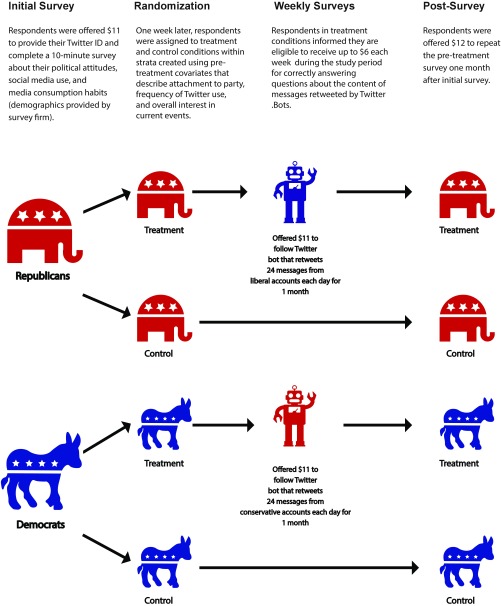
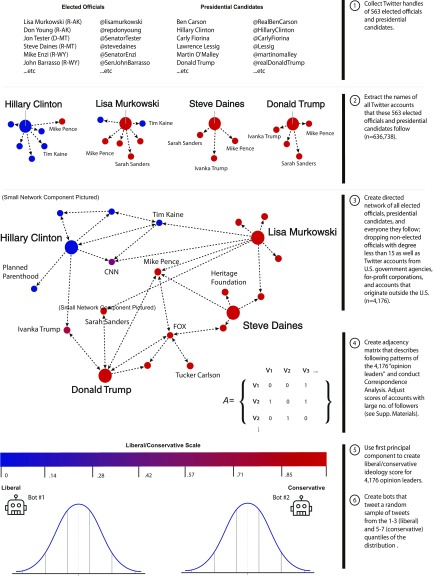
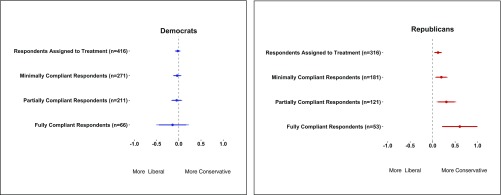
Significance: Social media sites are often blamed for exacerbating political polarization by creating “echo chambers” that prevent people from being exposed to information that contradicts their preexisting beliefs. We conducted a field experiment that offered a large group of Democrats and Republicans financial compensation to follow bots that retweeted messages by elected officials and opinion leaders with opposing political views. Republican participants expressed substantially more conservative views after following a liberal Twitter bot, whereas Democrats’ attitudes became slightly more liberal after following a conservative Twitter bot—although this effect was not statistically significant. Despite several limitations, this study has important implications for the emerging field of computational social science and ongoing efforts to reduce political polarization online.
Overview
The claims and statistics of this paper haven’t been checked yet.
Free: it reads the open-access text and checks the first 5 claims that cite a source we can check. Create a free account to check every claim.
Integrity signals
Registry
Cites
Statistics
Figures
Verification
Claims the paper makes
The claims and statistics of this paper haven’t been checked yet.
Free: it reads the open-access text and checks the first 5 claims that cite a source we can check. Create a free account to check every claim.
Claims other papers make about this one
Each is checked against this paper’s own text: does it say what the citing paper says it does?
The cited source doesn’t support the claim as written.
In the citing paper
“Supporting this, Bail et al. [2] further challenge the polarization assumption, showing that social media use can increase exposure to non-partisan content.”
From A systematic review of echo chamber research: comparative analysis of conceptualizations, operationalizations, and varying outcomes (2025) · cites this paper as [2]
Checked by a reasoning model — may be wrong.
Experimental — accuracy not yet measuredThe source backs part of the claim, not all of it — or backs it for a different population, condition or comparison.
In the citing paper
“For instance, it is neither clear what level of homophily in social networks is desirable or undesirable in a democratic society, nor is it clear how to interpret the results of certain studies on polarization69,130, whose findings depend on whether one assumes that social media have increased or decreased exposure to opposing views relative to some offline benchmark.”
From A systematic review of worldwide causal and correlational evidence on digital media and democracy (2022) · cites this paper as [69]
Experimental — accuracy not yet measuredThe source backs part of the claim, not all of it — or backs it for a different population, condition or comparison.
In the citing paper
“Even without being designed to shift opinions, it has been found that algorithms may contribute to political polarization by reinforcing divisive opinions [9, 24, 32].”
From Co-Writing with Opinionated Language Models Affects Users’ Views (2023) · cites this paper as [9]
Experimental — accuracy not yet measuredThe source backs part of the claim, not all of it — or backs it for a different population, condition or comparison.
In the citing paper
“Entrar en contacto con contenido contra-actitudinal puede generar una resistencia emocional y una sensación de amenaza que terminen polarizando igualmente al individuo (Bail et al., 2018;Dahlgren, 2022).”
From Política, uso de medios y polarización afectiva en España (2024) · cites this paper as Bail et al., 2018
Experimental — accuracy not yet measuredThe source backs part of the claim, not all of it — or backs it for a different population, condition or comparison.
In the citing paper
“Experimental approaches show e.g., how distorted meta-representations of outgroups on digital platforms can result in disaffection across ideological groups (Bail et al. 2018, Banks et al. 2021).”
From When debates break apart: discursive polarization as a multi-dimensional divergence emerging in and through communication (2023) · cites this paper as Bail et al. 2018
Experimental — accuracy not yet measured
18 more claims about this paper
Create a free account to see every claim other papers make about this one.
Self-check
Percentages, sums and reported differences re-computed from the paper’s own numbers.
The self-check needs the paper’s full text.
Citations
Cites
Birds of a Feather: Homophily in Social Networks
McPherson, M., Smith-Lovin, L., & Cook, J. M. (2001) · Annual Review of Sociology · doi:10.1146/annurev.soc.27.1.415 · Cited by 18,567 · cited 1×
“Despite initial optimism that social media might enable people to consume more heterogeneous sources of information about current events, there is growing concern that such forums exacerbate political polarization because of social network homophily, or the well-documented tendency of people to form social network tie…”
BackgroundA meta-analytic test of intergroup contact theory.
Pettigrew, T. F., & Tropp, L. R. (2006) · Journal of personality and social psychology · doi:10.1037/0022-3514.90.5.751 · Cited by 9,708 · cited 1×
“A vast literature indicates contact between opposing groups can challenge stereotypes that develop in the absence of positive interactions between them (30).”
BackgroundLord, C. G., Ross, L., & Lepper, M. R. (1979) · Journal of Personality and Social Psychology · doi:10.1037/0022-3514.37.11.2098 · Cited by 4,583
Liberals and conservatives rely on different sets of moral foundations.
Graham, J., Haidt, J., & Nosek, B. A. (2009) · Journal of Personality and Social Psychology · doi:10.1037/a0015141 · Cited by 4,560
Motivated Skepticism in the Evaluation of Political Beliefs
Taber, C. S., & Lodge, M. (2006) · American Journal of Political Science · doi:10.1111/j.1540-5907.2006.00214.x · Cited by 4,344
Lazer, D., Pentland, A., Adamic, L., Aral, S., Barabási, A.-L., Brewer, D., Christakis, N., Contractor, N., Fowler, J., Gutmann, M., et al. (2009) · Science · doi:10.1126/science.1167742 · Cited by 3,365
Exposure to ideologically diverse news and opinion on Facebook
Bakshy, E., Messing, S., & Adamic, L. A. (2015) · Science · doi:10.1126/science.aaa1160 · Cited by 3,245
When Corrections Fail: The Persistence of Political Misperceptions
Nyhan, B., & Reifler, J. (2010) · Political Behavior · doi:10.1007/s11109-010-9112-2 · Cited by 3,173
Fear and loathing across party lines: New evidence on group polarization
Iyengar, S., & Westwood, S. J. (2015) · American Journal of Political Science · doi:10.1111/ajps.12152 · Cited by 2,452
Uncivil Agreement: How Politics Became Our Identity
Mason, L. (2018) · doi:10.7208/chicago/9780226524689.001.0001 · Cited by 1,985
Research works printed but not linked: 1
- Sunstein C 2001 Echo Chambers, Bush v. Gore, Impeachment, and Beyond Princeton Univ Press Princeton
Cited by
Items 801–900 of 1,010
Evidence Can Change Partisan Minds but Less So in Hostile Contexts
Kim, J. W. (2025) · British Journal of Political Science · doi:10.1017/s0007123424000899 · Cited by 5
“…the stimuli used in some studies documenting resistance may have manipulated both the exposure to information and partisan animosity (for example, Bail et al. 2018; Taber et al. 2009; Taber and Lodge 2006), suggesting the possibility that people may accept contrary information when the latter is…”
InfluentialZhang, K., Dong, C., Guo, Y., Zhou, W., Yu, G., & Mi, J. (2025) · Systems · doi:10.3390/systems13060417 · Cited by 5
“For instance, Bail et al. [56] used digital trace data to calibrate agent attributes and network structures in their models of political polarization dynamics, demonstrating how empirically grounded ABMs can generate insights about causal mechanisms under‑ lying observed phenomena.”
Çakmak, M. C., & Agarwal, N. K. (2025) · Applied Network Science · doi:10.1007/s41109-025-00713-y · Cited by 9
“Bail et al. (2018) provided evidence that exposure to opposing views on social media can unexpectedly increase polarization, with symbolic imagery reinforcing ideological divides.”
Comparison of distance and reinforcement-learning rules in social-influence models
Grzywacz, N. M. (2025) · Neurocomputing · doi:10.1016/j.neucom.2025.130870 · Cited by 6
Reducing Prejudice and Support for Religious Nationalism Through Conversations on WhatsApp
Majumdar, R. (2026) · Comparative Political Studies · doi:10.1177/00104140261418627 · Cited by 7
El papel de la mediación comunicativa entre la polarización y la democracia en Colombia
Pardo, Ó. I. L., Morales, F. A. M., & Malaver, C. I. T. (2020) · Revista de Comunicación Política · doi:10.29105/rcp2-1 · Cited by 4
Cross-Cutting exposure, perceived realism, and online political engagement in the age of algorithms
Lin, J.-S. (2022) · Asian Journal of Communication · doi:10.1080/01292986.2021.2022175 · Cited by 6
“…concerns regarding how cognitive, social, and algorithmic biases may impact the democratic role of social media in individuals ’ civic lives (Bail et al., 2018; Dylko et al., 2017; Pariser, 2011; Stroud, 2008), this study provides a unique perspective for understanding their interpretations…”
BackgroundInfluentialCargnino, M., & Neubaum, G. (2022) · New Media & Society · doi:10.1177/14614448221083914 · Cited by 7
“Exposure to incongruent views still does not appear to decrease bias toward opposing political groups under all circumstances (Bail et al., 2018; Kim, 2015).”
BackgroundEvaluating Digital Polarization in Multi-Party Systems: Evidence from the German Bundestag
Chin, A., Vieira, C. C., & Kim, J. (2022) · ACM Web Science Conference (WebSci) · doi:10.1145/3501247.3531547 · Cited by 6
“Because research tends to focus on polarization in dual-party political systems [3, 8, 15], limited work is available for instances of multi-party or fragmented parliamentary systems.”
BackgroundHow Does the Thread Level of a Comment Affect its Perceived Persuasiveness? A Reddit Study
Xiao, L., & Mensah, H. (2022) · Lecture notes in networks and systems · doi:10.1007/978-3-031-10464-0_55 · Cited by 6
Social Media as a Tool for the Development of Future Journalists’ Communicative Competence
Гарачковська, О., Парфенюк, І., Галудзіна‐Горобець, В., Дмитренко, Н. В., Osaula, V., & Гребньов, Г. (2022) · Journal of Curriculum and Teaching · doi:10.5430/jct.v11n6p16 · Cited by 6
Meinungsbildung in und mit sozialen Medien
Stark, B., Magin, M., & Geiß, S. (2022) · Springer eBooks · doi:10.1007/978-3-658-25995-2_23 · Cited by 16
Jaramillo-Dent, D. (2023) · Politics and Governance · doi:10.17645/pag.v11i2.6375 · Cited by 6
Diplomacy in a social media environment: the bargaining model revisited
Xu, C. (2023) · Canadian Foreign Policy Journal · doi:10.1080/11926422.2023.2218500 · Cited by 5
“…role that social media has played in facilitating political polarization and economic nationalization over the last decade have caused FTAs in themselves to be questioned and challenged during the period of liberal retreat (Adler & Drieschova, 2021; Bail et al., 2018; van Aaken & Kurtz, 2019).”
BackgroundMedia preference increases polarization in an agent-based election model
Benedetto, A., Wieners, C., Dijkstra, H. A., & Stoof, H. T. C. (2023) · Physica A Statistical Mechanics and its Applications · doi:10.1016/j.physa.2023.129014 · Cited by 6
The public’s appropriation of multimodal discourses of fake news on social media
Al‐Rawi, A., & Prithipaul, D. (2023) · The Communication Review · doi:10.1080/10714421.2023.2242070 · Cited by 6
“Similarly, Bail et al. (2018) suggests that on social media (Twitter), exposure to opposing views, especially when a conservative person is exposed to liberal ideas, can increase political polarization. On the other hand, there are others such as Yarchi, Baden, and Kligler-Vilenchik (2021) who find that due to the pla…”
BackgroundInfluentialHow Mass Media Influences U.S. Political Polarization— A Comparison Study of CNN and Fox News
Yang, J. (2023) · SHS Web of Conferences · doi:10.1051/shsconf/202317802005 · Cited by 10
“Some studies have argued that media exposure can increase political polarization by creating “echo chambers” or “filter bubbles” that insulate people from opposing views and reinforce their existing beliefs [14] [15].”
BackgroundSubjective Political Polarization
Kwon, H., & Martin, J. J. (2023) · Sociological Science · doi:10.15195/v10.a32 · Cited by 4
“For various attempts to measure ideological consistency, see Mason (2013, 2015), Bougher (2017), Bail et al. (2018), Barton and Parsons (1977), Wyckoff (1980), and Ansolabehere, Rodden, and Snyder (2008).”
BackgroundThe Role of Moral Foundations in Support for Sex Work Decriminalization by Venue
Cole, K. (2023) · The Journal of Sex Research · doi:10.1080/00224499.2023.2291091 · Cited by 5
“Given the divide between conservatives and liberals in American politics is becoming increasingly polarized (Bail et al., 2018), MFT is a useful tool for elucidating the public’s moral objections to sex work and its possible decriminalization.”
Júnior, J. F., Schaefer, B. M., & Barbabela, E. (2024) · Social Sciences · doi:10.3390/socsci13050245 · Cited by 12
The Harm of Social Media to Public Reason
Benton, P., & Schmidt, M. (2024) · Topoi · doi:10.1007/s11245-024-10097-w · Cited by 9
Partisans process policy-based and identity-based messages using dissociable neural systems
Jacoby, N., Landau-Wells, M., Pearl, J., Paul, A., Falk, E. B., Bruneau, E., & Ochsner, K. N. (2024) · Cerebral Cortex · doi:10.1093/cercor/bhae368 · Cited by 5
Creative Minds in a Polarized World
Iannello, P., Cancer, A., Zmigrod, L., Antonietti, A., & Salvi, C. (2024) · The Journal of Creative Behavior · doi:10.1002/jocb.1509 · Cited by 4
Alem, Z., Admassu, K., & Belayneh, T. N. (2024) · Social Sciences & Humanities Open · doi:10.1016/j.ssaho.2024.101152 · Cited by 4
Using Candidates’ Tweets to Predict an Election Outcome
Afonso, F., Rita, P., & António, N. (2024) · Political Research Quarterly · doi:10.1177/10659129241286827 · Cited by 5
“However, this exposure to differing views does not appear to diminish polarization (Bail et al. 2018).”
Mahajan, S. (2024) · Philosophical Transactions of the Royal Society A Mathematical Physical and Engineering Sciences · doi:10.1098/rsta.2024.0093 · Cited by 8
“The emergence of ‘echo chambers’, where conformity overshadows dissent, is a testament to the delicate balance that must be navigated to harness the full potential of group collaboration [10,11].”
Metaverse maelstrom: Dissecting information dynamics and polarisation
Xing, Y., & Zhang, Z. (2025) · Journal of Information Science · doi:10.1177/01655515241307546 · Cited by 5
Mobile Internet and the Quality of Elections in Low-Income Democracies
Yeandle, A. (2025) · British Journal of Political Science · doi:10.1017/s0007123424000814 · Cited by 7
“Social media platforms can expose users to like-minded content (Cinelli et al. 2021) and drive polarisation (for example, Lelkes, Sood, and Iyengar 2017; Bail et al. 2018), while the challenges of regulating and fact-checking false claims are a growing issue (Lewandowsky and van der Linden 2021).”
The link between tobacco smoking and susceptibility to misinformation
Piksa, M., Zaniewska, M., Cieslik-Starkiewicz, A., Kunst, J. R., Morzy, M., Piasecki, J., & Ryguła, R. (2025) · Psychopharmacology · doi:10.1007/s00213-025-06802-1 · Cited by 4
“This tendency aligns with the concept of confirmation bias (Rassin 2008), a significant factor in susceptibility to misinformation, where individuals favor information that supports their pre-existing beliefs (Piksa et al. 2024b; Bail et al. 2018).”
Hanley, H. W. A., & Durumeric, Z. (2025) · Proceedings of the ACM on Human-Computer Interaction · doi:10.1145/3757661 · Cited by 9
“However, our results that illustrate an increased toxicity in posts that include hyperlinks from unreliable websites and false information do align with a large literature of similar results [11–13], some of which have found causal results.”
Not My President: How Names and Titles Frame Political Figures
van den Berg, E., Korfhage, K., Ruppenhofer, J., Wiegand, M., & Markert, K. (2019) · Workshop on Natural Language Processing and Computational Social Science (NLP+CSS) · doi:10.18653/v1/w19-2101 · Cited by 4
“, 2017), and assess political polarization (Bail et al., 2018).”
BackgroundStier, S., & Jungherr, A. M. (2019) · transcript Verlag eBooks · doi:10.14361/9783839448649-016 · Cited by 6
Interregional and intraregional variability of intergroup attitudes predict online hostility
Rosenbusch, H., Evans, A. M., & Zeelenberg, M. (2020) · European Journal of Personality · doi:10.1002/per.2301 · Cited by 9
“…and social identity research has described relationships between ideological opposition, group con fl ict, and aggressive behaviour on social media (Bail et al., 2018; Cicchirillo, Hmielowski, & Hutchens, 2015; Kwon & Cho, 2017; Kwon & Gruzd, 2017; Ott, 2017; Postmes, Spears, Sakhel, & De Groot,…”
BackgroundLegewie, N. M., & Fasang, A. E. (2021) · Edward Elgar Publishing eBooks · doi:10.4337/9781788975544.00014 · Cited by 5
“2013; Salganik and Levy 2015), to video data collection (Nassauer and Legewie 2018, 2019; Elsner and Wertz 2019), to digital field experiments and mass collaborative data collection (Bail et al. 2018; Cooper et al. 2010).”
BackgroundHow opinions crystallise: an analysis of polarisation in the voter modelPreprint
Vendeville, A., Guedj, B., & Zhou, S. (2020) · arXiv (Cornell University) · doi:10.1007/978-3-030-93413-2_29
“Because of the so-called backfire effect, presenting these users with opposing information might have the adverse effect of reinforcing their prior beliefs [9, 10].”
BackgroundKönig, T. (2022) · Zeitschrift für Politikwissenschaft · doi:10.1007/s41358-022-00312-8 · Cited by 5
Disruption of Social Orders in Societal Transitions as Affective Control of Uncertainty
Hoey, J., & Schröder, T. (2022) · American Behavioral Scientist · doi:10.1177/00027642211066055 · Cited by 5
Zhang, W., Chen, Z., Chia, Y., & Neoh, J. Y. (2022) · International Communication Gazette · doi:10.1177/17480485221094101 · Cited by 4
“For instance, there is growing concern that some mechanisms of social media, such as social network homophily and algorithmic recommendation, may encapsulate people into ‘echo chambers’, where the information shared mainly reinforces people’s pre-existing political views (Bail et al., 2018).”
BackgroundBroom, T. W., Stahl, J. L., Ping, E. E. C., & Wagner, D. D. (2022) · Journal of Cognitive Neuroscience · doi:10.1162/jocn_a_01888 · Cited by 6
“Moreover, the effect of political polarization can be difficult to undo, as demonstrated by recent work showing that exposure to opposing viewpoints does little to curb the polarization of subjective perceptions and, in certain cases, can exacerbate it (Bail et al., 2018).”
BackgroundCOVID-19 related social media use and attitudes towards pandemic control measures in Europe
Verbalytė, M., & Eigmüller, M. (2022) · Culture Practice & Europeanization · doi:10.5771/2566-7742-2022-1-37 · Cited by 7
Affect toward Minority and Majority Groups in the Era of Donald Trump
Brooks, C., & Harmon, A. (2022) · Socius Sociological Research for a Dynamic World · doi:10.1177/23780231221128427 · Cited by 4
“…groups into party coalitions and its consequences for identifiers’ patterns of affect toward partisanassociated groups is what distinguishes affective polarization theory from models of polarization based on policy attitudes (e.g., Bail et al. 2018; Campbell 2016; Fiorina, Abrams, and Pope 2006).”
BackgroundCerón, A., Pagano, G., & Bordignon, M. (2022) · Journal of Information Technology & Politics · doi:10.1080/19331681.2022.2157360 · Cited by 5
“For instance, a field experiment showed that Republicans and Democrats reinforced their preexisting attitudes after being exposed to Twitter bots that shared opposite political view-points (Bail et al., 2018).”
BackgroundThe Propagation of Misinformation in Social Media: A Cross-platform Analysis
Rogers, R. (2023) · Amsterdam University Press eBooks · doi:10.5117/9789463720762 · Cited by 27
Klösch, B., Hadler, M., Reiter-Haas, M., & Lex, E. (2023) · Innovation The European Journal of Social Science Research · doi:10.1080/13511610.2023.2201877 · Cited by 6
“Several studies have found that the exposure to opposing views and the negative framing of political candidates on social media can increase political polarization (see, e.g. Bail et al. 2018; Banks et al. 2021).”
Wang, L., & Güçlü, B. (2023) · Journal of Marketing Communications · doi:10.1080/13527266.2023.2209783 · Cited by 5
“Evidence also shows that social media might yield polarized user views (Bail et al. 2018; Campbell, Leister, and Zenou 2019; Levy 2021).”
Dawson, J. (2023) · Sociological Forum · doi:10.1111/socf.12907 · Cited by 11
Trust in Difficult People: A Social Network Perspective
Opper, S., & Zou, N. (2023) · Journal of Management Studies · doi:10.1111/joms.12996 · Cited by 18
Amro, F., & Purohit, H. (2023) · Social Network Analysis and Mining · doi:10.1007/s13278-023-01124-6 · Cited by 7
“Previous real-world events have shown that actor behavior in OSNs may be impacted by offline events and vice versa (Bail et al. 2018; Ramírez Sánchez et al. 2021; Khandpur et al. 2017; Kelshall 2019).”
BackgroundSuffering and prejudice: do negative emotions predict immigration concerns?
Deole, S. S., & Huang, Y. (2024) · Journal of Population Economics · doi:10.1007/s00148-024-01032-9 · Cited by 4
“At the same time, however, social media websites are often blamed for the dispersion of fake news (Sil-verman, 2016, as cited in Allcott & Gentzkow, 2017), leading to political polarization (Bail et al. 2018).”
Ajánlórendszerek és szűrőbuborékok
Papp, J. T. (2024) · Repository of the Academy's Library (Library of the Hungarian Academy of Sciences) · doi:10.59851/9789632586328_12 · Cited by 7
Alves, P. F., & Mutsvairo, B. (2019) · Springer eBooks · doi:10.1007/978-3-030-10719-2_15 · Cited by 5
Clifford, S., Smith, J. A., & Christie, B. D. (2020) · Social Media + Society · doi:10.1177/2056305120904708 · Cited by 6
Zarouali, B., Makhortykh, M., Bastian, M., & Araujo, T. (2020) · doi:10.25384/sage.c.5067083.v1 · Cited by 9
Duncan, M. A., & Coppini, D. (2019) · Journal of Information Technology & Politics · doi:10.1080/19331681.2019.1644266 · Cited by 4
“One of the most recent studies exploring “filter bubbles” suggested that some users would become even more polarized when exposed to political opinions from across the aisle (Bail et al., 2018).”
BackgroundRohlinger, D. A., & Vaccaro, C. A. (2021) · Information Communication & Society · doi:10.1080/1369118x.2021.1874473 · Cited by 6
Review Bomb: On the Gamification of the Ideological Conflict
Tomaselli, V., Cantone, G. G., & Mazzeo, V. (2022) · Advances in business strategy and competitive advantage book series · doi:10.4018/978-1-7998-9223-6.ch016 · Cited by 6
Southwell, B. G., & Boudewyns, V. (2018) · doi:10.3768/rtipress.2018.cp.0008.1812 · Cited by 5
Mitigating the Backfire Effect Using Pacing and LeadingPreprint
Yang, Q., Qureshi, K., & Zaman, T. R. (2020) · arXiv (Cornell University) · doi:10.48550/arxiv.2008.00049 · Cited by 4
“Therefore, we wanted the bots to resemble human Twitter users, in contrast to the study in Bail et al. (2018) where the subjects were told in advance the Twitter account they were following was a bot.”
ResultCommunity embeddings reveal large-scale cultural organization of online platformsPreprint
Waller, I., & Anderson, A. (2020) · arXiv (Cornell University) · Cited by 4
Troll and Divide: The Language of Online PolarizationPreprint
Simchon, A., Brady, W. J., & Bavel, J. J. V. (2020) · PsyArXiv (OSF Preprints) · doi:10.31234/osf.io/xjd64 · Cited by 7
Social Media and the Dynamics of ProtestsPreprint
Boyer, P., Delemotte, T., Rollet, V., Gauthier, G., & Schmutz, B. (2020) · SSRN Electronic Journal · doi:10.2139/ssrn.3618851 · Cited by 6
Divide and Rule: How Political Elites Polarize SocietyPreprint
Alder, S., & Wang, Y. (2021) · SSRN Electronic Journal · doi:10.2139/ssrn.3769435 · Cited by 5
Disengaging from Reality – Online Behavior and Unpleasant Political NewsPreprint
D'Amico, L., & Tabellini, G. (2022) · SSRN Electronic Journal · doi:10.2139/ssrn.4087951 · Cited by 4
Hard-Right Social Media and Civil UnrestPreprint
Karell, D., Linke, A. M., Holland, E. C., & Hendrickson, E. (2021) · doi:10.31235/osf.io/pna5u · Cited by 4
Structure is Management of Uncertainty in GroupsPreprint
Hoey, J. (2020) · SocArXiv (OSF Preprints) · doi:10.31235/osf.io/rzywc · Cited by 4
Does Fake News Create Echo Chambers?Preprint
Zhang, J., Moon, K., & Veeraraghavan, S. K. (2022) · SSRN Electronic Journal · doi:10.2139/ssrn.4144897 · Cited by 9
Human-Algorithm Interactions: Evidence from Zillow.comPreprint
Fu, R., Jin, G. Z., & Liu, M. (2022) · SSRN Electronic Journal · doi:10.2139/ssrn.4061116 · Cited by 11
Divided perceptions of risk? A new online tool to study the many flavors of polarizationPreprint
Fischer, O., & Frey, R. (2023) · doi:10.31234/osf.io/bv496 · Cited by 4
Affective Polarization, Media Outlets, and Opinion DynamicsPreprint
Lena, S. D., Merlino, L. P., & Zénou, Y. (2023) · SSRN Electronic Journal · doi:10.2139/ssrn.4595200 · Cited by 4
Wojcieszak et al No Polarization from Partisan News IJPP Forthcoming
Wojcieszak, M., de Leeuw, S. E., Menchen-Trevino, E., Lee, S., Huang-Isherwood, K. M., & Weeks, B. (2021) · doi:10.31219/osf.io/hqmuy · Cited by 3
Micek, C., & Solovey, E. (2024) · Interacting with Computers · doi:10.1093/iwc/iwae036 · Cited by 5
“Bail et al. (2018) showed that exposure to messages with opposing political views can increase ideological polarization.”
Explaining public communication change: A structure–actor model
Müller, P. (2025) · New Media & Society · doi:10.1177/14614448251321439 · Cited by 5
“…evidence suggests that algorithmic content selection might even promote source diversity (Jürgens and Stark, 2022; Scharkow et al., 2020), and that if it increases polarization, this might occur via exposure to counter-attitudinal rather than homogeneous content selection (Bail et al., 2018).”
Liu, J., & Zhang, L. (2025) · Chinese Journal of Communication · doi:10.1080/17544750.2025.2504367 · Cited by 4
“As a result, even exposure to opposing views can lead to stronger adherence to one’s position, intensifying affective polarization further (Bail et al., 2018).”
Cima, L., Tessa, B., Trujillo, A., Cresci, S., & Avvenuti, M. (2025) · Online Social Networks and Media · doi:10.1016/j.osnem.2025.100320 · Cited by 21
“These mixed outcomes align with broader findings in the literature, suggesting that moderation interventions do not always produce the intended or necessary e ff ects [5, 43, 31, 56].”
Emotionality in Political Social Media Communications: The Moderating Role of Audience Diversity
Fossen, B. L., & Schweidel, D. A. (2025) · Information Systems Research · doi:10.1287/isre.2022.0064 · Cited by 5
Sikosana, M., Maudsley-Barton, S., & Ajao, O. (2025) · Frontiers in Artificial Intelligence · doi:10.3389/frai.2025.1627522 · Cited by 9
“This observation aligns with Bail et al. (2018), who showed that issue-specific communities create their own communicative patterns.”
Rasul, M. E., Ahmed, S., Cho, J., & Moore‐Berg, S. L. (2025) · Media Psychology · doi:10.1080/15213269.2025.2580281 · Cited by 3
“Once individuals encounter information that challenges their existing viewpoints, they can maintain their beliefs (Majumdar, 2023) or even become more extreme in their opinions about outgroups, a concept known as the backfire effect or opinion backlash (Bail et al., 2018; Taber & Lodge, 2006).”
Polarization: linking loneliness and social media dependency
Rynarzewska, A. I., Waldsmith, C., & Nikolov, A. N. (2025) · Journal of Services Marketing · doi:10.1108/jsm-08-2025-0508 · Cited by 7
In two minds: ambivalence and the pathways to polarisation in the digital public sphere
Webb, A. (2025) · Australian Journal of Political Science · doi:10.1080/10361146.2025.2589756 · Cited by 5
“While early debates focused on echo chambers and isolation caused by platform algorithms, recent research suggests that continuous exposure to disagreement itself can heighten polarisation (Bail et al. 2018; Garrett et al. 2014).”
Political persuasion by artificial intelligence
Argyle, L. P. (2025) · Science · doi:10.1126/science.aec9293 · Cited by 8
Self-citationTreuillier, C., Castagnos, S., Dufraisse, E., Özgöbek, Ö., & Brun, A. (2026) · ACM Transactions on Recommender Systems · doi:10.1145/3790097 · Cited by 3
“In this case, diversity can even reinforce user political polarization [4].”
InfluentialUnited or Divided? A Polarized Society’s Response to War
Feinstein, Y., & Ben-David, G. (2026) · Public Opinion Quarterly · doi:10.1093/poq/nfag014 · Cited by 3
“…social media influencers, and algorithms create echo chambers that fuel fear and hatred of ethnic, racial, religious, or ideological “others” (Bail et al. 2018; Iyengar et al. 2019; Cinelli et al. 2021; Kawakatsu et al. 2021; Tokita, Guess, and Tarnita 2021; Gemici 2025; Nai and Maier 2023).”
Redesigning algorithms to intervene on social norm misperceptions during a national election
Brady, W. J., Doyle, M., Elnakouri, A., Finkel, E. J., Jackson, J. C., Kteily, N., Parker, V., Puryear, C., Spelman, T., Teeny, J. D., et al. (2026) · Nature · doi:10.1038/s41586-026-10536-1 · Cited by 13
“In fact, correcting perceptions of ingroup extremity may be more effective than exposing users to less extreme outgroup content, as exposing users to outgroup content has the possibility of backfiring and increasing outgroup animosity 54 .”
Grunseit, A. C., Howse, E., Bohn-Goldbaum, E. E., Mitchell, J., & Bauman, A. E. (2021) · BMC Public Health · doi:10.1186/s12889-021-12159-9 · Cited by 4
What Happens When Platforms Mediate the Audience–Journalism Relationship?
Seuri, O., Ikäheimo, H.-P., & Huhtamäki, J. (2022) · Springer eBooks · doi:10.1007/978-3-030-95073-6_15 · Cited by 11
Minimizing Data-Driven Targeting and Providing a Public Search Alternative
Phillips, A., & Mazzoli, E. M. (2021) · Oxford University Press eBooks · doi:10.1093/oso/9780197616093.003.0007 · Cited by 4
Murray, S. L., Xia, J., Lamarche, V. M., Seery, M. D., McNulty, J. K., Griffin, D. W., Ward, D. E., Jung, H. Y., Hicks, L. L., & Dubois, D. (2023) · Current Research in Ecological and Social Psychology · doi:10.1016/j.cresp.2023.100111 · Cited by 4
What can egocentric network measures contribute to stated preference analyses? An exploration
Geleta, S., Janmaat, J., & Loomis, J. B. (2023) · Resources Environment and Sustainability · doi:10.1016/j.resenv.2023.100132 · Cited by 4
New methodologies for the digital age? How methods (re-)organize research using social media data
Fan, Y., Lehmann, S., & Blok, A. (2023) · Quantitative Science Studies · doi:10.1162/qss_a_00271 · Cited by 5
“…(e.g., Twitter, Facebook, and Instagram) are by now pertinent practices in many disciplines and for many purposes (e.g., Agarwal et al., 2011; Bail et al., 2018; Golbeck & Hansen, 2011; Iosifidis & Nicoli, 2020; Krieg et al., 2017; Tanzil et al., 2017; van Vliet et al., 2020; Yuan et al.,…”
BackgroundInfluentialMann, M. (2024) · Poetics · doi:10.1016/j.poetic.2024.101899 · Cited by 3
Self-citationBridging Viewpoints in News with Recommender Systems
Jeng, J. H. (2024) · ACM Conference on Recommender Systems (RecSys) · doi:10.1145/3640457.3688008 · Cited by 8
“However, growing concerns suggest that such content can lead to increased polarization and isolation from different groups [5].”
Arceneaux, K., Foucault, M., Giannelos, K., Ladd, J. M., & Zengin, C. (2024) · Royal Society Open Science · doi:10.1098/rsos.240280 · Cited by 9
Why partisans feel hated: Distinct static and dynamic relationships with animosity meta-perceptions
Lees, J. M., Cikara, M., & Druckman, J. N. (2024) · PNAS Nexus · doi:10.1093/pnasnexus/pgae324 · Cited by 4
“Existing research on social media and polarization nearly always poses the question of whether social media contributes to various types of polarization or whether there are no effects (c.f. (29, 39, 41, 55 – 58)).”
BackgroundThe Nature of Online Talk: Incivility of Opposing Views and Affective Polarization
Goel, N., & Merkley, E. (2024) · Political Behavior · doi:10.1007/s11109-024-09998-8 · Cited by 10
“Because they used opposing views from high-profile figures, the authors suggest there is a potential for an anti-elite bias (Bail et al., 2018), however, they could not distinguish between the effects of being exposed to differing points of view and the ways in which those views were expressed.”
InfluentialThe preference for attitude neutrality.
Vaughan‐Johnston, T. I., Fowlie, D. I., Wallace, L., Susmann, M. W., & Fabrigar, L. R. (2025) · Journal of Experimental Psychology General · doi:10.1037/xge0001703 · Cited by 6
“Furthermore, preference for neutrality might reduce the tendency for groups to split into polarized camps, when debating (e.g., Bail et al., 2018) insofar as polarizing is antithetical to maintaining neutrality.”
Mepham, K., Vörös, A., & Stadtfeld, C. (2025) · Network Science · doi:10.1017/nws.2025.2 · Cited by 4
“Group differentiation in itself could then contribute to political polarization (Bail et al., 2018).”
State Actors as Hard-to-Reach Populations
Cheng, T. (2025) · Qualitative Sociology · doi:10.1007/s11133-025-09596-y · Cited by 5
“Whether analyzing patterns at scale with computational methods (e.g., Bail et al. 2018; Grunwald et al. 2022) or interactional processes with digital ethnographies (e.g., Lane 2018; Stuart 2020), scholars are examining social media as a central arena where contemporary social action unfolds.”
Take My Word for It: How organizational vocabularies foster trust across boundaries
Wang, P., & Lomi, A. (2025) · Organization Studies · doi:10.1177/01708406251349316 · Cited by 3
“…and the pervasive presence of interaction mediated by technological platforms with social media functionalities intensify, rather than alleviate, the polarizing effect of membership in different communities on interpersonal trust and knowledge exchange across communities (Bail et al., 2018).”
Makama, F. T., James, S. A., & Makama, E. F. (2025) · Cogent Social Sciences · doi:10.1080/23311886.2025.2518437 · Cited by 6
“…over liberals and conservatives showed that liberals became even more liberal after being exposed to some conservative views on social media and conservatives became even more conservative after being exposed to some liberal views on the same platform, particularly twitter (Bail et al., 2018).”
Infectivity enhances prediction of viral cascades in Twitter
Li, W., Cranmer, S., Zheng, Z., & Mucha, P. J. (2019) · PLoS ONE · doi:10.1371/journal.pone.0214453 · Cited by 4
Metadata
- Authors
- Bail, C. A., Argyle, L. P., Brown, T. W., Bumpus, J. P., Chen, H., Hunzaker, M. B. F., Lee, J., Mann, M., Merhout, F., & Volfovsky, A.
- Affiliations
- Duke University (US)
- Brigham Young University (US)
- New York University (US)
- Corresponding author
- Bail, Christopher A.
- ORCID
- Venue
- Proceedings of the National Academy of Sciences
- Publisher
- National Academy of Sciences
- Published
- 2018-08-28
- Volume
- 115
- Issue
- 37
- Pages
- 9216-9221
- ISSN
- 0027-8424 (ISSN-L)
- 1091-6490
- PMC
- PMC6140520
- OpenAlex
- W2889127731
- Semantic Scholar
- c1cb4725a7fb0df77c52d6d2792e87d588178715
- Cited by
- 1,863
- References
- 56
- Citations by year
- 2026: 275 · 2025: 272 · 2024: 248 · 2023: 292 · 2022: 264 · 2021: 228 · 2020: 181 · 2019: 96 · 2018: 7
- FWCI
- 278.82
- Type
- journal article
- Language
- en
- Open access
- hybrid
- doi.org
- Licence
- Locations
- Proceedings of the National Academy of Sciences (publishedVersion, cc-by-nc-nd)
- Europe PMC (PubMed Central) (publishedVersion, cc-by-nc-nd)
- PubMed Central (publishedVersion, cc-by-nc-nd)
- PubMed (publishedVersion)
- RePEc: Research Papers in Economics (submittedVersion)
- Funders
- Russell Sage Foundation (E0267)
- Topics
- Social Sciences › Communication › Social Media and Politics
- Social Sciences › Sociology and Political Science › Media Influence and Politics
- Social Sciences › Sociology and Political Science › Misinformation and Its Impacts
- Keywords
- political polarization, echo chambers, social media, Twitter bots, ideological change, financial incentives, computational social science, partisanship, social policy attitudes
- MeSH terms
- Political Activism, Democracy, Female, Humans, Male, United States, Social Media
About these checks
Registry, retraction, Cites and statistics results are computed, not judged, with one exception: a printed reference that no index lists is read once by a model before it counts as a citation error. Claims are extracted by a model and kept only when their quote appears verbatim in the text; each cited source is then checked, with a model’s help, for whether it says what the claim relies on. Those verdicts can be wrong — read the claim’s quote and the cited source before relying on one.
Statistics and arithmetic are recomputed, not judged.
Confidence bands are shown only for fields calibrated on our annotated test set. None is calibrated yet, so no band is shown.
What counts as a claim ›How we measure confidence ›How we check this ›
Are you an author, or do you see a problem with this page? Request a review
Data sources
Bibliographic data: Semantic Scholar, OpenAlex, Crossref.
Contains information from the Semantic Scholar Academic Graph Datasets, made available under the ODC Attribution License (ODC-BY 1.0).
Semantic Scholar’s data is described in: Kinney, R., et al. (2023). The Semantic Scholar Open Data Platform. arXiv:2301.10140.
