

Exposure to opposing views on social media can increase political polarization
Open accessThe DOI matches its Crossref record; 60 of the 60 references it cites were found in a registry or an index.
Abstract
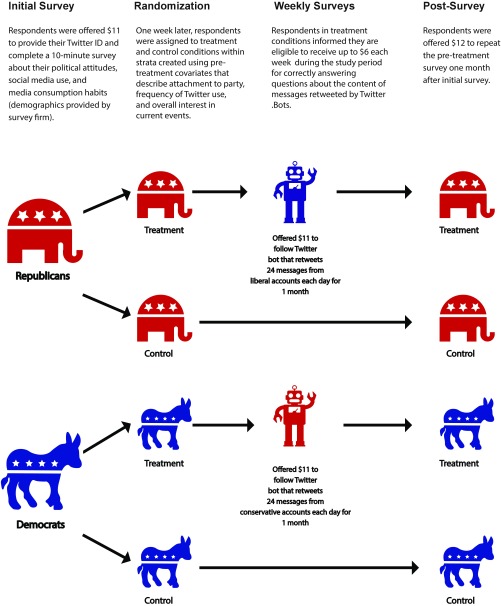
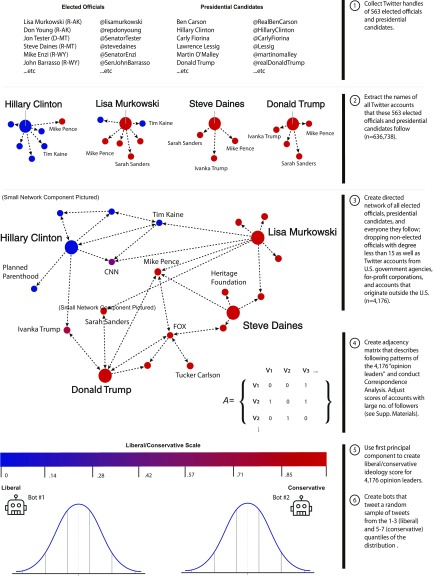
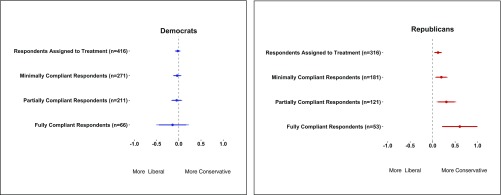
Significance: Social media sites are often blamed for exacerbating political polarization by creating “echo chambers” that prevent people from being exposed to information that contradicts their preexisting beliefs. We conducted a field experiment that offered a large group of Democrats and Republicans financial compensation to follow bots that retweeted messages by elected officials and opinion leaders with opposing political views. Republican participants expressed substantially more conservative views after following a liberal Twitter bot, whereas Democrats’ attitudes became slightly more liberal after following a conservative Twitter bot—although this effect was not statistically significant. Despite several limitations, this study has important implications for the emerging field of computational social science and ongoing efforts to reduce political polarization online.
Overview
The claims and statistics of this paper haven’t been checked yet.
Free: it reads the open-access text and checks the first 5 claims that cite a source we can check. Create a free account to check every claim.
Integrity signals
Registry
Cites
Statistics
Figures
Verification
Claims the paper makes
The claims and statistics of this paper haven’t been checked yet.
Free: it reads the open-access text and checks the first 5 claims that cite a source we can check. Create a free account to check every claim.
Claims other papers make about this one
Each is checked against this paper’s own text: does it say what the citing paper says it does?
The cited source doesn’t support the claim as written.
In the citing paper
“Supporting this, Bail et al. [2] further challenge the polarization assumption, showing that social media use can increase exposure to non-partisan content.”
From A systematic review of echo chamber research: comparative analysis of conceptualizations, operationalizations, and varying outcomes (2025) · cites this paper as [2]
Checked by a reasoning model — may be wrong.
Experimental — accuracy not yet measuredThe source backs part of the claim, not all of it — or backs it for a different population, condition or comparison.
In the citing paper
“For instance, it is neither clear what level of homophily in social networks is desirable or undesirable in a democratic society, nor is it clear how to interpret the results of certain studies on polarization69,130, whose findings depend on whether one assumes that social media have increased or decreased exposure to opposing views relative to some offline benchmark.”
From A systematic review of worldwide causal and correlational evidence on digital media and democracy (2022) · cites this paper as [69]
Experimental — accuracy not yet measuredThe source backs part of the claim, not all of it — or backs it for a different population, condition or comparison.
In the citing paper
“Even without being designed to shift opinions, it has been found that algorithms may contribute to political polarization by reinforcing divisive opinions [9, 24, 32].”
From Co-Writing with Opinionated Language Models Affects Users’ Views (2023) · cites this paper as [9]
Experimental — accuracy not yet measuredThe source backs part of the claim, not all of it — or backs it for a different population, condition or comparison.
In the citing paper
“Entrar en contacto con contenido contra-actitudinal puede generar una resistencia emocional y una sensación de amenaza que terminen polarizando igualmente al individuo (Bail et al., 2018;Dahlgren, 2022).”
From Política, uso de medios y polarización afectiva en España (2024) · cites this paper as Bail et al., 2018
Experimental — accuracy not yet measuredThe source backs part of the claim, not all of it — or backs it for a different population, condition or comparison.
In the citing paper
“Experimental approaches show e.g., how distorted meta-representations of outgroups on digital platforms can result in disaffection across ideological groups (Bail et al. 2018, Banks et al. 2021).”
From When debates break apart: discursive polarization as a multi-dimensional divergence emerging in and through communication (2023) · cites this paper as Bail et al. 2018
Experimental — accuracy not yet measured
18 more claims about this paper
Create a free account to see every claim other papers make about this one.
Self-check
Percentages, sums and reported differences re-computed from the paper’s own numbers.
The self-check needs the paper’s full text.
Citations
Cites
Birds of a Feather: Homophily in Social Networks
McPherson, M., Smith-Lovin, L., & Cook, J. M. (2001) · Annual Review of Sociology · doi:10.1146/annurev.soc.27.1.415 · Cited by 18,567 · cited 1×
“Despite initial optimism that social media might enable people to consume more heterogeneous sources of information about current events, there is growing concern that such forums exacerbate political polarization because of social network homophily, or the well-documented tendency of people to form social network tie…”
BackgroundA meta-analytic test of intergroup contact theory.
Pettigrew, T. F., & Tropp, L. R. (2006) · Journal of personality and social psychology · doi:10.1037/0022-3514.90.5.751 · Cited by 9,708 · cited 1×
“A vast literature indicates contact between opposing groups can challenge stereotypes that develop in the absence of positive interactions between them (30).”
BackgroundLord, C. G., Ross, L., & Lepper, M. R. (1979) · Journal of Personality and Social Psychology · doi:10.1037/0022-3514.37.11.2098 · Cited by 4,583
Liberals and conservatives rely on different sets of moral foundations.
Graham, J., Haidt, J., & Nosek, B. A. (2009) · Journal of Personality and Social Psychology · doi:10.1037/a0015141 · Cited by 4,560
Motivated Skepticism in the Evaluation of Political Beliefs
Taber, C. S., & Lodge, M. (2006) · American Journal of Political Science · doi:10.1111/j.1540-5907.2006.00214.x · Cited by 4,344
Lazer, D., Pentland, A., Adamic, L., Aral, S., Barabási, A.-L., Brewer, D., Christakis, N., Contractor, N., Fowler, J., Gutmann, M., et al. (2009) · Science · doi:10.1126/science.1167742 · Cited by 3,365
Exposure to ideologically diverse news and opinion on Facebook
Bakshy, E., Messing, S., & Adamic, L. A. (2015) · Science · doi:10.1126/science.aaa1160 · Cited by 3,245
When Corrections Fail: The Persistence of Political Misperceptions
Nyhan, B., & Reifler, J. (2010) · Political Behavior · doi:10.1007/s11109-010-9112-2 · Cited by 3,173
Fear and loathing across party lines: New evidence on group polarization
Iyengar, S., & Westwood, S. J. (2015) · American Journal of Political Science · doi:10.1111/ajps.12152 · Cited by 2,452
Uncivil Agreement: How Politics Became Our Identity
Mason, L. (2018) · doi:10.7208/chicago/9780226524689.001.0001 · Cited by 1,985
Research works printed but not linked: 1
- Sunstein C 2001 Echo Chambers, Bush v. Gore, Impeachment, and Beyond Princeton Univ Press Princeton
Cited by
Items 601–700 of 1,010
Ramos, G., Vieites, Y., Jacob, J., & Andrade, E. B. (2020) · Revista de Administração Pública · doi:10.1590/0034-761220200162 · Cited by 18
“…pesquisas anteriores lançaram dúvida sobre a influência da orientação política e da afiliação partidária, (Converse, 1964; Fiorina, 2006), trabalhos mais recentes reforçam o elevado poder preditivo da orientação política sobre as preferências políticas (Dimock & Carroll, 2014; Bail et al., 2018).”
BackgroundProbabilistic social learning improves the public’s judgments of news veracity
Guilbeault, D., Woolley, S., & Becker, J. A. (2021) · PLoS ONE · doi:10.1371/journal.pone.0247487 · Cited by 16
“ability for probabilistic social learning to improve misinformation detection even in highly polarized political environments (9,15,21,34).”
BackgroundDiffusion of social conventions across polarized communities: an empirical study
Nair, S., Ng, K. W., Iamnitchi, A., & Skvoretz, J. V. (2021) · Social Network Analysis and Mining · doi:10.1007/s13278-021-00726-2 · Cited by 13
Emmert‐Streib, F., & Dehmer, M. (2021) · Frontiers in Big Data · doi:10.3389/fdata.2021.591749 · Cited by 16
“This spans a wide number of questions from anthropology, sociology, economy, psychology, cyberpsychology, and political science (Kosinski et al., 2013; Badjatiya et al., 2017; Wei et al., 2017; Bail et al., 2018).”
BackgroundSurveying the Research on Fake News in Social Media: a Tale of Networks and Language.Preprint
Ruffo, G., Semeraro, A., Giachanou, A., & Rosso, P. (2021) · arXiv (Cornell University) · Cited by 9
Lawson, M. A., & Kakkar, H. (2020) · PsyArXiv (OSF Preprints) · doi:10.31234/osf.io/ves5m · Cited by 11
AI and Social Media: A Political Economy Perspective
Acemoglu, D., Ozdaglar, A., & Siderius, J. (2025) · doi:10.3386/w33892 · Cited by 9
Política, uso de medios y polarización afectiva en España
Crespo-Martínez, I., Melero-López, I., Mora-Rodríguez, A., & Rojo-Martínez, J.-M. (2024) · Revista Mediterránea de Comunicación · doi:10.14198/medcom.26681 · Cited by 21
The Devil No More? Decreasing Negative Outparty Affect through Asymmetric Partisan Thinking
Marsh, W. Z. C. (2023) · Public Opinion Quarterly · doi:10.1093/poq/nfad009 · Cited by 10
The Influence of Information Cocoons on Modern Consumers
Niu, L., Tian, R., Chen, I., & Wu, T. (2023) · Advances in economics, business and management research/Advances in Economics, Business and Management Research · doi:10.2991/978-94-6463-246-0_50 · Cited by 11
Stewart, A. J., Arechar, A. A., Rand, D. G., & Plotkin, J. B. (2024) · Proceedings of the National Academy of Sciences · doi:10.1073/pnas.2315195121 · Cited by 43
Alleviating negative group polarization with the aid of social bots
Wu, Y., Li, W., Li, Y., Chen, Q., Liu, M., & Li, Y. (2024) · Physica A Statistical Mechanics and its Applications · doi:10.1016/j.physa.2024.129804 · Cited by 8
Selective Permeability, Social Media and Epistemic Fragmentation
Crippen, M. (2024) · Topoi · doi:10.1007/s11245-024-10104-0 · Cited by 12
“In fact, an experiment showed that when heavy social media users read tweets from political figures they disliked, their zeal for their own views increased, albeit more for people on the right than the left (Bail et al. 2018).”
Zhang, M., Dong, Q., & Wu, X. (2024) · IEEE Transactions on Computational Social Systems · doi:10.1109/tcss.2024.3502662 · Cited by 16
“Nevertheless, existing research often overlooks the inherent specificity of misinformation, such as the exposure to opposing opinions that creates potential risks of further solid-ifying ones’ standpoint [4], as evidenced by the widely discussed “backfire effect” [5], [6] in sociological research.”
Inference of social media opinion trends in 2022 Italian elections
Zollo, S., Cinelli, M., Etta, G., Cerqueti, R., & Quattrociocchi, W. (2025) · Expert Systems with Applications · doi:10.1016/j.eswa.2024.126377 · Cited by 11
Fang, X., Heuser, S., & Stötzer, L. S. (2025) · Journal of Public Economics · doi:10.1016/j.jpubeco.2025.105309 · Cited by 21
Kim, J., Wang, Z., Shi, H., Ling, H.-K., & Evans, J. A. (2025) · Nature Communications · doi:10.1038/s41467-025-55868-0 · Cited by 20
“Earlier research on motivated reasoning suggests that misinformation tags contradicting targeted poster ’ s beliefs could back fi re and reinforce preexisting beliefs 16,17 , which could discourage people from exploring diverse information 18 .”
Ludwig, K., Müller, P., Nikolajevic, N., & Grote, A. (2025) · Information Communication & Society · doi:10.1080/1369118x.2024.2435998 · Cited by 20
“Among politically extreme individuals, any divergence from their ‘true’ viewpoint might be seen as a nuisance and in turn rather create a backfire effect, leading to an even stronger attachment to prior viewpoints (e.g., Bail et al., 2018).”
Durrheim, K., & Schuld, M. (2025) · Political Psychology · doi:10.1111/pops.70000 · Cited by 8
“Exposure to counter-attitudinal opinions via retweets may be especially important in producing such bipolarization (cf. Flache et al., 2017; cf. Bail et al., 2018); and is perhaps the reason why inflammatory material is more likely to be shared on social media (Brady et al., 2019, 2020).”
How out-group animosity can shape partisan divisions: A model of affective polarization
Nettasinghe, B., Percus, A. G., & Lerman, K. (2025) · PNAS Nexus · doi:10.1093/pnasnexus/pgaf082 · Cited by 19
“The model also explains why conventional wisdom-based approaches aimed at reducing polarization, such as connecting people from opposite parties, often backfire (13, 16).”
Mitigating opinion polarization in social networks using adversarial attacks
Ninomiya, M., Ichinose, G., Chiyomaru, K., & Takemoto, K. (2025) · Scientific Reports · doi:10.1038/s41598-025-93213-z · Cited by 12
Polarization of public opinions on feminism in China
Piao, J., Zhang, F., Ren, T., Xu, F., Zhou, J., Su, J., Ru, P., & Li, Y. (2025) · Humanities and Social Sciences Communications · doi:10.1057/s41599-025-04635-z · Cited by 15
“It permeates aspects of our society (Bail et al. 2018; Falkenberg et al. 2022; Jost et al. 2022; Lorenz-Spreen et al. 2023; Santos et al. 2021), ampli fi es ideological extremes (Hetherington, 2009; Jost et al. 2022), exacerbates hatred (Dimant, 2024; Jost et al. 2022), and threatens democracy…”
InfluentialA Survey on Opinion Dynamics in Social Media Networks: Analysis, Simulation, and Control
Zareer, M. N., & Šelmić, R. R. (2025) · IEEE Transactions on Computational Social Systems · doi:10.1109/tcss.2025.3622498 · Cited by 13
Prendergast, M., & Quinn, F. (2020) · Journalism Practice · doi:10.1080/17512786.2020.1786436 · Cited by 12
“What Benford and Snow (2000) identify as “motivational framing” which justifies social action, is prominent in both Twitter datasets, compared to the more evaluative mainstream media.”
BackgroundSuccessive Cohorts of Twitter Users Show Increasing Activity and Shrinking Content Horizons
Wolf, F., Lorenz-Spreen, P., & Lehmann, S. (2022) · Journal of Quantitative Description Digital Media · doi:10.51685/jqd.2022.014 · Cited by 9
A potential mechanism for low tolerance feedback loops in social media flagging systems
Westermann, C. J., & Coscia, M. (2022) · PLoS ONE · doi:10.1371/journal.pone.0268270 · Cited by 10
“We start by assigning a lower tolerance to agents on one side of the polarization spectrum.”
A Formal Model for Polarization under Confirmation Bias in Social Networks
Alvim, M. S., Amorim, B., Knight, S., Quintero, S., & Valencia, F. (2023) · Logical Methods in Computer Science · doi:10.46298/lmcs-19(1:18)2023 · Cited by 12
Li, Y., Gee, W., Jin, K., & Bond, R. M. (2023) · Journal of Medical Internet Research · doi:10.2196/41882 · Cited by 6
“However, research shows that when confronted with opposing views, people are likely to counterargue through directional motivated reasoning, reinforcing their preexisting beliefs [30-32].”
Does Social Media Use Promote Political Mass Polarization?
Ludwig, K., & Müller, P. (2022) · Nomos Verlagsgesellschaft mbH & Co. KG eBooks · doi:10.5771/9783748928232-118 · Cited by 16
Reliability of News and Toxicity in Twitter Conversations
Quattrociocchi, A., Etta, G., Avalle, M., Cinelli, M., & Quattrociocchi, W. (2022) · Lecture notes in computer science · doi:10.1007/978-3-031-19097-1_15 · Cited by 14
Marín-Albaladejo, J. A. (2023) · Espejo de Monografías de Comunicación Social · doi:10.52495/c3.emcs.10.p96 · Cited by 12
Journalism in Democracy: A Discourse Analysis of Twitter Posts on the Ferrerasgate Scandal
Sanz, I. R., Prieto, P. B., & Izquierdo, J. H. (2023) · Media and Communication · doi:10.17645/mac.v11i2.6314 · Cited by 9
A Method for Estimating Individual Socioeconomic Status of Twitter Users
He, Y., & Tsvetkova, M. (2023) · Sociological Methods & Research · doi:10.1177/00491241231168665 · Cited by 14
“…world reflects and even reproduces the existing cultural boundaries of the physical world regarding people’s interests in restaurants, music, films, museums, and galleries (Airoldi, 2021; Goldberg et al., 2016; Mihelj et al., 2019), and even more so, politics (Bail et al., 2018; Tucker et al., 2018).”
A Multi-factorial Analysis of Polarization on Social Media
Treuillier, C., Brun, A., & Castagnos, S. (2023) · ACM Conference on User Modeling, Adaptation and Personalization (UMAP) · doi:10.1145/3563359.3597393 · Cited by 11
“It may even reinforce the polarization phenomenon [2].”
Dueñas, J. M. R., & Humanes, M. L. (2023) · Cuadernos info · doi:10.7764/cdi.56.59797 · Cited by 17
Resampling reduces bias amplification in experimental social networks
Hardy, M. D., Thompson, B., Krafft, P. M., & Griffiths, T. L. (2023) · Nature Human Behaviour · doi:10.1038/s41562-023-01715-5 · Cited by 13
“Previous research has sought to construct more representative samples by directly curating opposing viewpoints or through heuristic algorithms that alter people’s social connections 52–54 .”
BackgroundKarell, D., & Sachs, J. D. (2023) · Socius Sociological Research for a Dynamic World · doi:10.1177/23780231231212108 · Cited by 14
“For example, reading novel political opinions on social media can make users more likely to express new political views (Gil de Zúñiga, Molyneux, and Zheng 2014; see also Bail et al. 2018) and, in some cases, even “radicalize” them (Pauwels and Schils 2016; Wahlström, Törnberg, and Ekbrand 2021).”
BackgroundMcKay, D., Makri, S., Lopez, M. G., Porlezza, C., MacFarlane, A., Cooper, G., & Missaoui, S. (2024) · Journal of the Association for Information Science and Technology · doi:10.1002/asi.24885 · Cited by 13
“There is also evidence that people prefer to consume information that reinforces rather than challenges their existing views (Garrett, 2009) and that exposure to opposing political views on social media can increase polarization (Bail et al., 2018).”
BackgroundFrom Feeds to Inboxes: A Comparative Study of Polarization in Facebook and Email News Sharing
Yoganarasimhan, H., & Yakovetskaya, I. (2024) · Management Science · doi:10.1287/mnsc.2023.04134 · Cited by 27
Betting on the underdog: the influence of social networks on vote choice
Fredén, A., Rheault, L., & Indridason, I. (2020) · Political Science Research and Methods · doi:10.1017/psrm.2020.21 · Cited by 8
“…” , for instance their potential impact on the decline of deliberative politics, the fomenta-tion of extreme ideology, and political polarization (Farrell, 2012; Lee et al. , 2014; Colleoni et al. , 2014; Barberá et al. , 2015; Flaxman et al. , 2016; Bail et al. , 2018; Eady et al. , 2019).”
Spread of tweets in climate discussions: A case study of the 2019 Nobel Peace Prize announcement
Xia, Y., Chen, T. H. Y., & Kivelä, M. (2021) · Nordic Journal of Media Studies · doi:10.2478/njms-2021-0006 · Cited by 15
VoxPop: An Experimental Social Media Platform for Calibrated (Mis)information Discourse
Sharevski, F., Jachim, P., Pieroni, E., & Jachim, N. (2021) · New Security Paradigms Workshop · doi:10.1145/3498891.3498893 · Cited by 13
“Exposure to opposing views on social media might increase political polarization in on certain topics [6], but VoxPop response of transparent echo chambers is precisely in eliminating the platform’s imposition of context (in this case Twitter) as a factor of polarization.”
BackgroundJohansen, N., Marjanović, S. V., Kjær, C. V., Baglini, R., & Adler‐Nissen, R. (2022) · Harvard Kennedy School Misinformation Review · doi:10.37016/mr-2020-93 · Cited by 11
Measuring Network Polarization and Political Sectarianism During the 2020 Pandemic
Kamienski, C., Penteado, C. L. D. C., Goya, D., da Rocha, R. V., Mazim, L., di Gênova, D. V. B., Ramos, D. F. S., de França, F. O., Horita, F., & dos Santos, C. D. S. (2022) · IEEE Transactions on Computational Social Systems · doi:10.1109/tcss.2022.3159449 · Cited by 9
“It is still unclear whether social media plays a significant role in driving political sectarianism, and there is limited evidence that individuals in the USA that identify with one party might assume more extreme stances after exposure to opposing views on Twitter [22].”
BackgroundModeling Political Activism around Gun Debate via Social Media
Mejova, Y., An, J., Morales, G. D. F., & Kwak, H. (2022) · ACM Transactions on Social Computing · doi:10.1145/3532102 · Cited by 9
“Ideological polarization is especially pronounced in the U.S. gun control debate—a 2016 Pew Research Center poll revealed that just 22% of self-identified Democrats chose protecting gun ownership rights compared with the 76% of Republicans who did—a gap that has widened since 2007 mainly by Republicans adopting a stro…”
BackgroundAydin, Z., Fuess, A., Förster, M., & Sunier, T. (2022) · Social Media + Society · doi:10.1177/20563051221115211 · Cited by 16
“Therefore, it is argued that the very exposure to crosscutting views is what is causing the polarization effect (Bail et al., 2018).”
BackgroundRed and blue states: dichotomized maps mislead and reduce perceived voting influence
Furrer, R. A., Schloss, K. B., Lupyan, G., Niedenthal, P. M., & Wood, A. (2023) · Cognitive Research Principles and Implications · doi:10.1186/s41235-023-00465-2 · Cited by 11
“The symbolic dichotomization implies a lack of nuance in political ideology, which in turn might exacerbate the bipartisan divide across political (Baldassarri & Gelman, 2008), geographic (Tam Cho et al., 2013), and virtual (Bail et al., 2018) settings.”
BackgroundUndue Hate: A Behavioral Economic Analysis of Hostile Polarization in US Politics and Beyond
Stone, D. F. (2023) · The MIT Press eBooks · doi:10.7551/mitpress/14496.001.0001 · Cited by 11
Guilbeault, D., van Loon, A., Lix, K., Goldberg, A., & Srivastava, S. B. (2023) · Management Science · doi:10.1287/mnsc.2022.00895 · Cited by 12
“Yet the learning benefits of exposure to the ideas of cognitively dissimilar others often fail to materialize (Baldassarri and Bearman 2007; Guilbeault, Becker, and Centola 2018; Bail, Argyle, Brown, Bumpus, Chen, Hunzaker, Lee, Mann, Merhout, and Volfovsky 2018).”
BackgroundA Geometric Model of Opinion Polarization
Hązła, J., Jin, Y., Mossel, E., & Ramnarayan, G. (2023) · Mathematics of Operations Research · doi:10.1287/moor.2023.1355 · Cited by 26
The Science of Belief: A Progress Report
Porot, N., & Mandelbaum, E. (2022) · Cambridge University Press eBooks · doi:10.1017/9781009001021.005 · Cited by 13
The role of decision confidence in advice-taking and trust formationPreprint
Pescetelli, N., & Yeung, N. (2019) · doi:10.31234/osf.io/sjgf7 · Cited by 8
The Effect of Independent Online Media in an AutocracyPreprint
Enikolopov, R., Rochlitz, M., Schoors, K., & Zakharov, N. (2022) · Social Science Research Network · doi:10.2139/ssrn.4131355 · Cited by 3
“More recent studies find that attitude polarization is especially prevalent among consumers of nonmainstream media generally (Lau et al., 2017) and social media in particular (Bail et al., 2018).”
BackgroundInfluentialLagares Díez, N., López-López, P. C., Oñate, P., & Blasco-Blasco, O. (2023) · Análisis Político · doi:10.15446/anpol.v36n106.111074 · Cited by 16
Bouchaud, P. (2024) · Journal of Computational Social Science · doi:10.1007/s42001-024-00255-w · Cited by 11
Deliberation, mood response, and the confirmation bias in the religious belief domain
Dickinson, D. L. (2024) · Journal of Behavioral and Experimental Economics · doi:10.1016/j.socec.2024.102161 · Cited by 11
Empowered Mini-Publics: A Shortcut or Democratically Legitimate?
Lee, S. M. (2024) · Journal of Deliberative Democracy · doi:10.16997/jdd.1501 · Cited by 7
Softening Online Extremes Using Network Engineering
Restrepo, E. M., Moreno, M., Illari, L., & Johnson, N. F. (2024) · IEEE Access · doi:10.1109/access.2024.3388851 · Cited by 7
“…and the anger that they incite can encourage physical attacks and riots [24], [25], [26], [44], [45], [46], [47], [48], [49], [50], [51], [52], [53], [54], undermine democratic processes [55], [56], [57], [58], [59], [60], [61], [62], [63], [64], and promote prejudice and hate crimes [65], [66].”
BackgroundMont’Alverne, C., Arguedas, A. R., Banerjee, S., Toff, B., Fletcher, R., & Nielsen, R. K. (2024) · The International Journal of Press/Politics · doi:10.1177/19401612241292700 · Cited by 9
“…the effects of partisan media specifically among those who are most ideological since it is plausible that those who hold extreme views in support of or opposition to the two candidates may behave somewhat differently in response to media use than the rest of the population (Bail et al. 2018).”
Moin, T., Itzchakov, G., Kasriel, E., & Weinstein, N. (2025) · Journal of Applied Social Psychology · doi:10.1111/jasp.13086 · Cited by 11
“…a result of these experiences, listening may come less naturally to conversation partners who disagree than to partners who agree (Cohen et al. 2020), and disparate worldviews have the potential to be affirmed rather than aligned (Bail et al. 2018; Eveland, Henry, and Appiah 2023; Lin et al. 2023).”
Misinformation Beyond Traditional Feeds: Evidence from a WhatsApp Deactivation Experiment in Brazil
Ventura, T., Majumdar, R., Nagler, J., & Tucker, J. A. (2025) · The Journal of Politics · doi:10.1086/737172 · Cited by 14
Motivations to connect with like-minded audiences increase partisan sharing on social media
Marie, A., & Petersen, M. B. (2025) · PNAS Nexus · doi:10.1093/pnasnexus/pgaf197 · Cited by 12
“Repeated exposure to caricatural claims on one side can also annoy the other side, thereby reinforcing partisan identities and affective polarization (33, 85).”
Bridging the Infodemic Equity Gap: North-South Digital Health Disparities and a Framework for Action
Osborne, A. (2025) · Journal of Medical Internet Research · doi:10.2196/80013 · Cited by 11
Misinformation in India's 2019 National Election
Basavaraj, K. A. (2022) · Journal of Quantitative Description Digital Media · doi:10.51685/jqd.2022.021 · Cited by 7
“Research on affective polarization, negative effect and echo-chambers have discussed the fact that pro- and anti-party claims are often blended in campaign communication to mobilize the electorate (Bail et al., 2018; Barberá et al., 2015; Flaxman et al., 2016; Iyengar et al., 2012; Rusconi et al., 2020).”
BackgroundArendt, F., Northup, T., Forrai, M., & Scheufele, D. A. (2023) · Journal of Communication · doi:10.1093/joc/jqad007 · Cited by 13
Incidental news exposure and political consumerism – Exploring nuances
Scheffauer, R., Durotoye, T., & de Zúñiga, H. G. (2023) · Telematics and Informatics · doi:10.1016/j.tele.2023.102044 · Cited by 14
Individuals, Collectives, and Individuals in Collectives: The Ineliminable Role of Dependence
Hahn, U. (2023) · Perspectives on Psychological Science · doi:10.1177/17456916231198479 · Cited by 14
“…al., 2017; Pariser, 2011; Sunstein, 2018; Wojcieszak & Mutz, 2009) and the advent of social media in promoting partisanship (Adamic & Glance, 2005; Bail et al., 2018; Bakshy et al., 2015; Barberá et al., 2015; Del Valle & Borge Bravo, 2018; Himelboim et al., 2013; Lee et al., 2014; Törnberg,…”
BackgroundRole of social media news consumption in cultivating opinion polarization
Kothur, L., & Pandey, V. (2023) · Information Technology and People · doi:10.1108/itp-12-2022-0942 · Cited by 20
“Prior research finds that discussions, whether congenial or cross-cutting, can lead to polarization (Bail et al. , 2018; Lee et al. , 2014).”
BackgroundNicolaidou, I. A., & Kampf, R. (2024) · Social Science Computer Review · doi:10.1177/08944393241249724 · Cited by 13
“…Israeli-Jews and Palestinian young people are more familiar with their side in the con fl ict than the other side because of the loaded and emotional situation and ethnocentrism that make it hard to be exposed to contradicting information about the other in the con fl ict (e.g., Bail et al., 2018).”
The likes that bind: Even novel opinion sharing can induce opinion‐based identification
O’Reilly, C., Maher, P. J., & Quayle, M. (2024) · British Journal of Social Psychology · doi:10.1111/bjso.12773 · Cited by 8
Auwal, A. M., & Ersoy, M. (2024) · Media International Australia · doi:10.1177/1329878x241280234 · Cited by 13
“Similarly, Bail et al. ’ s (2018) fi eld experiment concludes that exposure to opposing political views on social media may create echo chambers and back fi re effects that exacerbate political polarization among partisan supporters.”
Public concern about climate change impacts on food choices: The interplay of knowledge and politics
Schuldt, J. P., Eiseman, D. L., & Hoffmann, M. P. (2020) · Agriculture and Human Values · doi:10.1007/s10460-020-10019-7 · Cited by 9
The social function of rationalization: An identity perspective
Bavel, J. J. V., Sternisko, A., Harris, E., & Robertson, C. E. (2020) · Behavioral and Brain Sciences · doi:10.1017/s0140525x19002097 · Cited by 8
White Media Attitudes in the Trump Era
Thompson, J. (2020) · American Politics Research · doi:10.1177/1532673x20943566 · Cited by 11
“The effect of echo chambers on political polarization is such that political polarization may increase when individuals are exposed to information from outside their media bubble (Bail et al., 2018).”
BackgroundA Characterization of Portuguese Tweets Regarding the Covid-19 Pandemic
Brum, P. P. V., Teixeira, M. C., Miranda, R., Vimieiro, R., Meira, W., & Pappa, G. L. (2020) · Anais do Symposium on Knowledge Discovery, Mining and Learning (KDMiLe) · doi:10.5753/kdmile.2020.11974 · Cited by 7
“Através de conexões de amizade e relações seguidor/seguido, as redes sociais permitem que seus participantes se comuniquem de forma efetiva, o que contribui para a discussão de tópicos variados [Bail et al. 2018; Guerra et al. 2013].”
BackgroundDahlgren, P. M. (2022) · Journal of Media Psychology · doi:10.1027/1864-1105/a000302 · Cited by 7
Modeling the power of polarization
Waldrop, M. M. (2021) · Proceedings of the National Academy of Sciences · doi:10.1073/pnas.2114484118 · Cited by 8
Reyero, D., Pattier, D., & Gallego, D. G.-R. (2021) · Springer eBooks · doi:10.1007/978-3-030-85788-2_6 · Cited by 17
The Dynamics of Online Opinion Formation: Polarization Around the Vaccine Development for COVID-19
Jain, G., Sreenivas, A. B., Gupta, S., & Tiwari, A. A. (2022) · Springer eBooks · doi:10.1007/978-981-16-5268-4_3 · Cited by 10
Declining Civility and Growing Political Violence at the Local Level: A Threat to American Democracy
Williams, V., Gottlieb, J., & Lee, T. (2022) · State and Local Government Review · doi:10.1177/0160323x221089945 · Cited by 7
“Social media is often blamed for stimulating or exacerbating political polarization by creating echo chambers wherein people not only seek out information to confirm their existing biases. but are not exposed to information that contradicts their preexisting beliefs (Bail et al. 2018).”
BackgroundTiktok Content in Communication Strategy: Politics of the 15th General Election in Malaysia
Hung, L. (2022) · Higher Education and Oriental Studies · doi:10.54435/heos.v2i6.83 · Cited by 16
Cui, P.-B. (2023) · Physica A Statistical Mechanics and its Applications · doi:10.1016/j.physa.2023.128714 · Cited by 12
“Influence plays a decisive role in driving the evolution of individuals’ opinions, which is responsible for individuals’ tendency to either reach agreement with shared opinions (positive influence) [1, 41, 42, 7] or to amplify difference from others with distant opinions (negative influence) [5, 6, 34, 35, 37, 38, 43].”
BackgroundCharacterizing the language-production dynamics of social media users
Stine, Z. K., & Agarwal, N. K. (2019) · Social Network Analysis and Mining · doi:10.1007/s13278-019-0605-7 · Cited by 8
“2017; Bail et al. 2018) and the propagation of misinformation (Del Vicario et al. 2016). In response to the growing importance of social media, much research has been focused on discriminating between genuine, good-faith social media users, and bad-faith users, often in the form of automatically operated accounts coll…”
Quantitative Modeling and Analysis of Argumentation Polarization in Cyber Argumentation
Sirrianni, J., Liu, X., & Adams, D. (2020) · IEEE Transactions on Computational Social Systems · doi:10.1109/tcss.2020.3035228 · Cited by 9
“Bimodal approaches are very common in analysis of polarization [29], [39], [40], [58].”
BackgroundMethodEpistemic Frames and Political Discourse Modeling
Hamilton, E. R., & Hobbs, W. (2021) · Communications in computer and information science · doi:10.1007/978-3-030-67788-6_3 · Cited by 8
Exploring the disparity of influence between users in the discussion of Brexit on Twitter
Rajabi, A., Mantzaris, A. V., Atwal, K. S., & Garibay, I. I. (2021) · Journal of Computational Social Science · doi:10.1007/s42001-021-00112-0 · Cited by 9
YouTube and Traditional Media: Polarization in the Catalan Political Conflict
Marin, J. G. (2021) · Studies in digital politics and governance · doi:10.1007/978-3-030-71815-2_3 · Cited by 10
Studying Politicians' Information Sharing on Social Media
Meier, F., & Elsweiler, D. (2019) · Conference on Human Information Interaction and Retrieval · doi:10.1145/3295750.3298944 · Cited by 8
“The qRT feature has been seen as a good means to engage members of ideologically differently positioned groups by mentioning them in the comment [28] Recent work shows that exposure to opposing views does not dissolve the filter bubble and may even increase the echo chamber effect [1].”
BackgroundFairness and Diversity for Rankings in Two-Sided Markets.Preprint
Wang, L., & Joachims, T. (2020) · arXiv (Cornell University) · Cited by 7
Aruguete, N., Calvo, E. F., Scartascini, C., & Ventura, T. (2021) · doi:10.18235/0003389 · Cited by 11
Polarization in the Contemporary Political and Media LandscapePreprint
Wilson, A. E., Parker, V., & Feinberg, M. (2020) · PsyArXiv (OSF Preprints) · doi:10.31234/osf.io/yqvzc · Cited by 15
Echo ChambersPreprint
Cookson, J. A., Engelberg, J., & Mullins, W. (2020) · SSRN Electronic Journal · doi:10.2139/ssrn.3603107 · Cited by 11
“Several papers expose individuals to exogenous information shocks, and observe their ex post response (e.g., Heimer, 2014; D’Acunto, 2015; Heimer, 2016; Bail et al., 2018).”
Political Ideology, Mood Response, and the Confirmation BiasPreprint
Dickinson, D. L. (2022) · SSRN Electronic Journal · doi:10.2139/ssrn.4163305 · Cited by 7
Affective and interactional polarization align across countriesPreprint
Falkenberg, M., Zollo, F., Quattrociocchi, W., Pfeffer, J., & Baronchelli, A. (2023) · PsyArXiv (OSF Preprints) · doi:10.31234/osf.io/ngsb6 · Cited by 16
Social Media & Declining Trust: An Epistemic Challenge for Emerging Adults?
Sharon, T., & Encarnación, M. (2024) · Emerging Adulthood · doi:10.1177/21676968241234091 · Cited by 12
“Liberals showed a similar trend, although it was not signi fi cant (Bail et al., 2018).”
BackgroundMartínez‐España, R., Fernández-Pedauyé, J., de Lucía, J. G. P., Martínez, J. M. R., Bakdid, K., & Escribano, J. J. G. (2024) · IEEE Access · doi:10.1109/access.2024.3431999 · Cited by 18
“According to an experiment carried out in the United States, individuals became more polarized when they came into contact with outgroup content [26].”
BackgroundPublic opinion and Chinese exports: evidence from Twitter sentiment analysis
Deng, Y., Wang, H., & Wu, Y. (2024) · Journal of the Asia Pacific Economy · doi:10.1080/13547860.2024.2403512 · Cited by 7
“This result is in line with the findings by Bail et al. (2018) who showed that exposure to divided political views would increase political polarization.”
Volchenkov, D., & Putkaradze, V. (2025) · Mathematics · doi:10.3390/math13101625 · Cited by 6
Designing with Uncertainty: LLM Interfaces as Transitional Spaces for Democratic Revival
Delacroix, S. (2025) · Minds and Machines · doi:10.1007/s11023-025-09736-x · Cited by 10
“Bail et al. ( 2018) found that exposing participants to opposing political perspectives increased rather than decreased polarization, particularly among conservative participants.”
How social media users adopt the toxic behaviors of ingroup and outgroup accounts
Zoizner, A., & Levy, A. (2025) · Journal of Computer-Mediated Communication · doi:10.1093/jcmc/zmaf018 · Cited by 11
Metadata
- Authors
- Bail, C. A., Argyle, L. P., Brown, T. W., Bumpus, J. P., Chen, H., Hunzaker, M. B. F., Lee, J., Mann, M., Merhout, F., & Volfovsky, A.
- Affiliations
- Duke University (US)
- Brigham Young University (US)
- New York University (US)
- Corresponding author
- Bail, Christopher A.
- ORCID
- Venue
- Proceedings of the National Academy of Sciences
- Publisher
- National Academy of Sciences
- Published
- 2018-08-28
- Volume
- 115
- Issue
- 37
- Pages
- 9216-9221
- ISSN
- 0027-8424 (ISSN-L)
- 1091-6490
- PMC
- PMC6140520
- OpenAlex
- W2889127731
- Semantic Scholar
- c1cb4725a7fb0df77c52d6d2792e87d588178715
- Cited by
- 1,863
- References
- 56
- Citations by year
- 2026: 275 · 2025: 272 · 2024: 248 · 2023: 292 · 2022: 264 · 2021: 228 · 2020: 181 · 2019: 96 · 2018: 7
- FWCI
- 278.82
- Type
- journal article
- Language
- en
- Open access
- hybrid
- doi.org
- Licence
- Locations
- Proceedings of the National Academy of Sciences (publishedVersion, cc-by-nc-nd)
- Europe PMC (PubMed Central) (publishedVersion, cc-by-nc-nd)
- PubMed Central (publishedVersion, cc-by-nc-nd)
- PubMed (publishedVersion)
- RePEc: Research Papers in Economics (submittedVersion)
- Funders
- Russell Sage Foundation (E0267)
- Topics
- Social Sciences › Communication › Social Media and Politics
- Social Sciences › Sociology and Political Science › Media Influence and Politics
- Social Sciences › Sociology and Political Science › Misinformation and Its Impacts
- Keywords
- political polarization, echo chambers, social media, Twitter bots, ideological change, financial incentives, computational social science, partisanship, social policy attitudes
- MeSH terms
- Political Activism, Democracy, Female, Humans, Male, United States, Social Media
About these checks
Registry, retraction, Cites and statistics results are computed, not judged, with one exception: a printed reference that no index lists is read once by a model before it counts as a citation error. Claims are extracted by a model and kept only when their quote appears verbatim in the text; each cited source is then checked, with a model’s help, for whether it says what the claim relies on. Those verdicts can be wrong — read the claim’s quote and the cited source before relying on one.
Statistics and arithmetic are recomputed, not judged.
Confidence bands are shown only for fields calibrated on our annotated test set. None is calibrated yet, so no band is shown.
What counts as a claim ›How we measure confidence ›How we check this ›
Are you an author, or do you see a problem with this page? Request a review
Data sources
Bibliographic data: Semantic Scholar, OpenAlex, Crossref.
Contains information from the Semantic Scholar Academic Graph Datasets, made available under the ODC Attribution License (ODC-BY 1.0).
Semantic Scholar’s data is described in: Kinney, R., et al. (2023). The Semantic Scholar Open Data Platform. arXiv:2301.10140.
