

Exposure to opposing views on social media can increase political polarization
Open accessThe DOI matches its Crossref record; 60 of the 60 references it cites were found in a registry or an index.
Abstract
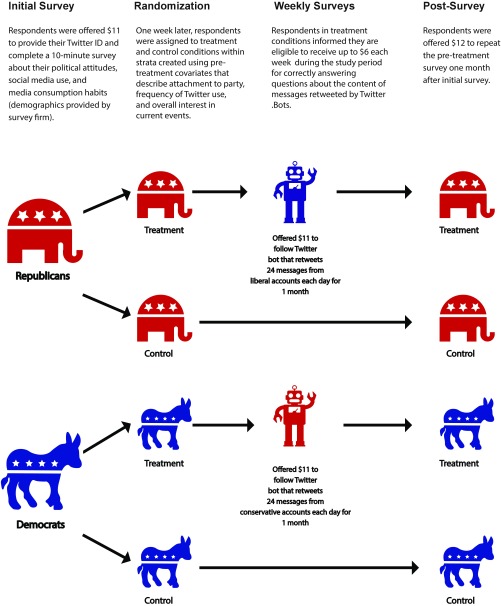
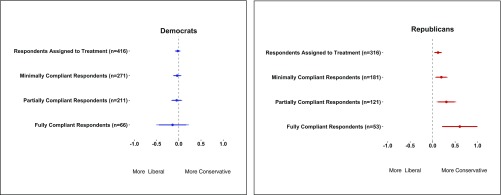
Significance: Social media sites are often blamed for exacerbating political polarization by creating “echo chambers” that prevent people from being exposed to information that contradicts their preexisting beliefs. We conducted a field experiment that offered a large group of Democrats and Republicans financial compensation to follow bots that retweeted messages by elected officials and opinion leaders with opposing political views. Republican participants expressed substantially more conservative views after following a liberal Twitter bot, whereas Democrats’ attitudes became slightly more liberal after following a conservative Twitter bot—although this effect was not statistically significant. Despite several limitations, this study has important implications for the emerging field of computational social science and ongoing efforts to reduce political polarization online.
Overview
The claims and statistics of this paper haven’t been checked yet.
Free: it reads the open-access text and checks the first 5 claims that cite a source we can check. Create a free account to check every claim.
Integrity signals
Registry
Cites
Statistics
Figures
Verification
Claims the paper makes
The claims and statistics of this paper haven’t been checked yet.
Free: it reads the open-access text and checks the first 5 claims that cite a source we can check. Create a free account to check every claim.
Claims other papers make about this one
Each is checked against this paper’s own text: does it say what the citing paper says it does?
The cited source doesn’t support the claim as written.
In the citing paper
“Supporting this, Bail et al. [2] further challenge the polarization assumption, showing that social media use can increase exposure to non-partisan content.”
From A systematic review of echo chamber research: comparative analysis of conceptualizations, operationalizations, and varying outcomes (2025) · cites this paper as [2]
Checked by a reasoning model — may be wrong.
Experimental — accuracy not yet measuredThe source backs part of the claim, not all of it — or backs it for a different population, condition or comparison.
In the citing paper
“For instance, it is neither clear what level of homophily in social networks is desirable or undesirable in a democratic society, nor is it clear how to interpret the results of certain studies on polarization69,130, whose findings depend on whether one assumes that social media have increased or decreased exposure to opposing views relative to some offline benchmark.”
From A systematic review of worldwide causal and correlational evidence on digital media and democracy (2022) · cites this paper as [69]
Experimental — accuracy not yet measuredThe source backs part of the claim, not all of it — or backs it for a different population, condition or comparison.
In the citing paper
“Even without being designed to shift opinions, it has been found that algorithms may contribute to political polarization by reinforcing divisive opinions [9, 24, 32].”
From Co-Writing with Opinionated Language Models Affects Users’ Views (2023) · cites this paper as [9]
Experimental — accuracy not yet measuredThe source backs part of the claim, not all of it — or backs it for a different population, condition or comparison.
In the citing paper
“Entrar en contacto con contenido contra-actitudinal puede generar una resistencia emocional y una sensación de amenaza que terminen polarizando igualmente al individuo (Bail et al., 2018;Dahlgren, 2022).”
From Política, uso de medios y polarización afectiva en España (2024) · cites this paper as Bail et al., 2018
Experimental — accuracy not yet measuredThe source backs part of the claim, not all of it — or backs it for a different population, condition or comparison.
In the citing paper
“Experimental approaches show e.g., how distorted meta-representations of outgroups on digital platforms can result in disaffection across ideological groups (Bail et al. 2018, Banks et al. 2021).”
From When debates break apart: discursive polarization as a multi-dimensional divergence emerging in and through communication (2023) · cites this paper as Bail et al. 2018
Experimental — accuracy not yet measured
18 more claims about this paper
Create a free account to see every claim other papers make about this one.
Self-check
Percentages, sums and reported differences re-computed from the paper’s own numbers.
The self-check needs the paper’s full text.
Citations
Cites
Birds of a Feather: Homophily in Social Networks
McPherson, M., Smith-Lovin, L., & Cook, J. M. (2001) · Annual Review of Sociology · doi:10.1146/annurev.soc.27.1.415 · Cited by 18,567 · cited 1×
“Despite initial optimism that social media might enable people to consume more heterogeneous sources of information about current events, there is growing concern that such forums exacerbate political polarization because of social network homophily, or the well-documented tendency of people to form social network tie…”
BackgroundA meta-analytic test of intergroup contact theory.
Pettigrew, T. F., & Tropp, L. R. (2006) · Journal of personality and social psychology · doi:10.1037/0022-3514.90.5.751 · Cited by 9,708 · cited 1×
“A vast literature indicates contact between opposing groups can challenge stereotypes that develop in the absence of positive interactions between them (30).”
BackgroundLord, C. G., Ross, L., & Lepper, M. R. (1979) · Journal of Personality and Social Psychology · doi:10.1037/0022-3514.37.11.2098 · Cited by 4,583
Liberals and conservatives rely on different sets of moral foundations.
Graham, J., Haidt, J., & Nosek, B. A. (2009) · Journal of Personality and Social Psychology · doi:10.1037/a0015141 · Cited by 4,560
Motivated Skepticism in the Evaluation of Political Beliefs
Taber, C. S., & Lodge, M. (2006) · American Journal of Political Science · doi:10.1111/j.1540-5907.2006.00214.x · Cited by 4,344
Lazer, D., Pentland, A., Adamic, L., Aral, S., Barabási, A.-L., Brewer, D., Christakis, N., Contractor, N., Fowler, J., Gutmann, M., et al. (2009) · Science · doi:10.1126/science.1167742 · Cited by 3,365
Exposure to ideologically diverse news and opinion on Facebook
Bakshy, E., Messing, S., & Adamic, L. A. (2015) · Science · doi:10.1126/science.aaa1160 · Cited by 3,245
When Corrections Fail: The Persistence of Political Misperceptions
Nyhan, B., & Reifler, J. (2010) · Political Behavior · doi:10.1007/s11109-010-9112-2 · Cited by 3,173
Fear and loathing across party lines: New evidence on group polarization
Iyengar, S., & Westwood, S. J. (2015) · American Journal of Political Science · doi:10.1111/ajps.12152 · Cited by 2,452
Uncivil Agreement: How Politics Became Our Identity
Mason, L. (2018) · doi:10.7208/chicago/9780226524689.001.0001 · Cited by 1,985
Research works printed but not linked: 1
- Sunstein C 2001 Echo Chambers, Bush v. Gore, Impeachment, and Beyond Princeton Univ Press Princeton
Cited by
The COVID-19 social media infodemic
Cinelli, M., Quattrociocchi, W., Galeazzi, A., Valensise, C. M., Brugnoli, E., Schmidt, A. L., Zola, P., Zollo, F., & Scala, A. (2020) · Scientific Reports · doi:10.1038/s41598-020-73510-5 · Cited by 2,313
“Indeed, users online tend to acquire information adhering to their worldviews [15], to ignore dissenting information [16, 17] and to form polarized groups around shared narratives [18, 19].”
BackgroundThe future of social media in marketing
Appel, G., Grewal, L., Hadi, R., & Stephen, A. T. (2020) · Journal of the Academy of Marketing Science · doi:10.1007/s11747-019-00695-1 · Cited by 1,893
“Notably, some research has found that exposure to opposing views (i.e., removing online echo chambers) may in fact increase (versus decrease) polarization (Bail et al.”
BackgroundPolitical Sectarianism in America
Finkel, E. J., Bail, C. A., Cikara, M., Ditto, P. H., Iyengar, S., Klar, S., Mason, L., McGrath, M. C., Nyhan, B., Rand, D. G., et al. (2020) · Science · doi:10.1126/science.abe1715 · Cited by 931
Self-citationThe online competition between pro- and anti-vaccination views
Johnson, N. F., Velásquez, N., Restrepo, N. J., Leahy, R., Gabriel, N., El Oud, S., Zheng, M., Manrique, P., Wuchty, S., & Lupu, Y. (2020) · Nature · doi:10.1038/s41586-020-2281-1 · Cited by 700
Social Media, News Consumption, and Polarization: Evidence from a Field Experiment
Levy, R. (2021) · American Economic Review · doi:10.1257/aer.20191777 · Cited by 624
The role of (social) media in political polarization: A systematic review
Kubin, E., & von Sikorski, C. (2021) · Annals of the International Communication Association · doi:10.1080/23808985.2021.1976070 · Cited by 610
Gollwitzer, A., Martel, C., Brady, W. J., Pärnamets, P., Freedman, I. G., Knowles, E. D., & Van Bavel, J. J. (2020) · Nature Human Behaviour · doi:10.1038/s41562-020-00977-7 · Cited by 609
Out-group animosity drives engagement on social media
Rathje, S., Van Bavel, J. J., & van der Linden, S. (2021) · Proceedings of the National Academy of Sciences · doi:10.1073/pnas.2024292118 · Cited by 560
“This may help explain why exposure to opposing views on Twitter can actually increase political polarization (62).”
Citizens Versus the Internet: Confronting Digital Challenges With Cognitive Tools
Kozyreva, A., Lewandowsky, S., & Hertwig, R. (2020) · Psychological Science in the Public Interest · doi:10.1177/1529100620946707 · Cited by 479
Brady, W. J., Crockett, M. J., & Van Bavel, J. J. (2020) · Perspectives on Psychological Science · doi:10.1177/1745691620917336 · Cited by 417
“Although some research would suggest that a solution to better civil discourse online would be to increase people’s exposure to ideologically diverse viewpoints (Grönlund, Herne, & Setälä, 2015; Mutz, 2002), existing data demonstrate that exposure to ideologically diverse viewpoints on social media can actually backfi…”
BackgroundKitchens, B., Johnson, S. L., & Gray, P. (2020) · MIS Quarterly · doi:10.25300/misq/2020/16371 · Cited by 376
“For example, studies have found that exposure to divergent viewpoints may fail to have a moderating effect and can even catalyze a polarizing backlash that hardens existing ideological positions (Bail et al. 2018; Stroud 2010).”
BackgroundMethodSocial Media, Echo Chambers, and Political Polarization
Barberá, P. (2020) · Social Media and Democracy · doi:10.1017/9781108890960.004 · Cited by 373
“This finding is consistent with the results of the field experiment conducted by Bail et al. (2018), which found that the increase in polarization in reaction to counter-attitudinal information was larger for conservatives than for liberals. It is possible, however, that some of these results are confounded by persona…”
InfluentialGrowing polarization around climate change on social media
Falkenberg, M., Galeazzi, A., Torricelli, M., Di Marco, N., Larosa, F., Sas, M., Mekacher, A., Pearce, W., Zollo, F., Quattrociocchi, W., et al. (2022) · Nature Climate Change · doi:10.1038/s41558-022-01527-x · Cited by 367
How do social media feed algorithms affect attitudes and behavior in an election campaign?
Guess, A. M., Malhotra, N., Pan, J., Barberá, P., Allcott, H., Brown, T., Crespo-Tenorio, A., Dimmery, D., Freelon, D., Gentzkow, M., et al. (2023) · Science · doi:10.1126/science.abp9364 · Cited by 363
Self-citationA systematic review of worldwide causal and correlational evidence on digital media and democracy
Lorenz-Spreen, P., Oswald, L., Lewandowsky, S., & Hertwig, R. (2022) · Nature Human Behaviour · doi:10.1038/s41562-022-01460-1 · Cited by 348
Camacho, D., Panizo-LLedot, Á., Bello-Orgaz, G., Gonzalez-Pardo, A., & Cambria, E. (2020) · Information Fusion · doi:10.1016/j.inffus.2020.05.009 · Cited by 329
Computational Social Science and Sociology
Edelmann, A., Wolff, T., Montagne, D., & Bail, C. A. (2020) · Annual Review of Sociology · doi:10.1146/annurev-soc-121919-054621 · Cited by 305
“Bail et al. (2018b) paid Twitter users to follow bots that exposed them to opposing political views and found this treatment increased partisanship.”
BackgroundMethodSelf-citationHow digital media drive affective polarization through partisan sorting
Törnberg, P. (2022) · Proceedings of the National Academy of Sciences · doi:10.1073/pnas.2207159119 · Cited by 438
“(75) similarly found in a field experiment on Twitter that individuals who were exposed to opposing views became more polarized, not less (see also ref.”
BackgroundBrashier, N. M., & Marsh, E. J. (2020) · Annual Review of Psychology · doi:10.1146/annurev-psych-010419-050807 · Cited by 288
“Exposure to opposing viewpoints (e.g., about gay rights) can polarize, rather than moderate, views (Bail et al. 2018).”
BackgroundMisinformation, Disinformation, and Online Propaganda
Guess, A. M., & Lyons, B. A. (2020) · Social Media and Democracy · doi:10.1017/9781108890960.003 · Cited by 284
Exaggerated meta-perceptions predict intergroup hostility between American political partisans
Moore-Berg, S. L., Ankori-Karlinsky, L.-O., Hameiri, B., & Bruneau, E. (2020) · Proceedings of the National Academy of Sciences · doi:10.1073/pnas.2001263117 · Cited by 281
False equivalencies: Online activism from left to right
Freelon, D., Marwick, A., & Kreiss, D. (2020) · Science · doi:10.1126/science.abb2428 · Cited by 281
Cognitive–motivational mechanisms of political polarization in social-communicative contexts
Jost, J. T., Baldassarri, D. S., & Druckman, J. N. (2022) · Nature Reviews Psychology · doi:10.1038/s44159-022-00093-5 · Cited by 379
Measuring Stability and Change in Personal Culture Using Panel Data
Kiley, K., & Vaisey, S. (2020) · American Sociological Review · doi:10.1177/0003122420921538 · Cited by 262
“…ideological commitments (Abramowitz and Saunders 2006; Baldassarri and Gelman 2008), or respond to exposure to opposing views by becoming more extreme in their opinions (Bail et al. 2018), the claim is rarely that these changes are temporary shocks that will revert to a stable baseline over time.”
Dancing to the Partisan Beat: A First Analysis of Political Communication on TikTok
Medina Serrano, J. C., Papakyriakopoulos, O., & Hegelich, S. (2020) · 12th ACM Conference on Web Science · doi:10.1145/3394231.3397916 · Cited by 180
“Studies have also focused on the usage of social media in periods of social unrest [50], analyzed online social platforms as spaces for the coordination of social movements [49], investigated how different social groups behave, and scrutinized the conditions in which they help to polarize and segregate the citizenry […”
BackgroundCo-Writing with Opinionated Language Models Affects Users’ Views
Jakesch, M., Bhat, A., Buschek, D., Zalmanson, L., & Naaman, M. (2023) · Proceedings of the 2023 CHI Conference on Human Factors in Computing Systems · doi:10.1145/3544548.3581196 · Cited by 265
“Even without being designed to shift opinions, it has been found that algorithms may contribute to political polarization by reinforcing divisive opinions [9, 24, 32].”
BackgroundBail, C. A., Guay, B., Maloney, E., Combs, A., Hillygus, D. S., Merhout, F., Freelon, D., & Volfovsky, A. (2020) · Proceedings of the National Academy of Sciences · doi:10.1073/pnas.1906420116 · Cited by 224
“(3) included a series of questions about political attitudes that we used to measure 4 of the 6 outcomes analyzed below.”
InfluentialSelf-citationPolarization in the contemporary political and media landscape
Wilson, A. E., Parker, V. A., & Feinberg, M. (2020) · Current Opinion in Behavioral Sciences · doi:10.1016/j.cobeha.2020.07.005 · Cited by 220
Pluralistic Collapse: The “Oil Spill” Model of Mass Opinion Polarization
DellaPosta, D. (2020) · American Sociological Review · doi:10.1177/0003122420922989 · Cited by 250
“Experimental and other approaches (e.g., Bail et al. 2018; Hunzaker and Valentino 2019) remain necessary for discovering the underlying root causes driving belief formation and change.”
BackgroundLink recommendation algorithms and dynamics of polarization in online social networks
Santos, F. P., Lelkes, Y., & Levin, S. A. (2021) · Proceedings of the National Academy of Sciences · doi:10.1073/pnas.2102141118 · Cited by 208
“3) Last, we explicitly consider that nodes can react differently to out-group links, either converging in their opinions (10, 47) or polarizing further (48 – 50).”
BackgroundMethodInfluentialSocial Drivers and Algorithmic Mechanisms on Digital Media.
Metzler, H., & Garcia, D. (2024) · Perspectives on Psychological Science · doi:10.1177/17456916231185057 · Cited by 204
“Supporting this, a field experiment on U.S. Twitter observed increased political polarization after exposure to posts from opinion leaders of the opposing party (Bail et al., 2018) and experience sampling reveals consistent results (de Mello et al., 2022).”
BackgroundCorritore, M., Goldberg, A., & Srivastava, S. B. (2020) · Administrative Science Quarterly · doi:10.1177/0001839219844175 · Cited by 198
“Under some circumstances such exposure begets intrapersonal cultural breadth (Morris, Chiu, and Liu, 2015), but under others it serves to narrow cultural repertoires and entrench cultural divisions (Bail et al., 2018; Goldberg and Stein, 2018).”
BackgroundCookson, J. A., Engelberg, J. E., & Mullins, W. (2023) · The Review of Financial Studies · doi:10.1093/rfs/hhac058 · Cited by 200
How social media shapes polarization
Van Bavel, J. J., Rathje, S., Harris, E., Robertson, C., & Sternisko, A. (2021) · Trends in Cognitive Sciences · doi:10.1016/j.tics.2021.07.013 · Cited by 192
“Another field experiment paid Democrats and Republicans to follow Twitter bots that retweeted messages by elected officials and opinion leaders with opposing political views for 1 month [6].”
Reshares on social media amplify political news but do not detectably affect beliefs or opinions
Guess, A. M., Malhotra, N., Pan, J., Barberá, P., Allcott, H., Brown, T., Crespo-Tenorio, A., Dimmery, D., Freelon, D., Gentzkow, M., et al. (2023) · Science · doi:10.1126/science.add8424 · Cited by 184
Self-citationInformation gerrymandering and undemocratic decisions
Stewart, A. J., Mosleh, M., Diakonova, M., Arechar, A. A., Rand, D. G., & Plotkin, J. B. (2019) · Nature · doi:10.1038/s41586-019-1507-6 · Cited by 176
Golovchenko, Y., Buntain, C., Eady, G., Brown, M. A., & Tucker, J. A. (2020) · The International Journal of Press/Politics · doi:10.1177/1940161220912682 · Cited by 179
“Recent field experimental work suggests, however, that exposure to social media and cross-cutting partisan information does cause polarization (Allcott et al. 2020; Bail et al. 2018).”
BackgroundExamining the consumption of radical content on YouTube
Hosseinmardi, H., Ghasemian, A., Clauset, A., Mobius, M., Rothschild, D. M., & Watts, D. J. (2021) · Proceedings of the National Academy of Sciences · doi:10.1073/pnas.2101967118 · Cited by 171
Interventions to reduce partisan animosity
Hartman, R., Blakey, W., Womick, J., Bail, C., Finkel, E. J., Han, H., Sarrouf, J., Schroeder, J., Sheeran, P., Van Bavel, J. J., et al. (2022) · Nature Human Behaviour · doi:10.1038/s41562-022-01442-3 · Cited by 171
Self-citationCharacterizing social media manipulation in the 2020 U.S. presidential election
Ferrara, E., Chang, H., Chen, E., Muric, G., & Patel, J. (2020) · First Monday · doi:10.5210/fm.v25i11.11431 · Cited by 171
Multibody interactions and nonlinear consensus dynamics on networked systems
Neuhäuser, L., Mellor, A., & Lambiotte, R. (2020) · Physical Review E · doi:10.1103/physreve.101.032310 · Cited by 158
Williams, M. L., Burnap, P., Javed, A., Liu, H., & Ozalp, S. (2019) · The British Journal of Criminology · doi:10.1093/bjc/azz049 · Cited by 152
Brevity Is the Soul of Twitter: The Constraint Affordance and Political Discussion
Jaidka, K., Zhou, A. Y., & Lelkes, Y. (2018) · Journal of Communication · doi:10.1093/joc/jqz023 · Cited by 181
Argyle, L. P., Bail, C. A., Busby, E. C., Gubler, J. R., Howe, T., Rytting, C., Sorensen, T., & Wingate, D. (2023) · Proceedings of the National Academy of Sciences · doi:10.1073/pnas.2311627120 · Cited by 144
Self-citationMeasuring algorithmically infused societies
Wagner, C., Strohmaier, M., Olteanu, A., Kıcıman, E., Contractor, N., & Eliassi-Rad, T. (2021) · Nature · doi:10.1038/s41586-021-03666-1 · Cited by 144
Quantifying social organization and political polarization in online platforms
Waller, I., & Anderson, A. (2021) · Nature · doi:10.1038/s41586-021-04167-x · Cited by 143
“Of particular concern is whether online populations increasingly sort into homogeneous “echo chambers”, and whether social media platforms tend to shift users towards ideological extremes [7, 8, 9].”
BackgroundKrupnikov, Y., & Ryan, J. B. (2022) · doi:10.1017/9781108923323 · Cited by 175
Conversational receptiveness: Improving engagement with opposing views
Yeomans, M., Minson, J., Collins, H., Chen, F., & Gino, F. (2020) · Organizational Behavior and Human Decision Processes · doi:10.1016/j.obhdp.2020.03.011 · Cited by 136
Preventing extreme polarization of political attitudes
Axelrod, R., Daymude, J. J., & Forrest, S. (2021) · Proceedings of the National Academy of Sciences · doi:10.1073/pnas.2102139118 · Cited by 134
“Although empirical evidence for differentiation is mixed—for example, negative interactions are apparent in the US Senate (21) and on social media (22) but are not always observed in group discussion and opinion exchange experiments (23, 24)—differentiation can capture the empirical effects of external messaging (16)…”
BackgroundModern Discrimination in Organizations
Hebl, M., Cheng, S. K., & Ng, L. C. (2020) · Annual Review of Organizational Psychology and Organizational Behavior · doi:10.1146/annurev-orgpsych-012119-044948 · Cited by 132
A systematic review of the use of topic models for short text social media analysis
Doogan, C., Buntine, W., & Linger, H. (2023) · Artificial Intelligence Review · doi:10.1007/s10462-023-10471-x · Cited by 202
“2018), political science (Bail et al. 2018), and information systems (Pousti et al.”
BackgroundAlgorithm-mediated social learning in online social networks
Brady, W. J., Jackson, J. C., Lindström, B., & Crockett, M. J. (2023) · Trends in Cognitive Sciences · doi:10.1016/j.tics.2023.06.008 · Cited by 132
“Research shows that partisan con fl ict does not result from ‘ echo chambers ’ , but precisely the opposite: con fl ict arises when people who hold diverse political views discuss highly divisive topics in the same space [94,119].”
Making America Hate Again? Twitter and Hate Crime Under TrumpPreprint
MMller, K., & Schwarz, C. R. (2018) · SSRN Electronic Journal · doi:10.2139/ssrn.3149103 · Cited by 165
The consequences of online partisan media
Guess, A. M., Barberá, P., Munzert, S., & Yang, J. (2021) · Proceedings of the National Academy of Sciences · doi:10.1073/pnas.2013464118 · Cited by 189
“We follow recent research in looking for shifts in policy opinions across a range of issues (27).”
BackgroundModelling opinion dynamics in the age of algorithmic personalisation
Perra, N., & Rocha, L. E. C. (2019) · Scientific Reports · doi:10.1038/s41598-019-43830-2 · Cited by 127
Outside the Bubble: Social Media and Political Participation in Western Democracies
Vaccari, C., & Valeriani, A. (2021) · doi:10.1093/oso/9780190858476.001.0001 · Cited by 264
Falling into the Echo Chamber: The Italian Vaccination Debate on Twitter
Cossard, A., De Francisci Morales, G., Kalimeri, K., Mejova, Y., Paolotti, D., & Starnini, M. (2020) · Proceedings of the International AAAI Conference on Web and Social Media · doi:10.1609/icwsm.v14i1.7285 · Cited by 126
A Framework for the Study of Persuasion
Druckman, J. N. (2022) · Annual Review of Political Science · doi:10.1146/annurev-polisci-051120-110428 · Cited by 126
Reducing opinion polarization: Effects of exposure to similar people with differing political views
Balietti, S., Getoor, L., Goldstein, D. G., & Watts, D. J. (2021) · Proceedings of the National Academy of Sciences · doi:10.1073/pnas.2112552118 · Cited by 124
“Finally, Bail et al. (41) found that exposing Twitter users to bots espousing opposite-side ideology increased polarization rather than decreasing it.”
BackgroundResultInfluentialSantoro, E., & Broockman, D. E. (2022) · Science Advances · doi:10.1126/sciadv.abn5515 · Cited by 126
Social Media and Democracy: The State of the Field, Prospects for Reform
(2020) · Cambridge University Press eBooks · doi:10.1017/9781108890960 · Cited by 295
Perl, A. D., Howlett, M. P., & Ramesh, M. (2018) · Policy Sciences · doi:10.1007/s11077-018-9334-4 · Cited by 158
Persistent interaction patterns across social media platforms and over time
Avalle, M., Marco, N. D., Etta, G., Sangiorgio, E., Alipour, S., Bonetti, A., Alvisi, L., Scala, A., Baronchelli, A., Cinelli, M., et al. (2024) · Nature · doi:10.1038/s41586-024-07229-y · Cited by 224
“Previous research has extensively addressed issues such as polarization, misinformation and antisocial behaviours in online spaces 5,7,12,15–17 , revealing the multifaceted nature of social media’s influence on public discourse.”
BackgroundIandoli, L., Primario, S., & Zollo, G. (2021) · Technological Forecasting and Social Change · doi:10.1016/j.techfore.2021.120924 · Cited by 122
Building Human Values into Recommender Systems: An Interdisciplinary Synthesis
Stray, J., Halevy, A., Assar, P., Hadfield-Menell, D., Boutilier, C., Ashar, A., Bakalar, C., Beattie, L., Ekstrand, M., Leibowicz, C., et al. (2024) · ACM Transactions on Recommender Systems · doi:10.1145/3632297 · Cited by 122
“In particular, it will be important to test for backfire effects where people reject diverse information (Bail et al., 2018; Dunn and Singh, 2014) or other unintended consequences.”
BackgroundThe Incidental Pundit: Who Talks Politics with Whom, and Why?
Minozzi, W., Song, H., Lazer, D. M. J., Neblo, M. A., & Ognyanova, K. (2020) · American Journal of Political Science · doi:10.1111/ajps.12469 · Cited by 123
“There remains reason for caution, as participants may anticipate disagreement, fostering defensiveness rather than open-mindedness (Taber and Lodge 2006; Bail et al. 2018), and the lack of social closeness in such groups could result in diminished civility.”
BackgroundMeasuring the news and its impact on democracy
Watts, D. J., Rothschild, D. M., & Mobius, M. (2021) · Proceedings of the National Academy of Sciences · doi:10.1073/pnas.1912443118 · Cited by 121
“Exposure to disconfirming information may reduce polarization, increase it, or have no effect depending on other factors (43, 44).”
BackgroundSiegel, A. A. (2020) · Social Media and Democracy · doi:10.1017/9781108890960.005 · Cited by 99
Grubbs, J. B., Warmke, B., Tosi, J., James, A. S., & Campbell, W. K. (2019) · PLOS ONE · doi:10.1371/journal.pone.0223749 · Cited by 118
“Moreover, it seems that, when people are actually exposed to opposing viewpoint, this exposure often actually increases polarization [20].”
BackgroundModeling the emergence of affective polarization in the social media society
Törnberg, P., Andersson, C., Lindgren, K., & Banisch, S. (2021) · PLOS ONE · doi:10.1371/journal.pone.0258259 · Cited by 118
Like, Post, and Distrust? How Social Media Use Affects Trust in Government
Klein, E., & Robison, J. (2020) · Political Communication · doi:10.1080/10584609.2019.1661891 · Cited by 117
“These patterns suggest that insofar as partisans are encountering incongruent information on social media they are principally using it to reaffirm their partisan allegiances (Bail et al. 2018).”
BackgroundSchöne, J. P., Parkinson, B., & Goldenberg, A. (2021) · Affective Science · doi:10.1007/s42761-021-00057-7 · Cited by 116
“Although it is well established that the content produced on social media is mainly driven by intragroup dynamics in echo-chambers of like-minded users (Bail et al., 2018; Boutyline & Willer, 2017; Brady et al., 2019), it is possible that the specific context of the election introduced intergroup dynamics too.”
BackgroundAllen, J. N. L., Martel, C., & Rand, D. G. (2022) · CHI Conference on Human Factors in Computing Systems · doi:10.1145/3491102.3502040 · Cited by 185
“Exposure to counter-partisan elites via social media can cause increased polarization [4], and more generally, social media use has been causally linked to polarization: being randomly assigned to deactivate Facebook in the leadup to the 2018 U.”
BackgroundVan Bavel, J. J., Robertson, C. E., del Rosario, K., Rasmussen, J., & Rathje, S. (2024) · Annual Review of Psychology · doi:10.1146/annurev-psych-022123-110258 · Cited by 121
Flamino, J., Galeazzi, A., Feldman, S., Macy, M. W., Cross, B., Zhou, Z., Serafino, M., Bovet, A., Makse, H. A., & Szymanski, B. K. (2023) · Nature Human Behaviour · doi:10.1038/s41562-023-01550-8 · Cited by 113
Nordbrandt, M. (2023) · New Media & Society · doi:10.1177/14614448211044393 · Cited by 112
“Instead of facilitating attitude adjustment and inter-group understanding, mechanisms involving motivated reasoning and disconfirmation bias may instead drive attitudes toward a more extreme or intolerant version of themselves and bolster polarization processes (Bail et al., 2018).”
Do social media undermine social cohesion? A critical review
González‐Bailón, S., & Lelkes, Y. (2022) · Social Issues and Policy Review · doi:10.1111/sipr.12091 · Cited by 205
Philosophical Problems With the Gender-Critical Feminist Argument Against Trans Inclusion
Zanghellini, A. (2020) · SAGE Open · doi:10.1177/2158244020927029 · Cited by 121
“Indeed, and SAGE Open perversely, even exposure to opposing views on social media can increase, rather than reduce, polarization for some demographics (Bail et al., 2018).”
BackgroundLLM-generated messages can persuade humans on policy issues
Bai, H., Voelkel, J. G., Muldowney, S., Eichstaedt, J. C., & Willer, R. (2025) · Nature Communications · doi:10.1038/s41467-025-61345-5 · Cited by 110
Context matters: political polarization on Twitter from a comparative perspective
Urman, A. (2020) · Media, Culture & Society · doi:10.1177/0163443719876541 · Cited by 108
“that were meant to connect and educate people can, on the contrary, increase polarization in the society, facilitate the spread of conspiracy theories and fake news, and even incite violent hate crimes (Allcott and Gentzkow, 2017; Bail et al., 2018; Lee et al., 2018; Müller and Schwarz, 2018).”
BackgroundWeber, T. J., Hydock, C., Ding, W., Gardner, M., Jacob, P., Mandel, N., Sprott, D. E., & Steenburg, E. V. (2021) · Journal of Public Policy & Marketing · doi:10.1177/0743915621991103 · Cited by 143
“In terms of a shifting information landscape, individuals’ tendency to select self-confirming information (Bail et al. 2018; Dylko et al. 2018) has been enabled by a fragmented landscape where users are targeted by their political beliefs (Gentzkow and Shapiro 2006).”
BackgroundDorst, K. M. (2021) · The Philosophical Review · doi:10.1215/00318108-10469499 · Cited by 136
Dorst, K. (2021) · SSRN Electronic Journal · doi:10.2139/ssrn.3918498 · Cited by 108
Altay, S., Berriche, M., Heuer, H., Farkas, J., & Rathje, S. (2023) · Harvard Kennedy School Misinformation Review · doi:10.37016/mr-2020-119 · Cited by 69
“This should motivate scientists to study the effect of exposure to opposing viewpoints (Bail et al., 2018).”
BackgroundHuman–AI adaptive dynamics drives the emergence of information cocoons
Piao, J., Liu, J., Zhang, F., Su, J., & Li, Y. (2023) · Nature Machine Intelligence · doi:10.1038/s42256-023-00731-4 · Cited by 137
“Recently, a few empirical studies 10,25,26 have conducted a causal analysis based on statistical methods.”
BackgroundCultural cartography with word embeddings
Stoltz, D. S., & Taylor, M. A. (2021) · Poetics · doi:10.1016/j.poetic.2021.101567 · Cited by 115
#MaskOn! #MaskOff! Digital polarization of mask-wearing in the United States during COVID-19
Lang, J., Erickson, W. W., & Jing-Schmidt, Z. (2021) · PLoS ONE · doi:10.1371/journal.pone.0250817 · Cited by 126
“It has been shown experimentally that exposure to opposing views on social media may create backfire effects that intensify political polarization [17].”
BackgroundDigital propaganda, political bots and polarized politics in India
Neyazi, T. A. (2019) · Asian Journal of Communication · doi:10.1080/01292986.2019.1699938 · Cited by 121
“Through an online fi eld experiment, Bail et al. (2018) have shown that exposure to counter opinion may increase political polarization.”
MethodNo echo in the chambers of political interactions on Reddit
De Francisci Morales, G., Monti, C., & Starnini, M. (2021) · Scientific Reports · doi:10.1038/s41598-021-81531-x · Cited by 161
Farrell, J. (2019) · Environmental Research Letters · doi:10.1088/1748-9326/aaf939 · Cited by 125
No Polarization From Partisan News: Over-Time Evidence From Trace Data
Wojcieszak, M., de Leeuw, S., Menchen-Trevino, E., Lee, S., Huang-Isherwood, K. M., & Weeks, B. (2023) · The International Journal of Press/Politics · doi:10.1177/19401612211047194 · Cited by 97
“…(which we do) but also whether there are ideological asymmetries between the left and the right in partisan news consumption and polarization (Bail et al. 2018; Eady et al. 2019), we test whether the polarizing effects of exposure to congenial, crosscutting and centrist news domains and…”
BackgroundUyheng, J., & Carley, K. M. (2020) · Journal of Computational Social Science · doi:10.1007/s42001-020-00087-4 · Cited by 96
“By altering who talks to whom, information maneuvers may strategically shape the flow of information regardless of its content [8, 37, 57].”
BackgroundInfluentialCard, D., Chang, S. Y., Becker, C., Mendelsohn, J., Voigt, R., Boustan, L. P., Abramitzky, R., & Jurafsky, D. (2022) · Proceedings of the National Academy of Sciences · doi:10.1073/pnas.2120510119 · Cited by 175
“public polarization (31, 32), and understanding the role of exposure to other views (33, 34) or economic inequality (35) in driving polarization.”
BackgroundA Meta-Analysis of the Effects of Cross-Cutting Exposure on Political Participation
Matthes, J., Knoll, J., Valenzuela, S., Hopmann, D. N., & von Sikorski, C. (2019) · Political Communication · doi:10.1080/10584609.2019.1619638 · Cited by 137
“For instance, in a field experiment that exposed large groups of Democrat and Republican social media users to bot messages from opposing political views, Bail et al. (2018) found that Republican participants expressed substantially more conservative views after following a liberal Twitter bot, whereas Democrats’ atti…”
BackgroundInfluentialCognitive and affective responses to political disinformation in Facebook
Barfar, A. (2019) · Computers in Human Behavior · doi:10.1016/j.chb.2019.07.026 · Cited by 93
Waisbord, S. (2020) · REVISTA SAAP · doi:10.46468/rsaap.14.2.a1 · Cited by 93
“Vol. 14, Nº 2 sugieren que cuando públicos con fuertes sentimientos partidarios están expuestos a contenidos opuestos o diferentes de sus convicciones refuerzan actitudes negativas hacia otros (Bail et al, 2018).”
BackgroundRuffo, G., Semeraro, A., Giachanou, A., & Rosso, P. (2022) · Computer Science Review · doi:10.1016/j.cosrev.2022.100531 · Cited by 146
“[17] authors surveyed Democrats and Republicans users before, during and after a month of observation, during which they exposed users to a bot spamming content from the opposite party.”
BackgroundBroockman, D. E., & Kalla, J. L. (2025) · The Journal of Politics · doi:10.1086/730725 · Cited by 93
Partisanship, White Racial Resentment, and State Support for Higher Education
Taylor, B. J., Cantwell, B. J., Watts, K., & Wood, O. (2020) · The Journal of Higher Education · doi:10.1080/00221546.2019.1706016 · Cited by 104
Polarized information ecosystems can reorganize social networks via information cascades
Tokita, C. K., Guess, A. M., & Tarnita, C. E. (2021) · Proceedings of the National Academy of Sciences · doi:10.1073/pnas.2102147118 · Cited by 92
“However, large-scale behavioral studies have offered mixed evidence of these mechanisms (18, 19), including evidence that many people encounter a signifi-cant amount of counter-attitudinal information online (20–22).”
Background
Metadata
- Authors
- Bail, C. A., Argyle, L. P., Brown, T. W., Bumpus, J. P., Chen, H., Hunzaker, M. B. F., Lee, J., Mann, M., Merhout, F., & Volfovsky, A.
- Affiliations
- Duke University (US)
- Brigham Young University (US)
- New York University (US)
- Corresponding author
- Bail, Christopher A.
- ORCID
- Venue
- Proceedings of the National Academy of Sciences
- Publisher
- National Academy of Sciences
- Published
- 2018-08-28
- Volume
- 115
- Issue
- 37
- Pages
- 9216-9221
- ISSN
- 0027-8424 (ISSN-L)
- 1091-6490
- PMC
- PMC6140520
- OpenAlex
- W2889127731
- Semantic Scholar
- c1cb4725a7fb0df77c52d6d2792e87d588178715
- Cited by
- 1,863
- References
- 56
- Citations by year
- 2026: 275 · 2025: 272 · 2024: 248 · 2023: 292 · 2022: 264 · 2021: 228 · 2020: 181 · 2019: 96 · 2018: 7
- FWCI
- 278.82
- Type
- journal article
- Language
- en
- Open access
- hybrid
- doi.org
- Licence
- Locations
- Proceedings of the National Academy of Sciences (publishedVersion, cc-by-nc-nd)
- Europe PMC (PubMed Central) (publishedVersion, cc-by-nc-nd)
- PubMed Central (publishedVersion, cc-by-nc-nd)
- PubMed (publishedVersion)
- RePEc: Research Papers in Economics (submittedVersion)
- Funders
- Russell Sage Foundation (E0267)
- Topics
- Social Sciences › Communication › Social Media and Politics
- Social Sciences › Sociology and Political Science › Media Influence and Politics
- Social Sciences › Sociology and Political Science › Misinformation and Its Impacts
- Keywords
- political polarization, echo chambers, social media, Twitter bots, ideological change, financial incentives, computational social science, partisanship, social policy attitudes
- MeSH terms
- Political Activism, Democracy, Female, Humans, Male, United States, Social Media
About these checks
Registry, retraction, Cites and statistics results are computed, not judged, with one exception: a printed reference that no index lists is read once by a model before it counts as a citation error. Claims are extracted by a model and kept only when their quote appears verbatim in the text; each cited source is then checked, with a model’s help, for whether it says what the claim relies on. Those verdicts can be wrong — read the claim’s quote and the cited source before relying on one.
Statistics and arithmetic are recomputed, not judged.
Confidence bands are shown only for fields calibrated on our annotated test set. None is calibrated yet, so no band is shown.
What counts as a claim ›How we measure confidence ›How we check this ›
Are you an author, or do you see a problem with this page? Request a review
Data sources
Bibliographic data: Semantic Scholar, OpenAlex, Crossref.
Contains information from the Semantic Scholar Academic Graph Datasets, made available under the ODC Attribution License (ODC-BY 1.0).
Semantic Scholar’s data is described in: Kinney, R., et al. (2023). The Semantic Scholar Open Data Platform. arXiv:2301.10140.
