

Exposure to opposing views on social media can increase political polarization
Open accessThe DOI matches its Crossref record; 60 of the 60 references it cites were found in a registry or an index.
Abstract
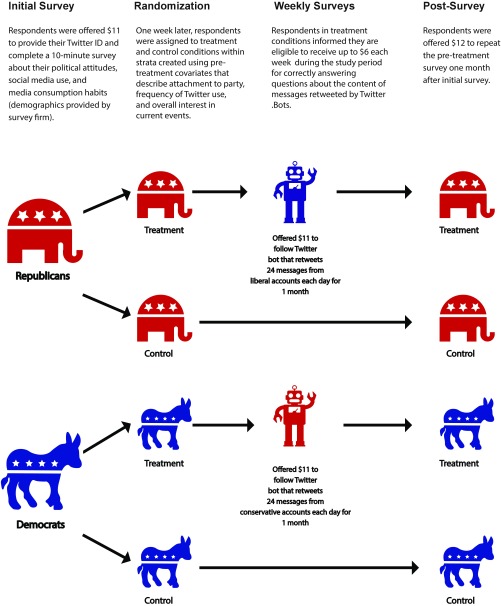
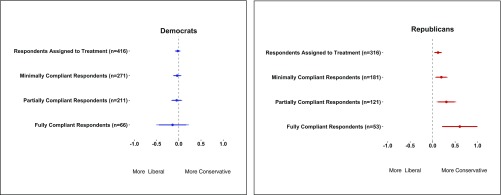
Significance: Social media sites are often blamed for exacerbating political polarization by creating “echo chambers” that prevent people from being exposed to information that contradicts their preexisting beliefs. We conducted a field experiment that offered a large group of Democrats and Republicans financial compensation to follow bots that retweeted messages by elected officials and opinion leaders with opposing political views. Republican participants expressed substantially more conservative views after following a liberal Twitter bot, whereas Democrats’ attitudes became slightly more liberal after following a conservative Twitter bot—although this effect was not statistically significant. Despite several limitations, this study has important implications for the emerging field of computational social science and ongoing efforts to reduce political polarization online.
Overview
The claims and statistics of this paper haven’t been checked yet.
Free: it reads the open-access text and checks the first 5 claims that cite a source we can check. Create a free account to check every claim.
Integrity signals
Registry
Cites
Statistics
Figures
Verification
Claims the paper makes
The claims and statistics of this paper haven’t been checked yet.
Free: it reads the open-access text and checks the first 5 claims that cite a source we can check. Create a free account to check every claim.
Claims other papers make about this one
Each is checked against this paper’s own text: does it say what the citing paper says it does?
The cited source doesn’t support the claim as written.
In the citing paper
“Supporting this, Bail et al. [2] further challenge the polarization assumption, showing that social media use can increase exposure to non-partisan content.”
From A systematic review of echo chamber research: comparative analysis of conceptualizations, operationalizations, and varying outcomes (2025) · cites this paper as [2]
Checked by a reasoning model — may be wrong.
Experimental — accuracy not yet measuredThe source backs part of the claim, not all of it — or backs it for a different population, condition or comparison.
In the citing paper
“For instance, it is neither clear what level of homophily in social networks is desirable or undesirable in a democratic society, nor is it clear how to interpret the results of certain studies on polarization69,130, whose findings depend on whether one assumes that social media have increased or decreased exposure to opposing views relative to some offline benchmark.”
From A systematic review of worldwide causal and correlational evidence on digital media and democracy (2022) · cites this paper as [69]
Experimental — accuracy not yet measuredThe source backs part of the claim, not all of it — or backs it for a different population, condition or comparison.
In the citing paper
“Even without being designed to shift opinions, it has been found that algorithms may contribute to political polarization by reinforcing divisive opinions [9, 24, 32].”
From Co-Writing with Opinionated Language Models Affects Users’ Views (2023) · cites this paper as [9]
Experimental — accuracy not yet measuredThe source backs part of the claim, not all of it — or backs it for a different population, condition or comparison.
In the citing paper
“Entrar en contacto con contenido contra-actitudinal puede generar una resistencia emocional y una sensación de amenaza que terminen polarizando igualmente al individuo (Bail et al., 2018;Dahlgren, 2022).”
From Política, uso de medios y polarización afectiva en España (2024) · cites this paper as Bail et al., 2018
Experimental — accuracy not yet measuredThe source backs part of the claim, not all of it — or backs it for a different population, condition or comparison.
In the citing paper
“Experimental approaches show e.g., how distorted meta-representations of outgroups on digital platforms can result in disaffection across ideological groups (Bail et al. 2018, Banks et al. 2021).”
From When debates break apart: discursive polarization as a multi-dimensional divergence emerging in and through communication (2023) · cites this paper as Bail et al. 2018
Experimental — accuracy not yet measured
18 more claims about this paper
Create a free account to see every claim other papers make about this one.
Self-check
Percentages, sums and reported differences re-computed from the paper’s own numbers.
The self-check needs the paper’s full text.
Citations
Cites
Birds of a Feather: Homophily in Social Networks
McPherson, M., Smith-Lovin, L., & Cook, J. M. (2001) · Annual Review of Sociology · doi:10.1146/annurev.soc.27.1.415 · Cited by 18,567 · cited 1×
“Despite initial optimism that social media might enable people to consume more heterogeneous sources of information about current events, there is growing concern that such forums exacerbate political polarization because of social network homophily, or the well-documented tendency of people to form social network tie…”
BackgroundA meta-analytic test of intergroup contact theory.
Pettigrew, T. F., & Tropp, L. R. (2006) · Journal of personality and social psychology · doi:10.1037/0022-3514.90.5.751 · Cited by 9,708 · cited 1×
“A vast literature indicates contact between opposing groups can challenge stereotypes that develop in the absence of positive interactions between them (30).”
BackgroundLord, C. G., Ross, L., & Lepper, M. R. (1979) · Journal of Personality and Social Psychology · doi:10.1037/0022-3514.37.11.2098 · Cited by 4,583
Liberals and conservatives rely on different sets of moral foundations.
Graham, J., Haidt, J., & Nosek, B. A. (2009) · Journal of Personality and Social Psychology · doi:10.1037/a0015141 · Cited by 4,560
Motivated Skepticism in the Evaluation of Political Beliefs
Taber, C. S., & Lodge, M. (2006) · American Journal of Political Science · doi:10.1111/j.1540-5907.2006.00214.x · Cited by 4,344
Lazer, D., Pentland, A., Adamic, L., Aral, S., Barabási, A.-L., Brewer, D., Christakis, N., Contractor, N., Fowler, J., Gutmann, M., et al. (2009) · Science · doi:10.1126/science.1167742 · Cited by 3,365
Exposure to ideologically diverse news and opinion on Facebook
Bakshy, E., Messing, S., & Adamic, L. A. (2015) · Science · doi:10.1126/science.aaa1160 · Cited by 3,245
When Corrections Fail: The Persistence of Political Misperceptions
Nyhan, B., & Reifler, J. (2010) · Political Behavior · doi:10.1007/s11109-010-9112-2 · Cited by 3,173
Fear and loathing across party lines: New evidence on group polarization
Iyengar, S., & Westwood, S. J. (2015) · American Journal of Political Science · doi:10.1111/ajps.12152 · Cited by 2,452
Uncivil Agreement: How Politics Became Our Identity
Mason, L. (2018) · doi:10.7208/chicago/9780226524689.001.0001 · Cited by 1,985
Research works printed but not linked: 1
- Sunstein C 2001 Echo Chambers, Bush v. Gore, Impeachment, and Beyond Princeton Univ Press Princeton
Cited by
Items 401–500 of 1,010
Seeking confirmation? Biased information search and deliberation in the food domain
Dickinson, D. L., & Kakoschke, N. (2021) · Food Quality and Preference · doi:10.1016/j.foodqual.2021.104189 · Cited by 23
Argumentative practices and patterns in debating climate change on Twitter
Foderaro, A., & Lorentzen, D. G. (2022) · Aslib Journal of Information Management · doi:10.1108/ajim-06-2021-0164 · Cited by 27
Scherman, A., Etchegaray, N., Browne, M., Mazorra, D., & Rojas, H. (2022) · Media and Communication · doi:10.17645/mac.v10i4.5817 · Cited by 33
Collaboration in a polarized context: lessons from public forest governance in the American West
Swette, B., Huntsinger, L., & Lambin, É. F. (2023) · Ecology and Society · doi:10.5751/es-13958-280129 · Cited by 29
Cheng, Z., Marcos-Marné, H., & de Zúñiga, H. G. (2023) · Political Behavior · doi:10.1007/s11109-023-09864-z · Cited by 29
“This gap is far from irrelevant given the importance of social media interactions to shape political attitudes in contemporary politics (Bail et al., 2018; Hoewe & Peacock, 2020; Zhang et al., 2010).”
Towards Consensus: Reducing Polarization by Perturbing Social Networks
Rácz, M. Z., & Rigobon, D. E. (2023) · IEEE Transactions on Network Science and Engineering · doi:10.1109/tnse.2023.3262970 · Cited by 39
“A fundamental feature of the FJ model is that individuals are always drawn toward the opinions of their neighbors – but experimental evidence of this feature is inconclusive and contextual [12], [13].”
BackgroundDyck, J. J., & Pearson‐Merkowitz, S. (2023) · doi:10.1093/oso/9780197623787.001.0001 · Cited by 22
Social media feedback and extreme opinion expression
Konovalova, E., Mens, G. L., & Schoell, N. (2023) · PLoS ONE · doi:10.1371/journal.pone.0293805 · Cited by 30
Geographical fragmentation of the global network of Twitter communications
Hedayatifar, L., Morales, A. J., & Bar-Yam, Y. (2020) · Chaos An Interdisciplinary Journal of Nonlinear Science · doi:10.1063/1.5143256 · Cited by 19
Close Relationships in Close Elections
Lee, B. (2020) · Social Forces · doi:10.1093/sf/soaa101 · Cited by 20
“Exposure to dissenting views, however, may backfire (Bail et al. 2018).”
BackgroundStrategic Polarization in Group Interactions
Iyer, G. V., & Yoganarasimhan, H. (2021) · Journal of Marketing Research · doi:10.1177/00222437211016389 · Cited by 21
“Indeed, this pattern is often visible in online forums, where agents who come later tend to express progressively more extreme opinions (Bail et al. 2018).”
BackgroundInfluentialTwitter’s Role in Digital Democracy, Post-Truth, and Political Polarization
Yeğen, C., Ayhan, B., & Demir, Y. (2022) · Romanian Journal of Communication and Public Relations · doi:10.21018/rjcpr.2022.2.343 · Cited by 22
Algorithm-Mediated Social Learning in Online Social NetworksPreprint
Brady, W. J., Jackson, J. C., Lindström, B., & Crockett, M. J. (2023) · doi:10.31219/osf.io/yw5ah · Cited by 18
Political Communication in the Age of Platforms
Papathanassopoulos, S., & Giannouli, I. (2025) · Encyclopedia · doi:10.3390/encyclopedia5020077 · Cited by 62
International actors as critics of domestic freedoms: the role of expertise and benefits
Marinov, N. (2021) · Mediterranean Politics · doi:10.1080/13629395.2021.1949917 · Cited by 17
“Research has found that social media polarizes opinions, and being exposed to alternative viewpoints can make some people who hold extreme opinions even more extreme (Bail et al., 2018).”
A systemic framework for disinformation on social media platforms
Recuero, R. (2025) · Platforms & Society · doi:10.1177/29768624251367199 · Cited by 26
“Polarization refers to the process through which individuals or groups increasingly adopt divergent ideological positions, which may be accompanied by growing hostility towards each other (Bail et al., 2018; Garimella and Weber, 2017).”
The impact of advanced AI systems on democracy
Summerfield, C., Argyle, L. P., Bakker, M. A., Collins, T., Durmus, E., Eloundou, T., Gabriel, I., Ganguli, D., Hackenburg, K., Hadfield, G. K., et al. (2025) · Nature Human Behaviour · doi:10.1038/s41562-025-02309-z · Cited by 87
“The view that filter bubbles and echo chambers increase partisanship has come into question 50,51 , and affective polarization may instead occur because social media algorithms often encourage the most divisive content to be viewed, attended to and shared 50 .”
Self-citationThe Impact of COVID-19 on Americans’ Attitudes toward China: Does Local Incidence Rate Matter?
He, Q. R., Zhang, Z., & Xie, Y. (2022) · Social Psychology Quarterly · doi:10.1177/01902725211072773 · Cited by 20
Mattila, H., & Nummi, P. (2022) · Planning Theory & Practice · doi:10.1080/14649357.2022.2074527 · Cited by 30
“Some scholars have presented evidence that this kind of exposure may even strengthen existing opinions (Bail et al., 2018; Nelimarkka et al., 2018).”
BackgroundTratamiento de la memoria histórica española en TikTok: perfiles, contenidos y mensajes
Alonso, N., & Bautista, P. S. (2022) · Revista Mediterránea de Comunicación · doi:10.14198/medcom.21824 · Cited by 30
Understanding subjective inequality in China
Song, X. (2022) · European Sociological Review · doi:10.1093/esr/jcac047 · Cited by 17
Understanding dynamics of polarization via multiagent social simulation
Haque, A., Ajmeri, N., & Singh, M. P. (2023) · AI & Society · doi:10.1007/s00146-022-01626-5 · Cited by 27
“Schkade et al. (2007) find that intragroup deliberation on social issues among like-minded people leads to more extreme and less diverse ideological beliefs, while Bail et al. (2018) observe that exposure to opposing views on social media can increase political polarization.”
BackgroundDetecting political biases of named entities and hashtags on Twitter
Xiao, Z., Zhu, J. D., Wang, Y., Zhou, P., Lam, W. H., Porter, M. A., & Sun, Y. (2023) · EPJ Data Science · doi:10.1140/epjds/s13688-023-00386-6 · Cited by 26
“Additionally, for more than a decade, social-media platforms like Twitter have simultaneously been an important source of political opinion data and have themselves impacted political opinions in various ways [16, 17].”
BackgroundDigital sociology: origin, development, and prospects from a global perspective
Zhao, Y., & Wang, M. (2023) · The Journal of Chinese Sociology · doi:10.1186/s40711-023-00198-1 · Cited by 48
“Recent experiments by Bail et al. (2018) have shown that breaking the "social media echo chamber" does not reconcile different stances.”
BackgroundSharing News Left and Right: Frictions and Misinformation on Twitter
Ershov, D., & Morales, J. S. (2024) · The Economic Journal · doi:10.1093/ej/ueae027 · Cited by 36
Artificial Intelligence Policymaking: An Agenda for Sociological Research
Law, T. L., & McCall, L. (2024) · Socius Sociological Research for a Dynamic World · doi:10.1177/23780231241261596 · Cited by 35
“…have contributed valuable insights into how social media platforms can contribute to polarization and misinformation in political discourse (e.g., Bail et al. 2018; Rafail, O’Connell, and Sager 2024), and how tech companies’ often uncritical uses of data can further disempower marginalized…”
Lee, C., Gligorić, K., Kalluri, P., Harrington, M., Durmus, E., Sanchez, K. L., San, N., Tse, D., Zhao, X., Hamedani, M. G., et al. (2024) · Proceedings of the National Academy of Sciences · doi:10.1073/pnas.2322764121 · Cited by 42
Echo chambers in climate science
Jasny, L., & Fisher, D. R. (2019) · Environmental Research Communications · doi:10.1088/2515-7620/ab491c · Cited by 21
Ahmed, S., & Gil‐López, T. (2022) · Journalism & Mass Communication Quarterly · doi:10.1177/10776990221110113 · Cited by 21
“Even so, timely interventions into algorithmic use could balance personal preferences with ethical and societal goals, although such endeavors may not be efficient under all circumstances (see Bail et al., 2018).”
North, S., Piwek, L., & Joinson, A. (2021) · Policy & Internet · doi:10.1002/poi3.247 · Cited by 16
Mitigating the Backfire Effect Using Pacing and Leading
Yang, Q., Qureshi, K., & Zaman, T. R. (2022) · Studies in computational intelligence · doi:10.1007/978-3-030-93413-2_14 · Cited by 26
Conflicting Policy Feedback: Enduring Tensions over Father Quotas in Norway
Ellingsæter, A. L. (2020) · Social Politics International Studies in Gender State & Society · doi:10.1093/sp/jxaa027 · Cited by 27
“Social media may represent patterns of information sharing that reinforce pre-existing beliefs by limiting exposure to opposing political views (Bail et al. 2018).”
Zafrilla, P. J. P. (2021) · Recerca Revista de pensament i anàlisi · doi:10.6035/recerca.4661 · Cited by 40
GraphNLI: A Graph-based Natural Language Inference Model for Polarity Prediction in Online Debates
Agarwal, V., Joglekar, S. P., Young, A. P., & Sastry, N. R. (2022) · International World Wide Web Conference (WWW) · doi:10.1145/3485447.3512144 · Cited by 35
“As many of these debates concern topics of societal importance, it is crucial to be able to model these debates accurately and at scale, so that we can better understand and control phenomena such as the spread of hate [15, 28], fake news [4, 24], how best to moderate political polarisation [5], and how to break echo…”
BackgroundNetwork activated frames: content sharing and perceived polarization in social media
Aruguete, N., Calvo, E. F., & Ventura, T. (2022) · Journal of Communication · doi:10.1093/joc/jqac035 · Cited by 23
«LO POLÍTICO COMO ALGO PERSONAL»: UNA REVISIÓN TEÓRICA SOBRE LA POLARIZACIÓN AFECTIVA
Martínez, J. M. R., & CRESPO-MARTÍNEZ, I. (2023) · Revista de ciencia política · doi:10.4067/s0718-090x2023005000102 · Cited by 42
Lane, D. S., Moxley, C. M., & McLeod, C. (2023) · Communication Research · doi:10.1177/00936502231161400 · Cited by 21
“Research finds that psychological attachment to political groups can shape news consumption, political expression, misinformation sharing, and polarization on social media (Bail et al., 2018; Hasell & Weeks, 2016; Pereira et al., 2023).”
BackgroundCharacteristics of online user-generated text predict the emotional intelligence of individuals
Dover, Y., & Amichai‐Hamburger, Y. (2023) · Scientific Reports · doi:10.1038/s41598-023-33907-4 · Cited by 25
Placek, M. (2023) · Journal of Information Technology & Politics · doi:10.1080/19331681.2023.2220319 · Cited by 26
“Further studies suggest that interactions with online opposition media can also exacerbate polarization (Bail et al., 2018), which is more likely to be realized through SNS use during heightened political conflict (Lee, 2016).”
BackgroundThe Plot Thickens: A Sociology of Conspiracy Theories
Rao, H., & Greve, H. R. (2024) · Annual Review of Sociology · doi:10.1146/annurev-soc-030222-031142 · Cited by 25
Broadening Exposure to Socio-Political Opinions via a Pushy Smart Home Device
Feltwell, T., Wood, G., Brooker, P., Rowland, S., Baumer, E. P. S., Long, K. S., Vines, J., Barnett, J. C., & Lawson, S. W. (2020) · CHI Conference on Human Factors in Computing Systems · doi:10.1145/3313831.3376774 · Cited by 20
“Exploring the backfire effect on Twitter, Bail et al [3] studied users in the US who selfreported alignment to either the Democratic or Republican parties.”
BackgroundNews sharing on Twitter reveals emergent fragmentation of media agenda and persistent polarization
Cicchini, T., del Pozo, S. M., Tagliazucchi, E., & Balenzuela, P. (2022) · EPJ Data Science · doi:10.1140/epjds/s13688-022-00360-8 · Cited by 23
The Effect of Social Media on Elections: Evidence from the United StatesPreprint
Fujiwara, T., Müller, K., & Schwarz, C. R. (2020) · SSRN Electronic Journal · doi:10.2139/ssrn.3719998 · Cited by 28
A new social conflict on globalisation-related issues in Germany? A longitudinal perspectivePreprint
Teney, C., & Rupieper, L. K. (2021) · doi:10.31235/osf.io/4xqke · Cited by 16
Enhancing social cohesion with cooperative bots in societies of greedy, mobile individuals
Shi, L., He, Z., Shen, C., & Tanimoto, J. (2024) · PNAS Nexus · doi:10.1093/pnasnexus/pgae223 · Cited by 21
“In contrast, the behavior and scale of digital bots are controllable, making them effective tools for influencing human beliefs and behaviors in various online aspects, such as elections (49), voting (50), and political issues (51).”
BackgroundWhy more social interactions lead to more polarization in societies
Thurner, S., Hofer, M., & Korbel, J. (2025) · Proceedings of the National Academy of Sciences · doi:10.1073/pnas.2517530122 · Cited by 31
Does Political Uncertainty Affect Residential Development?
Luo, S., Tidwell, A., & Clements, S. (2021) · The Journal of Real Estate Finance and Economics · doi:10.1007/s11146-021-09867-9 · Cited by 15
“Politics in the United States has become increasingly polarized, and thus more difficult to predict (Azzimonti, 2018; Bail et al., 2018; Mason, 2015).”
BackgroundThe Impact of Political Memes: a Longitudinal Field Experiment
galipeau, T. (2022) · Journal of Information Technology & Politics · doi:10.1080/19331681.2022.2150737 · Cited by 30
“Evidence suggests that exposure to counter-attitudinal content yields a backlash effect (Bail et al., 2018; Müller et al., 2017): instead of persuading and changing minds, it motivates viewers to counter-argue political messages, resists their influence, and strengthen their initial opinions (Lodge…”
BackgroundResultBorge, M., & Xia, Y. (2023) · Journal of the Learning Sciences · doi:10.1080/10508406.2022.2157725 · Cited by 20
“Research suggests socio-technical spaces are more likely to contain dysfunctional social interactions than collaboration: people invalidate each other, post offensive statements/responses, create echo chambers, and do not engage in collective sense-making (Bail et al., 2018; Conover et al., 2011; Garimella et al., 201…”
BackgroundKHAN: Knowledge-Aware Hierarchical Attention Networks for Accurate Political Stance Prediction
Ko, Y., Ryu, S., Han, S., Jeon, Y., Kim, J., Park, S., Han, K., Tong, H., & Kim, S. (2023) · International World Wide Web Conference (WWW) · doi:10.1145/3543507.3583300 · Cited by 33
“, [1, 5], where 1 indicates ‘left’ and 5 indicates ‘right’).”
BackgroundSincere or Motivated? Partisan Bias in Advice-taking
Zhang, Y., & Rand, D. G. (2021) · Judgment and Decision Making · doi:10.1017/jdm.2023.28 · Cited by 20
Attraction to politically extreme users on social media
Zimmerman, F., Bailey, D. D., Murić, G., Ferrara, E., Schöne, J. P., Willer, R., Halperin, E., Navajas, J., Gross, J. J., & Goldenberg, A. (2024) · PNAS Nexus · doi:10.1093/pnasnexus/pgae395 · Cited by 25
“Many have argued that homophilous political preferences are especially salient in the digital era, where social ties can be formed and dissolved quickly, resulting in the formation of echo chambers of like-minded people who rarely interact across political lines ( 2, 3, 15 – 17).”
BackgroundCommitment-trust theory in social media interactions: implications for firms
Rashidi‐Sabet, S., & Bolton, D. E. (2024) · Journal of Marketing Management · doi:10.1080/0267257x.2024.2434143 · Cited by 36
“For example, several studies demonstrate that social media platforms contribute to the polarisation and segregation of consumers by creating echo chambers of fake news (Bail et al., 2018; Bakshy et al., 2015; Conover et al., 2011; Fischer, 2019).”
Hawdon, J., Ranganathan, S., Leman, S., Bookhultz, S., & Mitra, T. (2020) · Lecture Notes in Computer Science · doi:10.1007/978-3-030-49570-1_17 · Cited by 15
From Symbols to Embeddings: A Tale of Two Representations in Computational Social Science
Chen, H., Yang, C. H., Zhang, X., Liu, Z., Sun, M., & Jin, J. (2021) · Journal of Social Computing · doi:10.23919/jsc.2021.0011 · Cited by 21
Self-citationPurposive and non-purposive information behaviour on Instagram
Marcella-Hood, M., & Marcella, R. (2022) · Journal of Librarianship and Information Science · doi:10.1177/09610006221097974 · Cited by 30
“In this way, Instagram users have a degree of control over the content and messages they consume but in doing so might block out objective and independent content that does not align with pre-existing beliefs (Bail et al., 2018).”
BackgroundA Weighted Balance Model of Opinion HyperpolarizationPreprint
Schweighofer, S., Schweitzer, F., & García, D. (2019) · doi:10.31235/osf.io/weg67 · Cited by 15
“And indeed, several studies have found that social influence can also be repulsive, meaning interacting individuals becomemoredissimilar (Hovland et al. 1957; Cohen 1962; Nyhan&Reifler 2010; Bail et al. 2018).”
BackgroundResultPolitical Partisanship and Anti-Science Attitudes in Online Discussions about Covid-19Preprint
Rao, A., Morstatter, F., Hu, M., Chen, E., Burghardt, K., Ferrara, E., & Lerman, K. (2020) · arXiv (Cornell University) · doi:10.48550/arxiv.2011.08498 · Cited by 15
“Moreover, viewing information from the other ideological side does not necessarily affect ones opinion (Bail et al. 2018).”
BackgroundTella, R. D., Gálvez, R. H., & Schargrodsky, E. (2021) · National Bureau of Economic Research · doi:10.3386/w29458 · Cited by 26
News Consumption of Russian Vkontakte Users: Polarization and News Avoidance
Urman, A. (2019) · University of Bern · doi:10.7892/boris.142408 · Cited by 15
“So far, most research on the matter was conducted in the U.S. context (e.g., Bail et al., 2018; Bakshy, Messing, & Adamic, 2015; Conover, Gonçalves, Flammini, & Menczer, 2012).”
BackgroundResearching With Our Hair on Fire: Three Frameworks for Rethinking News in a Postnormative World
Parks, P. (2020) · Journalism & Mass Communication Quarterly · doi:10.1177/1077699020916425 · Cited by 16
“in toxic politics, that mediated evidence and argumentation are largely futile or even counterproductive (Bail et al., 2018).”
BackgroundInfluentialBeing together in place as a catalyst for scientific advance
Duede, E., Teplitskiy, M., Lakhani, K. R., & Evans, J. (2023) · Research Policy · doi:10.1016/j.respol.2023.104911 · Cited by 19
“At the micro and macroscales of the internet as a whole, we see the opposite, with ideological echo chambers serving as the paradigm of what can happen when proper institutional constraints for the promotion of sustained, diverse interactions are not in place (Bishop 2009; Sunstein 2001; Bail et al. 2018).”
BackgroundHoward, K. A., Cervone, D., & Motyl, M. S. (2021) · Personality and Social Psychology Bulletin · doi:10.1177/01461672211028141 · Cited by 18
“In the sociopolitical realm, recent decades have seen increased political and affective polarization (Bail et al., 2018; Iyengar et al., 2019; Mason, 2015; Tucker et al., 2018).”
BackgroundIannelli, L., Biagi, B., & Meleddu, M. (2021) · The Communication Review · doi:10.1080/10714421.2021.1972720 · Cited by 18
Transforming conservation in Canada: shifting policies and paradigms
Beazley, K., & Olive, A. (2021) · FACETS · doi:10.1139/facets-2021-0144 · Cited by 15
Ideology and COVID-19 Vaccination Intention: Perceptual Mediators and Communication Moderators
Jiang, X., Hwang, J., Su, M.-H., Wagner, M. W., & Shah, D. V. (2022) · Journal of Health Communication · doi:10.1080/10810730.2022.2117438 · Cited by 17
“Conversation with conservatives was measured with the following question on an 8-point scale (0 = 0 day , 7 = 7 days ): “How many days per week do you discuss politics and current events with Republicans?””
InfluentialIn different worlds: The contributions of polarization and platforms to partisan (mis)perceptions
Overgaard, C. S. B., & Collier, J. R. (2023) · New Media & Society · doi:10.1177/14614448231176551 · Cited by 22
“On Twitter, Republican participants became more conservative after following a liberal bot; similar effects were not found for Democrats after following a conservative bot (Bail et al., 2018).”
de Jong, J. F. (2024) · Communications Psychology · doi:10.1038/s44271-023-00051-8 · Cited by 25
Knowledge mapping of information cocoons: A bibliometric study using visual analysis
Yan, C., Pu, K., & Luo, X. (2024) · Journal of Librarianship and Information Science · doi:10.1177/09610006231222628 · Cited by 17
“In addition, politics has been an increasingly significant aspect within this field where research results show that social media sites create “echo chambers” which isolate people from opposing views on current events thereby exacerbating political polarization (Bail et al., 2018).”
Polarization on Social Media: Micro-Level Evidence and Macro-Level Implications
Keijzer, M. A., Mäs, M., & Flache, A. (2024) · Journal of Artificial Societies and Social Simulation · doi:10.18564/jasss.5298 · Cited by 24
Rifat, M. R., Das, D., Podder, A., Jannat, M., Soden, R., Semaan, B., & Ahmed, S. I. (2024) · Proceedings of the ACM on Human-Computer Interaction · doi:10.1145/3686926 · Cited by 35
“Bail et al. show that intergroup communication fosters effective deliberation and mutual understanding in politics [16].”
Viewpoint: Social monitoring for food policy and research: Directions and implications
Delmastro, M., & Zollo, F. (2021) · Food Policy · doi:10.1016/j.foodpol.2021.102147 · Cited by 19
Inferring attitudinal spaces in social networks
Morales, P. R., Cointet, J., Zolotoochin, G. M., Peralta, A. F., Íñiguez, G., & Pournaki, A. (2022) · Social Network Analysis and Mining · doi:10.1007/s13278-022-01013-4 · Cited by 28
“…of multiple disciplines for several decades (DiMaggio et al. 1996; Bartels 2000; Fiorina et al. 2005), recently regaining additional interest due to new hypotheses and data surrounding digital social media studies (Bail et al. 2018; Tucker et al. 2018; Guerra et al. 2013; Lee et al. 2014).”
Befriended to polarise? The impact of friend identity on review polarisation—A quasi‐experiment
Wang, L., Wang, C., & Yao, X. (2023) · Information Systems Journal · doi:10.1111/isj.12425 · Cited by 27
“Although the proliferation of social media use empowers free expression, researchers are concerned about the growing polarisation in social media content (Allcott et al., 2020; Bail et al., 2018; Levy, 2021).”
BackgroundInfluentialTo Reply or to Quote: Comparing Conversational Framing Strategies on Twitter
Zade, H., Williams, S., Tran, T. T., Smith, C., Venkatagiri, S., Hsieh, G., & Starbird, K. (2024) · ACM Journal on Computing and Sustainable Societies · doi:10.1145/3625680 · Cited by 19
The interpersonal is political: unfriending to promote civic discourse on social media
Elder, A. M. (2019) · Ethics and Information Technology · doi:10.1007/s10676-019-09511-4 · Cited by 19
Opinion formation on social networks with algorithmic bias: dynamics and bias imbalance
Peralta, A. F., Kertész, J., & Íñiguez, G. (2021) · Journal of Physics Complexity · doi:10.1088/2632-072x/ac340f · Cited by 26
Tweeting for Peace : Experimental Evidence from the 2016 Colombian Plebiscite
Vásquez, M., Munger, K., Martínez, J. D. S., & Gallego, J. (2017) · Repositorio Institucional E-DocUR (Universidad Del Rosario) · doi:10.48713/10336_14059 · Cited by 16
The TikTok Self: Music, Signaling, and Identity on Social MediaPreprint
Sachs, J. D., Wise, R., & Karell, D. (2021) · SocArXiv (OSF Preprints) · doi:10.31235/osf.io/2rx46 · Cited by 16
Reinero, D. A., Harris, E., Rathje, S., Duke, A., & Bavel, J. J. V. (2023) · PsyArXiv (OSF Preprints) · doi:10.31234/osf.io/z4df3 · Cited by 20
Castillo-de-Mesa, J., Méndez-Domínguez, P., Carbonero-Muñoz, D., & Gómez-Jacinto, L. (2021) · Redes. Revista hispana para el análisis de redes sociales · doi:10.5565/rev/redes.913 · Cited by 32
Stewart, I., WELCH, C. A., An, L. C., Resnicow, K., Pennebaker, J. W., & Mihalcea, R. F. (2023) · JMIR Formative Research · doi:10.2196/40277 · Cited by 17
“Further work in this direction should consider political ideology as a possible social dimension that can affect responses to Expressive Interviewing, as prior work has found that political ideology can affect responses to behavior change interventions [32].”
BackgroundChen, H., Song, Y., & Guo, J. (2024) · Communication Research · doi:10.1177/00936502241285069 · Cited by 36
“Some scholars have found that rather than reducing extreme attitudes, it can actually intensify extremism (Bail et al., 2018).”
BackgroundSelf-citationDefining diversity, equity, and inclusion (DEI) by the scientific (de)merits of its programming
Mogilski, J. K., Jussim, L. J., Wilson, A. E., & Love, B. (2025) · Theory and Society · doi:10.1007/s11186-025-09646-y · Cited by 22
“This is essential for understanding unintended consequences, such as when intergroup contact exac - erbates conflict rather than mitigating it (Bail et al., 2018 ).”
Hate, amplified? Social media news consumption and support for anti-Muslim policies
Lajevardi, N., Oskooii, K. A. R., & Walker, H. L. (2022) · Journal of Public Policy · doi:10.1017/s0143814x22000083 · Cited by 21
“Usage of these sites silos users within their existing social networks, exacerbates political polarisation (Bail et al. 2018; Shin and Thorson 2017), and is linked to spreading misinformation (Abrajano and Lajevardi 2021; Anspach and Carlson 2020), primarily through filter bubbles (Pariser 2011) and echo chambers (Eyt…”
BackgroundYu, H., Ryoo, Y., & Han, E. (2023) · Internet Research · doi:10.1108/intr-09-2021-0677 · Cited by 17
A polarizing multiverse? Assessing Habermas’ digital update of his public sphere theory
Thiel, T. (2023) · Constellations · doi:10.1111/1467-8675.12667 · Cited by 22
All the President’s Lies: Repeated False Claims and Public Opinion
Pillai, R. M., Kim, E., & Fazio, L. K. (2023) · Public Opinion Quarterly · doi:10.1093/poq/nfad032 · Cited by 17
Electoral Competition in the Age of Social Media: The Role of Social Media Influencers
Ding, C., Jabr, W., & Guo, H. Y. (2023) · MIS Quarterly · doi:10.25300/misq/2022/16422 · Cited by 24
Emergence of simple and complex contagion dynamics from weighted belief networks
Aiyappa, R., Flammini, A., & Ahn, Y. (2024) · Science Advances · doi:10.1126/sciadv.adh4439 · Cited by 28
Predictability limit of partially observed systems
Abeliuk, A., Huang, Z., Ferrara, E., & Lerman, K. (2020) · Scientific Reports · doi:10.1038/s41598-020-77091-1 · Cited by 19
Röchert, D., Cargnino, M., & Neubaum, G. (2022) · Journal of Computational Social Science · doi:10.1007/s42001-022-00161-z · Cited by 17
“This concept of influence most closely resembles models of opinion formation (in particular, the two-step flow model, see [13, 14, 22]) and psychological models of social influence (e.g., [27, 28]), which refer to the role of influential single actors (i.e., OLs) and groups (e.g., a local…”
BackgroundTreuillier, C., Castagnos, S., Dufraisse, E., & Brun, A. (2022) · ACM Conference on User Modeling, Adaptation and Personalization (UMAP) · doi:10.1145/3511047.3538030 · Cited by 19
“according to which exposing potentially polarized users to diversity can be counterproductive [7].”
BackgroundIdeology: The Psychological and Social Foundations of Belief SystemsPreprint
Federico, C. M., & Malka, A. (2021) · doi:10.31234/osf.io/xhvyj · Cited by 13
The Economics of Social MediaPreprint
Aridor, G., Durán, R. J., Levy, R., & Song, L. (2024) · SSRN Electronic Journal · doi:10.2139/ssrn.4708840 · Cited by 23
Continued Influence of Misinformation and the Information Disorder
Tay, L. Q., & Ecker, U. K. H. (2025) · The Remaking of Memory in the Age of the Internet and Social Media · doi:10.1093/oso/9780197661260.003.0009 · Cited by 12
Chen, H., Ai, M., & Guo, J. (2022) · Asian Journal of Communication · doi:10.1080/01292986.2021.2022173 · Cited by 16
“chamber because of the ideologically homogeneous network it can promote (Bail et al., 2018; Himelboim, McCreery, & Smith, 2013), others argue that social media could facilitate cross-cutting exposure because of the diverse information it makes available and its weakened social and geographical boundaries (Brundidge, 2…”
BackgroundSelf-citationSosyal medya tükenmişliği ölçeğinin uyarlanması: geçerlik ve güvenirlik çalışması
Gündoğan, S. (2022) · Journal of Dependence · doi:10.51982/bagimli.1053234 · Cited by 13
Ngo, T., Wischnewski, M., Bernemann, R., Jansen, M., & Krämer, N. C. (2023) · Computers in Human Behavior · doi:10.1016/j.chb.2023.107819 · Cited by 17
Metadata
- Authors
- Bail, C. A., Argyle, L. P., Brown, T. W., Bumpus, J. P., Chen, H., Hunzaker, M. B. F., Lee, J., Mann, M., Merhout, F., & Volfovsky, A.
- Affiliations
- Duke University (US)
- Brigham Young University (US)
- New York University (US)
- Corresponding author
- Bail, Christopher A.
- ORCID
- Venue
- Proceedings of the National Academy of Sciences
- Publisher
- National Academy of Sciences
- Published
- 2018-08-28
- Volume
- 115
- Issue
- 37
- Pages
- 9216-9221
- ISSN
- 0027-8424 (ISSN-L)
- 1091-6490
- PMC
- PMC6140520
- OpenAlex
- W2889127731
- Semantic Scholar
- c1cb4725a7fb0df77c52d6d2792e87d588178715
- Cited by
- 1,863
- References
- 56
- Citations by year
- 2026: 275 · 2025: 272 · 2024: 248 · 2023: 292 · 2022: 264 · 2021: 228 · 2020: 181 · 2019: 96 · 2018: 7
- FWCI
- 278.82
- Type
- journal article
- Language
- en
- Open access
- hybrid
- doi.org
- Licence
- Locations
- Proceedings of the National Academy of Sciences (publishedVersion, cc-by-nc-nd)
- Europe PMC (PubMed Central) (publishedVersion, cc-by-nc-nd)
- PubMed Central (publishedVersion, cc-by-nc-nd)
- PubMed (publishedVersion)
- RePEc: Research Papers in Economics (submittedVersion)
- Funders
- Russell Sage Foundation (E0267)
- Topics
- Social Sciences › Communication › Social Media and Politics
- Social Sciences › Sociology and Political Science › Media Influence and Politics
- Social Sciences › Sociology and Political Science › Misinformation and Its Impacts
- Keywords
- political polarization, echo chambers, social media, Twitter bots, ideological change, financial incentives, computational social science, partisanship, social policy attitudes
- MeSH terms
- Political Activism, Democracy, Female, Humans, Male, United States, Social Media
About these checks
Registry, retraction, Cites and statistics results are computed, not judged, with one exception: a printed reference that no index lists is read once by a model before it counts as a citation error. Claims are extracted by a model and kept only when their quote appears verbatim in the text; each cited source is then checked, with a model’s help, for whether it says what the claim relies on. Those verdicts can be wrong — read the claim’s quote and the cited source before relying on one.
Statistics and arithmetic are recomputed, not judged.
Confidence bands are shown only for fields calibrated on our annotated test set. None is calibrated yet, so no band is shown.
What counts as a claim ›How we measure confidence ›How we check this ›
Are you an author, or do you see a problem with this page? Request a review
Data sources
Bibliographic data: Semantic Scholar, OpenAlex, Crossref.
Contains information from the Semantic Scholar Academic Graph Datasets, made available under the ODC Attribution License (ODC-BY 1.0).
Semantic Scholar’s data is described in: Kinney, R., et al. (2023). The Semantic Scholar Open Data Platform. arXiv:2301.10140.
