

The echo chamber effect on social media
Open accessThe DOI matches its Crossref record; 68 of the 69 references it cites were found in a registry or an index; 16 of the 38 sources its claims cite were checked for support.
Abstract
Significance: We explore the key differences between the main social media platforms and how they are likely to influence information spreading and the formation of echo chambers. To assess the different dynamics, we perform a comparative analysis on more than 100 million pieces of content concerning controversial topics (e.g., gun control, vaccination, abortion) from Gab, Facebook, Reddit, and Twitter. The analysis focuses on two main dimensions: 1) homophily in the interaction networks and 2) bias in the information diffusion toward like-minded peers. Our results show that the aggregation in homophilic clusters of users dominates online dynamics. However, a direct comparison of news consumption on Facebook and Reddit shows higher segregation on Facebook.
Overview
CoChat Summary
TL;DR
This paper compares echo-chamber dynamics across Gab, Facebook, Reddit, and Twitter using more than 100 million pieces of content and more than 1 million active users. It finds homophilic clustering dominates online dynamics, with Facebook and Twitter showing stronger segregation and like-minded information diffusion than Reddit and Gab, and Facebook showing higher news-consumption segregation than Reddit.
Key findings
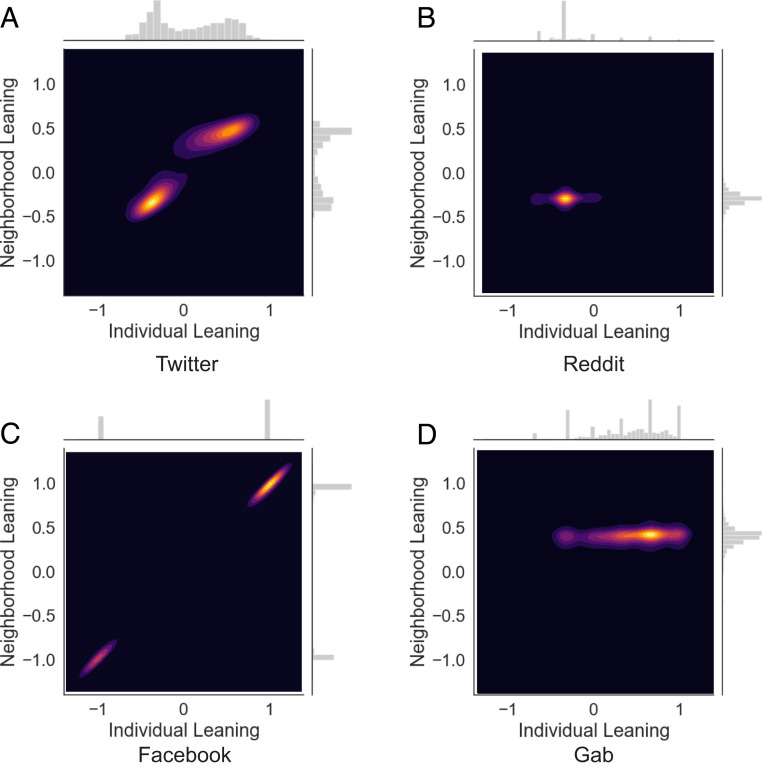
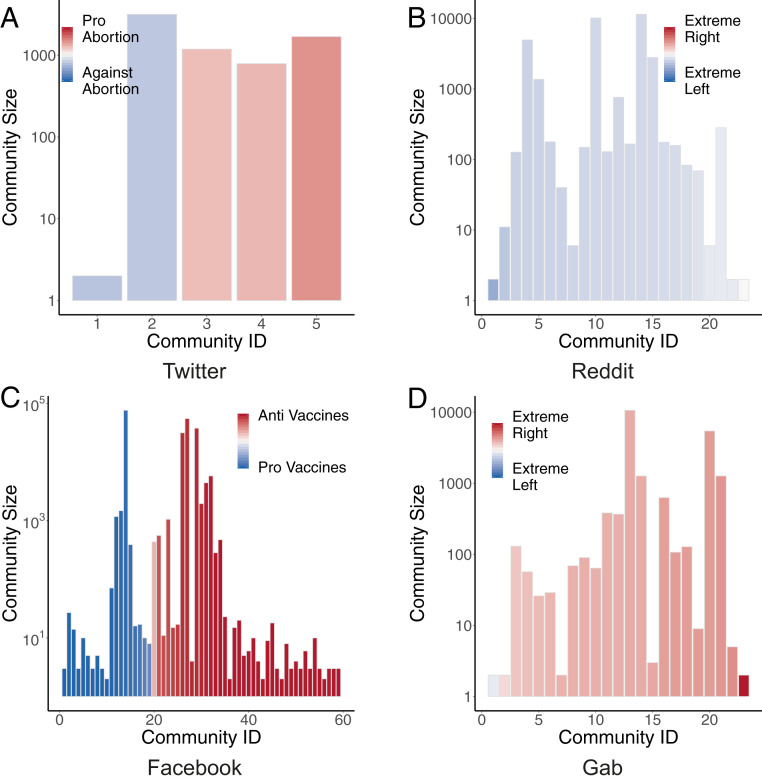
- Across the four platforms, “aggregation in homophilic clusters of users dominates online dynamics,” but platforms differ: Facebook and Twitter show homophilic clustering, while Reddit and Gab form a single community biased left or right rather than two opposing clusters.
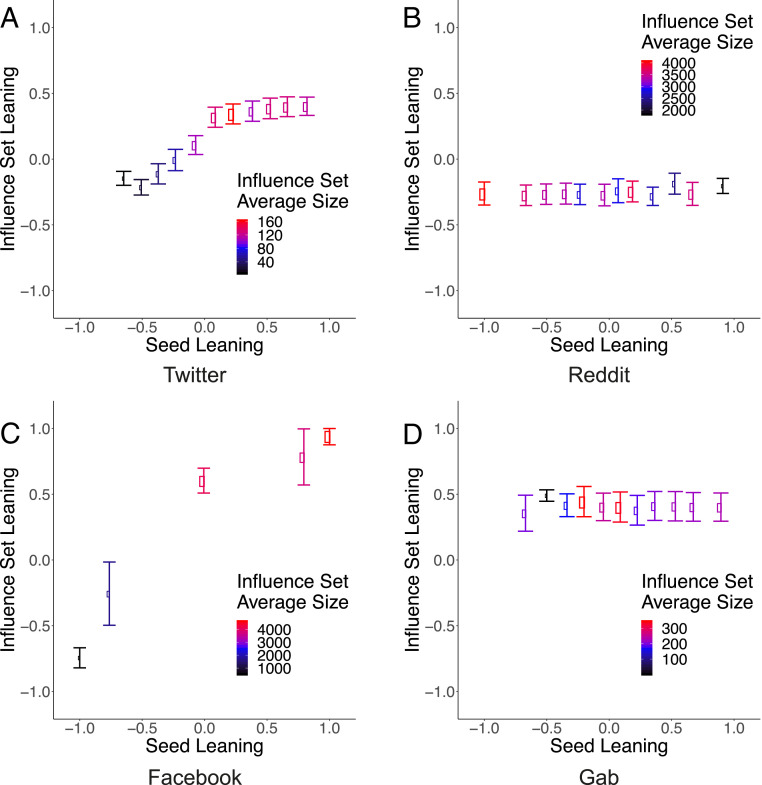
- Information diffusion is biased toward like-minded users on Facebook and Twitter, where the average leaning of a user’s influence set approximates the seed user’s leaning; on Reddit and Gab, the average leaning of the influence set does not depend on the seed user’s leaning.
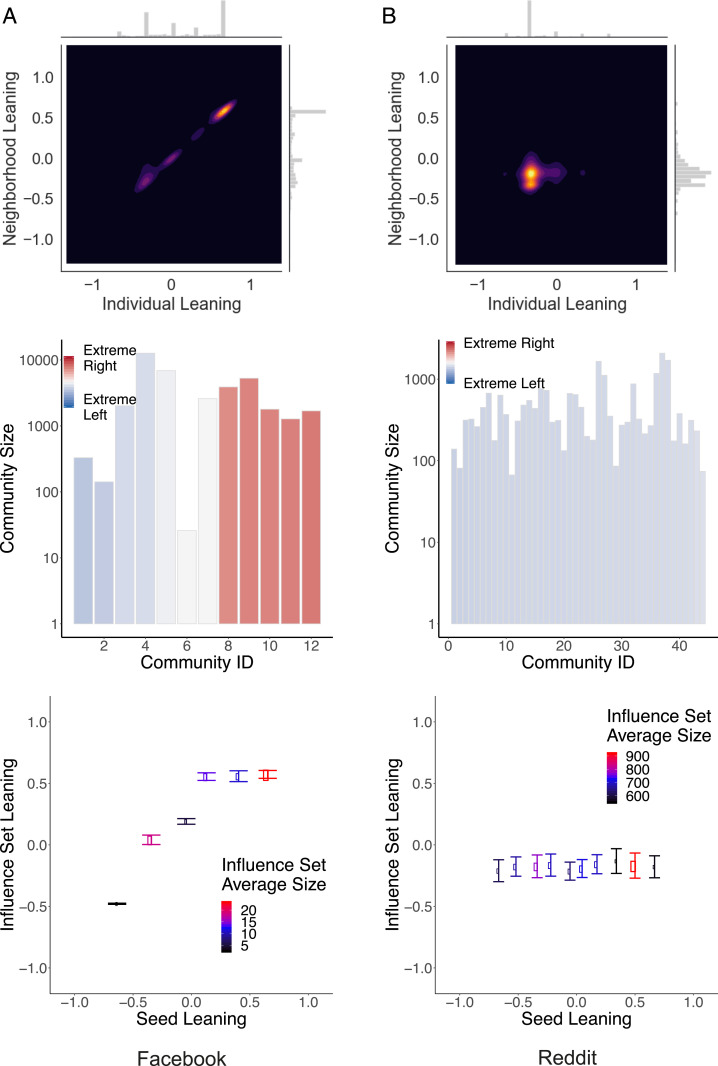
- In a direct comparison on news consumption, Facebook shows higher segregation than Reddit across all three measures: user-neighbor leaning correlation, community leaning, and SIR influence-set leaning.
- The study analyzes more than 100 million unique pieces of content and more than 1 million active users, with news outlets labeled using 2,190 media sources from Media Bias/Fact Check.
Methods
- Comparative analysis of Gab, Facebook, Reddit, and Twitter datasets on controversial topics including gun control, Obamacare, abortion, vaccines, science versus conspiracy, and news; main selected datasets were Abortion (Twitter), Vaccines (Facebook), Politics (Reddit), and Gab as a whole.
- Echo chambers were operationalized through two dimensions: homophily in interaction networks and bias in information diffusion toward like-minded peers. User leaning was inferred from linked news outlets, likes, or content, and interaction networks were built from follows, comments, cocomments, submissions, or replies depending on platform.
- Analyses included correlation between user leaning and average neighbor leaning, Louvain community detection, and SIR simulations to measure influence sets; SIR recovery rate was fixed at ν = 0.2, with dataset-specific infection ratios.
Limitations
- The paper states that the next envisioned step is to address the temporal dimension of echo chambers and how platform-specific social feedback mechanisms impact their formation.
- Evident from the text: leaning coverage varies strongly by platform, from 0.90–1.00 for Twitter/Facebook datasets to 0.15–0.20 for Reddit and 0.13 for Gab, so leaning-based conclusions for Reddit and Gab rest on a small classified fraction of users.
- Evident from the text: datasets differ by platform and topic, and the direct cross-platform comparison on a common topic is limited to news consumption on Facebook and Reddit; the authors also note that Reddit/Gab results could mean either no echo-chamber effect or observation inside a single echo chamber.
Model-written summary. Check it against the paper before relying on it.
Integrity signals
Registry
Cites
Statistics
Figures
Verification
Claims the paper makes
8 Valid · 1 Not valid · 7 Not checked · 38 Own results and interpretations
The cited sources support only part of this claim — read each source’s verdict below.
In the paper
“Selective exposure (19) and confirmation bias (20) (i.e., the tendency to seek information adhering to preexisting opinions) may explain the emergence of echo chambers on social media (1, 17, 21, 22).”
§ The echo chamber effect on social media > Abstract
What the sources say
- Supportedcites [1] M. Del Vicario, The spreading of misinformation online. Proc. Natl. Acad. Sci. U.S.A. 113, 554– 559 (2016). 26729863 PMC4725489 source
The Abstract says selective exposure generates homogeneous clusters, which it calls echo chambers. The Results and Discussion section says users select content matching a narrative and suggests confirmation bias determines echo-chamber formation. Page numbers are not provided in our copy. (LLM, conf=0.94)
- Partly supportedcites [17] K. Garimella, G. De Francisci Morales, A. Gionis, M. Mathioudakis, “ The effect of collective attention on controversial debates on social media” in WebSci ’17: 9th International ACM Web Science Conference (Association for Computing Machinery, New York, NY, 2017), pp. 43– 52. sourceExperimental — accuracy not yet measured
The Introduction reports that users mostly interact within their own side and endorse opinions from that side’s core. Related Work reports that users spread information faster when it agrees with their position. These passages are consistent with selective exposure, but the paper does not identify confirmation bias or establish that either tendency causes echo chambers to emerge. (LLM, conf=0.82)
- Supportedcites [21] M. Del Vicario, Echo chambers: Emotional contagion and group polarization on Facebook. Sci. Rep. 6, 37825 (2016). 27905402 PMC5131349 source
The Abstract says social-media disintermediation encourages users to select information that fits their beliefs (confirmation bias) and form like-minded groups (echo chambers). The Conclusions likewise describe Facebook as suited to the emergence of echo chambers. This supports the proposed explanation, without claiming it is the only cause. (LLM, conf=0.93)
- Supportedcites [22] A. Bessi, Science vs conspiracy: Collective narratives in the age of misinformation. PloS One 10, e0118093 (2015). 25706981 PMC4338055 source
The Introduction (page unavailable) says users consuming opposing information tend to form isolated clusters and describes polarized users whose likes are almost exclusively on one category of pages. The Conclusions (page unavailable) link information evaluation to existing beliefs. Together, these passages support the hedged explanation that selective exposure and confirmation bias may contribute to echo chambers. (LLM, conf=0.86)
hedgedstates a possible cause- Asserted: passes — The authors put it forward as true.
- Checkable: passes — It can be checked against evidence.
- Load-bearing: passes — The paper’s conclusions depend on it.
- Based: passes — The paper gives a reason why it holds.
- Supported
The cited sources support only part of this claim — read each source’s verdict below.
In the paper
“Our attention span remains limited (9, 10), and feed algorithms might limit our selection process by suggesting contents similar to the ones we are usually exposed to (11–13).”
§ The echo chamber effect on social media > Abstract
What the sources say
- Not checked — no full text of the sourcecites [11] A. L. Schmidt, Anatomy of news consumption on Facebook. Proc. Natl. Acad. Sci. U.S.A. 114, 3035– 3039 (2017). 28265082 PMC5373354 source
- Partly supportedcites [12] M. Cinelli, The COVID-19 social media infodemic. Sci. Rep. 10, 16598 (2020). 33024152 PMC7538912 sourceExperimental — accuracy not yet measured
The Introduction (page not provided) says algorithms take users’ preferences and attitudes into account when promoting content, and that users tend to seek information aligned with their worldviews. It does not say that feed algorithms suggest content similar to what users have previously seen or thereby limit their selection. (LLM, conf=0.82)
- Not checked — no full text of the sourcecites [13] E. Bakshy, S. Messing, L. A. Adamic, Exposure to ideologically diverse news and opinion on Facebook. Science 348, 1130– 1132 (2015). 25953820 source
hedgedstates a possible cause- Asserted: passes — The authors put it forward as true.
- Checkable: passes — It can be checked against evidence.
- Load-bearing: passes — The paper’s conclusions depend on it.
- Based: passes — The paper gives a reason why it holds.
Every source the paper cites for this claim was checked and supports it.
In the paper
“Online polarization, for instance, may foster misinformation spreading (1, 8).”
§ The echo chamber effect on social media > Abstract
What the sources say
- Supportedcites [1] M. Del Vicario, The spreading of misinformation online. Proc. Natl. Acad. Sci. U.S.A. 113, 554– 559 (2016). 26729863 PMC4725489 source
The Significance section says that homogeneity and polarization are main determinants of rumor-cascade size. The Conclusions also link polarized communities with the proliferation of narratives fueled by unsubstantiated rumors, supporting the hedged claim that online polarization may foster misinformation spreading. (LLM, conf=0.91)
- Supportedcites [8] M. D. Vicario, W. Quattrociocchi, A. Scala, F. Zollo, Polarization and fake news: Early warning of potential misinformation targets. ACM Trans. Web 13, 1– 22 (2019). source
The Introduction states that misinformation spreading on social media is directly related to increasing user polarization and segregation. This supports the citing sentence’s hedged claim that online polarization may foster misinformation spreading. (LLM, conf=0.94)
hedgedstates a possible cause- Asserted: passes — The authors put it forward as true.
- Checkable: passes — It can be checked against evidence.
- Load-bearing: unclear — It is unclear whether the paper’s conclusions depend on it.
- Based: passes — The paper gives a reason why it holds.
- Supported
Every source the paper cites for this claim was checked and supports it.
In the paper
“In network terms, this translates into a node i with a given leaning xi more likely to be connected with nodes with a leaning close to xi (18).”
§ The echo chamber effect on social media > Comparative Analysis > Polarization and Homophily in the Interaction Networks.
What the sources say
- Supportedcites [18] W. Cota, S. C. Ferreira, R. Pastor-Satorras, M. Starnini, Quantifying echo chamber effects in information spreading over political communication networks. EPJ Data Sci. 8, 35 (2019). source
The paper’s “Topological evidence of echo chambers” section says that a node with political position Pᵢ is connected with nodes whose positions are close to Pᵢ. It also reports a strong correlation between users’ positions and their neighbors’ average positions, supporting the citing sentence’s probabilistic paraphrase. (LLM, conf=0.94)
hedgedstates an association- Asserted: passes — The authors put it forward as true.
- Checkable: passes — It can be checked against evidence.
- Load-bearing: passes — The paper’s conclusions depend on it.
- Based: passes — The paper gives a reason why it holds.
- Supported
A result the paper reports from its own data — it cites no other source for it, so there is none to check. The quote shows it is in the paper.
In the paper
“Furthermore, the almost total absence of communities with leaning very close to 0 confirms the polarized state of the systems.”
§ The echo chamber effect on social media > Comparative Analysis > Polarization and Homophily in the Interaction Networks.
boostedstates a cause- Asserted: passes — The authors put it forward as true.
- Checkable: passes — It can be checked against evidence.
- Load-bearing: passes — The paper’s conclusions depend on it.
- Based: passes — The paper gives a reason why it holds.
- Rests on 4 assumptions not shown here.
32 more claims
Create a free account to see all 54 claims and to verify the 2 references still open.
- It may state two separate claims as one. 9
- Probably not a substantial claim. 9
Claims other papers make about this one
Each is checked against this paper’s own text: does it say what the citing paper says it does?
The source backs part of the claim, not all of it — or backs it for a different population, condition or comparison.
In the citing paper
“engagement with political content online is generally associated with high levels of ingroup bias; that is, it is far more likely to be shared within the political ingroup than in the outgroup (18, 19, 16).”
From Troll and divide: the language of online polarization (2022) · cites this paper as [16]
Experimental — accuracy not yet measuredThe source backs part of the claim, not all of it — or backs it for a different population, condition or comparison.
In the citing paper
“This challenge is reflected in research on”
From Machine culture (2023) · cites this paper as [142]
Experimental — accuracy not yet measuredThe source backs part of the claim, not all of it — or backs it for a different population, condition or comparison.
In the citing paper
“Thus, combating social media's echo chamber effect through an active exposure to diverse perspectives and networks also represents a viable individual-level strategy for addressing the deepfake problem (Cinelli et al., 2021; Gillani et al., 2018).”
From Deepfakes: Deceptions, mitigations, and opportunities (2023) · cites this paper as Cinelli et al., 2021
Experimental — accuracy not yet measuredThe source backs part of the claim, not all of it — or backs it for a different population, condition or comparison.
In the citing paper
“Even without being designed to shift opinions, it has been found that algorithms may contribute to political polarization by reinforcing divisive opinions [9, 24, 32].”
From Co-Writing with Opinionated Language Models Affects Users’ Views (2023) · cites this paper as [32]
Experimental — accuracy not yet measuredThe source backs part of the claim, not all of it — or backs it for a different population, condition or comparison.
In the citing paper
“On Reddit, studies find minimal evidence of echo chambers due to platform features encouraging cross-cutting exposure [17,61,63].”
From A systematic review of echo chamber research: comparative analysis of conceptualizations, operationalizations, and varying outcomes (2025) · cites this paper as [17]
Experimental — accuracy not yet measured
5 more claims about this paper
Create a free account to see every claim other papers make about this one.
Citations
Cites
Fast unfolding of communities in large networks
Blondel, V. D., Guillaume, J.-L., Lambiotte, R., & Lefebvre, E. (2008) · Journal of Statistical Mechanics: Theory and Experiment · doi:10.1088/1742-5468/2008/10/p10008 · Cited by 21,424 · cited 1×
“We detected communities by applying the Louvain algorithm (41), removing singleton communities with only one user.”
MethodThe spread of true and false news online
Vosoughi, S., Roy, D., & Aral, S. (2018) · Science · doi:10.1126/science.aap9559 · Cited by 8,847 · cited 1×
“A recent study (7) limited to Twitter claimed that fake news travels faster than real news.”
BackgroundConfirmation Bias: A Ubiquitous Phenomenon in Many Guises
Nickerson, R. S. (1998) · Review of General Psychology · doi:10.1037/1089-2680.2.2.175 · Cited by 7,267 · cited 1×
“Selective exposure (19) and confirmation bias (20) (i.e., the tendency to seek information adhering to preexisting opinions) may explain the emergence of echo chambers on social media (1, 17, 21, 22).”
BackgroundInfectious Diseases of Humans: Dynamics and Control
Anderson, R. M., & May, R. M. (1991) · doi:10.1093/oso/9780198545996.001.0001 · Cited by 6,179
Lazer, D. M. J., Baum, M. A., Benkler, Y., Berinsky, A. J., Greenhill, K. M., Menczer, F., Metzger, M. J., Nyhan, B., Pennycook, G., Rothschild, D., et al. (2018) · Science · doi:10.1126/science.aao2998 · Cited by 4,160
Degroot, M. H. (1974) · Journal of the American Statistical Association · doi:10.1080/01621459.1974.10480137 · Cited by 4,004 · cited 1×
“For instance, if opinions are assumed to be embedded in a onedimensional space (38), x ∈ [−1,+1] without loss of generality, as usual for controversial topics, then polarization is characterized by two well-separated peaks in P(x ), for positive and negative opinions.”
BackgroundExposure to ideologically diverse news and opinion on Facebook
Bakshy, E., Messing, S., & Adamic, L. A. (2015) · Science · doi:10.1126/science.aaa1160 · Cited by 3,245 · cited 2×
“Our attention span remains limited (9, 10), and feed algorithms might limit our selection process by suggesting contents similar to the ones we are usually exposed to (11–13).”
BackgroundThe spreading of misinformation online
Del Vicario, M., Bessi, A., Zollo, F., Petroni, F., Scala, A., Caldarelli, G., Stanley, H. E., & Quattrociocchi, W. (2016) · Proceedings of the National Academy of Sciences · doi:10.1073/pnas.1517441113 · Cited by 2,407 · cited 2×
“, the tendency to seek information adhering to preexisting opinions) may explain the emergence of echo chambers on social media (1, 17, 21, 22).”
BackgroundSelf-citationThe COVID-19 social media infodemic
Cinelli, M., Quattrociocchi, W., Galeazzi, A., Valensise, C. M., Brugnoli, E., Schmidt, A. L., Zola, P., Zollo, F., & Scala, A. (2020) · Scientific Reports · doi:10.1038/s41598-020-73510-5 · Cited by 2,313
Self-citationFilter Bubbles, Echo Chambers, and Online News Consumption
Flaxman, S., Goel, S., & Rao, J. M. (2016) · Public Opinion Quarterly · doi:10.1093/poq/nfw006 · Cited by 1,992
Research works printed but not linked: 2
- R. M. Anderson, R. M. May, Infectious Diseases in Humans (Oxford University Press, Oxford, United Kingdom, 1992).
- M. Cinelli, G. De Francisci Morales, A. Galeazzi, W. Quattrociocchi, M. Starnini, The echo chamber effect on social media. Open Science Framework. https://osf.io/x92br/?view_only=cdcc87d30e404e01b6ae316db15e3375. Deposited 22 January 2021. PMC7936330 33622786
Cited by
Items 901–1,000 of 2,063
Opinion dynamics on higher-order networks with stubbornness and trust.
Zheng, S., Sui, D.-Y., Liu, Y.-F., & Leng, S.-Y. (2026) · Chaos · doi:10.1063/5.0314686 · Cited by 3
A quantum probabilistic framework for reasoning coherence under contextual variability
Whittle-Walls, G. K. (2026) · Frontiers in cognition · doi:10.3389/fcogn.2026.1727891 · Cited by 1
Cooperation in collective dilemmas under opinion-based risk perceptions
Chica, M., Vargas-Pérez, V. A., & Hernández, J. M. (2026) · Applied Mathematical Modelling · doi:10.1016/j.apm.2026.116833 · Cited by 3
Digital cognitive democracy and the public sphere in Indonesia’s electoral politics
Nugroho, C. (2026) · Frontiers in Communication · doi:10.3389/fcomm.2026.1697979 · Cited by 12
Cosgrove, T. J., Bahr, M., & Fritzon, K. (2026) · Current Psychology · doi:10.1007/s12144-026-09157-8 · Cited by 3
“…criticised for creating homogenous spaces whereby users who engage with certain types of con - tent (often delineated by ideological values) are more likely to be exposed to and engage with content that aligns with or supports their existing values (Brugnoli et al., 2019 ; Cinelli et al., 2021 ).”
Qian, Y., Xia, C., Wang, J., & Tanimoto, J. (2026) · Applied Mathematics and Computation · doi:10.1016/j.amc.2026.130020 · Cited by 5
Omori, K., Jung, J.-Y., & Croucher, S. M. (2026) · Annals of the International Communication Association · doi:10.1093/anncom/wlag005 · Cited by 5
Pham, T. N. Q., & Morin, C. (2026) · AI & Society · doi:10.1007/s00146-026-02934-w · Cited by 5
“The platform's conversational nature, combined with its ideologically diverse user base (Bright 2018; Cinelli et al. 2021), creates a rich environment for studying how language shapes the sociocultural understanding of these systems.”
Generative AI as a Knowledge Distribution System
Lavazza, A., & Farina, M. (2026) · Social Epistemology · doi:10.1080/02691728.2026.2623557 · Cited by 5
Disinformation as a Weapon: Media Tactics and Psychological Warfare in the Ukrainian Conflict
Soler, U., & Lovi, S. (2025) · Slovak Journal of Political Sciences · doi:10.34135/sjps.250102 · Cited by 5
Tamura, Y., Tsugawa, S., & Watabe, K. (2026) · Social Network Analysis and Mining · doi:10.1007/s13278-025-01572-2 · Cited by 2
“This finding offers important implications for mitigating echo chambers (Cinelli et al. 2021), which often arise when information is confined within densely connected communities.”
Batool, H., & Batool, I. (2026) · International Journal of Human-Computer Interaction · doi:10.1080/10447318.2026.2631667 · Cited by 3
Intelligent Systems, Vulnerable Minds: A Framework for Radicalization to Violence in the Age of AI
Kunst, J. R., Obaidi, M., Gollwitzer, A., Brandtzæg, P. B., Hinrichs, Y., Saini, N., & Schroeder, D. T. (2026) · Personality and Social Psychology Review · doi:10.1177/10888683261430089 · Cited by 14
“The existence of homophilic clusters (echo chambers) on social media is empirically settled (Cinelli et al., 2021; Goldenberg et al., 2023; Lönnqvist & Itkonen, 2016; McPherson et al., 2001).”
InfluentialZollo, S., Sangiorgio, E., Etta, G., Marco, N. D., Cinelli, M., Cerqueti, R., & Quattrociocchi, W. (2026) · Technological Forecasting and Social Change · doi:10.1016/j.techfore.2026.124668 · Cited by 8
Self-citationXu, D., Li, Y., Li, S., Hu, H., Wei, S., Ma, Q., Yang, Y., Ge, J., & Ji, Y. (2026) · BMC Pediatrics · doi:10.1186/s12887-026-06832-4 · Cited by 3
“This asymmetry raises the risk that parents preferentially consume highly understandable but medically incomplete or inaccurate content, potentially reinforcing “echo cham-bers” of health-related misinformation within social-media networks [37].”
The Steered Self: Algorithmic Consumer Identity Theory in Platformized Markets
Camacho, L. J. (2026) · Businesses · doi:10.3390/businesses6020019 · Cited by 2
“Systems optimized for engagement often favor similarity-based recommendations, producing increasingly concentrated exposure distributions (Cinelli et al., 2021; Dobolyi et al., 2026; Zuiderveen Borgesius et al., 2016).”
InfluentialRenbiao, Y., & Cao, G. (2026) · Computers in Human Behavior · doi:10.1016/j.chb.2026.109031 · Cited by 3
Polarization in increasingly connected societies
Pham, T. M., Redner, S., Waldorp, L., Armas, J., & van der Maas, H. L. J. (2026) · Physical review. E · doi:10.1103/5lwq-2n8m · Cited by 5
Echo chamber dynamics on social media
Ruiz, C. A. D. (2026) · New Media & Society · doi:10.1177/14614448261441872 · Cited by 10
Lee, J. (2021) · Politikon IAPSS Journal of Political Science · doi:10.22151/politikon.51.3 · Cited by 4
López‐Borrull, A. (2022) · Boletim do Arquivo da Universidade de Coimbra · doi:10.14195/2182-7974_extra2022_1_4 · Cited by 2
Rising ownership of brachycephalic dogs: what can we do to intervene?
Farnworth, M. J. (2022) · Veterinary Record · doi:10.1002/vetr.1878 · Cited by 2
İLETİŞİM ALANINDA YAPILAN SOSYAL MEDYA KONULU ÇALIŞMALARA YÖNELİK BİR ARAŞTIRMA
Güneş, E., & Gümüş, S. (2022) · İNİF E - Dergi · doi:10.47107/inifedergi.1147721 · Cited by 2
Rentsch, S. (2023) · Sozialwissenschaften und Berufspraxis · doi:10.1007/978-3-658-38268-1_2 · Cited by 2
How I learned to hate you. Parasocial interactions in echo chambers and their spillover effects
Radu, R. N. (2023) · methaodos revista de ciencias sociales · doi:10.17502/mrcs.v11i1.598 · Cited by 5
Resilience in a noisy urban system
Broitman, D., & Czamanski, D. Z. (2023) · Regional Science Policy & Practice · doi:10.1111/rsp3.12704 · Cited by 2
Water Use in Australian Irrigated Agriculture—Sentiments of Twitter Users
Shrestha, A., Simmons, A. T., & Roth, G. W. (2023) · Water · doi:10.3390/w15152713 · Cited by 2
Carvalho, L. P., Suzano, J. A., Santoro, F. M., Oliveira, J., & Pimentel, M. D. G. C. (2023) · Journal on Interactive Systems · doi:10.5753/jis.2023.3138 · Cited by 2
“Echo chambers may increase social and political polarization and extremism (Cinelli et al., 2021).”
BackgroundA hypernetwork-based urn model for explaining collective dynamics
Lu, J., Du, H., & He, X. (2023) · PLoS ONE · doi:10.1371/journal.pone.0291778 · Cited by 3
“In particular, the prevailing of social media greatly facilitates people to exchange and spread information and favors the formation of like-minded users’ groups or communities framing then reinforcing shared perspectives [40].”
BackgroundWang, D., & Hong, Y. (2023) · Asian Journal of Communication · doi:10.1080/01292986.2023.2261114 · Cited by 4
“These fi ndings underscore the urgency of fi nding ways to reduce CBS in the social media context, in the absence of which individuals may enclose themselves in an environment full of attitude-consistent messages, accelerating political and social polarization (Cinelli et al., 2021; Rhodes, 2021).”
BackgroundGüngör, A. (2023) · Episteme · doi:10.1017/epi.2023.57 · Cited by 2
“Many agree on the common characterization of echo chambers, that echo chambers are epistemic structures in which repeated interaction fortifies the prevalent views while excluding and discre-diting others (Cinelli M. et al .”
Two crises – framing messages about the crisis on the Polish-Belarusian border
Szylko-Kwas, J. (2023) · Res Rhetorica · doi:10.29107/rr2023.4.7 · Cited by 4
Digital Platforms as Subjects of Conflict Communication: Features, Effects, Risks
Гуреева, А. Н., & Киреева, П. А. (2022) · Theoretical and Practical Issues of Journalism · doi:10.17150/2308-6203.2022.11(4).753-771 · Cited by 6
Machosfera, discursos de odio y algoritmización de la esfera pública
Bravo-Villasante, M. Á. (2024) · Teknokultura Revista de Cultura Digital y Movimientos Sociales · doi:10.5209/tekn.90501 · Cited by 12
A Framework for Understanding the Weaponisation of the Internet
McLoughlin, I. V. (2023) · IEEE International Conference on Service Operations and Logistics, and Informatics (SOLI) · doi:10.1109/soli60636.2023.10425340 · Cited by 2
“In social media, this describes an ‘echo chamber’ [21], although it can also describe other scenarios, and is also dependent on channels G a () and G b () .”
BackgroundParhizkari, S. (2024) · International Review of Sociology · doi:10.1080/03906701.2024.2316510 · Cited by 2
“Their respective beliefs (egalitarian or anti-egalitarian) could be reinforced by the ‘ echo chamber ’ e ff ect of social media (Cinelli et al., 2021).”
BackgroundYoung Professionals in Neuroradiology: Opportunities, Challenges, and Future Directions
Trofimova, A. V., Li, Y., Mazaheri, P., Krishnan, A., Payabvash, S., Kappelhof, M., & Gadde, J. A. (2024) · American Journal of Neuroradiology · doi:10.3174/ajnr.a8147 · Cited by 2
Escape from fraught states in a coordination game
Tabor, W., Smith, G., & Dankowicz, H. J. (2024) · Royal Society Open Science · doi:10.1098/rsos.231314 · Cited by 1
The Role Of Social Media in Knowledge Management: A Comprehensive Literature Review
Azzahra, S. F., Rahmani, D. A., Astriani, T., Lubis, M., & Hadi, R. M. E. (2023) · International Conference on Cyber and IT Service Management (CITSM) · doi:10.1109/citsm60085.2023.10455481 · Cited by 4
STEREOTYPED-INFORMATION BEHAVIOR CAUSED BY SOCIAL MEDIA: A CASE STUDY OF TIKTOK
Varmazyar, R., & Cardama, S. M. (2023) · Revista EDICIC · doi:10.62758/re.v3i3.235 · Cited by 5
Interface as a Mirror: Reflexivity of the Individual and the Collective
Aliev, R. T. (2024) · Философия и культура · doi:10.7256/2454-0757.2024.3.70212 · Cited by 5
Singh, H., & Singh, S. K. (2024) · Advances in marketing, customer relationship management, and e-services book series · doi:10.4018/979-8-3693-4195-7.ch014 · Cited by 3
Colacrai, E., Cinus, F., Morales, G. D. F., & Starnini, M. (2024) · International World Wide Web Conference (WWW) · doi:10.1145/3589334.3645606 · Cited by 13
“The presence of political echo chambers [2, 13, 32] is therefore to be expected if this social homophily is a driver of the interactions, as suggested by our results.”
BackgroundResultSelf-citationKnowing more, worrying less? Internet use eases public concern about immigrant cultural threat
Xia, S. (2024) · Technology in Society · doi:10.1016/j.techsoc.2024.102591 · Cited by 2
Digital echo chambers: amplifying populist rhetoric in the age of social media
Garaschuk, D. (2024) · Актуальні проблеми філософії та соціології · doi:10.32782/apfs.v046.2024.26 · Cited by 11
Opinion Market Model: Stemming Far-Right Opinion Spread Using Positive Interventions
Calderon, P. G. B., Ram, R., & Rizoiu, M.-A. (2024) · Proceedings of the International AAAI Conference on Web and Social Media · doi:10.1609/icwsm.v18i1.31306 · Cited by 8
Recommendation System as a Social Determinant of Health
Goswami, A. (2024) · Digital Society · doi:10.1007/s44206-024-00118-x · Cited by 4
“1 3 Cinelli et al. (2021) found that users of online platforms displayed a tendency to favor information conforming to their beliefs and, consequently, joined groups formed around a shared narrative.”
Broadband internet and attitudes toward migrants: Evidence from Spain
Golin, M., & Romarri, A. (2024) · European Journal of Political Economy · doi:10.1016/j.ejpoleco.2024.102579 · Cited by 8
Terada, M., Okuhara, T., Nishiie, Y., Kiuchi, T., & Murakami, K. (2024) · Health Promotion International · doi:10.1093/heapro/daae073 · Cited by 3
“This exposure can reinforce their misperceptions due to confirmation bias (Cinelli et al. , 2021).”
BackgroundWhat Makes Fake News Appeal to You? Empirical Evidence from the Tweets Related to COVID-19 Vaccines
Park, M., & Chai, S. (2024) · SAGE Open · doi:10.1177/21582440241257671 · Cited by 3
“…filtered information based on users’ preferences isolate certain users with similar tendencies into a bubble; similarly, echo chamber refers to a situation in which certain beliefs are amplified and reinforced by communication between users with similar opinions and thinking (Cinelli et al., 2021).”
Social balance-based centrality measure for directed signed networks
Gromov, D. (2024) · Social Networks · doi:10.1016/j.socnet.2024.08.002 · Cited by 7
Shades of incivility in Reddit: A comparison between echo chambers and plural spaces
Salgado, S., Fernández‐García, B., & Biscaia, A. (2024) · International Social Science Journal · doi:10.1111/issj.12536 · Cited by 5
Ferreira-Silva, S. N., Soares, M. E. M., Vasconcelos, R. D. P., Barbieri, C., Fujita, L., Medeiros, T., Matos, C. C. D. S. A., Couto, M. T., & Avelino‐Silva, V. I. (2024) · Vaccine · doi:10.1016/j.vaccine.2024.126247 · Cited by 7
Comparing Similarity and Homophily-Based Cognitive Models of Influence and Conformity
Thomson, R., & Lebiere, C. J. (2024) · Lecture notes in computer science · doi:10.1007/978-3-031-72241-7_5 · Cited by 4
Kim, D., & Kokuryo, J. (2024) · Societies · doi:10.3390/soc14090192 · Cited by 4
Hamati, F. J., Chapman, J. A., & Sood, A. (2024) · Pediatric Clinics of North America · doi:10.1016/j.pcl.2024.08.003 · Cited by 4
Quantifying metadata relevance to network block structure using description length
Mangold, L., & Roth, C. (2024) · Communications Physics · doi:10.1038/s42005-024-01819-y · Cited by 2
“The liberal-conservative opinion categories are based on a continuous score between – 1 and + 1 that were calculated 44 based on a method that uses URLs shared by Twitter accounts and the categorisation of websites behind these URLs on https://mediabiasfactcheck.com 45 .”
MethodExploring Digital Mobility in China’s Tourism Metaverse
Xu, J., Peng, K.-L., & Weltmann, D. (2024) · Journal of Quality Assurance in Hospitality & Tourism · doi:10.1080/1528008x.2024.2416536 · Cited by 3
“Metaverse media may limit one’s exposure to diverse perspectives, favoring groups of like-minded users; this framing and reinforcement of shared information, also known as an echo chamber, is affected by information entropy (Quattrociocchi et al., 2021).”
Mena‐Meléndez, L., Crawford, B. L., Valdez, D., LaRoche, K. J., Turner, R. C., & Jozkowski, K. N. (2024) · Frontiers in Communication · doi:10.3389/fcomm.2024.1422318 · Cited by 3
Shen, J., & Xu, D. (2024) · Social Science Computer Review · doi:10.1177/08944393241301043 · Cited by 2
“…policymakers is that internet users ’ selective exposure to opinion-consistent information creates insulating echo chambers that reinforce pre-existing opinions and exacerbate societal polarization (Cinelli et al., 2021; Messing & Westwood, 2014; Metzger et al., 2020; Stroud, 2010; Sunstein, 2017).”
ON THE IMPACT OF INFORMATION MANIPULATION IN DEMOCRATIC ELECTIONS
Grunewald, A., Klümper, A., & Kräkel, M. (2024) · International Economic Review · doi:10.1111/iere.12749 · Cited by 2
Unlocking the potential of social media on food additives for effective science communication
Lu, T., Mo, Z., He, F., Wang, Y., Yu, Z., Li, L., & Wall, P. G. (2024) · npj Science of Food · doi:10.1038/s41538-024-00345-z · Cited by 4
“However, there are also detractors who caution against the potential formation of echo chambers through new media 7 – 9 , where communities with the same biases associate and interact with each and reinforce their biases.”
Actor and Network Analysis: The Existence of Virtual Public Sphere on YouTube
Gasa, F. M., Sidharta, S., Setyowibowo, B., Angkawijaya, Y., Triagustin, A. Y., & Bakhir, N. M. (2024) · International Conference on Technology Innovation and Its Applications (ICTIIA) · doi:10.1109/ictiia61827.2024.10761317 · Cited by 2
“This problem is additionally exacerbated by the scarcity of comparative studies on social media, particularly regarding news consumption [3].”
Research on the Evaluation of Beauty Market: From Traditional Media to Digital Platforms
Kang, J. (2024) · SHS Web of Conferences · doi:10.1051/shsconf/202420704003 · Cited by 2
With just one tap. Network study of tweets dissemination during the war in Ukraine
Woźniak, M. (2025) · Cogent Arts and Humanities · doi:10.1080/23311983.2025.2451521 · Cited by 3
“…intra-group homophily, leading to the creation of echo chambers where individuals are exposed only to information confirming their existing beliefs (Cinelli et al., 2021). in addition to radicalization, our study identifies a decline in engagement associated with a decrease in the probability of…”
SAEQ: Semantic anomaly event quantifier for event detection and judgement in social media
Lu, X., Zhou, X. S., Gan, S., He, X. Q., Chen, X., Xiao, Y., & Liu, Y. (2025) · Expert Systems with Applications · doi:10.1016/j.eswa.2025.126522 · Cited by 3
Meng, X., Wang, X., & Zhao, X. (2025) · Internet Research · doi:10.1108/intr-07-2024-1123 · Cited by 3
Polaris: Sampling from the Multigraph Configuration Model with Prescribed Color Assortativity
Preti, G., Riondato, M., Gionis, A., & Morales, G. D. F. (2025) · ACM International Conference on Web Search and Data Mining (WSDM) · doi:10.1145/3701551.3703560 · Cited by 6
“Many different theories try to explain the phenomenon, from affective polarization to partisan identity and echo chambers [3, 10, 23, 28, 35, 51].”
Self-citationYang, B. (2025) · International Conference on Multi-Agent Systems for Collaborative Intelligence (ICMSCI) · doi:10.1109/icmsci62561.2025.10894172 · Cited by 2
“As the first layer of news dissemination, social networks [11]-[14] play an important role.”
Facciani, M., & Traberg, C. S. (2024) · Connections · doi:10.21307/connections-2019.044 · Cited by 6
Jones, C. R., Lee, R. P., & Kaklamanou, D. (2025) · Technology in Society · doi:10.1016/j.techsoc.2025.102891 · Cited by 2
Decoding Political Polarization in Social Media Interactions
Pecile, G., Marco, N. D., Cinelli, M., & Quattrociocchi, W. (2025) · Studies in computational intelligence · doi:10.1007/978-3-031-82435-7_23 · Cited by 8
Self-citationInvestigating Echo-Chambers in Decentralized Social Networks: A Mastodon Case Study
Huitema, I. R., Oskooei, A. R., Aktaş, M. S., & Riveni, M. (2025) · Studies in computational intelligence · doi:10.1007/978-3-031-82431-9_26 · Cited by 3
Modeling spatial and social interdependency effects on commuting mode choice
Giubergia, D., Haddad, A. J., Piras, F., Bhat, C. R., & Meloni, I. (2025) · Transportation Research Part A Policy and Practice · doi:10.1016/j.tra.2025.104474 · Cited by 5
The Agenda-Setting Function of Social Media
Kim, R. M., & Anderson, A. (2025) · International World Wide Web Conference (WWW) · doi:10.1145/3696410.3714750 · Cited by 11
“For example, news consumption is less segregated on Reddit than Facebook [8], and Reddit users’ curation and amplification behaviours can reduce exposure to highly biased content [51].”
Jiang, Q., Zhong, R., Deng, X., & Qi, Y. (2025) · Environment Development and Sustainability · doi:10.1007/s10668-025-06219-y · Cited by 3
X’s role in shaping mental health conversations in Nigeria
Nwagbara, U. U., & Dennis, W. U. (2025) · Discover Global Society · doi:10.1007/s44282-025-00173-w · Cited by 3
“Moreover, misinformation and echo chambers reinforce harmful narratives, particularly in contexts where mental illness is heavily stigmatised, such as Nigeria [15, 16, 42].”
User Correction of Misinformation on Social Media: Perceived and Actual Social Norms
Gurgun, S., Arden-Close, E. J., Phalp, K. T., & Ali, R. (2025) · Lecture notes in business information processing · doi:10.1007/978-3-031-92474-3_20 · Cited by 3
How opinion variation among in-groups can skew perceptions of ideological polarization
Steiglechner, P., Smaldino, P. E., & Merico, A. (2025) · PNAS Nexus · doi:10.1093/pnasnexus/pgaf184 · Cited by 5
“Factors, such as social segregation (62, 63), interrupted or biased flow of information (64, 65), cognitive biases (66), or affective polarization (67 – 69), might further amplify perceptions of polarization (70), but they are not necessarily required for the phenomenon to emerge.”
Evaluating the Impact of LLM-Manipulated Content on Fake News Detection
Huang, D., Ng, D., Wang, Z., Pen, H., & Cambria, E. (2025) · Lecture notes in computer science · doi:10.1007/978-981-96-8197-6_28 · Cited by 3
Reducing echo chamber effects: an allostatic regulator for recommendation algorithms
Henry, N., Pedersen, M., Williams, M. N., Martin, J. L. B., & Donkin, L. (2025) · Journal of Psychology and AI · doi:10.1080/29974100.2025.2517191 · Cited by 3
Twitter dreams of AI: understanding AI futurity through sentence embeddings
Zhang, S. Y. (2025) · Information Communication & Society · doi:10.1080/1369118x.2025.2525490 · Cited by 2
Dynamics of Electoral Polarisation in Climate Policy Discourse: A Temporal Network Analysis
Drecker, P. (2025) · Politics and Governance · doi:10.17645/pag.10004 · Cited by 6
“This effect of sustained prominence is enhanced by social media incentives and algorithms that strengthen the formation of distinct camps in the public discourse (Cinelli et al., 2021).”
Hanley, H. W. A., & Durumeric, Z. (2025) · Proceedings of the ACM on Human-Computer Interaction · doi:10.1145/3757661 · Cited by 9
“Building on extensive prior work on misinformation, toxicity, and political polarization [30, 61, 65, 148], we utilize community-accepted definitions of the following terms: Reliable and Unreliable Domains.”
Multi-platform analysis of sexual harassment networks: gender dynamics and digital amplification
Basit, L., Santoso, P., & Rizky, F. (2025) · Social Network Analysis and Mining · doi:10.1007/s13278-025-01563-3 · Cited by 5
“…analysis reveals echo chamber formation that limits cross-ideological dialogue while creating strong in-group support networks, supporting and extending theoretical frameworks developed by Cinelli et al. (2021) and Geschke et al. (2019 ) regarding filter bubble dynamics in digital environments.”
InfluentialParasocial Feminism and Social Media Communities: Subjective Empowerment and its Ambivalences
Degen, J. L., & Johanssen, J. (2026) · PSICOLOGIA DI COMUNITA · doi:10.3280/psc2025oa21762 · Cited by 3
When AI Rewrites the News: How Sentiment, Framing, and LLM Disclosure Shape Perceptions
Khatiwada, P., Pappu, V., Bagozzi, B. E., & Mauriello, M. L. (2026) · CHI Conference on Human Factors in Computing Systems · doi:10.1145/3772318.3791527 · Cited by 6
“Today’s fragmented, algorithmically curated environments often expose readers to content that confirms their existing beliefs, creating echo chambers that reinforce divides and erode trust in news media [22, 102, 104].”
Foley, B. C., McLaughlin, M., Edney, S. M., Islam, S. M. S., Seymour, J., Peralta, L. R., Douglas, A., Rosenbaum, S., Thorpe, H., Atkin, J., et al. (2021) · Journal of Physical Activity and Health · doi:10.1123/jpah.2021-0456 · Cited by 4
Bricolage in medical education, an approach with potential to address complex problems
González, C. M., & Lypson, M. L. (2021) · Medical Education · doi:10.1111/medu.14714 · Cited by 2
“inclusive of more diverse perspectives among the reviewer pool, we risk the medical education literature falling prey to sameness of thought, similar to one's social media ‘feeds’ limiting diverse perspectives and favouring reinforcement of like-minded narratives within ‘friends and followers’ cohorts.(8) Without furt…”
BackgroundMedienkompetenz als Herausforderung für Demokratie und politische Bildung
Oberle, M. (2022) · Ethik in mediatisierten Welten · doi:10.1007/978-3-658-36446-5_8 · Cited by 5
ERIS: An Approach Based on Community Boundaries to Assess Polarization in Online Social Networks
Guyot, A., Gillet, A., Leclercq, É., & Cullot, N. (2022) · Lecture notes in business information processing · doi:10.1007/978-3-031-05760-1_6 · Cited by 3
PROFESSIONAL FACT-CHECKING IDENTITY IN THE POST-TRUTH AGE
ADIYAMAN, F. (2022) · Gaziantep University Journal of Social Sciences · doi:10.21547/jss.1059384 · Cited by 3
Harms in Encouraging Social Media Use for Individual Academic Advancement
Ayyala, R. S. (2022) · American Journal of Roentgenology · doi:10.2214/ajr.22.28287 · Cited by 2
Failla, A., Citraro, S., & Rossetti, G. (2023) · Studies in computational intelligence · doi:10.1007/978-3-031-21127-0_13 · Cited by 2
A Scientometric Analysis of COVID-19 and Social Media Marketing
Shekhar, S. K., Mohanan, M., & Kandoth, S. (2023) · International Journal of Social Ecology and Sustainable Development · doi:10.4018/ijsesd.320220 · Cited by 3
Lomonaco, F., Taibi, D., Trianni, V., Buršić, S., Donabauer, G., & Ognibene, D. (2023) · Communications in computer and information science · doi:10.1007/978-3-031-29800-4_26 · Cited by 10
Why we need complexity: A conversation with AI
Frommherz, G., & Sissons, H. A. (2023) · Journal of Applied Journalism & Media Studies · doi:10.1386/ajms_00118_1 · Cited by 3
Crisis Management, Internet, and AI: Information in the Age of COVID-19 and Future Pandemics
Darban, K., Kabbaj, S., & Esmaoui, K. (2023) · Springer optimization and its applications · doi:10.1007/978-3-031-33183-1_14 · Cited by 5
Modelling and predicting online vaccination views using bow-tie decomposition
Han, Y., Bazzi, M., & Turrini, P. (2024) · Royal Society Open Science · doi:10.1098/rsos.231792 · Cited by 3
In the Shadows of Disinformation: Fake News and Violations of Human Rights
Battista, D. (2024) · Review of Human Rights · doi:10.35994/rhr.v9i1.257 · Cited by 4
Metadata
- Authors
- Cinelli, M., De Francisci Morales, G., Galeazzi, A., Quattrociocchi, W., & Starnini, M.
- Affiliations
- Ca' Foscari University of Venice (IT)
- Institute for Scientific Interchange (ISI) Foundation, 10126 Torino, Italy;
- University of Brescia (IT)
- University of Oslo (NO)
- Institute for Scientific Interchange (IT)
- Corresponding author
- Quattrociocchi, Walter
- ORCID
- Venue
- Proceedings of the National Academy of Sciences
- Publisher
- National Academy of Sciences
- Published
- 2021-02-23
- Volume
- 118
- Issue
- 9
- ISSN
- 0027-8424 (ISSN-L)
- 1091-6490
- PMC
- PMC7936330
- OpenAlex
- W3133423348
- Cited by
- 2,092
- References
- 62
- Citations by year
- 2026: 488 · 2025: 516 · 2024: 387 · 2023: 351 · 2022: 256 · 2021: 90
- FWCI
- 375.62
- Type
- journal article
- Language
- en
- Open access
- hybrid
- doi.org
- Licence
- Locations
- Proceedings of the National Academy of Sciences (publishedVersion, cc-by)
- PubMed Central (publishedVersion, cc-by)
- PubMed (publishedVersion)
- UPCommons institutional repository (Universitat Politècnica de Catalunya) (submittedVersion, cc-by)
- IRIS Research product catalog (Sapienza University of Rome) (submittedVersion)
- Padua Research Archive (University of Padova) (submittedVersion, cc-by)
- Topics
- Social Sciences › Sociology and Political Science › Misinformation and Its Impacts
- Social Sciences › Communication › Social Media and Politics
- Physical Sciences › Physics and Astronomy › Statistical and Nonlinear Physics › Complex Network Analysis Techniques
- Keywords
- echo chambers, social media, homophily, information dissemination, algorithmic curation, controversial issues, Facebook, Twitter, Reddit, Gab, news consumption
- MeSH terms
- Abortion, Legal, Gun Violence, Communication, Humans, Politics, Social Change, Vaccination, Bias, Information Dissemination, Narration, Patient Protection and Affordable Care Act, Social Networking, Social Media
About these checks
Registry, retraction, Cites and statistics results are computed, not judged, with one exception: a printed reference that no index lists is read once by a model before it counts as a citation error. Claims are extracted by a model and kept only when their quote appears verbatim in the text; each cited source is then checked, with a model’s help, for whether it says what the claim relies on. Those verdicts can be wrong — read the claim’s quote and the cited source before relying on one.
The claim verdicts this report counts are experimental: their accuracy is not yet measured.
A language model drew the claims from the paper on 2026-10-10, under version 3 of the claim definition (model deepseek-v4.1-flash, prompt extract-v3).
A second model labelled each claim on 2026-10-10 (model jev-1.13-20260917, definition revision gold-guideline-v0.2).
Cited sources are checked with a language model’s help (gpt-6-sol).
Statistics and arithmetic are recomputed, not judged.
Confidence bands are shown only for fields calibrated on our annotated test set. None is calibrated yet, so no band is shown.
What counts as a claim ›How we measure confidence ›How we check this ›
Are you an author, or do you see a problem with this page? Request a review
Data sources
Bibliographic data: Semantic Scholar, OpenAlex, Crossref.
Contains information from the Semantic Scholar Academic Graph Datasets, made available under the ODC Attribution License (ODC-BY 1.0).
Semantic Scholar’s data is described in: Kinney, R., et al. (2023). The Semantic Scholar Open Data Platform. arXiv:2301.10140.
