

The echo chamber effect on social media
Open accessThe DOI matches its Crossref record; 68 of the 69 references it cites were found in a registry or an index; 16 of the 38 sources its claims cite were checked for support.
Abstract
Significance: We explore the key differences between the main social media platforms and how they are likely to influence information spreading and the formation of echo chambers. To assess the different dynamics, we perform a comparative analysis on more than 100 million pieces of content concerning controversial topics (e.g., gun control, vaccination, abortion) from Gab, Facebook, Reddit, and Twitter. The analysis focuses on two main dimensions: 1) homophily in the interaction networks and 2) bias in the information diffusion toward like-minded peers. Our results show that the aggregation in homophilic clusters of users dominates online dynamics. However, a direct comparison of news consumption on Facebook and Reddit shows higher segregation on Facebook.
Overview
CoChat Summary
TL;DR
This paper compares echo-chamber dynamics across Gab, Facebook, Reddit, and Twitter using more than 100 million pieces of content and more than 1 million active users. It finds homophilic clustering dominates online dynamics, with Facebook and Twitter showing stronger segregation and like-minded information diffusion than Reddit and Gab, and Facebook showing higher news-consumption segregation than Reddit.
Key findings
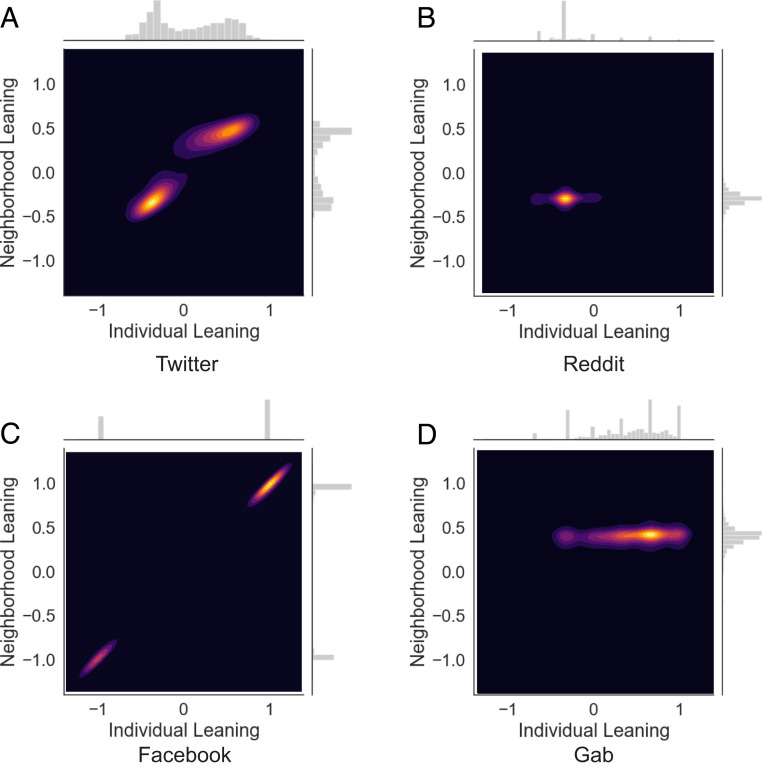
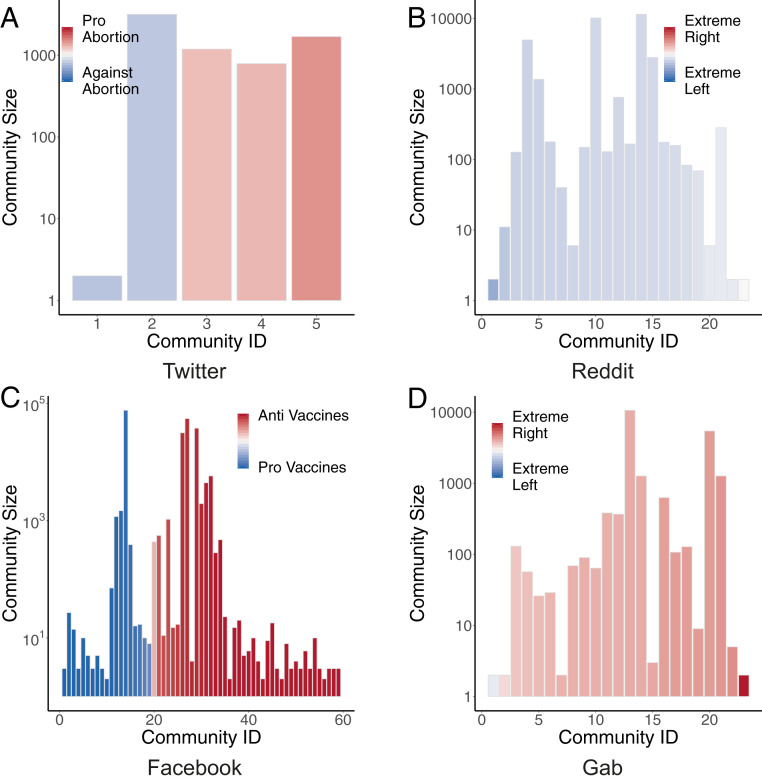
- Across the four platforms, “aggregation in homophilic clusters of users dominates online dynamics,” but platforms differ: Facebook and Twitter show homophilic clustering, while Reddit and Gab form a single community biased left or right rather than two opposing clusters.
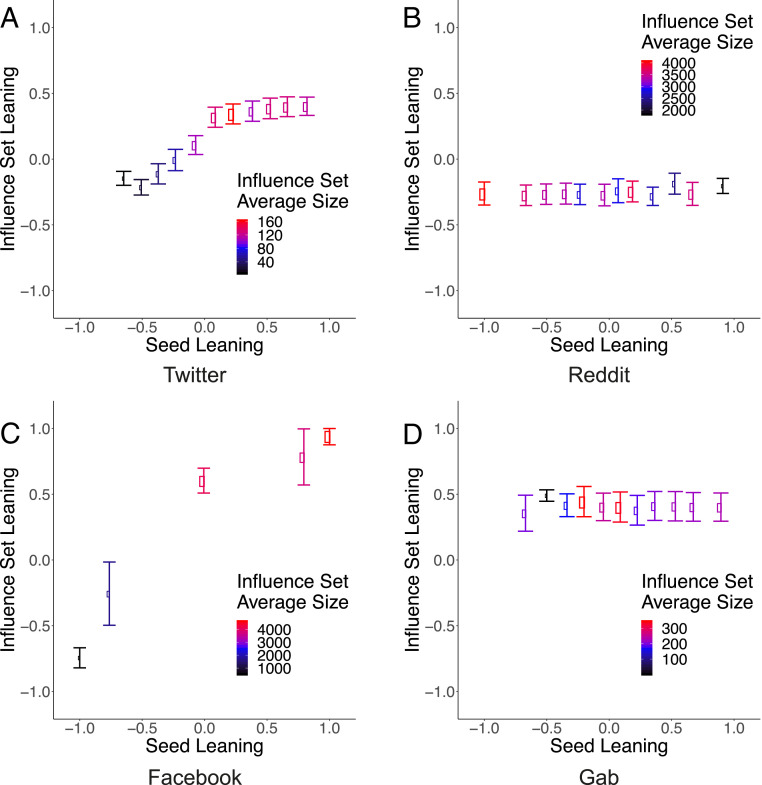
- Information diffusion is biased toward like-minded users on Facebook and Twitter, where the average leaning of a user’s influence set approximates the seed user’s leaning; on Reddit and Gab, the average leaning of the influence set does not depend on the seed user’s leaning.
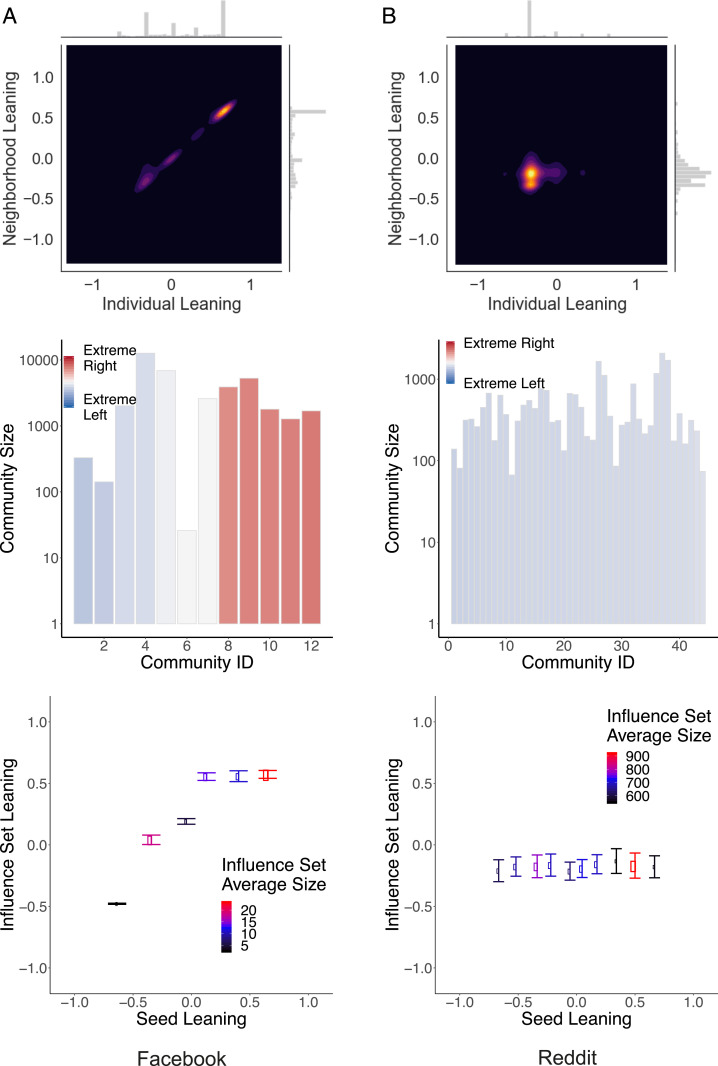
- In a direct comparison on news consumption, Facebook shows higher segregation than Reddit across all three measures: user-neighbor leaning correlation, community leaning, and SIR influence-set leaning.
- The study analyzes more than 100 million unique pieces of content and more than 1 million active users, with news outlets labeled using 2,190 media sources from Media Bias/Fact Check.
Methods
- Comparative analysis of Gab, Facebook, Reddit, and Twitter datasets on controversial topics including gun control, Obamacare, abortion, vaccines, science versus conspiracy, and news; main selected datasets were Abortion (Twitter), Vaccines (Facebook), Politics (Reddit), and Gab as a whole.
- Echo chambers were operationalized through two dimensions: homophily in interaction networks and bias in information diffusion toward like-minded peers. User leaning was inferred from linked news outlets, likes, or content, and interaction networks were built from follows, comments, cocomments, submissions, or replies depending on platform.
- Analyses included correlation between user leaning and average neighbor leaning, Louvain community detection, and SIR simulations to measure influence sets; SIR recovery rate was fixed at ν = 0.2, with dataset-specific infection ratios.
Limitations
- The paper states that the next envisioned step is to address the temporal dimension of echo chambers and how platform-specific social feedback mechanisms impact their formation.
- Evident from the text: leaning coverage varies strongly by platform, from 0.90–1.00 for Twitter/Facebook datasets to 0.15–0.20 for Reddit and 0.13 for Gab, so leaning-based conclusions for Reddit and Gab rest on a small classified fraction of users.
- Evident from the text: datasets differ by platform and topic, and the direct cross-platform comparison on a common topic is limited to news consumption on Facebook and Reddit; the authors also note that Reddit/Gab results could mean either no echo-chamber effect or observation inside a single echo chamber.
Model-written summary. Check it against the paper before relying on it.
Integrity signals
Registry
Cites
Statistics
Figures
Verification
Claims the paper makes
8 Valid · 1 Not valid · 7 Not checked · 38 Own results and interpretations
The cited sources support only part of this claim — read each source’s verdict below.
In the paper
“Selective exposure (19) and confirmation bias (20) (i.e., the tendency to seek information adhering to preexisting opinions) may explain the emergence of echo chambers on social media (1, 17, 21, 22).”
§ The echo chamber effect on social media > Abstract
What the sources say
- Supportedcites [1] M. Del Vicario, The spreading of misinformation online. Proc. Natl. Acad. Sci. U.S.A. 113, 554– 559 (2016). 26729863 PMC4725489 source
The Abstract says selective exposure generates homogeneous clusters, which it calls echo chambers. The Results and Discussion section says users select content matching a narrative and suggests confirmation bias determines echo-chamber formation. Page numbers are not provided in our copy. (LLM, conf=0.94)
- Partly supportedcites [17] K. Garimella, G. De Francisci Morales, A. Gionis, M. Mathioudakis, “ The effect of collective attention on controversial debates on social media” in WebSci ’17: 9th International ACM Web Science Conference (Association for Computing Machinery, New York, NY, 2017), pp. 43– 52. sourceExperimental — accuracy not yet measured
The Introduction reports that users mostly interact within their own side and endorse opinions from that side’s core. Related Work reports that users spread information faster when it agrees with their position. These passages are consistent with selective exposure, but the paper does not identify confirmation bias or establish that either tendency causes echo chambers to emerge. (LLM, conf=0.82)
- Supportedcites [21] M. Del Vicario, Echo chambers: Emotional contagion and group polarization on Facebook. Sci. Rep. 6, 37825 (2016). 27905402 PMC5131349 source
The Abstract says social-media disintermediation encourages users to select information that fits their beliefs (confirmation bias) and form like-minded groups (echo chambers). The Conclusions likewise describe Facebook as suited to the emergence of echo chambers. This supports the proposed explanation, without claiming it is the only cause. (LLM, conf=0.93)
- Supportedcites [22] A. Bessi, Science vs conspiracy: Collective narratives in the age of misinformation. PloS One 10, e0118093 (2015). 25706981 PMC4338055 source
The Introduction (page unavailable) says users consuming opposing information tend to form isolated clusters and describes polarized users whose likes are almost exclusively on one category of pages. The Conclusions (page unavailable) link information evaluation to existing beliefs. Together, these passages support the hedged explanation that selective exposure and confirmation bias may contribute to echo chambers. (LLM, conf=0.86)
hedgedstates a possible cause- Asserted: passes — The authors put it forward as true.
- Checkable: passes — It can be checked against evidence.
- Load-bearing: passes — The paper’s conclusions depend on it.
- Based: passes — The paper gives a reason why it holds.
- Supported
The cited sources support only part of this claim — read each source’s verdict below.
In the paper
“Our attention span remains limited (9, 10), and feed algorithms might limit our selection process by suggesting contents similar to the ones we are usually exposed to (11–13).”
§ The echo chamber effect on social media > Abstract
What the sources say
- Not checked — no full text of the sourcecites [11] A. L. Schmidt, Anatomy of news consumption on Facebook. Proc. Natl. Acad. Sci. U.S.A. 114, 3035– 3039 (2017). 28265082 PMC5373354 source
- Partly supportedcites [12] M. Cinelli, The COVID-19 social media infodemic. Sci. Rep. 10, 16598 (2020). 33024152 PMC7538912 sourceExperimental — accuracy not yet measured
The Introduction (page not provided) says algorithms take users’ preferences and attitudes into account when promoting content, and that users tend to seek information aligned with their worldviews. It does not say that feed algorithms suggest content similar to what users have previously seen or thereby limit their selection. (LLM, conf=0.82)
- Not checked — no full text of the sourcecites [13] E. Bakshy, S. Messing, L. A. Adamic, Exposure to ideologically diverse news and opinion on Facebook. Science 348, 1130– 1132 (2015). 25953820 source
hedgedstates a possible cause- Asserted: passes — The authors put it forward as true.
- Checkable: passes — It can be checked against evidence.
- Load-bearing: passes — The paper’s conclusions depend on it.
- Based: passes — The paper gives a reason why it holds.
Every source the paper cites for this claim was checked and supports it.
In the paper
“Online polarization, for instance, may foster misinformation spreading (1, 8).”
§ The echo chamber effect on social media > Abstract
What the sources say
- Supportedcites [1] M. Del Vicario, The spreading of misinformation online. Proc. Natl. Acad. Sci. U.S.A. 113, 554– 559 (2016). 26729863 PMC4725489 source
The Significance section says that homogeneity and polarization are main determinants of rumor-cascade size. The Conclusions also link polarized communities with the proliferation of narratives fueled by unsubstantiated rumors, supporting the hedged claim that online polarization may foster misinformation spreading. (LLM, conf=0.91)
- Supportedcites [8] M. D. Vicario, W. Quattrociocchi, A. Scala, F. Zollo, Polarization and fake news: Early warning of potential misinformation targets. ACM Trans. Web 13, 1– 22 (2019). source
The Introduction states that misinformation spreading on social media is directly related to increasing user polarization and segregation. This supports the citing sentence’s hedged claim that online polarization may foster misinformation spreading. (LLM, conf=0.94)
hedgedstates a possible cause- Asserted: passes — The authors put it forward as true.
- Checkable: passes — It can be checked against evidence.
- Load-bearing: unclear — It is unclear whether the paper’s conclusions depend on it.
- Based: passes — The paper gives a reason why it holds.
- Supported
Every source the paper cites for this claim was checked and supports it.
In the paper
“In network terms, this translates into a node i with a given leaning xi more likely to be connected with nodes with a leaning close to xi (18).”
§ The echo chamber effect on social media > Comparative Analysis > Polarization and Homophily in the Interaction Networks.
What the sources say
- Supportedcites [18] W. Cota, S. C. Ferreira, R. Pastor-Satorras, M. Starnini, Quantifying echo chamber effects in information spreading over political communication networks. EPJ Data Sci. 8, 35 (2019). source
The paper’s “Topological evidence of echo chambers” section says that a node with political position Pᵢ is connected with nodes whose positions are close to Pᵢ. It also reports a strong correlation between users’ positions and their neighbors’ average positions, supporting the citing sentence’s probabilistic paraphrase. (LLM, conf=0.94)
hedgedstates an association- Asserted: passes — The authors put it forward as true.
- Checkable: passes — It can be checked against evidence.
- Load-bearing: passes — The paper’s conclusions depend on it.
- Based: passes — The paper gives a reason why it holds.
- Supported
A result the paper reports from its own data — it cites no other source for it, so there is none to check. The quote shows it is in the paper.
In the paper
“Furthermore, the almost total absence of communities with leaning very close to 0 confirms the polarized state of the systems.”
§ The echo chamber effect on social media > Comparative Analysis > Polarization and Homophily in the Interaction Networks.
boostedstates a cause- Asserted: passes — The authors put it forward as true.
- Checkable: passes — It can be checked against evidence.
- Load-bearing: passes — The paper’s conclusions depend on it.
- Based: passes — The paper gives a reason why it holds.
- Rests on 4 assumptions not shown here.
32 more claims
Create a free account to see all 54 claims and to verify the 2 references still open.
- It may state two separate claims as one. 9
- Probably not a substantial claim. 9
Claims other papers make about this one
Each is checked against this paper’s own text: does it say what the citing paper says it does?
The source backs part of the claim, not all of it — or backs it for a different population, condition or comparison.
In the citing paper
“engagement with political content online is generally associated with high levels of ingroup bias; that is, it is far more likely to be shared within the political ingroup than in the outgroup (18, 19, 16).”
From Troll and divide: the language of online polarization (2022) · cites this paper as [16]
Experimental — accuracy not yet measuredThe source backs part of the claim, not all of it — or backs it for a different population, condition or comparison.
In the citing paper
“This challenge is reflected in research on”
From Machine culture (2023) · cites this paper as [142]
Experimental — accuracy not yet measuredThe source backs part of the claim, not all of it — or backs it for a different population, condition or comparison.
In the citing paper
“Thus, combating social media's echo chamber effect through an active exposure to diverse perspectives and networks also represents a viable individual-level strategy for addressing the deepfake problem (Cinelli et al., 2021; Gillani et al., 2018).”
From Deepfakes: Deceptions, mitigations, and opportunities (2023) · cites this paper as Cinelli et al., 2021
Experimental — accuracy not yet measuredThe source backs part of the claim, not all of it — or backs it for a different population, condition or comparison.
In the citing paper
“Even without being designed to shift opinions, it has been found that algorithms may contribute to political polarization by reinforcing divisive opinions [9, 24, 32].”
From Co-Writing with Opinionated Language Models Affects Users’ Views (2023) · cites this paper as [32]
Experimental — accuracy not yet measuredThe source backs part of the claim, not all of it — or backs it for a different population, condition or comparison.
In the citing paper
“On Reddit, studies find minimal evidence of echo chambers due to platform features encouraging cross-cutting exposure [17,61,63].”
From A systematic review of echo chamber research: comparative analysis of conceptualizations, operationalizations, and varying outcomes (2025) · cites this paper as [17]
Experimental — accuracy not yet measured
5 more claims about this paper
Create a free account to see every claim other papers make about this one.
Citations
Cites
Fast unfolding of communities in large networks
Blondel, V. D., Guillaume, J.-L., Lambiotte, R., & Lefebvre, E. (2008) · Journal of Statistical Mechanics: Theory and Experiment · doi:10.1088/1742-5468/2008/10/p10008 · Cited by 21,424 · cited 1×
“We detected communities by applying the Louvain algorithm (41), removing singleton communities with only one user.”
MethodThe spread of true and false news online
Vosoughi, S., Roy, D., & Aral, S. (2018) · Science · doi:10.1126/science.aap9559 · Cited by 8,847 · cited 1×
“A recent study (7) limited to Twitter claimed that fake news travels faster than real news.”
BackgroundConfirmation Bias: A Ubiquitous Phenomenon in Many Guises
Nickerson, R. S. (1998) · Review of General Psychology · doi:10.1037/1089-2680.2.2.175 · Cited by 7,267 · cited 1×
“Selective exposure (19) and confirmation bias (20) (i.e., the tendency to seek information adhering to preexisting opinions) may explain the emergence of echo chambers on social media (1, 17, 21, 22).”
BackgroundInfectious Diseases of Humans: Dynamics and Control
Anderson, R. M., & May, R. M. (1991) · doi:10.1093/oso/9780198545996.001.0001 · Cited by 6,179
Lazer, D. M. J., Baum, M. A., Benkler, Y., Berinsky, A. J., Greenhill, K. M., Menczer, F., Metzger, M. J., Nyhan, B., Pennycook, G., Rothschild, D., et al. (2018) · Science · doi:10.1126/science.aao2998 · Cited by 4,160
Degroot, M. H. (1974) · Journal of the American Statistical Association · doi:10.1080/01621459.1974.10480137 · Cited by 4,004 · cited 1×
“For instance, if opinions are assumed to be embedded in a onedimensional space (38), x ∈ [−1,+1] without loss of generality, as usual for controversial topics, then polarization is characterized by two well-separated peaks in P(x ), for positive and negative opinions.”
BackgroundExposure to ideologically diverse news and opinion on Facebook
Bakshy, E., Messing, S., & Adamic, L. A. (2015) · Science · doi:10.1126/science.aaa1160 · Cited by 3,245 · cited 2×
“Our attention span remains limited (9, 10), and feed algorithms might limit our selection process by suggesting contents similar to the ones we are usually exposed to (11–13).”
BackgroundThe spreading of misinformation online
Del Vicario, M., Bessi, A., Zollo, F., Petroni, F., Scala, A., Caldarelli, G., Stanley, H. E., & Quattrociocchi, W. (2016) · Proceedings of the National Academy of Sciences · doi:10.1073/pnas.1517441113 · Cited by 2,407 · cited 2×
“, the tendency to seek information adhering to preexisting opinions) may explain the emergence of echo chambers on social media (1, 17, 21, 22).”
BackgroundSelf-citationThe COVID-19 social media infodemic
Cinelli, M., Quattrociocchi, W., Galeazzi, A., Valensise, C. M., Brugnoli, E., Schmidt, A. L., Zola, P., Zollo, F., & Scala, A. (2020) · Scientific Reports · doi:10.1038/s41598-020-73510-5 · Cited by 2,313
Self-citationFilter Bubbles, Echo Chambers, and Online News Consumption
Flaxman, S., Goel, S., & Rao, J. M. (2016) · Public Opinion Quarterly · doi:10.1093/poq/nfw006 · Cited by 1,992
Research works printed but not linked: 2
- R. M. Anderson, R. M. May, Infectious Diseases in Humans (Oxford University Press, Oxford, United Kingdom, 1992).
- M. Cinelli, G. De Francisci Morales, A. Galeazzi, W. Quattrociocchi, M. Starnini, The echo chamber effect on social media. Open Science Framework. https://osf.io/x92br/?view_only=cdcc87d30e404e01b6ae316db15e3375. Deposited 22 January 2021. PMC7936330 33622786
Cited by
Items 1,001–1,100 of 2,063
Dinamica dezinformării. Impactul camerelor de ecou în modelarea opiniei publice online din România
Stoica, S. E. (2024) · Buletinul Universității Naționale de Apărare „Carol I” · doi:10.53477/2065-8281-24-04 · Cited by 1
From Polarization to Pro-Sociality: Measuring Beneficence in Controversial Online Conversations
Cinelli, M., Etta, G., Franzoni, V., Mancini, M., & Niewiadomski, R. (2024) · IEEE Access · doi:10.1109/access.2024.3430495 · Cited by 2
“According to the proposed methodology, polarization in beneficence, expressed by users and/or their neighbors, leads to at least two local maxima in the proximity measure distributions [6].”
BackgroundMethodSelf-citationBubble Effect Induced by Recommendation Systems in a Simple Social Media Model
Bagnoli, F., Cavalcabo’, G. D. B., Casu, B., & Guazzini, A. (2022) · Studies in computational intelligence · doi:10.1007/978-3-030-93413-2_11 · Cited by 2
Gamir-Ríos, J., Cano‐Orón, L., & Baviera, T. (2022) · Fonseca Journal of Communication · doi:10.14201/fjc.28295 · Cited by 2
Semantic Network Analysis of COVID-19 Vaccine Related Text from Reddit
Melton, C. A., Bae, J., Olusanya, O. A., Brenas, J. H., Shin, E. K., & Shaban‐Nejad, A. (2022) · Studies in computational intelligence · doi:10.1007/978-3-031-14771-5_18 · Cited by 2
Stochastische Gewalt und Stochastischer Terrorismus als Phänomene einer digitalisierten Welt
Staller, M. S., Körner, S., & Kron, T. (2022) · Springer eBooks · doi:10.1007/978-3-658-35450-3_53-1 · Cited by 2
Political coherence and certainty as drivers of interpersonal liking, over and above similarityPreprint
Zimmerman, F., Garbulsky, G., Ariely, D., et al. (2020) · doi:10.31234/osf.io/b9645 · Cited by 2
Artificial Intelligence, Misinformation, and Libraries: A New Frontier for Information Professionals
Salubi, O. G. (2025) · Proceedings of the Association for Information Science and Technology · doi:10.1002/pra2.1279 · Cited by 8
“These tools flood platforms with repetitive narratives, simulate public consensus, and manipulate engagement metrics to give fringe ideas disproportionate visibility (Cinelli et al., 2021).”
A cognitive model of economicsPreprint
Friesen, L. (2021) · PsyArXiv (OSF Preprints) · doi:10.31234/osf.io/qtcrp · Cited by 3
People and paradigms: mental networks and the ventromedial prefrontal cortexPreprint
Friesen, L. (2021) · PsyArXiv (OSF Preprints) · doi:10.31234/osf.io/mw65h · Cited by 2
Subjective Freedom of Speech: Why Do Citizens Think They Cannot Speak Freely?Preprint
Menzner, J., & Traunmüller, R. (2022) · SSRN Electronic Journal · doi:10.2139/ssrn.4052854 · Cited by 2
Advertising by Recruiting Influencers
Jalloul, M., & Kostami, V. (2022) · Management Science · doi:10.2139/ssrn.4043798 · Cited by 3
The Political Landscape of the U.S. TwitterversePreprint
Mukerjee, S., Jaidka, K., & Lelkes, Y. (2021) · OSF Preprints (OSF Preprints) · doi:10.31219/osf.io/n4udk · Cited by 2
Online Silence: Why Do Not People Challenge Others When Posting Misinformation?Preprint
Gurgun, S., Arden-Close, E., Phalp, K., & Ali, R. (2022) · Social Science Research Network · doi:10.2139/ssrn.4137613 · Cited by 1
“The way social media limits the exposure of diverse opinions and promotes a common narrative with like-minded people, known as an "echo chamber” (Cinelli et al. 2021), is also argued to amplify users’ cognitive biases, such as confirmation bias, which refers to the tendency to search or remember…”
InfluentialEmpirical Social Asset PricingPreprint
Hwang, B. (2022) · SSRN Electronic Journal · doi:10.2139/ssrn.4118285 · Cited by 2
The roots of polarisation in the individual reward systemPreprint
Lefebvre, G., Deroy, O. D., & Bahrami, B. (2023) · doi:10.31234/osf.io/4q3eu · Cited by 2
Artificial Intelligence Chatbots Mimic Human Collective BehaviourPreprint
He, J. K., Wallis, F. P. S., Gvirtz, A., & Rathje, S. (2023) · PsyArXiv (OSF Preprints) · doi:10.31234/osf.io/vf5ap · Cited by 2
Morrell, S. (2023) · doi:10.33774/apsa-2023-zjrvt-v2 · Cited by 1
The Canadian Information Ecosystem
Bridgman, A., Abrahams, A., Bergeron, T., galipeau, T., Lee‐Whiting, B., Naushan, H., Phillips, J., Pehlivan, Z., Park, S., Parker, S., et al. (2023) · doi:10.66536/canadian-info-ecosystem_2023 · Cited by 7
Social Media Toxicity and Market BehaviorPreprint
Blankespoor, E., Pinto, J. P., & Sinha, K. (2024) · SSRN Electronic Journal · doi:10.2139/ssrn.4692457 · Cited by 2
Walker, A. C., Fugelsang, J. A., & Koehler, D. J. (2024) · SSRN Electronic Journal · doi:10.2139/ssrn.4724808 · Cited by 2
The digitalization of discourse: Exploring key discussion points for the study of violence online
Recuero, R. (2024) · Dialogues on Digital Society · doi:10.1177/29768640241250267 · Cited by 4
“Thus, it can divide, radicalize, and isolate people, breaking the public discourse and shattering the public sphere (Cinelli et al., 2021).”
Network Analysis Reveals News Press Landscape and Asymmetric User PolarizationPreprint
Lee, B., Ryu, H.-S., Lee, J. K., et al. (2024) · SSRN Electronic Journal · doi:10.2139/ssrn.4831596 · Cited by 2
DomainDemo: a dataset of domain-sharing activities among different demographic groups on Twitter
Yang, K.-C., Goel, P., Quintana, A., Horgan, L., McCabe, S., Grinberg, N., Joseph, K., & Lazer, D. M. J. (2025) · Scientific Data · doi:10.1038/s41597-025-05604-6 · Cited by 8
“However, the presence of partisan online news and phenomena such as echo chambers and filter bubbles remain concerns (Cinelli et al., 2021; Bakshy et al., 2015).”
WeAudit: Scaffolding User Auditors and AI Practitioners in Auditing Generative AIPreprint
Deng, W. H., Wang, C., Han, H. Z., Hong, J., Holstein, K., & Eslami, M. (2025) · Qeios · doi:10.32388/b1lxnv · Cited by 4
Media Consumption Patterns and Public Hostility Toward China in the United StatesPreprint
Li, X., & Ang, Y. Y. (2025) · SSRN Electronic Journal · doi:10.2139/ssrn.5263311 · Cited by 2
Ahmed, M. (2025) · Preprints.org · doi:10.20944/preprints202506.0194.v1 · Cited by 3
López-Robles, A. (2023) · Revista de la Asociación Española de Investigación de la Comunicación · doi:10.24137/raeic.10.19.12 · Cited by 1
Online Platform as a Discourse Factor of Virtual Communities
Luk'yanova, G. V., & Martyanov, D. S. (2023) · Communication Strategies in Digital Society Seminar (ComSDS) · doi:10.1109/comsds58064.2023.10130352 · Cited by 1
“Hargittai found significant socio-demographic differences between users of platforms such as Facebook, Twitter, and LinkedIn [8, 11].”
InfluentialLevi, E., Bayerlein, M., Grimalda, G. F., & Reggiani, T. (2023) · MUNI ECON Working Papers · doi:10.5817/wp_muni_econ_2023-07 · Cited by 15
“…“echo chambers” or “filter bubbles,” in which users only process news in line with their views and exclusively engage with like-minded individuals (Acemoglu, Ozdaglar, and Siderius, 2021; Cinelli et al., 2021; Mosleh et al., 2021; Pariser, 2011; Sunstein, 2018; Stein, Keuschnigg, and Rijt, 2023).”
BackgroundA meta-discursive analysis of engagement markers in QAnon anti-immigration comments
Rasoulikolamaki, S., Zhdanava, A., Isa, N. A. N. M., Ahmad, M. N. N., & Kaur, S. (2023) · Journal of Language and Politics · doi:10.1075/jlp.23038.ras · Cited by 1
Social Media Technologies in the Political Socialization of Students
Artamonova, Y. S. (2023) · Вестник Волгоградского государственного университета. Серия 7: Философия. Социология и социальные технологии · doi:10.15688/lp.jvolsu.2023.2.9 · Cited by 1
How Can Social Media Affect EFL Teachers' Digital Well-Being and Digital Burnout?
Dehghan, F. (2023) · Advances in educational technologies and instructional design book series · doi:10.4018/978-1-6684-9246-8.ch007 · Cited by 1
Responsible users and platform competition: A computational model
Katsamakas, E. G., & Sanchez-Cartas, J. M. (2024) · Heliyon · doi:10.1016/j.heliyon.2024.e25010 · Cited by 4
Freedom of choice and network "echo effects" of information consumption
Leontyev, G. D., & Leontieva, L. S. (2024) · Социодинамика · doi:10.25136/2409-7144.2024.1.68951 · Cited by 1
Krebs, A. K. (2024) · De Gruyter eBooks · doi:10.1515/9783111349558 · Cited by 1
Arkhipova, D. (2024) · Theory and history in the human and social sciences · doi:10.1007/978-3-031-47001-1_11 · Cited by 2
Interactively Learning Social Media Representations Improves News Source Factuality Detection
Mehta, N., & Goldwasser, D. (2023) · doi:10.18653/v1/2023.findings-ijcnlp.27 · Cited by 5
Naim, H. M., & Sani, M. A. M. (2024) · Kajian Malaysia · doi:10.21315/km2024.42.s1.6 · Cited by 4
Basak, E., Tafti, A., & Pang, M. (2024) · Journal of the Association for Information Systems · doi:10.17705/1jais.00851 · Cited by 1
Waddell, M. W., Wright, S. C., Waldzus, S., & Stebner, G. A. (2024) · Frontiers in Social Psychology · doi:10.3389/frsps.2024.1347054 · Cited by 1
Public Health Communication in the COVID-19 Pandemic
McCloud, R. F., Bekalu, M. A., & Viswanath, K. (2024) · Oxford University Press eBooks · doi:10.1093/oso/9780197625217.003.0017 · Cited by 1
The Quiet Power of Social Media: Impact on Fish-Oil Purchases in Iceland during COVID-19
Carpinelli, C., Íslind, A. S., & Óskarsdóttir, M. (2024) · Proceedings of the International AAAI Conference on Web and Social Media · doi:10.1609/icwsm.v18i1.31308 · Cited by 2
“…there is ide-ological polarization. strengthening of the existing beliefs of netizens which are reinforced by the repetition of similar information within a closed system, also known as filter bubbles (Au, Ho, and Chiu 2021; Tomlein et al. 2021) or echo chambers (Cinelli et al. 2021).”
BackgroundAnalysis of the Echo Chamber Caused by Unexpected Opinions
Nakagawa, A., Sei, Y., Tahara, Y., & Ohsuga, A. (2024) · International Conference on Information and Computer Technologies (ICICT) · doi:10.1109/icict62343.2024.00010 · Cited by 2
The socio-cultural dimension of the "culture of cancellation" as a phenomenon of the XXI century
Леонидович, А. Г., Arutiunian, E. G., Gromova, L. P., et al. (2024) · Litera · doi:10.25136/2409-8698.2024.7.71219 · Cited by 1
“STOP BEING RACIST”: WHAT MALAYSIANS SAY ABOUT RACE ON SOCIAL MEDIA - A THEMATIC ANALYSIS
Jerome, C., Hasbi, N., & Ting, S. (2024) · International Journal of Law Government and Communication · doi:10.35631/ijlgc.936030 · Cited by 1
User-Centric Tensions: Exploring Perceived Benefits and (Dis)comfort in Media Personalisation
Rezk, A. M., Simkute, A., Vines, J., Elsden, C., Evans, M., Jones, R., & Luger, E. A. (2024) · Nordic Conference on Human-Computer Interaction · doi:10.1145/3679318.3685365 · Cited by 3
“…losing sight of the bigger picture through a lack of collective experience; at worst, users are at risk of being uncon-sciously radicalised, and on a wider social scale this can lead to a decreased ability to relate to other users, increasing the risk of cultural polarisation [11, 28, 33, 48].”
“News has Various Shades”: Quantifying and Analyzing Media Bias at Aspect-level Granularity
Kuila, A., Jena, S., Sarkar, S., & Chakrabarti, P. P. (2024) · ACM Journal on Computing and Sustainable Societies · doi:10.1145/3698797 · Cited by 4
DiversiNews: Enriching News Consumption with Relevant Yet Diverse News Articles Retrieval
Sun, Y., Huang, Q., Wang, Y., & Tung, A. K. H. (2024) · Proceedings of the VLDB Endowment · doi:10.14778/3685800.3685854 · Cited by 9
“Nevertheless, this shift has fostered the growth of echo chambers on these platforms: Users often join like-minded communities, sharing news that reflects their political beliefs, which narrows their exposure to diverse perspectives [5].”
BackgroundMetaplasticity and memory in multilevel recurrent feed-forward networks
Zanardi, G., Bettotti, P., Morand, J., Pavesi, L., & Tubiana, L. (2024) · Physical review. E · doi:10.1103/physreve.110.054304 · Cited by 1
Understanding Perceptions of the Reddit Reaction Mechanism in Political Subreddits
Guo, L., Yin, Y., & Thebault-Spieker, J. (2024) · ACM Conference on Computer Supported Cooperative Work (CSCW) · doi:10.1145/3678884.3681861 · Cited by 2
“…homophily, especially in communities dedicated to political topics [4], and that the dominant narrative of "echo chamber" both in academic research [6] and popular media [8] may have shaped participants’ perception on community homogeneity on Reddit (for example, P3 explicitly mentioned this term…”
Enhancing Cross-Community Diffusion Through Swarm Intelligence
Wu, X., Zhao, T.-F., & Chen, W. (2024) · International Conference on Machine Intelligence Theory and Applications (MiTA) · doi:10.1109/mita60795.2024.10751714 · Cited by 1
“This phenomenon, known in communication science as the "echo chamber effect" or "information cocoon" [1], have created a closed information environment.”
Exploring agent interaction patterns in the comment sections of fake and real news
Zhu, K., Peng, S., Nie, J., Ruan, Z., Yu, S., & Xuan, Q. (2024) · Journal of The Royal Society Interface · doi:10.1098/rsif.2024.0483 · Cited by 3
Inoue, S., & Fuji, K. (2024) · Technology in Society · doi:10.1016/j.techsoc.2024.102776 · Cited by 3
Belief Sharing: A Blessing or a Curse
Çatal, O., de Maele, T. V., Pitliya, R. J., Albarracin, M., Pattisapu, C., & Verbelen, T. (2024) · Communications in computer and information science · doi:10.1007/978-3-031-77138-5_8 · Cited by 7
Polarization and Shared Attention among Influential Amplifiers of 2018 U.S. Primary Candidates
Montez, D., & Shmargad, Y. (2025) · Journal of Quantitative Description Digital Media · doi:10.51685/jqd.2025.001 · Cited by 1
“Because of their gatekeeping function, polarization among political influencers could create information silos in which users are primarily exposed to messages from one side of the political spectrum, the so-called echo chamber effect (Cinelli et al., 2021).”
Ota, K., & Toriumi, F. (2024) · IEEE International Conference on Big Data (BigData) · doi:10.1109/bigdata62323.2024.10825413 · Cited by 1
Detecção de Posicionamento e Rotulação Automática de Usuários do Twitter: o caso da CPI da Covid-19
dos Santos, P. D., & Goya, D. (2024) · iSys - Brazilian Journal of Information Systems · doi:10.5753/isys.2023.3008 · Cited by 2
COVID-19 vaccination hesitancy among hemodialysis patients: A mixed-methods study
Sugawara, Y., Iwagami, M., Kikuchi, K., Hashiba, T., Yabushita, S., Hara, R., Hasegawa, T., Iino, Y., & Nangaku, M. (2025) · Vaccine X · doi:10.1016/j.jvacx.2025.100623 · Cited by 2
Calvo, D., Iranzo-Cabrera, M., Morales-i-Gras, J., & Tarullo, R. (2025) · Humanities and Social Sciences Communications · doi:10.1057/s41599-025-04568-7 · Cited by 5
“While negative emotional content and hate speech may not always violate legal boundaries, their dissemination can foster societal radicalisation and violence (Sunstein, 2002; Cinelli et al. 2021).”
Moreno, A., & Coughlan, A. U. (2025) · Revista Mexicana de Opinión Pública · doi:10.22201/fcpys.24484911e.2025.38.90089 · Cited by 1
Swift Unfolding of Communities: GPU-Accelerated Louvain Algorithm
Wang, Z., Lin, X., Li, X., Wang, P., Meng, Z., Liu, H., Tian, C., & Zhong, S. (2025) · ACM SIGPLAN Symposium on Principles and Practice of Parallel Programming · doi:10.1145/3710848.3710884 · Cited by 4
“…could unfold the structurally coherent vertices in an unsupervised manner, this tool is broadly used in a variety of scientific and engineering applications, including social network analysis [17, 55], bioinformatics [20, 47], and transportation network analysis [19, 49] among many others.”
Lu, Y. (2025) · Journal of Contingencies and Crisis Management · doi:10.1111/1468-5973.70040 · Cited by 2
Tran, G. T. C., Jung, J. J., & Han, J. (2025) · Technology in Society · doi:10.1016/j.techsoc.2025.102881 · Cited by 2
Participant engagement in a moderated Facebook group to promote COVID-19 vaccination
Wu, T.-C., Abroms, L. C., Napolitano, M. A., Wysota, C. N., Koban, D., & Broniatowski, D. A. (2025) · Health Education Research · doi:10.1093/her/cyaf008 · Cited by 1
Mete, H. (2025) · Election Law Journal Rules Politics and Policy · doi:10.1089/elj.2024.0014 · Cited by 3
“Echo chambers can reinforce existing opinions within a group or push the group toward more extreme positions (Bakshy et al., 2015; Cinelli et al., 2021; Sunstein, 1999).”
Consumers' trust in times of uncertainty
Bednarz, J., Aziewicz, A., & Wysiński, P. (2025) · Family and Consumer Sciences Research Journal · doi:10.1111/fcsr.70014 · Cited by 1
Causal Insights into Parler's Content Moderation Shift: Effects on Toxicity and Factuality
Kumarswamy, N., Singhal, M., & Nilizadeh, S. (2025) · International World Wide Web Conference (WWW) · doi:10.1145/3696410.3714865 · Cited by 8
“Media Bias Fact Check (MBFC): MBFC is widely used to assess the credibility and factuality of news sources for downstream analysis [18, 21, 22, 27, 33, 43, 54, 59, 83, 89] and serves as ground truth for prediction tasks [19, 30, 40, 66, 84].”
Can Large Language Models Effectively Mitigate Polarization in Social Media Text?
Santos, L. R. J., Marinho, L. B., Campelo, C. E. C., Menczer, F., & Flammini, A. (2025) · ACM Web Science Conference (WebSci) · doi:10.1145/3717867.3717904 · Cited by 8
“One of the most concerning issues is the proliferation of echo chambers [2, 7], where users are predominantly exposed to content that reinforces their existing beliefs.”
THE INFLUENCE OF TECHNOLOGICAL ADVANCEMENTS ON RETAIL INVESTMENT DECISIONS
Albert, A. (2025) · International Journal For Multidisciplinary Research · doi:10.36948/ijfmr.2025.v07i03.46390 · Cited by 1
“This leads to confirmation bias, causing individuals to ignore critical or opposing viewpoints and rely on emotionally driven narratives instead of fundamental analysis (Cinelli, 2021).”
Leveraging psychedelic neuroscience to boost human creativity using artificial intelligence
Ross, B. M. (2025) · Frontiers in Artificial Intelligence · doi:10.3389/frai.2025.1589086 · Cited by 1
Bainbridge, T. F., Ryan, M., Golley, S., Kakoschke, N., & Brindal, E. (2025) · PLoS ONE · doi:10.1371/journal.pone.0323849 · Cited by 1
Ge, W., Bai, X., Liu, J., Niu, G., & Sun, X. (2025) · Health Communication · doi:10.1080/10410236.2025.2502450 · Cited by 4
“Personalized algorithms tend to reinforce users’ existing beliefs and behaviors, limiting exposure to alternative perspectives (Cinelli et al., 2021; Dubois & Blank, 2018; Meppelink et al., 2019; Pariser, 2011).”
InfluentialDo People Think Fast or Slow When Training AI?
Treiman, L. S., Ho, C.-J., & Kool, W. (2025) · ACM Conference on Fairness, Accountability, and Transparency (FAccT) · doi:10.1145/3715275.3732177 · Cited by 7
“For instance, overlooking human behavior during AI training could result in substantial social impacts, like the echo chamber effect [21], or make learning infeasible [101].”
Gen Z Hybristophilia: The Role of tiktok in Young Women’s Attraction to Deviant Men
Treggia, E. V., Ιωάννου, Μ., Tzani, C., Lester, D., Rogers, L., Williams, T. J. V., Synnott, J., & Drouin, M. A. (2025) · Deviant Behavior · doi:10.1080/01639625.2025.2520587 · Cited by 6
Li, C., & Liu, X. (2025) · China & World Economy · doi:10.1111/cwe.12595 · Cited by 3
A Multi-aspect Analysis of Echo Chambers on Video-Sharing Social Media
Berjawi, O., Cavaliere, D., & Fenza, G. (2025) · Lecture notes in social networks · doi:10.1007/978-3-031-85240-4_16 · Cited by 4
Twitter polarity and computational propaganda: the case of the Woman, Life, Freedom movement in Iran
Rahbari, M. M., Blanchard, P., & Safari, H. (2025) · Journal of Information Technology & Politics · doi:10.1080/19331681.2025.2537270 · Cited by 3
Kolic, B., Aguirre-López, F., Hernández-Williams, S., & Garduño-Hernández, G. (2025) · Journal of Complex Networks · doi:10.1093/comnet/cnaf020 · Cited by 10
“While this approach lacks the detail of supervised meth-ods, analyzing tweet content could further reveal users’ ideological positions, reinforce evidence of echo chambers [21], and uncover the main discussion topics within and be-tween groups [13].”
InfluentialSocial Protest: The Psychological Science and Practical Art of Motivation and Mobilization
van Zomeren, M. (2025) · doi:10.1093/9780197782347.001.0001 · Cited by 1
Devesa, B. P. (2025) · Asian Journal of Women s Studies · doi:10.1080/12259276.2025.2541572 · Cited by 4
“This phenomenon parallels the echo chamber effect (Cinelli et al., 2021), wherein narratives are mutually reinforced, though in this case, the effect serves to heal and empower rather than polarize.”
Consumer Perception and Acceptance: Navigating the Challenges
Chauhan, A., Goyal, M. R., & Aswal, J. S. (2025) · Springer eBooks · doi:10.1007/978-3-031-96526-5_5 · Cited by 2
Social Media–Based Cancer Education: Bibliometric and Thematic Analysis
Xie, Y., Guo, Z., Zeng, X., Zhai, D., Zhai, G., Feng, Y., & Huang, H. (2025) · JMIR Cancer · doi:10.2196/77214 · Cited by 3
“Algorithm-driven recommendation mechanisms further exacerbate information asymmetry through the “echo chamber effect” [18].”
Temperature-noise interplay in a coupled model of opinion dynamics
Chmiel, A., & Sienkiewicz, J. (2025) · Physical review. E · doi:10.1103/v5q5-gy67 · Cited by 2
“As F q is linear with respect to p for any value of q , a straightforward solution presenting the critical value of the noise as a function of temperature reads which it is equivalent of solving m ( T, p ) = 0 when an explicit form of m ( T, p ) is given.”
Negative ties highlight hidden extremes in social media polarization
Candellone, E., Babul, S., Togay, Ö., Bovet, A., & Garcia‐Bernardo, J. (2025) · Network Science · doi:10.1017/nws.2025.10006 · Cited by 4
“…to the widening gap be-tween the political beliefs of different groups; affective polarization captures the emotional hostility and negative attitudes between political factions; and structural polarization examines the division of social interactions into homogeneous groups with minimal…”
Unraveling susceptibility: the psychological drivers of belief and action on misinformation
Shin, D. (2025) · Elsevier eBooks · doi:10.1016/b978-0-443-16104-9.00001-4 · Cited by 1
Digital Faith Journeys: Exploring How Technology Shapes Youth Spirituality and Religious Engagement
Ma’rof, A. A., & Abdullah, H. B. (2025) · Advances in computational intelligence and robotics book series · doi:10.4018/979-8-3373-2170-7.ch008 · Cited by 1
Song, Y., Zhang, Y., Zou, S., Yang, X., & Huang, Q. (2025) · Journal of Computational Social Science · doi:10.1007/s42001-025-00401-y · Cited by 7
“By exploiting platform mechanics, such as rapid, repeated link sharing, they artificially inflated engagement signals (e.g., clicks, shares), thereby taking advantage of algorithms that prioritize virality over content veracity [10, 18]).”
A Novel Framework for Evaluating Polarization in Online Social Networks
Buratti, C., Marchetti, M., Parlapiano, F., Ursino, D., & Virgili, L. (2025) · Big Data and Cognitive Computing · doi:10.3390/bdcc9090227 · Cited by 1
“As mentioned above, the polarization found can be explained by the fact that polarized communities are closed and their members communicate mainly to reinforce their beliefs [52].”
Refracting Blame in the Fentanyl Era: The Narrative Battleground on Facebook and Instagram
Kresovich, A., Emery, S., Borowiecki, M., Ngobo-Ekamby, M., Shi, H., Lamuda, P. A., Taylor, B. G., Schneider, J. A., & Pollack, H. A. (2025) · Substance Use & Misuse · doi:10.1080/10826084.2025.2547390 · Cited by 2
“This dynamic is amplified by platform algorithms that can reinforce these partisan blame narratives, hindering consensus on policy solutions (Cinelli et al., 2021; Grogan et al., 2020; Pyra et al., 2022).”
Michelot, F., Alkhalaf, R., & Picco, M. (2025) · Revue internationale de pédagogie de l’enseignement supérieur · doi:10.4000/14kwj · Cited by 1
Masood, M., & Ahmed, S. (2025) · International Journal of Public Opinion Research · doi:10.1093/ijpor/edaf046 · Cited by 1
Unpacking the Epistemology of Ethiopian Digital Journalism: An Exploration of News-Making Practices
Dessie, B. A., & Kebede, A. Y. (2025) · Journal of Media Ethics · doi:10.1080/23736992.2025.2560895 · Cited by 3
A multilevel network approach to revealing patterns of online political selective exposure
Zhang, Y., Castro, L., Esser, F., & Bovet, A. (2025) · PLoS ONE · doi:10.1371/journal.pone.0332663 · Cited by 6
“Many studies have explored selective exposure and related topics such as political polarization and echo chambers, e.g., [5,15–22].”
Majcen, A., & Spitzer, P. (2025) · Chemistry Teacher International · doi:10.1515/cti-2025-0057 · Cited by 1
Anderson, K.-A., Nowak, G. J., Cacciatore, M. A., Rohani, P., & Drake, J. M. (2025) · Vaccine · doi:10.1016/j.vaccine.2025.127804 · Cited by 2
Li, J., Cunningham, T., Geva, E., Snow, C. E., Biemiller, A. J., & Roihan, N. (2025) · Computer Assisted Language Learning · doi:10.1080/09588221.2025.2569343 · Cited by 3
Algorithmic Armaments: Social Media's Role in Information Warfare and Political Influence
Özkan, E. G. (2025) · IGI Global eBooks · doi:10.4018/979-8-3373-7406-2.ch005 · Cited by 1
Xu, C., & Ge, X. (2025) · Proceedings of the ACM on Human-Computer Interaction · doi:10.1145/3757396 · Cited by 1
“There is not a monolithic digital space; considerable heterogeneity exists among platforms and online communities [33].”
Lost in misinformation: The news media’s struggle to defend science
Lile, S., & Ansari, S. S. (2025) · Oxford University Press eBooks · doi:10.1093/9780198953067.003.0006 · Cited by 1
Metadata
- Authors
- Cinelli, M., De Francisci Morales, G., Galeazzi, A., Quattrociocchi, W., & Starnini, M.
- Affiliations
- Ca' Foscari University of Venice (IT)
- Institute for Scientific Interchange (ISI) Foundation, 10126 Torino, Italy;
- University of Brescia (IT)
- University of Oslo (NO)
- Institute for Scientific Interchange (IT)
- Corresponding author
- Quattrociocchi, Walter
- ORCID
- Venue
- Proceedings of the National Academy of Sciences
- Publisher
- National Academy of Sciences
- Published
- 2021-02-23
- Volume
- 118
- Issue
- 9
- ISSN
- 0027-8424 (ISSN-L)
- 1091-6490
- PMC
- PMC7936330
- OpenAlex
- W3133423348
- Cited by
- 2,092
- References
- 62
- Citations by year
- 2026: 488 · 2025: 516 · 2024: 387 · 2023: 351 · 2022: 256 · 2021: 90
- FWCI
- 375.62
- Type
- journal article
- Language
- en
- Open access
- hybrid
- doi.org
- Licence
- Locations
- Proceedings of the National Academy of Sciences (publishedVersion, cc-by)
- PubMed Central (publishedVersion, cc-by)
- PubMed (publishedVersion)
- UPCommons institutional repository (Universitat Politècnica de Catalunya) (submittedVersion, cc-by)
- IRIS Research product catalog (Sapienza University of Rome) (submittedVersion)
- Padua Research Archive (University of Padova) (submittedVersion, cc-by)
- Topics
- Social Sciences › Sociology and Political Science › Misinformation and Its Impacts
- Social Sciences › Communication › Social Media and Politics
- Physical Sciences › Physics and Astronomy › Statistical and Nonlinear Physics › Complex Network Analysis Techniques
- Keywords
- echo chambers, social media, homophily, information dissemination, algorithmic curation, controversial issues, Facebook, Twitter, Reddit, Gab, news consumption
- MeSH terms
- Abortion, Legal, Gun Violence, Communication, Humans, Politics, Social Change, Vaccination, Bias, Information Dissemination, Narration, Patient Protection and Affordable Care Act, Social Networking, Social Media
About these checks
Registry, retraction, Cites and statistics results are computed, not judged, with one exception: a printed reference that no index lists is read once by a model before it counts as a citation error. Claims are extracted by a model and kept only when their quote appears verbatim in the text; each cited source is then checked, with a model’s help, for whether it says what the claim relies on. Those verdicts can be wrong — read the claim’s quote and the cited source before relying on one.
The claim verdicts this report counts are experimental: their accuracy is not yet measured.
A language model drew the claims from the paper on 2026-10-10, under version 3 of the claim definition (model deepseek-v4.1-flash, prompt extract-v3).
A second model labelled each claim on 2026-10-10 (model jev-1.13-20260917, definition revision gold-guideline-v0.2).
Cited sources are checked with a language model’s help (gpt-6-sol).
Statistics and arithmetic are recomputed, not judged.
Confidence bands are shown only for fields calibrated on our annotated test set. None is calibrated yet, so no band is shown.
What counts as a claim ›How we measure confidence ›How we check this ›
Are you an author, or do you see a problem with this page? Request a review
Data sources
Bibliographic data: Semantic Scholar, OpenAlex, Crossref.
Contains information from the Semantic Scholar Academic Graph Datasets, made available under the ODC Attribution License (ODC-BY 1.0).
Semantic Scholar’s data is described in: Kinney, R., et al. (2023). The Semantic Scholar Open Data Platform. arXiv:2301.10140.
