

The echo chamber effect on social media
Open accessThe DOI matches its Crossref record; 68 of the 69 references it cites were found in a registry or an index; 16 of the 38 sources its claims cite were checked for support.
Abstract
Significance: We explore the key differences between the main social media platforms and how they are likely to influence information spreading and the formation of echo chambers. To assess the different dynamics, we perform a comparative analysis on more than 100 million pieces of content concerning controversial topics (e.g., gun control, vaccination, abortion) from Gab, Facebook, Reddit, and Twitter. The analysis focuses on two main dimensions: 1) homophily in the interaction networks and 2) bias in the information diffusion toward like-minded peers. Our results show that the aggregation in homophilic clusters of users dominates online dynamics. However, a direct comparison of news consumption on Facebook and Reddit shows higher segregation on Facebook.
Overview
CoChat Summary
TL;DR
This paper compares echo-chamber dynamics across Gab, Facebook, Reddit, and Twitter using more than 100 million pieces of content and more than 1 million active users. It finds homophilic clustering dominates online dynamics, with Facebook and Twitter showing stronger segregation and like-minded information diffusion than Reddit and Gab, and Facebook showing higher news-consumption segregation than Reddit.
Key findings
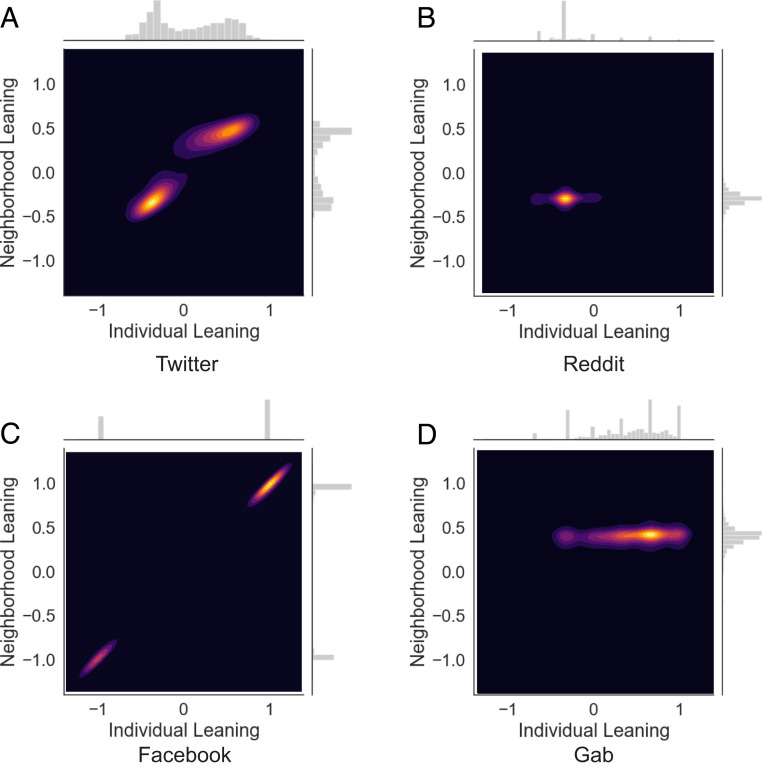
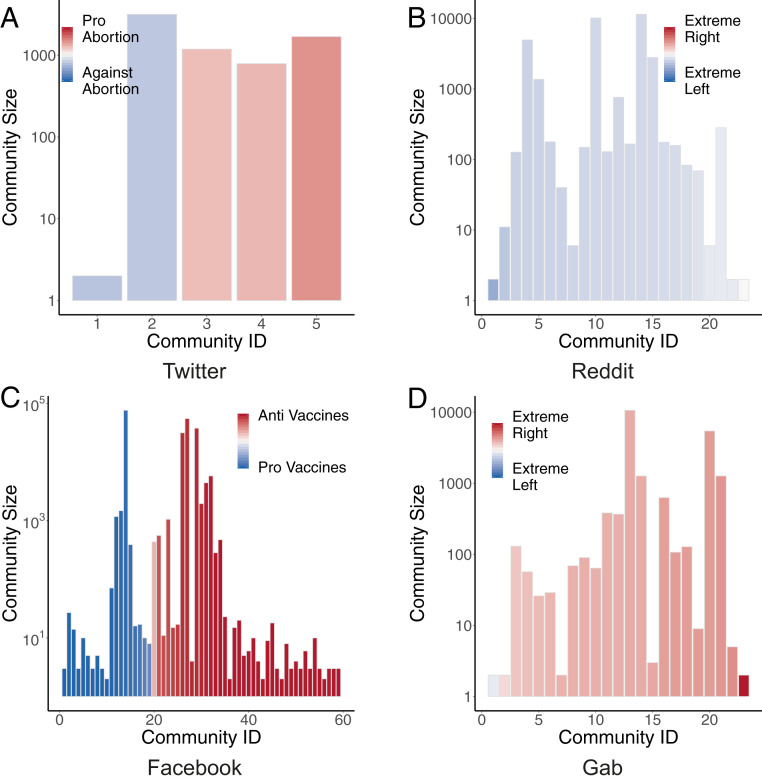
- Across the four platforms, “aggregation in homophilic clusters of users dominates online dynamics,” but platforms differ: Facebook and Twitter show homophilic clustering, while Reddit and Gab form a single community biased left or right rather than two opposing clusters.
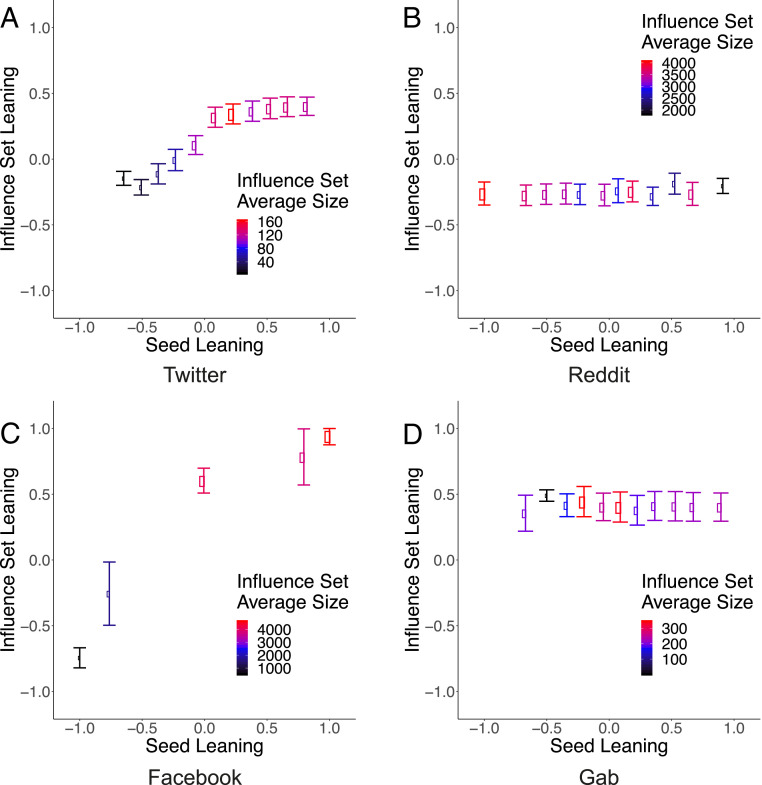
- Information diffusion is biased toward like-minded users on Facebook and Twitter, where the average leaning of a user’s influence set approximates the seed user’s leaning; on Reddit and Gab, the average leaning of the influence set does not depend on the seed user’s leaning.
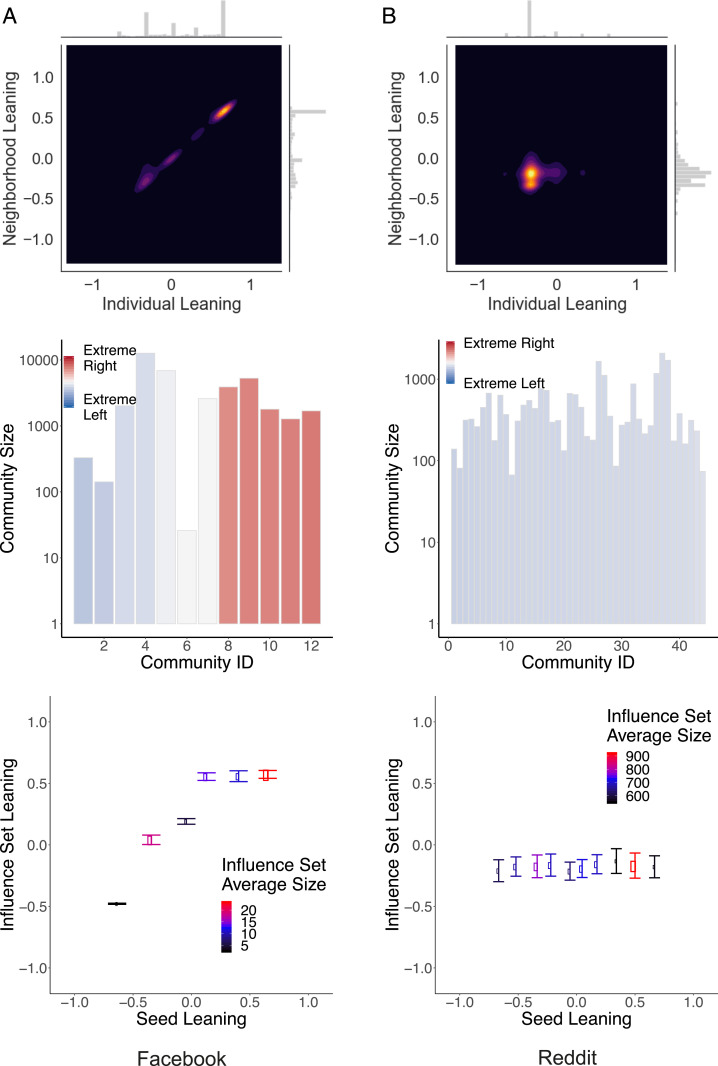
- In a direct comparison on news consumption, Facebook shows higher segregation than Reddit across all three measures: user-neighbor leaning correlation, community leaning, and SIR influence-set leaning.
- The study analyzes more than 100 million unique pieces of content and more than 1 million active users, with news outlets labeled using 2,190 media sources from Media Bias/Fact Check.
Methods
- Comparative analysis of Gab, Facebook, Reddit, and Twitter datasets on controversial topics including gun control, Obamacare, abortion, vaccines, science versus conspiracy, and news; main selected datasets were Abortion (Twitter), Vaccines (Facebook), Politics (Reddit), and Gab as a whole.
- Echo chambers were operationalized through two dimensions: homophily in interaction networks and bias in information diffusion toward like-minded peers. User leaning was inferred from linked news outlets, likes, or content, and interaction networks were built from follows, comments, cocomments, submissions, or replies depending on platform.
- Analyses included correlation between user leaning and average neighbor leaning, Louvain community detection, and SIR simulations to measure influence sets; SIR recovery rate was fixed at ν = 0.2, with dataset-specific infection ratios.
Limitations
- The paper states that the next envisioned step is to address the temporal dimension of echo chambers and how platform-specific social feedback mechanisms impact their formation.
- Evident from the text: leaning coverage varies strongly by platform, from 0.90–1.00 for Twitter/Facebook datasets to 0.15–0.20 for Reddit and 0.13 for Gab, so leaning-based conclusions for Reddit and Gab rest on a small classified fraction of users.
- Evident from the text: datasets differ by platform and topic, and the direct cross-platform comparison on a common topic is limited to news consumption on Facebook and Reddit; the authors also note that Reddit/Gab results could mean either no echo-chamber effect or observation inside a single echo chamber.
Model-written summary. Check it against the paper before relying on it.
Integrity signals
Registry
Cites
Statistics
Figures
Verification
Claims the paper makes
8 Valid · 1 Not valid · 7 Not checked · 38 Own results and interpretations
The cited sources support only part of this claim — read each source’s verdict below.
In the paper
“Selective exposure (19) and confirmation bias (20) (i.e., the tendency to seek information adhering to preexisting opinions) may explain the emergence of echo chambers on social media (1, 17, 21, 22).”
§ The echo chamber effect on social media > Abstract
What the sources say
- Supportedcites [1] M. Del Vicario, The spreading of misinformation online. Proc. Natl. Acad. Sci. U.S.A. 113, 554– 559 (2016). 26729863 PMC4725489 source
The Abstract says selective exposure generates homogeneous clusters, which it calls echo chambers. The Results and Discussion section says users select content matching a narrative and suggests confirmation bias determines echo-chamber formation. Page numbers are not provided in our copy. (LLM, conf=0.94)
- Partly supportedcites [17] K. Garimella, G. De Francisci Morales, A. Gionis, M. Mathioudakis, “ The effect of collective attention on controversial debates on social media” in WebSci ’17: 9th International ACM Web Science Conference (Association for Computing Machinery, New York, NY, 2017), pp. 43– 52. sourceExperimental — accuracy not yet measured
The Introduction reports that users mostly interact within their own side and endorse opinions from that side’s core. Related Work reports that users spread information faster when it agrees with their position. These passages are consistent with selective exposure, but the paper does not identify confirmation bias or establish that either tendency causes echo chambers to emerge. (LLM, conf=0.82)
- Supportedcites [21] M. Del Vicario, Echo chambers: Emotional contagion and group polarization on Facebook. Sci. Rep. 6, 37825 (2016). 27905402 PMC5131349 source
The Abstract says social-media disintermediation encourages users to select information that fits their beliefs (confirmation bias) and form like-minded groups (echo chambers). The Conclusions likewise describe Facebook as suited to the emergence of echo chambers. This supports the proposed explanation, without claiming it is the only cause. (LLM, conf=0.93)
- Supportedcites [22] A. Bessi, Science vs conspiracy: Collective narratives in the age of misinformation. PloS One 10, e0118093 (2015). 25706981 PMC4338055 source
The Introduction (page unavailable) says users consuming opposing information tend to form isolated clusters and describes polarized users whose likes are almost exclusively on one category of pages. The Conclusions (page unavailable) link information evaluation to existing beliefs. Together, these passages support the hedged explanation that selective exposure and confirmation bias may contribute to echo chambers. (LLM, conf=0.86)
hedgedstates a possible cause- Asserted: passes — The authors put it forward as true.
- Checkable: passes — It can be checked against evidence.
- Load-bearing: passes — The paper’s conclusions depend on it.
- Based: passes — The paper gives a reason why it holds.
- Supported
The cited sources support only part of this claim — read each source’s verdict below.
In the paper
“Our attention span remains limited (9, 10), and feed algorithms might limit our selection process by suggesting contents similar to the ones we are usually exposed to (11–13).”
§ The echo chamber effect on social media > Abstract
What the sources say
- Not checked — no full text of the sourcecites [11] A. L. Schmidt, Anatomy of news consumption on Facebook. Proc. Natl. Acad. Sci. U.S.A. 114, 3035– 3039 (2017). 28265082 PMC5373354 source
- Partly supportedcites [12] M. Cinelli, The COVID-19 social media infodemic. Sci. Rep. 10, 16598 (2020). 33024152 PMC7538912 sourceExperimental — accuracy not yet measured
The Introduction (page not provided) says algorithms take users’ preferences and attitudes into account when promoting content, and that users tend to seek information aligned with their worldviews. It does not say that feed algorithms suggest content similar to what users have previously seen or thereby limit their selection. (LLM, conf=0.82)
- Not checked — no full text of the sourcecites [13] E. Bakshy, S. Messing, L. A. Adamic, Exposure to ideologically diverse news and opinion on Facebook. Science 348, 1130– 1132 (2015). 25953820 source
hedgedstates a possible cause- Asserted: passes — The authors put it forward as true.
- Checkable: passes — It can be checked against evidence.
- Load-bearing: passes — The paper’s conclusions depend on it.
- Based: passes — The paper gives a reason why it holds.
Every source the paper cites for this claim was checked and supports it.
In the paper
“Online polarization, for instance, may foster misinformation spreading (1, 8).”
§ The echo chamber effect on social media > Abstract
What the sources say
- Supportedcites [1] M. Del Vicario, The spreading of misinformation online. Proc. Natl. Acad. Sci. U.S.A. 113, 554– 559 (2016). 26729863 PMC4725489 source
The Significance section says that homogeneity and polarization are main determinants of rumor-cascade size. The Conclusions also link polarized communities with the proliferation of narratives fueled by unsubstantiated rumors, supporting the hedged claim that online polarization may foster misinformation spreading. (LLM, conf=0.91)
- Supportedcites [8] M. D. Vicario, W. Quattrociocchi, A. Scala, F. Zollo, Polarization and fake news: Early warning of potential misinformation targets. ACM Trans. Web 13, 1– 22 (2019). source
The Introduction states that misinformation spreading on social media is directly related to increasing user polarization and segregation. This supports the citing sentence’s hedged claim that online polarization may foster misinformation spreading. (LLM, conf=0.94)
hedgedstates a possible cause- Asserted: passes — The authors put it forward as true.
- Checkable: passes — It can be checked against evidence.
- Load-bearing: unclear — It is unclear whether the paper’s conclusions depend on it.
- Based: passes — The paper gives a reason why it holds.
- Supported
Every source the paper cites for this claim was checked and supports it.
In the paper
“In network terms, this translates into a node i with a given leaning xi more likely to be connected with nodes with a leaning close to xi (18).”
§ The echo chamber effect on social media > Comparative Analysis > Polarization and Homophily in the Interaction Networks.
What the sources say
- Supportedcites [18] W. Cota, S. C. Ferreira, R. Pastor-Satorras, M. Starnini, Quantifying echo chamber effects in information spreading over political communication networks. EPJ Data Sci. 8, 35 (2019). source
The paper’s “Topological evidence of echo chambers” section says that a node with political position Pᵢ is connected with nodes whose positions are close to Pᵢ. It also reports a strong correlation between users’ positions and their neighbors’ average positions, supporting the citing sentence’s probabilistic paraphrase. (LLM, conf=0.94)
hedgedstates an association- Asserted: passes — The authors put it forward as true.
- Checkable: passes — It can be checked against evidence.
- Load-bearing: passes — The paper’s conclusions depend on it.
- Based: passes — The paper gives a reason why it holds.
- Supported
A result the paper reports from its own data — it cites no other source for it, so there is none to check. The quote shows it is in the paper.
In the paper
“Furthermore, the almost total absence of communities with leaning very close to 0 confirms the polarized state of the systems.”
§ The echo chamber effect on social media > Comparative Analysis > Polarization and Homophily in the Interaction Networks.
boostedstates a cause- Asserted: passes — The authors put it forward as true.
- Checkable: passes — It can be checked against evidence.
- Load-bearing: passes — The paper’s conclusions depend on it.
- Based: passes — The paper gives a reason why it holds.
- Rests on 4 assumptions not shown here.
32 more claims
Create a free account to see all 54 claims and to verify the 2 references still open.
- It may state two separate claims as one. 9
- Probably not a substantial claim. 9
Claims other papers make about this one
Each is checked against this paper’s own text: does it say what the citing paper says it does?
The source backs part of the claim, not all of it — or backs it for a different population, condition or comparison.
In the citing paper
“engagement with political content online is generally associated with high levels of ingroup bias; that is, it is far more likely to be shared within the political ingroup than in the outgroup (18, 19, 16).”
From Troll and divide: the language of online polarization (2022) · cites this paper as [16]
Experimental — accuracy not yet measuredThe source backs part of the claim, not all of it — or backs it for a different population, condition or comparison.
In the citing paper
“This challenge is reflected in research on”
From Machine culture (2023) · cites this paper as [142]
Experimental — accuracy not yet measuredThe source backs part of the claim, not all of it — or backs it for a different population, condition or comparison.
In the citing paper
“Thus, combating social media's echo chamber effect through an active exposure to diverse perspectives and networks also represents a viable individual-level strategy for addressing the deepfake problem (Cinelli et al., 2021; Gillani et al., 2018).”
From Deepfakes: Deceptions, mitigations, and opportunities (2023) · cites this paper as Cinelli et al., 2021
Experimental — accuracy not yet measuredThe source backs part of the claim, not all of it — or backs it for a different population, condition or comparison.
In the citing paper
“Even without being designed to shift opinions, it has been found that algorithms may contribute to political polarization by reinforcing divisive opinions [9, 24, 32].”
From Co-Writing with Opinionated Language Models Affects Users’ Views (2023) · cites this paper as [32]
Experimental — accuracy not yet measuredThe source backs part of the claim, not all of it — or backs it for a different population, condition or comparison.
In the citing paper
“On Reddit, studies find minimal evidence of echo chambers due to platform features encouraging cross-cutting exposure [17,61,63].”
From A systematic review of echo chamber research: comparative analysis of conceptualizations, operationalizations, and varying outcomes (2025) · cites this paper as [17]
Experimental — accuracy not yet measured
5 more claims about this paper
Create a free account to see every claim other papers make about this one.
Citations
Cites
Fast unfolding of communities in large networks
Blondel, V. D., Guillaume, J.-L., Lambiotte, R., & Lefebvre, E. (2008) · Journal of Statistical Mechanics: Theory and Experiment · doi:10.1088/1742-5468/2008/10/p10008 · Cited by 21,424 · cited 1×
“We detected communities by applying the Louvain algorithm (41), removing singleton communities with only one user.”
MethodThe spread of true and false news online
Vosoughi, S., Roy, D., & Aral, S. (2018) · Science · doi:10.1126/science.aap9559 · Cited by 8,847 · cited 1×
“A recent study (7) limited to Twitter claimed that fake news travels faster than real news.”
BackgroundConfirmation Bias: A Ubiquitous Phenomenon in Many Guises
Nickerson, R. S. (1998) · Review of General Psychology · doi:10.1037/1089-2680.2.2.175 · Cited by 7,267 · cited 1×
“Selective exposure (19) and confirmation bias (20) (i.e., the tendency to seek information adhering to preexisting opinions) may explain the emergence of echo chambers on social media (1, 17, 21, 22).”
BackgroundInfectious Diseases of Humans: Dynamics and Control
Anderson, R. M., & May, R. M. (1991) · doi:10.1093/oso/9780198545996.001.0001 · Cited by 6,179
Lazer, D. M. J., Baum, M. A., Benkler, Y., Berinsky, A. J., Greenhill, K. M., Menczer, F., Metzger, M. J., Nyhan, B., Pennycook, G., Rothschild, D., et al. (2018) · Science · doi:10.1126/science.aao2998 · Cited by 4,160
Degroot, M. H. (1974) · Journal of the American Statistical Association · doi:10.1080/01621459.1974.10480137 · Cited by 4,004 · cited 1×
“For instance, if opinions are assumed to be embedded in a onedimensional space (38), x ∈ [−1,+1] without loss of generality, as usual for controversial topics, then polarization is characterized by two well-separated peaks in P(x ), for positive and negative opinions.”
BackgroundExposure to ideologically diverse news and opinion on Facebook
Bakshy, E., Messing, S., & Adamic, L. A. (2015) · Science · doi:10.1126/science.aaa1160 · Cited by 3,245 · cited 2×
“Our attention span remains limited (9, 10), and feed algorithms might limit our selection process by suggesting contents similar to the ones we are usually exposed to (11–13).”
BackgroundThe spreading of misinformation online
Del Vicario, M., Bessi, A., Zollo, F., Petroni, F., Scala, A., Caldarelli, G., Stanley, H. E., & Quattrociocchi, W. (2016) · Proceedings of the National Academy of Sciences · doi:10.1073/pnas.1517441113 · Cited by 2,407 · cited 2×
“, the tendency to seek information adhering to preexisting opinions) may explain the emergence of echo chambers on social media (1, 17, 21, 22).”
BackgroundSelf-citationThe COVID-19 social media infodemic
Cinelli, M., Quattrociocchi, W., Galeazzi, A., Valensise, C. M., Brugnoli, E., Schmidt, A. L., Zola, P., Zollo, F., & Scala, A. (2020) · Scientific Reports · doi:10.1038/s41598-020-73510-5 · Cited by 2,313
Self-citationFilter Bubbles, Echo Chambers, and Online News Consumption
Flaxman, S., Goel, S., & Rao, J. M. (2016) · Public Opinion Quarterly · doi:10.1093/poq/nfw006 · Cited by 1,992
Research works printed but not linked: 2
- R. M. Anderson, R. M. May, Infectious Diseases in Humans (Oxford University Press, Oxford, United Kingdom, 1992).
- M. Cinelli, G. De Francisci Morales, A. Galeazzi, W. Quattrociocchi, M. Starnini, The echo chamber effect on social media. Open Science Framework. https://osf.io/x92br/?view_only=cdcc87d30e404e01b6ae316db15e3375. Deposited 22 January 2021. PMC7936330 33622786
Cited by
Items 701–800 of 2,063
[De]Politicizing the Pandemic: Visually Communicating Digital Public Sociology
Robinson, L., Trammel, J. M., & Moles, K. (2023) · American Behavioral Scientist · doi:10.1177/00027642231156769 · Cited by 4
“In the explanatory Figure 2 “Annotated Twitter Network Visualization of #mask, #masks,” we see how to understand key elements of this visualization.”
InfluentialMaximizing Neutrality in News Ordering
Advani, R., Papotti, P., & Asudeh, A. (2023) · ACM SIGKDD Conference on Knowledge Discovery and Data Mining (KDD) · doi:10.1145/3580305.3599425 · Cited by 3
“In particular, content spread in online social networks is affected by social bubbles and echo chambers [19, 21, 34, 74, 91], which significantly bias the spread of information.”
BackgroundCorrelates of COVID-19 Preventative Behaviors before and after Vaccination Availability
Kimbler, K. J., Gromer, C., Ayala, M., & Casey, B. (2023) · Behavioral Sciences · doi:10.3390/bs13060501 · Cited by 6
“Recent research demonstrates that many of the most prevalent social media platforms consistently segregate their users and the information they are exposed to biased on their beliefs, resulting in an ‘echo chamber’ that could strengthen existing tendencies related to confirmation bias [40].”
BackgroundMedia preference increases polarization in an agent-based election model
Benedetto, A., Wieners, C., Dijkstra, H. A., & Stoof, H. T. C. (2023) · Physica A Statistical Mechanics and its Applications · doi:10.1016/j.physa.2023.129014 · Cited by 6
A multilayered graph-based framework to explore behavioural phenomena in social media conversations
Blanco, G., & Lourenço, A. M. G. (2023) · International Journal of Medical Informatics · doi:10.1016/j.ijmedinf.2023.105236 · Cited by 7
The Human Governance Problem: Complex Systems and the Limits of Human Cognition
Atreides, K. (2023) · Filozofia i Nauka · doi:10.37240/fin.2023.11.1.4 · Cited by 4
“However, neither the Tool AI nor their selected representative are inherently qualified to give policy advice, nor can they be said to ethically represent a captive audience who has been fed a heavily restricted diet of polarizing information (Cinelli et al., 2021).”
Backgroundde Caria, R. (2023) · International Review of Law Computers & Technology · doi:10.1080/13600869.2023.2286559 · Cited by 5
How perceived coercion polarizes unvaccinated people: The mediating role of conspiracy beliefs
Wang, H., van Prooijen, J., & Lange, P. A. M. V. (2024) · Journal of Health Psychology · doi:10.1177/13591053241238126 · Cited by 6
“Besides, people tend to expose themselves to information and people that validate their existing beliefs, contributing to group polarization (i.e. echo chambers; Choi et al., 2020; Cinelli et al., 2021; Del Vicario et al., 2016).”
A Topology-Based Approach for Predicting Toxic Outcomes on Twitter and YouTube
Etta, G., Cinelli, M., Marco, N. D., Avalle, M., Panconesi, A., & Quattrociocchi, W. (2024) · IEEE Transactions on Network Science and Engineering · doi:10.1109/tnse.2024.3398219 · Cited by 13
“potential benefits, social media are also considered responsible for a number of issues, such as: fostering the spreading of online misinformation [6], the emergence of echo chambers [7], and increasing intolerance expressed in online debates [8], [9], [10].”
BackgroundSelf-citationSocial media and cost of debt financing: Evidence from stock forum text analysis
Meng, Q., Mo, S., Quan, X., & Zhang, J. H. (2024) · The Journal of Financial Research · doi:10.1111/jfir.12413 · Cited by 4
A Consumer Vulnerability Perspective on State-Sponsored Propaganda
Enriques, S., & Peterson, M. (2024) · Journal of Macromarketing · doi:10.1177/02761467241256578 · Cited by 6
“Some research fi nds that an echo chamber effect ampli fi es the proliferation of false information and suppresses alternative views (Cinelli et al. 2021).”
Wang, Z., Luo, Y., Xuan, C., & Jindong, J. (2024) · BMC Psychology · doi:10.1186/s40359-024-01858-8 · Cited by 30
“1 Conceptual Model of Irrational religious orientations creating an ‘Echo Chamber Effect’ and hindering critical thinking [42–43].”
BackgroundTanihara, T., Irihara, M., Murayama, T., Yoshida, M., Toriumi, F., & Miyazaki, K. (2024) · PLoS ONE · doi:10.1371/journal.pone.0306104 · Cited by 4
CEO social media celebrity status and credit rating assessment
Fang, Y., Bao, X. R., Sun, B., & Lau, R. Y. K. (2024) · Internet Research · doi:10.1108/intr-02-2023-0084 · Cited by 6
mRNA Vaccine Hesitancy: Spreading Misinformation Through Online Narratives
Sisco, H. F., & Brummette, J. (2024) · Journal of Health Communication · doi:10.1080/10810730.2024.2379954 · Cited by 7
Transformer-Based Quantification of the Echo Chamber Effect in Online Communities
Ghafouri, V., Alatawi, F., Karami, M., Such, J. M., & Suárez‐Tangil, G. (2024) · Proceedings of the ACM on Human-Computer Interaction · doi:10.1145/3687006 · Cited by 13
“User’s exposure or user’s general belief is typically modeled by the political leaning of the user’s neighborhood [18] which is estimated from follow networks representing the connections users have with each other.”
InfluentialLagrange, B. (2025) · Media and Communication · doi:10.17645/mac.8591 · Cited by 7
“Meaning, the content users see on social media becomes gradually less diverse over time (filter bubble; Leysen et al., 2022; Pariser, 2011) and people generally only see content that reflects or reinforces their own preconceived notions and ideas (echo chamber; Cinelli et al., 2021; Nguyen, 2018).”
Mapping the global election landscape on social media in 2024
Pecile, G., Marco, N. D., Cinelli, M., & Quattrociocchi, W. (2025) · PLoS ONE · doi:10.1371/journal.pone.0316271 · Cited by 13
“This behavior may fosters the emergence of homophilic communities, also know as echo-chambers [8], which significantly influence belief formation and communication meth-ods [12], especially during delicate periods such as elections.”
InfluentialSelf-citationCriticism goes social: exploring public architectural criticism through architecture awards
Tempestini, M. (2025) · International Journal of Architectural Research Archnet-IJAR · doi:10.1108/arch-04-2024-0165 · Cited by 8
CoDÆN: Benchmarks and Comparison of Evolutionary Community Detection Algorithms for Dynamic Networks
Paoletti, G., Gioacchini, L., Mellia, M., Vassio, L., & Almeida, J. M. (2025) · ACM Transactions on the Web · doi:10.1145/3718988 · Cited by 11
“…networks [19, 77], helps in studying patterns of relationships and influence among users, which is crucial for understanding how online communities clustering nodes that are frequently visited together, and it offers an alternative that emphasizes the dynamism of information flow over connectivity.”
Social Media as a Setting for Accounting Research
Booker, A., Curtis, A., & Ke, B. (2025) · Journal of Financial Reporting · doi:10.2308/jfr-2023-008 · Cited by 7
Weaponizing Disinformation Against Critical Infrastructures
Alvisi, L., Bianchi, J., Tibidò, S., et al. (2025) · Lecture notes in computer science · doi:10.1007/978-3-031-82362-6_23 · Cited by 4
Jonsson, J., & Astner, H. (2025) · Journal of Enterprising Communities People and Places in the Global Economy · doi:10.1108/jec-06-2024-0114 · Cited by 4
The Covid-19 Information Void: How Pro-Vaccination Voices Lost the Narrative in South Africa
Morselli, D., Beramendi, M., Torres, A. M., Ohamadike, N., Sepahpour‐Fard, M., & Schuld, M. (2025) · Media and Communication · doi:10.17645/mac.10462 · Cited by 5
“Our findings align with research demonstrating that exposure to misinformation significantly reduces the likelihood of vaccination (Cinelli et al., 2021; Gkinopoulos et al., 2022; Wilson & Wiysonge, 2020).”
Ogunlana, Y. S., & Omachi, A. (2024) · International Journal of Scientific Research in Humanities and Social Sciences · doi:10.32628/ijsrssh243668 · Cited by 9
Phillips, B., & Bauch, C. T. (2021) · Journal of Theoretical Biology · doi:10.1016/j.jtbi.2021.110881 · Cited by 8
"Don’t Downvote A\$\$\$\$\$\$s!!": An Exploration of Reddit’s Advice Communities
Cannon, E., Crouse, B., Ghosh, S., Rihn, N., & Chua, K. (2022) · Hawaii International Conference on System Sciences (HICSS) · doi:10.24251/hicss.2022.363 · Cited by 6
“Cinelli et al. (2021) [7] explored the frequency of echo chambers across different social media platforms, finding that Facebook and Twitter are more prone to siloed information exchanges.”
Youth Bulge in a Pandemic-Stricken World: Social-Psychology and the Radicalisation Concern
Batool, M. (2021) · Advances in religious and cultural studies (ARCS) book series · doi:10.4018/978-1-7998-8911-3.ch003 · Cited by 4
Lotto, M., Jorge, O. S., Menezes, T. S., Ramalho, A. M., de Oliveira, T. M., Bevilacqua, F., & Cruvinel, T. (2022) · JMIR Research Protocols · doi:10.2196/39133 · Cited by 5
“Concurrently, digital users tend to interact with posts associated with their interests uncritically, reinforcing the emergence of echo chambers on social media [13-15].”
Public Authorities as a Target of Disinformation
Koistinen, P., Alaraatikka, M., Sederholm, T., Savolainen, D., Huhtinen, A., & Kaarkoski, M. (2022) · European Conference on Cyber Warfare and Security · doi:10.34190/eccws.21.1.371 · Cited by 7
Chemophobia and passion: why chemists should desire Marcel Proust
Chalupa, R., & Nesměrák, K. (2022) · Monatshefte für Chemie - Chemical Monthly · doi:10.1007/s00706-022-02945-5 · Cited by 9
Diffusion dynamics of competing information on networks
Kobayashi, T. (2022) · Physical review. E · doi:10.1103/physreve.106.034303 · Cited by 5
Kang, J., Kim, J., Kim, T., Song, H., & Han, J. (2022) · Cyberpsychology Behavior and Social Networking · doi:10.1089/cyber.2022.0052 · Cited by 4
“…homophilic user networks are useful to analyze vulnerability to psychological distress 36 and information diffusion exists in these networks, 37 this would likely support an advanced learning model that helps to stratify the general population according to stress-related mechanisms and to…”
Digital corporate communication and co-productive citizen engagement
Homont, L. P. P., Canel, M. J., & Luoma‐aho, V. (2023) · Edward Elgar Publishing eBooks · doi:10.4337/9781802201963.00041 · Cited by 6
Cultural Evolution, Disinformation, and Social Division
Bentley, R. A., Horne, B. D., Borycz, J., Carrignon, S., Shteynberg, G., Vidiella, B., Valverde, S., & O’Brien, M. J. (2023) · Adaptive Behavior · doi:10.1177/10597123231186432 · Cited by 11
“The impact of this “ echo chamber ” effect (Cinelli et al., 2021), however, is debated (e.g., Dubois & Blank 2017).”
BackgroundSpennemann, D. H. R. (2023) · Knowledge · doi:10.3390/knowledge3030022 · Cited by 4
Lösch, L., Zuiderent‐Jerak, T., Kunneman, F., Syurina, E. V., Bongers, M. E. J., Stein, M. L., Chan, M., Willems, W., & Timen, A. (2023) · Journal of Medical Internet Research · doi:10.2196/44461 · Cited by 8
“Experiential knowledge about the subject is thus available, albeit scattered throughout media platforms and obfuscated by echo chamber characteristics of other posts on social media [12,13].”
Pandemic Culture Wars: Partisan Differences in the Moral Language of COVID-19 Discussions
Rao, A., Guo, S., Wang, S. Y. N., Morstatter, F., & Lerman, K. (2023) · IEEE International Conference on Big Data (BigData) · doi:10.1109/bigdata59044.2023.10386084 · Cited by 19
“A number of methods identify the political ideology of social media users, with recent works [14], [41]–[43] leveraging URLs that users share in tweets.”
MethodSibrian, N., Alfaro, A., & Núñez, J. C. (2024) · Revista Latina de Comunicación Social · doi:10.4185/rlcs-2024-2226 · Cited by 13
Lying for Viewers: Commingled Partisan Falsehoods Increase Viewing and Sharing of News Media
Seol, S., Mejia, J., & Dennis, A. R. (2024) · MIS Quarterly · doi:10.25300/misq/2023/17928 · Cited by 11
Liu, J., Wang, T., Shen, D., Zhang, Z., Yao, F., & He, R. (2021) · International Conference on Big Data and Information Analytics (BigDIA) · doi:10.1109/bigdia53151.2021.9619747 · Cited by 6
Critchfield, T. S., & Dixon, D. R. (2022) · Behavior Analysis in Practice · doi:10.1007/s40617-022-00725-5 · Cited by 4
The Constructivism of Social Discourse: Toward a Contemporaneous Understanding of Knowledge
de Soto, J. A. (2022) · Open Journal of Philosophy · doi:10.4236/ojpp.2022.123025 · Cited by 4
“Social “network’s topology can reveal echo chambers, where users are surrounded by peers with similar leanings, and thus they get exposed, with a higher probability, to similar contents” (Cinelli et al., 2021: p. 3).”
BackgroundInfluentialPartisan biases in social information usePreprint
Molleman, L., Gradassi, A., Sultan, M., & van den Bos, W. (2021) · PsyArXiv (OSF Preprints) · doi:10.31234/osf.io/uctxa · Cited by 4
“, sharing online news items that cast their favored party in a positive light [13,14,51]), and repudiate discordant views.”
BackgroundMainstream media use in far-right online ecosystems
Peucker, M., Fisher, T. J., & Davey, J. (2022) · doi:10.56311/gwlu8673 · Cited by 4
“…research on Gab describes the platform as a ‘right-leaning echo-chamber’ and ‘very politically oriented system that hosts banned users from other social networks, some of them due to possible cases of hate speech and association with extremism’ (Lima et al. 2018:1; see also Cinelli et al. 2021).”
BackgroundIs Fraud Contagious? Social Connections and the Looting of COVID Relief ProgramsPreprint
Griffin, J. M., Kruger, S. A., & Mahajan, P. (2023) · SSRN Electronic Journal · doi:10.2139/ssrn.4599654 · Cited by 4
Algorithms vs. Peers: Shaping Engagement with Novel ContentPreprint
Huang, S., & Ji, Y. (2025) · SSRN Electronic Journal · doi:10.2139/ssrn.4860857 · Cited by 6
Ruschemeier, H., & Bareis, J. (2024) · SSRN Electronic Journal · doi:10.2139/ssrn.4876206 · Cited by 6
Ahmed, M. (2025) · Preprints.org · doi:10.20944/preprints202505.1380.v1 · Cited by 3
Artificial Intelligence Chatbots Mimic Human Collective Behaviour
He, J., Wallis, F., Gvirtz, A., & Rathje, S. (2024) · doi:10.21203/rs.3.rs-3096289/v2 · Cited by 4
Verma, A. K., Sharma, A., Sharma, A. K., Prakash, A., & Das, A. (2023) · Journal of Content Community and Communication · doi:10.31620/jccc.06.23/03 · Cited by 7
The development of affective preferences and beliefs: A processing fluency framework
Reber, R., Richter, J., & Prenevost, M. H. (2024) · Developmental Review · doi:10.1016/j.dr.2024.101148 · Cited by 6
A semantic embedding space based on large language models for modelling human beliefs
Lee, B., Aiyappa, R., Ahn, Y., Kwak, H., & An, J. (2025) · Nature Human Behaviour · doi:10.1038/s41562-025-02228-z · Cited by 21
Quantifying Influencer Impact on Affective Polarization
Rashid, R., Melton, J., Ghorbani, O., Krishnan, S., Reid, S. E., & Terejanu, G. (2024) · International Conference on Machine Learning and Applications · doi:10.1109/icmla61862.2024.00174 · Cited by 10
“Echo chambers, a topic of much debate, reinforce ideological conformity and limit exposure to opposing views, which can intensify polarization [12].”
den Hond, F., & Vesa, M. J. (2025) · Organization · doi:10.1177/13505084251331396 · Cited by 4
Weisskirch, R. S. (2026) · Social Science Computer Review · doi:10.1177/08944393251337016 · Cited by 3
“Social media, with their algorithms to direct content that targets the users ’ demographics and interests, may provide adolescents with access to behaviors and attitudes of virtual “ peers ” (Cinelli et al., 2021).”
Aghajani, M. J., Maye, E., Burrell, K. L., Kok, C., & Frew, J. W. (2025) · Clinical and Experimental Dermatology · doi:10.1093/ced/llaf236 · Cited by 6
Search or Scroll: How Credibility versus Likability Premiums Shape Consumers’ Following Decisions
Shalev, E., Morvinski, C., Shoham, M., & Kyung, E. J. (2025) · Journal of Consumer Research · doi:10.1093/jcr/ucaf038 · Cited by 9
Unveiling Emotional Signature in Conspiracy Topics on Social Media Through Vector Analysis
Lomasto, L., Lettieri, N., Malandrino, D., Mosca, V., & Zaccagnino, R. (2025) · Lecture notes in computer science · doi:10.1007/978-3-031-97144-0_8 · Cited by 3
Cima, L., Tessa, B., Trujillo, A., Cresci, S., & Avvenuti, M. (2025) · Online Social Networks and Media · doi:10.1016/j.osnem.2025.100320 · Cited by 21
Emotionality in Political Social Media Communications: The Moderating Role of Audience Diversity
Fossen, B. L., & Schweidel, D. A. (2025) · Information Systems Research · doi:10.1287/isre.2022.0064 · Cited by 5
Ru, X., Li, Z., Shang, Q., Liu, L., & Gong, B. (2025) · Journal of theoretical and applied electronic commerce research · doi:10.3390/jtaer20030189 · Cited by 4
Liu, X., Shen, W., Hu, X.-Y., & Lu, F. (2025) · The American Journal of Psychology · doi:10.5406/19398298.138.1.03 · Cited by 3
Carolan, M. (2025) · Agriculture · doi:10.3390/agriculture15161749 · Cited by 3
Post-Kamusal Çağda Bilgi İktidarı: Algoritmik Filtreleme ve Ortak Akıl Krizi
Küçük, A. (2025) · İmgelem · doi:10.53791/imgelem.1708061 · Cited by 6
Design for Hope: Cultivating Deliberate Hope in the Face of Complex Societal Challenges
Kim, J., Liu, J., Popowski, L., Pyle, C., Arif, A., Hayes, G. R., Hiniker, A., Ju, W. G., Mueller, F., Shen, H., et al. (2025) · ACM Conference on Computer Supported Cooperative Work (CSCW) · doi:10.1145/3715070.3748287 · Cited by 13
“However, it is now often viewed as irreparably broken, with rising concerns about misinformation [39, 42], youth mental health [26, 30], online abuse [5, 28], and more [11, 41].”
Recoding Reality: A Case Study of YouTube Reactions to Generative AI Videos
Çallı, L., & Çallı, B. A. (2025) · Systems · doi:10.3390/systems13100925 · Cited by 8
From activism to polarization: temporal dynamics of #MeToo politicization on Twitter/X
Suk, J., Zhang, Y., Wang, R., Yang, D., Levin, S. H., Seo, J. M., & Dong, X. (2025) · Information Communication & Society · doi:10.1080/1369118x.2025.2581014 · Cited by 5
“In these environments, due to the public’s limited attention span (Cinelli et al., 2021), only the most committed actors are likely to sustain a given movement after sporadic bursts of public attention (Freelon et al., 2018), with a considerable number of conversations deviating from the substance…”
Howley, S. E., Smythe, T., Diamond, E. P., & Bidwell, D. (2025) · Energy Research & Social Science · doi:10.1016/j.erss.2025.104403 · Cited by 8
Targeted injection attack toward the semantic layer of large language models
Zhang, Y., & Aman, J. (2025) · Frontiers in Computer Science · doi:10.3389/fcomp.2025.1683495 · Cited by 4
Polarization: linking loneliness and social media dependency
Rynarzewska, A. I., Waldsmith, C., & Nikolov, A. N. (2025) · Journal of Services Marketing · doi:10.1108/jsm-08-2025-0508 · Cited by 7
Social media, AI, and the rise of extremism during intergroup conflict
Lavie-Driver, N. I., & van der Linden, S. (2025) · Frontiers in Social Psychology · doi:10.3389/frsps.2025.1711791 · Cited by 11
Tam, V. H., Trana, R., Nieto‐Argüello, A., Olasubulumi, O.-O., Babity, S., Skripka, A., Vetrone, F., Brambilla, D., & Cerruti, M. (2025) · Small · doi:10.1002/smll.202513138 · Cited by 3
Fuse-MD: A culturally-aware multimodal model for detecting misogyny memes
Ponnusamy, R., Saranya, R., Sivagnanam, B., Kizhakkeparambil, A., Sharma, D., Buitelaar, P., & Chakravarthi, B. R. (2026) · Natural Language Processing Journal · doi:10.1016/j.nlp.2026.100197 · Cited by 4
Mubarak, F. (2026) · Journal of Information Communication and Ethics in Society · doi:10.1108/jices-08-2025-0212 · Cited by 11
Zhang, J., Ren, L., Wu, Y., Shi, Y., & Liu, J. (2026) · Frontiers in Psychology · doi:10.3389/fpsyg.2026.1763608 · Cited by 4
“At the PSR level, it is recommended to help learners break through information silos and expand cognitive boundaries through exposure to diverse content (Cinelli et al., 2021).”
Carter, A., Gracey, F., Moody, J., Ovens, A., & Chatburn, E. (2026) · Journal of Social Media Research · doi:10.29329/jsomer.84 · Cited by 7
“…processes align with theories of selective exposure and confirmation bias, which suggest that individuals preferentially engage with content that confirms their existing beliefs, thereby reinforcing misinformation within algorithmically curated platforms (Cinelli et al., 2021; Nickerson, 1998).”
United or Divided? A Polarized Society’s Response to War
Feinstein, Y., & Ben-David, G. (2026) · Public Opinion Quarterly · doi:10.1093/poq/nfag014 · Cited by 3
“…social media influencers, and algorithms create echo chambers that fuel fear and hatred of ethnic, racial, religious, or ideological “others” (Bail et al. 2018; Iyengar et al. 2019; Cinelli et al. 2021; Kawakatsu et al. 2021; Tokita, Guess, and Tarnita 2021; Gemici 2025; Nai and Maier 2023).”
But did they get it “right”? Deadly force, body-worn camera footage, and hindsight bias
Roche, S. P., Fenimore, D. M., & Taylor, P. L. (2022) · Policing An International Journal · doi:10.1108/pijpsm-09-2021-0126 · Cited by 5
Il dibattito degli esperti sul Covid-19: sintomi di decivilizzazione
Tipaldo, G., Rocutto, S., Merlo, C., & Bruno, F. (2022) · Quaderni di Sociologia · doi:10.4000/qds.4976 · Cited by 6
The Scary Black Box: AI Driven Recommender Algorithms as The Most Powerful Social Force
Bojić, L., Bulatović, A., & Žikić, S. (2022) · Etnoantropološki problemi / Issues in Ethnology and Anthropology · doi:10.21301/eap.v17i2.11 · Cited by 4
“Finally, different socially important issues, such as elections or pandemics have been polarizing agents in societies across the world (Cinelli et al. 2021).”
BackgroundRationally blind? Rationality polarizes policy support for colour blindness versus multiculturalism
keersmaecker, J. D., Schmid, K., Roets, A., & Goyal, N. (2023) · British Journal of Social Psychology · doi:10.1111/bjso.12667 · Cited by 5
Sosyal Medyada İdeolojik ve Siyasi Kutuplaşma Üzerine Nicel Bir Araştırma
Hazar, Ç. M., Cengiz, M. F., & Özkan, A. V. C. I. (2023) · Middle Black Sea Journal of Communication Studies · doi:10.56202/mbsjcs.1320468 · Cited by 6
Polarisation and Disinformation Content from Spanish Political Actors on Twitter/X
Said-Hung, E., Merino-Arribas, A., & Martínez-Torres, J. (2023) · Communication Today · doi:10.34135/communicationtoday.2023.vol.14.no.2.8 · Cited by 3
Promoting prevention to fake news through an educational software
Santos, V. V. D. A., & Pereira, C. P. (2024) · Journal on Interactive Systems · doi:10.5753/jis.2024.3769 · Cited by 3
“Some probable explanations for this are the speed with which content circulates and the creation of niches of thought [ Shu et al ., 2017; Cinelli et al ., 2021].”
BackgroundHe, Q., Kong, F., Wei, F., Deng, X., Zhang, K., & Qi, Y. (2024) · Environment Development and Sustainability · doi:10.1007/s10668-024-04692-5 · Cited by 5
“In the setting of the DID model, the introduction of ex post control variables may lead to unsatisfied consistency of the estimated coefficients of the model (Cinelli et al., 2021).”
Oswald, L. (2024) · Humanities and Social Sciences Communications · doi:10.1057/s41599-024-03115-0 · Cited by 12
“Studies examining data within one speci fi c platform fi nd robust evidence for homophily in social networks (Cinelli et al., 2021; Cota et al. 2019; Guerrero-Solé and Lopez-Gonzalez 2019; Koiranen et al. 2019; Rivero 2019).”
Ünlü, A., Truong, S., & Kotonen, T. (2024) · International Journal of Data Science and Analytics · doi:10.1007/s41060-024-00571-4 · Cited by 7
Haqbeen, J. A., Sahab, S., & Itō, T. (2024) · Annual International Conference on Digital Government Research · doi:10.1145/3657054.3657093 · Cited by 3
“This concern is further heightened by the use of personalized recommendation algorithms, which can contribute to the filter bubble problem [4, 5, 27].”
BackgroundFrom Feeds to Inboxes: A Comparative Study of Polarization in Facebook and Email News Sharing
Yoganarasimhan, H., & Yakovetskaya, I. (2024) · Management Science · doi:10.1287/mnsc.2023.04134 · Cited by 27
Pedriza, S. B. (2024) · Enrahonar An international journal of theoretical and practical reason · doi:10.5565/rev/enrahonar.1570 · Cited by 8
Petersen, J. E., & Frantz, C. M. (2024) · Sustainability · doi:10.3390/su16177312 · Cited by 4
Bridging Viewpoints in News with Recommender Systems
Jeng, J. H. (2024) · ACM Conference on Recommender Systems (RecSys) · doi:10.1145/3640457.3688008 · Cited by 8
“For our study, we focus on the controversial news topics, such as Gun Control, Abortion and Climate Change [10].”
Political identity and risk politics: Evidence from a pandemic
Raile, E. D., Haines, P. E., Raile, A. N. W., Shanahan, E. A., & Parker, D. (2024) · Risk Analysis · doi:10.1111/risa.17654 · Cited by 5
“These echo chambers in which ideas go unchallenged are also evident in social media (Cinelli et al., 2021; Jamieson & Cappella, 2008).”
"Here's Your Evidence": False Consensus in Public Twitter Discussions of COVID-19 Science
Efstratiou, A., Efstratiou, M., Yudhoatmojo, S. B., Blackburn, J., & Cristofaro, E. D. (2024) · Proceedings of the ACM on Human-Computer Interaction · doi:10.1145/3687010 · Cited by 9
“Online echo chambers [20, 28, 74, 88] may worsen this effect, creating insular environments where individuals feel their views are widely shared [27].”
Characteristics of two polarized groups in online social networks’ controversial discourse
Mahmoudi, A., Jemielniak, D., & Ciechanowski, L. (2024) · Journal of Computational Social Science · doi:10.1007/s42001-024-00350-y · Cited by 6
“Cinelli et al. [25] quantified echo chambers on social media using two main elements: homophily in interaction networks and bias in information diffusion towards like-minded peers.”
Evaluating the relationship between news source sharing and political beliefs
del Pozo, S. M., Pinto, S., Serafino, M., Moss, F., Cicchini, T., Makse, H. A., & Balenzuela, P. (2025) · Scientific Reports · doi:10.1038/s41598-024-84110-y · Cited by 7
“Indeed, the media bias observed in shared news on Twitter has been employed as a proxy for users’ political ideologies [4, 5].”
Salendra, I. W. (2024) · FIKRI Jurnal Kajian Agama Sosial dan Budaya · doi:10.25217/jf.v9i2.4954 · Cited by 15
“Additionally, advancements in technology have triggered an echo effect through the algorithms of social media platforms (Cinelli et al., 2021; Auxier & Vitak, 2019; Kitchens et al., 2020).”
The ‘Spiritual’ and the ‘Religious’ in the Twittersphere: A Topic Model and Semantic Map
Winiger, F., Schneider, G., Goldzycher, J., Neuhold, D., & Peng‐Keller, S. (2025) · Journal of Religion Media and Digital Culture · doi:10.1163/21659214-bja10123 · Cited by 8
Qiu, Z., Chen, Y., Han, H., & Yin, Y. (2025) · Complexity · doi:10.1155/cplx/8884816 · Cited by 4
Metadata
- Authors
- Cinelli, M., De Francisci Morales, G., Galeazzi, A., Quattrociocchi, W., & Starnini, M.
- Affiliations
- Ca' Foscari University of Venice (IT)
- Institute for Scientific Interchange (ISI) Foundation, 10126 Torino, Italy;
- University of Brescia (IT)
- University of Oslo (NO)
- Institute for Scientific Interchange (IT)
- Corresponding author
- Quattrociocchi, Walter
- ORCID
- Venue
- Proceedings of the National Academy of Sciences
- Publisher
- National Academy of Sciences
- Published
- 2021-02-23
- Volume
- 118
- Issue
- 9
- ISSN
- 0027-8424 (ISSN-L)
- 1091-6490
- PMC
- PMC7936330
- OpenAlex
- W3133423348
- Cited by
- 2,092
- References
- 62
- Citations by year
- 2026: 488 · 2025: 516 · 2024: 387 · 2023: 351 · 2022: 256 · 2021: 90
- FWCI
- 375.62
- Type
- journal article
- Language
- en
- Open access
- hybrid
- doi.org
- Licence
- Locations
- Proceedings of the National Academy of Sciences (publishedVersion, cc-by)
- PubMed Central (publishedVersion, cc-by)
- PubMed (publishedVersion)
- UPCommons institutional repository (Universitat Politècnica de Catalunya) (submittedVersion, cc-by)
- IRIS Research product catalog (Sapienza University of Rome) (submittedVersion)
- Padua Research Archive (University of Padova) (submittedVersion, cc-by)
- Topics
- Social Sciences › Sociology and Political Science › Misinformation and Its Impacts
- Social Sciences › Communication › Social Media and Politics
- Physical Sciences › Physics and Astronomy › Statistical and Nonlinear Physics › Complex Network Analysis Techniques
- Keywords
- echo chambers, social media, homophily, information dissemination, algorithmic curation, controversial issues, Facebook, Twitter, Reddit, Gab, news consumption
- MeSH terms
- Abortion, Legal, Gun Violence, Communication, Humans, Politics, Social Change, Vaccination, Bias, Information Dissemination, Narration, Patient Protection and Affordable Care Act, Social Networking, Social Media
About these checks
Registry, retraction, Cites and statistics results are computed, not judged, with one exception: a printed reference that no index lists is read once by a model before it counts as a citation error. Claims are extracted by a model and kept only when their quote appears verbatim in the text; each cited source is then checked, with a model’s help, for whether it says what the claim relies on. Those verdicts can be wrong — read the claim’s quote and the cited source before relying on one.
The claim verdicts this report counts are experimental: their accuracy is not yet measured.
A language model drew the claims from the paper on 2026-10-10, under version 3 of the claim definition (model deepseek-v4.1-flash, prompt extract-v3).
A second model labelled each claim on 2026-10-10 (model jev-1.13-20260917, definition revision gold-guideline-v0.2).
Cited sources are checked with a language model’s help (gpt-6-sol).
Statistics and arithmetic are recomputed, not judged.
Confidence bands are shown only for fields calibrated on our annotated test set. None is calibrated yet, so no band is shown.
What counts as a claim ›How we measure confidence ›How we check this ›
Are you an author, or do you see a problem with this page? Request a review
Data sources
Bibliographic data: Semantic Scholar, OpenAlex, Crossref.
Contains information from the Semantic Scholar Academic Graph Datasets, made available under the ODC Attribution License (ODC-BY 1.0).
Semantic Scholar’s data is described in: Kinney, R., et al. (2023). The Semantic Scholar Open Data Platform. arXiv:2301.10140.
