

The echo chamber effect on social media
Open accessThe DOI matches its Crossref record; 68 of the 69 references it cites were found in a registry or an index; 16 of the 38 sources its claims cite were checked for support.
Abstract
Significance: We explore the key differences between the main social media platforms and how they are likely to influence information spreading and the formation of echo chambers. To assess the different dynamics, we perform a comparative analysis on more than 100 million pieces of content concerning controversial topics (e.g., gun control, vaccination, abortion) from Gab, Facebook, Reddit, and Twitter. The analysis focuses on two main dimensions: 1) homophily in the interaction networks and 2) bias in the information diffusion toward like-minded peers. Our results show that the aggregation in homophilic clusters of users dominates online dynamics. However, a direct comparison of news consumption on Facebook and Reddit shows higher segregation on Facebook.
Overview
CoChat Summary
TL;DR
This paper compares echo-chamber dynamics across Gab, Facebook, Reddit, and Twitter using more than 100 million pieces of content and more than 1 million active users. It finds homophilic clustering dominates online dynamics, with Facebook and Twitter showing stronger segregation and like-minded information diffusion than Reddit and Gab, and Facebook showing higher news-consumption segregation than Reddit.
Key findings
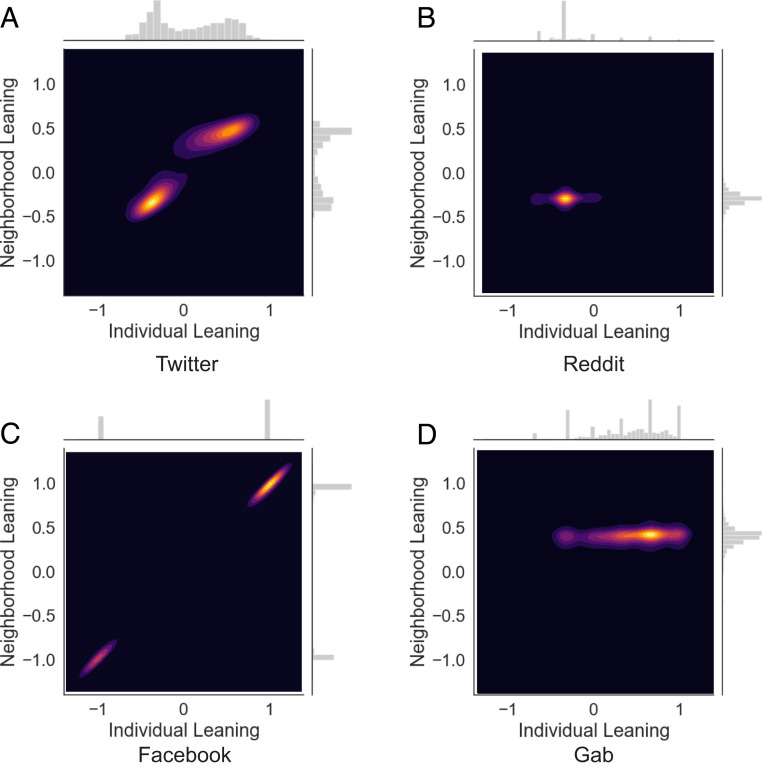
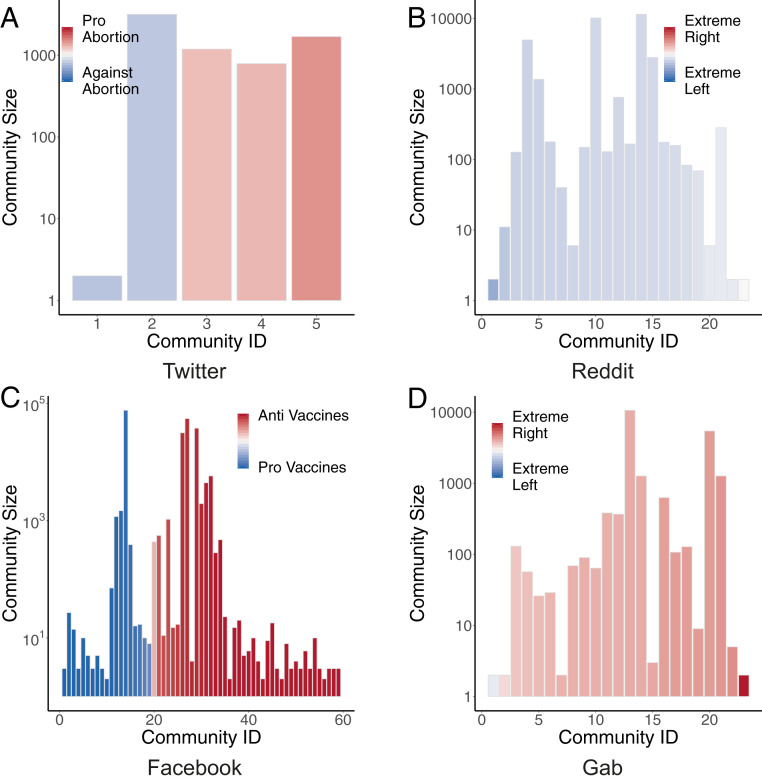
- Across the four platforms, “aggregation in homophilic clusters of users dominates online dynamics,” but platforms differ: Facebook and Twitter show homophilic clustering, while Reddit and Gab form a single community biased left or right rather than two opposing clusters.
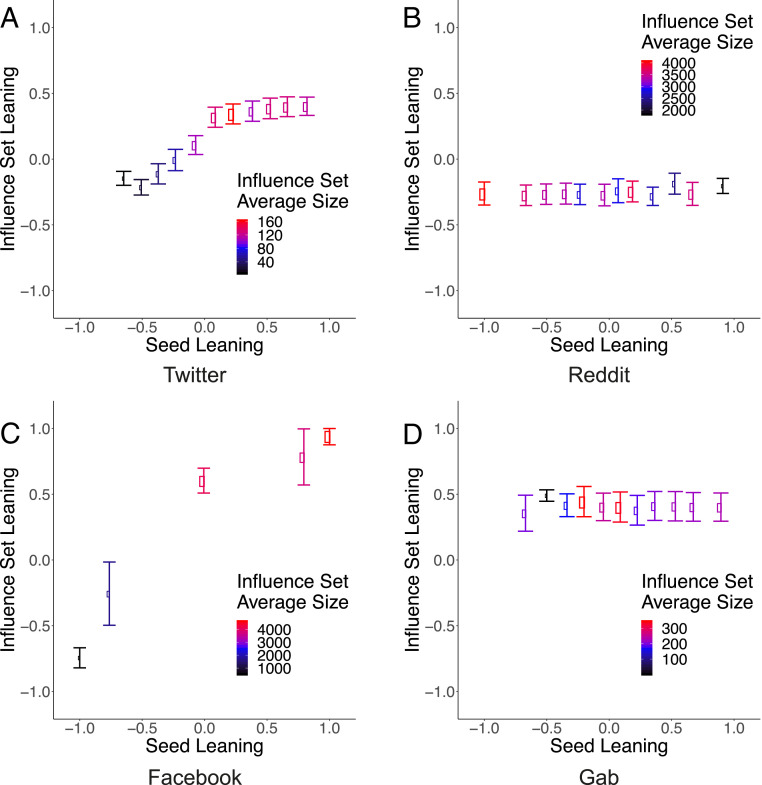
- Information diffusion is biased toward like-minded users on Facebook and Twitter, where the average leaning of a user’s influence set approximates the seed user’s leaning; on Reddit and Gab, the average leaning of the influence set does not depend on the seed user’s leaning.
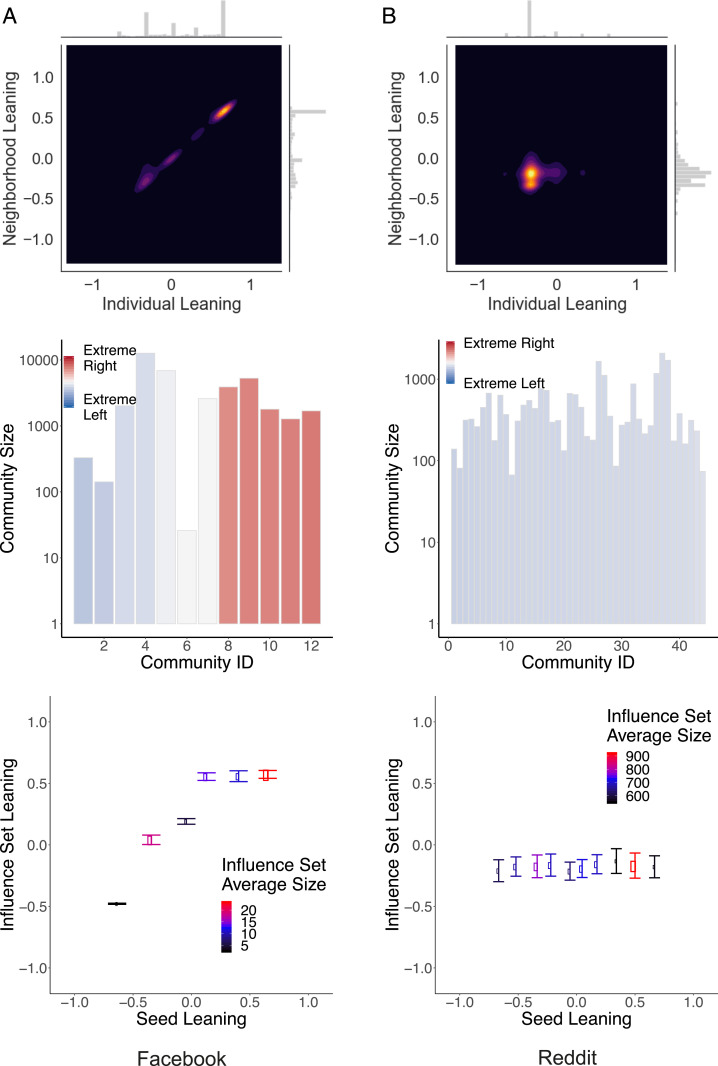
- In a direct comparison on news consumption, Facebook shows higher segregation than Reddit across all three measures: user-neighbor leaning correlation, community leaning, and SIR influence-set leaning.
- The study analyzes more than 100 million unique pieces of content and more than 1 million active users, with news outlets labeled using 2,190 media sources from Media Bias/Fact Check.
Methods
- Comparative analysis of Gab, Facebook, Reddit, and Twitter datasets on controversial topics including gun control, Obamacare, abortion, vaccines, science versus conspiracy, and news; main selected datasets were Abortion (Twitter), Vaccines (Facebook), Politics (Reddit), and Gab as a whole.
- Echo chambers were operationalized through two dimensions: homophily in interaction networks and bias in information diffusion toward like-minded peers. User leaning was inferred from linked news outlets, likes, or content, and interaction networks were built from follows, comments, cocomments, submissions, or replies depending on platform.
- Analyses included correlation between user leaning and average neighbor leaning, Louvain community detection, and SIR simulations to measure influence sets; SIR recovery rate was fixed at ν = 0.2, with dataset-specific infection ratios.
Limitations
- The paper states that the next envisioned step is to address the temporal dimension of echo chambers and how platform-specific social feedback mechanisms impact their formation.
- Evident from the text: leaning coverage varies strongly by platform, from 0.90–1.00 for Twitter/Facebook datasets to 0.15–0.20 for Reddit and 0.13 for Gab, so leaning-based conclusions for Reddit and Gab rest on a small classified fraction of users.
- Evident from the text: datasets differ by platform and topic, and the direct cross-platform comparison on a common topic is limited to news consumption on Facebook and Reddit; the authors also note that Reddit/Gab results could mean either no echo-chamber effect or observation inside a single echo chamber.
Model-written summary. Check it against the paper before relying on it.
Integrity signals
Registry
Cites
Statistics
Figures
Verification
Claims the paper makes
8 Valid · 1 Not valid · 7 Not checked · 38 Own results and interpretations
The cited sources support only part of this claim — read each source’s verdict below.
In the paper
“Selective exposure (19) and confirmation bias (20) (i.e., the tendency to seek information adhering to preexisting opinions) may explain the emergence of echo chambers on social media (1, 17, 21, 22).”
§ The echo chamber effect on social media > Abstract
What the sources say
- Supportedcites [1] M. Del Vicario, The spreading of misinformation online. Proc. Natl. Acad. Sci. U.S.A. 113, 554– 559 (2016). 26729863 PMC4725489 source
The Abstract says selective exposure generates homogeneous clusters, which it calls echo chambers. The Results and Discussion section says users select content matching a narrative and suggests confirmation bias determines echo-chamber formation. Page numbers are not provided in our copy. (LLM, conf=0.94)
- Partly supportedcites [17] K. Garimella, G. De Francisci Morales, A. Gionis, M. Mathioudakis, “ The effect of collective attention on controversial debates on social media” in WebSci ’17: 9th International ACM Web Science Conference (Association for Computing Machinery, New York, NY, 2017), pp. 43– 52. sourceExperimental — accuracy not yet measured
The Introduction reports that users mostly interact within their own side and endorse opinions from that side’s core. Related Work reports that users spread information faster when it agrees with their position. These passages are consistent with selective exposure, but the paper does not identify confirmation bias or establish that either tendency causes echo chambers to emerge. (LLM, conf=0.82)
- Supportedcites [21] M. Del Vicario, Echo chambers: Emotional contagion and group polarization on Facebook. Sci. Rep. 6, 37825 (2016). 27905402 PMC5131349 source
The Abstract says social-media disintermediation encourages users to select information that fits their beliefs (confirmation bias) and form like-minded groups (echo chambers). The Conclusions likewise describe Facebook as suited to the emergence of echo chambers. This supports the proposed explanation, without claiming it is the only cause. (LLM, conf=0.93)
- Supportedcites [22] A. Bessi, Science vs conspiracy: Collective narratives in the age of misinformation. PloS One 10, e0118093 (2015). 25706981 PMC4338055 source
The Introduction (page unavailable) says users consuming opposing information tend to form isolated clusters and describes polarized users whose likes are almost exclusively on one category of pages. The Conclusions (page unavailable) link information evaluation to existing beliefs. Together, these passages support the hedged explanation that selective exposure and confirmation bias may contribute to echo chambers. (LLM, conf=0.86)
hedgedstates a possible cause- Asserted: passes — The authors put it forward as true.
- Checkable: passes — It can be checked against evidence.
- Load-bearing: passes — The paper’s conclusions depend on it.
- Based: passes — The paper gives a reason why it holds.
- Supported
The cited sources support only part of this claim — read each source’s verdict below.
In the paper
“Our attention span remains limited (9, 10), and feed algorithms might limit our selection process by suggesting contents similar to the ones we are usually exposed to (11–13).”
§ The echo chamber effect on social media > Abstract
What the sources say
- Not checked — no full text of the sourcecites [11] A. L. Schmidt, Anatomy of news consumption on Facebook. Proc. Natl. Acad. Sci. U.S.A. 114, 3035– 3039 (2017). 28265082 PMC5373354 source
- Partly supportedcites [12] M. Cinelli, The COVID-19 social media infodemic. Sci. Rep. 10, 16598 (2020). 33024152 PMC7538912 sourceExperimental — accuracy not yet measured
The Introduction (page not provided) says algorithms take users’ preferences and attitudes into account when promoting content, and that users tend to seek information aligned with their worldviews. It does not say that feed algorithms suggest content similar to what users have previously seen or thereby limit their selection. (LLM, conf=0.82)
- Not checked — no full text of the sourcecites [13] E. Bakshy, S. Messing, L. A. Adamic, Exposure to ideologically diverse news and opinion on Facebook. Science 348, 1130– 1132 (2015). 25953820 source
hedgedstates a possible cause- Asserted: passes — The authors put it forward as true.
- Checkable: passes — It can be checked against evidence.
- Load-bearing: passes — The paper’s conclusions depend on it.
- Based: passes — The paper gives a reason why it holds.
Every source the paper cites for this claim was checked and supports it.
In the paper
“Online polarization, for instance, may foster misinformation spreading (1, 8).”
§ The echo chamber effect on social media > Abstract
What the sources say
- Supportedcites [1] M. Del Vicario, The spreading of misinformation online. Proc. Natl. Acad. Sci. U.S.A. 113, 554– 559 (2016). 26729863 PMC4725489 source
The Significance section says that homogeneity and polarization are main determinants of rumor-cascade size. The Conclusions also link polarized communities with the proliferation of narratives fueled by unsubstantiated rumors, supporting the hedged claim that online polarization may foster misinformation spreading. (LLM, conf=0.91)
- Supportedcites [8] M. D. Vicario, W. Quattrociocchi, A. Scala, F. Zollo, Polarization and fake news: Early warning of potential misinformation targets. ACM Trans. Web 13, 1– 22 (2019). source
The Introduction states that misinformation spreading on social media is directly related to increasing user polarization and segregation. This supports the citing sentence’s hedged claim that online polarization may foster misinformation spreading. (LLM, conf=0.94)
hedgedstates a possible cause- Asserted: passes — The authors put it forward as true.
- Checkable: passes — It can be checked against evidence.
- Load-bearing: unclear — It is unclear whether the paper’s conclusions depend on it.
- Based: passes — The paper gives a reason why it holds.
- Supported
Every source the paper cites for this claim was checked and supports it.
In the paper
“In network terms, this translates into a node i with a given leaning xi more likely to be connected with nodes with a leaning close to xi (18).”
§ The echo chamber effect on social media > Comparative Analysis > Polarization and Homophily in the Interaction Networks.
What the sources say
- Supportedcites [18] W. Cota, S. C. Ferreira, R. Pastor-Satorras, M. Starnini, Quantifying echo chamber effects in information spreading over political communication networks. EPJ Data Sci. 8, 35 (2019). source
The paper’s “Topological evidence of echo chambers” section says that a node with political position Pᵢ is connected with nodes whose positions are close to Pᵢ. It also reports a strong correlation between users’ positions and their neighbors’ average positions, supporting the citing sentence’s probabilistic paraphrase. (LLM, conf=0.94)
hedgedstates an association- Asserted: passes — The authors put it forward as true.
- Checkable: passes — It can be checked against evidence.
- Load-bearing: passes — The paper’s conclusions depend on it.
- Based: passes — The paper gives a reason why it holds.
- Supported
A result the paper reports from its own data — it cites no other source for it, so there is none to check. The quote shows it is in the paper.
In the paper
“Furthermore, the almost total absence of communities with leaning very close to 0 confirms the polarized state of the systems.”
§ The echo chamber effect on social media > Comparative Analysis > Polarization and Homophily in the Interaction Networks.
boostedstates a cause- Asserted: passes — The authors put it forward as true.
- Checkable: passes — It can be checked against evidence.
- Load-bearing: passes — The paper’s conclusions depend on it.
- Based: passes — The paper gives a reason why it holds.
- Rests on 4 assumptions not shown here.
32 more claims
Create a free account to see all 54 claims and to verify the 2 references still open.
- It may state two separate claims as one. 9
- Probably not a substantial claim. 9
Claims other papers make about this one
Each is checked against this paper’s own text: does it say what the citing paper says it does?
The source backs part of the claim, not all of it — or backs it for a different population, condition or comparison.
In the citing paper
“engagement with political content online is generally associated with high levels of ingroup bias; that is, it is far more likely to be shared within the political ingroup than in the outgroup (18, 19, 16).”
From Troll and divide: the language of online polarization (2022) · cites this paper as [16]
Experimental — accuracy not yet measuredThe source backs part of the claim, not all of it — or backs it for a different population, condition or comparison.
In the citing paper
“This challenge is reflected in research on”
From Machine culture (2023) · cites this paper as [142]
Experimental — accuracy not yet measuredThe source backs part of the claim, not all of it — or backs it for a different population, condition or comparison.
In the citing paper
“Thus, combating social media's echo chamber effect through an active exposure to diverse perspectives and networks also represents a viable individual-level strategy for addressing the deepfake problem (Cinelli et al., 2021; Gillani et al., 2018).”
From Deepfakes: Deceptions, mitigations, and opportunities (2023) · cites this paper as Cinelli et al., 2021
Experimental — accuracy not yet measuredThe source backs part of the claim, not all of it — or backs it for a different population, condition or comparison.
In the citing paper
“Even without being designed to shift opinions, it has been found that algorithms may contribute to political polarization by reinforcing divisive opinions [9, 24, 32].”
From Co-Writing with Opinionated Language Models Affects Users’ Views (2023) · cites this paper as [32]
Experimental — accuracy not yet measuredThe source backs part of the claim, not all of it — or backs it for a different population, condition or comparison.
In the citing paper
“On Reddit, studies find minimal evidence of echo chambers due to platform features encouraging cross-cutting exposure [17,61,63].”
From A systematic review of echo chamber research: comparative analysis of conceptualizations, operationalizations, and varying outcomes (2025) · cites this paper as [17]
Experimental — accuracy not yet measured
5 more claims about this paper
Create a free account to see every claim other papers make about this one.
Citations
Cites
Fast unfolding of communities in large networks
Blondel, V. D., Guillaume, J.-L., Lambiotte, R., & Lefebvre, E. (2008) · Journal of Statistical Mechanics: Theory and Experiment · doi:10.1088/1742-5468/2008/10/p10008 · Cited by 21,424 · cited 1×
“We detected communities by applying the Louvain algorithm (41), removing singleton communities with only one user.”
MethodThe spread of true and false news online
Vosoughi, S., Roy, D., & Aral, S. (2018) · Science · doi:10.1126/science.aap9559 · Cited by 8,847 · cited 1×
“A recent study (7) limited to Twitter claimed that fake news travels faster than real news.”
BackgroundConfirmation Bias: A Ubiquitous Phenomenon in Many Guises
Nickerson, R. S. (1998) · Review of General Psychology · doi:10.1037/1089-2680.2.2.175 · Cited by 7,267 · cited 1×
“Selective exposure (19) and confirmation bias (20) (i.e., the tendency to seek information adhering to preexisting opinions) may explain the emergence of echo chambers on social media (1, 17, 21, 22).”
BackgroundInfectious Diseases of Humans: Dynamics and Control
Anderson, R. M., & May, R. M. (1991) · doi:10.1093/oso/9780198545996.001.0001 · Cited by 6,179
Lazer, D. M. J., Baum, M. A., Benkler, Y., Berinsky, A. J., Greenhill, K. M., Menczer, F., Metzger, M. J., Nyhan, B., Pennycook, G., Rothschild, D., et al. (2018) · Science · doi:10.1126/science.aao2998 · Cited by 4,160
Degroot, M. H. (1974) · Journal of the American Statistical Association · doi:10.1080/01621459.1974.10480137 · Cited by 4,004 · cited 1×
“For instance, if opinions are assumed to be embedded in a onedimensional space (38), x ∈ [−1,+1] without loss of generality, as usual for controversial topics, then polarization is characterized by two well-separated peaks in P(x ), for positive and negative opinions.”
BackgroundExposure to ideologically diverse news and opinion on Facebook
Bakshy, E., Messing, S., & Adamic, L. A. (2015) · Science · doi:10.1126/science.aaa1160 · Cited by 3,245 · cited 2×
“Our attention span remains limited (9, 10), and feed algorithms might limit our selection process by suggesting contents similar to the ones we are usually exposed to (11–13).”
BackgroundThe spreading of misinformation online
Del Vicario, M., Bessi, A., Zollo, F., Petroni, F., Scala, A., Caldarelli, G., Stanley, H. E., & Quattrociocchi, W. (2016) · Proceedings of the National Academy of Sciences · doi:10.1073/pnas.1517441113 · Cited by 2,407 · cited 2×
“, the tendency to seek information adhering to preexisting opinions) may explain the emergence of echo chambers on social media (1, 17, 21, 22).”
BackgroundSelf-citationThe COVID-19 social media infodemic
Cinelli, M., Quattrociocchi, W., Galeazzi, A., Valensise, C. M., Brugnoli, E., Schmidt, A. L., Zola, P., Zollo, F., & Scala, A. (2020) · Scientific Reports · doi:10.1038/s41598-020-73510-5 · Cited by 2,313
Self-citationFilter Bubbles, Echo Chambers, and Online News Consumption
Flaxman, S., Goel, S., & Rao, J. M. (2016) · Public Opinion Quarterly · doi:10.1093/poq/nfw006 · Cited by 1,992
Research works printed but not linked: 2
- R. M. Anderson, R. M. May, Infectious Diseases in Humans (Oxford University Press, Oxford, United Kingdom, 1992).
- M. Cinelli, G. De Francisci Morales, A. Galeazzi, W. Quattrociocchi, M. Starnini, The echo chamber effect on social media. Open Science Framework. https://osf.io/x92br/?view_only=cdcc87d30e404e01b6ae316db15e3375. Deposited 22 January 2021. PMC7936330 33622786
Cited by
Items 601–700 of 2,063
Nayak, S., Campbell, J., & Cassity‐Duffey, K. (2024) · Frontiers in Communication · doi:10.3389/fcomm.2024.1414042 · Cited by 13
Trends and topics: Characterizing echo chambers’ topological stability and in-group attitudes
Cau, E., Morini, V., & Rossetti, G. (2024) · PLOS complex systems. · doi:10.1371/journal.pcsy.0000008 · Cited by 10
Wang, R., Pan, X., & Zhang, W. (2024) · International Journal of Human-Computer Interaction · doi:10.1080/10447318.2024.2443522 · Cited by 6
“And the data used is often accompanied by so much noise and uncertainty that analysis of the same data can lead to very different results (Cinelli et al., 2021), which shows the vulnerability of establishing causal relationships through empirical data.”
Unveiling the drivers of active participation in social media discourse
Baqir, A., Chen, Y., Diaz-Diaz, F., Kiyak, S., Louf, T., Morini, V., Pansanella, V., Torricelli, M., & Galeazzi, A. (2025) · Scientific Reports · doi:10.1038/s41598-025-88117-x · Cited by 23
“The division between supporters (orange) and opponents (black) of military aid is clear, highlighting the high level of homophilic interaction and underscoring the prevalence of echo chambers (as defined in Cinelli et al. 10 ) in this debate (see also Fig.”
Self-citationKauk, J., Kreysa, H., & Schweinberger, S. R. (2025) · PNAS Nexus · doi:10.1093/pnasnexus/pgaf028 · Cited by 9
“The comparatively limited importance of the falsehood effect may contrast with initial findings by Shin et al. (36), who reported that “most false rumors repeated periodically [11 out of 13], whereas true rumors did not [0 out of 4]” (p. 284).”
How can governments respond to policy bubbles driven by dysfunctional emotions?
Maor, M. H. (2025) · Policy and Society · doi:10.1093/polsoc/puaf008 · Cited by 7
A hybrid detection method for YouTube fake news using related video data
Kim, J., Shin, Y., Jung, G., & Ahn, H. (2025) · Engineering Applications of Artificial Intelligence · doi:10.1016/j.engappai.2025.111130 · Cited by 9
Wang, R., & Zhang, Y. (2025) · Journal of Information Technology & Politics · doi:10.1080/19331681.2025.2508750 · Cited by 7
Zhang, Y., & Lian, R. (2025) · Mass Communication & Society · doi:10.1080/15205436.2025.2529999 · Cited by 10
“…differences, investigating how various platforms facilitate different user interaction and content patterns (e.g., Bossetta & Schmøkel, 2023; Cinelli et al., 2021; Hase et al., 2023; Kim et al., 2024; Suk et al., 2023; Yarchi et al., 2021) and exploring how user-and content-based data…”
U.S. trust in physicians as key public health messengers during the H5N1 avian influenza outbreak
Piltch-Loeb, R. N., Gibbs, S. G., Lowe, J. J., Gorman, S. E., Wyka, K., White, T. M., & El-Mohandes, A. A. E. (2025) · Scientific Reports · doi:10.1038/s41598-025-12304-z · Cited by 6
“Independent research, likely conducted online involving social media, is most likely to provide an echo chamber of information that reinforces pre-existing notions about health and safety 24 .”
Theoretical Bases of Methods of Counteraction to Modern Forms of Information Warfare
Bakirov, A. S., & Suleimenov, I. E. (2025) · Computers · doi:10.3390/computers14100410 · Cited by 25
Deans-Browne, C., & Singmann, H. (2025) · Cognition · doi:10.1016/j.cognition.2025.106257 · Cited by 6
“…2022) found that the propensity to believe fake-news headlines was driven by a lack of analytical thinking, and others (e.g., Bakshy et al., 2015; Cinelli et al., 2021) have found that people are far more likely to encounter news and discussions on social media that are already aligned with…”
Ononuju, U. A., & Ujari, C. A. (2025) · Journal of Autism and Developmental Disorders · doi:10.1007/s10803-025-07057-7 · Cited by 9
AI, Digital Platforms, and the New Systemic Risk
Hacker, P., Edwards, L., & Kasirzadeh, A. (2026) · ACM Conference on Fairness, Accountability, and Transparency (FAccT) · doi:10.1145/3805689.3806506 · Cited by 19
“More generally, these risks emerge when recommendation algorithms on social media platforms optimize for engagement metrics, which creates echo chambers that may erode public discourse, democratic deliberation, and respect for individual and collective rights [21].”
Nguyen, T. T., Nguyen, D. C., Nguyen, H. T., Do, H., Ngo, T., Pham, A. B. G., Tran, T. Q., Hoang, L. P., Dang, H., Boyer, L., et al. (2025) · Scientific Reports · doi:10.1038/s41598-025-19175-4 · Cited by 18
“…algorithms designed to maximise user engagement frequently amplify sensational or emotionally charged content at the expense of factual accuracy, fuelling the spread of fake news at rates that outpace verified content and creating “echo chambers” where falsehoods are reinforced and normalised 5–9 .”
Beyond Big Tech: Advocacy Technologists within Mission-Driven Civil Society Organizations
Chambers, L. M. (2025) · Proceedings of the ACM on Human-Computer Interaction · doi:10.1145/3757559 · Cited by 7
Epistemic bubbles and echo chambers in the progress of science
Albuquerque, U. P. (2025) · Ethnobiology and Conservation · doi:10.15451/ec2025-11-14-38-1-19 · Cited by 7
“…research has high-lighted how algorithmic personalization on digital platforms contributes to the fragmentation of knowledge and the deepening of polarization (Bakshy et al. 2015; Cinelli et al. 2021; Oliveira and Albuquerque 2021; Arruda et al. 2021; Sun et al. 2022; Al-Omoush et al. 2023).”
Duan, J., Qi, S., Yan, H., & Wu, C. (2026) · Computers in Human Behavior · doi:10.1016/j.chb.2026.108907 · Cited by 8
Reactive Writers: How Co-Writing with AI Changes How We Engage with Ideas
Bhat, A., Quéré, M. A. L., Naaman, M., & Jakesch, M. (2026) · CHI Conference on Human Factors in Computing Systems · doi:10.1145/3772318.3791529 · Cited by 18
Zhang, H., Kwak, H., Gao, W. G., & An, J. (2023) · ACM Web Science Conference (WebSci) · doi:10.1145/3578503.3583606 · Cited by 11
Zheng, X., Lu, Y., Lee, J. K., & Choi, J. (2024) · Journal of Information Technology & Politics · doi:10.1080/19331681.2024.2317388 · Cited by 8
“Many previous studies documented that social media news use promotes like-minded discussion (e.g., Barberá, 2020; Cinelli et al., 2021).”
Laineste, L., & Fiadotava, A. (2024) · European Journal of Humour Research · doi:10.7592/ejhr.2024.12.1.835 · Cited by 5
“The coexistence of multiple active information sources can, on the one hand, increase societal polarisation and lock audiences into information bubbles that they share with people who think alike (Cinelli et al., 2021).”
BackgroundAdolescents’ Exposure to Violent Content Related to Conflict on Social Media: Qualitative Research
Franco, L., & Boniel‐Nissim, M. (2024) · IntechOpen eBooks · doi:10.5772/intechopen.1005821 · Cited by 11
Alexandrescu, M. (2024) · SAGE Open · doi:10.1177/21582440241268319 · Cited by 6
“Second, people informed mainly through social media may have a different perception of the war, as these platforms may facilitate the formation of ‘‘echo chambers’’ (Cinelli et al., 2021, p. 1) and the polarization of opinions.”
Lavorgna, A., & Corda, A. (2024) · International Criminology · doi:10.1007/s43576-024-00134-4 · Cited by 9
“This creates an environment where differing opinions are ignored or dismissed, deepening divisions and inhibiting constructive dialogue (e.g., Cinelli et al., 2021).”
Enhancing Recommendation Diversity and Novelty with Bi-LSTM and Mean Shift Clustering
Yuan, Y., Zhou, Y., Chen, X., Xiong, Q., & Okere, H. C. (2024) · Electronics · doi:10.3390/electronics13193841 · Cited by 5
Post-hoc Evaluation of Nodes Influence in Information Cascades: The Case of Coordinated Accounts
Marco, N. D., Brunetti, S., Cinelli, M., & Quattrociocchi, W. (2025) · ACM Transactions on the Web · doi:10.1145/3700644 · Cited by 14
Self-citationKumar, A., & Maurya, M. K. (2024) · Journal of Communication Inquiry · doi:10.1177/01968599241292623 · Cited by 18
Lu, A. H., & Mejova, Y. (2025) · International Journal of Intercultural Relations · doi:10.1016/j.ijintrel.2025.102162 · Cited by 7
Zhang, C., Wang, X., Min, Y., Yu, S., Wu, Y., Xuan, Q., & Fu, C. (2025) · Physica A Statistical Mechanics and its Applications · doi:10.1016/j.physa.2025.130487 · Cited by 8
Breaking the bubble: A case study on the echo chamber effect in Instagram
Dutta, S., Arivazhagan, R., & Pradeep, E. (2025) · Journal of Information Technology Teaching Cases · doi:10.1177/20438869251326279 · Cited by 10
Arifah, I. D. C., Maureen, I. Y., Rofik, A., Puspila, N. K. W., Erifiawan, H., & Mariyamidayati (2025) · Journal of Social Innovation and Knowledge · doi:10.1163/29502683-bja00011 · Cited by 25
Social media campaigning and voter behavior–evidence for the German federal election 2021
Aziz, A. I., & Bischoff, I. (2025) · European Journal of Political Economy · doi:10.1016/j.ejpoleco.2025.102685 · Cited by 10
Kim, Y., & Lee, S. (2022) · SAGE Open · doi:10.1177/21582440221093327 · Cited by 7
“…studies have examined the linguistic and discursive characteristics of abortion debates on SNSs (Molek-Kozakowska & Wanke, 2019; Sharma et al., 2017), and another body of literature has focused on the linkage pattern among participants of debates (Cinelli et al., 2021; Lycarião & Dos Santos, 2017).”
BackgroundReconstructing community structure of online social network via user opinions
Li, R., Guo, Q., Zhang, X.-K., & Liu, J.-G. (2022) · Chaos An Interdisciplinary Journal of Nonlinear Science · doi:10.1063/5.0086796 · Cited by 5
Recommender algorithms as a source of power in contemporary society
Bojić, L. (2022) · Socioloski pregled · doi:10.5937/socpreg56-36721 · Cited by 7
“Алгоритми за препоруке су имали важну улогу у поларизовању друштава око разних битних тема, везано за пандемију и предизборне кампање широм света (Cinelli et al., 2021).”
BackgroundMethodInfluentialPerception of United Nations Climate Change Conference in Social Networks
Das, S., & Chakraborty, S. (2022) · IEEE India Conference · doi:10.1109/indicon56171.2022.10039781 · Cited by 6
“Online users pertaining to a certain belief rarely interact with users having differing views [2].”
BackgroundIndividuation in the era of social media
Gaist, B. (2023) · Fabrica Societatis · doi:10.19195/2657-3679.5.9 · Cited by 5
Krebs, M., Oeberst, A., & von der Beck, I. (2023) · Topics in Cognitive Science · doi:10.1111/tops.12647 · Cited by 8
Koivula, A., Räsänen, P., Marttila, E., Sedgwick, D., & E.Hawdon, J. (2023) · Journal of Broadcasting & Electronic Media · doi:10.1080/08838151.2023.2226276 · Cited by 8
“People tend to choose information on social media that they share with like-minded people (Cinelli et al., 2021; Pulido et al., 2020; Sacco et al., 2021), which is also algorithmically filtered to be suitable for users (Bakshy et al., 2015).”
Promotion of hate speech by Spanish political actors on Twitter
Said-Hung, E. M., López, R. M., & Mottareale, D. (2023) · Policy & Internet · doi:10.1002/poi3.353 · Cited by 6
COVID-19 and social media: Beyond polarization
Nicola, G. D., Mambou, V. H. T., & Kauermann, G. (2023) · PNAS Nexus · doi:10.1093/pnasnexus/pgad246 · Cited by 12
Дунас, Д. В., Гуреева, А. Н., & Киреева, П. А. (2023) · Vestnik NSU Series History and Philology · doi:10.25205/1818-7919-2023-22-6-70-81 · Cited by 12
Social Forms Beyond Value: Public Wealth and Its Contradictions
Prug, T., & Žitko, M. (2023) · Critical Sociology · doi:10.1177/08969205231215235 · Cited by 6
“…consequences of the platform business model proved to be equally troubling as the economic transformation as the phenomena of echo chambers (Cinelli et al., 2021), fake news and outright propaganda increased their grip on mass democracy, removing the political agenda further away from the…”
BackgroundDİJİTALLEŞME EKSENİNDE İNFODEMİ VE BİLGİ DÜZENSİZLİKLERİ
Yıldırım, M. B., & Özgen, E. (2024) · Akademik Hassasiyetler · doi:10.58884/akademik-hassasiyetler.1435823 · Cited by 7
Kaçer, E. Ö., & Kacer, I. (2024) · PLoS ONE · doi:10.1371/journal.pone.0310508 · Cited by 8
“The underlying reasons for why video reliability and quality do not significantly influence the number of likes, dislikes, and views are not fully understood, but the existing literature explores the dynamics of social media platforms and algorithms from multiple angles [28–30].”
BackgroundA cultural evolution theory for contemporary polarization trends in moral opinions
Eriksson, K., Vartanova, I., & Strimling, P. (2024) · Humanities and Social Sciences Communications · doi:10.1057/s41599-024-04194-9 · Cited by 5
“…social cohesion, political polarization has been the focus of numerous studies (e.g., Abramowitz and Saunders, 2008; Baldassarri and Gelman, 2008; Cinelli et al. 2021; Druckman et al. 2021; Fiorina and Abrams, 2008; Iyengar and Westwood, 2015; Mason, 2015; Robison and Mullinix, 2016; Webster and…”
Exploring cognitive inertia in opinion dynamics using an activity-driven model
Pranesh, S., & Gupta, S. (2024) · Chaos Solitons & Fractals · doi:10.1016/j.chaos.2024.115879 · Cited by 16
The Erosion of Healthcare and Scientific Integrity: A Growing Concern
Brücher, B. L. D. M. (2025) · Journal of Healthcare Leadership · doi:10.2147/jhl.s506767 · Cited by 8
Mobile Internet and the Quality of Elections in Low-Income Democracies
Yeandle, A. (2025) · British Journal of Political Science · doi:10.1017/s0007123424000814 · Cited by 7
Community Fact-Checks Trigger Moral Outrage in Replies to Misleading Posts on Social Media
Chuai, Y., Sergeeva, A., Lenzini, G., & Pröllochs, N. (2025) · CHI Conference on Human Factors in Computing Systems · doi:10.1145/3706598.3713909 · Cited by 25
“…emotion contagion refers to the spreading effect of emotions from one user to another [51, 100], and emotion homophily indicates that like-minded users tend to flock together, potentially forming echo chambers that dominate online interactions and reinforce biases and attitude polarization [25].”
A three-dimensional motivation model of algorithm aversion
ZAHNG, Y., Xu, L., Yu, F., Xiaojun, D. I. N. G., Wu, J., Zhao, L., 邬, 家., & 赵, 靓. (2022) · Advances in Psychological Science · doi:10.3724/sp.j.1042.2022.01093 · Cited by 9
Listen to What They Say: Better Understand and Detect Online Misinformation with User Feedback
Etienne, H., & Çelebi, O. (2023) · Journal of Online Trust and Safety · doi:10.54501/jots.v1i5.106 · Cited by 5
“Furthermore, with a few exceptions (1, 2)), the selection of several countries and platforms in web-data-based research is justified by data augmentation purposes, rather than for comparative analysis.”
BackgroundMethodInfluentialCoulibaly, S. (2023) · Media International Australia · doi:10.1177/1329878x231177836 · Cited by 7
A Study of Chinese News Headline Classification Based on Keyword Feature Expansion
Miao, K., He, X., Yu, J., Wang, G., & Chen, Y. (2023) · International Journal of Computational Intelligence Systems · doi:10.1007/s44196-023-00251-4 · Cited by 5
“…effectively classify them. while high-quality headline classification has an efficient contribution to news content category classification and effectively saves computational overhead, and its main application directions include domain machine translation [3] and false information detection [4].”
BackgroundZhao, W., Walasek, L., & Brown, G. D. A. (2023) · Human Behavior and Emerging Technologies · doi:10.1155/2023/9094933 · Cited by 13
Large scale annotated dataset for code-mix abusive short noisy text
Tiwari, P., Rai, S., & Chowdary, C. R. (2024) · Language Resources and Evaluation · doi:10.1007/s10579-023-09707-7 · Cited by 9
Robertson, F. C., Linzey, J. R., Alotaibi, N. M., et al. (2021) · The Neuroradiology Journal · doi:10.1177/19714009211012363 · Cited by 5
The Political Landscape of the U.S. TwitterversePreprint
Mukerjee, S., Jaidka, K., & Lelkes, Y. (2020) · OSF Preprints (OSF Preprints) · doi:10.31219/osf.io/w98ms · Cited by 7
Organization and evolution of the UK far-right network on TelegramPreprint
Bovet, A., & Grindrod, P. (2022) · Research Square · doi:10.21203/rs.3.rs-1964336/v1 · Cited by 5
Abdaljaleel, M., Barakat, M. M., Mahafzah, A. M., Hallit, R. R., Hallit, S. R., & Sallam, M. (2023) · doi:10.2196/preprints.53458 · Cited by 5
From Feeds to Inboxes: A Comparative Study of Polarization in Facebook and Email News SharingPreprint
Yoganarasimhan, H., & Yakovetskaya, I. (2023) · SSRN Electronic Journal · doi:10.2139/ssrn.4666856 · Cited by 5
“…chambers, and filter bubbles, and it has suggested that personalization algorithms can amplify these effects (Pariser 2011, Barber ´ a et al. 2015, Sunstein 2018, Allcott et al. 2020, Persily and Tucker 2020, Cinelli et al. 2021, Iyer and Yoganarasimhan 2021, Levy 2021, Shin and Kadiyala 2022).”
Huang, J. T., Choi, J., & Wan, Y. (2024) · SSRN Electronic Journal · doi:10.2139/ssrn.4990476 · Cited by 10
Unfiltered Conversations: A Dataset of 2024 U.S. Presidential Election Discourse on Truth SocialPreprint
Shah, K., Gerard, P., Luceri, L., et al. (2025) · SSRN Electronic Journal · doi:10.2139/ssrn.5018881 · Cited by 5
The Demands of the Menstrual Movement: Stigma, Misinformation, and Social Inequalities
Tomlinson, M. K. (2024) · Palgrave studies in communication for social change · doi:10.1007/978-3-031-72195-3_2 · Cited by 5
Ignorance of the crowd: dysfunctional thinking in social networks
Seeme, F. B., Green, D., & Kopp, C. (2025) · Frontiers in Communication · doi:10.3389/fcomm.2025.1547489 · Cited by 9
Kuuse, S. F., Kangur, U., Chakraborty, R., & Sharma, R. R. (2025) · International World Wide Web Conference (WWW) · doi:10.1145/3701716.3717533 · Cited by 7
“Subsequently, it has been observed that biased information exposure through selective information exposure and confirmation bias leads to the formation of echo chambers and segregation of users [15].”
Moffitt, L., & Thomas, M. S. (2025) · International Journal of Nutrition and Food Sciences · doi:10.11648/j.ijnfs.20251404.14 · Cited by 13
Milbourn, H., Campbell, A., Clark, F., Darrah, E., Flaig, R., Kirby, L., McCartney, D. L., Mitchell, I., Robertson, S., Richmond, A., et al. (2025) · Journal of Medical Internet Research · doi:10.2196/75116 · Cited by 6
Gajardo, J. M., & Mas, M. Y. L. (2025) · Societies · doi:10.3390/soc15100284 · Cited by 7
“Recent studies show that digital systems favour echo chambers and engagement cascades that amplify polarising content and reinforce prejudices [37,38].”
Li, D., Fu, L., & Chen, L. (2025) · Journalism & Mass Communication Quarterly · doi:10.1177/10776990251378663 · Cited by 7
“High-profile cases, such as the anti-vaccination movement and misinformation surrounding the Fukushima nuclear wastewater discharge, demonstrate how false information can drive public confusion, fear, and misguided decision-making (Cinelli et al., 2021).”
Luo, K. (2025) · Chaos Solitons & Fractals · doi:10.1016/j.chaos.2025.117581 · Cited by 5
“5 , captures persistent external biases that systematically drive opinions in specific directions, as observed when filtering algorithms, recommendation systems, or media narratives introduce consistent distortions in information exposure 2,19,28 .”
Nogara, G., Sahneh, E. S., DeVerna, M., Liu, N., Luceri, L., Menczer, F., Pierri, F., & Giordano, S. (2025) · Online Social Networks and Media · doi:10.1016/j.osnem.2025.100342 · Cited by 23
Zhang, X., Wang, Q., Song, F., Wang, F., & Qu, C. (2026) · IEEE Transactions on Network Science and Engineering · doi:10.1109/tnse.2026.3654942 · Cited by 5
“Empiricalstudies[43],[44]showedthatsocialmedia recommendationsystemsamplifypolarizationviaechocham-bers,whileBakaryanetal.”
Schäfer, K., & Choi, J. (2023) · ACM Conference on Hypertext and Social Media (HT) · doi:10.1145/3603163.3609034 · Cited by 4
“For instance, SMA allows identifying echo chambers[4, 21] or spreaders of disinformation[10, 18, 22, 23].”
BackgroundChae, S. W., & Lee, S. H. (2024) · PLoS ONE · doi:10.1371/journal.pone.0302030 · Cited by 8
“As such, researchers have argued that the current trend of online news consumption via social media can reinforce echo chamber effects [7,8].”
BackgroundYouth and Media Literacy: Understanding Social Media's Influence on Information Consumption
Latif, A. S. S. S. A., Latiff, D. I. A., Zambri, W. A. A. M., Bakar, M. N. A., Razak, M. A., & Kamal, S. (2024) · International Journal of Academic Research in Business and Social Sciences · doi:10.6007/ijarbss/v14-i6/21747 · Cited by 10
“These are not baseless concerns especially with the issue on fake news which has been prevalent in the social media platform which does not trigger positive social impact in terms of degree of comprehension and perception among the populace in general (Cinelli et al., 2020).”
BackgroundManipulation, Algorithm Design, and the Multiple Dimensions of Autonomy
Sass, R. (2024) · Philosophy & Technology · doi:10.1007/s13347-024-00796-y · Cited by 9
“This sort of self-reinforcing loop has received much attention through the metaphor of the “echo chamber” or the “filter bubble” (Ter-ren and Borge 2021; Cinelli et al., 2021).”
A Malicious Information Popularity Prediction Model Based on User Influence
Li, T., Tang, Y., Xie, R., Weng, Y., Li, Q., Wang, R., Jia, C., & Xiao, Y. (2025) · IEEE Transactions on Services Computing · doi:10.1109/tsc.2025.3544122 · Cited by 6
“Toaddress theproblem of assessinguser influenceinthespace of malicious informationpropagation, CINELLI et al. [16] quantify the echo chamber effect in social media by considering the homogeneity of the interaction network and the user bias in the propagation process and studying the information…”
Zhang, J., & Sun, S. (2025) · Journal of Contingencies and Crisis Management · doi:10.1111/1468-5973.70033 · Cited by 7
A Highway for Disinformation? The Alarming Exodus of Scientists from Twitter/X and its Consequences
Smadja, D. M., & Sonnac, N. (2025) · Stem Cell Reviews and Reports · doi:10.1007/s12015-025-10864-1 · Cited by 5
“Algorithmic that favors sensationalist content has led to a loss of trust among scientists and academic institutions [7 ].”
A New Method to Investigate the Presence of the Echo Chamber Effect on Consumer Behavior
Mahmoudi, A., & Jemielniak, D. (2025) · Journal of Consumer Behaviour · doi:10.1002/cb.2493 · Cited by 5
Algorithmic Hegemony: AI, Political Elites, and the Reinvention of Electoral Influence
Shad, K. B. (2025) · Journal of Sociocybernetics · doi:10.26754/ojs_jos/jos.2025111599 · Cited by 7
Towards a Robust Framework for Multimodal Hate Detection: A Study on Video vs. Image-based Content
Koushik, G. A., Kanojia, D., & Treharne, H. (2025) · International World Wide Web Conference (WWW) · doi:10.1145/3701716.3718382 · Cited by 19
“By the time such content gets flagged or removed, it spreads across other platforms too, many of which propagate a high selective bias, leading to incorrect moderation from a particular echo chamber [11, 18].”
Building Trusting Health Care Teams
Sherrer, D. M., Peters, C. B., Mertz, B. A., Morris, A. H., Vining, B. R., & Vetter, T. R. (2025) · Anesthesia & Analgesia · doi:10.1213/ane.0000000000007588 · Cited by 4
Social Media Influence: Bridging Pro-Vaccination and Pro-Environmental Behaviors Among Youth
Orzan, O. A. (2025) · Sustainability · doi:10.3390/su17114814 · Cited by 13
“Moreover, the echo chamber phenomenon, as analyzed by Cinelli et al. [3], illustrates how algorithmic personalization reinforces pre-existing beliefs, potentially amplifying misinformation and polarizing public opinion.”
InfluentialÇakmak, M. C., & Agarwal, N. K. (2025) · Applied Network Science · doi:10.1007/s41109-025-00713-y · Cited by 9
“Studies indicate that emotionally charged or morally resonant symbols can diffuse widely through online communities (Brady et al. 2017) and contribute to the formation of echo chambers (Cinelli et al. 2021).”
Generative exaggeration in LLM social agents: Consistency, bias, and toxicity
Nudo, J., Pandolfo, M. E., Loru, E., Samory, M., Cinelli, M., & Quattrociocchi, W. (2025) · Online Social Networks and Media · doi:10.1016/j.osnem.2025.100344 · Cited by 30
Self-citationBagnoli, F., Cavalcabo’, G. D. B., Casu, B., & Guazzini, A. (2021) · Future Internet · doi:10.3390/fi13110296 · Cited by 4
“One possible drawback of this kind of recommendation system is the formation of filter bubbles [6,7] or echo chambers [8,9], i.”
BackgroundOpen-Domain Trending Hashtag Recommendation for Videos
Mehta, S., Sarkhel, S., Chen, X., Mitra, S., Swaminathan, V., Rossi, R. A., Aminian, A., Guo, H., & Garg, K. (2021) · IEEE International Symposium on Multimedia (ISM) · doi:10.1109/ism52913.2021.00035 · Cited by 9
Echo chambers in the Ising model and implications on the mean magnetization
Baravi, T., Feinerman, O., & Raz, O. (2022) · Journal of Statistical Mechanics Theory and Experiment · doi:10.1088/1742-5468/ac5d42 · Cited by 4
Kirwan, R., Mallett, G. S., Ellis, L. R., & Flanagan, A. (2022) · Current Developments in Nutrition · doi:10.1093/cdn/nzac037 · Cited by 8
“In recent years, research has noted the development of information and ideological echo chambers, segregated communities of online social media platforms, where individuals share a common interest or viewpoint and have little exposure to opposing views (9).”
BackgroundThe delusive economy: how information and affect colour perceptions of national economic performance
Linsi, L., Mügge, D., & Carillo-López, A. (2022) · Acta Politica · doi:10.1057/s41269-022-00258-3 · Cited by 8
Stereotypes and stereotyping in early modern England
Yamamoto, K. (2022) · Manchester University Press eBooks · doi:10.7765/9781526119148 · Cited by 4
Phillips, M. M., Weldon, R. H., Maniar, A., Patil, U. P., Kostareva, U., Agner, J., Finn, J., & Sentell, T. L. (2022) · International Journal of Environmental Research and Public Health · doi:10.3390/ijerph192416833 · Cited by 4
“These “echo chambers” are prevalent in social media spaces [47] and may influence individuals’ perceptions of the pandemic and lead them to engage in health behaviors that may or may not put them or others in their network at greater risk.”
BackgroundFinancial Fraud Detection on Social Networks Based on a Data Mining Approach
Bozhenko, V., Mynenko, S. V., & Shtefan, A. (2022) · Financial Markets Institutions and Risks · doi:10.21272/fmir.6(4).119-124.2022 · Cited by 4
The impact of political ideology, knowledge and participation on electoral conspiracy endorsement
Jiang, Y. (2023) · Frontiers in Political Science · doi:10.3389/fpos.2023.1069468 · Cited by 8
“This leaves us with a practical concern as the combination of these two features makes such people more easily manipulated by political elites through media priming (Zaller, 1992), especially since the chance of being trapped in the echo chamber is substantially higher in the digital media age (Cinelli et al., 2021).”
BackgroundArdèvol‐Abreu, A., Costa-Sánchez, C., & Macchione, P. A. D. (2023) · Journal of Information Technology & Politics · doi:10.1080/19331681.2023.2173699 · Cited by 7
“…facilitate cross cutting exchange and exposure to diverse ideas or, on the contrary, catalyze like-minded interactions and the reinforcement of previous attitudes is still an issue of academic debate (Bond & Sweitzer, 2022; see also Cinelli, Morales, Galeazzi, Quattrociocchi, & Starnini, 2021).”
BackgroundLi, J., & Adnan, H. M. (2023) · Studies in Media and Communication · doi:10.11114/smc.v11i4.6021 · Cited by 8
Metadata
- Authors
- Cinelli, M., De Francisci Morales, G., Galeazzi, A., Quattrociocchi, W., & Starnini, M.
- Affiliations
- Ca' Foscari University of Venice (IT)
- Institute for Scientific Interchange (ISI) Foundation, 10126 Torino, Italy;
- University of Brescia (IT)
- University of Oslo (NO)
- Institute for Scientific Interchange (IT)
- Corresponding author
- Quattrociocchi, Walter
- ORCID
- Venue
- Proceedings of the National Academy of Sciences
- Publisher
- National Academy of Sciences
- Published
- 2021-02-23
- Volume
- 118
- Issue
- 9
- ISSN
- 0027-8424 (ISSN-L)
- 1091-6490
- PMC
- PMC7936330
- OpenAlex
- W3133423348
- Cited by
- 2,092
- References
- 62
- Citations by year
- 2026: 488 · 2025: 516 · 2024: 387 · 2023: 351 · 2022: 256 · 2021: 90
- FWCI
- 375.62
- Type
- journal article
- Language
- en
- Open access
- hybrid
- doi.org
- Licence
- Locations
- Proceedings of the National Academy of Sciences (publishedVersion, cc-by)
- PubMed Central (publishedVersion, cc-by)
- PubMed (publishedVersion)
- UPCommons institutional repository (Universitat Politècnica de Catalunya) (submittedVersion, cc-by)
- IRIS Research product catalog (Sapienza University of Rome) (submittedVersion)
- Padua Research Archive (University of Padova) (submittedVersion, cc-by)
- Topics
- Social Sciences › Sociology and Political Science › Misinformation and Its Impacts
- Social Sciences › Communication › Social Media and Politics
- Physical Sciences › Physics and Astronomy › Statistical and Nonlinear Physics › Complex Network Analysis Techniques
- Keywords
- echo chambers, social media, homophily, information dissemination, algorithmic curation, controversial issues, Facebook, Twitter, Reddit, Gab, news consumption
- MeSH terms
- Abortion, Legal, Gun Violence, Communication, Humans, Politics, Social Change, Vaccination, Bias, Information Dissemination, Narration, Patient Protection and Affordable Care Act, Social Networking, Social Media
About these checks
Registry, retraction, Cites and statistics results are computed, not judged, with one exception: a printed reference that no index lists is read once by a model before it counts as a citation error. Claims are extracted by a model and kept only when their quote appears verbatim in the text; each cited source is then checked, with a model’s help, for whether it says what the claim relies on. Those verdicts can be wrong — read the claim’s quote and the cited source before relying on one.
The claim verdicts this report counts are experimental: their accuracy is not yet measured.
A language model drew the claims from the paper on 2026-10-10, under version 3 of the claim definition (model deepseek-v4.1-flash, prompt extract-v3).
A second model labelled each claim on 2026-10-10 (model jev-1.13-20260917, definition revision gold-guideline-v0.2).
Cited sources are checked with a language model’s help (gpt-6-sol).
Statistics and arithmetic are recomputed, not judged.
Confidence bands are shown only for fields calibrated on our annotated test set. None is calibrated yet, so no band is shown.
What counts as a claim ›How we measure confidence ›How we check this ›
Are you an author, or do you see a problem with this page? Request a review
Data sources
Bibliographic data: Semantic Scholar, OpenAlex, Crossref.
Contains information from the Semantic Scholar Academic Graph Datasets, made available under the ODC Attribution License (ODC-BY 1.0).
Semantic Scholar’s data is described in: Kinney, R., et al. (2023). The Semantic Scholar Open Data Platform. arXiv:2301.10140.
