

The DOI matches its Crossref record; 122 of the 122 references it cites were found in a registry or an index; 20 of the 56 sources its claims cite were checked for support.
How digital media drive affective polarization through partisan sorting
Open accessAbstract
Politics has in recent decades entered an era of intense polarization. Explanations have implicated digital media, with the so-called echo chamber remaining a dominant causal hypothesis despite growing challenge by empirical evidence. This paper suggests that this mounting evidence provides not only reason to reject the echo chamber hypothesis but also the foundation for an alternative causal mechanism. To propose such a mechanism, the paper draws on the literatures on affective polarization, digital media, and opinion dynamics. From the affective polarization literature, we follow the move from seeing polarization as diverging issue positions to rooted in sorting: an alignment of differences which is effectively dividing the electorate into two increasingly homogeneous megaparties. To explain the rise in sorting, the paper draws on opinion dynamics and digital media research to present a model which essentially turns the echo chamber on its head: it is not isolation from opposing views that drives polarization but precisely the fact that digital media bring us to interact outside our local bubble. When individuals interact locally, the outcome is a stable plural patchwork of cross-cutting conflicts. By encouraging nonlocal interaction, digital media drive an alignment of conflicts along partisan lines, thus effacing the counterbalancing effects of local heterogeneity. The result is polarization, even if individual interaction leads to convergence. The model thus suggests that digital media polarize through partisan sorting, creating a maelstrom in which more and more identities, beliefs, and cultural preferences become drawn into an all-encompassing societal division.
Overview
AI snapshot
Written from the paper’s full text.
TL;DR
The paper proposes a computational model in which digital media drive affective polarization not through echo chambers but through nonlocal interaction that aligns local political cultures into partisan sorting. Simulations show that increasing nonlocal interaction can sharply raise sorting when influence homophily is high, while purely local interaction keeps sorting low.
Key findings
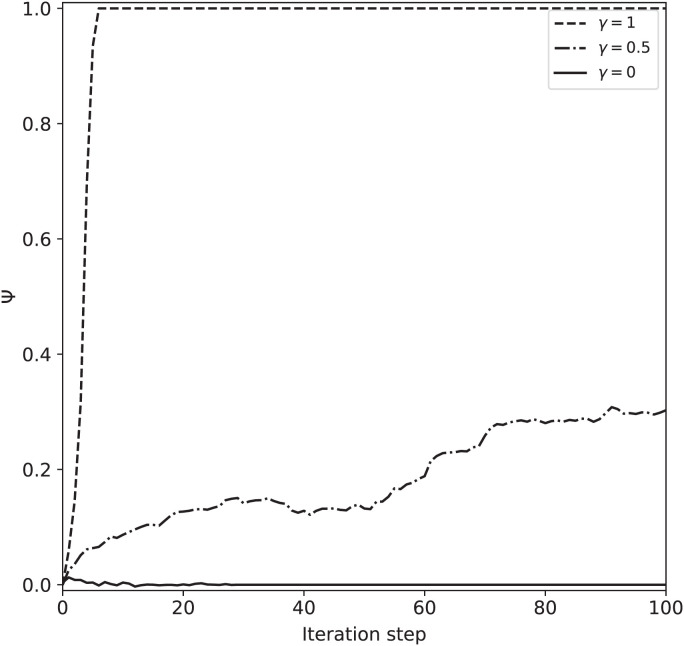
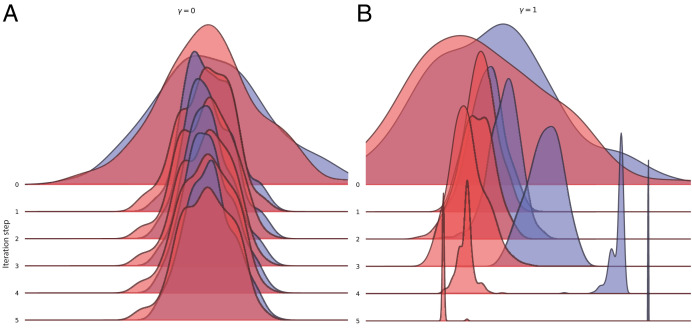
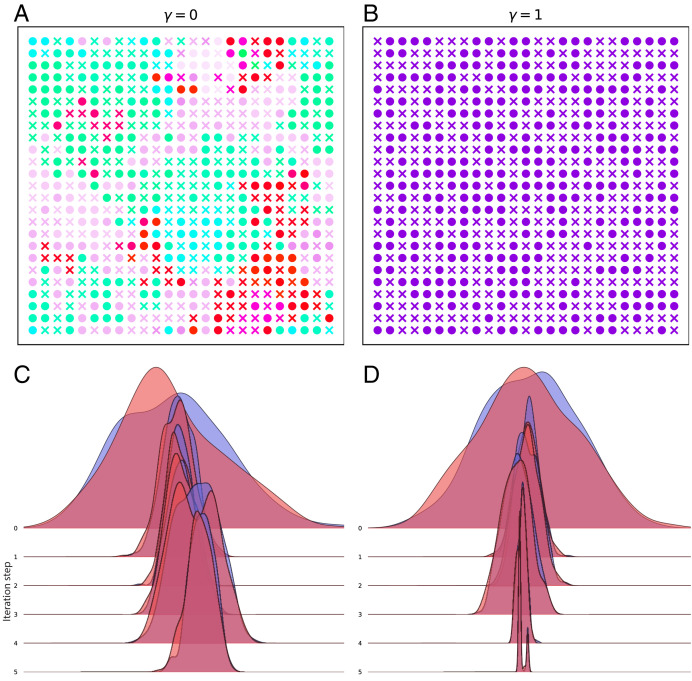
- In example runs with high influence homophily (h = 8; n = 10, |A| = 196, c = 4, m = 10), γ = 1 quickly reaches a high sorting value ψ; γ = 0.5 rises more slowly and settles around ψ = 0.3; γ = 0 remains near the expected ψ = 0.
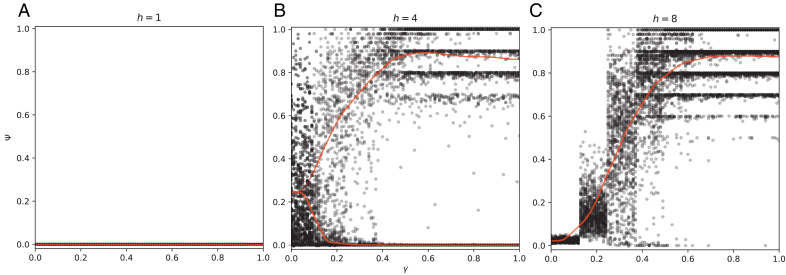
- Across 8,000 simulation runs varying γ and h, low influence homophily (h = 1) produces no partisan sorting regardless of γ; high homophily (h = 8) produces a rapid increase in sorting past a threshold of nonlocal interaction; intermediate homophily (h = 4) shows bistability between low- and high-sorting end states.
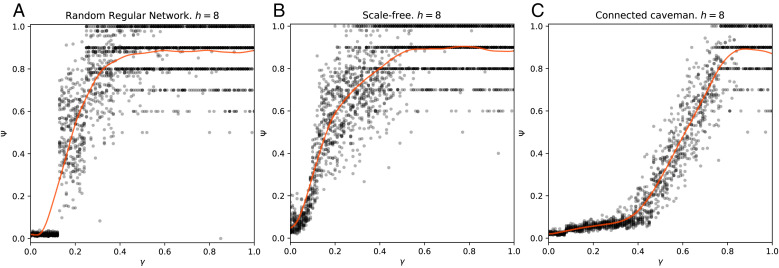
- The same general γ–ψ relationship appears on random regular, scale-free, and connected caveman networks (1,600 runs over the parameter space), though the clique-dominated caveman network requires higher γ before sorting rises.
- With n = 10 dynamic attributes and m = 10 possible states, the chance that two groups share at least one attribute is about 65% (1 − (9/10)^10 ≈ 0.65), which can prevent sorting from reaching 1 and affects convergence probability.
Methods
- Agent-based opinion-dynamics model: agents on a graph (primarily a two-dimensional torus lattice with Moore neighborhood), each with n dynamic attributes taking integer values 1–m and a fixed partisan attribute S (k = 2); partisanship is weighted by c = 4. Each asynchronous update selects a random agent; interlocutors are local neighbors with fraction γ replaced by nodes sampled randomly from the entire network; influence follows an urn model based on relative similarity with homophily parameter h; sorting ψ is the fraction of shared dynamic attributes among same-party agents minus that among different-party agents.
- Simulations: 8,000 runs varying γ and h (Fig. 2 reports h = 1, 4, 8), plus 1,600 runs on three common network structures (random regular, scale-free, connected caveman). Convergence is operationalized as no update during 10 runs across the full number of agents, or after 1,000,000 iterations.
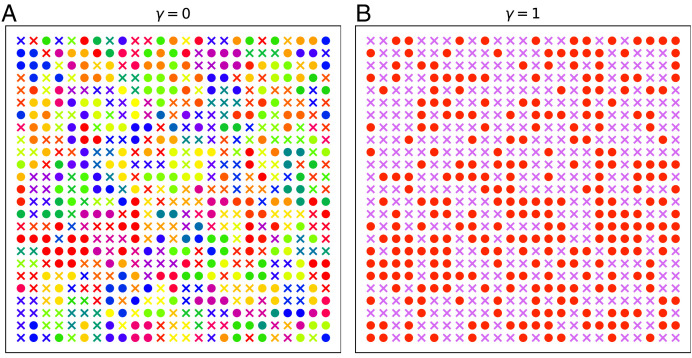
- Analysis: final ψ as a function of γ; PCA on the matrix of distances between agents and ridgeline plots to visualize group distributions over time; grid visualizations treating dynamic attributes as a base-m number.
Limitations
- Stated: partisan affiliation is treated as fixed, assuming it changes on a slower timescale; the model focuses on k = 2 bipolarization (though expandable to k > 2); nonlocal interlocutors are chosen without self-similarity bias, leaving selective-exposure-like bias to future research; the torus lattice is a poor representation of real-world networks, though other network structures are tested; convergence is challenging to prove analytically, so an empirically chosen stopping metric is used.
- Stated: the model is minimal and theoretical; it does not directly measure affective polarization but uses sorting ψ as a proxy linked in the literature; no empirical validation against real-world digital media data is presented.
- Evident: parameter choices (c = 4, h values, n = 10, m = 10, |A| = 196 or 625) and simulation stopping rules may affect results; causal claims about digital media are model-derived, not empirically tested; the paper notes academic debate about how far political divisions dominate cultural life, and cites a study finding most lifestyle preferences remain shared across the political divide.
Model-written summary. Check it against the paper before relying on it.
Integrity signals
Registry
Cites
Statistics
Figures
Verification
Claims the paper makes
18 Own interpretation · 13 No basis given · 8 Partly supported · 8 No full text of the sources · 8 Own result · 4 Supported so far · 2 Supported · 2 Sources not found · 2 Not checked yet · 1 Own method · accuracy not yet measured
The cited sources support only part of this claim — read each source’s verdict below.
In the paper
“Research using internet traffic data has even suggested that the online news audience is in fact less ideologically segregated than in-person interactions with family, friends, coworkers, and political discussants (70–72).”
§ How digital media drive affective polarization through partisan sorting > Media and Polarization
What the sources say
- Partly supportedcites [70] M. Gentzkow, J. M. Shapiro, Ideological segregation online and offline. Q. J. Econ. 126, 1799– 1839 (2011). sourceExperimental — accuracy not yet measured
Section 4.1 reports that Internet news segregation is lower than segregation in face-to-face interactions involving families, workplaces, and trusted acquaintances. Section 2.3 describes measures for friends and acquaintances, but our copy does not identify political discussants as a measured group, so that specific comparison is not established by this source. (LLM, conf=0.84)
- Partly supportedcites [71] D. C. Mutz, P. S. Martin, Facilitating communication across lines of political difference: The role of mass media. Am. Polit. Sci. Rev. 95, 97– 114 (2001). sourceExperimental — accuracy not yet measured
The section “Sources of Exposure to Cross-Cutting Political Views” finds that newspapers and television news expose people to more differing political views than interpersonal discussants, including workplace contacts. It does not establish the claim about online news audiences or use internet traffic data; “Implications of Availability and Selectivity” instead notes that people may select political websites that share their views. Page numbers are unavailable in our copy. (LLM, conf=0.88)
- Not checked — no full text of the sourcecites [72] D. C. Mutz, J. J. Mondak, The workplace as a context for cross-cutting political discourse. J. Polit. 68, 140– 155 (2006). source
hedged- Asserted: passes — The authors put it forward as true.
- Checkable: passes — It can be checked against evidence.
- Load-bearing: unclear — It is unclear whether the paper’s conclusions depend on it.
- Based: passes — The paper gives a reason why it holds.
- Partly supported
The cited sources support only part of this claim — read each source’s verdict below.
In the paper
“Bail et al. (75) similarly found in a field experiment on Twitter that individuals who were exposed to opposing views became more polarized, not less (see also ref. 25).”
§ How digital media drive affective polarization through partisan sorting > Media and Polarization
What the sources say
- Partly supportedcites [75] C. A. Bail, Exposure to opposing views on social media can increase political polarization. Proc. Natl. Acad. Sci. U.S.A. 115, 9216– 9221 (2018). 30154168 PMC6140520 sourceExperimental — accuracy not yet measured
The Abstract reports that Republicans expressed substantially more conservative views after following a liberal Twitter bot. Democrats became only slightly more liberal after following a conservative bot, and that effect was not statistically significant. The citing sentence overgeneralizes the increase in polarization to exposed individuals as a whole; the Discussion and Conclusion also cautions against generalizing beyond the study population. (LLM, conf=0.88)
plaindirect- Asserted: passes — The authors put it forward as true.
- Checkable: passes — It can be checked against evidence.
- Load-bearing: passes — The paper’s conclusions depend on it.
- Based: passes — The paper gives a reason why it holds.
- Partly supported
The sources with a verdict support this claim; the rest weren’t checked yet, have no full text we could read, or their verdicts aren’t rated yet.
In the paper
“The parameter γ thus represents a simple way of capturing the empirically observed effect of digital media: digital media means that individuals are brought into interaction with others outside their local network.”
§ How digital media drive affective polarization through partisan sorting > Model Description
What the sources say
- Not checked — no full text of the sourcecites [25] C. A. Bail, Breaking the Social Media Prism: How to Make Our Platforms Less Polarizing (Princeton University Press, 2021). source
- Not matchedcites [26] A. Guess, B. Nyhan, B. Lyons, J. Reifler, Avoiding the echo chamber about echo chambers. Knight Foundation 2, 1– 25 (2018).
Couldn’t be matched to a paper in Crossref, so it can’t be checked.
- Supportedcites [27] P. Törnberg, J. Uitermark, Tweeting ourselves to death: The cultural logic of digital capitalism. Media Cult. Soc. 44, 1– 20 (2022). source
The Introduction (page unavailable) contrasts local audiences with the Internet’s ability to reach audiences anywhere in the world. “Political discourse as self-presentation” (page unavailable) describes social media users participating in communities and interacting in groups formed around shared traits. Together, these passages support the paraphrase that digital media enables interaction beyond a local network. (LLM, conf=0.84)
plaindirect- Asserted: passes — The authors put it forward as true.
- Checkable: passes — It can be checked against evidence.
- Load-bearing: passes — The paper’s conclusions depend on it.
- Based: passes — The paper gives a reason why it holds.
The sources with a verdict support this claim; the rest weren’t checked yet, have no full text we could read, or their verdicts aren’t rated yet.
In the paper
“Correspondingly, when cleavages and conflicts come to align—what we will refer to as sorting—the effects are synergetic in terms of intensifying prejudice and conflict between opposing political groups (18, 44).”
§ How digital media drive affective polarization through partisan sorting > Affective Polarization and the Alignment of Difference
What the sources say
- Supportedcites [18] L. Mason, A cross-cutting calm: How social sorting drives affective polarization. Public Opin. Q. 80, 351– 377 (2016). source
The “Multiple Identities” section says that when cross-cutting cleavages align, partisan conflict is expected to increase substantially. It also links aligned identities to greater intolerance of outgroups and more volatile emotional reactions, supporting the claim’s characterization of intensified prejudice and conflict. (LLM, conf=0.90)
- Not checked — no full text of the sourcecites [44] S. Roccas, M. B. Brewer, Social identity complexity. Pers. Soc. Psychol. Rev. 6, 88– 106 (2002). source
plaindirect- Asserted: passes — The authors put it forward as true.
- Checkable: passes — It can be checked against evidence.
- Load-bearing: passes — The paper’s conclusions depend on it.
- Based: passes — The paper gives a reason why it holds.
- Supported
The sources with a verdict support this claim; the rest weren’t checked yet, have no full text we could read, or their verdicts aren’t rated yet.
In the paper
“Many scholars link these negative feelings to shifts in identity, with partisanship emerging as an important social identity under which many societal divisions and conflicts are coming to align (15–18).”
§ How digital media drive affective polarization through partisan sorting > Affective Polarization and the Alignment of Difference
What the sources say
- Not checked — no full text of the sourcecites [15] S. Iyengar, G. Sood, Y. Lelkes, Affect, not ideology: A social identity perspective on polarization. Public Opin. Q. 76, 405– 431 (2012). source
- Not checked — no full text of the sourcecites [16] S. Iyengar, S. J. Westwood, Fear and loathing across party lines: New evidence on group polarization. Am. J. Pol. Sci. 59, 690– 707 (2015). source
- Not checked — no full text of the sourcecites [17] L. Mason, “I disrespectfully agree”: The differential effects of partisan sorting on social and issue polarization. Am. J. Pol. Sci. 59, 128– 145 (2015). source
- Supportedcites [18] L. Mason, A cross-cutting calm: How social sorting drives affective polarization. Public Opin. Q. 80, 351– 377 (2016). source
The Abstract describes American partisan identities as increasingly linked with religious, racial, and other political identities. The Multiple Identities section says that when social divisions align along a single dimension, partisan conflict is expected to increase. Page numbers were not provided in our copy. (LLM, conf=0.93)
plaincorrelational- Asserted: passes — The authors put it forward as true.
- Checkable: passes — It can be checked against evidence.
- Load-bearing: passes — The paper’s conclusions depend on it.
- Based: passes — The paper gives a reason why it holds.
Every source the paper cites for this claim was checked and supports it.
In the paper
“The suggestion is, in short, that polarization on digital media is driven by conflict rather than isolation (117), affording a form of politics rooted in identity rather than opinion (4).”
§ How digital media drive affective polarization through partisan sorting > Conclusions
What the sources say
- Supportedcites [4] P. Törnberg, C. Andersson, K. Lindgren, S. Banisch, Modeling the emergence of affective polarization in the social media society. PLoS One 16, e0258259 (2021). 34634056 PMC8504759 source
The Conclusion says that digital media’s effects on polarization can turn opinions and arguments into symbols of identity. It explicitly contrasts this account with one in which polarization takes place within the space of opinions. (LLM, conf=0.93)
hedgeddirect- Asserted: passes — The authors put it forward as true.
- Checkable: passes — It can be checked against evidence.
- Load-bearing: passes — The paper’s conclusions depend on it.
- Based: passes — The paper gives a reason why it holds.
- Supported
A result the paper reports from its own data — it cites no other source for it, so there is none to check. The quote shows it is in the paper.
In the paper
“When γ is high, ψ quickly reaches a high level; when γ is 0.5, ψ rises more slowly and settles on a lower value; and with γ = 0, ψ remains fixed at a low level.”
§ How digital media drive affective polarization through partisan sorting > Results
plain- Asserted: passes — The authors put it forward as true.
- Checkable: passes — It can be checked against evidence.
- Load-bearing: passes — The paper’s conclusions depend on it.
- Based: passes — The paper gives a reason why it holds.
- The authors state this as an assumption: Partisan affiliation is fixed throughout the model run, assuming it changes on a slower timescale than other attributes.
- The authors state this as an assumption: Social similarity is relative to the larger social context.
- The authors state this as an assumption: Nonlocal interlocutors are chosen without bias toward self-similarity.
A result the paper reports from its own data — it cites no other source for it, so there is none to check. The quote shows it is in the paper.
In the paper
“At high levels of influence homophily (h = 8; Fig. 2C), the result is a rapid increase in sorting at a certain threshold of nonlocal interaction.”
§ How digital media drive affective polarization through partisan sorting > Results
plaindirect- Asserted: passes — The authors put it forward as true.
- Checkable: passes — It can be checked against evidence.
- Load-bearing: passes — The paper’s conclusions depend on it.
- Based: passes — The paper gives a reason why it holds.
- The authors state this as an assumption: Partisan affiliation is fixed throughout the model run, assuming it changes on a slower timescale than other attributes.
- The authors state this as an assumption: Social similarity is relative to the larger social context.
- The authors state this as an assumption: Nonlocal interlocutors are chosen without bias toward self-similarity.
A result the paper reports from its own data — it cites no other source for it, so there is none to check. The quote shows it is in the paper.
In the paper
“Fig. 1 shows that the evolution of ψ indeed depends on γ.”
§ How digital media drive affective polarization through partisan sorting > Results
boostedcorrelational- Asserted: passes — The authors put it forward as true.
- Checkable: passes — It can be checked against evidence.
- Load-bearing: passes — The paper’s conclusions depend on it.
- Based: passes — The paper gives a reason why it holds.
- The authors state this as an assumption: Partisan affiliation is fixed throughout the model run, assuming it changes on a slower timescale than other attributes.
- The authors state this as an assumption: Social similarity is relative to the larger social context.
- The authors state this as an assumption: Nonlocal interlocutors are chosen without bias toward self-similarity.
A result the paper reports from its own data — it cites no other source for it, so there is none to check. The quote shows it is in the paper.
In the paper
“When γ is high, ψ quickly reaches a high level; when γ is 0.5, ψ rises more slowly and settles on a lower value; and with γ = 0, ψ remains fixed at a low level.”
§ How digital media drive affective polarization through partisan sorting > Results
plaindirect- Asserted: passes — The authors put it forward as true.
- Checkable: passes — It can be checked against evidence.
- Load-bearing: passes — The paper’s conclusions depend on it.
- Based: passes — The paper gives a reason why it holds.
- The authors state this as an assumption: Partisan affiliation is fixed throughout the model run, assuming it changes on a slower timescale than other attributes.
- The authors state this as an assumption: Social similarity is relative to the larger social context.
- The authors state this as an assumption: Nonlocal interlocutors are chosen without bias toward self-similarity.
- It may state two separate claims as one. 24
- Probably not a substantial claim. 7
The cited sources support only part of this claim — read each source’s verdict below.
In the paper
“This literature suggests that digital media do not isolate us from opposing ideas; au contraire, they bring us to interact with individuals outside our local bubble, and they throw us into a political war, in which we are forced to take sides (25–27).”
§ How digital media drive affective polarization through partisan sorting > Abstract
What the sources say
- Not checked — no full text of the sourcecites [25] C. A. Bail, Breaking the Social Media Prism: How to Make Our Platforms Less Polarizing (Princeton University Press, 2021). source
- Not matchedcites [26] A. Guess, B. Nyhan, B. Lyons, J. Reifler, Avoiding the echo chamber about echo chambers. Knight Foundation 2, 1– 25 (2018).
Couldn’t be matched to a paper in Crossref, so it can’t be checked.
- Partly supportedcites [27] P. Törnberg, J. Uitermark, Tweeting ourselves to death: The cultural logic of digital capitalism. Media Cult. Soc. 44, 1– 20 (2022). sourceExperimental — accuracy not yet measured
In “Political discourse as self-presentation” (page unavailable), the paper says messages from opposing groups are common on social media and can fuel outrage and strengthen group identity; it also describes a broader political culture war. But it says social media cluster users into echo chambers or filter bubbles, and it does not establish that users interact with people outside those groups or are forced to take sides. (LLM, conf=0.84)
hedgeddirect- Asserted: passes — The authors put it forward as true.
- Checkable: passes — It can be checked against evidence.
- Load-bearing: passes — The paper’s conclusions depend on it.
- Based: passes — The paper gives a reason why it holds.
It may state two separate claims as one.
The sources with a verdict support this claim; the rest weren’t checked yet, have no full text we could read, or their verdicts aren’t rated yet.
In the paper
“While the political divide has remained relatively stable in the United States in terms of issue positions (33), many other indicators point to a significant increase in partisan polarization and animosity in the mass public (18, 34): Democrats and Republicans are growing increasingly cold to each other, coming to dislike or even disdain their partisan opponents (15).”
§ How digital media drive affective polarization through partisan sorting > Affective Polarization and the Alignment of Difference
What the sources say
- Not matchedcites [33] M. P. Fiorina, Unstable Majorities: Polarization, Party Sorting, and Political Stalemate (Hoover Press, 2017).
Couldn’t be matched to a paper in Crossref, so it can’t be checked.
- Supportedcites [18] L. Mason, A cross-cutting calm: How social sorting drives affective polarization. Public Opin. Q. 80, 351– 377 (2016). source
The stable-issue-positions clause is attributed to citation 33, not this paper. For the clause citing this paper, the Data and Methods—American National Election Studies section reports rising anger toward opposing presidential candidates from 1980 to 2012, alongside growing partisan social sorting; the Abstract describes an increasingly affectively polarized electorate. Page numbers are not provided in our copy. (LLM, conf=0.91)
- Not matchedcites [34] Pew Research Center, Partisanship and Political Animosity in 2016: Highly Negative Views of the Opposing Party and Its Members (2016). https://www.pewresearch.org/politics/2016/06/22/partisanship-and-political-animosity-in-2016/. Accessed 17 September 2022.
Couldn’t be matched to a paper in Crossref, so it can’t be checked.
- Not checked — no full text of the sourcecites [15] S. Iyengar, G. Sood, Y. Lelkes, Affect, not ideology: A social identity perspective on polarization. Public Opin. Q. 76, 405– 431 (2012). source
plain- Asserted: passes — The authors put it forward as true.
- Checkable: passes — It can be checked against evidence.
- Load-bearing: passes — The paper’s conclusions depend on it.
- Based: passes — The paper gives a reason why it holds.
It may state two separate claims as one.
- Not matched
The cited sources support only part of this claim — read each source’s verdict below.
In the paper
“Research on social media data tells a similar story: while partisan social media users do tend to interact across the ideological divide (62), this interaction is not characterized by rational arguments and deliberation but tends to be contentious and conflictual, suggesting that users may not be engaging in good faith attempts at seeing things through other perspectives (98–100).”
§ How digital media drive affective polarization through partisan sorting > Media and Polarization
What the sources say
- Not checked — no full text of the sourcecites [62] P. Barberá, J. T. Jost, J. Nagler, J. A. Tucker, R. Bonneau, Tweeting from left to right: Is online political communication more than an echo chamber? Psychol. Sci. 26, 1531– 1542 (2015). 26297377 source
- Partly supportedcites [98] G. Evolvi, Hate in a tweet: Exploring internet-based islamophobic discourses. Religions (Basel) 9, 307 (2018). sourceExperimental — accuracy not yet measured
Section 3 (Brexit and Twitter Islamophobia; page unavailable) says Islamophobic Twitter groups rarely converse with Muslims and instead establish an antagonistic relationship with them. Section 5.2 describes derogatory tweets intended to upset other users. This supports the contentious-interaction portion of the citing sentence, but the paper’s post-Brexit Islamophobia findings do not establish that characterization for partisan social media users generally. The separate claim that users interact across the ideological divide is cited to another source (62). (LLM, conf=0.85)
- Partly supportedcites [99] R. Moernaut, J. Mast, M. Temmerman, M. Broersma, Hot weather, hot topic. Polarization and sceptical framing in the climate debate on Twitter. Inform. Commun. Soc. 25, 1047– 1066 (2022). sourceExperimental — accuracy not yet measured
The Conclusion reports that when interactions occurred between climate sceptics and believers on Twitter, they tended to be antagonistic and aimed at delegitimizing the other group rather than fostering constructive debate. This supports the contentious-interaction portion attributed to this source, but the study does not establish that pattern for partisan social media users generally. The separate claim that users interact across the ideological divide is cited to another source (62). (LLM, conf=0.85)
- Not checked — no full text of the sourcecites [100] A. Gruzd, J. Roy, Investigating political polarization on Twitter: A Canadian perspective. Policy Internet 6, 28– 45 (2014). source
hedgedcorrelational- Asserted: passes — The authors put it forward as true.
- Checkable: passes — It can be checked against evidence.
- Load-bearing: passes — The paper’s conclusions depend on it.
- Based: passes — The paper gives a reason why it holds.
It may state two separate claims as one.
The cited sources support only part of this claim — read each source’s verdict below.
In the paper
“This evidence has been taken to suggest that in contrast to the assumptions of the selective exposure hypothesis, social media is in fact characterized by intense interaction across the political divide (73).”
§ How digital media drive affective polarization through partisan sorting > Media and Polarization
What the sources say
- Partly supportedcites [73] A. Keuchenius, P. Törnberg, J. Uitermark, Why it is important to consider negative ties when studying polarized debates: A signed network analysis of a Dutch cultural controversy on Twitter. PLoS One 16, e0256696 (2021). 34464396 PMC8407581 sourceExperimental — accuracy not yet measured
The Results (Coalitions and divisions in the debate; page unavailable) document antagonistic interaction between opposing groups in the Dutch Black Pete debate on Twitter. But the Conclusion and discussion says the study concerns one debate, time period, country, and platform, and leaves broader generalization to future research. It does not establish that social media generally is characterized by intense interaction across political divides. (LLM, conf=0.84)
hedgedcorrelational- Asserted: passes — The authors put it forward as true.
- Checkable: passes — It can be checked against evidence.
- Load-bearing: fails — The paper’s conclusions may not depend on it.
- Based: passes — The paper gives a reason why it holds.
Probably not a substantial claim. The paper’s conclusions may not depend on it.
- Partly supported
The cited sources support only part of this claim — read each source’s verdict below.
In the paper
“Studies on social media have found limited evidence for the described homogeneous clusters on most social media platforms: while users may be unlikely to rebroadcast content from the opposing side, they are often exposed to it and may even respond (11, 62–69).”
§ How digital media drive affective polarization through partisan sorting > Media and Polarization
What the sources say
- Partly supportedcites [11] R. Karlsen, K. Steen-Johnsen, D. Wollebaek, B. Enjolras, Echo chamber and trench warfare dynamics in online debates. Eur. J. Commun. 32, 257– 273 (2017). 28690351 PMC5482382 sourceExperimental — accuracy not yet measured
The Trench warfare dynamics section says there is little evidence that people avoid political diversity online, and the Conclusion reports that people frequently encounter opposing arguments and can interact with those holding opposite views. The paper does not establish this pattern across most social media platforms or address whether users rebroadcast opposing content; its Conclusion cautions that the dynamics may differ by platform. (LLM, conf=0.84)
- Not checked — no full text of the sourcecites [62] P. Barberá, J. T. Jost, J. Nagler, J. A. Tucker, R. Bonneau, Tweeting from left to right: Is online political communication more than an echo chamber? Psychol. Sci. 26, 1531– 1542 (2015). 26297377 source
- Not checked — no full text of the sourcecites [63] S. Goel, W. Mason, D. J. Watts, Real and perceived attitude agreement in social networks. J. Pers. Soc. Psychol. 99, 611– 621 (2010). 20731500 source
- Not checked — no full text of the sourcecites [64] E. Bakshy, S. Messing, L. A. Adamic, Exposure to ideologically diverse news and opinion on Facebook. Science 348, 1130– 1132 (2015). 25953820 source
- Not checked — no full text of the sourcecites [65] E. Colleoni, A. Rozza, A. Arvidsson, Echo chamber or public sphere? Predicting political orientation and measuring political homophily in Twitter using big data. J. Commun. 64, 317– 332 (2014). source
- Partly supportedcites [66] E. Lawrence, J. Sides, H. Farrell, Self-segregation or deliberation? Blog readership, participation, and polarization in American politics. Perspect. Polit. 8, 141– 157 (2010). sourceExperimental — accuracy not yet measured
The Blog Authors section says cross-ideological links are infrequent, but some involve substantive argument and conversation, supporting the possibility of responses to opposing views. The Homophily and Polarization in the Blogosphere section instead finds that 94% of political blog readers read only blogs from one ideological side. The paper studies political blogs, not most social media platforms, and does not establish that users are often exposed to opposing content. (LLM, conf=0.86)
- Partly supportedcites [67] C. Vaccari, Of echo chambers and contrarian clubs: Exposure to political disagreement among German and Italian users of Twitter. Soc. Media Soc. 2, 1– 24 (2016). sourceExperimental — accuracy not yet measured
The Introduction and Conclusion report that German and Italian Twitter users encountered opposing views, even though homogeneity was the modal outcome. The paper does not establish that homogeneous clusters have limited evidence across most social media platforms, nor do the cited passages assess whether users rebroadcast or respond to opposing content. Our copy provides no page numbers for these passages. (LLM, conf=0.86)
- Not checked — no full text of the sourcecites [68] S. Yardi, D. Boyd, Dynamic debates: An analysis of group polarization over time on twitter. Bull. Sci. Technol. Soc. 30, 316– 327 (2010). source
- Partly supportedcites [69] G. De Francisci Morales, C. Monti, M. Starnini, No echo in the chambers of political interactions on Reddit. Sci. Rep. 11, 2818 (2021). 33531520 PMC7854755 sourceExperimental — accuracy not yet measured
The Introduction and Discussion (pages unavailable) report that, in Reddit discussions of the 2016 US election, opposing political groups interacted more often than expected and Clinton supporters were particularly likely to answer Trump supporters. That supports the possibility of exposure and response, but the paper does not establish limited homogeneous clustering on most social media platforms; its Discussion describes echo chambers on other platforms. It also does not establish a general pattern of users declining to rebroadcast opposing content. (LLM, conf=0.88)
hedged- Asserted: passes — The authors put it forward as true.
- Checkable: passes — It can be checked against evidence.
- Load-bearing: passes — The paper’s conclusions depend on it.
- Based: passes — The paper gives a reason why it holds.
It may state two separate claims as one.
- Partly supported
The cited sources support only part of this claim — read each source’s verdict below.
In the paper
“In other words, partisans consume media from across the partisan divide but do not trust in what opposing media channels tell them.”
§ How digital media drive affective polarization through partisan sorting > Media and Polarization
What the sources say
- Partly supportedcites [96] A. M. Guess, P. Barberá, S. Munzert, J. Yang, The consequences of online partisan media. Proc. Natl. Acad. Sci. U.S.A. 118, e2013464118 (2021). 33782116 PMC8040813 sourceExperimental — accuracy not yet measured
The Discussion (page not available) says exposure to cross-cutting information is relatively common. It also reports reduced overall trust in mainstream media and suggests people may discount challenging content. It does not establish that partisans specifically distrust what opposing media channels tell them; that conclusion is more definite and more source-specific than the paper's finding. (LLM, conf=0.86)
- Not matchedcites [97] M. Jurkowitz, A. Mitchell, E. Shearer, M. Walker, US media polarization and the 2020 election: A nation divided (Pew Research Center, 2020). https://www.pewresearch.org/journalism/2020/01/24/u-s-media-polarization-and-the-2020-election-a-nation-divided/. Accessed 17 September 2022.
Couldn’t be matched to a paper in Crossref, so it can’t be checked.
plain- Asserted: passes — The authors put it forward as true.
- Checkable: passes — It can be checked against evidence.
- Load-bearing: passes — The paper’s conclusions depend on it.
- Based: passes — The paper gives a reason why it holds.
It may state two separate claims as one.
- Partly supported
The cited sources support only part of this claim — read each source’s verdict below.
In the paper
“This has brought researchers to conclude that negative influence effect is elusive, with limited relevance for politics outside the laboratory (88, 90, 93–95): while we may be less influenced by our political opponents, we are unlikely to be negatively influenced by them.”
§ How digital media drive affective polarization through partisan sorting > Media and Polarization
What the sources say
- Not checked — no full text of the sourcecites [88] D. M. Kahan, “The politically motivated reasoning paradigm, part 1: What politically motivated reasoning is and how to measure it” in Emerging Trends in the Social and Behavioral Sciences: An Interdisciplinary, Searchable, and Linkable Resource, R. A. Scott, S. M. Kosslyn, Eds. (John Wiley & Sons, Hoboken, NJ, 2015), pp. 1– 16. source
- Not checked — no full text of the sourcecites [90] T. Wood, E. Porter, The elusive backfire effect: Mass attitudes’ steadfast factual adherence. Polit. Behav. 41, 135– 163 (2019). source
- Not checked — no full text of the sourcecites [93] R. S. Nickerson, Confirmation bias: A ubiquitous phenomenon in many guises. Rev. Gen. Psychol. 2, 175 (1998). source
- Could not verifycites [94] D. M. Kahan, Ideology, motivated reasoning, and cognitive reflection: An experimental study. Judgm. Decis. Mak. 8, 407– 424 (2012). sourceExperimental — accuracy not yet measured
Section 5.1 reports ideologically motivated reasoning in an experiment, and Section 3.3 discusses how biased assessment of evidence might polarize beliefs. Neither passage addresses whether messages from political opponents cause a negative influence or backfire effect, or whether such an effect is rare outside the laboratory. Searches for those terms and for opposing-message effects found no passage settling the claim. (LLM, conf=0.72)
- Partly supportedcites [95] K. Takács, A. Flache, M. Mäs, Discrepancy and disliking do not induce negative opinion shifts. PLoS One 11, 1– 21 (2016). PMC4917087 27333160 sourceExperimental — accuracy not yet measured
The Summary and Conclusion reports no support for negative opinion shifts in the authors’ controlled experiments. It does not establish that the effect has limited relevance to politics outside the laboratory: the authors explicitly say they cannot exclude negative influence in field settings, and they did not study political opponents as such. (LLM, conf=0.86)
hedged- Asserted: passes — The authors put it forward as true.
- Checkable: passes — It can be checked against evidence.
- Load-bearing: unclear — It is unclear whether the paper’s conclusions depend on it.
- Based: passes — The paper gives a reason why it holds.
It may state two separate claims as one.
Every source the paper cites for this claim was checked and supports it.
In the paper
“The model thus suggests rethinking digital media as not merely arenas for rational deliberation and political debate but as spaces for social identity formation and for symbolic displays of solidarity with allies and difference from outgroups (27).”
§ How digital media drive affective polarization through partisan sorting > Conclusions
What the sources say
- Supportedcites [27] P. Törnberg, J. Uitermark, Tweeting ourselves to death: The cultural logic of digital capitalism. Media Cult. Soc. 44, 1– 20 (2022). source
In “Political discourse as self-presentation,” the paper says social media strengthen group identities and that messages from opposing groups affirm common identities and intensify outgroup dislike. The same section describes political expression as symbolic self-presentation grounded in identity and group belonging. The Conclusion likewise says public discourse is drawn into a logic of identity and difference. (LLM, conf=0.91)
hedged- Asserted: passes — The authors put it forward as true.
- Checkable: passes — It can be checked against evidence.
- Load-bearing: passes — The paper’s conclusions depend on it.
- Based: passes — The paper gives a reason why it holds.
It may state two separate claims as one.
- Supported
A result the paper reports from its own data — it cites no other source for it, so there is none to check. The quote shows it is in the paper.
In the paper
“When γ is high, ψ quickly reaches a high level; when γ is 0.5, ψ rises more slowly and settles on a lower value; and with γ = 0, ψ remains fixed at a low level.”
§ How digital media drive affective polarization through partisan sorting > Results
plaindirect- Asserted: passes — The authors put it forward as true.
- Checkable: passes — It can be checked against evidence.
- Load-bearing: passes — The paper’s conclusions depend on it.
- Based: passes — The paper gives a reason why it holds.
It may state two separate claims as one.
- The authors state this as an assumption: Partisan affiliation is fixed throughout the model run, assuming it changes on a slower timescale than other attributes.
- The authors state this as an assumption: Social similarity is relative to the larger social context.
- The authors state this as an assumption: Nonlocal interlocutors are chosen without bias toward self-similarity.
The paper states this without a source or data behind it here, so there is nothing to check it against. The quote shows it is in the paper.
In the paper
“The result is the crystallization of conflicting identities and the intensification of polarization, driven by a process in which sorting begets sorting and polarization begets polarization.”
§ How digital media drive affective polarization through partisan sorting > Conclusions
plaindirect- Asserted: passes — The authors put it forward as true.
- Checkable: passes — It can be checked against evidence.
- Load-bearing: passes — The paper’s conclusions depend on it.
- Based: passes — The paper gives a reason why it holds.
It may state two separate claims as one.
A conclusion the paper draws from its own results — it cites no other source for it, so there is none to check. The quote shows it is in the paper.
In the paper
“This paper provides a causal mechanism to explain this rise in polarization, by identifying how digital media may drive a sorting of differences, which has been linked to a breakdown of social cohesion and rising affective polarization.”
§ How digital media drive affective polarization through partisan sorting > Abstract
hedgedconditional- Asserted: passes — The authors put it forward as true.
- Checkable: passes — It can be checked against evidence.
- Load-bearing: passes — The paper’s conclusions depend on it.
- Based: passes — The paper gives a reason why it holds.
It may state two separate claims as one.
- The authors state this as an assumption: Partisan affiliation is fixed throughout the model run, assuming it changes on a slower timescale than other attributes.
- The authors state this as an assumption: Social similarity is relative to the larger social context.
- The authors state this as an assumption: Nonlocal interlocutors are chosen without bias toward self-similarity.
A conclusion the paper draws from its own results — it cites no other source for it, so there is none to check. The quote shows it is in the paper.
In the paper
“The suggested mechanism essentially turns the echo chamber on its head: it is not that isolation drives divergence of opinions but that the diverse and nonlocal interactions of digital media drive plural conflicts to align along partisan lines.”
§ How digital media drive affective polarization through partisan sorting > Abstract
plaindirect- Asserted: passes — The authors put it forward as true.
- Checkable: passes — It can be checked against evidence.
- Load-bearing: passes — The paper’s conclusions depend on it.
- Based: passes — The paper gives a reason why it holds.
It may state two separate claims as one.
- The authors state this as an assumption: Partisan affiliation is fixed throughout the model run, assuming it changes on a slower timescale than other attributes.
- The authors state this as an assumption: Social similarity is relative to the larger social context.
- The authors state this as an assumption: Nonlocal interlocutors are chosen without bias toward self-similarity.
The paper states this without a source or data behind it here, so there is nothing to check it against. The quote shows it is in the paper.
In the paper
“At the same time, such exposure does not seem to lead to political moderation: individuals are readily influenced by those they view as already similar to themselves, while disregarding messages from those they view as the outgroup.”
§ How digital media drive affective polarization through partisan sorting > Media and Polarization
hedged- Asserted: passes — The authors put it forward as true.
- Checkable: passes — It can be checked against evidence.
- Load-bearing: passes — The paper’s conclusions depend on it.
- Based: unclear — It is unclear why the paper says it holds.
It may state two separate claims as one.
A conclusion the paper draws from its own results — it cites no other source for it, so there is none to check. The quote shows it is in the paper.
In the paper
“The model thus suggests that digital media can intensify affective polarization by contributing to a runaway process in which more and more issues become drawn into a single growing social and cultural divide, in turn driving a breakdown of social cohesion.”
§ How digital media drive affective polarization through partisan sorting > Abstract
hedgedconditional- Asserted: passes — The authors put it forward as true.
- Checkable: passes — It can be checked against evidence.
- Load-bearing: passes — The paper’s conclusions depend on it.
- Based: passes — The paper gives a reason why it holds.
It may state two separate claims as one.
- The authors state this as an assumption: Partisan affiliation is fixed throughout the model run, assuming it changes on a slower timescale than other attributes.
- The authors state this as an assumption: Social similarity is relative to the larger social context.
- The authors state this as an assumption: Nonlocal interlocutors are chosen without bias toward self-similarity.
A conclusion the paper draws from its own results — it cites no other source for it, so there is none to check. The quote shows it is in the paper.
In the paper
“The suggestion of this paper is that these two points of empirical evidence may not only be reason to reject the echo chamber hypothesis (26), but they also provide the foundation for an alternative hypothesis for media polarization.”
§ How digital media drive affective polarization through partisan sorting > Media and Polarization
hedgeddirect- Asserted: passes — The authors put it forward as true.
- Checkable: passes — It can be checked against evidence.
- Load-bearing: passes — The paper’s conclusions depend on it.
- Based: passes — The paper gives a reason why it holds.
Probably not a substantial claim. It may state two separate claims as one.
In the paper
“Following the idea that we are more influenced by those similar to us, the node is then influenced as a function of the similarity with its interlocutors.”
§ How digital media drive affective polarization through partisan sorting > Model Description
What the sources say
- Not checked — no full text of the sourcecites [104] R. Axelrod, The dissemination of culture: A model with local convergence and global polarization. J. Conflict Resolut. 41, 203– 226 (1997). source
plaindirect- Asserted: passes — The authors put it forward as true.
- Checkable: passes — It can be checked against evidence.
- Load-bearing: passes — The paper’s conclusions depend on it.
- Based: passes — The paper gives a reason why it holds.
Probably not a substantial claim.
None of the sources cited for this claim have been checked yet.
In the paper
“In summary, the empirical literature suggests that digitalization does not appear to lead to a reduction of interaction across political divide, but quite the opposite: it confronts us with diverse individuals, perspectives, and viewpoints, often in contentious ways.”
§ How digital media drive affective polarization through partisan sorting > Media and Polarization
hedged- Asserted: passes — The authors put it forward as true.
- Checkable: passes — It can be checked against evidence.
- Load-bearing: passes — The paper’s conclusions depend on it.
- Based: passes — The paper gives a reason why it holds.
It may state two separate claims as one.
In the paper
“The degree to which political divisions have come to dominate cultural life, however, remains subject to academic debate, with a recent study finding that while some lifestyle preferences are politically polarized, most remain shared across the political divide (54).”
§ How digital media drive affective polarization through partisan sorting > Affective Polarization and the Alignment of Difference
What the sources say
- Not checked — no full text of the sourcecites [54] S. Praet, A. M. Guess, J. A. Tucker, R. Bonneau, J. Nagler, What’s not to like? Facebook page likes reveal limited polarization in lifestyle preferences. Polit. Commun. 39, 311– 338 (2022). source
hedged- Asserted: passes — The authors put it forward as true.
- Checkable: passes — It can be checked against evidence.
- Load-bearing: fails — The paper’s conclusions may not depend on it.
- Based: passes — The paper gives a reason why it holds.
Probably not a substantial claim. The paper’s conclusions may not depend on it. It may state two separate claims as one.
In the paper
“According to these scholars, sorting is thus central to understanding the rise in polarization and the growing sense of difference, distrust, and disdain between opposing partisans, suggesting that the causal link between digital media and polarization runs not through divergence of opinions but rather via the dynamics of partisan sorting (19).”
§ How digital media drive affective polarization through partisan sorting > Abstract
What the sources say
- Not checked — no full text of the sourcecites [19] M. Levendusky, The Partisan Sort: How Liberals Became Democrats and Conservatives Became Republicans (University of Chicago Press, 2009). source
hedgeddirect- Asserted: passes — The authors put it forward as true.
- Checkable: passes — It can be checked against evidence.
- Load-bearing: passes — The paper’s conclusions depend on it.
- Based: passes — The paper gives a reason why it holds.
Probably not a substantial claim.
In the paper
“The suggestion of this paper has been that these two points of empirical evidence may not only be reason to reject the echo chamber hypothesis (26), but that they also provide the foundation for an alternative emergent causal mechanism underlying the polarizing effects of digital media.”
§ How digital media drive affective polarization through partisan sorting > Conclusions
What the sources say
- Not matchedcites [26] A. Guess, B. Nyhan, B. Lyons, J. Reifler, Avoiding the echo chamber about echo chambers. Knight Foundation 2, 1– 25 (2018).
Couldn’t be matched to a paper in Crossref, so it can’t be checked.
hedgedconditional- Asserted: passes — The authors put it forward as true.
- Checkable: unclear — It is unclear whether it could be checked against evidence.
- Load-bearing: passes — The paper’s conclusions depend on it.
- Based: passes — The paper gives a reason why it holds.
It may state two separate claims as one.
- Not matched
What the paper did — it cites no source for this, so there is none to check. The quote shows it is in the paper.
In the paper
“Unless otherwise specified, the simulations here therefore use an empirically chosen metric for when convergence has occurred, verified on a large number of cases and with substantial margin: the simulation ends either when no update has occurred during 10 runs across the full number of agents or to prevent runs becoming infinitely stuck in a dynamic equilibrium, after 1,000,000 iterations.”
§ How digital media drive affective polarization through partisan sorting > Model Description
plain- Asserted: passes — The authors put it forward as true.
- Checkable: passes — It can be checked against evidence.
- Load-bearing: fails — The paper’s conclusions may not depend on it.
- Based: passes — The paper gives a reason why it holds.
Probably not a substantial claim. The paper’s conclusions may not depend on it. It may state two separate claims as one.
A conclusion the paper draws from its own results — it cites no other source for it, so there is none to check. The quote shows it is in the paper.
In the paper
“Digital media intensify polarization not as echo chambers but as a sorting machine, fueling a runaway social process that destabilizes plural societies by drawing more and more issues into a single expanding social and cultural divide.”
§ How digital media drive affective polarization through partisan sorting > Conclusions
plaindirect- Asserted: passes — The authors put it forward as true.
- Checkable: passes — It can be checked against evidence.
- Load-bearing: passes — The paper’s conclusions depend on it.
- Based: passes — The paper gives a reason why it holds.
It may state two separate claims as one.
A conclusion the paper draws from its own results — it cites no other source for it, so there is none to check. The quote shows it is in the paper.
In the paper
“in turn reducing their mutual social influence which further intensifies the process of sorting.”
§ How digital media drive affective polarization through partisan sorting > Conclusions
plaindirect- Asserted: passes — The authors put it forward as true.
- Checkable: passes — It can be checked against evidence.
- Load-bearing: passes — The paper’s conclusions depend on it.
- Based: passes — The paper gives a reason why it holds.
It may state two separate claims as one.
A conclusion the paper draws from its own results — it cites no other source for it, so there is none to check. The quote shows it is in the paper.
In the paper
“This is a striking result, showing that if individuals are more influenced by those who are similar to them, interaction outside of local bubbles can result in increased partisan sorting, in turn associated to affective polarization.”
§ How digital media drive affective polarization through partisan sorting > Results
plaindirect- Asserted: passes — The authors put it forward as true.
- Checkable: passes — It can be checked against evidence.
- Load-bearing: passes — The paper’s conclusions depend on it.
- Based: passes — The paper gives a reason why it holds.
It may state two separate claims as one.
- The authors state this as an assumption: Partisan affiliation is fixed throughout the model run, assuming it changes on a slower timescale than other attributes.
- The authors state this as an assumption: Social similarity is relative to the larger social context.
- The authors state this as an assumption: Nonlocal interlocutors are chosen without bias toward self-similarity.
A conclusion the paper draws from its own results — it cites no other source for it, so there is none to check. The quote shows it is in the paper.
In the paper
“it is not lack of exposure to competing ideas that lead to polarization but precisely that digital media brings us to interact outside of our local bubble.”
§ How digital media drive affective polarization through partisan sorting > Conclusions
plaindirect- Asserted: passes — The authors put it forward as true.
- Checkable: passes — It can be checked against evidence.
- Load-bearing: passes — The paper’s conclusions depend on it.
- Based: passes — The paper gives a reason why it holds.
It may state two separate claims as one.
A conclusion the paper draws from its own results — it cites no other source for it, so there is none to check. The quote shows it is in the paper.
In the paper
“creating a maelstrom in which additional identities, beliefs, and cultural belonging become sucked into a growing and all-encompassing societal division, which threatens the very foundation of social cohesion.”
§ How digital media drive affective polarization through partisan sorting > Conclusions
plaindirect- Asserted: passes — The authors put it forward as true.
- Checkable: fails — It may be too vague to check against evidence.
- Load-bearing: passes — The paper’s conclusions depend on it.
- Based: passes — The paper gives a reason why it holds.
Probably not a substantial claim. It may be too vague to check against evidence. It may state two separate claims as one.
A conclusion the paper draws from its own results — it cites no other source for it, so there is none to check. The quote shows it is in the paper.
In the paper
“Digital media do not isolate us from opposing ideas; au contraire, they throw us into a national political war, in which we are forced to take sides.”
§ How digital media drive affective polarization through partisan sorting > Conclusions
plaindirect- Asserted: passes — The authors put it forward as true.
- Checkable: unclear — It is unclear whether it could be checked against evidence.
- Load-bearing: passes — The paper’s conclusions depend on it.
- Based: unclear — It is unclear why the paper says it holds.
It may state two separate claims as one.
The authors state this as an assumption.
Partisan affiliation is fixed throughout the model run, assuming it changes on a slower timescale than other attributes.
“Each agent i also has a single attribute, Si, corresponding to partisan affiliation, which held fixed throughout the model run (see also ref. 58).”
“We here treat partisan affiliation as fixed, assuming that it will change on a slower timescale than the other attributes.”
The authors state this as an assumption.
Social similarity is relative to the larger social context.
“The social similarity is in other words treated as relative: that is, how similar we see ourselves to a particular individual depends on the larger social context (for instance, while the differences between Trotskyists and Stalinists may appear as a large chasm for members of the Party, they may for outsiders appear as a matter of relatively trivial detail).”
The authors state this as an assumption.
Nonlocal interlocutors are chosen without bias toward self-similarity.
“While the selective exposure hypothesis would suggest that these individuals would be selected with a bias toward self-similarity, we will here let the choice be unbiased as we are seeking to examine whether sorting can appear without such empirically questioned assumptions.”
Claims other papers make about this one
Each is checked against this paper’s own text: does it say what the citing paper says it does?
The source backs part of the claim, not all of it — or backs it for a different population, condition or comparison.
In the citing paper
“Because there is such a large volume of people to connect with in the online context, there are significantly more extreme voices to affiliate with than there were in prior social groups that were limited by geography (Petersen et al. 2020, Törnberg 2022).”
From Social Media and Morality. (2024) · cites this paper as Törnberg 2022
Experimental — accuracy not yet measuredThe source backs part of the claim, not all of it — or backs it for a different population, condition or comparison.
In the citing paper
“algo que permite afirmar -de nuevo-que no solo la homogeneidad polariza, la interacción intergrupal también lo hace (Törnberg, 2022).”
From Política, uso de medios y polarización afectiva en España (2024) · cites this paper as Törnberg, 2022
Experimental — accuracy not yet measured
Self-check
Percentages, sums and reported differences re-computed from the paper’s own numbers.
Each contradiction between two passages listed here was confirmed by an independent check.
Rated minor: it would not touch a result — a value no result rests on, a p-value that stays on the same side of the significance level, or a conflict that is clerical, resolved elsewhere in the paper, or outside its own findings.
In the paper
§ How digital media drive affective polarization through partisan sorting > Results
“we carry out 8,000 simulation runs for three values of h (1, 2, 5)”
§ How digital media drive affective polarization through partisan sorting > Results
“when the level of influence homophily is (A) low (h = 1), (B) medium (h = 4), and (C) high (h = 8).”
Citations
Cites
Confirmation Bias: A Ubiquitous Phenomenon in Many Guises
Nickerson, R. S. (1998) · Review of General Psychology · doi:10.1037/1089-2680.2.2.175 · Cited by 7,267
Modernity and self-identity: self and society in the late modern age
(1992) · Choice Reviews Online · doi:10.5860/choice.29-3618 · Cited by 5,667
The Social Self: On Being the Same and Different at the Same Time
Brewer, M. B. (1991) · Personality and Social Psychology Bulletin · doi:10.1177/0146167291175001 · Cited by 5,107
Motivated Skepticism in the Evaluation of Political Beliefs
Taber, C. S., & Lodge, M. (2006) · American Journal of Political Science · doi:10.1111/j.1540-5907.2006.00214.x · Cited by 4,344
Exposure to ideologically diverse news and opinion on Facebook
Bakshy, E., Messing, S., & Adamic, L. A. (2015) · Science · doi:10.1126/science.aaa1160 · Cited by 3,245
When Corrections Fail: The Persistence of Political Misperceptions
Nyhan, B., & Reifler, J. (2010) · Political Behavior · doi:10.1007/s11109-010-9112-2 · Cited by 3,173 · cited 1×
“Some earlier studies even suggested that messages from the opposing side can be rejected so strongly as to lead individuals to shift their position in the opposite direction—what is referred to as “negative influence” or the “backfire effect” (83).”
BackgroundIyengar, S., Sood, G., & Lelkes, Y. (2012) · Public Opinion Quarterly · doi:10.1093/poq/nfs038 · Cited by 2,996
Party Systems and Voter Alignments. Cross National Perspectives
Birnbaum, P., Lipset, S. M., & Rokkan, S. (1968) · Revue Française de Sociologie · doi:10.2307/3320570 · Cited by 2,802
The Functions of Social Conflict.
Levy, M. J. J., & Coser, L. A. (1957) · American Sociological Review · doi:10.2307/2088776 · Cited by 2,611
Fear and loathing across party lines: New evidence on group polarization
Iyengar, S., & Westwood, S. J. (2015) · American Journal of Political Science · doi:10.1111/ajps.12152 · Cited by 2,452
Research works printed but not linked: 7
- C. R. Sunstein, Echo Chambers: Bush v. Gore, Impeachment, and Beyond (Princeton University Press, Princeton, NJ, 2001).
- A. Guess, B. Nyhan, B. Lyons, J. Reifler, Avoiding the echo chamber about echo chambers. Knight Foundation 2, 1–25 (2018).
- E. A. Nordlinger, Conflict Regulation in Divided Societies (Center for International Affairs, Harvard University, 1972).
- S. Levitsky, D. Ziblatt, How Democracies Die (Broadway Books, 2018).
- M. W. Macy J. A. Kitts A. Flache S. Benard "Polarization in dynamic networks: A Hopfield model of emergent structure" in Dynamic Social Network Modeling and Analysis R. Breiger K. Carley P. Pattison Eds. (National Academies Press Washington DC 2003) pp.162–173.
- R. P. Abelson “Mathematical models of the distribution of attitudes under controversy” in Contributions to Mathematical Psychology N. Fredericksen H. Gullicksen Eds. (Holt Rinehart and Winston New York NY 1964) pp.142–165.
- E. Klein, Why We’re Polarized (Simon and Schuster, 2020).
Cited by
Sorted by citations
Social Drivers and Algorithmic Mechanisms on Digital Media.
Metzler, H., & Garcia, D. (2024) · Perspectives on Psychological Science · doi:10.1177/17456916231185057 · Cited by 204
A review and provocation: On polarization and platforms
Kreiss, D., & McGregor, S. C. (2024) · New Media & Society · doi:10.1177/14614448231161880 · Cited by 151
“…argue that the causes of this sectarian polarization are both political—such as the sorting of racial and other identities into distinct parties and the embrace of sectarianism by elites—and tied to broader shifts in media, including the rise of social media and platforms (e.g. Törnberg, 2022).”
BackgroundAlgorithm-mediated social learning in online social networks
Brady, W. J., Jackson, J. C., Lindström, B., & Crockett, M. J. (2023) · Trends in Cognitive Sciences · doi:10.1016/j.tics.2023.06.008 · Cited by 132
Building Human Values into Recommender Systems: An Interdisciplinary Synthesis
Stray, J., Halevy, A. Y., Assar, P., Hadfield-Menell, D., Boutilier, C. E., Ashar, A., Bakalar, C., Beattie, L., Ekstrand, M. D., Leibowicz, C., et al. (2023) · ACM Transactions on Recommender Systems · doi:10.1145/3632297 · Cited by 183
Van Bavel, J. J., Robertson, C. E., del Rosario, K., Rasmussen, J., & Rathje, S. (2024) · Annual Review of Psychology · doi:10.1146/annurev-psych-022123-110258 · Cited by 121
Do social media undermine social cohesion? A critical review
González‐Bailón, S., & Yphtach Lelkes, B. (2022) · Social Issues and Policy Review · doi:10.1111/sipr.12091 · Cited by 143
Vasist, P. N., Chatterjee, D., & Krishnan, S. (2023) · Information Systems Frontiers · doi:10.1007/s10796-023-10390-w · Cited by 160
“…ICTs also constitute a threat to society (Ahmed et al., 2022), and digital spaces have been accused of providing a fertile ground for fake news campaigns and online hate speech (Aanestad et al., 2021; Castaño-Pulgarín et al., 2021), while exacerbating societal polarization (Törnberg, 2022).”
Haroon, M., Wojcieszak, M., Chhabra, A., Liu, X., Mohapatra, P., & Shafiq, Z. (2023) · Proceedings of the National Academy of Sciences · doi:10.1073/pnas.2213020120 · Cited by 64
Brüggemann, M., & Meyer, H. (2023) · Communication Theory · doi:10.1093/ct/qtad012 · Cited by 60
Schneider, N. (2024) · University of California Press eBooks · doi:10.1525/9780520393950 · Cited by 43
Network segregation and the propagation of misinformation
Stein, J., Keuschnigg, M., & van de Rijt, A. (2023) · Scientific Reports · doi:10.1038/s41598-022-26913-5 · Cited by 41
“…platform’s act of exposing individuals to ideologi-cally opposed alters by diversifying users’ networks could backfire at a psychological level—e.g., inciting further polarization of attitudes 10,37,38 —our result suggests that it would lower the prevalence of misinformation in the system overall.”
BackgroundAlgorithmic media use and algorithm literacy: An integrative literature review
Gagrčin, E., Naab, T. K., & Grub, M. F. (2024) · New Media & Society · doi:10.1177/14614448241291137 · Cited by 82
Esau, K., Choucair, T. D. S., Vilkins, S., Svegaard, S. F. K., Bruns, A., O’Connor-Farfan, K. S., & Lubicz-Zaorski, C. (2024) · Information Communication & Society · doi:10.1080/1369118x.2024.2413127 · Cited by 52
“…the lack of a direct linkage between selective exposure and selective avoidance (Weeks et al., 2016), and incidental exposure to a more diverse range of news sources for active social media users (Fletcher & Nielsen, 2018) – though such increased exposure can itself be problematic (Törnberg, 2022).”
Falkenberg, M., Zollo, F., Quattrociocchi, W., Pfeffer, J., & Baronchelli, A. (2024) · Nature Communications · doi:10.1038/s41467-024-53868-0 · Cited by 54
“However, the richness and availability of social media data has made it an invaluable forum for studying the mechanisms of polarization 15,29 – 31 , depolarization 32,33 , its evolution over time 16,34 , and for testing potential interventions and countermeasures 18 .”
The WEIRD governance of fact-checking and the politics of content moderation
Vinhas, O., & Bastos, M. (2023) · New Media & Society · doi:10.1177/14614448231213942 · Cited by 42
“As such, rather than offering opportunity for common ground, successful cross-cutting fact-checking posts are likely to fuel affective polarization between opposing groups (Tornberg, 2022) and be weaponized through the selective and partisan sharing of fact-checks (Shin and Thorson, 2017).”
Embedding Democratic Values into Social Media AIs via Societal Objective Functions
Jia, C., Lam, M. S., Mai, M. C., Hancock, J. T., & Bernstein, M. S. (2024) · Proceedings of the ACM on Human-Computer Interaction · doi:10.1145/3641002 · Cited by 31
“by repeated exposure to individuals outside of local networks, which might cause local conflicts to align on global partisan lines [84].”
BackgroundInfluentialKnowledge through social networks: Accuracy, error, and polarisation
Hahn, U., Merdes, C. J., & von Sydow, M. (2024) · PLoS ONE · doi:10.1371/journal.pone.0294815 · Cited by 30
The Algorithmic Management of Polarization and Violence on Social MediaPreprint
Stray, J., Iyer, R., & Larrauri, H. P. (2023) · SSRN Electronic Journal · doi:10.2139/ssrn.4429558 · Cited by 47
Understanding anti-immigration sentiment spreading on Twitter
Nasuto, A., & Rowe, F. (2024) · PLoS ONE · doi:10.1371/journal.pone.0307917 · Cited by 30
Li, M., Suk, J., Zhang, Y., Pevehouse, J. C. W., Sun, Y., Kwon, H., Lian, R., Wang, R., Dong, X., & Shah, D. V. (2024) · New Media & Society · doi:10.1177/14614448241285562 · Cited by 24
“Twitter demonstrates homophilic tendencies in user interactions (Cinelli et al., 2021; Yarchi et al., 2021; Zhang et al., 2022a) through partisan sorting to create like-minded networks (Törnberg, 2022).”
Keepin' it Reel: Investigating how Short Videos on TikTok and Instagram Reels Influence View Change
Molem, A., Makri, S., & McKay, D. (2024) · Conference on Human Information Interaction and Retrieval · doi:10.1145/3627508.3638341 · Cited by 31
Data in movement: the social movement society in the age of datafication
Milan, S., & Beraldo, D. (2024) · Social movement studies · doi:10.1080/14742837.2024.2331550 · Cited by 33
“…and re-arrange information for users, allegedly augmenting political polarization, either by trapping users in echo chambers of homogeneous content, or by exposing them to positions outside of their bubble and reinforcing partisanship as the result of group interaction dynamics (Törnberg, 2022).”
BackgroundA theoretical framework for polarization as the gradual fragmentation of a divided society
Bliuc, A., Betts, J. M., Vergani, M., Bouguettaya, A., & Cristea, M. (2024) · Communications Psychology · doi:10.1038/s44271-024-00125-1 · Cited by 38
“Differences in ideological position become the driver of the process of sorting the public into opposing sides along the lines of con fl icting multiple social identities; a process further enhanced by difference, distrust, and disdain for the opposing group 24,25 .”
BackgroundMethodInfluentialShockwavelike Behavior across Social Media
Manrique, P. D., Huo, F. Y., Oud, S. E., et al. (2023) · Physical Review Letters · doi:10.1103/physrevlett.130.237401 · Cited by 19
“Following prior social science and physics studies [11 – 14 ,16 ,17 , 32, 33 ], each individual i Master equations for the number n s ð t Þ of aggregates of size s , are for s > 1 and s ¼ 1 , respectively, where the first term(s) on each right-hand side are fusion, the next are total fission, and…”
MethodThe Origins of Elected Strongmen
Frantz, E., Kendall-Taylor, A., & Wright, J. (2024) · doi:10.1093/oso/9780198888079.001.0001 · Cited by 23
Motivated information acquisition and social norm formation
Dimant, E., Galeotti, F., & Villeval, M. C. (2024) · European Economic Review · doi:10.1016/j.euroecorev.2024.104778 · Cited by 19
Unraveling polarization: Insights into individual and collective dynamics
Bar-On, K. K., Dimant, E., Yphtach Lelkes, B., & Rand, D. G. (2024) · PNAS Nexus · doi:10.1093/pnasnexus/pgae426 · Cited by 24
Stray, J. (2023) · Analytics · doi:10.3390/analytics2020020 · Cited by 17
Threatening experts: Correlates of viewing scientists as a social threat
Chinn, S., Hasell, A., Roden, J., & Zichettella, B. (2023) · Public Understanding of Science · doi:10.1177/09636625231183115 · Cited by 18
“Individuals who seek information about science in social media are likely exposed to diverse political discourses and may rely on partisan group cues to evaluate and form attitudes toward scientists (Törnberg, 2022).”
BackgroundChavalarias, D., Bouchaud, P., & Panahi, M. (2024) · Journal of Artificial Societies and Social Simulation · doi:10.18564/jasss.5203 · Cited by 28
Algorithm-Mediated Social Learning in Online Social NetworksPreprint
Brady, W. J., Jackson, J. C., Lindström, B., & Crockett, M. J. (2023) · doi:10.31219/osf.io/yw5ah · Cited by 18
Internet-based micro-identities as a driver of societal disintegration
Kossowska, M., Kłodkowski, P., Siewierska-Chmaj, A., Guinote, A., Kessels, U., Moyano, M., & Strömbäck, J. (2023) · Humanities and Social Sciences Communications · doi:10.1057/s41599-023-02441-z · Cited by 22
Multispecies Cohesion: Humans, Machinery, AI, and Beyond
Huo, F. Y., Manrique, P. D., & Johnson, N. F. (2024) · Physical Review Letters · doi:10.1103/physrevlett.133.247401 · Cited by 17
CSR Communication and the Polarization of Public Discourses: Introduction to the Special Issue
Schoeneborn, D., Golob, U., Trittin‐Ulbrich, H., Wenzel, M., & O’Connor, A. (2024) · Management Communication Quarterly · doi:10.1177/08933189241268503 · Cited by 20
“Especially Especially the latter observation seems characteristic for communication on and through social media: It is the affective side of such communication that seems to contribute to the emergence of diametrically opposed positions (T¨ornberg, 2022).”
Contextures of hate: Towards a systems theory of hate communication on social media platforms
Barth, N., Wagner, E., Raab, P., & Wiegärtner, B. (2023) · The Communication Review · doi:10.1080/10714421.2023.2208513 · Cited by 26
“Media scholars have not only criticized the echo chamber thesis that Habermas is referring to (Bruns, 2019a, 2019b; Törnberg, 2022) but have also argued for a more differentiated concept of digital publics.”
BackgroundGovernable Spaces: Democratic Design for Online Life
Schneider, N. (2023) · University of California Press eBooks · doi:10.1525/luminos.181 · Cited by 19
The Echo chamber-driven Polarization on Social Media
Kim, L. (2023) · Journal of Student Research · doi:10.47611/jsr.v12i4.2274 · Cited by 15
The Plot Thickens: A Sociology of Conspiracy Theories
Rao, H., & Greve, H. R. (2024) · Annual Review of Sociology · doi:10.1146/annurev-soc-030222-031142 · Cited by 20
Othering in politics: how affective polarization undermines democratic philia?
Erdoğan, E., & Uyan-Semerci, P. (2025) · Frontiers in Political Science · doi:10.3389/fpos.2025.1553889 · Cited by 23
“Emotional responses to political content on social media, such as anger and disgust, reinforce affective polarization, particularly in polarized digital environments (Druckman et al., 2021; Iyengar, 2019; Törnberg, 2022).”
AI and human autonomy: a literature review
Catena, E. (2026) · AI and Ethics · doi:10.1007/s43681-025-00958-4 · Cited by 20
“…media platforms are in line with debates on the socio-political implications of cases like Facebook emotional contagion experiment, the Cambridge Analytica scandal, and related phenomena such as filter bubbles and eco-chambers (although the latter have been recently questioned; see e.g., [122]).”
de Jong, J. F. (2024) · Communications Psychology · doi:10.1038/s44271-023-00051-8 · Cited by 17
Wuestenenk, N., van Tubergen, F., & Stark, T. (2023) · New Media & Society · doi:10.1177/14614448231172966 · Cited by 18
“This, in turn, leads to a greater difference in opinions between groups along political lines ( ideological polarization ) (Sunstein, 2018; Terren et al., 2021) and more hostile intergroup relations ( affective polarization ) (Törnberg, 2022).”
Countering the “Climate Cult” – Framing Cascades in Far-Right Digital Networks
Knüpfer, C. B., & Hoffmann, M. (2024) · Political Communication · doi:10.1080/10584609.2024.2332762 · Cited by 12
“This enables forms of ideological sorting around shared perceptions and monitoring of opposing out-groups (Törnberg, 2022).”
White supremacists anonymous: how digital media emotionally energize far-right movements
Törnberg, A., & Törnberg, P. (2023) · Journal of Information Technology & Politics · doi:10.1080/19331681.2023.2262459 · Cited by 12
“But social media not only offer tactical tools for these movements; they also serve as communitarian space for negotiations and identity-formation within movements (Törnberg & Törnberg, 2022).”
Self-citationManhart, S. (2023) · Springer eBooks · doi:10.1007/978-3-658-41104-6_12 · Cited by 12
Zhu, Z., Zhang, N., Ding, M., & Chen, L. (2023) · Information Systems Journal · doi:10.1111/isj.12486 · Cited by 11
“On the other hand, some studies suggest that algorithms that avoid exposure to opposite ideas could reduce SMIP because digital media may drive affective SMIP by connecting us to views and positions outside our local bubble (Törnberg, 2022).”
BackgroundStitch incoming: political engagement and aggression on TikTok
McLaughlin, B., Cloudy, J., Hunter, J. A., & Potter, B. (2024) · Behaviour and Information Technology · doi:10.1080/0144929x.2024.2354436 · Cited by 12
“For example, in face-to-face communities, where people know each other well, individuals are more likely to overcome political di ff erences and fi nd ways to work together and co-exist (Törnberg 2022).”
Emotion processes in social and political contexts: the case of affective polarisation
Scherer, K. R. (2024) · Cognition & Emotion · doi:10.1080/02699931.2024.2361754 · Cited by 10
“Interdisciplinary theorising and research on a ff ective polarisation is all the more urgent and important given the increasing role of digital social media in the process of social organisation and political behaviour (Harel et al., 2020; Törnberg, 2022; Yarchi et al., 2021).”
BackgroundAffective polarization is uniformly distributed across American States
Holliday, D. E., Yphtach Lelkes, B., & Westwood, S. J. (2024) · PNAS Nexus · doi:10.1093/pnasnexus/pgae310 · Cited by 10
Conceptualizing new forms of volunteering in urban governance
Fenger, M., Karré, P. M., & Blok, S. N. (2023) · Urban Governance · doi:10.1016/j.ugj.2023.09.002 · Cited by 11
Neyazi, T. A., Kuru, O., & Mukerjee, S. (2024) · The International Journal of Press/Politics · doi:10.1177/19401612241242431 · Cited by 10
“Research has shown that digital platforms can amplify partisan sentiments, potentially leading to heightened polarization (Törnberg 2022).”
Agents of Discord: Modeling the Impact of Political Bots on Opinion Polarization in Social Networks
Lu, H.-C., & Lee, H. (2024) · Social Science Computer Review · doi:10.1177/08944393241270382 · Cited by 9
“This observation aligns with previous research suggesting that microconvergence can lead to macropolarization (T¨ornberg, 2022).”
Charting multidimensional ideological polarization across demographic groups in the USA
Ojer, J., Carcamo, D. P., Pastor‐Satorras, R., & Starnini, M. (2025) · Nature Human Behaviour · doi:10.1038/s41562-025-02251-0 · Cited by 23
“Interestingly, online interactions on social media are segregated by demographic factors 31 and contribute to the rise of affective polarization through partisan sorting 32 .”
Zhang, Y., Yue, Z., Yang, X., Chen, F., & Kwak, N. (2022) · New Media & Society · doi:10.1177/14614448221137324 · Cited by 9
“…shows that QAnon accounts promote shared values and beliefs to bond with in-group members, speaking of how social media provide a hotbed for members of a group, marginal or not, to network with each other, seek gratification, and build group cohesion (Benkler, 2006; Castells, 2007; Törnberg, 2022).”
Tweet Trajectory and AMPS-based Contextual Cues can Help Users Identify Misinformation
Zade, H., Woodruff, M., Johnson, E., Stanley, M., Zhou, Z., Huynh, M. T., Acheson, A. E., Hsieh, G., & Starbird, K. (2023) · Proceedings of the ACM on Human-Computer Interaction · doi:10.1145/3579536 · Cited by 9
De-sounding echo chambers: Simulation-based analysis of polarization dynamics in social networks
Donkers, T., & Ziegler, J. (2023) · Online Social Networks and Media · doi:10.1016/j.osnem.2023.100275 · Cited by 14
Su, Y., Luo, C., & Borah, P. (2024) · Journal of Computer-Mediated Communication · doi:10.1093/jcmc/zmae010 · Cited by 13
Política, uso de medios y polarización afectiva en España
Crespo-Martínez, I., Melero-López, I., Mora-Rodríguez, A., & Rojo-Martínez, J.-M. (2024) · Revista Mediterránea de Comunicación · doi:10.14198/medcom.26681 · Cited by 8
Modeling echo chamber effects in signed networks
Vendeville, A., & Diaz-Diaz, F. (2025) · Physical review. E · doi:10.1103/physreve.111.024302 · Cited by 8
How out-group animosity can shape partisan divisions: A model of affective polarization
Nettasinghe, B., Percus, A. G., & Lerman, K. (2025) · PNAS Nexus · doi:10.1093/pnasnexus/pgaf082 · Cited by 9
“…as one possible explanation of why even traits that are historically nonpartisan, such as the preferred choice of beverage, leisure activity, vocabulary, etc., can start to diverge along party lines when the prevalence of that trait in the opposite party is emphasized in the digital news (13).”
Gagrčin, E., Ohme, J., Buttgereit, L., & Grünewald, F. (2023) · Media and Communication · doi:10.17645/mac.v11i3.6641 · Cited by 9
“, 2018), leading to an increase in the number of topics linked to politics but a decrease in their diversity (Törnberg, 2022).”
BackgroundInfluentialMcKay, D., Makri, S., Lopez, M. G., Porlezza, C., MacFarlane, A., Cooper, G., & Missaoui, S. (2024) · Journal of the Association for Information Science and Technology · doi:10.1002/asi.24885 · Cited by 8
“Although evidence of filter bubbles is lacking and echo chambers limited, polarization remains a perennial problem, which may have an alternative causal mechanism (Törnberg, 2022).”
Background“It Became No Man’s Land”: The Burden of Moderating Online Harassment in Newswork
Dodds, T., Geboers, M., & Boukes, M. (2026) · Journalism Practice · doi:10.1080/17512786.2024.2387664 · Cited by 8
“We know that social media are not “merely arenas for rational deliberation” but rather boast a space for social identity formation and “symbolic displays of solidarity with allies and difference from outgroups” (Törnberg 2022, 10).”
Media anti-populism and political parallelism in Latin America
Hallin, D. C., Kitzberger, P., & Pons, M. P. (2025) · Annals of the International Communication Association · doi:10.1093/anncom/wlaf003 · Cited by 10
Sun, M., Gao, X., Jing, X., et al. (2025) · Energy · doi:10.1016/j.energy.2025.136975 · Cited by 7
Lee, Y., Min, B., & Han, S. (2026) · Cities · doi:10.1016/j.cities.2025.106766 · Cited by 7
Individuals, Collectives, and Individuals in Collectives: The Ineliminable Role of Dependence
Hahn, U. (2023) · Perspectives on Psychological Science · doi:10.1177/17456916231198479 · Cited by 11
“…Glance, 2005; Bail et al., 2018; Bakshy et al., 2015; Barberá et al., 2015; Del Valle & Borge Bravo, 2018; Himelboim et al., 2013; Lee et al., 2014; Törnberg, 2022; Tucker et al., 2017), conspiracy theories, and fake news (Del Vicario et al., 2016; Lazer et al., 2018; Scheufele & Krause, 2019;…”
BackgroundSakieh, Y. (2023) · Social Network Analysis and Mining · doi:10.1007/s13278-023-01175-9 · Cited by 7
“In the case of climate change, recommendation systems have a major impact on formation of attitudes in society toward the issue and climate change itself has fundamental implications in economic and political domains (Törnberg 2022).”
Affective and interactional polarization align across countriesPreprint
Falkenberg, M., Zollo, F., Quattrociocchi, W., Pfeffer, J., & Baronchelli, A. (2023) · PsyArXiv (OSF Preprints) · doi:10.31234/osf.io/ngsb6 · Cited by 14
Martínez‐España, R., Fernández-Pedauyé, J., de Lucía, J. G. P., Martínez, J. M. R., Bakdid, K., & Escribano, J. J. G. (2024) · IEEE Access · doi:10.1109/access.2024.3431999 · Cited by 6
“Contrary to expectations, what social networks promote is not isolation, but interaction outside the local bubble which tempers partisan classification, generating an adverse emotional reaction that reinforces our identity [25].”
Background(De)Polarization Entrepreneurs? Think Tanks and Pernicious Polarization in Central Europe
Jezierska, K., Krizsán, A., & Sörbom, A. (2024) · Perspectives on Politics · doi:10.1017/s1537592724001397 · Cited by 8
“…with signi fi cant resources for employing polarizing strategies, are political leaders (Enyedi 2016; Lorch 2021; McCoy, Rahman, and Somer 2018; Mietzner 2021; Rahman 2019; Somer, McCoy, and Luke 2021; Svolik 2019; Tworzecki 2019; Vachu-dova 2019) and media outlets (e.g., Prior 2013; Törnberg 2022).”
How social media users adopt the toxic behaviors of ingroup and outgroup accounts
Zoizner, A., & Levy, A. (2025) · Journal of Computer-Mediated Communication · doi:10.1093/jcmc/zmaf018 · Cited by 7
Distorted flesh – Towards a non-speculative concept of social pathology
Sík, D. (2024) · Philosophy & Social Criticism · doi:10.1177/01914537241244820 · Cited by 6
“Besides the actors ’ discursive efforts, algorithms are also responsible for amplifying the dominant expressions, which often results in polarization and the undermining of meaningful discussions (T¨ornberg 2022).”
From Echo Chambers to Digital Campfires
Törnberg, A., & Törnberg, P. (2024) · Routledge eBooks · doi:10.4324/9781003472148-5 · Cited by 9
Self-citationPoliticized and Paranoid? Assessing Attitudinal Predictors of Alternative News Consumption
Puschmann, C., Stier, S., Zerrer, P., & Rauxloh, H. (2024) · Journal of Broadcasting & Electronic Media · doi:10.1080/08838151.2024.2383411 · Cited by 6
“…is debated intensely within political communication what consequences, if any, such a shift may have on political polarization, the fragmentation of public opinion, and the role of media in shaping public discourse (Nelson & Webster, 2017; Steppat et al., 2022; Stier et al., 2023; Törnberg, 2022).”
Raemdonck, N. V., Picone, I., & Pierson, J. (2025) · Social Media + Society · doi:10.1177/20563051251319066 · Cited by 12
“We know that exposure to dissenting views can increase “partisan sorting,” forcing people to choose a side (Bail et al., 2018; Törnberg, 2022).”
Nettasinghe, B., Rao, A., Jiang, B., Percus, A. G., & Lerman, K. (2025) · International World Wide Web Conference (WWW) · doi:10.1145/3696410.3714935 · Cited by 6
Bassi, D., Maggini, M. J., Vieira, R. L. R., & Pereira-Fariña, M. (2024) · International Conference on Social Networks Analysis, Management and Security (SNAMS) · doi:10.1109/snams64316.2024.10883781 · Cited by 5
Aytaç, S. E., Irmak, S., & Söylemez-Karakoç, B. (2025) · South European Society & Politics · doi:10.1080/13608746.2025.2597287 · Cited by 9
Chinn, S., & Hasell, A. (2023) · Health Communication · doi:10.1080/10410236.2023.2207284 · Cited by 7
“In sum, individuals using social media to seek information about health, science, and news may be exposed to diverse information from experts and political elites, but that information may not be accurate and is likely to activate partisan norms and identities (Törnberg, 2022).”
BackgroundHow to divide people with things: division entrepreneurs, wedges, and the Delta Smelt controversy
Scoville, C. (2024) · American Journal of Cultural Sociology · doi:10.1057/s41290-024-00212-0 · Cited by 5
Partisan winds: Group-level polarization and issue-framing propel attitudes about local wind farms
Marcos, A., Hartmann, P., Bessette, D., & Árvai, J. (2024) · Energy Research & Social Science · doi:10.1016/j.erss.2024.103848 · Cited by 7
Neumann, R., Pfetsch, B., Hutter, S., Koschut, S., Schieferdecker, D., & Specht, J. (2023) · Social Indicators Research · doi:10.1007/s11205-023-03163-0 · Cited by 12
You Are a Bot! – Studying the Development of Bot Accusations on Twitter
Assenmacher, D., Fröhling, L., & Wagner, C. (2024) · Proceedings of the International AAAI Conference on Web and Social Media · doi:10.1609/icwsm.v18i1.31301 · Cited by 5
Depolarizing within the Comfort of Your Party: Experimental Evidence from Online Workshops
Blair, R., Gottlieb, J., Schenk, M., & Woods, C. (2025) · Political Communication · doi:10.1080/10584609.2025.2469097 · Cited by 6
“Perhaps counterintuitively, Törnberg (2022) argues that the fact that people increasingly interact online only serves to exacerbate polarization induced by this physical sorting: this is because people who are physically proximate tend to have more cross-cutting attributes than groups who choose to…”
Neyazi, T. A., Ee, T. K., & Kuru, O. (2025) · Social Science Computer Review · doi:10.1177/08944393251362247 · Cited by 4
“…as social media algorithms prioritize negative and polarized content that is more likely to create engagement, this can further magnify partisan divides as voters become more entrenched in their views and less tolerant of opposing perspectives (Iyengar & Krupenkin, 2018; T¨ornberg, 2022).”
Social Cohesion in (Post‐)Conflict and Divided Societies: Recent Advances and Future Directions
Figueiredo, A., Baysu, G., Uluğ, Ö. M., et al. (2025) · European Journal of Social Psychology · doi:10.1002/ejsp.70024 · Cited by 4
Primig, F. (2025) · Publizistik · doi:10.1007/s11616-025-00887-6 · Cited by 9
“Digital-ization, however, has introduced new potential for reshuffling and contesting these norms, and it has increased the instances in which alternatives collide; as some argue a key driver for societal polarization (Bor and Petersen 2021; Rosa 2013; Törnberg 2022).”
The Creative and Cultural Industries towards Sustainability and Recovery
Komorowski, M., & Lewis, J. (2023) · MDPI eBooks · doi:10.3390/books978-3-0365-8133-0 · Cited by 4
Evangelista, R. (2023) · Aurora Revista de Arte Mídia e Política · doi:10.23925/1982-6672.2022v15i47p112-133 · Cited by 5
Macková, A., Novotná, M., Čejková, L., & Hrbková, L. (2023) · Journal of Information Technology & Politics · doi:10.1080/19331681.2023.2202650 · Cited by 7
“This leads to more polarization (Törnberg, 2022) because opinions on SNS become less important as opinions and become markers of identity (Törnberg, Andersson, Lindgren, Banisch, & Mahmoud, 2021).”
BackgroundCultural Evolution, Disinformation, and Social Division
Bentley, R. A., Horne, B. D., Borycz, J., Carrignon, S., Shteynberg, G., Vidiella, B., Valverde, S., & O’Brien, M. J. (2023) · Adaptive Behavior · doi:10.1177/10597123231186432 · Cited by 6
Castaños, S. P., & Núñez, J. M. R. (2023) · Social Sciences · doi:10.3390/socsci12090504 · Cited by 4
Klein, O., Trenz, H.-J., & Hesse, N. (2024) · Journal of Information Technology & Politics · doi:10.1080/19331681.2024.2308886 · Cited by 4
“Applied to the new field of social media conflict research, we can extrapolate the general expectation that conflict increases in terms of polarization through the selective exposure to content combined with the fragmentation of relatively homogenous user communities (Törnberg, 2022).”
BackgroundOnline-Informationen: Individuelle und gesellschaftliche Effekte
Schweiger, W. (2025) · Springer eBooks · doi:10.1007/978-3-658-18017-1_41-1 · Cited by 3
Civil society IV: Democratic solidarity and the non-civil scaffolding of the civil sphere
Watts, G., & Horgan, M. (2025) · Filozofija i drustvo · doi:10.2298/fid2501011w · Cited by 4
Flood the Zone with Shit: Algorithmic Domination in the Modern Republic
Maynor, J. W. (2025) · Social Sciences · doi:10.3390/socsci14060391 · Cited by 3
From activism to polarization: temporal dynamics of #MeToo politicization on Twitter/X
Suk, J., Zhang, Y., Wang, R., Yang, D., Levin, S. H., Seo, J. M., & Dong, X. (2025) · Information Communication & Society · doi:10.1080/1369118x.2025.2581014 · Cited by 4
“Platforms promote ideological sorting by letting users choose the ‘right’ side (Törnberg, 2022).”
Hakkarainen, J., & Savolainen, L. (2025) · Information Communication & Society · doi:10.1080/1369118x.2025.2595663 · Cited by 3
“It should be noted that the ‘filter bubble’ effect is debated in the literature (Törnberg, 2022).”
deWaard, A. (2024) · University of California Press eBooks · doi:10.1525/luminos.197 · Cited by 27
Metadata
- Authors
- Törnberg, P.
- Affiliations
- University of Neuchâtel (CH)
- Corresponding author
- Törnberg, Petter
- ORCID
- Törnberg, Petter
- Venue
- Proceedings of the National Academy of Sciences
- Publisher
- National Academy of Sciences
- Published
- 2022-10-10
- Volume
- 119
- Issue
- 42
- Pages
- e2207159119-e2207159119
- ISSN
- 0027-8424 (ISSN-L)
- 1091-6490
- PMC
- PMC9586282
- OpenAlex
- W4304098849
- Semantic Scholar
- ab19b3fdc1f28d16e01c7ca9fdd1ba217428a298
- Cited by
- 288
- References
- 110
- Citations by year
- 2026: 76 · 2025: 75 · 2024: 79 · 2023: 52 · 2022: 6
- FWCI
- 81.17
- Type
- journal article
- Language
- en
- Open access
- hybrid
- doi.org
- Licence
- Locations
- Proceedings of the National Academy of Sciences (publishedVersion, cc-by-nc-nd)
- PubMed (publishedVersion)
- UvA-DARE (University of Amsterdam) (acceptedVersion, cc-by-nc-nd)
- PubMed Central (submittedVersion, cc-by-nc-nd)
- RePEc: Research Papers in Economics (submittedVersion)
- Data Archiving and Networked Services (DANS) (submittedVersion, other-oa)
- Funders
- Nederlandse Organisatie voor Wetenschappelijk Onderzoek (VI.Veni.201S.006)
- Topics
- Social Sciences › Communication › Social Media and Politics
- Social Sciences › Political Science and International Relations › Electoral Systems and Political Participation
- Physical Sciences › Physics and Astronomy › Statistical and Nonlinear Physics › Opinion Dynamics and Social Influence
- Keywords
- affective polarization, digital media, partisan sorting, opinion dynamics, nonlocal interactions, local interactions, political polarization, social media
- MeSH terms
- Attitude, Humans, Politics, Internet
About these checks
Registry, retraction, Cites and statistics results are computed, not judged, with one exception: a printed reference that no index lists is read once by a model before it counts as a citation error. Claims are extracted by a model and kept only when their quote appears verbatim in the text; each cited source is then checked, with a model’s help, for whether it says what the claim relies on. Those verdicts can be wrong — read the claim’s quote and the cited source before relying on one.
A language model drew the claims from the paper on 2026-10-13, under version 3 of the claim definition (model deepseek-v4.1-flash, prompt extract-v3).
A second model labelled each claim on 2026-10-13 (model jev-1.13-20260917, definition revision gold-guideline-v0.2).
Cited sources are checked with a language model’s help (gpt-6-sol).
Statistics and arithmetic are recomputed, not judged.
Confidence bands are shown only for fields calibrated on our annotated test set. None is calibrated yet, so no band is shown.
What counts as a claim ›How we measure confidence ›How we check this ›
Are you an author, or do you see a problem with this page? Request a review
