

STRING v9.1: protein-protein interaction networks, with increased coverage and integration
Open accessThe DOI matches its Crossref record; 61 of the 61 references it cites were found in a registry or an index.
Abstract
Complete knowledge of all direct and indirect interactions between proteins in a given cell would represent an important milestone towards a comprehensive description of cellular mechanisms and functions. Although this goal is still elusive, considerable progress has been made-particularly for certain model organisms and functional systems. Currently, protein interactions and associations are annotated at various levels of detail in online resources, ranging from raw data repositories to highly formalized pathway databases. For many applications, a global view of all the available interaction data is desirable, including lower-quality data and/or computational predictions. The STRING database (http://string-db.org/) aims to provide such a global perspective for as many organisms as feasible. Known and predicted associations are scored and integrated, resulting in comprehensive protein networks covering >1100 organisms. Here, we describe the update to version 9.1 of STRING, introducing several improvements: (i) we extend the automated mining of scientific texts for interaction information, to now also include full-text articles; (ii) we entirely re-designed the algorithm for transferring interactions from one model organism to the other; and (iii) we provide users with statistical information on any functional enrichment observed in their networks.
Overview
The claims and statistics of this paper haven’t been checked yet.
Free: it reads the open-access text and checks the first 5 claims that cite a source we can check. Create a free account to check every claim.
Integrity signals
Registry
Cites
Statistics
Figures

Verification
Claims the paper makes
The claims and statistics of this paper haven’t been checked yet.
Free: it reads the open-access text and checks the first 5 claims that cite a source we can check. Create a free account to check every claim.
Claims other papers make about this one
Each is checked against this paper’s own text: does it say what the citing paper says it does?
The source backs part of the claim, not all of it — or backs it for a different population, condition or comparison.
In the citing paper
“One approach is to treat the multiple datasets as different “features” annotated to each edge in a single unified network; these multiple features are combined to estimate a single interaction likelihood score for each node pair using supervised machine learning (Kramer et al., 2017) or Bayesian inference (Franceschini et al., 2013; Wong et al., 2004).”
From Mapping the multiscale structure of biological systems (2021) · cites this paper as Franceschini et al., 2013
Experimental — accuracy not yet measuredIn the citing paper
“Bioinformatic network tools, including STRING and GeneMania (93, 94), can score direct and indirect protein functional relationships using public database repositories, such as IntAct and Reactome (95, 96).”
From The Impact of Mass Spectrometry–Based Proteomics on Fundamental Discoveries in Virology (2014) · cites this paper as [94]
Self-check
Percentages, sums and reported differences re-computed from the paper’s own numbers.
The self-check needs the paper’s full text.
Citations
Cites
Controlling the False Discovery Rate: A Practical and Powerful Approach to Multiple Testing
Benjamini, Y., & Hochberg, Y. (1995) · Journal of the Royal Statistical Society Series B: Statistical Methodology · doi:10.1111/j.2517-6161.1995.tb02031.x · Cited by 109,482 · cited 1×
“The P -values are corrected for multiple testing using the method of Benjamini and Hochberg (54), but we also provide options to either disable that correction or to select a more stringent statistical test (Bonferroni).”
MethodSystematic and integrative analysis of large gene lists using DAVID bioinformatics resources
Huang, D. W., Sherman, B. T., & Lempicki, R. A. (2009) · Nature Protocols · doi:10.1038/nprot.2008.211 · Cited by 35,890 · cited 1×
“To address this question, a variety of dedicated online resources are already available (49,50), most notably the DAVID resource (51).”
BackgroundHuang, D. W., Sherman, B. T., & Lempicki, R. A. (2009) · Nucleic Acids Research · doi:10.1093/nar/gkn923 · Cited by 14,108 · cited 1×
“To address this question, a variety of dedicated online resources are already available (49,50), most notably the DAVID resource (51).”
BackgroundWarde-Farley, D., Donaldson, S. L., Comes, O., Zuberi, K., Badrawi, R., Chao, P., Franz, M., Grouios, C., Kazi, F., Lopes, C. T., et al. (2010) · Nucleic Acids Research · doi:10.1093/nar/gkq537 · Cited by 4,835 · cited 1×
“These include GeneMANIA (23), Consensus-PathDB (24), I2D (25), VisANT (26) and, more recently, hPRINT (27), HitPredict (28), IMID (29) and IMP (30).”
BackgroundThe COG database: a tool for genome-scale analysis of protein functions and evolution
Tatusov, R. L. (2000) · Nucleic Acids Research · doi:10.1093/nar/28.1.33 · Cited by 4,520 · cited 1×
“In the past, STRING has therefore used two distinct heuristic options: either to substitute homology for orthology (46) or to use pre-defined orthology relations described at high-level taxonomic groups, from the COG database (47).”
MethodSzklarczyk, D., Franceschini, A., Kuhn, M., Simonovic, M., Roth, A., Minguez, P., Doerks, T., Stark, M., Muller, J., Bork, P., et al. (2011) · Nucleic Acids Research · doi:10.1093/nar/gkq973 · Cited by 3,460 · cited 2×
“We have already discussed many aspects of the STRING resource previously, e.g. (31,32), including its data-sources, prediction algorithms and user-interface.”
BackgroundSelf-citationCaspi, R., Billington, R., Ferrer, L., Foerster, H., Fulcher, C. A., Keseler, I. M., Kothari, A., Krummenacker, M., Latendresse, M., Mueller, L. A., et al. (2016) · Nucleic Acids Research · doi:10.1093/nar/gkv1164 · Cited by 3,395
Specificity and Stability in Topology of Protein Networks
Maslov, S., & Sneppen, K. (2002) · Science · doi:10.1126/science.1065103 · Cited by 3,051
STRING 8--a global view on proteins and their functional interactions in 630 organisms
Jensen, L. J., Kuhn, M., Stark, M., Chaffron, S., Creevey, C., Muller, J., Doerks, T., Julien, P., Roth, A., Simonovic, M., et al. (2009) · Nucleic Acids Research · doi:10.1093/nar/gkn760 · Cited by 2,474 · cited 1×
“We have already discussed many aspects of the STRING resource previously, e.g. (31,32), including its data-sources, prediction algorithms and user-interface.”
BackgroundSelf-citationCOSMIC: mining complete cancer genomes in the Catalogue of Somatic Mutations in Cancer
Forbes, S. A., Bindal, N., Bamford, S., Cole, C., Kok, C. Y., Beare, D., Jia, M., Shepherd, R., Leung, K., Menzies, A., et al. (2011) · Nucleic Acids Research · doi:10.1093/nar/gkq929 · Cited by 2,278 · cited 1×
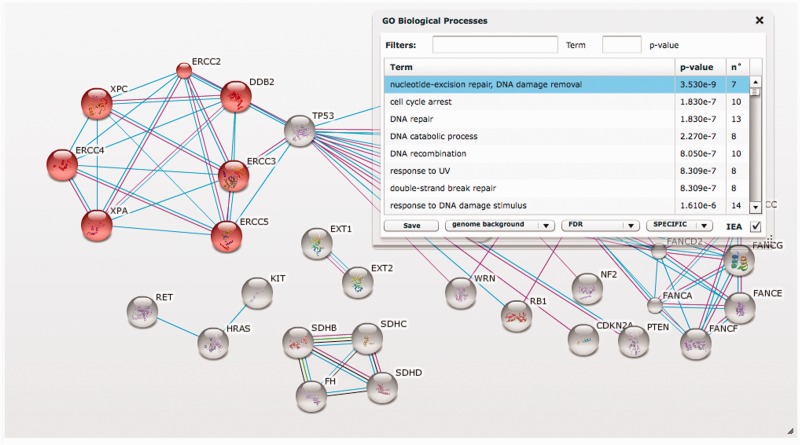
“The STRING screenshot shows a user-supplied set of genes, here a selection of cancer genes as annotated at the COSMIC database (52).”
Cited by
Items 101–200 of 1,021
Li, L., Lei, Q., Zhang, S., Kong, L., & Qin, B. (2017) · Oncology Reports · doi:10.3892/or.2017.5946 · Cited by 206
Ozyigit, I. I., Filiz, E., Vatansever, R., Kurtoglu, K. Y., Koc, I., Öztürk, M. X., & Anjum, N. A. (2016) · Frontiers in Plant Science · doi:10.3389/fpls.2016.00301 · Cited by 206
“Putative interaction partners of APX/GPXs were predicted with the STRING server (Franceschini et al., 2013) and an interactome network was generated using cytoscape (Smoot et al., 2011).”
MethodA PGC1α-mediated transcriptional axis suppresses melanoma metastasis
Luo, C., Lim, J.-H., Lee, Y., Granter, S. R., Thomas, A., Vazquez, F., Widlund, H. R., & Puigserver, P. (2016) · Nature · doi:10.1038/nature19347 · Cited by 205
Pharmacogenomic landscape of patient-derived tumor cells informs precision oncology therapy
Lee, J.-K., Liu, Z., Sa, J. K., Shin, S., Wang, J., Bordyuh, M., Cho, H. J., Elliott, O., Chu, T., Choi, S. W., et al. (2018) · Nature Genetics · doi:10.1038/s41588-018-0209-6 · Cited by 203
Bulusu, K. C., Guha, R., Mason, D. J., Lewis, R. P. I., Muratov, E., Kalantar Motamedi, Y., Cokol, M., & Bender, A. (2016) · Drug Discovery Today · doi:10.1016/j.drudis.2015.09.003 · Cited by 202
Glioblastoma‐derived extracellular vesicles modify the phenotype of monocytic cells
de Vrij, J., Maas, S. L. N., Kwappenberg, K. M. C., Schnoor, R., Kleijn, A., Dekker, L., Luider, T. M., de Witte, L. D., Litjens, M., van Strien, M. E., et al. (2015) · International Journal of Cancer · doi:10.1002/ijc.29521 · Cited by 201
Ortiz-Ramírez, C., Hernandez-Coronado, M., Thamm, A., Catarino, B., Wang, M., Dolan, L., Feijó, J. A., & Becker, J. D. (2016) · Molecular Plant · doi:10.1016/j.molp.2015.12.002 · Cited by 200
Morris, J. H., Knudsen, G. M., Verschueren, E., Johnson, J. R., Cimermancic, P., Greninger, A. L., & Pico, A. R. (2014) · Nature Protocols · doi:10.1038/nprot.2014.164 · Cited by 198
Staphylococcus aureus Biofilms Induce Macrophage Dysfunction Through Leukocidin AB and Alpha-Toxin
Scherr, T. D., Hanke, M. L., Huang, O., James, D. B. A., Horswill, A. R., Bayles, K. W., Fey, P. D., Torres, V. J., & Kielian, T. (2015) · mBio · doi:10.1128/mbio.01021-15 · Cited by 195
Samuel, W., Jaworski, C. J., Postnikova, O. A., Kutty, R. K., Duncan, T. E., Tan, L. X., Poliakov, E., Lakkaraju, A., & Redmond, T. M. (2017) · PubMed Central · Cited by 198
Li, F., Li, C., Wang, M., Webb, G. I., Zhang, Y., Whisstock, J. C., & Song, J. (2015) · Bioinformatics · doi:10.1093/bioinformatics/btu852 · Cited by 194
Xu, R., Wang, Q., & Li, L. (2015) · BMC Genomics · doi:10.1186/1471-2164-16-s7-s4 · Cited by 193
“The PPI data was obtained from the STRING database, a database of known and predicted protein interactions [17].”
MethodApplication of text mining in the biomedical domain
Fleuren, W. W. M., & Alkema, W. (2015) · Methods · doi:10.1016/j.ymeth.2015.01.015 · Cited by 193
MobiDB 2.0: an improved database of intrinsically disordered and mobile proteins
Potenza, E., Domenico, T. D., Walsh, I., & Tosatto, S. C. E. (2015) · Nucleic Acids Research · doi:10.1093/nar/gku982 · Cited by 193
Chen, X., Gao, C., Guo, L., Hu, G., Luo, Q., Liu, J., Nielsen, J., Chen, J., & Liu, L. (2018) · Chemical Reviews · doi:10.1021/acs.chemrev.6b00804 · Cited by 193
Hoang, S. A., Oseini, A., Feaver, R. E., Cole, B. K., Asgharpour, A., Vincent, R., Siddiqui, M., Lawson, M. J., Day, N. C., Taylor, J. M., et al. (2019) · Scientific Reports · doi:10.1038/s41598-019-48746-5 · Cited by 192
Protein-driven inference of miRNA–disease associations
Mørk, S., Pletscher-Frankild, S., Palleja Caro, A., Gorodkin, J., & Jensen, L. J. (2014) · Bioinformatics · doi:10.1093/bioinformatics/btt677 · Cited by 191
“Not surprisingly, miRNAs have been associated with a large number of diseases (Esteller, 2011; Mendell and Olson, 2012) including schizophrenia (Feng et al., 2009), cardiovascular diseases (Small and Olson, 2011) and cancer (He et al., 2005; Võsa et al., 2011).”
BackgroundSelf-citationWestergaard, D., Stærfeldt, H.-H., Tønsberg, C., Jensen, L. J., & Brunak, S. (2018) · PLOS Computational Biology · doi:10.1371/journal.pcbi.1005962 · Cited by 190
“The same approach has been used for the STRING database [39].”
MethodSelf-citationXu, W.-H., Xu, Y., Wang, J., Wan, F.-N., Wang, H.-K., Cao, D.-L., Shi, G.-H., Qu, Y.-Y., Zhang, H.-L., & Ye, D.-W. (2019) · Aging · doi:10.18632/aging.102233 · Cited by 190
“0) online database was used to predict PPI network of significantly positive DEGs and analyze the degree of interactions between proteins [39].”
MethodGlobal Mapping of the Inc-Human Interactome Reveals that Retromer Restricts Chlamydia Infection
Mirrashidi, K. M., Elwell, C. A., Verschueren, E., Johnson, J. R., Frando, A., Von Dollen, J., Rosenberg, O., Gulbahce, N., Jang, G., Johnson, T., et al. (2015) · Cell Host & Microbe · doi:10.1016/j.chom.2015.06.004 · Cited by 189
“, 2010] and STRING [Franceschini et al., 2013]) to identify multiprotein complexes and potential connections between Incs (Figure 2).”
Expanding the computational toolbox for mining cancer genomes
Ding, L., Wendl, M. C., McMichael, J. F., & Raphael, B. J. (2014) · Nature Reviews Genetics · doi:10.1038/nrg3767 · Cited by 185
“For example, the human protein reference database (HPRD) 111 , KEGG 104 and Reactome 112 summarize experimentally validated protein–protein interactions, whereas other databases — such as BioGRID 113 , search tool for the retrieval of interacting genes/proteins (STRING) 114 , high-quality interactomes (HINT) 115 and i…”
BackgroundBalmus, G., Pilger, D., Coates, J., Demir, M., Sczaniecka-Clift, M., Barros, A. C., Woods, M., Fu, B., Yang, F., Chen, E., et al. (2019) · Nature Communications · doi:10.1038/s41467-018-07729-2 · Cited by 184
Characterization of the direct targets of FOXO transcription factors throughout evolution
Webb, A. E., Kundaje, A., & Brunet, A. (2016) · Aging Cell · doi:10.1111/acel.12479 · Cited by 182
“STRING network analysis was used to display the data (Franceschini et al., 2013).”
MethodNPInter v2.0: an updated database of ncRNA interactions
Yuan, J., Wu, W., Xie, C., Zhao, G., Zhao, Y., & Chen, R. (2014) · Nucleic Acids Research · doi:10.1093/nar/gkt1057 · Cited by 182
Mapping native disulfide bonds at a proteome scale
Lu, S., Fan, S.-B., Yang, B., Li, Y.-X., Meng, J.-M., Wu, L., Li, P., Zhang, K., Zhang, M.-J., Fu, Y., et al. (2015) · Nature Methods · doi:10.1038/nmeth.3283 · Cited by 179
Tsai, C.-F., Wang, Y.-T., Yen, H.-Y., Tsou, C.-C., Ku, W.-C., Lin, P.-Y., Chen, H.-Y., Nesvizhskii, A. I., Ishihama, Y., & Chen, Y.-J. (2015) · Nature Communications · doi:10.1038/ncomms7622 · Cited by 176
Towards understanding brain-gut-microbiome connections in Alzheimer’s disease
Xu, R., & Wang, Q. (2016) · BMC Systems Biology · doi:10.1186/s12918-016-0307-y · Cited by 175
“STRING is a comprehensive functional PPI database and contains 4,137,054 PPI pairs in human, representing 17,756 proteins/genes [19].”
BackgroundLalit, P. A., Salick, M. R., Nelson, D. O., Squirrell, J. M., Shafer, C. M., Patel, N. G., Saeed, I., Schmuck, E. G., Markandeya, Y. S., Wong, R., et al. (2016) · Cell Stem Cell · doi:10.1016/j.stem.2015.12.001 · Cited by 174
“The Search Tool for Retrieval of Interacting Genes/Proteins (STRING) database was used for GO analysis (Franceschini et al., 2013).”
MethodA new molecular classification to drive precision treatment strategies in primary Sjögren’s syndrome
Soret, P., Le Dantec, C., Desvaux, E., Foulquier, N., Chassagnol, B., Hubert, S., Jamin, C., Barturen, G., Desachy, G., Devauchelle-Pensec, V., et al. (2021) · Nature Communications · doi:10.1038/s41467-021-23472-7 · Cited by 173
Kessler, T., Vilne, B., & Schunkert, H. (2016) · EMBO Molecular Medicine · doi:10.15252/emmm.201506174 · Cited by 173
An eQTL Landscape of Kidney Tissue in Human Nephrotic Syndrome
Gillies, C. E., Putler, R., Menon, R., Otto, E., Yasutake, K., Nair, V., Hoover, P., Lieb, D., Li, S., Eddy, S., et al. (2018) · The American Journal of Human Genetics · doi:10.1016/j.ajhg.2018.07.004 · Cited by 173
Self-citationWounding induces dedifferentiation of epidermal Gata6+ cells and acquisition of stem cell properties
Donati, G., Rognoni, E., Hiratsuka, T., Liakath-Ali, K., Hoste, E., Kar, G., Kayikci, M., Russell, R., Kretzschmar, K., Mulder, K. W., et al. (2017) · Nature Cell Biology · doi:10.1038/ncb3532 · Cited by 173
Tuncbag, N., Gosline, S. J. C., Kedaigle, A., Soltis, A. R., Gitter, A., & Fraenkel, E. (2016) · PLOS Computational Biology · doi:10.1371/journal.pcbi.1004879 · Cited by 171
“Several approaches have been described for deriving these probabilities or other confidence scores [1,10,26,51,52].”
BackgroundBioinformatic analysis of proteomics data
Schmidt, A., Forne, I., & Imhof, A. (2014) · BMC Systems Biology · doi:10.1186/1752-0509-8-s2-s3 · Cited by 170
“A widely used resource for interaction data is STRING, which is not only a database itself, but connects to several other data resources to and is therefore also capable of literature mining [59,62].”
MethodA survey about methods dedicated to epistasis detection
Niel, C., Sinoquet, C., Dina, C., & Rocheleau, G. (2015) · Frontiers in Genetics · doi:10.3389/fgene.2015.00285 · Cited by 175
“One way to do that is to query information in online public protein-protein interaction databases like IntAct (Kerrien et al., 2012 ), BioGRID (Chatr-Aryamontri et al., 2015), STRING (Franceschini et al., 2013) or ChEMBL (Willighagen et al., 2013).”
BackgroundViruses.STRING: A Virus-Host Protein-Protein Interaction Database
Cook, H. V., Doncheva, N. T., Szklarczyk, D., Von Mering, C., & Jensen, L. J. (2018) · Viruses · doi:10.3390/v10100519 · Cited by 169
Self-citationAML suppresses hematopoiesis by releasing exosomes that contain microRNAs targeting c-MYB
Hornick, N. I., Doron, B., Abdelhamed, S., Huan, J., Harrington, C. A., Shen, R., Cambronne, X. A., Verghese, S. C., & Kurre, P. (2016) · Science Signaling · doi:10.1126/scisignal.aaf2797 · Cited by 169
Mok, S., Stokes, B. H., Gnädig, N. F., Ross, L. S., Yeo, T., Amaratunga, C., Allman, E. L., Solyakov, L. S., Bottrill, A. R., Tripathi, J., et al. (2021) · Nature Communications · doi:10.1038/s41467-020-20805-w · Cited by 169
Oncogenic fusion protein EWS-FLI1 is a network hub that regulates alternative splicing
Selvanathan, S. P., Graham, G. T., Erkizan, H. V., Dirksen, U., Natarajan, T. G., Dakic, A., Yu, S., Liu, X., Paulsen, M. T., Ljungman, M. E., et al. (2015) · Proceedings of the National Academy of Sciences · doi:10.1073/pnas.1500536112 · Cited by 168
“1 (53) that includes YB-1 (SI Appendix, Fig.”
Plasma membrane V-ATPase controls oncogenic RAS-induced macropinocytosis
Ramirez, C., Hauser, A. D., Vucic, E. A., & Bar-Sagi, D. (2019) · Nature · doi:10.1038/s41586-019-1831-x · Cited by 167
Yu, J., Zhang, S., Cui, L., Wang, W., Na, H., Zhu, X., Li, L., Xu, G., Yang, F., Christian, M., et al. (2015) · Biochimica et Biophysica Acta (BBA) - Molecular Cell Research · doi:10.1016/j.bbamcr.2015.01.020 · Cited by 167
Single nucleotide variations: Biological impact and theoretical interpretation
Katsonis, P., Koire, A., Wilson, S. J., Hsu, T., Lua, R. C., Wilkins, A. D., & Lichtarge, O. (2014) · Protein Science · doi:10.1002/pro.2552 · Cited by 137
Krishna, A., Biryukov, M., Trefois, C., Antony, P. M., Hussong, R., Lin, J., Heinäniemi, M., Glusman, G., Köglsberger, S., Boyd, O., et al. (2014) · BMC Genomics · doi:10.1186/1471-2164-15-1154 · Cited by 166
“Alternatively, disease-related networks were built using Online Mendelian Inheritance in Man (OMIM) [75]– a catalogue of human genes and genetic disorders; and STRING – a state-of-the-art database of known and predicted protein-protein interactions [76] version 9.”
MethodSelf-citationWidespread Signals of Convergent Adaptation to High Altitude in Asia and America
Foll, M., Gaggiotti, O. E., Daub, J. T., Vatsiou, A., & Excoffier, L. (2014) · The American Journal of Human Genetics · doi:10.1016/j.ajhg.2014.09.002 · Cited by 144
Papasaikas, P., Tejedor, J. R., Vigevani, L., & Valcárcel, J. (2015) · Molecular Cell · doi:10.1016/j.molcel.2014.10.030 · Cited by 164
Phen-Gen: combining phenotype and genotype to analyze rare disorders
Javed, A., Agrawal, S., & Ng, P. C. (2014) · Nature Methods · doi:10.1038/nmeth.3046 · Cited by 146
Sensing of latent EBV infection through exosomal transfer of 5′pppRNA
Baglio, S. R., van Eijndhoven, M. A. J., Koppers-Lalic, D., Berenguer, J., Lougheed, S. M., Gibbs, S., Léveillé, N., Rinkel, R. N. P. M., Hopmans, E. S., Swaminathan, S., et al. (2016) · Proceedings of the National Academy of Sciences · doi:10.1073/pnas.1518130113 · Cited by 163
“Proteins linked to this term were encompassed within a major cluster of protein–protein associations retrieved from the STRING database (29) (Fig.”
BackgroundOkamura, Y., Aoki, Y., Obayashi, T., Tadaka, S., Ito, S., Narise, T., & Kinoshita, K. (2015) · Nucleic Acids Research · doi:10.1093/nar/gku1163 · Cited by 145
“In animal science, coexpression information is largely used as part of the supporting information to predict protein–protein interactions, such as with the STRING (9), IMP (10) and Funcoup (11) databases.”
MethodAnalytical Tools and Databases for Metagenomics in the Next-Generation Sequencing Era
Kim, M., Lee, K.-H., Yoon, S.-W., Kim, B. S., Chun, J., & Yi, H. (2013) · Genomics & Informatics · doi:10.5808/gi.2013.11.3.102 · Cited by 164
Mosler, T., Conte, F., Longo, G. M. C., Mikicic, I., Kreim, N., Möckel, M. M., Petrosino, G., Flach, J., Barau, J., Luke, B., et al. (2021) · Nature Communications · doi:10.1038/s41467-021-27530-y · Cited by 162
Elevated Levels of Proinflammatory Cytokines in Cerebrospinal Fluid of Multiple Sclerosis Patients
Khaibullin, T., Ivanova, V., Martynova, E., Cherepnev, G., Khabirov, F., Granatov, E., Rizvanov, A., & Khaiboullina, S. (2017) · Frontiers in Immunology · doi:10.3389/fimmu.2017.00531 · Cited by 162
“de/) was used to analyze interactions between cytokines with differential expression between MS cases and controls (14).”
MethodCabral-Marques, O., Marques, A., Giil, L. M., De Vito, R., Rademacher, J., Günther, J., Lange, T., Humrich, J. Y., Klapa, S., Schinke, S., et al. (2018) · Nature Communications · doi:10.1038/s41467-018-07598-9 · Cited by 162
Hawe, J. S., Wilson, R., Schmid, K. T., Zhou, L., Lakshmanan, L. N., Lehne, B. C., Kühnel, B., Scott, W. R., Wielscher, M., Yew, Y. W., et al. (2022) · Nature Genetics · doi:10.1038/s41588-021-00969-x · Cited by 161
Yang, T., Ma, H., Zhang, J., Wu, T., Song, T., Tian, J., & Yao, Y. (2019) · The Plant Journal · doi:10.1111/tpj.14470 · Cited by 161
Damron, F. H., Oglesby-Sherrouse, A. G., Wilks, A., & Barbier, M. (2016) · Scientific Reports · doi:10.1038/srep39172 · Cited by 161
An Attention-based Collaboration Framework for Multi-View Network Representation Learning
Qu, M., Tang, J., Shang, J., Ren, X., Zhang, M., & Han, J. (2017) · Proceedings of the 2017 ACM on Conference on Information and Knowledge Management · doi:10.1145/3132847.3133021 · Cited by 160
DNA hypermethylation and DNA hypomethylation is present at different loci in chronic kidney disease
Smyth, L. J., McKay, G. J., Maxwell, A. P., & McKnight, A. J. (2014) · Epigenetics · doi:10.4161/epi.27161 · Cited by 160
“05 interaction network.(79) NCBI BioSystems Database(80) was searched to investigate which pathways were affiliated with top-ranked genes.”
BackgroundChaiyadet, S., Sotillo, J., Smout, M., Cantacessi, C., Jones, M. K., Johnson, M. S., Turnbull, L., Whitchurch, C. B., Potriquet, J., Laohaviroj, M., et al. (2015) · Journal of Infectious Diseases · doi:10.1093/infdis/jiv291 · Cited by 160
Cheng, F., Zhao, J., & Zhao, Z. (2015) · Briefings in Bioinformatics · doi:10.1093/bib/bbv068 · Cited by 161
“Major PPI databases include BioGRID [31], HPRD [32], MINT [33], IntAct [34], STRING [35], PINA [36], PhosphoSitePlus [37], Phospho.”
MethodSun, J. L., Zhao, L. L., Wu, H., Liu, Q., Liao, L., Luo, J., Lian, W. Q., Cui, C., Jin, L., Ma, J. D., et al. (2020) · Science of The Total Environment · doi:10.1016/j.scitotenv.2019.135157 · Cited by 159
Miryala, S. K., Anbarasu, A., & Ramaiah, S. (2017) · Gene · doi:10.1016/j.gene.2017.11.028 · Cited by 160
Global transcriptional disturbances underlie Cornelia de Lange syndrome and related phenotypes
Yuan, B., Pehlivan, D., Karaca, E., Patel, N., Charng, W.-L., Gambin, T., Gonzaga-Jauregui, C., Sutton, V. R., Yesil, G., Bozdogan, S. T., et al. (2015) · Journal of Clinical Investigation · doi:10.1172/jci77435 · Cited by 158
A primer to frequent itemset mining for bioinformatics
Naulaerts, S., Meysman, P., Bittremieux, W., Vu, T. N., Berghe, W. V., Goethals, B., & Laukens, K. (2013) · Briefings in Bioinformatics · doi:10.1093/bib/bbt074 · Cited by 157
“quently appear together, there must be an underlying Figure 5: Gene interaction networks in mouse, human and rat as derived from String [12].”
MethodIntegration of ‘omics’ data in aging research: from biomarkers to systems biology
Zierer, J., Menni, C., Kastenmüller, G., & Spector, T. D. (2015) · Aging Cell · doi:10.1111/acel.12386 · Cited by 140
“(B) is the close neighbourhood of the ApoD protein in a PPI network from STRING DB (Franceschini et al., 2013) using only experimentally confirmed interactions.”
Hossini, A. M., Megges, M., Prigione, A., Lichtner, B., Toliat, M. R., Wruck, W., Schröter, F., Nuernberg, P., Kroll, H., Makrantonaki, E., et al. (2015) · BMC Genomics · doi:10.1186/s12864-015-1262-5 · Cited by 136
The genome of black raspberry (Rubus occidentalis)
VanBuren, R., Bryant, D., Bushakra, J. M., Vining, K. J., Edger, P. P., Rowley, E. R., Priest, H. D., Michael, T. P., Lyons, E. H., Filichkin, S. A., et al. (2016) · The Plant Journal · doi:10.1111/tpj.13215 · Cited by 155
Stoichiometry of site-specific lysine acetylation in an entire proteome
Baeza, J., Dowell, J. A., Smallegan, M. J., Fan, J., Amador-Noguez, D., Khan, Z., & Denu, J. M. (2014) · Journal of Biological Chemistry · doi:10.1074/jbc.m114.581843 · Cited by 154
“A network analysis of the identified pathways was performed using the STRING Database (26, 27).”
BackgroundMethodLuo, X., Sun, J., Wang, Z., Li, S., & Shang, M. (2017) · IEEE Transactions on Industrial Informatics · doi:10.1109/tii.2017.2724769 · Cited by 154
Integrating protein-protein interaction networks with phenotypes reveals signs of interactions
Vinayagam, A., Zirin, J. D., Roesel, C. L., Hu, Y., Yilmazel, B., Samsonova, A. A., Neumüller, R. A., Mohr, S. E., & Perrimon, N. (2013) · Nature Methods · doi:10.1038/nmeth.2733 · Cited by 151
“In addition to PPI network, we also predicted signs for Drosophila functional interaction derived from the STRING database 38 .”
MethodPre/post-natal exposure to microplastic as a potential risk factor for autism spectrum disorder
Zaheer, J., Kim, H., Ko, I. O., Jo, E.-K., Choi, E., Lee, H., Shim, I., Woo, H., Choi, J. H., Kim, G.-H., et al. (2022) · Environment International · doi:10.1016/j.envint.2022.107121 · Cited by 155
TP53 mutations, expression and interaction networks in human cancers
Wang, X., & Sun, Q. (2017) · Oncotarget · doi:10.18632/oncotarget.13483 · Cited by 132
“Network analysis using STRING [35] shows that TP53 inhibits FOSL1, SPHK1, ICAM5, and MSLN.”
MethodInfluentialScalable Parameter Estimation for Genome-Scale Biochemical Reaction Networks
Fröhlich, F., Kaltenbacher, B., Theis, F. J., & Hasenauer, J. (2017) · PLOS Computational Biology · doi:10.1371/journal.pcbi.1005331 · Cited by 132
Guo, Y., Bao, Y., Ma, M., & Yang, W. (2017) · International Journal of Molecular Sciences · doi:10.3390/ijms18040722 · Cited by 148
“org) [16] and Cytoscape software [17], total of 180 DEGs (113 up-regulated and 67 down-regulated genes) of the 292 commonly altered DEGs were filtered into the DEGs PPI network complex, containing 180 nodes and 518 edges (Figure 4A), and 112 of the 292DEGs did not fall into the DEGs PPI network.”
MethodArginine-rhamnosylation as new strategy to activate translation elongation factor P
Lassak, J., Keilhauer, E. C., Fürst, M. J. L. J., Wuichet, K., Gödeke, J., Starosta, A. L., Chen, J., Søgaard‐Andersen, L., Rohr, J., Wilson, D. N., et al. (2015) · Nature Chemical Biology · doi:10.1038/nchembio.1751 · Cited by 148
Changes of bivalent chromatin coincide with increased expression of developmental genes in cancer
Bernhart, S. H., Kretzmer, H., Holdt, L. M., Jühling, F., Ammerpohl, O., Bergmann, A. K., Northoff, B. H., Doose, G., Siebert, R., Stadler, P. F., et al. (2016) · Scientific Reports · doi:10.1038/srep37393 · Cited by 125
Proteomic profiling of VCP substrates links VCP to K6‐linked ubiquitylation and c‐Myc function
Heidelberger, J. B., Voigt, A., Borisova, M. E., Petrosino, G., Ruf, S., Wagner, S., & Beli, P. (2018) · EMBO Reports · doi:10.15252/embr.201744754 · Cited by 148
“Functional protein interaction network analysis was performed using interaction data from the STRING database [104].”
The genetic architecture of floral traits in the woody plant Prunus mume
Zhang, Q., Zhang, H., Sun, L., Fan, G., Ye, M., Jiang, L., Liu, X., Ma, K., Shi, C., Bao, F., et al. (2018) · Nature Communications · doi:10.1038/s41467-018-04093-z · Cited by 147
Wang, J., Lan, P., Gao, H., Zheng, L., Li, W., & Schmidt, W. (2013) · BMC Genomics · doi:10.1186/1471-2164-14-783 · Cited by 147
“org) [46] The network is presented in the ‘evidence’ view, whereby lines connecting proteins represent the type of evidence (neighborhood, gene fusion, co-occurrence, co-expression, experiments, databases, text mining) used in predicting the association.”
MethodRuprecht, B., Koch, H., Medard, G., Mundt, M., Kuster, B., & Lemeer, S. (2015) · Molecular & Cellular Proteomics · doi:10.1074/mcp.m114.043109 · Cited by 128
Navigating Traditional Chinese Medicine Network Pharmacology and Computational Tools
Yang, M., Chen, J.-L., Xu, L.-W., & Ji, G. (2013) · Evidence-based Complementary and Alternative Medicine · doi:10.1155/2013/731969 · Cited by 146
Ravcheev, D. A., & Thiele, I. (2017) · Frontiers in Genetics · doi:10.3389/fgene.2017.00111 · Cited by 148
“1 (Franceschini et al., 2013) along with phylogenetic trees for protein domains in MicrobesOnline (Dehal et al.”
BackgroundIdentification of candidate diagnostic and prognostic biomarkers for pancreatic carcinoma
Cheng, Y., Wang, K., Geng, L., Sun, J., Xu, W., Liu, D., Gong, S., & Zhu, Y. (2019) · EBioMedicine · doi:10.1016/j.ebiom.2019.01.003 · Cited by 146
Leiter, O., Brici, D., Fletcher, S. J., Yong, X. L. H., Widagdo, J., Matigian, N., Schroer, A. B., Bieri, G., Blackmore, D. G., Bartlett, P. F., et al. (2023) · Nature Communications · doi:10.1038/s41467-023-39873-9 · Cited by 145
“When viewed as a STRING protein-protein interaction network 16 , many of the genes which showed enrichment in GO biological processes related to differentiation also clustered together, suggesting a functional relevance and similarity of thesegenes (Fig.”
Host-Microbe Protein Interactions during Bacterial Infection
Schweppe, D. K., Harding, C., Chavez, J. D., Wu, X., Ramage, E., Singh, P. K., Manoil, C., & Bruce, J. E. (2015) · Chemistry & Biology · doi:10.1016/j.chembiol.2015.09.015 · Cited by 135
“Subnetworks of PPIs from known complexes included host cytoskeleton, heterogeneous ribonucleoproteins, integrins, histones, cohesin, and ATP synthase (Figure S2) (Franceschini et al., 2013).”
BackgroundDu, Y., Cai, T., Li, T., Xue, P., Zhou, B., He, X., Wei, P., Liu, P., Yang, F., & Wei, T. (2015) · Molecular & Cellular Proteomics · doi:10.1074/mcp.m114.041947 · Cited by 136
“protein interaction (PPI) network analysis using the STRING database (25).”
MethodGong, P., Shao, Y.-C., Yang, Y. T., Song, W., He, X., Zeng, Y., Huang, S., Wei, L., & Zhang, J. (2020) · Frontiers in Oncology · doi:10.3389/fonc.2020.578963 · Cited by 144
Heme drives hemolysis-induced susceptibility to infection via disruption of phagocyte functions
Martins, R., Maier, J., Gorki, A.-D., Huber, K. V. M., Sharif, O., Starkl, P., Saluzzo, S., Quattrone, F., Gawish, R., Lakovits, K., et al. (2016) · Nature Immunology · doi:10.1038/ni.3590 · Cited by 142
Pathway and network analysis in proteomics
Wu, X., Hasan, M. A., & Chen, J. Y. (2014) · Journal of Theoretical Biology · doi:10.1016/j.jtbi.2014.05.031 · Cited by 123
“This workflow utilizes both functional information from the PAGED [30] and topological information from the protein-protein interaction (PPI) database, such as HAPPI or STRING.”
InfluentialIslam, S., Rahman, I. A., Islam, T., & Ghosh, A. (2017) · PLoS ONE · doi:10.1371/journal.pone.0187504 · Cited by 143
Screening Hub Genes as Prognostic Biomarkers of Hepatocellular Carcinoma by Bioinformatics Analysis
Zhou, Z., Li, Y., Hao, H., Wang, Y., Zhou, Z., Wang, Z., & Chu, X. (2019) · Cell Transplantation · doi:10.1177/0963689719893950 · Cited by 142
Complex‐centric proteome profiling by SEC‐SWATH‐MS
Heusel, M., Bludau, I., Rosenberger, G., Hafen, R., Frank, M., Banaei‐Esfahani, A., van Drogen, A., Collins, B. C., Gstaiger, M., & Aebersold, R. (2019) · Molecular Systems Biology · doi:10.15252/msb.20188438 · Cited by 141
Identifying antimicrobial peptides using word embedding with deep recurrent neural networks
Hamid, M.-N., & Friedberg, I. (2019) · Bioinformatics · doi:10.1093/bioinformatics/bty937 · Cited by 132
CentiServer: A Comprehensive Resource, Web-Based Application and R Package for Centrality Analysis
Jalili, M., Salehzadeh‐Yazdi, A., Asgari, Y., Arab, S. S., Yaghmaie, M., Ghavamzadeh, A., & Alimoghaddam, K. (2015) · PLoS ONE · doi:10.1371/journal.pone.0143111 · Cited by 140
Kamelgarn, M., Chen, J., Kuang, L., Arenas, A., Zhai, J., Zhu, H., & Gal, J. (2016) · Biochimica et Biophysica Acta (BBA) - Molecular Basis of Disease · doi:10.1016/j.bbadis.2016.07.015 · Cited by 124
“The p-values shown in the tables are Benjamini-Hochberg corrected p-values for enrichment of the terms in question, representing the estimated false discovery rate [46].”
MethodCapturing protein communities by structural proteomics in a thermophilic eukaryote
Kastritis, P. L., O'Reilly, F. J., Bock, T., Li, Y., Rogon, M. Z., Buczak, K., Romanov, N., Betts, M. J., Bui, K. H., Hagen, W. J., et al. (2017) · Molecular Systems Biology · doi:10.15252/msb.20167412 · Cited by 133
Self-citationA novel heterogeneous network-based method for drug response prediction in cancer cell lines
Zhang, F., Wang, M., Xi, J., Yang, J., & Li, A. (2018) · Scientific Reports · doi:10.1038/s41598-018-21622-4 · Cited by 137
Protein–protein interactions and genetic diseases: The interactome
Lage, K. (2014) · Biochimica et Biophysica Acta (BBA) - Molecular Basis of Disease · doi:10.1016/j.bbadis.2014.05.028 · Cited by 123
Drug target prioritization by perturbed gene expression and network information
Isik, Z., Baldow, C., Cannistraci, C. V., & Schroeder, M. (2015) · Scientific Reports · doi:10.1038/srep17417 · Cited by 135
Systems biology in hepatology: approaches and applications
Mardinoğlu, A., Borén, J., Smith, U., Uhlén, M., & Nielsen, J. (2018) · Nature Reviews Gastroenterology & Hepatology · doi:10.1038/s41575-018-0007-8 · Cited by 135
Pfammatter, S., Bonneil, E., McManus, F. P., Prasad, S., Bailey, D. J., Belford, M., Dunyach, J.-J., & Thibault, P. (2018) · Molecular & Cellular Proteomics · doi:10.1074/mcp.tir118.000862 · Cited by 123
“400) (48) using proteins whose abundances changed in response to the challenge and fit one of the four dynamic profiles described in the results section.”
Method
Metadata
- Authors
- Franceschini, A., Szklarczyk, D., Frankild, S., Kuhn, M., Simonovic, M., Roth, A., Lin, J., Minguez, P., Bork, P., von Mering, C., & Jensen, L. J.
- Affiliations
- SIB Swiss Institute of Bioinformatics (CH)
- University of Copenhagen (DK)
- Venue
- Nucleic Acids Research
- Publisher
- Oxford University Press (OUP)
- Published
- 2012-11-29
- Volume
- 41
- Issue
- D1
- Pages
- D808-D815
- ISSN
- 0305-1048 (ISSN-L)
- 1362-4962
- PMC
- PMC3531103
- OpenAlex
- W2105924489
- Cited by
- 4,398
- References
- 61
- Citations by year
- 2026: 77 · 2025: 153 · 2024: 201 · 2023: 247 · 2022: 325 · 2021: 335 · 2020: 366 · 2019: 281 · 2018: 291 · 2017: 371 · 2016: 476 · 2015: 675 · 2014: 457 · 2013: 134 · 2012: 3
- FWCI
- 163.15
- Type
- journal article
- Language
- en
- Open access
- gold
- doi.org
- Licence
- Locations
- Nucleic Acids Research (publishedVersion, cc-by-nc)
- Europe PMC (PubMed Central) (publishedVersion, cc-by-nc)
- PubMed Central (publishedVersion, cc-by-nc)
- PubMed (publishedVersion)
- MDC Repository (Max-Delbrueck-Center for Molecular Medicine) (acceptedVersion)
- Zurich Open Repository and Archive (University of Zurich) (acceptedVersion, other-oa)
- reroDoc Digital Library (submittedVersion)
- Archivio Istituzionale della Ricerca (Universita Degli Studi Di Milano) (submittedVersion, cc-by-nc)
- Research at the University of Copenhagen (University of Copenhagen) (submittedVersion)
- Zurich Open Repository and Archive (University of Zurich) (submittedVersion, other-oa)
- Zurich Open Repository and Archive (University of Zurich)
- Funders
- European Molecular Biology Laboratory
- Novo Nordisk
- Universität Zürich
- Topics
- Life Sciences › Biochemistry, Genetics and Molecular Biology › Molecular Biology › Bioinformatics and Genomic Networks
- Health Sciences › Medicine › Health Informatics › Biomedical Text Mining and Ontologies
- Life Sciences › Biochemistry, Genetics and Molecular Biology › Molecular Biology › Genomics and Phylogenetic Studies
- Keywords
- STRING database, protein-protein interaction network, interaction prediction, literature mining, functional enrichment, biological pathway databases
- MeSH terms
- Algorithms, Data Interpretation, Statistical, User-Computer Interface, Systems Integration, Internet, Protein Interaction Mapping, Databases, Protein, Data Mining
About these checks
Registry, retraction, Cites and statistics results are computed, not judged, with one exception: a printed reference that no index lists is read once by a model before it counts as a citation error. Claims are extracted by a model and kept only when their quote appears verbatim in the text; each cited source is then checked, with a model’s help, for whether it says what the claim relies on. Those verdicts can be wrong — read the claim’s quote and the cited source before relying on one.
Statistics and arithmetic are recomputed, not judged.
Confidence bands are shown only for fields calibrated on our annotated test set. None is calibrated yet, so no band is shown.
What counts as a claim ›How we measure confidence ›How we check this ›
Are you an author, or do you see a problem with this page? Request a review
Data sources
Bibliographic data: Semantic Scholar, OpenAlex, Crossref.
Contains information from the Semantic Scholar Academic Graph Datasets, made available under the ODC Attribution License (ODC-BY 1.0).
Semantic Scholar’s data is described in: Kinney, R., et al. (2023). The Semantic Scholar Open Data Platform. arXiv:2301.10140.
