

STRING v9.1: protein-protein interaction networks, with increased coverage and integration
Open accessThe DOI matches its Crossref record; 61 of the 61 references it cites were found in a registry or an index.
Abstract
Complete knowledge of all direct and indirect interactions between proteins in a given cell would represent an important milestone towards a comprehensive description of cellular mechanisms and functions. Although this goal is still elusive, considerable progress has been made-particularly for certain model organisms and functional systems. Currently, protein interactions and associations are annotated at various levels of detail in online resources, ranging from raw data repositories to highly formalized pathway databases. For many applications, a global view of all the available interaction data is desirable, including lower-quality data and/or computational predictions. The STRING database (http://string-db.org/) aims to provide such a global perspective for as many organisms as feasible. Known and predicted associations are scored and integrated, resulting in comprehensive protein networks covering >1100 organisms. Here, we describe the update to version 9.1 of STRING, introducing several improvements: (i) we extend the automated mining of scientific texts for interaction information, to now also include full-text articles; (ii) we entirely re-designed the algorithm for transferring interactions from one model organism to the other; and (iii) we provide users with statistical information on any functional enrichment observed in their networks.
Overview
The claims and statistics of this paper haven’t been checked yet.
Free: it reads the open-access text and checks the first 5 claims that cite a source we can check. Create a free account to check every claim.
Integrity signals
Registry
Cites
Statistics
Figures

Verification
Claims the paper makes
The claims and statistics of this paper haven’t been checked yet.
Free: it reads the open-access text and checks the first 5 claims that cite a source we can check. Create a free account to check every claim.
Claims other papers make about this one
Each is checked against this paper’s own text: does it say what the citing paper says it does?
The source backs part of the claim, not all of it — or backs it for a different population, condition or comparison.
In the citing paper
“One approach is to treat the multiple datasets as different “features” annotated to each edge in a single unified network; these multiple features are combined to estimate a single interaction likelihood score for each node pair using supervised machine learning (Kramer et al., 2017) or Bayesian inference (Franceschini et al., 2013; Wong et al., 2004).”
From Mapping the multiscale structure of biological systems (2021) · cites this paper as Franceschini et al., 2013
Experimental — accuracy not yet measuredIn the citing paper
“Bioinformatic network tools, including STRING and GeneMania (93, 94), can score direct and indirect protein functional relationships using public database repositories, such as IntAct and Reactome (95, 96).”
From The Impact of Mass Spectrometry–Based Proteomics on Fundamental Discoveries in Virology (2014) · cites this paper as [94]
Self-check
Percentages, sums and reported differences re-computed from the paper’s own numbers.
The self-check needs the paper’s full text.
Citations
Cites
Controlling the False Discovery Rate: A Practical and Powerful Approach to Multiple Testing
Benjamini, Y., & Hochberg, Y. (1995) · Journal of the Royal Statistical Society Series B: Statistical Methodology · doi:10.1111/j.2517-6161.1995.tb02031.x · Cited by 109,482 · cited 1×
“The P -values are corrected for multiple testing using the method of Benjamini and Hochberg (54), but we also provide options to either disable that correction or to select a more stringent statistical test (Bonferroni).”
MethodSystematic and integrative analysis of large gene lists using DAVID bioinformatics resources
Huang, D. W., Sherman, B. T., & Lempicki, R. A. (2009) · Nature Protocols · doi:10.1038/nprot.2008.211 · Cited by 35,890 · cited 1×
“To address this question, a variety of dedicated online resources are already available (49,50), most notably the DAVID resource (51).”
BackgroundHuang, D. W., Sherman, B. T., & Lempicki, R. A. (2009) · Nucleic Acids Research · doi:10.1093/nar/gkn923 · Cited by 14,108 · cited 1×
“To address this question, a variety of dedicated online resources are already available (49,50), most notably the DAVID resource (51).”
BackgroundWarde-Farley, D., Donaldson, S. L., Comes, O., Zuberi, K., Badrawi, R., Chao, P., Franz, M., Grouios, C., Kazi, F., Lopes, C. T., et al. (2010) · Nucleic Acids Research · doi:10.1093/nar/gkq537 · Cited by 4,835 · cited 1×
“These include GeneMANIA (23), Consensus-PathDB (24), I2D (25), VisANT (26) and, more recently, hPRINT (27), HitPredict (28), IMID (29) and IMP (30).”
BackgroundThe COG database: a tool for genome-scale analysis of protein functions and evolution
Tatusov, R. L. (2000) · Nucleic Acids Research · doi:10.1093/nar/28.1.33 · Cited by 4,520 · cited 1×
“In the past, STRING has therefore used two distinct heuristic options: either to substitute homology for orthology (46) or to use pre-defined orthology relations described at high-level taxonomic groups, from the COG database (47).”
MethodSzklarczyk, D., Franceschini, A., Kuhn, M., Simonovic, M., Roth, A., Minguez, P., Doerks, T., Stark, M., Muller, J., Bork, P., et al. (2011) · Nucleic Acids Research · doi:10.1093/nar/gkq973 · Cited by 3,460 · cited 2×
“We have already discussed many aspects of the STRING resource previously, e.g. (31,32), including its data-sources, prediction algorithms and user-interface.”
BackgroundSelf-citationCaspi, R., Billington, R., Ferrer, L., Foerster, H., Fulcher, C. A., Keseler, I. M., Kothari, A., Krummenacker, M., Latendresse, M., Mueller, L. A., et al. (2016) · Nucleic Acids Research · doi:10.1093/nar/gkv1164 · Cited by 3,395
Specificity and Stability in Topology of Protein Networks
Maslov, S., & Sneppen, K. (2002) · Science · doi:10.1126/science.1065103 · Cited by 3,051
STRING 8--a global view on proteins and their functional interactions in 630 organisms
Jensen, L. J., Kuhn, M., Stark, M., Chaffron, S., Creevey, C., Muller, J., Doerks, T., Julien, P., Roth, A., Simonovic, M., et al. (2009) · Nucleic Acids Research · doi:10.1093/nar/gkn760 · Cited by 2,474 · cited 1×
“We have already discussed many aspects of the STRING resource previously, e.g. (31,32), including its data-sources, prediction algorithms and user-interface.”
BackgroundSelf-citationCOSMIC: mining complete cancer genomes in the Catalogue of Somatic Mutations in Cancer
Forbes, S. A., Bindal, N., Bamford, S., Cole, C., Kok, C. Y., Beare, D., Jia, M., Shepherd, R., Leung, K., Menzies, A., et al. (2011) · Nucleic Acids Research · doi:10.1093/nar/gkq929 · Cited by 2,278 · cited 1×
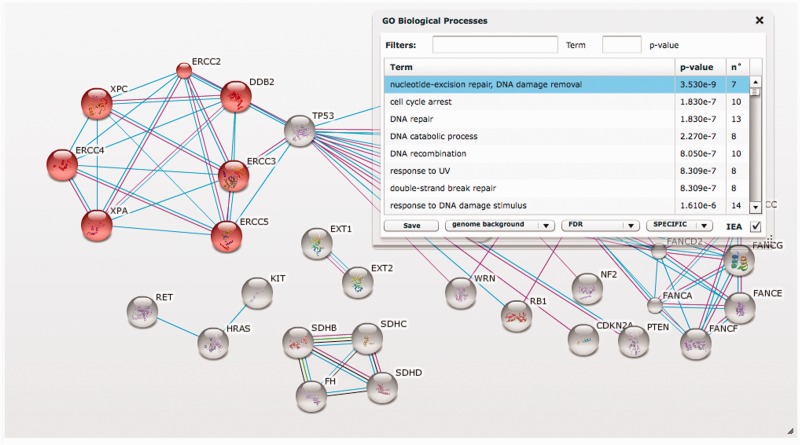
“The STRING screenshot shows a user-supplied set of genes, here a selection of cancer genes as annotated at the COSMIC database (52).”
Cited by
Items 301–400 of 1,021
Smedley, D. P., Köhler, S., Czeschik, J. C., Amberger, J. S., Bocchini, C. A., Hamosh, A., Veldboer, J., Żemojtel, T., & Robinson, P. N. (2014) · Bioinformatics · doi:10.1093/bioinformatics/btu508 · Cited by 103
“We constructed a PPA network based on 210945 associations among 12511 human genes using high-confidence interactions in the STRING database (Franceschini et al. , 2013).”
Large-scale models of signal propagation in human cells derived from discovery phosphoproteomic data
Terfve, C. D. A., Wilkes, E. H., Casado, P., Cutillas, P. R., & Saez-Rodriguez, J. (2015) · Nature Communications · doi:10.1038/ncomms9033 · Cited by 92
“Because of the nature of the networks that frequently support these procedures (that is, PPI networks or compendium functional networks such as STRING 33 ), the resulting networks connect experimentally or knowledge-derived ‘hit nodes’ rather than physically interpretable and testable paths, and do not include site-sp…”
Smoking-Dependent Distal-to-Proximal Repatterning of the Adult Human Small Airway Epithelium
Yang, J. Y., Zuo, W.-L., Fukui, T., Chao, I., Gomi, K., Lee, B., Staudt, M. R., Kaner, R. J., Strulovici‐Barel, Y., Salit, J., et al. (2017) · American Journal of Respiratory and Critical Care Medicine · doi:10.1164/rccm.201608-1672oc · Cited by 102
Boatwright, J. L., Sapkota, S., Jin, H., Schnable, J. C., Brenton, Z. W., Boyles, R. E., & Kresovich, S. (2022) · The Plant Journal · doi:10.1111/tpj.15853 · Cited by 103
“Gene network analysis and enrichment were performed using the STRING database (https://string-db.org/) (Franceschini et al., 2013).”
Ataxin-2 (Atxn2)-Knock-Out Mice Show Branched Chain Amino Acids and Fatty Acids Pathway Alterations
Meierhofer, D., Halbach, M. V., Şen, N.-E., Gispert, S., & Auburger, G. W. J. (2016) · Molecular & Cellular Proteomics · doi:10.1074/mcp.m115.056770 · Cited by 102
Transcriptional landscape of human cancers
Li, M., Sun, Q., & Wang, X. (2017) · Oncotarget · doi:10.18632/oncotarget.15837 · Cited by 101
“Franceschini A, Szklarczyk D, Frankild S, Kuhn M, Simonovic M, Roth A, Lin J, Minguez P, Bork P, von Mering C, Jensen LJ. STRING v9.”
BackgroundMethodPredicting tissue-specific gene expression from whole blood transcriptome
Basu, M., Wang, K., Ruppin, E., & Hannenhalli, S. S. (2021) · Science Advances · doi:10.1126/sciadv.abd6991 · Cited by 102
Protein–protein interaction predictions using text mining methods
Papanikolaou, N., Pavlopoulos, G. A., Θεοδοσίου, Θ., & Iliopoulos, I. (2014) · Methods · doi:10.1016/j.ymeth.2014.10.026 · Cited by 101
Luo, Y., Uzuner, Ö., & Szolovits, P. (2017) · Briefings in Bioinformatics · doi:10.1093/bib/bbw001 · Cited by 78
“Some of these knowledge bases are biologically focused, such as KEGG [13], STRING [14], InterPro [15] and InterDom [16].”
BackgroundFranke, J., Eichner, S., Zeilinger, C., & Kirschning, A. (2013) · Natural Product Reports · doi:10.1039/c3np70012g · Cited by 100
Detailed phenotyping identifies genes with pleiotropic effects on body composition
Bolormaa, S., Hayes, B. J., van der Werf, J. H. J., Pethick, D. W., Goddard, M. E., & Daetwyler, H. D. (2016) · BMC Genomics · doi:10.1186/s12864-016-2538-0 · Cited by 100
“GO and KEGG analysis in STRING (functional protein association network program) [22] confirms this functional similarity between the genes near group 2 SNPs (Additional file 2: Figure S2).”
BackgroundMethodInfluentialVerstegen, M. M. A., Willemse, J., van den Hoek, S., Kremers, G.-J., Luider, T. M., van Huizen, N. A., Willemssen, F. E. J. A., Metselaar, H. J., IJzermans, J. N. M., van der Laan, L. J. W., et al. (2017) · Stem Cells and Development · doi:10.1089/scd.2017.0095 · Cited by 93
“1) [24].”
Leiserson, M. D., Eldridge, J. V., Ramachandran, S., & Raphael, B. J. (2013) · Current Opinion in Genetics & Development · doi:10.1016/j.gde.2013.09.003 · Cited by 93
Tyagi, A., Vishnoi, K., Mahata, S., Verma, G. S., Srivastava, Y., Masaldan, S., Roy, B. G., Bharti, A. C., & Das, B. C. (2016) · Clinical Cancer Research · doi:10.1158/1078-0432.ccr-15-2574 · Cited by 101
“Proteins were linked basedon the following six criteria; neighborhood, gene fusion, cooccurrence, co-expression, experimental evidence, and existing databases (31).”
BackgroundZhao, S., Sakai, A., Zhang, X., Vetting, M. W., Kumar, R., Hillerich, B., San Francisco, B., Solbiati, J., Steves, A., Brown, S., et al. (2014) · eLife · doi:10.7554/elife.03275 · Cited by 93
“However, large-scale approaches are required to efficiently mine this information for entire protein/enzyme families ( Dehal et al., 2010 ; Caspi et al., 2012 ; Markowitz et al., 2012 ; Franceschini et al., 2013 ; Overbeek et al., 2014 ).”
BackgroundProteomic analysis of human lacrimal and tear fluid in dry eye disease
Jung, J. H., Ji, Y. W., Hwang, H. S., Oh, J. W., Kim, H. C., Lee, H. K., & Kim, K. P. (2017) · Scientific Reports · doi:10.1038/s41598-017-13817-y · Cited by 99
Sable, R. V., & Jois, S. D. S. (2015) · Molecules · doi:10.3390/molecules200611569 · Cited by 102
Stewart, P. A., Luks, J., Roycik, M. D., Sang, Q. A., & Zhang, J. (2013) · PLoS ONE · doi:10.1371/journal.pone.0082460 · Cited by 101
“STRING, a database of protein-protein-interactions, was used to visualize GXNA results [68].”
MethodCheng, F., Hong, H., Yang, S., & Wei, Y. (2016) · Briefings in Bioinformatics · doi:10.1093/bib/bbw051 · Cited by 99
Alterations in the sputum proteome and transcriptome in smokers and early-stage COPD subjects
Titz, B., Sewer, A., Schneider, T., Elamin, A., Martin, F. P., Dijon, S., Luettich, K., Guedj, E., Vuillaume, G., Ivanov, N. V., et al. (2015) · Journal of Proteomics · doi:10.1016/j.jprot.2015.08.009 · Cited by 99
Structural and functional analysis of hypothetical and conserved proteins of Clostridium tetani
Enany, S. (2014) · Journal of Infection and Public Health · doi:10.1016/j.jiph.2014.02.002 · Cited by 99
The structural network of Interleukin-10 and its implications in inflammation and cancer
Acuner, S. E., Engin, B. H., Guven‐Maiorov, E., Kuzu, G., Muratcioğlu, S., Baspinar, A., Chen, Z., Waes, C. V., Gürsoy, A., Keskin, Ö., et al. (2014) · BMC Genomics · doi:10.1186/1471-2164-15-s4-s2 · Cited by 98
“We used the String server [46] for selecting the first and second-degree neighbors of IL-10.”
MethodKakar, K. U., Nawaz, Z., Kakar, K., Ali, E., Almoneafy, A., Ullah, R., Ren, X., & Shu, Q. (2017) · BMC Genomics · doi:10.1186/s12864-017-4244-y · Cited by 98
“Though, it is reported that evidence transfer from one model organism to the other seems feasible approach to study interaction conservation, and it has been implemented in several frameworks already [42].”
BackgroundIntegrating multi-network topology for gene function prediction using deep neural networks
Peng, J., Xue, H., Wei, Z., Tuncali, I., Hao, J., & Shang, X. (2020) · Briefings in Bioinformatics · doi:10.1093/bib/bbaa036 · Cited by 100
Lean Big Data integration in systems biology and systems pharmacology
Ma’ayan, A., Rouillard, A. D., Clark, N. R., Wang, Z., Duan, Q., & Kou, Y. (2014) · Trends in Pharmacological Sciences · doi:10.1016/j.tips.2014.07.001 · Cited by 91
Li, J., Wang, Y., Wang, X., & Yang, Q. (2020) · World Journal of Surgical Oncology · doi:10.1186/s12957-020-01817-8 · Cited by 97
Zhang, Y., Zeng, T., Chen, L., Huang, T., & Cai, Y. (2021) · Biochimica et Biophysica Acta (BBA) - Proteins and Proteomics · doi:10.1016/j.bbapap.2021.140621 · Cited by 97
A Pilot Proteomic Analysis of Salivary Biomarkers in Autism Spectrum Disorder
Wetie, A. G. N., Wormwood, K. L., Russell, S., Ryan, J. P., Darie, C. C., & Woods, A. G. (2015) · Autism Research · doi:10.1002/aur.1450 · Cited by 100
“…Analysis Identification of the interaction partners for our proteins of interest was performed using the freely-available STRING software (http://string-db.org/newstring_cgi/ show_input_page.pl), using instructions provided in the published work [Szklarczyk et al., 2011; Franceschini et al., 2013].”
MethodDynamics in Transcriptomics: Advancements in RNA-seq Time Course and Downstream Analysis
Spies, D., & Ciaudo, C. (2015) · Computational and Structural Biotechnology Journal · doi:10.1016/j.csbj.2015.08.004 · Cited by 100
“Other options are the investigation of direct and indirect protein – protein interactions via the STRING database [80] or via Cytoscape applications [81].”
MethodEiler, A., Zaremba-Niedźwiedzka, K., Martínez‐García, M., McMahon, K. D., Stepanauskas, R., Andersson, S. G. E., & Bertilsson, S. (2013) · Environmental Microbiology · doi:10.1111/1462-2920.12301 · Cited by 99
“To assure the best available taxonomic representation, the STRING database was used (Franceschini et al., 2013), as it comprises over 1000 genomes of bacteria, archaea and eukaryota compared with 66 genomes in the original COG database.”
BackgroundMethodInfluentialZhang, X., Niu, J., Liang, Y., Liu, X., & Yin, H. (2016) · BMC Genetics · doi:10.1186/s12863-016-0330-4 · Cited by 97
“All putative protein coding sequences were searched against the databases including NCBI-nr, the extended COG [28] and KEGG, and we obtained a total of 535,887 (81.12 %), 517,948 (78.41”
MethodInfluentialHeo, M. J., Kim, Y. M., Koo, J. H., Yang, Y. M., An, J., Lee, S.-K., Lee, S. J., Kim, K. M., Park, J., & Kim, S. G. (2014) · Oncotarget · doi:10.18632/oncotarget.1920 · Cited by 96
“1 database [43], and visualization was done using Cytoscape 3.”
Dong, J., Tay, F. P., Swa, H. L. F., Gunaratne, J., LEUNG, T. K. C., Burke, B. E., & Manser, E. (2016) · Science Signaling · doi:10.1126/scisignal.aaf3572 · Cited by 96
Memory acquisition and retrieval impact different epigenetic processes that regulate gene expression
Peixoto, L. L., Wimmer, M. E., Poplawski, S. G., Tudor, J. C., Kenworthy, C. A., Liu, S., Mizuno, K., Garcia, B. A., Zhang, N. R., Giese, K. P., et al. (2015) · BMC Genomics · doi:10.1186/1471-2164-16-s5-s5 · Cited by 87
“Functional interaction analysis of protein coding genes induced at FC30 ’ and RT30 ’ (STRING [80]).”
Guo, M., Härtlová, A., Dill, B. D., Prescott, A. R., Gierliński, M., & Trost, M. (2014) · PROTEOMICS · doi:10.1002/pmic.201400431 · Cited by 96
Uncovering Phosphorylation-Based Specificities through Functional Interaction Networks
Wagih, O. M., Sugiyama, N., Ishihama, Y., & Beltrão, P. (2015) · Molecular & Cellular Proteomics · doi:10.1074/mcp.m115.052357 · Cited by 95
Dong, K., Zhen, S., Cheng, Z., Cao, H., Ge, P., & Yan, Y. (2015) · Frontiers in Plant Science · doi:10.3389/fpls.2015.01017 · Cited by 97
“After freeze drying, protein samples were collected and stored at −80◦C. Protein powders were redissolved by lysis buffer containing 7M urea, 2 Mthiourea, and 4% w/v CHAPS.”
MethodComputational approaches for the identification of cancer genes and pathways
Dimitrakopoulos, C. M., & Beerenwinkel, N. (2016) · WIREs Systems Biology and Medicine · doi:10.1002/wsbm.1364 · Cited by 96
“Other databases, like STRING 63 for example, contain both experimentally veri fi ed and computationally predicted interactions.”
MethodSmout, M. J., Sotillo, J., Laha, T., Papatpremsiri, A., Rinaldi, G., Pimenta, R. N., Chan, L. Y., Johnson, M. S., Turnbull, L., Whitchurch, C. B., et al. (2015) · PLOS Pathogens · doi:10.1371/journal.ppat.1005209 · Cited by 94
Rexach, J. E., Polioudakis, D., Yin, A., Swarup, V., Chang, T. S., Nguyen, T., Sarkar, A., Chen, L., Huang, J., Lin, L.-C., et al. (2020) · Cell Reports · doi:10.1016/j.celrep.2020.108398 · Cited by 94
Kalathur, R. K. R., Pinto, J. P., Hernández‐Prieto, M. A., Machado, R. S. R., Almeida, D., Chaurasia, G., & Futschik, M. E. (2013) · Nucleic Acids Research · doi:10.1093/nar/gkt1100 · Cited by 94
Guimarães, T. A., Farias, L. C., Santos, E. S., Fraga, C. A. D. C., Orsine, L. A., Teles, L. D. F., Feltenberger, J. D., de Jesus, S. F., de Souza, M. G., Santos, S. H. S., et al. (2016) · Oncotarget · doi:10.18632/oncotarget.10842 · Cited by 94
“All genes were taken together to build the biological network in STRING (version 9.05) [56].”
MethodInfluentialBereczki, Z., Benczik, B., Balogh, O. M., Marton, S., Puhl, E., Pétervári, M., Váczy‐Földi, M., Papp, Z. T., Makkos, A., Glass, K., et al. (2024) · British Journal of Pharmacology · doi:10.1111/bph.17302 · Cited by 94
“Attention can also be compared to word embedding methods, as the database, where many of the collected protein – protein interactions are a result of text mining from scientific literature (Franceschini et al., 2013).”
Gene expression profiling identifies candidate biomarkers for active and latent tuberculosis
Lee, S.-W., Wu, L. S., Huang, G.-M., Huang, K., Lee, T.-Y., & Weng, J. T.-Y. (2016) · BMC Bioinformatics · doi:10.1186/s12859-015-0848-x · Cited by 94
“The network modules were grouped according to their GO annotations and have been cross-validated with the STRING database [19, 20] (Fig.”
MethodPredicting Long Noncoding RNA and Protein Interactions Using Heterogeneous Network Model
Li, A., Ge, M., Zhang, Y., Chen, P., & Wang, M. (2015) · BioMed Research International · doi:10.1155/2015/671950 · Cited by 94
Are graph databases ready for bioinformatics?
Have, C. T., & Jensen, L. J. (2013) · Bioinformatics · doi:10.1093/bioinformatics/btt549 · Cited by 94
Self-citationEmmott, E., Munday, D., Bickerton, E., Britton, P., Rodgers, M. A., Whitehouse, A., Zhou, E.-M., & Hiscox, J. A. (2013) · Journal of Virology · doi:10.1128/jvi.00321-13 · Cited by 93
“STRING analysis was performed using version 9 (52), and STRING has been found to be a robust noncommercial algorithm for predicting protein-protein interactions (53).”
MethodOasis 2: improved online analysis of small RNA-seq data
Rahman, R., Gautam, A., Bethune, J., Sattar, A., Fiošins, M., Magruder, D. S., Capece, V., Shomroni, O., & Bonn, S. (2018) · BMC Bioinformatics · doi:10.1186/s12859-018-2047-z · Cited by 93
“This web report allows for the subsequent functional enrichment analysis of miRNAs using GeneMania (interactome and GO analysis) [21], g:Profiler (GO, pathway-Kegg, Reactome) [13], STRING (protein-protein interaction network) [4], STITCH (chemical-protein interaction network) [9], and DAVID (enrichment analysis based…”
MethodE2F1 Drives Breast Cancer Metastasis by Regulating the Target Gene FGF13 and Altering Cell Migration
Hollern, D. P., Swiatnicki, M., Rennhack, J. P., Misek, S. A., Matson, B. C., McAuliff, A., Gallo, K. A., Caron, K. M., & Andrechek, E. R. (2019) · Scientific Reports · doi:10.1038/s41598-019-47218-0 · Cited by 93
Husain, A., Begum, N. A., Taniguchi, T., Taniguchi, H., Kobayashi, M., & Honjo, T. (2016) · Nature Communications · doi:10.1038/ncomms10549 · Cited by 94
“To further elucidate the functional relationships among the TOP1-associated proteins, we mapped them using the STRING database, a knowledge base of protein associations, and visualized the interactions by Cytoscape 3.2 (refs 38,39).”
InfluentialComprehensive comparison of large-scale tissue expression datasets
Santos, A., Tsafou, K., Stolte, C., Pletscher-Frankild, S., O’Donoghue, S. I., & Jensen, L. J. (2015) · PeerJ · doi:10.7717/peerj.1054 · Cited by 92
“We mapped the remaining probe sets to gene identifiers using the probeset-to-gene annotation file (gnf1h.annot2007.tsv) and finally mapped these to 16,598 Ensembl protein identifiers using the alias file from the STRING database (Franceschini & Szklarczyk, 2013).”
Self-citationProteogenomics from a bioinformatics angle: A growing field
Menschaert, G., & Fenyö, D. (2017) · Mass Spectrometry Reviews · doi:10.1002/mas.21483 · Cited by 87
“Further top-down validation by means of protein interaction networks (STRING (Franceschini et al., 2013)) or gene ontology (DAVID (Huang da et al., 2009), QuickGO (Binns et al., 2009)) is also possible within the tool.”
MethodJostes, S., Nettersheim, D., Fellermeyer, M., Schneider, S., Hafezi, F., Honecker, F. U., Schumacher, V., Geyer, M., Kristiansen, G., & Schorle, H. (2016) · Journal of Cellular and Molecular Medicine · doi:10.1111/jcmm.13059 · Cited by 91
Yang, G., Guan, W., Cao, Z., Guo, W., Xiong, G., Zhao, F., Feng, M., Qiu, J., Liu, Y., Zhang, M. Q., et al. (2021) · Clinical Cancer Research · doi:10.1158/1078-0432.ccr-19-3975 · Cited by 91
Kubisch, J., Türei, D., Földvári-Nagy, L., Dunai, Z. A., Zsákai, L., Varga, M., Vellai, T., Csermely, P., & Korcsmáros, T. (2013) · Seminars in Cancer Biology · doi:10.1016/j.semcancer.2013.06.009 · Cited by 93
Sheikh, A. H., Eschen‐Lippold, L., Pecher, P., Hoehenwarter, W., Sinha, A. K., Scheel, D., & Lee, J. (2016) · Frontiers in Plant Science · doi:10.3389/fpls.2016.00061 · Cited by 91
“To narrow down the candidate WRKYs possibly involved in plant defense responses, in silico data-mining for proteinprotein interaction (STRING 9.1, Franceschini et al., 2013) and functional annotation of roles in defense or transcriptional regulation (DAVID 6.7, Huang et al., 2009) was carried out…”
BackgroundMethodInfluentialWang, Q., Venkataramanan, K. P., Huang, H., Papoutsakis, E. T., & Wu, C. H. (2013) · BMC Systems Biology · doi:10.1186/1752-0509-7-120 · Cited by 90
“In addition, the STRING network for CAC2236 further supports its involvement in regulating cysteine metabolism [73].”
BackgroundThe emerging era of genomic data integration for analyzing splice isoform function
Li, H.-D., Menon, R., Omenn, G. S., & Guan, Y. (2014) · Trends in Genetics · doi:10.1016/j.tig.2014.05.005 · Cited by 86
Pinto, J. A., Rolfo, C. D., Raez, L. E., Prado-Mantilla, A., Araujo, J. M., Bravo, L., Fajardo, W., Morante, Z., Aguilar, A., Neciosup, S. P., et al. (2017) · Scientific Reports · doi:10.1038/s41598-017-01207-3 · Cited by 90
Perez-Samper, G., Cerulus, B., Jariani, A., Vermeersch, L., Barrajón, N., Bisschops, M. M. M., van den Brink, J., Solis-Escalante, D., Gallone, B., Maeyer, D. D., et al. (2018) · mBio · doi:10.1128/mbio.01331-18 · Cited by 91
“The STRING interaction database was used to extract the protein-protein interactions (62), YEASTRACT was used for the protein-DNA interactions (63), and the metabolic networks were retrieved from the KEGG database (64).”
Luo, X., Wang, L., Hu, P., & Hu, L. (2023) · IEEE Transactions on Computational Biology and Bioinformatics · doi:10.1109/tcbb.2023.3273567 · Cited by 90
“In particular, PPIs in AT, EC and SP were collected from the STRING database [68].”
MethodThe prognostic factors and multiple biomarkers in young patients with colorectal cancer
Wang, M., Ping, J., Li, Y., Adell, G., Arbman, G., Nodin, B., Meng, W., Zhang, H., Yu, Y., Wang, C., et al. (2015) · Scientific Reports · doi:10.1038/srep10645 · Cited by 90
“979 Strong 10 (83) 102 (78) c-erbB-2 Weak 5 (42) 113 (40) 1.”
Metabolome and Proteome Profiling of Complex I Deficiency Induced by Rotenone
Gielisch, I., & Meierhofer, D. (2014) · Journal of Proteome Research · doi:10.1021/pr500894v · Cited by 91
Franco, D., Mato, A., Salgado, F. J., López‐Pedrouso, M., Carrera, M., Bravo, S. B., Parrado, M., Gallardo, J. M., & Zapata, C. (2015) · Journal of Proteomics · doi:10.1016/j.jprot.2015.03.029 · Cited by 90
Ahmed, F. H., Carr, P. D., Lee, B. M., Afriat‐Jurnou, L., Mohamed, A. E., Hong, N., Flanagan, J. U., Taylor, M. C., Greening, C., & Jackson, C. J. (2015) · Journal of Molecular Biology · doi:10.1016/j.jmb.2015.09.021 · Cited by 90
miR-638 promotes melanoma metastasis and protects melanoma cells from apoptosis and autophagy
Bhattacharya, A., Schmitz, U., Raatz, Y., Schönherr, M., Kottek, T., Schauer, M., Franz, S., Saalbach, A., Anderegg, U., Wolkenhauer, O., et al. (2014) · Oncotarget · doi:10.18632/oncotarget.3070 · Cited by 90
Large-scale extraction of gene interactions from full-text literature using DeepDive
Mallory, E. K., Zhang, C., Ré, C., & Altman, R. B. (2015) · Bioinformatics · doi:10.1093/bioinformatics/btv476 · Cited by 89
“Availability and implementation: Application source code is publicly available at https://github.com/edoughty/deepdive_genegene_app Contact: russ.altman@stanford.edu Supplementary information: Supplementary data are available at Bioinformatics online.”
BackgroundAbelin, J. G., Patel, J., Lu, X., Feeney, C. M., Fagbami, L., Creech, A. L., Hu, R., Lam, D., Davison, D., Pino, L., et al. (2016) · Molecular & Cellular Proteomics · doi:10.1074/mcp.m116.058354 · Cited by 87
Lysine Succinylation Contributes to Aflatoxin Production and Pathogenicity in Aspergillus flavus
Ren, S., Yang, M., Yue, Y., Ge, F., Li, Y., Guo, X., Zhang, J., Zhang, F., Nie, X., & Wang, S. (2018) · Molecular & Cellular Proteomics · doi:10.1074/mcp.ra117.000393 · Cited by 89
“Protein-protein interactions of the succinylation proteins were generated by STRING (46, 47) and visualized using the Cytoscape software (version 2.8.3) (48).”
MethodInfluentialGenome-wide identification and expression of GRAS gene family members in cassava
Shan, Z., Luo, X., Wu, M., Wei, L., Fan, Z., & Zhu, Y. (2020) · BMC Plant Biology · doi:10.1186/s12870-020-2242-8 · Cited by 89
Li, Y., Yin, C., Liu, B., Nie, H., Wang, J., Zeng, D., Chen, R., He, X., Fang, J., Du, J., et al. (2021) · Journal of Neuroinflammation · doi:10.1186/s12974-021-02098-y · Cited by 89
“org/) was used to produce PPI predictions after uploading the union gene list to the search bar [42].”
MethodEukaryotic LYR Proteins Interact with Mitochondrial Protein Complexes
Angerer, H. (2015) · Biology · doi:10.3390/biology4010133 · Cited by 81
New paradigms for metabolic modeling of human cells
Mardinoğlu, A., & Nielsen, J. (2015) · Current Opinion in Biotechnology · doi:10.1016/j.copbio.2014.12.013 · Cited by 91
“Integration of GEMs with other biological networks, for example, regulatory [48 ,49 ], signaling [50,51] and protein–protein interaction networks [52,53,54 ] (Figure 2b), will allow for further integration”
BackgroundMeasuring intratumor heterogeneity by network entropy using RNA-seq data
Park, Y., Lim, S., Nam, J., & Kim, S. (2016) · Scientific Reports · doi:10.1038/srep37767 · Cited by 89
p38-MK2 signaling axis regulates RNA metabolism after UV-light-induced DNA damage
Borisova, M. E., Voigt, A., Tollenaere, M. A. X., Sahu, S. K., Juretschke, T., Kreim, N., Mailand, N., Choudhary, C., Bekker-Jensen, S., Akutsu, M., et al. (2018) · Nature Communications · doi:10.1038/s41467-018-03417-3 · Cited by 80
Dass, S. A. H., McCracken, K., Pokhvisneva, I., Chen, L. M., Garg, E., Nguyen, T. T. T., Wang, Z., Barth, B., Yaqubi, M., McEwen, L. M., et al. (2019) · EBioMedicine · doi:10.1016/j.ebiom.2019.03.051 · Cited by 89
“org/) [56] and GeneMANIA (https://genemania.”
Prioritizing network communities
Žitnik, M., Sosič, R., & Leskovec, J. (2018) · Nature Communications · doi:10.1038/s41467-018-04948-5 · Cited by 89
Moolhuijzen, P., See, P. T., Hane, J. K., Shi, G., Liu, Z., Oliver, R. P., & Moffat, C. S. (2018) · BMC Genomics · doi:10.1186/s12864-018-4680-3 · Cited by 87
“Functional annotations and potential interactions were also searched using StringDB [113].”
MethodCao, T., Pan, W., Sun, X., & Shen, H. (2019) · Journal of Ovarian Research · doi:10.1186/s13048-019-0575-4 · Cited by 87
“Franceschini A, et al. STRING v9.”
InfluentialMilone, J. P., Chakrabarti, P., Sagili, R. R., & Tarpy, D. R. (2020) · Chemosphere · doi:10.1016/j.chemosphere.2020.128183 · Cited by 87
Han, W., Hu, C., Fan, Z.-J., & Shen, G. (2021) · Scientific Reports · doi:10.1038/s41598-020-80336-8 · Cited by 87
Martin, E. M., Ray, P. D., Smeester, L., Grace, M. R., Boggess, K., & Fry, R. C. (2015) · PLoS ONE · doi:10.1371/journal.pone.0141294 · Cited by 87
“String bioinformatics software was used to construct protein networks from genes determined to be associated with the enriched canonical pathways [20].”
MethodEverson, J. L., Fink, D. M., Yoon, J. W., Leslie, E. J., Kietzman, H. W., Ansen-Wilson, L. J., Chung, H. M., Walterhouse, D. O., Marazita, M. L., & Lipinski, R. J. (2017) · Development · doi:10.1242/dev.149930 · Cited by 87
“STRING v9.”
MethodAssigning chemoreceptors to chemosensory pathways in Pseudomonas aeruginosa
Ortega, D. R., Fleetwood, A. D., Krell, T., Harwood, C. S., Jensen, G. J., & Zhulin, I. B. (2017) · Proceedings of the National Academy of Sciences · doi:10.1073/pnas.1708842114 · Cited by 87
“First, all chemoreceptors were subjected to automated searches against the STRING database (34): the results are shown in Dataset S1.”
MethodZhao, B., Baloch, Z., Ma, Y., Wan, Z., Huo, Y., Li, F., & Zhao, Y. (2019) · Cancer Control · doi:10.1177/1073274819831260 · Cited by 86
Identification of key genes involved in the metastasis of clear cell renal cell carcinoma
Wei, W., Lv, Y., Gan, Z., Zhang, Y., Han, X., & Xu, Z. (2019) · Oncology Letters · doi:10.3892/ol.2019.10130 · Cited by 86
“To obtain the interactions between the 472 DEGs in the metastasis group, a PPI network was constructed using the STRING database and visualized by cytoscape software.”
MethodLu, X., Liu, W., Xiang, C., Li, X., Wang, Q., Wang, T., Liu, Z., Zhang, J., Gao, L., & Zhang, W. (2020) · International Journal of Molecular Sciences · doi:10.3390/ijms21113857 · Cited by 86
Aeberhard, L., Banhart, S., Fischer, M., Jehmlich, N., Rose, L., Koch, S., Laue, M. M., Renard, B. Y., Schmidt, F., & Heuer, D. (2015) · PLoS Pathogens · doi:10.1371/journal.ppat.1004883 · Cited by 86
Muenchhoff, J., Poljak, A., Song, F., Raftery, M., Brodaty, H., Duncan, M., McEvoy, M., Attia, J., Schofield, P. W., & Sachdev, P. S. (2014) · Journal of Alzheimer’s Disease · doi:10.3233/jad-141266 · Cited by 82
Khan, S. A., Ahmad, K., Al-Shammari, E., Adnan, M., Baig, M. H., Lohani, M., Somvanshi, P., & Haque, S. (2015) · BioMed Research International · doi:10.1155/2015/379817 · Cited by 86
Acetylated α-tubulin is reduced in individuals with poor sperm motility
Bhagwat, S., Dalvi, V., Chandrasekhar, D., Matthew, T., Acharya, K. K., Gajbhiye, R., Kulkarni, V., Sonawane, S., Ghosalkar, M. N., & Parte, P. P. (2013) · Fertility and Sterility · doi:10.1016/j.fertnstert.2013.09.016 · Cited by 86
Computational approaches for prioritizing candidate disease genes based on PPI networks
Lan, W., Wang, J., Li, M., Peng, W., & Wu, F. (2015) · Tsinghua Science & Technology · doi:10.1109/tst.2015.7297749 · Cited by 86
“In addition, Search Tool for the Retrieval of Interacting Genes (STRING) [32] and Human Integrated Protein-Protein Interaction rEference (HIPPIE) databases [33] try to construct comprehensive PPI dataset by integrating different organisms or data resources.”
BackgroundMohamad, M., Mitchell, S. J., Wu, L. E., White, M. Y., Cordwell, S. J., Mach, J., Solon‐Biet, S. M., Boyer, D., Nines, D., Das, A., et al. (2016) · Aging Cell · doi:10.1111/acel.12481 · Cited by 77
“Bioinformatic analysis was performed to reveal the pathways associated with aging or P407 treatment using STRING (Jensen et al., 2009; Szklarczyk et al., 2011; Franceschini et al., 2013) and KEGG (Kanehisa & Goto, 2000; Kanehisa et al., 2014) pathway analysis.”
MethodTorres-Odio, S., Key, J., Hoepken, H.-H., Canet-Pons, J., Valek, L., Roller, B., Walter, M., Morales-Gordo, B., Meierhofer, D., Harter, P. N., et al. (2017) · Journal of Neuroinflammation · doi:10.1186/s12974-017-0928-0 · Cited by 86
“org/) with standard settings has been employed to visualize networks of significant dysregulations [32].”
MethodEmdal, K. B., Pedersen, A.-K., Bekker-Jensen, D. B., Tsafou, K. P., Horn, H., Lindner, S., Schulte, J. H., Eggert, A., Jensen, L. J., Francavilla, C., et al. (2015) · Science Signaling · doi:10.1126/scisignal.2005769 · Cited by 83
Self-citationYan, H., Li, Z., Shen, Q., Wang, Q., Tian, J., Jiang, Q., & Gao, L. (2017) · Pathology - Research and Practice · doi:10.1016/j.prp.2017.01.019 · Cited by 85
Fan, Y., Liang, Y., Deng, K., Zhang, Z., Zhang, G., Zhang, Y., & Wang, F. (2020) · BMC Genomics · doi:10.1186/s12864-020-6751-5 · Cited by 89
Shahina, Z., Homsi, R. A., Price, J. D. W., Whiteway, M. S., Sultana, T., & Dahms, T. E. S. (2022) · PLoS ONE · doi:10.1371/journal.pone.0277097 · Cited by 86
Diffusion Component Analysis: Unraveling Functional Topology in Biological Networks
Cho, H., Berger, B., & Peng, J. (2015) · Lecture notes in computer science · doi:10.1007/978-3-319-16706-0_9 · Cited by 85
Prati, F., Uliassi, E., & Bolognesi, M. L. (2014) · MedChemComm · doi:10.1039/c4md00069b · Cited by 77
Metadata
- Authors
- Franceschini, A., Szklarczyk, D., Frankild, S., Kuhn, M., Simonovic, M., Roth, A., Lin, J., Minguez, P., Bork, P., von Mering, C., & Jensen, L. J.
- Affiliations
- SIB Swiss Institute of Bioinformatics (CH)
- University of Copenhagen (DK)
- Venue
- Nucleic Acids Research
- Publisher
- Oxford University Press (OUP)
- Published
- 2012-11-29
- Volume
- 41
- Issue
- D1
- Pages
- D808-D815
- ISSN
- 0305-1048 (ISSN-L)
- 1362-4962
- PMC
- PMC3531103
- OpenAlex
- W2105924489
- Cited by
- 4,398
- References
- 61
- Citations by year
- 2026: 77 · 2025: 153 · 2024: 201 · 2023: 247 · 2022: 325 · 2021: 335 · 2020: 366 · 2019: 281 · 2018: 291 · 2017: 371 · 2016: 476 · 2015: 675 · 2014: 457 · 2013: 134 · 2012: 3
- FWCI
- 163.15
- Type
- journal article
- Language
- en
- Open access
- gold
- doi.org
- Licence
- Locations
- Nucleic Acids Research (publishedVersion, cc-by-nc)
- Europe PMC (PubMed Central) (publishedVersion, cc-by-nc)
- PubMed Central (publishedVersion, cc-by-nc)
- PubMed (publishedVersion)
- MDC Repository (Max-Delbrueck-Center for Molecular Medicine) (acceptedVersion)
- Zurich Open Repository and Archive (University of Zurich) (acceptedVersion, other-oa)
- reroDoc Digital Library (submittedVersion)
- Archivio Istituzionale della Ricerca (Universita Degli Studi Di Milano) (submittedVersion, cc-by-nc)
- Research at the University of Copenhagen (University of Copenhagen) (submittedVersion)
- Zurich Open Repository and Archive (University of Zurich) (submittedVersion, other-oa)
- Zurich Open Repository and Archive (University of Zurich)
- Funders
- European Molecular Biology Laboratory
- Novo Nordisk
- Universität Zürich
- Topics
- Life Sciences › Biochemistry, Genetics and Molecular Biology › Molecular Biology › Bioinformatics and Genomic Networks
- Health Sciences › Medicine › Health Informatics › Biomedical Text Mining and Ontologies
- Life Sciences › Biochemistry, Genetics and Molecular Biology › Molecular Biology › Genomics and Phylogenetic Studies
- Keywords
- STRING database, protein-protein interaction network, interaction prediction, literature mining, functional enrichment, biological pathway databases
- MeSH terms
- Algorithms, Data Interpretation, Statistical, User-Computer Interface, Systems Integration, Internet, Protein Interaction Mapping, Databases, Protein, Data Mining
About these checks
Registry, retraction, Cites and statistics results are computed, not judged, with one exception: a printed reference that no index lists is read once by a model before it counts as a citation error. Claims are extracted by a model and kept only when their quote appears verbatim in the text; each cited source is then checked, with a model’s help, for whether it says what the claim relies on. Those verdicts can be wrong — read the claim’s quote and the cited source before relying on one.
Statistics and arithmetic are recomputed, not judged.
Confidence bands are shown only for fields calibrated on our annotated test set. None is calibrated yet, so no band is shown.
What counts as a claim ›How we measure confidence ›How we check this ›
Are you an author, or do you see a problem with this page? Request a review
Data sources
Bibliographic data: Semantic Scholar, OpenAlex, Crossref.
Contains information from the Semantic Scholar Academic Graph Datasets, made available under the ODC Attribution License (ODC-BY 1.0).
Semantic Scholar’s data is described in: Kinney, R., et al. (2023). The Semantic Scholar Open Data Platform. arXiv:2301.10140.
