

STRING v9.1: protein-protein interaction networks, with increased coverage and integration
Open accessThe DOI matches its Crossref record; 61 of the 61 references it cites were found in a registry or an index.
Abstract
Complete knowledge of all direct and indirect interactions between proteins in a given cell would represent an important milestone towards a comprehensive description of cellular mechanisms and functions. Although this goal is still elusive, considerable progress has been made-particularly for certain model organisms and functional systems. Currently, protein interactions and associations are annotated at various levels of detail in online resources, ranging from raw data repositories to highly formalized pathway databases. For many applications, a global view of all the available interaction data is desirable, including lower-quality data and/or computational predictions. The STRING database (http://string-db.org/) aims to provide such a global perspective for as many organisms as feasible. Known and predicted associations are scored and integrated, resulting in comprehensive protein networks covering >1100 organisms. Here, we describe the update to version 9.1 of STRING, introducing several improvements: (i) we extend the automated mining of scientific texts for interaction information, to now also include full-text articles; (ii) we entirely re-designed the algorithm for transferring interactions from one model organism to the other; and (iii) we provide users with statistical information on any functional enrichment observed in their networks.
Overview
The claims and statistics of this paper haven’t been checked yet.
Free: it reads the open-access text and checks the first 5 claims that cite a source we can check. Create a free account to check every claim.
Integrity signals
Registry
Cites
Statistics
Figures
Verification
Claims the paper makes
The claims and statistics of this paper haven’t been checked yet.
Free: it reads the open-access text and checks the first 5 claims that cite a source we can check. Create a free account to check every claim.
Claims other papers make about this one
Each is checked against this paper’s own text: does it say what the citing paper says it does?
The source backs part of the claim, not all of it — or backs it for a different population, condition or comparison.
In the citing paper
“One approach is to treat the multiple datasets as different “features” annotated to each edge in a single unified network; these multiple features are combined to estimate a single interaction likelihood score for each node pair using supervised machine learning (Kramer et al., 2017) or Bayesian inference (Franceschini et al., 2013; Wong et al., 2004).”
From Mapping the multiscale structure of biological systems (2021) · cites this paper as Franceschini et al., 2013
Experimental — accuracy not yet measuredIn the citing paper
“Bioinformatic network tools, including STRING and GeneMania (93, 94), can score direct and indirect protein functional relationships using public database repositories, such as IntAct and Reactome (95, 96).”
From The Impact of Mass Spectrometry–Based Proteomics on Fundamental Discoveries in Virology (2014) · cites this paper as [94]
Self-check
Percentages, sums and reported differences re-computed from the paper’s own numbers.
The self-check needs the paper’s full text.
Citations
Cites
Controlling the False Discovery Rate: A Practical and Powerful Approach to Multiple Testing
Benjamini, Y., & Hochberg, Y. (1995) · Journal of the Royal Statistical Society Series B: Statistical Methodology · doi:10.1111/j.2517-6161.1995.tb02031.x · Cited by 109,482 · cited 1×
“The P -values are corrected for multiple testing using the method of Benjamini and Hochberg (54), but we also provide options to either disable that correction or to select a more stringent statistical test (Bonferroni).”
MethodSystematic and integrative analysis of large gene lists using DAVID bioinformatics resources
Huang, D. W., Sherman, B. T., & Lempicki, R. A. (2009) · Nature Protocols · doi:10.1038/nprot.2008.211 · Cited by 35,890 · cited 1×
“To address this question, a variety of dedicated online resources are already available (49,50), most notably the DAVID resource (51).”
BackgroundHuang, D. W., Sherman, B. T., & Lempicki, R. A. (2009) · Nucleic Acids Research · doi:10.1093/nar/gkn923 · Cited by 14,108 · cited 1×
“To address this question, a variety of dedicated online resources are already available (49,50), most notably the DAVID resource (51).”
BackgroundWarde-Farley, D., Donaldson, S. L., Comes, O., Zuberi, K., Badrawi, R., Chao, P., Franz, M., Grouios, C., Kazi, F., Lopes, C. T., et al. (2010) · Nucleic Acids Research · doi:10.1093/nar/gkq537 · Cited by 4,835 · cited 1×
“These include GeneMANIA (23), Consensus-PathDB (24), I2D (25), VisANT (26) and, more recently, hPRINT (27), HitPredict (28), IMID (29) and IMP (30).”
BackgroundThe COG database: a tool for genome-scale analysis of protein functions and evolution
Tatusov, R. L. (2000) · Nucleic Acids Research · doi:10.1093/nar/28.1.33 · Cited by 4,520 · cited 1×
“In the past, STRING has therefore used two distinct heuristic options: either to substitute homology for orthology (46) or to use pre-defined orthology relations described at high-level taxonomic groups, from the COG database (47).”
MethodSzklarczyk, D., Franceschini, A., Kuhn, M., Simonovic, M., Roth, A., Minguez, P., Doerks, T., Stark, M., Muller, J., Bork, P., et al. (2011) · Nucleic Acids Research · doi:10.1093/nar/gkq973 · Cited by 3,460 · cited 2×
“We have already discussed many aspects of the STRING resource previously, e.g. (31,32), including its data-sources, prediction algorithms and user-interface.”
BackgroundSelf-citationCaspi, R., Billington, R., Ferrer, L., Foerster, H., Fulcher, C. A., Keseler, I. M., Kothari, A., Krummenacker, M., Latendresse, M., Mueller, L. A., et al. (2016) · Nucleic Acids Research · doi:10.1093/nar/gkv1164 · Cited by 3,395
Specificity and Stability in Topology of Protein Networks
Maslov, S., & Sneppen, K. (2002) · Science · doi:10.1126/science.1065103 · Cited by 3,051
STRING 8--a global view on proteins and their functional interactions in 630 organisms
Jensen, L. J., Kuhn, M., Stark, M., Chaffron, S., Creevey, C., Muller, J., Doerks, T., Julien, P., Roth, A., Simonovic, M., et al. (2009) · Nucleic Acids Research · doi:10.1093/nar/gkn760 · Cited by 2,474 · cited 1×
“We have already discussed many aspects of the STRING resource previously, e.g. (31,32), including its data-sources, prediction algorithms and user-interface.”
BackgroundSelf-citationCOSMIC: mining complete cancer genomes in the Catalogue of Somatic Mutations in Cancer
Forbes, S. A., Bindal, N., Bamford, S., Cole, C., Kok, C. Y., Beare, D., Jia, M., Shepherd, R., Leung, K., Menzies, A., et al. (2011) · Nucleic Acids Research · doi:10.1093/nar/gkq929 · Cited by 2,278 · cited 1×
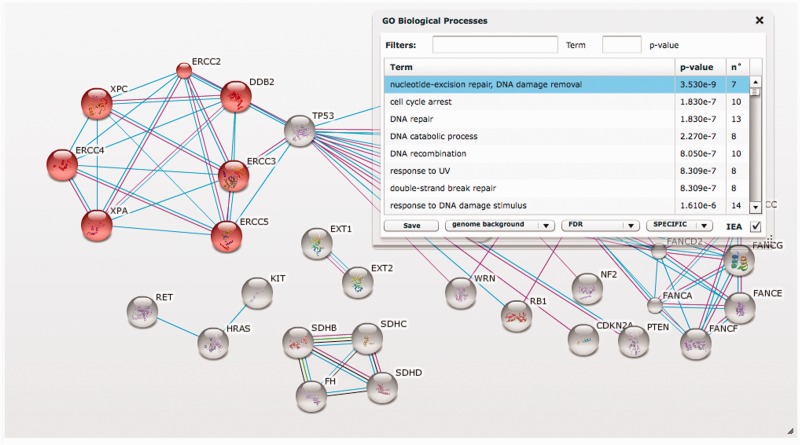
“The STRING screenshot shows a user-supplied set of genes, here a selection of cancer genes as annotated at the COSMIC database (52).”
Cited by
Items 1,001–1,021 of 1,021
Mukhopadhyay, S., Saha, R., Palanisamy, A., Ghosh, M., Biswas, A., Roy, S., Pal, A., Sarkar, K., & Bagh, S. (2016) · Scientific Reports · doi:10.1038/srep25975 · Cited by 30
Kang, S., Jeong, H., Baek, J.-H., Lee, S.-J., Han, S.-H., Cho, H. J., Kim, H., Hong, H. S., Kim, Y. H., Yi, E. C., et al. (2016) · Journal of Alzheimer’s Disease · doi:10.3233/jad-160025 · Cited by 30
Golden, C. E. M., Breen, M. S., Koro, L., Sonar, S., Niblo, K., Browne, A., Burlant, N., Di Marino, D., De Rubeis, S., Baxter, M. G., et al. (2019) · Cerebral Cortex · doi:10.1093/cercor/bhz029 · Cited by 29
“PPIs were obtained from the STRING database (Franceschini et al. 2013) 2232 | Cerebral Cortex, 2019, Vol.”
MethodDobrowolny, G., Bernardini, C., Martini, M., Baranzini, M., Barba, M., & Musarò, A. (2015) · Frontiers in Cellular Neuroscience · doi:10.3389/fncel.2015.00463 · Cited by 29
“…from the average of the major axis (Dmax: maximum fiber diameter; dmax:maximum axonal diameter) and the minor axis (Dmin: minimum fiber diameter; dmin: minimum axonal diameter), (Tsutsumi et al., 2014) and was measured using Image J software (Image J 1.36, National Institutes of Health, MD, USA).”
MethodInfluentialGene expression profiling analysis of osteosarcoma cell lines
SUN, L., LI, J., & YAN, B. (2015) · Molecular Medicine Reports · doi:10.3892/mmr.2015.3958 · Cited by 27
“org/) (20) was used to identify interactions/associations between the proteins encoded by the DEGs, and a combined score >0.”
A large-scale benchmark for network inference from single-cell perturbation data
Chevalley, M., Roohani, Y. H., Mehrjou, A., Leskovec, J., & Schwab, P. (2025) · Communications Biology · doi:10.1038/s42003-025-07764-y · Cited by 26
Ouyang, S., Tang, R., Liu, Z., Ma, F., Li, Y., & Wu, J. (2017) · Molecular Medicine Reports · doi:10.3892/mmr.2017.7118 · Cited by 25
Bertin, G. I., Sabbagh, A., Guillonneau, F., Jafari-Guemouri, S., Ezinmegnon, S., Federici, C., Hounkpatin, B., Fievet, N., & Deloron, P. (2013) · The Journal of Infectious Diseases · doi:10.1093/infdis/jit377 · Cited by 21
Issa, N. T., Kruger, J., Wathieu, H., Raja, R., Byers, S. W., & Dakshanamurthy, S. (2016) · BMC Bioinformatics · doi:10.1186/s12859-016-1065-y · Cited by 22
“Protein-protein interactions (PPIs) were extracted from the ExPASy STRING database [31] using a confidence score cutoff of 0.95.”
MethodInfluentialPetrera, A., Kern, U., Linz, D., Gomez-Auli, A., Hohl, M., Gassenhuber, J., Sadowski, T., & Schilling, O. (2016) · Journal of Proteome Research · doi:10.1021/acs.jproteome.6b00413 · Cited by 22
The extracellular matrix phenome across species
Statzer, C., & Ewald, C. Y. (2020) · Matrix Biology Plus · doi:10.1016/j.mbplus.2020.100039 · Cited by 21
“To assess whether the generated phenotype collections are functionally interconnected, we employed the STRING database and analyzed all orthologues mapped to the human matrisome (version 10) to quantify the predicted degree of interaction on the protein level [28].”
MethodXu, J., Xu, P., Wu, M., Chen, H., Xu, J., Wu, M., Li, M., & Qian, F. (2016) · OncoTargets and Therapy · doi:10.2147/ott.s91748 · Cited by 20
Van Assche, E., Moons, T., Cinar, O., Viechtbauer, W., Oldehinkel, A. J., Van Leeuwen, K., Verschueren, K., Colpin, H., Lambrechts, D., Van den Noortgate, W., et al. (2017) · Journal of Child Psychology and Psychiatry · doi:10.1111/jcpp.12766 · Cited by 19
“The setup of the study was based on known neurotransmitter-related protein interaction networks (Franceschini et al., 2013) of the phenotype (depressive symptoms) and genetic variants known to be involved in neurotransmission.”
Cao, C., Wang, K., Wang, Y., Liu, T.-B., Rivera, A., & Xue, C. (2022) · Nature Communications · doi:10.1038/s41467-022-34151-6 · Cited by 18
Synergistic Antifungal Activity of Berberine Derivative B-7b and Fluconazole
Li, L. P., Liu, W., Liu, H., Zhu, F., Zhang, D. Z., Shen, H., Xu, Z., Qi, Y. P., Zhang, S. Q., Chen, S. M., et al. (2015) · PLOS ONE · doi:10.1371/journal.pone.0126393 · Cited by 17
“1 (Search Tool for the Retrieval of Interacting Genes) database [38].”
BackgroundYue, X., Acun, A., & Zorlutuna, P. (2017) · Acta Biomaterialia · doi:10.1016/j.actbio.2017.06.031 · Cited by 16
MAD2L1 Functions As a Novel Diagnostic and Predictive Biomarker in Cholangiocarcinoma
Gao, Y., Liu, Y., Sun, L., Ouyang, X., Zhu, C., & Qin, X. (2021) · Genetic Testing and Molecular Biomarkers · doi:10.1089/gtmb.2021.0122 · Cited by 9
“The search tool for the retrieval of interacting genes (STRING; http://string-db.org; version 11.0) was performed to predict the functional interactions between proteins, and a combined score > 0.4 was considered statistically significant (Franceschini et al. , 2013).”
Influential(2025) · doi:10.1038/s44319-024-00339-8 · Cited by 6
“They further interacted with 881 redundant additional interactors, of which 199 were unique and overlapped with the STRING input list of 330 proteins, suggesting that our miniTurboID approach also captured the indirect recruitment of factors into the p65/RELA interactome (Fig.”
InfluentialMasson, H., Tat, J., Di Giusto, P., Antonakoudis, A., Shamie, I., Baghdassarian, H., Samoudi, M., Robinson, C. M., Kuo, C.-C., Koga, N., et al. (2025) · Cell Systems · doi:10.1016/j.cels.2025.101453 · Cited by 6
Girisha, M. N., Badiger, V. P., & Pattar, S. (2022) · Network Modeling Analysis in Health Informatics and Bioinformatics · doi:10.1007/s13721-022-00353-7 · Cited by 4
Carneiro, L., Silva, F., Vasoncelos-Raposo, J., Mota, M. P., Vieira-Coelho, M. A., Deslandes, A., Marinho, H., Amaral, G., & Monteiro-Júnior, R. (2020) · doi:10.21203/rs.3.rs-24600/v1 · Cited by 3
“01) [15] among all genes were found in the network (Figure 4).”
Background
Metadata
- Authors
- Franceschini, A., Szklarczyk, D., Frankild, S., Kuhn, M., Simonovic, M., Roth, A., Lin, J., Minguez, P., Bork, P., von Mering, C., & Jensen, L. J.
- Affiliations
- SIB Swiss Institute of Bioinformatics (CH)
- University of Copenhagen (DK)
- Venue
- Nucleic Acids Research
- Publisher
- Oxford University Press (OUP)
- Published
- 2012-11-29
- Volume
- 41
- Issue
- D1
- Pages
- D808-D815
- ISSN
- 0305-1048 (ISSN-L)
- 1362-4962
- PMC
- PMC3531103
- OpenAlex
- W2105924489
- Cited by
- 4,398
- References
- 61
- Citations by year
- 2026: 77 · 2025: 153 · 2024: 201 · 2023: 247 · 2022: 325 · 2021: 335 · 2020: 366 · 2019: 281 · 2018: 291 · 2017: 371 · 2016: 476 · 2015: 675 · 2014: 457 · 2013: 134 · 2012: 3
- FWCI
- 163.15
- Type
- journal article
- Language
- en
- Open access
- gold
- doi.org
- Licence
- Locations
- Nucleic Acids Research (publishedVersion, cc-by-nc)
- Europe PMC (PubMed Central) (publishedVersion, cc-by-nc)
- PubMed Central (publishedVersion, cc-by-nc)
- PubMed (publishedVersion)
- MDC Repository (Max-Delbrueck-Center for Molecular Medicine) (acceptedVersion)
- Zurich Open Repository and Archive (University of Zurich) (acceptedVersion, other-oa)
- reroDoc Digital Library (submittedVersion)
- Archivio Istituzionale della Ricerca (Universita Degli Studi Di Milano) (submittedVersion, cc-by-nc)
- Research at the University of Copenhagen (University of Copenhagen) (submittedVersion)
- Zurich Open Repository and Archive (University of Zurich) (submittedVersion, other-oa)
- Zurich Open Repository and Archive (University of Zurich)
- Funders
- European Molecular Biology Laboratory
- Novo Nordisk
- Universität Zürich
- Topics
- Life Sciences › Biochemistry, Genetics and Molecular Biology › Molecular Biology › Bioinformatics and Genomic Networks
- Health Sciences › Medicine › Health Informatics › Biomedical Text Mining and Ontologies
- Life Sciences › Biochemistry, Genetics and Molecular Biology › Molecular Biology › Genomics and Phylogenetic Studies
- Keywords
- STRING database, protein-protein interaction network, interaction prediction, literature mining, functional enrichment, biological pathway databases
- MeSH terms
- Algorithms, Data Interpretation, Statistical, User-Computer Interface, Systems Integration, Internet, Protein Interaction Mapping, Databases, Protein, Data Mining
About these checks
Registry, retraction, Cites and statistics results are computed, not judged, with one exception: a printed reference that no index lists is read once by a model before it counts as a citation error. Claims are extracted by a model and kept only when their quote appears verbatim in the text; each cited source is then checked, with a model’s help, for whether it says what the claim relies on. Those verdicts can be wrong — read the claim’s quote and the cited source before relying on one.
Statistics and arithmetic are recomputed, not judged.
Confidence bands are shown only for fields calibrated on our annotated test set. None is calibrated yet, so no band is shown.
What counts as a claim ›How we measure confidence ›How we check this ›
Are you an author, or do you see a problem with this page? Request a review
Data sources
Bibliographic data: Semantic Scholar, OpenAlex, Crossref.
Contains information from the Semantic Scholar Academic Graph Datasets, made available under the ODC Attribution License (ODC-BY 1.0).
Semantic Scholar’s data is described in: Kinney, R., et al. (2023). The Semantic Scholar Open Data Platform. arXiv:2301.10140.
