

STRING v9.1: protein-protein interaction networks, with increased coverage and integration
Open accessThe DOI matches its Crossref record; 61 of the 61 references it cites were found in a registry or an index.
Abstract
Complete knowledge of all direct and indirect interactions between proteins in a given cell would represent an important milestone towards a comprehensive description of cellular mechanisms and functions. Although this goal is still elusive, considerable progress has been made-particularly for certain model organisms and functional systems. Currently, protein interactions and associations are annotated at various levels of detail in online resources, ranging from raw data repositories to highly formalized pathway databases. For many applications, a global view of all the available interaction data is desirable, including lower-quality data and/or computational predictions. The STRING database (http://string-db.org/) aims to provide such a global perspective for as many organisms as feasible. Known and predicted associations are scored and integrated, resulting in comprehensive protein networks covering >1100 organisms. Here, we describe the update to version 9.1 of STRING, introducing several improvements: (i) we extend the automated mining of scientific texts for interaction information, to now also include full-text articles; (ii) we entirely re-designed the algorithm for transferring interactions from one model organism to the other; and (iii) we provide users with statistical information on any functional enrichment observed in their networks.
Overview
The claims and statistics of this paper haven’t been checked yet.
Free: it reads the open-access text and checks the first 5 claims that cite a source we can check. Create a free account to check every claim.
Integrity signals
Registry
Cites
Statistics
Figures

Verification
Claims the paper makes
The claims and statistics of this paper haven’t been checked yet.
Free: it reads the open-access text and checks the first 5 claims that cite a source we can check. Create a free account to check every claim.
Claims other papers make about this one
Each is checked against this paper’s own text: does it say what the citing paper says it does?
The source backs part of the claim, not all of it — or backs it for a different population, condition or comparison.
In the citing paper
“One approach is to treat the multiple datasets as different “features” annotated to each edge in a single unified network; these multiple features are combined to estimate a single interaction likelihood score for each node pair using supervised machine learning (Kramer et al., 2017) or Bayesian inference (Franceschini et al., 2013; Wong et al., 2004).”
From Mapping the multiscale structure of biological systems (2021) · cites this paper as Franceschini et al., 2013
Experimental — accuracy not yet measuredIn the citing paper
“Bioinformatic network tools, including STRING and GeneMania (93, 94), can score direct and indirect protein functional relationships using public database repositories, such as IntAct and Reactome (95, 96).”
From The Impact of Mass Spectrometry–Based Proteomics on Fundamental Discoveries in Virology (2014) · cites this paper as [94]
Self-check
Percentages, sums and reported differences re-computed from the paper’s own numbers.
The self-check needs the paper’s full text.
Citations
Cites
Controlling the False Discovery Rate: A Practical and Powerful Approach to Multiple Testing
Benjamini, Y., & Hochberg, Y. (1995) · Journal of the Royal Statistical Society Series B: Statistical Methodology · doi:10.1111/j.2517-6161.1995.tb02031.x · Cited by 109,482 · cited 1×
“The P -values are corrected for multiple testing using the method of Benjamini and Hochberg (54), but we also provide options to either disable that correction or to select a more stringent statistical test (Bonferroni).”
MethodSystematic and integrative analysis of large gene lists using DAVID bioinformatics resources
Huang, D. W., Sherman, B. T., & Lempicki, R. A. (2009) · Nature Protocols · doi:10.1038/nprot.2008.211 · Cited by 35,890 · cited 1×
“To address this question, a variety of dedicated online resources are already available (49,50), most notably the DAVID resource (51).”
BackgroundHuang, D. W., Sherman, B. T., & Lempicki, R. A. (2009) · Nucleic Acids Research · doi:10.1093/nar/gkn923 · Cited by 14,108 · cited 1×
“To address this question, a variety of dedicated online resources are already available (49,50), most notably the DAVID resource (51).”
BackgroundWarde-Farley, D., Donaldson, S. L., Comes, O., Zuberi, K., Badrawi, R., Chao, P., Franz, M., Grouios, C., Kazi, F., Lopes, C. T., et al. (2010) · Nucleic Acids Research · doi:10.1093/nar/gkq537 · Cited by 4,835 · cited 1×
“These include GeneMANIA (23), Consensus-PathDB (24), I2D (25), VisANT (26) and, more recently, hPRINT (27), HitPredict (28), IMID (29) and IMP (30).”
BackgroundThe COG database: a tool for genome-scale analysis of protein functions and evolution
Tatusov, R. L. (2000) · Nucleic Acids Research · doi:10.1093/nar/28.1.33 · Cited by 4,520 · cited 1×
“In the past, STRING has therefore used two distinct heuristic options: either to substitute homology for orthology (46) or to use pre-defined orthology relations described at high-level taxonomic groups, from the COG database (47).”
MethodSzklarczyk, D., Franceschini, A., Kuhn, M., Simonovic, M., Roth, A., Minguez, P., Doerks, T., Stark, M., Muller, J., Bork, P., et al. (2011) · Nucleic Acids Research · doi:10.1093/nar/gkq973 · Cited by 3,460 · cited 2×
“We have already discussed many aspects of the STRING resource previously, e.g. (31,32), including its data-sources, prediction algorithms and user-interface.”
BackgroundSelf-citationCaspi, R., Billington, R., Ferrer, L., Foerster, H., Fulcher, C. A., Keseler, I. M., Kothari, A., Krummenacker, M., Latendresse, M., Mueller, L. A., et al. (2016) · Nucleic Acids Research · doi:10.1093/nar/gkv1164 · Cited by 3,395
Specificity and Stability in Topology of Protein Networks
Maslov, S., & Sneppen, K. (2002) · Science · doi:10.1126/science.1065103 · Cited by 3,051
STRING 8--a global view on proteins and their functional interactions in 630 organisms
Jensen, L. J., Kuhn, M., Stark, M., Chaffron, S., Creevey, C., Muller, J., Doerks, T., Julien, P., Roth, A., Simonovic, M., et al. (2009) · Nucleic Acids Research · doi:10.1093/nar/gkn760 · Cited by 2,474 · cited 1×
“We have already discussed many aspects of the STRING resource previously, e.g. (31,32), including its data-sources, prediction algorithms and user-interface.”
BackgroundSelf-citationCOSMIC: mining complete cancer genomes in the Catalogue of Somatic Mutations in Cancer
Forbes, S. A., Bindal, N., Bamford, S., Cole, C., Kok, C. Y., Beare, D., Jia, M., Shepherd, R., Leung, K., Menzies, A., et al. (2011) · Nucleic Acids Research · doi:10.1093/nar/gkq929 · Cited by 2,278 · cited 1×
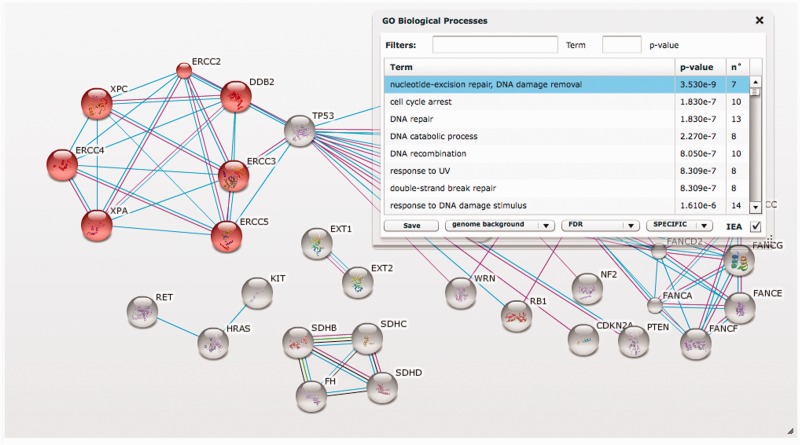
“The STRING screenshot shows a user-supplied set of genes, here a selection of cancer genes as annotated at the COSMIC database (52).”
Cited by
Items 801–900 of 1,021
Genetic and epigenetic insights into uveal melanoma
Sharma, A., Stei, M. M., Fröhlich, H., Holz, F. G., Loeffler, K. U., & Herwig‐Carl, M. C. (2017) · Clinical Genetics · doi:10.1111/cge.13136 · Cited by 47
“To estimate the contribution and involvement of the genes discussed in this review, we conducted a comprehensive analysis of protein interactions using the STRING tool .(139) STRING, which is a biological database to predict functional protein-protein interactions,(140) is purely based on the literature known (experim…”
MethodKürschner, G., Zhang, Q., Clima, R., Xiao, Y., Busch, J. F., Kilic, E., Jung, K., Berndt, N., Bulik, S., Holzhütter, H., et al. (2017) · Oncotarget · doi:10.18632/oncotarget.22413 · Cited by 47
“org [35], and displayed once more the huge impact on mitochondrial protein abundances, such as proteins involved in the 55S mitochondrial ribosome, TCA cycle, fatty acid metabolism, mitochondrial protein transport, and respiratory chain (Figure 3A), except CI (Figure 3B) in renal oncocytomas.”
Identification of DKK-1 as a novel mediator of statin effects in human endothelial cells
Pontremoli, M., Brioschi, M., Baetta, R., Ghilardi, S., & Banfi, C. (2018) · Scientific Reports · doi:10.1038/s41598-018-35119-7 · Cited by 47
In Silico Target Prediction for Small Molecules
Byrne, R., & Schneider, G. (2018) · Methods in molecular biology · doi:10.1007/978-1-4939-8891-4_16 · Cited by 47
Network-based features enable prediction of essential genes across diverse organisms
Azhagesan, K., Ravindran, B., & Raman, K. (2018) · PLoS ONE · doi:10.1371/journal.pone.0208722 · Cited by 47
Ma, L., Yang, Y., Zhao, X., Wang, F., Gao, S., & Bu, D. (2019) · PLoS ONE · doi:10.1371/journal.pone.0209182 · Cited by 47
Hasan, M. A., Khan, M. A., Sharmin, T., Mazumder, M. H. H., & Chowdhury, A. S. (2015) · Gene · doi:10.1016/j.gene.2015.08.044 · Cited by 47
Mitsi, V., Terzi, D., Purushothaman, I., Manouras, L., Gaspari, S., Neve, R. L., Stratinaki, M., Feng, J., Shen, L., & Zachariou, V. (2015) · Proceedings of the National Academy of Sciences · doi:10.1073/pnas.1504283112 · Cited by 42
Behr, S., Fried, L. P., & Jung, K. (2014) · Journal of Bacteriology · doi:10.1128/jb.01554-14 · Cited by 47
“Both HKs and RRs are over 30% identical at the amino acid sequence level and share the same pattern of structural domains (4, 5).”
BackgroundGao, J., Zhang, S., He, W., Shao, X., Li, C., Wei, Y., Deng, G., Kuang, R., Hu, C., Yi, G., et al. (2017) · Scientific Reports · doi:10.1038/srep40852 · Cited by 47
Calciolari, E., Mardas, N., Dereka, X. E., Anagnostopoulos, A. K., Tsangaris, G. T., & Donos, N. (2017) · Journal of Periodontal Research · doi:10.1111/jre.12498 · Cited by 47
Discover the network mechanisms underlying the connections between aging and age-related diseases
Yang, J., Huang, T., Song, W.-M., Petralia, F., Mobbs, C. V., Zhang, B., Zhao, Y., Schadt, E. E., Zhu, J., & Tu, Z. (2016) · Scientific Reports · doi:10.1038/srep32566 · Cited by 46
TopicNet: a framework for measuring transcriptional regulatory network change
Lou, S., Li, T., Kong, X., Zhang, J., Liu, J. J., Lee, D., & Gerstein, M. (2020) · Bioinformatics · doi:10.1093/bioinformatics/btaa403 · Cited by 46
Moon, S., Han, D., Kim, Y., Jin, J., Ho, W., & Kim, Y. (2014) · Scientific Reports · doi:10.1038/srep04376 · Cited by 46
A curated C. difficile strain 630 metabolic network: prediction of essential targets and inhibitors
Larocque, M., Chénard, T., & Najmanovich, R. (2014) · BMC Systems Biology · doi:10.1186/s12918-014-0117-z · Cited by 47
“In every case the STRING version 9.1 (Franceschini et al , 2013) score was calculated to evaluate the confidence score attributed to each complex (Table E11).”
MethodInfluentialHu, L., & Chan, K. C. C. (2016) · IEEE Transactions on Computational Biology and Bioinformatics · doi:10.1109/tcbb.2016.2520923 · Cited by 46
Liu, F., Jia, L., Wang, P., Wang, H., Farren, T., & Agrawal, S. G. (2016) · Oncotarget · doi:10.18632/oncotarget.8672 · Cited by 48
“org/) [39].”
New Genes Involved in Osmotic Stress Tolerance in Saccharomyces cerevisiae
Gonzalez, R., Morales, P., Tronchoni, J., Cordero-Bueso, G. A., Vaudano, E. T., Quirós, M., Novo, M., Torres‐Pérez, R., & Valero, E. (2016) · Frontiers in Microbiology · doi:10.3389/fmicb.2016.01545 · Cited by 46
“String 10.0 (Franceschini et al., 2013) was used to visualize known interactions between the genes (or their gene products) deleted in the strains highlighted by the pairwise comparisons.”
MethodInfluentialA proteomics view on integrin‐mediated adhesions
Manninen, A., & Varjosalo, M. T. (2016) · PROTEOMICS · doi:10.1002/pmic.201600022 · Cited by 47
“STRING analysis [125] of the most frequently identified IAC components.”
BackgroundSchmitt, A., Martins-de-Souza, D., Akbarian, S., Cassoli, J. S., Ehrenreich, H., Fischer, A., Fonteh, A., Gattaz, W. F., Gawlik, M., Gerlach, M., et al. (2017) · The World Journal of Biological Psychiatry · doi:10.1080/15622975.2016.1224929 · Cited by 38
“The use of STRING (search tool for the retrieval of interacting genes/proteins) (Franceschini et al. 2013) to visualise functional protein association networks (http://string-db.org) allows us to depict a cluster of the most consistently differentially expressed proteins in the blood samples of…”
MethodFan, M., Sun, X. K., Xu, N., Liao, Z., Li, Y., Wang, J., Fan, Y., Cui, D., Li, P., & Miao, Z. (2017) · Scientific Reports · doi:10.1038/s41598-017-11449-w · Cited by 46
Iqbal, S., & Hoque, M. T. (2018) · Bioinformatics · doi:10.1093/bioinformatics/bty352 · Cited by 46
Zhu, G., Yan, X., Zhu, D. Z., Deng, X., Wu, J., Xia, J. L., & Yan, Y. (2018) · Journal of Proteomics · doi:10.1016/j.jprot.2018.06.019 · Cited by 46
A quantitative analysis of heterogeneities and hallmarks in acute myelogenous leukaemia
Hu, C. W., Qiu, Y., Ligeralde, A., Raybon, A. Y., Yoo, S., Coombes, K. R., Qutub, A. A., & Kornblau, S. M. (2019) · Nature Biomedical Engineering · doi:10.1038/s41551-019-0387-2 · Cited by 46
Li, D., Wang, X., Fu, Y., Zhang, C., Cao, Y., Wang, J., Zhang, Y., Li, Y., Chen, Y., Li, Z., et al. (2019) · Frontiers in Genetics · doi:10.3389/fgene.2019.00457 · Cited by 46
“0 for protein-protein interaction (PPI) network analysis (Franceschini et al., 2013), and the PPI network was visualized using Cytoscape (version 3.6.0) (Shannon et al., 2003).”
MethodInfluentialDoes hyperglycemia downregulate glucose transporters in the brain?
Leão, L. L., Tangen, G. G., Barca, M. L., Engedal, K., Santos, S. H. S., Machado, F. S. M., de Paula, A. M. B., & Monteiro-Júnior, R. S. (2020) · Medical Hypotheses · doi:10.1016/j.mehy.2020.109614 · Cited by 48
Du, J., Yan, X., Mi, S., Yuan, L., Ji, H., Hou, K., Ma, S., Ba, Y., Zhou, P., Chen, L., et al. (2020) · Frontiers in Cell and Developmental Biology · doi:10.3389/fcell.2020.558961 · Cited by 46
“An interaction network was produced by the STRING5 database and was reconstructed via Cytoscape software (Shannon et al., 2003; Franceschini et al., 2013).”
BackgroundMethodAnwaier, A., Zhu, S., Tian, X., Xu, W., Wang, Y., Palihati, M., Wang, W.-Y., Shi, G., Qu, Y., Zhang, H., et al. (2022) · Phenomics · doi:10.1007/s43657-022-00070-1 · Cited by 46
Exploring Transcription Factors-microRNAs Co-regulation Networks in Schizophrenia
Xu, Y. J., Yue, W., Shugart, Y. Y., Li, S., Cai, L., Li, Q., Cheng, Z., Wang, G., Zhou, Z., Jin, C., et al. (2015) · Schizophrenia Bulletin · doi:10.1093/schbul/sbv170 · Cited by 46
Cao, H., He, M., Zhu, C., Yuan, L., Dong, L., Bian, Y., Zhang, W., & Yan, Y. (2016) · PROTEOMICS · doi:10.1002/pmic.201500371 · Cited by 46
“org) [39, 40], and the PPI network with a confidence score of at least 0.”
BackgroundGenome-wide analysis of DNA methylation in obese, lean and miniature pig breeds
Yang, Y., Zhou, R., Mu, Y., Hou, X., Tang, Z., & Li, K. (2016) · Scientific Reports · doi:10.1038/srep30160 · Cited by 46
Azman, M. S., Alard, E. L., Dodel, M., Capraro, F., Faraway, R., Dermit, M., Fan, W., Chakraborty, A., Ule, J., & Mardakheh, F. K. (2023) · The EMBO Journal · doi:10.15252/embj.2022110902 · Cited by 45
Murphy, S., Henry, M. A., Meleady, P., Zweyer, M., Mundegar, R. R., Swandulla, D., & Ohlendieck, K. (2015) · Biology · doi:10.3390/biology4020397 · Cited by 45
Sleight, V. A., Thorne, M. A. S., Peck, L. S., & Clark, M. S. (2015) · Marine Genomics · doi:10.1016/j.margen.2015.01.009 · Cited by 45
“1 program was used (Franceschini et al., 2013).”
Mutation analysis in patients with total sperm immotility
Pereira, R., Oliveira, J., Ferráz, L., Barros, A., Santos, R., & Sousa, M. (2015) · Journal of Assisted Reproduction and Genetics · doi:10.1007/s10815-015-0474-6 · Cited by 45
“According to Search Tool for the Retrieval of Interacting Genes/Proteins (STRING) [37], these two genes may interact with a score of 0.540.”
MethodInfluentialJung, H. S., Seo, Y.-R., Yang, Y. M., Koo, J. H., An, J., Lee, S. J., Kim, K. M., & Kim, S. G. (2014) · Cellular Signalling · doi:10.1016/j.cellsig.2014.02.022 · Cited by 45
Wu, X., Skłodowski, K., Encke, B., & Schulze, W. X. (2014) · Journal of Proteome Research · doi:10.1021/pr5003164 · Cited by 45
Turtoï, A., Blomme, A., Bianchi, E., Maris, P., Vannozzi, R., Naccarato, A. G., Delvenne, P., Pauw, E. D., Bevilacqua, G., & Castronovo, V. (2014) · Journal of Proteome Research · doi:10.1021/pr500657w · Cited by 45
Martin, L. B. B., Sherwood, R., Nicklay, J. J., Yang, Y., Muratore‐Schroeder, T. L., Anderson, E. T., Thannhauser, T. W., Rose, J. K. C., & Zhang, S. (2016) · PROTEOMICS · doi:10.1002/pmic.201500450 · Cited by 45
“Indeed, further analysis of putative protein interaction networks using STRING database [30] (http://string-db.”
BackgroundMcDonald, K. R., Guise, A. J., Pourbozorgi, P. L., Cristea, I. M., Zakian, V. A., Capra, J. A., & Sabouri, N. (2016) · PLoS Genetics · doi:10.1371/journal.pgen.1006238 · Cited by 45
Cutaneous applied nano-ZnO reduce the ability of hair follicle stem cells to differentiate
Ge, W., Zhao, Y. M., Lai, F.-N., Liu, J., Sun, Y.-C., Wang, J., Cheng, S., Zhang, X., Sun, L.-L., Li, L., et al. (2017) · Nanotoxicology · doi:10.1080/17435390.2017.1310947 · Cited by 46
“Annotation of differentially expressed genes was performed with the Database for Annotation, Visualization, and Integrated Discovery (DAVID 6.7) (Huang et al., 2009a,b) or STRING (Franceschini et al., 2013).”
MethodInfluentialMolecular profiling and combinatorial activity of CCT 068127: a potent CDK 2 and CDK 9 inhibitor
Whittaker, S. R., Barlow, C., Martin, M. P., Mancusi, C., Wagner, S., Self, A. J., Barrie, E., Poele, R. T., Sharp, S. Y., Brown, N., et al. (2018) · Molecular Oncology · doi:10.1002/1878-0261.12148 · Cited by 45
“We also utilized the STRING database (Franceschini et al., 2013) to look for functional associations between genes with altered expression in response to CDK inhibition (Fig.”
MethodCREB/CRTC2 controls GLP‐1‐dependent regulation of glucose homeostasis
Lee, J., Wen, X., Cho, H., & Koo, S. (2018) · The FASEB Journal · doi:10.1096/fj.201700845r · Cited by 45
Understanding serine proteases implications on Leishmania spp lifecycle
Alves, C. R., de Souza, R. S., Charret, K. S., Côrtes, L. M. D. C., Silva, M. P. D. S., Veloso, L. B., de Oliveira, L. F. G., & Souza‐Silva, F. (2017) · Experimental Parasitology · doi:10.1016/j.exppara.2017.11.008 · Cited by 45
He, J., Sun, C., Gu, Z., Yang, Y., Gu, M., Xue, C., Xie, Z., Ren, H., Wang, Y., Liu, Y., et al. (2018) · ACS Nano · doi:10.1021/acsnano.8b00552 · Cited by 45
Moghadam, F. H., Mesbah-Ardakani, M., & Nasr‐Esfahani, M. H. (2018) · European Journal of Pharmacology · doi:10.1016/j.ejphar.2018.10.003 · Cited by 45
Guo, W., Sun, S., Guo, L., Song, P., Xue, X., Zhang, H., Zhang, G., Li, R., Gao, Y., Qiu, B., et al. (2020) · DNA and Cell Biology · doi:10.1089/dna.2019.5291 · Cited by 45
Kifle, D. W., Chaiyadet, S., Waardenberg, A. J., Wise, I. A., Cooper, M. M., Becker, L., Doolan, D. L., Laha, T., Sotillo, J., Pearson, M. S., et al. (2020) · International Journal for Parasitology · doi:10.1016/j.ijpara.2020.05.005 · Cited by 45
Dai, W., Wu, F., McMyn, N. F., Song, B., Walker-Sperling, V. E. K., Varriale, J., Zhang, H., Barouch, D. H., Siliciano, J. D., Li, W., et al. (2022) · Science Translational Medicine · doi:10.1126/scitranslmed.abh3351 · Cited by 45
Systems Pharmacology Augments Drug Safety Surveillance
Lorberbaum, T., Nasir, M. N., Keiser, M. J., Vilar, S., Hripcsak, G. M., & Tatonetti, N. P. (2014) · Clinical Pharmacology & Therapeutics · doi:10.1002/cpt.2 · Cited by 45
Baumann, J., Wong, J., Sun, Y., & Conklin, D. S. (2016) · BMC Cancer · doi:10.1186/s12885-016-2611-8 · Cited by 45
“The two transcription factors were used as input for the STRING database of protein interactions to retrieve the immediate network neighborhood [24], which is shown as a Cytoscape network in Fig.”
MethodZhou, S., Li, J., Xu, H., Zhang, S., Chen, X., Chen, W., Yang, S., Zhong, S., Zhao, J., & Tang, J. (2017) · Gene · doi:10.1016/j.gene.2017.04.026 · Cited by 45
Vora, B., Wang, A., Kosti, I., Huang, H., Paranjpe, I., Woodruff, T. J., MacKenzie, T. C., & Sirota, M. (2018) · Frontiers in Immunology · doi:10.3389/fimmu.2018.00993 · Cited by 45
Singh, S., Praveen, A., Dudha, N., & Bhadrecha, P. (2024) · Physiology and Molecular Biology of Plants · doi:10.1007/s12298-024-01480-3 · Cited by 44
“The research community relies on these bioinformatics tools to efficiently, accurately, and reproducibly analyze a diverse range of multi-omics data (Franceschini et al. 2013; Orozco et al. 2013; Yachdav et al. 2014; Henry et al. 2014; Franz et al. 2023).”
Sircar, S., & Parekh, N. (2015) · Frontiers in Genetics · doi:10.3389/fgene.2015.00256 · Cited by 44
“Moreover, systems level information, viz., transcriptome and proteome data (Cao et al., 2012; Franceschini et al., 2013), gene regulatory information (Higo et al., 1999), metabolic and pathway level information (Dharmawardhana et al., 2013), including sequence-level information (Monaco et al.,…”
BackgroundZhang, S., Tian, L., Ma, P., Sun, Q., Zhang, K., GuanchaoWang, Liu, H., & Xu, B. (2015) · Archives of Oral Biology · doi:10.1016/j.archoralbio.2015.08.003 · Cited by 44
Collaborative rewiring of the pluripotency network by chromatin and signalling modulating pathways
Tran, K. A., Jackson, S. A., Olufs, Z. P. G., Zaidan, N. Z., Leng, N., Kendziorski, C. M., Roy, S., & Sridharan, R. (2015) · Nature Communications · doi:10.1038/ncomms7188 · Cited by 44
Borirak, O., de Koning, L. J., van der Woude, A. D., Hoefsloot, H. C. J., Dekker, H. L., Roseboom, W., de Koster, C. G., & Hellingwerf, K. J. (2015) · Biotechnology for Biofuels · doi:10.1186/s13068-015-0294-z · Cited by 42
A New Feature Vector Based on Gene Ontology Terms for Protein-Protein Interaction Prediction
Bandyopadhyay, S., & Mallick, K. (2016) · IEEE Transactions on Computational Biology and Bioinformatics · doi:10.1109/tcbb.2016.2555304 · Cited by 44
Mahadevan, C., Krishnan, A., Saraswathy, G. G., Surendran, A., Jaleel, A., & Sakuntala, M. (2016) · Frontiers in Plant Science · doi:10.3389/fpls.2016.00785 · Cited by 44
Saha, S., Sengupta, K., Chatterjee, P., Basu, S., & Nasipuri, M. (2017) · Briefings in Functional Genomics · doi:10.1093/bfgp/elx024 · Cited by 44
Prediction of Human Phenotype Ontology terms by means of hierarchical ensemble methods
Notaro, M., Schubach, M., Robinson, P. N., & Valentini, G. (2017) · BMC Bioinformatics · doi:10.1186/s12859-017-1854-y · Cited by 44
Wang, R., Li, J., Zhao, Y., Li, Y., & Yin, L. (2017) · Breast Cancer · doi:10.1007/s12282-017-0816-6 · Cited by 44
“To investigate the PPIs among DEGs, online sever STRING [12] was employed.”
MethodIdentification of critically carcinogenesis-related genes in basal cell carcinoma
Dai, J., Kang, L., Huang, Y., Lü, Y., Chen, W., Zhang, X., He, B., Pan, Y., Wang, S., & Fan, W. (2018) · OncoTargets and Therapy · doi:10.2147/ott.s170504 · Cited by 45
“Functional and pathway enrichment analysis Gene ontology (GO) analysis defines the functions of gene products covering three domains, including biological process, molecular function, and cellular component.14,15 The Kyoto Encyclopedia of Genes and Genomes (KEGG) pathway database is widely used to map large-scale data…”
MethodInfluentialIn Vivo Proteome of Pseudomonas aeruginosa in Airways of Cystic Fibrosis Patients
Wu, X., Siehnel, R., Garudathri, J., Staudinger, B. J., Hisert, K. B., Ozer, E. A., Hauser, A. R., Eng, J. K., Manoil, C., Singh, P. K., et al. (2019) · Journal of Proteome Research · doi:10.1021/acs.jproteome.9b00122 · Cited by 44
Lung adenocarcinoma pathology stages related gene identification
Sun, G., & Zhao, T. (2019) · Mathematical Biosciences & Engineering · doi:10.3934/mbe.2020038 · Cited by 44
Kahraman, A., Karakulak, T., Szklarczyk, D., & von Mering, C. (2020) · Scientific Reports · doi:10.1038/s41598-020-71221-5 · Cited by 44
Self-citationChen, Y., Huang, J., Liu, Z., Chen, R., Fu, D., Yang, L., Wang, J., Du, L., Wen, L., Miao, Y., et al. (2020) · Frontiers in Cell and Developmental Biology · doi:10.3389/fcell.2020.593638 · Cited by 44
“To screen PPIs (protein–protein interaction), the target genes of DEMs were mapped to the STRING database4 (Franceschini et al., 2013), and networks were visualized using Cytoscape (Smoot et al., 2011).”
MethodLin, Y., & Hu, Z. (2021) · International Journal of Pediatric Otorhinolaryngology · doi:10.1016/j.ijporl.2020.110595 · Cited by 44
Jiang, M., Wang, Z., Xia, F., Wen, Z., Chen, R., Zhu, D., Wang, M., Zhuge, X., & Dai, J. (2022) · PLoS Pathogens · doi:10.1371/journal.ppat.1010908 · Cited by 44
Kidd, M. S., Modlin, I. M., Bodei, L., & Drozdov, I. A. (2015) · Cellular and Molecular Gastroenterology and Hepatology · doi:10.1016/j.jcmgh.2014.12.008 · Cited by 44
Quantitative proteomics of delirium cerebrospinal fluid
Poljak, A., Hill, M., Hall, R. J., MacLullich, A. M., Raftery, M. J., Tai, J., Yan, S., & Caplan, G. A. (2014) · Translational Psychiatry · doi:10.1038/tp.2014.114 · Cited by 40
Waqas, M., Guo, L., Zhang, S., Chen, Y., Zhang, X., Wang, L., Tang, M., Shi, H., Bird, P. I., Li, H., et al. (2016) · Oncotarget · doi:10.18632/oncotarget.8636 · Cited by 44
“To gain a comprehensive view of the gene network in inner ear HC regeneration, we combined a STRING protein-protein interaction analysis [34], which was used to assemble the predicted networks of the significantly altered genes (fold change > 2.0, p 0.01) with the functional categories…”
InfluentialRen, S., Yang, M., Li, Y., Zhang, F., Chen, Z., Zhang, J., Yang, G., Yue, Y., Li, S., Ge, F., et al. (2016) · Scientific Reports · doi:10.1038/srep34078 · Cited by 44
Martínez‐Martínez, E., Ibarrola, J., Fernández‐Celis, A., Santamaría, E., Fernández‐Irigoyen, J., Rossignol, P., Jaisser, F., & López‐Andrés, N. (2017) · Scientific Reports · doi:10.1038/s41598-017-12305-7 · Cited by 44
Identification of prefrontal cortex protein alterations in Alzheimer’s disease
Garranzo‐Asensio, M., Segundo‐Acosta, P. S., Martínez‐Useros, J., Montero‐Calle, A., Fernández‐Aceñero, M. J., Månberg, A., Peláez‐García, A., Villalba, M., Rábano, A., Nilsson, P., et al. (2018) · Oncotarget · doi:10.18632/oncotarget.24303 · Cited by 45
“com) to identify altered networks and pathways [97].”
BackgroundChen, C.-Y., Melo, E., Jakob, P., Friedlein, A., Elsässer, B., Goettig, P., Küppers, V., Delobel, F., Stucki, C., Dunkley, T. P. J., et al. (2018) · Matrix Biology · doi:10.1016/j.matbio.2018.03.013 · Cited by 44
Krause, B. J., Carrasco‐Wong, I., Domínguez, A., Arnaíz, P., Farías, M., Salesa Barja, Y., Mardones, F., & Casanello, P. C. (2015) · PLoS ONE · doi:10.1371/journal.pone.0128140 · Cited by 44
Expression Profiles and Prognostic Roles of m6A Writers, Erasers and Readers in Gastric Cancer
Jing, J., Zhao, X., Li, H. R., Sun, L. L., & Yuan, Y. (2021) · Future Oncology · doi:10.2217/fon-2020-0630 · Cited by 43
Cui, Y., Zhang, H., Wang, Z., Gong, B., Al-Ward, H., Deng, Y., Fan, O. R., Wang, J., Zhu, W., & Sun, Y. E. (2023) · Frontiers in Immunology · doi:10.3389/fimmu.2023.1212330 · Cited by 43
Role of microRNAs in the immunity process of the flat oyster Ostrea edulis against bonamiosis
Martín-Gómez, L., Villalba, A., Kerkhoven, R. H., & Abollo, E. (2014) · Infection Genetics and Evolution · doi:10.1016/j.meegid.2014.06.026 · Cited by 44
Janvilisri, T., Leelawat, K., Roytrakul, S., Paemanee, A., & Tohtong, R. (2015) · Disease Markers · doi:10.1155/2015/105358 · Cited by 43
Essentiality and centrality in protein interaction networks revisited
Khuri, S., & Wuchty, S. (2015) · BMC Bioinformatics · doi:10.1186/s12859-015-0536-x · Cited by 43
“Therefore, we took the logical next step of grouping our protein sets according to broad functional classes that were defined by clusters of orthologous groups (COGs) [27,28].”
BackgroundMethodLeveraging structure for enzyme function prediction: methods, opportunities, and challenges
Jacobson, M. P., Kalyanaraman, C., Zhao, S., & Tian, B. (2014) · Trends in Biochemical Sciences · doi:10.1016/j.tibs.2014.05.006 · Cited by 43
Yang, L., Jiang, T., Fountain, J. C., Scully, B. T., Lee, R., Kemerait, R. C., Chen, S., & Guo, B. Z. (2014) · International Journal of Molecular Sciences · doi:10.3390/ijms151018892 · Cited by 43
Qiao, N., Huang, Y., Naveed, H., Green, C. D., & Han, J. J. (2013) · PLoS ONE · doi:10.1371/journal.pone.0074074 · Cited by 43
Protein deep sequencing applied to biobank samples from patients with pancreatic cancer
Ansari, D., Andersson, R. E., Bauden, M. P., Andersson, B., Connolly, J. B., Welinder, C., Sasor, A., & Marko‐Varga, G. (2014) · Journal of Cancer Research and Clinical Oncology · doi:10.1007/s00432-014-1817-x · Cited by 43
“1 containing known and predicted physical and functional protein–protein interactions (Franceschini et al. 2013).”
BackgroundMethodInfluentialGenome Scale Modeling in Systems Biology: Algorithms and Resources
Najafi, A., Bidkhori, G., Bozorgmehr, J. H., Koch, I., & Masoudi‐Nejad, A. (2014) · Current Genomics · doi:10.2174/1389202915666140319002221 · Cited by 43
Lewis, A. M., Matzdorf, S. S., Endres, J. L., Windham, I. H., Bayles, K. W., & Rice, K. C. (2015) · Molecular Microbiology · doi:10.1111/mmi.12962 · Cited by 44
“Using the STRING database (Franceschini et al., 2013), a close genomic association (whereby two genes are located in close proximity to each other) was found between scdA and nor homologs in several bacteria, including Cupriavidus taiwanesis (formally belonging to the genus Ralstonia), Kangiella…”
MethodAwan, F. M., Naz, A., Obaid, A., Ali, A., Ahmad, J., Anjum, S., & Janjua, H. A. (2015) · PLoS ONE · doi:10.1371/journal.pone.0138913 · Cited by 42
“In PLOS ONE | DOI:10.1371/journal.pone.0138913 September 28, 2015 5 / 26 order to determine whether the identified proteins interact with each other as well as with MDK, DKK1, current standard HCC biomarker AFP and its interacting partners, network based tools: STRING [45], FpClass [46] and GeneMANIA [47] were used.”
MethodInfluentialBin, B.-H., Kim, D., Kim, N.-H., Choi, E.-J., Bhin, J., Kim, S. T., Gho, Y. S., Lee, A., Lee, T. R., & Cho, E. (2016) · Journal of Investigative Dermatology · doi:10.1016/j.jid.2015.08.001 · Cited by 43
“The network analysis of the identified EV proteins, performed using the STRING database (version 9.05) (Franceschini et al., 2013) and the network-visualizing program Cytoscape (version 2.8.3) (Shannon et al., 2003), revealed a network of 39 proteins (Figure 1d).”
BackgroundMethodInfluentialMolecular modeling in the age of clinical genomics, the enterprise of the next generation
Prokop, J. W., Lazar, J., Crapitto, G., Smith, D. C., Worthey, E. A., & Jacob, H. J. (2017) · Journal of Molecular Modeling · doi:10.1007/s00894-017-3258-3 · Cited by 43
Al-Ramahi, I., Lu, B., Di Paola, S., Pang, K., de Haro, M., Peluso, I., Gallego-Flores, T., Malik, N. T., Erikson, K., Bleiberg, B. A., et al. (2018) · Cell Systems · doi:10.1016/j.cels.2018.05.010 · Cited by 43
Roustan, V., & Weckwerth, W. (2018) · Frontiers in Plant Science · doi:10.3389/fpls.2018.01590 · Cited by 43
“Moreover, PPI-network with protein sequences of each of the 61 proteins discussed above was generated with STRING database (Figure 4C) (Franceschini et al., 2013).”
MethodHigashi, H., Maejima, T., Lee, L. H., Yamazaki, Y., Hottiger, M. O., Singh, S. A., & Aikawa, M. (2019) · Journal of Proteome Research · doi:10.1021/acs.jproteome.8b00895 · Cited by 43
Panga, V., Kallor, A. A., Nair, A., Harshan, S., & Raghunathan, S. (2019) · PLoS ONE · doi:10.1371/journal.pone.0224632 · Cited by 43
Metagenomic insights into microbial arsenic metabolism in shallow groundwater of Datong basin, China
Wang, L., Yin, Z., & Jing, C. (2019) · Chemosphere · doi:10.1016/j.chemosphere.2019.125603 · Cited by 43
Billing, A. M., Knudsen, K. B., Chetwynd, A. J., Ellis, L. A., Tang, S. V. Y., Berthing, T., Wallin, H., Lynch, I., Vogel, U. B., & Kjeldsen, F. (2020) · ACS Nano · doi:10.1021/acsnano.9b08818 · Cited by 43
Gene Expression Alterations and Molecular Analysis of CHEK1 in Solid Tumors
Fadaka, A. O., Bakare, O. O., Sibuyi, N. R. S., & Klein, A. (2020) · Cancers · doi:10.3390/cancers12030662 · Cited by 45
“0) is a unique tool that provides a comprehensive view of all the known and predicted interactions and associations among proteins [89].”
BackgroundSazzini, M., Abondio, P., Sarno, S., Gnecchi‐Ruscone, G. A., Ragno, M., Giuliani, C., Fanti, S. D., Ojeda‐Granados, C., Boattini, A., Marquis, J., et al. (2020) · BMC Biology · doi:10.1186/s12915-020-00778-4 · Cited by 43
Metadata
- Authors
- Franceschini, A., Szklarczyk, D., Frankild, S., Kuhn, M., Simonovic, M., Roth, A., Lin, J., Minguez, P., Bork, P., von Mering, C., & Jensen, L. J.
- Affiliations
- SIB Swiss Institute of Bioinformatics (CH)
- University of Copenhagen (DK)
- Venue
- Nucleic Acids Research
- Publisher
- Oxford University Press (OUP)
- Published
- 2012-11-29
- Volume
- 41
- Issue
- D1
- Pages
- D808-D815
- ISSN
- 0305-1048 (ISSN-L)
- 1362-4962
- PMC
- PMC3531103
- OpenAlex
- W2105924489
- Cited by
- 4,398
- References
- 61
- Citations by year
- 2026: 77 · 2025: 153 · 2024: 201 · 2023: 247 · 2022: 325 · 2021: 335 · 2020: 366 · 2019: 281 · 2018: 291 · 2017: 371 · 2016: 476 · 2015: 675 · 2014: 457 · 2013: 134 · 2012: 3
- FWCI
- 163.15
- Type
- journal article
- Language
- en
- Open access
- gold
- doi.org
- Licence
- Locations
- Nucleic Acids Research (publishedVersion, cc-by-nc)
- Europe PMC (PubMed Central) (publishedVersion, cc-by-nc)
- PubMed Central (publishedVersion, cc-by-nc)
- PubMed (publishedVersion)
- MDC Repository (Max-Delbrueck-Center for Molecular Medicine) (acceptedVersion)
- Zurich Open Repository and Archive (University of Zurich) (acceptedVersion, other-oa)
- reroDoc Digital Library (submittedVersion)
- Archivio Istituzionale della Ricerca (Universita Degli Studi Di Milano) (submittedVersion, cc-by-nc)
- Research at the University of Copenhagen (University of Copenhagen) (submittedVersion)
- Zurich Open Repository and Archive (University of Zurich) (submittedVersion, other-oa)
- Zurich Open Repository and Archive (University of Zurich)
- Funders
- European Molecular Biology Laboratory
- Novo Nordisk
- Universität Zürich
- Topics
- Life Sciences › Biochemistry, Genetics and Molecular Biology › Molecular Biology › Bioinformatics and Genomic Networks
- Health Sciences › Medicine › Health Informatics › Biomedical Text Mining and Ontologies
- Life Sciences › Biochemistry, Genetics and Molecular Biology › Molecular Biology › Genomics and Phylogenetic Studies
- Keywords
- STRING database, protein-protein interaction network, interaction prediction, literature mining, functional enrichment, biological pathway databases
- MeSH terms
- Algorithms, Data Interpretation, Statistical, User-Computer Interface, Systems Integration, Internet, Protein Interaction Mapping, Databases, Protein, Data Mining
About these checks
Registry, retraction, Cites and statistics results are computed, not judged, with one exception: a printed reference that no index lists is read once by a model before it counts as a citation error. Claims are extracted by a model and kept only when their quote appears verbatim in the text; each cited source is then checked, with a model’s help, for whether it says what the claim relies on. Those verdicts can be wrong — read the claim’s quote and the cited source before relying on one.
Statistics and arithmetic are recomputed, not judged.
Confidence bands are shown only for fields calibrated on our annotated test set. None is calibrated yet, so no band is shown.
What counts as a claim ›How we measure confidence ›How we check this ›
Are you an author, or do you see a problem with this page? Request a review
Data sources
Bibliographic data: Semantic Scholar, OpenAlex, Crossref.
Contains information from the Semantic Scholar Academic Graph Datasets, made available under the ODC Attribution License (ODC-BY 1.0).
Semantic Scholar’s data is described in: Kinney, R., et al. (2023). The Semantic Scholar Open Data Platform. arXiv:2301.10140.
