

STRING v9.1: protein-protein interaction networks, with increased coverage and integration
Open accessThe DOI matches its Crossref record; 61 of the 61 references it cites were found in a registry or an index.
Abstract
Complete knowledge of all direct and indirect interactions between proteins in a given cell would represent an important milestone towards a comprehensive description of cellular mechanisms and functions. Although this goal is still elusive, considerable progress has been made-particularly for certain model organisms and functional systems. Currently, protein interactions and associations are annotated at various levels of detail in online resources, ranging from raw data repositories to highly formalized pathway databases. For many applications, a global view of all the available interaction data is desirable, including lower-quality data and/or computational predictions. The STRING database (http://string-db.org/) aims to provide such a global perspective for as many organisms as feasible. Known and predicted associations are scored and integrated, resulting in comprehensive protein networks covering >1100 organisms. Here, we describe the update to version 9.1 of STRING, introducing several improvements: (i) we extend the automated mining of scientific texts for interaction information, to now also include full-text articles; (ii) we entirely re-designed the algorithm for transferring interactions from one model organism to the other; and (iii) we provide users with statistical information on any functional enrichment observed in their networks.
Overview
The claims and statistics of this paper haven’t been checked yet.
Free: it reads the open-access text and checks the first 5 claims that cite a source we can check. Create a free account to check every claim.
Integrity signals
Registry
Cites
Statistics
Figures

Verification
Claims the paper makes
The claims and statistics of this paper haven’t been checked yet.
Free: it reads the open-access text and checks the first 5 claims that cite a source we can check. Create a free account to check every claim.
Claims other papers make about this one
Each is checked against this paper’s own text: does it say what the citing paper says it does?
The source backs part of the claim, not all of it — or backs it for a different population, condition or comparison.
In the citing paper
“One approach is to treat the multiple datasets as different “features” annotated to each edge in a single unified network; these multiple features are combined to estimate a single interaction likelihood score for each node pair using supervised machine learning (Kramer et al., 2017) or Bayesian inference (Franceschini et al., 2013; Wong et al., 2004).”
From Mapping the multiscale structure of biological systems (2021) · cites this paper as Franceschini et al., 2013
Experimental — accuracy not yet measuredIn the citing paper
“Bioinformatic network tools, including STRING and GeneMania (93, 94), can score direct and indirect protein functional relationships using public database repositories, such as IntAct and Reactome (95, 96).”
From The Impact of Mass Spectrometry–Based Proteomics on Fundamental Discoveries in Virology (2014) · cites this paper as [94]
Self-check
Percentages, sums and reported differences re-computed from the paper’s own numbers.
The self-check needs the paper’s full text.
Citations
Cites
Controlling the False Discovery Rate: A Practical and Powerful Approach to Multiple Testing
Benjamini, Y., & Hochberg, Y. (1995) · Journal of the Royal Statistical Society Series B: Statistical Methodology · doi:10.1111/j.2517-6161.1995.tb02031.x · Cited by 109,482 · cited 1×
“The P -values are corrected for multiple testing using the method of Benjamini and Hochberg (54), but we also provide options to either disable that correction or to select a more stringent statistical test (Bonferroni).”
MethodSystematic and integrative analysis of large gene lists using DAVID bioinformatics resources
Huang, D. W., Sherman, B. T., & Lempicki, R. A. (2009) · Nature Protocols · doi:10.1038/nprot.2008.211 · Cited by 35,890 · cited 1×
“To address this question, a variety of dedicated online resources are already available (49,50), most notably the DAVID resource (51).”
BackgroundHuang, D. W., Sherman, B. T., & Lempicki, R. A. (2009) · Nucleic Acids Research · doi:10.1093/nar/gkn923 · Cited by 14,108 · cited 1×
“To address this question, a variety of dedicated online resources are already available (49,50), most notably the DAVID resource (51).”
BackgroundWarde-Farley, D., Donaldson, S. L., Comes, O., Zuberi, K., Badrawi, R., Chao, P., Franz, M., Grouios, C., Kazi, F., Lopes, C. T., et al. (2010) · Nucleic Acids Research · doi:10.1093/nar/gkq537 · Cited by 4,835 · cited 1×
“These include GeneMANIA (23), Consensus-PathDB (24), I2D (25), VisANT (26) and, more recently, hPRINT (27), HitPredict (28), IMID (29) and IMP (30).”
BackgroundThe COG database: a tool for genome-scale analysis of protein functions and evolution
Tatusov, R. L. (2000) · Nucleic Acids Research · doi:10.1093/nar/28.1.33 · Cited by 4,520 · cited 1×
“In the past, STRING has therefore used two distinct heuristic options: either to substitute homology for orthology (46) or to use pre-defined orthology relations described at high-level taxonomic groups, from the COG database (47).”
MethodSzklarczyk, D., Franceschini, A., Kuhn, M., Simonovic, M., Roth, A., Minguez, P., Doerks, T., Stark, M., Muller, J., Bork, P., et al. (2011) · Nucleic Acids Research · doi:10.1093/nar/gkq973 · Cited by 3,460 · cited 2×
“We have already discussed many aspects of the STRING resource previously, e.g. (31,32), including its data-sources, prediction algorithms and user-interface.”
BackgroundSelf-citationCaspi, R., Billington, R., Ferrer, L., Foerster, H., Fulcher, C. A., Keseler, I. M., Kothari, A., Krummenacker, M., Latendresse, M., Mueller, L. A., et al. (2016) · Nucleic Acids Research · doi:10.1093/nar/gkv1164 · Cited by 3,395
Specificity and Stability in Topology of Protein Networks
Maslov, S., & Sneppen, K. (2002) · Science · doi:10.1126/science.1065103 · Cited by 3,051
STRING 8--a global view on proteins and their functional interactions in 630 organisms
Jensen, L. J., Kuhn, M., Stark, M., Chaffron, S., Creevey, C., Muller, J., Doerks, T., Julien, P., Roth, A., Simonovic, M., et al. (2009) · Nucleic Acids Research · doi:10.1093/nar/gkn760 · Cited by 2,474 · cited 1×
“We have already discussed many aspects of the STRING resource previously, e.g. (31,32), including its data-sources, prediction algorithms and user-interface.”
BackgroundSelf-citationCOSMIC: mining complete cancer genomes in the Catalogue of Somatic Mutations in Cancer
Forbes, S. A., Bindal, N., Bamford, S., Cole, C., Kok, C. Y., Beare, D., Jia, M., Shepherd, R., Leung, K., Menzies, A., et al. (2011) · Nucleic Acids Research · doi:10.1093/nar/gkq929 · Cited by 2,278 · cited 1×
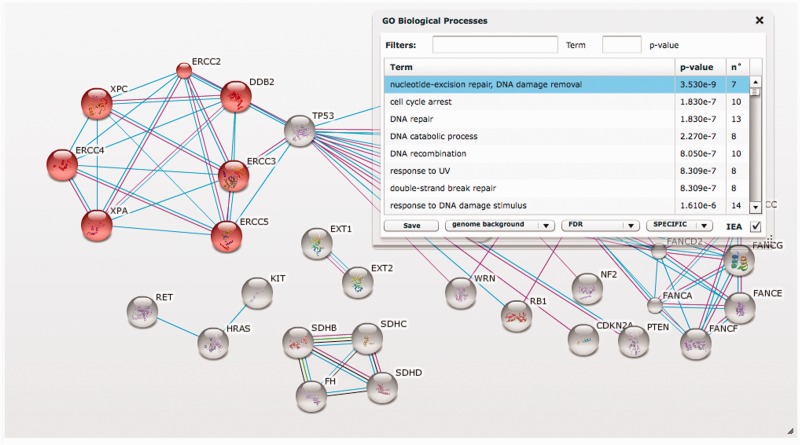
“The STRING screenshot shows a user-supplied set of genes, here a selection of cancer genes as annotated at the COSMIC database (52).”
Cited by
Items 601–700 of 1,021
Paulo, J. A., O’Connell, J. D., Gaun, A., & Gygi, S. P. (2015) · Molecular Biology of the Cell · doi:10.1091/mbc.e15-07-0499 · Cited by 60
“cerevisiae | 4065 Subsequently, we classified these clusters of proteins using Kyoto Encyclopedia of Genes and Genomes (KEGG) pathways analysis (Wixon and Kell, 2000) through the STRING interface (Franceschini et al., 2013) and tallied the number of significantly altered proteins in given categories.”
MethodSzlachcic, W. J., Switonski, P. M., Krzyżosiak, W. J., Figlerowicz, M., & Figiel, M. (2015) · Disease Models & Mechanisms · doi:10.1242/dmm.019406 · Cited by 62
Loke, M. F., Ng, C. G., Vilashni, Y., Lim, J. W. E., & Ho, B. (2016) · Scientific Reports · doi:10.1038/srep26784 · Cited by 61
Breast cancer cell adhesome and degradome interact to drive metastasis
Rizwan, A., Cheng, M., Bhujwalla, Z. M., Krishnamachary, B., Jiang, L., & Glunde, K. (2015) · npj Breast Cancer · doi:10.1038/npjbcancer.2015.17 · Cited by 61
Verma, S. K., Panda, P. K., Kumari, P., Patel, P., Arunima, A., Jha, E., Husain, S., Prakash, R., Hergenröder, R., Mishra, Y. K., et al. (2021) · Green Chemistry · doi:10.1039/d1gc00571e · Cited by 61
Singh, P., & Mukhopadhyay, K. (2021) · Scientific Reports · doi:10.1038/s41598-021-87722-w · Cited by 61
Sinha, S., Eisenhaber, B., Jensen, L. J., Kalbuaji, B., & Eisenhaber, F. (2018) · PROTEOMICS · doi:10.1002/pmic.201800093 · Cited by 60
Self-citationRAID: a comprehensive resource for human RNA-associated (RNA–RNA/RNA–protein) interaction
Zhang, X., Wu, D., Chen, L., Li, X., Yang, J., Fan, D., Dong, T., Liu, M., Tan, P., Xu, J., et al. (2014) · RNA · doi:10.1261/rna.044776.114 · Cited by 60
“Consequently, text mining-based annotations of this huge number of protein–protein interactions (PPIs) have been established and lead to a more comprehensive understanding of protein function and cellular processes (STRING) (Franceschini et al. 2013), eggnog (Powell et al.”
BackgroundWang, H., Hu, L., Li, H., Lai, Y., Wei, X., Xu, X., Cao, Z., Cao, H., Wan, Q., Chang, Y., et al. (2023) · Nature Communications · doi:10.1038/s41467-023-37351-w · Cited by 60
GSAASeqSP: A Toolset for Gene Set Association Analysis of RNA-Seq Data
Xiong, Q., Mukherjee, S., & Furey, T. S. (2014) · Scientific Reports · doi:10.1038/srep06347 · Cited by 60
High-Throughput Quantitative Proteomic Analysis of Dengue Virus Type 2 Infected A549 Cells
Chiu, H.-C., Hannemann, H., Heesom, K. J., Matthews, D. A., & Davidson, A. D. (2014) · PLoS ONE · doi:10.1371/journal.pone.0093305 · Cited by 62
Munhoz, C. D. F., dos Santos, A. A., Arenhart, R. A., Santini, L., Monteiro-Vitorello, C. B., & Vieira, M. L. C. (2015) · Annals of Applied Biology · doi:10.1111/aab.12215 · Cited by 60
“1) (Franceschini et al., 2013), using Markov Clustering (MCL) algorithms (Brohée & van Helden, 2006) in order to identify possible clusters of protein–protein interactions.”
MethodMicroRNAs of the RPE are essential for RPE differentiation and photoreceptor maturation
Ohana, R., Weiman-Kelman, B., Raviv, S., Tamm, E., Pasmanik-Chor, M., Rinon, A., Netanely, D., Shamir, R., Salomon, A. S., & Ashery-Padan, R. (2015) · Development · doi:10.1242/dev.121533 · Cited by 57
Evolutionary and Functional Features of Copy Number Variation in the Cattle Genome1
Keel, B. N., Lindholm‐Perry, A. K., & Snelling, W. M. (2016) · Frontiers in Genetics · doi:10.3389/fgene.2016.00207 · Cited by 61
“Analysis of Network Centrality Centrality of CNV overlapped genes in protein-protein interaction (PPI) networks was assessed using the Bos taurus interaction dataset from the STRING database (Franceschini et al., 2013).”
MethodZhang, X., Liu, X., Liang, Y., Guo, X. Y., Xiao, Y., Ma, L., Miao, B., Liu, H., Peng, D., Huang, W., et al. (2017) · Applied and Environmental Microbiology · doi:10.1128/aem.03098-16 · Cited by 60
“Further analysis based on COG classification showed that the four most abundant genes shared by S. thermosulfidooxidans strains and Sulfobacillus sp. CBAR-13 were assigned to COG categories E, C, G (carbohydrate transport and metabolism), and J (Fig.”
MethodInfluentialZeng, L., Wang, D., Hu, N., Zhu, Q., Chen, K., Dong, K., Zhang, Y., Yao, Y., Guo, X., Chang, Y., et al. (2017) · Frontiers in Microbiology · doi:10.3389/fmicb.2017.00396 · Cited by 60
“String database was used for analyzing protein–protein interactions (PPI) of L. interrogans PSEs (Franceschini et al., 2013).”
MethodTarget deconvolution of bioactive small molecules: the heart of chemical biology and drug discovery
Jung, H. J., & Kwon, H. J. (2015) · Archives of Pharmacal Research · doi:10.1007/s12272-015-0618-3 · Cited by 60
“A widely used database of known and predicted protein interactions is the Search Tool for the Retrieval of Interacting Genes/Proteins (STRING) (Franceschini et al. 2013).”
MethodSánchez, F. A. P., Sifuentes‐Rincón, A. M., Segura‐Cabrera, A., Pérez, C. A. G., Parra‐Bracamonte, G. M., & Morales, P. A. (2015) · BMC Genetics · doi:10.1186/s12863-015-0247-3 · Cited by 59
“These results were expected because the interactions in STRING were generated using an integrative method that is conceptually similar to the methodology applied in the present study [12].”
MethodVatansever, R., Özyiğit, İ. İ., Filiz, E., & Gozukara, N. (2017) · BioMetals · doi:10.1007/s10534-017-9992-2 · Cited by 59
“Interactome map was constructed by Cytoscape (downloadable from cytoscape.org/; Smoot et al. 2011) using STRING data (string-db.org/; Franceschini et al. 2013).”
Organ-specific adaptive signaling pathway activation in metastatic breast cancer cells
Burnett, R. M., Craven, K. E., Krishnamurthy, P., Goswami, C. P., Badve, S., Crooks, P. A., Mathews, W. P., Bhat‐Nakshatri, P., & Nakshatri, H. (2015) · Oncotarget · doi:10.18632/oncotarget.3707 · Cited by 59
“To gain insight into their function, we analyzed the STRING database to identify potential interacting partners [31].”
BackgroundA directed-overflow and damage-control N-glycosidase in riboflavin biosynthesis
Frelin, O., Huang, L., Hasnain, G., Jeffryes, J. G., Ziemak, M. J., Rocca, J. R., Wang, B., Rice, J. T., Roje, S., Yurgel, S. N., et al. (2014) · Biochemical Journal · doi:10.1042/bj20141237 · Cited by 59
Dong, X., Hao, Y., Wang, X., & Tian, W. (2016) · Scientific Reports · doi:10.1038/srep18871 · Cited by 61
He, W., Kuang, Y.-Q., Xing, X., Simpson, R. J., Huang, H., Yang, T., Chen, J., Yang, L., Liu, E., He, W., et al. (2014) · Journal of Proteome Research · doi:10.1021/pr500064m · Cited by 59
Explaining the disease phenotype of intergenic SNP through predicted long range regulation
Chen, J., & Tian, W. (2016) · Nucleic Acids Research · doi:10.1093/nar/gkw519 · Cited by 59
“The relevance analysis was based on a functional association network––the STRING network (34).”
MethodBreen, M. S., White, C., Shekhtman, T., Lin, K., Looney, D. J., Woelk, C. H., & Kelsoe, J. R. (2016) · The Pharmacogenomics Journal · doi:10.1038/tpj.2016.50 · Cited by 59
A Systems Approach to Refine Disease Taxonomy by Integrating Phenotypic and Molecular Networks
Zhou, X., Lei, L., Liu, J. H., Halu, A., Zhang, Y., Li, B., Guo, Z., Liu, G., Sun, C., Loscalzo, J., et al. (2018) · EBioMedicine · doi:10.1016/j.ebiom.2018.04.002 · Cited by 60
“Results Category similarity of ICD taxonomy We curated 1,883 distinct ICD disease codes (Table S1) from the 5-level tree structure of 14,292 ICD-9-CM codes, as well as high confidence protein-protein interactions consisting of 15,551 nodes and 218,409 edges (Franceschini et al. 2013).”
MethodInfluentialEngholm-Keller, K., Waardenberg, A. J., Müller, J. A., Wark, J. R., Fernando, R. N., Arthur, J. W., Robinson, P. J., Dietrich, D., Schoch, S., & Graham, M. E. (2019) · PLOS Biology · doi:10.1371/journal.pbio.3000170 · Cited by 52
Assessment of community efforts to advance network-based prediction of protein–protein interactions
Wang, X., Madeddu, L., Spirohn, K., Martini, L., Fazzone, A., Becchetti, L., Wytock, T. P., Kovács, I. A., Balogh, O. M., Benczik, B., et al. (2023) · Nature Communications · doi:10.1038/s41467-023-37079-7 · Cited by 58
Social disadvantage accelerates aging
Kivimäki, M., Pentti, J., Frank, P., Liu, F., Blake, A., Nyberg, S. T., Vahtera, J., Singh‐Manoux, A., Wyss‐Coray, T., Walker, K. A., et al. (2025) · Nature Medicine · doi:10.1038/s41591-025-03563-4 · Cited by 59
Huo, T., Liu, W., Guo, Y., Yang, C., Lin, J., & Rao, Z. (2015) · BMC Bioinformatics · doi:10.1186/s12859-015-0535-y · Cited by 58
“We also attempted to use more databases such as virusmint [52], virhostnet [53], and STRING [54], while the number of PPIs would not be increased due to the overlaps and redundancy among the databases.”
MethodSelf-citationTranscriptional atlas of cardiogenesis maps congenital heart disease interactome
Li, X., Martinez‐Fernandez, A., Hartjes, K. A., Kocher, J., Olson, T. M., Terzic, A., & Nelson, T. J. (2014) · Physiological Genomics · doi:10.1152/physiolgenomics.00015.2014 · Cited by 58
Teng, Y., Wang, Y. Z., Zhang, X., Liu, W., Fan, H., Yao, H., Lin, B., Zhu, P., Yuan, W.-J., Tong, Y., et al. (2015) · Scientific Reports · doi:10.1038/srep09912 · Cited by 58
Structure of the EndoMS-DNA Complex as Mismatch Restriction Endonuclease
Nakae, S., Hijikata, A., Tsuji, T., Yonezawa, K., Kouyama, K., Mayanagi, K., Ishino, S., Ishino, Y., & Shirai, T. (2016) · Structure · doi:10.1016/j.str.2016.09.005 · Cited by 58
“STRING and IntAct databases were referenced for the experimentally detected protein-protein interactions and used to Structure 24, 1–12, November 1, 2016 9 predict the functional relationships of EndoMS (Figure 5B) (Franceschini et al., 2012; Orchard et al., 2013).”
BackgroundMethodZhu, H. L., Xia, W., Mo, X., Lin, X., Qiu, Y., Yi, N., Zhang, Y.-H., Deng, F., & Lei, S. (2016) · PLoS ONE · doi:10.1371/journal.pone.0167212 · Cited by 59
Li, J., Huang, Y., Zhao, S., Guo, Q., Zhou, J., Han, W., & Xu, Y. (2019) · Annals of Translational Medicine · doi:10.21037/atm.2019.10.118 · Cited by 58
Predicting Future Scientific Discoveries Based on a Networked Analysis of the Past Literature
Nagarajan, M., Wilkins, A. D., Bachman, B. J., Novikov, I. B., Bao, S., Haas, P. J., Terrón-Díaz, M. E., Bhatia, S., Adikesavan, A. K., Labrie, J. J., et al. (2015) · ACM SIGKDD Conference on Knowledge Discovery and Data Mining (KDD) · doi:10.1145/2783258.2788609 · Cited by 57
“This type of information is often represented as a multimodal graph of relationships between proteins[21], for example StringDB[13].”
BackgroundMethodResultInfluentialInitiation of the flexirubin biosynthesis in C hitinophaga pinensis
Schöner, T. A., Fuchs, S. W., Schönau, C., & Bode, H. B. (2014) · Microbial Biotechnology · doi:10.1111/1751-7915.12110 · Cited by 57
Ensemble learning prediction of protein–protein interactions using proteins functional annotations
Saha, I., Zubek, J., Klingström, T., Forsberg, S. K. G., Wikander, J., Kierczak, M., Maulik, U., & Plewczyński, D. (2014) · Molecular BioSystems · doi:10.1039/c3mb70486f · Cited by 59
Molecular mechanism underlying the impact of vitamin D on disease activity of MS
Munger, K. L., Köchert, K., Simon, K. C., Kappos, L., Polman, C. H., Freedman, M. S., Hartung, H. P., Miller, D. H., Montalbán, X., Edan, G., et al. (2014) · Annals of Clinical and Translational Neurology · doi:10.1002/acn3.91 · Cited by 57
“In order to gain deeper insight into regulatory interactions and associations between the genes found to be associated with GELs and/or 25(OH)D, these two gene sets were analyzed using the Search Tool for the Retrieval of Interacting Genes/Proteins (STRING).(37) In case of the 25(OH)D-associated genes (Fig.”
BioGRID: A Resource for Studying Biological Interactions in Yeast
Oughtred, R., Chatr‐aryamontri, A., Breitkreutz, B., Chang, C., Rust, J., Theesfeld, C. L., Heinicke, S., Breitkreutz, A., Chen, D., Hirschman, J., et al. (2016) · Cold Spring Harbor Protocols · doi:10.1101/pdb.top080754 · Cited by 57
“…2012; Wood et al. 2012; Yook et al. 2012; Marygold et al. 2013), with other interaction databases (Luc and Tempst 2004; Razick et al. 2008; Chautard et al. 2009; Matthews et al. 2009; Cerami et al. 2011; Franceschini et al. 2013), and with metadatabases (Benson et al. 2004; Matthews et al. 2009).”
BackgroundUnderstanding cancer complexome using networks, spectral graph theory and multilayer framework
Rai, A., Pradhan, P., Nagraj, J., Lohitesh, K., Chowdhury, R., & Jalan, S. (2017) · Scientific Reports · doi:10.1038/srep41676 · Cited by 57
“5) indicates participation of these proteins in many pathways in the network as well as their significant role in causing cancer which we discuss in the following section.”
Computational modeling of protein assemblies
Soni, N., & Madhusudhan, M. S. (2017) · Current Opinion in Structural Biology · doi:10.1016/j.sbi.2017.04.006 · Cited by 52
Deng, G., Yang, Q., He, W., Li, C., Yang, J., Zuo, C.-W., Gao, J., Sheng, O., Lu, S., Zhang, S., et al. (2015) · Applied Microbiology and Biotechnology · doi:10.1007/s00253-015-6768-x · Cited by 57
“…initially conducted for blast searching against existing databases in the STRING software, followed by STRING analysis for those blast-matched sequence entries to detect potential interactors based on existing database, highthroughput experimental data, and text mining (Franceschini et al. 2013).”
MethodFu, D., Zhang, B., Yang, L., Huang, S., & Wang, X. (2020) · Frontiers in Genetics · doi:10.3389/fgene.2020.00978 · Cited by 56
“To explore the interplay between these OS-related IRGs, the protein-protein interaction (PPI) network was assessed from the STRING database (Franceschini et al., 2013).”
MethodFetal microglial phenotype in vitro carries memory of prior in vivo exposure to inflammation
Cao, M., Cortes, M., Moore, C. S., Leong, S. Y., Durosier, L. D., Burns, P., Fecteau, G., Desrochers, A., Auer, R. N., Barreiro, L. B., et al. (2015) · Frontiers in Cellular Neuroscience · doi:10.3389/fncel.2015.00294 · Cited by 52
Hare, N. J., Chan, B., Chan, E. D., Alexander, K. L., Britton, W. J., & Saunders, B. M. (2015) · PROTEOMICS · doi:10.1002/pmic.201400610 · Cited by 56
Whole Genome Sequencing Reveals a De Novo SHANK3 Mutation in Familial Autism Spectrum Disorder
Nemirovsky, S. I., Córdoba, M., Zaiat, J., Completa, S. P., Vega, P., González‐Morón, D., Medina, N., Fabbro, M., Romero, S., Brun, B., et al. (2015) · PLoS ONE · doi:10.1371/journal.pone.0116358 · Cited by 57
Song, L., Yao, J., He, Z., & Xu, B. (2015) · BMC Oral Health · doi:10.1186/s12903-015-0086-7 · Cited by 58
“The STRING (Search Tool for the Retrieval of Interacting Genes/Proteins) database, which is a database of known and predicted protein interactions [20], was used to select the interactions among the selected DEGs in this study, which were not used in the study of Kebschull et al.”
MethodUnraveling the mechanisms of extreme radioresistance in prokaryotes: Lessons from nature
Pavlopoulou, A., Savva, G. D., Louka, M. A., Bagos, P. G., Vorgias, C. E., Michalopoulos, I., & Georgakilas, A. G. (2015) · Mutation Research/Reviews in Mutation Research · doi:10.1016/j.mrrev.2015.10.001 · Cited by 57
“[54] A. Franceschini, et al., STRING v9.”
BackgroundMethodInfluentialJin, R., Shen, J., Zhang, T., Liu, Q., Liao, C., Ma, H., Li, S., & Yu, Z. (2017) · Oncotarget · doi:10.18632/oncotarget.17345 · Cited by 56
“STRING extracted 562 pairs of PPI which were containing 41 DEGs.”
BackgroundInfluentialKaranja, B., Fan, L., Xu, L., Wang, Y., Zhu, X., Tang, M., Wang, R., Zhang, F., Muleke, E. M., & Liu, L. (2017) · Plant Cell Reports · doi:10.1007/s00299-017-2190-4 · Cited by 56
“Physical interactions were constructed using Arabidopsis association model in the STRING Protein– Protein Interaction Networks software (Franceschini et al. 2013).”
MethodPuccetti, A., Fiore, P. F., Pelosi, A., Tinazzi, E., Patuzzo, G., Argentino, G., Moretta, F., Lunardi, C., & Dolcino, M. (2018) · Journal of Immunology Research · doi:10.1155/2018/4246965 · Cited by 56
“org/) is an online database which includes experimental as well as predicted interaction information and comprises >1100 completely sequenced organisms [20].”
BackgroundKämmer, P., McNamara, S., Wolf, T., Conrad, T., Allert, S., Gerwien, F., Hünniger, K., Kurzai, O., Guthke, R., Hube, B., et al. (2020) · mBio · doi:10.1128/mbio.02435-20 · Cited by 47
Guitton, B., Kelner, J., Celton, J., Sabau, X., Renou, J., Chagné, D., & Costes, E. (2016) · BMC Plant Biology · doi:10.1186/s12870-016-0739-y · Cited by 56
Proteome analysis of the HIV-1 Gag interactome
Engeland, C. E., Brown, N. P., Börner, K., Schümann, M., Krause, E., Kaderali, L., Müller, G. A., & Kräusslich, H.-G. (2014) · Virology · doi:10.1016/j.virol.2014.04.038 · Cited by 55
Zheng, L., Wu, W., Chen, Q., Zhang, G., Gao, F., & Zhou, Y. (2022) · Industrial Crops and Products · doi:10.1016/j.indcrop.2022.114946 · Cited by 55
Spatial transcriptomics using multiplexed deterministic barcoding in tissue
Wirth, J., Huber, N., Yin, K., Brood, S., Chang, S., Martinez‐Jimenez, C. P., & Meier, M. (2023) · Nature Communications · doi:10.1038/s41467-023-37111-w · Cited by 55
Wimalagunasekara, S. S., Weeraman, J., Tirimanne, S., & Fernando, P. C. (2023) · Journal of Genetic Engineering and Biotechnology · doi:10.1186/s43141-023-00515-8 · Cited by 55
Kahle, M., Schäfer, A., Seelig, A., Schultheiß, J., Wu, M., Aichler, M., Leonhardt, J., Rathkolb, B., Rozman, J., Sarioglu, H., et al. (2014) · Molecular Metabolism · doi:10.1016/j.molmet.2014.11.004 · Cited by 56
“STRING v9.”
MethodDrosophila miR-9a Targets the ECM Receptor Dystroglycan to Canalize Myotendinous Junction Formation
Yatsenko, A. S., & Shcherbata, H. R. (2014) · Developmental Cell · doi:10.1016/j.devcel.2014.01.004 · Cited by 55
Novel skin phenotypes revealed by a genome-wide mouse reverse genetic screen
Liakath‐Ali, K., Vancollie, V. E., Heath, E., Smedley, D. P., Estabel, J., Sunter, D. C., DiTommaso, T., White, J. K., Ramírez‐Solis, R., Smyth, I., et al. (2014) · Nature Communications · doi:10.1038/ncomms4540 · Cited by 55
atBRX1-1 and atBRX1-2 are involved in an alternative rRNA processing pathway in Arabidopsis thaliana
Weis, B. L., Palm, D., Missbach, S., Bohnsack, M. T., & Schleiff, E. (2015) · RNA · doi:10.1261/rna.047563.114 · Cited by 55
A method for predicting protein complex in dynamic PPI networks
Zhang, Y., Lin, H., Yang, Z., Wang, J., Liu, Y., & Sang, S. (2016) · BMC Bioinformatics · doi:10.1186/s12859-016-1101-y · Cited by 55
“In our experiments, we choose four high-throughput yeast PPI datasets including Gavin dataset [23], Krogan dataset [24], MIPS dataset [25] and STRING dataset [26], respectively.”
An interactomics overview of the human and bovine milk proteome over lactation
Zhang, L., van Dijk, A. D. J., & Hettinga, K. A. (2016) · Proteome Science · doi:10.1186/s12953-016-0110-0 · Cited by 55
“For co-expression network analysis, a cutoff of 0.3 on the absolute value of the Pearson correlation was applied, in order to get a number of interactions in the coexpression networks that would be comparable to that in the STRING interaction networks.”
MethodInfluentialIdentification of prognostic genes in the acute myeloid leukemia microenvironment
Huang, S., Zhang, B., Fan, W., Zhao, Q., Yang, L., Xin, W., & Fu, D. (2019) · Aging · doi:10.18632/aging.102477 · Cited by 55
“To explore potential relationships among DEGs, a protein-protein interaction (PPI) network was retrieved from the STRING database [82] and reconstructed using Cytoscape software [83].”
MethodBovine sperm plasma membrane proteomics through biotinylation and subcellular enrichment
Kasvandik, S., Sillaste, G., Velthut‐Meikas, A., Mikelsaar, A., Hallap, T., Padrik, P., Tenson, T., Jaakma, Ü., Kõks, S., & Salumets, A. (2015) · PROTEOMICS · doi:10.1002/pmic.201400297 · Cited by 55
“1 [32, 33] with human background information.”
Protein interaction networks as starting points to identify novel antimicrobial drug targets
Zoraghi, R., & Reiner, N. E. (2013) · Current Opinion in Microbiology · doi:10.1016/j.mib.2013.07.010 · Cited by 55
Viewing the proteome: How to visualize proteomics data?
Oveland, E., Muth, T., Rapp, E., Martens, L., Berven, F. S., & Barsnes, H. (2015) · PROTEOMICS · doi:10.1002/pmic.201400412 · Cited by 55
“(C ) STRING protein–protein interaction display (with known and predicted functional partners), showing the WNT7a signaling protein with interaction partners (STRING [60]).”
BackgroundInfluentialNetwork‐based proteomic analysis for postmenopausal osteoporosis in Caucasian females
Zhang, L., Liu, Y., Zeng, Y., Zhu, W., Zhao, Y., Zhang, J., Zhu, J., He, H., Shen, H., Tian, Q., et al. (2015) · PROTEOMICS · doi:10.1002/pmic.201500005 · Cited by 54
“1 (a search tool for the retrieval of interacting genes/proteins) [37], a comprehensive database designed to collect and evaluate protein–protein association information.”
BackgroundMaier, V., Feeney, C. M., Taylor, J. E., Creech, A. L., Qiao, J., Szántó, A., Das, P. P., Chevrier, N., Cifuentes‐Rojas, C., Orkin, S. H., et al. (2015) · Molecular & Cellular Proteomics · doi:10.1074/mcp.m114.044586 · Cited by 54
“protein interaction data deposited in the STRING database (72) and visualized them using Cytoscape (73).”
MethodZheng, P., Xiong, Q., Wu, Y., Chen, Y., Chen, Z., Fleming, J., Gao, D., Bi, L., & Ge, F. (2015) · Molecular & Cellular Proteomics · doi:10.1074/mcp.m114.043984 · Cited by 55
“The protein–protein interaction (PPI) network of HOTAIR-regulated proteins was built by searching against the STRING (Search Tool for the Retrieval of Interacting Genes/Proteins) database version 9.1(30) with default settings except that organism was set to “human.””
BackgroundMethodInfluentialRoyaert, S., Jansen, J., da Silva, D. V., Branco, S. M. D. J., Livingstone, D. S., Mustiga, G. M., Marelli, J., Araújo, I. S., Corrêa, R. X., & Motamayor, J. C. (2016) · BMC Genomics · doi:10.1186/s12864-016-2415-x · Cited by 54
“1 [72], this protein in A.”
Hossein‐Nezhad, A., Fatemi, R. P., Ahmad, R., Peskind, E. R., Zabetian, C. P., Hu, S., Shi, M. Y., Wahlestedt, C., Zhang, J., & Faghihi, M. A. (2016) · Journal of Parkinson s Disease · doi:10.3233/jpd-150737 · Cited by 54
“Protein-protein interaction networks of DETs were constructed via the search tool for the retrieval of interacting genes/proteins (STRING; http://www.stringdb.org/) and the similarity between the PPI networks and the KEGG pathways were calculated via EnrichNet [18, 19].”
MethodMurphy, S., Dowling, P., Zweyer, M., Mundegar, R. R., Henry, M. A., Meleady, P., Swandulla, D., & Ohlendieck, K. (2016) · Journal of Proteomics · doi:10.1016/j.jprot.2016.03.011 · Cited by 54
“direct physical and indirect functional protein linkages, the bioinformatics STRING database [40] was used to analyse mass spectrometrically identified proteins with an increased”
BackgroundMethodGold nanorods inhibit respiratory syncytial virus by stimulating the innate immune response
Bawage, S. S., Tiwari, P. M., Singh, A., Dixit, S., Pillai, S., Dennis, V. A., & Singh, S. R. (2016) · Nanomedicine Nanotechnology Biology and Medicine · doi:10.1016/j.nano.2016.06.006 · Cited by 54
“The gene network displays were generated using gene regulation data to predict the functional protein associations for in vitro and in vivo experiments with the help of STRING version 10.(36)”
Zhang, X., Maity, T. K., Kashyap, M. K., Bansal, M., Venugopalan, A. K., Singh, S., Awasthi, S., Marimuthu, A., Jacob, H. K. C., Belkina, N., et al. (2017) · Molecular & Cellular Proteomics · doi:10.1074/mcp.m117.067439 · Cited by 54
“We used experimentally validated phosphatase-substrate and EGFR-substrate databases from STRING and DEPOD to infer potentially upstream phosphatases of this group of identified phosphosites which are also EGFR substrates.”
MethodInfluentialThe Atypical Kinase RIOK1 Promotes Tumor Growth and Invasive Behavior
Weinberg, F., Reischmann, N., Fauth, L., Taromi, S., Mastroianni, J., Köhler, M., Halbach, S., Becker, A. C., Deng, N., Schmitz, T., et al. (2017) · EBioMedicine · doi:10.1016/j.ebiom.2017.04.015 · Cited by 54
“5c) (Franceschini et al., 2013).”
MethodInfluentialSollero, B. P., Junqueira, V. S., Gomes, C. C. G., Caetano, A. R., & Cardoso, F. F. (2017) · Genetics Selection Evolution · doi:10.1186/s12711-017-0325-2 · Cited by 46
“1 [45] was used to identify potential protein–protein interactions related to the identified genes.”
MethodMolecular mechanisms of breast cancer metastasis by gene expression profile analysis
Zheng, T., Wang, A., Hu, D., & Wang, Y. (2017) · Molecular Medicine Reports · doi:10.3892/mmr.2017.7157 · Cited by 54
Liu, Z., Meng, J., Li, X., Zhu, F., Liu, T., Wu, G., & Zhang, L. (2018) · BioMed Research International · doi:10.1155/2018/3574534 · Cited by 54
da Costa, W. L. O., Araújo, C. L., Dias, L. M., Pereira, L. C. D. S., Alves, J. T. C., Araújo, F. A., Folador, E. L., Henriques, I. S., Silva, A., & Carneiro, A. R. (2018) · PLoS ONE · doi:10.1371/journal.pone.0198965 · Cited by 54
Lun, X., Szklarczyk, D., Gábor, A., Dobberstein, N., Zanotelli, V. R., Sáez-Rodríguez, J., von Mering, C., & Bodenmiller, B. (2018) · Molecular Cell · doi:10.1016/j.molcel.2019.04.021 · Cited by 54
Self-citationKaspric, N., Picard, B. B., Reichstadt, M., Tournayre, J., & Bonnet, M. (2015) · PLoS ONE · doi:10.1371/journal.pone.0128086 · Cited by 56
“Settings used for custom analyses were: Gene Ontology with IEA, prediction of secreted proteins with default settings, and PPi research on 9 widely used databases (BioGrid, IntAct, MINT, MatrixDB, STRING, Reactome, InnateDB-IMEx, UniProt, and I2D-IMEx).”
MethodInfluentialThe Architecture of the Human RNA-Binding Protein Regulatory Network
Quattrone, A., & Dassi, E. (2019) · iScience · doi:10.1016/j.isci.2019.10.058 · Cited by 53
Macrophage Mitochondrial and Stress Response to Ingestion of Cryptococcus neoformans
Coelho, C., Souza, A. C. O., Derengowski, L. D. S., de Leon-Rodriguez, C., Wang, B., Leon-Rivera, R., Bocca, A. L., Gonçalves, T., & Casadevall, A. (2015) · The Journal of Immunology · doi:10.4049/jimmunol.1402350 · Cited by 48
“4 was generated using String database (29).”
Systems Medicine: from molecular features and models to the clinic in COPD
Gómez-Cabrero, D., Menche, J., Cano, I., Abugessaisa, I., Huertas-Migueláñez, M., Tényi, Á., de Mas, I. M., Kiani, N. A., Marabita, F., Falciani, F., et al. (2014) · Journal of Translational Medicine · doi:10.1186/1479-5876-12-s2-s4 · Cited by 55
“Databases integrating several sources IntAct [59], MINT [60], BioGRID [61], HPRD [62], MIPS [63], STRING [64]”
BackgroundNamkoong, S., Lee, K. I., Lee, J. I., Park, R., Lee, E.-J., Jang, I.-S., & Park, J. (2015) · Autophagy · doi:10.1080/15548627.2015.1034412 · Cited by 50
“1 protein-protein interaction network, and found that ATP6V0A4/v-ATPase a4 was a potential binding partner.(24) To examine the interaction between ITM2A and ATP6V0A4, we performed a coimmunoprecipitation assay with endogenous ITM2A and endogenous ATP6V0A4.”
MethodChernobrovkin, A. L., Marín‐Vicente, C., Visa, N., & Zubarev, R. A. (2015) · Scientific Reports · doi:10.1038/srep11176 · Cited by 54
Protein-protein interaction network analysis of cirrhosis liver disease.
Safaei, A., Rezaei–Tavirani, M., Oskouie, A. A., Azodi, M. Z., Mohebbi, S. R., & Nikzamir, A. R. (2016) · Gastroenterology and hepatology from bed to bench. · Cited by 53
Eising, E., Shyti, R., Hoen, P. A. C. ’., Vijfhuizen, L. S., Huisman, S. M. H., Broos, L. A. M., Mahfouz, A. E., Reinders, M. J. T., Ferrari, M. D., Tolner, E. A., et al. (2016) · Molecular Neurobiology · doi:10.1007/s12035-015-9681-5 · Cited by 53
“org/) [21] was used to identify physical and functional associations between proteins within a gene list.”
MethodMicro RNA expression profiles in testicular biopsies of patients with impaired spermatogenesis
Noveski, P., Popovska-Jankovic, K., Sabit, K. K., Filipovski, V. A., Lazarevski, S., Plaseski, T., & Plaseska‐Karanfilska, D. (2016) · Andrology · doi:10.1111/andr.12246 · Cited by 53
“The protein–protein interaction network was constructed using STRING (Franceschini et al., 2013).”
MethodLi, H., Zhao, X., Wang, J., Zong, M., & Yang, H. (2016) · Gene · doi:10.1016/j.gene.2016.09.037 · Cited by 53
“…for the DEGs using the pheatmap package (Wang et al., 2014) in R. 2.4 Construction of PPI network STRING (version 9.1, http://www.string-db.org/) (Franceschini et al., 2013) is a web resource and biological database that includes comprehensively predicted and known interaction information.”
MethodInfluentialDeepCCI: End-to-end Deep Learning for Chemical-Chemical Interaction Prediction
Kwon, S., & Yoon, S. (2017) · ACM International Conference on Bioinformatics, Computational Biology, and Health Informatics (ACM-BCB) · doi:10.1145/3107411.3107451 · Cited by 53
“Various interactions exist, such as protein-protein [15, 24, 47], compoundprotein [58], miRNA-mRNA [33], and chemical-chemical interactions (CCI) [31].”
BackgroundOmics Technologies for Abiotic Stress Tolerance in Plants: Current Status and Prospects
Mehta, S., James, D., & Reddy, M. K. (2019) · Springer eBooks · doi:10.1007/978-3-030-21687-0_1 · Cited by 53
MacAlister, C. A., Ortiz‐Ramírez, C., Becker, J. D., Feijó, J. A., & Lippman, Z. B. (2015) · The Plant Journal · doi:10.1111/tpj.13079 · Cited by 53
CausalBench: A Large-scale Benchmark for Network Inference from Single-cell Perturbation DataPreprint
Chevalley, M., Roohani, Y., Mehrjou, A., Leskovec, J., & Schwab, P. (2022) · arXiv (Cornell University) · doi:10.48550/arxiv.2210.17283 · Cited by 53
“…network data from two widely used open biological databases: CORUM (Giurgiu et al., 2019) and STRING (Von Mering et al., 2005; Snel et al., 2000; Von Mering et al., 2007; Jensen et al., 2009; Mering et al., 2003; Szklar-czyk et al., 2010; 2015; 2016; 2019; 2021; Franceschini et al., 2012; 2016).”
MethodMicroRNA Expression Profiling in Behçet’s Disease
Puccetti, A., Pelosi, A., Fiore, P. F., Patuzzo, G., Lunardi, C., & Dolcino, M. (2018) · Journal of Immunology Research · doi:10.1155/2018/2405150 · Cited by 52
“org/) [27] to detect protein-protein interactions (PPI) pairs validated by experimental studies.”
MethodGlycation modulates glutamatergic signaling and exacerbates Parkinson’s disease-like phenotypes
Chegão, A., Guarda, M., Alexandre, B. M., Shvachiy, L., Temido‐Ferreira, M., Marques-Morgado, I., Gomes, B. F., Matthiesen, R., Lopes, L. V., Florindo, P. R., et al. (2022) · npj Parkinson's Disease · doi:10.1038/s41531-022-00314-x · Cited by 56
Hui, R. K.-H., & Leung, F. C.-C. (2015) · PLoS ONE · doi:10.1371/journal.pone.0111771 · Cited by 52
Ping, S., Ma, C., Liu, P., Yang, L., Yang, X., Wu, Q., Zhao, X., & Gong, B. (2015) · Archives of Gynecology and Obstetrics · doi:10.1007/s00404-015-3875-y · Cited by 52
Metadata
- Authors
- Franceschini, A., Szklarczyk, D., Frankild, S., Kuhn, M., Simonovic, M., Roth, A., Lin, J., Minguez, P., Bork, P., von Mering, C., & Jensen, L. J.
- Affiliations
- SIB Swiss Institute of Bioinformatics (CH)
- University of Copenhagen (DK)
- Venue
- Nucleic Acids Research
- Publisher
- Oxford University Press (OUP)
- Published
- 2012-11-29
- Volume
- 41
- Issue
- D1
- Pages
- D808-D815
- ISSN
- 0305-1048 (ISSN-L)
- 1362-4962
- PMC
- PMC3531103
- OpenAlex
- W2105924489
- Cited by
- 4,398
- References
- 61
- Citations by year
- 2026: 77 · 2025: 153 · 2024: 201 · 2023: 247 · 2022: 325 · 2021: 335 · 2020: 366 · 2019: 281 · 2018: 291 · 2017: 371 · 2016: 476 · 2015: 675 · 2014: 457 · 2013: 134 · 2012: 3
- FWCI
- 163.15
- Type
- journal article
- Language
- en
- Open access
- gold
- doi.org
- Licence
- Locations
- Nucleic Acids Research (publishedVersion, cc-by-nc)
- Europe PMC (PubMed Central) (publishedVersion, cc-by-nc)
- PubMed Central (publishedVersion, cc-by-nc)
- PubMed (publishedVersion)
- MDC Repository (Max-Delbrueck-Center for Molecular Medicine) (acceptedVersion)
- Zurich Open Repository and Archive (University of Zurich) (acceptedVersion, other-oa)
- reroDoc Digital Library (submittedVersion)
- Archivio Istituzionale della Ricerca (Universita Degli Studi Di Milano) (submittedVersion, cc-by-nc)
- Research at the University of Copenhagen (University of Copenhagen) (submittedVersion)
- Zurich Open Repository and Archive (University of Zurich) (submittedVersion, other-oa)
- Zurich Open Repository and Archive (University of Zurich)
- Funders
- European Molecular Biology Laboratory
- Novo Nordisk
- Universität Zürich
- Topics
- Life Sciences › Biochemistry, Genetics and Molecular Biology › Molecular Biology › Bioinformatics and Genomic Networks
- Health Sciences › Medicine › Health Informatics › Biomedical Text Mining and Ontologies
- Life Sciences › Biochemistry, Genetics and Molecular Biology › Molecular Biology › Genomics and Phylogenetic Studies
- Keywords
- STRING database, protein-protein interaction network, interaction prediction, literature mining, functional enrichment, biological pathway databases
- MeSH terms
- Algorithms, Data Interpretation, Statistical, User-Computer Interface, Systems Integration, Internet, Protein Interaction Mapping, Databases, Protein, Data Mining
About these checks
Registry, retraction, Cites and statistics results are computed, not judged, with one exception: a printed reference that no index lists is read once by a model before it counts as a citation error. Claims are extracted by a model and kept only when their quote appears verbatim in the text; each cited source is then checked, with a model’s help, for whether it says what the claim relies on. Those verdicts can be wrong — read the claim’s quote and the cited source before relying on one.
Statistics and arithmetic are recomputed, not judged.
Confidence bands are shown only for fields calibrated on our annotated test set. None is calibrated yet, so no band is shown.
What counts as a claim ›How we measure confidence ›How we check this ›
Are you an author, or do you see a problem with this page? Request a review
Data sources
Bibliographic data: Semantic Scholar, OpenAlex, Crossref.
Contains information from the Semantic Scholar Academic Graph Datasets, made available under the ODC Attribution License (ODC-BY 1.0).
Semantic Scholar’s data is described in: Kinney, R., et al. (2023). The Semantic Scholar Open Data Platform. arXiv:2301.10140.
