

A Critical Overview of Industrial Internet of Things Security and Privacy Issues Using a Layer-Based Hacking Scenario
Open accessThe DOI matches its Crossref record; 187 of the 187 references it cites were found in a registry or an index; 31 of the 79 sources its claims cite were checked for support.
Abstract
We have witnessed significant technological advancement over the past few years, including the Internet of Things (IoT). The IoT’s ability to connect consumer appliances to the internet has changed the way we live. As a result of the significant benefits that IoT has brought to household usage, it has become a topic of discussion for research departments, leading to its expansion into industrial sectors, commonly known as the Industrial Internet of Things (IIoT). IIoT enables automation and the use of intelligent machines to improve product manufacturing processes and enhance our lives as customers. However, as IIoT-enabling technology and applications continue to grow, security issues and privacy protection challenges become harder to manage, which frequently results in data breaches and sensitive information disclosures. This paper first explains what the reader needs to know about the IIoT system architecture in Industry 4.0 to make it easier for them to understand. Second, a hacking scenario is utilized as a methodology to conduct an in-depth analysis of various security issues, as well as their impacts and countermeasures, for each level of the IIoT architecture. Additionally, our hacking scenarios present a variety of targets from which malicious actors can launch their assaults. Third, we provide a thorough review of the various blockchain solutions currently being employed to protect IIoT systems. Finally, this paper draws to a close by outlining certain gaps and potential solutions that could be investigated in subsequent studies to strengthen security and enhance privacy for IIoT systems.
Overview
CoChat Summary
TL;DR
This paper is a review of Industrial Internet of Things (IIoT) security and privacy issues organized around a four-layer architecture and illustrated with layer-specific hacking scenarios for a hypothetical factory, Prime MotorX. It also surveys blockchain-based privacy approaches and proposes directions such as stronger public-key randomness, differential privacy optimization, AI-assisted defenses, and a unified IIoT security architecture.
Key findings
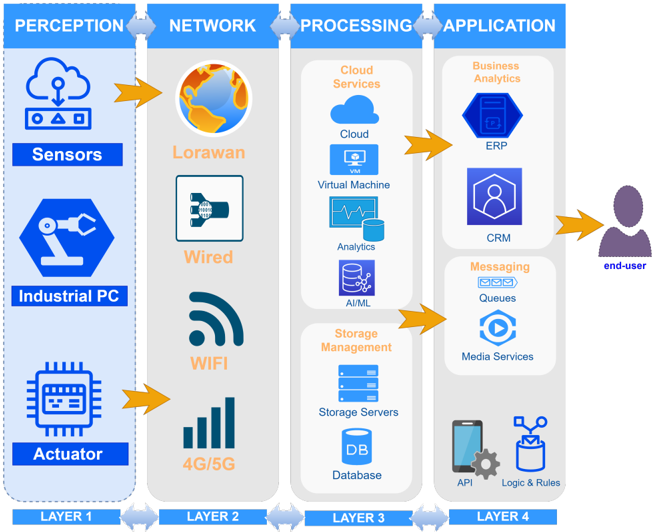
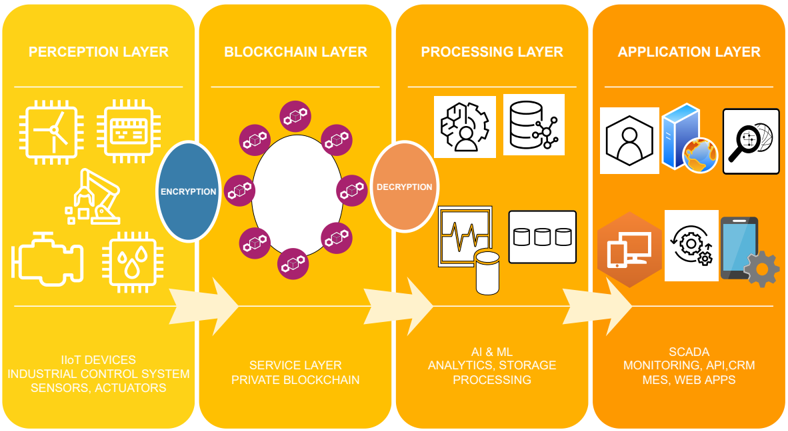
- The paper structures IIoT risks into four layers—perception, network, processing, and application—and summarizes attacks, vulnerabilities, effects, and countermeasures in Table II.
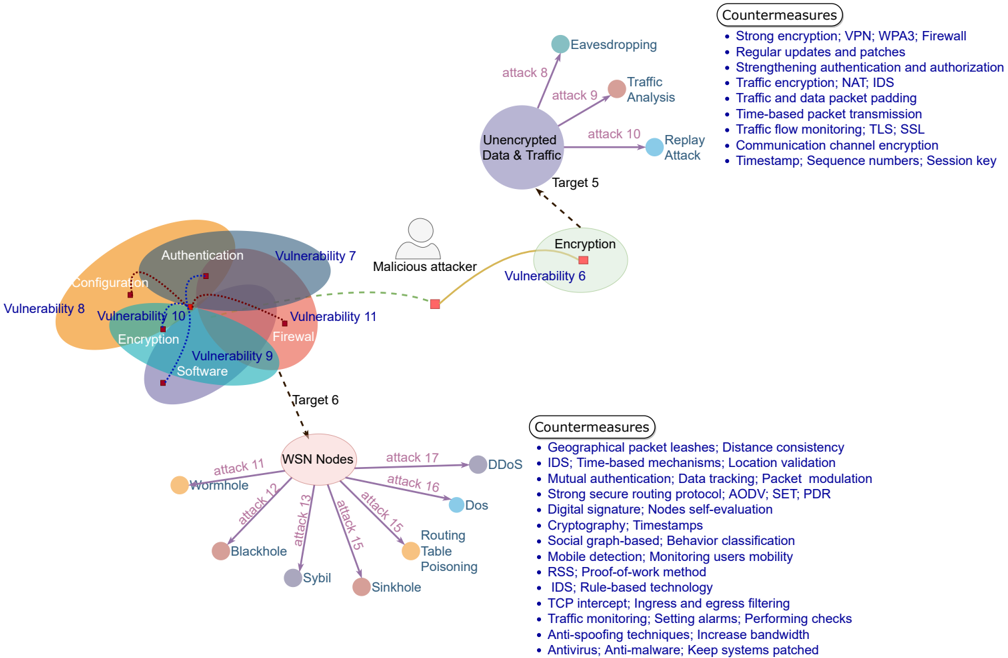
- In the network-layer scenario, unencrypted sensor data enables eavesdropping; after encryption, the attacker can still perform traffic analysis and replay attacks. The paper states that these are passive attacks except replay, which is active.
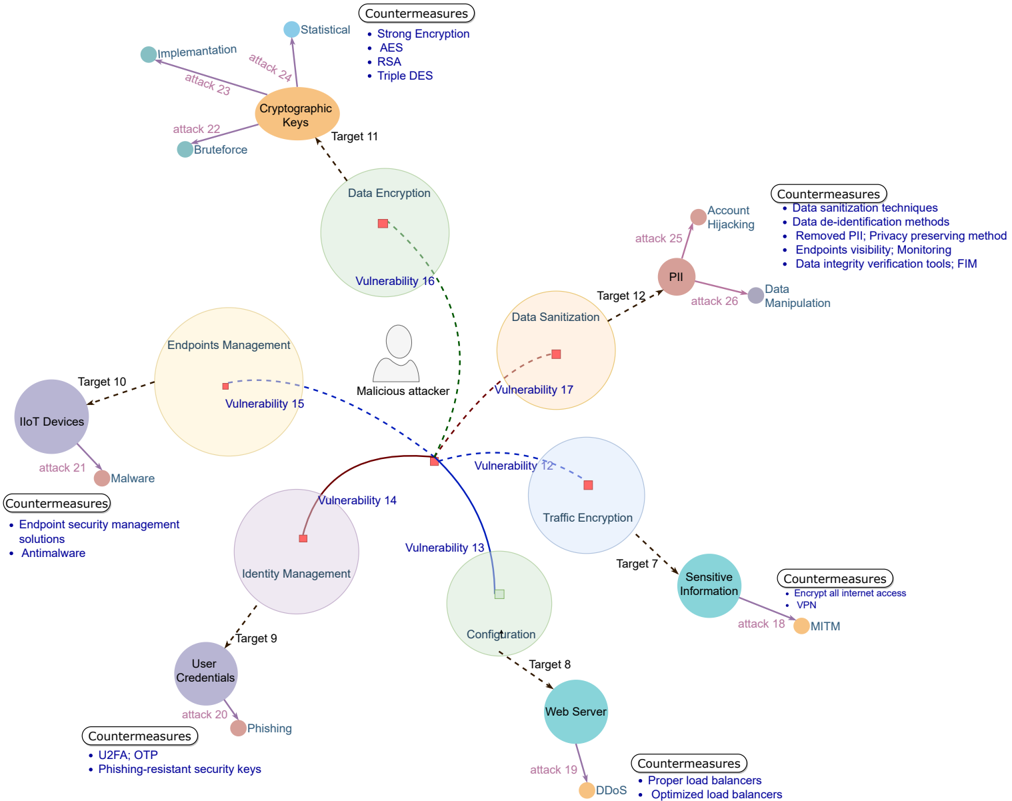
- In the processing-layer scenario, the paper describes MITM, DDoS, phishing, malware, brute force, implementation, statistical, account hijacking, and data manipulation attacks, with impacts including credential theft, production disruption, and financial losses.
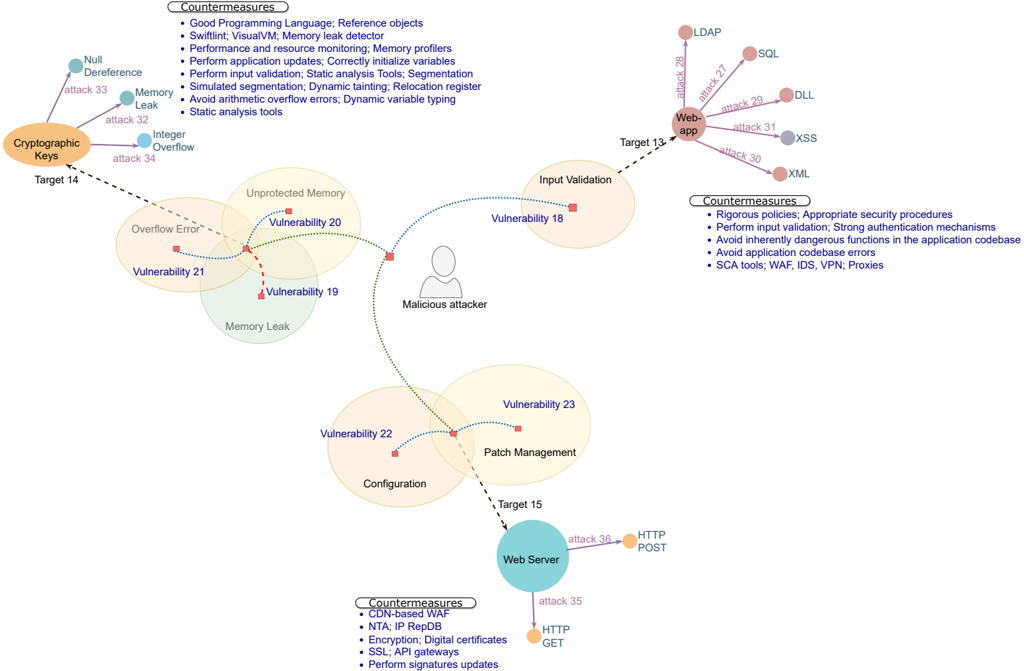
- In the application-layer scenario, the paper identifies code-injection and HTTP-flooding threats such as SQL injection, LDAP injection, DLL injection, XML injection, XSS, HTTP GET, and HTTP POST attacks, and links them to data breaches, malfunction, and reputational damage.
Methods
- Literature review / survey: the paper gives a “comprehensive overview” of IIoT security and privacy literature, with emphasis on blockchain-based privacy protection strategies.
- Layer-based analytic framework: it develops a taxonomy of IIoT’s layered modular architecture and uses hypothetical hacking scenarios on each layer to explain vulnerabilities, attack paths, impacts, and countermeasures.
- Case-based illustration: it uses the fictional Prime MotorX factory and real-world examples (e.g., Hirotec, DHL, Alibaba, Bombardier, WannaCry, Triton) to illustrate benefits, attacks, and security challenges.
Limitations
- The paper states that many reviewed security and privacy solutions, especially blockchain-based ones, are still in the experimental stage and may remain open to security and privacy issues.
- It explicitly notes open problems including pattern recognition among public keys, insecurity against impersonation/session-specific attacks, and optimization difficulty in selecting the differential-privacy parameter ϵ.
- Evident from the text: the paper is conceptual and review-based, with no original empirical dataset, controlled experiment, or quantitative evaluation of the proposed countermeasures.
Model-written summary. Check it against the paper before relying on it.
Integrity signals
Registry
Cites
Statistics
Figures



Verification
Claims the paper makes
15 Valid · 9 Not valid · 31 Not checked · 43 Own results and interpretations
The cited sources support only part of this claim — read each source’s verdict below.
In the paper
“The heterogeneity of devices and data formats conveyed via IIoT networks raises the possibility of data parsing mistakes in the processing layer, which could result in inaccurate processing results [39].”
§ A Critical Overview of Industrial Internet of Things Security and Privacy Issues Using a Layer-Based Hacking Scenario > F. Limitations of IIoT System Architecture
What the sources say
- Partly supportedcites [39] 40. S. N. Deshpande and R. M. Jogdand, "A survey on internet of things (iot), industrial iot (iiot) and industry 4.0," International Journal of Computer Applications, vol. 175, no. 27, pp. 20-27, 2020. sourceExperimental — accuracy not yet measured
Section 6.3 says heterogeneity makes IoT data management, processing, and analysis complex, and section 3.2.2 describes a processing layer. Neither passage says that differing data formats cause parsing mistakes or inaccurate processing results in IIoT networks. (LLM, conf=0.83)
hedgedstates a possible cause- Asserted: passes — The authors put it forward as true.
- Checkable: passes — It can be checked against evidence.
- Load-bearing: unclear — It is unclear whether the paper’s conclusions depend on it.
- Based: passes — The paper gives a reason why it holds.
- Partly supported
The cited sources that could be checked couldn’t confirm or dispute this claim.
In the paper
“Insufficient anomaly detection techniques and data integrity checks further exacerbate reliability concerns [39].”
§ A Critical Overview of Industrial Internet of Things Security and Privacy Issues Using a Layer-Based Hacking Scenario > F. Limitations of IIoT System Architecture
What the sources say
- Could not verifycites [39] 40. S. N. Deshpande and R. M. Jogdand, "A survey on internet of things (iot), industrial iot (iiot) and industry 4.0," International Journal of Computer Applications, vol. 175, no. 27, pp. 20-27, 2020. sourceExperimental — accuracy not yet measured
Section 6.4 identifies security and data privacy as IoT challenges, and Section 6.3 discusses difficulties in data management. Neither addresses insufficient anomaly detection techniques or data integrity checks as causes of reliability concerns. Searches for those specific mechanisms found no supporting passage; page numbers were not available in our copy. (LLM, conf=0.74)
plainstates a cause- Asserted: passes — The authors put it forward as true.
- Checkable: passes — It can be checked against evidence.
- Load-bearing: unclear — It is unclear whether the paper’s conclusions depend on it.
- Based: passes — The paper gives a reason why it holds.
- Could not verify
The cited sources that could be checked couldn’t confirm or dispute this claim.
In the paper
“The present methods for time-slotted packet scheduling, which are frequently used in IIoT systems to achieve the appropriate Quality of Service (QoS), are hampered by network overhead and scalability issues [37].”
§ A Critical Overview of Industrial Internet of Things Security and Privacy Issues Using a Layer-Based Hacking Scenario > F. Limitations of IIoT System Architecture
What the sources say
- Could not verifycites [37] 38. A. A. Mirani, G. Velasco-Hernandez, A. Awasthi, and J. Walsh, "Key challenges and emerging technologies in industrial iot architectures: A review," Sensors, vol. 22, no. 15, p. 5836, 2022. sourceExperimental — accuracy not yet measured
Section 3.3 discusses QoS-based communication and scalability in IIoT architectures, but does not address time-slotted packet scheduling or attribute network overhead and scalability problems to those methods. Searches for time-slotted scheduling, packet scheduling, and network overhead found no passage establishing the claim. (LLM, conf=0.74)
plainstates a cause- Asserted: passes — The authors put it forward as true.
- Checkable: passes — It can be checked against evidence.
- Load-bearing: unclear — It is unclear whether the paper’s conclusions depend on it.
- Based: passes — The paper gives a reason why it holds.
- Could not verify
The cited sources support only part of this claim — read each source’s verdict below.
In the paper
“Lack of patch management is one of the main causes of inherent IIoT security vulnerabilities [16].”
§ A Critical Overview of Industrial Internet of Things Security and Privacy Issues Using a Layer-Based Hacking Scenario > I. INTRODUCTION
What the sources say
- Partly supportedcites [16] 17. G. McDonald, P. Papadopoulos, N. Pitropakis, J. Ahmad, and W. J. Buchanan, "Ransomware: Analysing the impact on windows active directory domain services," Sensors, vol. 22, no. 3, p. 953, 2022. sourceExperimental — accuracy not yet measured
The Literature Review (§2.1; page unavailable) says organisations neglect software updates and that patching addresses security vulnerabilities in Windows domain controllers. It does not identify lack of patch management as a main cause of inherent IIoT vulnerabilities; its discussion concerns Windows servers, not IIoT devices. (LLM, conf=0.86)
plainstates a cause- Asserted: passes — The authors put it forward as true.
- Checkable: passes — It can be checked against evidence.
- Load-bearing: unclear — It is unclear whether the paper’s conclusions depend on it.
- Based: passes — The paper gives a reason why it holds.
- Partly supported
The cited sources support only part of this claim — read each source’s verdict below.
In the paper
“However, relying on outdated Central Processing Units (CPUs) and inadequate technology may compromise security against cyber threats like ransomware, malware, data breaches, or server takeovers due to insufficient processing power [14], [15].”
§ A Critical Overview of Industrial Internet of Things Security and Privacy Issues Using a Layer-Based Hacking Scenario > I. INTRODUCTION
What the sources say
- Partly supportedcites [14] 15. --, "Lightweight authentication protocol for m2m communications of resource-constrained devices in industrial internet of things," Sen- sors, vol. 20, no. 2, p. 501, 2020. sourceExperimental — accuracy not yet measured
The Introduction says legacy, resource-constrained IIoT devices can become a security weak link, and that limited processing power makes some security protocols difficult to implement. It does not identify outdated CPUs specifically or link insufficient processing power to ransomware, malware, data breaches, or server takeovers. (LLM, conf=0.86)
- Partly supportedcites [15] 16. I. Mugarza, J. L. Flores, and J. L. Montero, "Security issues and software updates management in the industrial internet of things (iiot) era," Sensors, vol. 20, no. 24, p. 7160, 2020. sourceExperimental — accuracy not yet measured
The Introduction says security countermeasures in long-lived industrial systems can become obsolete, and §5.4 notes that outdated or legacy systems may be difficult to upgrade. Those passages support the general concern about aging technology and security, but they do not link outdated CPUs or insufficient processing power to ransomware, malware, data breaches, or server takeovers. Searches for CPU and ransomware found no such link. (LLM, conf=0.84)
hedgedstates a possible cause- Asserted: passes — The authors put it forward as true.
- Checkable: passes — It can be checked against evidence.
- Load-bearing: unclear — It is unclear whether the paper’s conclusions depend on it.
- Based: passes — The paper gives a reason why it holds.
- Partly supported
43 more claims · 10 with their cited sources checked
Create a free account to see all 98 claims and to verify the 2 references still open.
- Probably not a substantial claim. 34
- It may state two separate claims as one. 35
- The quote only partly states this claim. 1
Self-check
Percentages, sums and reported differences re-computed from the paper’s own numbers.
Self-check results appear here once an independent check has confirmed them.
Cited works that were retracted
Works this paper cites that were later retracted, from the retraction notices publishers deposit. Major when the notice came out before this paper was published.
Rated major: it would touch a result — a value a result rests on, reported and recomputed p-values on opposite sides of the significance level, two passages that conflict with no sign which is right, or a cited work retracted before this paper was published.
In the paper
“These constraints can result in energy consumption and time delay issues during computation offloading, further exacerbating reliability concerns [33].”
Cited work 10.1155/2022/6469380 · retracted 2023-12-06 · notice 10.1155/2023/9842763 · this paper published 2023-12-15
A note, not an issue: for example, a cited work that was retracted only after this paper was published, which its authors could not have known.
In the paper
“Additionally, deploying antimalware software enhances the overall defense against malware, ensuring the integrity and security of the IIoT processing layer and safeguarding the smooth operation of essential industrial processes [119], [120], [121].”
Cited work 10.1117/1.jei.31.6.061802 · retraction date not known · this paper published 2023-12-15
Citations
Cites
2 retracted
RETRACTED: Secure framework against cyber attacks on cyber-physical robotic systems
Bhardwaj, A., Alshehri, M. D., Kaushik, K., Alyamani, H. J., & Kumar, M. (2022) · Journal of Electronic Imaging · doi:10.1117/1.jei.31.6.061802 · Cited by 26 · cited 1×
“Additionally, deploying antimalware software enhances the overall defense against malware, ensuring the integrity and security of the IIoT processing layer and safeguarding the smooth operation of essential industrial processes [119], [120], [121].”
MethodRetractedRafiq, A., Wang, P., Wei, M., Ali Muthanna, M. S., & Josbert, N. N. (2022) · Security and Communication Networks · doi:10.1155/2022/6469380 · Cited by 7 · cited 1×
“These constraints can result in energy consumption and time delay issues during computation offloading, further exacerbating reliability concerns [33].”
BackgroundRetractedIndustrial Internet of Things: Challenges, Opportunities, and Directions
Sisinni, E., Saifullah, A., Han, S., Jennehag, U., & Gidlund, M. (2018) · IEEE Transactions on Industrial Informatics · doi:10.1109/tii.2018.2852491 · Cited by 2,380 · cited 2×
“However, the architecture itself poses difficulties in terms of communication protocol inefficiencies, network congestion, and latency problems [34], [35], [36].”
BackgroundMQTT-S — A publish/subscribe protocol for Wireless Sensor Networks
Hunkeler, U., Truong, H. L., & Stanford-Clark, A. (2008) · 2008 3rd International Conference on Communication Systems Software and Middleware and Workshops (COMSWARE '08) · doi:10.1109/comswa.2008.4554519 · Cited by 813 · cited 1×
“The MQTT [17] is an efficient messaging protocol tailored for the IIoT ecosystem, offering scalability and wide-ranging application support.”
MethodA survey on security challenges in cloud computing: issues, threats, and solutions
Tabrizchi, H., & Kuchaki Rafsanjani, M. (2020) · The Journal of Supercomputing · doi:10.1007/s11227-020-03213-1 · Cited by 538 · cited 1×
“…the attacker may also compromise the personally identifiable information (PII) of Prime MotorX employees or customers, hijacking their accounts through Account Hijacking attack [110], [111], and damaging their identity integrity due to the lack of adequate data sanitization mechanisms by the CSP.”
BackgroundIndustrial Internet of Things and its Applications in Industry 4.0: State of The Art
Malik, P. K., Sharma, R., Singh, R., Gehlot, A., Satapathy, S. C., Alnumay, W. S., Pelusi, D., Ghosh, U., & Nayak, J. (2021) · Computer Communications · doi:10.1016/j.comcom.2020.11.016 · Cited by 523 · cited 1×
“Various technology-driven sectors like manufacturing, IT industries, automotive, healthcare, agriculture, and retail have started adopting IIoT technology to transform their businesses digitally [26].”
BackgroundDRAMA: Exploiting DRAM Addressing for Cross-CPU AttacksPreprint
Pessl, P., Gruss, D., Maurice, C., Schwarz, M., & Mangard, S. (2015) · arXiv (Cornell University) · doi:10.48550/arxiv.1511.08756 · Cited by 505
Kaur, K., Garg, S., Aujla, G. S., Kumar, N., Rodrigues, J. J. P. C., & Guizani, M. (2018) · IEEE Communications Magazine · doi:10.1109/mcom.2018.1700622 · Cited by 353 · cited 2×
“However, the architecture itself poses difficulties in terms of communication protocol inefficiencies, network congestion, and latency problems [34], [35], [36].”
BackgroundWu, Y., Dai, H.-N., & Wang, H. (2021) · IEEE Internet of Things Journal · doi:10.1109/jiot.2020.3025916 · Cited by 323 · cited 1×
“Data format incompatibility and the handling of big data introduce additional challenges to interoperability [37], [41].”
BackgroundTask Co-Offloading for D2D-Assisted Mobile Edge Computing in Industrial Internet of Things
Dai, X., Xiao, Z., Jiang, H., Alazab, M., Lui, J. C. S., Dustdar, S., & Liu, J. (2023) · IEEE Transactions on Industrial Informatics · doi:10.1109/tii.2022.3158974 · Cited by 304
A Survey on Ransomware: Evolution, Taxonomy, and Defense Solutions
Oz, H., Aris, A., Levi, A., & Uluagac, A. S. (2022) · ACM Computing Surveys · doi:10.1145/3514229 · Cited by 297 · cited 1×
“The launched attacks include Ransomware [44], [45], and Malware [46], with the target being the Firmware.”
BackgroundEvolution and future of manufacturing systems
ElMaraghy, H., Monostori, L., Schuh, G., & ElMaraghy, W. (2021) · CIRP Annals · doi:10.1016/j.cirp.2021.05.008 · Cited by 290 · cited 1×
“At Hirotec, automated predictive maintenance shows how IIoT improves industrial operations by further increasing safety and efficiency [18], [19], [20].”
BackgroundThe evolution of the Internet of Things (IoT) over the past 20 years
Wang, J., Lim, M. K., Wang, C., & Tseng, M.-L. (2021) · Computers & Industrial Engineering · doi:10.1016/j.cie.2021.107174 · Cited by 271
Cybersecurity of industrial cyber-physical systems: A review
Kayan, H., Nunes, M., Rana, O., Burnap, P., & Perera, C. (2022) · ACM Computing Surveys · doi:10.1145/3510410 · Cited by 261 · cited 1×
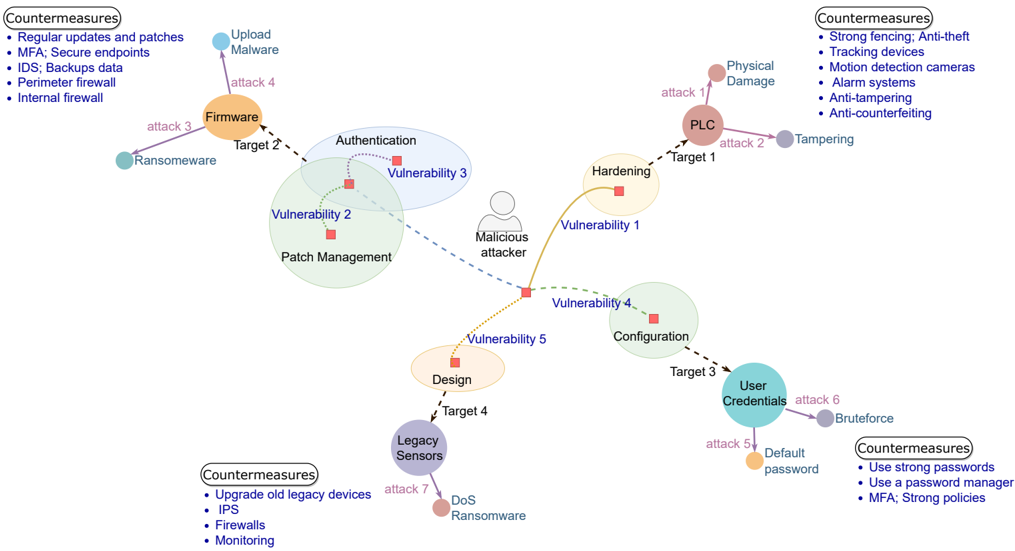
“In this scenario, the exploited vulnerability is Poor Hardening and the launched attacks are Physical Damage [42] and Tampering [43], with the target being the PLC. Scenario − 2: Prime MotorX is equipped with thermocouples to maintain precise and consistent temperature conditions during various…”
BackgroundInternet of Things: Evolution, Concerns and Security Challenges
Malhotra, P., Singh, Y., Anand, P., Bangotra, D. K., Singh, P. K., & Hong, W.-C. (2021) · Sensors · doi:10.3390/s21051809 · Cited by 260 · cited 1×
“With the increasing adoption of IIoT technologies, security and privacy concerns escalate, leading to information leakage, sensitive data disclosure, and data theft [12], [13].”
BackgroundCorallo, A., Lazoi, M., Lezzi, M., & Luperto, A. (2022) · Computers in Industry · doi:10.1016/j.compind.2022.103614 · Cited by 238 · cited 1×
“When IT interacts with OT environments, forming a “cyber-physical system” (CPS) in sectors like manufacturing, it exposes IIoT architecture to cyber-physical threats at every layer [10], [11].”
BackgroundPrivacy-preserving blockchain based IoT ecosystem using attribute-based encryption
Rahulamathavan, Y., Phan, R. C.-W., Rajarajan, M., Misra, S., & Kondoz, A. (2017) · 2017 IEEE International Conference on Advanced Networks and Telecommunications Systems (ANTS) · doi:10.1109/ants.2017.8384164 · Cited by 211 · cited 1×
“Rahulamathavan et al. [174] proposed an end-to-end privacy-preserving IoT blockchain architecture.”
BackgroundWeber, E., Büttgen, M., & Bartsch, S. (2022) · Journal of Business Research · doi:10.1016/j.jbusres.2022.01.036 · Cited by 205 · cited 1×
“…a result of the rapid development of cloud computing, artificial intelligence (AI), big data analytics, the Internet of Things (IoT), and other emerging technologies, along with digital transformation mechanisms, have fundamentally altered how the industry responds to societal needs [1], [2], [3].”
BackgroundSecurity Threats, Defense Mechanisms, Challenges, and Future Directions in Cloud Computing
Kafhali, S. E., Mir, I. E., & Hanini, M. (2021) · Archives of Computational Methods in Engineering · doi:10.1007/s11831-021-09573-y · Cited by 194 · cited 1×
“By incorporating these preventive measures, the IIoT processing layer can safeguard user accounts, maintain data privacy, and uphold the integrity of identity information, enhancing overall cybersecurity resilience [124], [125].”
BackgroundA survey of phishing attack techniques, defence mechanisms and open research challenges
Jain, A. K., & Gupta, B. B. (2022) · Enterprise Information Systems · doi:10.1080/17517575.2021.1896786 · Cited by 192 · cited 1×
“Moreover, the attacker may discover poorly configured identity authorization services, allowing them to launch a Phishing attack [105] to steal user credentials and access resources at the processing layer.”
BackgroundConsumer, Commercial, and Industrial IoT (In)Security: Attack Taxonomy and Case Studies
Xenofontos, C., Zografopoulos, I., Konstantinou, C., Jolfaei, A., Khan, M. K., & Choo, K.-K. R. (2022) · IEEE Internet of Things Journal · doi:10.1109/jiot.2021.3079916 · Cited by 183 · cited 1×
“The launched attacks include default password attack [47], [48], DoS attack [49], [50], and Brute force attack [51], [52], with the target being the user credentials.”
BackgroundUrooj, U., Al-rimy, B. A. S., Zainal, A., Ghaleb, F. A., & Rassam, M. A. (2021) · Applied Sciences · doi:10.3390/app12010172 · Cited by 181 · cited 1×
“The launched attacks include Ransomware [44], [45], and Malware [46], with the target being the Firmware.”
BackgroundThe 51% Attack on Blockchains: A Mining Behavior Study
Aponte-Novoa, F. A., Orozco, A. L. S., Villanueva-Polanco, R., & Wightman, P. M. (2021) · IEEE Access · doi:10.1109/access.2021.3119291 · Cited by 179 · cited 1×
“…is that the previous blockchain methods earlier mentioned in Section IV do not take into account the semantics of low-frequency keywords and can be insecure against known session-specific temporary information attacks, 51% attacks, and user and server impersonation attacks [179], [180], [181].”
MethodMihoub, A., Fredj, O. B., Cheikhrouhou, O., Derhab, A., & Krichen, M. (2022) · Computers and Electrical Engineering · doi:10.1016/j.compeleceng.2022.107716 · Cited by 177 · cited 1×
“The launched attacks include default password attack [47], [48], DoS attack [49], [50], and Brute force attack [51], [52], with the target being the user credentials.”
BackgroundConsumer, Commercial, and Industrial IoT (In)Security: Attack Taxonomy and Case Studies
Xenofontos, C., Zografopoulos, I., Konstantinou, C., Jolfaei, A., Khan, M., & Choo, K. (2021) · IEEE Internet of Things Journal · doi:10.48550/arxiv.2105.06612 · Cited by 160
Internet of Video Things: Next-Generation IoT With Visual Sensors
Chen, C. W. (2020) · IEEE Internet of Things Journal · doi:10.1109/jiot.2020.3005727 · Cited by 157 · cited 1×
“Digital Object Identifier 10.1109/JIOT.2023.3308195 unit [5], [6], [7].”
InfluentialBlockchain Enabled Industrial Internet of Things Technology
Zhao, S., Li, S., & Yao, Y. (2019) · IEEE Transactions on Computational Social Systems · doi:10.1109/tcss.2019.2924054 · Cited by 155 · cited 1×
“[177] explored the integration of blockchain and IIoT, addressing applications and challenges.”
BackgroundA Survey on blockchain for industrial Internet of Things
Kumar, R. L., Khan, F., Kadry, S., & Rho, S. (2021) · Alexandria Engineering Journal · doi:10.1016/j.aej.2021.11.023 · Cited by 155 · cited 1×
“Blockchain can overcome privacy concerns when combined with encryption, consensus methods, and distributed data storage in the IIoT [166].”
MethodSoftware Supply Chain Attacks, a Threat to Global Cybersecurity: SolarWinds’ Case Study
Martínez, J., & Durán, J. M. (2021) · International Journal of Safety and Security Engineering · doi:10.18280/ijsse.110505 · Cited by 151 · cited 1×
“These countermeasures fortify the IIoT perception layer, bolstering its resilience against malware and safeguarding the integrity and availability of essential industrial processes and data [61], [62], [63], [64].”
BackgroundBrute-force and dictionary attack on hashed real-world passwords
Bošnjak, L., Sres, J., & Brumen, B. (2018) · International Convention on Information and Communication Technology, Electronics and Microelectronics · doi:10.23919/mipro.2018.8400211 · Cited by 147 · cited 1×
“The launched attacks include default password attack [47], [48], DoS attack [49], [50], and Brute force attack [51], [52], with the target being the user credentials.”
BackgroundDDoS attacks in IoT networks: a comprehensive systematic literature review
Al-Hadhrami, Y., & Hussain, F. K. (2021) · World Wide Web · doi:10.1007/s11280-020-00855-2 · Cited by 147 · cited 1×
“The launched attacks consist of the Wormhole attack [74], Blackhole [58], [75], the Sybil attack [60], the Sinkhole attack [76], the Routing Table Poisoning attack [77], DoS attack [78], [79], the DDoS attack [79], [80], with the target being the WSN Nodes of Prime MotorX.”
BackgroundA Comprehensive Survey on the Internet of Things with the Industrial Marketplace
Salih, K. O. M., Rashid, T. A., Radovanović, D., & Bačanin, N. (2022) · Sensors · doi:10.3390/s22030730 · Cited by 146 · cited 1×
“At Hirotec, automated predictive maintenance shows how IIoT improves industrial operations by further increasing safety and efficiency [18], [19], [20].”
BackgroundMokbal, F. M. M., Dan, W., Imran, A., Lin, J., Akhtar, F., & Xiaoxi, W. (2019) · IEEE Access · doi:10.1109/access.2019.2927417 · Cited by 139 · cited 1×
“By implementing these comprehensive measures, IIoT applications can be safe-guarded against the threat of code injection attacks, preserving the integrity and security of critical industrial systems [148], [149], [150], [151], [152], [153], [154].”
BackgroundInformation security breaches due to ransomware attacks - a systematic literature review
Reshmi, T. R. (2021) · International Journal of Information Management Data Insights · doi:10.1016/j.jjimei.2021.100013 · Cited by 120 · cited 1×
“In this scenario, the exploited vulnerability is Design, and the launched attack is a Ransomware [53], [54] on the Legacy Sensor.”
BackgroundChen, P., Liu, S., Chen, B., & Yu, L. (2022) · IEEE Transactions on Smart Grid · doi:10.1109/tsg.2022.3142087 · Cited by 120 · cited 1×
“The launched attacks include default password attack [47], [48], DoS attack [49], [50], and Brute force attack [51], [52], with the target being the user credentials.”
BackgroundKey Challenges and Emerging Technologies in Industrial IoT Architectures: A Review
Mirani, A. A., Velasco-Hernandez, G., Awasthi, A., & Walsh, J. (2022) · Sensors · doi:10.3390/s22155836 · Cited by 119 · cited 2×
“Data format incompatibility and the handling of big data introduce additional challenges to interoperability [37], [41].”
BackgroundMethodSnehi, M., & Bhandari, A. (2021) · Computer Science Review · doi:10.1016/j.cosrev.2021.100371 · Cited by 118 · cited 1×
“The launched attacks consist of the Wormhole attack [74], Blackhole [58], [75], the Sybil attack [60], the Sinkhole attack [76], the Routing Table Poisoning attack [77], DoS attack [78], [79], the DDoS attack [79], [80], with the target being the WSN Nodes of Prime MotorX.”
BackgroundData Integrity Attack in Dynamic State Estimation of Smart Grid: Attack Model and Countermeasures
An, D., Zhang, F., Yang, Q., & Zhang, C. (2022) · IEEE Transactions on Automation Science and Engineering · doi:10.1109/tase.2022.3149764 · Cited by 118 · cited 1×
“These proactive measures collectively fortify the IIoT processing layer, safeguarding data integrity and maintaining the reliability of critical processes within the industrial environment [126], [127], [128].”
BackgroundDesign of an Industrial IoT-Based Monitoring System for Power Substations
Zhao, L., Matsuo, I. B. M., Zhou, Y., & Lee, W. (2019) · IEEE Transactions on Industry Applications · doi:10.1109/tia.2019.2940668 · Cited by 116
A survey on DoS/DDoS attacks mathematical modelling for traditional, SDN and virtual networks
Balarezo, J. F., Wang, S., Gomez, K., Al‐Hourani, A., & Kandeepan, S. (2021) · Engineering Science and Technology an International Journal · doi:10.1016/j.jestch.2021.09.011 · Cited by 108 · cited 1×
“The launched attacks consist of the Wormhole attack [74], Blackhole [58], [75], the Sybil attack [60], the Sinkhole attack [76], the Routing Table Poisoning attack [77], DoS attack [78], [79], the DDoS attack [79], [80], with the target being the WSN Nodes of Prime MotorX.”
BackgroundIoT reliability: a review leading to 5 key research directions
Moore, S. J., Nugent, C. D., Zhang, S., & Cleland, I. (2020) · CCF Transactions on Pervasive Computing and Interaction · doi:10.1007/s42486-020-00037-z · Cited by 106 · cited 2×
“Insufficient anomaly detection techniques and data integrity checks further exacerbate reliability concerns [38].”
BackgroundIndustrial Internet of Things: A Review
Karmakar, A., Dey, N., Baral, T., Chowdhury, M., & Rehan, M. (2019) · 2019 International Conference on Opto-Electronics and Applied Optics (Optronix) · doi:10.1109/optronix.2019.8862436 · Cited by 100 · cited 1×
“At Hirotec, automated predictive maintenance shows how IIoT improves industrial operations by further increasing safety and efficiency [18], [19], [20].”
BackgroundBhardwaj, A., Mangat, V., Vig, R., Halder, S., & Conti, M. (2021) · Computer Science Review · doi:10.1016/j.cosrev.2020.100332 · Cited by 100 · cited 1×
“Additionally, the attacker may exploit misconfigured cloud-level load balancing, causing a DDoS attack [104] that renders Prime MotorX resources on the Web server inaccessible, disrupting production and customer experience.”
BackgroundSecurity, Privacy, and Usability in Continuous Authentication: A Survey
Baig, A. F., & Eskeland, S. (2021) · Sensors · doi:10.3390/s21175967 · Cited by 98 · cited 1×
“On the other hand, when the data is encrypted, the attacker launches a Traffic Analysis attack [71], utilizing Wireshark [72], and a Replay attack [73], with the target being the encrypted data.”
MethodLara, E., Aguilar, L., Sanchez, M. A., & García, J. A. (2020) · Sensors · doi:10.3390/s20020501 · Cited by 96 · cited 1×
“However, relying on outdated central processing units (CPUs) and inadequate technology may compromise security against cyber threats like ransomware, malware, data breaches, or server takeovers due to insufficient processing power [14].”
BackgroundPhysical Security and Safety of IoT Equipment: A Survey of Recent Advances and Opportunities
Yang, X., Shu, L., Liu, Y., Hancke, G. P., Ferrag, M. A., & Huang, K. (2022) · IEEE Transactions on Industrial Informatics · doi:10.1109/tii.2022.3141408 · Cited by 93 · cited 1×
“By employing these comprehensive countermeasures, organizations can effectively defend against Physical Damage attacks and enhance the over-all security posture of their IIoT infrastructure [55], [56], [57].”
BackgroundDynamic and Privacy-Preserving Reputation Management for Blockchain-Based Mobile Crowdsensing
Zhao, K., Tang, S., Zhao, B., & Wu, Y. (2019) · IEEE Access · doi:10.1109/access.2019.2920922 · Cited by 89 · cited 1×
“Zhao et al. [178] proposed a dynamic reputation management system in blockchain-based crowdsensing.”
BackgroundPrivacy-Preserving and Efficient Multi-Keyword Search over Encrypted Data on Blockchain
Jiang, S., Cao, J., McCann, J. A., Yang, Y., Liu, Y., Wang, X., & Deng, Y. (2019) · 2019 IEEE International Conference on Blockchain (Blockchain) · doi:10.1109/blockchain.2019.00062 · Cited by 89 · cited 1×
“Jiang et al. [175] enhanced search performance with privacy using Bloom filters.”
MethodChen, C., Yang, J., Tsaur, W.-J., Weng, W. H., Wu, C.-M., & Wei, X. (2022) · Sensors · doi:10.3390/s22031146 · Cited by 89 · cited 1×
“Chen et al. [170] used Hyperledger Fabric to protect sensitive data during enterprise data sharing.”
MethodJayalaxmi, P., Saha, R., Kumar, G., Kumar, N., & Kim, T.-H. (2021) · IEEE Access · doi:10.1109/access.2021.3057766 · Cited by 88 · cited 1×
“With the increasing adoption of IIoT technologies, security and privacy concerns escalate, leading to information leakage, sensitive data disclosure, and data theft [12], [13].”
BackgroundA Detection and Prevention Technique for Man in the Middle Attack in Fog Computing
Aliyu, F., Sheltami, T., & Shakshuki, E. M. (2018) · Procedia Computer Science · doi:10.1016/j.procs.2018.10.125 · Cited by 79 · cited 1×
“By implementing these countermeasures, the IIoT processing layer can establish a robust line of defense, safeguarding against potential man-in-the-middle attacks and preserving the integrity of critical resources and data [113].”
BackgroundGupta, B. B., Chaudhary, P., Chang, X., & Nedjah, N. (2022) · Computers & Electrical Engineering · doi:10.1016/j.compeleceng.2022.107726 · Cited by 77 · cited 1×
“Through these measures, the processing layer of the IIoT can proactively defend against DDoS attacks, ensuring the uninterrupted and secure operation of critical systems and services [114], [115].”
Alyahya, S., Khan, W. U., Ahmed, S., Marwat, S. N. K., & Habib, S. (2022) · Electronics · doi:10.3390/electronics11060963 · Cited by 74
Resilient Event-Triggered Control Strategies for Second-Order Consensus
Xu, W., Kurths, J., Wen, G., & Yu, X. (2021) · IEEE Transactions on Automatic Control · doi:10.1109/tac.2021.3122382 · Cited by 73 · cited 1×
“By incorporating these countermeasures, organizations can enhance the security of their IIoT network layer and defend against replay attacks effectively [87], [88], [89], [90].”
BackgroundKautish, S., Reyana, A., & Vidyarthi, A. (2022) · IEEE Transactions on Industrial Informatics · doi:10.1109/tii.2022.3146290 · Cited by 73 · cited 1×
“Through these measures, the processing layer of the IIoT can proactively defend against DDoS attacks, ensuring the uninterrupted and secure operation of critical systems and services [114], [115].”
The Electronic Health Record and its Contribution to Healthcare Information Systems Interoperability
Jardim, S. V. B. (2013) · Procedia Technology · doi:10.1016/j.protcy.2013.12.105 · Cited by 72 · cited 1×
“In this scenario, the exploited vulnerability is Poor Hardening and the launched attacks are Physical Damage [42] and Tampering [43], with the target being the PLC. Scenario − 2: Prime MotorX is equipped with thermocouples to maintain precise and consistent temperature conditions during various…”
BackgroundNew Frontiers in IoT: Networking, Systems, Reliability, and Security Challenges
Bagchi, S., Abdelzaher, T. F., Govindan, R., Shenoy, P., Atrey, A., Ghosh, P., & Xu, R. (2020) · IEEE Internet of Things Journal · doi:10.1109/jiot.2020.3007690 · Cited by 72 · cited 1×
“1)The heterogeneity of IoT devices presents reliability challenges with limitations in hardware and software components, affecting parameters like throughput and data accuracy [29], [30].”
BackgroundFerrag, M. A., Maglaras, L., Derhab, A., & Janicke, H. (2020) · Telecommunication Systems · doi:10.1007/s11235-019-00612-5 · Cited by 71 · cited 1×
“In this scenario, when the data is unencrypted, the attacker exploits insufficient data and transport encryption as a vulnerability and launches an Eavesdropping [69], [70], with the target being Unencrypted Data.”
BackgroundAldauiji, F., Batarfi, O., & Bayousef, M. (2022) · IEEE Access · doi:10.1109/access.2022.3181278 · Cited by 71 · cited 1×
“By adopting these countermeasures, the IIoT perception layer can bolster its resilience against ransomware attacks and safe-guard critical industrial operations and data from potential harm [58], [59], [60].”
BackgroundBao, Z., He, D., Khan, M. K., Luo, M., & Xie, Q. (2022) · IEEE Transactions on Industrial Informatics · doi:10.1109/tii.2022.3206798 · Cited by 68 · cited 1×
“Bao et al. [173] developed an identity management strategy to preserve user privacy.”
BackgroundDemertzis, K., Τσίκνας, Κ., Taketzis, D., Skianis, C. A., & Iliadis, L. (2021) · Electronics · doi:10.3390/electronics10070781 · Cited by 68 · cited 1×
“By combining these countermeasures, organizations can effectively safeguard against traffic analysis attacks and protect the integrity and privacy of their data and communications [84], [85], [86].”
BackgroundSecurity Issues and Software Updates Management in the Industrial Internet of Things (IIoT) Era
Mugarza, I., Flores, J. L., & Montero, J. L. (2020) · Sensors · doi:10.3390/s20247160 · Cited by 65 · cited 1×
“Lack of patch management is one of the main causes of inherent IIoT security vulnerabilities [15].”
BackgroundA multi‐attack resilient lightweight IoT authentication scheme
Adeel, A., Ali, M., Khan, A. N., Khalid, T., Rehman, F. U., Jararweh, Y., & Shuja, J. (2019) · Transactions on Emerging Telecommunications Technologies · doi:10.1002/ett.3676 · Cited by 61 · cited 1×
“By proactively incorporating these countermeasures, organizations can bolster the security of their IIoT network layer and safeguard against eavesdropping threats [81], [82], [83].”
BackgroundCombining Unsupervised Approaches for Near Real-Time Network Traffic Anomaly Detection
Carrera, F., Dentamaro, V., Galantucci, S., Iannacone, A., Impedovo, D., & Pirlo, G. (2022) · Applied Sciences · doi:10.3390/app12031759 · Cited by 59 · cited 1×
“By combining these countermeasures, organizations can effectively safeguard against traffic analysis attacks and protect the integrity and privacy of their data and communications [84], [85], [86].”
BackgroundBlockchain Data Privacy Protection and Sharing Scheme Based on Zero‐Knowledge Proof
Feng, T., Yang, P., Liu, C., Fang, J., & Ma, R. (2022) · Wireless Communications and Mobile Computing · doi:10.1155/2022/1040662 · Cited by 59 · cited 1×
“Feng et al. [171] utilized zero-knowledge proof to maintain data privacy in IIoT data sharing.”
BackgroundSelf-citationKebande, V. R. (2022) · Forensic Science International Reports · doi:10.1016/j.fsir.2022.100257 · Cited by 58
Secure Web development using OWASP Guidelines
Lala, S. K., Kumar, A., & Subbulakshmi, T. (2021) · International Conference on Intelligent Computing and Control Systems (ICICCS) · doi:10.1109/iciccs51141.2021.9432179 · Cited by 56 · cited 1×
“…launches other code injection attacks, such as LDAP Injection attack [130], [131], DLL Injection attack [132], XML Injection attack [133], [134], [135], and cross-site scripting (XSS) attack [136], [137], [138], to insert malicious code and manipulate user input, further jeopardizing the…”
BackgroundCode Smells in iOS Apps: How Do They Compare to Android?
Habchi, S., Hecht, G., Rouvoy, R., & Moha, N. (2017) · IEEE/ACM International Conference on Mobile Software Engineering and Systems (MOBILESoft) · doi:10.1109/mobilesoft.2017.11 · Cited by 55 · cited 1×
“By implementing these countermeasures, the IIoT application layer can be better safeguarded against memory-based leak attacks, ensuring the integrity and reliability of critical industrial systems [155], [156], [157], [158], [159].”
MethodTraffic Analysis Attacks on Tor: A Survey
Basyoni, L., Fetais, N., Erbad, A., Mohamed, A., & Guizani, M. (2020) · 2020 IEEE International Conference on Informatics, IoT, and Enabling Technologies (ICIoT) · doi:10.1109/iciot48696.2020.9089497 · Cited by 54 · cited 1×
“On the other hand, when the data is encrypted, the attacker launches a Traffic Analysis attack [71], utilizing Wireshark [72], and a Replay attack [73], with the target being the encrypted data.”
MethodImproved ECC-Based Three-Factor Multiserver Authentication Scheme
Wu, T.-Y., Yang, L., Lee, Z., Chen, C.-M., Pan, J.-S., & Islam, S. H. (2021) · Security and Communication Networks · doi:10.1155/2021/6627956 · Cited by 52 · cited 1×
“2) We can even combine the suggested ECDSA, which the blockchain utilizes to generate new PKIs, with the enhanced ECC-based three-factor multiserver authentication approach proposed by Wu et al. [184] to give an even stronger and better security mechanism for IIoT systems.”
MethodSecurity of Industrial Robots: Vulnerabilities, Attacks, and Mitigations
Pu, H., He, L., Cheng, P., Sun, M., & Chen, J. (2022) · IEEE Network · doi:10.1109/mnet.116.2200034 · Cited by 51 · cited 2×
“The launched attacks consist of the Wormhole attack [74], Blackhole [58], [75], the Sybil attack [60], the Sinkhole attack [76], the Routing Table Poisoning attack [77], DoS attack [78], [79], the DDoS attack [79], [80], with the target being the WSN Nodes of Prime MotorX.”
BackgroundMoens, P., Bracke, V., Soete, C., Vanden Hautte, S., Nieves Avendano, D., Ooijevaar, T., Devos, S., Volckaert, B., & Van Hoecke, S. (2020) · Sensors · doi:10.3390/s20154308 · Cited by 50 · cited 1×
“IIoT systems can assist in the real-time monitoring of conveyor belt production flow [8].”
BackgroundWang, L., Cao, X., Zhang, H., Sun, C., & Zheng, W. X. (2022) · Automatica · doi:10.1016/j.automatica.2021.110145 · Cited by 50 · cited 1×
“By proactively incorporating these countermeasures, organizations can bolster the security of their IIoT network layer and safeguard against eavesdropping threats [81], [82], [83].”
BackgroundWormhole Attack Detection System for IoT Network: A Hybrid Approach
Bhosale, S., & Sonavane, S. S. (2021) · Wireless Personal Communications · doi:10.1007/s11277-021-09395-y · Cited by 49 · cited 1×
“…of data packets and employing modulation packet techniques on wireless communication after experiencing an attack on the nodes, the impact of wormholes can be minimized, enhancing the overall security and resilience of the IIoT network layer against such attacks [91], [92], [93], [94], [95], [96].”
BackgroundAttacks on the Industrial Internet of Things – Development of a multi-layer Taxonomy
Berger, S., Bürger, O., & Röglinger, M. (2020) · Computers & Security · doi:10.1016/j.cose.2020.101790 · Cited by 47 · cited 1×
“These countermeasures fortify the IIoT perception layer, bolstering its resilience against malware and safeguarding the integrity and availability of essential industrial processes and data [61], [62], [63], [64].”
BackgroundFederated Threat-Hunting Approach for Microservice-Based Industrial Cyber-Physical System
Abdel-Basset, M., Hawash, H., & Sallam, K. (2022) · IEEE Transactions on Industrial Informatics · doi:10.1109/tii.2021.3091150 · Cited by 47 · cited 1×
“When IT interacts with OT environments, forming a “cyber-physical system” (CPS) in sectors like manufacturing, it exposes IIoT architecture to cyber-physical threats at every layer [10], [11].”
BackgroundA Counter-Eavesdropping Technique for Optimized Privacy of Wireless Industrial IoT Communications
Anajemba, J. H., Iwendi, C., Razzak, I., Ansere, J. A., & Okpalaoguchi, I. M. (2022) · IEEE Transactions on Industrial Informatics · doi:10.1109/tii.2021.3140109 · Cited by 47 · cited 1×
“By proactively incorporating these countermeasures, organizations can bolster the security of their IIoT network layer and safeguard against eavesdropping threats [81], [82], [83].”
BackgroundIIoT based Augmented Reality for Factory Data Collection and Visualization
Rosales, J., Deshpande, S., & Anand, S. (2021) · Procedia Manufacturing · doi:10.1016/j.promfg.2021.06.062 · Cited by 46 · cited 1×
“Smart manufacturing is made possible by the IIoT, which combines sensors with data analytics, cloud-based infrastructure, and visualization [9].”
MethodMultiple-Layer Security Threats on the Ethereum Blockchain and Their Countermeasures
Duan, L., Sun, Y., Zhang, K., & Ding, Y. (2022) · Security and Communication Networks · doi:10.1155/2022/5307697 · Cited by 44 · cited 1×
“By repeatedly attempting multiple overflow attacks, the attacker compromises the ERP application with an Integer Overflow attack [142], [143], another common type of memory-based attack.”
MethodInternet of Things (IoT) Overview
Rayes, A., & Salam, S. (2017) · Internet of Things From Hype to Reality · doi:10.1007/978-3-319-44860-2_1 · Cited by 40
Lee, J., Oh, J., Kwon, D., Kim, M., Yu, S., Jho, N.-S., & Park, Y. (2022) · Sensors · doi:10.3390/s22187075 · Cited by 38 · cited 1×
“…is that the previous blockchain methods earlier mentioned in Section IV do not take into account the semantics of low-frequency keywords and can be insecure against known session-specific temporary information attacks, 51% attacks, and user and server impersonation attacks [179], [180], [181].”
MethodMachine Learning based Malware Detection in Cloud Environment using Clustering Approach
Kumar, R., Sethi, K., Prajapati, N., Rout, R. R., & Bera, P. (2020) · International Conference on Computing, Communication and Networking Technologies (ICCCNT) · doi:10.1109/icccnt49239.2020.9225627 · Cited by 36 · cited 1×
“Additionally, deploying antimalware software enhances the overall defense against malware, ensuring the integrity and security of the IIoT processing layer and safeguarding the smooth operation of essential industrial processes [119], [120], [121].”
MethodProgram Repair: Automated vs. ManualPreprint
Zhang, Q., Zhao, Y., Sun, W., Fang, C., Wang, Z., & Zhang, L. (2022) · arXiv (Cornell University) · doi:10.48550/arxiv.2203.05166 · Cited by 36
SCARE: Side Channel Attack on In-Memory Computing for Reverse Engineering
Ensan, S. S., Nagarajan, K., Khan, M. N. I., & Ghosh, S. (2021) · IEEE Transactions on Very Large Scale Integration (VLSI) Systems · doi:10.1109/tvlsi.2021.3110744 · Cited by 35 · cited 1×
“Armed with this crucial information, the attacker exploits this vulnerability to launch a Memory-Based Leak attack [139], [140].”
BackgroundEffective Filter for Common Injection Attacks in Online Web Applications
Ibarra-Fiallos, S., Higuera, J. B., Intriago-Pazmiño, M., et al. (2021) · IEEE Access · doi:10.1109/access.2021.3050566 · Cited by 35 · cited 1×
“…attacker launches other code injection attacks, such as LDAP Injection attack [130], [131], DLL Injection attack [132], XML Injection attack [133], [134], [135], and cross-site scripting (XSS) attack [136], [137], [138], to insert malicious code and manipulate user input, further jeopardizing the…”
BackgroundIntelligent Ad-Hoc-On Demand Multipath Distance Vector for Wormhole Attack in Clustered WSN
Singh, S., & Saini, H. S. (2021) · Wireless Personal Communications · doi:10.1007/s11277-021-08950-x · Cited by 34 · cited 1×
“…of data packets and employing modulation packet techniques on wireless communication after experiencing an attack on the nodes, the impact of wormholes can be minimized, enhancing the overall security and resilience of the IIoT network layer against such attacks [91], [92], [93], [94], [95], [96].”
BackgroundSurvey and taxonomy of information-centric vehicular networking security attacks
Safwat, M., Elgammal, A., AbdAllah, E. G., & Azer, M. A. (2021) · Ad Hoc Networks · doi:10.1016/j.adhoc.2021.102696 · Cited by 34 · cited 1×
“In this scenario, when the data is unencrypted, the attacker exploits insufficient data and transport encryption as a vulnerability and launches an Eavesdropping [69], [70], with the target being Unencrypted Data.”
BackgroundA study of Security Threats and Attacks in Cloud Computing
Bella, H. K., & Vasundra, S. (2022) · International Conference on Smart Systems and Inventive Technology (ICSSIT) · doi:10.1109/icssit53264.2022.9716317 · Cited by 34 · cited 1×
“Moreover, the attacker may choose to manipulate data through Data Manipulation attack [112] directly at the data center system level, leading to data integrity degradation and causing the Prime MotorX system to malfunction.”
BackgroundAmjad, S., Abbas, S., Abubaker, Z., Alsharif, M. H., Jahid, A., & Javaid, N. (2022) · Sensors · doi:10.3390/s22051972 · Cited by 34 · cited 1×
“These countermeasures fortify the IIoT perception layer, bolstering its resilience against malware and safeguarding the integrity and availability of essential industrial processes and data [61], [62], [63], [64].”
BackgroundPrivacy-Preserving Tucker Train Decomposition Over Blockchain-Based Encrypted Industrial IoT Data
Feng, J., Yang, L. T., Zhang, R., & Gavuna, B. S. (2020) · IEEE Transactions on Industrial Informatics · doi:10.1109/tii.2020.2968923 · Cited by 33 · cited 1×
“Feng et al. [176] utilized blockchain and homomorphic encryption for secure IIoT data communication.”
BackgroundCL-MLSP: The design of a detection mechanism for sinkhole attacks in smart cities
Sangaiah, A. K., Javadpour, A., Ja’fari, F., Pinto, P., Ahmadi, H., & Zhang, W. (2022) · Microprocessors and Microsystems · doi:10.1016/j.micpro.2022.104504 · Cited by 33 · cited 1×
“Additionally, deploying IDSs, rule-based technologies, and geo-routing protocols further fortify the network’s defense against Sybil attacks, ensuring the IIoT network remains secure and resilient to potential threats [97], [98], [99].”
MethodReal-time DDoS flood attack monitoring and detection (RT-AMD) model for cloud computing
Bamasag, O. O., Alsaeedi, A., Munshi, A. M., Alghazzawi, D., Alshehri, S., & Jamjoom, A. A. (2022) · PeerJ Computer Science · doi:10.7717/peerj-cs.814 · Cited by 33
Ransomware: Analysing the Impact on Windows Active Directory Domain Services
McDonald, G., Papadopoulos, P., Pitropakis, N., Ahmad, J., & Buchanan, W. J. (2022) · Sensors · doi:10.3390/s22030953 · Cited by 32 · cited 1×
“This was perfectly illustrated by the WannaCry ransomware attack [16], where despite the fact that Microsoft published a patch to fix the vulnerability, several companies in the machine and industrial networking industries did not successfully install it.”
Design of an Industrial IoT-Based Monitoring System for Power Substations
Zhao, L., Matsuo, I. B. M., Zhou, Y., & Lee, W. (2019) · IEEE/IAS Industrial and Commercial Power Systems Technical Conference · doi:10.1109/icps.2019.8733348 · Cited by 32
Enhancing Security with In-Depth Analysis of Brute-Force Attack on Secure Hashing Algorithms
Verma, R., Dhanda, N., & Nagar, V. (2022) · Lecture notes in networks and systems · doi:10.1007/978-981-16-8826-3_44 · Cited by 31
A Wormhole Attack Detection Algorithm Integrated With the Node Trust Optimization Model in WSNs
Teng, Z., Du, C., Li, M., et al. (2022) · IEEE Sensors Journal · doi:10.1109/jsen.2022.3152841 · Cited by 30
The AODV routing protocol with built-in security to counter blackhole attack in MANET
Prabhakar Reddy, B., Bhaskar Reddy, B., & Dhananjaya, B. (2021) · Materials Today Proceedings · doi:10.1016/j.matpr.2021.08.039 · Cited by 27 · cited 2×
“…of data packets and employing modulation packet techniques on wireless communication after experiencing an attack on the nodes, the impact of wormholes can be minimized, enhancing the overall security and resilience of the IIoT network layer against such attacks [91], [92], [93], [94], [95], [96].”
BackgroundImpact of Internets of Things (IOT) in retail sector
Kaur, J., Santhoshkumar, N., Nomani, M. Z. M., et al. (2021) · Materials Today Proceedings · doi:10.1016/j.matpr.2021.04.246 · Cited by 26
A Dynamic Light-Weight Symmetric Encryption Algorithm for Secure Data Transmission via BLE Beacons
Banani, S., Thiemjarus, S., Wongthavarawat, K., & Ounanong, N. (2021) · Journal of Sensor and Actuator Networks · doi:10.3390/jsan11010002 · Cited by 26 · cited 1×
“By combining these countermeasures, the IIoT processing layer can establish a formidable defense against various types of attacks, safeguarding critical data and maintaining a secure and reliable industrial infrastructure [52], [122], [123].”
BackgroundLechowski, G., & Krzywdzinski, M. (2022) · Global Networks · doi:10.1111/glob.12380 · Cited by 26 · cited 1×
“…Study 2—Siemens: Siemens is a remarkable example of a business embracing IIoT, with its platform brand, MindSphere, introduced in 2016 as a commercial IIoT service catering not only to manufacturing customers but also extending its reach beyond, forming the core of the company’s IIoT strategy [28].”
BackgroundScalable, password-based and threshold authentication for smart homes
Huszti, A., Kovács, S., & Oláh, N. (2022) · International Journal of Information Security · doi:10.1007/s10207-022-00578-7 · Cited by 25 · cited 1×
“These measures help to ensure that only authorized users with legitimate credentials can access critical resources, mitigating the potential impact of phishing attacks on the processing layer of the IIoT and safeguarding sensitive information and operations [116], [117], [118].”
BackgroundSQL Injection: Classification and Prevention
Rai, A., Miraz, M. M. I., Das, D., et al. (2021) · International Conference on Intelligent Engineering and Management (ICIEM) · doi:10.1109/iciem51511.2021.9445347 · Cited by 24
Securing SCADA Energy Management System under DDos Attacks Using Token Verification Approach
Yang, Y., Lee, S., Chen, W.-C., Yang, C., Huang, Y.-M., & Hou, T. (2022) · Applied Sciences · doi:10.3390/app12010530 · Cited by 24 · cited 1×
“By adopting these counter-measures, the IIoT network layer can effectively mitigate the impact of DoS and DDoS attacks, ensuring the smooth and secure operation of the industrial systems [100], [101], [102].”
BackgroundJethava, G., & Rao, U. P. (2022) · Computers & Electrical Engineering · doi:10.1016/j.compeleceng.2022.107753 · Cited by 24 · cited 1×
“Additionally, deploying IDSs, rule-based technologies, and geo-routing protocols further fortify the network’s defense against Sybil attacks, ensuring the IIoT network remains secure and resilient to potential threats [97], [98], [99].”
MethodPrivacy Enhancement Scheme (PES) in a Blockchain-Edge Computing Environment
Ernest, B., & Shiguang, J. (2020) · IEEE Access · doi:10.1109/access.2020.2968621 · Cited by 23 · cited 3×
“ECC ensures data security in the IIoT ecosystem [168].”
BackgroundMethodInfluentialAlsulami, H. (2022) · Computers and Electrical Engineering · doi:10.1016/j.compeleceng.2022.107870 · Cited by 21 · cited 1×
“One approach is to exploit poor data encryption at the data center system level by employing Brute Force attack [107], Implementation attack [108], or Statistical attack [109] on weak cryptographic algorithms to crack the encryption keys and access sensitive information.”
MethodAn Overview on Detection and Prevention of Application Layer DDoS Attacks
Black, S., & Kim, Y. (2022) · IEEE Annual Computing and Communication Workshop and Conference (CCWC) · doi:10.1109/ccwc54503.2022.9720741 · Cited by 20 · cited 1×
“These countermeasures collectively bolster the IIoT application layer’s resilience against HTTP flooding attacks, ensuring robust and secure service availability for legitimate users [161], [162], [163], [164], [165].”
BackgroundA Blockchain-Based Privacy Information Security Sharing Scheme in Industrial Internet of Things
Wang, Y., Che, T., Zhao, X., Zhou, T., Zhang, K., & Hu, X. (2022) · Sensors · doi:10.3390/s22093426 · Cited by 20 · cited 1×
“Wang et al. [169] proposed a blockchain-based privacy-sharing scheme in IIoT to protect keys, ensure data consistency, and incentivize communication.”
BackgroundAn Improved SQL Injection Attack Detection Model Using Machine Learning Techniques
Abdulmalik, Y. (2021) · International Journal of Innovative Computing · doi:10.11113/ijic.v11n1.300 · Cited by 19 · cited 1×
“By implementing these comprehensive measures, IIoT applications can be safe-guarded against the threat of code injection attacks, preserving the integrity and security of critical industrial systems [148], [149], [150], [151], [152], [153], [154].”
BackgroundAn OpenStack based cloud testbed framework for evaluating HTTP flooding attacks
Dhanapal, A., & Nithyanandam, P. (2019) · Wireless Networks · doi:10.1007/s11276-019-01937-4 · Cited by 18 · cited 1×
“HTTP flood attacks, both HTTP GET and HTTP POST [144], [145], [146], [147], pose serious threats to IIoT businesses, leading to financial losses, reputational damage, revenue loss, and decreased consumer trust.”
BackgroundAn IPS Approach to Secure V-RSU Communication from Blackhole and Wormhole Attacks in VANET
Soni, G., Chandravanshi, K., Jhariya, M. K., & Rajput, A. (2022) · Lecture Notes in Networks and Systems · doi:10.1007/978-981-16-4244-9_5 · Cited by 18 · cited 1×
“…of data packets and employing modulation packet techniques on wireless communication after experiencing an attack on the nodes, the impact of wormholes can be minimized, enhancing the overall security and resilience of the IIoT network layer against such attacks [91], [92], [93], [94], [95], [96].”
BackgroundSoftware Visualizations to Analyze Memory Consumption: A Literature Review
Blanco, A. F., Bergel, A., & Alcocer, J. P. S. (2022) · ACM Computing Surveys · doi:10.1145/3485134 · Cited by 18 · cited 1×
“By implementing these countermeasures, the IIoT application layer can be better safeguarded against memory-based leak attacks, ensuring the integrity and reliability of critical industrial systems [155], [156], [157], [158], [159].”
MethodA Study on Brute Force Attack on T-Mobile Leading to SIM-Hijacking and Identity-Theft
Faircloth, C., Hartzell, G., Callahan, N., et al. (2022) · IEEE World AI IoT Congress (AIIoT) · doi:10.1109/aiiot54504.2022.9817175 · Cited by 18 · cited 2×
“Moreover, ensuring secure endpoints with up-to-date firmware and robust security measures can prevent the exploitation of devices with default passwords, bolstering the overall resilience of the IIoT perception layer [65], [66], [67].”
Background(2018) · Bristol Research (University of Bristol) · Cited by 17
Fault-Tolerant Privacy-Preserving Data Aggregation for Smart Grid
Liu, H., Gu, T., Liu, Y., Song, J., & Zeng, Z. (2020) · Wireless Communications and Mobile Computing · doi:10.1155/2020/8810393 · Cited by 17 · cited 1×
“1) Problem − 3 (Optimization): Existing differential privacy methods, such as methods [182], [183], can set a privacy probability threshold to select the best privacy parameter based on the Laplace distribution and Privacy Fault Tolerance and, thus, achieve privacy protection while ensuring data…”
MethodA measurement study on device-to-device communication technologies for IIoT
Li, F., Guo, Z., Liang, B., Yi, X., Wang, X., Li, W., & Wang, Y. (2021) · Computer Networks · doi:10.1016/j.comnet.2021.108072 · Cited by 17 · cited 1×
“Digital Object Identifier 10.1109/JIOT.2023.3308195 unit [5], [6], [7].”
InfluentialSpecView: Malware Spectrum Visualization Framework With Singular Spectrum Transformation
Yu, J. Q., He, Y., Yan, Q., & Kang, X. (2021) · IEEE Transactions on Information Forensics and Security · doi:10.1109/tifs.2021.3124725 · Cited by 17 · cited 1×
“Additionally, deploying antimalware software enhances the overall defense against malware, ensuring the integrity and security of the IIoT processing layer and safeguarding the smooth operation of essential industrial processes [119], [120], [121].”
MethodA Survey on Internet of Things (IoT), Industrial IoT (IIoT) and Industry 4.0
Deshpande, S. N., & Jogdand, R. M. (2020) · International Journal of Computer Applications · doi:10.5120/ijca2020920790 · Cited by 16 · cited 1×
“The increased volume of data could overwhelm the processing layer, causing bottlenecks that hinder real-time analysis and response and lower system reliability [39].”
BackgroundChinna Rao, R., Lakshmi, K. M., Raja, C., Varma, P. B. S., Rao, G. R. K., & Patibandla, A. (2022) · Journal of Interconnection Networks · doi:10.1142/s0219265921410309 · Cited by 15 · cited 1×
“On the other hand, when the data is encrypted, the attacker launches a Traffic Analysis attack [71], utilizing Wireshark [72], and a Replay attack [73], with the target being the encrypted data.”
MethodSTOP: A Service Oriented Internet Purification Against Link Flooding Attacks
Lu, N., Zhang, J., Liu, X., et al. (2022) · IEEE Transactions on Information Forensics and Security · doi:10.1109/tifs.2022.3152406 · Cited by 15 · cited 1×
“These countermeasures collectively bolster the IIoT application layer’s resilience against HTTP flooding attacks, ensuring robust and secure service availability for legitimate users [161], [162], [163], [164], [165].”
BackgroundA comprehensive and critical analysis of TLS 1.3
Kumari, N., & Mohapatra, A. K. (2022) · Journal of Information and Optimization Sciences · doi:10.1080/02522667.2021.1968579 · Cited by 14 · cited 1×
“By incorporating these countermeasures, organizations can enhance the security of their IIoT network layer and defend against replay attacks effectively [87], [88], [89], [90].”
BackgroundAn Evaluation Framework for Machine Learning Methods in Detection of DoS and DDoS Intrusion
Zewdie, T. G., & Girma, A. (2022) · International Conference on Artificial Intelligence in Information and Communication (ICAIIC) · doi:10.1109/icaiic54071.2022.9722661 · Cited by 14 · cited 1×
“By adopting these counter-measures, the IIoT network layer can effectively mitigate the impact of DoS and DDoS attacks, ensuring the smooth and secure operation of the industrial systems [100], [101], [102].”
BackgroundA survey and classification of XML based attacks on web applications
Gupta, C., Singh, R. K., & Mohapatra, A. K. (2020) · Information Security Journal: A Global Perspective · doi:10.1080/19393555.2020.1740839 · Cited by 13 · cited 1×
“…the attacker launches other code injection attacks, such as LDAP Injection attack [130], [131], DLL Injection attack [132], XML Injection attack [133], [134], [135], and cross-site scripting (XSS) attack [136], [137], [138], to insert malicious code and manipulate user input, further…”
BackgroundSurvey of wormhole attack in wireless sensor networks
Ghugar, U., & Pradhan, J. (2021) · Computer Science and Information Technologies · doi:10.11591/csit.v2i1.p33-42 · Cited by 13 · cited 1×
“The launched attacks consist of the Wormhole attack [74], Blackhole [58], [75], the Sybil attack [60], the Sinkhole attack [76], the Routing Table Poisoning attack [77], DoS attack [78], [79], the DDoS attack [79], [80], with the target being the WSN Nodes of Prime MotorX.”
BackgroundSecuring Remote User Authentication in Industrial Internet of Things
Nimmy, K., Sankaran, S., Achuthan, K., & Calyam, P. (2022) · 2022 IEEE 19th Annual Consumer Communications & Networking Conference (CCNC) · doi:10.1109/ccnc49033.2022.9700512 · Cited by 13 · cited 1×
“The launched attacks include default password attack [47], [48], DoS attack [49], [50], and Brute force attack [51], [52], with the target being the user credentials.”
BackgroundDefeating traffic analysis via differential privacy: a case study on streaming traffic
Zhang, X., Hamm, J., Reiter, M. K., & Zhang, Y. (2022) · International Journal of Information Security · doi:10.1007/s10207-021-00574-3 · Cited by 12
Selvamani, K., & Kannan, A. (2011) · Communications in computer and information science · doi:10.1007/978-3-642-20499-9_5 · Cited by 11 · cited 1×
“By implementing these comprehensive measures, IIoT applications can be safe-guarded against the threat of code injection attacks, preserving the integrity and security of critical industrial systems [148], [149], [150], [151], [152], [153], [154].”
BackgroundExploiting Trust: Stealthy Attacks Through Socioware and Insider Threats
Sood, A. K., Zeadally, S., & Bansal, R. (2017) · IEEE Systems Journal · doi:10.1109/jsyst.2015.2388707 · Cited by 11
Understanding Man-in-the-middle-attack through Survey of Literature
Mallik, A., Ahsan, A., Shahadat, M. M. Z., & Tsou, J. C. (2019) · Indonesian Journal of Computing, Engineering and Design (IJoCED) · doi:10.35806/ijoced.v1i1.36 · Cited by 11 · cited 1×
“One example is the attacker’s use of a MITM attack [103] to intercept Web traffic and access sensitive information within Prime MotorX’s processing layer due to the lack of Web traffic encryption.”
BackgroundTCP/IP Layerwise Taxonomy of Attacks and Defence Mechanisms in Mobile Ad Hoc Networks
Mahamune, A. A., & Chandane, M. M. (2022) · Journal of The Institution of Engineers (India): Series B · doi:10.1007/s40031-021-00627-0 · Cited by 11 · cited 1×
“The launched attacks consist of the Wormhole attack [74], Blackhole [58], [75], the Sybil attack [60], the Sinkhole attack [76], the Routing Table Poisoning attack [77], DoS attack [78], [79], the DDoS attack [79], [80], with the target being the WSN Nodes of Prime MotorX.”
BackgroundCan a TLS Certificate Be Phishy?
Hageman, K., Kidmose, E., Hansen, R. R., & Pedersen, J. M. (2021) · International Conference on Security and Cryptography · doi:10.5220/0010516600380049 · Cited by 11
HTTP DDoS Flooding Attack Mitigation in Software-Defined Networking
Park, S., Kim, Y., Choi, H., et al. (2021) · IEICE Transactions on Information and Systems · doi:10.1587/transinf.2021edl8022 · Cited by 11
aSGD: Stochastic Gradient Descent with Adaptive Batch Size for Every Parameter
Shi, H., Yang, N., Tang, H., & Yang, X. (2022) · Mathematics · doi:10.3390/math10060863 · Cited by 11
SWAN: a static analysis framework for swift
Tiganov, D., Cho, J., Ali, K., & Dolby, J. (2020) · ACM Joint European Software Engineering Conference and Symposium on the Foundations of Software Engineering (ESEC/FSE) · doi:10.1145/3368089.3417924 · Cited by 10 · cited 2×
“By employing these countermeasures, the IIoT application layer can enhance its resilience against integer overflow attacks, safeguarding the integrity and stability of the system [61], [155], [157], [160].”
MethodOuahab, I. B. A., Bouhorma, M., Elaachak, L., & Abdelhakim, B. A. (2020) · Recent Advances in Computer Science and Communications · doi:10.2174/2666255813999201117093512 · Cited by 10 · cited 2×
“By employing these countermeasures, the IIoT application layer can enhance its resilience against integer overflow attacks, safeguarding the integrity and stability of the system [61], [155], [157], [160].”
BackgroundMethodData Privacy Security Mechanism of Industrial Internet of Things Based on Block Chain
Xie, Y., Li, Y., & Ma, Y. (2022) · Applied Sciences · doi:10.3390/app12146859 · Cited by 10
Yan, X., Yan, K., Rehman, M. U., et al. (2022) · Applied Sciences · doi:10.3390/app122010225 · Cited by 10 · cited 1×
“…is that the previous blockchain methods earlier mentioned in Section IV do not take into account the semantics of low-frequency keywords and can be insecure against known session-specific temporary information attacks, 51% attacks, and user and server impersonation attacks [179], [180], [181].”
MethodThe legal obligation to provide timely security patching and automatic updates
Maurushat, A., & Nguyen, K. (2022) · International Cybersecurity Law Review · doi:10.1365/s43439-022-00059-6 · Cited by 10 · cited 2×
“The launched attacks consist of the Wormhole attack [74], Blackhole [58], [75], the Sybil attack [60], the Sinkhole attack [76], the Routing Table Poisoning attack [77], DoS attack [78], [79], the DDoS attack [79], [80], with the target being the WSN Nodes of Prime MotorX.”
BackgroundCountering Statistical Attacks in Cloud-Based Searchable Encryption
Ahsan, M. A. M., Ali, I., Bin Idris, M. Y. I., Imran, M., & Shoaib, M. (2020) · International Journal of Parallel Programming · doi:10.1007/s10766-018-0584-8 · Cited by 9 · cited 1×
“One approach is to exploit poor data encryption at the data center system level by employing Brute Force attack [107], Implementation attack [108], or Statistical attack [109] on weak cryptographic algorithms to crack the encryption keys and access sensitive information.”
MethodGupta, S. R., & Gupta, B. B. (2018) · Journal of Ambient Intelligence and Humanized Computing · doi:10.1007/s12652-018-1118-3 · Cited by 9 · cited 1×
“By implementing these comprehensive measures, IIoT applications can be safe-guarded against the threat of code injection attacks, preserving the integrity and security of critical industrial systems [148], [149], [150], [151], [152], [153], [154].”
BackgroundCross-site Scripting Research: A Review
Nagarjun, P., & Shakeel, S. (2020) · International Journal of Advanced Computer Science and Applications · doi:10.14569/ijacsa.2020.0110481 · Cited by 9 · cited 1×
“…attacks, such as LDAP Injection attack [130], [131], DLL Injection attack [132], XML Injection attack [133], [134], [135], and cross-site scripting (XSS) attack [136], [137], [138], to insert malicious code and manipulate user input, further jeopardizing the system’s integrity and user credentials.”
BackgroundA Comparative Review between Modern Encryption Algorithms viz. DES, AES, and RSA
Priyanka, M. P., Kaur, N., Nazir, N., Khan, A. A., Singh, M. V., Kaur, M., Behera, T., Rakhra, M., & Dahiya, O. (2022) · International Conference on Computational Intelligence and Sustainable Engineering Solutions (CISES) · doi:10.1109/cises54857.2022.9844393 · Cited by 9 · cited 1×
“By combining these countermeasures, the IIoT processing layer can establish a formidable defense against various types of attacks, safeguarding critical data and maintaining a secure and reliable industrial infrastructure [52], [122], [123].”
BackgroundCloud-Assisted Privacy Protection Energy Trading Based on IBS and Homomorphic Encryption in IIoT
Wang, H., Xiao, Y., Feng, Y., Qian, Q., Li, Y., & Fu, X. (2022) · Applied Sciences · doi:10.3390/app12199509 · Cited by 9 · cited 1×
“Wang et al. [172] applied identity-based signatures and homomorphic encryption for privacy protection in energy trading.”
BackgroundExtensive Study of Cloud Computing Technologies, Threats and Solutions Prospective
Abu-Alhaija, M., M. Turab, N., & Hamza, A. (2022) · Computer Systems Science and Engineering · doi:10.32604/csse.2022.019547 · Cited by 8 · cited 1×
“…the attacker may also compromise the personally identifiable information (PII) of Prime MotorX employees or customers, hijacking their accounts through Account Hijacking attack [110], [111], and damaging their identity integrity due to the lack of adequate data sanitization mechanisms by the CSP.”
BackgroundPSPS: A Step toward Tamper Resistance against Physical Computer Intrusion
Lu, M.-C., Huang, Q.-X., Chiu, M.-Y., et al. (2022) · Sensors · doi:10.3390/s22051882 · Cited by 8 · cited 1×
“By employing these comprehensive countermeasures, organizations can effectively defend against Physical Damage attacks and enhance the over-all security posture of their IIoT infrastructure [55], [56], [57].”
BackgroundCountering DNS Vulnerability to Attacks Using Ensemble Learning
Ahakonye, L. A. C., Nwakanma, C. I., Ajakwe, S. O., Lee, J. M., & Kim, D. (2022) · International Conference on Artificial Intelligence in Information and Communication (ICAIIC) · doi:10.1109/icaiic54071.2022.9722641 · Cited by 8 · cited 1×
“HTTP flood attacks, both HTTP GET and HTTP POST [144], [145], [146], [147], pose serious threats to IIoT businesses, leading to financial losses, reputational damage, revenue loss, and decreased consumer trust.”
BackgroundWeninger, M., Gander, E., & Mössenböck, H. (2018) · doi:10.1145/3237009.3237023 · Cited by 7 · cited 1×
“By implementing these countermeasures, the IIoT application layer can be better safeguarded against memory-based leak attacks, ensuring the integrity and reliability of critical industrial systems [155], [156], [157], [158], [159].”
MethodA Routing Table Poisoning Model for Peer-to-Peer (P2P) Botnets
Tetarave, S. K., Tripathy, S., Kalaimannan, E., John, C., & Srivastava, A. (2019) · IEEE Access · doi:10.1109/access.2019.2906875 · Cited by 7 · cited 1×
“The launched attacks consist of the Wormhole attack [74], Blackhole [58], [75], the Sybil attack [60], the Sinkhole attack [76], the Routing Table Poisoning attack [77], DoS attack [78], [79], the DDoS attack [79], [80], with the target being the WSN Nodes of Prime MotorX.”
BackgroundDetecting Http Flooding Attacks Based on Uniform Model
Nashat, D., & Khairy, S. A. (2021) · International Conference on Networking and Network Applications (NaNA) · doi:10.1109/nana53684.2021.00024 · Cited by 7 · cited 1×
“These countermeasures collectively bolster the IIoT application layer’s resilience against HTTP flooding attacks, ensuring robust and secure service availability for legitimate users [161], [162], [163], [164], [165].”
BackgroundCyber Arms: Security in Cyberspace
Abaimov, S., & Martellini, M. (2020) · doi:10.1201/9780367853860 · Cited by 7
Secure authentication and session key management scheme for Internet of Vehicles
Sharma, N., Chauhan, N., Chand, N., et al. (2022) · Transactions on Emerging Telecommunications Technologies · doi:10.1002/ett.4451 · Cited by 7 · cited 1×
“By incorporating these countermeasures, organizations can enhance the security of their IIoT network layer and defend against replay attacks effectively [87], [88], [89], [90].”
BackgroundSmart Warehouses in Logistics 4.0
Alιm, M., & Kesen, S. E. (2020) · CRC Press eBooks · doi:10.1201/9780429327636-22 · Cited by 6 · cited 1×
“These businesses have established themselves as market leaders in logistics and e-commerce by embracing IIoT technical breakthroughs and Industry 4.0 ideas [21].”
BackgroundInfluentialSinkhole Attack Detection in Wireless Sensor Networks
Mehta, A., Sandhu, J. K., Pundir, M., Kaur, R., & Sapra, L. (2022) · Lecture Notes on Data Engineering and Communications Technologies · doi:10.1007/978-981-16-6285-0_8 · Cited by 6 · cited 1×
“The launched attacks consist of the Wormhole attack [74], Blackhole [58], [75], the Sybil attack [60], the Sinkhole attack [76], the Routing Table Poisoning attack [77], DoS attack [78], [79], the DDoS attack [79], [80], with the target being the WSN Nodes of Prime MotorX.”
BackgroundThe flaws of Internet of Things (IoT) intrusion detection and prevention schemes
Ghayyad, S., Du, S., & Kurien, A. M. (2022) · International Journal of Sensor Networks · doi:10.1504/ijsnet.2022.120270 · Cited by 6
Secure Shared Data in the Private Cloud With an EA Algorithm
Singh, V. K., Bharathiraja, N., Arun, S., et al. (2022) · International Conference on Smart Structures and Systems (ICSSS) · doi:10.1109/icsss54381.2022.9782299 · Cited by 6 · cited 1×
“These proactive measures collectively fortify the IIoT processing layer, safeguarding data integrity and maintaining the reliability of critical processes within the industrial environment [126], [127], [128].”
BackgroundA Lightweight One Time Password (OTP) Based Smart Learning in Internet of Things
Kadham, N. R., & Ravi.K, S. (2018) · International Journal of Engineering & Technology · doi:10.14419/ijet.v7i2.7.10867 · Cited by 5 · cited 1×
“Moreover, ensuring secure endpoints with up-to-date firmware and robust security measures can prevent the exploitation of devices with default passwords, bolstering the overall resilience of the IIoT perception layer [65], [66], [67].”
BackgroundEnhanced IoT Wi-Fi protocol standard’s security using secure remote password
Tarish, H. A. (2022) · Periodicals of Engineering and Natural Sciences (PEN) · doi:10.21533/pen.v10i1.2728 · Cited by 5 · cited 2×
“Moreover, ensuring secure endpoints with up-to-date firmware and robust security measures can prevent the exploitation of devices with default passwords, bolstering the overall resilience of the IIoT perception layer [65], [66], [67].”
BackgroundFile Integrity Checkers: Functionality, Attacks, and Protection
Salman, A., Khan, M. S., Idrees, S., Akram, F., Junaid, M., & Malik, A. L. (2022) · International Conference on Digital Futures and Transformative Technologies (ICoDT2) · doi:10.1109/icodt255437.2022.9787428 · Cited by 5 · cited 1×
“These proactive measures collectively fortify the IIoT processing layer, safeguarding data integrity and maintaining the reliability of critical processes within the industrial environment [126], [127], [128].”
BackgroundDeep Learning Approach for RPL Wormhole Attack
Thiyagu, T., Krishnaveni, S., & Arthi, R. (2022) · Lecture notes on data engineering and communications technologies · doi:10.1007/978-981-16-7610-9_23 · Cited by 5
Investigating the IoT Security and Privacy Challenges: Summary and Recommendations
Chauhan, P., Ahmad, S., Khan, P. R., et al. (2022) · EAI Endorsed Transactions on Cloud Systems · doi:10.4108/eetcs.v7i22.2652 · Cited by 5 · cited 1×
“By incorporating these preventive measures, the IIoT processing layer can safeguard user accounts, maintain data privacy, and uphold the integrity of identity information, enhancing overall cybersecurity resilience [124], [125].”
BackgroundDetection of XSS Attack and Defense of REST Web Service – Machine Learning Perspective
Ivanova, M., & Rozeva, A. (2021) · International Conference on Machine Learning and Soft Computing (ICMLSC) · doi:10.1145/3453800.3453805 · Cited by 4 · cited 1×
“By implementing these comprehensive measures, IIoT applications can be safe-guarded against the threat of code injection attacks, preserving the integrity and security of critical industrial systems [148], [149], [150], [151], [152], [153], [154].”
BackgroundNPDHunter: Efficient Null Pointer Dereference Vulnerability Detection in Binary
Jin, W., Ullah, S., Yoo, D., et al. (2021) · IEEE Access · doi:10.1109/access.2021.3091209 · Cited by 4 · cited 1×
“This allows the attacker to corrupt the memory and carry out a Null Pointer Dereference attack [141], another form of memory-based attack that can crash the ERP and facilitate a successful DoS attack.”
BackgroundTurning old into new: adding LoRaWAN connectivity to PLC in brownfield installations
Ferrari, P., Sisinni, E., Bellagente, P., et al. (2021) · IEEE International Workshop on Metrology for Industry 4.0 & IoT (MetroInd4.0&IoT) · doi:10.1109/metroind4.0iot51437.2021.9488564 · Cited by 4 · cited 1×
“By eliminating these old legacy devices and adopting newer ones with enhanced security protocols, organizations can better protect their IIoT infrastructure from Ransomware threats and mitigate potential risks associated with outdated technology [68].”
BackgroundA Study of SQL Injection Hacking Techniques
Joe, F. Y., & Selvarajah, V. (2021) · Atlantis Highlights in Computer Sciences/Atlantis highlights in computer sciences · doi:10.2991/ahis.k.210913.067 · Cited by 4 · cited 1×
“Specifically, the attacker exploits Web applications vulnerable to SQL Injection attack [129] to gain unauthorized access to the database, compromising sensitive information and system security.”
BackgroundStatic Analysis Tools Against Cross-site Scripting Vulnerabilities in Web Applications : An Analysis
Talib, N. A. A., & Doh, K.-G. (2021) · Journal of Software Assessment and Valuation · doi:10.29056/jsav.2021.12.14 · Cited by 4 · cited 1×
“…attacks, such as LDAP Injection attack [130], [131], DLL Injection attack [132], XML Injection attack [133], [134], [135], and cross-site scripting (XSS) attack [136], [137], [138], to insert malicious code and manipulate user input, further jeopardizing the system’s integrity and user credentials.”
BackgroundWake Up Digital Forensics’ Community and Help Combat Ransomware
Huck, J., & Breitinger, F. (2022) · IEEE Security & Privacy · doi:10.1109/msec.2021.3137018 · Cited by 4 · cited 1×
“In this scenario, the exploited vulnerability is Design, and the launched attack is a Ransomware [53], [54] on the Legacy Sensor.”
BackgroundOverview of passive attacks in cloud environment
Raich, A., & Gadicha, V. B. (2022) · AIP conference proceedings · doi:10.1063/5.0076729 · Cited by 4 · cited 1×
“Additionally, the attacker launches other code injection attacks, such as LDAP Injection attack [130], [131], DLL Injection attack [132], XML Injection attack [133], [134], [135], and cross-site scripting (XSS) attack [136], [137], [138], to insert malicious code and manipulate user input, further…”
BackgroundProactive Secure Coding for iOS Applications
Marin, M. A., Carabaș, C., Deaconescu, R. A., & Ţăpuş, N. (2019) · RoEduNet Conference: Networking in Education and Research (RoEduNet) · doi:10.1109/roedunet.2019.8909672 · Cited by 3 · cited 2×
“By employing these countermeasures, the IIoT application layer can enhance its resilience against integer overflow attacks, safeguarding the integrity and stability of the system [61], [155], [157], [160].”
MethodSekar, K., Shah, S. A., & Antony Athithan, A. (2021) · IOP Conference Series: Materials Science and Engineering · doi:10.1088/1757-899x/1128/1/012010 · Cited by 3 · cited 1×
“1)The heterogeneity of IoT devices presents reliability challenges with limitations in hardware and software components, affecting parameters like throughput and data accuracy [29], [30].”
BackgroundGeneric Security Risk Profile of e-Governance Applications—a Case Study
Kumar, B. S., Sridhar, V., & Sudhindra, K. R. (2022) · Lecture Notes in Electrical Engineering · doi:10.1007/978-981-16-1342-5_57 · Cited by 3 · cited 1×
“Additionally, the attacker launches other code injection attacks, such as LDAP Injection attack [130], [131], DLL Injection attack [132], XML Injection attack [133], [134], [135], and cross-site scripting (XSS) attack [136], [137], [138], to insert malicious code and manipulate user input, further…”
BackgroundLaTLS: A Lattice‐Based TLS Proxy Protocol
ZHANG, X., Cheng, Q., & Yuting, L. I. (2022) · Chinese Journal of Electronics · doi:10.1049/cje.2018.00.357 · Cited by 3 · cited 1×
“By incorporating these countermeasures, organizations can enhance the security of their IIoT network layer and defend against replay attacks effectively [87], [88], [89], [90].”
BackgroundDetecSec: A Framework to Detect and Mitigate ARP Cache Poisoning Attacks
Bhattacharya, D., Karthick, N. S. H., Suresh, P., & Bhalaji, N. (2022) · Lecture notes on data engineering and communications technologies · doi:10.1007/978-981-16-9605-3_70 · Cited by 3
A software approach for stack memory protection based on duplication and randomisation
Alouneh, S., Kharbutli, M., & AlQurem, R. (2016) · International Journal of Internet Technology and Secured Transactions · doi:10.1504/ijitst.2016.082982 · Cited by 3
Quantum cryptography for the benefit of API keys safety
Ghilen, A., Zahou, A. M. E., & Khalifa, W. A. B. (2022) · doi:10.1109/setit54465.2022.9875712 · Cited by 3 · cited 1×
“These countermeasures collectively bolster the IIoT application layer’s resilience against HTTP flooding attacks, ensuring robust and secure service availability for legitimate users [161], [162], [163], [164], [165].”
BackgroundThe HTTP Flooding Attack Detection to Secure and Safeguard Online Applications in the Cloud
Dhanapal, A., & Nithyanandam, P. (2019) · International Journal of Information System Modeling and Design · doi:10.4018/ijismd.2019070103 · Cited by 2 · cited 1×
“HTTP flood attacks, both HTTP GET and HTTP POST [144], [145], [146], [147], pose serious threats to IIoT businesses, leading to financial losses, reputational damage, revenue loss, and decreased consumer trust.”
BackgroundResearch on Selection Method of Privacy Parameter ε
Sun, P. J. (2020) · Security and Communication Networks · doi:10.1155/2020/8845038 · Cited by 2 · cited 1×
“1) Problem − 3 (Optimization): Existing differential privacy methods, such as methods [182], [183], can set a privacy probability threshold to select the best privacy parameter based on the Laplace distribution and Privacy Fault Tolerance and, thus, achieve privacy protection while ensuring data…”
MethodA Survey of Malware Risk Detection Techniques in Cloud
Et.al, A. F. G. (2021) · Turkish Journal of Computer and Mathematics Education (TURCOMAT) · doi:10.17762/turcomat.v12i3.797 · Cited by 2 · cited 1×
“If Prime MotorX’s user devices have weak endpoint security management, the attacker can exploit this vulnerability to launch a Malware attack [106] and gain unauthorized access to the IIoT devices.”
BackgroundRed Toad, Blue Toad, Hacked Toad?
Rizkallah, L., Potter, N., Reed, K., Reynolds, D., Salman, M., & Bhunia, S. (2022) · 2022 IEEE World AI IoT Congress (AIIoT) · doi:10.1109/aiiot54504.2022.9817361 · Cited by 2
LDAP Vulnerability Detection in Web Applications
Shahriar, H., Haddad, H. M., & Bulusu, P. (2017) · International Journal of Secure Software Engineering · doi:10.4018/ijsse.2017100102 · Cited by 1 · cited 1×
“By implementing these comprehensive measures, IIoT applications can be safe-guarded against the threat of code injection attacks, preserving the integrity and security of critical industrial systems [148], [149], [150], [151], [152], [153], [154].”
BackgroundA Review of Faults Attack on Symmetric Key Cipher and Appropriate Counter Measures
Abdulkarim, S., Ahmad, S. K., & Binord, F. (2022) · OIRT Journal of Information Technology · doi:10.53944/ojit-2206 · Cited by 1 · cited 1×
“One approach is to exploit poor data encryption at the data center system level by employing Brute Force attack [107], Implementation attack [108], or Statistical attack [109] on weak cryptographic algorithms to crack the encryption keys and access sensitive information.”
MethodKey Challenges and Emerging Technologies in Industrial IoT Architectures: A Review
Mirani, A. A., Velasco-Hernandez, G., Awasthi, A., et al. (2022) · doi:10.20944/preprints202207.0022.v1
Survey of wormhole attack in wireless sensor networks
Ghugar, U., & Pradhan, J. (2021) · Computer Science and Information Technologies · doi:10.11591/csit.v2i1.pp33-42
Demertzis, K., Tsiknas, K., Takezis, D., et al. (2021) · doi:10.20944/preprints202102.0404.v1
Wormhole Attack Detection System for IoT Network: A Hybrid Approach
Bhosale, S. A., & Sonavane, S. S. (2021) · doi:10.21203/rs.3.rs-252135/v1
Correction to: The legal obligation to provide timely security patching and automatic updates
Maurushat, A., & Nguyen, K. (2022) · International Cybersecurity Law Review · doi:10.1365/s43439-022-00068-5
Correction to: Countering Statistical Attacks in Cloud-Based Searchable Encryption
Ahsan, M. A. M., Ali, I., Idris, M. Y. I. B., Imran, M., & Shoaib, M. (2020) · International Journal of Parallel Programming · doi:10.1007/s10766-018-0599-1
Research works printed but not linked: 7
- 14. E. Lara, L. Aguilar, M. A. Sanchez, and J. A. García, "Lightweight au- thentication protocol for m2m communications of resource-constrained devices in industrial internet of things," Sensors, vol. 20, no. 2, p. 501, 2020.
- 25. T. Roccia, "Triton malware spearheads latest attacks on industrial systems," Technical report, McAfee, Tech. Rep., 2018.
- 33. L. Gant, "Airworthiness directives: The boeing company airplanes," Federal Register. https://public-inspection. federalregister. gov/2022- 03967. pdf, 2022.
- 41. P. Manna and R. K. Das, "Scalability in internet of things: Techniques, challenges and solutions," International Journal for Research in Engi- neering Application & Management (IJREAM), pp. 259-261, 2021.
- 118. S. Ciolino, S. Parkin, and P. Dunphy, "Of two minds about {Two- Factor}: Understanding everyday {FIDO}{U2F} usability through device comparison and experience sampling," in Fifteenth Symposium on Usable Privacy and Security (SOUPS 2019), 2019, pp. 339-356.
- 139. Y. Yu, Z. Chen, S. Gan, and X. Qin, "Research on the technologies of security analysis technologies on the embedded device firmware," Chin. J. Comput, vol. 44, no. 05, pp. 859-881, 2021.
- 152. M. ALAHMAD, A. ALKANDARI, and N. ALAWADHI, "Survey of os command injection web application vulnerability attack," Journal of Engineering Science and Technology, vol. 17, no. 1, pp. 0075-0084, 2022.
Cited by
Zhukabayeva, T. K., Zholshiyeva, L., Karabayev, N., Khan, S., & Alnazzawi, N. (2025) · Sensors · doi:10.3390/s25010213 · Cited by 204
SYNTHESIZING AI'S IMPACT ON CYBERSECURITY IN TELECOMMUNICATIONS: A CONCEPTUAL FRAMEWORK
Shoetan, P. O., Amoo, O. O., Okafor, E. S., & Olorunfemi, O. L. (2024) · Computer Science & IT Research Journal · doi:10.51594/csitrj.v5i3.908 · Cited by 67
Yalli, J. S., Hasan, M. H., Jung, L. T., Yerima, A. I., Aliyu, D. A., Maiwada, U. D., Al-Selwi, S. M., & Shaikh, M. U. R. (2025) · IEEE Internet of Things Journal · doi:10.1109/jiot.2025.3545737 · Cited by 51
“Among other numerous challenges of the IoT, there are software and network constraints [40].”
QuIDS: A Quantum Support Vector machine-based Intrusion Detection System for IoT networks
Kumar, R., & Swarnkar, M. (2024) · Journal of Network and Computer Applications · doi:10.1016/j.jnca.2024.104072 · Cited by 40
Aslam, M. M., Tufail, A., Gul, H., Irshad, M. N., & Namoun, A. (2025) · Artificial Intelligence Review · doi:10.1007/s10462-025-11320-9 · Cited by 41
Metadata
- Authors
- Eyeleko, A. H., & Feng, T.
- Affiliations
- Lanzhou University of Technology (CN)
- Venue
- IEEE Internet of Things Journal
- Published
- 2023-12-15
- Volume
- 10
- Issue
- 24
- Pages
- 21917-21941
- ISSN
- 2327-4662 (ISSN-L)
- 2372-2541
- OpenAlex
- W4386132186
- Cited by
- 38
- References
- 185
- Citations by year
- 2026: 9 · 2025: 14 · 2024: 15
- FWCI
- 4.23
- Type
- journal article
- Language
- en
- Open access
- hybrid
- doi.org
- Licence
- Locations
- IEEE Internet of Things Journal (publishedVersion, cc-by-nc-nd)
- Funders
- National Natural Science Foundation of China (62162039, 61762060)
- Topics
- Physical Sciences › Computer Science › Computer Networks and Communications › IoT and Edge/Fog Computing
- Physical Sciences › Computer Science › Information Systems › Blockchain Technology Applications and Security
- Physical Sciences › Computer Science › Information Systems › Internet of Things and AI
- Keywords
- Industrial Internet of Things, IIoT security, privacy preservation, IIoT architecture, Industry 4.0, blockchain security, data breaches, security countermeasures
About these checks
Registry, retraction, Cites and statistics results are computed, not judged, with one exception: a printed reference that no index lists is read once by a model before it counts as a citation error. Claims are extracted by a model and kept only when their quote appears verbatim in the text; each cited source is then checked, with a model’s help, for whether it says what the claim relies on. Those verdicts can be wrong — read the claim’s quote and the cited source before relying on one.
The claim verdicts this report counts are experimental: their accuracy is not yet measured.
A language model drew the claims from the paper on 2026-10-06, under version 3 of the claim definition (model deepseek-v4.1-flash, prompt extract-v3).
A second model labelled each claim on 2026-10-06 (model jev-1.13-20260917, definition revision gold-guideline-v0.2).
Cited sources are checked with a language model’s help (gpt-6-sol).
Statistics and arithmetic are recomputed, not judged.
Confidence bands are shown only for fields calibrated on our annotated test set. None is calibrated yet, so no band is shown.
What counts as a claim ›How we measure confidence ›How we check this ›
Are you an author, or do you see a problem with this page? Request a review
Data sources
Bibliographic data: Semantic Scholar, OpenAlex, Crossref.
Contains information from the Semantic Scholar Academic Graph Datasets, made available under the ODC Attribution License (ODC-BY 1.0).
Semantic Scholar’s data is described in: Kinney, R., et al. (2023). The Semantic Scholar Open Data Platform. arXiv:2301.10140.
