

The DOI matches its Crossref record; 40 of the 40 references it cites were found in a registry or an index; 5 of the 82 sources its claims cite were checked for support.
Pre-Clovis projectile points at the Debra L. Friedkin site, Texas—Implications for the Late Pleistocene peopling of the Americas
Open accessAbstract
Stemmed projectile points are ~13,500 to ~15,500 years old and lie stratigraphically below ~13,000-year-old Clovis artifacts., Lanceolate projectile points of the Clovis complex and stemmed projectile points of the Western Stemmed Tradition first appeared in North America by ~13 thousand years (ka) ago. The origin, age, and chronological superposition of these stemmed and lanceolate traditions are unclear. At the Debra L. Friedkin site, Texas, below Folsom and Clovis horizons, we find stemmed projectile points dating from ~13.5 to ~15.5 ka ago, with a triangular lanceolate point form appearing ~14 ka ago. The sequential relationship of stemmed projectile points followed by lanceolate forms suggests that lanceolate points are derived from stemmed forms or that they originated from two separate migrations into the Americas.
Overview
AI snapshot
Written from the paper’s full text.
TL;DR
At the Debra L. Friedkin site, Texas, 12 complete and fragmentary stemmed and triangular lanceolate projectile points from the Buttermilk Creek Complex are dated by 19 OSL ages to ~13.5–15.5 ka, stratigraphically below Folsom-Clovis. The authors argue these pre-Clovis points support an early stemmed-point tradition and present two models for the Late Pleistocene peopling of the Americas, including possible in situ development of Clovis or a separate later migration.
Key findings
- The Buttermilk Creek Complex horizon yielded ~100,000 artifacts, including 328 tools and 12 complete and fragmentary projectile points, dated to ~13.5–15.5 ka by 19 OSL ages and lying 15–20 cm below the Folsom-Clovis zone.
- The projectile point assemblage includes lanceolate stemmed forms and a triangular lanceolate form; lanceolate stemmed points are confined exclusively to the Buttermilk Creek Complex horizon and are absent from post–13-thousand-year-old sediments.
- Across the Late Prehistoric to Clovis horizons, 130 time-diagnostic artifacts form four mutually exclusive chronological zones, with no in situ diagnostics from one zone found in overlying or underlying zones; the authors use this to argue against downward artifact movement and for stratigraphic integrity.
- OSL ages overlap known ages for later diagnostics: the Clovis point base is bracketed by 12,500 ± 480 and 12,950 ± 480 yr B.P.; the Folsom-Clovis zone ranges from 11,980 ± 490 to 13,590 ± 720 yr B.P.; Late Paleoindian ages range from 9,590 ± 370 to 11,980 ± 555 yr B.P.; Middle/Early Archaic ages range from 7,295 ± 315 to 9,000 ± 375 yr B.P.
Methods
- Excavated 104 m² of Block A at the Debra L. Friedkin site (41BL1239) in 2006–2009 and 2015–2016 using 1 m by 1 m units, generally 5- and 2.5-cm levels, with artifacts mapped in Paleoindian levels and sediments screened through 6.35-mm and 3.175-mm mesh.
- OSL dating targeted the 4- to 11-μm quartz fraction from clay-rich distal overbank sediments; 70 OSL ages were obtained from Late Pleistocene and Early Holocene sediments, including 38 previously published and 32 new ages, using single aliquot regeneration protocols.
- Bayesian models in OxCal using a Poisson deposition model were created for four OSL columns to identify outliers and compute posterior age estimates; artifact analysis included time-diagnostic projectile points, use-wear, and biface technology comparisons.
Limitations
- The paper states that radiocarbon dating was not used because no carbon samples would yield reliable ages: in situ charcoal is not preserved, all bones are leached of collagen, and bulk sediment organics were avoided as usually inaccurate.
- The paper states that some projectile point types are poorly dated, that two OSL ages appear too young for Angostura, and that older point types can be found in younger contexts because prehistoric people sometimes picked up older points; it also notes a few Late Prehistoric/Archaic points are out of chronological order due to repeated use of cooking features.
- Evident from the text: OSL ages carry large uncertainties (e.g., ±360 to ±880 years), and several point fragments occur 2.4 to 5.3 m from the nearest OSL column, so their ages rely on stratigraphic correlation; the paper also states that more excavations of buried and datable Late Pleistocene sites are needed to test the proposed models.
Model-written summary. Check it against the paper before relying on it.
Integrity signals
Registry
Cites
Statistics
Figures
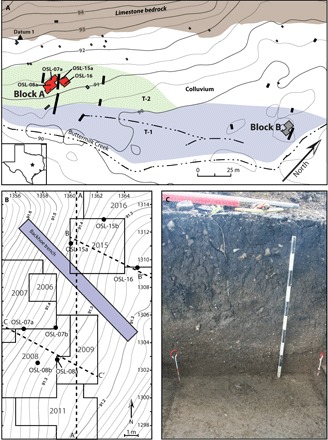
Verification
Claims the paper makes
46 Own result · 21 Own interpretation · 19 No full text of the sources · 15 Not checked yet · 9 Sources not found · 8 No basis given · 4 Partly supported · 4 Own method · accuracy not yet measured
The cited sources support only part of this claim — read each source’s verdict below.
In the paper
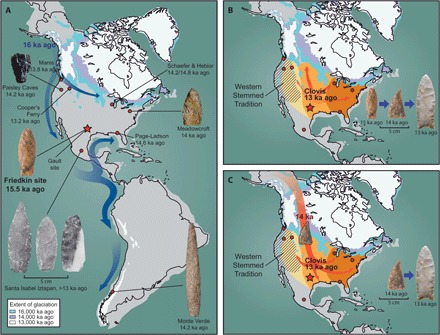
“These people likely arrived by traversing the Pacific coast using watercraft (Fig. 6A) (10, 32).”
§ Pre-Clovis projectile points at the Debra L. Friedkin site, Texas—Implications for the Late Pleistocene peopling of the Americas > DISCUSSION
What the sources say
- Not checked — no full text of the sourcecites [10] Beck C., Jones G. T., Clovis and Western Stemmed: Population migration and the meeting of two technologies in the Intermountain West. Am. Antiq. 75, 81– 116 (2010). source
- Partly supportedcites [32] Lesnek A. J., Briner J. P., Lindqvist C., Baichtal J. F., Heaton T. H., Deglaciation of the Pacific coastal corridor directly preceded the human colonization of the Americas. Sci. Adv. 4, eaar5040 (2018). 29854947 PMC5976267 sourceExperimental — accuracy not yet measured
The Introduction describes a possible migration of “sea-faring peoples” from Asia to the Americas, and the Discussion says the Pacific coastal corridor was a viable pathway for initial colonization. The paper does not establish that people likely arrived by that route; it says archaeological evidence is needed to evaluate the migration hypothesis. (LLM, conf=0.84)
hedgedconditional- Asserted: passes — The authors put it forward as true.
- Checkable: passes — It can be checked against evidence.
- Load-bearing: unclear — It is unclear whether the paper’s conclusions depend on it.
- Based: passes — The paper gives a reason why it holds.
The cited sources support only part of this claim — read each source’s verdict below.
In the paper
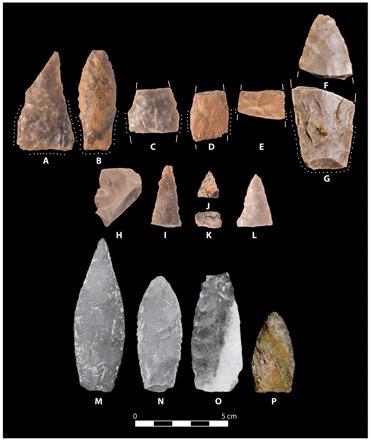
“In Mexico, a stemmed projectile point (Fig. 5O), along with other artifacts, was associated with the bones of a single mammoth buried in undisturbed lacustrine sediments at Santa Isabel Iztapan I (Fig. 6A) (29, 30).”
§ Pre-Clovis projectile points at the Debra L. Friedkin site, Texas—Implications for the Late Pleistocene peopling of the Americas > DISCUSSION
What the sources say
- Not checked — no full text of the sourcecites [29] Aveleyra Arroyo de Anda L., Maldonado-Koerdell M., Association of artifacts with mammoth in the Valley of Mexico. Am. Antiq. 18, 332– 340 (1953). source
- Partly supportedcites [30] Gonzalez S., Huddart D., Israde-Alcántara I., Domínguez-Vázquez G., Bischoff J., Felstead N., Paleoindian sites from the Basin of Mexico: Evidence from stratigraphy, tephrochronology and dating. Quat. Int. 363, 4– 19 (2015). sourceExperimental — accuracy not yet measured
Section 5.2 reports a mammoth skeleton at Santa Isabel Iztapan I embedded in green clay, with six lithic points and other artifacts directly associated with it. The paper describes one point as Scottsbluff-like, but our copy does not explicitly identify it as stemmed or establish that the sediments at site I were undisturbed. (LLM, conf=0.82)
plaincorrelationalSingle case- Asserted: passes — The authors put it forward as true.
- Checkable: passes — It can be checked against evidence.
- Load-bearing: unclear — It is unclear whether the paper’s conclusions depend on it.
- Based: passes — The paper gives a reason why it holds.
The cited sources support only part of this claim — read each source’s verdict below.
In the paper
“Also, along Buttermilk Creek, in similar deposits just 250 m upstream of Block A at the Friedkin site, stemmed projectile points dated to ~16 ka ago are reported below a Clovis horizon at Area 15 of the Gault site, Texas (15).”
§ Pre-Clovis projectile points at the Debra L. Friedkin site, Texas—Implications for the Late Pleistocene peopling of the Americas > DISCUSSION
What the sources say
- Partly supportedcites [15] Williams T. J., Collins M. B., Rodrigues K., Rink W. J., Velchoff N., Keen-Zebert A., Gilmer A., Frederick C. D., Ayala S. J., Prewitt E. R., Evidence of an early projectile point technology in North America at the Gault site, Texas, USA. Sci. Adv. 4, eaar5954 (2018). 30009257 PMC6040843 sourceExperimental — accuracy not yet measured
The Introduction (Background and Stone tool assemblage; page unavailable) reports stemmed projectile points in Area 15 deposits below the Clovis component, and Results and Discussion dates the Gault Assemblage to at least 16 ka. Our copy places Gault along Buttermilk Creek but does not substantiate the stated 250 m distance from Friedkin Block A or the comparison of their deposits. (LLM, conf=0.88)
plain- Asserted: passes — The authors put it forward as true.
- Checkable: passes — It can be checked against evidence.
- Load-bearing: unclear — It is unclear whether the paper’s conclusions depend on it.
- Based: passes — The paper gives a reason why it holds.
- Partly supported
A result the paper reports from its own data — it cites no other source for it, so there is none to check. The quote shows it is in the paper.
In the paper
“Seven of the 11 projectile points and point fragments occur in close proximity to specific OSL ages.”
§ Pre-Clovis projectile points at the Debra L. Friedkin site, Texas—Implications for the Late Pleistocene peopling of the Americas > RESULTS > Buttermilk Creek Complex horizon
plaincorrelational- Asserted: passes — The authors put it forward as true.
- Checkable: passes — It can be checked against evidence.
- Load-bearing: passes — The paper’s conclusions depend on it.
- Based: passes — The paper gives a reason why it holds.
A result the paper reports from its own data — it cites no other source for it, so there is none to check. The quote shows it is in the paper.
In the paper
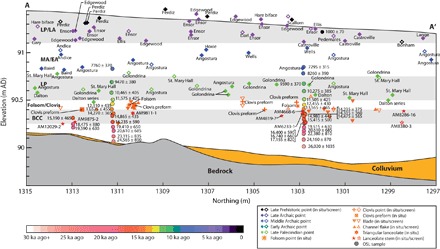
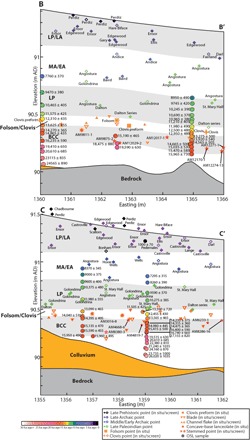
“A 10-cm-thick zone with Folsom and Clovis artifacts occurs below the Late Paleoindian horizon (Figs. 2 and 3).”
§ Pre-Clovis projectile points at the Debra L. Friedkin site, Texas—Implications for the Late Pleistocene peopling of the Americas > RESULTS > Late Prehistoric to Clovis archaeological horizons
plain- Asserted: passes — The authors put it forward as true.
- Checkable: passes — It can be checked against evidence.
- Load-bearing: unclear — It is unclear whether the paper’s conclusions depend on it.
- Based: passes — The paper gives a reason why it holds.
A result the paper reports from its own data — it cites no other source for it, so there is none to check. The quote shows it is in the paper.
In the paper
“These artifacts are dated to ~13.5 and ~15.5 ka ago by 19 OSL ages (table S2).”
§ Pre-Clovis projectile points at the Debra L. Friedkin site, Texas—Implications for the Late Pleistocene peopling of the Americas > RESULTS > Buttermilk Creek Complex horizon
plain- Asserted: passes — The authors put it forward as true.
- Checkable: passes — It can be checked against evidence.
- Load-bearing: passes — The paper’s conclusions depend on it.
- Based: passes — The paper gives a reason why it holds.
A result the paper reports from its own data — it cites no other source for it, so there is none to check. The quote shows it is in the paper.
In the paper
“Seven ages from the Folsom-Clovis zone range from 11,980 ± 490 yr B.P. (BG4208) to 13,590 ± 720 yr B.P. (UIC2059; Figs. 2 and 3 and table S2).”
§ Pre-Clovis projectile points at the Debra L. Friedkin site, Texas—Implications for the Late Pleistocene peopling of the Americas > RESULTS > Late Prehistoric to Clovis archaeological horizons
plain- Asserted: passes — The authors put it forward as true.
- Checkable: passes — It can be checked against evidence.
- Load-bearing: unclear — It is unclear whether the paper’s conclusions depend on it.
- Based: passes — The paper gives a reason why it holds.
A result the paper reports from its own data — it cites no other source for it, so there is none to check. The quote shows it is in the paper.
In the paper
“Lanceolate stemmed points include one complete specimen, one base fragment, four medial fragments, and five tips (Fig. 5, fig. S6, and table S3).”
§ Pre-Clovis projectile points at the Debra L. Friedkin site, Texas—Implications for the Late Pleistocene peopling of the Americas > RESULTS > Buttermilk Creek Complex horizon
plain- Asserted: passes — The authors put it forward as true.
- Checkable: passes — It can be checked against evidence.
- Load-bearing: unclear — It is unclear whether the paper’s conclusions depend on it.
- Based: passes — The paper gives a reason why it holds.
The paper states this without a source or data behind it here, so there is nothing to check it against. The quote shows it is in the paper.
In the paper
“Within a zone, most projectile points are in correct chronological order.”
§ Pre-Clovis projectile points at the Debra L. Friedkin site, Texas—Implications for the Late Pleistocene peopling of the Americas > RESULTS > Late Prehistoric to Clovis archaeological horizons
plaincorrelational- Asserted: passes — The authors put it forward as true.
- Checkable: passes — It can be checked against evidence.
- Load-bearing: passes — The paper’s conclusions depend on it.
- Based: passes — The paper gives a reason why it holds.
A result the paper reports from its own data — it cites no other source for it, so there is none to check. The quote shows it is in the paper.
In the paper
“Seventy OSL ages were obtained from the Late Pleistocene and Early Holocene sediments of Block A (Figs. 1 to 3 and figs. S1 to S3).”
§ Pre-Clovis projectile points at the Debra L. Friedkin site, Texas—Implications for the Late Pleistocene peopling of the Americas > RESULTS > Geology and geochronology
plain- Asserted: passes — The authors put it forward as true.
- Checkable: passes — It can be checked against evidence.
- Load-bearing: passes — The paper’s conclusions depend on it.
- Based: passes — The paper gives a reason why it holds.
A result the paper reports from its own data — it cites no other source for it, so there is none to check. The quote shows it is in the paper.
In the paper
“A single OSL age of 1000 ± 70 yr B.P. (UIC2352; Figs. 2 and 3 and table S2) was obtained from the Late Prehistoric and Late Archaic horizon associated with the Ensor and Ellis points at the Friedkin site.”
§ Pre-Clovis projectile points at the Debra L. Friedkin site, Texas—Implications for the Late Pleistocene peopling of the Americas > RESULTS > Late Prehistoric to Clovis archaeological horizons
plaincorrelationalSingle case- Asserted: passes — The authors put it forward as true.
- Checkable: passes — It can be checked against evidence.
- Load-bearing: unclear — It is unclear whether the paper’s conclusions depend on it.
- Based: passes — The paper gives a reason why it holds.
A result the paper reports from its own data — it cites no other source for it, so there is none to check. The quote shows it is in the paper.
In the paper
“Six OSL ages from the Middle Archaic and Early Archaic horizon at the Friedkin site range from 7295 ± 315 yr B.P. (UIC2360) to 9000 ± 375 yr B.P. (UIC2061; Figs. 2 and 3 and table S2).”
§ Pre-Clovis projectile points at the Debra L. Friedkin site, Texas—Implications for the Late Pleistocene peopling of the Americas > RESULTS > Late Prehistoric to Clovis archaeological horizons
plain- Asserted: passes — The authors put it forward as true.
- Checkable: passes — It can be checked against evidence.
- Load-bearing: unclear — It is unclear whether the paper’s conclusions depend on it.
- Based: passes — The paper gives a reason why it holds.
A result the paper reports from its own data — it cites no other source for it, so there is none to check. The quote shows it is in the paper.
In the paper
“End thinning and base beveling in preparation for end thinning found on Clovis preforms are absent in the pre–13-thousand-year-old biface assemblage.”
§ Pre-Clovis projectile points at the Debra L. Friedkin site, Texas—Implications for the Late Pleistocene peopling of the Americas > RESULTS > Buttermilk Creek Complex horizon
plain- Asserted: passes — The authors put it forward as true.
- Checkable: passes — It can be checked against evidence.
- Load-bearing: passes — The paper’s conclusions depend on it.
- Based: passes — The paper gives a reason why it holds.
In the paper
“Here, we report a robust lithic projectile point assemblage from the layers dated between ~13.5 and 15.5 ka ago at the Debra L. Friedkin site, Texas (11), which has implications for the origin of both the ~13-thousand-year-old lanceolate and stemmed point traditions of North America.”
§ Pre-Clovis projectile points at the Debra L. Friedkin site, Texas—Implications for the Late Pleistocene peopling of the Americas > INTRODUCTION
What the sources say
- Not checked — no full text of the sourcecites [11] Waters M. R., Forman S. L., Jennings T. A., Nordt L. C., Driese S. G., Feinberg J. M., Keene J. L., Halligan J., Lindquist A., Pierson J., Hallmark C. T., Collins M. B., Wiederhold J. E., The Buttermilk Creek complex and the origins of Clovis at the Debra L. Friedkin site, Texas. Science 331, 1599– 1603 (2011). 21436451 source
plain- Asserted: passes — The authors put it forward as true.
- Checkable: passes — It can be checked against evidence.
- Load-bearing: passes — The paper’s conclusions depend on it.
- Based: passes — The paper gives a reason why it holds.
A result the paper reports from its own data — it cites no other source for it, so there is none to check. The quote shows it is in the paper.
In the paper
“Lanceolate stemmed points at the Friedkin site are confined to the clays dating between ~13.5 and ~15.5 ka ago (Figs. 2 and 3 and table S2).”
§ Pre-Clovis projectile points at the Debra L. Friedkin site, Texas—Implications for the Late Pleistocene peopling of the Americas > RESULTS > Buttermilk Creek Complex horizon
plain- Asserted: passes — The authors put it forward as true.
- Checkable: passes — It can be checked against evidence.
- Load-bearing: passes — The paper’s conclusions depend on it.
- Based: passes — The paper gives a reason why it holds.
A result the paper reports from its own data — it cites no other source for it, so there is none to check. The quote shows it is in the paper.
In the paper
“Bayesian analyses of all OSL ages from four sediment columns yielded modeled ages with reduced SDs (fig. S1 and table S2).”
§ Pre-Clovis projectile points at the Debra L. Friedkin site, Texas—Implications for the Late Pleistocene peopling of the Americas > RESULTS > Geology and geochronology
plaindirect- Asserted: passes — The authors put it forward as true.
- Checkable: passes — It can be checked against evidence.
- Load-bearing: passes — The paper’s conclusions depend on it.
- Based: passes — The paper gives a reason why it holds.
None of the sources cited for this claim have been checked yet.
In the paper
“These artifacts group into four mutually exclusive zones that correspond to the prehistoric cultural periods of central Texas (18, 19).”
§ Pre-Clovis projectile points at the Debra L. Friedkin site, Texas—Implications for the Late Pleistocene peopling of the Americas > RESULTS > Late Prehistoric to Clovis archaeological horizons
What the sources say
- Not matchedcites [18] M. B. Collins, Archeology in Central Texas, in The Prehistory of Texas, T. K. Perttula, Ed. (Texas A&M Univ. Press, 2004), pp. 101–126.
Couldn’t be matched to a paper in Crossref, so it can’t be checked.
- Not checked yetcites [19] Lohse J., Black S. L., Cholak L. M., Toward an improved Archaic radiocarbon chronology for Central Texas. Bull. Texas Archeol. Soc. 85, 259– 287 (2014).
plaincorrelational- Asserted: passes — The authors put it forward as true.
- Checkable: passes — It can be checked against evidence.
- Load-bearing: passes — The paper’s conclusions depend on it.
- Based: passes — The paper gives a reason why it holds.
- Not matched
A result the paper reports from its own data — it cites no other source for it, so there is none to check. The quote shows it is in the paper.
In the paper
“Fourteen OSL ages, ranging from 9590 ± 370 yr B.P. (UIC2363) to 11,980 ± 555 yr B.P. (UIC2048; Figs. 2 and 3 and table S2), are from the Late Paleoindian horizon at the Friedkin site.”
§ Pre-Clovis projectile points at the Debra L. Friedkin site, Texas—Implications for the Late Pleistocene peopling of the Americas > RESULTS > Late Prehistoric to Clovis archaeological horizons
plain- Asserted: passes — The authors put it forward as true.
- Checkable: passes — It can be checked against evidence.
- Load-bearing: unclear — It is unclear whether the paper’s conclusions depend on it.
- Based: passes — The paper gives a reason why it holds.
The paper states this without a source or data behind it here, so there is nothing to check it against. The quote shows it is in the paper.
In the paper
“Four points (one Pedernales, one Bonham, one Darl, and one Castroville) are out of chronological order within the Late Prehistoric and Late Archaic zone.”
§ Pre-Clovis projectile points at the Debra L. Friedkin site, Texas—Implications for the Late Pleistocene peopling of the Americas > RESULTS > Late Prehistoric to Clovis archaeological horizons
plain- Asserted: passes — The authors put it forward as true.
- Checkable: passes — It can be checked against evidence.
- Load-bearing: unclear — It is unclear whether the paper’s conclusions depend on it.
- Based: passes — The paper gives a reason why it holds.
A result the paper reports from its own data — it cites no other source for it, so there is none to check. The quote shows it is in the paper.
In the paper
“These OSL dates encompass the known ages for the various Late Paleoindian projectile point types.”
§ Pre-Clovis projectile points at the Debra L. Friedkin site, Texas—Implications for the Late Pleistocene peopling of the Americas > RESULTS > Late Prehistoric to Clovis archaeological horizons
plaincorrelational- Asserted: passes — The authors put it forward as true.
- Checkable: passes — It can be checked against evidence.
- Load-bearing: unclear — It is unclear whether the paper’s conclusions depend on it.
- Based: passes — The paper gives a reason why it holds.
A result the paper reports from its own data — it cites no other source for it, so there is none to check. The quote shows it is in the paper.
In the paper
“In situ diagnostics of one zone are not found in overlying or underlying zones.”
§ Pre-Clovis projectile points at the Debra L. Friedkin site, Texas—Implications for the Late Pleistocene peopling of the Americas > RESULTS > Late Prehistoric to Clovis archaeological horizons
plain- Asserted: passes — The authors put it forward as true.
- Checkable: passes — It can be checked against evidence.
- Load-bearing: passes — The paper’s conclusions depend on it.
- Based: passes — The paper gives a reason why it holds.
A result the paper reports from its own data — it cites no other source for it, so there is none to check. The quote shows it is in the paper.
In the paper
“About 100,000 artifacts, including 328 tools and 12 complete and fragmentary projectile points of the Buttermilk Creek Complex, were excavated from the floodplain clays, 15 to 20 cm below the Folsom-Clovis zone (Figs. 2 to 5).”
§ Pre-Clovis projectile points at the Debra L. Friedkin site, Texas—Implications for the Late Pleistocene peopling of the Americas > RESULTS > Buttermilk Creek Complex horizon
plain- Asserted: passes — The authors put it forward as true.
- Checkable: passes — It can be checked against evidence.
- Load-bearing: passes — The paper’s conclusions depend on it.
- Based: passes — The paper gives a reason why it holds.
A result the paper reports from its own data — it cites no other source for it, so there is none to check. The quote shows it is in the paper.
In the paper
“All specimens show microscopic use-wear consistent with hafting and use as projectile points (fig. S8).”
§ Pre-Clovis projectile points at the Debra L. Friedkin site, Texas—Implications for the Late Pleistocene peopling of the Americas > RESULTS > Buttermilk Creek Complex horizon
plain- Asserted: passes — The authors put it forward as true.
- Checkable: passes — It can be checked against evidence.
- Load-bearing: passes — The paper’s conclusions depend on it.
- Based: passes — The paper gives a reason why it holds.
A result the paper reports from its own data — it cites no other source for it, so there is none to check. The quote shows it is in the paper.
In the paper
“Here, we describe the Buttermilk Creek Complex projectile point assemblage that includes lanceolate stemmed and triangular lanceolate forms (Fig. 5 and fig. S6).”
§ Pre-Clovis projectile points at the Debra L. Friedkin site, Texas—Implications for the Late Pleistocene peopling of the Americas > RESULTS > Buttermilk Creek Complex horizon
plain- Asserted: passes — The authors put it forward as true.
- Checkable: passes — It can be checked against evidence.
- Load-bearing: unclear — It is unclear whether the paper’s conclusions depend on it.
- Based: passes — The paper gives a reason why it holds.
A result the paper reports from its own data — it cites no other source for it, so there is none to check. The quote shows it is in the paper.
In the paper
“The bifaces show no evidence of end thinning or preparation of a beveled base for later fluting.”
§ Pre-Clovis projectile points at the Debra L. Friedkin site, Texas—Implications for the Late Pleistocene peopling of the Americas > RESULTS > Buttermilk Creek Complex horizon
plain- Asserted: passes — The authors put it forward as true.
- Checkable: passes — It can be checked against evidence.
- Load-bearing: passes — The paper’s conclusions depend on it.
- Based: passes — The paper gives a reason why it holds.
A result the paper reports from its own data — it cites no other source for it, so there is none to check. The quote shows it is in the paper.
In the paper
“A broken triangular lanceolate projectile point (AM9811-1) occurs in the uppermost portion of the clays ranging in age from ~13.5 to ~14 ka ago, below the Clovis horizon (Fig. 5A, fig. S6, and table S3).”
§ Pre-Clovis projectile points at the Debra L. Friedkin site, Texas—Implications for the Late Pleistocene peopling of the Americas > RESULTS > Buttermilk Creek Complex horizon
plainSingle case- Asserted: passes — The authors put it forward as true.
- Checkable: passes — It can be checked against evidence.
- Load-bearing: passes — The paper’s conclusions depend on it.
- Based: passes — The paper gives a reason why it holds.
A result the paper reports from its own data — it cites no other source for it, so there is none to check. The quote shows it is in the paper.
In the paper
“The 2007 column of OSL ages shows agreement indices of 115.4/116.7 (model and overall agreement) with a single outlier (UIC2050).”
§ Pre-Clovis projectile points at the Debra L. Friedkin site, Texas—Implications for the Late Pleistocene peopling of the Americas > MATERIALS AND METHODS > Statistical analysis: Bayesian analysis of OSL ages
plain- Asserted: passes — The authors put it forward as true.
- Checkable: passes — It can be checked against evidence.
- Load-bearing: unclear — It is unclear whether the paper’s conclusions depend on it.
- Based: passes — The paper gives a reason why it holds.
The paper states this without a source or data behind it here, so there is nothing to check it against. The quote shows it is in the paper.
In the paper
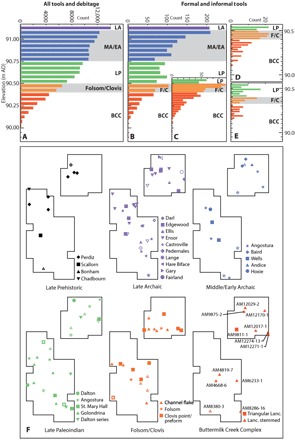
“Intense use of the Friedkin site over time combined with slow deposition has resulted in no clear indication of multimodal distribution of artifacts when all tools and debitage are considered (Fig. 4A).”
§ Pre-Clovis projectile points at the Debra L. Friedkin site, Texas—Implications for the Late Pleistocene peopling of the Americas > RESULTS > Integrity of the Late Prehistoric to Buttermilk Creek Complex horizons
plaindirect- Asserted: passes — The authors put it forward as true.
- Checkable: passes — It can be checked against evidence.
- Load-bearing: passes — The paper’s conclusions depend on it.
- Based: passes — The paper gives a reason why it holds.
A result the paper reports from its own data — it cites no other source for it, so there is none to check. The quote shows it is in the paper.
In the paper
“At the Friedkin site, there is a general increase through time in total lithic tools and debitage”
§ Pre-Clovis projectile points at the Debra L. Friedkin site, Texas—Implications for the Late Pleistocene peopling of the Americas > RESULTS > Integrity of the Late Prehistoric to Buttermilk Creek Complex horizons
plaindirect- Asserted: passes — The authors put it forward as true.
- Checkable: passes — It can be checked against evidence.
- Load-bearing: unclear — It is unclear whether the paper’s conclusions depend on it.
- Based: passes — The paper gives a reason why it holds.
A result the paper reports from its own data — it cites no other source for it, so there is none to check. The quote shows it is in the paper.
In the paper
“A large increase in tools at 90.50 to 90.45 m AD correlates with the top of the Folsom and Clovis horizon”
§ Pre-Clovis projectile points at the Debra L. Friedkin site, Texas—Implications for the Late Pleistocene peopling of the Americas > RESULTS > Integrity of the Late Prehistoric to Buttermilk Creek Complex horizons
plaincorrelational- Asserted: passes — The authors put it forward as true.
- Checkable: passes — It can be checked against evidence.
- Load-bearing: unclear — It is unclear whether the paper’s conclusions depend on it.
- Based: passes — The paper gives a reason why it holds.
A result the paper reports from its own data — it cites no other source for it, so there is none to check. The quote shows it is in the paper.
In the paper
“Here, we reported an assemblage of stemmed projectile points associated with other artifacts, below a Folsom and Clovis artifact–bearing layer at the Debra L. Friedkin site along Buttermilk Creek, Texas, dated to ~13.5 to ~15.5 ka ago.”
§ Pre-Clovis projectile points at the Debra L. Friedkin site, Texas—Implications for the Late Pleistocene peopling of the Americas > DISCUSSION
plaincorrelational- Asserted: passes — The authors put it forward as true.
- Checkable: passes — It can be checked against evidence.
- Load-bearing: passes — The paper’s conclusions depend on it.
- Based: passes — The paper gives a reason why it holds.
A result the paper reports from its own data — it cites no other source for it, so there is none to check. The quote shows it is in the paper.
In the paper
“When only the quantities of formal and informal tools with depth are plotted (Fig. 4, B and C), multiple modes of artifact concentrations appear”
§ Pre-Clovis projectile points at the Debra L. Friedkin site, Texas—Implications for the Late Pleistocene peopling of the Americas > RESULTS > Integrity of the Late Prehistoric to Buttermilk Creek Complex horizons
hedgedcorrelational- Asserted: passes — The authors put it forward as true.
- Checkable: passes — It can be checked against evidence.
- Load-bearing: passes — The paper’s conclusions depend on it.
- Based: passes — The paper gives a reason why it holds.
The paper states this without a source or data behind it here, so there is nothing to check it against. The quote shows it is in the paper.
In the paper
“A new point form, a triangular lanceolate point, appears at the Friedkin site by ~14 ka ago.”
§ Pre-Clovis projectile points at the Debra L. Friedkin site, Texas—Implications for the Late Pleistocene peopling of the Americas > DISCUSSION
hedged- Asserted: passes — The authors put it forward as true.
- Checkable: passes — It can be checked against evidence.
- Load-bearing: passes — The paper’s conclusions depend on it.
- Based: passes — The paper gives a reason why it holds.
A claim is checked only against the cited paper’s full text, never its abstract, and none is available for its sources.
In the paper
“Furthermore, a previous study of artifact size classes with depth at the Friedkin site (11, 16) showed no change in relative size class from the surface down to 90.225 m AD for artifacts larger than 0.625 cm in diameter.”
§ Pre-Clovis projectile points at the Debra L. Friedkin site, Texas—Implications for the Late Pleistocene peopling of the Americas > RESULTS > Integrity of the Late Prehistoric to Buttermilk Creek Complex horizons
What the sources say
- Not checked — no full text of the sourcecites [11] Waters M. R., Forman S. L., Jennings T. A., Nordt L. C., Driese S. G., Feinberg J. M., Keene J. L., Halligan J., Lindquist A., Pierson J., Hallmark C. T., Collins M. B., Wiederhold J. E., The Buttermilk Creek complex and the origins of Clovis at the Debra L. Friedkin site, Texas. Science 331, 1599– 1603 (2011). 21436451 source
- Not checked — no full text of the sourcecites [16] Driese S. G., Nordt L. C., Waters M. R., Keene J. L., Analysis of site formation history and potential disturbance of stratigraphic context in Vertisols at the Debra L. Friedkin archaeological site in central Texas, USA. Geoarchaeology 28, 221– 248 (2013). source
plain- Asserted: passes — The authors put it forward as true.
- Checkable: passes — It can be checked against evidence.
- Load-bearing: passes — The paper’s conclusions depend on it.
- Based: passes — The paper gives a reason why it holds.
A result the paper reports from its own data — it cites no other source for it, so there is none to check. The quote shows it is in the paper.
In the paper
“When the number of formal and informal tools is plotted with depth, the same peaks in the number of tools are still present but offset ~10 cm due to slope (Fig. 4, D and E).”
§ Pre-Clovis projectile points at the Debra L. Friedkin site, Texas—Implications for the Late Pleistocene peopling of the Americas > RESULTS > Integrity of the Late Prehistoric to Buttermilk Creek Complex horizons
plaindirectn = 2- Asserted: passes — The authors put it forward as true.
- Checkable: passes — It can be checked against evidence.
- Load-bearing: passes — The paper’s conclusions depend on it.
- Based: passes — The paper gives a reason why it holds.
In the paper
“In South America, humans occupied Monte Verde, Chile, by ~14.2 ka ago (3)”
§ Pre-Clovis projectile points at the Debra L. Friedkin site, Texas—Implications for the Late Pleistocene peopling of the Americas > INTRODUCTION
What the sources say
- Not checked — no full text of the sourcecites [3] Dillehay T. D., Ramírez C., Pino M., Collins M. B., Rossen J., Pino-Navarro J. D., Monte Verde: Seaweed, food, medicine, and the peopling of South America. Science 320, 784– 786 (2008). 18467586 source
plain- Asserted: passes — The authors put it forward as true.
- Checkable: passes — It can be checked against evidence.
- Load-bearing: passes — The paper’s conclusions depend on it.
- Based: passes — The paper gives a reason why it holds.
A conclusion the paper draws from its own results — it cites no other source for it, so there is none to check. The quote shows it is in the paper.
In the paper
“indicating that people must have been in North America ≥14.2 ka ago”
§ Pre-Clovis projectile points at the Debra L. Friedkin site, Texas—Implications for the Late Pleistocene peopling of the Americas > INTRODUCTION
hedged- Asserted: passes — The authors put it forward as true.
- Checkable: passes — It can be checked against evidence.
- Load-bearing: passes — The paper’s conclusions depend on it.
- Based: passes — The paper gives a reason why it holds.
The paper states this without a source or data behind it here, so there is nothing to check it against. The quote shows it is in the paper.
In the paper
“Archaeological studies over the last 25 years show that people successfully occupied the Americas ~14 to ~15 ka ago, in agreement with the genetic estimates.”
§ Pre-Clovis projectile points at the Debra L. Friedkin site, Texas—Implications for the Late Pleistocene peopling of the Americas > INTRODUCTION
plain- Asserted: passes — The authors put it forward as true.
- Checkable: passes — It can be checked against evidence.
- Load-bearing: unclear — It is unclear whether the paper’s conclusions depend on it.
- Based: passes — The paper gives a reason why it holds.
None of the sources cited for this claim have been checked yet.
In the paper
“genetic studies of modern Native Americans and prehistoric skeletons have shown that the initial movement of people south of the continental ice sheets occurred as early as ~15 to ~16 ka ago”
§ Pre-Clovis projectile points at the Debra L. Friedkin site, Texas—Implications for the Late Pleistocene peopling of the Americas > INTRODUCTION
What the sources say
- Not checked yetcites [1] Moreno-Mayar J. V., Potter B. A., Vinner L., Steinrücken M., Rasmussen S., Terhorst J., Kamm J. A., Albrechtsen A., Malaspinas A.-S., Sikora M., Reuther J. D., Irish J. D., Malhi R. S., Orlando L., Song Y. S., Nielsen R., Meltzer D. J., Willerslev E., Terminal Pleistocene Alaskan genome reveals first founding population of native Americans. Nature 553, 203– 207 (2018). 29323294 source
Checked before — its earlier verdict is held back until a new check runs.
- Not checked — no full text of the sourcecites [2] Scheib C. L., Hongjie L., Desai T., Link V., Kendall C., Dewar G., Griffith P. W., Mörseburg A., Johnson J. R., Potter A., Kerr S. L., Endicott P., Lindo J., Haber M., Xue Y., Tyler-Smith C., Sandhu M. S., Lorenz J. G., Randall T. D., Faltyskova Z., Pagani L., Danecek P., O’Connell T. C., Martz P., Boraas A. S., Byrd B. F., Leventhal A., Cambra R., Williamson R., Lessage L., Holguin B., Ygnacio-De Soto E., Rosas J., Metspalu M., Stock J. T., Manica A., Scally A., Wegmann D., Malhi R. S., Kivisild T., Ancient human parallel lineages within North America contributed to a coastal expansion. Scien source
plain- Asserted: passes — The authors put it forward as true.
- Checkable: passes — It can be checked against evidence.
- Load-bearing: unclear — It is unclear whether the paper’s conclusions depend on it.
- Based: passes — The paper gives a reason why it holds.
- Not checked yet
None of the sources cited for this claim could be matched to a paper in Crossref, so there is nothing to check it against.
In the paper
“This type of mixing of Late Prehistoric and Late Archaic point types in central Texas sites is common because of repeated use of cooking features during the Late Holocene [e.g., (18, 20)].”
§ Pre-Clovis projectile points at the Debra L. Friedkin site, Texas—Implications for the Late Pleistocene peopling of the Americas > RESULTS > Late Prehistoric to Clovis archaeological horizons
What the sources say
- Not matchedcites [18] M. B. Collins, Archeology in Central Texas, in The Prehistory of Texas, T. K. Perttula, Ed. (Texas A&M Univ. Press, 2004), pp. 101–126.
Couldn’t be matched to a paper in Crossref, so it can’t be checked.
- Not matchedcites [20] M. B. Collins, G. L. Bailey, N. A. Kenmotsu, F. A. Weir, Wilson-Leonard: An 11,000-year Archeological Record of Hunter-Gatherers in Central Texas (Studies in Archeology 31, Texas Archaeological Research Laboratory, University of Texas, 1998).
Couldn’t be matched to a paper in Crossref, so it can’t be checked.
plaindirect- Asserted: passes — The authors put it forward as true.
- Checkable: passes — It can be checked against evidence.
- Load-bearing: unclear — It is unclear whether the paper’s conclusions depend on it.
- Based: passes — The paper gives a reason why it holds.
- Not matched
A conclusion the paper draws from its own results — it cites no other source for it, so there is none to check. The quote shows it is in the paper.
In the paper
“This point lacks the distal tip due to a diagonal snap fracture that probably resulted from impact.”
§ Pre-Clovis projectile points at the Debra L. Friedkin site, Texas—Implications for the Late Pleistocene peopling of the Americas > RESULTS > Buttermilk Creek Complex horizon
hedgedconditionalSingle case- Asserted: passes — The authors put it forward as true.
- Checkable: passes — It can be checked against evidence.
- Load-bearing: unclear — It is unclear whether the paper’s conclusions depend on it.
- Based: passes — The paper gives a reason why it holds.
None of the sources cited for this claim have been checked yet.
In the paper
“Near and at the base of the Late Paleoindian zone at the Friedkin site are Dalton/Dalton series points that are radiocarbon dated elsewhere to between ~11.2 and ~12 ka ago (18, 22, 23).”
§ Pre-Clovis projectile points at the Debra L. Friedkin site, Texas—Implications for the Late Pleistocene peopling of the Americas > RESULTS > Late Prehistoric to Clovis archaeological horizons
What the sources say
- Not matchedcites [18] M. B. Collins, Archeology in Central Texas, in The Prehistory of Texas, T. K. Perttula, Ed. (Texas A&M Univ. Press, 2004), pp. 101–126.
Couldn’t be matched to a paper in Crossref, so it can’t be checked.
- Not matchedcites [22] C. B. Bousman, B. W. Baker, and A. C. Kerr, Paleoindian Archeology in Texas, in The Prehistory of Texas, T. K. Perttula, Ed. (Texas A&M Univ. Press, 2004), pp. 15–97.
Couldn’t be matched to a paper in Crossref, so it can’t be checked.
- Not checked — no full text of the sourcecites [23] Jennings T. A., Smallwood A. M., Waters M. R., Exploring late Paleoindian and early Archaic unfluted lanceolate point classification in the Southern Plains. North Am. Archaeol. 36, 243– 265 (2015). source
plain- Asserted: passes — The authors put it forward as true.
- Checkable: passes — It can be checked against evidence.
- Load-bearing: unclear — It is unclear whether the paper’s conclusions depend on it.
- Based: passes — The paper gives a reason why it holds.
- Not matched
A claim is checked only against the cited paper’s full text, never its abstract, and none is available for its sources.
In the paper
“Previous studies of the geology, pedology, micromorphology, and magnetic properties of the site’s sediments show that the deposits at the Friedkin site are minimally disturbed by postdepositional processes (11, 16, 17).”
§ Pre-Clovis projectile points at the Debra L. Friedkin site, Texas—Implications for the Late Pleistocene peopling of the Americas > RESULTS > Integrity of the Late Prehistoric to Buttermilk Creek Complex horizons
What the sources say
- Not checked — no full text of the sourcecites [11] Waters M. R., Forman S. L., Jennings T. A., Nordt L. C., Driese S. G., Feinberg J. M., Keene J. L., Halligan J., Lindquist A., Pierson J., Hallmark C. T., Collins M. B., Wiederhold J. E., The Buttermilk Creek complex and the origins of Clovis at the Debra L. Friedkin site, Texas. Science 331, 1599– 1603 (2011). 21436451 source
- Not checked — no full text of the sourcecites [16] Driese S. G., Nordt L. C., Waters M. R., Keene J. L., Analysis of site formation history and potential disturbance of stratigraphic context in Vertisols at the Debra L. Friedkin archaeological site in central Texas, USA. Geoarchaeology 28, 221– 248 (2013). source
- Not checked — no full text of the sourcecites [17] Lindquist A. K., Feinberg J. M., Waters M. R., Rock magnetic properties of a soil developed on an alluvial deposit at Buttermilk Creek, Texas, USA. Geochem. Geophys. Geosyst. 12, 1– 11 (2011). source
plain- Asserted: passes — The authors put it forward as true.
- Checkable: passes — It can be checked against evidence.
- Load-bearing: passes — The paper’s conclusions depend on it.
- Based: passes — The paper gives a reason why it holds.
What the paper did — it cites no source for this, so there is none to check. The quote shows it is in the paper.
In the paper
“Instead, the OSL dating method was used to determine the age of the artifacts at the Friedkin site by dating the floodplain sediments that bury them.”
§ Pre-Clovis projectile points at the Debra L. Friedkin site, Texas—Implications for the Late Pleistocene peopling of the Americas > RESULTS > Geology and geochronology
plaindirect- Asserted: passes — The authors put it forward as true.
- Checkable: passes — It can be checked against evidence.
- Load-bearing: passes — The paper’s conclusions depend on it.
- Based: passes — The paper gives a reason why it holds.
- Rests on an assumption: According to the geological principle of inclusions, any items, such as artifacts, in an undisturbed sedimentary deposit are at least as old as the sediments that contain them.
A conclusion the paper draws from its own results — it cites no other source for it, so there is none to check. The quote shows it is in the paper.
In the paper
“Since burial, these zones have remained intact with minimal disturbance.”
§ Pre-Clovis projectile points at the Debra L. Friedkin site, Texas—Implications for the Late Pleistocene peopling of the Americas > RESULTS > Late Prehistoric to Clovis archaeological horizons
plain- Asserted: passes — The authors put it forward as true.
- Checkable: passes — It can be checked against evidence.
- Load-bearing: passes — The paper’s conclusions depend on it.
- Based: passes — The paper gives a reason why it holds.
In the paper
“These types commonly co-occur at sites such as the Wilson-Leonard site, located 40 km from the Friedkin site, where Golondrina, St. Mary Hall, and Angostura types overlap in deposits radiocarbon dated between ~9.7 and ~11.1 ka ago (20).”
§ Pre-Clovis projectile points at the Debra L. Friedkin site, Texas—Implications for the Late Pleistocene peopling of the Americas > RESULTS > Late Prehistoric to Clovis archaeological horizons
What the sources say
- Not matchedcites [20] M. B. Collins, G. L. Bailey, N. A. Kenmotsu, F. A. Weir, Wilson-Leonard: An 11,000-year Archeological Record of Hunter-Gatherers in Central Texas (Studies in Archeology 31, Texas Archaeological Research Laboratory, University of Texas, 1998).
Couldn’t be matched to a paper in Crossref, so it can’t be checked.
plaincorrelational- Asserted: passes — The authors put it forward as true.
- Checkable: passes — It can be checked against evidence.
- Load-bearing: unclear — It is unclear whether the paper’s conclusions depend on it.
- Based: passes — The paper gives a reason why it holds.
- Not matched
None of the sources cited for this claim have been checked yet.
In the paper
“This assemblage compares well with the pre-Clovis assemblage from the Gault site (15).”
§ Pre-Clovis projectile points at the Debra L. Friedkin site, Texas—Implications for the Late Pleistocene peopling of the Americas > RESULTS > Buttermilk Creek Complex horizon
What the sources say
- Not checked yetcites [15] Williams T. J., Collins M. B., Rodrigues K., Rink W. J., Velchoff N., Keen-Zebert A., Gilmer A., Frederick C. D., Ayala S. J., Prewitt E. R., Evidence of an early projectile point technology in North America at the Gault site, Texas, USA. Sci. Adv. 4, eaar5954 (2018). 30009257 PMC6040843 source
Checked before — its earlier verdict is held back until a new check runs.
boostedcorrelational- Asserted: passes — The authors put it forward as true.
- Checkable: passes — It can be checked against evidence.
- Load-bearing: unclear — It is unclear whether the paper’s conclusions depend on it.
- Based: passes — The paper gives a reason why it holds.
- Not checked yet
A conclusion the paper draws from its own results — it cites no other source for it, so there is none to check. The quote shows it is in the paper.
In the paper
“This shows that there were sequential occupations on the Buttermilk Creek floodplain that were incrementally buried over time by sediment during repeated overbank events over the last 13 ka.”
§ Pre-Clovis projectile points at the Debra L. Friedkin site, Texas—Implications for the Late Pleistocene peopling of the Americas > RESULTS > Late Prehistoric to Clovis archaeological horizons
boosteddirect- Asserted: passes — The authors put it forward as true.
- Checkable: passes — It can be checked against evidence.
- Load-bearing: passes — The paper’s conclusions depend on it.
- Based: passes — The paper gives a reason why it holds.
In the paper
“The lanceolate stemmed points of the Buttermilk Creek Complex closely resemble an undated Texas projectile point type defined as “Early Stemmed Lanceolate” (25).”
§ Pre-Clovis projectile points at the Debra L. Friedkin site, Texas—Implications for the Late Pleistocene peopling of the Americas > RESULTS > Buttermilk Creek Complex horizon
What the sources say
- Not matchedcites [25] E. S. Turner, T. R. Hester, R. L. McReynolds, Stone Artifacts of Texas Indians (Taylor Trade Publishing, 2011).
Couldn’t be matched to a paper in Crossref, so it can’t be checked.
plaincorrelational- Asserted: passes — The authors put it forward as true.
- Checkable: passes — It can be checked against evidence.
- Load-bearing: unclear — It is unclear whether the paper’s conclusions depend on it.
- Based: passes — The paper gives a reason why it holds.
- Not matched
A conclusion the paper draws from its own results — it cites no other source for it, so there is none to check. The quote shows it is in the paper.
In the paper
“The superposition of cultural time horizons described for the Late Prehistoric through Clovis horizons at the site based on the distribution of 130 time-diagnostic artifacts shows that downward movement of large artifacts, such as projectile points, did not occur.”
§ Pre-Clovis projectile points at the Debra L. Friedkin site, Texas—Implications for the Late Pleistocene peopling of the Americas > RESULTS > Integrity of the Late Prehistoric to Buttermilk Creek Complex horizons
plain- Asserted: passes — The authors put it forward as true.
- Checkable: passes — It can be checked against evidence.
- Load-bearing: passes — The paper’s conclusions depend on it.
- Based: passes — The paper gives a reason why it holds.
A conclusion the paper draws from its own results — it cites no other source for it, so there is none to check. The quote shows it is in the paper.
In the paper
“These distributions again show that artifacts have remained in their original context, albeit on a sloping surface in the 2015–2016 block excavation.”
§ Pre-Clovis projectile points at the Debra L. Friedkin site, Texas—Implications for the Late Pleistocene peopling of the Americas > RESULTS > Integrity of the Late Prehistoric to Buttermilk Creek Complex horizons
plain- Asserted: passes — The authors put it forward as true.
- Checkable: passes — It can be checked against evidence.
- Load-bearing: passes — The paper’s conclusions depend on it.
- Based: passes — The paper gives a reason why it holds.
In the paper
“This corridor would have been open for migration by ~16 ka ago as the Cordilleran Ice Sheet retreated and exposed tracks of land along the coast (32).”
§ Pre-Clovis projectile points at the Debra L. Friedkin site, Texas—Implications for the Late Pleistocene peopling of the Americas > DISCUSSION
What the sources say
- Not checked yetcites [32] Lesnek A. J., Briner J. P., Lindqvist C., Baichtal J. F., Heaton T. H., Deglaciation of the Pacific coastal corridor directly preceded the human colonization of the Americas. Sci. Adv. 4, eaar5040 (2018). 29854947 PMC5976267 source
hedgeddirect- Asserted: passes — The authors put it forward as true.
- Checkable: passes — It can be checked against evidence.
- Load-bearing: passes — The paper’s conclusions depend on it.
- Based: passes — The paper gives a reason why it holds.
A conclusion the paper draws from its own results — it cites no other source for it, so there is none to check. The quote shows it is in the paper.
In the paper
“and that there is an in situ cultural horizon predating Clovis at the site.”
§ Pre-Clovis projectile points at the Debra L. Friedkin site, Texas—Implications for the Late Pleistocene peopling of the Americas > RESULTS > Integrity of the Late Prehistoric to Buttermilk Creek Complex horizons
plain- Asserted: passes — The authors put it forward as true.
- Checkable: passes — It can be checked against evidence.
- Load-bearing: passes — The paper’s conclusions depend on it.
- Based: passes — The paper gives a reason why it holds.
A conclusion the paper draws from its own results — it cites no other source for it, so there is none to check. The quote shows it is in the paper.
In the paper
“which suggest changes in local lithic reduction activities through time.”
§ Pre-Clovis projectile points at the Debra L. Friedkin site, Texas—Implications for the Late Pleistocene peopling of the Americas > RESULTS > Integrity of the Late Prehistoric to Buttermilk Creek Complex horizons
hedgedcorrelationaln = 2- Asserted: passes — The authors put it forward as true.
- Checkable: passes — It can be checked against evidence.
- Load-bearing: unclear — It is unclear whether the paper’s conclusions depend on it.
- Based: passes — The paper gives a reason why it holds.
A conclusion the paper draws from its own results — it cites no other source for it, so there is none to check. The quote shows it is in the paper.
In the paper
“that the OSL ages from the site are accurate”
§ Pre-Clovis projectile points at the Debra L. Friedkin site, Texas—Implications for the Late Pleistocene peopling of the Americas > RESULTS > Integrity of the Late Prehistoric to Buttermilk Creek Complex horizons
plain- Asserted: passes — The authors put it forward as true.
- Checkable: passes — It can be checked against evidence.
- Load-bearing: passes — The paper’s conclusions depend on it.
- Based: passes — The paper gives a reason why it holds.
- The authors state this as an assumption: The U and Th decay series are in secular equilibrium in the dated sediments.
- Rests on an assumption: The moisture content of the dated sediments during burial was similar to that of the nearby pedons used to derive it.
- Rests on an assumption: The cosmic ray dose rate component can be estimated from the current depth of burial.
What the paper did — it cites no source for this, so there is none to check. The quote shows it is in the paper.
In the paper
“There was concordance (±10%) with the known dose for preheat temperatures between 160° and 200°C with a used initial preheat temperature of 180°C for 10 s in the SAR protocols (fig. S3).”
§ Pre-Clovis projectile points at the Debra L. Friedkin site, Texas—Implications for the Late Pleistocene peopling of the Americas > MATERIALS AND METHODS > OSL dating
plaincorrelational- Asserted: passes — The authors put it forward as true.
- Checkable: passes — It can be checked against evidence.
- Load-bearing: passes — The paper’s conclusions depend on it.
- Based: passes — The paper gives a reason why it holds.
A conclusion the paper draws from its own results — it cites no other source for it, so there is none to check. The quote shows it is in the paper.
In the paper
“that appears to reflect a continuous increase in lithic reduction activity from the Late Pleistocene through the Holocene”
§ Pre-Clovis projectile points at the Debra L. Friedkin site, Texas—Implications for the Late Pleistocene peopling of the Americas > RESULTS > Integrity of the Late Prehistoric to Buttermilk Creek Complex horizons
hedgeddirect- Asserted: passes — The authors put it forward as true.
- Checkable: passes — It can be checked against evidence.
- Load-bearing: unclear — It is unclear whether the paper’s conclusions depend on it.
- Based: passes — The paper gives a reason why it holds.
A conclusion the paper draws from its own results — it cites no other source for it, so there is none to check. The quote shows it is in the paper.
In the paper
“The evidence from Friedkin, Gault, and other sites suggests that the earliest known people to enter the Americas were using stemmed points.”
§ Pre-Clovis projectile points at the Debra L. Friedkin site, Texas—Implications for the Late Pleistocene peopling of the Americas > DISCUSSION
hedgedcorrelational- Asserted: passes — The authors put it forward as true.
- Checkable: passes — It can be checked against evidence.
- Load-bearing: passes — The paper’s conclusions depend on it.
- Based: passes — The paper gives a reason why it holds.
In the paper
“This, combined with the lack of diagnostic Clovis technology in the site assemblage, suggests that stemmed points may date to the earliest occupation at Paisley Caves (9).”
§ Pre-Clovis projectile points at the Debra L. Friedkin site, Texas—Implications for the Late Pleistocene peopling of the Americas > DISCUSSION
What the sources say
- Not checked — no full text of the sourcecites [9] Jenkins D. L., Davis L. G., Stafford T. W. Jr, Campos P. F., Hockett B., Jones G. T., Cummings L. S., Yost C., Connolly T. J., Yohe R. M. II, Gibbons S. C., Raghavan M., Rasmussen M., Paijmans J. L. A., Hofreiter M., Kemp B. M., Barta J. L., Monroe C., Gilbert M. T. P., Willerslev E., Clovis age Western Stemmed projectile points and human coprolites at the Paisley Caves. Science 337, 223– 228 (2012). 22798611 source
hedgedcorrelational- Asserted: passes — The authors put it forward as true.
- Checkable: passes — It can be checked against evidence.
- Load-bearing: unclear — It is unclear whether the paper’s conclusions depend on it.
- Based: passes — The paper gives a reason why it holds.
In the paper
“The interior corridor between the Cordilleran and Laurentide ice sheets did not open until ~14 ka ago”
§ Pre-Clovis projectile points at the Debra L. Friedkin site, Texas—Implications for the Late Pleistocene peopling of the Americas > DISCUSSION
What the sources say
- Not checked yetcites [32] Lesnek A. J., Briner J. P., Lindqvist C., Baichtal J. F., Heaton T. H., Deglaciation of the Pacific coastal corridor directly preceded the human colonization of the Americas. Sci. Adv. 4, eaar5040 (2018). 29854947 PMC5976267 source
plain- Asserted: passes — The authors put it forward as true.
- Checkable: passes — It can be checked against evidence.
- Load-bearing: passes — The paper’s conclusions depend on it.
- Based: passes — The paper gives a reason why it holds.
A conclusion the paper draws from its own results — it cites no other source for it, so there is none to check. The quote shows it is in the paper.
In the paper
“Variation in the number of formal tools with depth also demonstrates the presence of intact cultural horizons at the Friedkin site.”
§ Pre-Clovis projectile points at the Debra L. Friedkin site, Texas—Implications for the Late Pleistocene peopling of the Americas > RESULTS > Integrity of the Late Prehistoric to Buttermilk Creek Complex horizons
boosteddirect- Asserted: passes — The authors put it forward as true.
- Checkable: passes — It can be checked against evidence.
- Load-bearing: passes — The paper’s conclusions depend on it.
- Based: passes — The paper gives a reason why it holds.
What the paper did — it cites no source for this, so there is none to check. The quote shows it is in the paper.
In the paper
“All four columns are internally consistent with very good agreement levels.”
§ Pre-Clovis projectile points at the Debra L. Friedkin site, Texas—Implications for the Late Pleistocene peopling of the Americas > MATERIALS AND METHODS > Statistical analysis: Bayesian analysis of OSL ages
plain- Asserted: passes — The authors put it forward as true.
- Checkable: passes — It can be checked against evidence.
- Load-bearing: passes — The paper’s conclusions depend on it.
- Based: passes — The paper gives a reason why it holds.
A claim is checked only against the cited paper’s full text, never its abstract, and none is available for its sources.
In the paper
“we focused on OSL dating the 4- to 11-μm quartz fraction, which had yielded previously accurate ages (11, 13).”
§ Pre-Clovis projectile points at the Debra L. Friedkin site, Texas—Implications for the Late Pleistocene peopling of the Americas > MATERIALS AND METHODS > OSL dating
What the sources say
- Not checked — no full text of the sourcecites [11] Waters M. R., Forman S. L., Jennings T. A., Nordt L. C., Driese S. G., Feinberg J. M., Keene J. L., Halligan J., Lindquist A., Pierson J., Hallmark C. T., Collins M. B., Wiederhold J. E., The Buttermilk Creek complex and the origins of Clovis at the Debra L. Friedkin site, Texas. Science 331, 1599– 1603 (2011). 21436451 source
- Not checked — no full text of the sourcecites [13] Forman S. L., Waters M. R., Optically stimulated luminescence dating and the peopling of the Americas. PaleoAmerica 2, 6– 10 (2016). source
plain- Asserted: passes — The authors put it forward as true.
- Checkable: passes — It can be checked against evidence.
- Load-bearing: passes — The paper’s conclusions depend on it.
- Based: passes — The paper gives a reason why it holds.
- The authors state this as an assumption: The U and Th decay series are in secular equilibrium in the dated sediments.
- Rests on an assumption: The moisture content of the dated sediments during burial was similar to that of the nearby pedons used to derive it.
- Rests on an assumption: The cosmic ray dose rate component can be estimated from the current depth of burial.
A claim is checked only against the cited paper’s full text, never its abstract, and none is available for its sources.
In the paper
“In short, 130 time-diagnostic artifacts within the Late Prehistoric to Clovis horizons, coupled with all other previous studies (11, 16, 17), show that downward movement of artifacts did not take place at the site.”
§ Pre-Clovis projectile points at the Debra L. Friedkin site, Texas—Implications for the Late Pleistocene peopling of the Americas > RESULTS > Integrity of the Late Prehistoric to Buttermilk Creek Complex horizons
What the sources say
- Not checked — no full text of the sourcecites [11] Waters M. R., Forman S. L., Jennings T. A., Nordt L. C., Driese S. G., Feinberg J. M., Keene J. L., Halligan J., Lindquist A., Pierson J., Hallmark C. T., Collins M. B., Wiederhold J. E., The Buttermilk Creek complex and the origins of Clovis at the Debra L. Friedkin site, Texas. Science 331, 1599– 1603 (2011). 21436451 source
- Not checked — no full text of the sourcecites [16] Driese S. G., Nordt L. C., Waters M. R., Keene J. L., Analysis of site formation history and potential disturbance of stratigraphic context in Vertisols at the Debra L. Friedkin archaeological site in central Texas, USA. Geoarchaeology 28, 221– 248 (2013). source
- Not checked — no full text of the sourcecites [17] Lindquist A. K., Feinberg J. M., Waters M. R., Rock magnetic properties of a soil developed on an alluvial deposit at Buttermilk Creek, Texas, USA. Geochem. Geophys. Geosyst. 12, 1– 11 (2011). source
boosted- Asserted: passes — The authors put it forward as true.
- Checkable: passes — It can be checked against evidence.
- Load-bearing: passes — The paper’s conclusions depend on it.
- Based: passes — The paper gives a reason why it holds.
In the paper
“and bison and other animals were passing through the corridor by ~13 ka ago (32).”
§ Pre-Clovis projectile points at the Debra L. Friedkin site, Texas—Implications for the Late Pleistocene peopling of the Americas > DISCUSSION
What the sources say
- Not checked yetcites [32] Lesnek A. J., Briner J. P., Lindqvist C., Baichtal J. F., Heaton T. H., Deglaciation of the Pacific coastal corridor directly preceded the human colonization of the Americas. Sci. Adv. 4, eaar5040 (2018). 29854947 PMC5976267 source
plain- Asserted: passes — The authors put it forward as true.
- Checkable: passes — It can be checked against evidence.
- Load-bearing: unclear — It is unclear whether the paper’s conclusions depend on it.
- Based: passes — The paper gives a reason why it holds.
A conclusion the paper draws from its own results — it cites no other source for it, so there is none to check. The quote shows it is in the paper.
In the paper
“These lines of evidence demonstrate that there has been minimal to no movement of artifacts between cultural zones at the site”
§ Pre-Clovis projectile points at the Debra L. Friedkin site, Texas—Implications for the Late Pleistocene peopling of the Americas > RESULTS > Integrity of the Late Prehistoric to Buttermilk Creek Complex horizons
boosted- Asserted: passes — The authors put it forward as true.
- Checkable: passes — It can be checked against evidence.
- Load-bearing: passes — The paper’s conclusions depend on it.
- Based: passes — The paper gives a reason why it holds.
A conclusion the paper draws from its own results — it cites no other source for it, so there is none to check. The quote shows it is in the paper.
In the paper
“The ice-free corridor did not open soon enough to explain the presence of people south of the ice before ~14 ka ago.”
§ Pre-Clovis projectile points at the Debra L. Friedkin site, Texas—Implications for the Late Pleistocene peopling of the Americas > DISCUSSION
plaindirect- Asserted: passes — The authors put it forward as true.
- Checkable: passes — It can be checked against evidence.
- Load-bearing: passes — The paper’s conclusions depend on it.
- Based: passes — The paper gives a reason why it holds.
In the paper
“Four hundred meters away, at Santa Isabel Iztapan II, two stemmed points (Fig. 5, M and N) were associated with butchered mammoth bones in the same lacustrine sediments (29).”
§ Pre-Clovis projectile points at the Debra L. Friedkin site, Texas—Implications for the Late Pleistocene peopling of the Americas > DISCUSSION
What the sources say
- Not checked — no full text of the sourcecites [29] Aveleyra Arroyo de Anda L., Maldonado-Koerdell M., Association of artifacts with mammoth in the Valley of Mexico. Am. Antiq. 18, 332– 340 (1953). source
plaincorrelational- Asserted: passes — The authors put it forward as true.
- Checkable: passes — It can be checked against evidence.
- Load-bearing: unclear — It is unclear whether the paper’s conclusions depend on it.
- Based: passes — The paper gives a reason why it holds.
In the paper
“These Western Stemmed Tradition projectile points are at least contemporaneous with Clovis, dated to ~12.7 to ~13 ka ago (9).”
§ Pre-Clovis projectile points at the Debra L. Friedkin site, Texas—Implications for the Late Pleistocene peopling of the Americas > DISCUSSION
What the sources say
- Not checked — no full text of the sourcecites [9] Jenkins D. L., Davis L. G., Stafford T. W. Jr, Campos P. F., Hockett B., Jones G. T., Cummings L. S., Yost C., Connolly T. J., Yohe R. M. II, Gibbons S. C., Raghavan M., Rasmussen M., Paijmans J. L. A., Hofreiter M., Kemp B. M., Barta J. L., Monroe C., Gilbert M. T. P., Willerslev E., Clovis age Western Stemmed projectile points and human coprolites at the Paisley Caves. Science 337, 223– 228 (2012). 22798611 source
plaincorrelational- Asserted: passes — The authors put it forward as true.
- Checkable: passes — It can be checked against evidence.
- Load-bearing: passes — The paper’s conclusions depend on it.
- Based: passes — The paper gives a reason why it holds.
A conclusion the paper draws from its own results — it cites no other source for it, so there is none to check. The quote shows it is in the paper.
In the paper
“with two smaller peaks below this, at 90.375 to 90.35 m AD and 90.30 to 90.275 m AD, that seem to reflect separate occupation episodes in the Buttermilk Creek Complex horizon.”
§ Pre-Clovis projectile points at the Debra L. Friedkin site, Texas—Implications for the Late Pleistocene peopling of the Americas > RESULTS > Integrity of the Late Prehistoric to Buttermilk Creek Complex horizons
hedgedcorrelationaln = 2- Asserted: passes — The authors put it forward as true.
- Checkable: passes — It can be checked against evidence.
- Load-bearing: unclear — It is unclear whether the paper’s conclusions depend on it.
- Based: passes — The paper gives a reason why it holds.
- It may state two separate claims as one. 43
- Probably not a substantial claim. 22
The cited sources support only part of this claim — read each source’s verdict below.
In the paper
“In North America, humans were present during the period ~14 to ~15 ka ago, as documented by archaeological evidence radiocarbon dated to ~14.6 ka ago at Page-Ladson, Florida (4); ~14.2 ka ago at Paisley Caves, Oregon (5); ~14.2 and ~14.8 ka ago at Schaefer and Hebior, Wisconsin (6, 7); and ~13.8 ka ago at Manis, Washington (8).”
§ Pre-Clovis projectile points at the Debra L. Friedkin site, Texas—Implications for the Late Pleistocene peopling of the Americas > INTRODUCTION
What the sources say
- Supportedcites [4] Halligan J. J., Waters M. R., Perrotti A., Owens I. J., Feinberg J. M., Bourne M. D., Fenerty B., Winsborough B., Carlson D., Fisher D. C., Stafford T. W. Jr, Dunbar J. S., Pre-Clovis occupation 14,550 years ago at the Page-Ladson site, Florida, and the peopling of the Americas. Sci. Adv. 2, e1600375 (2016). 27386553 PMC4928949 source
Split into 2 atoms — 2 confirmed, 0 partially supported, 0 disputed, 0 misattributed, 0 unverifiable. Expand the claim to see per-atom verdicts.
- Partly supportedcites [5] Gilbert M. T. P., Jenkins D. L., Götherstrom A., Naveran N., Sanchez J. J., Hofreiter M., Thomsen P. F., Binladen J., Higham T. F. G., Yohne R. M. II, Parr R., Cummings L. S., Willerslev E., DNA from pre-Clovis human coprolites in Oregon, North America. Science 320, 786– 789 (2008). 18388261 sourceExperimental — accuracy not yet measured
Split into 2 atoms — 0 confirmed, 2 partially supported, 0 disputed, 0 misattributed, 0 unverifiable. Expand the claim to see per-atom verdicts.
- Not checked — no full text of the sourcecites [6] Joyce D. J., Chronology and new research on the Schaefer mammoth (Mammuthus primigenius) site, Kenosha County, Wisconsin, USA. Quat. Int. 142–143, 44– 57 (2006). source
- Not matchedcites [7] M. R. Waters, T. W. Stafford, The First Americans: A review of the evidence for the late-Pleistocene peopling of the Americas, in Paleoamerican Odyssey, K. E. Graf, C. V. Ketron, M. R. Waters, Eds. (Texas A&M Univ. Press, 2014), pp. 541–560.
Couldn’t be matched to a paper in Crossref, so it can’t be checked.
plain- Asserted: passes — The authors put it forward as true.
- Checkable: passes — It can be checked against evidence.
- Load-bearing: unclear — It is unclear whether the paper’s conclusions depend on it.
- Based: passes — The paper gives a reason why it holds.
It may state two separate claims as one.
- Supported
The paper states this without a source or data behind it here, so there is nothing to check it against. The quote shows it is in the paper.
In the paper
“Stemmed projectile points are ~13,500 to ~15,500 years old and lie stratigraphically below ~13,000-year-old Clovis artifacts.”
§ Pre-Clovis projectile points at the Debra L. Friedkin site, Texas—Implications for the Late Pleistocene peopling of the Americas > Abstract
plain- Asserted: passes — The authors put it forward as true.
- Checkable: passes — It can be checked against evidence.
- Load-bearing: passes — The paper’s conclusions depend on it.
- Based: passes — The paper gives a reason why it holds.
It may state two separate claims as one.
A result the paper reports from its own data — it cites no other source for it, so there is none to check. The quote shows it is in the paper.
In the paper
“Most flake scars on these bifaces terminate at the midline, but five bifaces show flakes crossing over the midline of the biface (overface flaking) and two display a rolled edge from an overshot flake removal. Two overshot flakes were found in the same deposits.”
§ Pre-Clovis projectile points at the Debra L. Friedkin site, Texas—Implications for the Late Pleistocene peopling of the Americas > RESULTS > Buttermilk Creek Complex horizon
plain- Asserted: passes — The authors put it forward as true.
- Checkable: passes — It can be checked against evidence.
- Load-bearing: unclear — It is unclear whether the paper’s conclusions depend on it.
- Based: passes — The paper gives a reason why it holds.
It may state two separate claims as one.
A result the paper reports from its own data — it cites no other source for it, so there is none to check. The quote shows it is in the paper.
In the paper
“Forty late-stage biface fragments were found in the ~13.5- to ~15.5-thousand-year-old sediments. Of these, 13 are large enough to provide insights into the production of stemmed lanceolate points (fig. S7 and table S3).”
§ Pre-Clovis projectile points at the Debra L. Friedkin site, Texas—Implications for the Late Pleistocene peopling of the Americas > RESULTS > Buttermilk Creek Complex horizon
plain- Asserted: passes — The authors put it forward as true.
- Checkable: passes — It can be checked against evidence.
- Load-bearing: passes — The paper’s conclusions depend on it.
- Based: passes — The paper gives a reason why it holds.
It may state two separate claims as one.
A result the paper reports from its own data — it cites no other source for it, so there is none to check. The quote shows it is in the paper.
In the paper
“Near the top of this zone are a Folsom point fragment and two late-stage Folsom preform flute failures (fig. S4). These Folsom artifacts are separated up to 9 m horizontally (Fig. 4F) but only 1.7 cm vertically.”
§ Pre-Clovis projectile points at the Debra L. Friedkin site, Texas—Implications for the Late Pleistocene peopling of the Americas > RESULTS > Late Prehistoric to Clovis archaeological horizons
plain- Asserted: passes — The authors put it forward as true.
- Checkable: passes — It can be checked against evidence.
- Load-bearing: fails — The paper’s conclusions may not depend on it.
- Based: passes — The paper gives a reason why it holds.
Probably not a substantial claim. The paper’s conclusions may not depend on it. It may state two separate claims as one.
A result the paper reports from its own data — it cites no other source for it, so there is none to check. The quote shows it is in the paper.
In the paper
“Both exhibit overface and overshot flaking, reflecting similar biface thinning strategies; however, these flaking techniques were used with greater frequency to produce Clovis preforms.”
§ Pre-Clovis projectile points at the Debra L. Friedkin site, Texas—Implications for the Late Pleistocene peopling of the Americas > RESULTS > Buttermilk Creek Complex horizon
plaincorrelational- Asserted: passes — The authors put it forward as true.
- Checkable: passes — It can be checked against evidence.
- Load-bearing: unclear — It is unclear whether the paper’s conclusions depend on it.
- Based: passes — The paper gives a reason why it holds.
It may state two separate claims as one.
A result the paper reports from its own data — it cites no other source for it, so there is none to check. The quote shows it is in the paper.
In the paper
“The pre–13-thousand-year-old bifaces are predominately made on large flake blanks, whereas the Clovis bifaces were made from both nodules and flake blanks.”
§ Pre-Clovis projectile points at the Debra L. Friedkin site, Texas—Implications for the Late Pleistocene peopling of the Americas > RESULTS > Buttermilk Creek Complex horizon
plaincorrelational- Asserted: passes — The authors put it forward as true.
- Checkable: passes — It can be checked against evidence.
- Load-bearing: unclear — It is unclear whether the paper’s conclusions depend on it.
- Based: passes — The paper gives a reason why it holds.
It may state two separate claims as one.
A result the paper reports from its own data — it cites no other source for it, so there is none to check. The quote shows it is in the paper.
In the paper
“The OSL ages ranging from 11,210 ± 405 yr B.P. (BG4206) to 11,980 ± 555 yr B.P. (UIC2048) occur in the zone with the Dalton/Dalton series points (Figs. 2 and 3) and again agree well with the known age for Dalton at other sites.”
§ Pre-Clovis projectile points at the Debra L. Friedkin site, Texas—Implications for the Late Pleistocene peopling of the Americas > RESULTS > Late Prehistoric to Clovis archaeological horizons
boostedcorrelational- Asserted: passes — The authors put it forward as true.
- Checkable: passes — It can be checked against evidence.
- Load-bearing: unclear — It is unclear whether the paper’s conclusions depend on it.
- Based: passes — The paper gives a reason why it holds.
It may state two separate claims as one.
A result the paper reports from its own data — it cites no other source for it, so there is none to check. The quote shows it is in the paper.
In the paper
“In addition to the points and other bifaces, the ~13.5- to ~15.5-thousand-year-old assemblage at the Friedkin site also includes blade segments, bladelets, scrapers, bifacial discoidal cores, and snap fracture tools (radial and bend break) most commonly made on flakes but also bifaces, retouched flakes, expedient tools, and ground hematite.”
§ Pre-Clovis projectile points at the Debra L. Friedkin site, Texas—Implications for the Late Pleistocene peopling of the Americas > RESULTS > Buttermilk Creek Complex horizon
plain- Asserted: passes — The authors put it forward as true.
- Checkable: passes — It can be checked against evidence.
- Load-bearing: unclear — It is unclear whether the paper’s conclusions depend on it.
- Based: passes — The paper gives a reason why it holds.
It may state two separate claims as one.
A result the paper reports from its own data — it cites no other source for it, so there is none to check. The quote shows it is in the paper.
In the paper
“In the upper 0.8 to 1.1 m of the floodplain sequence at Block A, we recovered over 639,000 artifacts, including over 4600 tools, of which 130 are time diagnostic (mostly projectile points).”
§ Pre-Clovis projectile points at the Debra L. Friedkin site, Texas—Implications for the Late Pleistocene peopling of the Americas > RESULTS > Late Prehistoric to Clovis archaeological horizons
plain- Asserted: passes — The authors put it forward as true.
- Checkable: passes — It can be checked against evidence.
- Load-bearing: unclear — It is unclear whether the paper’s conclusions depend on it.
- Based: passes — The paper gives a reason why it holds.
It may state two separate claims as one.
A result the paper reports from its own data — it cites no other source for it, so there is none to check. The quote shows it is in the paper.
In the paper
“The other point fragments (AM12170-1, AM6233-1, AM8380-3, and AM8286-16) occur 2.4 to 5.3 m from the nearest OSL column. These points lie in the horizon dated between ~13.5 and ~15.5 ka ago.”
§ Pre-Clovis projectile points at the Debra L. Friedkin site, Texas—Implications for the Late Pleistocene peopling of the Americas > RESULTS > Buttermilk Creek Complex horizon
plain- Asserted: passes — The authors put it forward as true.
- Checkable: passes — It can be checked against evidence.
- Load-bearing: passes — The paper’s conclusions depend on it.
- Based: passes — The paper gives a reason why it holds.
It may state two separate claims as one.
A result the paper reports from its own data — it cites no other source for it, so there is none to check. The quote shows it is in the paper.
In the paper
“These zones occur in chronological order, with Late Prehistoric and Late Archaic artifacts occurring near the surface, followed by a zone with only Middle Archaic and Early Archaic artifacts, then by a deeper zone with Late Paleoindian point types, and below this a zone containing only Folsom and Clovis artifacts (Figs. 2 and 3).”
§ Pre-Clovis projectile points at the Debra L. Friedkin site, Texas—Implications for the Late Pleistocene peopling of the Americas > RESULTS > Late Prehistoric to Clovis archaeological horizons
plaincorrelational- Asserted: passes — The authors put it forward as true.
- Checkable: passes — It can be checked against evidence.
- Load-bearing: passes — The paper’s conclusions depend on it.
- Based: passes — The paper gives a reason why it holds.
It may state two separate claims as one.
A result the paper reports from its own data — it cites no other source for it, so there is none to check. The quote shows it is in the paper.
In the paper
“Angostura points are associated with all six OSL ages; four ages overlap with the known minimum age for Angostura (~8.6 ka ago), but two OSL ages appear too young for Angostura.”
§ Pre-Clovis projectile points at the Debra L. Friedkin site, Texas—Implications for the Late Pleistocene peopling of the Americas > RESULTS > Late Prehistoric to Clovis archaeological horizons
hedgedcorrelational- Asserted: passes — The authors put it forward as true.
- Checkable: passes — It can be checked against evidence.
- Load-bearing: unclear — It is unclear whether the paper’s conclusions depend on it.
- Based: passes — The paper gives a reason why it holds.
It may state two separate claims as one.
A result the paper reports from its own data — it cites no other source for it, so there is none to check. The quote shows it is in the paper.
In the paper
“Forty-four Late Prehistoric and Late Archaic points are in chronological order (Figs. 2 and 3).”
§ Pre-Clovis projectile points at the Debra L. Friedkin site, Texas—Implications for the Late Pleistocene peopling of the Americas > RESULTS > Late Prehistoric to Clovis archaeological horizons
plain- Asserted: passes — The authors put it forward as true.
- Checkable: passes — It can be checked against evidence.
- Load-bearing: fails — The paper’s conclusions may not depend on it.
- Based: passes — The paper gives a reason why it holds.
Probably not a substantial claim. The paper’s conclusions may not depend on it.
A result the paper reports from its own data — it cites no other source for it, so there is none to check. The quote shows it is in the paper.
In the paper
“Three OSL ages temporally bracket the complete point (AM9875-2) that rested horizontally on older floodplain clays; the two ages below the point are 18,480 ± 880 yr B.P. (BG3994) and 19,410 ± 650 yr B.P. (BG4076), and, at 3 cm above this point, the age is 15,190 ± 465 yr B.P. (BG3995).”
§ Pre-Clovis projectile points at the Debra L. Friedkin site, Texas—Implications for the Late Pleistocene peopling of the Americas > RESULTS > Buttermilk Creek Complex horizon
plainSingle case- Asserted: passes — The authors put it forward as true.
- Checkable: passes — It can be checked against evidence.
- Load-bearing: passes — The paper’s conclusions depend on it.
- Based: passes — The paper gives a reason why it holds.
It may state two separate claims as one.
A result the paper reports from its own data — it cites no other source for it, so there is none to check. The quote shows it is in the paper.
In the paper
“In addition, nine channel flakes were recovered. Seven were found within the Folsom and Clovis zone, one was found <2.5 cm below the lower boundary, and one was found <5 cm above the upper contact of this zone (Figs. 2 and 3).”
§ Pre-Clovis projectile points at the Debra L. Friedkin site, Texas—Implications for the Late Pleistocene peopling of the Americas > RESULTS > Late Prehistoric to Clovis archaeological horizons
plain- Asserted: passes — The authors put it forward as true.
- Checkable: passes — It can be checked against evidence.
- Load-bearing: fails — The paper’s conclusions may not depend on it.
- Based: passes — The paper gives a reason why it holds.
Probably not a substantial claim. The paper’s conclusions may not depend on it. It may state two separate claims as one.
A result the paper reports from its own data — it cites no other source for it, so there is none to check. The quote shows it is in the paper.
In the paper
“This point was found at the same elevation and 1 m south of the OSL age 14,270 ± 365 yr B.P. (BG4017). A second age 13,625 ± 455 yr B.P. (BG4019) was obtained 4.5 cm above the point.”
§ Pre-Clovis projectile points at the Debra L. Friedkin site, Texas—Implications for the Late Pleistocene peopling of the Americas > RESULTS > Buttermilk Creek Complex horizon
plainSingle case- Asserted: passes — The authors put it forward as true.
- Checkable: passes — It can be checked against evidence.
- Load-bearing: passes — The paper’s conclusions depend on it.
- Based: passes — The paper gives a reason why it holds.
It may state two separate claims as one.
A result the paper reports from its own data — it cites no other source for it, so there is none to check. The quote shows it is in the paper.
In the paper
“Correlation of Bayesian-modeled OSL ages and time-diagnostic artifacts shows that, in most areas of the site, floodplain sediments were horizontally deposited, but slope slightly upward at the northwest end of the 2007 excavation area and downward at the southeast end of the 2016 excavation area of Block A (Figs. 1 to 3).”
§ Pre-Clovis projectile points at the Debra L. Friedkin site, Texas—Implications for the Late Pleistocene peopling of the Americas > RESULTS > Geology and geochronology
plaincorrelational- Asserted: passes — The authors put it forward as true.
- Checkable: passes — It can be checked against evidence.
- Load-bearing: unclear — It is unclear whether the paper’s conclusions depend on it.
- Based: passes — The paper gives a reason why it holds.
It may state two separate claims as one.
A result the paper reports from its own data — it cites no other source for it, so there is none to check. The quote shows it is in the paper.
In the paper
“In the Middle Archaic and Early Archaic zone at the Friedkin site, 15 time-diagnostic Early Archaic projectile points were recovered (Figs. 2 to 4).”
§ Pre-Clovis projectile points at the Debra L. Friedkin site, Texas—Implications for the Late Pleistocene peopling of the Americas > RESULTS > Late Prehistoric to Clovis archaeological horizons
plain- Asserted: passes — The authors put it forward as true.
- Checkable: passes — It can be checked against evidence.
- Load-bearing: fails — The paper’s conclusions may not depend on it.
- Based: passes — The paper gives a reason why it holds.
Probably not a substantial claim. The paper’s conclusions may not depend on it.
In the paper
“Thirty-eight OSL ages were previously published (11). Here, we present 32 new OSL ages obtained in 2015 and 2016 (table S1).”
§ Pre-Clovis projectile points at the Debra L. Friedkin site, Texas—Implications for the Late Pleistocene peopling of the Americas > RESULTS > Geology and geochronology
What the sources say
- Not checked — no full text of the sourcecites [11] Waters M. R., Forman S. L., Jennings T. A., Nordt L. C., Driese S. G., Feinberg J. M., Keene J. L., Halligan J., Lindquist A., Pierson J., Hallmark C. T., Collins M. B., Wiederhold J. E., The Buttermilk Creek complex and the origins of Clovis at the Debra L. Friedkin site, Texas. Science 331, 1599– 1603 (2011). 21436451 source
plain- Asserted: passes — The authors put it forward as true.
- Checkable: passes — It can be checked against evidence.
- Load-bearing: fails — The paper’s conclusions may not depend on it.
- Based: passes — The paper gives a reason why it holds.
Probably not a substantial claim. The paper’s conclusions may not depend on it. It may state two separate claims as one.
In the paper
“These ages fall within the known age range for Folsom (~12.2 to 12.7 ka ago) and Clovis (~12.7 to ~13 ka ago) (7).”
§ Pre-Clovis projectile points at the Debra L. Friedkin site, Texas—Implications for the Late Pleistocene peopling of the Americas > RESULTS > Late Prehistoric to Clovis archaeological horizons
What the sources say
- Not matchedcites [7] M. R. Waters, T. W. Stafford, The First Americans: A review of the evidence for the late-Pleistocene peopling of the Americas, in Paleoamerican Odyssey, K. E. Graf, C. V. Ketron, M. R. Waters, Eds. (Texas A&M Univ. Press, 2014), pp. 541–560.
Couldn’t be matched to a paper in Crossref, so it can’t be checked.
plain- Asserted: passes — The authors put it forward as true.
- Checkable: passes — It can be checked against evidence.
- Load-bearing: unclear — It is unclear whether the paper’s conclusions depend on it.
- Based: passes — The paper gives a reason why it holds.
It may state two separate claims as one.
- Not matched
A result the paper reports from its own data — it cites no other source for it, so there is none to check. The quote shows it is in the paper.
In the paper
“The Clovis point base (AM12018-1) is within 20 cm of the 2016 column of OSL ages and is bracketed by ages of 12,500 ± 480 yr B.P. (BG4209) and 12,950 ± 480 yr B.P. (BG4218).”
§ Pre-Clovis projectile points at the Debra L. Friedkin site, Texas—Implications for the Late Pleistocene peopling of the Americas > RESULTS > Late Prehistoric to Clovis archaeological horizons
plain- Asserted: passes — The authors put it forward as true.
- Checkable: passes — It can be checked against evidence.
- Load-bearing: unclear — It is unclear whether the paper’s conclusions depend on it.
- Based: passes — The paper gives a reason why it holds.
It may state two separate claims as one.
In the paper
“The deepest floodplain clays are OSL dated to >16 ka ago (n = 13) and have no in situ artifacts (Figs. 2 and 3 and table S2) (11).”
§ Pre-Clovis projectile points at the Debra L. Friedkin site, Texas—Implications for the Late Pleistocene peopling of the Americas > RESULTS > Buttermilk Creek Complex horizon
What the sources say
- Not checked — no full text of the sourcecites [11] Waters M. R., Forman S. L., Jennings T. A., Nordt L. C., Driese S. G., Feinberg J. M., Keene J. L., Halligan J., Lindquist A., Pierson J., Hallmark C. T., Collins M. B., Wiederhold J. E., The Buttermilk Creek complex and the origins of Clovis at the Debra L. Friedkin site, Texas. Science 331, 1599– 1603 (2011). 21436451 source
plainn = 13- Asserted: passes — The authors put it forward as true.
- Checkable: passes — It can be checked against evidence.
- Load-bearing: passes — The paper’s conclusions depend on it.
- Based: passes — The paper gives a reason why it holds.
It may state two separate claims as one.
A result the paper reports from its own data — it cites no other source for it, so there is none to check. The quote shows it is in the paper.
In the paper
“The Late Paleoindian zone at the Friedkin site contains five Angostura, five St. Mary Hall, nine Golondrina, and five Dalton/Dalton series points (Figs. 2 and 4).”
§ Pre-Clovis projectile points at the Debra L. Friedkin site, Texas—Implications for the Late Pleistocene peopling of the Americas > RESULTS > Late Prehistoric to Clovis archaeological horizons
plain- Asserted: passes — The authors put it forward as true.
- Checkable: passes — It can be checked against evidence.
- Load-bearing: unclear — It is unclear whether the paper’s conclusions depend on it.
- Based: passes — The paper gives a reason why it holds.
It may state two separate claims as one.
A result the paper reports from its own data — it cites no other source for it, so there is none to check. The quote shows it is in the paper.
In the paper
“Analysis of the 2016 column produced agreement indices of 187.1/179.8 with no outliers.”
§ Pre-Clovis projectile points at the Debra L. Friedkin site, Texas—Implications for the Late Pleistocene peopling of the Americas > MATERIALS AND METHODS > Statistical analysis: Bayesian analysis of OSL ages
plain- Asserted: passes — The authors put it forward as true.
- Checkable: passes — It can be checked against evidence.
- Load-bearing: fails — The paper’s conclusions may not depend on it.
- Based: passes — The paper gives a reason why it holds.
Probably not a substantial claim. The paper’s conclusions may not depend on it. It may state two separate claims as one.
A result the paper reports from its own data — it cites no other source for it, so there is none to check. The quote shows it is in the paper.
In the paper
“The 2008 and 2015 columns were combined into a single Bayesian age model that resulted in model agreement values of 182.3/185.7 with two outliers (UIC2361 and UIC2349).”
§ Pre-Clovis projectile points at the Debra L. Friedkin site, Texas—Implications for the Late Pleistocene peopling of the Americas > MATERIALS AND METHODS > Statistical analysis: Bayesian analysis of OSL ages
plaindirect- Asserted: passes — The authors put it forward as true.
- Checkable: passes — It can be checked against evidence.
- Load-bearing: fails — The paper’s conclusions may not depend on it.
- Based: passes — The paper gives a reason why it holds.
Probably not a substantial claim. The paper’s conclusions may not depend on it.
A claim is checked only against the cited paper’s full text, never its abstract, and none is available for its sources.
In the paper
“It was not until ~13 ka ago that the first recognizable and widespread North American archaeological traditions appeared, with people making lanceolate fluted points in central and eastern North America (Clovis Tradition) and others using stemmed projectile points in unglaciated western North America (Western Stemmed Tradition) (9, 10).”
§ Pre-Clovis projectile points at the Debra L. Friedkin site, Texas—Implications for the Late Pleistocene peopling of the Americas > INTRODUCTION
What the sources say
- Not checked — no full text of the sourcecites [9] Jenkins D. L., Davis L. G., Stafford T. W. Jr, Campos P. F., Hockett B., Jones G. T., Cummings L. S., Yost C., Connolly T. J., Yohe R. M. II, Gibbons S. C., Raghavan M., Rasmussen M., Paijmans J. L. A., Hofreiter M., Kemp B. M., Barta J. L., Monroe C., Gilbert M. T. P., Willerslev E., Clovis age Western Stemmed projectile points and human coprolites at the Paisley Caves. Science 337, 223– 228 (2012). 22798611 source
- Not checked — no full text of the sourcecites [10] Beck C., Jones G. T., Clovis and Western Stemmed: Population migration and the meeting of two technologies in the Intermountain West. Am. Antiq. 75, 81– 116 (2010). source
plain- Asserted: passes — The authors put it forward as true.
- Checkable: passes — It can be checked against evidence.
- Load-bearing: passes — The paper’s conclusions depend on it.
- Based: passes — The paper gives a reason why it holds.
It may state two separate claims as one.
None of the sources cited for this claim have been checked yet.
In the paper
“there is genetic continuity between the first immigrants to enter the Americas and modern Native Americans (1, 2)”
§ Pre-Clovis projectile points at the Debra L. Friedkin site, Texas—Implications for the Late Pleistocene peopling of the Americas > INTRODUCTION
What the sources say
- Not checked yetcites [1] Moreno-Mayar J. V., Potter B. A., Vinner L., Steinrücken M., Rasmussen S., Terhorst J., Kamm J. A., Albrechtsen A., Malaspinas A.-S., Sikora M., Reuther J. D., Irish J. D., Malhi R. S., Orlando L., Song Y. S., Nielsen R., Meltzer D. J., Willerslev E., Terminal Pleistocene Alaskan genome reveals first founding population of native Americans. Nature 553, 203– 207 (2018). 29323294 source
Checked before — its earlier verdict is held back until a new check runs.
- Not checked — no full text of the sourcecites [2] Scheib C. L., Hongjie L., Desai T., Link V., Kendall C., Dewar G., Griffith P. W., Mörseburg A., Johnson J. R., Potter A., Kerr S. L., Endicott P., Lindo J., Haber M., Xue Y., Tyler-Smith C., Sandhu M. S., Lorenz J. G., Randall T. D., Faltyskova Z., Pagani L., Danecek P., O’Connell T. C., Martz P., Boraas A. S., Byrd B. F., Leventhal A., Cambra R., Williamson R., Lessage L., Holguin B., Ygnacio-De Soto E., Rosas J., Metspalu M., Stock J. T., Manica A., Scally A., Wegmann D., Malhi R. S., Kivisild T., Ancient human parallel lineages within North America contributed to a coastal expansion. Scien source
plaincorrelational- Asserted: passes — The authors put it forward as true.
- Checkable: passes — It can be checked against evidence.
- Load-bearing: fails — The paper’s conclusions may not depend on it.
- Based: passes — The paper gives a reason why it holds.
Probably not a substantial claim. The paper’s conclusions may not depend on it.
- Not checked yet
The paper states this without a source or data behind it here, so there is nothing to check it against. The quote shows it is in the paper.
In the paper
“However, the artifact assemblages from these ~14- to ~15-thousand-year-old North American sites are small and nondiagnostic, and lithic projectile points are absent.”
§ Pre-Clovis projectile points at the Debra L. Friedkin site, Texas—Implications for the Late Pleistocene peopling of the Americas > INTRODUCTION
plain- Asserted: passes — The authors put it forward as true.
- Checkable: passes — It can be checked against evidence.
- Load-bearing: passes — The paper’s conclusions depend on it.
- Based: passes — The paper gives a reason why it holds.
It may state two separate claims as one.
None of the sources cited for this claim have been checked yet.
In the paper
“Luminescence dating has also been used to successfully date archaeological sites in North America such as the Clovis horizon at Pavo Real, Texas, and the Archaic, Paleoindian, and pre-Clovis horizons at the Gault site, Texas (12, 14, 15).”
§ Pre-Clovis projectile points at the Debra L. Friedkin site, Texas—Implications for the Late Pleistocene peopling of the Americas > RESULTS > Geology and geochronology
What the sources say
- Not matchedcites [12] M. R. Waters, C. D. Pevny, D. L. Carlson, Clovis Lithic Technology: Investigation of a Stratified Workshop at the Gault Site, Texas (Texas A&M Univ. Press, 2011).
Couldn’t be matched to a paper in Crossref, so it can’t be checked.
- Not checked — no full text of the sourcecites [14] Rodrigues K., Rink W. J., Collins M. B., Williams T. J., Keen-Zebert A., Lόpez G. I., OSL ages of the Clovis, Late Paleoindian, and Archaic components at Area 15 of the Gault Site, Central Texas, U.S.A. J. Archaeol. Sci. Rep. 7, 94– 103 (2016). source
- Not checked yetcites [15] Williams T. J., Collins M. B., Rodrigues K., Rink W. J., Velchoff N., Keen-Zebert A., Gilmer A., Frederick C. D., Ayala S. J., Prewitt E. R., Evidence of an early projectile point technology in North America at the Gault site, Texas, USA. Sci. Adv. 4, eaar5954 (2018). 30009257 PMC6040843 source
Checked before — its earlier verdict is held back until a new check runs.
plaindirect- Asserted: passes — The authors put it forward as true.
- Checkable: passes — It can be checked against evidence.
- Load-bearing: fails — The paper’s conclusions may not depend on it.
- Based: passes — The paper gives a reason why it holds.
Probably not a substantial claim. The paper’s conclusions may not depend on it.
- Not matched
A conclusion the paper draws from its own results — it cites no other source for it, so there is none to check. The quote shows it is in the paper.
In the paper
“All bifaces are plano-convex in cross section, indicating that lanceolate stemmed points were made from flake blanks that were bifacially reduced by lateral thinning.”
§ Pre-Clovis projectile points at the Debra L. Friedkin site, Texas—Implications for the Late Pleistocene peopling of the Americas > RESULTS > Buttermilk Creek Complex horizon
hedgeddirect- Asserted: passes — The authors put it forward as true.
- Checkable: passes — It can be checked against evidence.
- Load-bearing: passes — The paper’s conclusions depend on it.
- Based: passes — The paper gives a reason why it holds.
It may state two separate claims as one.
In the paper
“The OSL method has been used for decades to date Late Quaternary deposits and has been shown to yield accurate ages; many tests have shown that OSL ages are in agreement with radiocarbon ages (13).”
§ Pre-Clovis projectile points at the Debra L. Friedkin site, Texas—Implications for the Late Pleistocene peopling of the Americas > RESULTS > Geology and geochronology
What the sources say
- Not checked — no full text of the sourcecites [13] Forman S. L., Waters M. R., Optically stimulated luminescence dating and the peopling of the Americas. PaleoAmerica 2, 6– 10 (2016). source
boostedcorrelational- Asserted: passes — The authors put it forward as true.
- Checkable: passes — It can be checked against evidence.
- Load-bearing: passes — The paper’s conclusions depend on it.
- Based: passes — The paper gives a reason why it holds.
It may state two separate claims as one.
A conclusion the paper draws from its own results — it cites no other source for it, so there is none to check. The quote shows it is in the paper.
In the paper
“Overall, these results show that within the Late Prehistoric to Clovis horizons at the Friedkin site, the relative order of time-diagnostic artifacts matches the known cultural chronology for central Texas, and the known ages for time-diagnostic artifacts overlap with OSL ages.”
§ Pre-Clovis projectile points at the Debra L. Friedkin site, Texas—Implications for the Late Pleistocene peopling of the Americas > RESULTS > Late Prehistoric to Clovis archaeological horizons
plaincorrelational- Asserted: passes — The authors put it forward as true.
- Checkable: passes — It can be checked against evidence.
- Load-bearing: passes — The paper’s conclusions depend on it.
- Based: passes — The paper gives a reason why it holds.
It may state two separate claims as one.
The paper states this without a source or data behind it here, so there is nothing to check it against. The quote shows it is in the paper.
In the paper
“It is not uncommon for older projectile point types to be found in a younger cultural context because prehistoric people would sometimes pick up older points from the surface and bring them to their camps.”
§ Pre-Clovis projectile points at the Debra L. Friedkin site, Texas—Implications for the Late Pleistocene peopling of the Americas > RESULTS > Late Prehistoric to Clovis archaeological horizons
hedgeddirect- Asserted: passes — The authors put it forward as true.
- Checkable: passes — It can be checked against evidence.
- Load-bearing: fails — The paper’s conclusions may not depend on it.
- Based: fails — The paper may give no reason why it holds.
Probably not a substantial claim. The paper’s conclusions may not depend on it. The paper may give no reason why it holds.
A conclusion the paper draws from its own results — it cites no other source for it, so there is none to check. The quote shows it is in the paper.
In the paper
“This suggests that either this type extends later in time or some of the Angostura points at the Friedkin site may be intrusive into the youngest Early Archaic sediments.”
§ Pre-Clovis projectile points at the Debra L. Friedkin site, Texas—Implications for the Late Pleistocene peopling of the Americas > RESULTS > Late Prehistoric to Clovis archaeological horizons
hedgedconditional- Asserted: passes — The authors put it forward as true.
- Checkable: passes — It can be checked against evidence.
- Load-bearing: unclear — It is unclear whether the paper’s conclusions depend on it.
- Based: passes — The paper gives a reason why it holds.
It may state two separate claims as one.
None of the sources cited for this claim have been checked yet.
In the paper
“In central Texas, the Late Prehistoric period postdates ~0.65 ka ago, and the Late Archaic period dates between ~0.65 and ~4.2 ka ago (18, 19).”
§ Pre-Clovis projectile points at the Debra L. Friedkin site, Texas—Implications for the Late Pleistocene peopling of the Americas > RESULTS > Late Prehistoric to Clovis archaeological horizons
What the sources say
- Not matchedcites [18] M. B. Collins, Archeology in Central Texas, in The Prehistory of Texas, T. K. Perttula, Ed. (Texas A&M Univ. Press, 2004), pp. 101–126.
Couldn’t be matched to a paper in Crossref, so it can’t be checked.
- Not checked yetcites [19] Lohse J., Black S. L., Cholak L. M., Toward an improved Archaic radiocarbon chronology for Central Texas. Bull. Texas Archeol. Soc. 85, 259– 287 (2014).
plain- Asserted: passes — The authors put it forward as true.
- Checkable: passes — It can be checked against evidence.
- Load-bearing: fails — The paper’s conclusions may not depend on it.
- Based: passes — The paper gives a reason why it holds.
Probably not a substantial claim. The paper’s conclusions may not depend on it. It may state two separate claims as one.
- Not matched
A claim is checked only against the cited paper’s full text, never its abstract, and none is available for its sources.
In the paper
“This assemblage, combined with the newly described projectile points, makes up the Buttermilk Creek Complex (11, 24).”
§ Pre-Clovis projectile points at the Debra L. Friedkin site, Texas—Implications for the Late Pleistocene peopling of the Americas > RESULTS > Buttermilk Creek Complex horizon
What the sources say
- Not checked — no full text of the sourcecites [11] Waters M. R., Forman S. L., Jennings T. A., Nordt L. C., Driese S. G., Feinberg J. M., Keene J. L., Halligan J., Lindquist A., Pierson J., Hallmark C. T., Collins M. B., Wiederhold J. E., The Buttermilk Creek complex and the origins of Clovis at the Debra L. Friedkin site, Texas. Science 331, 1599– 1603 (2011). 21436451 source
- Not checked — no full text of the sourcecites [24] Jennings T. A., Waters M. R., Pre-Clovis lithic technology at the Debra L. Friedkin site, Texas: Comparisons to Clovis through site-level behavior, technological trait-list, and cladistics analysis. Am. Antiq. 79, 25– 44 (2014). source
plain- Asserted: passes — The authors put it forward as true.
- Checkable: passes — It can be checked against evidence.
- Load-bearing: fails — The paper’s conclusions may not depend on it.
- Based: passes — The paper gives a reason why it holds.
Probably not a substantial claim. The paper’s conclusions may not depend on it.
None of the sources cited for this claim have been checked yet.
In the paper
“Below the Middle Archaic and Early Archaic zone is a 25-cm-thick zone with Late Paleoindian diagnostic artifacts, known to date ~9 to 12 ka ago in central Texas (18, 20, 22, 23).”
§ Pre-Clovis projectile points at the Debra L. Friedkin site, Texas—Implications for the Late Pleistocene peopling of the Americas > RESULTS > Late Prehistoric to Clovis archaeological horizons
What the sources say
- Not matchedcites [18] M. B. Collins, Archeology in Central Texas, in The Prehistory of Texas, T. K. Perttula, Ed. (Texas A&M Univ. Press, 2004), pp. 101–126.
Couldn’t be matched to a paper in Crossref, so it can’t be checked.
- Not matchedcites [20] M. B. Collins, G. L. Bailey, N. A. Kenmotsu, F. A. Weir, Wilson-Leonard: An 11,000-year Archeological Record of Hunter-Gatherers in Central Texas (Studies in Archeology 31, Texas Archaeological Research Laboratory, University of Texas, 1998).
Couldn’t be matched to a paper in Crossref, so it can’t be checked.
- Not matchedcites [22] C. B. Bousman, B. W. Baker, and A. C. Kerr, Paleoindian Archeology in Texas, in The Prehistory of Texas, T. K. Perttula, Ed. (Texas A&M Univ. Press, 2004), pp. 15–97.
Couldn’t be matched to a paper in Crossref, so it can’t be checked.
- Not checked — no full text of the sourcecites [23] Jennings T. A., Smallwood A. M., Waters M. R., Exploring late Paleoindian and early Archaic unfluted lanceolate point classification in the Southern Plains. North Am. Archaeol. 36, 243– 265 (2015). source
boosted- Asserted: passes — The authors put it forward as true.
- Checkable: passes — It can be checked against evidence.
- Load-bearing: unclear — It is unclear whether the paper’s conclusions depend on it.
- Based: passes — The paper gives a reason why it holds.
It may state two separate claims as one.
- Not matched
None of the sources cited for this claim have been checked yet.
In the paper
“These types are poorly dated, but estimates place Golondrina at ~9.6 to ~11.2 ka ago, St. Mary Hall at ~9.8 to ~11.5 ka ago, and Angostura at ~8.6 to 10.4 ka ago (18, 22, 23).”
§ Pre-Clovis projectile points at the Debra L. Friedkin site, Texas—Implications for the Late Pleistocene peopling of the Americas > RESULTS > Late Prehistoric to Clovis archaeological horizons
What the sources say
- Not matchedcites [18] M. B. Collins, Archeology in Central Texas, in The Prehistory of Texas, T. K. Perttula, Ed. (Texas A&M Univ. Press, 2004), pp. 101–126.
Couldn’t be matched to a paper in Crossref, so it can’t be checked.
- Not matchedcites [22] C. B. Bousman, B. W. Baker, and A. C. Kerr, Paleoindian Archeology in Texas, in The Prehistory of Texas, T. K. Perttula, Ed. (Texas A&M Univ. Press, 2004), pp. 15–97.
Couldn’t be matched to a paper in Crossref, so it can’t be checked.
- Not checked — no full text of the sourcecites [23] Jennings T. A., Smallwood A. M., Waters M. R., Exploring late Paleoindian and early Archaic unfluted lanceolate point classification in the Southern Plains. North Am. Archaeol. 36, 243– 265 (2015). source
hedged- Asserted: passes — The authors put it forward as true.
- Checkable: passes — It can be checked against evidence.
- Load-bearing: unclear — It is unclear whether the paper’s conclusions depend on it.
- Based: passes — The paper gives a reason why it holds.
It may state two separate claims as one.
- Not matched
None of the sources cited for this claim have been checked yet.
In the paper
“In central Texas, the Middle Archaic dates between ~4.2 and ~5.7 ka ago, and the Early Archaic dates from ~5.7 to ~8.6 ka ago (18–20).”
§ Pre-Clovis projectile points at the Debra L. Friedkin site, Texas—Implications for the Late Pleistocene peopling of the Americas > RESULTS > Late Prehistoric to Clovis archaeological horizons
What the sources say
- Not matchedcites [18] M. B. Collins, Archeology in Central Texas, in The Prehistory of Texas, T. K. Perttula, Ed. (Texas A&M Univ. Press, 2004), pp. 101–126.
Couldn’t be matched to a paper in Crossref, so it can’t be checked.
- Not checked yetcites [19] Lohse J., Black S. L., Cholak L. M., Toward an improved Archaic radiocarbon chronology for Central Texas. Bull. Texas Archeol. Soc. 85, 259– 287 (2014).
- Not matchedcites [20] M. B. Collins, G. L. Bailey, N. A. Kenmotsu, F. A. Weir, Wilson-Leonard: An 11,000-year Archeological Record of Hunter-Gatherers in Central Texas (Studies in Archeology 31, Texas Archaeological Research Laboratory, University of Texas, 1998).
Couldn’t be matched to a paper in Crossref, so it can’t be checked.
plain- Asserted: passes — The authors put it forward as true.
- Checkable: passes — It can be checked against evidence.
- Load-bearing: fails — The paper’s conclusions may not depend on it.
- Based: passes — The paper gives a reason why it holds.
Probably not a substantial claim. The paper’s conclusions may not depend on it. It may state two separate claims as one.
- Not matched
A claim is checked only against the cited paper’s full text, never its abstract, and none is available for its sources.
In the paper
“The sediments at the Friedkin site are ideal for OSL dating because of the low-energy fluvial depositional environment. The slow incremental deposition on the floodplain and associated weak pedogenic alternation ensured solar resetting of sediment grains before burial. After burial, the sediments on the floodplain were minimally disturbed (11, 13, 16, 17).”
§ Pre-Clovis projectile points at the Debra L. Friedkin site, Texas—Implications for the Late Pleistocene peopling of the Americas > RESULTS > Geology and geochronology
What the sources say
- Not checked — no full text of the sourcecites [11] Waters M. R., Forman S. L., Jennings T. A., Nordt L. C., Driese S. G., Feinberg J. M., Keene J. L., Halligan J., Lindquist A., Pierson J., Hallmark C. T., Collins M. B., Wiederhold J. E., The Buttermilk Creek complex and the origins of Clovis at the Debra L. Friedkin site, Texas. Science 331, 1599– 1603 (2011). 21436451 source
- Not checked — no full text of the sourcecites [13] Forman S. L., Waters M. R., Optically stimulated luminescence dating and the peopling of the Americas. PaleoAmerica 2, 6– 10 (2016). source
- Not checked — no full text of the sourcecites [16] Driese S. G., Nordt L. C., Waters M. R., Keene J. L., Analysis of site formation history and potential disturbance of stratigraphic context in Vertisols at the Debra L. Friedkin archaeological site in central Texas, USA. Geoarchaeology 28, 221– 248 (2013). source
- Not checked — no full text of the sourcecites [17] Lindquist A. K., Feinberg J. M., Waters M. R., Rock magnetic properties of a soil developed on an alluvial deposit at Buttermilk Creek, Texas, USA. Geochem. Geophys. Geosyst. 12, 1– 11 (2011). source
plaindirect- Asserted: passes — The authors put it forward as true.
- Checkable: passes — It can be checked against evidence.
- Load-bearing: passes — The paper’s conclusions depend on it.
- Based: passes — The paper gives a reason why it holds.
It may state two separate claims as one.
In the paper
“At Cooper’s Ferry, Idaho, stemmed points are reported to date to ~13.2 ka ago (Fig. 6) (28), but additional chronological information is needed to confirm this proposed age.”
§ Pre-Clovis projectile points at the Debra L. Friedkin site, Texas—Implications for the Late Pleistocene peopling of the Americas > DISCUSSION
What the sources say
- Not checked — no full text of the sourcecites [28] Davis L. G., Nyers A. J., Willis S. C., Context, provenance, and technology of a Western Stemmed Tradition artifact cache from the Cooper’s Ferry site, Idaho. Am. Antiq. 79, 596– 615 (2014). source
hedged- Asserted: passes — The authors put it forward as true.
- Checkable: passes — It can be checked against evidence.
- Load-bearing: fails — The paper’s conclusions may not depend on it.
- Based: passes — The paper gives a reason why it holds.
Probably not a substantial claim. The paper’s conclusions may not depend on it.
A conclusion the paper draws from its own results — it cites no other source for it, so there is none to check. The quote shows it is in the paper.
In the paper
“In addition, the OSL ages associated with each cultural zone agree with the known age of the time-diagnostic artifacts found in each zone, demonstrating the accuracy of these ages.”
§ Pre-Clovis projectile points at the Debra L. Friedkin site, Texas—Implications for the Late Pleistocene peopling of the Americas > RESULTS > Integrity of the Late Prehistoric to Buttermilk Creek Complex horizons
boostedcorrelational- Asserted: passes — The authors put it forward as true.
- Checkable: passes — It can be checked against evidence.
- Load-bearing: passes — The paper’s conclusions depend on it.
- Based: passes — The paper gives a reason why it holds.
It may state two separate claims as one.
In the paper
“At Meadowcroft Rockshelter, Pennsylvania (Fig. 6A), the Miller point (Fig. 5P) with its subtle shoulder and short stem may be dated to ~14 ka ago (7), but this age remains to be confirmed.”
§ Pre-Clovis projectile points at the Debra L. Friedkin site, Texas—Implications for the Late Pleistocene peopling of the Americas > DISCUSSION
What the sources say
- Not matchedcites [7] M. R. Waters, T. W. Stafford, The First Americans: A review of the evidence for the late-Pleistocene peopling of the Americas, in Paleoamerican Odyssey, K. E. Graf, C. V. Ketron, M. R. Waters, Eds. (Texas A&M Univ. Press, 2014), pp. 541–560.
Couldn’t be matched to a paper in Crossref, so it can’t be checked.
hedged- Asserted: passes — The authors put it forward as true.
- Checkable: passes — It can be checked against evidence.
- Load-bearing: fails — The paper’s conclusions may not depend on it.
- Based: passes — The paper gives a reason why it holds.
Probably not a substantial claim. The paper’s conclusions may not depend on it.
- Not matched
In the paper
“A test for dose reproducibility was also performed following procedures of (36) with the initial and final regenerative dose of 4.2 Gy (fig. S2), with the resultant recycling ratio of 1.00 ± 0.05.”
§ Pre-Clovis projectile points at the Debra L. Friedkin site, Texas—Implications for the Late Pleistocene peopling of the Americas > MATERIALS AND METHODS > OSL dating
What the sources say
- Not checked — no full text of the sourcecites [36] Murray A. S., Wintle A. G., The single aliquot regenerative dose protocol: Potential for improvements in reliability. Radiat. Meas. 37, 377– 381 (2003). source
plain- Asserted: passes — The authors put it forward as true.
- Checkable: passes — It can be checked against evidence.
- Load-bearing: fails — The paper’s conclusions may not depend on it.
- Based: passes — The paper gives a reason why it holds.
Probably not a substantial claim. The paper’s conclusions may not depend on it.
In the paper
“All resultant samples showed weak emissions (<400 counts/s) with infrared excitation at or close to background counts, and the ratio of emissions from blue to infrared excitation of >20, indicating a spectrally pure quartz extract (35).”
§ Pre-Clovis projectile points at the Debra L. Friedkin site, Texas—Implications for the Late Pleistocene peopling of the Americas > MATERIALS AND METHODS > OSL dating
What the sources say
- Not checked — no full text of the sourcecites [35] Duller G. A. T., Bøtter-Jensen L., Murray A. S., Combining infrared- and green-laser stimulation sources in single-grain luminescence measurements of feldspar and quartz. Radiat. Meas. 37, 543– 550 (2003). source
hedged- Asserted: passes — The authors put it forward as true.
- Checkable: passes — It can be checked against evidence.
- Load-bearing: passes — The paper’s conclusions depend on it.
- Based: passes — The paper gives a reason why it holds.
It may state two separate claims as one.
What the paper did — it cites no source for this, so there is none to check. The quote shows it is in the paper.
In the paper
“De distributions were log normal and exhibited overdispersion values ≤20%, except for sample DF16-05 (table S1 and figs. S1 and S2).”
§ Pre-Clovis projectile points at the Debra L. Friedkin site, Texas—Implications for the Late Pleistocene peopling of the Americas > MATERIALS AND METHODS > OSL dating
plainn = 32- Asserted: passes — The authors put it forward as true.
- Checkable: passes — It can be checked against evidence.
- Load-bearing: passes — The paper’s conclusions depend on it.
- Based: passes — The paper gives a reason why it holds.
It may state two separate claims as one.
None of the sources cited for this claim have been checked yet.
In the paper
“Both models are compatible with the current human genetic evidence and what is known about the opening of the coastal and inland corridors (1, 2, 32).”
§ Pre-Clovis projectile points at the Debra L. Friedkin site, Texas—Implications for the Late Pleistocene peopling of the Americas > DISCUSSION
What the sources say
- Not checked yetcites [1] Moreno-Mayar J. V., Potter B. A., Vinner L., Steinrücken M., Rasmussen S., Terhorst J., Kamm J. A., Albrechtsen A., Malaspinas A.-S., Sikora M., Reuther J. D., Irish J. D., Malhi R. S., Orlando L., Song Y. S., Nielsen R., Meltzer D. J., Willerslev E., Terminal Pleistocene Alaskan genome reveals first founding population of native Americans. Nature 553, 203– 207 (2018). 29323294 source
Checked before — its earlier verdict is held back until a new check runs.
- Not checked — no full text of the sourcecites [2] Scheib C. L., Hongjie L., Desai T., Link V., Kendall C., Dewar G., Griffith P. W., Mörseburg A., Johnson J. R., Potter A., Kerr S. L., Endicott P., Lindo J., Haber M., Xue Y., Tyler-Smith C., Sandhu M. S., Lorenz J. G., Randall T. D., Faltyskova Z., Pagani L., Danecek P., O’Connell T. C., Martz P., Boraas A. S., Byrd B. F., Leventhal A., Cambra R., Williamson R., Lessage L., Holguin B., Ygnacio-De Soto E., Rosas J., Metspalu M., Stock J. T., Manica A., Scally A., Wegmann D., Malhi R. S., Kivisild T., Ancient human parallel lineages within North America contributed to a coastal expansion. Scien source
- Not checked yetcites [32] Lesnek A. J., Briner J. P., Lindqvist C., Baichtal J. F., Heaton T. H., Deglaciation of the Pacific coastal corridor directly preceded the human colonization of the Americas. Sci. Adv. 4, eaar5040 (2018). 29854947 PMC5976267 source
Checked before — its earlier verdict is held back until a new check runs.
plain- Asserted: passes — The authors put it forward as true.
- Checkable: passes — It can be checked against evidence.
- Load-bearing: unclear — It is unclear whether the paper’s conclusions depend on it.
- Based: passes — The paper gives a reason why it holds.
It may state two separate claims as one.
- Not checked yet
None of the sources cited for this claim have been checked yet.
In the paper
“The Iztapan sites are not directly dated, but dated tephra layers bracketing the mammoth remains and associated artifacts suggest that they fall between ~14.5 and ~10.8 ka ago (30).”
§ Pre-Clovis projectile points at the Debra L. Friedkin site, Texas—Implications for the Late Pleistocene peopling of the Americas > DISCUSSION
What the sources say
- Not checked yetcites [30] Gonzalez S., Huddart D., Israde-Alcántara I., Domínguez-Vázquez G., Bischoff J., Felstead N., Paleoindian sites from the Basin of Mexico: Evidence from stratigraphy, tephrochronology and dating. Quat. Int. 363, 4– 19 (2015). source
Checked before — its earlier verdict is held back until a new check runs.
hedged- Asserted: passes — The authors put it forward as true.
- Checkable: passes — It can be checked against evidence.
- Load-bearing: fails — The paper’s conclusions may not depend on it.
- Based: passes — The paper gives a reason why it holds.
Probably not a substantial claim. The paper’s conclusions may not depend on it.
- Not checked yet
In the paper
“with El Jobo and later stemmed Fishtail points becoming widespread across South America ~13 ka ago (31).”
§ Pre-Clovis projectile points at the Debra L. Friedkin site, Texas—Implications for the Late Pleistocene peopling of the Americas > DISCUSSION
What the sources say
- Not matchedcites [31] N. Flegenheimer, L. Miotti, N. Mazzia, Rethinking early objects and landscapes in the Southern Cone: Fishtail-point concentrations in the Pampas and northern Patagonia, in Paleoamerican Odyssey, K. E. Graf, C. V. Ketron, M. R. Waters, Eds. (Texas A&M Univ. Press, 2014), pp. 359–376.
Couldn’t be matched to a paper in Crossref, so it can’t be checked.
plain- Asserted: passes — The authors put it forward as true.
- Checkable: passes — It can be checked against evidence.
- Load-bearing: fails — The paper’s conclusions may not depend on it.
- Based: passes — The paper gives a reason why it holds.
Probably not a substantial claim. The paper’s conclusions may not depend on it.
- Not matched
A conclusion the paper draws from its own results — it cites no other source for it, so there is none to check. The quote shows it is in the paper.
In the paper
“This form could have developed in situ from the earlier lanceolate stemmed point and could be the precursor to the lanceolate, fluted Clovis point.”
§ Pre-Clovis projectile points at the Debra L. Friedkin site, Texas—Implications for the Late Pleistocene peopling of the Americas > DISCUSSION
hedgedconditional- Asserted: passes — The authors put it forward as true.
- Checkable: passes — It can be checked against evidence.
- Load-bearing: passes — The paper’s conclusions depend on it.
- Based: passes — The paper gives a reason why it holds.
It may state two separate claims as one.
A conclusion the paper draws from its own results — it cites no other source for it, so there is none to check. The quote shows it is in the paper.
In the paper
“because of either increasing human populations or increasing site occupation span and decreasing mobility over time (Fig. 4A).”
§ Pre-Clovis projectile points at the Debra L. Friedkin site, Texas—Implications for the Late Pleistocene peopling of the Americas > RESULTS > Integrity of the Late Prehistoric to Buttermilk Creek Complex horizons
hedgeddirect- Asserted: passes — The authors put it forward as true.
- Checkable: passes — It can be checked against evidence.
- Load-bearing: fails — The paper’s conclusions may not depend on it.
- Based: passes — The paper gives a reason why it holds.
Probably not a substantial claim. The paper’s conclusions may not depend on it. It may state two separate claims as one.
A claim is checked only against the cited paper’s full text, never its abstract, and none is available for its sources.
In the paper
“Similarities exist between the bifaces and tool assemblages of the Buttermilk Creek Complex and Clovis and may suggest that Clovis emerged in situ from the Buttermilk Creek Complex (11, 24).”
§ Pre-Clovis projectile points at the Debra L. Friedkin site, Texas—Implications for the Late Pleistocene peopling of the Americas > DISCUSSION
What the sources say
- Not checked — no full text of the sourcecites [11] Waters M. R., Forman S. L., Jennings T. A., Nordt L. C., Driese S. G., Feinberg J. M., Keene J. L., Halligan J., Lindquist A., Pierson J., Hallmark C. T., Collins M. B., Wiederhold J. E., The Buttermilk Creek complex and the origins of Clovis at the Debra L. Friedkin site, Texas. Science 331, 1599– 1603 (2011). 21436451 source
- Not checked — no full text of the sourcecites [24] Jennings T. A., Waters M. R., Pre-Clovis lithic technology at the Debra L. Friedkin site, Texas: Comparisons to Clovis through site-level behavior, technological trait-list, and cladistics analysis. Am. Antiq. 79, 25– 44 (2014). source
hedgedconditional- Asserted: passes — The authors put it forward as true.
- Checkable: passes — It can be checked against evidence.
- Load-bearing: passes — The paper’s conclusions depend on it.
- Based: passes — The paper gives a reason why it holds.
It may state two separate claims as one.
In the paper
“At Monte Verde, Chile (Fig. 6A), people used stemmed El Jobo projectile points by ~14.2 ka ago (7)”
§ Pre-Clovis projectile points at the Debra L. Friedkin site, Texas—Implications for the Late Pleistocene peopling of the Americas > DISCUSSION
What the sources say
- Not matchedcites [7] M. R. Waters, T. W. Stafford, The First Americans: A review of the evidence for the late-Pleistocene peopling of the Americas, in Paleoamerican Odyssey, K. E. Graf, C. V. Ketron, M. R. Waters, Eds. (Texas A&M Univ. Press, 2014), pp. 541–560.
Couldn’t be matched to a paper in Crossref, so it can’t be checked.
plain- Asserted: passes — The authors put it forward as true.
- Checkable: passes — It can be checked against evidence.
- Load-bearing: fails — The paper’s conclusions may not depend on it.
- Based: passes — The paper gives a reason why it holds.
Probably not a substantial claim. The paper’s conclusions may not depend on it.
- Not matched
In the paper
“Alternatively, the stemmed and lanceolate point traditions of North America may represent two separate human migrations that took different routes south of the continental ice sheets and accessed and settled different parts of the unglaciated continent at the end of the Pleistocene (Fig. 6C) (33).”
§ Pre-Clovis projectile points at the Debra L. Friedkin site, Texas—Implications for the Late Pleistocene peopling of the Americas > DISCUSSION
What the sources say
- Not matchedcites [33] L. G. Davis, S. C. Willis, S. J. Macfarlan, Lithic technology, cultural transmission, and the nature of the Far Western Paleoarchaic/Paleoindian co-tradition, in Meeting at the Margins, D. Rhode, Ed. (Univ. Utah Press, 2012), pp. 47–64.
Couldn’t be matched to a paper in Crossref, so it can’t be checked.
hedgedconditional- Asserted: fails — The authors may not put it forward as true.
- Checkable: passes — It can be checked against evidence.
- Load-bearing: fails — The paper’s conclusions may not depend on it.
- Based: passes — The paper gives a reason why it holds.
Probably not a substantial claim. The authors may not put it forward as true. The paper’s conclusions may not depend on it. It may state two separate claims as one.
- Not matched
In the paper
“It was not until many years later that Clovis was dated to ~12.7 to ~13 ka ago and Folsom ~12.2 to ~12.7 ka ago (7).”
§ Pre-Clovis projectile points at the Debra L. Friedkin site, Texas—Implications for the Late Pleistocene peopling of the Americas > DISCUSSION
What the sources say
- Not matchedcites [7] M. R. Waters, T. W. Stafford, The First Americans: A review of the evidence for the late-Pleistocene peopling of the Americas, in Paleoamerican Odyssey, K. E. Graf, C. V. Ketron, M. R. Waters, Eds. (Texas A&M Univ. Press, 2014), pp. 541–560.
Couldn’t be matched to a paper in Crossref, so it can’t be checked.
plain- Asserted: passes — The authors put it forward as true.
- Checkable: passes — It can be checked against evidence.
- Load-bearing: fails — The paper’s conclusions may not depend on it.
- Based: passes — The paper gives a reason why it holds.
Probably not a substantial claim. The paper’s conclusions may not depend on it. It may state two separate claims as one.
- Not matched
The paper relies on this without support.
The connection between the artifact assemblages of the ~14- to ~15-thousand-year-old North American sites and later Clovis and Western Stemmed Traditions remains unclear.
“The connection between the artifact assemblages of the ~14- to ~15-thousand-year-old North American sites and later Clovis and Western Stemmed Traditions remains unclear.”
The paper relies on this without support.
According to the geological principle of inclusions, any items, such as artifacts, in an undisturbed sedimentary deposit are at least as old as the sediments that contain them.
“according to the geological principle of inclusions, any items, such as artifacts, in an undisturbed sedimentary deposit, such as the floodplain clays at the Friedkin site, are at least as old as the sediments that contain them”
The authors state this as an assumption.
The U and Th decay series are in secular equilibrium in the dated sediments.
“The U and Th content of the sediments, assuming secular equilibrium in the decay series, 40K, and Rb, was determined by inductively coupled plasma mass spectrometry by ALS Laboratories (Reno, NV).”
The paper relies on this without support.
The moisture content of the dated sediments during burial was similar to that of the nearby pedons used to derive it.
“Moisture content (weight percent) during the burial period was derived from instrumented, nearby pedons whose floodplain soils were similar to those that formed along a higher-order tributary, such as Buttermilk Creek (11).”
The paper relies on this without support.
The cosmic ray dose rate component can be estimated from the current depth of burial.
“A significant cosmic ray component between 0.24 and 0.29 mGy/year was included in the estimated dose rate, taking into account the current depth of burial (44).”
Self-check
Percentages, sums and reported differences re-computed from the paper’s own numbers.
Each contradiction between two passages listed here was confirmed by an independent check.
Rated minor: it would not touch a result — a value no result rests on, a p-value that stays on the same side of the significance level, or a conflict that is clerical, resolved elsewhere in the paper, or outside its own findings.
In the paper
§ Pre-Clovis projectile points at the Debra L. Friedkin site, Texas—Implications for the Late Pleistocene peopling of the Americas > RESULTS > Late Prehistoric to Clovis archaeological horizons
“Forty-four Late Prehistoric and Late Archaic points are in chronological order (Figs. 2 and 3). Four points (one Pedernales, one Bonham, one Darl, and one Castroville) are out of chronological order within the Late Prehistoric and Late Archaic zone.”
§ Pre-Clovis projectile points at the Debra L. Friedkin site, Texas—Implications for the Late Pleistocene peopling of the Americas > RESULTS > Late Prehistoric to Clovis archaeological horizons
“The Late Prehistoric period is recognized by 10 time-diagnostic projectile points: 7 Perdiz, 1 Scallorn, 1 Bonham, and 1 Chadbourne. The Late Archaic is represented by 35 time-diagnostic projectile points:”
Citations
Cites
Prescott, J. R., & Hutton, J. T. (1994) · Radiation Measurements · doi:10.1016/1350-4487(94)90086-8 · Cited by 3,626
Galbraith, R. F., Roberts, R. G., Laslett, G. M., YOSHIDA, H., & Olley, J. M. (1999) · Archaeometry · doi:10.1111/j.1475-4754.1999.tb00987.x · Cited by 2,495
The single aliquot regenerative dose protocol: potential for improvements in reliability
Murray, A. S., & Wintle, A. G. (2003) · Radiation Measurements · doi:10.1016/s1350-4487(03)00053-2 · Cited by 1,983
WINTLE, A. G., & Murray, A. S. (2005) · Radiation Measurements · doi:10.1016/j.radmeas.2005.11.001 · Cited by 1,892
Deposition models for chronological records
Ramsey, C. B. (2008) · Quaternary Science Reviews · doi:10.1016/j.quascirev.2007.01.019 · Cited by 1,813
Advances in luminescence instrument systems
Bøtter-Jensen, L., Bulur, E., Duller, G. A. T., & Murray, A. S. (2000) · Radiation Measurements · doi:10.1016/s1350-4487(00)00039-1 · Cited by 764
Galbraith, R. F., & Roberts, R. G. (2012) · Quaternary Geochronology · doi:10.1016/j.quageo.2012.04.020 · Cited by 730
Monte Verde: Seaweed, Food, Medicine, and the Peopling of South America
Dillehay, T. D., Ramírez, C., Pino, M., Collins, M. B., Rossen, J., & Pino-Navarro, J. D. (2008) · Science · doi:10.1126/science.1156533 · Cited by 695
Estimating the component ages in a finite mixture
Galbraith, R. F., & Green, P. F. (1990) · International Journal of Radiation Applications and Instrumentation Part D Nuclear Tracks and Radiation Measurements · doi:10.1016/1359-0189(90)90035-v · Cited by 575
Olley, J. M., Pietsch, T., & Roberts, R. G. (2003) · Geomorphology · doi:10.1016/j.geomorph.2003.09.020 · Cited by 446
Research works printed but not linked: 8
- M. R. Waters T. W. Stafford The First Americans: A review of the evidence for the late-Pleistocene peopling of the Americas in Paleoamerican Odyssey K. E. Graf C. V. Ketron M. R. Waters Eds. (Texas A&M Univ. Press 2014) pp. 541–560.
- M. R. Waters C. D. Pevny D. L. Carlson Clovis Lithic Technology: Investigation of a Stratified Workshop at the Gault Site Texas (Texas A&M Univ. Press 2011).
- M. B. Collins Archeology in Central Texas in The Prehistory of Texas T. K. Perttula Ed. (Texas A&M Univ. Press 2004) pp. 101–126.
- J. Lohse, S. L. Black, L. M. Cholak, Toward an improved Archaic radiocarbon chronology for Central Texas. Bull. Texas Archeol. Soc. 85, 259–287 (2014).
- C. B. Bousman B. W. Baker and A. C. Kerr Paleoindian Archeology in Texas in The Prehistory of Texas T. K. Perttula Ed. (Texas A&M Univ. Press 2004) pp. 15–97.
- N. Flegenheimer L. Miotti N. Mazzia Rethinking early objects and landscapes in the Southern Cone: Fishtail-point concentrations in the Pampas and northern Patagonia in Paleoamerican Odyssey K. E. Graf C. V. Ketron M. R. Waters Eds. (Texas A&M Univ. Press 2014) pp. 359–376.
- L. G. Davis S. C. Willis S. J. Macfarlan Lithic technology cultural transmission and the nature of the Far Western Paleoarchaic/Paleoindian co-tradition in Meeting at the Margins D. Rhode Ed. (Univ. Utah Press 2012) pp. 47–64.
- D. A. Suhm E. B. Jelks Handbook of Texas Archaeology: Type Descriptions (Texas Memorial Museum Bulletin no. 4 1962).
Cited by
Sorted by citations
Dog domestication and the dual dispersal of people and dogs into the Americas
Perri, A. R., Feuerborn, T. R., Frantz, L., Larson, G., Malhi, R. S., Meltzer, D. J., & Witt, K. E. (2021) · Proceedings of the National Academy of Sciences · doi:10.1073/pnas.2010083118 · Cited by 253
Peopling of the Americas as inferred from ancient genomics
Willerslev, E., & Meltzer, D. J. (2021) · Nature · doi:10.1038/s41586-021-03499-y · Cited by 131
Evidence of human occupation in Mexico around the Last Glacial Maximum
Ardelean, C. F., Becerra‐Valdivia, L., Pedersen, M. W., Schwenninger, J., Oviatt, C. G., Quintero, J. I. M., Arroyo‐Cabrales, J., Sikora, M., Ocampo-Díaz, Y. Z. E., Cisneros, I. I. R., et al. (2020) · Nature · doi:10.1038/s41586-020-2509-0 · Cited by 183
Late Upper Paleolithic occupation at Cooper’s Ferry, Idaho, USA, ~16,000 years ago
Davis, L. G., Madsen, D. B., Becerra-Valdivia, L., Higham, T., Sisson, D. A., Skinner, S. M., Stueber, D., Nyers, A. J., Keen-Zebert, A., Neudorf, C., et al. (2019) · Science · doi:10.1126/science.aax9830 · Cited by 142
Late Pleistocene exploration and settlement of the Americas by modern humans
Waters, M. R. (2019) · Science · doi:10.1126/science.aat5447 · Cited by 176
Self-citation
Metadata
- Authors
- Waters, M. R., Keene, J. L., Forman, S. L., Prewitt, E. R., Carlson, D. L., & Wiederhold, J. E.
- Affiliations
- Texas A&M University (US)
- Baylor University (US)
- The University of Texas at Austin (US)
- Corresponding author
- Waters, Michael R.
- Venue
- Science Advances
- Published
- 2018-10-05
- Volume
- 4
- Issue
- 10
- Pages
- eaat4505-eaat4505
- ISSN
- 2375-2548 (ISSN-L)
- PMC
- PMC6200361
- OpenAlex
- W2898132821
- Cited by
- 115
- References
- 39
- Citations by year
- 2026: 3 · 2025: 11 · 2024: 3 · 2023: 10 · 2022: 19 · 2021: 40 · 2020: 13 · 2019: 14 · 2018: 2
- FWCI
- 47.68
- Type
- journal article
- Language
- en
- Open access
- gold
- doi.org
- Locations
- Science Advances (publishedVersion)
- Europe PMC (PubMed Central) (publishedVersion, cc-by-nc)
- PubMed Central (publishedVersion, cc-by-nc)
- PubMed (publishedVersion)
- Funders
- North Star Archaeological Research Program
- Elfrieda Frank Foundation
- Topics
- Social Sciences › Anthropology › Pleistocene-Era Hominins and Archaeology
- Social Sciences › Archeology › Archaeology and ancient environmental studies
- Physical Sciences › Earth and Planetary Sciences › Atmospheric Science › Geology and Paleoclimatology Research
- Keywords
- pre-Clovis, projectile points, stemmed projectile points, Folsom points, peopling of the Americas, Late Pleistocene, lithic chronology, Texas
- MeSH terms
- Americas, Archaeology, Bayes Theorem, Geology, Humans, Luminescent Measurements, Texas, Geologic Sediments, History, Ancient, Human Migration
About these checks
Registry, retraction, Cites and statistics results are computed, not judged, with one exception: a printed reference that no index lists is read once by a model before it counts as a citation error. Claims are extracted by a model and kept only when their quote appears verbatim in the text; each cited source is then checked, with a model’s help, for whether it says what the claim relies on. Those verdicts can be wrong — read the claim’s quote and the cited source before relying on one.
A language model drew the claims from the paper on 2026-11-10, under version 3 of the claim definition (model deepseek-v4.1-flash, prompt extract-v3).
A second model labelled each claim on 2026-11-10 (model jev-1.13-20260917, definition revision gold-guideline-v0.2).
Cited sources are checked with a language model’s help (gpt-6-sol).
Statistics and arithmetic are recomputed, not judged.
Confidence bands are shown only for fields calibrated on our annotated test set. None is calibrated yet, so no band is shown.
What counts as a claim ›How we measure confidence ›How we check this ›
Are you an author, or do you see a problem with this page? Request a review
