

Preferred reporting items for systematic reviews and meta-analyses: the PRISMA statement
Open accessThe DOI matches its Crossref record; 53 of the 56 references it cites were found in a registry or an index; none of the 31 sources its claims cite is checked for support yet.
Abstract
David Moher and colleagues introduce PRISMA, an update of the QUOROM guidelines for reporting systematic reviews and meta-analyses
Overview
CoChat Summary
TL;DR
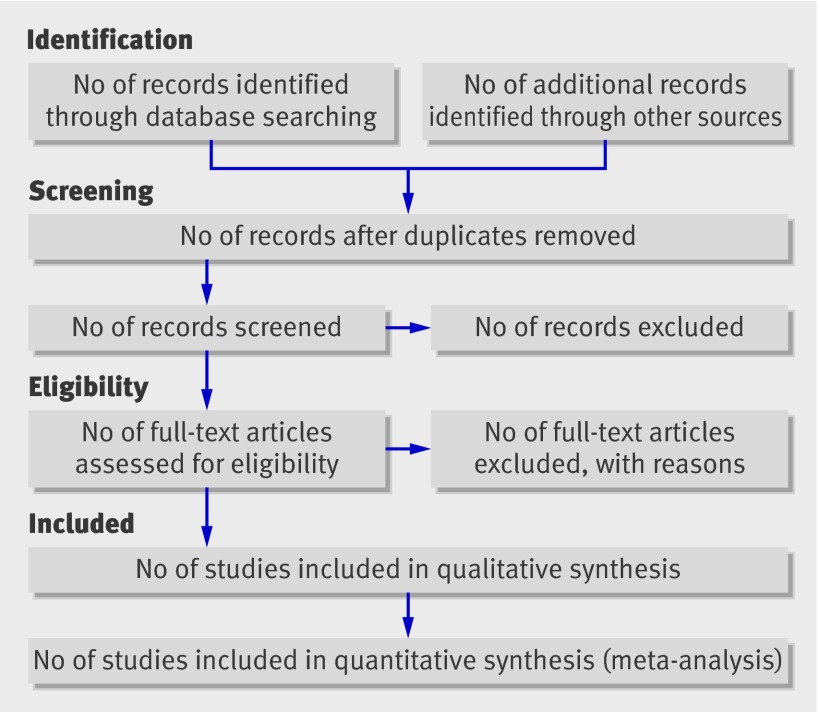
PRISMA is a 2009 revision of the QUOROM reporting guideline for systematic reviews and meta-analyses, consisting of a 27-item checklist and a four-phase flow diagram. It aims to improve reporting transparency and completeness, while acknowledging that it is not a quality assessment instrument.
Key findings
- PRISMA replaces QUOROM and comprises a 27-item checklist plus a four-phase flow diagram for reporting systematic reviews and meta-analyses.
- The revision adds new items on protocol/registration, risk of bias across studies, funding, and explicit objectives using PICOS; it also renames “quality assessment” as “risk of bias” and introduces outcome-level assessment.
- The guideline development meeting was held in Ottawa in June 2005 with 29 participants; the checklist was revised 11 times before group approval.
- The paper cites prior evidence of suboptimal reporting: Mulrow found none of 50 review articles met all eight explicit scientific criteria; Sacks et al. found reporting was generally poor, with a mean of 7.7 (SD 2.7) of 23 characteristics adequately reported; and in a review of 300 systematic reviews, few authors reported assessing publication bias.
Methods
- Guideline development: a three-day meeting in Ottawa, Canada, in June 2005 with 29 participants, including review authors, methodologists, clinicians, medical editors, and a consumer.
- Pre-meeting activities included a systematic review of studies examining reporting quality, a comprehensive literature search, and an international survey of review authors, consumers, and commissioning/using groups.
- A draft checklist was circulated, comments and revisions were compiled in a disposition file, and the checklist was revised 11 times before approval of the checklist, flow diagram, and summary paper.
Limitations
- Stated: no direct evidence was found to support retaining or adding some checklist items; evidence from other domains was believed relevant.
- Stated: PRISMA focuses on randomised trials, though it can be used as a basis for other research types; modifications may be necessary for diagnostic reviews, individual patient data meta-analyses, and other contexts.
- Stated: the PRISMA checklist is not a quality assessment instrument to gauge the quality of a systematic review.
- Evident: the paper does not report empirical validation that adopting PRISMA improves review quality or outcomes; it presents the guideline and its development process rather than testing its impact.
Model-written summary. Check it against the paper before relying on it.
Integrity signals
Registry
Cites
Statistics
Figures
Verification
Claims the paper makes
0 Valid · 0 Not valid · 20 Not checked · 11 Own results and interpretations
None of the sources cited for this claim could be matched to a paper, so there is nothing to check it against.
In the paper
“The quality of reporting of systematic reviews is still not optimal.”
- Also stated in: § Discussion · plain
“The quality of reporting of systematic reviews is still not optimal.9 30 31 32 33 34”
What the sources say
- Not matchedcites [9] 9. Moher D, Tetzlaff J, Tricco AC, Sampson M, Altman DG. Epidemiology and reporting characteristics of systematic reviews. PLoS Med 2007; 4: e78, 10.1371/journal.pmed.0040078. 17388659 10.1371/journal.pmed.0040078 PMC1831728
Couldn’t be matched to a paper, so it can’t be checked.
- Not matchedcites [30] 30. Bhandari M, Morrow F, Kulkarni AV, Tornetta P. Meta-analyses in orthopaedic surgery: a systematic review of their methodologies. J Bone Joint Surg Am 2001;83-A:15-24. 11205853
Couldn’t be matched to a paper, so it can’t be checked.
- Not matchedcites [31] 31. Kelly KD, Travers A, Dorgan M, Slater L, Rowe BH. Evaluating the quality of systematic reviews in the emergency medicine literature. Ann Emerg Med 2001; 38: 518-26. 11679863 10.1067/mem.2001.115881
Couldn’t be matched to a paper, so it can’t be checked.
plain- Asserted: passes — The authors put it forward as true.
- Checkable: passes — It can be checked against evidence.
- Load-bearing: passes — The paper’s conclusions depend on it.
- Based: passes — The paper gives a reason why it holds.
- Also stated in: § Discussion · plain
In the paper
“For studies included in a systematic review, a thorough assessment of the risk of bias requires both a study-level assessment (such as adequacy of allocation concealment) and, for some features, a newer approach called outcome-level assessment.”
§ Preferred reporting items for systematic reviews and meta-analyses: the PRISMA statement > Conceptual issues in the evolution from QUOROM to PRISMA > Study-level versus outcome-level assessment of risk of bias
What the sources say
- Not checked yetcites [11] 11. Guyatt GH, Oxman AD, Vist GE, Kunz R, Falck-Ytter Y, Alonso-Coello P, et al, for the GRADE Working Group. GRADE: an emerging consensus on rating quality of evidence and strength of recommendations. BMJ 2008; 336: 924-6. 18436948 10.1136/bmj.39489.470347.AD PMC2335261
plainstates a cause- Asserted: passes — The authors put it forward as true.
- Checkable: passes — It can be checked against evidence.
- Load-bearing: passes — The paper’s conclusions depend on it.
- Based: passes — The paper gives a reason why it holds.
None of the sources cited for this claim have been checked yet.
In the paper
“Different types of reporting biases may hamper the conduct and interpretation of systematic reviews.”
§ Preferred reporting items for systematic reviews and meta-analyses: the PRISMA statement > Conceptual issues in the evolution from QUOROM to PRISMA > Importance of reporting biases
What the sources say
- Not checked yetcites [13] 13. Dickersin K. Publication bias: recognizing the problem, understanding its origins and scope, and preventing harm. In: Rothstein HR, Sutton AJ, Borenstein M, eds. Publication bias in meta-analysis—prevention, assessment and adjustments. Chichester: John Wiley, 2005:11-33.
- Not checked yetcites [14] 14. Chan AW, Hrobjartsson A, Haahr MT, Gøtzsche PC, Altman DG. Empirical evidence for selective reporting of outcomes in randomized trials: comparison of protocols to published articles. JAMA 2004; 291: 2457-65. 15161896 10.1001/jama.291.20.2457
- Not checked yetcites [15] 15. Chan AW, Krleza-Jeric K, Schmid I, Altman DG. Outcome reporting bias in randomized trials funded by the Canadian Institutes of Health Research. CMAJ 2004; 171: 735-40. 15451835 10.1503/cmaj.1041086 PMC517858
hedgedstates a possible cause- Asserted: passes — The authors put it forward as true.
- Checkable: passes — It can be checked against evidence.
- Load-bearing: passes — The paper’s conclusions depend on it.
- Based: passes — The paper gives a reason why it holds.
In the paper
“In 1987 Mulrow examined 50 review articles published in four leading medical journals in 1985 and 1986 and found that none met all eight explicit scientific criteria, such as a quality assessment of included studies.5”
§ Preferred reporting items for systematic reviews and meta-analyses: the PRISMA statement > Abstract
What the sources say
- Not checked yetcites [5] 5. Mulrow CD. The medical review article: state of the science. Ann Intern Med 1987; 106: 485-8. 3813259 10.7326/0003-4819-106-3-485
plain- Asserted: passes — The authors put it forward as true.
- Checkable: passes — It can be checked against evidence.
- Load-bearing: passes — The paper’s conclusions depend on it.
- Based: passes — The paper gives a reason why it holds.
In the paper
“Although the implications of these biases on the conduct and reporting of systematic reviews themselves are unclear, some research has identified that selective outcome reporting may occur also in the context of systematic reviews.16”
§ Preferred reporting items for systematic reviews and meta-analyses: the PRISMA statement > Conceptual issues in the evolution from QUOROM to PRISMA > Importance of reporting biases
What the sources say
- Not checked yetcites [16] 16. Silagy CA, Middleton P, Hopewell S. Publishing protocols of systematic reviews: comparing what was done to what was planned. JAMA 2002; 287: 2831-4. 12038926 10.1001/jama.287.21.2831
hedged- Asserted: passes — The authors put it forward as true.
- Checkable: passes — It can be checked against evidence.
- Load-bearing: unclear — It is unclear whether the paper’s conclusions depend on it.
- Based: passes — The paper gives a reason why it holds.
6 more claims
Create a free account to see all 31 claims and to verify the 28 references still open.
- Probably not a substantial claim. 16
- It may state two separate claims as one. 8
Claims other papers make about this one
Each is checked against this paper’s own text: does it say what the citing paper says it does?
The source backs part of the claim, not all of it — or backs it for a different population, condition or comparison.
In the citing paper
“Many groups have called for the widespread preparation and registration of systematic review protocols in order to increase the availability and accessibility of a priori methods for systematic reviews [12–14].”
From Preferred reporting items for systematic review and meta-analysis protocols (PRISMA-P) 2015 statement (2015) · cites this paper as [13]
Experimental — accuracy not yet measuredThe source backs part of the claim, not all of it — or backs it for a different population, condition or comparison.
In the citing paper
“This systematic review and meta‐analysis meet the preferred reporting items for systematic reviews and meta‐analysis statement requirements (PRISMA) [14, 15].”
From Meta-Analysis: Chronic Gastrointestinal Symptoms and Comorbidities in Hypermobile Ehlers-Danlos Syndrome and Hypermobility Spectrum Disorders (2026) · cites this paper as [14]
Experimental — accuracy not yet measuredThe source backs part of the claim, not all of it — or backs it for a different population, condition or comparison.
In the citing paper
“Our review followed established review procedures developed by PRISMAScR and the Joanna Briggs Institute (Lockwood et al., 2019; Moher et al., 2009).”
From Mortality management and climate action: A review and reference for using Terror Management Theory methods in interdisciplinary environmental research (2022) · cites this paper as Moher et al., 2009
Experimental — accuracy not yet measuredThe source backs part of the claim, not all of it — or backs it for a different population, condition or comparison.
In the citing paper
“Our strategies for literature search were based on the guidelines of the Preferred Reporting Items for Systematic Reviews and Meta-Analyses (PRISMA), a framework for reporting and synthesising literature review (Moher et al., 2009).”
From Dimensions of teachers’ data literacy: A systematic review of literature from 1990 to 2021 (2024) · cites this paper as Moher et al., 2009
Experimental — accuracy not yet measuredThe source backs part of the claim, not all of it — or backs it for a different population, condition or comparison.
In the citing paper
“To this end, we conducted a systematic literature review in accordance with the Preferred Reporting Items for Systematic reviews and Meta-Analyses (PRISMA) method (Moher et al., 2009) (cf. Figure 2).”
From The Impact of Machine Learning on 2D/3D Registration for Image-Guided Interventions: A Systematic Review and Perspective (2021) · cites this paper as Moher et al., 2009
Experimental — accuracy not yet measured
66 more claims about this paper
Create a free account to see every claim other papers make about this one.
Citations
Cites
Liberati, A., Altman, D. G., Tetzlaff, J., Mulrow, C., Gøtzsche, P. C., Ioannidis, J. P. A., Clarke, M., Devereaux, P. J., Kleijnen, J., & Moher, D. (2009) · PLoS Medicine · doi:10.1371/journal.pmed.1000100 · Cited by 28,164
Self-citationGRADE: an emerging consensus on rating quality of evidence and strength of recommendations
Guyatt, G. H., Oxman, A. D., Vist, G. E., Kunz, R., Falck-Ytter, Y., Alonso-Coello, P., & Schünemann, H. J. (2008) · BMJ · doi:10.1136/bmj.39489.470347.ad · Cited by 23,305
von Elm, E., Altman, D. G., Egger, M., Pocock, S. J., Gøtzsche, P. C., Vandenbroucke, J. P., & Initiative, F. T. S. (2007) · PLoS Medicine · doi:10.1371/journal.pmed.0040296 · Cited by 23,020
Self-citationLiberati, A., Altman, D. G., Tetzlaff, J., Mulrow, C., Gotzsche, P. C., Ioannidis, J. P. A., Clarke, M., Devereaux, P. J., Kleijnen, J., & Moher, D. (2009) · BMJ · doi:10.1136/bmj.b2700 · Cited by 17,648
Self-citationLiberati, A., Altman, D. G., Tetzlaff, J., Mulrow, C., Gøtzsche, P. C., Ioannidis, J. P. A., Clarke, M., Devereaux, P. J., Kleijnen, J., & Moher, D. (2009) · Annals of Internal Medicine · doi:10.7326/0003-4819-151-4-200908180-00136 · Cited by 10,349
Self-citationVandenbroucke, J. P., von Elm, E., Altman, D. G., Gøtzsche, P. C., Mulrow, C. D., Pocock, S. J., Poole, C., Schlesselman, J. J., Egger, M., & Initiative, F. T. S. (2007) · PLoS Medicine · doi:10.1371/journal.pmed.0040297 · Cited by 8,613
Self-citationMoher, D., Cook, D. J., Eastwood, S., Olkin, I., Rennie, D., & Stroup, D. F. (1999) · The Lancet · doi:10.1016/s0140-6736(99)04149-5 · Cited by 4,826
Self-citationThe Revised CONSORT Statement for Reporting Randomized Trials: Explanation and Elaboration
Altman, D. G., Schulz, K. F., Moher, D., Egger, M., Davidoff, F., Elbourne, D., Gøtzsche, P. C., Lang, T., & for the CONSORT Group (2001) · Annals of Internal Medicine · doi:10.7326/0003-4819-134-8-200104170-00012 · Cited by 3,835
Self-citationVandenbroucke, J. P., Elm, E. V., Altman, D. G., Gøtzsche, P. C., Mulrow, C. D., Pocock, S. J., Poole, C., Schlesselman, J. J., Egger, M., & initiative, F. T. S. (2007) · Annals of Internal Medicine · doi:10.7326/0003-4819-147-8-200710160-00010-w1 · Cited by 3,543
Self-citationTowards complete and accurate reporting of studies of diagnostic accuracy: The STARD Initiative.
Bossuyt, P. M., Reitsma, J. B., Bruns, D. E., Gatsonis, C. A., Glasziou, P. P., Irwig, L. M., Lijmer, J. G., Moher, D., Rennie, D., de Vet, H. C. W., et al. (2003) · Annals of Internal Medicine · doi:10.7326/0003-4819-138-1-200301070-00010 · Cited by 3,219
Cited by
Items 5,501–5,600 of 7,591
Loo Gee, B., Griffiths, K. M., & Gulliver, A. (2016) · Journal of the American Medical Informatics Association · doi:10.1093/jamia/ocv043 · Cited by 92
Wang, B., Baldwin, J. R., Schoeler, T., Cheesman, R., Barkhuizen, W., Dudbridge, F., Bann, D., Morris, T. T., & Pingault, J.-B. (2021) · The American Journal of Human Genetics · doi:10.1016/j.ajhg.2021.07.010 · Cited by 103
Knop, M., Weber, S., Mueller, M., & Niehaves, B. (2022) · JMIR Human Factors · doi:10.2196/28639 · Cited by 103
Mansfield, L., Kay, T., Meads, C., Grigsby-Duffy, L., Lane, J., John, A., Daykin, N., Dolan, P., Testoni, S., Julier, G., et al. (2018) · BMJ Open · doi:10.1136/bmjopen-2017-020959 · Cited by 103
Garba, R. M., & Gadanya, M. A. (2017) · PLOS ONE · doi:10.1371/journal.pone.0174438 · Cited by 103
Community reinforcement and family training and rates of treatment entry: a systematic review.
Archer, M., Harwood, H., Stevelink, S., Rafferty, L., & Greenberg, N. (2020) · Addiction · doi:10.1111/add.14901 · Cited by 95
Assessing the Risk of Bias in Randomized Clinical Trials With Large Language Models
Lai, H., Ge, L., Sun, M., Pan, B., Huang, J., Hou, L., Yang, Q., Liu, J., Liu, J., Ye, Z., et al. (2024) · JAMA Network Open · doi:10.1001/jamanetworkopen.2024.12687 · Cited by 103
Ketamine and other glutamate receptor modulators for depression in bipolar disorder in adults
McCloud, T. L., Caddy, C., Jochim, J., Rendell, J. M., Diamond, P. R., Shuttleworth, C., Brett, D., Amit, B. H., McShane, R., Hamadi, L., et al. (2015) · Cochrane Database of Systematic Reviews · doi:10.1002/14651858.cd011611.pub2 · Cited by 102
Chemokine alterations in bipolar disorder: A systematic review and meta-analysis
Misiak, B., Bartoli, F., Carrà, G., Małecka, M., Samochowiec, J., Jarosz, K., Banik, A., & Stańczykiewicz, B. (2020) · Brain, Behavior, and Immunity · doi:10.1016/j.bbi.2020.04.013 · Cited by 102
Can chemokines be used as biomarkers for endometriosis? A systematic review
Borrelli, G. M., Abrao, M. S., & Mechsner, S. (2014) · Human Reproduction · doi:10.1093/humrep/det401 · Cited by 102
Vergnes, J.-N., Marchal-Sixou, C., Nabet, C., Maret, D., & Hamel, O. (2010) · Journal of Medical Ethics · doi:10.1136/jme.2010.039941 · Cited by 102
Unberath, M., Gao, C., Hu, Y., Judish, M., Taylor, R. H., Armand, M., & Grupp, R. (2021) · Frontiers in Robotics and AI · doi:10.3389/frobt.2021.716007 · Cited by 121
Tefagh, G., Payab, M., Qorbani, M., Sharifi, F., Sharifi, Y., Ebrahimnegad Shirvani, M. S., Pourghazi, F., Atlasi, R., Shadman, Z., Rezaei, N., et al. (2022) · Scientific Reports · doi:10.1038/s41598-022-09082-3 · Cited by 102
Putra, I. G. N. E., Astell-Burt, T., Cliff, D. P., Vella, S. A., John, E. E., & Feng, X. (2020) · Frontiers in Psychology · doi:10.3389/fpsyg.2020.00859 · Cited by 102
Pascucci, D., Sassano, M., Nurchis, M. C., Cicconi, M., Acampora, A., Park, D., Morano, C., & Damiani, G. (2021) · Health Policy · doi:10.1016/j.healthpol.2020.12.006 · Cited by 102
Evidence-Based Chinese Medicine for Hypertension
Wang, J., & Xiong, X. (2013) · Evidence-Based Complementary and Alternative Medicine · doi:10.1155/2013/978398 · Cited by 102
Clinical Handover and Handoff in Healthcare: A Systematic Review of Systematic Reviews
Desmedt, M., Ulenaers, D., Grosemans, J., Hellings, J., & Bergs, J. (2021) · International Journal for Quality in Health Care · doi:10.1093/intqhc/mzaa170 · Cited by 102
Therapeutic use of classic psychedelics to treat cancer-related psychiatric distress
Ross, S. (2018) · International Review of Psychiatry · doi:10.1080/09540261.2018.1482261 · Cited by 102
Development and validation of early warning score system: A systematic literature review
Fu, L.-H., Schwartz, J., Moy, A., Knaplund, C., Kang, M.-J., Schnock, K. O., Garcia, J. P., Jia, H., Dykes, P. C., Cato, K., et al. (2020) · Journal of Biomedical Informatics · doi:10.1016/j.jbi.2020.103410 · Cited by 102
Downing, K. L., Hnatiuk, J. A., Hinkley, T., Salmon, J., & Hesketh, K. D. (2018) · British Journal of Sports Medicine · doi:10.1136/bjsports-2016-096634 · Cited by 102
Huque, H., Eramudugolla, R., Chidiac, B., Ee, N., Ehrenfeld, L., Matthews, F. E., Peters, R., & Anstey, K. J. (2023) · Journal of Alzheimer's Disease · doi:10.3233/jad-220724 · Cited by 102
Hartley, M., Dorstyn, D., & Due, C. (2019) · Journal of Autism and Developmental Disorders · doi:10.1007/s10803-019-04145-3 · Cited by 99
Tao, K.-M., Li, X.-Q., Zhou, Q.-H., Moher, D., Ling, C.-Q., & Yu, W.-F. (2011) · PLoS ONE · doi:10.1371/journal.pone.0027611 · Cited by 101
Self-citationSerafini, G., Pompili, M., Belvederi Murri, M., Respino, M., Ghio, L., Girardi, P., Fitzgerald, P. B., & Amore, M. (2015) · Neuropsychobiology · doi:10.1159/000381351 · Cited by 101
Rys, P., Wojciechowski, P., Rogoz-Sitek, A., Niesyczyński, G., Lis, J., Syta, A., & Malecki, M. T. (2015) · Acta Diabetologica · doi:10.1007/s00592-014-0698-4 · Cited by 101
Moman, R. N., Dvorkin, J., Pollard, E. M., Wanderman, R., Murad, M. H., Warner, D. O., & Hooten, W. M. (2019) · Pain Medicine · doi:10.1093/pm/pnz164 · Cited by 93
Introduction to systematic reviews and meta‐analysis
McKenzie, J. E., Beller, E. M., & Forbes, A. B. (2016) · Respirology · doi:10.1111/resp.12783 · Cited by 101
Singh, P. M., Panwar, R., Borle, A., Goudra, B., Trikha, A., van Wagensveld, B. A., & Sinha, A. (2017) · Obesity Surgery · doi:10.1007/s11695-016-2442-3 · Cited by 101
Kambeitz, J. P., & Howes, O. D. (2015) · Journal of Affective Disorders · doi:10.1016/j.jad.2015.07.034 · Cited by 96
Murphy, L. A., Harrington, P., Taylor, S. J., Teljeur, C., Smith, S. M., Pinnock, H., & Ryan, M. (2017) · Chronic Respiratory Disease · doi:10.1177/1479972316687208 · Cited by 93
Imtiaz, S., Nafeh, F., Russell, C., Ali, F., Elton-Marshall, T., & Rehm, J. (2021) · Substance Abuse Treatment, Prevention, and Policy · doi:10.1186/s13011-021-00423-5 · Cited by 101
Baricitinib in hospitalised patients with COVID-19: a meta-analysis of randomised controlled trials
Selvaraj, V., Finn, A., Lal, A., Khan, M. S., Dapaah-Afriyie, K., & Carino, G. P. (2022) · EClinicalMedicine · doi:10.1016/j.eclinm.2022.101489 · Cited by 101
Collins, R. N., & Kishita, N. (2019) · The Gerontologist · doi:10.1093/geront/gny024 · Cited by 101
Daks, J. S., & Rogge, R. D. (2020) · Journal of Contextual Behavioral Science · doi:10.1016/j.jcbs.2020.09.010 · Cited by 101
Gonzalez, M., Pascoe, M. C., Yang, G., de Manincor, M., Grant, S., Lacey, J., Firth, J., & Sarris, J. (2021) · Psycho-Oncology · doi:10.1002/pon.5671 · Cited by 102
Cost-effectiveness of early intervention in psychosis: systematic review
Aceituno, D., Vera, N., Prina, A. M., & McCrone, P. (2019) · The British Journal of Psychiatry · doi:10.1192/bjp.2018.298 · Cited by 101
Intimate partner violence and perinatal health: a systematic review
Pastor‐Moreno, G., Ruiz‐Pérez, I., Henares‐Montiel, J., Escribà‐Agüir, V, Higueras‐Callejón, C., & Ricci‐Cabello, I. (2020) · BJOG: An International Journal of Obstetrics & Gynaecology · doi:10.1111/1471-0528.16084 · Cited by 101
Eddens, L., van Someren, K., & Howatson, G. (2018) · Sports Medicine · doi:10.1007/s40279-017-0784-1 · Cited by 100
Accuracy of laboratory tests for the diagnosis of Cushing syndrome
Galm, B. P., Qiao, N., Klibanski, A., Biller, B. M. K., & Tritos, N. A. (2020) · The Journal of Clinical Endocrinology & Metabolism · doi:10.1210/clinem/dgaa105 · Cited by 100
The impact of alcohol on Alzheimer's disease: A systematic review
Piazza-Gardner, A. K., Gaffud, T. J. B., & Barry, A. E. (2013) · Aging & Mental Health · doi:10.1080/13607863.2012.742488 · Cited by 94
Quality of Life in Women with Gestational Diabetes Mellitus: A Systematic Review
Marchetti, D., Carrozzino, D., Fraticelli, F., Fulcheri, M., & Vitacolonna, E. (2017) · Journal of Diabetes Research · doi:10.1155/2017/7058082 · Cited by 100
Koonrungsesomboon, N., Khatsri, R., Wongchompoo, P., & Teekachunhatean, S. (2018) · The Pharmacogenomics Journal · doi:10.1038/s41397-017-0011-3 · Cited by 100
Yu, Z., Nan, F., Wang, L. Y., Jiang, H., Chen, W., & Jiang, Y. (2020) · Clinical Nutrition · doi:10.1016/j.clnu.2019.08.008 · Cited by 100
Statins use and risk of depression: A systematic review and meta-analysis
Parsaik, A. K., Singh, B., M. Hassan, M., Singh, K., Mascarenhas, S. S., Williams, M. D., Lapid, M. I., Richardson, J. W., West, C. P., & Rummans, T. A. (2014) · Journal of Affective Disorders · doi:10.1016/j.jad.2013.11.026 · Cited by 100
Geoffroy, P. A., Schroder, C. M., Reynaud, E., & Bourgin, P. (2019) · Sleep Medicine Reviews · doi:10.1016/j.smrv.2019.101213 · Cited by 100
Recipients of children’s and adolescents’ disclosures of childhood sexual abuse: A systematic review
Manay, N., & Collin-Vézina, D. (2021) · Child Abuse & Neglect · doi:10.1016/j.chiabu.2019.104192 · Cited by 100
Farnood, A., Johnston, B., & Mair, F. S. (2020) · BMC Medical Informatics and Decision Making · doi:10.1186/s12911-020-01243-6 · Cited by 100
Zeng, B., Gao, L., Yang, Q., Jia, H., & Sun, F. (2023) · Diabetes Care · doi:10.2337/dc23-0504 · Cited by 100
Shams-White, M. M., Chung, M., Fu, Z., Insogna, K. L., Karlsen, M. C., LeBoff, M. S., Shapses, S. A., Sackey, J., Shi, J., Wallace, T. C., et al. (2018) · PLOS ONE · doi:10.1371/journal.pone.0192459 · Cited by 100
Li, S. S., Kendall, C. W. C., de Souza, R. J., Jayalath, V. H., Cozma, A. I., Ha, V., Mirrahimi, A., Chiavaroli, L., Augustin, L. S. A., Blanco Mejia, S., et al. (2014) · Obesity · doi:10.1002/oby.20782 · Cited by 100
Natamba, B. K., Namara, A. A., & Nyirenda, M. J. (2019) · BMC Pregnancy and Childbirth · doi:10.1186/s12884-019-2593-z · Cited by 100
The Prognostic and Clinical Value of CD44 in Colorectal Cancer: A Meta-Analysis
Wang, Z., Tang, Y., Xie, L., Huang, A., Xue, C., Gu, Z., Wang, K., & Zong, S. (2019) · Frontiers in Oncology · doi:10.3389/fonc.2019.00309 · Cited by 100
Gooding, P., & Kariotis, T. (2021) · JMIR Mental Health · doi:10.2196/24668 · Cited by 100
Volunteering in the Community: Potential Benefits for Cognitive Aging
Guiney, H., & Machado, L. (2018) · The Journals of Gerontology: Series B · doi:10.1093/geronb/gbx134 · Cited by 100
Exercise and the cortisol awakening response: a systematic review
Anderson, T., & Wideman, L. (2017) · Sports Medicine - Open · doi:10.1186/s40798-017-0102-3 · Cited by 100
Walters, S., Loades, M., & Russell, A. (2016) · Review Journal of Autism and Developmental Disorders · doi:10.1007/s40489-016-0072-2 · Cited by 99
Camacho, M., Li, D., Kawai, M., Zaghi, S., Teixeira, J., Senchak, A. J., Brietzke, S. E., Frasier, S., & Certal, V. (2016) · The Laryngoscope · doi:10.1002/lary.25931 · Cited by 100
Cao, C., Yang, S., & Zhou, Z. (2019) · Endocrine · doi:10.1007/s12020-019-02055-z · Cited by 99
Liu, F., Yan, L., Wang, Z., Lu, Y., Chu, Y., Li, X., Liu, Y., Rui, D., Nie, S., & Xiang, H. (2017) · Oncotarget · doi:10.18632/oncotarget.13762 · Cited by 99
Zhang, Z., Zhang, L., Zhang, G., Jin, J., & Zheng, Z. (2018) · BMC Psychiatry · doi:10.1186/s12888-018-1610-5 · Cited by 99
Clegg, A. P., Barber, S. E., Young, J. B., Forster, A., & Iliffe, S. J. (2012) · Reviews in Clinical Gerontology · doi:10.1017/s0959259811000165 · Cited by 99
Hunter, A., Murray, R., Asher, L., & Leonardi-Bee, J. (2020) · Nicotine & Tobacco Research · doi:10.1093/ntr/nty160 · Cited by 95
Affective empathy in schizophrenia: a meta-analysis
Bonfils, K. A., Lysaker, P. H., Minor, K. S., & Salyers, M. P. (2016) · Schizophrenia Research · doi:10.1016/j.schres.2016.03.037 · Cited by 99
Haghayegh, S., Khoshnevis, S., Smolensky, M. H., Diller, K. R., & Castriotta, R. J. (2019) · Sleep Medicine Reviews · doi:10.1016/j.smrv.2019.04.008 · Cited by 99
Implementing Ethics in Healthcare AI-Based Applications: A Scoping Review
Goirand, M., Austin, E., & Clay-Williams, R. (2021) · Science and Engineering Ethics · doi:10.1007/s11948-021-00336-3 · Cited by 101
Effect of Adherence to Mediterranean Diet during Pregnancy on Children’s Health: A Systematic Review
Biagi, C., Di Nunzio, M., Bordoni, A., Gori, D., & Lanari, M. (2019) · Nutrients · doi:10.3390/nu11050997 · Cited by 99
De Buck, E., Van Remoortel, H., Hannes, K., Govender, T., Naidoo, S., Avau, B., Veegaete, A. V., Musekiwa, A., Lutje, V., Cargo, M., et al. (2017) · Campbell Systematic Reviews: Better Evidence for a Better World · doi:10.4073/csr.2017.7 · Cited by 99
A systematic review of structural and functional MRI studies on pain catastrophizing
Galambos, A., Szabó, E., Nagy, Z., Édes, A. E., Kocsel, N., Juhász, G., & Kökönyei, G. (2019) · Journal of Pain Research · doi:10.2147/jpr.s192246 · Cited by 99
Mavrakanas, T. A., Tsoukas, M. A., Brophy, J. M., Sharma, A., & Gariani, K. (2023) · Scientific Reports · doi:10.1038/s41598-023-42989-z · Cited by 99
Does methylphenidate improve academic performance? A systematic review and meta-analysis
Kortekaas-Rijlaarsdam, A. F., Luman, M., Sonuga-Barke, E., & Oosterlaan, J. (2019) · European Child & Adolescent Psychiatry · doi:10.1007/s00787-018-1106-3 · Cited by 99
Xiao, M., van Niekerk, M., Trivedi, N. N., Hwang, C. E., Sherman, S. L., Safran, M. R., & Abrams, G. D. (2023) · The American Journal of Sports Medicine · doi:10.1177/03635465221102420 · Cited by 99
Lynch, J. (2019) · Environmental Impact Assessment Review · doi:10.1016/j.eiar.2019.02.003 · Cited by 99
Bosqui, T. J., & Marshoud, B. (2018) · Conflict and Health · doi:10.1186/s13031-018-0153-1 · Cited by 98
Chen, H., Aarab, G., de Ruiter, M. H. T., de Lange, J., Lobbezoo, F., & van der Stelt, P. F. (2016) · Sleep Medicine · doi:10.1016/j.sleep.2016.01.022 · Cited by 98
Strawn, J. R., Mills, J. A., Sauley, B. A., & Welge, J. A. (2018) · Journal of the American Academy of Child & Adolescent Psychiatry · doi:10.1016/j.jaac.2018.01.015 · Cited by 98
Sanada, K., Montero-Marin, J., Barceló-Soler, A., Ikuse, D., Ota, M., Hirata, A., Yoshizawa, A., Hatanaka, R., Valero, M. S., Demarzo, M., et al. (2020) · International Journal of Molecular Sciences · doi:10.3390/ijms21072484 · Cited by 96
Dennehy, R., Meaney, S., Walsh, K. A., Sinnott, C., Cronin, M., & Arensman, E. (2020) · Aggression and Violent Behavior · doi:10.1016/j.avb.2020.101379 · Cited by 98
Decker, A., Askar, H., Tattan, M., Taichman, R., & Wang, H.-L. (2020) · Clinical Oral Investigations · doi:10.1007/s00784-019-03089-3 · Cited by 98
Efficacy of bioactive compounds from extra virgin olive oil to modulate atherosclerosis development
Lou‐Bonafonte, J. M., Arnal, C., Navarro, M. A., & Osada, J. (2012) · Molecular Nutrition & Food Research · doi:10.1002/mnfr.201100668 · Cited by 98
Arjadi, R., Nauta, M. H., Chowdhary, N., & Bockting, C. L. H. (2015) · Global Mental Health · doi:10.1017/gmh.2015.10 · Cited by 98
Sutton, L., Rowe, S., Hammerton, G., & Billings, J. (2022) · European Journal of Psychotraumatology · doi:10.1080/20008198.2021.2022278 · Cited by 98
Knight, S. R., Ng, N., Tsanas, A., Mclean, K., Pagliari, C., & Harrison, E. M. (2021) · npj Digital Medicine · doi:10.1038/s41746-021-00525-1 · Cited by 104
Digital interventions to support adolescents and young adults with cancer: systematic review
McCann, L., McMillan, K. A., & Pugh, G. (2019) · JMIR Cancer · doi:10.2196/12071 · Cited by 98
The effects of mindfulness interventions on prenatal well-being: A systematic review
Matvienko-Sikar, K., Lee, L., Murphy, G., & Murphy, L. (2016) · Psychology & Health · doi:10.1080/08870446.2016.1220557 · Cited by 98
Behavioural activation therapy for depression in adults
Uphoff, E., Ekers, D., Robertson, L., Dawson, S., Sanger, E., South, E., Samaan, Z., Richards, D., Meader, N., & Churchill, R. (2020) · Cochrane Database of Systematic Reviews · doi:10.1002/14651858.cd013305.pub2 · Cited by 98
Brooks, A. J., Rowse, G., Ryder, A., Peach, E. J., Corfe, B. M., & Lobo, A. J. (2016) · Alimentary Pharmacology & Therapeutics · doi:10.1111/apt.13645 · Cited by 98
Interventions to improve outcomes for caregivers of patients with advanced cancer: a meta-analysis
Chow, R., Mathews, J. J., Cheng, E. Y., Lo, S., Wong, J., Alam, S., Hannon, B., Rodin, G., Nissim, R., Hales, S., et al. (2023) · JNCI: Journal of the National Cancer Institute · doi:10.1093/jnci/djad075 · Cited by 98
A comprehensive view of trust in education: Conclusions from a systematic literature review
Niedlich, S., Kallfaß, A., Pohle, S., & Bormann, I. (2021) · Review of Education · doi:10.1002/rev3.3239 · Cited by 98
Stehle, P., Ellger, B., Kojic, D., Feuersenger, A., Schneid, C., Stover, J., Scheiner, D., & Westphal, M. (2017) · Clinical Nutrition ESPEN · doi:10.1016/j.clnesp.2016.09.007 · Cited by 98
Kilpatrick, K., Kaasalainen, S., Donald, F., Reid, K., Carter, N., Bryant‐Lukosius, D., Martin‐Misener, R., Harbman, P., Marshall, D. A., Charbonneau‐Smith, R., et al. (2014) · Journal of Evaluation in Clinical Practice · doi:10.1111/jep.12219 · Cited by 98
A Systematic Review of the Clinical Efficacy and Safety of CFTR Modulators in Cystic Fibrosis
Habib, A.-R. R., Kajbafzadeh, M., Desai, S., Yang, C. L., Skolnik, K., & Quon, B. S. (2019) · Scientific Reports · doi:10.1038/s41598-019-43652-2 · Cited by 98
Van Leeuwen, E., van Driel, M. L., Horowitz, M. A., Kendrick, T., Donald, M., De Sutter, A. I., Robertson, L., & Christiaens, T. (2021) · Cochrane Database of Systematic Reviews · doi:10.1002/14651858.cd013495.pub2 · Cited by 90
Predictors of outcomes of psychological treatments for disordered gambling: A systematic review
Merkouris, S. S., Thomas, S. A., Browning, C. J., & Dowling, N. A. (2016) · Clinical Psychology Review · doi:10.1016/j.cpr.2016.06.004 · Cited by 96
Elraiyah, T., Sonbol, M. B., Wang, Z., Khairalseed, T., Asi, N., Undavalli, C., Nabhan, M., Altayar, O., Prokop, L., Montori, V. M., et al. (2014) · The Journal of Clinical Endocrinology & Metabolism · doi:10.1210/jc.2014-2261 · Cited by 97
Schaffler, J., Leung, K., Tremblay, S., Merdsoy, L., Belzile, E., Lambrou, A., & Lambert, S. D. (2018) · Journal of General Internal Medicine · doi:10.1007/s11606-017-4265-x · Cited by 97
Health and migration in the context of a changing climate: a systematic literature assessment
Schwerdtle, P. N., McMichael, C., Mank, I., Sauerborn, R., Danquah, I., & Bowen, K. J. (2020) · Environmental Research Letters · doi:10.1088/1748-9326/ab9ece · Cited by 94
Hennessy, E. A., Johnson, B. T., & Keenan, C. (2019) · Applied Psychology: Health and Well-Being · doi:10.1111/aphw.12169 · Cited by 91
Kotsakis, G. A., Lian, Q., Ioannou, A. L., Michalowicz, B. S., John, M. T., & Chu, H. (2018) · Journal of Periodontology · doi:10.1002/jper.17-0368 · Cited by 97
Facchinetti, F., Orrù, B., Grandi, G., & Unfer, V. (2019) · Gynecological Endocrinology · doi:10.1080/09513590.2018.1540578 · Cited by 94
Bradford, N. K., & Chan, R. J. (2017) · Cancer Treatment Reviews · doi:10.1016/j.ctrv.2017.02.011 · Cited by 97
Metadata
- Authors
- Moher, D., Liberati, A., Tetzlaff, J., Altman, D. G., & for the PRISMA Group
- Affiliations
- University of Ottawa (CA)
- University of Modena and Reggio Emilia (IT)
- Ottawa Hospital Research Institute (CA)
- University of Oxford (GB)
- Corresponding author
- Moher, D.
- Venue
- BMJ
- Publisher
- BMJ
- Published
- 2009-07-21
- Volume
- 339
- Issue
- jul21 1
- Pages
- b2535-b2535
- ISSN
- 0007-1447 (ISSN-L)
- 0959-8138
- 1468-5833
- PMC
- PMC2714657
- OpenAlex
- W2156098321
- Cited by
- 83,823
- References
- 56
- Citations by year
- 2026: 1223 · 2025: 2325 · 2024: 3601 · 2023: 5067 · 2022: 7278 · 2021: 14834 · 2020: 12076 · 2019: 8599 · 2018: 6635 · 2017: 6088 · 2016: 5138 · 2015: 3942 · 2014: 2914 · 2013: 1936 · 2012: 1174
- FWCI
- 54.09
- Type
- journal article
- Language
- en
- Open access
- hybrid
- doi.org
- Licence
- cc-by-nc
- Locations
- BMJ (publishedVersion, cc-by-nc)
- Europe PMC (PubMed Central) (publishedVersion, cc-by-nc)
- PubMed Central (publishedVersion, cc-by-nc)
- PubMed (publishedVersion)
- Archivio Istituzionale della Ricerca (Universita Degli Studi Di Milano) (submittedVersion, other-oa)
- Funders
- GlaxoSmithKline
- Health Services Research and Development
- Johns Hopkins University
- University of Ottawa
- University of Bern
- Ottawa Hospital Research Institute
- McMaster University
- Cancer Research UK
- University of Ioannina
- Johns Hopkins Bloomberg School of Public Health
- Canadian Institutes of Health Research
- Medical Research Council
- Care and Public Health Research Institute, Universiteit Maastricht
- Topics
- Social Sciences › Decision Sciences › Statistics, Probability and Uncertainty › Meta-analysis and systematic reviews
- Health Sciences › Medicine › Public Health, Environmental and Occupational Health › Clinical practice guidelines implementation
- Social Sciences › Sociology and Political Science › Delphi Technique in Research
- Keywords
- PRISMA statement, reporting guidelines, systematic reviews, meta-analysis, reporting quality
- MeSH terms
- Humans, Terminology as Topic, Periodicals as Topic, Publishing, Quality Control, Review Literature as Topic, Meta-Analysis as Topic, Publication Bias, Evidence-Based Practice
About these checks
Registry, retraction, Cites and statistics results are computed, not judged, with one exception: a printed reference that no index lists is read once by a model before it counts as a citation error. Claims are extracted by a model and kept only when their quote appears verbatim in the text; each cited source is then checked, with a model’s help, for whether it says what the claim relies on. Those verdicts can be wrong — read the claim’s quote and the cited source before relying on one.
A language model drew the claims from the paper on 2026-09-30, under version 3 of the claim definition (model deepseek-v4.1-flash, prompt extract-v3).
A second model labelled each claim on 2026-09-30 (model jev-1.13-20260917, definition revision gold-guideline-v0.2).
Statistics and arithmetic are recomputed, not judged.
Confidence bands are shown only for fields calibrated on our annotated test set. None is calibrated yet, so no band is shown.
What counts as a claim ›How we measure confidence ›How we check this ›
Are you an author, or do you see a problem with this page? Request a review
Data sources
Bibliographic data: Semantic Scholar, OpenAlex, Crossref.
Contains information from the Semantic Scholar Academic Graph Datasets, made available under the ODC Attribution License (ODC-BY 1.0).
Semantic Scholar’s data is described in: Kinney, R., et al. (2023). The Semantic Scholar Open Data Platform. arXiv:2301.10140.
