

Psilocybin-occasioned mystical-type experience in combination with meditation and other spiritual practices produces enduring positive changes in psychological functioning and in trait measures of prosocial attitudes and behaviors
Open accessThe DOI matches its Crossref record; 58 of the 58 references it cites were found in a registry or an index.
Abstract
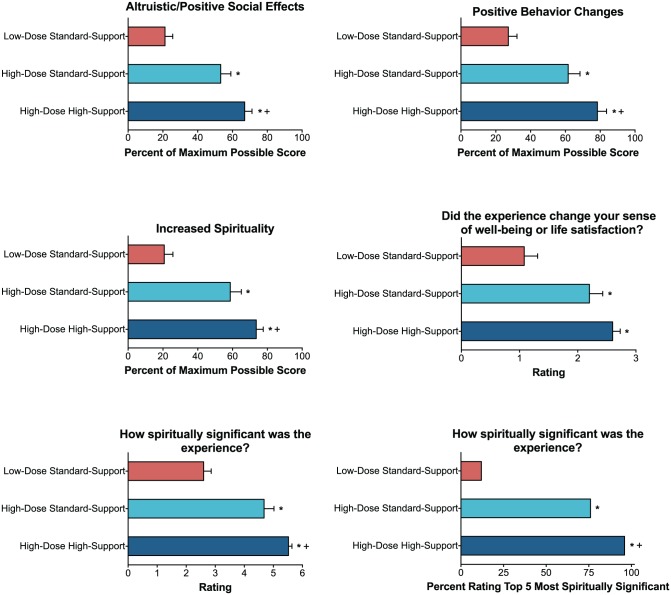
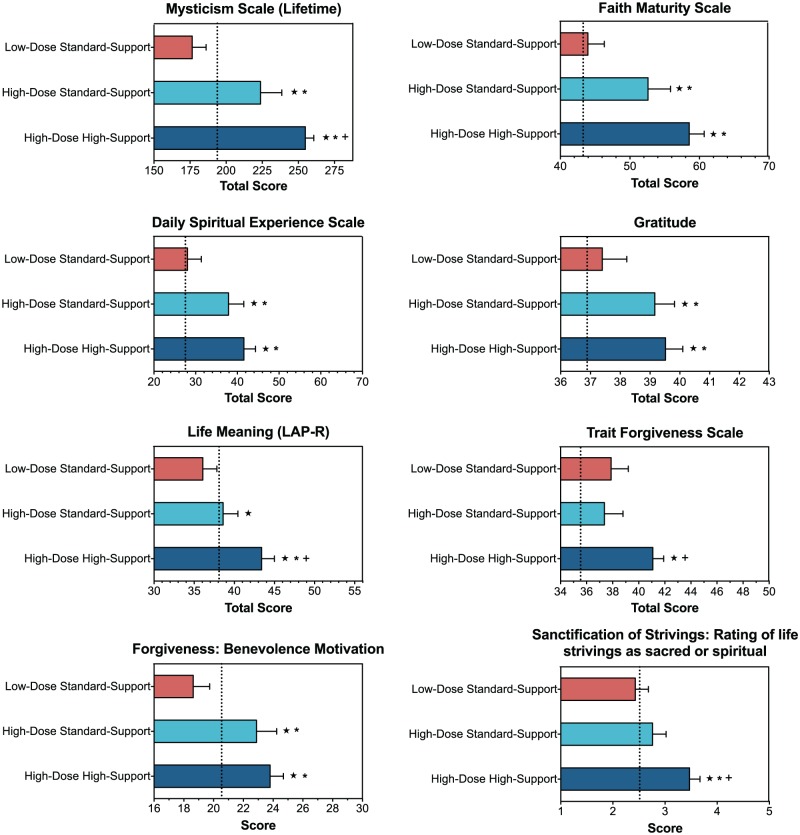
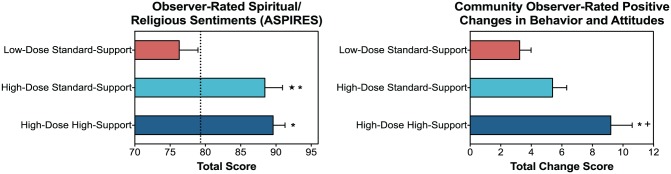
Psilocybin can occasion mystical-type experiences with participant-attributed increases in well-being. However, little research has examined enduring changes in traits. This study administered psilocybin to participants who undertook a program of meditation/spiritual practices. Healthy participants were randomized to three groups (25 each): (1) very low-dose (1 mg/70 kg on sessions 1 and 2) with moderate-level (“standard”) support for spiritual-practice (LD-SS); (2) high-dose (20 and 30 mg/70 kg on sessions 1 and 2, respectively) with standard support (HD-SS); and (3) high-dose (20 and 30 mg/70kg on sessions 1 and 2, respectively) with high support for spiritual practice (HD-HS). Psilocybin was administered double-blind and instructions to participants/staff minimized expectancy confounds. Psilocybin was administered 1 and 2 months after spiritual-practice initiation. Outcomes at 6 months included rates of spiritual practice and persisting effects of psilocybin. Compared with low-dose, high-dose psilocybin produced greater acute and persisting effects. At 6 months, compared with LD-SS, both high-dose groups showed large significant positive changes on longitudinal measures of interpersonal closeness, gratitude, life meaning/purpose, forgiveness, death transcendence, daily spiritual experiences, religious faith and coping, and community observer ratings. Determinants of enduring effects were psilocybin-occasioned mystical-type experience and rates of meditation/spiritual practices. Psilocybin can occasion enduring trait-level increases in prosocial attitudes/behaviors and in healthy psychological functioning. Trial Registration ClinicalTrials.gov Identifier NCT00802282
Overview
The claims and statistics of this paper haven’t been checked yet.
Free: it reads the open-access text and checks the first 5 claims that cite a source we can check. Create a free account to check every claim.
Integrity signals
Registry
Cites
Statistics
Figures
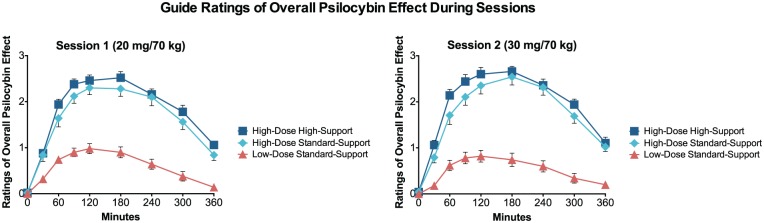
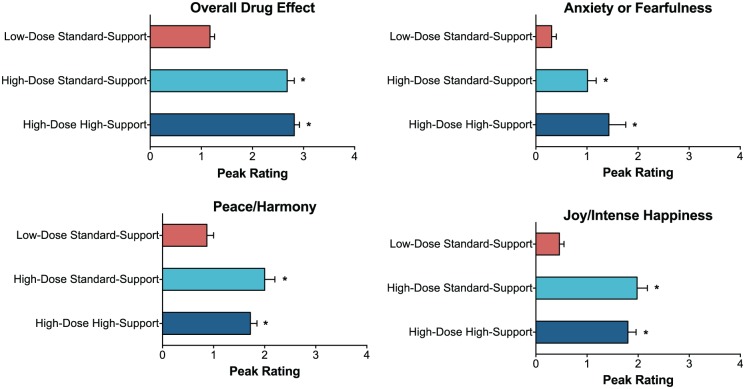
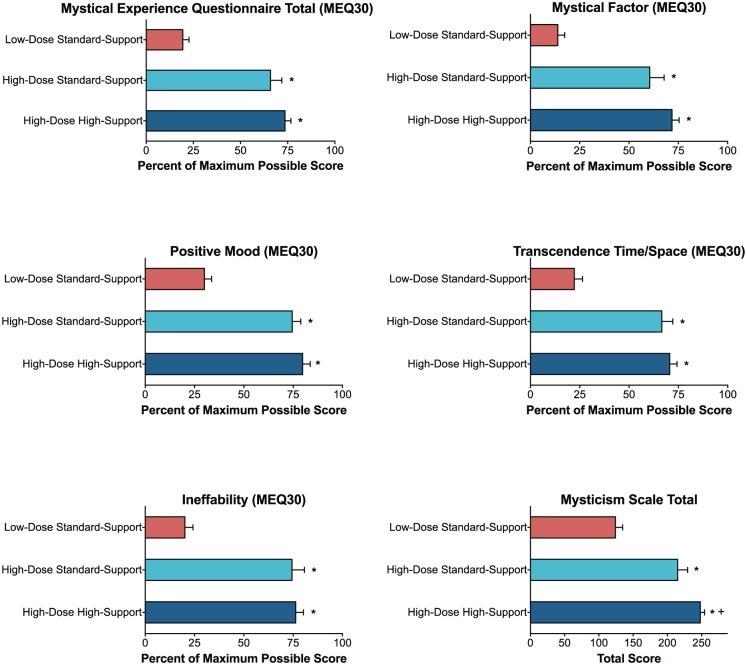
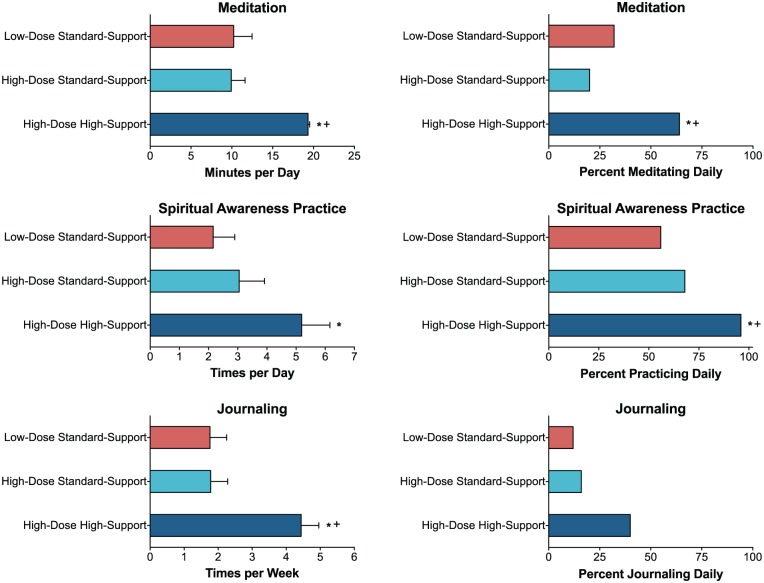
Verification
Claims the paper makes
The claims and statistics of this paper haven’t been checked yet.
Free: it reads the open-access text and checks the first 5 claims that cite a source we can check. Create a free account to check every claim.
Claims other papers make about this one
Each is checked against this paper’s own text: does it say what the citing paper says it does?
The cited source doesn’t support the claim as written.
In the citing paper
“In the aforementioned studies, the administration of psilocybin within a context of mindfulness-training significantly enhanced engagement with formal spiritual practises, mindfulness meditation depth and trait mindfulness (60, 61).”
From Examining the Potential Synergistic Effects Between Mindfulness Training and Psychedelic-Assisted Therapy (2021) · cites this paper as [60]
Checked by a reasoning model — may be wrong.
Experimental — accuracy not yet measuredThe source backs part of the claim, not all of it — or backs it for a different population, condition or comparison.
In the citing paper
“In addition, studies being performed on the use of psychoactive agents as catalysts for therapeutic psychological transformation, such as the Johns Hopkins psilocybin study, have examined the ways in which Buddhist meditation practice further facilitates”
From Buddhist Meditation and the Ethics of Human Augmentation (2020) · cites this paper as Griffiths et al. 2018
Experimental — accuracy not yet measuredThe source backs part of the claim, not all of it — or backs it for a different population, condition or comparison.
In the citing paper
“Similarly, research in healthy participants (N = 75) suggests group-based aftercare in addition to standard 2-on-1 support models can amplify well-being benefits of individual high-dose psilocybin sessions.11”
From Innovations in group-based psilocybin-assisted therapy of major depression in patients with cancer (2024) · cites this paper as [11]
Experimental — accuracy not yet measuredThe source backs part of the claim, not all of it — or backs it for a different population, condition or comparison.
In the citing paper
“It has been suggested by some studies that the intensity or quality of the psychedelic experience determines the treatment outcome (52–54).”
From Decreases in State and Trait Anxiety Post-psilocybin: A Naturalistic, Observational Study Among Retreat Attendees (2022) · cites this paper as [52]
Experimental — accuracy not yet measuredThe source backs part of the claim, not all of it — or backs it for a different population, condition or comparison.
In the citing paper
“it has been repeatedly found that psychedelic-induced mystical-type experiences and ego dissolution, the latter a phenomenon characterized by the reduction in self-referential awareness, disruption self-world boundaries, and increased feelings of unity with one’s surroundings (55), correlates with long-term (positive) outcomes (23, 52–54, 56–58).”
From Decreases in State and Trait Anxiety Post-psilocybin: A Naturalistic, Observational Study Among Retreat Attendees (2022) · cites this paper as [52]
Experimental — accuracy not yet measured
14 more claims about this paper
Create a free account to see every claim other papers make about this one.
Self-check
Percentages, sums and reported differences re-computed from the paper’s own numbers.
The self-check needs the paper’s full text.
Citations
Cites
Schwartz, S. H. (1992) · Advances in Experimental Social Psychology · doi:10.1016/s0065-2601(08)60281-6 · Cited by 14,619 · cited 1×
“…spiritual, holy, heavenly, and blessed (Mahoney et al., 2005); Schwartz Value Scale , a measure of relative importance of various life values (Schwartz, 1992, 1994); Inclusion of Others in the Self scale (IOS), a measure of interpersonal closeness (Aron et al., 1992), mean score of ratings…”
BackgroundScheier, M. F., Carver, C. S., & Bridges, M. W. (1994) · Journal of Personality and Social Psychology · doi:10.1037//0022-3514.67.6.1063 · Cited by 7,456 · cited 2×
“…compassion, amusement, and awe) (Shiota et al., 2006); Life-Orientation Test-Revised (LOT-R) , a measure of optimism associated with health outcomes (Scheier et al., 1994); Satisfaction with Life Scale (Pavot and Diener, 1993); Purpose in Life Test (PIL) , a assessment of meaningfulness in life…”
BackgroundAre There Universal Aspects in the Structure and Contents of Human Values?
Schwartz, S. H. (1994) · Journal of Social Issues · doi:10.1111/j.1540-4560.1994.tb01196.x · Cited by 5,793 · cited 1×
“…spiritual, holy, heavenly, and blessed (Mahoney et al., 2005); Schwartz Value Scale , a measure of relative importance of various life values (Schwartz, 1992, 1994); Inclusion of Others in the Self scale (IOS), a measure of interpersonal closeness (Aron et al., 1992), mean score of ratings…”
BackgroundThe varieties of religious experience: A study in human nature.
James, W. (1902) · doi:10.1037/10004-000 · Cited by 5,204
Inclusion of Other in the Self Scale and the structure of interpersonal closeness.
Aron, A., Aron, E. N., & Smollan, D. (1992) · Journal of Personality and Social Psychology · doi:10.1037/0022-3514.63.4.596 · Cited by 5,157 · cited 1×
“…relative importance of various life values (Schwartz, 1992, 1994); Inclusion of Others in the Self scale (IOS), a measure of interpersonal closeness (Aron et al., 1992), mean score of ratings of closest person, closest family member, least close family member, a stranger, and a difficult personal…”
BackgroundThe grateful disposition: A conceptual and empirical topography.
McCullough, M. E., Emmons, R. A., & Tsang, J.-A. (2002) · Journal of Personality and Social Psychology · doi:10.1037//0022-3514.82.1.112 · Cited by 3,664 · cited 2×
“…Loma Linda University, 2007), Daily Spiritual Experience Scale (general population survey data, Underwood, 2006); Gratitude Questionnaire-6 (adults, McCullough et al., 2002); Life Meaning (college and community sample, Reker, 2007); Trait Forgive-ness Scale (college students, Berry et al., 2005);…”
BackgroundReview of the Satisfaction With Life Scale.
Pavot, W., & Diener, E. (1993) · Psychological Assessment · doi:10.1037/1040-3590.5.2.164 · Cited by 3,611
Review of the Satisfaction With Life Scale
Pavot, W., & Diener, E. (2009) · Social Indicators Research Series · doi:10.1007/978-90-481-2354-4_5 · Cited by 3,460 · cited 4×
“Per the plan in the Data Analysis section, three longitudinal measures were dropped from analysis (Forgiveness subscale of the BMMRS; self-rated ASPIRES; and the Satisfaction with Life Scale) because of significant between-group differences at baseline and no significant difference in change from baseline.”
InfluentialPatterns of Positive and Negative Religious Coping with Major Life Stressors
Pargament, K. I., Smith, B. W., Koenig, H. G., & Perez, L. (1998) · Journal for the Scientific Study of Religion · doi:10.2307/1388152 · Cited by 2,425 · cited 1×
“…Protestant traditions (Benson et al., 1993); Brief RCOPE , a measure of religious/spiritual coping with stressful life events (Pargament, 1999; Pargament et al., 1998); Daily Spiritual Experience Scale , a measure of an individual’s perception of and interaction with the transcendent in daily…”
BackgroundGriffiths, R. R., Johnson, M. W., Carducci, M. A., Umbricht, A., Richards, W. A., Richards, B. D., Cosimano, M. P., & Klinedinst, M. A. (2016) · Journal of Psychopharmacology · doi:10.1177/0269881116675513 · Cited by 2,201 · cited 6×
“Prior research suggests an important role of psilocybin-occasioned mystical experience in the observed enduring positive changes in psychological well-being, prosocial disposition, and spiritual worldview (Garcia-Romeu et al., 2014; Griffiths et al., 2008, 2016; Ross et al., 2016).”
BackgroundMethodResultInfluentialSelf-citation
Research works printed but not linked: 14
- Costa PT McCrae RR (1992) Revised NEO Personality Inventory (NEO-PI-R) and NEO Five-Factor Inventory (NEO-FFI) (Professional manual). Odessa, FL: Psychological Assessment Resources.
- Darling DC Doblin R Metzner R (2004) Prisoner behavior change and experimental mysticism: Two classic studies from the Harvard psilocybin project. In: Metzner R (ed.) Teonanacatl: Sacred Mushroom of Visions. El Verano, CA: Four Trees Press, pp. 135– 151.
- Doblin R (1991) Pahnke’s Good Friday experiment: A long-term follow-up and methodological critique. J Transpersonal Psy 23: 1– 28.
- Easwaran E (1991/ 1978) Meditation: A Simple Eight-Point Program for Translating Spiritual Ideals into Daily Life. 2nd ed. Tomales, CA: Nilgiri Press.
- The Fetzer Institute (1999, Reprinted 2003) Brief multidimensional measure of religiousness/spirituality: 1999. In: Multidimensional Measurement of Religiousness/Spirituality for use in Health Research: A Report of the Fetzer Institute/National Institute on Aging Working Group. Kalamazoo, MI: Fetzer Institute, pp. 85– 95.
- Pahnke W (1963) Drugs and Mysticism: An Analysis of the Relationship Between Psychedelic Drugs and the Mystical Consciousness. PhD thesis. Cambridge, MA: Harvard University, Department of Religion and Society.
- Pargament KI (1999, Reprinted 2003) Religious/spiritual coping. In: Multidimensional Measurement of Religiousness/Spirituality for Use in Health Research: A Report of the Fetzer Institute/National Institute on Aging Working Group. Kalamazoo, MI: Fetzer Institute, pp. 43– 56.
- Passie T (2004) A history of the use of psilocybin in psychotherapy. In: Metzner R (ed.) Teonanacatl: Sacred Mushroom of Visions. El Verano, CA: Four Trees Press, pp. 109– 134.
- Passie T (2007) Contemporary psychedelic therapy: An overview. In: Winkelman MJ Roberts TB (eds) Psychedelic Medicine. Vol. 1 Westport CN: Praeger, pp. 45– 68.
- Piedmont RL (2010) ASPIRES: Assessment of Spirituality and Religious Sentiments (Technical Manual). 2nd ed. Columbia, MD: Loyola University Maryland, Department of Pastoral Counseling.
- Reker GT (2007) The Life Attitude Profile-Revised (LAP-R) (Procedures Manual). Research edn. Peterborough, ON: Student Psychologists Press.
- Stevens J (1987) Storming Heaven. New York: Harper & Row Publishers.
- VandeCreek L (1999) The death transcendence scale (Hood and Morris, 1983). In: Hill PC Hood RW (eds) Measures of Religiousity. Birmingham AL: Religious Education Press, pp. 442– 445.
- Weil GM Metzner R Leary T (1965, Reprinted 1997) The subjective after-effects of psychedelic experiences: A summary of four recent questionnaire studies. In: Weil GM Metzner R Leary T (eds) The Psychedelic Reader. Secaucus, NJ: Citadel Press, pp. 13– 21.
Cited by
Effects of Psilocybin-Assisted Therapy on Major Depressive Disorder: A Randomized Clinical Trial
Davis, A. K., Barrett, F. S., May, D. G., Cosimano, M. P., Sepeda, N. D., Johnson, M. W., Finan, P. H., & Griffiths, R. R. (2021) · JAMA Psychiatry · doi:10.1001/jamapsychiatry.2020.3285 · Cited by 1,301
Self-citationPsychedelics and Psychedelic-Assisted Psychotherapy
Reiff, C. M., Richman, E. E., Nemeroff, C. B., Carpenter, L. L., Widge, A. S., Rodriguez, C. I., Kalin, N. H., McDonald, W. M., & and the Work Group on Biomarkers and Novel Treatments, A. D. O. T. A. P. A. C. O. R. (2020) · American Journal of Psychiatry · doi:10.1176/appi.ajp.2019.19010035 · Cited by 649
“mations that lead to dramatic or “quantum” changes in a person’s sense of self and behavior (34).”
BackgroundPsychedelic drugs: neurobiology and potential for treatment of psychiatric disorders
Vollenweider, F. X., & Preller, K. H. (2020) · Nature Reviews Neuroscience · doi:10.1038/s41583-020-0367-2 · Cited by 570
The subjective effects of psychedelics are necessary for their enduring therapeutic effects
Yaden, D. B., & Griffiths, R. R. (2021) · ACS Pharmacology & Translational Science · doi:10.1021/acsptsci.0c00194 · Cited by 541
Self-citationJohnson, M. W., Hendricks, P. S., Barrett, F. S., & Griffiths, R. R. (2019) · Pharmacology & Therapeutics · doi:10.1016/j.pharmthera.2018.11.010 · Cited by 506
“…dose was significantly greater than after both placebo and DXM. Barrett and Griffiths (2017) conducted a further analysis of psilocybin-occasioned mystical experience in 119 healthy volunteers by collapsing data at 30 mg/70 kg psilocybin across three studies (Griffiths et al., 2006, 2011, 2018).”
BackgroundSelf-citationGukasyan, N., Davis, A. K., Barrett, F. S., Cosimano, M. P., Sepeda, N. D., Johnson, M. W., & Griffiths, R. R. (2022) · Journal of Psychopharmacology · doi:10.1177/02698811211073759 · Cited by 425
Self-citationPsychedelics, meditation, and self-consciousness
Millière, R., Carhart-Harris, R. L., Roseman, L., Trautwein, F.-M., & Berkovich-Ohana, A. (2018) · Frontiers in Psychology · doi:10.3389/fpsyg.2018.01475 · Cited by 390
Emotions and brain function are altered up to one month after a single high dose of psilocybin.
Barrett, F. S., Doss, M. K., Sepeda, N. D., Pekar, J. J., & Griffiths, R. R. (2020) · Scientific Reports · doi:10.1038/s41598-020-59282-y · Cited by 375
Self-citationJohnson, M. W., Griffiths, R. R., Hendricks, P. S., & Henningfield, J. E. (2018) · Neuropharmacology · doi:10.1016/j.neuropharm.2018.05.012 · Cited by 354
“lable at ScienceDirect Contents lists avai Neuropharmacology journal homepage: www.elsevier .com/locate/neuropharm Invited review The abuse potential of medical psilocybin according to the 8 factors of the Controlled Substances Act Matthew W. Johnson a, *, Roland R. Griffiths a, b, Peter S. Hendricks c, Jack E. Hennin…”
InfluentialSelf-citationLong-term effects of psychedelic drugs: A systematic review
Aday, J. S., Mitzkovitz, C. M., Bloesch, E. K., Davoli, C. C., & Davis, A. K. (2020) · Neuroscience & Biobehavioral Reviews · doi:10.1016/j.neubiorev.2020.03.017 · Cited by 257
Griffiths, R. R., Hurwitz, E. S., Davis, A. K., Johnson, M. W., & Jesse, R. (2019) · PLOS ONE · doi:10.1371/journal.pone.0214377 · Cited by 247
Self-citationSmigielski, L., Scheidegger, M., Kometer, M., & Vollenweider, F. X. (2019) · NeuroImage · doi:10.1016/j.neuroimage.2019.04.009 · Cited by 248
A systematic study of microdosing psychedelics
Polito, V., & Stevenson, R. J. (2019) · PLoS ONE · doi:10.1371/journal.pone.0211023 · Cited by 235
Long-lasting subjective effects of LSD in normal subjects.
Schmid, Y., & Liechti, M. E. (2018) · Psychopharmacology · doi:10.1007/s00213-017-4733-3 · Cited by 232
Psychedelics in Psychiatry: Neuroplastic, Immunomodulatory, and Neurotransmitter Mechanisms
Inserra, A., De Gregorio, D., & Gobbi, G. (2021) · Pharmacological Reviews · doi:10.1124/pharmrev.120.000056 · Cited by 232
Aday, J. S., Davis, A. K., Mitzkovitz, C. M., Bloesch, E. K., & Davoli, C. C. (2021) · ACS Pharmacology & Translational Science · doi:10.1021/acsptsci.1c00014 · Cited by 224
Pharmacological, neural, and psychological mechanisms underlying psychedelics: A critical review
van Elk, M., & Yaden, D. B. (2022) · Neuroscience & Biobehavioral Reviews · doi:10.1016/j.neubiorev.2022.104793 · Cited by 221
“A psilocybin study found that a condition that received instruction in meditation and psilocybin had more benefit than conditions receiving psilocybin alone or meditation instructions alone (Griffiths et al., 2018).”
BackgroundGarcia-Romeu, A., & Richards, W. A. (2018) · International Review of Psychiatry · doi:10.1080/09540261.2018.1486289 · Cited by 189
Self-citationLearning to Let Go: A Cognitive-Behavioral Model of How Psychedelic Therapy Promotes Acceptance
Wolff, M., Evens, R., Mertens, L. J., Koslowski, M., Betzler, F., Gründer, G., & Jungaberle, H. (2020) · Frontiers in Psychiatry · doi:10.3389/fpsyt.2020.00005 · Cited by 194
“Blissful ego-dissolution and related phenomena such as “oceanic boundlessness” and “mystical-type experiences” have been shown to predict not only long-term increases in well-being (80, 85) and trait openness in non-clinical samples (59, 60, 89) but also positive clinical outcomes (5, 7, 11, 46).”
BackgroundAwe: a putative mechanism underlying the effects of classic psychedelic-assisted psychotherapy
Hendricks, P. S. (2018) · International Review of Psychiatry · doi:10.1080/09540261.2018.1474185 · Cited by 179
“…psychedelics have been shown to produce enduring positive change across a range of psychological and behavioural outcomes among healthy subjects (Griffiths et al., 2018; Griffiths, Richards, Johnson, McCann, & Jesse, 2008, Griffiths et al., 2011; Griffiths, Richards, McCann, & Jesse, 2006;…”
BackgroundInfluentialForstmann, M., Yudkin, D. A., Prosser, A. M. B., Heller, S. M., & Crockett, M. J. (2020) · Proceedings of the National Academy of Sciences · doi:10.1073/pnas.1918477117 · Cited by 185
“These experiences have been found to produce lasting, positive effects on subjective well-being (25), openness to experience (26), perceived meaning in life (25), and prosocial attitudes and behaviors (19).”
BackgroundMadsen, M. K., Fisher, P. M., Stenbæk, D. S., Kristiansen, S., Burmester, D., Lehel, S., Páleníček, T., Kuchař, M., Svarer, C., Ozenne, B., et al. (2020) · European Neuropsychopharmacology · doi:10.1016/j.euroneuro.2020.02.001 · Cited by 183
Racial Justice Requires Ending the War on Drugs
Earp, B. D., Lewis, J., Hart, C. L., & Reform, W. B. A. A. P. F. D. P. (2021) · The American Journal of Bioethics · doi:10.1080/15265161.2020.1861364 · Cited by 167
“…to their values, motivations, and desires, and to engage in self-development and self-understanding (Fadiman 2011; Kaelen et al. 2015; Schmid et al. 2015; Liechti, Dolder, and Schmid 2017; Preller et al. 2017; Griffiths et al. 2018; Veit 2018; Earp 2018; Lewis 2020; Earp and Savulescu, in press).”
BackgroundSmigielski, L., Kometer, M., Scheidegger, M., Krähenmann, R., Huber, T., & Vollenweider, F. X. (2019) · Scientific Reports · doi:10.1038/s41598-019-50612-3 · Cited by 176
Brouwer, A., & Carhart-Harris, R. L. (2021) · Journal of Psychopharmacology · doi:10.1177/0269881120959637 · Cited by 143
Kettner, H., Gandy, S., Haijen, E. C. H. M., & Carhart-Harris, R. L. (2019) · International Journal of Environmental Research and Public Health · doi:10.3390/ijerph16245147 · Cited by 157
Madsen, M. K., Stenbæk, D. S., Arvidsson, A., Armand, S., Marstrand-Joergensen, M. R., Johansen, S. S., Linnet, K., Ozenne, B., Knudsen, G. M., & Fisher, P. M. (2021) · European Neuropsychopharmacology · doi:10.1016/j.euroneuro.2021.06.001 · Cited by 151
Timmermann, C., Bauer, P. R., Gosseries, O., Vanhaudenhuyse, A., Vollenweider, F., Laureys, S., Singer, T., Antonova, E., & Lutz, A. (2023) · Trends in Cognitive Sciences · doi:10.1016/j.tics.2022.11.006 · Cited by 150
Peill, J. M., Trinci, K. E., Kettner, H., Mertens, L. J., Roseman, L., Timmermann, C., Rosas, F. E., Lyons, T., & Carhart-Harris, R. L. (2022) · Journal of Psychopharmacology · doi:10.1177/02698811211066709 · Cited by 141
Polito, V., & Liknaitzky, P. (2022) · Neuroscience & Biobehavioral Reviews · doi:10.1016/j.neubiorev.2022.104706 · Cited by 141
Psychedelic-Assisted Group Therapy: A Systematic Review
Trope, A., Anderson, B. T., Hooker, A. R., Glick, G., Stauffer, C., & Woolley, J. D. (2019) · Journal of Psychoactive Drugs · doi:10.1080/02791072.2019.1593559 · Cited by 113
Therapeutic effect of psilocybin in addiction: A systematic review
van der Meer, P. B., Fuentes, J. J., Kaptein, A. A., Schoones, J. W., de Waal, M. M., Goudriaan, A. E., Kramers, K., Schellekens, A., Somers, M., Bossong, M. G., et al. (2023) · Frontiers in Psychiatry · doi:10.3389/fpsyt.2023.1134454 · Cited by 127
“, the degree to which a patient has a mysticaltype experience during the psilocybin session seems an important mediator for the enduring effect of the psilocybin) (25, 37).”
BackgroundMcCulloch, D. E.-W., Grzywacz, M. Z., Madsen, M. K., Jensen, P. S., Ozenne, B., Armand, S., Knudsen, G. M., Fisher, P. M., & Stenbæk, D. S. (2022) · Frontiers in Pharmacology · doi:10.3389/fphar.2022.841648 · Cited by 126
Classic Psychedelic Drugs: Update on Biological Mechanisms
Vollenweider, F. X., & Smallridge, J. W. (2022) · Pharmacopsychiatry · doi:10.1055/a-1721-2914 · Cited by 128
“To date, however, only a few prospective studies including controlled conditions [47–49, 51– 55 ] and a meta-analysis The OB-related blissful “mystical-type” experience can also be measured by the Mysticism Scale (M-Scale) [57] or by the Mystical Experience Questionnaire (MEQ30) [58].”
Kangaslampi, S. (2023) · Journal of Psychedelic Studies · doi:10.1556/2054.2023.00243 · Cited by 124
Barrett, F. S., Carbonaro, T. M., Hurwitz, E., Johnson, M. W., & Griffiths, R. R. (2018) · Psychopharmacology · doi:10.1007/s00213-018-4981-x · Cited by 109
Self-citationBehavioral Neurobiology of Psychedelic Drugs
(2018) · Current topics in behavioral neurosciences · doi:10.1007/978-3-662-55880-5 · Cited by 118
The acute effects of classic psychedelics on memory in humans
Healy, C. J. (2021) · Psychopharmacology · doi:10.1007/s00213-020-05756-w · Cited by 108
“…(and sometimes expressly) privilege the mystical experience as the type of psychedelic experience that engenders the most therapeutic benefit and, therefore, as the ultimate goal of the treatment (Barrett and Griffiths 2018; Garcia-Romeu and Richards 2018; Roseman et al. 2018; Ross et al. 2016).”
BackgroundSystematized Review of Psychotherapeutic Components of Psilocybin-Assisted Psychotherapy
Horton, D. M., Morrison, B., & Schmidt, J. (2021) · American Journal of Psychotherapy · doi:10.1176/appi.psychotherapy.20200055 · Cited by 93
Neural Mechanisms and Psychology of Psychedelic Ego Dissolution
Stoliker, D., Egan, G. F., Friston, K. J., & Razi, A. (2022) · Pharmacological Reviews · doi:10.1124/pharmrev.121.000508 · Cited by 81
Nayak, S. M., Jackson, H., Sepeda, N. D., Mathai, D. S., So, S., Yaffe, A., Zaki, H., Brasher, T. J., Lowe, M. X., Jolly, D. R. P., et al. (2023) · Frontiers in Psychiatry · doi:10.3389/fpsyt.2023.1199642 · Cited by 112
“Results suggest psilocybin holds further promise for spirituality and wellbeing enhancement in non-clinical populations, which warrants additional research (21, 25).”
BackgroundSelf-citationSet and setting: a randomized study of different musical genres in supporting psychedelic therapy
Strickland, J. C., Garcia-Romeu, A., & Johnson, M. W. (2021) · ACS Pharmacology & Translational Science · doi:10.1021/acsptsci.0c00187 · Cited by 97
Self-citationDose–response relationships of psilocybin-induced subjective experiences in humans
Hirschfeld, T., & Schmidt, T. T. (2021) · Journal of Psychopharmacology · doi:10.1177/0269881121992676 · Cited by 93
Belief changes associated with psychedelic use
Nayak, S. M., Singh, M., Yaden, D. B., & Griffiths, R. R. (2022) · Journal of Psychopharmacology · doi:10.1177/02698811221131989 · Cited by 105
Self-citationGarcia-Romeu, A., Barrett, F. S., Carbonaro, T. M., Johnson, M. W., & Griffiths, R. R. (2021) · Journal of Psychopharmacology · doi:10.1177/0269881121991822 · Cited by 96
Self-citationDoes Psychedelic Therapy Have a Transdiagnostic Action and Prophylactic Potential?
Kočárová, R., Horáček, J., & Carhart-Harris, R. (2021) · Frontiers in Psychiatry · doi:10.3389/fpsyt.2021.661233 · Cited by 96
The Psychedelic Future of Post-Traumatic Stress Disorder Treatment
Zaretsky, T. G., Jagodnik, K. M., Barsic, R., Antonio, J. H., Bonanno, P. A., MacLeod, C., Pierce, C., Carney, H., Morrison, M. T., Saylor, C., et al. (2024) · Current Neuropharmacology · doi:10.2174/1570159x22666231027111147 · Cited by 85
Greenway, K. T., Garel, N., Jerome, L., & Feduccia, A. A. (2020) · Expert Review of Clinical Pharmacology · doi:10.1080/17512433.2020.1772054 · Cited by 94
Upward spirals of positive emotions and religious behaviors
Cappellen, P. V., Edwards, M., & Fredrickson, B. L. (2020) · Current Opinion in Psychology · doi:10.1016/j.copsyc.2020.09.004 · Cited by 103
Barsuglia, J., Davis, A. K., Palmer, R., Lancelotta, R., Windham-Herman, A.-M., Peterson, K., Polanco, M., Grant, R., & Griffiths, R. R. (2018) · Frontiers in Psychology · doi:10.3389/fpsyg.2018.02459 · Cited by 79
Self-citationBrennan, W., & Belser, A. B. (2022) · Frontiers in Psychology · doi:10.3389/fpsyg.2022.866018 · Cited by 90
“, 2014), and other positive changes in psychological functioning (Griffiths et al., 2018).”
BackgroundBender, D., & Hellerstein, D. J. (2022) · Psychopharmacology · doi:10.1007/s00213-021-06049-6 · Cited by 88
High dose psilocybin is associated with positive subjective effects in healthy volunteers
Nicholas, C. R., Henriquez, K. M., Gassman, M. C., Cooper, K. M., Muller, D., Hetzel, S., Brown, R. T., Cozzi, N. V., Thomas, C., & Hutson, P. R. (2018) · Journal of Psychopharmacology · doi:10.1177/0269881118780713 · Cited by 83
Heuschkel, K., & Kuypers, K. P. C. (2020) · Frontiers in Psychiatry · doi:10.3389/fpsyt.2020.00224 · Cited by 86
“(69) found that more extensive spiritual practice, including meditation, was associated with a higher frequency of psychedelic-induced peak experiences.”
BackgroundResultInfluentialPsychedelics, Sociality, and Human Evolution
Rodríguez Arce, J. M., & Winkelman, M. J. (2021) · Frontiers in Psychology · doi:10.3389/fpsyg.2021.729425 · Cited by 86
“Psilocybin occasioned mystical experiences produce enduring beneficial changes, such as trait-level increases in prosocial attitudes and behaviors (Griffiths et al., 2018) and in the personality domain of Openness (MacLean et al.”
BackgroundExamining changes in personality following shamanic ceremonial use of ayahuasca
Weiss, B., Miller, J. D., Carter, N. T., & Keith Campbell, W. (2021) · Scientific Reports · doi:10.1038/s41598-021-84746-0 · Cited by 86
Handbook of Positive Psychology, Religion, and Spirituality
Davis, E. B., Worthington, E. L., & Schnitker, S. A. (2022) · Springer eBooks · doi:10.1007/978-3-031-10274-5 · Cited by 107
Tulver, K., Kaup, K., Laukkonen, R., & Aru, J. (2023) · Consciousness and Cognition · doi:10.1016/j.concog.2023.103494 · Cited by 99
Acute subjective effects in LSD- and MDMA-assisted psychotherapy
Schmid, Y., Gasser, P., Oehen, P., & Liechti, M. E. (2021) · Journal of Psychopharmacology · doi:10.1177/0269881120959604 · Cited by 85
Moreton, S. G., Szalla, L., Menzies, R. E., & Arena, A. F. A. (2019) · Psychopharmacology · doi:10.1007/s00213-019-05391-0 · Cited by 93
Replication and extension of a model predicting response to psilocybin
Russ, S. L., Carhart-Harris, R. L., Maruyama, G. M., & Elliott, M. S. (2019) · Psychopharmacology · doi:10.1007/s00213-019-05279-z · Cited by 85
Critical Period Plasticity as a Framework for Psychedelic-Assisted Psychotherapy
Lepow, L., Morishita, H., & Yehuda, R. (2021) · Frontiers in Neuroscience · doi:10.3389/fnins.2021.710004 · Cited by 86
“Furthermore, the specific type and intensity of psychological support framing the experience has been correlated with clinical and efficacy outcomes (Griffiths et al., 2018).”
BackgroundRight-Wing Psychedelia: Case Studies in Cultural Plasticity and Political Pluripotency
Pace, B. A., & Devenot, N. (2021) · Frontiers in Psychology · doi:10.3389/fpsyg.2021.733185 · Cited by 93
“Prosociality and openness have both been shown under experimental conditions to be dramatically affected by psilocybin (MacLean et al., 2011; Griffiths et al., 2018).”
BackgroundAntidepressant effects of a psychedelic experience in a large prospective naturalistic sample
Nygart, V. A., Pommerencke, L. M., Haijen, E., Kettner, H., Kaelen, M., Mortensen, E. L., Nutt, D. J., Carhart-Harris, R. L., & Erritzoe, D. (2022) · Journal of Psychopharmacology · doi:10.1177/02698811221101061 · Cited by 73
Combining Psychedelic and Mindfulness Interventions: Synergies to Inform Clinical Practice
Payne, J. E., Chambers, R., & Liknaitzky, P. (2021) · ACS Pharmacology & Translational Science · doi:10.1021/acsptsci.1c00034 · Cited by 78
Nayak, S. M., & Griffiths, R. R. (2022) · Frontiers in Psychology · doi:10.3389/fpsyg.2022.852248 · Cited by 73
“…MEQ item “Awareness of the life or living presence in all things”) coupled with a noetic quality [e.g., MEQ item (“Certainty of encounter with ultimate reality (in the sense of being able to ‘know’ and ‘see’ what is really real at some time during your experience”) (Barrett and Griffiths, 2018).”
BackgroundSelf-citationAssociations between lifetime classic psychedelic use and markers of physical health
Simonsson, O., Sexton, J. D., & Hendricks, P. S. (2021) · Journal of Psychopharmacology · doi:10.1177/0269881121996863 · Cited by 79
“…indices of mental health beyond the simple absence of psychological distress (e.g. increased prosociality, trait mindfulness and purpose in life; Griffiths et al., 2018; Murphy-Beiner and Soar, 2020), many of which are well-known risk factors for physical maladies (Chaddha et al., 2016;…”
BackgroundDefining Transformative Experiences: A Conceptual Analysis
Chirico, A., Pizzolante, M., Kitson, A., Gianotti, E., Riecke, B. E., & Gaggioli, A. (2022) · Frontiers in Psychology · doi:10.3389/fpsyg.2022.790300 · Cited by 91
Safety and risk assessment of psychedelic psychotherapy: A meta-analysis and systematic review
Roméo, B., Kervadec, E., Fauvel, B., Strika-Bruneau, L., Amirouche, A., Verroust, V., Piolino, P., & Benyamina, A. (2024) · Psychiatry Research · doi:10.1016/j.psychres.2024.115880 · Cited by 74
Modulation of Social Cognition via Hallucinogens and “Entactogens”
Preller, K. H., & Vollenweider, F. X. (2019) · Frontiers in Psychiatry · doi:10.3389/fpsyt.2019.00881 · Cited by 71
Psychedelics and psychotherapy
Nayak, S., & Johnson, M. W. (2021) · Pharmacopsychiatry · doi:10.1055/a-1312-7297 · Cited by 71
“Study participants receiving moderate to high dose psilocybin ( > 20mg/70kg) often rank such experiences among the top 5 most meaningful experiences of their lives [5, 54, 55], even 14 months later [2].”
BackgroundSelf-citationStrategies for Fostering a Genuine Feeling of Connection in Technologically Mediated Systems
Stepanova, E. R., Desnoyers-Stewart, J., Höök, K., & Riecke, B. E. (2022) · CHI Conference on Human Factors in Computing Systems · doi:10.1145/3491102.3517580 · Cited by 81
“Such experiences are associated with pro-social outcomes [60, 105].”
BackgroundA unified model of ketamine’s dissociative and psychedelic properties
Marguilho, M., Figueiredo, I., & Castro-Rodrigues, P. (2022) · Journal of Psychopharmacology · doi:10.1177/02698811221140011 · Cited by 78
Gandy, S., Forstmann, M., Carhart-Harris, R. L., Timmermann, C., Luke, D., & Watts, R. (2020) · Health Psychology Open · doi:10.1177/2055102920978123 · Cited by 63
Psychedelics and Consciousness: Distinctions, Demarcations, and Opportunities
Yaden, D. B., Johnson, M. W., Griffiths, R. R., Doss, M. K., Garcia‐Romeu, A., Nayak, S. M., Gukasyan, N., Mathur, B. N., & Barrett, F. S. (2021) · The International Journal of Neuropsychopharmacology · doi:10.1093/ijnp/pyab026 · Cited by 77
Self-citationSweeney, M. M., Nayak, S. M., Hurwitz, E. S., Mitchell, L. N., Swift, T. C., & Griffiths, R. R. (2022) · PLoS ONE · doi:10.1371/journal.pone.0271926 · Cited by 76
Self-citationPattern breaking: a complex systems approach to psychedelic medicine
Hipólito, I., Mago, J., Rosas, F. E., & Carhart-Harris, R. L. (2023) · Neuroscience of Consciousness · doi:10.1093/nc/niad017 · Cited by 82
Psychedelic therapy's transdiagnostic effects: A research domain criteria (RDoC) perspective
Kelly, J. R., Gillan, C. M., Prenderville, J., Kelly, C., Harkin, A., Clarke, G., & O'Keane, V. (2021) · Frontiers in Psychiatry · doi:10.3389/fpsyt.2021.800072 · Cited by 69
“In addition to significant positive changes in gratitude, life meaning/purpose, forgiveness and death transcendence, a double-blind study comparing low and high dose psilocybin therapy in HCs reported sustained increases in experiences of interpersonal closeness at 6 month follow up, associated with mystical-type expe…”
BackgroundGiluk (2009) · doi:10.1017/s003329172000389x · Cited by 68
Zeifman, R. J., & Wagner, A. C. (2020) · Journal of Contextual Behavioral Science · doi:10.1016/j.jcbs.2019.11.001 · Cited by 67
Clinically relevant acute subjective effects of psychedelics beyond mystical experience
Yaden, D. B., Goldy, S. P., Weiss, B., & Griffiths, R. R. (2024) · Nature Reviews Psychology · doi:10.1038/s44159-024-00345-6 · Cited by 72
“In several trials of non-clinical samples, the majority of participants rated the experience as among the most meaningful of their entire lives 4,13,14 .”
Self-citationWalsh, Z., & Thiessen, M. S. (2018) · International Review of Psychiatry · doi:10.1080/09540261.2018.1474088 · Cited by 66
“Interestingly, this preliminary evidence points to a reciprocal relationship such that psychedelic use may facilitate mindfulness (Soler et al., 2016), and mindfulnessenhancing practices may accentuate the positive effects of psychedelic use (Griffiths et al., 2017).”
BackgroundInfluentialEffects of psilocybin versus escitalopram on rumination and thought suppression in depression
Barba, T., Buehler, S., Kettner, H., Radu, C., Cunha, B. G., Nutt, D. J., Erritzoe, D., Roseman, L., & Carhart-Harris, R. (2022) · BJPsych Open · doi:10.1192/bjo.2022.565 · Cited by 57
Agin-Liebes, G., Nielson, E. M., Zingman, M., Kim, K., Haas, A., Owens, L. T., Rogers, U. A., & Bogenschutz, M. P. (2024) · Psychology of Addictive Behaviors · doi:10.1037/adb0000935 · Cited by 70
Sloshower, J., Zeifman, R. J., Guss, J., Krause, R., Safi-Aghdam, H., Pathania, S., Pittman, B., & D’Souza, D. C. (2024) · Scientific Reports · doi:10.1038/s41598-024-58318-x · Cited by 65
“Research has also found that administration of psilocybin alongside support for spiritual practice is associated with increases in valuing of tradition 55 .”
BackgroundMertens, L. J., & Preller, K. H. (2021) · Pharmacopsychiatry · doi:10.1055/a-1341-1907 · Cited by 65
“Healthy participants reported increases in interpersonal closeness and positive/ altruistic social effects up to 14 months after the administration of psilocybin and LSD [118, 119].”
BackgroundFrom relaxed beliefs under psychedelics (REBUS) to revised beliefs after psychedelics (REBAS)
Zeifman, R. J., Spriggs, M. J., Kettner, H., Lyons, T., Rosas, F. E., Mediano, P. A. M., Erritzøe, D., & Carhart-Harris, R. L. (2025) · Scientific Reports · doi:10.1038/s41598-023-28111-3 · Cited by 70
Mans, K., Kettner, H., Erritzøe, D., Haijen, E. C. H. M., Kaelen, M., & Carhart-Harris, R. L. (2021) · Frontiers in Psychiatry · doi:10.3389/fpsyt.2021.647909 · Cited by 67
“combined with meditation and spiritual practises (60).”
Group VR experiences can produce ego attenuation and connectedness comparable to psychedelics
Glowacki, D. R., Williams, R. R., Wonnacott, M., Maynard, O., Freire, R., Pike, J. E., & Chatziapostolou, M. (2022) · Scientific Reports · doi:10.1038/s41598-022-12637-z · Cited by 75
“Connectedness, which has been previously been highlighted as a key aspect of the YD experience 87 , emerged as the strongest qualitative theme for Isness-D participants, “ I felt connected with myself but also with everyone else here… I think ‘connected’ is the word for me for the end of this session.”
BackgroundMethodInfluentialPerkins, D., Opaleye, E. S., Šimonová, H., Bouso, J. C., Tófoli, L. F., Coelho, N. L. G., Schubert, V., & Sarris, J. J. (2021) · Drug and Alcohol Review · doi:10.1111/dar.13348 · Cited by 69
Psychosis and psychedelics: Historical entanglements and contemporary contrasts
Friesen, P. (2022) · Transcultural Psychiatry · doi:10.1177/13634615221129116 · Cited by 62
Yaden, D. B., Berghella, A. P., Regier, P. S., Garcia‐Romeu, A., Johnson, M. W., & Hendricks, P. S. (2021) · International Journal of Drug Policy · doi:10.1016/j.drugpo.2021.103380 · Cited by 59
Self-citationWießner, I., Falchi-Carvalho, M., Palhano-Fontes, F., Feilding, A., Ribeiro, S. T. G., & Tófoli, L. F. (2021) · Psychological Medicine · doi:10.1017/s0033291721002531 · Cited by 62
Psychedelic-assisted psychotherapy: Where is the psychotherapy research
Aday, J. S., Horton, D., Fernandes-Osterhold, G., O’Donovan, A., Bradley, E. R., Rosen, R. C., & Woolley, J. D. (2024) · Psychopharmacology · doi:10.1007/s00213-024-06620-x · Cited by 54
Isness: Using Multi-Person VR to Design Peak Mystical Type Experiences Comparable to Psychedelics
Glowacki, D. R., Wonnacott, M. D., Freire, R., Glowacki, B. R., Gale, E. M., Pike, J. E., de Haan, T., Chatziapostolou, M., & Metatla, O. (2020) · Proceedings of the 2020 CHI Conference on Human Factors in Computing Systems · doi:10.1145/3313831.3376649 · Cited by 54
Ort, A., Smallridge, J. W., Sarasso, S., Casarotto, S., von Rotz, R., Casanova, A., Seifritz, E., Preller, K. H., Tononi, G., & Vollenweider, F. X. (2023) · iScience · doi:10.1016/j.isci.2023.106589 · Cited by 59
Psychedelics and potential benefits in “healthy normals”: A review of the literature
Gandy, S. (2019) · Journal of Psychedelic Studies · doi:10.1556/2054.2019.029 · Cited by 60
Carhart-Harris, R. L., Wagner, A. C., Agrawal, M., Kettner, H., Rosenbaum, J. F., Gazzaley, A., Nutt, D. J., & Erritzoe, D. (2022) · Journal of Psychopharmacology · doi:10.1177/02698811211008567 · Cited by 51
Brennan, B., Kelman, A. R., & Belser, A. (2023) · Psychedelic Medicine · doi:10.1089/psymed.2023.0007 · Cited by 52
“Griffiths et al. 30 designed a trial to determine, in part, any added benefits to providing a high-support (35 h) as compared with a low-support condition (only 7 h and 20 min).”
Borkel, L. F., Rojas‐Hernández, J., Henríquez‐Hernández, L. A., Santana, Á., & Hernández, D. J. Q. (2023) · Expert Review of Clinical Pharmacology · doi:10.1080/17512433.2023.2295997 · Cited by 60
“However, psychedelic use has been found to increase connectedness, nature-relatedness, and altruism and prosocial behavior [33,64,72–74].”
Background
Metadata
- Authors
- Griffiths, R. R., Johnson, M. W., Richards, W. A., Richards, B. D., Jesse, R., MacLean, K. A., Barrett, F. S., Cosimano, M. P., & Klinedinst, M. A.
- Affiliations
- Johns Hopkins University (US)
- Council on Spiritual Practices, Occidental, USA
- Center for Optimal Living, New York, USA
- Corresponding author
- Griffiths, Roland R
- Venue
- Journal of Psychopharmacology
- Publisher
- SAGE Publications
- Published
- 2017-10-11
- Volume
- 32
- Issue
- 1
- Pages
- 49-69
- ISSN
- 0269-8811 (ISSN-L)
- 1461-7285
- PMC
- PMC5772431
- OpenAlex
- W2762822955
- Semantic Scholar
- 9548d9e33e5cadf7c65e63c815a68480fb48571a
- Cited by
- 520
- References
- 58
- Citations by year
- 2026: 47 · 2025: 76 · 2024: 83 · 2023: 91 · 2022: 89 · 2021: 60 · 2020: 37 · 2019: 19 · 2018: 16 · 2017: 1
- FWCI
- 24.76
- Type
- journal article
- Language
- en
- Open access
- hybrid
- doi.org
- Licence
- cc-by-nc
- journals.sagepub.com/page/policies/text-and-data-mining-license (tdm)
- Locations
- Journal of Psychopharmacology (publishedVersion, cc-by-nc)
- Europe PMC (PubMed Central) (publishedVersion, cc-by-nc)
- PubMed Central (publishedVersion, cc-by-nc)
- PubMed (publishedVersion)
- Funders
- Fetzer Institute
- National Institute on Drug Abuse (R01DA003889)
- Topics
- Social Sciences › Psychology › Clinical Psychology › Psychedelics and Drug Studies
- Social Sciences › Health › Religion, Spirituality, and Psychology
- Social Sciences › Psychology › Social Psychology › Paranormal Experiences and Beliefs
- Keywords
- psilocybin, meditation, spiritual practice, prosocial attitudes, prosocial behavior, well-being, gratitude, meaning of life, forgiveness, faith, coping, relationship closeness, dose-response relationship, psychedelic-assisted psychotherapy
- MeSH terms
- Adult, Aged, Attitude, Behavior, Double-Blind Method, Female, Humans, Longitudinal Studies, Male, Middle Aged, Mysticism, Psilocybin, Meditation, Young Adult
About these checks
Registry, retraction, Cites and statistics results are computed, not judged, with one exception: a printed reference that no index lists is read once by a model before it counts as a citation error. Claims are extracted by a model and kept only when their quote appears verbatim in the text; each cited source is then checked, with a model’s help, for whether it says what the claim relies on. Those verdicts can be wrong — read the claim’s quote and the cited source before relying on one.
Statistics and arithmetic are recomputed, not judged.
Confidence bands are shown only for fields calibrated on our annotated test set. None is calibrated yet, so no band is shown.
What counts as a claim ›How we measure confidence ›How we check this ›
Are you an author, or do you see a problem with this page? Request a review
Data sources
Bibliographic data: Semantic Scholar, OpenAlex, Crossref.
Contains information from the Semantic Scholar Academic Graph Datasets, made available under the ODC Attribution License (ODC-BY 1.0).
Semantic Scholar’s data is described in: Kinney, R., et al. (2023). The Semantic Scholar Open Data Platform. arXiv:2301.10140.
