

Effectiveness of a guided ACT-based self-help resilience training for depressive symptoms during pregnancy: Study protocol of a randomized controlled trial embedded in a prospective cohort.
Open accessThe DOI matches its Crossref record; 82 of the 84 references it cites were found in a registry or an index; 25 of the 55 sources its claims cite were checked for support.
Abstract
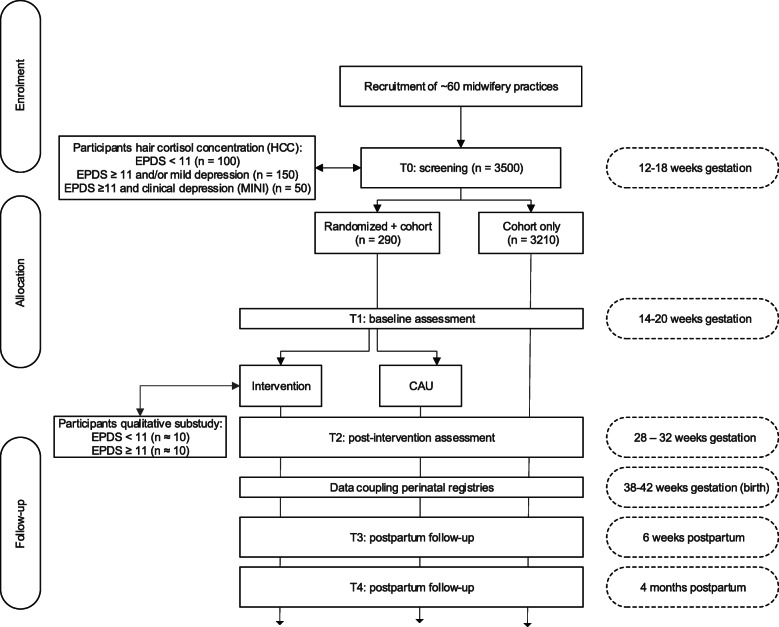
Background: During pregnancy, about 10 to 20% of women experience depressive symptoms. Subclinical depression increases the risk of peripartum depression, maternal neuro-endocrine dysregulations, and adverse birth and infant outcomes. Current treatments often comprise face-to-face psychological or pharmacological treatments that may be too intensive for women with subclinical depression leading to drop-out and moderate effectiveness. Therefore, easily accessible, resilience enhancing and less stigmatizing interventions are needed to prevent the development of clinical depression. This paper describes the protocol of a prospective cohort study with an embedded randomized controlled trial (RCT) that aims to improve mental resilience in a sample of pregnant women through a self-help program based on the principles of Acceptance and Commitment Therapy (ACT). Maternal and offspring correlates of the trajectories of peripartum depressive symptoms will also be studied.Methods: Pregnant women (≥ 18 years) receiving care in Dutch midwifery practices will participate in a prospective cohort study (n ~ 3500). Between 12 and 18 weeks of pregnancy, all women will be screened for depression with the Edinburgh Postnatal Depression Scale (EPDS). Women with an EPDS score ≥ 11 will be evaluated with a structured clinical interview. Participants with subclinical depression (n = 290) will be randomized to a 9-week guided self-help ACT-training or to care as usual (CAU). Primary outcomes (depressive symptoms and resilience) and secondary outcomes (e.g. anxiety and PTSD, bonding, infant development) will be collected via online questionnaires at four prospective assessments around 20 weeks and 30 weeks gestation and at 6 weeks and 4 months postpartum. Maternal hair cortisol concentrations will be assessed in a subsample of women with a range of depressive symptoms (n = 300). The intervention's feasibility will be assessed through qualitative interviews in a subsample of participants (n = 20).Discussion: This is the first study to assess the effectiveness of an easy to administer intervention strategy to prevent adverse mental health effects through enhancing resilience in pregnant women with antepartum depressive symptomatology. This longitudinal study will provide insights into trajectories of peripartum depressive symptoms in relation to resilience, maternal cortisol, psychological outcomes, and infant developmental milestones.Trial Registration: Netherlands Trial Register (NTR), NL7499 . Registered 5 February 2019.
Overview
CoChat Summary
## TL;DR
This paper is a study protocol for a prospective cohort study with an embedded randomized controlled trial testing a 9-week guided ACT-based self-help resilience program for pregnant women with subclinical depression. It will also examine depressive-symptom trajectories, cortisol, and infant outcomes across pregnancy and postpartum.
## Key findings
- The cohort will enroll about 3,500 pregnant women in Dutch midwifery care, and the embedded RCT will randomize 290 women with subclinical depression to intervention or care as usual.
- Depression screening uses the EPDS at 12–18 weeks gestation; women with EPDS ≥ 11 receive a structured interview, and the primary outcomes are depressive symptoms and resilience.
- Follow-up data are planned at about 20 weeks and 30 weeks gestation, plus 6 weeks and 4 months postpartum; secondary outcomes include anxiety, PTSD, bonding, quality of life, birth outcomes, and infant development.
- The power calculation states that with 290 women and 80% power, the study can detect effect sizes of about d = 0.33 between groups, and about d = 0.365 after assuming 18% attrition.
## Methods
- Prospective cohort study with an embedded 1:1 randomized controlled trial; women aged ≥18 years in Dutch midwifery practices are screened, and those with subclinical depression are assigned to 9 weeks of guided ACT-based self-help or care as usual.
- Planned samples include a cohort of about 3,500, an RCT of 290, a hair-cortisol substudy of 300, and a qualitative interview substudy of about 20 intervention participants.
- Main analyses: intention-to-treat and per-protocol analyses, independent t-tests, linear mixed models, generalized linear mixed models, chi-square tests, latent class analyses for symptom trajectories, and thematic analysis for interviews.
## Limitations
- The paper states that multiple clinical self-assessments during the intervention may reduce compliance and increase drop-out rates.
- It also states that infant developmental milestones are reported by the mother rather than the father, which may cause reporter bias, especially among women with more depressive symptoms.
- Evident from the protocol: the study is not blinded to participants or researchers after allocation, and the text is a protocol, so effectiveness results are not yet available.
Model-written summary. Check it against the paper before relying on it.
Integrity signals
Registry
Cites
Statistics
Figures
Verification
Claims the paper makes
17 Valid · 2 Not valid · 13 Not checked · 10 Own results and interpretations
At least one cited source doesn’t support this claim or points to a different paper, and none confirmed it — see the verdicts below.
In the paper
“Assuming an attrition rate of 18% as in previous trials evaluating the long-term effectiveness of ACT [45, 80], the current sample-size allows us to detect small to moderate effect sizes (i.e., d = 0.365) with a power of 80% at the planned follow-up assessment [81].”
§ Effectiveness of a guided ACT-based self-help resilience training for depressive symptoms during pregnancy: Study protocol of a randomized controlled trial embedded in a prospective cohort > Statistical methods > Power calculation
What the sources say
- Not checked — no full text of the sourcecites [45] Fledderus M Bohlmeijer ET Pieterse ME Schreurs KM Acceptance and commitment therapy as guided self-help for psychological distress and positive mental health: a randomized controlled trial Psychol Med 2012 42 485 95 10.1017/s0033291711001206 21740624 source
- Disputedcites [80] Pots WTM Fledderus M Meulenbeek PAM ten Klooster PM Schreurs KMG Bohlmeijer ET Acceptance and commitment therapy as a web-based intervention for depressive symptoms: randomised controlled trial Br J Psychiatry 2016 208 69 77 10.1192/bjp.bp.114.146068 26250745 sourceExperimental — accuracy not yet measured
The Results (page unavailable) report 13% attrition in the ACT group at the 12-month follow-up, not 18%. This source is cited for the assumed attrition rate; the sentence cites a different source for the sample-size and power calculation. (LLM, conf=0.85)
Checked by a reasoning model — may be wrong.
- Not checked — no full text of the sourcecites [81] Rompala KS Cirino N Rosenberg KD Fu R Lambert WE Prenatal Depression Screening by Certified Nurse-Midwives, Oregon J Midwifery Womens Health 2016 61 599 605 10.1111/jmwh.12491 27541435 source
plainn = 290- Asserted: passes — The authors put it forward as true.
- Checkable: passes — It can be checked against evidence.
- Load-bearing: passes — The paper’s conclusions depend on it.
- Based: passes — The paper gives a reason why it holds.
The cited sources support only part of this claim — read each source’s verdict below.
In the paper
“The medium effect (Cohen’s d) of ACT treatment on depressive symptoms lies between 0.4 and 0.6 [30, 79].”
§ Effectiveness of a guided ACT-based self-help resilience training for depressive symptoms during pregnancy: Study protocol of a randomized controlled trial embedded in a prospective cohort > Statistical methods > Power calculation
What the sources say
- Not matchedcites [30] Ruiz FJ Acceptance and commitment therapy versus traditional cognitive behavioral therapy: A systematic review and meta-analysis of current empirical evidence Int J Psychol Psychol Ther. 2012 12 333 57
We searched by its title and found no matching paper.
- Partly supportedcites [79] A-Tjak JGL Davis ML Morina N Powers MB Smits JAJ Emmelkamp PMG A meta-analysis of the efficacy of acceptance and commitment therapy for clinically relevant mental and physical health problems Psychother Psychosom 2015 84 30 6 10.1159/000365764 25547522 sourceExperimental — accuracy not yet measured
The Results section, “ACT vs. Control Conditions on Primary Outcome Variables” (page unavailable), reports an overall effect of Hedges’s g = 0.57, within the claimed range, but that estimate pools outcomes across disorders. “Effect Size as a Function of Target Problem” reports g = 0.37 for the combined anxiety/depression group, not a Cohen’s d of 0.4–0.6 specifically for depressive symptoms. (LLM, conf=0.88)
plainstates a cause- Asserted: passes — The authors put it forward as true.
- Checkable: passes — It can be checked against evidence.
- Load-bearing: passes — The paper’s conclusions depend on it.
- Based: passes — The paper gives a reason why it holds.
- Not matched
The cited sources support only part of this claim — read each source’s verdict below.
In the paper
“A potential mechanism underlying these associations is stress-induced neuroendocrine dysregulation of the maternal Hypothalamic Pituitary Adrenal (HPA)-axis reflected by increased maternal cortisol levels that, in turn, affects the functioning of the neonatal HPA-axis [11].”
§ Effectiveness of a guided ACT-based self-help resilience training for depressive symptoms during pregnancy: Study protocol of a randomized controlled trial embedded in a prospective cohort > Background
What the sources say
- Partly supportedcites [11] Xiong F, Zhang L. Role of the hypothalamic–pituitary–adrenal axis in developmental programming of health and disease. Front Neuroendocrinol. 2013;34:27–46. 10.1016/J.YFRNE.2012.11.002. PMC3594480 23200813 sourceExperimental — accuracy not yet measured
Split into 2 atoms — 1 confirmed, 1 partially supported, 0 disputed, 0 misattributed, 0 unverifiable. Expand the claim to see per-atom verdicts.
hedgedstates a possible cause- Asserted: passes — The authors put it forward as true.
- Checkable: passes — It can be checked against evidence.
- Load-bearing: unclear — It is unclear whether the paper’s conclusions depend on it.
- Based: passes — The paper gives a reason why it holds.
- Partly supported
The cited sources support only part of this claim — read each source’s verdict below.
In the paper
“An important protective factor against the development of depression is resilience: adapting to and recovering from stress [12].”
§ Effectiveness of a guided ACT-based self-help resilience training for depressive symptoms during pregnancy: Study protocol of a randomized controlled trial embedded in a prospective cohort > Background
What the sources say
- Partly supportedcites [12] Waugh CE Koster EHW A resilience framework for promoting stable remission from depression Clin Psychol Rev 2015 41 49 60 10.1016/j.cpr.2014.05.004 24930712 sourceExperimental — accuracy not yet measured
The Abstract defines resilience as adapting to and recovering from stress, and p. 7 links resilience to whether people develop psychopathology after a stressor. But the paper’s proposed protective role in depression specifically concerns preventing recurrence in people already in remission, not preventing its initial development. (LLM, conf=0.85)
plainstates a cause- Asserted: passes — The authors put it forward as true.
- Checkable: passes — It can be checked against evidence.
- Load-bearing: passes — The paper’s conclusions depend on it.
- Based: passes — The paper gives a reason why it holds.
- Partly supported
The sources with a verdict support this claim; the rest weren’t checked yet, have no full text we could read, or their verdicts aren’t rated yet.
In the paper
“To date, only a few small studies have examined associations between levels of resilience (or related factors) and maternal depression and depressive symptoms or infant behavioral and developmental outcomes [14–16].”
§ Effectiveness of a guided ACT-based self-help resilience training for depressive symptoms during pregnancy: Study protocol of a randomized controlled trial embedded in a prospective cohort > Background
What the sources say
- Supportedcites [14] Johnson KM Paley FM Modest AM Hacker MR Shaughnessy S Ricciotti HA An assessment of depression, psychosocial factors, and resilience among women seeking prenatal care at an urban community health center Int J Gynecol Obstet 2018 140 153 8 10.1002/ijgo.12358 PMC5760355 29055046 source
This paper is an example of a small study examining resilience in relation to maternal depression and depressive symptoms. The Results report 30 participants, an association between depression history and lower resilience, and an analysis of current depressive symptoms using PHQ-9 scores. (LLM, conf=0.90)
- Not checked — no full text of the sourcecites [15] van den Heuvel MI Johannes MA Henrichs J Van den Bergh BRH Maternal mindfulness during pregnancy and infant socio-emotional development and temperament: The mediating role of maternal anxiety Early Hum Dev 2015 91 103 8 10.1016/j.earlhumdev.2014.12.003 25577496 source
- Supportedcites [16] Bellido-González M Robles-Ortega H Castelar-Ríos MJ Díaz-López M Gallo-Vallejo JL Moreno-Galdó MF Psychological distress and resilience of mothers and fathers with respect to the neurobehavioral performance of small-for-gestational-age newborns Health Qual Life Outcomes 2019 17 54 10.1186/s12955-019-1119-8 30922371 PMC6437857 source
The Methods (Exclusion criteria; page not provided) describe a small study of 26 SGA and 34 AGA newborns and their parents. The Results (The moderation of mothers’ psychological distress and resilience; page not provided) examine maternal resilience and depression scores in relation to newborn neurobehavioral performance. The paper therefore supports its use as an example of the studies described; it does not independently establish how many such studies exist. (LLM, conf=0.91)
plainstates an association- Asserted: passes — The authors put it forward as true.
- Checkable: passes — It can be checked against evidence.
- Load-bearing: passes — The paper’s conclusions depend on it.
- Based: passes — The paper gives a reason why it holds.
- Supported
14 more claims · 3 with their cited sources checked
Create a free account to see all 42 claims and every source verdict.
- It may state two separate claims as one. 12
- Probably not a substantial claim. 15
Citations
Cites
Using thematic analysis in psychology
Braun, V., & Clarke, V. (2006) · Qualitative Research in Psychology · doi:10.1191/1478088706qp063oa · Cited by 194,414
Statistical Power Analysis for the Behavioral Sciences
Muller, K. (1989) · Technometrics · doi:10.1080/00401706.1989.10488618 · Cited by 99,167
Statistical power analysis for the behavioral sciences
(1990) · Computers, Environment and Urban Systems · doi:10.1016/0198-9715(90)90050-4 · Cited by 65,269
(1970) · Cited by 24,983
International physical activity questionnaire: 12-country reliability and validity
CRAIG, C. L., MARSHALL, A. L., SJ??STR??M, M., BAUMAN, A. E., BOOTH, M. L., AINSWORTH, B. E., PRATT, M., EKELUND, U., YNGVE, A., SALLIS, J. F., et al. (2003) · Medicine & Science in Sports & Exercise · doi:10.1249/01.mss.0000078924.61453.fb · Cited by 21,619
(1998) · The Journal of Clinical Psychiatry · Cited by 19,139
Detection of Postnatal Depression: Development of the 10-item Edinburgh Postnatal Depression Scale
Cox, J. L., Holden, J. M., & Sagovsky, R. (1987) · British Journal of Psychiatry · doi:10.1192/bjp.150.6.782 · Cited by 14,183
(1998) · PubMed · Cited by 10,216
Acceptance and commitment therapy: model, processes and outcomes
Hayes, S. C., Luoma, J. B., Bond, F. W., Masuda, A., & Lillis, J. (2006) · Behaviour Research and Therapy · doi:10.1016/j.brat.2005.06.006 · Cited by 6,587
Bond, F. W., Hayes, S. C., Baer, R. A., Carpenter, K. M., Guenole, N., Orcutt, H. K., Waltz, T., & Zettle, R. D. (2011) · Behavior Therapy · doi:10.1016/j.beth.2011.03.007 · Cited by 3,950
Mental illness and/or mental health? Investigating axioms of the complete state model of health
Keyes, C. L. M. (2005) · Journal of Consulting and Clinical Psychology · doi:10.1037/0022-006x.73.3.539 · Cited by 3,357
Marteau, T. M., & Bekker, H. (1992) · British Journal of Clinical Psychology · doi:10.1111/j.2044-8260.1992.tb00997.x · Cited by 3,238
Negative life events, cognitive emotion regulation and emotional problems
Garnefski, N., Kraaij, V, & Spinhoven, P. (2001) · Personality and Individual Differences · doi:10.1016/s0191-8869(00)00113-6 · Cited by 2,494
Effects of perinatal mental disorders on the fetus and child
Stein, A., Pearson, R. M., Goodman, S. H., Rapa, E., Rahman, A., McCallum, M., Howard, L. M., & Pariante, C. M. (2014) · The Lancet · doi:10.1016/s0140-6736(14)61277-0 · Cited by 2,166
The client satisfaction questionnaire
Attkisson, C. C., & Zwick, R. (1982) · Evaluation and Program Planning · doi:10.1016/0149-7189(82)90074-x · Cited by 1,743
Evaluating the psychometric properties of the mental health continuum-short form (MHC-SF)
Lamers, S. M. A., Westerhof, G. J., Bohlmeijer, E. T., ten Klooster, P. M., & Keyes, C. L. M. (2011) · Journal of Clinical Psychology · doi:10.1002/jclp.20741 · Cited by 1,402 · cited 1×
“dated in a Dutch sample (n = 1621) [51].”
BackgroundSelf-citationAntenatal maternal stress and long‐term effects on child neurodevelopment: how and why?
Talge, N. M., Neal, C., Glover, V., & the Early Stress, T. R. A. P. S. N. F. A. N. E. O. C. A. A. M. H. (2007) · Journal of Child Psychology and Psychiatry · doi:10.1111/j.1469-7610.2006.01714.x · Cited by 1,349
Studying infant temperament via the Revised Infant Behavior Questionnaire
Gartstein, M. A., & Rothbart, M. K. (2003) · Infant Behavior and Development · doi:10.1016/s0163-6383(02)00169-8 · Cited by 1,344
Prins, A., Bovin, M. J., Smolenski, D. J., Marx, B. P., Kimerling, R., Jenkins-Guarnieri, M. A., Kaloupek, D. G., Schnurr, P. P., Kaiser, A. P., Leyva, Y. E., et al. (2016) · Journal of General Internal Medicine · doi:10.1007/s11606-016-3703-5 · Cited by 1,303
Risk factors for depressive symptoms during pregnancy: a systematic review
Lancaster, C. A., Gold, K. J., Flynn, H. A., Yoo, H., Marcus, S. M., & Davis, M. M. (2010) · American Journal of Obstetrics and Gynecology · doi:10.1016/j.ajog.2009.09.007 · Cited by 1,208
Van den Bergh, B. R. H., van den Heuvel, M. I., Lahti, M., Braeken, M., de Rooij, S. R., Entringer, S., Hoyer, D., Roseboom, T., Räikkönen, K., King, S., et al. (2020) · Neuroscience & Biobehavioral Reviews · doi:10.1016/j.neubiorev.2017.07.003 · Cited by 1,181
A-Tjak, J. G. L., Davis, M. L., Morina, N., Powers, M. B., Smits, J. A. J., & Emmelkamp, P. M. G. (2015) · Psychotherapy and Psychosomatics · doi:10.1159/000365764 · Cited by 1,031
Assessing Psychiatric Impairment in Primary Care with the Sheehan Disability Scale
Leon, A. C., Olfson, M., Portera, L., Farber, L., & Sheehan, D. V. (1997) · The International Journal of Psychiatry in Medicine · doi:10.2190/t8em-c8yh-373n-1uwd · Cited by 987
Assessment of patient satisfaction: Development and refinement of a Service Evaluation Questionnaire
Nguyen, T. D., Attkisson, C. C., & Stegner, B. L. (1983) · Evaluation and Program Planning · doi:10.1016/0149-7189(83)90010-1 · Cited by 736
Promoting Mental Health: Concepts, Emerging Evidence, Practice: (538802013-009)
Herrman, H., Saxena, S., & Moodie, R. (2004) · PsycEXTRA Dataset · doi:10.1037/e538802013-009 · Cited by 701
Revision of a Parent-Completed Developmental Screening Tool: Ages and Stages Questionnaires
Squires, J., Bricker, D., & Potter, L. (1997) · Journal of Pediatric Psychology · doi:10.1093/jpepsy/22.3.313 · Cited by 603
Validation of the Edinburgh Depression Scale during pregnancy
Bergink, V., Kooistra, L., Lambregtse-van den Berg, M. P., Wijnen, H., Bunevicius, R., van Baar, A., & Pop, V. (2011) · Journal of Psychosomatic Research · doi:10.1016/j.jpsychores.2010.07.008 · Cited by 601
US Preventive Services Task Force, Curry, S. J., Krist, A. H., Owens, D. K., Barry, M. J., Caughey, A. B., Davidson, K. W., Doubeni, C. A., Epling, J. W., Grossman, D. C., et al. (2019) · JAMA · doi:10.1001/jama.2019.0007 · Cited by 494
Posttraumatic stress disorder after childbirth: A cross sectional study
Wijma, K., Söderquist, J., & Wijma, B. (1997) · Journal of Anxiety Disorders · doi:10.1016/s0887-6185(97)00041-8 · Cited by 418
(2005) · Cited by 415
Bouwmans, C., De Jong, K., Timman, R., Zijlstra-Vlasveld, M., Van der Feltz-Cornelis, C., Tan, S. S., & Hakkaart-van Roijen, L. (2013) · BMC Health Services Research · doi:10.1186/1472-6963-13-217 · Cited by 401 · cited 1×
“Care use will be assessed with part two of the Trimbos/iMTA questionnaire of the Costs associated with Psychiatric Illness (TiC-P) [54].”
MethodSockol, L. E. (2015) · Journal of Affective Disorders · doi:10.1016/j.jad.2015.01.052 · Cited by 395
Dencker, A., Taft, C., Bergqvist, L., Lilja, H., & Berg, M. (2010) · BMC Pregnancy and Childbirth · doi:10.1186/1471-2393-10-81 · Cited by 365
(2007) · PubMed · Cited by 324
Depression during Pregnancy: Overview of Clinical Factors
Bennett, H. A., Einarson, A., Taddio, A., Koren, G., & Einarson, T. R. (2004) · Clinical Drug Investigation · doi:10.2165/00044011-200424030-00004 · Cited by 317
Characteristics of the Edinburgh post natal depression scale in The Netherlands
Pop, V. J., Komproe, I. H., & van Son, M. J. (1992) · Journal of Affective Disorders · doi:10.1016/0165-0327(92)90041-4 · Cited by 286
(2012) · Re-Unir (International University of La Rioja) · Cited by 262
Huizink, A. C., Delforterie, M. J., Scheinin, N. M., Tolvanen, M., Karlsson, L., & Karlsson, H. (2016) · Archives of Women's Mental Health · doi:10.1007/s00737-015-0531-2 · Cited by 249
King, S., Dancause, K., Turcotte‐Tremblay, A., Veru, F., & Laplante, D. P. (2012) · Birth Defects Research Part C: Embryo Today: Reviews · doi:10.1002/bdrc.21026 · Cited by 232
Bohlmeijer, E. T., Fledderus, M., Rokx, T. A. J. J., & Pieterse, M. E. (2011) · Behaviour Research and Therapy · doi:10.1016/j.brat.2010.10.003 · Cited by 232
Self-citationPreventing postpartum depression: Review and recommendations
Werner, E., Miller, M., Osborne, L. M., Kuzava, S., & Monk, C. (2015) · Archives of Women's Mental Health · doi:10.1007/s00737-014-0475-y · Cited by 212
Fledderus, M., Bohlmeijer, E. T., Pieterse, M. E., & Schreurs, K. M. G. (2012) · Psychological Medicine · doi:10.1017/s0033291711001206 · Cited by 209
Self-citationA resilience framework for promoting stable remission from depression
Waugh, C. E., & Koster, E. H. W. (2015) · Clinical Psychology Review · doi:10.1016/j.cpr.2014.05.004 · Cited by 202
Mols, F., Pelle, A. J., & Kupper, N. (2009) · Quality of Life Research · doi:10.1007/s11136-009-9455-5 · Cited by 200
Role of the hypothalamic–pituitary–adrenal axis in developmental programming of health and disease
Xiong, F., & Zhang, L. (2013) · Frontiers in Neuroendocrinology · doi:10.1016/j.yfrne.2012.11.002 · Cited by 177 · cited 3×
“Third, instead of cortisol from blood or saliva, antepartum hair cortisol levels will be assessed that are less invasive to obtain and will offer a more stable cumulative longitudinal measure of the maternal HPA-axis that can be linked to different levels of antepartum depressive symptoms and adverse maternal and chil…”
BackgroundInfluentialMilgrom, J., Schembri, C., Ericksen, J., Ross, J., & Gemmill, A. W. (2011) · Journal of Affective Disorders · doi:10.1016/j.jad.2010.10.045 · Cited by 175 · cited 1×
“Psychological interventions that aim to improve mental resilience through self-help training might offer a less stigmatizing and more fruitful approach during pregnancy [25].”
BackgroundDeterminants of hair cortisol and hair cortisone concentrations in adults
Staufenbiel, S. M., Penninx, B. W. J. H., de Rijke, Y. B., van den Akker, E. L. T., & van Rossum, E. F. C. (2015) · Psychoneuroendocrinology · doi:10.1016/j.psyneuen.2015.06.011 · Cited by 169
Continuous feelings of love? The parental bond from pregnancy to toddlerhood.
de Cock, E. S. A., Henrichs, J., Vreeswijk, C. M. J. M., Maas, A. J. B. M., Rijk, C. H. A. M., & van Bakel, H. J. A. (2016) · Journal of Family Psychology · doi:10.1037/fam0000138 · Cited by 165
Self-citationDikmen-Yildiz, P., Ayers, S., & Phillips, L. (2018) · Journal of Affective Disorders · doi:10.1016/j.jad.2017.12.074 · Cited by 146
Prevalence of Antenatal Depression in Women Enrolled in an Outreach Program in Canada
Bowen, A., & Muhajarine, N. (2006) · Journal of Obstetric, Gynecologic & Neonatal Nursing · doi:10.1111/j.1552-6909.2006.00064.x · Cited by 141 · cited 1×
“The EPDS has been validated to screen for mild or major depression both antepartum and postpartum [49].”
Methodvan Ravesteyn, L. M., Lambregtse - van den Berg, M. P., Hoogendijk, W. J. G., & Kamperman, A. M. (2017) · PLOS ONE · doi:10.1371/journal.pone.0173397 · Cited by 138
Velders, F. P., Dieleman, G., Henrichs, J., Jaddoe, V. W. V., Hofman, A., Verhulst, F. C., Hudziak, J. J., & Tiemeier, H. (2011) · European Child & Adolescent Psychiatry · doi:10.1007/s00787-011-0178-0 · Cited by 136
Self-citationPots, W. T. M., Fledderus, M., Meulenbeek, P. A. M., ten Klooster, P. M., Schreurs, K. M. G., & Bohlmeijer, E. T. (2016) · British Journal of Psychiatry · doi:10.1192/bjp.bp.114.146068 · Cited by 133
Self-citationCharacteristics of women with different perinatal depression trajectories
Wikman, A., Axfors, C., Iliadis, S. I., Cox, J., Fransson, E., & Skalkidou, A. (2019) · Journal of Neuroscience Research · doi:10.1002/jnr.24390 · Cited by 133 · cited 1×
“, younger age, smoking, nausea, operative delivery, bonding difficulties, and low partner support) of several maternal depressive trajectories [17].”
BackgroundLC‐MS/MS‐based method for long‐term steroid profiling in human scalp hair
Noppe, G., de Rijke, Y. B., Dorst, K., van den Akker, E. L. T., & van Rossum, E. F. C. (2015) · Clinical Endocrinology · doi:10.1111/cen.12781 · Cited by 127
Parental and professional assessment of early child development: The ASQ-3 and the Bayley-III-NL
Steenis, L. J. P., Verhoeven, M., Hessen, D. J., & van Baar, A. L. (2015) · Early Human Development · doi:10.1016/j.earlhumdev.2015.01.008 · Cited by 123
Accortt, E. E., & Wong, M. S. (2017) · Obstetrical & Gynecological Survey · doi:10.1097/ogx.0000000000000477 · Cited by 122
Forman, E. M., Shaw, J. A., Goetter, E. M., Herbert, J. D., Park, J. A., & Yuen, E. K. (2012) · Behavior Therapy · doi:10.1016/j.beth.2012.04.004 · Cited by 113
A cross-national validation of the client satisfaction questionnaire: the Dutch experience
De Brey, H. (1983) · Evaluation and Program Planning · doi:10.1016/0149-7189(83)90018-6 · Cited by 109
Worobey, J., & Blajda, V. M. (1989) · Developmental Psychology · doi:10.1037/0012-1649.25.2.257 · Cited by 109
van den Heuvel, M. I., Johannes, M. A., Henrichs, J., & Van den Bergh, B. R. H. (2015) · Early Human Development · doi:10.1016/j.earlhumdev.2014.12.003 · Cited by 105
Self-citationCao-Lei, L., Elgbeili, G., Massart, R., Laplante, D. P., Szyf, M., & King, S. (2015) · Translational Psychiatry · doi:10.1038/tp.2015.13 · Cited by 98
Depressive symptoms during pregnancy and low birth weight at term
Evans, J., Heron, J., Patel, R. R., & Wiles, N. (2007) · British Journal of Psychiatry · doi:10.1192/bjp.bp.105.016568 · Cited by 96
Fontein‐Kuipers, Y., Nieuwenhuijze, M., Ausems, M., Budé, L., & de Vries, R. (2014) · BJOG: An International Journal of Obstetrics & Gynaecology · doi:10.1111/1471-0528.12500 · Cited by 91
Underwood, L., Waldie, K. E., D’Souza, S., Peterson, E. R., & Morton, S. M. B. (2017) · Maternal and Child Health Journal · doi:10.1007/s10995-016-2191-x · Cited by 77
Bonacquisti, A., Cohen, M. J., & Schiller, C. E. (2017) · Archives of Women's Mental Health · doi:10.1007/s00737-017-0735-8 · Cited by 63 · cited 1×
“though a four-session ACT-based group intervention in pregnancy has recently been developed [31], ACT’s ef-”
Truijens, S. E. M., Pommer, A. M., van Runnard Heimel, P. J., Verhoeven, C. J. M., Oei, S. G., & Pop, V. J. M. (2014) · European Journal of Obstetrics & Gynecology and Reproductive Biology · doi:10.1016/j.ejogrb.2013.11.019 · Cited by 52
Self-citationRisk and protective factors for antepartum and postpartum depression: a prospective study
Hain, S., Oddo-Sommerfeld, S., Bahlmann, F., Louwen, F., & Schermelleh-Engel, K. (2016) · Journal of Psychosomatic Obstetrics & Gynecology · doi:10.1080/0167482x.2016.1197904 · Cited by 52
Manniën, J., Klomp, T., Wiegers, T., Pereboom, M., Brug, J., de Jonge, A., van der Meijde, M., Hutton, E., Schellevis, F., & Spelten, E. (2012) · BMC Health Services Research · doi:10.1186/1472-6963-12-69 · Cited by 50
Self-citationDifferent patterns of depressive symptoms during pregnancy
Truijens, S. E. M., Spek, V., van Son, M. J. M., Guid Oei, S., & Pop, V. J. M. (2017) · Archives of Women's Mental Health · doi:10.1007/s00737-017-0738-5 · Cited by 43
Burger, H., Verbeek, T., Aris-Meijer, J. L., Beijers, C., Mol, B. W., Hollon, S. D., Ormel, J., van Pampus, M. G., & Bockting, C. L. H. (2020) · The British Journal of Psychiatry · doi:10.1192/bjp.2019.260 · Cited by 41
Self-citationReynolds, C. F., & Frank, E. (2016) · JAMA Psychiatry · doi:10.1001/jamapsychiatry.2015.3281 · Cited by 39
The Association between Hair Cortisol and Self-Reported Symptoms of Depression in Pregnant Women
Wikenius, E., Moe, V., Kjellevold, M., Smith, L., Lyle, R., Waagbø, R., Page, C. M., & Myhre, A. M. (2016) · PLOS ONE · doi:10.1371/journal.pone.0161804 · Cited by 36
Hair cortisol concentrations in a Spanish sample of healthy adults
Garcia-Leon, M. A., Peralta-Ramirez, M. I., Arco-Garcia, L., Romero-Gonzalez, B., Caparros-Gonzalez, R. A., Saez-Sanz, N., Santos-Ruiz, A. M., Montero-Lopez, E., Gonzalez, A., & Gonzalez-Perez, R. (2018) · PLOS ONE · doi:10.1371/journal.pone.0204807 · Cited by 35
Klaassen, K., Nyklíček, I., Traa, S., & de Nijs, R. (2011) · Clinical Rheumatology · doi:10.1007/s10067-011-1905-0 · Cited by 30
Meijer, J. L., Bockting, C. L., Beijers, C., Verbeek, T., Stant, A. D., Ormel, J., Stolk, R. P., de Jonge, P., van Pampus, M. G., & Burger, H. (2011) · Trials · doi:10.1186/1745-6215-12-157 · Cited by 28
Self-citationDevelopment of a Pre- and Postnatal Bonding Scale (PPBS)
I, C., Wetering AP, V. D., ES, P., SEM, T., Baar AL, V., & VJM, P. (2016) · Journal of Psychology & Psychotherapy · doi:10.4172/2161-0487.1000282 · Cited by 25
Bellido-González, M., Robles-Ortega, H., Castelar-Ríos, M. J., Díaz-López, M. Á., Gallo-Vallejo, J. L., Moreno-Galdó, M. F., & de los Santos-Roig, M. (2019) · Health and Quality of Life Outcomes · doi:10.1186/s12955-019-1119-8 · Cited by 23
Johnson, K. M., Paley, F. M., Modest, A. M., Hacker, M. R., Shaughnessy, S., Ricciotti, H. A., & Scott, J. (2018) · International Journal of Gynecology & Obstetrics · doi:10.1002/ijgo.12358 · Cited by 18
Ghosn, F., Almansa, B., Moreno-Giménez, A., Sahuquillo-Leal, R., Serrano-Lozano, E., Hervás, D., Diago, V., Cháfer-Pericás, C., Vento, M., & García Blanco, A. (2019) · European Journal of Psychotraumatology · doi:10.1080/20008198.2019.1601990 · Cited by 17
Prenatal Depression Screening by Certified Nurse‐Midwives, Oregon
Rompala, K. S., Cirino, N., Rosenberg, K. D., Fu, R., & Lambert, W. E. (2016) · Journal of Midwifery & Women's Health · doi:10.1111/jmwh.12491 · Cited by 15
(2015) · Archives of Women's Mental Health · doi:10.1007/s00737-014-0488-6 · Cited by 10
van Vliet, I. M., & de Beurs, E. (2007) · Tijdschrift voor psychiatrie · Cited by 2
Research works printed but not linked: 6
- Lambregtse-van den Berg MP van Kamo I Wennink H Handboek Psychiatrie en Zwangerschap 2015 Utrecht de Tijdstroom
- NICE-Guideline, editor. Antenatal and postnatal mental health: clinical management and service guidance |. NICE; 2014. https://www.nice.org.uk/guidance/cg192. Accessed 31 May 2017. 31841290
- Bohlmeijer ET Hulsbergen M Voluit leven. Mindfulness of de kunst van het aanvaarden, nu als praktisch hulpboek 2008 Amsterdam Boom
- Guy W Clinical Global Impression Scale The ECDEU Assessment Manual for Psychopharmacology-Revised 338 1976 218 22
- van der Ploeg HM De Zelf-Beoordelings Vragenlijst angst. Tijdschr Psychiatr. 1982 24 576 88
- Utens E van Rijen EHM Erdman RAM Verhulst FC Rotterdam’s Kwaliteit van Leven – Interview 2000 Rotterdam Department of Child & Adolescent Psychiatry/Psychology
Cited by
Resilience-enhancing interventions for antepartum depressive symptoms: systematic review
Walker, A. L., Witteveen, A. B., Otten, R. H. J., Verhoeven, C. J. M., Henrichs, J., & de Jonge, A. (2022) · BJPsych Open · doi:10.1192/bjo.2022.60 · Cited by 34
Self-citationMei, X., Mei, R., Liu, Y., Wang, X., Chen, Q., Lei, Y., & Ye, Z. (2022) · Frontiers in Psychiatry · doi:10.3389/fpsyt.2022.1091042 · Cited by 30
Liu, H., Huang, F., Gao, Y., Wang, M., Lin, Q., Kong, Y., Zhou, R., Zhang, C., & Chen, Y. (2025) · BMC Psychiatry · doi:10.1186/s12888-025-06978-y · Cited by 16
“Acceptance commitment therapy should be used to alleviate cognitive fusion and excessive worry symptoms [51].”
Motrico, E., Cerón, S. C., Gómez, C. M., Gómez‐Gómez, I., Fonseca, A. C., & Moreno-Peral, P. (2021) · Internet Interventions · doi:10.1016/j.invent.2021.100471 · Cited by 10
The effects of aromatherapy on the mood state and resilience of pregnant women: A clinical trial
Hajibagheri, F., Fahami, F., & Valiani, M. (2024) · Journal of Education and Health Promotion · doi:10.4103/jehp.jehp_1794_22 · Cited by 5
“[7] Resilience is a process of adapting well to difficult situations and allows individuals to cope with adversities and stress; it can reduce negative emotions that result in life satisfaction and mental health.”
Background
Metadata
- Authors
- Witteveen, A. B., Henrichs, J., Walker, A. L., Bohlmeijer, E. T., Burger, H., Fontein-Kuipers, Y., Schellevis, F. G., Stramrood, C. A. I., Olff, M., Verhoeven, C. J., & de Jonge, A.
- Affiliations
- Amsterdam Public Health (NL)
- University of Twente (NL)
- University Medical Center Groningen (NL)
- OLVG (NL)
- Amsterdam UMC Location University of Amsterdam (NL)
- University of Nottingham (GB)
- Corresponding author
- Witteveen, Anke B.
- ORCID
- Venue
- BMC Pregnancy and Childbirth
- Published
- 2020-11-19
- Volume
- 20
- Issue
- 1
- Pages
- 705-705
- ISSN
- 1471-2393 (ISSN-L)
- PMC
- PMC7676420
- OpenAlex
- W3102565922
- Semantic Scholar
- a18c7edc44e3c42808cbecdba7d766e053ee88d7
- Cited by
- 13
- References
- 84
- Citations by year
- 2026: 3 · 2025: 5 · 2024: 1 · 2022: 3 · 2021: 1
- FWCI
- 0.75
- Type
- journal article
- Language
- en
- Open access
- gold
- doi.org
- Licence
- cc-by
- creativecommons.org/licenses/by/4.0/ (tdm)
- creativecommons.org/licenses/by/4.0/ (vor)
- Locations
- BMC Pregnancy and Childbirth (publishedVersion, cc-by)
- PubMed Central (publishedVersion, cc-by)
- PubMed (publishedVersion)
- Repository@Nottingham (University of Nottingham) (publishedVersion, cc-by)
- Edinburgh Napier Research Repository (Edinburgh Napier University) (publishedVersion, cc-by)
- Pure Amsterdam UMC (acceptedVersion, cc-by)
- Repository@Nottingham (University of Nottingham) (submittedVersion, cc-by)
- University of Groningen research database (University of Groningen / Centre for Information Technology) (submittedVersion, cc-by)
- University of Twente Research Information (submittedVersion, cc-by)
- Data Archiving and Networked Services (DANS) (submittedVersion, other-oa)
- DOAJ (DOAJ: Directory of Open Access Journals) (submittedVersion, cc-by-sa)
- Edinburgh Napier Research Repository (Edinburgh Napier University) (submittedVersion, other-oa)
- Pure Amsterdam UMC (submittedVersion, cc-by)
- University of Groningen research database (University of Groningen / Centre for Information Technology) (submittedVersion, other-oa)
- Funders
- Universiteit van Amsterdam
- ZonMw (606360098007)
- Topics
- Health Sciences › Medicine › Public Health, Environmental and Occupational Health › Maternal Mental Health During Pregnancy and Postpartum
- Social Sciences › Psychology › Clinical Psychology › Mindfulness and Compassion Interventions
- Social Sciences › Psychology › Applied Psychology › Digital Mental Health Interventions
- Keywords
- perinatal depression, acceptance and commitment therapy, resilience, maternal mental health, hair cortisol, postpartum anxiety, postpartum PTSD, maternal-infant bonding, infant development, Edinburgh Postnatal Depression Scale, midwifery care
- MeSH terms
- Adult, Depression, Female, Humans, Pregnancy, Pregnancy Complications, Prospective Studies, Psychiatric Status Rating Scales, Self Care, Randomized Controlled Trials as Topic, Treatment Outcome, Resilience, Psychological, Acceptance and Commitment Therapy
About these checks
Registry, retraction, Cites and statistics results are computed, not judged, with one exception: a printed reference that no index lists is read once by a model before it counts as a citation error. Claims are extracted by a model and kept only when their quote appears verbatim in the text; each cited source is then checked, with a model’s help, for whether it says what the claim relies on. Those verdicts can be wrong — read the claim’s quote and the cited source before relying on one.
The claim verdicts this report counts are experimental: their accuracy is not yet measured.
A language model drew the claims from the paper on 2026-10-11, under version 3 of the claim definition (model deepseek-v4.1-flash, prompt extract-v3).
A second model labelled each claim on 2026-10-11 (model jev-1.13-20260917, definition revision gold-guideline-v0.2).
Cited sources are checked with a language model’s help (gpt-6-sol).
Statistics and arithmetic are recomputed, not judged.
Confidence bands are shown only for fields calibrated on our annotated test set. None is calibrated yet, so no band is shown.
What counts as a claim ›How we measure confidence ›How we check this ›
Are you an author, or do you see a problem with this page? Request a review
Data sources
Bibliographic data: Semantic Scholar, OpenAlex, Crossref.
Contains information from the Semantic Scholar Academic Graph Datasets, made available under the ODC Attribution License (ODC-BY 1.0).
Semantic Scholar’s data is described in: Kinney, R., et al. (2023). The Semantic Scholar Open Data Platform. arXiv:2301.10140.
