

Extending research on Emotion Regulation Individual Therapy for Adolescents (ERITA) with nonsuicidal self-injury disorder: open pilot trial and mediation analysis of a novel online version
Open accessThe DOI matches its Crossref record; 74 of the 74 references it cites were found in a registry or an index.
Abstract
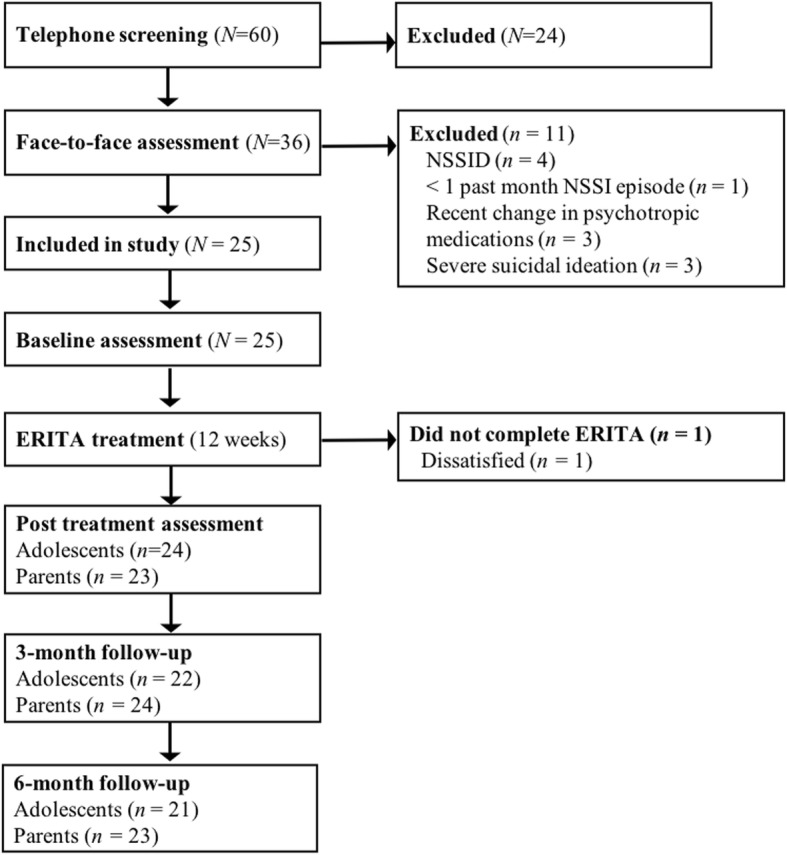
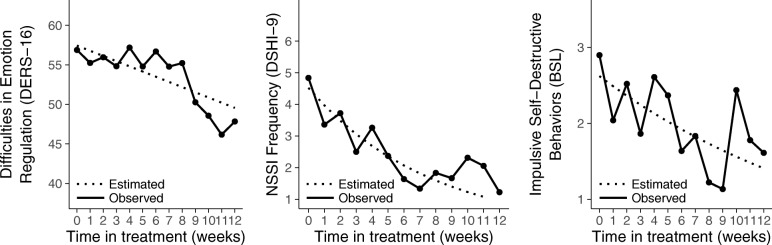
BACKGROUND: Nonsuicidal self-injury (NSSI) is common among adolescents and associated with negative outcomes. However, treatments developed specifically for NSSI and the proposed NSSI disorder (NSSID) are scarce, and access to empirically supported treatments for NSSI in many areas is limited. Online treatments carry the potential to increase the availability of evidence-based treatments. Emotion regulation individual therapy for adolescents (ERITA) has shown promise in the treatment of adolescents with NSSID. METHOD: The present study examined the feasibility, acceptability, and utility of an online version of ERITA. Twenty-five adolescents (aged 13-17) with NSSID and their parents were included in an uncontrolled open trial. Self-report and clinician-rated assessments of outcomes such as NSSI, self-destructive behaviors, emotion dysregulation, and global functioning were administered at pre-treatment, post-treatment, 3- and 6- month follow-up. Measures of NSSI, self-destructive behaviors, and emotion dysregulation were also assessed weekly during treatment. RESULTS: Ratings of treatment credibility, expectancy, and satisfaction were acceptable, and the therapeutic alliance and treatment completion rate (96%) were high. Adolescent participation in the treatment was associated with a statistically significant increase in past-month NSSI abstinence (p = .007), large-sized improvements in past-month NSSI frequency (55% reduction, 95% confidence interval [CI]: 29, 72; Cohen's d = 0.88, 95% CI: 0.73, 1.06) and global functioning (d = 1.01, 95% CI: 0.77, 1.32), and medium-sized improvements in emotion dysregulation (d = 0.75, 95% CI: 0.59, 0.90) and NSSI versatility (d = 0.63, 95% CI: 0.54, 0.77) from pre- to post-treatment. These improvements were further strengthened at 3-month follow-up and maintained at 6-month follow-up. The online therapist-guided parent program was associated with small- to large-sized (ds = 0.47-1.22) improvements in adaptive parent behaviors, and these improvements were maintained or further improved upon at 6-month follow-up. Moreover, in line with the theoretical model underlying ERITA, change in emotion dysregulation mediated changes in both NSSI frequency and self-destructive behaviors over the course of treatment. CONCLUSIONS: Together, results suggest that online ERITA is an acceptable, feasible, and promising low-intensity treatment for adolescents with NSSID. The results of this open trial must be replicated in controlled studies. TRIAL REGISTRATION: ClinicalTrials.gov ( NCT02697019 ). Registered 2 March 2016.
Overview
The claims and statistics of this paper haven’t been checked yet.
Free: it reads the open-access text and checks the first 5 claims that cite a source we can check. Create a free account to check every claim.
Integrity signals
Registry
Cites
Statistics
Figures
Verification
Claims the paper makes
The claims and statistics of this paper haven’t been checked yet.
Free: it reads the open-access text and checks the first 5 claims that cite a source we can check. Create a free account to check every claim.
Claims other papers make about this one
Each is checked against this paper’s own text: does it say what the citing paper says it does?
The cited source says what the claim attributes to it.
In the citing paper
“Treatments that emphasize ER as a core component have successfully reduced addiction, self-harm, symptoms of posttraumatic stress disorder, symptoms of borderline personality disorder (BPD), and depression and anxiety, for example (6–10).”
From An emotion regulation skills training for adolescents and parents: perceptions and acceptability of methodological aspects (2024) · cites this paper as [6]
Self-check
Percentages, sums and reported differences re-computed from the paper’s own numbers.
The self-check needs the paper’s full text.
Citations
Cites
Diagnostic and Statistical Manual of Mental Disorders
American Psychiatric Association (2013) · doi:10.1176/appi.books.9780890425596 · Cited by 116,369
Diagnostic and Statistical Manual of Mental Disorders
Williams, J. B. W., & First, M. (2013) · Encyclopedia of Social Work · doi:10.1093/acrefore/9780199975839.013.104 · Cited by 109,519
Preacher, K. J., & Hayes, A. F. (2008) · Behavior Research Methods · doi:10.3758/brm.40.3.879 · Cited by 34,117
(1998) · The Journal of Clinical Psychiatry · Cited by 19,139
(1998) · PubMed · Cited by 10,216
Gratz, K. L., & Roemer, L. (2004) · Journal of Psychopathology and Behavioral Assessment · doi:10.1023/b:joba.0000007455.08539.94 · Cited by 8,942
Self-citation(1993) · Cited by 7,136
MacKinnon, D. P., Fairchild, A. J., & Fritz, M. S. (2007) · Annual Review of Psychology · doi:10.1146/annurev.psych.58.110405.085542 · Cited by 5,688 · cited 1×
“In both sets, two regression equations were estimated [63].”
Bond, F. W., Hayes, S. C., Baer, R. A., Carpenter, K. M., Guenole, N., Orcutt, H. K., Waltz, T., & Zettle, R. D. (2011) · Behavior Therapy · doi:10.1016/j.beth.2011.03.007 · Cited by 3,950
A Children's Global Assessment Scale (CGAS)
Shaffer, D. (1983) · Archives of General Psychiatry · doi:10.1001/archpsyc.1983.01790100074010 · Cited by 3,716
(1997) · American Psychiatric Press eBooks · Cited by 3,056
Des Jarlais, D. C., Lyles, C., Crepaz, N., & the TREND Group (2004) · American Journal of Public Health · doi:10.2105/ajph.94.3.361 · Cited by 2,817 · cited 1×
“gov (Identifier NCT02697019), and the TREND Statement guidelines for nonrandomized interventions [29] were followed when reporting the trial.”
MethodPsychometric properties of the credibility/expectancy questionnaire
Devilly, G. J., & Borkovec, T. D. (2000) · Journal of Behavior Therapy and Experimental Psychiatry · doi:10.1016/s0005-7916(00)00012-4 · Cited by 2,295
The role and interpretation of pilot studies in clinical research
Leon, A. C., Davis, L. L., & Kraemer, H. C. (2011) · Journal of Psychiatric Research · doi:10.1016/j.jpsychires.2010.10.008 · Cited by 1,917
The client satisfaction questionnaire
Attkisson, C. C., & Zwick, R. (1982) · Evaluation and Program Planning · doi:10.1016/0149-7189(82)90074-x · Cited by 1,743
Credibility of analogue therapy rationales
Borkovec, T. D., & Nau, S. D. (1972) · Journal of Behavior Therapy and Experimental Psychiatry · doi:10.1016/0005-7916(72)90045-6 · Cited by 1,553
Development and validation of a revised short version of the working alliance inventory
Hatcher, R. L., & Gillaspy, J. A. (2006) · Psychotherapy Research · doi:10.1080/10503300500352500 · Cited by 1,355
Carlbring, P., Andersson, G., Cuijpers, P., Riper, H., & Hedman-Lagerlöf, E. (2018) · Cognitive Behaviour Therapy · doi:10.1080/16506073.2017.1401115 · Cited by 1,232
Self-citationBjureberg, J., Ljótsson, B., Tull, M. T., Hedman, E., Sahlin, H., Lundh, L.-G., Bjärehed, J., DiLillo, D., Messman-Moore, T., Gumpert, C. H., et al. (2016) · Journal of Psychopathology and Behavioral Assessment · doi:10.1007/s10862-015-9514-x · Cited by 1,081
Characteristics and functions of non-suicidal self-injury in a community sample of adolescents
LLOYD-RICHARDSON, E. E., PERRINE, N., DIERKER, L., & KELLEY, M. L. (2007) · Psychological Medicine · doi:10.1017/s003329170700027x · Cited by 928
Semiparametric Efficiency in Multivariate Regression Models with Missing Data
Robins, J. M., & Rotnitzky, A. (1995) · Journal of the American Statistical Association · doi:10.1080/01621459.1995.10476494 · Cited by 903
A stage model of behavioral therapies research: getting started and moving on from stage I.
Rounsaville, B. J., Carroll, K. M., & Onken, L. S. (2001) · Clinical Psychology: Science and Practice · doi:10.1093/clipsy.8.2.133 · Cited by 846
A Stage Model of Behavioral Therapies Research: Getting Started and Moving on From Stage I
Rounsaville, B. J., Carroll, K. M., & Onken, L. S. (2001) · Clinical Psychology: Science and Practice · doi:10.1093/clipsy/8.2.133 · Cited by 846
Mentalization-based treatment for self-harm in adolescents: a randomized controlled trial
Rossouw, T. I., & Fonagy, P. (2012) · Journal of the American Academy of Child & Adolescent Psychiatry · doi:10.1016/j.jaac.2012.09.018 · Cited by 746
Gratz, K. L., & Gunderson, J. G. (2006) · Behavior Therapy · doi:10.1016/j.beth.2005.03.002 · Cited by 618
Mehlum, L., Tørmoen, A. J., Ramberg, M., Haga, E., Diep, L. M., Laberg, S., Larsson, B. S., Stanley, B. H., Miller, A. L., Sund, A. M., et al. (2014) · Journal of the American Academy of Child & Adolescent Psychiatry · doi:10.1016/j.jaac.2014.07.003 · Cited by 616
Internet-Delivered Psychological Treatments
Andersson, G. (2016) · Annual Review of Clinical Psychology · doi:10.1146/annurev-clinpsy-021815-093006 · Cited by 595
Internet use and stigmatized illness
Berger, M., Wagner, T. H., & Baker, L. C. (2005) · Social Science & Medicine · doi:10.1016/j.socscimed.2005.03.025 · Cited by 547
McCauley, E., Berk, M. S., Asarnow, J. R., Adrian, M., Cohen, J., Korslund, K., Avina, C., Hughes, J., Harned, M., Gallop, R., et al. (2018) · JAMA Psychiatry · doi:10.1001/jamapsychiatry.2018.1109 · Cited by 531 · cited 1×
“Moreover, although a recent review of treatments for suicidal and nonsuicidal self-injurious behaviors among adolescents [9] identified three treatments as promising (including dialectical behavior therapy [11, 12], mentalization-based treatment [13], and cognitive behavior therapy [CBT]; [14, 15]), the authors conclu…”
BackgroundNeumann, A., van Lier, P. A. C., Gratz, K. L., & Koot, H. M. (2010) · Assessment · doi:10.1177/1073191109349579 · Cited by 521 · cited 1×
“The DERS has demonstrated good reliability and construct and convergent validity in adolescents [40].”
BackgroundSelf-citationCognitive-behavioral treatment of borderline personality disorder
Brasfield, C. R. (1994) · Behaviour Research and Therapy · doi:10.1016/0005-7967(94)90183-x · Cited by 515
Ougrin, D., Tranah, T., Stahl, D., Moran, P., & Asarnow, J. R. (2015) · Journal of the American Academy of Child & Adolescent Psychiatry · doi:10.1016/j.jaac.2014.10.009 · Cited by 508
Fabes, R. A., Poulin, R. E., Eisenberg, N., & Madden-Derdich, D. A. (2002) · Marriage & Family Review · doi:10.1300/j002v34n03_05 · Cited by 437
Borderline personality features in childhood: A short-term longitudinal study
CRICK, N. R., MURRAY–CLOSE, D., & WOODS, K. (2005) · Development and Psychopathology · doi:10.1017/s0954579405050492 · Cited by 428
Zetterqvist, M., Lundh, L.-G., Dahlström, Ö., & Svedin, C. G. (2013) · Journal of Abnormal Child Psychology · doi:10.1007/s10802-013-9712-5 · Cited by 408
Fagerland, M. W., Lydersen, S., & Laake, P. (2013) · BMC Medical Research Methodology · doi:10.1186/1471-2288-13-91 · Cited by 403 · cited 1×
“Finally, we calculated the number of participants who reported no (zero) NSSI episodes at pre-treatment, post-treatment, and 3- and 6-month follow-up and used McNemar’s mid-p test [62] to analyze the changes between the assessment points (list-wise deletion was used in these specific analyses when data were missing).”
MethodFabes, R. A., Poulin, R. E., Eisenberg, N., & Madden‐Derdich, D. A. (2002) · Marriage & Family Review · Cited by 353
Nonsuicidal Self-Injury Disorder: An Empirical Investigation in Adolescent Psychiatric Patients
Glenn, C. R., & Klonsky, E. D. (2013) · Journal of Clinical Child & Adolescent Psychology · doi:10.1080/15374416.2013.794699 · Cited by 337 · cited 1×
“7% in adolescent community samples [3, 4], and both NSSI and NSSID have been associated with a variety of negative outcomes, including general psychopathology and suicide attempts [5, 6].”
BackgroundVigerland, S., Lenhard, F., Bonnert, M., Lalouni, M., Hedman, E., Ahlen, J., Olén, O., Serlachius, E., & Ljótsson, B. (2016) · Clinical Psychology Review · doi:10.1016/j.cpr.2016.09.005 · Cited by 292
Self-citationEvidence-Based Psychosocial Treatments for Self-Injurious Thoughts and Behaviors in Youth
Glenn, C. R., Franklin, J. C., & Nock, M. K. (2015) · Journal of Clinical Child & Adolescent Psychology · doi:10.1080/15374416.2014.945211 · Cited by 288
Interventions for self-harm in children and adolescents
Hawton, K., Witt, K. G., Taylor Salisbury, T. L., Arensman, E., Gunnell, D., Townsend, E., van Heeringen, K., & Hazell, P. (2015) · Cochrane Database of Systematic Reviews · doi:10.1002/14651858.cd012013 · Cited by 261
Turner, B. J., Austin, S. B., & Chapman, A. L. (2014) · The Canadian Journal of Psychiatry · doi:10.1177/070674371405901103 · Cited by 259
Treatment of co-occurring substance abuse and suicidality among adolescents: A randomized trial.
Esposito-Smythers, C., Spirito, A., Kahler, C. W., Hunt, J., & Monti, P. (2011) · Journal of Consulting and Clinical Psychology · doi:10.1037/a0026074 · Cited by 254
Protecting Adolescents From Self-Harm: A Critical Review of Intervention Studies
Brent, D. A., McMakin, D. L., Kennard, B. D., Goldstein, T. R., Mayes, T. L., & Douaihy, A. B. (2013) · Journal of the American Academy of Child & Adolescent Psychiatry · doi:10.1016/j.jaac.2013.09.009 · Cited by 223
Hedman, E., Ljótsson, B., Rück, C., Furmark, T., Carlbring, P., Lindefors, N., & Andersson, G. (2010) · Computers in Human Behavior · doi:10.1016/j.chb.2010.01.010 · Cited by 220
Self-citationAndersson, G., Paxling, B., Wiwe, M., Vernmark, K., Felix, C. B., Lundborg, L., Furmark, T., Cuijpers, P., & Carlbring, P. (2012) · Behaviour Research and Therapy · doi:10.1016/j.brat.2012.05.003 · Cited by 202
Gratz, K. L., Tull, M. T., & Levy, R. (2014) · Psychological Medicine · doi:10.1017/s0033291713002134 · Cited by 194
Kelley, K. (2005) · Educational and Psychological Measurement · doi:10.1177/0013164404264850 · Cited by 185
Cognitive-behavioural intervention for self-harm: Randomised controlled trial
Slee, N., Garnefski, N., van der Leeden, R., Arensman, E., & Spinhoven, P. (2008) · British Journal of Psychiatry · doi:10.1192/bjp.bp.107.037564 · Cited by 183
Bjärehed, J., & Lundh, L. (2008) · Cognitive Behaviour Therapy · doi:10.1080/16506070701778951 · Cited by 183
Preisser, J. S., Lohman, K. K., & Rathouz, P. J. (2002) · Statistics in Medicine · doi:10.1002/sim.1241 · Cited by 165
Entwicklung der Borderline- Symptom-Liste1
Bohus, M., Limberger, M. F., Frank, U., Sender, I., Gratwohl, T., & Stieglitz, R.-D. (2001) · PPmP - Psychotherapie · Psychosomatik · Medizinische Psychologie · doi:10.1055/s-2001-13281 · Cited by 154
Nonparametric bootstrapping for hierarchical data
Ren, S., Lai, H., Tong, W., Aminzadeh, M., Hou, X., & Lai, S. (2010) · Journal of Applied Statistics · doi:10.1080/02664760903046102 · Cited by 148
Lenhard, F., Andersson, E., Mataix-Cols, D., Rück, C., Vigerland, S., Högström, J., Hillborg, M., Brander, G., Ljungström, M., Ljótsson, B., et al. (2017) · Journal of the American Academy of Child & Adolescent Psychiatry · doi:10.1016/j.jaac.2016.09.515 · Cited by 146
Gratz, K. L., Dixon-Gordon, K. L., Chapman, A. L., & Tull, M. T. (2015) · Assessment · doi:10.1177/1073191114565878 · Cited by 139 · cited 1×
“The Clinician-Administered Nonsuicidal Self-Injury Disorder Index [31] was used to determine if participants met criteria for NSSID, and the Structured Clinical Interview for DSM-IV Personality Disorders BPD Module [32] was used to assess diagnostic criteria for BPD.”
MethodBonnert, M., Olén, O., Lalouni, M., Benninga, M. A., Bottai, M., Engelbrektsson, J., Hedman, E., Lenhard, F., Melin, B., Simrén, M., et al. (2017) · American Journal of Gastroenterology · doi:10.1038/ajg.2016.503 · Cited by 139
Vigerland, S., Ljótsson, B., Thulin, U., Öst, L.-G., Andersson, G., & Serlachius, E. (2016) · Behaviour Research and Therapy · doi:10.1016/j.brat.2015.11.006 · Cited by 136
Turner, B. J., Layden, B. K., Butler, S. M., & Chapman, A. L. (2013) · Archives of Suicide Research · doi:10.1080/13811118.2013.802660 · Cited by 135
Lundh, A., Kowalski, J. H., Sundberg, C. J., Gumpert, C. H., & Landén, M. (2010) · Psychiatry Research · doi:10.1016/j.psychres.2010.02.006 · Cited by 124
Hetrick, S. E., Yuen, H. P., Bailey, E., Cox, G. R., Templer, K., Rice, S. M., Bendall, S., & Robinson, J. (2017) · Evidence-Based Mental Health · doi:10.1136/eb-2017-102719 · Cited by 124
Gratz, K. L., & Tull, M. T. (2011) · Personality Disorders: Theory, Research, and Treatment · doi:10.1037/a0022144 · Cited by 115
Self-citationGratz, K. L., Bardeen, J. R., Levy, R., Dixon-Gordon, K. L., & Tull, M. T. (2015) · Behaviour Research and Therapy · doi:10.1016/j.brat.2014.12.005 · Cited by 102
Miguel, F. K., Giromini, L., Colombarolli, M. S., Zuanazzi, A. C., & Zennaro, A. (2017) · Journal of Clinical Psychology · doi:10.1002/jclp.22404 · Cited by 84
Bjureberg, J., Sahlin, H., Hellner, C., Hedman-Lagerlöf, E., Gratz, K. L., Bjärehed, J., Jokinen, J., Tull, M. T., & Ljótsson, B. (2017) · BMC Psychiatry · doi:10.1186/s12888-017-1527-4 · Cited by 84
Self-citationManca, M., Presaghi, F., & Cerutti, R. (2013) · Psychiatry Research · doi:10.1016/j.psychres.2013.10.010 · Cited by 79
An Examination of Disclosure of Nonsuicidal Self‐injury among University Students
Armiento, J., Hamza, C., & Willoughby, T. (2014) · Journal of Community & Applied Social Psychology · doi:10.1002/casp.2190 · Cited by 74
Gratz, K. L., Levy, R., & Tull, M. T. (2012) · Journal of Cognitive Psychotherapy · doi:10.1891/0889-8391.26.4.365 · Cited by 69 · cited 7×
“ERITA is a 12-week, acceptance-based behavioral individual therapy adapted from emotion regulation group therapy (ERGT) for NSSI in adults [17, 18].”
ResultInfluentialShenk, C. E., & Fruzzetti, A. E. (2014) · The Family Journal · doi:10.1177/1066480713490900 · Cited by 63 · cited 1×
“Given past findings that parental invalidation is associated with higher levels of adolescent externalizing problem behaviors, and parental validation is associated with lower levels of emotion dysregulation [70], these findings may, at least in part, account for some of the observed improvements in adolescent NSSI an…”
ResultAn intervention for nonsuicidal self-injury in young adults: A pilot randomized controlled trial.
Andover, M. S., Schatten, H. T., Morris, B. W., Holman, C. S., & Miller, I. W. (2017) · Journal of Consulting and Clinical Psychology · doi:10.1037/ccp0000206 · Cited by 58
Sahlin, H., Bjureberg, J., Gratz, K. L., Tull, M. T., Hedman, E., Bjärehed, J., Jokinen, J., Lundh, L.-G., Ljótsson, B., & Hellner, C. (2017) · BMJ Open · doi:10.1136/bmjopen-2017-016220 · Cited by 50
Shahabi, M., Hasani, J., & Bjureberg, J. (2020) · Assessment for Effective Intervention · doi:10.1177/1534508418800210 · Cited by 48
Accommodating binary and count variables in mediation: A case for conditional indirect effects
Geldhof, G. J., Anthony, K. P., Selig, J. P., & Mendez‐Luck, C. A. (2017) · International Journal of Behavioral Development · doi:10.1177/0165025417727876 · Cited by 45 · cited 1×
“The first and third regression equations used a negative binomial distribution with a log link function [64], and the second equation used a normal distribution.”
MethodBjureberg, J., Ohlis, A., Ljótsson, B., D'Onofrio, B. M., Hedman‐Lagerlöf, E., Jokinen, J., Sahlin, H., Lichtenstein, P., Cederlöf, M., & Hellner, C. (2019) · Journal of Child Psychology and Psychiatry · doi:10.1111/jcpp.12967 · Cited by 38 · cited 1×
“7% in adolescent community samples [3, 4], and both NSSI and NSSID have been associated with a variety of negative outcomes, including general psychopathology and suicide attempts [5, 6].”
BackgroundLenhard, F., Vigerland, S., Engberg, H., Hallberg, A., Thermaenius, H., & Serlachius, E. (2016) · PLOS ONE · doi:10.1371/journal.pone.0164311 · Cited by 37
Research works printed but not linked: 1
- Fabes RA Eisenberger N The Coping with Children’s Negative Emotions Scale Adolescent Version: Procedures and Scoring 1998
Cited by
Emotional Dysregulation in Children and Adolescents With Psychiatric Disorders. A Narrative Review
Paulus, F. W., Ohmann, S., Möhler, E., Plener, P., & Popow, C. (2021) · Frontiers in Psychiatry · doi:10.3389/fpsyt.2021.628252 · Cited by 280
Asarnow, J. R., Berk, M. S., Bedics, J. D., Adrian, M. C., Gallop, R., Cohen, J. A., Korslund, K. E., Hughes, J. L., Avina, C., Linehan, M. M., et al. (2021) · Journal of the American Academy of Child & Adolescent Psychiatry · doi:10.1016/j.jaac.2021.01.016 · Cited by 170
Arshad, U., Farhat‐ul‐Ain, Gauntlett, J., Husain, N., Chaudhry, N., & Taylor, P. J. (2020) · Suicide and Life-Threatening Behavior · doi:10.1111/sltb.12583 · Cited by 104
“Overall satisfaction was only moderate for one Internet-delivered emotion regulation therapy (M rating = 17.8 of 32; Bjureberg et al., 2018).”
BackgroundMethodInfluentialA Meta-Analytic Review of Emotion Regulation Focused Psychosocial Interventions for Adolescents
Eadeh, H., Breaux, R., & Nikolas, M. A. (2021) · Clinical Child and Family Psychology Review · doi:10.1007/s10567-021-00362-4 · Cited by 126
Psychotherapeutic interventions specifically developed for NSSI in adolescence: A systematic review
Calvo, N., García-González, S., Pérez-Galbarro, C., Regales-Peco, C., Lugo‐Marín, J., Ramos‐Quiroga, J. A., & Ferrer, M. (2022) · European Neuropsychopharmacology · doi:10.1016/j.euroneuro.2022.02.009 · Cited by 102
Metadata
- Authors
- Bjureberg, J., Sahlin, H., Hedman-Lagerlöf, E., Gratz, K. L., Tull, M. T., Jokinen, J., Hellner, C., & Ljótsson, B.
- Affiliations
- Region Stockholm (SE)
- University of Toledo (US)
- Corresponding author
- Bjureberg, Johan
- ORCID
- Venue
- BMC Psychiatry
- Published
- 2018-10-11
- Volume
- 18
- Issue
- 1
- Pages
- 326-326
- ISSN
- 1471-244X (ISSN-L)
- PMC
- PMC6180600
- OpenAlex
- W2898029007
- Cited by
- 96
- References
- 74
- Citations by year
- 2026: 9 · 2025: 13 · 2024: 15 · 2023: 17 · 2022: 12 · 2021: 15 · 2020: 8 · 2019: 7
- FWCI
- 8.81
- Type
- journal article
- Language
- en
- Open access
- gold
- doi.org
- Licence
- cc-by
- creativecommons.org/licenses/by/4.0/ (tdm)
- Locations
- BMC Psychiatry (publishedVersion, cc-by)
- Europe PMC (PubMed Central) (publishedVersion, other-oa)
- PubMed Central (publishedVersion, cc-by)
- PubMed (publishedVersion)
- DiVA at Umeå University (Umeå University) (submittedVersion, other-oa)
- DOAJ (DOAJ: Directory of Open Access Journals) (submittedVersion, cc-by-sa)
- Funders
- National Self Injury Project in Sweden
- Markus and Amelia Wallenberg Foundation (MAW 2014.0021)
- Fredrik och Ingrid Thurings Stifelse
- Sven Jerring Foundation
- the Kempe-Carlgrenska Foundation
- Stiftelsen Professor Bror Gadelius Minnesfond
- Topics
- Social Sciences › Psychology › Clinical Psychology › Suicide and Self-Harm Studies
- Social Sciences › Psychology › Clinical Psychology › Personality Disorders and Psychopathology
- Social Sciences › Psychology › Applied Psychology › Digital Mental Health Interventions
- Keywords
- non-suicidal self-injury, online therapy, adolescents, emotional dysregulation, self-destructive behavior, parent training, parental behavior, treatment acceptability, intervention fidelity, mediation analysis
- MeSH terms
- Adolescent, Adolescent Behavior, Affective Symptoms, Emotions, Female, Follow-Up Studies, Humans, Male, Pilot Projects, Psychotherapy, Therapy, Computer-Assisted, Self-Injurious Behavior, Internet, Self Report
About these checks
Registry, retraction, Cites and statistics results are computed, not judged, with one exception: a printed reference that no index lists is read once by a model before it counts as a citation error. Claims are extracted by a model and kept only when their quote appears verbatim in the text; each cited source is then checked, with a model’s help, for whether it says what the claim relies on. Those verdicts can be wrong — read the claim’s quote and the cited source before relying on one.
Statistics and arithmetic are recomputed, not judged.
Confidence bands are shown only for fields calibrated on our annotated test set. None is calibrated yet, so no band is shown.
What counts as a claim ›How we measure confidence ›How we check this ›
Are you an author, or do you see a problem with this page? Request a review
Data sources
Bibliographic data: Semantic Scholar, OpenAlex, Crossref.
Contains information from the Semantic Scholar Academic Graph Datasets, made available under the ODC Attribution License (ODC-BY 1.0).
Semantic Scholar’s data is described in: Kinney, R., et al. (2023). The Semantic Scholar Open Data Platform. arXiv:2301.10140.
