

The “common” experience of voice-hearing and its relationship with shame and guilt: a systematic review
Open accessPublished version of a preprint
The DOI matches its Crossref record; 92 of the 92 references it cites were found in a registry or an index; 35 of the 89 sources its claims cite were checked for support.
Abstract
Background: Despite Auditory Verbal Hallucinations (AVHs) having been long associated with mental illness, they represent a common experience also in the non-clinical population, yet do not exhibit distress or need for care. Shame and guilt are emotions related to one's perception of oneself and one's responsibility. As such, they direct our attention to aspects of AVHs that are under-researched and elusive, particularly about the status of voices as others, their social implications and the constitution and conceptualisation of the self. Objectives: This paper aims to provide a systematic review of studies that investigated the relationship between auditory hallucinations, shame, and guilt in people without relevant signs of psychiatric issues. Methods: We searched studies reporting information about voices characteristics, the relationship between voices and hearers, hearer's reactions, and beliefs, paying peculiar attention to shame and guilt issues. Included papers were evaluated for risk of bias. Results: Eleven studies that explored the relationship between AVHs, shame and guilt, were extracted. Phenomenological, pragmatic, as well as neuropsychological features of hearing voices in non-clinical populations, allowed us to note a dynamic relationship and the constellation of subjective experiences that can occur. The role of guilt was characterized by few studies and mixed results, while shame was mainly common. Conclusions: Due to the high heterogeneity detected and the scarce sources available, further studies should focus on both the aetiology and the bidirectional relationship between hearing voices, shame, and guilt in non-clinical people. This can be helpful in therapies for non-clinical populations who are distressed by their voices (e.g., psychotherapy), and for whom shame, and guilt may contribute to negative consequences such as isolation, anxiety or future depression. Moreover, it might favour the development and implication of different treatments considering emotion regulation, distress tolerance and interpersonal sensitivity on the clinical populations. © 2022, The Author(s).
Overview
CoChat Summary
## TL;DR
This systematic review examined how shame and guilt relate to auditory verbal hallucinations (AVHs) in non-clinical voice-hearers. Across 11 studies, shame was more consistently linked to AVHs than guilt, but the evidence was heterogeneous and low quality.
## Key findings
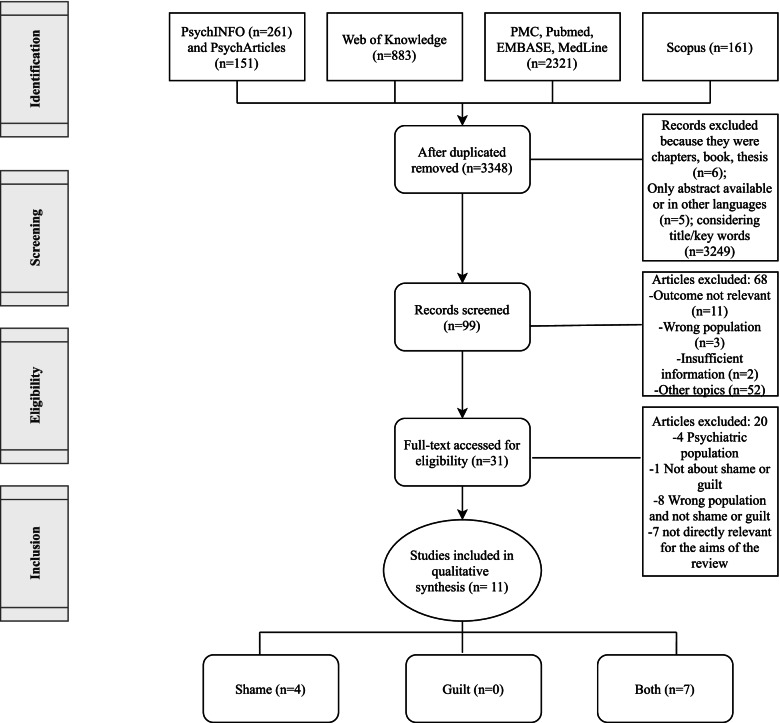
- The review included 11 studies; the authors identified 3348 separate records, screened 99, downloaded 31 full texts, and selected 11 for review.
- Shame was reported as positively correlated with more negative features of verbal hallucinations in non-clinical populations, and the review states that shame was “mainly common.”
- Guilt had few studies and mixed results; the paper says its relationship with AVHs was unclear and limited by the small number of included studies.
- The authors report the included studies were published between 2017 and 2019 and came from 7 countries; the most represented were the UK (3), USA (2), and Australia (2).
## Methods
- Systematic review conducted under PRISMA guidance, with protocol registered in PROSPERO (CRD42017054819).
- Searched multiple databases up to July 27, 2021 and included English-language peer-reviewed journal articles focused on non-clinical populations; intervention studies and clinical/non-clinical comparisons were also eligible if relevant.
- Two reviewers screened studies, four reviewers extracted data and assessed quality using an MMAT 2018-adapted appraisal; because of heterogeneity, the authors used a narrative synthesis rather than meta-analysis.
## Limitations
- The paper states the evidence base was scarce and highly heterogeneous, preventing generalizability.
- The included studies were of generally low quality; many lacked complete information on baseline response rate, outcome data, follow-up, and none were randomized controlled trials.
- The review was limited to shame and guilt and did not include clinical populations; it also says the search may not be exhaustive and that eligible studies came from only 7 countries, mostly the USA.
Model-written summary. Check it against the paper before relying on it.
Integrity signals
Registry
Cites
Statistics
Figures
Verification
Claims the paper makes
26 Valid · 2 Not valid · 29 Not checked · 56 Own results and interpretations
The cited sources support only part of this claim — read each source’s verdict below.
In the paper
“Furthermore, it can be difficult to identify and recruit nonclinical voice-hearers, because it may be uneasy to share their own experience, probably fearing encountering stigma [18, 24] or to be isolated by other people [25–27].”
§ The “common” experience of voice-hearing and its relationship with shame and guilt: a systematic review > Background
What the sources say
- Not checked — no full text of the sourcecites [18] Newton E Larkin M Melhuish R Wykes T More than just a place to talk: Young people’s experiences of group psychological therapy as an early intervention for auditory hallucinations Psychol Psychother Theory, Res Pract 2007 80 1 127 149 10.1348/147608306X110148 17346385 source
- Not checked — no full text of the sourcecites [24] Vilhauer RP Stigma and need for care in individuals who hear voices Int J Soc Psychiatry 2017 63 1 5 13 10.1177/0020764016675888 27815515 source
- Not matchedcites [25] Salvini A Il nostro inquilino segreto: psicologia e psicoterapia della coscienza 2011 Milano Ponte alle Grazie
We searched by its title and found no matching paper.
- Not matchedcites [26] Salvini, A., & Stecca A. “Udire voci”. Ipotesi per la psicoterapia e la ricerca. Riv di Psicol Clin e Psicoter 2013;Scienze de (1–2):40–58.
Its entry has no title and year that we can search by.
- Partly supportedcites [27] Iudici A Turchi G Faccio E Some consideration about auditory verbal hallucinations in the clinical field Psychiatr i Psychol Klin [Internet] 2020 20 1 77 79 10.15557/PiPK.2020.0010 sourceExperimental — accuracy not yet measured
The main text (pp. 77–79) says that some people who hear voices avoid services because they fear being seen as “deranged or insane,” and it discusses stigma associated with schizophrenia. It does not say that nonclinical voice-hearers are reluctant to share their experiences or that this makes them difficult to identify and recruit. (LLM, conf=0.80)
hedgedstates a possible cause- Asserted: passes — The authors put it forward as true.
- Checkable: passes — It can be checked against evidence.
- Load-bearing: passes — The paper’s conclusions depend on it.
- Based: passes — The paper gives a reason why it holds.
The cited sources support only part of this claim — read each source’s verdict below.
In the paper
“Inflexible avoidant strategies such as dissociation and suppression that are commonly used to deal with shame- and guilt-related events often cause a rebound effect that can generate intrusive AVHs with unexpected greater vigour [36].”
§ The “common” experience of voice-hearing and its relationship with shame and guilt: a systematic review > Background > The relationship between shame and guilt and mental disorders The relationship between shame and guilt and mental disorders has been explored in the last decades. Both shameful feelings of powerlessness and maladaptive feelings of guilt and hyper-responsibility can exacerbate anxiety, depression, eating behaviours and traumatic symptoms [32]. Even if the different studies showed that shame can be more strongly associated with various psychological symptoms [33–35], still little is known about how shame and guilt are involved in the perception of AVHs. As evidenced by McCarthy-Jones (2017), the occurrence of AVHs may be linked with the use of inflexible approaches aimed at processing unresolved events related to shame- and guilt-related experiences. Inflexible avoidant strategies such as dissociation and suppression that are commonly used to deal with shame- and guilt-related events often cause a rebound effect that can generate intrusive AVHs with unexpected greater vigour [36]. Within this perspective AVHs related to shame and guilt can be considered in a continuum of clinical severity: the more inflexibility is adopted to try to deal with negative experiences the more AVHs will be severe as they will be probably related to unresolved materials and ruminative thoughts [37]. On the contrary, the use of a flexible “talking to myself” strategy can foster adaptive meanings of past negative experiences. This can avoid cognitive or emotional overload and enhance a constructive internal dialogue.
What the sources say
- Partly supportedcites [36] McCarthy-Jones S. Is shame hallucinogenic? Front Psychol. 2017. PMC5541028 28824494 sourceExperimental — accuracy not yet measured
In “Generating mechanisms for the hypothesized relation,” the paper proposes dissociation and suppression as avoidant responses to shame that could contribute to AVH. It describes an unexpected rebound with greater vigor specifically for suppressed thoughts and emotions, not for dissociation, and presents the link to AVH as plausible rather than something these strategies often cause. The cited passages do not extend this mechanism to guilt-related events. (LLM, conf=0.88)
plainstates a cause- Asserted: passes — The authors put it forward as true.
- Checkable: passes — It can be checked against evidence.
- Load-bearing: passes — The paper’s conclusions depend on it.
- Based: passes — The paper gives a reason why it holds.
- Partly supported
The cited sources support only part of this claim — read each source’s verdict below.
In the paper
“As evidenced by McCarthy-Jones (2017), the occurrence of AVHs may be linked with the use of inflexible approaches aimed at processing unresolved events related to shame- and guilt-related experiences.”
§ The “common” experience of voice-hearing and its relationship with shame and guilt: a systematic review > Background > The relationship between shame and guilt and mental disorders The relationship between shame and guilt and mental disorders has been explored in the last decades. Both shameful feelings of powerlessness and maladaptive feelings of guilt and hyper-responsibility can exacerbate anxiety, depression, eating behaviours and traumatic symptoms [32]. Even if the different studies showed that shame can be more strongly associated with various psychological symptoms [33–35], still little is known about how shame and guilt are involved in the perception of AVHs. As evidenced by McCarthy-Jones (2017), the occurrence of AVHs may be linked with the use of inflexible approaches aimed at processing unresolved events related to shame- and guilt-related experiences. Inflexible avoidant strategies such as dissociation and suppression that are commonly used to deal with shame- and guilt-related events often cause a rebound effect that can generate intrusive AVHs with unexpected greater vigour [36]. Within this perspective AVHs related to shame and guilt can be considered in a continuum of clinical severity: the more inflexibility is adopted to try to deal with negative experiences the more AVHs will be severe as they will be probably related to unresolved materials and ruminative thoughts [37]. On the contrary, the use of a flexible “talking to myself” strategy can foster adaptive meanings of past negative experiences. This can avoid cognitive or emotional overload and enhance a constructive internal dialogue.
What the sources say
- Partly supportedcites McCarthy-Jones (2017) matched to “Is Shame Hallucinogenic?” (2017) sourceExperimental — accuracy not yet measured
In “Generating mechanisms for the hypothesized relation,” the paper proposes that inflexible, absorbed or avoidant ways of dealing with shame-related events may encourage AVHs. The claim extends that proposal to guilt-related experiences, but the Conclusions instead identify as a hypothesis that shame, not guilt, mediates the relation between trauma and AVHs. (LLM, conf=0.88)
hedgedstates an association- Asserted: passes — The authors put it forward as true.
- Checkable: passes — It can be checked against evidence.
- Load-bearing: unclear — It is unclear whether the paper’s conclusions depend on it.
- Based: passes — The paper gives a reason why it holds.
- Partly supported
The cited sources support only part of this claim — read each source’s verdict below.
In the paper
“Even in the case of voices related to negative emotional experiences, the content of the message is usually characterized by a contained level of hostility and negativity not to elicit severe states of impairment [9].”
§ The “common” experience of voice-hearing and its relationship with shame and guilt: a systematic review > Background
What the sources say
- Partly supportedcites [9] Sommer IE, Daalman K, Rietkerk T, Diederen KM, Bakker S, Wijkstra J, et al. Healthy individuals with auditory verbal hallucinations; Who are they? psychiatric assessments of a selected sample of 103 subjects. Schizophrenia Bull. 2010. PMC2879692 18849293 sourceExperimental — accuracy not yet measured
The Hallucinations section reports that none of the 103 selected healthy voice-hearers experienced severe disturbance from their voices, including participants who heard negative messages. But the Discussion says those with negative-content voices had greater distress and lower functioning; the paper does not establish that such messages usually have a contained level of hostility or negativity that prevents severe impairment. Page numbers are unavailable in our copy. (LLM, conf=0.85)
plain- Asserted: passes — The authors put it forward as true.
- Checkable: passes — It can be checked against evidence.
- Load-bearing: unclear — It is unclear whether the paper’s conclusions depend on it.
- Based: passes — The paper gives a reason why it holds.
- Partly supported
Every source the paper cites for this claim was checked and supports it.
In the paper
“Therefore, shame can be not only simply correlated with this phenomenon, but it may be a causal factor in the onset of AVH [36].”
§ The “common” experience of voice-hearing and its relationship with shame and guilt: a systematic review > Discussion > Shame and AVH in a non-clinical population The experience of hearing voices can be correlated with shameful experiences in several ways. Like other emotions such as sadness, shame may have a role in shaping voices and activating them in specific circumstances [36]. Firstly, AVH can represent a source of significant distress in terms of content, meaning ascribed, and the relationship between the voice and the hearer. Shame was found to be related to the negative content, qualities of the heard voices and the subjective ratings of deprivation [45]. This finding supports the idea of mirroring between voice hearers’ experience and the quality of voice-hearer relationship: for instance, in case of feelings of inferiority and defectiveness concerning the self, this is mirrored in the voice being experienced as powerful, dominant, harming, and intrusive [52]. Given that induction of shame led to increased levels of intrusive thoughts and working memory impairments [34], there are reasons to expect that shame in response to a stressful event can be involved in the elicitation of AVH [53]. Therefore, shame can be not only simply correlated with this phenomenon, but it may be a causal factor in the onset of AVH [36]. One possible function of this process is proposed by McCarthy-Jones that evidenced that shame could elicit AVH to encourage submissive and self-protective behaviours avoiding situations that can be potentially threatening for one’s identity. For example, this can be true in people who lived negative past experiences of stigmatization, bullying or neglect. Previous studies have documented the occurrence of AVH following traumatic experiences in both Post Traumatic Stress Disorder (PTSD) [54–57] and dissociative disorders [58–60]. In this regard, the authors also found that the content of the voices was often symbolically or thematically related to the trauma but that the voices were distinguishable from memory representations of experiences, such as flashbacks [61]. Despite the intrinsic negative content related to shame, it’s possible that in healthy voice-hearers the way the message is communicated is different than in clinical voice hearers. The message might be reiterated in a less persistent way, or the same content might be expressed in a less directive way. For example, considering a given future social event, instead of voices that put the person in front of impending failures or experiences of inadequacy that will certainly happen, they might take the form of more friendly suggestions that give advice to avoid possible negative scenarios. Within this perspective, shame can be related to AVH in healthy voice-hearers playing an adaptive function that aids survival protecting people from further unpleasant experiences [36]. Finally, shame can in some occasions emerge because of AVH. The experience of AVH per se can constitute a significant source of stress for cultural reasons [62, 63]. Even when AVH is appraised by their hearing voice’s experience as benign, positive, and controllable, this phenomenon may be considered a social taboo, as it is difficult to talk about voices “without being looked at in a strange way” [24, 64, 65]. People who hear voices may report a lack of understanding by friends, families and even professionals and, as a result, many people hide these experiences, because of the fear of social judgment and stigma [65, 66]. People who experience hearing voices may feel themselves negatively judged by others and they can experience shame perceiving themselves as defective or inadequate [28]. Even though these experiences of isolation can still happen, it’s important to note that the stigma related to voice-hearing can be shaped by cultural and social conditions [67]. Voice-hearing embedded in an agreeable social world may become more manageable [68]. For those people who are part of social networks that provide support and validation the risk of being stigmatized is more contained. Furtherly, distressing voice-hearing may improve in response to specific coaching [69] and voice-hearing in religious contexts may become more culturally appropriate over time [70].
What the sources say
- Supportedcites [36] McCarthy-Jones S. Is shame hallucinogenic? Front Psychol. 2017. PMC5541028 28824494 source
The Conclusions section explicitly hypothesizes that shame may play a causal role in the onset of AVH, rather than merely relating to their content. It also states that no studies have directly tested this causal role, consistent with the citing sentence’s tentative wording. No page number is provided in our copy. (LLM, conf=0.93)
hedgedstates a possible cause- Asserted: passes — The authors put it forward as true.
- Checkable: passes — It can be checked against evidence.
- Load-bearing: passes — The paper’s conclusions depend on it.
- Based: passes — The paper gives a reason why it holds.
- Supported
37 more claims · 8 with their cited sources checked
Create a free account to see all 113 claims and to verify the 2 references still open.
- Probably not a substantial claim. 43
- It may state two separate claims as one. 41
Citations
Cites
Preferred Reporting Items for Systematic Reviews and Meta-Analyses: The PRISMA Statement
Moher, D., Liberati, A., Tetzlaff, J., Altman, D. G., & The PRISMA Group (2009) · PLoS Medicine · doi:10.1371/journal.pmed.1000097 · Cited by 64,042
Preferred reporting items for systematic reviews and meta-analyses: the PRISMA Statement.
(2009) · PubMed Central · Cited by 44,859
Preferred reporting items for systematic reviews and meta-analyses: The PRISMA statement
Moher, D., Liberati, A., Tetzlaff, J., Altman, D. G., & the PRISMA Group* (2009) · Annals of Internal Medicine · doi:10.7326/0003-4819-151-4-200908180-00135 · Cited by 37,554
The Mixed Methods Appraisal Tool (MMAT) version 2018 for information professionals and researchers
Hong, Q. N., Fàbregues, S., Bartlett, G., Boardman, F., Cargo, M., Dagenais, P., Gagnon, M.-P., Griffiths, F., Nicolau, B., O’Cathain, A., et al. (2018) · Education for Information · doi:10.3233/efi-180221 · Cited by 4,737 · cited 1×
“The methodological quality of each study included in the systematic review was assessed using a standard form adapted from the Mixed Methods Appraisal Tool (MMAT) –Version 2018, a critical appraisal tool that is designed for the appraisal stage of systematic mixed studies reviews [44].”
MethodThe Self-conscious emotions: theory and research
(2008) · Choice Reviews Online · doi:10.5860/choice.45-5271 · Cited by 1,342 · cited 1×
“Literature of the last two decades agrees on the fact that shame and guilt are two separate emotions with different implications for psychological adjustment [28, 29].”
Linscott, R. J., & van Os, J. (2013) · Psychological Medicine · doi:10.1017/s0033291712001626 · Cited by 1,181 · cited 1×
“2% in the general population [21], indicating that age, minority or migrant status, marital status, income, education, alcohol and cannabis use, stress, urbanization and family history could all influence their onset [17].”
BackgroundGilbert, P. (2010) · Routledge eBooks · doi:10.4324/9780203851197 · Cited by 957
Meaning in Method: The Rhetoric of Quantitative and Qualitative Research
FIRESTONE, W. A. (1987) · Educational Researcher · doi:10.3102/0013189x016007016 · Cited by 738 · cited 1×
“This voice represents the introjected negative thoughts and it ranges from unconscious or subliminal to fully conscious [71].”
BackgroundKelleher, I., Connor, D., Clarke, M. C., Devlin, N., Harley, M., & Cannon, M. (2012) · Psychological Medicine · doi:10.1017/s0033291711002960 · Cited by 686 · cited 1×
“5% in adolescents (13–18 years), suggesting how, while psychotic symptoms may be more commonly experienced during a child’s typical development, they become less frequent and increasingly indicative of pathology as the child grows older [22, 23].”
BackgroundAppraisal Antecedents of Shame and Guilt: Support for a Theoretical Model
Tracy, J. L., & Robins, R. W. (2006) · Personality and Social Psychology Bulletin · doi:10.1177/0146167206290212 · Cited by 574 · cited 1×
“Therefore, shame is associated with feelings of inferiority and worthlessness for a defective self while guilt is associated with feelings of tension and remorse [30].”
BackgroundKelleher, I., Keeley, H., Corcoran, P., Lynch, F., Fitzpatrick, C., Devlin, N., Molloy, C., Roddy, S., Clarke, M. C., Harley, M., et al. (2012) · British Journal of Psychiatry · doi:10.1192/bjp.bp.111.101543 · Cited by 443
Craig, T. K., Rus-Calafell, M., Ward, T., Leff, J. P., Huckvale, M., Howarth, E., Emsley, R., & Garety, P. A. (2018) · The Lancet Psychiatry · doi:10.1016/s2215-0366(17)30427-3 · Cited by 403
An Introduction to Compassion Focused Therapy in Cognitive Behavior Therapy
Gilbert, P. (2010) · International Journal of Cognitive Therapy · doi:10.1521/ijct.2010.3.2.97 · Cited by 317
Laroi, F., Sommer, I. E., Blom, J. D., Fernyhough, C., ffytche, D. H., Hugdahl, K., Johns, L. C., McCarthy-Jones, S., Preti, A., Raballo, A., et al. (2012) · Schizophrenia Bulletin · doi:10.1093/schbul/sbs061 · Cited by 315
Auditory Verbal Hallucinations in Persons With and Without a Need for Care
Johns, L. C., Kompus, K., Connell, M., Humpston, C., Lincoln, T. M., Longden, E., Preti, A., Alderson-Day, B., Badcock, J. C., Cella, M., et al. (2014) · Schizophrenia Bulletin · doi:10.1093/schbul/sbu005 · Cited by 311
Auditory verbal hallucinations predominantly activate the right inferior frontal area
Sommer, I. E. C., Diederen, K. M. J., Blom, J.-D., Willems, A., Kushan, L., Slotema, K., Boks, M. P. M., Daalman, K., Hoek, H. W., Neggers, S. F. W., et al. (2008) · Brain · doi:10.1093/brain/awn251 · Cited by 297 · cited 1×
“The negative emotional valence of AVH could be related to the activation of the right Broca’s area [46, 73].”
BackgroundSommer, I. E., Daalman, K., Rietkerk, T., Diederen, K. M., Bakker, S., Wijkstra, J., & Boks, M. P. M. (2010) · Schizophrenia Bulletin · doi:10.1093/schbul/sbn130 · Cited by 282 · cited 3×
“They can experience voices principally because of sleep deprivation or major life stressors and can be intra- or extracranial [9].”
BackgroundMultiple Personalities: A Report of 14 Cases With Implications for Schizophrenia and Hysteria
Bliss, E. L. (1980) · Archives of General Psychiatry · doi:10.1001/archpsyc.1980.01780250074009 · Cited by 261
Coping with Hearing Voices: An Emancipatory Approach
Romme, M. A. J., Honig, A., Noorthoorn, E. O., & Escher, A. D. M. A. C. (1992) · British Journal of Psychiatry · doi:10.1192/bjp.161.1.99 · Cited by 237 · cited 1×
“According to Romme and colleagues [1] hallucinations are a disorder of perception that people describe as being located in the external world (ego-dystonic), with the same qualities of “normal” perceptions, but in the Open Access”
BackgroundAlien voices and inner dialogue: towards a developmental account of auditory verbal hallucinations
Fernyhough, C. (2004) · New Ideas in Psychology · doi:10.1016/j.newideapsych.2004.09.001 · Cited by 236
Shame-proneness, guilt-proneness and anxiety symptoms: A meta-analysis
Cândea, D.-M., & Szentagotai-Tătar, A. (2018) · Journal of Anxiety Disorders · doi:10.1016/j.janxdis.2018.07.005 · Cited by 230
de Leede-Smith, S., & Barkus, E. (2013) · Frontiers in Human Neuroscience · doi:10.3389/fnhum.2013.00367 · Cited by 222
Baumeister, D., Sedgwick, O., Howes, O., & Peters, E. (2017) · Clinical Psychology Review · doi:10.1016/j.cpr.2016.10.010 · Cited by 220 · cited 4×
“Conceptually, there has also been a distinct shift away from categorical models towards a view of the continuum of psychotic symptoms and abnormal experiences that extends not only across diagnostic categories but also into the non-clinical population [14].”
BackgroundInfluentialShame- and guilt-proneness: relationships with anxiety disorder symptoms in a clinical sample
Fergus, T. A., Valentiner, D. P., McGrath, P. B., & Jencius, S. (2010) · Journal of Anxiety Disorders · doi:10.1016/j.janxdis.2010.06.002 · Cited by 217
Northoff, G., & Qin, P. (2011) · Schizophrenia Research · doi:10.1016/j.schres.2010.11.009 · Cited by 209
What voices can do with words: pragmatics of verbal hallucinations
LEUDAR, I., THOMAS, P., McNALLY, D., & GLINSKI, A. (1997) · Psychological Medicine · doi:10.1017/s0033291797005138 · Cited by 187 · cited 1×
“AVHs indicate auditory perceptions of speech [6], with pragmatic properties similar to “real” speech [7].”
BackgroundAuditory hallucinations across the lifespan: a systematic review and meta-analysis
Maijer, K., Begemann, M. J. H., Palmen, S. J. M. C., Leucht, S., & Sommer, I. E. C. (2018) · Psychological Medicine · doi:10.1017/s0033291717002367 · Cited by 180
The internal structure of the phenomenology of auditory verbal hallucinations
Stephane, M., THURAS, P. D., Nasrallah, H. A., & Georgopoulos, A. P. (2003) · Schizophrenia Research · doi:10.1016/s0920-9964(03)00013-6 · Cited by 176 · cited 1×
“AVHs indicate auditory perceptions of speech [6], with pragmatic properties similar to “real” speech [7].”
BackgroundVerbal hallucinations in normals, I: People who hear ‘voices’
Barrett, T. R., & Etheridge, J. B. (1992) · Applied Cognitive Psychology · doi:10.1002/acp.2350060503 · Cited by 164
Neurobiological underpinnings of shame and guilt: a pilot fMRI study
Michl, P., Meindl, T., Meister, F., Born, C., Engel, R. R., Reiser, M., & Hennig-Fast, K. (2014) · Social Cognitive and Affective Neuroscience · doi:10.1093/scan/nss114 · Cited by 146 · cited 2×
“While the social function of guilt is linked with reparative behaviours, the adaptive role of shame is to communicate/show similar patterns of brain activation related to the temporal lobe, but while guilt seems related to the amygdala and insula, shame is involved in the frontal lobe activation [31].”
BackgroundResultThe relationship between dissociation and voices: A systematic literature review and meta-analysis
Pilton, M., Varese, F., Berry, K., & Bucci, S. (2015) · Clinical Psychology Review · doi:10.1016/j.cpr.2015.06.004 · Cited by 141 · cited 1×
“, they focused on specific mechanisms or experience) [38], theoretical, centred on the continuum [14] or focused on the comparison between clinical and non-clinical voicehearers [20, 39–42].”
BackgroundSchmitt, E. M., Gallagher, J., Albuquerque, A., Tabloski, P., Lee, H. J., Gleason, L., Weiner, L. S., Marcantonio, E. R., Jones, R. N., Inouye, S. K., et al. (2019) · The Gerontologist · doi:10.1093/geront/gnx153 · Cited by 138 · cited 1×
“People feel guilty about experiencing the voices, fearing that they will become a cause of concern for their loved ones or that they will be mocked or not understood [51].”
BackgroundMoritz, S., & Larøi, F. (2008) · Schizophrenia Research · doi:10.1016/j.schres.2008.04.007 · Cited by 134 · cited 2×
“AVHs mainly comprise someone’s else voice or multiple sounds [11], familiar [13] as well as unfamiliar voices [12].”
BackgroundNeural activity in speech-sensitive auditory cortex during silence
Hunter, M. D., Eickhoff, S. B., Miller, T. W. R., Farrow, T. F. D., Wilkinson, I. D., & Woodruff, P. W. R. (2006) · Proceedings of the National Academy of Sciences · doi:10.1073/pnas.0506268103 · Cited by 131
Varieties of Voice-Hearing: Psychics and the Psychosis Continuum
Powers, A. R., Kelley, M. S., & Corlett, P. R. (2017) · Schizophrenia Bulletin · doi:10.1093/schbul/sbw133 · Cited by 124 · cited 1×
“Voice-hearing embedded in an agreeable social world may become more manageable [68].”
BackgroundAuditory hallucinations in combat-related chronic posttraumatic stress disorder
(1987) · American Journal of Psychiatry · doi:10.1176/ajp.144.3.299 · Cited by 119
Morrison, A. P., Nothard, S., Bowe, S. E., & Wells, A. (2003) · Behaviour Research and Therapy · doi:10.1016/j.brat.2003.08.009 · Cited by 118
Structured interview data on 35 cases of dissociative identity disorder in Turkey
(1996) · American Journal of Psychiatry · doi:10.1176/ajp.153.10.1329 · Cited by 113
Dissociative Identity Disorder: An Australian Series
Middleton, W., & Butler, J. (1998) · Australian & New Zealand Journal of Psychiatry · doi:10.3109/00048679809073868 · Cited by 105
Auditory hallucinations: Failure to inhibit irrelevant memories
Michie, P. T., Badcock, J. C., Waters, F. A. V., & Maybery, M. T. (2005) · Cognitive Neuropsychiatry · doi:10.1080/13546800344000363 · Cited by 104
Brett, C., Heriot‐Maitland, C., McGuire, P., & Peters, E. (2014) · British Journal of Clinical Psychology · doi:10.1111/bjc.12036 · Cited by 99 · cited 1×
“Non-clinical individuals are more likely to appraise their hearing voice’s experience as benign, positive, and controllable [15], less hallucination-related distress [16], and with lower levels of negative beliefs about AVHs than people with psychiatric disorders [9, 17, 18].”
BackgroundUnderwood, R., Tolmeijer, E., Wibroe, J., PETERS, E. R., & Mason, L. (2021) · NeuroImage · doi:10.1016/j.neuroimage.2021.118486 · Cited by 99
An exploratory analysis of voice hearing in chronic PTSD: potential associated mechanisms
Anketell, C., Dorahy, M. J., Shannon, M., Elder, R., Hamilton, G., Corry, M., MacSherry, A., Curran, D., & O'Rawe, B. (2010) · Journal of Trauma & Dissociation · doi:10.1080/15299730903143600 · Cited by 92 · cited 1×
“In this regard, the authors also found that the content of the voices was often symbolically or thematically related to the trauma but that the voices were distinguishable from memory representations of experiences, such as flashbacks [61].”
BackgroundCognitive mechanisms of auditory verbal hallucinations in psychotic and non-psychotic groups
Badcock, J. C., & Hugdahl, K. (2012) · Neuroscience & Biobehavioral Reviews · doi:10.1016/j.neubiorev.2011.07.010 · Cited by 92 · cited 1×
“Their dysfunction may lead to the emergence of redundant and/or irrelevant or distractive information from the long-term memory to awareness, resulting in AVHs [39].”
Auditory hallucinations in those populations that do not suffer from schizophrenia
Choong, C. S., Hunter, M. D., & Woodruff, P. W. R. (2007) · Current Psychiatry Reports · doi:10.1007/s11920-007-0020-z · Cited by 92
The ice in voices: Understanding negative content in auditory-verbal hallucinations
Larøi, F., Thomas, N., Aleman, A., Fernyhough, C., Wilkinson, S., Deamer, F., & McCarthy-Jones, S. (2019) · Clinical Psychology Review · doi:10.1016/j.cpr.2018.11.001 · Cited by 89 · cited 2×
“The negative emotional valence of AVH could be related to the activation of the right Broca’s area [46, 73].”
BackgroundSorrell, E., Hayward, M., & Meddings, S. (2010) · Behavioural and Cognitive Psychotherapy · doi:10.1017/s1352465809990506 · Cited by 85 · cited 1×
“This finding supports the idea of mirroring between voice hearers’ experience and the quality of voice-hearer relationship: for instance, in case of feelings of inferiority and defectiveness concerning the self, this is mirrored in the voice being experienced as powerful, dominant, harming, and intrusive [52].”
ResultEscartí, M. J., de la Iglesia-Vayá, M., Martí-Bonmatí, L., Robles, M., Carbonell, J., Lull, J. J., García-Martí, G., Manjón, J. V., Aguilar, E. J., Aleman, A., et al. (2010) · Schizophrenia Research · doi:10.1016/j.schres.2009.12.028 · Cited by 80 · cited 1×
“Other studies noted a consistent activation of both amygdala and parahippocampal gyrus during processing the negative content of the heard voices [75].”
BackgroundAuditory verbal hallucinations and cognitive functioning in healthy individuals
Daalman, K., van Zandvoort, M., Bootsman, F., Boks, M., Kahn, R., & Sommer, I. (2011) · Schizophrenia Research · doi:10.1016/j.schres.2011.07.013 · Cited by 77 · cited 2×
“Indeed, while non-clinical voice-hearers more frequently endorsed external or non-specific spiritual explanations about the origins of the voices heard, clinical voice-hearers more frequently explained that the voices were other (living) people, God, demons/evils or implanted devices [14, 19].”
BackgroundA qualitative comparison of psychotic‐like phenomena in clinical and non‐clinical populations
Heriot‐Maitland, C., Knight, M., & Peters, E. (2012) · British Journal of Clinical Psychology · doi:10.1111/j.2044-8260.2011.02011.x · Cited by 73 · cited 1×
“Furtherly, distressing voice-hearing may improve in response to specific coaching [69] and voice-hearing in religious contexts may become more culturally appropriate over time [70].”
BackgroundNewton, E., Larkin, M., Melhuish, R., & Wykes, T. (2007) · Psychology and Psychotherapy Theory Research and Practice · doi:10.1348/147608306x110148 · Cited by 70 · cited 2×
“be difficult to identify and recruit nonclinical voice-hearers, because it may be uneasy to share their own experience, probably fearing encountering stigma [18, 24] or to be isolated by other people [25–27].”
BackgroundAuditory Hallucinations, Source Monitoring, and the Belief That "Voices" Are Real
Garrett, M., & Silva, R. (2003) · Schizophrenia Bulletin · doi:10.1093/oxfordjournals.schbul.a007018 · Cited by 70 · cited 3×
“Reported hallucinations are perceived as real, as demonstrated by Aggernaes’s study (11), later con rmed by Barrett and Caylor (12) and Garrett (13).”
BackgroundNetwork analysis of auditory hallucinations in nonpsychotic individuals
van Lutterveld, R., Diederen, K. M. J., Otte, W. M., & Sommer, I. E. (2014) · Human Brain Mapping · doi:10.1002/hbm.22264 · Cited by 68 · cited 1×
“Moreover, Van Lutterveld and colleagues found that, in resting-state networks, the role of the amygdala tends to decrease, and Vercammen found its reduced connectivity with the left temporoparietal region, which is recognised to be generally overactive during AVHs [76, 77].”
BackgroundVercammen, A., Knegtering, H., Bruggeman, R., & Aleman, A. (2011) · Schizophrenia Bulletin · doi:10.1093/schbul/sbq007 · Cited by 63 · cited 1×
“Moreover, Van Lutterveld and colleagues found that, in resting-state networks, the role of the amygdala tends to decrease, and Vercammen found its reduced connectivity with the left temporoparietal region, which is recognised to be generally overactive during AVHs [76, 77].”
BackgroundBadcock, J. C., Dehon, H., & Larøi, F. (2017) · Frontiers in Psychology · doi:10.3389/fpsyg.2017.01134 · Cited by 62 · cited 1×
“Furthermore, a couple of studies underline the need to find functional interventions that reduce stigma rates towards those who hear voices [24], taking into account differences linked to the life cycle [49].”
BackgroundFraser, G. A. (2003) · Journal of Trauma & Dissociation · doi:10.1300/j229v04n04_02 · Cited by 54 · cited 1×
“Shame, guilt and AVH in psychotherapy Even if the notion of hearing voices is not necessarily a pathological phenomenon, psychotherapy literature from very different orientations explored the multivoiced nature of the self [78, 79].”
BackgroundThe influence of semantic top-down processing in auditory verbal hallucinations
Daalman, K., Verkooijen, S., Derks, E. M., Aleman, A., & Sommer, I. E. C. (2012) · Schizophrenia Research · doi:10.1016/j.schres.2012.06.005 · Cited by 52 · cited 1×
“The experience of AVH per se can constitute a significant source of stress for cultural reasons [62, 63].”
BackgroundStigma and need for care in individuals who hear voices
Vilhauer, R. P. (2017) · International Journal of Social Psychiatry · doi:10.1177/0020764016675888 · Cited by 50 · cited 3×
“Furthermore, a couple of studies underline the need to find functional interventions that reduce stigma rates towards those who hear voices [24], taking into account differences linked to the life cycle [49].”
BackgroundNegative social emotions and cognition: Shame, guilt and working memory impairments
Cavalera, C., Pepe, A., Zurloni, V., Diana, B., Realdon, O., Todisco, P., Castelnuovo, G., Molinari, E., & Pagnini, F. (2018) · Acta Psychologica · doi:10.1016/j.actpsy.2018.05.005 · Cited by 48 · cited 2×
“Given that induction of shame led to increased levels of intrusive thoughts and working memory impairments [34], there are reasons to expect that shame in response to a stressful event can be involved in the elicitation of AVH [53].”
BackgroundSelf-citationAuditory verbal hallucinations in first-episode psychosis: a phenomenological investigation
Upthegrove, R., Ives, J., Broome, M. R., Caldwell, K., Wood, S. J., & Oyebode, F. (2016) · BJPsych Open · doi:10.1192/bjpo.bp.115.002303 · Cited by 47 · cited 2×
“AVHs mainly comprise someone’s else voice or multiple sounds [11], familiar [13] as well as unfamiliar voices [12].”
BackgroundAuditory hallucinations, top-down processing and language perception: a general population study
de Boer, J. N., Linszen, M. M. J., de Vries, J., Schutte, M. J. L., Begemann, M. J. H., Heringa, S. M., Bohlken, M. M., Hugdahl, K., Aleman, A., Wijnen, F. N. K., et al. (2019) · Psychological Medicine · doi:10.1017/s003329171800380x · Cited by 46 · cited 1×
“Moreover, de Boer’s study claims that, once in a lifetime, the experience of an auditory hallucination is associated with an aberrant perception of auditory language, suggesting a close relationship between the two processes in the general population [50].”
BackgroundFaccio, E., Romaioli, D., Dagani, J., & Cipolletta, S. (2013) · Journal of Psychiatric and Mental Health Nursing · doi:10.1111/jpm.12008 · Cited by 45 · cited 1×
“AVHs mainly comprise someone’s else voice or multiple sounds [11], familiar [13] as well as unfamiliar voices [12].”
BackgroundZhuo, C., Jiang, D., Liu, C., Lin, X., Li, J., Chen, G., Xie, Z.-L., Xu, Z., Zhou, C., & Zhu, J. (2019) · Psychiatry Research · doi:10.1016/j.psychres.2019.02.040 · Cited by 45 · cited 2×
“In healthy people, AVHs are isolated experiences that can be associated with psychological conditions such as anxiety, depression, difficulty concentrating, suspiciousness or withdrawal from family and friends [8].”
BackgroundDeterminants of outcome in the pathways through care for children hearing voices
Escher, S., Morris, M., Buiks, A., Delespaul, P., Van Os, J., & Romme, M. (2004) · International Journal of Social Welfare · doi:10.1111/j.1369-6866.2004.00315.x · Cited by 44 · cited 1×
“Voices are often related to individuals’ lives, and they are often described as messengers [10], communicating something that can be very important for hearers (i.”
BackgroundThe role of safety-seeking behaviours in maintaining threat appraisals in psychosis
Gaynor, K., Ward, T., Garety, P., & Peters, E. (2013) · Behaviour Research and Therapy · doi:10.1016/j.brat.2012.10.008 · Cited by 42 · cited 1×
“Non-clinical individuals are more likely to appraise their hearing voice’s experience as benign, positive, and controllable [15], less hallucination-related distress [16], and with lower levels of negative beliefs about AVHs than people with psychiatric disorders [9, 17, 18].”
BackgroundMorris, E. M., Garety, P., & Peters, E. (2014) · Australian & New Zealand Journal of Psychiatry · doi:10.1177/0004867414535671 · Cited by 41
The Innovation of Self-Narratives: A Dialogical Approach
M. HERMANS, H. J. (2004) · The Handbook of Narrative and Psychotherapy · doi:10.4135/9781412973496.d14 · Cited by 40
The role of shame in people with a diagnosis of schizophrenia
Keen, N., George, D., Scragg, P., & PETERS, E. R. (2017) · British Journal of Clinical Psychology · doi:10.1111/bjc.12125 · Cited by 40
McCarthy-Jones, S. (2017) · Frontiers in Psychology · doi:10.3389/fpsyg.2017.01310 · Cited by 40 · cited 10×
“This can be common in people who experienced stressful life events that are linked with repentance or regret [36].”
BackgroundInfluentialVoices to reckon with: perceptions of voice identity in clinical and non-clinical voice hearers
Badcock, J. C., & Chhabra, S. (2013) · Frontiers in Human Neuroscience · doi:10.3389/fnhum.2013.00114 · Cited by 39
Cognitive biases and auditory verbal hallucinations in healthy and clinical individuals
Daalman, K., Sommer, I. E. C., Derks, E. M., & Peters, E. R. (2013) · Psychological Medicine · doi:10.1017/s0033291713000275 · Cited by 38 · cited 1×
“The experience of AVH per se can constitute a significant source of stress for cultural reasons [62, 63].”
BackgroundVerbal hallucinations in normals—III: Dysfunctional personality correlates
Barrett, T. R., & Etheridge, J. B. (1994) · Personality and Individual Differences · doi:10.1016/0191-8869(94)90110-4 · Cited by 34
Exploring the experience of hearing voices: A qualitative study
Fenekou, V., & Georgaca, E. (2010) · Psychosis · doi:10.1080/17522430903191783 · Cited by 31 · cited 1×
“Shame, guilt and AVH in psychotherapy Even if the notion of hearing voices is not necessarily a pathological phenomenon, psychotherapy literature from very different orientations explored the multivoiced nature of the self [78, 79].”
BackgroundWoods, A. (2017) · Medical Humanities · doi:10.1136/medhum-2016-011167 · Cited by 31 · cited 1×
“Specifically, adverse life events may prompt greater onset of negative content, characterised by a relationship mediated by mechanisms including those involving shame and guilt [36, 46, 47].”
BackgroundShinn, A. K., Wolff, J. D., Hwang, M., Lebois, L. A. M., Robinson, M. A., Winternitz, S. R., Öngür, D., Ressler, K. J., & Kaufman, M. L. (2020) · Frontiers in Psychiatry · doi:10.3389/fpsyt.2019.01011 · Cited by 31
Sommer, I. E., & Diederen, K. M. (2009) · Brain · doi:10.1093/brain/awp040 · Cited by 30 · cited 1×
“Owing to the role of Broca’s area in the inhibitory process, its relationship with simple repetition is considered plausible [74].”
BackgroundMason, L., PETERS, E. R., & Kumari, V. (2016) · Australian & New Zealand Journal of Psychiatry · doi:10.1177/0004867415624970 · Cited by 29
Simon, V. A., Feiring, C., & Cleland, C. M. (2016) · Psychology of Violence · doi:10.1037/a0038264 · Cited by 28 · cited 1×
“Within this perspective AVHs related to shame and guilt can be considered in a continuum of clinical severity: the more inflexibility is adopted to try to deal with negative experiences the more AVHs will be severe as they will be probably related to unresolved materials and ruminative thoughts [37].”
BackgroundAuditory Hallucinations Following Near-Death Experiences
Greyson, B., & Liester, M. B. (2004) · Journal of Humanistic Psychology · doi:10.1177/0022167804266281 · Cited by 23 · cited 1×
“People who hear voices may report a lack of understanding by friends, families and even professionals and, as a result, many people hide these experiences, because of the fear of social judgment and stigma [65, 66].”
BackgroundClifford, G., Dalgleish, T., & Hitchcock, C. (2018) · Behaviour Research and Therapy · doi:10.1016/j.brat.2018.10.015 · Cited by 20
Verbal hallucinations in normals, V: perceived reality characteristics
Barrett, T. R., & Caylor, M. R. (1998) · Personality and Individual Differences · doi:10.1016/s0191-8869(98)00014-2 · Cited by 19 · cited 3×
“Reported hallucinations are perceived as real, as demonstrated by Aggernaes’s study (11), later con rmed by Barrett and Caylor (12) and Garrett (13).”
BackgroundAuditory hallucinations and PTSD in ex-POWS
Crompton, L., Lahav, Y., & Solomon, Z. (2017) · Journal of Trauma & Dissociation · doi:10.1080/15299732.2016.1267682 · Cited by 19
Bortolon, C., & Raffard, S. (2019) · Cognitive Neuropsychiatry · doi:10.1080/13546805.2019.1670152 · Cited by 19 · cited 1×
“At the same time, intrusive memories, images and thoughts about past experiences, together with the shame associated with them, can stimulate the onset of traumatic experiences [36, 48].”
BackgroundAggernæs, A. (1972) · Acta Psychiatrica Scandinavica · doi:10.1111/j.1600-0447.1972.tb04370.x · Cited by 16
Empowering People who Hear Voices
Romme, M., & Escher, S. (2019) · Cognitive-Behavioural Interventions with Psychotic Disorders · doi:10.4324/9781315812663-8 · Cited by 13 · cited 1×
“Even when AVH is appraised by their hearing voice’s experience as benign, positive, and controllable, this phenomenon may be considered a social taboo, as it is difficult to talk about voices “without being looked at in a strange way” [24, 64, 65].”
Background“Enriching Our Inner Dialogue”: An Activity to Explore Compassionate Voices
Viou, M., & Georgaca, E. (2020) · Journal of Constructivist Psychology · doi:10.1080/10720537.2020.1717150 · Cited by 13 · cited 1×
“Within this perspective, the therapist and the client start to give equal space to all the parts of the self-fostering the development of a richer and more integrated constellation of voices that express different parts of the client’s identity [83].”
BackgroundShame, social deprivation, and the quality of the voice‐hearing relationship
Carden, L. J., Saini, P., Seddon, C., Evans, E., & Taylor, P. J. (2020) · Psychology and Psychotherapy: Theory, Research and Practice · doi:10.1111/papt.12216 · Cited by 8 · cited 2×
“Shame was found to be related to the negative content, qualities of the heard voices and the subjective ratings of deprivation [45].”
BackgroundNeed for care, adversity exposure and perceived stress in clinical and healthy voice-hearers
Baumeister, D., Ward, T., Garety, P. A., Jackson, M. C., Morgan, C., Charalambides, M., Chadwick, P., Howes, O. D., & PETERS, E. R. (2020) · Psychological Medicine · doi:10.1017/s0033291720002433 · Cited by 7 · cited 1×
“In this regard, as evidenced by recent findings [84], it may be also interesting to look at socio-economic variables or the presence of risky behaviors.”
BackgroundConnell, M., Scott, J. G., McGrath, J. J., Waters, F., Larøi, F., Alati, R., Najman, J. M., & Betts, K. S. (2019) · Psychiatry Research · doi:10.1016/j.psychres.2019.01.079 · Cited by 5
Breggin, P. R. (2015) · The Humanistic Psychologist · doi:10.1080/08873267.2014.993072 · Cited by 4 · cited 1×
“Clients can be encouraged to explore the content of that voices that are often tied to previous negative experiences that they can learn to manage and resolve [82].”
BackgroundSome consideration about auditory verbal hallucinations in the clinical field
Department of Philosophy, S., Iudici, A., Turchi, G., Department of Philosophy, S., Faccio, E., & Department of Philosophy, S. (2020) · Psychiatria i Psychologia Kliniczna · doi:10.15557/pipk.2020.0010 · Cited by 4
Poster #174 THE INFLUENCE OF TOP-DOWN PROCESSING IN AUDITORY VERBAL HALLUCINATIONS
Verkooijen, S., Daalman, K., Derks, E. M., Kahn, R., Aleman, A., & Sommer, I. E. (2012) · Schizophrenia Research · doi:10.1016/s0920-9964(12)71006-x · Cited by 1
Research works printed but not linked: 5
- Salvini A Il nostro inquilino segreto: psicologia e psicoterapia della coscienza 2011 Milano Ponte alle Grazie
- Cavalera C Pepe A Zurloni V Diana B Realdon O A short version of the state shame and guilt scale (SSGS-8), TPM - Testing Psychom Methodol Appl Psychol 2017 24 1 99 106
- Crompton L, Lahav Y, Solomon Z. Auditory hallucinations and PTSD in ex-POWS. J Trauma Dissociation [Internet] 2017 18(5):663–678. Available from: 10.1080/15299732.2016.1267682 27918879 · DOI · Paper page
- Van der Hart O Nijenhuis ER & Steele K 2007 The Haunted Self Structural Dissociation and the Treatment of Chronic Traumatization. Psychiatr Serv
- Sidgewick H Johnson A Myers FWH Report of the census of hallucinations Proc Soc Psych Res 1894 34 25 394
Cited by
Ashamed or afraid? Traumatic symptom severity and emotional activations of Covid-19-related events
Cavalera, C., Quiroga, A., & Oasi, O. (2023) · Asian Journal of Psychiatry · doi:10.1016/j.ajp.2023.103500 · Cited by 13
“, 2022), COVID-19 can be traumatic in terms of the intrusive experience of guilt and of shame, which may undermine mental well-being (Cavalera, 2020; Volpato et al., 2022).”
BackgroundSelf-citationShame and Guilt Proneness as Mediators of PTSD/DSO Symptoms in Young Adults
Oasi, O., Shevlin, M. E., Lasalvia, A., Bonetto, C., Cristofalo, D., Marzocco, G., Somma, C., Toscano, M., Karatzias, T., & Cavalera, C. (2025) · Clinical Psychology & Psychotherapy · doi:10.1002/cpp.70131 · Cited by 11
Self-citationBaelemans, M. C. E., Plooij, P., Bachrach, N., & Arntz, A. R. (2025) · Clinical Psychology & Psychotherapy · doi:10.1002/cpp.70045 · Cited by 9
“…data through semistructured interviews may have introduced social desirability or recall bias (Fisher 1993; Bradburn, Rips, and Shevell 1987), as participants might have altered their descriptions due to the stigma surrounding BPD and AVHs (Aviram, Brodsky, and Stanley 2006; Volpato et al. 2022).”
Halamová, J., Kanovský, M., Brockington, G., & Strnádelová, B. (2023) · Frontiers in Psychology · doi:10.3389/fpsyg.2023.1138916 · Cited by 5
“It may depend on how much the person able to manage, control and dialogue with the critical part of the self, even transform this internal monologue (Volpato et al., 2022).”
BackgroundАнатольевна, С. О., Truevtsev, D. V., Zhirnova, O. V., & Tinekov, A. V. (2023) · Clinical Psychology and Special Education · doi:10.17759/cpse.2023120202 · Cited by 4
Metadata
- Authors
- Volpato, E., Cavalera, C., Castelnuovo, G., Molinari, E., & Pagnini, F.
- Affiliations
- Università Cattolica del Sacro Cuore (IT)
- Corresponding author
- Volpato, E.
- Venue
- BMC Psychiatry
- Published
- 2022-04-20
- Volume
- 22
- Issue
- 1
- Pages
- 281-281
- ISSN
- 1471-244X (ISSN-L)
- PMC
- PMC9022353
- OpenAlex
- W4225485777
- Cited by
- 33
- References
- 91
- Citations by year
- 2026: 17 · 2025: 7 · 2024: 3 · 2023: 6
- FWCI
- 0.56
- Type
- journal article
- Language
- en
- Open access
- gold
- doi.org
- Licence
- cc-by
- creativecommons.org/licenses/by/4.0 (tdm)
- creativecommons.org/licenses/by/4.0 (vor)
- Locations
- BMC Psychiatry (publishedVersion, cc-by)
- Research Square (acceptedVersion, cc-by)
- PubMed Central (publishedVersion, cc-by)
- PubMed (publishedVersion)
- Lirias (submittedVersion, other-oa)
- DOAJ (DOAJ: Directory of Open Access Journals) (submittedVersion, cc-by-sa)
- PubliCatt (Università Cattolica del Sacro Cuore) (submittedVersion, cc-by)
- Topics
- Life Sciences › Neuroscience › Cognitive Neuroscience › Hallucinations in medical conditions
- Health Sciences › Medicine › Psychiatry and Mental health › Schizophrenia research and treatment
- Social Sciences › Arts and Humanities › Philosophy › Mental Health and Psychiatry
- Keywords
- auditory verbal hallucinations, voice hearing, shame, guilt, non-clinical population, self-concept, emotion regulation, distress tolerance, interpersonal sensitivity
- MeSH terms
- Emotions, Hallucinations, Hearing, Humans, Shame, Voice
About these checks
Registry, retraction, Cites and statistics results are computed, not judged, with one exception: a printed reference that no index lists is read once by a model before it counts as a citation error. Claims are extracted by a model and kept only when their quote appears verbatim in the text; each cited source is then checked, with a model’s help, for whether it says what the claim relies on. Those verdicts can be wrong — read the claim’s quote and the cited source before relying on one.
The claim verdicts this report counts are experimental: their accuracy is not yet measured.
A language model drew the claims from the paper on 2026-10-11, under version 3 of the claim definition (model deepseek-v4.1-flash, prompt extract-v3).
A second model labelled each claim on 2026-10-11 (model jev-1.13-20260917, definition revision gold-guideline-v0.2).
Cited sources are checked with a language model’s help (gpt-6-sol).
Statistics and arithmetic are recomputed, not judged.
Confidence bands are shown only for fields calibrated on our annotated test set. None is calibrated yet, so no band is shown.
What counts as a claim ›How we measure confidence ›How we check this ›
Are you an author, or do you see a problem with this page? Request a review
Data sources
Bibliographic data: Semantic Scholar, OpenAlex, Crossref.
Contains information from the Semantic Scholar Academic Graph Datasets, made available under the ODC Attribution License (ODC-BY 1.0).
Semantic Scholar’s data is described in: Kinney, R., et al. (2023). The Semantic Scholar Open Data Platform. arXiv:2301.10140.
