

Medical assistance in dying for people living with mental disorders: a qualitative thematic review
Open accessThe DOI matches its Crossref record; 79 of the 81 references it cites were found in a registry or an index, and 1 are not checked yet; 35 of the 114 sources its claims cite were checked for support.
Abstract
BACKGROUND: Medical assistance in dying (MAiD) sparks debate in several countries, some of which allow or plan to allow MAiD where a mental disorder is the sole underlying medical condition (MAiD-MD). Since MAiD-MD is becoming permissible in a growing number of jurisdictions, there is a need to better understand the moral concerns related to this option. Gaining a better understanding of the moral concerns at stake is a first step towards identifying ways of addressing them so that MAiD-MD can be successfully introduced and implemented, where legislations allow it. METHODS: Thus, this article aims (1) to better understand the moral concerns regarding MAiD-MD, and (2) to identify potential solutions to promote stakeholders' well-being. A qualitative thematic review was undertaken, which used systematic keyword-driven search and thematic analysis of content. Seventy-four publications met the inclusion criteria. RESULTS: Various moral concerns and proposed solutions were identified and are related to how MAiD-MD is introduced in 5 contexts: (1) Societal context, (2) Healthcare system, (3) Continuum of care, (4) Discussions on the option of MAiD-MD, (5) MAiD-MD practices. We propose this classification of the identified moral concerns because it helps to better understand the various facets of discomfort experienced with MAiD-MD. In so doing, it also directs the various actions to be taken to alleviate these discomforts and promote the well-being of stakeholders. CONCLUSION: The assessment of MAiD-MD applications, which is part of the context of MAiD-MD practices, emerges as the most widespread source of concern. Addressing the moral concerns arising in the five contexts identified could help ease concerns regarding the assessment of MAiD-MD.
Verified 2026-11-22 · 1 reference not checked yet
Overview
CoChat Summary
TL;DR
This qualitative thematic review analyzed 74 publications to map moral concerns and proposed solutions regarding medical assistance in dying when a mental disorder is the sole underlying condition (MAiD-MD), organizing them into five contexts. Assessment of MAiD-MD requests emerged as the most widespread source of concern, and addressing concerns upstream may help ease assessment.
Key findings
- The review included 74 publications: 18/74 from jurisdictions allowing MAiD-MD (Belgium, The Netherlands, Switzerland), 22/74 from Canada (planning legislative expansion), 19/74 from places where MAiD-MD is not considered (USA, Africa, Australia, other European countries), and 14/74 combined international perspectives. Publication types were 29/74 theoretical articles, 28/74 comments or perspectives, 7/74 reviews, 4/74 empirical studies, 4/74 case studies, and 2/74 chapters.
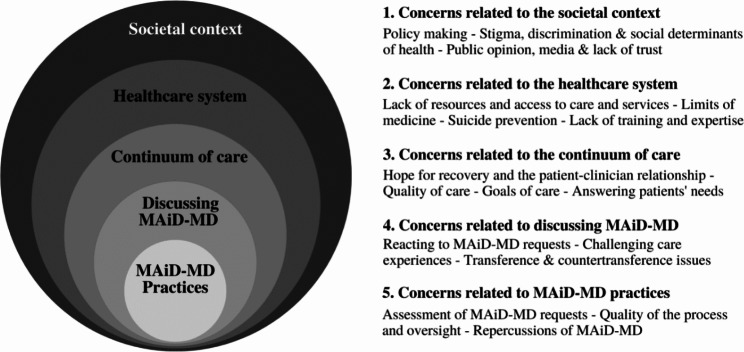
- Moral concerns and proposed solutions were grouped into five contexts of emergence: (1) societal context, (2) healthcare system, (3) continuum of care, (4) discussions on the option of MAiD-MD, and (5) MAiD-MD practices.
- The assessment of MAiD-MD applications was the most recurrent source of concern, involving interpretation and application of eligibility criteria such as capacity, intolerability of suffering, and irremediability, as well as voluntariness, biases, safeguards, and oversight.
- The review found only 4/74 articles were qualitative empirical studies, and only one directly related to the moral concerns of people living with mental disorders; the remaining 70 articles were contributions from clinicians or academics. Proposed solutions were mainly oriented toward “what to do” rather than “how” to implement remedies.
Methods
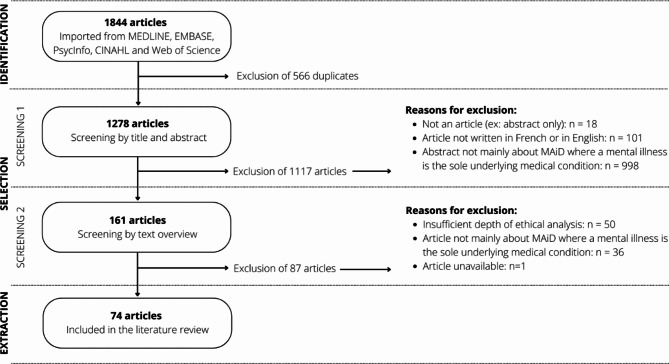
- Qualitative thematic review using systematic keyword-driven searches in MEDLINE (n = 641), EMBASE (n = 509), CINAHL (n = 170), PsycInfo (n = 268), and Web of Science (n = 256), for a total of N = 1278 records imported into Covidence; searches were conducted on July 13, 2022.
- Two-phase screening by title/abstract and then content overview; inclusion required focus on MAiD-MD, substantial qualitative analysis, and mention of moral concerns related to MAiD-MD, yielding 74 included articles.
- Thematic analysis extracted moral concerns and proposed solutions, grouped them into five contexts, and included a consultation phase with key stakeholders, including people living with a mental disorder.
Limitations
- The paper states that it excluded grey literature (e.g., Canada’s Final Report of the Expert Panel on MAiD and Mental Illness); limited the search to writings with ethics or morality keywords, possibly excluding relevant articles; restricted inclusion to publications with qualitative depth, possibly discarding quantitative empirical research; and excluded neurocognitive disorders, autism spectrum disorders, and intellectual disabilities, though some concerns may still apply to those groups.
- The paper also states that moral concerns relating to not allowing MAiD for people with psychiatric suffering are not covered by the review.
- Evident from the review’s own findings: only 4/74 included articles were qualitative empirical studies, and only one directly reported the moral concerns of people living with mental disorders, so patient and relative perspectives appear poorly documented and often reported indirectly by others.
Model-written summary. Check it against the paper before relying on it.
Integrity signals
Registry
Cites
Statistics
Figures
Verification
Claims the paper makes
26 Valid · 2 Not valid · 51 Not checked · 50 Own results and interpretations
The sources with a verdict support this claim; the rest weren’t checked yet, have no full text we could read, or their verdicts aren’t rated yet.
In the paper
“Although MAiD-MD can bring some peace of mind [18, 20, 21] by offering an exit option to people who fear that their suffering will be perpetual [22]”
§ Medical assistance in dying for people living with mental disorders: a qualitative thematic review > Societal context > Moral concerns related to the societal context
What the sources say
- Not checked — no full text of the sourcecites [18] Provencher-Renaud G Larivée S Sénéchal C L’accès à L’aide médicale à mourir pour les personnes souffrant de troubles mentaux Ann Med Psychol 2019 177 8 801 8 source
- Supportedcites [20] Pronk R Willems DL van de Vathorst S Feeling seen, being heard: perspectives of patients suffering from mental Illness on the possibility of physician-assisted death in the Netherlands Cult Med Psychiatry 2022 46 2 475 89 34132955 PMC8208069 source
The Results (‘Ending the Suffering’) describe PAD as an option if suffering worsens or nothing else works, and say respondents perceived their suffering as without an end. The Discussion likewise identifies the perceived endlessness of suffering as a reason patients sought a way to end it. Page numbers were not provided in the supplied passages. (LLM, conf=0.92)
- Not checked — no full text of the sourcecites [21] Wilson C Psychiatry’s last taboo New Sci 2016 231 3083 16 7 source
- Not checked — no full text of the sourcecites [22] Cowley C Euthanasia in psychiatry can never be justified. A reply to Wijsbek Theor Med Bioeth 2013 34 3 227 38 23612799 source
plainstates a cause- Asserted: passes — The authors put it forward as true.
- Checkable: passes — It can be checked against evidence.
- Load-bearing: unclear — It is unclear whether the paper’s conclusions depend on it.
- Based: passes — The paper gives a reason why it holds.
The cited sources support only part of this claim — read each source’s verdict below.
In the paper
“Human, financial, and material resource shortages [34, 45, 46] are acute in mental health care and services.”
§ Medical assistance in dying for people living with mental disorders: a qualitative thematic review > Healthcare system > Moral concerns related to the healthcare system
What the sources say
- Partly supportedcites [34] Downie J Schuklenk U Social determinants of health and slippery slopes in assisted dying debates: lessons from Canada J Med Ethics 2021 47 10 662 9 34349029 PMC8479744 sourceExperimental — accuracy not yet measured
In “Responses to the social determinants of health arguments (disability and mental illness)” (page unavailable), the paper describes services for people with mental illnesses as under-resourced and calls for substantially more healthcare and social-service resources. It does not identify shortages specifically in human, financial, and material resources, so it supports the general point but not the three-part breakdown. (LLM, conf=0.84)
- Not checked — no full text of the sourcecites [45] Freeland A Godkin D Dembo J Chan P Knoops F Lachmann M Medical assistance in dying (MAiD) for persons whose sole underlying medical condition is a mental disorder: challenges and considerations Can J Psychiatry 2022 67 1 71 87 34465248 PMC8811251 source
- Not checked — no full text of the sourcecites [46] Pronk R Evenblij K Willems DL van de Vathorst S Considerations by Dutch psychiatrists regarding euthanasia and physician-assisted Suicide in psychiatry: a qualitative study JCP 2019 80 6 14494 31721484 source
plain- Asserted: passes — The authors put it forward as true.
- Checkable: passes — It can be checked against evidence.
- Load-bearing: passes — The paper’s conclusions depend on it.
- Based: passes — The paper gives a reason why it holds.
- Partly supported
The cited sources support only part of this claim — read each source’s verdict below.
In the paper
“It is problematic that a person could request MAiD-MD without first accessing care and services adapted to their situation [61, 62].”
§ Medical assistance in dying for people living with mental disorders: a qualitative thematic review > Continuum of care > Moral concerns related to the continuum of care
What the sources say
- Partly supportedcites [61] Trachsel M Jox RJ Suffering is not enough: assisted dying for people with mental Illness Bioethics 2022 36 5 519 24 35045199 PMC9306695 sourceExperimental — accuracy not yet measured
The Introduction says assisted dying should never compete with adequate care and could be considered when adequate care has failed to relieve suffering. Section 4 also treats refractoriness to potentially beneficial treatment as a proposed eligibility criterion. The paper addresses access to assisted dying, however, not whether it is problematic for someone to make a request before receiving care adapted to their situation. (LLM, conf=0.85)
- Not checked — no full text of the sourcecites [62] Vandenberghe J Physician-assisted Suicide and psychiatric Illness N Engl J Med 2018 378 10 885 7 29514019 source
hedged- Asserted: passes — The authors put it forward as true.
- Checkable: passes — It can be checked against evidence.
- Load-bearing: passes — The paper’s conclusions depend on it.
- Based: passes — The paper gives a reason why it holds.
- Partly supported
The sources with a verdict support this claim; the rest weren’t checked yet, have no full text we could read, or their verdicts aren’t rated yet.
In the paper
“The main concern surrounding MAiD-MD and suicide prevention is the idea that MAiD-MD is a way of helping some people commit suicide [49, 52].”
§ Medical assistance in dying for people living with mental disorders: a qualitative thematic review > Healthcare system > Moral concerns related to the healthcare system
What the sources say
- Not checked — no full text of the sourcecites [49] Kious BM Battin M Physician aid-in-dying and Suicide prevention in psychiatry: a moral crisis? AJOB 2019 19 10 29 39 31557090 source
- Supportedcites [52] Mack RA Stanton CE Responding to terminal Anorexia Nervosa: three cases and proposed clinical characteristics J Eat Disord 2022 10 1 87 35752866 PMC9233818 source
In the Main text, the authors argue that MAID gives a person experiencing suicidality the capability to end their life, using Jessica’s case as an example. They also describe MAID as an active step toward death that some consider suicide. This supports the cited concern, although the paper discusses it specifically in the context of eating disorders. (LLM, conf=0.87)
plain- Asserted: passes — The authors put it forward as true.
- Checkable: passes — It can be checked against evidence.
- Load-bearing: unclear — It is unclear whether the paper’s conclusions depend on it.
- Based: passes — The paper gives a reason why it holds.
The sources with a verdict support this claim; the rest weren’t checked yet, have no full text we could read, or their verdicts aren’t rated yet.
In the paper
“For some, the mere possibility of having access to MAiD-MD could be enough to lighten the burden of their mental disorder without feeling the need to take advantage of it [20, 21].”
§ Medical assistance in dying for people living with mental disorders: a qualitative thematic review > Continuum of care > Identified needs and proposed solutions to continuum of care issues
What the sources say
- Supportedcites [20] Pronk R Willems DL van de Vathorst S Feeling seen, being heard: perspectives of patients suffering from mental Illness on the possibility of physician-assisted death in the Netherlands Cult Med Psychiatry 2022 46 2 475 89 34132955 PMC8208069 source
The Discussion says that, for some patients, the possibility of PAD itself creates peace of mind and helps them continue living. The Results (“Ending the Suffering”) likewise describe a respondent who felt that having PAD as a future option could help psychologically, without needing to use it. (LLM, conf=0.93)
- Not checked — no full text of the sourcecites [21] Wilson C Psychiatry’s last taboo New Sci 2016 231 3083 16 7 source
hedgedstates a possible cause- Asserted: passes — The authors put it forward as true.
- Checkable: passes — It can be checked against evidence.
- Load-bearing: unclear — It is unclear whether the paper’s conclusions depend on it.
- Based: passes — The paper gives a reason why it holds.
- Supported
44 more claims · 8 with their cited sources checked
Create a free account to see all 129 claims and every source verdict.
- Probably not a substantial claim. 50
- It may state two separate claims as one. 49
Claims other papers make about this one
Each is checked against this paper’s own text: does it say what the citing paper says it does?
The source backs part of the claim, not all of it — or backs it for a different population, condition or comparison.
In the citing paper
“psychiatric suffering is inherently subjective, often fluctuating, and characterized by prognostic uncertainty”
From Forensic-psychiatric and medico-legal challenges in euthanasia and assisted suicide for patients with mental disorders: balancing autonomy, vulnerability, and professional responsibility (2026) · cites this paper as [5]
Experimental — accuracy not yet measuredThe source backs part of the claim, not all of it — or backs it for a different population, condition or comparison.
In the citing paper
“In psychiatric contexts, these safeguards typically include repeated and decision-specific capacity assessments, independent psychiatric consultations, comprehensive reconstruction of treatment history, cooling-off periods, and formal systems of ex post oversight”
From Forensic-psychiatric and medico-legal challenges in euthanasia and assisted suicide for patients with mental disorders: balancing autonomy, vulnerability, and professional responsibility (2026) · cites this paper as [5]
Experimental — accuracy not yet measuredThe source backs part of the claim, not all of it — or backs it for a different population, condition or comparison.
In the citing paper
“Rather than representing mutually exclusive paradigms, these models may converge through the implementation of robust safeguards and multidisciplinary assessment processes capable of balancing autonomy and protection ( 3 , 5 , 9 ).”
From Forensic-psychiatric and medico-legal challenges in euthanasia and assisted suicide for patients with mental disorders: balancing autonomy, vulnerability, and professional responsibility (2026) · cites this paper as [5]
Experimental — accuracy not yet measuredThe source backs part of the claim, not all of it — or backs it for a different population, condition or comparison.
In the citing paper
“When the request for EAS is motivated solely by a mental disorder, without the presence of a serious or irreversible somatic condition, the clinical, ethical, and medico-legal challenges become significantly amplified ( 3 – 5 , 9 ).”
From Forensic-psychiatric and medico-legal challenges in euthanasia and assisted suicide for patients with mental disorders: balancing autonomy, vulnerability, and professional responsibility (2026) · cites this paper as [5]
Experimental — accuracy not yet measuredThe cited source says what the claim attributes to it.
In the citing paper
“The constant evolution of therapeutic options makes it particularly difficult to assign a definitive and irreversible character to psychological suffering, necessitating a prudent, probabilistic, and necessarily case-specific judgment with important ethical and medico-legal implications”
3 more claims about this paper
Create a free account to see every claim other papers make about this one.
Citations
Cites
Scoping studies: towards a methodological framework
Arksey, H., & O'Malley, L. (2005) · International Journal of Social Research Methodology · doi:10.1080/1364557032000119616 · Cited by 36,742 · cited 1×
“Consultation: Following Levac et al. (2010)’s steps for realizing a scoping review, this literature review included a consultation phase with a group of key stakeholders, including people living with a mental disorder, to complement the literature review [11, 12].”
MethodScoping studies: advancing the methodology
Levac, D., Colquhoun, H., & O'Brien, K. K. (2010) · Implementation Science · doi:10.1186/1748-5908-5-69 · Cited by 15,268 · cited 2×
“Consultation: Following Levac et al. (2010)’s steps for realizing a scoping review, this literature review included a consultation phase with a group of key stakeholders, including people living with a mental disorder, to complement the literature review [11, 12].”
BackgroundMethodKnow thyself and become what you are: a eudaimonic approach to psychological well-being
Ryff, C. D., & Singer, B. H. (2008) · Journal of Happiness Studies · doi:10.1007/s10902-006-9019-0 · Cited by 3,149 · cited 1×
“A moral concern was identified when discomfort, distress, uncertainty, or a dilemma as to the best way to act was identified [13] or if a described situation impeded stakeholders’ well-being [14].”
BackgroundTreatment-resistant major depressive disorder and assisted dying
Schuklenk, U., & Vathorst, S. V. D. (2015) · Journal of Medical Ethics · doi:10.1136/medethics-2014-102458 · Cited by 93 · cited 3×
“Several authors express a profound unease with this idea, knowing that letting the patient take matters into their own hands can lead to a violent and isolated death or to an even more painful situation in the event of a failed suicide attempt [30, 41, 63].”
BackgroundMethodEuthanasia and assisted suicide in psychiatric patients: A systematic review of the literature
Calati, R., Olié, E., Dassa, D., Gramaglia, C., Guillaume, S., Madeddu, F., & Courtet, P. (2021) · Journal of Psychiatric Research · doi:10.1016/j.jpsychires.2020.12.006 · Cited by 88
Nicolini, M. E., Kim, S. Y. H., Churchill, M. E., & Gastmans, C. (2020) · Psychological Medicine · doi:10.1017/s0033291720001543 · Cited by 77 · cited 1×
“Literature reviews on the arguments in favor and against MAiD-MD have notably been carried out by Nicolini et al. (2020) and Grassi et al. (2022) [5, 6].”
BackgroundSocial determinants of health and slippery slopes in assisted dying debates: lessons from Canada
Downie, J., & Schuklenk, U. (2021) · Journal of Medical Ethics · doi:10.1136/medethics-2021-107493 · Cited by 65 · cited 4×
“The need to show humility in the face of the limits of psychiatry in relieving mental suffering [24] is reported, and the need to improve access to mental health care and services is also expressed [34, 42, 45, 57].”
BackgroundInfluentialKissane, D. W., & Kelly, B. J. (2000) · Australian & New Zealand Journal of Psychiatry · doi:10.1080/j.1440-1614.2000.00692.x · Cited by 64 · cited 4×
“The ability to bear the suffering reported by patients while containing their feeling of helplessness is a major personal and relational challenge for healthcare professionals, who are often ill-prepared for this type of communication [57].”
BackgroundInfluentialPhysician-assisted suicide in psychiatry and loss of hope
Berghmans, R., Widdershoven, G., & Widdershoven-Heerding, I. (2013) · International Journal of Law and Psychiatry · doi:10.1016/j.ijlp.2013.06.020 · Cited by 61 · cited 6×
“In this sense, Berghmans et al. (2013) express that people living with mental disorders generally do not have the means to end their life with dignity without the help of healthcare professionals [71].”
BackgroundInfluentialFour Reasons Why Assisted Dying Should Not Be Offered for Depression
Blikshavn, T., Husum, T. L., & Magelssen, M. (2017) · Journal of Bioethical Inquiry · doi:10.1007/s11673-016-9759-4 · Cited by 60 · cited 6×
“…of MAiD-MD could also affect the resilience of patients [60], the therapeutic relationship [26, 48, 60] and potentially influence the patient to lose hope that their situation will improve if they have the impression that the healthcare professional is abandoning the therapeutic project [23, 37].”
BackgroundInfluentialDembo, J., Schuklenk, U., & Reggler, J. (2018) · The Canadian Journal of Psychiatry · doi:10.1177/0706743718766055 · Cited by 60 · cited 3×
“The lack of response to these needs can prevent them from having a satisfactory quality of life [31].”
BackgroundVerhofstadt, M., Van Assche, K., Sterckx, S., Audenaert, K., & Chambaere, K. (2019) · International Journal of Law and Psychiatry · doi:10.1016/j.ijlp.2019.04.004 · Cited by 60 · cited 3×
“Among the proposed solutions, having better-resourced mental health services is necessary [16, 40].”
BackgroundMethodDeschepper, R., Distelmans, W., & Bilsen, J. (2014) · JAMA Psychiatry · doi:10.1001/jamapsychiatry.2014.185 · Cited by 58 · cited 8×
“The fate of patients being refused MAiD-MD [83], as well as the impact of MAiD-MD on loved ones [55] and on other people living with mental disorders [59, 68], are noted as morally concerning and remain understudied.”
BackgroundInfluentialPhysician Aid-in-Dying and Suicide Prevention in Psychiatry: A Moral Crisis?
Kious, B. M., & Battin, M. (. (2019) · The American Journal of Bioethics · doi:10.1080/15265161.2019.1653397 · Cited by 54 · cited 3×
“Attempting to objectively assess suffering can also lead to insensitivity towards a person’s unique experiences of states they consider intolerable [49].”
BackgroundEuthanasia: The role of the psychiatrist
Naudts, K., Ducatelle, C., Kovacs, J., Laurens, K., Van Den Eynde, F., & Van Heeringen, C. (2006) · British Journal of Psychiatry · doi:10.1192/bjp.bp.105.010256 · Cited by 52 · cited 2×
“Healthcare professionals’ involvement or support of MAiD-MD could also affect the resilience of patients [60], the therapeutic relationship [26, 48, 60] and potentially influence the patient to lose hope that their situation will improve if they have the impression that the healthcare professional…”
BackgroundPhysician-assisted suicide and psychiatric illness
Vandenberghe, J. (2018) · New England Journal of Medicine · doi:10.1056/nejmp1714496 · Cited by 50 · cited 3×
“These avenues seem promising for helping people living with mental disorders lead meaningful lives and maintain a positive view of themselves [62].”
BackgroundSuffering is not enough: Assisted dying for people with mental illness
Trachsel, M., & Jox, R. J. (2022) · Bioethics · doi:10.1111/bioe.13002 · Cited by 48 · cited 3×
“…on – contains biases, particularly in relation to the clinical experience, beliefs and values of health-care professionals [28], or because of existing prejudices against mental disorders (e.g., assuming that all people living with mental disorders lack decision making capacity) [32, 43, 61].”
BackgroundRooney, W., Schuklenk, U., & van de Vathorst, S. (2018) · Health Care Analysis · doi:10.1007/s10728-017-0344-8 · Cited by 44 · cited 4×
“Among the proposed solutions, having better-resourced mental health services is necessary [16, 40].”
BackgroundInfluentialPhysician-assisted death for psychiatric patients: misguided public policy.
Miller, F. G., & Appelbaum, P. S. (2018) · New England Journal of Medicine · doi:10.1056/nejmp1709024 · Cited by 44 · cited 6×
“Errors in assessment could result in some patients being incorrectly deemed eligible, and vice versa [19, 47].”
BackgroundInfluentialMehlum, L., Schmahl, C., Berens, A., Doering, S., Hutsebaut, J., Kaera, A., Kramer, U., Moran, P. A., Renneberg, B., Ribaudi, J. S., et al. (2020) · Borderline Personality Disorder and Emotion Dysregulation · doi:10.1186/s40479-020-00131-9 · Cited by 42 · cited 1×
“For example, Mehlum et al. (2020) mentioned doubting whether people living with borderline personality disorder are offered evidence-based personality disorder-specific treatments.”
BackgroundPsychiatric euthanasia, suicide and the role of gender
Nicolini, M. E., Gastmans, C., & Kim, S. Y. H. (2022) · The British Journal of Psychiatry · doi:10.1192/bjp.2021.95 · Cited by 40 · cited 3×
“…of people living with mental disorders are those related to care and services (notably a lack of symptom relief), but also those related to daily needs (notably the need to have satisfying relationships) and existential needs (especially the difficulty of finding meaning to life) [16, 20, 68].”
BackgroundMethodDebating Euthanasia and Physician-Assisted Death in People with Psychiatric Disorders
Grassi, L., Folesani, F., Marella, M., Tiberto, E., Riba, M. B., Bortolotti, L., Toffanin, T., Palagini, L., Belvederi Murri, M., Biancosino, B., et al. (2022) · Current Psychiatry Reports · doi:10.1007/s11920-022-01339-y · Cited by 39 · cited 7×
“Some of them may experience moral distress if they think the eligibility criteria for MAiD-MD do not take into consideration key features of certain mental disorders, like fluctuating suicidal ideations and behaviours [6].”
BackgroundInfluentialPhysician‐Assisted Death and Severe, Treatment‐Resistant Depression
Steinbock, B. (2017) · Hastings Center Report · doi:10.1002/hast.768 · Cited by 36 · cited 2×
“…to the complexity of the assessment of MAiD-MD requests [56, 58]; as well as to the interpretation and application of eligibility criteria [6, 56], mainly in relation to capacity [29, 77, 78], to the intolerability of suffering [17, 56, 64, 70], and to the irremediability of the condition [47, 51].”
BackgroundPersons with mental disorders and assisted dying practices in Spain: An overview
Pozón, S. R., Terribas, N., Falcó‐Pegueroles, A., & Román-Maestre, B. (2023) · International Journal of Law and Psychiatry · doi:10.1016/j.ijlp.2023.101871 · Cited by 36 · cited 1×
“More recently, Spain has passed a MAiD law making people living with mental disorders eligible for MAiD under certain conditions [3].”
BackgroundBroome, M. R., & de Cates, A. (2015) · Journal of Medical Ethics · doi:10.1136/medethics-2015-102812 · Cited by 35 · cited 2×
“…to the complexity of the assessment of MAiD-MD requests [56, 58]; as well as to the interpretation and application of eligibility criteria [6, 56], mainly in relation to capacity [29, 77, 78], to the intolerability of suffering [17, 56, 64, 70], and to the irremediability of the condition [47, 51].”
BackgroundMedical assistance in dying: special issues for patients with mental illness
Sheehan, K., Gaind, K. S., & Downar, J. (2017) · Current Opinion in Psychiatry · doi:10.1097/yco.0000000000000298 · Cited by 33 · cited 2×
“…to the complexity of the assessment of MAiD-MD requests [56, 58]; as well as to the interpretation and application of eligibility criteria [6, 56], mainly in relation to capacity [29, 77, 78], to the intolerability of suffering [17, 56, 64, 70], and to the irremediability of the condition [47, 51].”
BackgroundMedical Assistance in Dying and Mental Health: A Legal, Ethical, and Clinical Analysis
Simpson, A. I. F. (2018) · The Canadian Journal of Psychiatry · doi:10.1177/0706743717746662 · Cited by 32 · cited 5×
“It can also be challenging for family members to accept that their loved one intends to request or has requested MAiD-MD [24].”
BackgroundInfluentialVerhofstadt, M., Pardon, K., Audenaert, K., Deliens, L., Mortier, F., Liégeois, A., & Chambaere, K. (2021) · Journal of Psychiatric Research · doi:10.1016/j.jpsychires.2021.09.032 · Cited by 32 · cited 1×
“However, a growing body of empirical qualitative research on medical assistance in dying for people with mental disorders has emerged in recent years [85–87].”
BackgroundPronk, R., Willems, D. L., & van de Vathorst, S. (2022) · Culture, Medicine, and Psychiatry · doi:10.1007/s11013-021-09726-5 · Cited by 29 · cited 10×
“People living with mental disorders are often not taken seriously [20, 48] unless they have physical symptoms or somatic manifestations.”
BackgroundInfluentialPhysician-assisted suicide in psychiatry: developments in The Netherlands
Schoevers, R. A., Asmus, F. P., & Tilburg, W. V. (1998) · Psychiatric Services · doi:10.1176/ps.49.11.1475 · Cited by 28 · cited 6×
“The fate of patients being refused MAiD-MD [83], as well as the impact of MAiD-MD on loved ones [55] and on other people living with mental disorders [59, 68], are noted as morally concerning and remain understudied.”
BackgroundInfluentialSaigle, V., & Racine, É. (2018) · Bioethics News · doi:10.1007/s40592-018-0076-z · Cited by 28
Self-citationDemedts, D., Roelands, M., Libbrecht, J., & Bilsen, J. (2018) · Journal of Psychiatric and Mental Health Nursing · doi:10.1111/jpm.12475 · Cited by 28 · cited 9×
“…to the complexity of the assessment of MAiD-MD requests [56, 58]; as well as to the interpretation and application of eligibility criteria [6, 56], mainly in relation to capacity [29, 77, 78], to the intolerability of suffering [17, 56, 64, 70], and to the irremediability of the condition…”
BackgroundInfluentialBracken‐Roche, D., Bell, E. C., Karpowicz, L., & Racine, É. (2014) · Accountability in Research · doi:10.1080/08989621.2013.866045 · Cited by 27
Self-citationThe terminal, the futile, and the psychiatrically disordered
Cholbi, M. J. (2013) · International Journal of Law and Psychiatry · doi:10.1016/j.ijlp.2013.06.011 · Cited by 26 · cited 5×
“Thus, biases against psychiatric distress can lead healthcare professionals to conclude that the person’s suffering is exaggerated and only in their head [32].”
BackgroundInfluentialShaffer, C. S., Cook, A. N., & Connolly, D. A. (2016) · Psychology, Public Policy, and Law · doi:10.1037/law0000082 · Cited by 21 · cited 4×
“Discrimination can be experienced by people with mental disorders on a daily basis, both by the people around them [27], by the authorities [28], by the medical profession [17], or by public policies that exclude them or fail to consider them adequately [16, 29–32].”
BackgroundInfluentialVerhofstadt, M., Audenaert, K., Van den Broeck, K., Deliens, L., Mortier, F., Titeca, K., De Bacquer, D., & Chambaere, K. (2021) · Science Progress · doi:10.1177/00368504211029775 · Cited by 21 · cited 1×
“However, a growing body of empirical qualitative research on medical assistance in dying for people with mental disorders has emerged in recent years [85–87].”
BackgroundIrremediable psychiatric suffering in the context of medical assistance in dying: A delphi-study
van Veen, S. M. P., Evans, N., Ruissen, A. M., Vandenberghe, J., Beekman, A. T. F., & Widdershoven, G. A. M. (2022) · The Canadian Journal of Psychiatry · doi:10.1177/07067437221087052 · Cited by 21 · cited 2×
“Canada has decriminalized MAiD for physical conditions and plans to allow MAiD when a mental disorder is the sole underlying medical condition (MAiD-MD) [4].”
BackgroundStoll, J., Ryan, C. J., & Trachsel, M. (2021) · Frontiers in Psychiatry · doi:10.3389/fpsyt.2020.532817 · Cited by 20 · cited 4×
“Two-track approaches to MAiD-MD, which maintain recovery-oriented care in parallel with the assessment of MAiD-MD requests, are also reportedly promising [40, 69].”
BackgroundMethodInfluentialThe influence of cognitive distortions on decision-making capacity for physician aid in dying
Dembo, J., van Veen, S., & Widdershoven, G. (2020) · International Journal of Law and Psychiatry · doi:10.1016/j.ijlp.2020.101627 · Cited by 19 · cited 3×
“…examine the legislative developments surrounding MAiD-MD [43] to ensure that the suffering of people living with mental disorders is not minimized [44] and to promote their empowerment in their care decisions as well as in their life trajectories, which may or may not include a request for…”
BackgroundVerhofstadt, M., Chambaere, K., Pardon, K., Mortier, F., Liégeois, A., Deliens, L., & Audenaert, K. (2022) · BMC Psychiatry · doi:10.1186/s12888-022-04039-2 · Cited by 19
Medical Assistance in Dying: Challenges for Psychiatry
Jones, R. M., & Simpson, A. I. F. (2018) · Frontiers in Psychiatry · doi:10.3389/fpsyt.2018.00678 · Cited by 18 · cited 2×
“The fear that the gradual expansion of the laws governing MAiD could lead to abuses is also noted [25, 26].”
BackgroundPronk, R., Evenblij, K., Willems, D. L., & van de Vathorst, S. (2019) · The Journal of Clinical Psychiatry · doi:10.4088/jcp.19m12736 · Cited by 18 · cited 6×
“Knowing that the perceived acceptability of an intervention varies across patients [27], it can be difficult for healthcare professionals to confirm that a person’s suffering is intolerable [46].”
BackgroundInfluentialIs the exclusion of psychiatric patients from access to physician-assisted suicide discriminatory?
Hatherley, J. J. (2019) · Journal of Medical Ethics · doi:10.1136/medethics-2019-105546 · Cited by 17 · cited 3×
“The fact that the causes of mental disorders are often misunderstood limits the chances that effective treatments adapted to the patient’s needs will be available [50, 51].”
BackgroundIs Euthanasia Psychiatric Treatment? The Struggle With Death on Request in the Netherlands
Denys, D. (2018) · American Journal of Psychiatry · doi:10.1176/appi.ajp.2018.18060725 · Cited by 16 · cited 3×
“Therefore, MAiD-MD seems complicated to reconcile with suicide prevention [53, 54], with suicide prevention being a well-established societal responsibility [47].”
BackgroundVerhofstadt, M., Audenaert, K., Van Assche, K., Sterckx, S., & Chambaere, K. (2019) · BMC Medical Ethics · doi:10.1186/s12910-019-0400-z · Cited by 15 · cited 1×
“The fate of patients being refused MAiD-MD [83], as well as the impact of MAiD-MD on loved ones [55] and on other people living with mental disorders [59, 68], are noted as morally concerning and remain understudied.”
BackgroundButurovic, Z. (2021) · Journal of Medical Ethics · doi:10.1136/medethics-2020-106089 · Cited by 15 · cited 1×
“Some authors fear MAiD-MD may lead to or increase the erosion of patient and public trust in psychiatry [25, 36] by reinforcing the belief that nothing can be done to help people living with mental disorders [37].”
BackgroundVerhofstadt, M., Audenaert, K., Mortier, F., Deliens, L., Liégeois, A., Pardon, K., & Chambaere, K. (2022) · Frontiers in Psychiatry · doi:10.3389/fpsyt.2022.859745 · Cited by 14 · cited 1×
“A need for training [78], awareness-rais-ing [27], and guidelines [78] is apparent, as well as a need to develop more support resources to help all stakeholders through the challenging situations and discussions that can arise in the context of MAiD-MD [64, 70, 84].”
BackgroundEuthanasia in psychiatry can never be justified. A reply to Wijsbek
Cowley, C. (2013) · Theoretical Medicine and Bioethics · doi:10.1007/s11017-013-9252-6 · Cited by 13 · cited 5×
“Reasonable therapeutic alternatives should be tried before considering MAiD-MD [18, 22] while considering the patient’s values.”
BackgroundInfluentialLast-Minute Recovery of a Psychiatric Patient Requesting Physician-Assisted Death
van Veen, S. M. P., Scheurleer, W. F. J., Ruijsch, M. L., Röder, C. H., Widdershoven, G. A. M., & Batalla, A. (2020) · Psychiatric Services · doi:10.1176/appi.ps.201900489 · Cited by 13 · cited 1×
“In terms of the irremedi-ability of the condition, the diagnostic and prognostic uncertainty complicates the assessment of eligibility for MAiD-MD [82], in particular because the possibility that a future intervention will succeed in alleviating the suffering still exists [38], but also because…”
BackgroundFreeland, A., Godkin, D., Dembo, J., Chan, P., Knoops, F., Lachmann, M., Morissette, L., Smith, D. H., Stewart, D. E., Trew, M., et al. (2022) · The Canadian Journal of Psychiatry · doi:10.1177/07067437211043315 · Cited by 13 · cited 9×
“Questions are also raised regarding the quality of regulatory over-sight processes for MAiD-MD [37, 75] and the best type of oversight process to implement retrospectively or prospectively [45].”
BackgroundInfluentialWhat Does “Irremediability” in Mental Illness Mean?
Gaind, K. S. (2020) · The Canadian Journal of Psychiatry · doi:10.1177/0706743720928656 · Cited by 12 · cited 5×
“Experiences of stigma have been reported as contributing more to the intolerability of suffering among people with mental disorders than the symptoms of the disorder [33].”
BackgroundInfluentialBahji, A., & Delva, N. (2022) · Journal of Medical Ethics · doi:10.1136/medethics-2020-107133 · Cited by 12 · cited 9×
“People living with mental disorders are often not taken seriously [20, 48] unless they have physical symptoms or somatic manifestations.”
BackgroundInfluentialResponding to “Terminal anorexia nervosa: three cases and proposed clinical characteristics”
Mack, R. A., & Stanton, C. E. (2022) · Journal of Eating Disorders · doi:10.1186/s40337-022-00612-y · Cited by 12 · cited 3×
“The introduction of MAiD-MD into the continuum of care can affect the therapeutic relationship [17, 48, 59], which is closely correlated with patients’ hope for improvement [37], a key facilitator of recovery [23, 52].”
BackgroundDeveloping the language of futility in psychiatry with care
Wp, P. (2016) · South African Journal of Psychiatry · doi:10.4102/sajpsychiatry.v22i1.978 · Cited by 11 · cited 5×
“Being regularly confronted with patients with suicidal ideation, healthcare professionals can involuntarily adopt paternalistic attitudes towards these people [64], which affects their quality of care.”
BackgroundInfluential(2017) · PubMed · Cited by 11
Self-citationNicolini, M. E., Gastmans, C., & Kim, S. Y. H. (2019) · The American Journal of Bioethics · doi:10.1080/15265161.2019.1659606 · Cited by 10 · cited 1×
“Conscien-tious objectors can oppose MAiD-MD without ignoring the suffering at stake: assuming the opposite is a mistake [74].”
BackgroundSinyor, M., & Schaffer, A. (2020) · The Canadian Journal of Psychiatry · doi:10.1177/0706743720928658 · Cited by 10 · cited 2×
“Therefore, MAiD-MD seems complicated to reconcile with suicide prevention [53, 54], with suicide prevention being a well-established societal responsibility [47].”
BackgroundAn Ethical-Legal Analysis of Medical Assistance in Dying for Those with Mental Illness
Tanner, R. (2018) · Alberta Law Review · doi:10.29173/alr2500 · Cited by 10
Social Determinants of Mental Health and Physician Aid-in-Dying: The Real Moral Crisis
Ho, A., & Norman, J. S. (2019) · The American Journal of Bioethics · doi:10.1080/15265161.2019.1654025 · Cited by 9 · cited 1×
“Thus, people could ask for MAiD-MD to escape life circum-stances that are in principle remediable (e.g., with policy and decisions regarding resource allocation [35]).”
BackgroundPhysician-Assisted Suicide and the Dutch Courts
Gevers, J. K. M. (1996) · Cambridge Quarterly of Healthcare Ethics · doi:10.1017/s0963180100006757 · Cited by 8 · cited 1×
“Helping people live with their mental disorders should precede MAiD-MD [66].”
BackgroundThe need to exercise caution in accepting addiction as a reason for performing euthanasia
Hall, W., & Parker, M. (2018) · Addiction · doi:10.1111/add.14025 · Cited by 8 · cited 1×
“…authors are concerned that requests for MAiD-MD can be influenced by the mental disorder and that the desire to die can be a symptom of the disorder, or that the request for MAiD-MD can stem from external pressure [6, 41, 45], which would invalidate the voluntary nature of the request [56, 80].”
BackgroundZhong, R., Xu, Y. E., Oquendo, M. A., & Sisti, D. A. (2019) · The American Journal of Bioethics · doi:10.1080/15265161.2019.1654018 · Cited by 8 · cited 1×
“Still, the goals of care should also be tailored to each person’s specific needs, preferences, and life goals, including the right to refuse treatments, and the need to recognize when interventions become futile [2, 32, 61, 62, 64, 67].”
BackgroundVoluntary decision-making in addiction: A comprehensive review of existing measurement tools
Barned, C., Rochette, M., & Racine, É. (2021) · Consciousness and Cognition · doi:10.1016/j.concog.2021.103115 · Cited by 8 · cited 1×
“(2010), as well as by more structured forms of thematic literature reviews [7–12].”
BackgroundSelf-citationPearce, S. (2017) · British Journal of Psychiatry · doi:10.1192/bjp.bp.117.199687 · Cited by 7 · cited 2×
“Although the involvement of relatives can be beneficial to better understand the situation of the person requesting MAiD-MD, confidentiality issues also arise when it comes to whether or not to involve relatives in the discussions surrounding MAiD-MD [45, 75].”
BackgroundEuthanasia requests in a Canadian psychiatric emergency room: A case series
Benrimoh, D., Perreault, A., & Van Den Eynde, F. (2017) · International Journal of Law and Psychiatry · doi:10.1016/j.ijlp.2017.10.006 · Cited by 7 · cited 9×
“A healthcare professional could share the patient’s demoralization [57] from lack of being able to relieve their suffering [28]: this transposition of the patient’s despair onto the healthcare professional would constitute transference.”
BackgroundInfluentialDom, G., Stoop, H., Haekens, A., & Sterckx, S. (2020) · Psychiatria Polska · doi:10.12740/pp/124078 · Cited by 7 · cited 4×
“The underlying moral concerns are manifold and relate to the complexity of the assessment of MAiD-MD requests [56, 58]; as well as to the interpretation and application of eligibility criteria [6, 56], mainly in relation to capacity [29, 77, 78], to the intolerability of suffering [17, 56, 64, 70],…”
BackgroundInfluentialL’accès à l’aide médicale à mourir pour les personnes souffrant de troubles mentaux
Provencher-Renaud, G., Larivée, S., & Sénéchal, C. (2019) · Annales Médico-psychologiques, revue psychiatrique · doi:10.1016/j.amp.2018.08.022 · Cited by 7 · cited 4×
“Reasonable therapeutic alternatives should be tried before considering MAiD-MD [18, 22] while considering the patient’s values.”
BackgroundInfluentialAssisted suicide in the care of mentally ill patients: The Lucio Magri's case
Frati, P., Gulino, M., Mancarella, P., Cecchi, R., & Ferracuti, S. (2014) · Journal of Forensic and Legal Medicine · doi:10.1016/j.jflm.2013.10.017 · Cited by 6 · cited 1×
“Perception conflicts can arise between patients and healthcare professionals [71, 73], whose training focuses mainly on preserving life, particularly when MAiD-MD is not considered a last resort because treatment options remain to be tried [22].”
BackgroundThe Wish to Die: Assisted Suicide and Mental Illness
Hirsch, J. (2016) · Journal of Social Work in End-of-Life & Palliative Care · doi:10.1080/15524256.2016.1200516 · Cited by 6 · cited 3×
“The way of receiving and responding to the request for MAiD-MD can be tinged with paternalism aimed at imposing healthcare professionals’ values on patients [48] or reveal a lack of empathy or sensitivity to their situation [39], which can increase the distress of applicants.”
BackgroundEuthanasia and Mental Suffering: An Ethical Advice for Catholic Mental Health Services
Liegeois, A. (2013) · Christian Bioethics · doi:10.1093/cb/cbt004 · Cited by 5 · cited 8×
“It is essential to cultivate the therapeutic relationship, to maintain open communication, and to offer support to address existential questions [70].”
BackgroundInfluentialLemmens, T. (2019) · The American Journal of Bioethics · doi:10.1080/15265161.2019.1654026 · Cited by 5 · cited 2×
“Healthcare professionals’ involvement or support of MAiD-MD could also affect the resilience of patients [60], the therapeutic relationship [26, 48, 60] and potentially influence the patient to lose hope that their situation will improve if they have the impression that the healthcare professional…”
BackgroundBrodeur, J., Links, P. S., Boursiquot, P.-E., & Snelgrove, N. (2022) · The Canadian Journal of Psychiatry · doi:10.1177/0706743721993645 · Cited by 5 · cited 2×
“Cognitive distortions resulting from the disorder could invalidate the informed nature of the requests [47], but this is not always the case [44, 79].”
BackgroundAssisted Suicide for People with Depression: An Advocate's Perspective
Biggs, H., & Diesfeld, K. (1995) · Medical Law International · doi:10.1177/096853329500200102 · Cited by 4 · cited 3×
“…on – contains biases, particularly in relation to the clinical experience, beliefs and values of health-care professionals [28], or because of existing prejudices against mental disorders (e.g., assuming that all people living with mental disorders lack decision making capacity) [32, 43, 61].”
BackgroundThe advocates of euthanasia in patients with mental illness are going in the wrong direction
Olié, É., & Courtet, P. (2019) · The British Journal of Psychiatry · doi:10.1192/bjp.2018.236 · Cited by 4 · cited 1×
“When remediable external factors are driving the request, the concern that MAiD-MD could become a permanent solution to a temporary problem is palpable [22, 81].”
Deep Uncertainties in the Criteria for Physician Aid-in-Dying for Psychiatric Patients
Żuradzki, T., & Nowak, P. (2019) · The American Journal of Bioethics · doi:10.1080/15265161.2019.1654028 · Cited by 4 · cited 1×
“The fact that the causes of mental disorders are often misunderstood limits the chances that effective treatments adapted to the patient’s needs will be available [50, 51].”
BackgroundAssisted Dying for Mental Disorders: Why Canada's Legal Approach Raises Serious Concerns
Yarascavitch, A. (2017) · SSRN Electronic Journal · doi:10.2139/ssrn.2988535 · Cited by 3 · cited 6×
“Errors in assessment could result in some patients being incorrectly deemed eligible, and vice versa [19, 47].”
BackgroundInfluentialMacri, R., Wagner, F., & Stuckey, M. I. (2020) · Canadian Journal of Community Mental Health · doi:10.7870/cjcmh-2020-009 · Cited by 3 · cited 5×
“A critical need is to help people live with their mental disorders before considering helping them die, which requires improving social support [40], reducing stigma [41], adapting work environments to mental health needs, and fostering a sense of community belonging [42].”
BackgroundInfluentialWinkler, L., & Wetterauer, C. (2021) · GeroPsych · doi:10.1024/1662-9647/a000259 · Cited by 3 · cited 2×
“This requires facilitating communication through deliberation and considering the important values of all stakeholders [65, 70] as well as the needs of the MAiD-MD applicant.”
BackgroundWilson, C. (2016) · New Scientist · doi:10.1016/s0262-4079(16)31317-3 · Cited by 1
Courtet, P., & Olié, E. (2021) · Oxford Textbook of Suicidology and Suicide Prevention · doi:10.1093/med/9780198834441.003.0018 · Cited by 1 · cited 10×
“…of MAiD-MD could also affect the resilience of patients [60], the therapeutic relationship [26, 48, 60] and potentially influence the patient to lose hope that their situation will improve if they have the impression that the healthcare professional is abandoning the therapeutic project [23, 37].”
BackgroundInfluential(2017) · doi:10.1201/9781315198620-20 · Cited by 1
Research works printed but not linked: 2
- Quintal A, Hotte É, Racine E. Morality as experienced: a scoping review of moral matters encountered by adults living with rare diseases. Philos Ethics Humanit Med. (Under review).
- Gupta M Carter RM Final report of the Expert Panel on MAiD and Mental Illness 2022 Ottawa, Ontario Health Canada
Cited by
The Evolving Complexities of MAID Care in Canada From a Nursing Perspective
Pesut, B., Thorne, S. E., Chambaere, K., Hall, M., & Schiller, C. J. (2024) · Global Qualitative Nursing Research · doi:10.1177/23333936241228233 · Cited by 27
“A recent review indicated that in the context of MAID and mental illness concerns arise around the adequacy of the societal context, healthcare system, and continuums of care (Favron-Godbout & Racine, 2023).”
BackgroundPersons with mental disorders and assisted dying practices in Spain: In response to Ramos et al.
Pifarré, J., Esquerda, M., Torralba, F., Bátiz, J., & Bofarull, M. (2024) · International Journal of Law and Psychiatry · doi:10.1016/j.ijlp.2024.101980 · Cited by 7
Favron‐Godbout, C., Foster, I., & Racine, É. (2025) · International Journal of Law and Psychiatry · doi:10.1016/j.ijlp.2025.102114 · Cited by 2
Self-citationSuicide-risk implications in legalising medical assistance in dying for mental disorders
Gay, M. (2025) · Mortality · doi:10.1080/13576275.2025.2481265 · Cited by 2
“Current propositions for Medical Assistance in Dying where Mental Disorder is the Sole Underlying Medical Condition (MAID MD-SUMC) aim to de-stigmatise those living with mental disorders by providing agency over significant medical decisions (Favron-Godbout & Racine, 2023).”
García, P. G. (2025) · Actualización en Medicina de Familia · doi:10.55783/amf.210403
Metadata
- Authors
- Favron-Godbout, C., & Racine, E.
- Venue
- BMC Medical Ethics
- Published
- 2023-10-24
- Volume
- 24
- Issue
- 1
- Pages
- 86-86
- ISSN
- 1472-6939 (ISSN-L)
- PMC
- PMC10594804
- OpenAlex
- W4387904886
- Cited by
- 6
- References
- 78
- Citations by year
- 2026: 1 · 2025: 3 · 2024: 2
- FWCI
- 0.30
- Type
- journal article
- Language
- en
- Open access
- gold
- doi.org
- Licence
- cc-by
- creativecommons.org/licenses/by/4.0 (tdm)
- creativecommons.org/licenses/by/4.0 (vor)
- Locations
- BMC Medical Ethics (publishedVersion, cc-by)
- PubMed Central (publishedVersion, cc-by)
- PubMed (publishedVersion)
- DOAJ (DOAJ: Directory of Open Access Journals) (submittedVersion, cc-by-sa)
- Funders
- Fonds de Recherche du Québec - Santé (307478, 271913)
- Réseau québécois sur le suicide, les troubles de l’humeur et les troubles associés (268065)
- Topics
- Health Sciences › Medicine › Public Health, Environmental and Occupational Health › Ethics and bioethics in healthcare
- Health Sciences › Medicine › Public Health, Environmental and Occupational Health › Palliative Care and End-of-Life Issues
- Health Sciences › Medicine › Public Health, Environmental and Occupational Health › Palliative and Oncologic Care
- Keywords
- medical assistance in dying, mental illness, moral concern, euthanasia, continuum of care, health care system, stakeholder well-being, end-of-life decisions
- MeSH terms
- Mental Disorders, Canada, Humans, Medical Assistance, Morals, Psychotic Disorders, Suicide, Assisted
About these checks
Registry, retraction, Cites and statistics results are computed, not judged, with one exception: a printed reference that no index lists is read once by a model before it counts as a citation error. Claims are extracted by a model and kept only when their quote appears verbatim in the text; each cited source is then checked, with a model’s help, for whether it says what the claim relies on. Those verdicts can be wrong — read the claim’s quote and the cited source before relying on one.
The claim verdicts this report counts are experimental: their accuracy is not yet measured.
A language model drew the claims from the paper on 2026-10-10, under version 3 of the claim definition (model deepseek-v4.1-flash, prompt extract-v3).
A second model labelled each claim on 2026-10-10 (model jev-1.13-20260917, definition revision gold-guideline-v0.2).
Cited sources are checked with a language model’s help (gpt-6-sol).
Statistics and arithmetic are recomputed, not judged.
Confidence bands are shown only for fields calibrated on our annotated test set. None is calibrated yet, so no band is shown.
What counts as a claim ›How we measure confidence ›How we check this ›
Are you an author, or do you see a problem with this page? Request a review
Data sources
Bibliographic data: Semantic Scholar, OpenAlex, Crossref.
Contains information from the Semantic Scholar Academic Graph Datasets, made available under the ODC Attribution License (ODC-BY 1.0).
Semantic Scholar’s data is described in: Kinney, R., et al. (2023). The Semantic Scholar Open Data Platform. arXiv:2301.10140.
