

Narcissistic leadership, workplace bullying, turnover intention, and creative performance: a study of nurses
Open accessThe DOI matches its Crossref record; 39 of the 60 references it cites were found in a registry or an index; 15 of the 52 sources its claims cite were checked for support.
Abstract
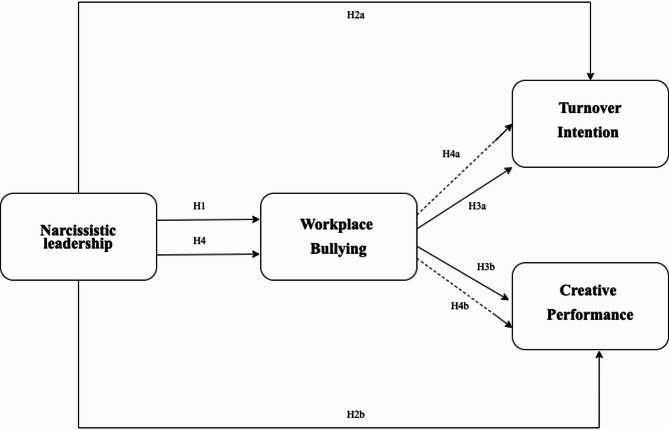
PURPOSE: This study aims to develop and propose a research model that investigates the effects of a narcissistic leadership style on nurses. In brief, this empirical study investigates three main aims: (a) direct effect of narcissistic leadership on workplace bullying, nurses turnover intention, and creative performance; (b) effect of bullying on turnover intention and creative performance; and (c) how bullying acts as a mediator between these three variables. DESIGN/METHODOLOGY/APPROACH: The study is a quantitative survey depending on questionnaire, the date were collected from nurses in the private hospitals in Sulaimania city, Kurdistan region of Iraq. FINDINGS: The findings from structural equation modeling indicate that workplace bullying acts as a key mechanism linking narcissistic leadership to nurses' turnover intention and reduced creative performance. ORIGINALITY/VALUE: No empirical study has examined the linkage between narcissistic leadership, workplace bullying, nurses turnover intention and creative performance so far. Moreover, there are few empirical studies in the current literature have tested the mechanism through which workplace bullying is associated with nurses turnover intention and creative performance.
Overview
CoChat Summary
TL;DR
This study tests a model in which narcissistic leadership increases workplace bullying, which in turn raises nurses’ turnover intention and reduces creative performance. Using survey data from 374 nurses in private hospitals in Sulaimania, Kurdistan Region of Iraq, SEM supports workplace bullying as a mediating mechanism.
Key findings
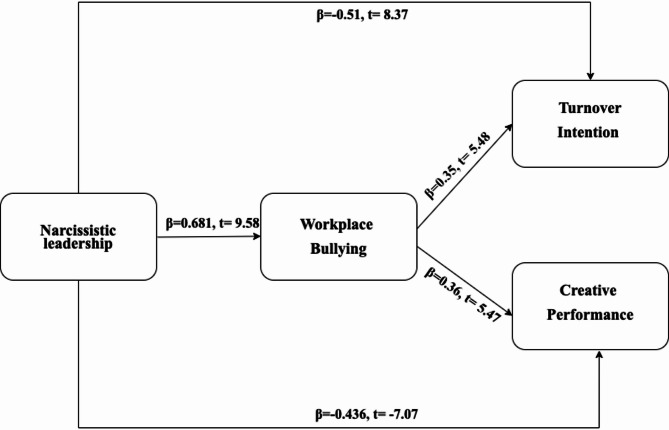
- Narcissistic leadership positively predicted workplace bullying (β = 0.681, t = 9.58, p < .001), positively predicted turnover intention (β = 0.51, t = 8.37, p < .001), and negatively predicted creative performance (β = −0.436, t = −7.07, p < .001).
- Workplace bullying positively predicted turnover intention (β = 0.35, t = 5.48, p < .001) and negatively affected creative performance (Table 4: β = −0.36, t = −5.47, p < .001; earlier text reports β = −0.22, t = −2.39).
- Mediation tests indicated narcissistic leadership affected turnover intention through workplace bullying (Sobel z = 3.29) and creative performance through workplace bullying (Sobel z = −4.73).
- Correlations showed narcissistic leadership was related to bullying (r = 0.572), turnover intention (r = 0.277), and creative performance (r = −0.400); bullying was related to turnover intention (r = 0.289) and creative performance (r = −0.417), all p < .01, one-tailed.
Methods
- Quantitative questionnaire survey of nurses in private hospitals in Sulaimania city, Kurdistan Region of Iraq. Of 14 private hospitals contacted, 9 consented; 435 nurses were invited and 374 questionnaires were returned, a 79.7% response rate. Random sampling was used; questionnaires were translated from English to Kurdish via back-translation and pretested with five nurses.
- Measures: narcissistic leadership (6 items, Hochwarter & Thompson), workplace bullying (9 items, Einarsen et al.), turnover intention (3 items, Singh et al.), and creative performance (6 items adapted from Wang & Netemeyer, manager-rated), using five-point Likert-type scales.
- Analysis: SPSS 22 for descriptives and correlations; AMOS 22 two-step CFA/SEM with maximum likelihood; bias-corrected bootstrapping with 5,000 samples and 95% CI. Partially mediated model fit: χ² = 493.51, df = 185, χ²/df = 2.66; CFI = 0.94; PNFI = 0.76; RMSEA = 0.077; SRMR = 0.065; fully mediated model fit worse (Δχ² = 40.56, Δdf = 2, p < .01).
Limitations
- Stated: self-report bias and social desirability may affect responses, especially about bullying and turnover; generalizability is limited because the sample comes from private hospitals in one region/sector (Kurdistan), not public or rural settings; and the cross-sectional design limits causal inference.
- Stated: voluntary participation may introduce selection bias, and the sample is limited to a single urban center.
- Evident: the paper reports inconsistent coefficients for workplace bullying → creative performance (β = −0.22, t = −2.39 in text vs β = −0.36, t = −5.47 in Table 4), and creative performance was manager-rated while other key variables were nurse self-reports.
Model-written summary. Check it against the paper before relying on it.
Integrity signals
Registry
Cites
Statistics
Figures
Verification
Claims the paper makes
8 Valid · 1 Not valid · 23 Not checked · 25 Own results and interpretations
The cited sources support only part of this claim — read each source’s verdict below.
In the paper
“individuals who recognize pronounced indicators of narcissistic leadership in the workplace engage in workplace bullying; bullying is intrinsic to narcissistic behavior Glad [13]”
§ Narcissistic leadership, workplace bullying, turnover intention, and creative performance: a study of nurses > Introduction
What the sources say
- Partly supportedcites [13] Glad B. Why tyrants go too far: malignant narcissism and absolute power. Polit Psychol. 2002;23(1):1–37. sourceExperimental — accuracy not yet measured
The “Borderline Personality and Malignant Narcissism” section (page unavailable) describes aggression and sadism in malignant narcissists, which partly supports a link between that subtype and harmful behavior toward others. It does not address workplace bullying or say that people who recognize signs of narcissistic leadership engage in it. The section also distinguishes malignant narcissism from more benign forms, so it does not support calling bullying intrinsic to narcissistic behavior generally. (LLM, conf=0.84)
plainstates a cause- Asserted: passes — The authors put it forward as true.
- Checkable: passes — It can be checked against evidence.
- Load-bearing: passes — The paper’s conclusions depend on it.
- Based: passes — The paper gives a reason why it holds.
- Partly supported
The cited sources support only part of this claim — read each source’s verdict below.
In the paper
“Resources (JD-R) model, individuals exposed to high job stress—such as toxic leadership or excessive workload—experience emotional and physical resource depletion, increasing strain and workplace bullying [48].”
§ Narcissistic leadership, workplace bullying, turnover intention, and creative performance: a study of nurses > Hypotheses, and research model > H3: Workplace bullying (a) is positively related to turnover intention (b) and negatively related to creative performance
What the sources say
- Partly supportedcites [48] Karatepe OM, Okumus F, Saydam MB. Outcomes of job insecurity among hotel employees during COVID-19. Int Hosp Rev. 2022; (ahead-of-print). 10.1108/IHR-09-2021-0064 sourceExperimental — accuracy not yet measured
The ‘Job tension as a mediator between job insecurity and proclivity to display nonattendance intentions’ section says high job demands, including work overload, deplete emotional and physical resources and heighten strain. The paper discusses job insecurity and nonattendance intentions as outcomes, but does not identify toxic leadership as a stressor or say resource depletion increases workplace bullying; bullying appears only in a reference title. Page numbers are unavailable in our copy. (LLM, conf=0.88)
plainstates a cause- Asserted: passes — The authors put it forward as true.
- Checkable: passes — It can be checked against evidence.
- Load-bearing: passes — The paper’s conclusions depend on it.
- Based: passes — The paper gives a reason why it holds.
- Partly supported
The sources with a verdict support this claim; the rest weren’t checked yet, have no full text we could read, or their verdicts aren’t rated yet.
In the paper
“Narcissistic leadership seems to more effectively elucidate numerous adverse outcomes (e.g., work deviance; diminished job embeddedness; reduced job engagement; lack of innovative behavior) [8–10].”
§ Narcissistic leadership, workplace bullying, turnover intention, and creative performance: a study of nurses > Introduction
What the sources say
- Could not verifycites [8] Alhasnawi HH, Abbas AA. Narcissistic leadership and workplace deviance: a moderated mediation model of organizational aggression and workplace hostility. Organizacija. 2021;54(4):334–49. 10.2478/orga-2021-0019. sourceExperimental — accuracy not yet measured
The Results of the final structural model section (page unavailable) examines factors affecting acceptance of microchip implants, not narcissistic leadership or employee outcomes. Searches for narcissistic leadership, work deviance, job embeddedness, job engagement, and innovative behavior found no passage addressing the claim. (LLM, conf=0.76)
- Not checked — no full text of the sourcecites [9] Norouzinik Y, Rahimnia F, Maharati Y, Eslami G. Narcissistic leadership and employees’ innovative behaviour: mediating roles of job embeddedness and job engagement. Innov. 2022;24(3):355–80. 10.1080/14479338.2021.1917000. source
- Supportedcites [10] Wang H, Jiao R, Li F. Research on the effect of narcissistic leadership on employee job embeddedness. Front Psychol. 2022;13:927529. 10.3389/fpsyg.2022.927529. 35874331 PMC9301298 source
This paper supports the job-embeddedness example in the sentence’s grouped citation. Its Theoretical Background and Hypotheses section predicts that narcissistic leadership reduces employees’ job embeddedness, and its Discussion reports that the study found narcissistic leaders did not promote embeddedness among new-generation employees. The other examples are not specifically assigned to this source. (LLM, conf=0.91)
hedgedstates an association- Asserted: passes — The authors put it forward as true.
- Checkable: passes — It can be checked against evidence.
- Load-bearing: unclear — It is unclear whether the paper’s conclusions depend on it.
- Based: passes — The paper gives a reason why it holds.
- Could not verify
The cited sources that could be checked couldn’t confirm or dispute this claim.
In the paper
“A minimum of 113 participants was suggested for structural equation modeling with four latent variables (narcissistic leadership, workplace bullying, creative performance, and turnover intention), an expected effect size of 0.5, and a desired statistical power level of 0.8. A total of twenty-four variables have been recorded. Accordingly, the present study’s sample size was considered adequate [60”
§ Narcissistic leadership, workplace bullying, turnover intention, and creative performance: a study of nurses > Methodology > Data analysis
What the sources say
- Could not verifycites [60] Soper T. Knowledge into learning: comparing lecture, e-learning and self-study take-home packet instructional methodologies with nurses. Nurs Open. 2017;4(2):76–83. 10.1002/nop2.73. 28286663 PMC5340166 sourceExperimental — accuracy not yet measured
The Methods > Data source passage reports a minimum of 44 participants for this paper’s study of nurses, which enrolled 87. Methods > Data analysis describes ANOVA, not structural equation modeling. Searches for the four latent variables and the 113-participant threshold found no passage addressing the claimed SEM sample-size recommendation; the different threshold for a different study does not contradict it. (LLM, conf=0.76)
plain- Asserted: passes — The authors put it forward as true.
- Checkable: passes — It can be checked against evidence.
- Load-bearing: passes — The paper’s conclusions depend on it.
- Based: passes — The paper gives a reason why it holds.
- Could not verify
A result the paper reports from its own data — it cites no other source for it, so there is none to check. The quote shows it is in the paper.
In the paper
“The findings from structural equation modeling indicate that workplace bullying acts as a key mechanism linking narcissistic leadership to nurses’ turnover intention and reduced creative performance.”
§ Narcissistic leadership, workplace bullying, turnover intention, and creative performance: a study of nurses > Abstract > Findings
hedgedstates a cause- Asserted: passes — The authors put it forward as true.
- Checkable: passes — It can be checked against evidence.
- Load-bearing: passes — The paper’s conclusions depend on it.
- Based: passes — The paper gives a reason why it holds.
23 more claims
Create a free account to see all 57 claims and to verify the 5 references still open.
- It may state two separate claims as one. 19
- Probably not a substantial claim. 15
- The quote only partly states this claim. 1
Self-check
Percentages, sums and reported differences re-computed from the paper’s own numbers.
Each contradiction between two passages listed here was confirmed by an independent check.
Rated major: it would touch a result — a value a result rests on, reported and recomputed p-values on opposite sides of the significance level, two passages that conflict with no sign which is right, or a cited work retracted before this paper was published.
In the paper
§ Narcissistic leadership, workplace bullying, turnover intention, and creative performance: a study of nurses > Methodology > Findings
“a negative impact on creative performance (β = -0.22, t = -2.39)”
§ Narcissistic leadership, workplace bullying, turnover intention, and creative performance: a study of nurses > Methodology > Findings
“| Workplace Bullying → Creative Performance | –0.36 | –5.47 | [–0.48, − 0.24] | p < .001 |”
Rated minor: it would not touch a result — a value no result rests on, a p-value that stays on the same side of the significance level, or a conflict that is clerical, resolved elsewhere in the paper, or outside its own findings.
In the paper
“Four hundred thirty-five nurses from nine private hospitals in Sulaimania, Kurdistan region, Iraq, were invited to participate in the study. Three hundred seventy-four questionnaires were submitted. As a result, questionnaires were collected, resulting in a response rate of 79.7%.”
§ Narcissistic leadership, workplace bullying, turnover intention, and creative performance: a study of nurses > Methodology > Sample and procedure
Reported 79.7 · recomputed 85.977011
Rated minor: it would not touch a result — a value no result rests on, a p-value that stays on the same side of the significance level, or a conflict that is clerical, resolved elsewhere in the paper, or outside its own findings.
In the paper
§ Narcissistic leadership, workplace bullying, turnover intention, and creative performance: a study of nurses > Methodology > Findings
“for creative performance it was 0.66”
§ Narcissistic leadership, workplace bullying, turnover intention, and creative performance: a study of nurses > Methodology > Findings
“Creative performance (AVE = 0.78, CR = 0.5, α = 0.88)”
Rated minor: it would not touch a result — a value no result rests on, a p-value that stays on the same side of the significance level, or a conflict that is clerical, resolved elsewhere in the paper, or outside its own findings.
In the paper
§ Narcissistic leadership, workplace bullying, turnover intention, and creative performance: a study of nurses > Methodology > Findings
“for turnover intention it was 0.78”
§ Narcissistic leadership, workplace bullying, turnover intention, and creative performance: a study of nurses > Methodology > Findings
“Turnover intention (AVE 0.66=, CR = 0.50,α = 0.78)”
Citations
Cites
Evaluating structural equation models with unobservable variables and measurement error
Fornell, C., & Larcker, D. F. (1981) · Journal of Marketing Research · doi:10.1177/002224378101800104 · Cited by 109,190 · cited 3×
“The method proposed by Fornell and Larcker [59] was used to assess discriminant validity.”
InfluentialStructural equation modeling in practice: A review and recommended two-step approach
Anderson, J. C., & Gerbing, D. W. (1988) · Psychological Bulletin · doi:10.1037/0033-2909.103.3.411 · Cited by 41,941 · cited 1×
“According to Anderson and Gerbing [57] AMOS is a two-step process that our study used to test the measurement and structural models.”
On the Evaluation of Structural Equation Models
Bagozzi, R. P., & Yi, Y. (1988) · Journal of the Academy of Marketing Science · doi:10.1007/bf02723327 · Cited by 26,163
Conservation of resources: A new attempt at conceptualizing stress
Hobfoll, S. E. (1989) · American Psychologist · doi:10.1037/0003-066x.44.3.513 · Cited by 18,187 · cited 1×
“This theory defines resources as “objects, personal characteristics, conditions, or energies valued by the individual or that facilitate the acquisition of these objects, personal characteristics, conditions, or energies” [33].”
Hobfoll, S. E. (2001) · Applied Psychology · doi:10.1111/1464-0597.00062 · Cited by 7,139 · cited 2×
“According to the Conservation of Resources (COR) theory, individuals who experience resource depletion may adopt self-defense strategies to preserve their remaining resources [35].”
Hobfoll, S. E., Halbesleben, J., Neveu, J.-P., & Westman, M. (2018) · Annual Review of Organizational Psychology and Organizational Behavior · doi:10.1146/annurev-orgpsych-032117-104640 · Cited by 5,781 · cited 1×
“Along the same lines, COR theory asserts that less experienced nurses with fewer resources will be less able to obtain additional resources [38].”
A meta-analytic examination of the correlates of the three dimensions of job burnout
Lee, R. T., & Ashforth, B. E. (1996) · Journal of Applied Psychology · doi:10.1037/0021-9010.81.2.123 · Cited by 3,262
Einarsen, S., Hoel, H., & Notelaers, G. (2009) · Work & Stress · doi:10.1080/02678370902815673 · Cited by 1,598 · cited 2×
“…that narcissistic leadership correlates with higher staff burnout and turnover, while research in the UK has highlighted its negative effect on team collaboration and creativity— indicating that the detrimental impact of narcissistic leadership transcends regional and economic boundaries [51].”
Bullying at work: Epidemiological findings in public and private organizations
Einarsen, S., & Skogstad, A. (1996) · European Journal of Work and Organizational Psychology · doi:10.1080/13594329608414854 · Cited by 999 · cited 2×
“To establish the previously mentioned relationships, our research employs both the Conservation of Resources (COR) and Job Demands-Resources (JDR) frameworks [14].”
Singh, J., Verbeke, W., & Rhoads, G. K. (1996) · Journal of Marketing · doi:10.1177/002224299606000305 · Cited by 502
Salesperson creative performance: conceptualization, measurement, and nomological validity
Wang, G., & Netemeyer, R. G. (2004) · Journal of Business Research · doi:10.1016/s0148-2963(02)00483-6 · Cited by 331 · cited 1×
“Six items were altered from Wang and Netemeyer [55] to assess creative performance (the manager questionnaire).”
Khan, H., Rehmat, M., Butt, T. H., Farooqi, S., & Asim, J. (2020) · Future Business Journal · doi:10.1186/s43093-020-00043-8 · Cited by 310
Alessandri, G., Consiglio, C., Luthans, F., & Borgogni, L. (2018) · Career Development International · doi:10.1108/cdi-11-2016-0210 · Cited by 269 · cited 1×
“For example, Research by Alessandri et al. [26] stated that psychological capital affected work engagement and job performance.”
Why Tyrants Go Too Far: Malignant Narcissism and Absolute Power
Glad, B. (2002) · Political Psychology · doi:10.1111/0162-895x.00268 · Cited by 223 · cited 1×
“…12]. individuals who recognize pronounced indicators of narcissistic leadership in the workplace engage in work-place bullying; bullying is intrinsic to narcissistic behavior Glad [13] and is defined as “harassing, offending, socially excluding someone, or negatively affecting someone’s work” [14].”
Karatepe, O. M., Rezapouraghdam, H., & Hassannia, R. (2020) · International Journal of Hospitality Management · doi:10.1016/j.ijhm.2020.102472 · Cited by 218 · cited 1×
“However, the presence of negative leadership or the prevalence of stressors in the workplace can lead to resource exhaustion and adverse outcomes [34].”
Hayat, A., & Afshari, L. (2020) · Personnel Review · doi:10.1108/pr-06-2020-0407 · Cited by 163
Islam, M. S., & Amin, M. (2021) · European journal of training and development · doi:10.1108/ejtd-12-2020-0177 · Cited by 147 · cited 1×
“Nonetheless, are unique among organizational resources since they are neither owned nor controlled by the organization in its entirety [4].”
Servant leadership, organisational trust, and bank employee outcomes
Karatepe, O. M., Ozturk, A., & Kim, T. T. (2019) · The Service Industries Journal · doi:10.1080/02642069.2018.1464559 · Cited by 137 · cited 1×
“The study by Karatepe et al. [28] established that servant leadership and organizational trust forecasted employees’ intentions to be absent, their creative performance, and their service recovery performance.”
Olsen, E., Bjaalid, G., & Mikkelsen, A. (2017) · Journal of Advanced Nursing · doi:10.1111/jan.13337 · Cited by 128 · cited 3×
“According to recent research, it is essential to determine the underlying mechanism that links narcissistic leadership to the attitudes and behaviors of nurses based on strong theoretical foundations (for example, [49]).”
InfluentialImpact of ethical leadership on job satisfaction: the mediating effect of work–family conflict
Freire, C., & Bettencourt, C. (2020) · Leadership & Organization Development Journal · doi:10.1108/lodj-07-2019-0338 · Cited by 120
Ampofo, E. T., & Karatepe, O. M. (2022) · International Journal of Contemporary Hospitality Management · doi:10.1108/ijchm-07-2021-0858 · Cited by 119
Aboramadan, M., Turkmenoglu, M. A., Dahleez, K. A., & Cicek, B. (2021) · International Journal of Contemporary Hospitality Management · doi:10.1108/ijchm-04-2020-0348 · Cited by 118 · cited 7×
“Third, the majority of empirical studies in the existing literature have predominantly concentrated on investigating narcissistic leadership in developed nations [7].”
InfluentialKim, T. (., Karatepe, O. M., Lee, G., Lee, S., Hur, K., & Xijing, C. (2017) · International Journal of Contemporary Hospitality Management · doi:10.1108/ijchm-04-2016-0224 · Cited by 102 · cited 1×
“More-over, such individuals not only undermine the morale of their colleagues but also obstruct the efficacy and efficiency of the service delivery process, including creative performance [22].”
Hochwarter, W. A., & Thompson, K. W. (2012) · Human Relations · doi:10.1177/0018726711430003 · Cited by 98 · cited 1×
“Narcissistic leadership was assessed utilizing a six-item scale created by Hochwarter and Thompson [50].”
Anasori, E., De Vita, G., & Gürkan Küçükergin, K. (2023) · The Service Industries Journal · doi:10.1080/02642069.2022.2147514 · Cited by 77 · cited 2×
“The Anasori et al. [45] study reported a significant positive correlation between workplace bullying and employee creativity.”
Training and development: Challenges of strategy and managing performance in Jordanian banking
Rowland, C. A., Hall, R. D., & Altarawneh, I. (2017) · EuroMed Journal of Business · doi:10.1108/emjb-01-2016-0001 · Cited by 72
Yao, Z., Zhang, X., Liu, Z., Zhang, L., & Luo, J. (2019) · Chinese Management Studies · doi:10.1108/cms-11-2018-0747 · Cited by 68
The relationships of meaningful work and narcissistic leadership with nurses’ job satisfaction
Ghislieri, C., Cortese, C. G., Molino, M., & Gatti, P. (2019) · Journal of Nursing Management · doi:10.1111/jonm.12859 · Cited by 59 · cited 2×
“Ghislieri et al. [25] examine the inadequate empirical research regarding the mediating variables that affect the relationship between narcissistic leadership and workplace outcomes.”
Gruda, D., McCleskey, J. A., Karanatsiou, D., & Vakali, A. I. (2020) · Personality and Individual Differences · doi:10.1016/j.paid.2020.110317 · Cited by 57 · cited 1×
“According to Rossenthal and Pittinsky [6] “principally motivated by the leader’s own ego-maniacal needs and beliefs, superseding the needs and interests of the constituents and institutions they lead” describes narcissistic leadership, an undesirable style of leadership.”
Wu, H., & Liu, Y. (2022) · BMC Family Practice · doi:10.1186/s12875-022-01753-4 · Cited by 57 · cited 1×
“Nurses in the healthcare industry are a vital asset, constituting the service capacity of health organizations and playing a critical role in enabling these institutions to operate efficiently [1] demonstrating innovative ideas and appropriate performance when needed.”
Badar, K., Aboramadan, M., & Plimmer, G. (2023) · International Journal of Conflict Management · doi:10.1108/ijcma-12-2022-0210 · Cited by 52 · cited 2×
“Previous works disclosed that narsisitic leaders positively effected turnover intention [39–41], negatively impacted performance [2, 42, 43].”
Norouzinik, Y., Rahimnia, F., Maharati, Y., & Eslami, G. (2022) · Innovation · doi:10.1080/14479338.2021.1897467 · Cited by 48 · cited 2×
“Norouzinik [9] emphasizes the necessity for a deeper comprehension of the mediating mechanism that connects narcissistic leadership to adverse outcomes.”
Clercq, D. D., Fatima, T., & Jahanzeb, S. (2021) · Personnel Review · doi:10.1108/pr-05-2020-0326 · Cited by 46
Erkutlu, H. V., & Chafra, J. (2017) · EuroMed Journal of Business · doi:10.1108/emjb-04-2016-0012 · Cited by 44 · cited 1×
“…literature on narcissistic leadership, we identified a paucity of studies clarifying the consequences of such leadership, exemplified by the research conducted by Erkutlu and Chafra [23] which investigated the correlation between narcissistic leaders and followers’ embeddedness in Turkish hotels.”
Holm, K., Jönsson, S., & Muhonen, T. (2023) · International Journal of Nursing Studies · doi:10.1016/j.ijnurstu.2022.104429 · Cited by 42 · cited 3×
“According to Anasori et al. and Holm et al. [17] bullying in the workplace is a factor that contributes to nurses turnover.”
Islam, M. S., Amin, M., Feranita, F., & Karatepe, O. M. (2023) · International Journal of Bank Marketing · doi:10.1108/ijbm-04-2022-0157 · Cited by 40 · cited 1×
“Investment in human resources and the implementation of various strategies to eradicate negative leadership do not guarantee the retention of proficient personnel [5].”
Coetzee, M., & Oosthuizen, R. M. (2017) · Journal of Psychology in Africa · doi:10.1080/14330237.2017.1321826 · Cited by 37
Impact of narcissistic leadership on employee work outcomes in banking sector of Pakistan
Asrar‐ul‐Haq, M., & Anjum, T. (2020) · Future Business Journal · doi:10.1186/s43093-020-00040-x · Cited by 35
Mendiratta, A., & Srivastava, S. (2023) · International Journal of Emerging Markets · doi:10.1108/ijoem-03-2021-0417 · Cited by 34
Xiao, X., Liu, F., Zhou, F., & Chen, S. (2018) · Social Behavior and Personality: an international journal · doi:10.2224/sbp.7034 · Cited by 30 · cited 1×
“According to Xiao et al. [61] the majority of the studies that have been conducted on narcissistic leadership have focused on organizational identification.”
Durrah, O., & Kahwaji, A. T. (2022) · Employee Responsibilities and Rights Journal · doi:10.1007/s10672-022-09414-5 · Cited by 30
Muala, I. A., Al-Ghalabi, R. R., Alsheikh, G. A. A., Hamdan, K. B., & Alnawafleh, E. A. T. (2022) · International Journal of Professional Business Review · doi:10.26668/businessreview/2022.v7i3.0526 · Cited by 28 · cited 1×
“Workplace bullying produces adverse effects, including increased individual turnover intention, diminished job satisfaction, reduced work engagement, and decreased job performance [15–18].”
Factors Influencing Post-traumatic Stress in Korean Forensic Science Investigators
Yoo, Y.-S., Cho, O.-H., Cha, K.-S., & Boo, Y.-J. (2013) · Asian Nursing Research · doi:10.1016/j.anr.2013.07.002 · Cited by 27
Zhou, L., Li, J., Liu, Y., Tian, F., Zhang, X., & Qin, W. (2019) · Leadership & Organization Development Journal · doi:10.1108/lodj-03-2019-0099 · Cited by 27
Outcomes of job insecurity among hotel employees during COVID-19
Karatepe, O. M., Okumus, F., & Saydam, M. B. (2024) · International Hospitality Review · doi:10.1108/ihr-11-2021-0070 · Cited by 25 · cited 3×
“…component of this model, it can be posited that narcissistic leadership, identified as a job stressor, contributes to the depletion of nurses’ energy and emotional and physical resources, consequently escalating the occurrence of workplace bullying as a manifestation of work-related strain [48].”
InfluentialResearch on the Effect of Narcissistic Leadership on Employee Job Embeddedness
Wang, H., Jiao, R., & Li, F. (2022) · Frontiers in Psychology · doi:10.3389/fpsyg.2022.927529 · Cited by 20 · cited 1×
“Narcissistic leadership seems to more effectively elucidate numerous adverse outcomes (e.g., work deviance; diminished job embeddedness; reduced job engagement; lack of innovative behavior) [8–10].”
Jang, S. J., & Lee, H. (2022) · Journal of Nursing Management · doi:10.1111/jonm.13706 · Cited by 18
Cho, S., & Jang, S. J. (2022) · Nursing & Health Sciences · doi:10.1111/nhs.12968 · Cited by 18
Liu, X., Zheng, X., Zhang, Y., Liao, H., Harms, P. D., Qin, X., & Yu, Y. (2025) · Human Relations · doi:10.1177/00187267241251983 · Cited by 18 · cited 1×
“Previous works disclosed that narsisitic leaders positively effected turnover intention [39–41], negatively impacted performance [2, 42, 43].”
Soper, T. (2017) · Nursing Open · doi:10.1002/nop2.73 · Cited by 17 · cited 2×
“This study extends the COR model by demonstrating how narcissistic leadership acts as a resource-draining factor that not only depletes nurses’ emotional and psychological resources but also triggers defensive responses such as turnover intention and reduced creative performance [60].”
Impact of workplace bullying and resilience on new nurses' turnover intention in tertiary hospitals
Baek, G., & Lee, E. (2022) · Nursing and Health Sciences · doi:10.1111/nhs.12981 · Cited by 17 · cited 2×
“Baek and Lee [46] found a positive correlation between workplace bullying and turnover intention among nurses in Korea in their study.”
Hasnawi, H. H. A., & Abbas, A. A. (2021) · Organizacija · doi:10.2478/orga-2021-0023 · Cited by 17
Ta'an, W. F., Al‐Hammouri, M. M., & Rababah, J. A. (2022) · Journal of Nursing Management · doi:10.1111/jonm.13698 · Cited by 16
Are we Ready to Use Microchip Implants? An International Cross-sectional Study
Žnidaršič, A., Baggia, A., Pavlíček, A., Fischer, J., Rostański, M., & Werber, B. (2021) · Organizacija · doi:10.2478/orga-2021-0019 · Cited by 14
Structural Equation Modeling on Life-world Integration in People with Severe Burns
Lee, G. S., & Yom, Y.-H. (2013) · Asian Nursing Research · doi:10.1016/j.anr.2013.06.003 · Cited by 13 · cited 1×
“According to Lee and Yom [62] these results did not show any signs of non-normality.”
Testing The Validity of the Feldstein-Horioka Puzzle For Croatia
Jošić, H., & Jošić, M. (2012) · Economic Research-Ekonomska Istraživanja · doi:10.1080/1331677x.2012.11517524 · Cited by 8
Park, E., You, C. H., Joung, H., & Kwon, Y. D. (2024) · Human Resources for Health · doi:10.1186/s12960-024-00926-9 · Cited by 8
Grandiose narcissism and performance in organizations: mediating role of subjective wellbeing
Sakkar Sudha, K., & Shahnawaz, M. G. (2020) · Leadership, Education, Personality: An Interdisciplinary Journal · doi:10.1365/s42681-020-00015-0 · Cited by 7 · cited 1×
“…leadership, as a detrimental leadership style, manifests in diverse environments including hospitality, banking, and the public sector [7, 11, 12]. individuals who recognize pronounced indicators of narcissistic leadership in the workplace engage in work-place bullying; bullying is intrinsic…”
İçsel pazarlamanın yaratıcı çalışan performansı üzerindeki etkisinde narsist liderliğin rolü
KAYNAK, İ., AKILLIBAŞ, E., & ÇİÇEK, B. (2022) · Business & Management Studies: An International Journal · doi:10.15295/bmij.v10i2.2014 · Cited by 4
Declining Employee Engagement & Employee Performance: The Noxious Effects of Workplace Bullying
Malik, M. S., & Sattar, S. (2020) · Journal of Business and Social Review in Emerging Economies · doi:10.26710/jbsee.v6i1.1035 · Cited by 2
Research works printed but not linked: 7
- Keyes-Pretlow C. The correlation between workplace bullying, leader narcissistic tendencies, and the organizational culture within the financial sector [dissertation]. Grand Canyon University. 2021.
- Khan HSUD, Cristofaro M, Chughtai MS, Baiocco S. Understanding the psychology of workplace bullies: the impact of dark tetrad and how to mitigate it. Manag Res Rev. 2023;46(12):1748–68. 10.1108/MRR-04-2022-0256. · doi:10.1108/mrr-04-2022-0256
- Saeed M. Mediation effect of psychological contract between personality dimensions and turnover intention. J Econ Finance Adm Sci. 2020;25(50):205–20. 10.1108/JEFAS-07-2019-0113. · doi:10.1108/jefas-07-2019-0113
- Muzee H. Strategic leadership and employee engagement, evidences from an African industrial setting. Open Access Libr J. 2016;3(08):1. 10.4236/oalib.1102892. · doi:10.4236/oalib.1102892
- Jaffar ZA, Mahdi MS, Hadi HMAA. Bullying at the workplace as a mediating variable between narcissistic leadership and organizational cynicism: an exploratory study in a selected sample in Kufa cement factory. J Posit Sch Psychol. 2022;6(8):5398–412.
- Louis L. Leader’s perception of organizational narcissism density (OND), turnover intentions (TI), and the mediating role of organizational commitment (OC) [dissertation]. Alliant International University. 2015.
- Disque N. Influence of perceived supervisor support and narcissistic leadership on employee turnover intention [dissertation]. Walden University. 2020.
Cited by
Džambić, A., Hadžiahmetović, N., Sateeshchandra, N. G., Chelabi, K., & Fountis, A. (2025) · Administrative Sciences · doi:10.3390/admsci15080309 · Cited by 17
“As noted by Faeq (2025), while transformational leadership enhances creativity, this creativity may not always lead to stronger organizational commitment, particularly in industries where creative talent is highly mobile and sought after externally.”
Li, X., & Hahn, J. (2026) · Frontiers in Psychology · doi:10.3389/fpsyg.2026.1782797 · Cited by 3
“Although recent research has begun to acknowledge the dual nature of narcissistic leadership (Eden et al., 2000; Faeq, 2025), its effects on employees’ psychological resources and innovation-related behaviors remain insufficiently understood.”
Factors Affecting Workplace Bullying Among Nurses: A Secondary Analysis According to Career Stage
Jang, S. J., & Lee, H. (2025) · Clinical Nursing Research · doi:10.1177/10547738251401704 · Cited by 2
“In healthcare settings, narcissistic leadership was also linked to increased bullying, turnover intention, and reduced performance (Faeq, 2025); managerial narcissism further influenced counterproductive behaviors through vengeful responses by subordinate nurses (Atalla et al., 2025).”
Abousoliman, A. D., Zoromba, M. A., & El‐Gazar, H. E. (2026) · International Journal of Africa Nursing Sciences · doi:10.1016/j.ijans.2026.101077 · Cited by 2
Faeq, D. K. (2025) · Research Square · doi:10.21203/rs.3.rs-7519724/v1
Self-citation
Metadata
- Authors
- Faeq, D. K.
- Affiliations
- Koya University (IQ)
- Corresponding author
- Faeq, Dalia Khalid
- ORCID
- Faeq, Dalia Khalid
- Venue
- BMC Nursing
- Published
- 2025-07-10
- Volume
- 24
- Issue
- 1
- Pages
- 898-898
- ISSN
- 1472-6955 (ISSN-L)
- PMC
- PMC12243138
- OpenAlex
- W4412174984
- Cited by
- 6
- References
- 39
- Citations by year
- 2026: 3 · 2025: 3
- FWCI
- 10.38
- Type
- journal article
- Language
- en
- Open access
- gold
- doi.org
- Licence
- cc-by
- creativecommons.org/licenses/by/4.0 (tdm)
- creativecommons.org/licenses/by/4.0 (vor)
- Locations
- BMC Nursing (publishedVersion, cc-by)
- PubMed Central (publishedVersion, cc-by)
- PubMed (publishedVersion)
- DOAJ (DOAJ: Directory of Open Access Journals) (submittedVersion, cc-by-sa)
- Topics
- Social Sciences › Business, Management and Accounting › Organizational Behavior and Human Resource Management › Workplace Violence and Bullying
- Health Sciences › Nursing › Research and Theory › Nursing education and management
- Social Sciences › Business, Management and Accounting › Organizational Behavior and Human Resource Management › Job Satisfaction and Organizational Behavior
- Keywords
- narcissistic leadership, workplace harassment, turnover intention, creative performance, nurses, mediation, private hospitals, nursing leadership
About these checks
Registry, retraction, Cites and statistics results are computed, not judged, with one exception: a printed reference that no index lists is read once by a model before it counts as a citation error. Claims are extracted by a model and kept only when their quote appears verbatim in the text; each cited source is then checked, with a model’s help, for whether it says what the claim relies on. Those verdicts can be wrong — read the claim’s quote and the cited source before relying on one.
The claim verdicts this report counts are experimental: their accuracy is not yet measured.
A language model drew the claims from the paper on 2026-10-10, under version 3 of the claim definition (model deepseek-v4.1-flash, prompt extract-v3).
A second model labelled each claim on 2026-10-10 (model jev-1.13-20260917, definition revision gold-guideline-v0.2).
Cited sources are checked with a language model’s help (gpt-6-sol).
Statistics and arithmetic are recomputed, not judged.
Confidence bands are shown only for fields calibrated on our annotated test set. None is calibrated yet, so no band is shown.
What counts as a claim ›How we measure confidence ›How we check this ›
Are you an author, or do you see a problem with this page? Request a review
Data sources
Bibliographic data: Semantic Scholar, OpenAlex, Crossref.
Contains information from the Semantic Scholar Academic Graph Datasets, made available under the ODC Attribution License (ODC-BY 1.0).
Semantic Scholar’s data is described in: Kinney, R., et al. (2023). The Semantic Scholar Open Data Platform. arXiv:2301.10140.
