

Optimizing parenting and child outcomes following parent–child interaction therapy – toddler: a randomized controlled trial
Open accessThe DOI matches its Crossref record; 83 of the 89 references it cites were found in a registry or an index; 22 of the 72 sources its claims cite were checked for support.
Abstract
BACKGROUND: Parent-Child Interaction Therapy-Toddler (PCIT-T) is an attachment-informed intervention model designed to meet the specific developmental needs of toddlers aged 12-24 months presenting with challenging behaviors. METHODS: This study used a randomized controlled design to evaluate outcomes of PCIT-T for children aged 14-24 months with disruptive behaviors. Ninety toddlers with parent-reported disruptive behavior were randomly allocated to PCIT-T (intervention), an active control condition (Circle of Security- Parenting™; COS-P), or a non-treatment control condition (wait-list; WL). Outcomes were assessed at baseline (Time 1), post treatment/post waitlist (Time 2) and 4-month follow-up (Time 3). RESULTS: At follow-up, the PCIT-T group displayed the highest levels of parenting sensitivity and positive parental verbalizations, and the lowest levels of negative child-directed verbalizations and non-attuned mind-minded statements. Of the three groups, the PCIT-T group showed the greatest degree of change on these variables, followed by the COS-P group and then the non-treated controls. The PCIT-T group were also the only group to show significant within-group improvements in sensitivity, self-reported parental reflectiveness, empathy and emotional understanding, parent-reported child social competence, child internalizing problems, and general behavior issues. Significant reductions in parental stress, child externalizing behaviors and parenting behaviors were seen for both the PCIT-T and COS-P groups. CONCLUSIONS: Delivered in the early intervention period of toddlerhood, Parent-Child Interaction Therapy-Toddler has the potential to bring about significant changes for children presenting with early onset behavioral issues. TRIAL REGISTRATION: Australian New Zealand Clinical Trials Registry (ANZCTR), 12,618,001,554,257. Registered 24 September 2018 - retrospectively registered, https://anzctr.org.au/Trial/Registration/TrialReview.aspx?ACTRN=12618001554257 .
Overview
CoChat Summary
TL;DR
This randomized controlled trial found that PCIT-T produced stronger improvements than COS-P or waitlist on several observed parenting behaviors, especially parenting sensitivity and positive/negative verbalizations, in toddlers aged 14–24 months with disruptive behaviors. Child behavior and some parent-report outcomes also improved, but attachment outcomes and several reflective-functioning measures did not show clear between-group advantages and some findings were weakened by attrition.
Key findings
- Ninety toddlers aged 14–24 months were randomized to PCIT-T, COS-P, or waitlist; at 4-month follow-up, the PCIT-T group showed the highest parenting sensitivity and positive parental verbalizations, and the lowest negative child-directed verbalizations and non-attuned mind-minded statements.
- PCIT-T was the only group with significant within-group improvements in sensitivity (d = 1.03 at T2; d = 0.66 at T3), self-reported parental reflectiveness, empathy/emotional understanding, child social competence, child internalizing problems, and general behavior issues.
- Both PCIT-T and COS-P reduced parental stress and child externalizing behavior; for example, parenting stress decreased within-group for PCIT-T (d = 0.47 at T2; d = 0.43 at T3) and COS-P (d = 0.55 at T2; d = 0.79 at T3).
- Child outcomes showed some improvement in PCIT-T, including reductions in externalizing behavior (d = −0.61 at T2; d = −0.51 at T3), internalizing symptoms (d = −0.48 at T2), and general problem behaviors (d = −0.64 at T2; d = −0.78 at T3), but attachment security/disorganization changes were not statistically significant.
Methods
- Randomized controlled trial with three arms: PCIT-T intervention, active control COS-P, and waitlist control.
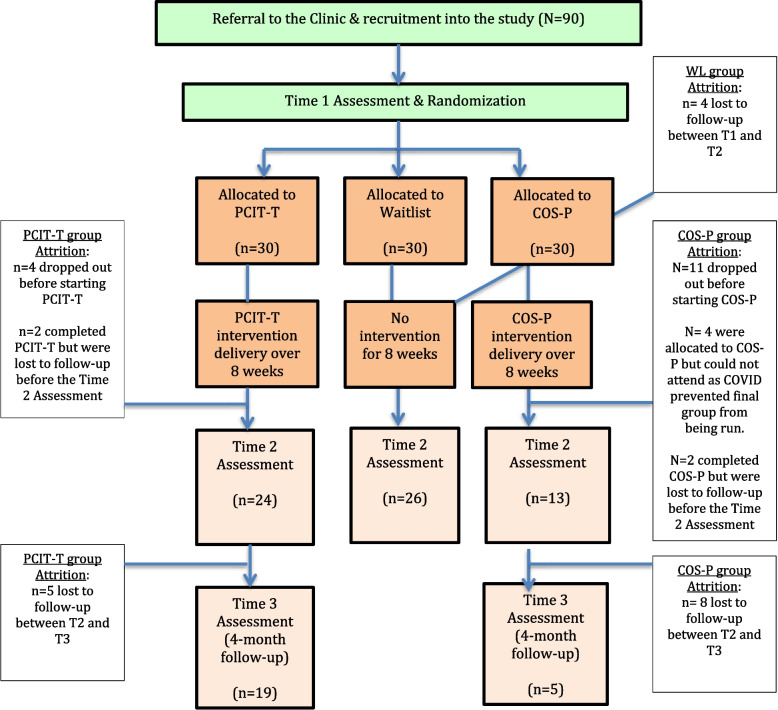
- Sample: 90 parent–toddler dyads referred to a specialized outpatient clinic in South Western Sydney, Australia; children were 14–24 months old, and all participating parents were female.
- Main analysis used linear mixed models for continuous outcomes and generalized linear mixed models for categorical attachment outcomes, with intention-to-treat analyses and Holm-adjusted planned comparisons.
Limitations
- The paper states that the two active treatments differed in delivery mode and dose: PCIT-T was individual and twice weekly, whereas COS-P was group-based and many more COS-P sessions were missed; the authors say this is a significant limitation.
- The study used many outcome measures, increasing Type I error risk, although the authors applied family-wise adjustments; they still caution interpretation.
- The waitlist group did not complete 4-month follow-up, follow-up was brief, and attrition was substantial; only 5 COS-P participants completed T3, and the authors note missing data likely affected parental reflectiveness and child outcomes.
- Evident from the text: participant retention was uneven, with dropouts more likely to be less educated and younger, and participants/readers were not fully blinded after allocation, which could bias results.
Model-written summary. Check it against the paper before relying on it.
Integrity signals
Registry
Cites
Statistics
Figures
Verification
Claims the paper makes
17 Valid · 1 Not valid · 21 Not checked · 265 Own results and interpretations
The sources with a verdict support this claim; the rest weren’t checked yet, have no full text we could read, or their verdicts aren’t rated yet.
In the paper
“When the sample was followed up 4-months after the completion of PCIT-T treatment, the gains in these key parent and child domains were maintained [50, 53].”
§ Optimizing parenting and child outcomes following parent–child interaction therapy – toddler: a randomized controlled trial > Background
What the sources say
- Supportedcites [50] Kohlhoff J, Cibralic S, Wallace N, Morgan S, McMahon C, Hawkins E, Eapen V, Briggs N, Huber A, McNeil C. A randomized controlled trial comparing parent child interaction therapy-toddler, circle of security–parenting™ and waitlist controls in the treatment of disruptive behaviors for children aged 14–24 months: study protocol. BMC Psychology. 2020;8(1):1–14. 32867832 PMC7457749 source
The Background reports that parent and child gains after PCIT-T were maintained at a four-month follow-up. It presents this as a finding from earlier research, not as a result of the protocol study itself. (LLM, conf=0.94)
- Not checked — no full text of the sourcecites [53] Kohlhoff J, Morgan S, Briggs N, Egan R, Niec L. Parent-Child Interaction Therapy with Toddlers in a community-based setting: Improvements in parenting behaviour, emotional availability, child behaviour and attachment. Infant Ment Health J. 2020;41(4):543–62. 32589327 source
plainn = 16- Asserted: passes — The authors put it forward as true.
- Checkable: passes — It can be checked against evidence.
- Load-bearing: passes — The paper’s conclusions depend on it.
- Based: passes — The paper gives a reason why it holds.
- Supported
The cited sources that could be checked couldn’t confirm or dispute this claim.
In the paper
“While the sample size at follow-up was small for categorical analyses (n = 16), there was a pattern (non-significant) of positive change from disorganized to organized infant attachment.”
§ Optimizing parenting and child outcomes following parent–child interaction therapy – toddler: a randomized controlled trial > Background
What the sources say
- Could not verifycites [50] Kohlhoff J, Cibralic S, Wallace N, Morgan S, McMahon C, Hawkins E, Eapen V, Briggs N, Huber A, McNeil C. A randomized controlled trial comparing parent child interaction therapy-toddler, circle of security–parenting™ and waitlist controls in the treatment of disruptive behaviors for children aged 14–24 months: study protocol. BMC Psychology. 2020;8(1):1–14. 32867832 PMC7457749 sourceExperimental — accuracy not yet measured
The Methods > Measures and Methods > Statistical analysis sections describe plans to classify attachment and test changes from baseline to follow-up; they do not report outcomes. Searches for a non-significant shift from disorganized to organized attachment and a follow-up sample of n = 16 found no supporting result in our copy. (LLM, conf=0.78)
- Not checked — no full text of the sourcecites [53] Kohlhoff J, Morgan S, Briggs N, Egan R, Niec L. Parent-Child Interaction Therapy with Toddlers in a community-based setting: Improvements in parenting behaviour, emotional availability, child behaviour and attachment. Infant Ment Health J. 2020;41(4):543–62. 32589327 source
hedgedn = 16- Asserted: passes — The authors put it forward as true.
- Checkable: passes — It can be checked against evidence.
- Load-bearing: unclear — It is unclear whether the paper’s conclusions depend on it.
- Based: passes — The paper gives a reason why it holds.
- Could not verify
The sources with a verdict support this claim; the rest weren’t checked yet, have no full text we could read, or their verdicts aren’t rated yet.
In the paper
“In particular, evidence suggests that receiving sensitive caregiving from a primary attachment figure, defined as the capacity to notice and correctly interpret the child’s signals and to respond contingently, is key [22, 26].”
§ Optimizing parenting and child outcomes following parent–child interaction therapy – toddler: a randomized controlled trial > Background
What the sources say
- Supportedcites [22] Cooke JE, Deneault AA, Devereux C, Eirich R, Fearon RP, Madigan S. Parental sensitivity and child behavioral problems: A meta-analytic review. Child Dev. 2022;93(5):1231–48. 35357693 source
The opening section describes caregiving quality as foundational to children’s socioemotional development and links sensitivity to attachment security. “Parental Sensitivity: Theory and Measurement” defines sensitive caregiving as identifying and interpreting a child’s cues and responding contingently, matching the citing sentence’s definition. Page numbers are unavailable in our copy. (LLM, conf=0.90)
- Not checked — no full text of the sourcecites [26] Deans CL. Maternal sensitivity, its relationship with child outcomes, and interventions that address it: A systematic literature review. Early Child Dev Care. 2020;190(2):252–75. source
hedgedstates a cause- Asserted: passes — The authors put it forward as true.
- Checkable: passes — It can be checked against evidence.
- Load-bearing: passes — The paper’s conclusions depend on it.
- Based: passes — The paper gives a reason why it holds.
- Supported
The cited sources support only part of this claim — read each source’s verdict below.
In the paper
“These results confirm those of the one previous controlled study testing outcomes of PCIT-T [50, 53, 54]”
§ Optimizing parenting and child outcomes following parent–child interaction therapy – toddler: a randomized controlled trial > Discussion
What the sources say
- Partly supportedcites [50] Kohlhoff J, Cibralic S, Wallace N, Morgan S, McMahon C, Hawkins E, Eapen V, Briggs N, Huber A, McNeil C. A randomized controlled trial comparing parent child interaction therapy-toddler, circle of security–parenting™ and waitlist controls in the treatment of disruptive behaviors for children aged 14–24 months: study protocol. BMC Psychology. 2020;8(1):1–14. 32867832 PMC7457749 sourceExperimental — accuracy not yet measured
The Background reports positive outcomes from a previous randomized waitlist-controlled PCIT-T study. But this cited paper is a protocol that reports those findings, not the completed controlled study itself; it cannot serve as that study when the citation is used to identify it. (LLM, conf=0.85)
- Not checked — no full text of the sourcecites [53] Kohlhoff J, Morgan S, Briggs N, Egan R, Niec L. Parent-Child Interaction Therapy with Toddlers in a community-based setting: Improvements in parenting behaviour, emotional availability, child behaviour and attachment. Infant Ment Health J. 2020;41(4):543–62. 32589327 source
- Not checked — no full text of the sourcecites [54] Kohlhoff J, Morgan S, Briggs N, Egan R, Niec L. Parent-Child Interaction Therapy with Toddlers: A community-based randomized controlled trial with children aged 14–24 months. J Clin Child Adolesc Psychol. 2021;50:411–26. 10.1080/15374416.2020.1723599. 32078379 source
plain- Asserted: passes — The authors put it forward as true.
- Checkable: passes — It can be checked against evidence.
- Load-bearing: unclear — It is unclear whether the paper’s conclusions depend on it.
- Based: passes — The paper gives a reason why it holds.
- Partly supported
Every source the paper cites for this claim was checked and supports it.
In the paper
“A parent’s ability to reflect on their child’s mental states, often referred to as ‘mentalising’ or ‘reflective functioning’, has been linked with the capacity to provide sensitive caregiving [14]”
§ Optimizing parenting and child outcomes following parent–child interaction therapy – toddler: a randomized controlled trial > Discussion
What the sources say
- Supportedcites [14] Camoirano A. Mentalizing makes parenting work: A review about parental reflective functioning and clinical interventions to improve it. Front Psychol. 2017;8: 244245. PMC5247433 28163690 source
The Results section, under “Parental RF, Quality of Caregiving, and Attachment Security,” reports a significant relationship between maternal reflective functioning and adequate caregiving, including behavioral sensitivity and parenting sensitivity. The Discussion likewise states that the reviewed studies associate parental reflective functioning with adequate caregiving. (LLM, conf=0.94)
plainstates an association- Asserted: passes — The authors put it forward as true.
- Checkable: passes — It can be checked against evidence.
- Load-bearing: passes — The paper’s conclusions depend on it.
- Based: passes — The paper gives a reason why it holds.
- Supported
153 more claims · 4 with their cited sources checked
Create a free account to see all 304 claims and every source verdict.
- It may state two separate claims as one. 109
- Probably not a substantial claim. 55
- The quote only partly states this claim. 3
Statistics that don’t add up
Each reported p-value recomputed from its test statistic and degrees of freedom, each partial η² from its F, and each ratio, mean difference or B printed with a p checked against its own confidence interval.
Rated minor: it would not touch a result — a value no result rests on, a p-value that stays on the same side of the significance level, or a conflict that is clerical, resolved elsewhere in the paper, or outside its own findings.
In the paper
“F (1, 155) = 0.23, p = 0.793”
§ Optimizing parenting and child outcomes following parent–child interaction therapy – toddler: a randomized controlled trial > Results > Child outcomes
Reported p = .793 · recomputed p = .632
Rated minor: it would not touch a result — a value no result rests on, a p-value that stays on the same side of the significance level, or a conflict that is clerical, resolved elsewhere in the paper, or outside its own findings.
In the paper
“F (1,131) = 1.11, p = 0.332”
§ Optimizing parenting and child outcomes following parent–child interaction therapy – toddler: a randomized controlled trial > Results > Child outcomes
Reported p = .332 · recomputed p = .294
Rated minor: it would not touch a result — a value no result rests on, a p-value that stays on the same side of the significance level, or a conflict that is clerical, resolved elsewhere in the paper, or outside its own findings.
In the paper
“F (2, 155) = 0.056, p = 0.572”
§ Optimizing parenting and child outcomes following parent–child interaction therapy – toddler: a randomized controlled trial > Results > Child outcomes
Reported p = .572 · recomputed p = .946
Rated minor: it would not touch a result — a value no result rests on, a p-value that stays on the same side of the significance level, or a conflict that is clerical, resolved elsewhere in the paper, or outside its own findings.
In the paper
“F (2, 153) = 2.478, p = 0.07”
§ Optimizing parenting and child outcomes following parent–child interaction therapy – toddler: a randomized controlled trial > Results > Caregiver outcomes
Reported p = .07 · recomputed p = .087
Statistics recomputed
Every reported test result, recomputed from its test statistic and degrees of freedom. A result shows as not adding up only once an independent check has confirmed it.
- Doesn’t add upF(2, 153) = 2.478reported p = .07 · recomputed p = .087
“F (2, 153) = 2.478, p = .07”
- Doesn’t add upF(1, 131) = 1.11reported p = .332 · recomputed p = .294
“F (1,131) = 1.11, p = .332”
- Doesn’t add upF(2, 155) = 0.056reported p = .572 · recomputed p = .946
“F (2, 155) = 0.056, p = .572”
- Doesn’t add upF(1, 155) = 0.23reported p = .793 · recomputed p = .632
“F (1, 155) = 0.23, p = .793”
- Consistentχ²(1) = 5.07reported p = .024 · recomputed p = .024
“χ2 (1) = 5.07, p = .024”
42 more recomputed tests
Create a free account to see every test the Stats check recomputed.
Self-check
Percentages, sums and reported differences re-computed from the paper’s own numbers.
Self-check results appear here once an independent check has confirmed them.
Citations
Cites
Statistical Power Analysis for the Behavioral Sciences (2nd ed.).
Lachenbruch, P. A., & Cohen, J. (1989) · Journal of the American Statistical Association · doi:10.2307/2290095 · Cited by 37,395
mice: Multivariate Imputation by Chained Equations in R
Buuren, S. V., & Groothuis-Oudshoorn, K. (2011) · Journal of Statistical Software · doi:10.18637/jss.v045.i03 · Cited by 13,870 · cited 1×
“…the data analysis strategy (given missing data associated with participant attrition), for variables that showed a significant change from T1 to T3 (for any group), a post-hoc sensitivity analysis involving multiple imputation by chained equations was performed using the mice package in R [85, 87].”
Gratz, K. L., & Roemer, L. (2004) · Journal of Psychopathology and Behavioral Assessment · doi:10.1023/b:joba.0000007455.08539.94 · Cited by 8,942 · cited 1×
“Parental emotion regulation was assessed using the Difficulties in Emotion Regulation Scale (DERS; [38]).”
Jacobson, N. S., & Truax, P. (1991) · Journal of Consulting and Clinical Psychology · doi:10.1037/0022-006x.59.1.12 · Cited by 7,770 · cited 1×
“Reliable change index (RCI) scores were also calculated to assess whether the magnitude of individual-level change on continuous study measures from T1 to T2 exceeded the margin of measurement error [45].”
A secure base: parent-child attachment and healthy human development
(1989) · Choice Reviews Online · doi:10.5860/choice.26-4750 · Cited by 4,886 · cited 1×
“…attachment relationship in which the child develops an internal working model or ‘representation’ of the caregiver as a reliable ‘secure base’ from which they can confidently explore the environment and new relationships, and a ‘safe haven’ to which they can return for comfort when required [8].”
Sensitivity and attachment: A meta-analysis on parental antecedents of infant attachment
De Wolff, M. S., & van Ijzendoorn, M. H. (1997) · Child Development · doi:10.1111/j.1467-8624.1997.tb04218.x · Cited by 2,526
Intention-to-treat concept: A review
Gupta, S. (2011) · Perspectives in Clinical Research · doi:10.4103/2229-3485.83221 · Cited by 1,921 · cited 1×
“Intention-to-treat analyses (ITT; [41]) were used, with participants included in the analyses within their randomly assigned treatment condition regardless of the amount of treatment received and group mean values estimated based on all observed data of those in the ITT sample.”
Less is more: meta-analyses of sensitivity and attachment interventions in early childhood
Bakermans-Kranenburg, M. J., van IJzendoorn, M. H., & Juffer, F. (2003) · Psychological Bulletin · doi:10.1037/0033-2909.129.2.195 · Cited by 1,883 · cited 1×
“…aligns with meta-analytic findings indicating that interventions that are brief, have a behavioral component, and which enhance parental sensitivity are most likely to bring about lasting improvements in children’s attachment security and thus capacity for behavioral and emotional regulation [6].”
Broidy, L. M., Nagin, D. S., Tremblay, R. E., Bates, J. E., Brame, B., Dodge, K. A., Fergusson, D., Horwood, J. L., Loeber, R., Laird, R., et al. (2003) · Developmental Psychology · doi:10.1037//0012-1649.39.2.222 · Cited by 1,637 · cited 1×
“While such difficulties usually resolve naturally across the transition into the pre-school years [86], for a small proportion of children, difficulties persist and represent the start of a pathway to mental health challenges [4, 11, 15, 16, 24, 44, 71].”
Fearon, R. P., Bakermans-Kranenburg, M. J., Van IJzendoorn, M. H., Lapsley, A.-M., & Roisman, G. I. (2010) · Child Development · doi:10.1111/j.1467-8624.2009.01405.x · Cited by 1,326 · cited 1×
“There is also a large body of evidence documenting longitudinal links between insecure and disor-ganised attachment in infancy/toddlerhood and a range of social-emotional, mental health and functional outcomes in middle childhood and adolescence [32, 39, 58].”
Parental reflective functioning: An introduction
Slade, A. (2005) · Attachment & Human Development · doi:10.1080/14616730500245906 · Cited by 1,209 · cited 1×
“…parenting representations such as parental reflective functioning and caregiving helplessness has been questioned [17, 64, 65], and a different result may have been obtained had an interview-based assessment been utilised, e.g., Parent Development Interview [78] or Car-egiving Interview [34].”
Affective development in infancy
Brazelton, T. B., & Yogman, M. W. (1986) · Medical Entomology and Zoology · Cited by 1,145
Waters, E., & Deane, K. E. (1985) · Monographs of the Society for Research in Child Development · doi:10.2307/3333826 · Cited by 1,144 · cited 1×
“First, to examine attachment security dimensionally, the video-taped home visit was coded using the Attachment Q-set (AQS) [90, 92], a validated coding procedure designed to assess attachment security in a naturalistic environment in children aged 12–48 months.”
Early externalizing behavior problems: Toddlers and preschoolers at risk for later maladjustment
CAMPBELL, S. B., SHAW, D. S., & GILLIOM, M. (2000) · Development and Psychopathology · doi:10.1017/s0954579400003114 · Cited by 1,081 · cited 1×
“While such difficulties usually resolve naturally across the transition into the pre-school years [86], for a small proportion of children, difficulties persist and represent the start of a pathway to mental health challenges [4, 11, 15, 16, 24, 44, 71].”
A tutorial on sensitivity analyses in clinical trials: the what, why, when and how
Thabane, L., Mbuagbaw, L., Zhang, S., Samaan, Z., Marcucci, M., Ye, C., Thabane, M., Giangregorio, L., Dennis, B., Kosa, D., et al. (2013) · BMC Medical Research Methodology · doi:10.1186/1471-2288-13-92 · Cited by 893 · cited 1×
“…the data analysis strategy (given missing data associated with participant attrition), for variables that showed a significant change from T1 to T3 (for any group), a post-hoc sensitivity analysis involving multiple imputation by chained equations was performed using the mice package in R [85, 87].”
The development of aggressive behaviour during childhood: What have we learned in the past century?
Tremblay, R. E. (2000) · International Journal of Behavioral Development · doi:10.1080/016502500383232 · Cited by 842 · cited 1×
“While such difficulties usually resolve naturally across the transition into the pre-school years [86], for a small proportion of children, difficulties persist and represent the start of a pathway to mental health challenges [4, 11, 15, 16, 24, 44, 71].”
Effect Size Guidelines, Sample Size Calculations, and Statistical Power in Gerontology
Brydges, C. R. (2019) · Innovation in Aging · doi:10.1093/geroni/igz036 · Cited by 826 · cited 1×
“At both T2 and T3, the PCIT-T group showed medium effect size changes, placing it in a comparable range to other brief to medium-term attachment-based interventions, e.g., VIPP-SD (overall combined effect size r = 0.23, medium effect size; [13]).”
InfluentialEmotional Development: The Organization of Emotional Life in the Early Years
Sroufe, L. A. (1996) · doi:10.1017/cbo9780511527661 · Cited by 809
Côté, S., Vaillancourt, T., LeBlanc, J. C., Nagin, D. S., & Tremblay, R. E. (2006) · Journal of Abnormal Child Psychology · doi:10.1007/s10802-005-9001-z · Cited by 641 · cited 1×
“While such difficulties usually resolve naturally across the transition into the pre-school years [86], for a small proportion of children, difficulties persist and represent the start of a pathway to mental health challenges [4, 11, 15, 16, 24, 44, 71].”
Groh, A. M., Roisman, G. I., van IJzendoorn, M. H., Bakermans-Kranenburg, M. J., & Fearon, R. P. (2012) · Child Development · doi:10.1111/j.1467-8624.2011.01711.x · Cited by 638 · cited 1×
“There is also a large body of evidence documenting longitudinal links between insecure and disor-ganised attachment in infancy/toddlerhood and a range of social-emotional, mental health and functional outcomes in middle childhood and adolescence [32, 39, 58].”
Antisocial behavior from a developmental psychopathology perspective
Frick, P. J., & Viding, E. (2009) · Development and Psychopathology · doi:10.1017/s0954579409990071 · Cited by 579 · cited 1×
“While various genetic, social, and temperamental pathways to behavioral difficulties in early childhood have been proposed [33, 49, 57], one of the strongest known predictors of persistent behavioral issues in early childhood is the quality of the early caregiving environment [76].”
Briggs-Gowan, M. J. (2004) · Journal of Pediatric Psychology · doi:10.1093/jpepsy/jsh017 · Cited by 573 · cited 3×
“Problematic child behaviors were assessed with two measures: the Child Behavior Checklist for ages 1.5–5 years (CBCL/1.5–5; [2]), and the Brief Infant–Toddler Social Emotional Assessment (BITSEA; [9, 10]).”
InfluentialChanging toddlers' and preschoolers' attachment classifications: the Circle of Security intervention
Hoffman, K. T., Marvin, R. S., Cooper, G., & Powell, B. (2006) · Journal of Consulting and Clinical Psychology · doi:10.1037/0022-006x.74.6.1017 · Cited by 467 · cited 1×
“Examples include Video-feedback Intervention to promote Positive Parenting and Sensitive Discipline (VIPP-SD; [47, 88]), the Circle of Security Intensive (COS-I) and Circle of Security Parenting (COS-P) interventions [23, 43, 94], and ABC Biobehavioral Feedback [29, 40].”
Socioemotional development in the toddler years: transitions and transformations
(2008) · Choice Reviews Online · doi:10.5860/choice.45-6470 · Cited by 445 · cited 1×
“Toddlerhood, defined as the period from around 12 to 30 months of age, is a unique developmental period characterized by increased physical mobility, language, autonomy, and individuation [12, 21].”
Spinrad, T. L., Eisenberg, N., Gaertner, B., Popp, T., Smith, C. L., Kupfer, A., Greving, K., Liew, J., & Hofer, C. (2007) · Developmental Psychology · doi:10.1037/0012-1649.43.5.1170 · Cited by 419 · cited 1×
“…of within and between group changes on key outcome variables; 2) Coping with Tod-dler’s Negative Emotions Scale (CTNES) scores not reported [80] due to an administration error; 3) Mind-mindedness was coded from the 20-min parent-toddler play sessions rather than from 5-min parent speech…”
Parent-Child Interaction Therapy: Integration of Traditional and Behavioral Concerns
Eyberg, S. (1988) · Child & Family Behavior Therapy · doi:10.1300/j019v10n01_04 · Cited by 415 · cited 1×
“PCIT-T is an adapted version of the standard PCIT intervention, which was designed for pre-school and early primary school aged children with conduct problems [30, 67].”
Promoting Positive Parenting : An Attachment-Based Intervention
Juffer, F., Bakermans‐Kranenburg, M. J., & van IJzendoorn, M. H. (2012) · Cited by 402
Campbell, S. B., Spieker, S., Burchinal, M., Poe, M. D., & The NICHD Early Child Care Research Network (2006) · Journal of Child Psychology and Psychiatry · doi:10.1111/j.1469-7610.2006.01636.x · Cited by 391 · cited 1×
“While such difficulties usually resolve naturally across the transition into the pre-school years [86], for a small proportion of children, difficulties persist and represent the start of a pathway to mental health challenges [4, 11, 15, 16, 24, 44, 71].”
Child-care effect sizes for the NICHD Study of Early Child Care and Youth Development.
NICHD Early Child Care Research Network (2006) · American Psychologist · doi:10.1037/0003-066x.61.2.99 · Cited by 377 · cited 1×
“…the National Institute of Child Health and Human Development Study of Early Child Care and Youth Development: Sensitivity Scales (NICHD-SECCYD; [66]), Composite parental sensitivity scores were calculated by summing scores on the six NICHD scales [sensitivity, positive regard for the child,…”
Attachment and internalizing behavior in early childhood: a meta-analysis
Madigan, S., Atkinson, L., Laurin, K., & Benoit, D. (2013) · Developmental Psychology · doi:10.1037/a0028793 · Cited by 365 · cited 1×
“There is also a large body of evidence documenting longitudinal links between insecure and disor-ganised attachment in infancy/toddlerhood and a range of social-emotional, mental health and functional outcomes in middle childhood and adolescence [32, 39, 58].”
Camoirano, A. (2017) · Frontiers in Psychology · doi:10.3389/fpsyg.2017.00014 · Cited by 356 · cited 1×
“A parent’s ability to reflect on their child’s mental states, often referred to as ‘mentalising’ or ‘reflec-tive functioning’, has been linked with the capacity to provide sensitive caregiving [14] and to the development of the child’s sense of self [77].”
Granqvist, P., Sroufe, L. A., Dozier, M., Hesse, E., Steele, M., van Ijzendoorn, M., Solomon, J., Schuengel, C., Fearon, P., Bakermans-Kranenburg, M., et al. (2017) · Attachment & Human Development · doi:10.1080/14616734.2017.1354040 · Cited by 317 · cited 1×
“…children have received abusive, extremely insensitive or hostile caregiving, or when they have received neglectful or frightened/frightening caregiving, there can be a break-down or incoherence in organisational strategy within the relationship (referred to as ‘disorganised’ attachment; [37, 59]).”
Understanding and Improving the Validity of Self-Report of Parenting
Morsbach, S. K., & Prinz, R. J. (2006) · Clinical Child and Family Psychology Review · doi:10.1007/s10567-006-0001-5 · Cited by 302 · cited 1×
“…measures to assess parenting representations such as parental reflective functioning and caregiving helplessness has been questioned [17, 64, 65], and a different result may have been obtained had an interview-based assessment been utilised, e.g., Parent Development Interview [78] or…”
Development and Etiology of Disruptive and Delinquent Behavior
Loeber, R., Burke, J. D., & Pardini, D. A. (2009) · Annual Review of Clinical Psychology · doi:10.1146/annurev.clinpsy.032408.153631 · Cited by 262
APPENDIX A: THE ATTACHMENT Q-SET (VERSION 3.0)
Waters, E. (2008) · Monographs of the Society for Research in Child Development · doi:10.1111/j.1540-5834.1995.tb00214.x · Cited by 258 · cited 1×
“…that insecure and disorganized attachment patterns in infants and young toddlers can be reliably observed experimentally with the Strange Situations Procedure (SSP; [3]), and that attachment security can be assessed using in-home assessment protocols including the Attachment Q-set (AQS; [91]).”
Otto, C., Reiss, F., Voss, C., Wüstner, A., Meyrose, A.-K., Hölling, H., & Ravens-Sieberer, U. (2021) · European Child & Adolescent Psychiatry · doi:10.1007/s00787-020-01630-4 · Cited by 235 · cited 1×
“While such difficulties usually resolve naturally across the transition into the pre-school years [86], for a small proportion of children, difficulties persist and represent the start of a pathway to mental health challenges [4, 11, 15, 16, 24, 44, 71].”
Developing and validating a tool to measure parenting self‐efficacy
Kendall, S., & Bloomfield, L. (2005) · Journal of Advanced Nursing · doi:10.1111/j.1365-2648.2005.03479.x · Cited by 234 · cited 1×
“Parental self-efficacy regarding empathy and emotional understanding was assessed using the empathy and emotion subscales of the Tool to Measure Parenting Self-Efficacy (TOPSE; [48]), administered as part of the CCQ [60].”
Vaughn, B. E., & Waters, E. (1990) · Child Development · doi:10.1111/j.1467-8624.1990.tb03578.x · Cited by 217 · cited 1×
“First, to examine attachment security dimensionally, the video-taped home visit was coded using the Attachment Q-set (AQS) [90, 92], a validated coding procedure designed to assess attachment security in a naturalistic environment in children aged 12–48 months.”
Impact of Early Intervention on Psychopathology, Crime, and Well-Being at Age 25
Dodge, K. A., Bierman, K. L., Coie, J. D., Greenberg, M. T., Lochman, J. E., McMahon, R. J., Pinderhughes, E. E., & for the Conduct Problems Prevention Research Group (2015) · American Journal of Psychiatry · doi:10.1176/appi.ajp.2014.13060786 · Cited by 213
Scully, C., McLaughlin, J., & Fitzgerald, A. (2020) · Journal of Family Therapy · doi:10.1111/1467-6427.12263 · Cited by 193 · cited 1×
“While various genetic, social, and temperamental pathways to behavioral difficulties in early childhood have been proposed [33, 49, 57], one of the strongest known predictors of persistent behavioral issues in early childhood is the quality of the early caregiving environment [76].”
Pathways from Infancy to Adolescence: Australian Temperament Project 1983-2000: (567532013-001)
Prior, M., Sanson, A., Smart, D., & Oberklaid, F. (2000) · PsycEXTRA Dataset · doi:10.1037/e567532013-001 · Cited by 182 · cited 1×
“Parenting hostility was assessed using the Longitudinal Study of Australian Children (LSAC) Parenting Hostility scale [73], administered as part of the CCQ [60].”
Vaughn, B. E., & Waters, E. (1990) · Child Development · doi:10.2307/1130850 · Cited by 175
Parental sensitivity and child behavioral problems: A meta-analytic review
Cooke, J. E., Deneault, A.-A., Devereux, C., Eirich, R., Fearon, R. M. P., & Madigan, S. (2022) · Child Development · doi:10.1111/cdev.13764 · Cited by 173 · cited 2×
“In particular, evidence suggests that receiving sensitive caregiving from a primary attachment figure, defined as the capacity to notice and correctly interpret the child’s signals and to respond contingently, is key [22, 26].”
Circle of Security–Parenting: A randomized controlled trial in Head Start
Cassidy, J., Brett, B. E., Gross, J. T., Stern, J. A., Martin, D. R., Mohr, J. J., & Woodhouse, S. S. (2017) · Development and Psychopathology · doi:10.1017/s0954579417000244 · Cited by 167 · cited 1×
“These are important findings because COS-P is a program that has been widely disseminated but not been extensively researched, and of the studies conducted to date, results have been mixed [18, 74, 95].”
A Brief Form of the Child Abuse Potential Inventory: Development and Validation
Ondersma, S. J., Chaffin, M. J., Mullins, S. M., & LeBreton, J. M. (2005) · Journal of Clinical Child & Adolescent Psychology · doi:10.1207/s15374424jccp3402_9 · Cited by 166 · cited 1×
“Child abuse potential was assessed using the Brief Child Abuse Potential Inventory (BCAP; [69]), an abbreviated version of the widely-used 160-item Child Abuse Potential Inventory [62].”
Handbook of attachment-based interventions
Steele, H., & Steele, M. (n.d.) · Cited by 159
Prediction and explanation of child abuse: Cross-validation of the Child Abuse Potential Inventory.
Milner, J. S., Gold, R. G., & Wimberley, R. C. (1986) · Journal of Consulting and Clinical Psychology · doi:10.1037/0022-006x.54.6.865 · Cited by 150
Deans, C. L. (2020) · Early Child Development and Care · doi:10.1080/03004430.2018.1465415 · Cited by 148 · cited 2×
“In particular, evidence suggests that receiving sensitive caregiving from a primary attachment figure, defined as the capacity to notice and correctly interpret the child’s signals and to respond contingently, is key [22, 26].”
Infant social and emotional development in family context.
Crockenberg, S., & Leerkes, E. M. (2000) · Cited by 143
A Critical Evaluation of the Reflective Functioning Questionnaire (RFQ)
Müller, S., Wendt, L. P., Spitzer, C., Masuhr, O., Back, S. N., & Zimmermann, J. (2022) · Journal of Personality Assessment · doi:10.1080/00223891.2021.1981346 · Cited by 138 · cited 1×
“…measures to assess parenting representations such as parental reflective functioning and caregiving helplessness has been questioned [17, 64, 65], and a different result may have been obtained had an interview-based assessment been utilised, e.g., Parent Development Interview [78] or…”
Dozier, M., & Bernard, K. (2017) · Current Opinion in Psychology · doi:10.1016/j.copsyc.2017.03.003 · Cited by 133 · cited 1×
“Examples include Video-feedback Intervention to promote Positive Parenting and Sensitive Discipline (VIPP-SD; [47, 88]), the Circle of Security Intensive (COS-I) and Circle of Security Parenting (COS-P) interventions [23, 43, 94], and ABC Biobehavioral Feedback [29, 40].”
van IJzendoorn, M. H., Schuengel, C., Wang, Q., & Bakermans-Kranenburg, M. J. (2023) · Development and Psychopathology · doi:10.1017/s0954579421001462 · Cited by 116 · cited 2×
“For example, ABC, which has had reported d s ranging from 0.08 to 0.7 [68], and VIPP-SD, which in Van Ijzendoorn et al. [88]’s recent systematic review had a combined effect size of r = 0.18, which the authors state was comparable to d = 0.37.”
InfluentialTerrible ones? Assessment of externalizing behaviors in infancy with the Child Behavior Checklist
Van Zeijl, J., Mesman, J., Stolk, M. N., Alink, L. R. A., Van IJzendoorn, M. H., Bakermans‐Kranenburg, M. J., Juffer, F., & Koot, H. M. (2006) · Journal of Child Psychology and Psychiatry · doi:10.1111/j.1469-7610.2006.01616.x · Cited by 110 · cited 2×
“…measures of child externalizing problems, the CBCL, has been used successfully in previous studies with children aged as young as 12 months [89], this measure has not been validated for children aged less than 18 months and so there is a need to exercise caution in interpreting the results.”
Influential(2017) · Cited by 103
ATTACHMENT AND BIOBEHAVIORAL CATCH‐UP: A SYSTEMATIC REVIEW
Grube, W. A., & Liming, K. W. (2018) · Infant Mental Health Journal · doi:10.1002/imhj.21745 · Cited by 89 · cited 1×
“Examples include Video-feedback Intervention to promote Positive Parenting and Sensitive Discipline (VIPP-SD; [47, 88]), the Circle of Security Intensive (COS-I) and Circle of Security Parenting (COS-P) interventions [23, 43, 94], and ABC Biobehavioral Feedback [29, 40].”
Efficacy of the Circle of Security Intervention: A Meta-Analysis
Yaholkoski, A., Hurl, K., & Theule, J. (2016) · Journal of Infant, Child, and Adolescent Psychotherapy · doi:10.1080/15289168.2016.1163161 · Cited by 87 · cited 1×
“Examples include Video-feedback Intervention to promote Positive Parenting and Sensitive Discipline (VIPP-SD; [47, 88]), the Circle of Security Intensive (COS-I) and Circle of Security Parenting (COS-P) interventions [23, 43, 94], and ABC Biobehavioral Feedback [29, 40].”
Morales Parra, T. (2021) · LA Referencia (Red Federada de Repositorios Institucionales de Publicaciones Científicas) · Cited by 82
Clinical Validity of a Brief Measure of Early Childhood Social–Emotional/Behavioral Problems
Briggs‐Gowan, M. J., Carter, A. S., McCarthy, K. J., Augustyn, M. C., Caronna, E. B., & Clark, R. (2013) · Journal of Pediatric Psychology · doi:10.1093/jpepsy/jst014 · Cited by 81 · cited 3×
“Problematic child behaviors were assessed with two measures: the Child Behavior Checklist for ages 1.5–5 years (CBCL/1.5–5; [2]), and the Brief Infant–Toddler Social Emotional Assessment (BITSEA; [9, 10]).”
InfluentialThe Emotional Life of the Toddler
Lieberman, A. F. (1993) · Medical Entomology and Zoology · Cited by 73
LeBuffe, P. A., & Naglieri, J. A. (1999) · NHSA Dialog · doi:10.1207/s19309325nhsa0301_10 · Cited by 63 · cited 1×
“Child social-emotional functioning was assessed with the Devereux Early Childhood Assessment (DECA; [55, 72]), and the Brief Infant–Toddler Social Emotional Assessment (BITSEA; [9, 10]).”
Österman, K., & Björkqvist, K. (2010) · Psychological Reports · doi:10.2466/pr0.106.2.448-454 · Cited by 59 · cited 1×
“As a normative response to the challenges of this developmental phase, many toddlers will, at times, display heightened levels of emotionality, some-times manifested as ‘tantrums’ and other externalizing behaviors (e.g., aggression and non-compliance) [21, 35, 42, 70].”
Kohlhoff, J. R., Cibralic, S., Hawes, D. J., & Eapen, V. (2022) · Neuroscience & Biobehavioral Reviews · doi:10.1016/j.neubiorev.2022.104573 · Cited by 57 · cited 1×
“While various genetic, social, and temperamental pathways to behavioral difficulties in early childhood have been proposed [33, 49, 57], one of the strongest known predictors of persistent behavioral issues in early childhood is the quality of the early caregiving environment [76].”
Self-citationRisholm Mothander, P., Furmark, C., & Neander, K. (2018) · Scandinavian Journal of Psychology · doi:10.1111/sjop.12419 · Cited by 49 · cited 1×
“These are important findings because COS-P is a program that has been widely disseminated but not been extensively researched, and of the studies conducted to date, results have been mixed [18, 74, 95].”
Kohlhoff, J., Morgan, S., Briggs, N., Egan, R., & Niec, L. (2021) · Journal of Clinical Child & Adolescent Psychology · doi:10.1080/15374416.2020.1723599 · Cited by 49 · cited 6×
“An a-priori power calculation based on Child Behavior Checklist (CBCL/1.5–5; [2]) externalizing subscale scores obtained in a similar study at the same site [54] suggested that n = 30 in each group would give 80% power to detect a mean difference between groups of at least 8.0, with SD of 9.”
InfluentialSelf-citationMaxwell, A.-M., McMahon, C., Huber, A., Reay, R. E., Hawkins, E., & Barnett, B. (2021) · Journal of Child and Family Studies · doi:10.1007/s10826-021-01932-4 · Cited by 49 · cited 5×
“Parenting hostility was assessed using the Longitudinal Study of Australian Children (LSAC) Parenting Hostility scale [73], administered as part of the CCQ [60].”
InfluentialSelf-citationGiesbrecht, G. F., Miller, M. R., & Müller, U. (2010) · Infant and Child Development · doi:10.1002/icd.677 · Cited by 45 · cited 1×
“As a normative response to the challenges of this developmental phase, many toddlers will, at times, display heightened levels of emotionality, some-times manifested as ‘tantrums’ and other externalizing behaviors (e.g., aggression and non-compliance) [21, 35, 42, 70].”
Temper Tantrums in Toddlers and Preschoolers: Longitudinal Associations with Adjustment Problems
van den Akker, A. L., Hoffenaar, P. J., & Overbeek, G. J. (2022) · Journal of Developmental & Behavioral Pediatrics · doi:10.1097/dbp.0000000000001071 · Cited by 42 · cited 1×
“As a normative response to the challenges of this developmental phase, many toddlers will, at times, display heightened levels of emotionality, some-times manifested as ‘tantrums’ and other externalizing behaviors (e.g., aggression and non-compliance) [21, 35, 42, 70].”
Parent-Child Interaction Therapy with Toddlers: Improving Attachment and Emotion Regulation
Girard, E. I., Wallace, N. M., Kohlhoff, J. R., Morgan, S. S. J., & McNeil, C. B. (2018) · doi:10.1007/978-3-319-93251-4 · Cited by 41
Self-citationKohlhoff, J., Morgan, S., Briggs, N., Egan, R., & Niec, L. (2020) · Infant Mental Health Journal · doi:10.1002/imhj.21864 · Cited by 37
Self-citationColson, E. R., & Dworkin, P. H. (1997) · Pediatrics In Review · doi:10.1542/pir.18.8.255 · Cited by 37 · cited 2×
“Toddlerhood, defined as the period from around 12 to 30 months of age, is a unique developmental period characterized by increased physical mobility, language, autonomy, and individuation [12, 21].”
Parent-Child Interaction Therapy for Toddlers: A Pilot Study
Kohlhoff, J., & Morgan, S. (2014) · Child & Family Behavior Therapy · doi:10.1080/07317107.2014.910733 · Cited by 35 · cited 2×
“In an initial study, Kohlhoff and Morgan [51] retrospectively reviewed outcomes of 29 clinic-referred parent-toddler dyads (Child M age 19.8 months, SD 2.60) treated with an early version of the PCIT-T (CDI-T phase only).”
InfluentialSelf-citationCarlone, C., Milan, S., Decoste, C., Borelli, J. L., McMahon, T. J., & Suchman, N. E. (2023) · Infant Mental Health Journal · doi:10.1002/imhj.22046 · Cited by 35 · cited 1×
“…of self-report measures to assess parenting representations such as parental reflective functioning and caregiving helplessness has been questioned [17, 64, 65], and a different result may have been obtained had an interview-based assessment been utilised, e.g., Parent Development Interview [78]…”
Kohlhoff, J., Cibralic, S., Wallace, N., Morgan, S., McMahon, C., Hawkins, E., Eapen, V., Briggs, N., Huber, A., & McNeil, C. (2020) · BMC Psychology · doi:10.1186/s40359-020-00457-7 · Cited by 29
Self-citationZimmer-Gembeck, M. J., Rudolph, J., Edwards, E.-J., Swan, K., Campbell, S. M., Hawes, T., & Webb, H. J. (2022) · Behavior Therapy · doi:10.1016/j.beth.2021.07.003 · Cited by 29 · cited 1×
“These are important findings because COS-P is a program that has been widely disseminated but not been extensively researched, and of the studies conducted to date, results have been mixed [18, 74, 95].”
Devereux Early Childhood Assessment for Infants and Toddlers
Mackrain, M., & LeBuffe, P. A. (2013) · PsycTESTS Dataset · doi:10.1037/t15185-000 · Cited by 22
Asmussen, J., Davidsen, K. A., Olsen, A. L., Skovgaard, A. M., & Bilenberg, N. (2024) · European Child & Adolescent Psychiatry · doi:10.1007/s00787-023-02262-0 · Cited by 18 · cited 1×
“While such difficulties usually resolve naturally across the transition into the pre-school years [86], for a small proportion of children, difficulties persist and represent the start of a pathway to mental health challenges [4, 11, 15, 16, 24, 44, 71].”
Cibralic, S., Kohlhoff, J. R., Wallace, N. M., McMahon, C. A., & Eapen, V. (2020) · Clinical Case Studies · doi:10.1177/1534650120969854 · Cited by 17 · cited 1×
“In addition, apart from one published case study [19], there have been no evaluations of the full PCIT-T program (i.e., CDI-T + PDI-T) [36].”
Self-citationBick, J., Dozier, M., & Perkins, E. (2012) · Attachment & Human Development · doi:10.1080/14616734.2012.636645 · Cited by 14 · cited 1×
“The SSP has demonstrated validity [7, 93] and is widely considered to be the gold standard measure of infant attachment.”
Developmental pathways from preschool temper tantrums to later psychopathology
Hoyniak, C. P., Donohue, M. R., Quiñones-Camacho, L. E., Vogel, A. C., Perino, M. T., Hennefield, L., Tillman, R., Barch, D. M., & Luby, J. L. (2023) · Development and Psychopathology · doi:10.1017/s0954579422000359 · Cited by 12 · cited 1×
“While such difficulties usually resolve naturally across the transition into the pre-school years [86], for a small proportion of children, difficulties persist and represent the start of a pathway to mental health challenges [4, 11, 15, 16, 24, 44, 71].”
O'Byrne, E., McCusker, C., & McSweeney, S. (2023) · Infant Mental Health Journal · doi:10.1002/imhj.22025 · Cited by 11 · cited 1×
“For example, ABC, which has had reported d s ranging from 0.08 to 0.7 [68], and VIPP-SD, which in Van Ijzendoorn et al. [88]’s recent systematic review had a combined effect size of r = 0.18, which the authors state was comparable to d = 0.37.”
InfluentialParent–Child Interaction Therapy for Toddlers (PCIT-T)
Kohlhoff, J., & Morgan, S. (2018) · Handbook of Parent-Child Interaction Therapy · doi:10.1007/978-3-319-97698-3_12 · Cited by 8 · cited 5×
“This study represents the first RCT study to test outcomes of the most recent iteration of the PCIT-T model [36], and the first ever comparison of the PCIT-T model (in any form) with an active treatment condition.”
InfluentialSelf-citation(2000)
Research works printed but not linked: 6
- Ainsworth M, Blehar MC, Waters E, Wall SN. Patterns of attachment: assessed in the strange situation and at home. Erlbaum; 1978.
- Eyberg, S. M., Nelson, M. M., Ginn, N. C., Bhuiyan, N., & Boggs, S. R. (2013). Dyadic parent–child interaction coding system (DPICS), 4th edition (DPICS-IV) comprehensive manual for research and training. PCIT International.
- Rubin, D. B. (2004). Multiple imputation for nonresponse in surveys (Vol. 81). John Wiley & Sons.
- Slade A. Parental reflective functioning: an introduction. Attach Hum Dev. 2005;7(3):269–81. 10.1080/14616730500245906. 16210239 · DOI · Paper page
- Solomon, J., & George, C. (1999). The measurement of attachment security in infancy and childhood. In Handbook of Attachment: Theory, Research, and Clinical Applications (pp. 287–316). Guilford Publications.
- Sroufe, L., Egeland, B., Carlson, E., & Collins, W. (2005). The development ofthe person. In: New York, NY, US: Guilford Press.
Cited by
Annual Research Review: Early conduct problems – precursors, outcomes, and etiology
Hyde, L. W., Trentacosta, C. J., & Bezek, J. L. (2025) · Journal of Child Psychology and Psychiatry · doi:10.1111/jcpp.70031 · Cited by 23
“One such program, Parent – Child Interaction Therapy-Toddler (PCIT-T; Kohlhoff et al., 2024) is an adaptation of PCIT.”
Liao, X., Wang, T., Tian, J., & Xie, H. (2025) · Journal of Autism and Developmental Disorders · doi:10.1007/s10803-025-06887-9 · Cited by 4
Kohlhoff, J. R., Cibralic, S., Wallace, N. M., Morgan, S. S. J., Lennie, L., & Rabbetts, L. (2025) · Scandinavian Journal of Psychology · doi:10.1111/sjop.70009 · Cited by 2
Self-citationDruskin, L. R., Phillips, S. T., Kohlhoff, J. R., Owen, C. K., Han, R. C., Franzese, S. N., Wallace, N. M., Cibralic, S., Morgan, S., & McNeil, C. B. (2025) · Infant Mental Health Journal · doi:10.1002/imhj.70045
Self-citationKim, J., Bendel-Stenzel, L. C., & Kochanska, G. (2026) · Attachment & Human Development · doi:10.1080/14616734.2026.2655283 · Cited by 1
“Evidence from studies using attachment-informed interventions supports such effects, with parents often reporting reduced levels of stress and increased sense of parenting efficacy upon completion (e.g., Kohlhoff et al., 2024; Røhder et al., 2022; Yaholkoski et al., 2016).”
Metadata
- Authors
- Kohlhoff, J., Wallace, N., Cibralic, S., Morgan, S., Briggs, N. E., McMahon, C., Hawkins, E., Druskin, L., Owen, C., Lieneman, C., Han, R., Eapen, V., Huber, A., & McNeil, C. B.
- Affiliations
- UNSW Sydney (AU)
- Macquarie University (AU)
- Griffith University (AU)
- West Virginia University (US)
- Boys Town (US)
- University of Florida (US)
- Corresponding author
- Kohlhoff, Jane
- ORCID
- Venue
- BMC Psychology
- Published
- 2024-11-22
- Volume
- 12
- Issue
- 1
- Pages
- 688-688
- ISSN
- 2050-7283 (ISSN-L)
- PMC
- PMC11583383
- OpenAlex
- W4404639321
- Cited by
- 11
- References
- 89
- Citations by year
- 2026: 7 · 2025: 4
- FWCI
- 5.48
- Type
- journal article
- Language
- en
- Open access
- gold
- doi.org
- Licence
- cc-by-nc-nd
- creativecommons.org/licenses/by-nc-nd/4.0 (tdm)
- creativecommons.org/licenses/by-nc-nd/4.0 (vor)
- Locations
- BMC Psychology (publishedVersion, cc-by-nc-nd)
- PubMed Central (publishedVersion, cc-by-nc-nd)
- PubMed (publishedVersion)
- DOAJ (DOAJ: Directory of Open Access Journals) (submittedVersion)
- Funders
- University of New South Wales
- Griffith University
- Topics
- Social Sciences › Psychology › Clinical Psychology › Child and Adolescent Psychosocial and Emotional Development
- Social Sciences › Psychology › Clinical Psychology › Child Therapy and Development
- Social Sciences › Psychology › Clinical Psychology › Psychoanalysis and Psychopathology Research
- Keywords
- parent-child interaction, toddlers, behavioral problems, disruptive behavior, parenting sensitivity, Circle of Security Parenting, attachment, early intervention, children's social competence, internalizing problems, externalizing problems, parental stress, mind-mindedness
- MeSH terms
- Problem Behavior, Adult, Child Behavior, Child, Preschool, Female, Humans, Infant, Male, Object Attachment, Parent-Child Relations, Parenting
About these checks
Registry, retraction, Cites and statistics results are computed, not judged, with one exception: a printed reference that no index lists is read once by a model before it counts as a citation error. Claims are extracted by a model and kept only when their quote appears verbatim in the text; each cited source is then checked, with a model’s help, for whether it says what the claim relies on. Those verdicts can be wrong — read the claim’s quote and the cited source before relying on one.
The claim verdicts this report counts are experimental: their accuracy is not yet measured.
A language model drew the claims from the paper on 2026-10-11, under version 3 of the claim definition (model deepseek-v4.1-flash, prompt extract-v3).
A second model labelled each claim on 2026-10-11 (model jev-1.13-20260917, definition revision gold-guideline-v0.2).
Cited sources are checked with a language model’s help (gpt-6-sol).
Statistics and arithmetic are recomputed, not judged.
Confidence bands are shown only for fields calibrated on our annotated test set. None is calibrated yet, so no band is shown.
What counts as a claim ›How we measure confidence ›How we check this ›
Are you an author, or do you see a problem with this page? Request a review
Data sources
Bibliographic data: Semantic Scholar, OpenAlex, Crossref.
Contains information from the Semantic Scholar Academic Graph Datasets, made available under the ODC Attribution License (ODC-BY 1.0).
Semantic Scholar’s data is described in: Kinney, R., et al. (2023). The Semantic Scholar Open Data Platform. arXiv:2301.10140.
