

The DOI matches its Crossref record; 76 of the 78 references it cites were found in a registry or an index, and 2 are not checked yet; 5 of the 288 sources its claims cite were checked for support.
Telehealth Interventions to Support Self-Management of Long-Term Conditions: A Systematic Metareview of Diabetes, Heart Failure, Asthma, Chronic Obstructive Pulmonary Disease, and Cancer
Open accessAbstract
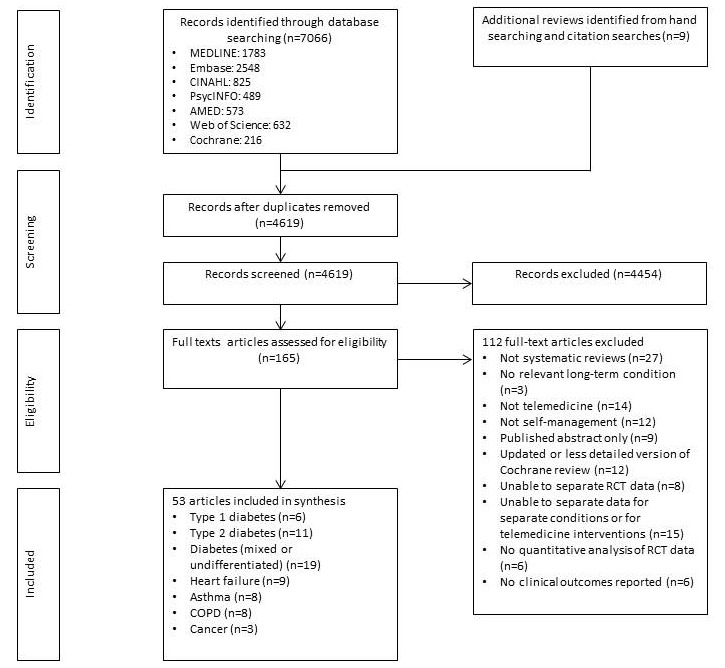
BACKGROUND: Self-management support is one mechanism by which telehealth interventions have been proposed to facilitate management of long-term conditions. OBJECTIVE: The objectives of this metareview were to (1) assess the impact of telehealth interventions to support self-management on disease control and health care utilization, and (2) identify components of telehealth support and their impact on disease control and the process of self-management. Our goal was to synthesise evidence for telehealth-supported self-management of diabetes (types 1 and 2), heart failure, asthma, chronic obstructive pulmonary disease (COPD) and cancer to identify components of effective self-management support. METHODS: We performed a metareview (a systematic review of systematic reviews) of randomized controlled trials (RCTs) of telehealth interventions to support self-management in 6 exemplar long-term conditions. We searched 7 databases for reviews published from January 2000 to May 2016 and screened identified studies against eligibility criteria. We weighted reviews by quality (revised A Measurement Tool to Assess Systematic Reviews), size, and relevance. We then combined our results in a narrative synthesis and using harvest plots. RESULTS: We included 53 systematic reviews, comprising 232 unique RCTs. Reviews concerned diabetes (type 1: n=6; type 2, n=11; mixed, n=19), heart failure (n=9), asthma (n=8), COPD (n=8), and cancer (n=3). Findings varied between and within disease areas. The highest-weighted reviews showed that blood glucose telemonitoring with feedback and some educational and lifestyle interventions improved glycemic control in type 2, but not type 1, diabetes, and that telemonitoring and telephone interventions reduced mortality and hospital admissions in heart failure, but these findings were not consistent in all reviews. Results for the other conditions were mixed, although no reviews showed evidence of harm. Analysis of the mediating role of self-management, and of components of successful interventions, was limited and inconclusive. More intensive and multifaceted interventions were associated with greater improvements in diabetes, heart failure, and asthma. CONCLUSIONS: While telehealth-mediated self-management was not consistently superior to usual care, none of the reviews reported any negative effects, suggesting that telehealth is a safe option for delivery of self-management support, particularly in conditions such as heart failure and type 2 diabetes, where the evidence base is more developed. Larger-scale trials of telehealth-supported self-management, based on explicit self-management theory, are needed before the extent to which telehealth technologies may be harnessed to support self-management can be established.
Verified 2026-10-06 · 2 references not checked yet
Overview
AI snapshot
Written from the paper’s full text.
TL;DR
This metareview synthesized 53 systematic reviews (231 unique RCTs per Results; abstract says 232) of telehealth interventions to support self-management in diabetes, heart failure, asthma, COPD, and cancer. Evidence was inconsistent and no single self-management component was consistently effective, but no reviews reported harm, with the strongest support in type 2 diabetes and heart failure.
Key findings
- Included 53 systematic reviews comprising 231 unique RCTs (119 diabetes, 58 heart failure, 28 asthma, 23 COPD, 3 cancer); the abstract reports 232 unique RCTs. Findings varied between and within disease areas.
- Highest-weighted reviews showed blood glucose telemonitoring with feedback and some educational/lifestyle interventions improved glycemic control in type 2, but not type 1, diabetes; telemonitoring and telephone interventions reduced mortality and hospital admissions in heart failure, though findings were not consistent in all reviews.
- No reviews showed evidence of harm; results for asthma, COPD, and cancer were mixed, and more intensive/multifaceted interventions were associated with greater improvements in diabetes, heart failure, and asthma.
- Analysis of the mediating role of self-management and of components of successful interventions was limited and inconclusive; no single self-management component was consistently effective or ineffective.
Methods
- Metareview (systematic review of systematic reviews) of RCTs of telehealth interventions to support self-management in 6 long-term conditions; searched 7 databases for reviews published January 2000 to May 2016.
- Included 53 reviews; quality assessed with R-AMSTAR (scores 19–43 out of 44) and weighted by quality, size, and explicit self-management focus (8 reviews 3 stars, 23 reviews 2 stars, 21 reviews 1 star, 1 review no stars).
- Because RCT overlap precluded meta-analysis, findings were combined in narrative synthesis and harvest plots; data were extracted from reviews, not individual RCTs, covering disease control, health care utilization, self-management process, and quality-of-life outcomes.
Limitations
- Stated: metareview lag risks outdated results; reliance on review authors’ interpretation; inability to adjust for geography, age, or socioeconomic variables; RCT overlap risks overrepresenting some trials; only 6 conditions were considered; inclusion of reviews with implied self-management focus was potentially subjective; few reviews assessed publication bias.
- Stated: most reviews did not analyze intervention intensity or specific components, limiting conclusions about which components or combinations are most beneficial.
- Evident from the text: the abstract and Results report different unique RCT counts (232 vs 231); heterogeneity and poor intervention reporting limit component analysis; harvest plot rules may overlook individual RCTs.
Model-written summary. Check it against the paper before relying on it.
Integrity signals
Registry
Cites
Statistics
Figures
Verification
Claims the paper makes
121 Not checked yet · 25 Own method · 25 Own result · 23 No basis given · 13 Own interpretation · 1 Supported so far · 1 Partly supported · 1 Mixed support · accuracy not yet measured
The sources with a verdict support this claim; the rest weren’t checked yet, have no full text we could read, or their verdicts aren’t rated yet.
In the paper
“Three 1-star narrative syntheses suggested improved outcomes with mobile phone interventions [32,35,36], but others showed no overall benefit from teleconsultations [47,51] or telemonitoring [34,39].”
§ Telehealth Interventions to Support Self-Management of Long-Term Conditions: A Systematic Metareview of Diabetes, Heart Failure, Asthma, Chronic Obstructive Pulmonary Disease, and Cancer > Results > Impact of Telehealth Interventions on Disease Control and Health Care Utilization
What the sources say
- Supportedcites [32] source
The paper is a review of mobile-phone interventions for diabetes. In OUTCOMES REPORTED (page unavailable), it says 85% of studies measuring HbA1c reported improvements; the Discussion says the studies showed many positive trends, though few findings were statistically significant. The “1-star” rating belongs to the citing paper’s appraisal, not a finding attributed to this source. (LLM, conf=0.90)
- Not checked yetcites [35] Krishna, S, 2008, J Diabetes Sci Technol source
- Not checked yetcites [36] source
hedgeddirect- Asserted: passes — The authors put it forward as true.
- Checkable: passes — It can be checked against evidence.
- Load-bearing: unclear — It is unclear whether the paper’s conclusions depend on it.
- Based: passes — The paper gives a reason why it holds.
- Supported
The cited sources support only part of this claim — read each source’s verdict below.
In the paper
“Three 1-star narrative syntheses suggested improved outcomes with mobile phone interventions [32,35,36], but others showed no overall benefit from teleconsultations [47,51] or telemonitoring [34,39].”
§ Telehealth Interventions to Support Self-Management of Long-Term Conditions: A Systematic Metareview of Diabetes, Heart Failure, Asthma, Chronic Obstructive Pulmonary Disease, and Cancer > Results > Impact of Telehealth Interventions on Disease Control and Health Care Utilization
What the sources say
- Partly supportedcites [47] sourceExperimental — accuracy not yet measured
The Results > Efficacy section reports that phone-call intervention did not significantly improve HbA1c compared with standard clinical care in diabetes patients. But this paper is a meta-analysis of five randomized trials, not a narrative synthesis, and it studied phone calls without electronic data transmission rather than teleconsultations or telemonitoring generally. (LLM, conf=0.87)
- Partly supportedcites [51] sourceExperimental — accuracy not yet measured
In Results, under “Studies on the Effects of Teleconsultation” (page unavailable), the review reports no statistically significant pooled reduction in HbA1c across six trials. That supports a narrower finding than “no overall benefit”: the review also reports improvements in other outcomes, and it conducted a meta-analysis rather than only a narrative synthesis. This verdict concerns the teleconsultation citation, not the separate telemonitoring citations. (LLM, conf=0.88)
- Not checked yetcites [34] source
- Not checked yetcites [39] source
plain- Asserted: passes — The authors put it forward as true.
- Checkable: passes — It can be checked against evidence.
- Load-bearing: unclear — It is unclear whether the paper’s conclusions depend on it.
- Based: passes — The paper gives a reason why it holds.
- Partly supported
The paper states this without a source or data behind it here, so there is nothing to check it against. The quote shows it is in the paper.
In the paper
“that telemonitoring and telephone interventions reduced mortality and hospital admissions in heart failure, but these findings were not consistent in all reviews.”
§ Telehealth Interventions to Support Self-Management of Long-Term Conditions: A Systematic Metareview of Diabetes, Heart Failure, Asthma, Chronic Obstructive Pulmonary Disease, and Cancer > Abstract > Results
plaindirect- Asserted: passes — The authors put it forward as true.
- Checkable: passes — It can be checked against evidence.
- Load-bearing: passes — The paper’s conclusions depend on it.
- Based: passes — The paper gives a reason why it holds.
The paper states this without a source or data behind it here, so there is nothing to check it against. The quote shows it is in the paper.
In the paper
“Analysis of the mediating role of self-management, and of components of successful interventions, was limited and inconclusive.”
§ Telehealth Interventions to Support Self-Management of Long-Term Conditions: A Systematic Metareview of Diabetes, Heart Failure, Asthma, Chronic Obstructive Pulmonary Disease, and Cancer > Abstract > Results
plain- Asserted: passes — The authors put it forward as true.
- Checkable: passes — It can be checked against evidence.
- Load-bearing: unclear — It is unclear whether the paper’s conclusions depend on it.
- Based: passes — The paper gives a reason why it holds.
A result the paper reports from its own data — it cites no other source for it, so there is none to check. The quote shows it is in the paper.
In the paper
“that telemonitoring and telephone interventions reduced mortality and hospital admissions in heart failure, but these findings were not consistent in all reviews.”
§ Telehealth Interventions to Support Self-Management of Long-Term Conditions: A Systematic Metareview of Diabetes, Heart Failure, Asthma, Chronic Obstructive Pulmonary Disease, and Cancer > Abstract > Results
hedgeddirect- Asserted: passes — The authors put it forward as true.
- Checkable: passes — It can be checked against evidence.
- Load-bearing: passes — The paper’s conclusions depend on it.
- Based: passes — The paper gives a reason why it holds.
The paper states this without a source or data behind it here, so there is nothing to check it against. The quote shows it is in the paper.
In the paper
“While telehealth-mediated self-management was not consistently superior to usual care, none of the reviews reported any negative effects”
§ Telehealth Interventions to Support Self-Management of Long-Term Conditions: A Systematic Metareview of Diabetes, Heart Failure, Asthma, Chronic Obstructive Pulmonary Disease, and Cancer > Abstract > Conclusions
plain- Asserted: passes — The authors put it forward as true.
- Checkable: passes — It can be checked against evidence.
- Load-bearing: passes — The paper’s conclusions depend on it.
- Based: passes — The paper gives a reason why it holds.
A result the paper reports from its own data — it cites no other source for it, so there is none to check. The quote shows it is in the paper.
In the paper
“Findings varied between and within disease areas.”
§ Telehealth Interventions to Support Self-Management of Long-Term Conditions: A Systematic Metareview of Diabetes, Heart Failure, Asthma, Chronic Obstructive Pulmonary Disease, and Cancer > Abstract > Results
plain- Asserted: passes — The authors put it forward as true.
- Checkable: passes — It can be checked against evidence.
- Load-bearing: passes — The paper’s conclusions depend on it.
- Based: passes — The paper gives a reason why it holds.
The paper states this without a source or data behind it here, so there is nothing to check it against. The quote shows it is in the paper.
In the paper
“Analysis of the mediating role of self-management, and of components of successful interventions, was limited and inconclusive.”
§ Telehealth Interventions to Support Self-Management of Long-Term Conditions: A Systematic Metareview of Diabetes, Heart Failure, Asthma, Chronic Obstructive Pulmonary Disease, and Cancer > Abstract > Results
plain- Asserted: passes — The authors put it forward as true.
- Checkable: passes — It can be checked against evidence.
- Load-bearing: unclear — It is unclear whether the paper’s conclusions depend on it.
- Based: passes — The paper gives a reason why it holds.
A result the paper reports from its own data — it cites no other source for it, so there is none to check. The quote shows it is in the paper.
In the paper
“The highest-weighted reviews showed that blood glucose telemonitoring with feedback and some educational and lifestyle interventions improved glycemic control in type 2, but not type 1, diabetes”
§ Telehealth Interventions to Support Self-Management of Long-Term Conditions: A Systematic Metareview of Diabetes, Heart Failure, Asthma, Chronic Obstructive Pulmonary Disease, and Cancer > Abstract > Results
plaindirect- Asserted: passes — The authors put it forward as true.
- Checkable: passes — It can be checked against evidence.
- Load-bearing: passes — The paper’s conclusions depend on it.
- Based: passes — The paper gives a reason why it holds.
A result the paper reports from its own data — it cites no other source for it, so there is none to check. The quote shows it is in the paper.
In the paper
“The highest-weighted reviews showed that blood glucose telemonitoring with feedback and some educational and lifestyle interventions improved glycemic control in type 2, but not type 1, diabetes”
§ Telehealth Interventions to Support Self-Management of Long-Term Conditions: A Systematic Metareview of Diabetes, Heart Failure, Asthma, Chronic Obstructive Pulmonary Disease, and Cancer > Abstract > Results
plain- Asserted: passes — The authors put it forward as true.
- Checkable: passes — It can be checked against evidence.
- Load-bearing: passes — The paper’s conclusions depend on it.
- Based: passes — The paper gives a reason why it holds.
- It may state two separate claims as one. 78
- Probably not a substantial claim. 50
Some cited sources support this claim and some don’t — read each source’s verdict below.
In the paper
“de Jongh et al [24] and Marcano Belisario et al [62] reviewed mobile interventions and smartphone apps, respectively. The number of included RCTs was small for both (1 and 2, respectively).”
§ Telehealth Interventions to Support Self-Management of Long-Term Conditions: A Systematic Metareview of Diabetes, Heart Failure, Asthma, Chronic Obstructive Pulmonary Disease, and Cancer > Results > Impact of Telehealth Interventions on Disease Control and Health Care Utilization
What the sources say
- Disputedcites [24] sourceExperimental — accuracy not yet measured
The paper does review mobile phone messaging interventions, but the claim that de Jongh et al. included one RCT conflicts with its Implications for research section, which says the review's evidence was based on four RCTs. The count of two belongs to the separately cited review and is not assessed here. (LLM, conf=0.94)
Checked by a reasoning model — may be wrong.
- Supportedcites [62] source
The Discussion describes this as a systematic review of smartphone apps for asthma self-management and refers to both studies included in the review (Liu 2011 and Ryan 2012). The Methods say that no eligible non-RCT designs were identified, supporting the count of two included RCTs. The separate count attributed to de Jongh et al. is not being assessed against this source. (LLM, conf=0.93)
plain- Asserted: passes — The authors put it forward as true.
- Checkable: passes — It can be checked against evidence.
- Load-bearing: unclear — It is unclear whether the paper’s conclusions depend on it.
- Based: passes — The paper gives a reason why it holds.
It may state two separate claims as one.
- Disputed
A result the paper reports from its own data — it cites no other source for it, so there is none to check. The quote shows it is in the paper.
In the paper
“We included 53 systematic reviews, comprising 232 unique RCTs.”
§ Telehealth Interventions to Support Self-Management of Long-Term Conditions: A Systematic Metareview of Diabetes, Heart Failure, Asthma, Chronic Obstructive Pulmonary Disease, and Cancer > Abstract > Results
plain- Asserted: passes — The authors put it forward as true.
- Checkable: passes — It can be checked against evidence.
- Load-bearing: unclear — It is unclear whether the paper’s conclusions depend on it.
- Based: passes — The paper gives a reason why it holds.
It may state two separate claims as one.
None of the sources cited for this claim have been checked yet.
In the paper
“Taking into account quality assessment, explicit self-management focus, and total population size, 8 reviews received an evidence weighting of 3 stars [16,21,25,26,38,45,53,56], 23 received 2 stars [22,24,27-31, 33,37,40,42,44,46,49,50,52,54,55,58,62,63,67,68], 21 received 1 star [19,20,23,32,34-36,39,43,47,48,51,57, 59-61,64-66,69,70], and 1 received no stars [41].”
§ Telehealth Interventions to Support Self-Management of Long-Term Conditions: A Systematic Metareview of Diabetes, Heart Failure, Asthma, Chronic Obstructive Pulmonary Disease, and Cancer > Results > Quality and Weighting of Included Reviews
What the sources say
- Not checked yetcites [16] source
- Not checked yetcites [21] source
- Not checked yetcites [25] source
- Not checked yetcites [26] source
- Not checked yetcites [38] source
- Not checked yetcites [45] source
- Not checked yetcites [53] source
- Not checked yetcites [56] source
- Not checked yetcites [22] source
- Not checked yetcites [24] source
plain- Asserted: passes — The authors put it forward as true.
- Checkable: passes — It can be checked against evidence.
- Load-bearing: passes — The paper’s conclusions depend on it.
- Based: passes — The paper gives a reason why it holds.
It may state two separate claims as one.
A result the paper reports from its own data — it cites no other source for it, so there is none to check. The quote shows it is in the paper.
In the paper
“The year of publication ranged from 2000 to 2016.”
§ Telehealth Interventions to Support Self-Management of Long-Term Conditions: A Systematic Metareview of Diabetes, Heart Failure, Asthma, Chronic Obstructive Pulmonary Disease, and Cancer > Results > Search Results
plain- Asserted: passes — The authors put it forward as true.
- Checkable: passes — It can be checked against evidence.
- Load-bearing: fails — The paper’s conclusions may not depend on it.
- Based: passes — The paper gives a reason why it holds.
Probably not a substantial claim. The paper’s conclusions may not depend on it.
A result the paper reports from its own data — it cites no other source for it, so there is none to check. The quote shows it is in the paper.
In the paper
“Information on the geographical spread of the RCTs included within the SRs was incomplete, but included studies from North and South America, Europe, Asia, and Oceania.”
§ Telehealth Interventions to Support Self-Management of Long-Term Conditions: A Systematic Metareview of Diabetes, Heart Failure, Asthma, Chronic Obstructive Pulmonary Disease, and Cancer > Results > Search Results
plain- Asserted: passes — The authors put it forward as true.
- Checkable: passes — It can be checked against evidence.
- Load-bearing: fails — The paper’s conclusions may not depend on it.
- Based: passes — The paper gives a reason why it holds.
Probably not a substantial claim. The paper’s conclusions may not depend on it.
None of the sources cited for this claim have been checked yet.
In the paper
“A total of 5 reviews focused on type 1 diabetes [23,24,41,48,49] and 1 analyzed type 1 diabetes within a mixed review [19].”
§ Telehealth Interventions to Support Self-Management of Long-Term Conditions: A Systematic Metareview of Diabetes, Heart Failure, Asthma, Chronic Obstructive Pulmonary Disease, and Cancer > Results > Impact of Telehealth Interventions on Disease Control and Health Care Utilization
What the sources say
plain- Asserted: passes — The authors put it forward as true.
- Checkable: passes — It can be checked against evidence.
- Load-bearing: unclear — It is unclear whether the paper’s conclusions depend on it.
- Based: passes — The paper gives a reason why it holds.
It may state two separate claims as one.
A result the paper reports from its own data — it cites no other source for it, so there is none to check. The quote shows it is in the paper.
In the paper
“Information on the geographical spread of the RCTs included within the SRs was incomplete, but included studies from North and South America, Europe, Asia, and Oceania.”
§ Telehealth Interventions to Support Self-Management of Long-Term Conditions: A Systematic Metareview of Diabetes, Heart Failure, Asthma, Chronic Obstructive Pulmonary Disease, and Cancer > Results > Search Results
plain- Asserted: passes — The authors put it forward as true.
- Checkable: passes — It can be checked against evidence.
- Load-bearing: fails — The paper’s conclusions may not depend on it.
- Based: passes — The paper gives a reason why it holds.
Probably not a substantial claim. The paper’s conclusions may not depend on it.
None of the sources cited for this claim have been checked yet.
In the paper
“Three 1-star narrative syntheses showed improvement in HbA1c limited to only a few RCTs, and all concluded that further evaluation was required [19,23,48].”
§ Telehealth Interventions to Support Self-Management of Long-Term Conditions: A Systematic Metareview of Diabetes, Heart Failure, Asthma, Chronic Obstructive Pulmonary Disease, and Cancer > Results > Impact of Telehealth Interventions on Disease Control and Health Care Utilization
What the sources say
plaindirect- Asserted: passes — The authors put it forward as true.
- Checkable: passes — It can be checked against evidence.
- Load-bearing: unclear — It is unclear whether the paper’s conclusions depend on it.
- Based: passes — The paper gives a reason why it holds.
It may state two separate claims as one.
None of the sources cited for this claim have been checked yet.
In the paper
“Narrative syntheses found that telehealth-delivered educational interventions [52] and telephone interventions [29] did not improve glycemic control.”
§ Telehealth Interventions to Support Self-Management of Long-Term Conditions: A Systematic Metareview of Diabetes, Heart Failure, Asthma, Chronic Obstructive Pulmonary Disease, and Cancer > Results > Impact of Telehealth Interventions on Disease Control and Health Care Utilization
plain- Asserted: passes — The authors put it forward as true.
- Checkable: passes — It can be checked against evidence.
- Load-bearing: unclear — It is unclear whether the paper’s conclusions depend on it.
- Based: passes — The paper gives a reason why it holds.
It may state two separate claims as one.
None of the sources cited for this claim have been checked yet.
In the paper
“Of these, 2 were awarded a 3-star weighting [21,53].”
§ Telehealth Interventions to Support Self-Management of Long-Term Conditions: A Systematic Metareview of Diabetes, Heart Failure, Asthma, Chronic Obstructive Pulmonary Disease, and Cancer > Results > Impact of Telehealth Interventions on Disease Control and Health Care Utilization
plain- Asserted: passes — The authors put it forward as true.
- Checkable: passes — It can be checked against evidence.
- Load-bearing: fails — The paper’s conclusions may not depend on it.
- Based: passes — The paper gives a reason why it holds.
Probably not a substantial claim. The paper’s conclusions may not depend on it.
In the paper
“The former focused on mobile messaging interventions, including medication reminders, and found no improvement in hemoglobin A1c (HbA1c) compared with usual care in a meta-analysis of 2 RCTs [24].”
§ Telehealth Interventions to Support Self-Management of Long-Term Conditions: A Systematic Metareview of Diabetes, Heart Failure, Asthma, Chronic Obstructive Pulmonary Disease, and Cancer > Results > Impact of Telehealth Interventions on Disease Control and Health Care Utilization
What the sources say
- Not checked yetcites [24] source
plain- Asserted: passes — The authors put it forward as true.
- Checkable: passes — It can be checked against evidence.
- Load-bearing: unclear — It is unclear whether the paper’s conclusions depend on it.
- Based: passes — The paper gives a reason why it holds.
It may state two separate claims as one.
None of the sources cited for this claim have been checked yet.
In the paper
“Interventions included telemonitoring of blood glucose [33,42,54] and mobile messaging [46].”
§ Telehealth Interventions to Support Self-Management of Long-Term Conditions: A Systematic Metareview of Diabetes, Heart Failure, Asthma, Chronic Obstructive Pulmonary Disease, and Cancer > Results > Impact of Telehealth Interventions on Disease Control and Health Care Utilization
What the sources say
plaincorrelational- Asserted: passes — The authors put it forward as true.
- Checkable: passes — It can be checked against evidence.
- Load-bearing: unclear — It is unclear whether the paper’s conclusions depend on it.
- Based: passes — The paper gives a reason why it holds.
It may state two separate claims as one.
None of the sources cited for this claim have been checked yet.
In the paper
“The reviews of de Jongh et al [24] and Viana et al [49] were both weighted 2 stars.”
§ Telehealth Interventions to Support Self-Management of Long-Term Conditions: A Systematic Metareview of Diabetes, Heart Failure, Asthma, Chronic Obstructive Pulmonary Disease, and Cancer > Results > Impact of Telehealth Interventions on Disease Control and Health Care Utilization
plain- Asserted: passes — The authors put it forward as true.
- Checkable: passes — It can be checked against evidence.
- Load-bearing: fails — The paper’s conclusions may not depend on it.
- Based: passes — The paper gives a reason why it holds.
Probably not a substantial claim. The paper’s conclusions may not depend on it. It may state two separate claims as one.
None of the sources cited for this claim have been checked yet.
In the paper
“Of seven 2-star reviews [29,30,33,42,46,52,54], 4 were meta-analyses, all of which showed significant reductions in HbA1c compared with controls, although the effect sizes were small.”
§ Telehealth Interventions to Support Self-Management of Long-Term Conditions: A Systematic Metareview of Diabetes, Heart Failure, Asthma, Chronic Obstructive Pulmonary Disease, and Cancer > Results > Impact of Telehealth Interventions on Disease Control and Health Care Utilization
What the sources say
plaindirect- Asserted: passes — The authors put it forward as true.
- Checkable: passes — It can be checked against evidence.
- Load-bearing: unclear — It is unclear whether the paper’s conclusions depend on it.
- Based: passes — The paper gives a reason why it holds.
It may state two separate claims as one.
In the paper
“Farmer et al assessed telemonitoring of self-monitored blood glucose and found no significant improvement in HbA1c in a meta-analysis of 9 RCTs, and either no difference or an increase in health care utilization in 6 RCTs [25].”
§ Telehealth Interventions to Support Self-Management of Long-Term Conditions: A Systematic Metareview of Diabetes, Heart Failure, Asthma, Chronic Obstructive Pulmonary Disease, and Cancer > Results > Impact of Telehealth Interventions on Disease Control and Health Care Utilization
What the sources say
- Not checked yetcites [25] source
plain- Asserted: passes — The authors put it forward as true.
- Checkable: passes — It can be checked against evidence.
- Load-bearing: unclear — It is unclear whether the paper’s conclusions depend on it.
- Based: passes — The paper gives a reason why it holds.
It may state two separate claims as one.
None of the sources cited for this claim have been checked yet.
In the paper
“Of these, 4 were awarded a 3-star weighting [16,25,38,45], of which Farmer et al [25] , Small et al [45], and Liang et al [38] analyzed control or health care utilization outcomes, or both.”
§ Telehealth Interventions to Support Self-Management of Long-Term Conditions: A Systematic Metareview of Diabetes, Heart Failure, Asthma, Chronic Obstructive Pulmonary Disease, and Cancer > Results > Impact of Telehealth Interventions on Disease Control and Health Care Utilization
What the sources say
plain- Asserted: passes — The authors put it forward as true.
- Checkable: passes — It can be checked against evidence.
- Load-bearing: fails — The paper’s conclusions may not depend on it.
- Based: passes — The paper gives a reason why it holds.
Probably not a substantial claim. The paper’s conclusions may not depend on it.
None of the sources cited for this claim have been checked yet.
In the paper
“Interventions included telemonitoring of blood sugar [40,44] and interactive telehealth excluding telephone support [27].”
§ Telehealth Interventions to Support Self-Management of Long-Term Conditions: A Systematic Metareview of Diabetes, Heart Failure, Asthma, Chronic Obstructive Pulmonary Disease, and Cancer > Results > Impact of Telehealth Interventions on Disease Control and Health Care Utilization
What the sources say
plain- Asserted: passes — The authors put it forward as true.
- Checkable: passes — It can be checked against evidence.
- Load-bearing: unclear — It is unclear whether the paper’s conclusions depend on it.
- Based: passes — The paper gives a reason why it holds.
It may state two separate claims as one.
None of the sources cited for this claim have been checked yet.
In the paper
“A total of 8 reviews were weighted 2 stars [22,27,28,31,37,40,44,50]; 4 of these included meta-analyses of impact on HbA1c, with 3 showing significant improvements over controls.”
§ Telehealth Interventions to Support Self-Management of Long-Term Conditions: A Systematic Metareview of Diabetes, Heart Failure, Asthma, Chronic Obstructive Pulmonary Disease, and Cancer > Results > Impact of Telehealth Interventions on Disease Control and Health Care Utilization
What the sources say
plaindirect- Asserted: passes — The authors put it forward as true.
- Checkable: passes — It can be checked against evidence.
- Load-bearing: unclear — It is unclear whether the paper’s conclusions depend on it.
- Based: passes — The paper gives a reason why it holds.
It may state two separate claims as one.
In the paper
“In contrast, a 2-star narrative review showed no mortality benefit from telephone-only interventions and a variable effect on hospital admissions [55].”
§ Telehealth Interventions to Support Self-Management of Long-Term Conditions: A Systematic Metareview of Diabetes, Heart Failure, Asthma, Chronic Obstructive Pulmonary Disease, and Cancer > Results > Impact of Telehealth Interventions on Disease Control and Health Care Utilization
What the sources say
- Not checked yetcites [55] source
plain- Asserted: passes — The authors put it forward as true.
- Checkable: passes — It can be checked against evidence.
- Load-bearing: unclear — It is unclear whether the paper’s conclusions depend on it.
- Based: passes — The paper gives a reason why it holds.
It may state two separate claims as one.
In the paper
“Some studies reported improvements in symptom scores; however, most showed no benefit.”
§ Telehealth Interventions to Support Self-Management of Long-Term Conditions: A Systematic Metareview of Diabetes, Heart Failure, Asthma, Chronic Obstructive Pulmonary Disease, and Cancer > Results > Impact of Telehealth Interventions on Disease Control and Health Care Utilization
What the sources say
- Not checked yetcites [63] source
plain- Asserted: passes — The authors put it forward as true.
- Checkable: passes — It can be checked against evidence.
- Load-bearing: passes — The paper’s conclusions depend on it.
- Based: passes — The paper gives a reason why it holds.
It may state two separate claims as one.
None of the sources cited for this claim have been checked yet.
In the paper
“The highest weighted of these (Ciere et al, 3 stars) did not include any disease control outcomes [56], nor did 3 others [16,59,60].”
§ Telehealth Interventions to Support Self-Management of Long-Term Conditions: A Systematic Metareview of Diabetes, Heart Failure, Asthma, Chronic Obstructive Pulmonary Disease, and Cancer > Results > Impact of Telehealth Interventions on Disease Control and Health Care Utilization
What the sources say
plain- Asserted: passes — The authors put it forward as true.
- Checkable: passes — It can be checked against evidence.
- Load-bearing: unclear — It is unclear whether the paper’s conclusions depend on it.
- Based: passes — The paper gives a reason why it holds.
It may state two separate claims as one.
In the paper
“Self-management support was explicitly hypothesized as a mechanism by which these interventions might exert their effect, and both interventions reduced all-cause mortality.”
§ Telehealth Interventions to Support Self-Management of Long-Term Conditions: A Systematic Metareview of Diabetes, Heart Failure, Asthma, Chronic Obstructive Pulmonary Disease, and Cancer > Results > Impact of Telehealth Interventions on Disease Control and Health Care Utilization
What the sources say
- Not checked yetcites [58] source
plaindirect- Asserted: passes — The authors put it forward as true.
- Checkable: passes — It can be checked against evidence.
- Load-bearing: passes — The paper’s conclusions depend on it.
- Based: passes — The paper gives a reason why it holds.
It may state two separate claims as one.
In the paper
“Heart failure hospitalizations, but not all-cause hospital admissions, were also significantly lower with either telemonitoring or telephone support.”
§ Telehealth Interventions to Support Self-Management of Long-Term Conditions: A Systematic Metareview of Diabetes, Heart Failure, Asthma, Chronic Obstructive Pulmonary Disease, and Cancer > Results > Impact of Telehealth Interventions on Disease Control and Health Care Utilization
What the sources say
- Not checked yetcites [58] source
plaindirect- Asserted: passes — The authors put it forward as true.
- Checkable: passes — It can be checked against evidence.
- Load-bearing: passes — The paper’s conclusions depend on it.
- Based: passes — The paper gives a reason why it holds.
It may state two separate claims as one.
None of the sources cited for this claim have been checked yet.
In the paper
“Both highlighted the potential benefit from some positive findings in the studies but acknowledged that these findings were not consistent and that the evidence base required development.”
§ Telehealth Interventions to Support Self-Management of Long-Term Conditions: A Systematic Metareview of Diabetes, Heart Failure, Asthma, Chronic Obstructive Pulmonary Disease, and Cancer > Results > Impact of Telehealth Interventions on Disease Control and Health Care Utilization
plain- Asserted: passes — The authors put it forward as true.
- Checkable: passes — It can be checked against evidence.
- Load-bearing: fails — The paper’s conclusions may not depend on it.
- Based: passes — The paper gives a reason why it holds.
Probably not a substantial claim. The paper’s conclusions may not depend on it. It may state two separate claims as one.
None of the sources cited for this claim have been checked yet.
In the paper
“The highest weighted of these each scored 2 stars [24,27,62,63], including 3 narrative syntheses and 1 meta-analysis.”
§ Telehealth Interventions to Support Self-Management of Long-Term Conditions: A Systematic Metareview of Diabetes, Heart Failure, Asthma, Chronic Obstructive Pulmonary Disease, and Cancer > Results > Impact of Telehealth Interventions on Disease Control and Health Care Utilization
What the sources say
plain- Asserted: passes — The authors put it forward as true.
- Checkable: passes — It can be checked against evidence.
- Load-bearing: unclear — It is unclear whether the paper’s conclusions depend on it.
- Based: passes — The paper gives a reason why it holds.
It may state two separate claims as one.
In the paper
“McLean et al analyzed a wide range of telehealth interventions, including structured telephone support, education support, telemonitoring, and action plan components [63].”
§ Telehealth Interventions to Support Self-Management of Long-Term Conditions: A Systematic Metareview of Diabetes, Heart Failure, Asthma, Chronic Obstructive Pulmonary Disease, and Cancer > Results > Impact of Telehealth Interventions on Disease Control and Health Care Utilization
What the sources say
- Not checked yetcites [63] source
plain- Asserted: passes — The authors put it forward as true.
- Checkable: passes — It can be checked against evidence.
- Load-bearing: fails — The paper’s conclusions may not depend on it.
- Based: passes — The paper gives a reason why it holds.
Probably not a substantial claim. The paper’s conclusions may not depend on it.
In the paper
“A 1-star weighted meta-analysis of telemonitoring for heart failure (excluding telephone interventions) showed a significant reduction in mortality and heart failure admissions, but not all-cause admissions or emergency department visits [57].”
§ Telehealth Interventions to Support Self-Management of Long-Term Conditions: A Systematic Metareview of Diabetes, Heart Failure, Asthma, Chronic Obstructive Pulmonary Disease, and Cancer > Results > Impact of Telehealth Interventions on Disease Control and Health Care Utilization
What the sources say
- Not checked yetcites [57] source
plaindirect- Asserted: passes — The authors put it forward as true.
- Checkable: passes — It can be checked against evidence.
- Load-bearing: unclear — It is unclear whether the paper’s conclusions depend on it.
- Based: passes — The paper gives a reason why it holds.
It may state two separate claims as one.
In the paper
“Meta-analyses showed no significant improvement in emergency department use or hospitalization at 3 months, but a significant reduction in hospitalizations compared with usual care at 12 months.”
§ Telehealth Interventions to Support Self-Management of Long-Term Conditions: A Systematic Metareview of Diabetes, Heart Failure, Asthma, Chronic Obstructive Pulmonary Disease, and Cancer > Results > Impact of Telehealth Interventions on Disease Control and Health Care Utilization
What the sources say
- Not checked yetcites [63] source
plaindirect- Asserted: passes — The authors put it forward as true.
- Checkable: passes — It can be checked against evidence.
- Load-bearing: passes — The paper’s conclusions depend on it.
- Based: passes — The paper gives a reason why it holds.
It may state two separate claims as one.
None of the sources cited for this claim have been checked yet.
In the paper
“Supported education and information interventions were particularly effective in the context of diabetes, with 9 larger systematic reviews showing evidence of improvement in HbA1c [27,30,35-37,40,44-46].”
§ Telehealth Interventions to Support Self-Management of Long-Term Conditions: A Systematic Metareview of Diabetes, Heart Failure, Asthma, Chronic Obstructive Pulmonary Disease, and Cancer > Results > Telehealth-Supported Components of Self-Management and Their Impact on Disease Control and the Process of Self-Management
What the sources say
- Not checked yetcites [27] source
- Not checked yetcites [30] source
- Not checked yetcites [35] Krishna, S, 2008, J Diabetes Sci Technol source
- Not checked yetcites [36] source
- Not checked yetcites [37] source
- Not checked yetcites [40] source
- Not checked yetcites [44] source
- Not checked yetcites [45] source
- Not checked yetcites [46] source
plaindirect- Asserted: passes — The authors put it forward as true.
- Checkable: passes — It can be checked against evidence.
- Load-bearing: passes — The paper’s conclusions depend on it.
- Based: passes — The paper gives a reason why it holds.
It may state two separate claims as one.
In the paper
“Lundell et al showed a significant improvement in physical activity with telehealth, but no impact on dyspnea [67].”
§ Telehealth Interventions to Support Self-Management of Long-Term Conditions: A Systematic Metareview of Diabetes, Heart Failure, Asthma, Chronic Obstructive Pulmonary Disease, and Cancer > Results > Impact of Telehealth Interventions on Disease Control and Health Care Utilization
What the sources say
- Not checked yetcites [67] source
plaindirect- Asserted: passes — The authors put it forward as true.
- Checkable: passes — It can be checked against evidence.
- Load-bearing: unclear — It is unclear whether the paper’s conclusions depend on it.
- Based: passes — The paper gives a reason why it holds.
It may state two separate claims as one.
None of the sources cited for this claim have been checked yet.
In the paper
“Both 2-star meta-analyses concerned home-based telehealth using a variety of technologies, incorporating information transmission with personalized feedback.”
§ Telehealth Interventions to Support Self-Management of Long-Term Conditions: A Systematic Metareview of Diabetes, Heart Failure, Asthma, Chronic Obstructive Pulmonary Disease, and Cancer > Results > Impact of Telehealth Interventions on Disease Control and Health Care Utilization
plain- Asserted: passes — The authors put it forward as true.
- Checkable: passes — It can be checked against evidence.
- Load-bearing: unclear — It is unclear whether the paper’s conclusions depend on it.
- Based: passes — The paper gives a reason why it holds.
It may state two separate claims as one.
In the paper
“The highest weighted of the heart failure reviews (Ciere et al) specifically analyzed whether the beneficial effects of telehealth interventions on clinical outcomes were mediated by increases in knowledge, self-care, or self-efficacy [56].”
§ Telehealth Interventions to Support Self-Management of Long-Term Conditions: A Systematic Metareview of Diabetes, Heart Failure, Asthma, Chronic Obstructive Pulmonary Disease, and Cancer > Results > Telehealth-Supported Components of Self-Management and Their Impact on Disease Control and the Process of Self-Management
What the sources say
- Not checked yetcites [56] source
plain- Asserted: passes — The authors put it forward as true.
- Checkable: passes — It can be checked against evidence.
- Load-bearing: fails — The paper’s conclusions may not depend on it.
- Based: passes — The paper gives a reason why it holds.
Probably not a substantial claim. The paper’s conclusions may not depend on it.
In the paper
“Another meta-analysis, weighted 1 star, showed no impact on mortality but evidence of fewer hospitalizations in a narrative synthesis [69].”
§ Telehealth Interventions to Support Self-Management of Long-Term Conditions: A Systematic Metareview of Diabetes, Heart Failure, Asthma, Chronic Obstructive Pulmonary Disease, and Cancer > Results > Impact of Telehealth Interventions on Disease Control and Health Care Utilization
What the sources say
- Not checked yetcites [69] source
plain- Asserted: passes — The authors put it forward as true.
- Checkable: passes — It can be checked against evidence.
- Load-bearing: unclear — It is unclear whether the paper’s conclusions depend on it.
- Based: passes — The paper gives a reason why it holds.
It may state two separate claims as one.
None of the sources cited for this claim have been checked yet.
In the paper
“These included 2 meta-analyses, both weighted 2 stars [67,68].”
§ Telehealth Interventions to Support Self-Management of Long-Term Conditions: A Systematic Metareview of Diabetes, Heart Failure, Asthma, Chronic Obstructive Pulmonary Disease, and Cancer > Results > Impact of Telehealth Interventions on Disease Control and Health Care Utilization
plain- Asserted: passes — The authors put it forward as true.
- Checkable: passes — It can be checked against evidence.
- Load-bearing: unclear — It is unclear whether the paper’s conclusions depend on it.
- Based: passes — The paper gives a reason why it holds.
It may state two separate claims as one.
A result the paper reports from its own data — it cites no other source for it, so there is none to check. The quote shows it is in the paper.
In the paper
“No single self-management component was found to be consistently effective, or consistently ineffective.”
§ Telehealth Interventions to Support Self-Management of Long-Term Conditions: A Systematic Metareview of Diabetes, Heart Failure, Asthma, Chronic Obstructive Pulmonary Disease, and Cancer > Results > Telehealth-Supported Components of Self-Management and Their Impact on Disease Control and the Process of Self-Management
plain- Asserted: passes — The authors put it forward as true.
- Checkable: passes — It can be checked against evidence.
- Load-bearing: passes — The paper’s conclusions depend on it.
- Based: passes — The paper gives a reason why it holds.
It may state two separate claims as one.
In the paper
“A 2-star weighted review of multiple conditions included a narrative synthesis of 5 RCTs of interactive telehealth interventions, excluding telephone-only support, and concluded no overall evidence of benefit in asthma [27].”
§ Telehealth Interventions to Support Self-Management of Long-Term Conditions: A Systematic Metareview of Diabetes, Heart Failure, Asthma, Chronic Obstructive Pulmonary Disease, and Cancer > Results > Impact of Telehealth Interventions on Disease Control and Health Care Utilization
What the sources say
- Not checked yetcites [27] source
plain- Asserted: passes — The authors put it forward as true.
- Checkable: passes — It can be checked against evidence.
- Load-bearing: unclear — It is unclear whether the paper’s conclusions depend on it.
- Based: passes — The paper gives a reason why it holds.
It may state two separate claims as one.
In the paper
“They found that evidence linking telehealth interventions with increased knowledge or self-care behaviors, or linking self-efficacy with self-care was “ambiguous,” and concluded that, on the basis of their findings and the poor methodological quality of the included studies, the evidence neither supports nor refutes their models [56].”
§ Telehealth Interventions to Support Self-Management of Long-Term Conditions: A Systematic Metareview of Diabetes, Heart Failure, Asthma, Chronic Obstructive Pulmonary Disease, and Cancer > Results > Telehealth-Supported Components of Self-Management and Their Impact on Disease Control and the Process of Self-Management
What the sources say
- Not checked yetcites [56] source
plaincorrelational- Asserted: passes — The authors put it forward as true.
- Checkable: passes — It can be checked against evidence.
- Load-bearing: passes — The paper’s conclusions depend on it.
- Based: passes — The paper gives a reason why it holds.
Probably not a substantial claim.
None of the sources cited for this claim have been checked yet.
In the paper
“A total of 4 reviews (3 meta-analyses and 1 narrative syntheses) analyzed the impact of telehealth on all-cause mortality, and none showed a significant difference versus usual care [65,66,68,69,71,72].”
§ Telehealth Interventions to Support Self-Management of Long-Term Conditions: A Systematic Metareview of Diabetes, Heart Failure, Asthma, Chronic Obstructive Pulmonary Disease, and Cancer > Results > Impact of Telehealth Interventions on Disease Control and Health Care Utilization
What the sources say
plain- Asserted: passes — The authors put it forward as true.
- Checkable: passes — It can be checked against evidence.
- Load-bearing: passes — The paper’s conclusions depend on it.
- Based: passes — The paper gives a reason why it holds.
It may state two separate claims as one.
In the paper
“The other review analyzed Internet-based education programs linking patients with clinicians and found no improvement in quality of life in 2 RCTs and an improvement in symptom scores in 1 of the RCTs [70].”
§ Telehealth Interventions to Support Self-Management of Long-Term Conditions: A Systematic Metareview of Diabetes, Heart Failure, Asthma, Chronic Obstructive Pulmonary Disease, and Cancer > Results > Impact of Telehealth Interventions on Disease Control and Health Care Utilization
What the sources say
- Not checked yetcites [70] source
plain- Asserted: passes — The authors put it forward as true.
- Checkable: passes — It can be checked against evidence.
- Load-bearing: unclear — It is unclear whether the paper’s conclusions depend on it.
- Based: passes — The paper gives a reason why it holds.
It may state two separate claims as one.
In the paper
“Teleconsultations, videoconferencing, and telephone follow-up designed to review symptoms or clinical course were important aspects of telehealth interventions described by Inglis et al for heart failure, whose meta-analysis showed reduced mortality and heart failure hospital admission with telemonitoring and telephone review [58].”
§ Telehealth Interventions to Support Self-Management of Long-Term Conditions: A Systematic Metareview of Diabetes, Heart Failure, Asthma, Chronic Obstructive Pulmonary Disease, and Cancer > Results > Telehealth-Supported Components of Self-Management and Their Impact on Disease Control and the Process of Self-Management
What the sources say
- Not checked yetcites [58] source
plaindirect- Asserted: passes — The authors put it forward as true.
- Checkable: passes — It can be checked against evidence.
- Load-bearing: unclear — It is unclear whether the paper’s conclusions depend on it.
- Based: passes — The paper gives a reason why it holds.
It may state two separate claims as one.
A result the paper reports from its own data — it cites no other source for it, so there is none to check. The quote shows it is in the paper.
In the paper
“Fewer reviews focused on adherence support or lifestyle interventions, and, of those that did, several did not report disease control outcomes.”
§ Telehealth Interventions to Support Self-Management of Long-Term Conditions: A Systematic Metareview of Diabetes, Heart Failure, Asthma, Chronic Obstructive Pulmonary Disease, and Cancer > Results > Telehealth-Supported Components of Self-Management and Their Impact on Disease Control and the Process of Self-Management
plain- Asserted: passes — The authors put it forward as true.
- Checkable: passes — It can be checked against evidence.
- Load-bearing: unclear — It is unclear whether the paper’s conclusions depend on it.
- Based: passes — The paper gives a reason why it holds.
It may state two separate claims as one.
The paper states this without a source or data behind it here, so there is nothing to check it against. The quote shows it is in the paper.
In the paper
“Diabetes and heart failure constituted the greatest evidence base, with available data on cancer being very limited.”
§ Telehealth Interventions to Support Self-Management of Long-Term Conditions: A Systematic Metareview of Diabetes, Heart Failure, Asthma, Chronic Obstructive Pulmonary Disease, and Cancer > Discussion > Statement of Main Findings
plain- Asserted: passes — The authors put it forward as true.
- Checkable: passes — It can be checked against evidence.
- Load-bearing: unclear — It is unclear whether the paper’s conclusions depend on it.
- Based: passes — The paper gives a reason why it holds.
It may state two separate claims as one.
A result the paper reports from its own data — it cites no other source for it, so there is none to check. The quote shows it is in the paper.
In the paper
“most of the included reviews either provided limited description of the interventions or did not specifically analyze the impact of individual components on the efficacy of the intervention as a whole.”
§ Telehealth Interventions to Support Self-Management of Long-Term Conditions: A Systematic Metareview of Diabetes, Heart Failure, Asthma, Chronic Obstructive Pulmonary Disease, and Cancer > Results > Telehealth-Supported Components of Self-Management and Their Impact on Disease Control and the Process of Self-Management
plain- Asserted: passes — The authors put it forward as true.
- Checkable: passes — It can be checked against evidence.
- Load-bearing: passes — The paper’s conclusions depend on it.
- Based: passes — The paper gives a reason why it holds.
It may state two separate claims as one.
None of the sources cited for this claim have been checked yet.
In the paper
“The highest-weighted evidence showed improvement in HbA1c in type 2 diabetes with interventions remotely monitoring blood glucose and in some more intensive telephone interventions [31,38,53].”
§ Telehealth Interventions to Support Self-Management of Long-Term Conditions: A Systematic Metareview of Diabetes, Heart Failure, Asthma, Chronic Obstructive Pulmonary Disease, and Cancer > Discussion > Statement of Main Findings
What the sources say
plaindirect- Asserted: passes — The authors put it forward as true.
- Checkable: passes — It can be checked against evidence.
- Load-bearing: passes — The paper’s conclusions depend on it.
- Based: passes — The paper gives a reason why it holds.
It may state two separate claims as one.
In the paper
“Cassimatis et al (2 stars) analyzed behavioral interventions (excluding telemonitoring) and found some improvements in self-care, dietary and medication adherence, and physical activity, but the effect was inconsistent [22].”
§ Telehealth Interventions to Support Self-Management of Long-Term Conditions: A Systematic Metareview of Diabetes, Heart Failure, Asthma, Chronic Obstructive Pulmonary Disease, and Cancer > Results > Telehealth-Supported Components of Self-Management and Their Impact on Disease Control and the Process of Self-Management
What the sources say
- Not checked yetcites [22] source
plainconditional- Asserted: passes — The authors put it forward as true.
- Checkable: passes — It can be checked against evidence.
- Load-bearing: unclear — It is unclear whether the paper’s conclusions depend on it.
- Based: passes — The paper gives a reason why it holds.
It may state two separate claims as one.
In the paper
“They found that evidence linking telehealth interventions with increased knowledge or self-care behaviors, or linking self-efficacy with self-care was “ambiguous,” and concluded that, on the basis of their findings and the poor methodological quality of the included studies, the evidence neither supports nor refutes their models [56].”
§ Telehealth Interventions to Support Self-Management of Long-Term Conditions: A Systematic Metareview of Diabetes, Heart Failure, Asthma, Chronic Obstructive Pulmonary Disease, and Cancer > Results > Telehealth-Supported Components of Self-Management and Their Impact on Disease Control and the Process of Self-Management
What the sources say
- Not checked yetcites [56] source
plain- Asserted: passes — The authors put it forward as true.
- Checkable: passes — It can be checked against evidence.
- Load-bearing: fails — The paper’s conclusions may not depend on it.
- Based: passes — The paper gives a reason why it holds.
Probably not a substantial claim. The paper’s conclusions may not depend on it.
None of the sources cited for this claim have been checked yet.
In the paper
“Several diabetes reviews included elements of remote clinical review, with some reporting positive outcomes [27,30,40].”
§ Telehealth Interventions to Support Self-Management of Long-Term Conditions: A Systematic Metareview of Diabetes, Heart Failure, Asthma, Chronic Obstructive Pulmonary Disease, and Cancer > Results > Telehealth-Supported Components of Self-Management and Their Impact on Disease Control and the Process of Self-Management
What the sources say
plaincorrelational- Asserted: passes — The authors put it forward as true.
- Checkable: passes — It can be checked against evidence.
- Load-bearing: unclear — It is unclear whether the paper’s conclusions depend on it.
- Based: passes — The paper gives a reason why it holds.
It may state two separate claims as one.
In the paper
“Cassimatis et al highlighted in their analysis that more intensive lifestyle interventions appeared to have a greater impact on glycemic control [22].”
§ Telehealth Interventions to Support Self-Management of Long-Term Conditions: A Systematic Metareview of Diabetes, Heart Failure, Asthma, Chronic Obstructive Pulmonary Disease, and Cancer > Results > Telehealth-Supported Components of Self-Management and Their Impact on Disease Control and the Process of Self-Management
What the sources say
- Not checked yetcites [22] source
hedgedconditional- Asserted: passes — The authors put it forward as true.
- Checkable: passes — It can be checked against evidence.
- Load-bearing: fails — The paper’s conclusions may not depend on it.
- Based: passes — The paper gives a reason why it holds.
Probably not a substantial claim. The paper’s conclusions may not depend on it.
None of the sources cited for this claim have been checked yet.
In the paper
“few reviews specifically considered or assessed for publication bias and, of those that did, some found evidence to suggest bias [38,46].”
§ Telehealth Interventions to Support Self-Management of Long-Term Conditions: A Systematic Metareview of Diabetes, Heart Failure, Asthma, Chronic Obstructive Pulmonary Disease, and Cancer > Discussion > Statement of Main Findings
hedged- Asserted: passes — The authors put it forward as true.
- Checkable: passes — It can be checked against evidence.
- Load-bearing: passes — The paper’s conclusions depend on it.
- Based: passes — The paper gives a reason why it holds.
It may state two separate claims as one.
A result the paper reports from its own data — it cites no other source for it, so there is none to check. The quote shows it is in the paper.
In the paper
“The individual long-term conditions considered in this metareview differed both in the quantity of evidence for telehealth interventions supporting self-management and in the findings and conclusions of the included systematic reviews.”
§ Telehealth Interventions to Support Self-Management of Long-Term Conditions: A Systematic Metareview of Diabetes, Heart Failure, Asthma, Chronic Obstructive Pulmonary Disease, and Cancer > Discussion > Statement of Main Findings
plaincorrelational- Asserted: passes — The authors put it forward as true.
- Checkable: passes — It can be checked against evidence.
- Load-bearing: passes — The paper’s conclusions depend on it.
- Based: passes — The paper gives a reason why it holds.
It may state two separate claims as one.
In the paper
“They defined 7 separate components of telehealth (patient education, health care provider education, self-monitoring profile, blood glucose goals, use of blood glucose data to modify behavior, feedback to patients, and 2-way interaction).”
§ Telehealth Interventions to Support Self-Management of Long-Term Conditions: A Systematic Metareview of Diabetes, Heart Failure, Asthma, Chronic Obstructive Pulmonary Disease, and Cancer > Results > Telehealth-Supported Components of Self-Management and Their Impact on Disease Control and the Process of Self-Management
What the sources say
- Not checked yetcites [30] source
plain- Asserted: passes — The authors put it forward as true.
- Checkable: passes — It can be checked against evidence.
- Load-bearing: passes — The paper’s conclusions depend on it.
- Based: passes — The paper gives a reason why it holds.
Probably not a substantial claim.
In the paper
“Physiological telemonitoring and telephone support for heart failure were associated with reduced mortality and heart failure-specific hospital admissions [58].”
§ Telehealth Interventions to Support Self-Management of Long-Term Conditions: A Systematic Metareview of Diabetes, Heart Failure, Asthma, Chronic Obstructive Pulmonary Disease, and Cancer > Discussion > Statement of Main Findings
What the sources say
- Not checked yetcites [58] source
plaincorrelational- Asserted: passes — The authors put it forward as true.
- Checkable: passes — It can be checked against evidence.
- Load-bearing: passes — The paper’s conclusions depend on it.
- Based: passes — The paper gives a reason why it holds.
It may state two separate claims as one.
The paper states this without a source or data behind it here, so there is nothing to check it against. The quote shows it is in the paper.
In the paper
“Findings varied by disease group and by components of telehealth delivery.”
§ Telehealth Interventions to Support Self-Management of Long-Term Conditions: A Systematic Metareview of Diabetes, Heart Failure, Asthma, Chronic Obstructive Pulmonary Disease, and Cancer > Discussion > Statement of Main Findings
plaincorrelational- Asserted: passes — The authors put it forward as true.
- Checkable: passes — It can be checked against evidence.
- Load-bearing: passes — The paper’s conclusions depend on it.
- Based: passes — The paper gives a reason why it holds.
It may state two separate claims as one.
The paper states this without a source or data behind it here, so there is nothing to check it against. The quote shows it is in the paper.
In the paper
“The impact of telehealth-supported self-management on disease control and health care utilization was inconsistent, with positive outcomes more frequently identified in type 2 diabetes and heart failure and often no effect demonstrated in other conditions.”
§ Telehealth Interventions to Support Self-Management of Long-Term Conditions: A Systematic Metareview of Diabetes, Heart Failure, Asthma, Chronic Obstructive Pulmonary Disease, and Cancer > Discussion > Statement of Main Findings
plaincorrelational- Asserted: passes — The authors put it forward as true.
- Checkable: passes — It can be checked against evidence.
- Load-bearing: passes — The paper’s conclusions depend on it.
- Based: passes — The paper gives a reason why it holds.
It may state two separate claims as one.
A result the paper reports from its own data — it cites no other source for it, so there is none to check. The quote shows it is in the paper.
In the paper
“Clinical review, adherence support, and lifestyle interventions also showed some positive results, but with substantial inconsistency.”
§ Telehealth Interventions to Support Self-Management of Long-Term Conditions: A Systematic Metareview of Diabetes, Heart Failure, Asthma, Chronic Obstructive Pulmonary Disease, and Cancer > Discussion > Comparison With Other Literature
plaincorrelational- Asserted: passes — The authors put it forward as true.
- Checkable: passes — It can be checked against evidence.
- Load-bearing: passes — The paper’s conclusions depend on it.
- Based: passes — The paper gives a reason why it holds.
It may state two separate claims as one.
A result the paper reports from its own data — it cites no other source for it, so there is none to check. The quote shows it is in the paper.
In the paper
“We found little explicit evidence of a mediating role for self-management in telehealth interventions and the specific components that may encourage self-care.”
§ Telehealth Interventions to Support Self-Management of Long-Term Conditions: A Systematic Metareview of Diabetes, Heart Failure, Asthma, Chronic Obstructive Pulmonary Disease, and Cancer > Discussion > Conclusions
plain- Asserted: passes — The authors put it forward as true.
- Checkable: passes — It can be checked against evidence.
- Load-bearing: passes — The paper’s conclusions depend on it.
- Based: passes — The paper gives a reason why it holds.
It may state two separate claims as one.
The paper states this without a source or data behind it here, so there is nothing to check it against. The quote shows it is in the paper.
In the paper
“No single component was consistently effective in any disease area, although none were associated with harm.”
§ Telehealth Interventions to Support Self-Management of Long-Term Conditions: A Systematic Metareview of Diabetes, Heart Failure, Asthma, Chronic Obstructive Pulmonary Disease, and Cancer > Discussion > Statement of Main Findings
plain- Asserted: passes — The authors put it forward as true.
- Checkable: passes — It can be checked against evidence.
- Load-bearing: passes — The paper’s conclusions depend on it.
- Based: passes — The paper gives a reason why it holds.
It may state two separate claims as one.
A result the paper reports from its own data — it cites no other source for it, so there is none to check. The quote shows it is in the paper.
In the paper
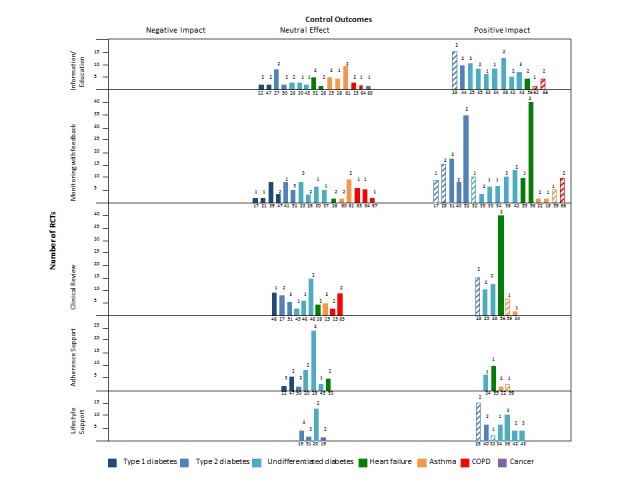
“The greatest volume of evidence was for educational interventions and monitoring of clinical data incorporating feedback, and several reviews, notably those with higher weighting, demonstrated improved outcomes in some (notably type 2 diabetes) but not all conditions (Figure 2).”
§ Telehealth Interventions to Support Self-Management of Long-Term Conditions: A Systematic Metareview of Diabetes, Heart Failure, Asthma, Chronic Obstructive Pulmonary Disease, and Cancer > Discussion > Comparison With Other Literature
boostedcorrelational- Asserted: passes — The authors put it forward as true.
- Checkable: passes — It can be checked against evidence.
- Load-bearing: passes — The paper’s conclusions depend on it.
- Based: passes — The paper gives a reason why it holds.
It may state two separate claims as one.
None of the sources cited for this claim have been checked yet.
In the paper
“For both of these conditions, however, findings were inconsistent between reviews, and analyses of similar interventions reached different conclusions [25,55,57].”
§ Telehealth Interventions to Support Self-Management of Long-Term Conditions: A Systematic Metareview of Diabetes, Heart Failure, Asthma, Chronic Obstructive Pulmonary Disease, and Cancer > Discussion > Statement of Main Findings
What the sources say
plain- Asserted: passes — The authors put it forward as true.
- Checkable: passes — It can be checked against evidence.
- Load-bearing: passes — The paper’s conclusions depend on it.
- Based: passes — The paper gives a reason why it holds.
It may state two separate claims as one.
The paper states this without a source or data behind it here, so there is nothing to check it against. The quote shows it is in the paper.
In the paper
“There was some evidence for telehealth-delivered adherence support in asthma and diabetes, but this was variable and inconsistent.”
§ Telehealth Interventions to Support Self-Management of Long-Term Conditions: A Systematic Metareview of Diabetes, Heart Failure, Asthma, Chronic Obstructive Pulmonary Disease, and Cancer > Discussion > Comparison With Other Literature
hedgedcorrelational- Asserted: passes — The authors put it forward as true.
- Checkable: passes — It can be checked against evidence.
- Load-bearing: unclear — It is unclear whether the paper’s conclusions depend on it.
- Based: passes — The paper gives a reason why it holds.
It may state two separate claims as one.
In the paper
“The rising prevalence of long-term conditions is a major clinical and public health challenge [1].”
§ Telehealth Interventions to Support Self-Management of Long-Term Conditions: A Systematic Metareview of Diabetes, Heart Failure, Asthma, Chronic Obstructive Pulmonary Disease, and Cancer > Introduction
What the sources say
- Not checked yetcites [1] source
plain- Asserted: passes — The authors put it forward as true.
- Checkable: passes — It can be checked against evidence.
- Load-bearing: fails — The paper’s conclusions may not depend on it.
- Based: passes — The paper gives a reason why it holds.
Probably not a substantial claim. The paper’s conclusions may not depend on it.
In the paper
“Telehealth has attracted considerable interest as a means of delivering care to those with long-term conditions [2].”
§ Telehealth Interventions to Support Self-Management of Long-Term Conditions: A Systematic Metareview of Diabetes, Heart Failure, Asthma, Chronic Obstructive Pulmonary Disease, and Cancer > Introduction
What the sources say
- Not checked yetcites [2] source
plain- Asserted: passes — The authors put it forward as true.
- Checkable: fails — It may be too vague to check against evidence.
- Load-bearing: fails — The paper’s conclusions may not depend on it.
- Based: passes — The paper gives a reason why it holds.
Probably not a substantial claim. It may be too vague to check against evidence. The paper’s conclusions may not depend on it.
None of the sources cited for this claim have been checked yet.
In the paper
“Self-management—whereby individuals take on tasks to deal with medical management, role management, or emotional aspects of their condition [6]—is also increasingly recognized as important for effective management of long-term conditions [7-9].”
§ Telehealth Interventions to Support Self-Management of Long-Term Conditions: A Systematic Metareview of Diabetes, Heart Failure, Asthma, Chronic Obstructive Pulmonary Disease, and Cancer > Introduction
What the sources say
- Not checked yetcites [7] Department of HealthOur health, our care, our say: a new direction for community services20062016-09-21London, UKThe Stationary Officehttps://www.gov.uk/government/uploads/system/uploads/attachment_data/file/272238/6737.pdf
- Not checked yetcites [8] Department of HealthA new approach to chronic disease management for the 21st century20012016-09-21http://webarchive.nationalarchives.gov.uk/20130107105354/http://www.dh.gov.uk/prod_consum_dh/groups/dh_digitalassets/@dh/@en/documents/digitalasset/dh_4018578.pdf
- Not checked yetcites [9] World Health OrganizationInnovative care for chronic conditions: building blocks for action20122016-09-21Geneva, SwitzerlandWHOhttp://www.who.int/chp/knowledge/publications/icccglobalreport.pdf
plain- Asserted: passes — The authors put it forward as true.
- Checkable: passes — It can be checked against evidence.
- Load-bearing: passes — The paper’s conclusions depend on it.
- Based: passes — The paper gives a reason why it holds.
Probably not a substantial claim.
A conclusion the paper draws from its own results — it cites no other source for it, so there is none to check. The quote shows it is in the paper.
In the paper
“suggesting that telehealth is a safe option for delivery of self-management support, particularly in conditions such as heart failure and type 2 diabetes, where the evidence base is more developed.”
§ Telehealth Interventions to Support Self-Management of Long-Term Conditions: A Systematic Metareview of Diabetes, Heart Failure, Asthma, Chronic Obstructive Pulmonary Disease, and Cancer > Abstract > Conclusions
hedged- Asserted: passes — The authors put it forward as true.
- Checkable: passes — It can be checked against evidence.
- Load-bearing: passes — The paper’s conclusions depend on it.
- Based: passes — The paper gives a reason why it holds.
It may state two separate claims as one.
- Rests on an assumption: The included systematic reviews adequately assessed and reported harms or negative effects, so the absence of reported harm indicates that telehealth is safe.
What the paper did — it cites no source for this, so there is none to check. The quote shows it is in the paper.
In the paper
“We were unable to register our protocol as PROSPERO (an international prospective register of systematic reviews) does not accept protocols for metareviews.”
§ Telehealth Interventions to Support Self-Management of Long-Term Conditions: A Systematic Metareview of Diabetes, Heart Failure, Asthma, Chronic Obstructive Pulmonary Disease, and Cancer > Methods
plaindirect- Asserted: passes — The authors put it forward as true.
- Checkable: passes — It can be checked against evidence.
- Load-bearing: fails — The paper’s conclusions may not depend on it.
- Based: passes — The paper gives a reason why it holds.
Probably not a substantial claim. The paper’s conclusions may not depend on it.
What the paper did — it cites no source for this, so there is none to check. The quote shows it is in the paper.
In the paper
“We assessed the quality of the included reviews using the revised A Measurement Tool to Assess Systematic Reviews (R-AMSTAR) quality assessment tool.”
§ Telehealth Interventions to Support Self-Management of Long-Term Conditions: A Systematic Metareview of Diabetes, Heart Failure, Asthma, Chronic Obstructive Pulmonary Disease, and Cancer > Methods > Weighting and Quality Assessment
plain- Asserted: passes — The authors put it forward as true.
- Checkable: passes — It can be checked against evidence.
- Load-bearing: passes — The paper’s conclusions depend on it.
- Based: passes — The paper gives a reason why it holds.
Probably not a substantial claim.
What the paper did — it cites no source for this, so there is none to check. The quote shows it is in the paper.
In the paper
“A random sample of 250 abstracts was screened by 2 reviewers (PH and LD).”
§ Telehealth Interventions to Support Self-Management of Long-Term Conditions: A Systematic Metareview of Diabetes, Heart Failure, Asthma, Chronic Obstructive Pulmonary Disease, and Cancer > Methods > Screening of Titles, Abstracts, and Full Texts
plain- Asserted: passes — The authors put it forward as true.
- Checkable: passes — It can be checked against evidence.
- Load-bearing: fails — The paper’s conclusions may not depend on it.
- Based: passes — The paper gives a reason why it holds.
Probably not a substantial claim. The paper’s conclusions may not depend on it.
In the paper
“A systematic overview of self-management interventions (Practical Reviews in Self-Management Support [PRISMS]) demonstrated that self-management support interventions across a range of 14 long-term conditions are complex and multifaceted, involve both the patient and health care professional, and need to be tailored to the individual and their specific condition and context [12].”
§ Telehealth Interventions to Support Self-Management of Long-Term Conditions: A Systematic Metareview of Diabetes, Heart Failure, Asthma, Chronic Obstructive Pulmonary Disease, and Cancer > Introduction
What the sources say
- Not checked yetcites [12] Taylor, S, 2014, Southampton (UK); NIHR Journals Library
boosted- Asserted: passes — The authors put it forward as true.
- Checkable: passes — It can be checked against evidence.
- Load-bearing: passes — The paper’s conclusions depend on it.
- Based: passes — The paper gives a reason why it holds.
Probably not a substantial claim.
What the paper did — it cites no source for this, so there is none to check. The quote shows it is in the paper.
In the paper
“Data were extracted using a piloted data extraction template for included studies (PH), and each study was checked for accuracy (LD).”
§ Telehealth Interventions to Support Self-Management of Long-Term Conditions: A Systematic Metareview of Diabetes, Heart Failure, Asthma, Chronic Obstructive Pulmonary Disease, and Cancer > Methods > Data Extraction and Interpretation
plain- Asserted: passes — The authors put it forward as true.
- Checkable: passes — It can be checked against evidence.
- Load-bearing: fails — The paper’s conclusions may not depend on it.
- Based: passes — The paper gives a reason why it holds.
Probably not a substantial claim. The paper’s conclusions may not depend on it. It may state two separate claims as one.
In the paper
“A systematic overview of self-management interventions (Practical Reviews in Self-Management Support [PRISMS]) demonstrated that self-management support interventions across a range of 14 long-term conditions are complex and multifaceted, involve both the patient and health care professional, and need to be tailored to the individual and their specific condition and context [12].”
§ Telehealth Interventions to Support Self-Management of Long-Term Conditions: A Systematic Metareview of Diabetes, Heart Failure, Asthma, Chronic Obstructive Pulmonary Disease, and Cancer > Introduction
What the sources say
- Not checked yetcites [12] Taylor, S, 2014, Southampton (UK); NIHR Journals Library
boosted- Asserted: passes — The authors put it forward as true.
- Checkable: passes — It can be checked against evidence.
- Load-bearing: passes — The paper’s conclusions depend on it.
- Based: passes — The paper gives a reason why it holds.
Probably not a substantial claim.
None of the sources cited for this claim have been checked yet.
In the paper
“The review found that no single component of self-management interventions could be identified as being more important than others, but also that the detail and quality of reporting of these complex interventions was a barrier to their wider implementation and the understanding of their effective components [12,13].”
§ Telehealth Interventions to Support Self-Management of Long-Term Conditions: A Systematic Metareview of Diabetes, Heart Failure, Asthma, Chronic Obstructive Pulmonary Disease, and Cancer > Introduction
What the sources say
- Not checked yetcites [12] Taylor, S, 2014, Southampton (UK); NIHR Journals Library
- Not checked yetcites [13] Hoffmann, TC, 2013, BMJ source
plain- Asserted: passes — The authors put it forward as true.
- Checkable: passes — It can be checked against evidence.
- Load-bearing: passes — The paper’s conclusions depend on it.
- Based: passes — The paper gives a reason why it holds.
Probably not a substantial claim.
What the paper did — it cites no source for this, so there is none to check. The quote shows it is in the paper.
In the paper
“These were devised and refined by discussion between the authors and are described in Table 3.”
§ Telehealth Interventions to Support Self-Management of Long-Term Conditions: A Systematic Metareview of Diabetes, Heart Failure, Asthma, Chronic Obstructive Pulmonary Disease, and Cancer > Methods > Data Extraction and Interpretation
plain- Asserted: passes — The authors put it forward as true.
- Checkable: passes — It can be checked against evidence.
- Load-bearing: passes — The paper’s conclusions depend on it.
- Based: passes — The paper gives a reason why it holds.
Probably not a substantial claim.
What the paper did — it cites no source for this, so there is none to check. The quote shows it is in the paper.
In the paper
“A kappa statistic of agreement was calculated using IBM SPSS version 22 (IBM Corporation) and was high (0.96).”
§ Telehealth Interventions to Support Self-Management of Long-Term Conditions: A Systematic Metareview of Diabetes, Heart Failure, Asthma, Chronic Obstructive Pulmonary Disease, and Cancer > Methods > Screening of Titles, Abstracts, and Full Texts
plain- Asserted: passes — The authors put it forward as true.
- Checkable: passes — It can be checked against evidence.
- Load-bearing: fails — The paper’s conclusions may not depend on it.
- Based: passes — The paper gives a reason why it holds.
Probably not a substantial claim. The paper’s conclusions may not depend on it.
What the paper did — it cites no source for this, so there is none to check. The quote shows it is in the paper.
In the paper
“Each included review was assessed independently by 2 reviewers (PH and LD) and disagreements were resolved by discussion.”
§ Telehealth Interventions to Support Self-Management of Long-Term Conditions: A Systematic Metareview of Diabetes, Heart Failure, Asthma, Chronic Obstructive Pulmonary Disease, and Cancer > Methods > Weighting and Quality Assessment
plain- Asserted: passes — The authors put it forward as true.
- Checkable: passes — It can be checked against evidence.
- Load-bearing: passes — The paper’s conclusions depend on it.
- Based: passes — The paper gives a reason why it holds.
Probably not a substantial claim. It may state two separate claims as one.
In the paper
“Telehealth has been proposed as one mechanism by which self-management may be promoted and enabled [10]”
§ Telehealth Interventions to Support Self-Management of Long-Term Conditions: A Systematic Metareview of Diabetes, Heart Failure, Asthma, Chronic Obstructive Pulmonary Disease, and Cancer > Introduction
What the sources say
- Not checked yetcites [10] Steventon, A, 2012, BMJ source
hedgedconditional- Asserted: passes — The authors put it forward as true.
- Checkable: passes — It can be checked against evidence.
- Load-bearing: passes — The paper’s conclusions depend on it.
- Based: passes — The paper gives a reason why it holds.
Probably not a substantial claim.
What the paper did — it cites no source for this, so there is none to check. The quote shows it is in the paper.
In the paper
“Full texts of all potentially eligible articles were assessed independently by 2 reviewers (PH and LD).”
§ Telehealth Interventions to Support Self-Management of Long-Term Conditions: A Systematic Metareview of Diabetes, Heart Failure, Asthma, Chronic Obstructive Pulmonary Disease, and Cancer > Methods > Screening of Titles, Abstracts, and Full Texts
plain- Asserted: passes — The authors put it forward as true.
- Checkable: passes — It can be checked against evidence.
- Load-bearing: fails — The paper’s conclusions may not depend on it.
- Based: passes — The paper gives a reason why it holds.
Probably not a substantial claim. The paper’s conclusions may not depend on it.
What the paper did — it cites no source for this, so there is none to check. The quote shows it is in the paper.
In the paper
“The overlap in included RCTs (ie, reviews with similar inclusion criteria may include the same RCTs) precluded meta-analysis of the review findings; we therefore undertook a narrative synthesis.”
§ Telehealth Interventions to Support Self-Management of Long-Term Conditions: A Systematic Metareview of Diabetes, Heart Failure, Asthma, Chronic Obstructive Pulmonary Disease, and Cancer > Methods > Data Extraction and Interpretation
plaindirect- Asserted: passes — The authors put it forward as true.
- Checkable: passes — It can be checked against evidence.
- Load-bearing: passes — The paper’s conclusions depend on it.
- Based: passes — The paper gives a reason why it holds.
It may state two separate claims as one.
- Rests on an assumption: The included reviews' findings can be meaningfully combined in a narrative synthesis and harvest plots despite heterogeneity in outcomes and methods.
In the paper
“A systematic overview of self-management interventions (Practical Reviews in Self-Management Support [PRISMS]) demonstrated that self-management support interventions across a range of 14 long-term conditions are complex and multifaceted, involve both the patient and health care professional, and need to be tailored to the individual and their specific condition and context [12].”
§ Telehealth Interventions to Support Self-Management of Long-Term Conditions: A Systematic Metareview of Diabetes, Heart Failure, Asthma, Chronic Obstructive Pulmonary Disease, and Cancer > Introduction
What the sources say
- Not checked yetcites [12] Taylor, S, 2014, Southampton (UK); NIHR Journals Library
boosted- Asserted: passes — The authors put it forward as true.
- Checkable: passes — It can be checked against evidence.
- Load-bearing: fails — The paper’s conclusions may not depend on it.
- Based: passes — The paper gives a reason why it holds.
Probably not a substantial claim. The paper’s conclusions may not depend on it.
What the paper did — it cites no source for this, so there is none to check. The quote shows it is in the paper.
In the paper
“Inclusion criteria were piloted by 2 authors (PH and HP) and disagreements were resolved by discussion with all authors.”
§ Telehealth Interventions to Support Self-Management of Long-Term Conditions: A Systematic Metareview of Diabetes, Heart Failure, Asthma, Chronic Obstructive Pulmonary Disease, and Cancer > Methods > Screening of Titles, Abstracts, and Full Texts
plain- Asserted: passes — The authors put it forward as true.
- Checkable: passes — It can be checked against evidence.
- Load-bearing: fails — The paper’s conclusions may not depend on it.
- Based: passes — The paper gives a reason why it holds.
Probably not a substantial claim. The paper’s conclusions may not depend on it. It may state two separate claims as one.
What the paper did — it cites no source for this, so there is none to check. The quote shows it is in the paper.
In the paper
“We carried it out according to a prespecified protocol.”
§ Telehealth Interventions to Support Self-Management of Long-Term Conditions: A Systematic Metareview of Diabetes, Heart Failure, Asthma, Chronic Obstructive Pulmonary Disease, and Cancer > Methods
plain- Asserted: passes — The authors put it forward as true.
- Checkable: passes — It can be checked against evidence.
- Load-bearing: fails — The paper’s conclusions may not depend on it.
- Based: passes — The paper gives a reason why it holds.
Probably not a substantial claim. The paper’s conclusions may not depend on it.
The paper states this without a source or data behind it here, so there is nothing to check it against. The quote shows it is in the paper.
In the paper
“Several of these components could be potentially delivered via telehealth, and may be grouped and considered under the following headings:”
§ Telehealth Interventions to Support Self-Management of Long-Term Conditions: A Systematic Metareview of Diabetes, Heart Failure, Asthma, Chronic Obstructive Pulmonary Disease, and Cancer > Introduction
hedged- Asserted: passes — The authors put it forward as true.
- Checkable: passes — It can be checked against evidence.
- Load-bearing: fails — The paper’s conclusions may not depend on it.
- Based: passes — The paper gives a reason why it holds.
Probably not a substantial claim. The paper’s conclusions may not depend on it.
In the paper
“This taxonomy identified 14 separate components that might be adapted and used to support self-management across a range of long-term conditions.”
§ Telehealth Interventions to Support Self-Management of Long-Term Conditions: A Systematic Metareview of Diabetes, Heart Failure, Asthma, Chronic Obstructive Pulmonary Disease, and Cancer > Introduction
What the sources say
- Not checked yetcites [14] source
hedged- Asserted: passes — The authors put it forward as true.
- Checkable: passes — It can be checked against evidence.
- Load-bearing: passes — The paper’s conclusions depend on it.
- Based: passes — The paper gives a reason why it holds.
Probably not a substantial claim.
A conclusion the paper draws from its own results — it cites no other source for it, so there is none to check. The quote shows it is in the paper.
In the paper
“Active self-monitoring of blood glucose data appeared to be most consistently associated with improved outcomes, although this was not consistent across reviews.”
§ Telehealth Interventions to Support Self-Management of Long-Term Conditions: A Systematic Metareview of Diabetes, Heart Failure, Asthma, Chronic Obstructive Pulmonary Disease, and Cancer > Results > Impact of Telehealth Interventions on Disease Control and Health Care Utilization
hedgedcorrelational- Asserted: passes — The authors put it forward as true.
- Checkable: passes — It can be checked against evidence.
- Load-bearing: passes — The paper’s conclusions depend on it.
- Based: passes — The paper gives a reason why it holds.
It may state two separate claims as one.
A conclusion the paper draws from its own results — it cites no other source for it, so there is none to check. The quote shows it is in the paper.
In the paper
“Evidence for telephone support was more limited, although it may be effective as part of intensive interventions.”
§ Telehealth Interventions to Support Self-Management of Long-Term Conditions: A Systematic Metareview of Diabetes, Heart Failure, Asthma, Chronic Obstructive Pulmonary Disease, and Cancer > Results > Impact of Telehealth Interventions on Disease Control and Health Care Utilization
hedgedconditional- Asserted: passes — The authors put it forward as true.
- Checkable: passes — It can be checked against evidence.
- Load-bearing: passes — The paper’s conclusions depend on it.
- Based: passes — The paper gives a reason why it holds.
It may state two separate claims as one.
In the paper
“The authors concluded that benefits were unlikely in mild asthma but that those at higher risk of hospitalization may benefit.”
§ Telehealth Interventions to Support Self-Management of Long-Term Conditions: A Systematic Metareview of Diabetes, Heart Failure, Asthma, Chronic Obstructive Pulmonary Disease, and Cancer > Results > Impact of Telehealth Interventions on Disease Control and Health Care Utilization
What the sources say
- Not checked yetcites [63] source
hedgedconditional- Asserted: passes — The authors put it forward as true.
- Checkable: passes — It can be checked against evidence.
- Load-bearing: passes — The paper’s conclusions depend on it.
- Based: passes — The paper gives a reason why it holds.
It may state two separate claims as one.
In the paper
“The authors emphasized that, despite some positive findings, the telehealth interventions were components in complex interventions and further evaluation would be required to clarify their role in COPD [68].”
§ Telehealth Interventions to Support Self-Management of Long-Term Conditions: A Systematic Metareview of Diabetes, Heart Failure, Asthma, Chronic Obstructive Pulmonary Disease, and Cancer > Results > Impact of Telehealth Interventions on Disease Control and Health Care Utilization
What the sources say
- Not checked yetcites [68] source
hedged- Asserted: passes — The authors put it forward as true.
- Checkable: passes — It can be checked against evidence.
- Load-bearing: passes — The paper’s conclusions depend on it.
- Based: passes — The paper gives a reason why it holds.
Probably not a substantial claim. It may state two separate claims as one.
In the paper
“The authors concluded that a range of these components need to be incorporated into telehealth interventions for clinically significant improvements in diabetes self-management to be seen.”
§ Telehealth Interventions to Support Self-Management of Long-Term Conditions: A Systematic Metareview of Diabetes, Heart Failure, Asthma, Chronic Obstructive Pulmonary Disease, and Cancer > Results > Telehealth-Supported Components of Self-Management and Their Impact on Disease Control and the Process of Self-Management
What the sources say
- Not checked yetcites [30] source
plainconditional- Asserted: passes — The authors put it forward as true.
- Checkable: passes — It can be checked against evidence.
- Load-bearing: passes — The paper’s conclusions depend on it.
- Based: passes — The paper gives a reason why it holds.
Probably not a substantial claim.
In the paper
“A recent metareview of heart failure telemonitoring interventions showed a reduction in all-cause mortality (relative risk 0.60-0.85) and heart failure hospitalizations (relative risk 0.64-0.86) in an analysis of 15 meta-analyses [74].”
§ Telehealth Interventions to Support Self-Management of Long-Term Conditions: A Systematic Metareview of Diabetes, Heart Failure, Asthma, Chronic Obstructive Pulmonary Disease, and Cancer > Discussion > Comparison With Other Literature
What the sources say
- Not checked yetcites [74] source
plaindirect- Asserted: passes — The authors put it forward as true.
- Checkable: passes — It can be checked against evidence.
- Load-bearing: unclear — It is unclear whether the paper’s conclusions depend on it.
- Based: passes — The paper gives a reason why it holds.
It may state two separate claims as one.
What the paper did — it cites no source for this, so there is none to check. The quote shows it is in the paper.
In the paper
“We designed the rules used to determine how each review was displayed in the harvest plots to ensure that the assessment of reviews was consistent and transparent.”
§ Telehealth Interventions to Support Self-Management of Long-Term Conditions: A Systematic Metareview of Diabetes, Heart Failure, Asthma, Chronic Obstructive Pulmonary Disease, and Cancer > Discussion > Strengths and Limitations
plaindirect- Asserted: passes — The authors put it forward as true.
- Checkable: passes — It can be checked against evidence.
- Load-bearing: fails — The paper’s conclusions may not depend on it.
- Based: passes — The paper gives a reason why it holds.
Probably not a substantial claim. The paper’s conclusions may not depend on it.
What the paper did — it cites no source for this, so there is none to check. The quote shows it is in the paper.
In the paper
“However, we developed clear rules for the inclusion criteria and undertook duplicate full-text screening, but this might have resulted in some inappropriate inclusions or exclusions due to limited description of interventions.”
§ Telehealth Interventions to Support Self-Management of Long-Term Conditions: A Systematic Metareview of Diabetes, Heart Failure, Asthma, Chronic Obstructive Pulmonary Disease, and Cancer > Discussion > Strengths and Limitations
hedgedconditional- Asserted: passes — The authors put it forward as true.
- Checkable: passes — It can be checked against evidence.
- Load-bearing: fails — The paper’s conclusions may not depend on it.
- Based: passes — The paper gives a reason why it holds.
Probably not a substantial claim. The paper’s conclusions may not depend on it. It may state two separate claims as one.
In the paper
“Greenwood et al concluded that a range of components (including educational, self-monitoring, goal-driven, and interactive elements) were important in improving glycemic control [30] and emphasized the multifaceted nature of self-management support.”
§ Telehealth Interventions to Support Self-Management of Long-Term Conditions: A Systematic Metareview of Diabetes, Heart Failure, Asthma, Chronic Obstructive Pulmonary Disease, and Cancer > Discussion > Comparison With Other Literature
What the sources say
- Not checked yetcites [30] source
plaindirect- Asserted: passes — The authors put it forward as true.
- Checkable: passes — It can be checked against evidence.
- Load-bearing: fails — The paper’s conclusions may not depend on it.
- Based: passes — The paper gives a reason why it holds.
Probably not a substantial claim. The paper’s conclusions may not depend on it. It may state two separate claims as one.
A conclusion the paper draws from its own results — it cites no other source for it, so there is none to check. The quote shows it is in the paper.
In the paper
“While telehealth interventions were not consistently found to be superior to usual care, none of the reviews reported any negative effects, suggesting that telehealth is a safe alternative mode of delivery for self-management support, particularly in conditions such as heart failure and type 2 diabetes, where the evidence base is more developed.”
§ Telehealth Interventions to Support Self-Management of Long-Term Conditions: A Systematic Metareview of Diabetes, Heart Failure, Asthma, Chronic Obstructive Pulmonary Disease, and Cancer > Discussion > Conclusions
hedged- Asserted: passes — The authors put it forward as true.
- Checkable: passes — It can be checked against evidence.
- Load-bearing: passes — The paper’s conclusions depend on it.
- Based: passes — The paper gives a reason why it holds.
It may state two separate claims as one.
What the paper did — it cites no source for this, so there is none to check. The quote shows it is in the paper.
In the paper
“Any systematic review is limited by the time delay from completion of a primary study to publication, and subsequently conducting the review itself. By reviewing systematic reviews, this lag time is further extended and, as such, the results risk being out of date”
§ Telehealth Interventions to Support Self-Management of Long-Term Conditions: A Systematic Metareview of Diabetes, Heart Failure, Asthma, Chronic Obstructive Pulmonary Disease, and Cancer > Discussion > Strengths and Limitations
plaindirect- Asserted: passes — The authors put it forward as true.
- Checkable: passes — It can be checked against evidence.
- Load-bearing: unclear — It is unclear whether the paper’s conclusions depend on it.
- Based: passes — The paper gives a reason why it holds.
It may state two separate claims as one.
What the paper did — it cites no source for this, so there is none to check. The quote shows it is in the paper.
In the paper
“By relying on systematic review findings, the evidence is 1 step removed from the empirical evidence, and thus reliant on the interpretation of the review authors. This was mitigated to some extent by assessing the methodological quality of the reviews and using this to weight the evidence.”
§ Telehealth Interventions to Support Self-Management of Long-Term Conditions: A Systematic Metareview of Diabetes, Heart Failure, Asthma, Chronic Obstructive Pulmonary Disease, and Cancer > Discussion > Strengths and Limitations
plain- Asserted: passes — The authors put it forward as true.
- Checkable: passes — It can be checked against evidence.
- Load-bearing: fails — The paper’s conclusions may not depend on it.
- Based: passes — The paper gives a reason why it holds.
Probably not a substantial claim. The paper’s conclusions may not depend on it. It may state two separate claims as one.
What the paper did — it cites no source for this, so there is none to check. The quote shows it is in the paper.
In the paper
“Specifying that more than 50% of RCTs in a narrative synthesis must show positive results for a review to be considered as having consistently positive findings avoids overly optimistic interpretation, but risks overlooking individual RCTs that may be particularly relevant to the review question.”
§ Telehealth Interventions to Support Self-Management of Long-Term Conditions: A Systematic Metareview of Diabetes, Heart Failure, Asthma, Chronic Obstructive Pulmonary Disease, and Cancer > Discussion > Strengths and Limitations
plainconditional- Asserted: passes — The authors put it forward as true.
- Checkable: fails — It may be too vague to check against evidence.
- Load-bearing: fails — The paper’s conclusions may not depend on it.
- Based: passes — The paper gives a reason why it holds.
Probably not a substantial claim. It may be too vague to check against evidence. The paper’s conclusions may not depend on it. It may state two separate claims as one.
None of the sources cited for this claim have been checked yet.
In the paper
“Interventions with multiple components, or more intensive interventions, may be associated with greater benefits [30,53,63,68].”
§ Telehealth Interventions to Support Self-Management of Long-Term Conditions: A Systematic Metareview of Diabetes, Heart Failure, Asthma, Chronic Obstructive Pulmonary Disease, and Cancer > Discussion > Statement of Main Findings
What the sources say
hedgedcorrelational- Asserted: passes — The authors put it forward as true.
- Checkable: passes — It can be checked against evidence.
- Load-bearing: passes — The paper’s conclusions depend on it.
- Based: passes — The paper gives a reason why it holds.
It may state two separate claims as one.
In the paper
“An overview of telehealth across a number of conditions noted modest improvements in HbA1c in some reviews with others noting no overall effect [2].”
§ Telehealth Interventions to Support Self-Management of Long-Term Conditions: A Systematic Metareview of Diabetes, Heart Failure, Asthma, Chronic Obstructive Pulmonary Disease, and Cancer > Discussion > Comparison With Other Literature
What the sources say
- Not checked yetcites [2] source
plainconditional- Asserted: passes — The authors put it forward as true.
- Checkable: passes — It can be checked against evidence.
- Load-bearing: fails — The paper’s conclusions may not depend on it.
- Based: passes — The paper gives a reason why it holds.
Probably not a substantial claim. The paper’s conclusions may not depend on it. It may state two separate claims as one.
What the paper did — it cites no source for this, so there is none to check. The quote shows it is in the paper.
In the paper
“A metareview such as this is thus well suited to forming an overview of the topic, but loses granularity and detail of the evidence, a limitation particularly evident when attempting to analyze components of self-management support.”
§ Telehealth Interventions to Support Self-Management of Long-Term Conditions: A Systematic Metareview of Diabetes, Heart Failure, Asthma, Chronic Obstructive Pulmonary Disease, and Cancer > Discussion > Strengths and Limitations
plaindirect- Asserted: passes — The authors put it forward as true.
- Checkable: fails — It may be too vague to check against evidence.
- Load-bearing: passes — The paper’s conclusions depend on it.
- Based: passes — The paper gives a reason why it holds.
Probably not a substantial claim. It may be too vague to check against evidence. It may state two separate claims as one.
What the paper did — it cites no source for this, so there is none to check. The quote shows it is in the paper.
In the paper
“There is also overlap in the included RCTs, which risks overrepresenting the results of a few RCTs included in several systematic reviews and giving a false impression of consensus.”
§ Telehealth Interventions to Support Self-Management of Long-Term Conditions: A Systematic Metareview of Diabetes, Heart Failure, Asthma, Chronic Obstructive Pulmonary Disease, and Cancer > Discussion > Strengths and Limitations
plainconditional- Asserted: passes — The authors put it forward as true.
- Checkable: passes — It can be checked against evidence.
- Load-bearing: passes — The paper’s conclusions depend on it.
- Based: passes — The paper gives a reason why it holds.
It may state two separate claims as one.
A conclusion the paper draws from its own results — it cites no other source for it, so there is none to check. The quote shows it is in the paper.
In the paper
“Improvements may be more readily seen in those with more severe disease.”
§ Telehealth Interventions to Support Self-Management of Long-Term Conditions: A Systematic Metareview of Diabetes, Heart Failure, Asthma, Chronic Obstructive Pulmonary Disease, and Cancer > Discussion > Conclusions
hedgedconditional- Asserted: passes — The authors put it forward as true.
- Checkable: passes — It can be checked against evidence.
- Load-bearing: fails — The paper’s conclusions may not depend on it.
- Based: fails — The paper may give no reason why it holds.
Probably not a substantial claim. The paper’s conclusions may not depend on it. The paper may give no reason why it holds.
In the paper
“A strength of metareview methodology is that it allows a relatively rapid synthesis of a large body of primary literature and enables a broad overview of a subject area [15].”
§ Telehealth Interventions to Support Self-Management of Long-Term Conditions: A Systematic Metareview of Diabetes, Heart Failure, Asthma, Chronic Obstructive Pulmonary Disease, and Cancer > Discussion > Strengths and Limitations
What the sources say
- Not checked yetcites [15] source
plaindirect- Asserted: passes — The authors put it forward as true.
- Checkable: passes — It can be checked against evidence.
- Load-bearing: fails — The paper’s conclusions may not depend on it.
- Based: passes — The paper gives a reason why it holds.
Probably not a substantial claim. The paper’s conclusions may not depend on it. It may state two separate claims as one.
What the paper did — it cites no source for this, so there is none to check. The quote shows it is in the paper.
In the paper
“Overlap precludes meta-analysis, but the use of harvest plots provides a visual synthesis of the findings of each individual review.”
§ Telehealth Interventions to Support Self-Management of Long-Term Conditions: A Systematic Metareview of Diabetes, Heart Failure, Asthma, Chronic Obstructive Pulmonary Disease, and Cancer > Discussion > Strengths and Limitations
plaindirect- Asserted: passes — The authors put it forward as true.
- Checkable: passes — It can be checked against evidence.
- Load-bearing: passes — The paper’s conclusions depend on it.
- Based: passes — The paper gives a reason why it holds.
Probably not a substantial claim. It may state two separate claims as one.
What the paper did — it cites no source for this, so there is none to check. The quote shows it is in the paper.
In the paper
“In addition, we identified reviews that focused specifically on self-management and incorporated this into the weighting system, so as to minimize the impact of this limitation on the interpretation of the findings.”
§ Telehealth Interventions to Support Self-Management of Long-Term Conditions: A Systematic Metareview of Diabetes, Heart Failure, Asthma, Chronic Obstructive Pulmonary Disease, and Cancer > Discussion > Strengths and Limitations
plaindirect- Asserted: passes — The authors put it forward as true.
- Checkable: passes — It can be checked against evidence.
- Load-bearing: passes — The paper’s conclusions depend on it.
- Based: passes — The paper gives a reason why it holds.
Probably not a substantial claim. It may state two separate claims as one.
A conclusion the paper draws from its own results — it cites no other source for it, so there is none to check. The quote shows it is in the paper.
In the paper
“The decision to adopt telehealth strategies will be determined not only by clinical or demographic circumstances but also by patient or clinician preference.”
§ Telehealth Interventions to Support Self-Management of Long-Term Conditions: A Systematic Metareview of Diabetes, Heart Failure, Asthma, Chronic Obstructive Pulmonary Disease, and Cancer > Discussion > Conclusions
plaindirect- Asserted: passes — The authors put it forward as true.
- Checkable: passes — It can be checked against evidence.
- Load-bearing: passes — The paper’s conclusions depend on it.
- Based: fails — The paper may give no reason why it holds.
Probably not a substantial claim. The paper may give no reason why it holds. It may state two separate claims as one.
A conclusion the paper draws from its own results — it cites no other source for it, so there is none to check. The quote shows it is in the paper.
In the paper
“Taken together, it appears that, while not consistently superior to usual care, telehealth is a safe alternative mode of delivery for self-management support, particularly in conditions such as heart failure and type 2 diabetes, where the evidence base is more developed.”
§ Telehealth Interventions to Support Self-Management of Long-Term Conditions: A Systematic Metareview of Diabetes, Heart Failure, Asthma, Chronic Obstructive Pulmonary Disease, and Cancer > Discussion > Comparison With Other Literature
hedged- Asserted: passes — The authors put it forward as true.
- Checkable: passes — It can be checked against evidence.
- Load-bearing: passes — The paper’s conclusions depend on it.
- Based: passes — The paper gives a reason why it holds.
It may state two separate claims as one.
None of the sources cited for this claim have been checked yet.
In the paper
“Such questions have been addressed using qualitative methodologies [75], which have highlighted that users valued convenience [76], a sense of being “watched over” [11,77], and finding the telemonitoring data reassuring [78].”
§ Telehealth Interventions to Support Self-Management of Long-Term Conditions: A Systematic Metareview of Diabetes, Heart Failure, Asthma, Chronic Obstructive Pulmonary Disease, and Cancer > Discussion > Comparison With Other Literature
What the sources say
- Not checked yetcites [75] Medical Research CouncilDeveloping and evaluating complex interventions: new guidance20062016-09-21Swindon, UKMRChttp://www.mrc.ac.uk/documents/pdf/complex-interventions-guidance/
- Not checked yetcites [76] source
- Not checked yetcites [11] source
- Not checked yetcites [77] source
plain- Asserted: passes — The authors put it forward as true.
- Checkable: passes — It can be checked against evidence.
- Load-bearing: unclear — It is unclear whether the paper’s conclusions depend on it.
- Based: passes — The paper gives a reason why it holds.
It may state two separate claims as one.
What the paper did — it cites no source for this, so there is none to check. The quote shows it is in the paper.
In the paper
“However, we selected common conditions, 5 of which had a good evidence base for telehealth or self-management, or both, and included 1 area (cancer) in which these concepts are still at an early stage.”
§ Telehealth Interventions to Support Self-Management of Long-Term Conditions: A Systematic Metareview of Diabetes, Heart Failure, Asthma, Chronic Obstructive Pulmonary Disease, and Cancer > Discussion > Strengths and Limitations
plain- Asserted: passes — The authors put it forward as true.
- Checkable: passes — It can be checked against evidence.
- Load-bearing: passes — The paper’s conclusions depend on it.
- Based: fails — The paper may give no reason why it holds.
Probably not a substantial claim. The paper may give no reason why it holds. It may state two separate claims as one.
A conclusion the paper draws from its own results — it cites no other source for it, so there is none to check. The quote shows it is in the paper.
In the paper
“The relative lack of data for cancer may reflect a lack of research in this field or simply that the available evidence has yet to be synthesized in a systematic review.”
§ Telehealth Interventions to Support Self-Management of Long-Term Conditions: A Systematic Metareview of Diabetes, Heart Failure, Asthma, Chronic Obstructive Pulmonary Disease, and Cancer > Discussion > Strengths and Limitations
hedgedconditional- Asserted: passes — The authors put it forward as true.
- Checkable: fails — It may be too vague to check against evidence.
- Load-bearing: fails — The paper’s conclusions may not depend on it.
- Based: passes — The paper gives a reason why it holds.
Probably not a substantial claim. It may be too vague to check against evidence. The paper’s conclusions may not depend on it. It may state two separate claims as one.
What the paper did — it cites no source for this, so there is none to check. The quote shows it is in the paper.
In the paper
“This metareview considered only 6 long-term conditions and may have reached different conclusions had we selected a different set of conditions.”
§ Telehealth Interventions to Support Self-Management of Long-Term Conditions: A Systematic Metareview of Diabetes, Heart Failure, Asthma, Chronic Obstructive Pulmonary Disease, and Cancer > Discussion > Strengths and Limitations
hedgedconditional- Asserted: passes — The authors put it forward as true.
- Checkable: passes — It can be checked against evidence.
- Load-bearing: fails — The paper’s conclusions may not depend on it.
- Based: passes — The paper gives a reason why it holds.
Probably not a substantial claim. The paper’s conclusions may not depend on it. It may state two separate claims as one.
The paper relies on this without support.
The included systematic reviews adequately assessed and reported harms or negative effects, so the absence of reported harm indicates that telehealth is safe.
“none of the reviews reported any negative effects”
“no reviews showed evidence of harm”
The paper relies on this without support.
The extent to which telehealth effectively promotes self-management, and the components of telehealth interventions that contribute to this goal, remain unclear.
“The extent to which telehealth effectively promotes self-management, and the components of telehealth interventions that contribute to this goal, remain unclear.”
The paper relies on this without support.
The included reviews' findings can be meaningfully combined in a narrative synthesis and harvest plots despite heterogeneity in outcomes and methods.
“we therefore undertook a narrative synthesis”
“We used harvest plots to illustrate the disease control outcomes related to telehealth-supported self-management components [17,18].”
The paper relies on this without support.
The included systematic reviews collectively provide a sufficiently complete and unbiased evidence base for the metareview's conclusions about telehealth for self-management of the six conditions.
“By relying on systematic review findings, the evidence is 1 step removed from the empirical evidence, and thus reliant on the interpretation of the review authors.”
The paper relies on this without support.
The six selected long-term conditions are representative enough to generalize the metareview's conclusions about telehealth for self-management to long-term conditions more broadly.
“This metareview considered only 6 long-term conditions and may have reached different conclusions had we selected a different set of conditions.”
Claims other papers make about this one
Each is checked against this paper’s own text: does it say what the citing paper says it does?
The cited source says what the claim attributes to it.
In the citing paper
“Our findings confirm previous reviews [177,178] while expanding the results to populations outside care homes [178] and including study designs other than RCTs [177].”
From Interactive Remote Patient Monitoring Devices for Managing Chronic Health Conditions: Systematic Review and Meta-analysis (2022) · cites this paper as [177]
In the citing paper
“However, these previous reviews have often focused on a specific type of telemedicine, a specific outcome, and/or a specific comparator, which calls for a more comprehensive and inclusive systematic review seeking to compare and synthesize findings for treatment outcomes while adjusting for different study characteristics.”
From The Effectiveness of Telemedicine Solutions for the Management of Type 2 Diabetes: A Systematic Review, Meta-Analysis, and Meta-Regression (2023) · cites this paper as [17]
In the citing paper
“In terms of telemonitoring, Hanlon et al found improved glycemic control in studies that included telemonitoring with feedback 17”
From The Effectiveness of Telemedicine Solutions for the Management of Type 2 Diabetes: A Systematic Review, Meta-Analysis, and Meta-Regression (2023) · cites this paper as [17]
Self-check
Percentages, sums and reported differences re-computed from the paper’s own numbers.
Each contradiction between two passages listed here was confirmed by an independent check.
Rated minor: it would not touch a result — a value no result rests on, a p-value that stays on the same side of the significance level, or a conflict that is clerical, resolved elsewhere in the paper, or outside its own findings.
In the paper
§ Telehealth Interventions to Support Self-Management of Long-Term Conditions: A Systematic Metareview of Diabetes, Heart Failure, Asthma, Chronic Obstructive Pulmonary Disease, and Cancer > Results > Impact of Telehealth Interventions on Disease Control and Health Care Utilization
“A total of 4 reviews (3 meta-analyses and 1 narrative syntheses) analyzed the impact of telehealth on all-cause mortality, and none showed a significant difference versus usual care [65,66,68,69,71,72].”
§ Telehealth Interventions to Support Self-Management of Long-Term Conditions: A Systematic Metareview of Diabetes, Heart Failure, Asthma, Chronic Obstructive Pulmonary Disease, and Cancer > Results > Impact of Telehealth Interventions on Disease Control and Health Care Utilization
“Four 1-star weighted narrative syntheses emphasized either a lack [27,64,65] or a low quality [66] of evidence for improved health outcomes.”
Rated minor: it would not touch a result — a value no result rests on, a p-value that stays on the same side of the significance level, or a conflict that is clerical, resolved elsewhere in the paper, or outside its own findings.
In the paper
§ Telehealth Interventions to Support Self-Management of Long-Term Conditions: A Systematic Metareview of Diabetes, Heart Failure, Asthma, Chronic Obstructive Pulmonary Disease, and Cancer > Abstract > Results
“We included 53 systematic reviews, comprising 232 unique RCTs.”
§ Telehealth Interventions to Support Self-Management of Long-Term Conditions: A Systematic Metareview of Diabetes, Heart Failure, Asthma, Chronic Obstructive Pulmonary Disease, and Cancer > Results > Search Results
“These presented data from 231 unique RCTs (119 diabetes, 58 heart failure, 28 asthma, 23 COPD, and 3 cancer).”
Rated minor: it would not touch a result — a value no result rests on, a p-value that stays on the same side of the significance level, or a conflict that is clerical, resolved elsewhere in the paper, or outside its own findings.
In the paper
§ Telehealth Interventions to Support Self-Management of Long-Term Conditions: A Systematic Metareview of Diabetes, Heart Failure, Asthma, Chronic Obstructive Pulmonary Disease, and Cancer > Results > Impact of Telehealth Interventions on Disease Control and Health Care Utilization
“Of the 3 reviews that included cancer RCTs, 2 contained analyses of physical outcomes [21,70]. Both reviews were 2-star weighted.”
§ Telehealth Interventions to Support Self-Management of Long-Term Conditions: A Systematic Metareview of Diabetes, Heart Failure, Asthma, Chronic Obstructive Pulmonary Disease, and Cancer > Results > Quality and Weighting of Included Reviews
“8 reviews received an evidence weighting of 3 stars [16,21,25,26,38,45,53,56], 23 received 2 stars [22,24,27-31, 33,37,40,42,44,46,49,50,52,54,55,58,62,63,67,68], 21 received 1 star [19,20,23,32,34-36,39,43,47,48,51,57, 59-61,64-66,69,70]”
Citations
Cites
Self-efficacy: Toward a unifying theory of behavioral change
Bandura, A. (1977) · Psychological Review · doi:10.1037/0033-295x.84.2.191 · Cited by 43,925
Self-efficacy: Toward a unifying theory of behavioral change
Bandura, A. (1978) · Advances in Behaviour Research and Therapy · doi:10.1016/0146-6402(78)90002-4 · Cited by 10,586
Barnett, K., Mercer, S. W., Norbury, M., Watt, G., Wyke, S., & Guthrie, B. (2012) · The Lancet · doi:10.1016/s0140-6736(12)60240-2 · Cited by 6,972 · cited 1×
“The rising prevalence of long-term conditions is a major clinical and public health challenge [1].”
Methodology in conducting a systematic review of systematic reviews of healthcare interventions
Smith, V., Devane, D., Begley, C. M., & Clarke, M. (2011) · BMC Medical Research Methodology · doi:10.1186/1471-2288-11-15 · Cited by 1,227 · cited 2×
“A strength of metareview methodology is that it allows a relatively rapid synthesis of a large body of primary literature and enables a broad overview of a subject area [15].”
Effectiveness of telemedicine: A systematic review of reviews
Ekeland, A. G., Bowes, A., & Flottorp, S. (2010) · International Journal of Medical Informatics · doi:10.1016/j.ijmedinf.2010.08.006 · Cited by 1,162 · cited 1×
“Definitions of telehealth are many and varied [3], and the technologies involved are novel and evolving [4]: in this paper we use the term to refer to any use”
Hamine, S., Gerth-Guyette, E., Faulx, D., Green, B. B., & Ginsburg, A. S. (2015) · Journal of Medical Internet Research · doi:10.2196/jmir.3951 · Cited by 1,149 · cited 5×
“A total of 53 systematic reviews met the inclusion criteria [16,19-70].”
InfluentialHealthcare via Cell Phones: A Systematic Review
Krishna, S., Boren, S. A., & Balas, E. A. (2009) · Telemedicine and e-Health · doi:10.1089/tmj.2008.0099 · Cited by 882 · cited 8×
“Supported education and information interventions were particularly effective in the context of diabetes, with 9 larger systematic reviews showing evidence of improvement in HbA1c [27,30,35-37,40,44-46].”
InfluentialInteractive telemedicine: effects on professional practice and health care outcomes
Flodgren, G., Rachas, A., Farmer, A. J., Inzitari, M., & Shepperd, S. (2015) · Cochrane Database of Systematic Reviews · doi:10.1002/14651858.cd002098.pub2 · Cited by 806 · cited 10×
“A total of 53 systematic reviews met the inclusion criteria [16,19-70].”
InfluentialO’Connor, S., Hanlon, P., O’Donnell, C. A., Garcia, S., Glanville, J., & Mair, F. S. (2016) · BMC Medical Informatics and Decision Making · doi:10.1186/s12911-016-0359-3 · Cited by 636
Self-citationWhat Is Telemedicine? A Collection of 104 Peer-Reviewed Perspectives and Theoretical Underpinnings
Sood, S., Mbarika, V., Jugoo, S., Dookhy, R., Doarn, C. R., Prakash, N., & Merrell, R. C. (2007) · Telemedicine and e-Health · doi:10.1089/tmj.2006.0073 · Cited by 627 · cited 1×
“Definitions of telehealth are many and varied [3], and the technologies involved are novel and evolving [4]: in this paper we use the term to refer to any use”
Research works printed but not linked: 5
- Taylor, S, 2014, Southampton (UK); NIHR Journals Library, 1
- 2009, Ont Health Technol Assess Ser, 9, 1
- Jaana, M, 2009, Am J Manag Care, 15, 313
- Franek, J, 2012, Ont Health Technol Assess Ser, 12, 1
- 10.1016/j.pop.2012.03.005 · DOI
Cited by
Sorted by citations
Items 301–400 of 498
Gjestsen, M. T., Wiig, S., & Testad, I. (2019) · Journal of Medical Internet Research · doi:10.2196/12797 · Cited by 6
“The underlying assumption is that the use of digital technologies can potentially redesign care pathways in a way that will improve monitoring and treatment of degenerative and chronic diseases, encourage better self-management of health problems, and alert professional support if devices signal a problem [2,3,6-9], u…”
BackgroundKnowledge to action framework for home health monitoring
Lee, C., & Ho, K. (2019) · Healthcare Management Forum · doi:10.1177/0840470419855364 · Cited by 6
eH ealth tool for patients with abdominal aortic aneurysm: development and initial evaluation
Nilsson, O., Hultgren, R., & Letterstål, A. (2019) · Scandinavian Journal of Caring Sciences · doi:10.1111/scs.12736 · Cited by 6
Costa, M., Corréard, F., Montaleytang, M., Baumstarck, K., Loubière, S., Amichi, K., Villani, P., Honoré, S., Daumas, A., & Verger, P. (2021) · Clinical Interventions in Aging · doi:10.2147/cia.s283496 · Cited by 6
Kelly, M., Fullen, B. M., Martin, D., McMahon, S., & McVeigh, J. G. (2021) · JBI Evidence Synthesis · doi:10.11124/jbies-20-00147 · Cited by 6
Results of pilot remote monitoring of heart failure patients
Викторовна, П. Н., Mozgunov, N. A., & Осипова, И. В. (2022) · CARDIOVASCULAR THERAPY AND PREVENTION · doi:10.15829/1728-8800-2022-3151 · Cited by 6
Remote Delivery of Vestibular Rehabilitation for Vestibular Dysfunction: A Systematic Review
Perez-Heydrich, C. A., Creary-Miller, I., Spann, M., & Agrawal, Y. (2024) · Otology & Neurotology · doi:10.1097/mao.0000000000004218 · Cited by 5
Tsokani, A., Stefanouli, V., Adriaenssens, N., Kotsakis, A. P., Kapreli, E., & Στριμπάκος, Ν. (2024) · International Journal of Environmental Health Research · doi:10.1080/09603123.2024.2391991 · Cited by 5
“…behaviors, such as dietary choices and physical activity levels, as well as external environmental factors, including exposure to pollutants and socioeconomic conditions, which collectively play pivotal roles in the development and progression of chronic health conditions (Hanlon et al. 2017).”
Chen, X., Ma, X., Scheibe, K. P., & Johnson, N. (2025) · Journal of Management Information Systems · doi:10.1080/07421222.2025.2452012 · Cited by 5
Bayat, F., Negarandeh, R., & Pashaeypoor, S. (2025) · BMC Neurology · doi:10.1186/s12883-025-04148-x · Cited by 7
“Telehealth has been proposed as a mechanism through which empowerment of chronic patients in self-management can be facilitated [23].”
Roubos, L. A. C., Westland, H., Hulstein-Brink, N. L., Visser, R., van den Berg, J. W., & Leenen, J. P. L. (2025) · Journal of Medical Internet Research · doi:10.2196/66743 · Cited by 5
“Other systematic reviews showed promising results, including a decrease in COPD-or asthma-related hospitalizations [16,22,23] and a reduced frequency of COPD-or asthma-related ED visits [22,24].”
InfluentialDigital Care Pathway for Patients With Sleep Apnea in Specialized Care: Mixed Methods Study
Haverinen, J., Harju, T. H., Mikkonen, H., Liljamo, P., Turpeinen, M., & Reponen, J. (2024) · JMIR Human Factors · doi:10.2196/47809 · Cited by 11
Agrawal, R. (2024) · Springer eBooks · doi:10.1007/978-981-97-9582-6_2 · Cited by 6
Digitalisering i helsevesenet skaper nye roller for sykepleier og pasient
Lie, S. S. (2019) · Sykepleien · doi:10.4220/sykepleiens.2019.78902 · Cited by 4
“helsevesenets ønsker og behov, forutsetter en endring til en digital helsetjeneste (4, 5).”
BackgroundBerglund, M., Andersson, S., & Kjellsdotter, A. (2024) · Nursing Open · doi:10.1002/nop2.2153 · Cited by 5
“However, effects are inconsistent and further research is needed (Hanlon et al., 2017).”
BackgroundSalles, N., Saillour-Glénisson, F., Sibé, M., Langlois, E., Krêt, M., Durrieu, J., Arditi, N., Abraham, M., & Perry, F. (2021) · Digital Health · doi:10.1177/2055207620982422 · Cited by 5
Nowicki, M., Bazan-Socha, S., Kłopotowski, M., Błażejewska-Hyżorek, B., Kusztal, M., Pawlaczyk, K., Sławek, J., Oko, A., & Oko-Sarnowska, Z. (2021) · International Journal of Environmental Research and Public Health · doi:10.3390/ijerph18168242 · Cited by 7
“These interventions can be synchronous or asynchronous, and include any information technology-based strategies for connecting healthcare professionals and patients through video conferencing, e-mail, remote electronic monitoring equipment, social network apps, and internet portals [27].”
BackgroundCruz-Martínez, R. R., Wentzel, J., Sanderman, R., & van Gemert‐Pijnen, J. E. W. C. (2021) · Behaviour and Information Technology · doi:10.1080/0144929x.2021.1971764 · Cited by 5
Göbl, L., Weis, A., Hoffmann, M., Wiezorreck, L., Wensing, M., Szécsényi, J., & Litke, N. A. (2022) · Zeitschrift für Evidenz Fortbildung und Qualität im Gesundheitswesen · doi:10.1016/j.zefq.2021.11.002 · Cited by 5
Hradská, K., Popková, T., Skořupová, M., Mihályová, J., Jelı́nek, T., Lančová, J., Schellong, N., & Hájek, R. (2022) · Cancer Management and Research · doi:10.2147/cmar.s348923 · Cited by 5
“term chronic conditions such as diabetes, heart failure, asthma, chronic obstructive pulmonary disease and last but not least, cancer, including hemato-oncological diagnoses.(3)”
BackgroundUtilizing Technology to Manage Symptoms
Oldenmenger, W. H., van den Hurk, C. J. G., & Howell, D. (2020) · Springer eBooks · doi:10.1007/978-3-030-60697-8_5 · Cited by 5
Basholli, A., Λάγκας, Θ., Bath, P. A., & Eleftherakis, G. (2021) · Health Informatics Journal · doi:10.1177/1460458220979350 · Cited by 5
Telemedicine as a Means to an End, Not an End in Itself
Vitacca, M., & Scalvini, S. (2022) · Life · doi:10.3390/life12010122 · Cited by 5
Making COPD Self-Management Education Work
Becker, E. A. (2018) · Respiratory care · doi:10.4187/respcare.06389 · Cited by 4
Laursen, S., Hangaard, S., Udsen, F., Vestergaard, P., & Hejlesen, O. (2020) · JMIR Research Protocols · doi:10.2196/22062 · Cited by 4
“A recent systematic review and meta-analysis concluded that the use of telehealth solutions among people with diabetes is a safe option for the delivery of self-management support [13].”
BackgroundGao, Z., Li, S., Xu, Y., & Bai, X. (2025) · Cancer Nursing · doi:10.1097/ncc.0000000000001475 · Cited by 4
Qiu, Y., Tang, Y., Li, Y., Cheng, L., Wang, X., Du, B., & Bai, R. (2025) · Primary care diabetes · doi:10.1016/j.pcd.2025.08.010 · Cited by 5
Ogrin, R., Neoh, S. L., Aylen, T., Audehm, R. G., Churilov, L. P., Thurgood, L., Major, G., Zajac, J. D., & Ekinci, E. I. (2019) · JMIR Research Protocols · doi:10.2196/13986 · Cited by 4
“Telemedicine has been successfully used for the management of chronic diseases in this age group [8].”
Eeles, J., Ellison, S., Jones, C., & Huntington, C. (2023) · British Journal of Community Nursing · doi:10.12968/bjcn.2023.28.4.172 · Cited by 4
Chaudhry, M. T., McCambridge, A. B., Russell, S., Yong, K., Inglis, S. C., Verhagen, A. P., & Ferguson, C. (2023) · Contemporary Nurse · doi:10.1080/10376178.2023.2262619 · Cited by 4
“Phone-based services are thought to play an integral role in the ongoing care of people living with chronic health conditions, especially in facilitating cost-effective support for self-management of care (Hanlon et al., 2017; Taylor et al., 2014).”
BackgroundMacPherson, M., Khaleghi, R., Rourke, S., Ramanaidu, R., & Montenegro, M. (2024) · BMC Digital Health · doi:10.1186/s44247-024-00119-3 · Cited by 4
“The provision of virtual support through telephone, video conference, or other communication platforms has the potential to enhance patient access to care, facilitate disease management, and provide support for self-management [73].”
Blockchain-Based Secure IoT Telemedicine System
Parikh, D. P., Dhanotiya, A., & Vetrivelan, P. (2021) · Lecture notes in electrical engineering · doi:10.1007/978-981-16-4625-6_92 · Cited by 4
Chronic Disease Self-Management
Straub, L., & Thekkekandam, M. (2023) · Springer eBooks · doi:10.1007/978-3-031-29171-5_5 · Cited by 4
Improving Telenursing Skills Through Simulation-Based Education
Parmeter, S., Foronda, C. L., & Lee, J. (2023) · Journal of Doctoral Nursing Practice · doi:10.1891/jdnp-2022-0021 · Cited by 4
Khalid, O. B., Qazi, M., Khattak, A. F., Khattak, M., Wazir, M. N. K., & Gilani, H. (2023) · Cureus · doi:10.7759/cureus.45980 · Cited by 4
Maaitah, W., Abdelhay, O., Tourkmani, A. M., Azzeh, M., Abu-Soud, M. S., & Atiani, S. (2024) · BMJ Open · doi:10.1136/bmjopen-2023-078100 · Cited by 5
“42 Nevertheless, despite the potential advantages of tele-medicine in managing T2DM, further research is still required to assess its impact on individual outcomes and clinical efficacy.”
BackgroundLearnings from implementing telemonitoring – the LITE study
Chow, J. S. F., Gonzalez-Arce, V. E., Knight, A. W., Maurya, N., & Köhler, F. (2019) · Journal of Integrated Care · doi:10.1108/jica-05-2019-0022 · Cited by 4
A patient perspective on eHealth in primary care
Huygens, M. (2018) · Research Publications (Maastricht University) · doi:10.26481/dis.20180111mh · Cited by 5
Ekstedt, M., Kirsebom, M., Lindqvist, G., Frykholm, O., Kneck, Å., Flink, M., & Wannheden, C. (2021) · doi:10.2196/preprints.34972 · Cited by 4
Kim, S., & Jeong, H. N. (2025) · Journal of Clinical Nursing · doi:10.1111/jocn.70037 · Cited by 3
“Telehealth is widely utilised for patient education and consulta-tion (Carrillo de Albornoz et al. 2022; Hanlon et al. 2017).”
eHealth Self-Management Interventions for Patients With Liver Cirrhosis: Scoping Review
Lee, S.-J., Joo, Y., & Jang, Y. (2025) · Journal of Medical Internet Research · doi:10.2196/68650 · Cited by 4
Palomares, J. M., Molina‐Luque, R., León‐García, F., Casares-Rodríguez, I., García-Rodríguez, M., Villena-Esponera, M. P., & Molina‐Recio, G. (2026) · Journal of Medical Internet Research · doi:10.2196/75744 · Cited by 4
“Mobile health apps have been shown to support lifestyle changes and chronic disease management [11-13].”
Telemonitoring for health education and self-management in South Western Sydney
Chow, J. S. F., Sykes, A., Guzman, J. D., Bonfield, V., & Maurya, N. (2023) · Australian Journal of Primary Health · doi:10.1071/py22067 · Cited by 3
Rush, K. L., Burton, L., Seaton, C. L., Loewen, P. S., O’Connor, B. P., Moroz, L., Corman, K., Smith, M. A., & Andrade, J. G. (2023) · JMIR Human Factors · doi:10.2196/50232 · Cited by 3
Li, Y., Shi, Q., Yang, J., & Ran, L. (2025) · Frontiers in Public Health · doi:10.3389/fpubh.2024.1510735 · Cited by 8
Nørlev, J. T. D., Kronborg, T., Jensen, M. H., Rana, P., Vestergaard, P., & Hangaard, S. (2025) · Diabetes Research and Clinical Practice · doi:10.1016/j.diabres.2025.112191 · Cited by 3
Digital Inclusion in Parkinson's Disease: A Case–Control Study
Canoro, V., Pilotto, A., Lena, F., Fioravanti, V., Longo, C., Schirinzi, T., Picillo, M., Pellecchia, M. T., Sorrentino, C., Cavallieri, F., et al. (2025) · Movement Disorders Clinical Practice · doi:10.1002/mdc3.70171 · Cited by 4
“12 Previous studies have demonstrated the feasibility and effectiveness of implementing telemedicine models in the management of PD, reporting a high level of satisfaction from both patients and physicians.”
van Uum, R. T., Breteler, M. J. M., Hardeman, H. A., van de Pol, A. C., Smit, K., Boeijen, J. A., Ahmad, A., Rigter, F. H. W., Venekamp, R. P., Rutten, F. H., et al. (2025) · BMJ Open · doi:10.1136/bmjopen-2024-097839 · Cited by 3
TELEMEDICINE USE DURING COVID-19 PANDEMIC : PROSPECTS AND CHALLENGES
Adnan, M., & Pramaningtyas, M. D. (2021) · JIMKI Jurnal Ilmiah Mahasiswa Kedokteran Indonesia · doi:10.53366/jimki.v8i3.247 · Cited by 3
Telerehabilitation During the COVID-19 Pandemic
Gharib, M., & Rahmani, N. (2021) · فصلنامه علمی پژوهشی توانبخشی · doi:10.32598/rj.22.1.426.13 · Cited by 3
Helm, E. E., Crowley, B., Crowell, T. L., & Galantino, M. L. (2022) · Rehabilitation Oncology · doi:10.1097/01.reo.0000000000000326 · Cited by 3
Burke, C. A., Salcedo, S., Bejarano, G., Knisely, M. R., Ford, C. G., Allen, K. D., Ma, J. E., Blalock, D. V., Ear, B., Cantrell, S. E., et al. (2023) · Telemedicine Journal and e-Health · doi:10.1089/tmj.2022.0308 · Cited by 3
Larbre, V., Romain‐Scelle, N., Reymond, P., Ladjouzi, Y., Herledan, C., Caffin, A. G., Baudouin, A., Maire, M., Maucort‐Boulch, D., Ranchon, F., et al. (2023) · Journal of Cancer Research and Clinical Oncology · doi:10.1007/s00432-023-04971-0 · Cited by 3
“Telemedicine is a promising public health tool, developed particularly for patients with chronic disease (2009, LOI n° 2009–879; Finnane et al. 2017; Hanlon et al. 2017).”
BackgroundMarch, B. C., Gandy, K. L., Domen, J., Hamidi, S. A., Chen, B. R., Barach, P. R., & Szema, A. M. (2022) · Telehealth and Medicine Today · doi:10.30953/thmt.v7.374 · Cited by 3
Petersson, C., Björkander, J., & Fust, R. (2018) · Nursing Open · doi:10.1002/nop2.182 · Cited by 3
Cowdell, F. (2019) · BMJ Open · doi:10.1136/bmjopen-2018-028225 · Cited by 3
“Eczema is not formally categorised as a longterm condition.(14) Knowledge mobilisation (KM) is concerned with the creation and movement of new knowledge to where it can be most useful.”
BackgroundAn integrated care solution for the electrocardiogram monitoring
Chow, J. S. F., Hopkins, A. P., Dimitri, H. R., Tie, H., Williams, R., Rajaratnam, R., Gopinath, S., Lazarovska, S., Andrijevic, S., Premawardhana, U., et al. (2020) · Journal of Integrated Care · doi:10.1108/jica-04-2020-0018 · Cited by 3
Psychological assessment of persons with chronic pain
Jamison, R. N., & Craig, K. D. (2022) · Wiley eBooks · doi:10.1002/9781119701170.ch11 · Cited by 3
Raad, T., George, E. S., Griffin, A., Larkin, L., Fraser, A. D., Kennedy, N., & Tierney, A. C. (2023) · medRxiv · doi:10.1101/2023.02.21.23286250 · Cited by 3
Feasibility and Acceptability of Community-Based Telehealth to Prevent Long-Term Care Readmission
Mallow, J. A., Davis, S. M., Herczyk, J., Jaynes, M. E., Klos, B., Canaday, M., & Theeke, L. A. (2023) · Telemedicine Reports · doi:10.1089/tmr.2022.0040 · Cited by 2
“7 Another recent systematic review with meta-analysis further demonstrated the positive impact of nursing led telehealth interventions on the quality of life and self-care ability of patients with chronic diseases.”
Feasibility of a noninvasive heart failure telemonitoring system: A mixed methods study
Ekola, T., Virtanen, V., & Koskela, T. (2024) · Digital Health · doi:10.1177/20552076241272633 · Cited by 2
“1 11 – 17 The adherence of patients to telemonitoring has mostly been high, and tele-monitoring has improved their self-care.”
BackgroundBussesund, S. T. D., Steindal, S. A., & Østensen, E. (2024) · Tidsskrift for omsorgsforskning · doi:10.18261/tfo.10.3.2 · Cited by 2
Vijayakumar, S., Corneau, E. A., Erqou, S. A., Kokkirala, A. R., & Wu, W. (2025) · PLoS ONE · doi:10.1371/journal.pone.0323308 · Cited by 2
“…particularly patients with HF, cancer or diabetes mellitus, virtual visits have been shown to be a feasible option for patients to remain engaged and connected with the healthcare system [17,18], paving the way for these visits to potentially be a component of outpatient care in the future.”
Jena, S., Tarazi, E., Willey, B. M., Hergenroeder, A. L., Imes, C. C., Lenderman, E., Moon, S. J. E., Jones, K. B., Vendetti, M. L., & Dabbs, A. D. (2025) · International Journal of Telerehabilitation · doi:10.63144/ijt.2025.6705 · Cited by 2
“…responses did not report any negative effects, suggesting that telerehabilitation is a convenient and safe option for the delivery of self-management support, particularly in conditions such as heart failure and type 2 diabetes, where the evidence base is more developed (Hanlon et.al., 2017).”
Alfian, S. D., Khoiry, Q. A., Griselda, M., Pradipta, I. S., Nursiswati, N., & Abdulah, R. (2025) · Scientific Reports · doi:10.1038/s41598-025-09688-3 · Cited by 2
Dozie, U. W., Daniel, G. U., Raphael, C. O., Dozie, K. C. N., Nnadede, C. J., Igwe, C. N., Anthony, A., & Dozie, I. N. S. (2025) · BMC Public Health · doi:10.1186/s12889-025-23935-2 · Cited by 2
“Digital health tools have emerged as potent platforms for self-management, especially in chronic diseases [20].”
Ortiz-Cortés, C., Rey‐Sánchez, P., Gómez-Turégano, P., Bover-Freire, R., García, J. F. C., Gómez-Barrado, J. J., & Rico‐Martín, S. (2025) · Nutrients · doi:10.3390/nu17172899 · Cited by 2
“In this regard, telemedicine could be a particularly useful tool, as it facilitates periodic assessment and reinforcement of dietary habits and has been associated with reductions in HF hospitalizations and, in some programs, mortality [26,27].”
Understanding insulin dose deviations in people with type 2 diabetes receiving telemonitoring
Nørlev, J. T. D., Kronborg, T., Jensen, M. H., Vestergaard, P., & Hangaard, S. (2025) · Primary care diabetes · doi:10.1016/j.pcd.2025.10.001 · Cited by 2
Stahn, M., Roemhild, M., Kopkow, C., & Osthoff, A.-K. R. (2026) · BMC Health Services Research · doi:10.1186/s12913-026-14636-6 · Cited by 2
“This aligns with the findings of Hanlon et al. (2017), who highlighted the potential of telehealth interventions in supporting self-management especially of long-term conditions [39].”
Guzman-Clark, J., Wakefield, B. J., Farmer, M. M., Yefimova, M., Viernes, B., Lee, M. L., & Hahn, T. J. (2020) · Telemedicine Journal and e-Health · doi:10.1089/tmj.2020.0312 · Cited by 2
Ulin, K., Fors, A., Ali, L., Ekman, I., & Jansson, I. (2023) · Scandinavian Journal of Caring Sciences · doi:10.1111/scs.13164 · Cited by 2
Riihimies, R., Kosunen, E., & Koskela, T. (2023) · Journal of Medical Internet Research · doi:10.2196/40560 · Cited by 2
“Additionally, digital interventions may efficiently and safely improve patients’ self-management skills [1,3-6 However, digital services are not appropriate for all patients.”
ERS International Congress 2023: highlights from the Allied Respiratory Professionals Assembly
Jacinto, T., Smith, E. F., Diciolla, N. S., Herck, M. V., Silva, L., Santiago, M. G., Volpato, E., Grønhaug, L. M., Verkleij, M., Peters, J. B., et al. (2023) · ERJ Open Research · doi:10.1183/23120541.00889-2023 · Cited by 2
“This section will describe 1) how to deal with dyspnoea; 2) the role of psychosocial factors in treatment management; and 3) integrating personality, affectivity and change using insights from recent studies.”
BackgroundJones, M., Metse, A. P., Watkins, A., Hermens, D. F., & Driver, C. (2024) · Digital Health · doi:10.1177/20552076241288381 · Cited by 2
“38 Wind, Rijkeboer 39 cites that the traditional approach for mental health care did not routinely integrate telehealth sessions, with myths of face-to-face sessions being more important for therapeutic alliance prevailing prior to the COVID-19 pandemic.”
BackgroundDepression among older adults with multimorbidity: A scope review on the prevalence and intervention
Zhang, F., Huang, Z., Jiang, C., Xie, Y., & Tao, Q. (2024) · Aging Research · doi:10.26599/agr.2024.9340029 · Cited by 2
Erdt, M., Yusof, S. B., Chai, L., Salleh, S. U. M., Liu, Z., Sarim, H. B., Lim, G. H., Lim, H., Suhaimi, N. F. A., Yulong, L., et al. (2024) · Journal of Medical Internet Research · doi:10.2196/46983 · Cited by 2
“Telehealth interventions for chronic disease management have been evaluated in randomized controlled trials [12,13] and shown to have positive effects on health outcomes and health care utilization [10,14-16].”
Tsay, S., Chang, H.-C., Mu, P. F., Chou, P.-L., Yao, L. I. N., & Lin, J.-H. (2025) · International Journal of Evidence-Based Healthcare · doi:10.1097/xeb.0000000000000519 · Cited by 2
Putri, S. I., Supriyono, N. D., Fajriah, A. S., & Akbar, P. S. (2025) · Majalah Kesehatan Indonesia · doi:10.47679/makein.2025261 · Cited by 4
E-consultation in primary care: A systematic review
Mold, F., Hendy, J., Lai, Y., & de Lusignan, S. (2019) · Surrey Research Insight Open Access (The University of Surrey) · doi:10.2196/preprints.13042 · Cited by 2
Matthias, K., Honekamp, I., & Santis, K. K. D. (2022) · JMIR Research Protocols · doi:10.2196/40538 · Cited by 2
“Digital technologies offer unique opportunities for treatment and monitoring of people with chronic diseases [14-17].”
BackgroundAj, S., Abdelhafiz, A. H., & Cukierman‐Yaffe, T. (2019) · Journal of Diabetes Research and Therapy · doi:10.16966/2380-5544.141 · Cited by 4
“diabetes reviews showed, that in type 2 diabetes, glycaemic control was improved when blood glucose telemonitoring that included educational and lifestyle support was administered [3].”
BackgroundWhat next for COVID Oximetry and virtual ward?
Irving, G. J., & Neves, A. L. (2021) · British Journal of General Practice · doi:10.3399/bjgp21x717041 · Cited by 3
Anakotta, O., Rochmawati, E., & Saidi, S. B. (2023) · Jurnal NERS · doi:10.20473/jn.v18i2.46216 · Cited by 2
“Previous studies demonstrate self-management interventions could improve a patient’s self-efficacy, behavior and knowledge ( Hanlon et al., 2017; Papadakos et al., 2018; Budhwani et al., 2019).”
BackgroundEffect of Telehealth Services on Mitral and Tricuspid Regurgitation Progression: Retrospective Study
Yang, L., Lee, J., Tsai, C.-M., Chen, Y., Huang, C., Wu, H., Su, C., Lee, C., Hung, C., & Ho, Y. (2023) · Journal of Medical Internet Research · doi:10.2196/47947 · Cited by 2
“…for self-management of chronic conditions were largely concentrated on patient education, remote consultations, and lifestyle interventions [8], but the heightened demand for telehealth triggered by the COVID-19 pandemic and lockdown policies has triggered great advances in remote patient…”
Télémédecine et iatrogénie médicamenteuse en Ehpad
Montaleytang, M., Corréard, F., Delalande, G., Bourriquen, M., & Daumas, A. (2019) · Soins Gérontologie · doi:10.1016/j.sger.2019.07.007 · Cited by 2
Gossenheimer, A. N., Rigo, A. P., Argoud, V. K., Rojas, C., Alberti, F. F., & Schneiders, R. E. (2021) · Revista Brasileira de Farmácia Hospitalar e Serviços de Saúde · doi:10.30968/rbfhss.2021.123.0654 · Cited by 2
From Paper to Cyber : Medicines Information as a Strategic Goal in Finland and the European Union
Mononen, N. (2020) · Työväentutkimus Vuosikirja · Cited by 2
Navigating Diabetes Care and Education Through Telehealth Services
Drobycki, N., & Roseman, D. (2021) · ADCES in Practice · doi:10.1177/2633559x211060764 · Cited by 1
Fiol, G. D. (2023) · Elsevier eBooks · doi:10.1016/b978-0-323-91200-6.00023-1 · Cited by 1
Knight, K. R. (2024) · Culture Medicine and Psychiatry · doi:10.1007/s11013-023-09842-4 · Cited by 1
“…exchange from one site to another via electronic communications to improve a patient’s clinical health status” (American Telemedicine Association, 2013), telemedicine has a history of demonstrated effectiveness for the management of multiple chronic conditions (Hanlon et al., 2017; Jayakody, 2016).”
BackgroundTelehealth Intervention for Self-management Among Patient with Hypertension: A Scoping Review
Agastiya, I. M. C., & Risnawati, N. E. (2024) · Jurnal Keperawatan Malang (JKM) · doi:10.36916/jkm.v9i01.245 · Cited by 2
Effectiveness, Costs and Satisfaction of Telemedicine: Review of the Current State
Bruchanski, L., Frid, S. A., Tejerina, L., Sommer, J., Nelson, J. M., Otero, P., Bagolle, A., & Plazzotta, F. (2024) · Studies in health technology and informatics · doi:10.3233/shti230995 · Cited by 1
Laursen, S. H., Giese, I. E., Udsen, F. W., Hejlesen, O. K., Barington, P. F., Ohrt, M., Vestergaard, P., & Hangaard, S. (2024) · Pilot and Feasibility Studies · doi:10.1186/s40814-024-01509-0 · Cited by 3
“In a comprehensive 2017 review, it was reported that telemedicine for people with diabetes is a safe way to provide support for self-care [33].”
BackgroundRozzino, T. P. D. C., Cardim, T. B. M., Laselva, C. R., Pires, C. D. L., Mendonca, C., & Nascimento, M. S. (2024) · Einstein (São Paulo) · doi:10.31744/einstein_journal/2024ao0748 · Cited by 1
Smit, K., van Uum, R. T., Rijks, S., van de Pol, A. C., Ahmad, A., Venekamp, R. P., Rutten, F. H., & Zwart, D. L. M. (2024) · BMC Health Services Research · doi:10.1186/s12913-024-11910-3 · Cited by 1
Molina-Vázquez, I., Rodríguez-León, M. Á., Montes-Alamilla, D., Sánchez, J. J. S., & Albornos-Muñóz, L. (2024) · International Journal of Evidence-Based Healthcare · doi:10.1097/xeb.0000000000000484 · Cited by 1
5G-Enabled Communication for Real-Time Patient Monitoring: Opportunities and Challenges
Mahajan, R., & Kaur, P. (2024) · DMIHER International Conference on Artificial Intelligence in Healthcare, Education and Industry (IDICAIHEI) · doi:10.1109/idicaiei61867.2024.10842800 · Cited by 1
Liu, B., Chen, J., Zhao, X., Gui, Q., Lin, Y. L., He, B., Zhang, L., Feng, L., Zhang, Y., Yu, A., et al. (2025) · BMC Health Services Research · doi:10.1186/s12913-025-12272-0 · Cited by 1
“Patient engagement in self-management is critical for recovery and long-term prognosis in liver cancer treatment [8].”
Kirk, K. R., Bille, M., & Jensen, R. G. (2025) · International Journal of Circumpolar Health · doi:10.1080/22423982.2025.2550809 · Cited by 1
“In a systematic meta-review by Hanlon et al. from 2017 [59], effects of telehealth in self-management of diabetes, heart failure, asthma, chronic obstructive lung disease, and cancer were studied.”
Watcharanat, P. (2025) · Journal of Health Research · doi:10.56808/2586-940x.1153 · Cited by 3
Metadata
- Authors
- Hanlon, P., Daines, L., Campbell, C., McKinstry, B., Weller, D., & Pinnock, H.
- Affiliations
- University of Edinburgh (GB)
- Corresponding author
- Pinnock, Hilary
- Venue
- Journal of Medical Internet Research
- Publisher
- JMIR Publications Inc.
- Published
- 2017-05-17
- Volume
- 19
- Issue
- 5
- Pages
- e172
- ISSN
- 1438-8871 (ISSN-L)
- PMC
- PMC5451641
- OpenAlex
- W2609520421
- Semantic Scholar
- 2aade83dc64d7ebc9bc9436027ed04c36c2fd2af
- Cited by
- 499
- References
- 78
- Citations by year
- 2026: 22 · 2025: 47 · 2024: 64 · 2023: 67 · 2022: 79 · 2021: 75 · 2020: 55 · 2019: 55 · 2018: 30 · 2017: 5
- FWCI
- 6.44
- Type
- journal article
- Language
- en
- Open access
- gold
- doi.org
- Licence
- cc-by
- Locations
- Journal of Medical Internet Research (publishedVersion, cc-by)
- Europe PMC (PubMed Central) (publishedVersion, cc-by)
- PubMed Central (publishedVersion, cc-by)
- PubMed (publishedVersion)
- ENLIGHTEN (Jurnal Bimbingan dan Konseling Islam) (acceptedVersion)
- Edinburgh Research Explorer (University of Edinburgh) (submittedVersion, cc-by)
- Funders
- National Institute for Health and Care Research (RP-DG-1213-10008, 11/1014/04)
- Topics
- Health Sciences › Medicine › Public Health, Environmental and Occupational Health › Telemedicine and Telehealth Implementation
- Health Sciences › Health Professions › General Health Professions › Mobile Health and mHealth Applications
- Health Sciences › Medicine › Endocrinology, Diabetes and Metabolism › Diabetes Management and Education
- Keywords
- self-management support, chronic disease, diabetes mellitus, type 1 diabetes, type 2 diabetes, heart failure, asthma, chronic obstructive pulmonary disease, cancer, glycemic control, hospitalization, mortality, health care utilization, intervention components, telephone-delivered intervention, educational intervention, lifestyle intervention, mediating role
- MeSH terms
- Self-Management, Asthma, Chronic Disease, Delivery of Health Care, Diabetes Mellitus, Type 2, Heart Failure, Humans, Neoplasms, Telemedicine, Pulmonary Disease, Chronic Obstructive
About these checks
Registry, retraction, Cites and statistics results are computed, not judged, with one exception: a printed reference that no index lists is read once by a model before it counts as a citation error. Claims are extracted by a model and kept only when their quote appears verbatim in the text; each cited source is then checked, with a model’s help, for whether it says what the claim relies on. Those verdicts can be wrong — read the claim’s quote and the cited source before relying on one.
A language model drew the claims from the paper on 2026-10-06, under version 3 of the claim definition (model deepseek-v4.1-flash, prompt extract-v3).
A second model labelled each claim on 2026-10-06 (model jev-1.13-20260917, definition revision gold-guideline-v0.2).
Cited sources are checked with a language model’s help (gpt-6-sol).
Statistics and arithmetic are recomputed, not judged.
Confidence bands are shown only for fields calibrated on our annotated test set. None is calibrated yet, so no band is shown.
What counts as a claim ›How we measure confidence ›How we check this ›
Are you an author, or do you see a problem with this page? Request a review
