

Projecting future climate change impacts on the distribution of the ‘Octopus vulgaris species complex’
Open accessThe DOI matches its Crossref record; 121 of the 128 references it cites were found in a registry or an index; 15 of the 42 sources its claims cite were checked for support.
Abstract
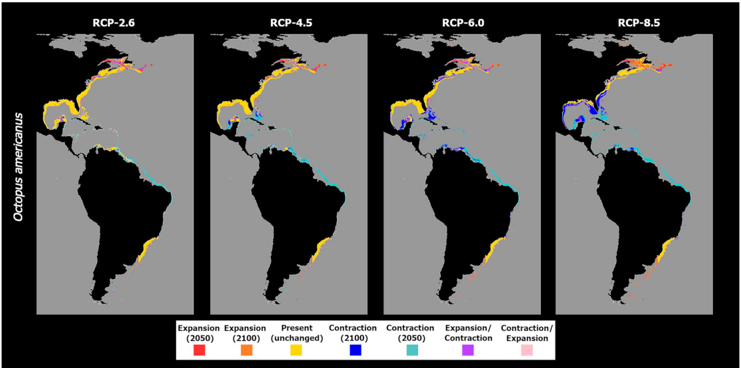
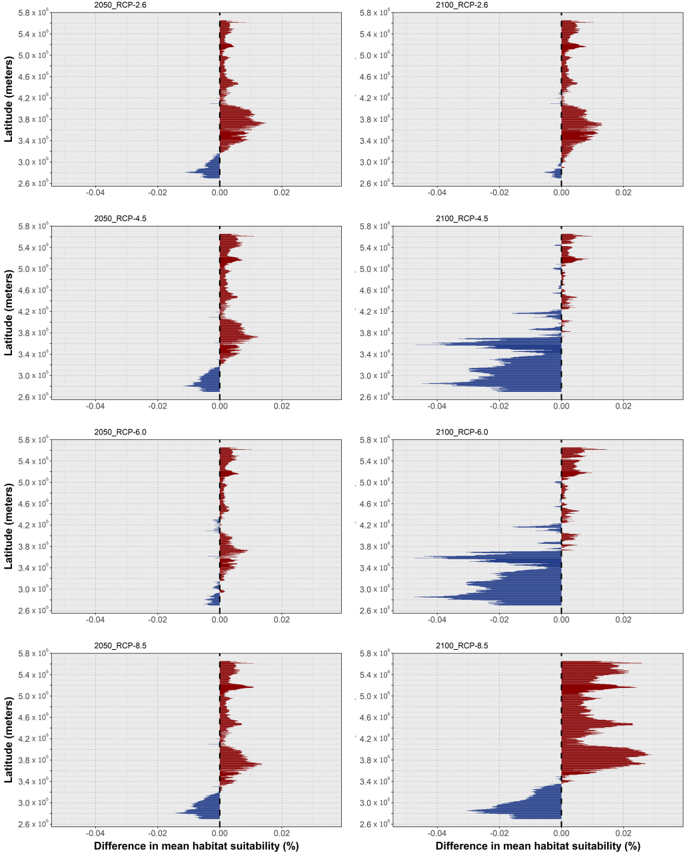
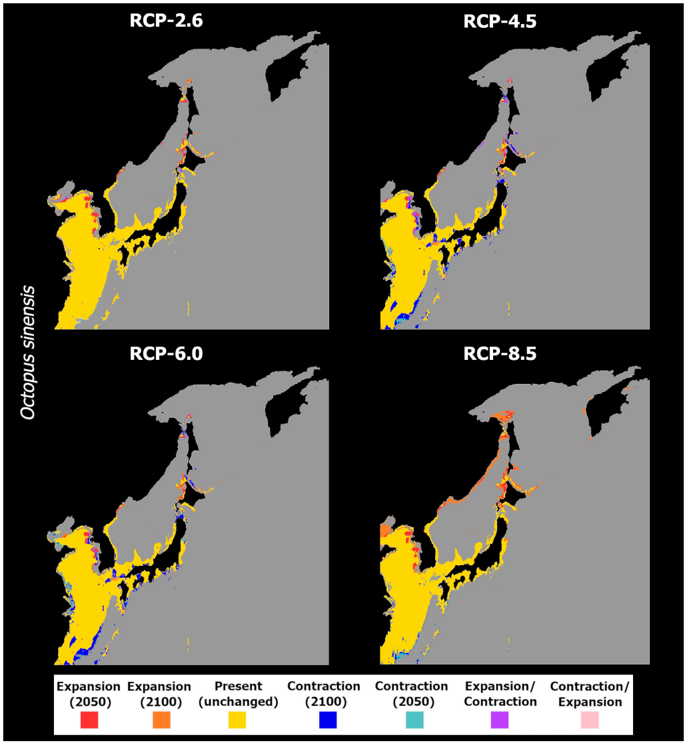
Introduction Historically considered to be a single cosmopolitan species, the so called Octopus vulgaris species complex (OVSC) is now recognized to be a group of (at least) six cryptic species: O. americanus (in the west Atlantic), O. vulgaris (in the northeast Atlantic and Mediterranean Sea), O. aff . vulgaris (in the region of South Africa), O. tetricus (southeastern Oceania), O. sinensis (northwestern Pacific), and O. djinda (western Australia). The potentially different environmental preferences of this highly cryptic species complex may result in distinct consequences under future environmental conditions. Methods The present study employed species distribution models (SDM) using MaxEnt to investigate potential changes in habitat suitability and geographical distribution of the OVSC in the future ( i.e. , 2050, and 2100), across four representative concentration pathway scenarios (RCP-2.6, 4.5, 6.0, and 8.5, CMIP5). Results Differential responses were observed in the OVSC species analyzed. Specifically, O. vulgaris and O. tetricus exhibited a severe loss in distribution across their predicted range; O. americanus exhibited projected extirpation close to the equator, with limited expansion towards the poles; O. aff . vulgaris was projected to lose half of its current distribution; O. sinensis exhibited moderate losses, with projected increases in northern areas; and finally, O. djinda exhibited limited losses to its distribution. Except for O. sinensis , increasing RCP severity exacerbated changes in mean habitat suitability and projected distribution gains and losses. Discussion Ultimately, this study provides information on the potential biogeographical effects of marine climate change on a key worldwide ecological and economic resource to further disentangle the effects over each OVSC species, with the goal of assisting toward the sustainable management of octopus species at the global scale.
Overview
CoChat Summary
TL;DR
This study used MaxEnt species distribution models to project habitat suitability and range shifts for the six cryptic species of the *Octopus vulgaris* species complex under four RCP scenarios for 2050 and 2100. It found species-specific responses, with severe projected losses for *O. vulgaris* and *O. tetricus*, equatorial extirpation for *O. americanus*, and northern expansion for *O. sinensis*.
Key findings
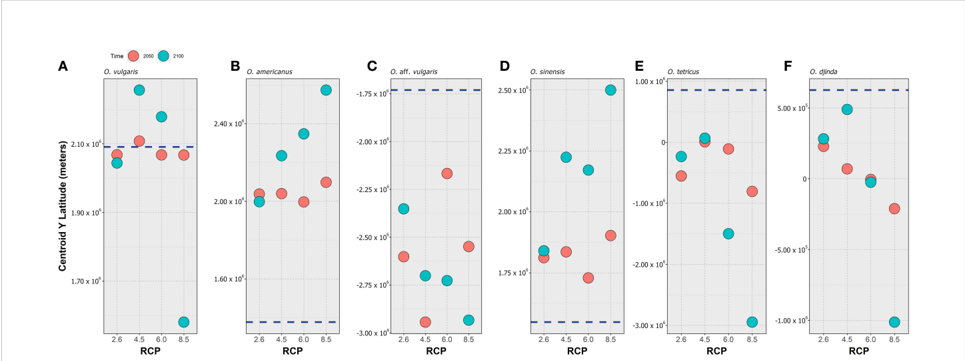
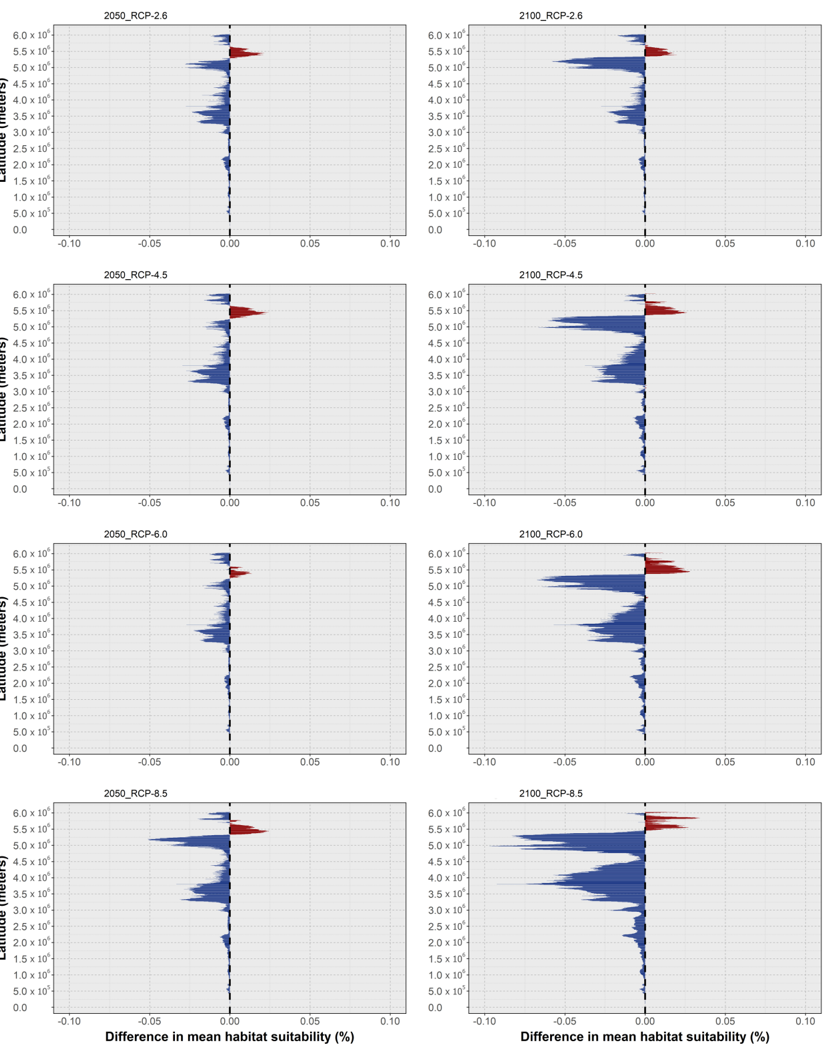
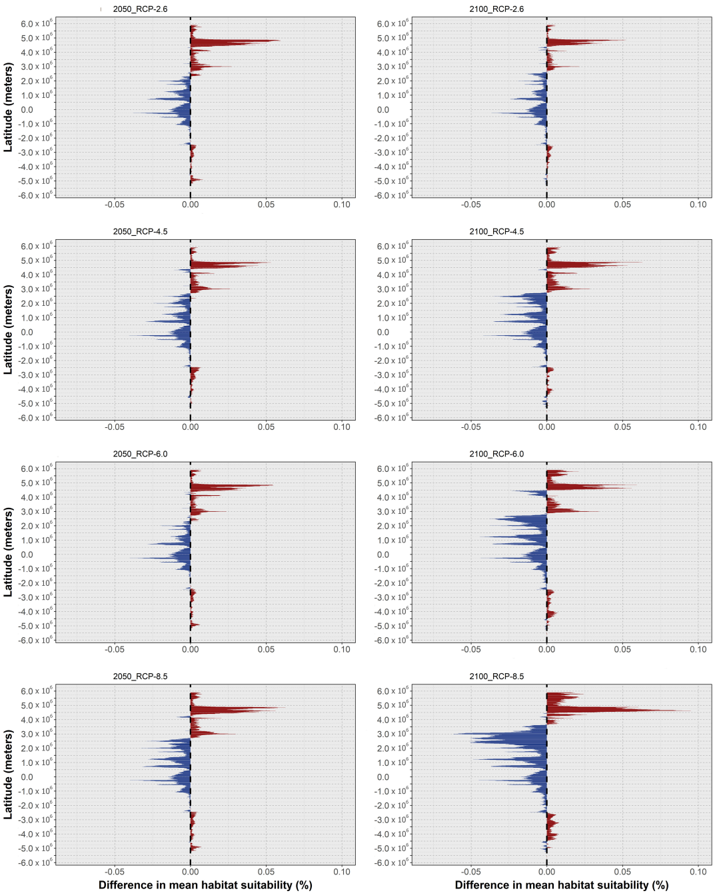
- Differential responses were projected across the complex: *O. vulgaris* and *O. tetricus* showed severe loss across their predicted ranges; *O. americanus* showed projected extirpation close to the equator with limited poleward expansion; *O. aff. vulgaris* was projected to lose half of its current distribution; *O. sinensis* showed moderate losses with increases in northern areas; and *O. djinda* showed limited losses. Except for *O. sinensis*, increasing RCP severity exacerbated changes in mean habitat suitability and projected distribution gains and losses.
- Temperature-related variables contributed most to habitat suitability for most species; the top contributing variable was benthic salinity maximum for *O. vulgaris* (80.9%), benthic mean temperature for *O. americanus* (39.7%) and *O. aff. vulgaris* (24.8%), surface temperature range for *O. djinda* (33.3%) and *O. sinensis* (20.4%), and benthic temperature range for *O. tetricus* (41.5%).
- Occurrence records after environmental filtering varied widely by species: *O. vulgaris* 836, *O. americanus* 438, *O. aff. vulgaris* 72, *O. djinda* 19, *O. sinensis* 28, and *O. tetricus* 88.
Methods
- Occurrence data were compiled from GBIF and OBIS, filtered to human observation and preserved specimens, curated to continental shelf depths ≤200 m, and re-labeled using Avendaño et al. (2020); *O. djinda* records from Amor and Hart (2021) were added, and *O. sinensis* records from the Kermadec Islands were excluded.
- MaxEnt models were run with the `megaSDM` package using bathymetry, temperature, salinity, and current velocity (surface and maximum-depth layers) from Bio-ORACLE and MARSPEC at 5 arcmin; models used environmental filtering with 25 bins, 1,000 background points per species (50% random, 50% spatially constrained), 5 replicates, an AUC threshold of 0.70, and ensemble medians.
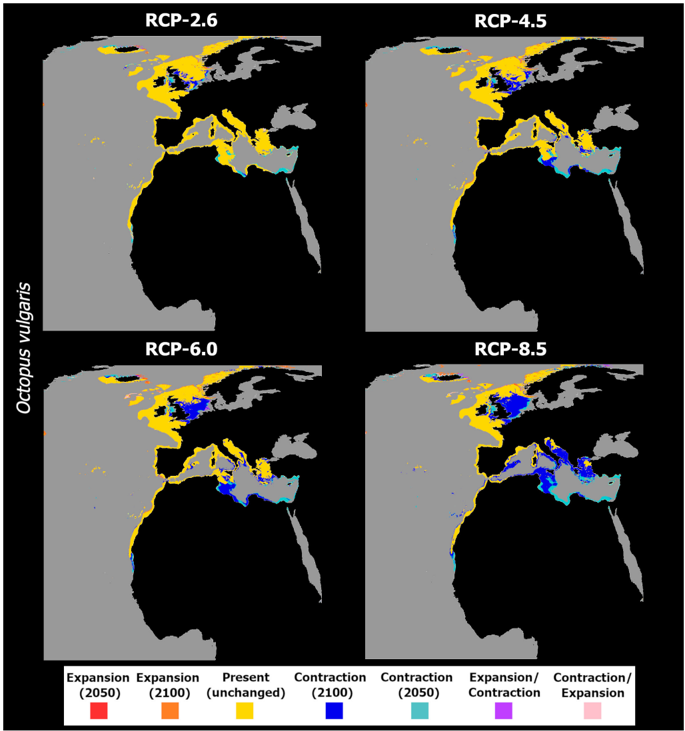
- Projections were made for 2050 and 2100 under RCP-2.6, 4.5, 6.0, and 8.5 (CMIP5); post-analysis assessed latitudinal centroids, latitudinal mean habitat suitability changes, and binary time maps of expansion, contraction, and transitory fluctuations.
Limitations
- The paper states that all models had some degree of over- or underprediction; SDMs assume species fully occupy climatically suitable areas, ignoring barriers and unaccounted predictors, and occurrence data from online databases are subject to sampling bias and possible misidentification, especially for *O. americanus*.
- The paper states that low sample sizes for *O. djinda* and *O. sinensis* (19 and 28 post-filtering, respectively) may introduce uncertainty because sample sizes under 50–100 occurrence points can reduce predictive accuracy; it also notes the assumption of climatic niche conservation and that adaptation is not modeled.
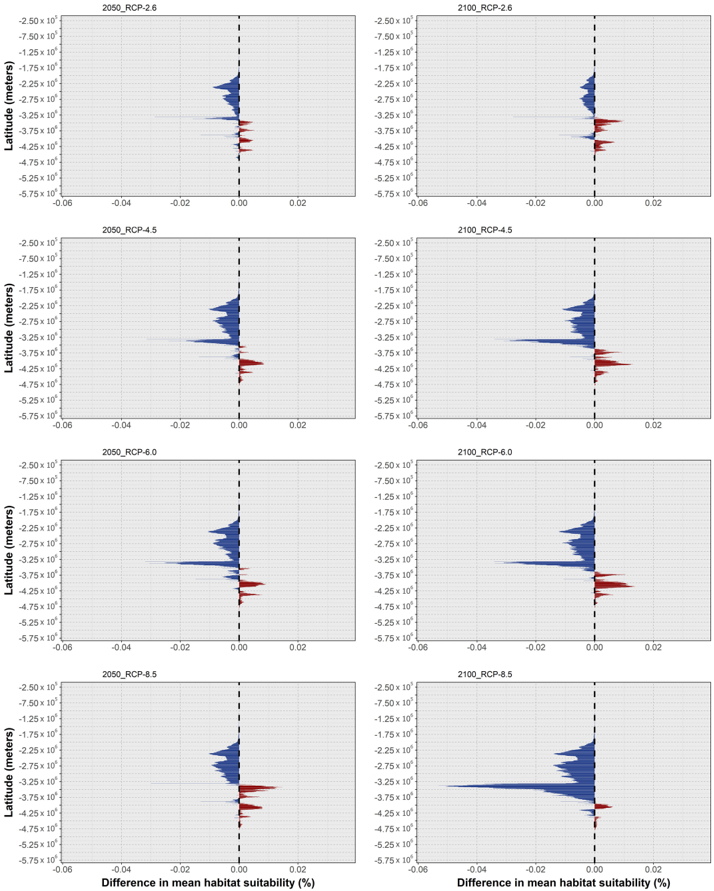
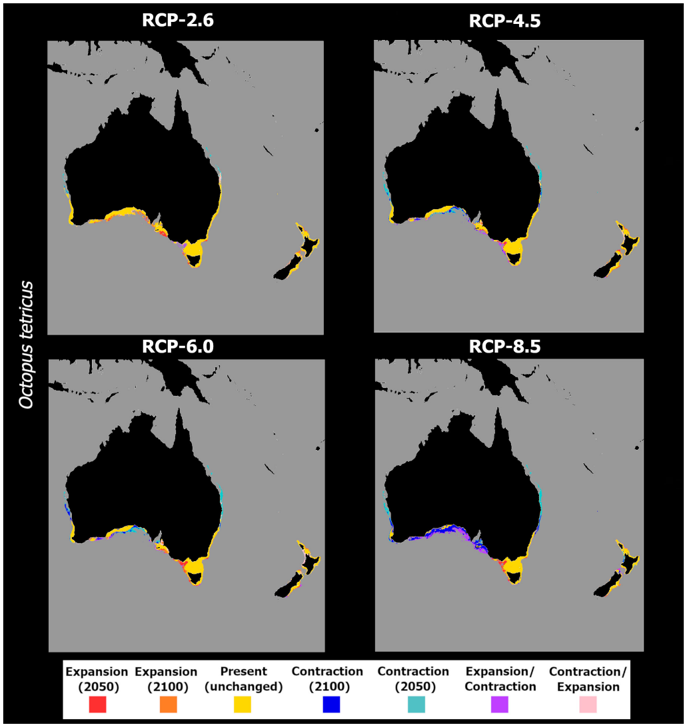
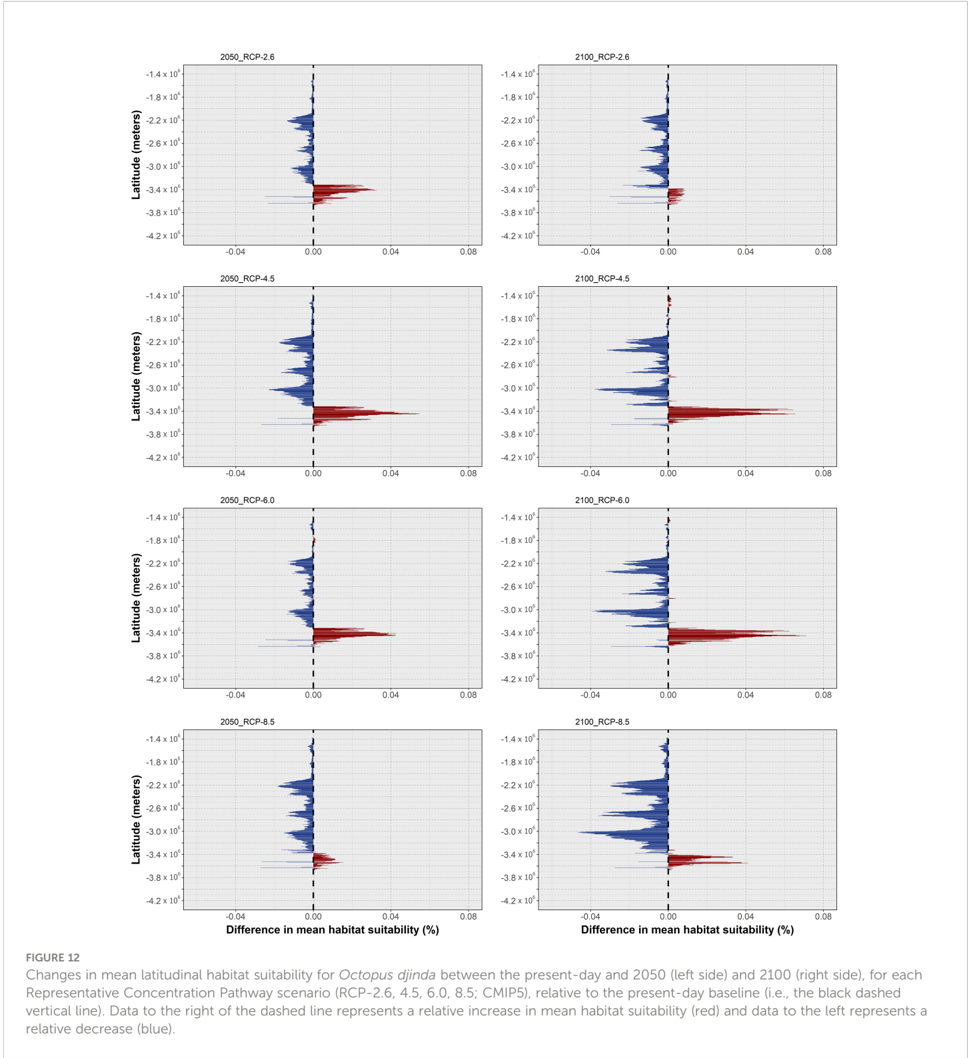
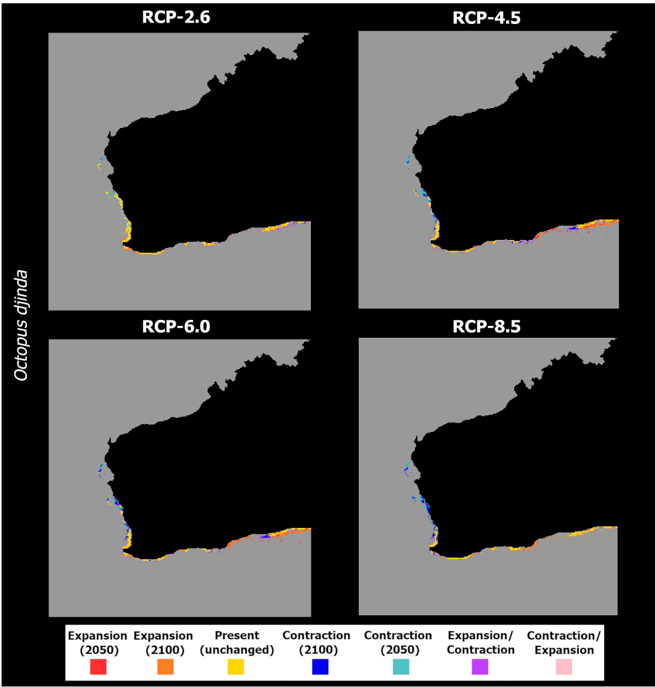
- Evident from the text: the models overpredicted present-day distributions for some species, including *O. vulgaris* in Iceland and the North Sea, *O. tetricus* along much of southern and southwestern Australia, and *O. djinda* in disjunct areas of the Great Australian Bight.
Model-written summary. Check it against the paper before relying on it.
Integrity signals
Registry
Cites
Statistics
Figures

![FIGURE 7 Time maps of the projected changes in species occurrence distribution for Octopus aff. vulgaris , showing unidirectional range shifts in occurrence distribution [i.e., range expansion (in red and orange) or contraction (in dark and light blue)] as well as transitory fl uctuations (i.e., range contraction followed by expansion (pink), and vice-versa (purple)] across time (i.e., 2050 and 2100) and RCP scenarios (RCP-2.6, 4.5, 6.0, 8.5; CMIP5).](https://figures.cochat.ai/paper-figures/b1c8e145cebe4238a0c36ef5f3540e43/projecting-future-climate-change-impacts-on-the-distribution-of-the-octopus-figure-7.png)
Verification
Claims the paper makes
10 Valid · 2 Not valid · 14 Not checked · 70 Own results and interpretations
The cited sources support only part of this claim — read each source’s verdict below.
In the paper
“The package then takes and manipulates the occurrence data and employs a series of measures to mitigate the inherent bias, typical of collected or downloaded occurrence data (Phillips et al., 2009; Boakes et al., 2010) and which decreases the overall accuracy of SDMs (Phillips et al., 2009; Beck et al., 2013; Varela et al., 2014).”
What the sources say
- Supportedcites Phillips et al., 2009 matched to “Sample selection bias and presence-only distribution models: Implications for background and pseudo-absence data” (2009) source
The Introduction (p.1) states that occurrence records from museums and herbaria 'often exhibit strong spatial bias in survey effort' and that this sample selection bias 'can severely impact model quality', and the Abstract says the resulting environmental bias 'may lead to inaccurate models'; the Introduction also notes the bias can be 'an inherent part of the realized, current distribution' that new surveys cannot fix, matching the claim's 'inherent'. The Conclusions and the worked example ('The dangers of sample selection bias: an example') confirm the accuracy loss, showing predictive correlation dropping with increasing bias for presence-only methods — the class of SDM the paper addresses, so the paraphrase is faithful, with the caveat that the paper demonstrates the accuracy drop chiefly for presence-only rather than presence-absence models. (LLM, conf=0.85)
- Supportedcites Boakes et al., 2010 matched to “Distorted Views of Biodiversity: Spatial and Temporal Bias in Species Occurrence Data” (2010) source
The sentence cites Boakes et al. for the inherent bias in collected or downloaded occurrence data, not specifically for the effect on SDM accuracy, which it cites to other papers. The Conclusions state that observations and collections are biased by source, location and collection period, and Box 3 discusses biases inherent in data from different sources. (LLM, conf=0.92)
- Partly supportedcites Beck et al., 2013 matched to “Online solutions and the ‘Wallacean shortfall’: what does GBIF contribute to our knowledge of species' ranges?” (2013) sourceExperimental — accuracy not yet measured
The Methods section (page unavailable) says spatial sampling bias in GBIF records can produce lower-quality range models, supporting the concern about occurrence-data bias. It does not establish that bias in collected or downloaded occurrence data invariably decreases the overall accuracy of SDMs; that part of the claim is more categorical and broader than the passage. (LLM, conf=0.84)
plainstates a cause- Asserted: passes — The authors put it forward as true.
- Checkable: passes — It can be checked against evidence.
- Load-bearing: passes — The paper’s conclusions depend on it.
- Based: passes — The paper gives a reason why it holds.
- Supported
The cited sources support only part of this claim — read each source’s verdict below.
In the paper
“However, its occurrence was also predicted in Iceland and in the North Sea, where it currently does not occur (Goud et al., 2019; Oesterwind et al., 2022).”
What the sources say
- Not matchedcites Goud et al., 2019
An author–year citation the paper’s reference list doesn’t settle. We don’t search these by name.
- Partly supportedcites Oesterwind et al., 2022 matched to “Climate change-related changes in cephalopod biodiversity on the north East Atlantic shelf” (2022) sourceExperimental — accuracy not yet measured
The Octopoda section says recent O. vulgaris reports in the North Sea are few and probably misidentified, supporting the claim that it does not currently occur there. The paper does not report ensemble-model predictions of its occurrence in the North Sea or Iceland; its distribution analysis uses survey records and a literature review (Methods; page unavailable). (LLM, conf=0.82)
plain- Asserted: passes — The authors put it forward as true.
- Checkable: passes — It can be checked against evidence.
- Load-bearing: unclear — It is unclear whether the paper’s conclusions depend on it.
- Based: passes — The paper gives a reason why it holds.
- Not matched
A result the paper reports from its own data — it cites no other source for it, so there is none to check. The quote shows it is in the paper.
In the paper
“Except for O. sinensis , increasing RCP severity exacerbated changes in mean habitat suitability and projected distribution gains and losses.”
plainstates a cause- Asserted: passes — The authors put it forward as true.
- Checkable: passes — It can be checked against evidence.
- Load-bearing: passes — The paper’s conclusions depend on it.
- Based: passes — The paper gives a reason why it holds.
A result the paper reports from its own data — it cites no other source for it, so there is none to check. The quote shows it is in the paper.
In the paper
“O. aff . vulgaris was projected to lose half of its current distribution”
plainstates a cause- Asserted: passes — The authors put it forward as true.
- Checkable: passes — It can be checked against evidence.
- Load-bearing: passes — The paper’s conclusions depend on it.
- Based: passes — The paper gives a reason why it holds.
A result the paper reports from its own data — it cites no other source for it, so there is none to check. The quote shows it is in the paper.
In the paper
“This pattern is exacerbated by the increasing severity of the RCP scenario.”
plainstates a cause- Asserted: passes — The authors put it forward as true.
- Checkable: passes — It can be checked against evidence.
- Load-bearing: unclear — It is unclear whether the paper’s conclusions depend on it.
- Based: passes — The paper gives a reason why it holds.
- Rests on an assumption not shown here.
30 more claims
Create a free account to see all 96 claims and to verify the 1 reference still open.
- It may state two separate claims as one. 50
- Probably not a substantial claim. 13
- The quote only partly states this claim. 3
Self-check
Percentages, sums and reported differences re-computed from the paper’s own numbers.
Each contradiction between two passages listed here was confirmed by an independent check.
Rated minor: it would not touch a result — a value no result rests on, a p-value that stays on the same side of the significance level, or a conflict that is clerical, resolved elsewhere in the paper, or outside its own findings.
In the paper
§ Introduction · p. 2
“Octopus americanus - occurring along the Atlantic continental shelves of the Americas”
§ FIGURE 13 · p. 20
“its occurrence from the north of Argentina, along the continental shelf of Yucatan, and into the northwest coast of the United States and Canada.”
Rated minor: it would not touch a result — a value no result rests on, a p-value that stays on the same side of the significance level, or a conflict that is clerical, resolved elsewhere in the paper, or outside its own findings.
In the paper
§ FIGURE 4 · p. 11
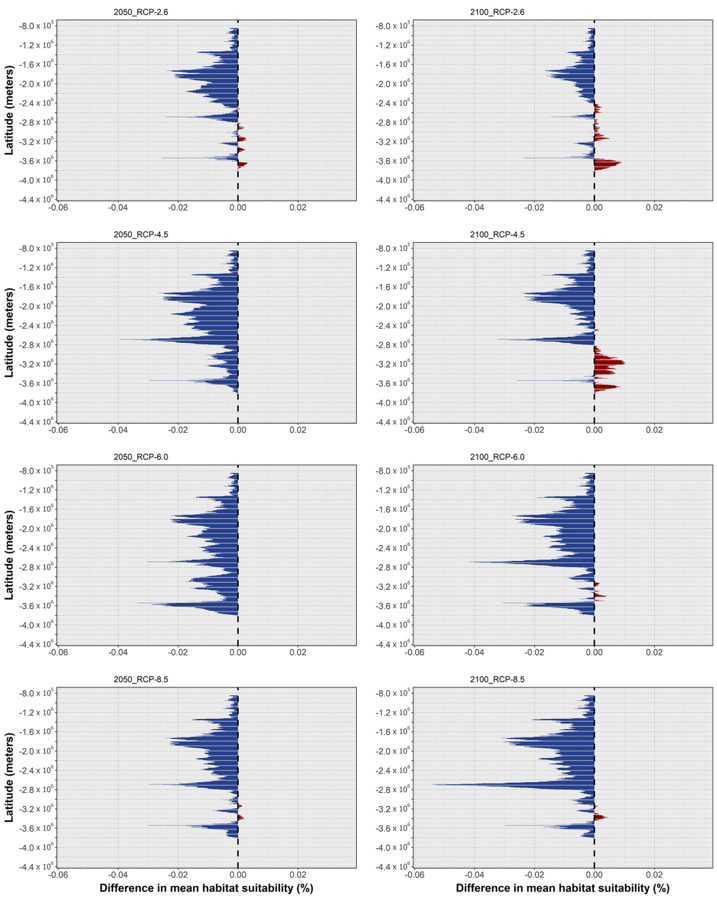
“the models projected considerable losses between 2050 and 2100 (Figure 4C).”
§ FIGURE 4 · p. 10
“FIGURE 4 Changes in mean latitudinal habitat suitability for Octopus americanus between the present-day and 2050 (left side) and 2100 (right side)”
Citations
Cites
Biological identifications through DNA barcodes
Hebert, P. D. N., Cywinska, A., Ball, S. L., & deWaard, J. R. (2003) · Proceedings of the Royal Society of London. Series B: Biological Sciences · doi:10.1098/rspb.2002.2218 · Cited by 13,376 · cited 1×
“Over the past decades, techniques such as molecular sequencing, DNA barcoding, and mitochondrial DNA (mtDNA) analysis have enabled the disentangling of such instances, revealing a vast array of cryptic species complexes (Hebert et al., 2003; Bickford et al., 2007).”
BackgroundApplied Multiple Regression/Correlation Analysis for the Behavioral Sciences
Kemp, F. (2003) · Journal of the Royal Statistical Society: Series D (The Statistician) · doi:10.1046/j.1467-9884.2003.t01-2-00383_4.x · Cited by 9,293
Novel methods improve prediction of species’ distributions from occurrence data
Elith*, J., H. Graham*, C., P. Anderson, R., Dudík, M., Ferrier, S., Guisan, A., J. Hijmans, R., Huettmann, F., R. Leathwick, J., Lehmann, A., et al. (2006) · Ecography · doi:10.1111/j.2006.0906-7590.04596.x · Cited by 9,088 · cited 2×
“This method also has a predictive performance that is consistently competitive with other high-performing methods (Elith et al., 2006; Feng et al., 2019).”
A statistical explanation of MaxEnt for ecologists
Elith, J., Phillips, S. J., Hastie, T., Dudík, M., Chee, Y. E., & Yates, C. J. (2011) · Diversity and Distributions · doi:10.1111/j.1472-4642.2010.00725.x · Cited by 6,699 · cited 1×
“, specifically the cylindrical equalarea projection – “+proj=cea +lat_ts=0 +lon_0 = 0 +x_0 = 0 +y_0 = 0 +datum=WGS84 +no_defs”), because conventional non-equal area projections have grids which vary in their area the further away from the equator, and MaxEnt randomly samples cells from the available geographic space,…”
BackgroundThe State of World Fisheries and Aquaculture 2022
(2022) · FAO eBooks · doi:10.4060/cc0461en · Cited by 5,689
Biodiversity redistribution under climate change: Impacts on ecosystems and human well-being
Pecl, G. T., Araújo, M. B., Bell, J. D., Blanchard, J., Bonebrake, T. C., Chen, I.-C., Clark, T. D., Colwell, R. K., Danielsen, F., Evengård, B., et al. (2017) · Science · doi:10.1126/science.aai9214 · Cited by 3,668 · cited 1×
“, 2021) are responsible for significant changes to the earth’s climate and the global ocean system (Pecl et al., 2017).”
BackgroundEnsemble forecasting of species distributions
ARAUJO, M., & NEW, M. (2007) · Trends in Ecology & Evolution · doi:10.1016/j.tree.2006.09.010 · Cited by 3,640 · cited 1×
“The same function then projected all models onto the specified future environments, across all RCP scenarios, and created the ensemble of all replicate maps using the median value of each pixel, thus reducing the effect of outliers (Araújo and New, 2007; Shipley et al., 2022).”
Background(2019) · Cited by 3,602
Cryptic species as a window on diversity and conservation
Bickford, D., Lohman, D. J., Sodhi, N. S., Ng, P. K. L., Meier, R., Winker, K., Ingram, K. K., & Das, I. (2007) · Trends in Ecology & Evolution · doi:10.1016/j.tree.2006.11.004 · Cited by 3,512 · cited 2×
“The term ‘species complex’ is employed when referring to a group of closely related species, historically classified as a single taxon, given the difficulty in their distinction through traditional morphology-based taxonomic methods (Knowlton, 1993; Bickford et al., 2007).”
BackgroundPhillips, S. J., Dudík, M., Elith, J., Graham, C. H., Lehmann, A., Leathwick, J., & Ferrier, S. (2009) · Ecological Applications · doi:10.1890/07-2153.1 · Cited by 2,996 · cited 7×
“The package then takes and manipulates the occurrence data and employs a series of measures to mitigate the inherent bias, typical of collected or downloaded occurrence data (Phillips et al., 2009; Boakes et al., 2010) and which decreases the overall accuracy of SDMs (Phillips et al.”
BackgroundMethodInfluentialThe art of modelling range-shifting species: The art of modelling range-shifting species
Elith, J., Kearney, M., & Phillips, S. (2010) · Methods in Ecology and Evolution · doi:10.1111/j.2041-210x.2010.00036.x · Cited by 2,813 · cited 1×
“The present habitat suitability and distribution of each species were estimated using the MaxEnt modelling technique, which employs maximum entropy methods and is particularly resilient when dealing with presence-only species records (Elith et al., 2010).”
MethodSelecting pseudo‐absences for species distribution models: how, where and how many?
Barbet‐Massin, M., Jiguet, F., Albert, C. H., & Thuiller, W. (2012) · Methods in Ecology and Evolution · doi:10.1111/j.2041-210x.2011.00172.x · Cited by 2,716
Selecting thresholds of occurrence in the prediction of species distributions
Liu, C., Berry, P. M., Dawson, T. P., & Pearson, R. G. (2005) · Ecography · doi:10.1111/j.0906-7590.2005.03957.x · Cited by 2,701 · cited 1×
“, the ROC curve), and is particularly effective in presence-only data (Liu et al., 2005).”
BackgroundGlobal imprint of climate change on marine life
Poloczanska, E. S., Brown, C. J., Sydeman, W. J., Kiessling, W., Schoeman, D. S., Moore, P. J., Brander, K., Bruno, J. F., Buckley, L. B., Burrows, M. T., et al. (2013) · Nature Climate Change · doi:10.1038/nclimate1958 · Cited by 2,311
Five (or so) challenges for species distribution modelling
Araújo, M. B., & Guisan, A. (2006) · Journal of Biogeography · doi:10.1111/j.1365-2699.2006.01584.x · Cited by 1,901 · cited 1×
“While these models are bounded by a set of assumptions and limitations that must be taken into consideration during interpretation (Araújo et al., 2005; Araújo and Guisan, 2006; Heikkinen et al., 2006; Fitzpatrick and Hargrove, 2009), SDMs incorporating future climate change predictions are considered a very effective…”
BackgroundMaking better M axent models of species distributions: complexity, overfitting and evaluation
Radosavljevic, A., & Anderson, R. P. (2014) · Journal of Biogeography · doi:10.1111/jbi.12227 · Cited by 1,723 · cited 1×
“At the same time, this method also reduces the susceptibility of extreme extrapolation errors and overfitting induced by spatially constrained methods, by assigning a percentage of the background points to be sampled randomly from the entire environmental extent (Radosavljevic and Anderson, 2014).”
MethodThe Pace of Shifting Climate in Marine and Terrestrial Ecosystems
Burrows, M. T., Schoeman, D. S., Buckley, L. B., Moore, P., Poloczanska, E. S., Brander, K. M., Brown, C., Bruno, J. F., Duarte, C. M., Halpern, B. S., et al. (2011) · Science · doi:10.1126/science.1210288 · Cited by 1,342
The importance of correcting for sampling bias in MaxEnt species distribution models
Kramer‐Schadt, S., Niedballa, J., Pilgrim, J. D., Schröder, B., Lindenborn, J., Reinfelder, V., Stillfried, M., Heckmann, I., Scharf, A. K., Augeri, D. M., et al. (2013) · Diversity and Distributions · doi:10.1111/ddi.12096 · Cited by 1,321 · cited 1×
“, spatial bias), and which random background point generation by itself does not consider (Lobo et al., 2010; Kramer-Schadt et al., 2013).”
BackgroundKnowlton, N. (1993) · Annual Review of Ecology and Systematics · doi:10.1146/annurev.ecolsys.24.1.189 · Cited by 1,243 · cited 1×
“The term ‘species complex’ is employed when referring to a group of closely related species, historically classified as a single taxon, given the difficulty in their distinction through traditional morphology-based taxonomic methods (Knowlton, 1993; Bickford et al., 2007).”
BackgroundNiche dynamics in space and time
Pearman, P. B., Guisan, A., Broennimann, O., & Randin, C. F. (2008) · Trends in Ecology & Evolution · doi:10.1016/j.tree.2007.11.005 · Cited by 1,042 · cited 1×
“Another issue refers to the assumption of climatic niche conservation between native and non-native ranges, which could potentially introduce biases and lead to inaccurate predictions (Pearman et al., 2008).”
BackgroundMethods and uncertainties in bioclimatic envelope modelling under climate change
Heikkinen, R. K., Luoto, M., Araújo, M. B., Virkkala, R., Thuiller, W., & Sykes, M. T. (2006) · Progress in Physical Geography: Earth and Environment · doi:10.1177/0309133306071957 · Cited by 995 · cited 1×
“While these models are bounded by a set of assumptions and limitations that must be taken into consideration during interpretation (Araújo et al., 2005; Araújo and Guisan, 2006; Heikkinen et al., 2006; Fitzpatrick and Hargrove, 2009), SDMs incorporating future climate change predictions are considered a very effective…”
BackgroundPutting the Heat on Tropical Animals
Tewksbury, J. J., Huey, R. B., & Deutsch, C. A. (2008) · Science · doi:10.1126/science.1159328 · Cited by 983 · cited 1×
“In this context, decreasing habitat suitability and potential distribution contraction in tropical and subtropical areas were to be expected, since the thermal tolerance of marine animals in these regions is closer to the environmental temperature limits in their habitats (Tewksbury et al., 2008; Nguyen et al., 2011;…”
BackgroundBio‐ORACLE: a global environmental dataset for marine species distribution modelling
Tyberghein, L., Verbruggen, H., Pauly, K., Troupin, C., Mineur, F., & De Clerck, O. (2012) · Global Ecology and Biogeography · doi:10.1111/j.1466-8238.2011.00656.x · Cited by 933 · cited 1×
“The mean, max, min, and range for each predictor were obtained from Bio-ORACLE, which offers global geophysical, biotic, and climate layers at a common spatial resolution (5 arcmins) and a uniform landmask (Tyberghein et al., 2012; Assis et al., 2018).”
MethodBio‐ORACLE v2.0: Extending marine data layers for bioclimatic modelling
Assis, J., Tyberghein, L., Bosch, S., Verbruggen, H., Serrão, E. A., & De Clerck, O. (2018) · Global Ecology and Biogeography · doi:10.1111/geb.12693 · Cited by 931 · cited 1×
“The mean, max, min, and range for each predictor were obtained from Bio-ORACLE, which offers global geophysical, biotic, and climate layers at a common spatial resolution (5 arcmins) and a uniform landmask (Tyberghein et al., 2012; Assis et al., 2018).”
MethodSo Many Variables: Joint Modeling in Community Ecology
Warton, D. I., Blanchet, F. G., O’Hara, R. B., Ovaskainen, O., Taskinen, S., Walker, S. C., & Hui, F. K. C. (2015) · Trends in Ecology & Evolution · doi:10.1016/j.tree.2015.09.007 · Cited by 854 · cited 1×
“In this sense, the inclusion of dissolved oxygen, pH, and the distribution and ecological relationships between the OVSC species and potential predators and competitors would contribute towards more ecologically relevant models (Warton et al., 2015; Abdulwahab et al., 2022).”
BackgroundDistorted Views of Biodiversity: Spatial and Temporal Bias in Species Occurrence Data
Boakes, E. H., McGowan, P. J. K., Fuller, R. A., Chang-qing, D., Clark, N. E., O'Connor, K., & Mace, G. M. (2010) · PLoS Biology · doi:10.1371/journal.pbio.1000385 · Cited by 824 · cited 1×
“The package then takes and manipulates the occurrence data and employs a series of measures to mitigate the inherent bias, typical of collected or downloaded occurrence data (Phillips et al., 2009; Boakes et al., 2010) and which decreases the overall accuracy of SDMs (Phillips et al.”
MethodRCP8.5 tracks cumulative CO 2 emissions
Schwalm, C. R., Glendon, S., & Duffy, P. B. (2020) · Proceedings of the National Academy of Sciences · doi:10.1073/pnas.2007117117 · Cited by 804
Species Distribution Modeling and Ecological Niche Modeling: Getting the Concepts Right
Peterson, A. T., & Soberón, J. (2012) · Natureza & Conservação · doi:10.4322/natcon.2012.019 · Cited by 702 · cited 2×
“These restriction procedures were performed because SDMs must ideally restrict model calibration to accessible areas (Peterson and Soberón, 2012).”
MethodMiller, J. (2010) · Geography Compass · doi:10.1111/j.1749-8198.2010.00351.x · Cited by 689 · cited 2×
“These models take georeferenced occurrence data and environmental predictors for a defined geographical extent and establish the relationship between a species’ occurrence and environmental conditions, defining a species’ ecological niche and allowing researchers to perform projections on the potential changes in a sp…”
BackgroundEquilibrium of species’ distributions with climate
Araújo, M. B., & Pearson, R. G. (2005) · Ecography · doi:10.1111/j.2005.0906-7590.04253.x · Cited by 665 · cited 1×
“While these models are bounded by a set of assumptions and limitations that must be taken into consideration during interpretation (Araújo et al., 2005; Araújo and Guisan, 2006; Heikkinen et al., 2006; Fitzpatrick and Hargrove, 2009), SDMs incorporating future climate change predictions are considered a very effective…”
BackgroundThe uncertain nature of absences and their importance in species distribution modelling
Lobo, J. M., Jiménez‐Valverde, A., & Hortal, J. (2010) · Ecography · doi:10.1111/j.1600-0587.2009.06039.x · Cited by 656 · cited 1×
“, spatial bias), and which random background point generation by itself does not consider (Lobo et al., 2010; Kramer-Schadt et al., 2013).”
BackgroundCryptic animal species are homogeneously distributed among taxa and biogeographical regions
Pfenninger, M., & Schwenk, K. (2007) · BMC Evolutionary Biology · doi:10.1186/1471-2148-7-121 · Cited by 652 · cited 1×
“Cryptic diversity is relatively common in the Tree of Life, with cryptic species occurring almost homogenously among metazoans (Pfenninger and Schwenk, 2007) and protozoa (Bass et al.”
BackgroundRelation between production and biomass
Allen, K. R. (1971) · Journal of the Fisheries Research Board of Canada · doi:10.1139/f71-236 · Cited by 590 · cited 2×
“…to undergo octopus range contraction could very well suffer a decrease in top-down control of benthic communities, while projected poleward shifts could increase this top-down control on lower trophic levels, in higher latitude areas (Allen, 1971; Colléter et al., 2012; Schickele et al., 2021).”
BackgroundA null‐model for significance testing of presence‐only species distribution models
Raes, N., & ter Steege, H. (2007) · Ecography · doi:10.1111/j.2007.0906-7590.05041.x · Cited by 537
Conservation of Biodiversity in a Changing Climate
Hannah, L., Midgley, G. F., Lovejoy, T., Bond, W. J., Bush, M., Lovett, J. C., Scott, D., & Woodward, F. I. (2002) · Conservation Biology · doi:10.1046/j.1523-1739.2002.00465.x · Cited by 466 · cited 1×
“With the combination of biogeographic knowledge and modelling in climate change impact studies, it is possible to attempt the prediction of the future impacts on biodiversity and ecosystem health (Hannah et al., 2002).”
BackgroundENMTools 1.0: an R package for comparative ecological biogeography
Warren, D. L., Matzke, N. J., Cardillo, M., Baumgartner, J. B., Beaumont, L. J., Turelli, M., Glor, R. E., Huron, N. A., Simões, M., Iglesias, T. L., et al. (2021) · Ecography · doi:10.1111/ecog.05485 · Cited by 463 · cited 1×
“rar), together with the correlation plots obtained using the ‘ENMTools’ package (Warren et al., 2021).”
MethodVarela, S., Anderson, R. P., García‐Valdés, R., & Fernández‐González, F. (2014) · Ecography · doi:10.1111/j.1600-0587.2013.00441.x · Cited by 433 · cited 8×
“, 2010) and which decreases the overall accuracy of SDMs (Phillips et al., 2009; Beck et al., 2013; Varela et al., 2014).”
BackgroundMethodInfluentialThe projection of species distribution models and the problem of non-analog climate
Fitzpatrick, M. C., & Hargrove, W. W. (2009) · Biodiversity and Conservation · doi:10.1007/s10531-009-9584-8 · Cited by 415 · cited 1×
“While these models are bounded by a set of assumptions and limitations that must be taken into consideration during interpretation (Araújo et al., 2005; Araújo and Guisan, 2006; Heikkinen et al., 2006; Fitzpatrick and Hargrove, 2009), SDMs incorporating future climate change predictions are considered a very effective…”
BackgroundHow Useful Are Species Distribution Models for Managing Biodiversity under Future Climates?
Sinclair, S. J., White, M. D., & Newell, G. R. (2010) · Ecology and Society · doi:10.5751/es-03089-150108 · Cited by 375 · cited 2×
“, 2006; Fitzpatrick and Hargrove, 2009), SDMs incorporating future climate change predictions are considered a very effective way to address some of the questions regarding climate change effects on biodiversity (Sinclair et al., 2010).”
BackgroundNew trends in species distribution modelling
Zimmermann, N. E., Edwards, T. C., Graham, C. H., Pearman, P. B., & Svenning, J. (2010) · Ecography · doi:10.1111/j.1600-0587.2010.06953.x · Cited by 356 · cited 1×
“Indeed, its development and use have increased steeply over the past decades (Zimmermann et al., 2010), since these models offer a good framework for predicting changes in species distributions, across vast geographical spaces and regarding large species assemblages (Elith et al.”
BackgroundTrade-off between transcriptome plasticity and genome evolution in cephalopods
Liscovitch-Brauer, N., Alon, S., Porath, H. T., Elstein, B., Unger, R., Ziv, T., Admon, A., Levanon, E. Y., Rosenthal, J. J. C., & Eisenberg, E. (2017) · Cell · doi:10.1016/j.cell.2017.03.025 · Cited by 356 · cited 2×
“Their high phenotypic flexibility and consequent environmental plasticity (Liscovitch-Brauer et al., 2017), together with their ‘live fast and die young’ lifestyle (O’Dor and Webber, 1991) likely represent an advantage over other marine taxa when confronted with the various challenges of a changing climate.”
BackgroundHypoxia and acidification in ocean ecosystems: coupled dynamics and effects on marine life
Gobler, C. J., & Baumann, H. (2016) · Biology Letters · doi:10.1098/rsbl.2015.0976 · Cited by 354 · cited 2×
“At the same time, increased absorption of approximately 30% of the excess atmospheric CO2 has also been changing ocean chemistry, leading to decreasing pH levels (Gobler and Baumann, 2016).”
BackgroundRosa, R., & Seibel, B. A. (2008) · Proceedings of the National Academy of Sciences · doi:10.1073/pnas.0806886105 · Cited by 341 · cited 1×
“, 2019), squid (Rosa and Seibel, 2008; Rosa et al., 2012; Rosa et al., 2014), and cuttlefishes (Rosa et al.”
BackgroundSelf-citationMARSPEC: ocean climate layers for marine spatial ecology: Ecological Archives E094‐086
Sbrocco, E. J., & Barber, P. H. (2013) · Ecology · doi:10.1890/12-1358.1 · Cited by 338 · cited 2×
“Bathymetry, in turn, was retrieved from MARSPEC at a resolution of 5 arcmins (Sbrocco and Barber, 2013) and used as a predictor variable, to incorporate the water column height into the spatial analysis.”
MethodGlobal proliferation of cephalopods
Doubleday, Z. A., Prowse, T. A. A., Arkhipkin, A., Pierce, G. J., Semmens, J., Steer, M., Leporati, S. C., Lourenço, S., Quetglas, A., Sauer, W., et al. (2016) · Current Biology · doi:10.1016/j.cub.2016.04.002 · Cited by 325 · cited 3×
“Indeed, the synergistic effects of warming and the overfishing of their predators and competitors, have been linked to the increased fitness of cephalopod species (Rodhouse et al., 2014; Doubleday et al., 2016).”
BackgroundA checklist for maximizing reproducibility of ecological niche models
Feng, X., Park, D. S., Walker, C., Peterson, A. T., Merow, C., & Papeş, M. (2019) · Nature Ecology & Evolution · doi:10.1038/s41559-019-0972-5 · Cited by 323 · cited 1×
“This method also has a predictive performance that is consistently competitive with other high-performing methods (Elith et al., 2006; Feng et al., 2019).”
MethodGlobal reconstruction of historical ocean heat storage and transport
Zanna, L., Khatiwala, S., Gregory, J. M., Ison, J., & Heimbach, P. (2019) · Proceedings of the National Academy of Sciences · doi:10.1073/pnas.1808838115 · Cited by 318
Impacts of hypoxic events surpass those of future ocean warming and acidification
Sampaio, E., Santos, C., Rosa, I. C., Ferreira, V., Pörtner, H.-O., Duarte, C. M., Levin, L. A., & Rosa, R. (2021) · Nature Ecology & Evolution · doi:10.1038/s41559-020-01370-3 · Cited by 295 · cited 1×
“These phenomena are both consequences and drivers of ocean climate change and are set to yield a vast array of negative impacts on marine ecosystems worldwide (Sampaio et al., 2021).”
BackgroundSelf-citationUpper Temperature Limits of Tropical Marine Ectotherms: Global Warming Implications
Nguyen, K. D. T., Morley, S. A., Lai, C.-H., Clark, M. S., Tan, K. S., Bates, A. E., & Peck, L. S. (2011) · PLoS ONE · doi:10.1371/journal.pone.0029340 · Cited by 245 · cited 1×
“In this context, decreasing habitat suitability and potential distribution contraction in tropical and subtropical areas were to be expected, since the thermal tolerance of marine animals in these regions is closer to the environmental temperature limits in their habitats (Tewksbury et al., 2008; Nguyen et al., 2011;…”
BackgroundContinental shelves as a variable but increasing global sink for atmospheric carbon dioxide
Laruelle, G. G., Cai, W.-J., Hu, X., Gruber, N., Mackenzie, F. T., & Regnier, P. (2018) · Nature Communications · doi:10.1038/s41467-017-02738-z · Cited by 228 · cited 1×
“, from the surface to a depth of 200 m; (Laruelle et al., 2018)] and removing potential occurrences referenced on land.”
BackgroundCephalopods of the world: an annotated and illustrated catalogue of cephalopod species known to date
Jereb, P. (2016) · Cited by 228
Cephalopod populations: definition and dynamics
Boyle, P. R., & Boletzky, S. V. (1996) · Philosophical Transactions of the Royal Society of London. Series B: Biological Sciences · doi:10.1098/rstb.1996.0089 · Cited by 220 · cited 1×
“As was already mentioned, the high phenotypic flexibility and strong adaptation potential of cephalopods (Boyle et al., 1996; Liscovitch-Brauer et al., 2017) suggest that Octopus species could adapt to future climate change-related conditions.”
BackgroundThe potential impacts of climate change on inshore squid: biology, ecology and fisheries
Pecl, G. T., & Jackson, G. D. (2008) · Reviews in Fish Biology and Fisheries · doi:10.1007/s11160-007-9077-3 · Cited by 189 · cited 1×
“, 2016), although their responses are likely to be complex (Pecl and Jackson, 2008; Rodhouse et al., 2014).”
BackgroundCryptic biodiversity in a changing world
Beheregaray, L. B., & Caccone, A. (2007) · Journal of Biology · doi:10.1186/jbiol60 · Cited by 184 · cited 1×
“Moreover, cryptic species can be found in all major terrestrial and aquatic taxa, across the entire latitudinal profile (Beheregaray and Caccone, 2007).”
BackgroundEnvironmental Effects on Cephalopod Population Dynamics
Rodhouse, P. G. K., Pierce, G. J., Nichols, O. C., Sauer, W. H. H., Arkhipkin, A. I., Laptikhovsky, V. V., Lipiński, M. R., Ramos, J. E., Gras, M., Kidokoro, H., et al. (2014) · Advances in Marine Biology · doi:10.1016/b978-0-12-800287-2.00002-0 · Cited by 180
Sauer, W. H. H., Gleadall, I. G., Downey-Breedt, N., Doubleday, Z., Gillespie, G., Haimovici, M., Ibáñez, C. M., Katugin, O. N., Leporati, S., Lipinski, M. R., et al. (2021) · Reviews in Fisheries Science & Aquaculture · doi:10.1080/23308249.2019.1680603 · Cited by 177
Beck, J., Ballesteros‐Mejia, L., Nagel, P., & Kitching, I. J. (2013) · Diversity and Distributions · doi:10.1111/ddi.12083 · Cited by 157 · cited 8×
“, 2010) and which decreases the overall accuracy of SDMs (Phillips et al., 2009; Beck et al., 2013; Varela et al., 2014).”
BackgroundMethodInfluentialDNA evidence for global dispersal and probable endemicity of protozoa
Bass, D., Richards, T. A., Matthai, L., et al. (2007) · BMC Evolutionary Biology · doi:10.1186/1471-2148-7-162 · Cited by 146 · cited 1×
“Cryptic diversity is relatively common in the Tree of Life, with cryptic species occurring almost homogenously among metazoans (Pfenninger and Schwenk, 2007) and protozoa (Bass et al., 2007).”
BackgroundAnalysis of climate paths reveals potential limitations on species range shifts
Early, R., & Sax, D. F. (2011) · Ecology Letters · doi:10.1111/j.1461-0248.2011.01681.x · Cited by 144 · cited 1×
“, range contraction followed by expansion, and vice-versa), per scenario, per species (Early and Sax, 2011) using the function ‘createTimeMaps’ (Shipley et al.”
MethodO'Dor, R. K., & Webber, D. M. (1991) · Journal of Experimental Biology · doi:10.1242/jeb.160.1.93 · Cited by 143
Leite, T. S., Haimovici, M., Molina, W., & Warnke, K. (2008) · Journal of Molluscan Studies · doi:10.1093/mollus/eym050 · Cited by 137 · cited 1×
“insularis (Leite et al., 2008), which occurs in tropical and subtropical waters of the Central and South American continents, sharing most of its distribution with part of O.”
BackgroundRosa, R., Pimentel, M. S., Boavida-Portugal, J., Teixeira, T., Trübenbach, K., & Diniz, M. (2012) · PLoS ONE · doi:10.1371/journal.pone.0038282 · Cited by 130 · cited 1×
“, 2019), squid (Rosa and Seibel, 2008; Rosa et al., 2012; Rosa et al., 2014), and cuttlefishes (Rosa et al.”
BackgroundSelf-citationEnvironmental filtering improves ecological niche models across multiple scales
Castellanos, A. A., Huntley, J. W., Voelker, G., & Lawing, A. M. (2019) · Methods in Ecology and Evolution · doi:10.1111/2041-210x.13142 · Cited by 118 · cited 1×
“To mitigate environmental and spatial biases within the occurrence data, the package performs environmental filtering of the occurrence data by dividing the environmental values at each point into a pre-determined number of bins (n = 25 in the present study), and then selecting one point from each unique combination o…”
MethodSöller, R., Warnke, K., Saint-Paul, U., & Blohm, D. (2000) · Marine Biology · doi:10.1007/s002270050004 · Cited by 112
Amor, M. D., Norman, M. D., Roura, A., Leite, T. S., Gleadall, I. G., Reid, A., Perales‐Raya, C., Lu, C., Silvey, C. J., Vidal, E. A. G., et al. (2017) · Zoologica Scripta · doi:10.1111/zsc.12207 · Cited by 107 · cited 8×
“Vulgaris – occurring in the coastlines of South Africa and Madagascar (Oosthuizen and Smale, 2003; Oosthuizen et al., 2004); iv) Octopus sinensis, occurring in the north-western Pacific Ocean, in the region of Japan and the Eastern China Sea (Reid and Wilson, 2015; Gleadall, 2016); v) Octopus tetricus, occurring in th…”
BackgroundInfluentialMolecular phylogeny of the benthic shallow-water octopuses (Cephalopoda: Octopodinae)
Guzik, M. T., Norman, M. D., & Crozier, R. H. (2005) · Molecular Phylogenetics and Evolution · doi:10.1016/j.ympev.2005.05.009 · Cited by 86 · cited 8×
“Vulgaris – occurring in the coastlines of South Africa and Madagascar (Oosthuizen and Smale, 2003; Oosthuizen et al., 2004); iv) Octopus sinensis, occurring in the north-western Pacific Ocean, in the region of Japan and the Eastern China Sea (Reid and Wilson, 2015; Gleadall, 2016); v) Octopus tetricus, occurring in th…”
BackgroundInfluentialRepolho, T., Baptista, M., Pimentel, M. S., Dionísio, G., Trübenbach, K., Lopes, V. M., Lopes, A. R., Calado, R., Diniz, M., & Rosa, R. (2014) · Journal of Comparative Physiology B · doi:10.1007/s00360-013-0783-y · Cited by 85 · cited 1×
“On the other hand, several experimental studies have shown potential deleterious effects of climate change for a wide array of cephalopod species, including octopuses (Repolho et al., 2014; Rosa et al., 2019), squid (Rosa and Seibel, 2008; Rosa et al.”
BackgroundSelf-citationRosa, R., Trübenbach, K., Pimentel, M. S., Boavida-Portugal, J., Faleiro, F., Baptista, M., Dionísio, G., Calado, R., Pörtner, H. O., & Repolho, T. (2014) · Journal of Experimental Biology · doi:10.1242/jeb.096081 · Cited by 85
Self-citationmegaSDM: Integrating dispersal and time-step analyses into species distribution models
Shipley, B. R., Bach, R., Do, Y., Strathearn, H., McGuire, J. L., & Dilkina, B. (2022) · Ecography · doi:10.1111/ecog.05450 · Cited by 80 · cited 9×
“In short, the training area, where the occurrence and background points are located, and the study area, where the model will be projected, were defined using the functions ‘TrainStudyEnv’ and ‘PredictEnv’, which take specific raster stacks and manipulates them to standardize the present and future period’s environmen…”
BackgroundMethodInfluentialAllopatric speciation within a cryptic species complex of Australasian octopuses
Amor, M. D., Norman, M. D., Cameron, H. E., & Strugnell, J. M. (2014) · PLoS ONE · doi:10.1371/journal.pone.0098982 · Cited by 79
Lower hypoxia thresholds of cuttlefish early life stages living in a warm acidified ocean
Rosa, R., Trübenbach, K., Repolho, T., Pimentel, M., Faleiro, F., Boavida-Portugal, J., Baptista, M., Lopes, V. M., Dionísio, G., Leal, M. C., et al. (2013) · Proceedings of the Royal Society B: Biological Sciences · doi:10.1098/rspb.2013.1695 · Cited by 77
Self-citationGlobal patterns of species richness in coastal cephalopods
Rosa, R., Pissarra, V., Borges, F. O., Xavier, J., Gleadall, I. G., Golikov, A., Bello, G., Morais, L., Lishchenko, F., Roura, Á., et al. (2019) · Frontiers in Marine Science · doi:10.3389/fmars.2019.00469 · Cited by 70 · cited 2×
“Frontiers in Marine Science 03 2022), suggesting a broad redistribution of cephalopod species over the coming decades as they seek suitable environmental conditions (Xavier et al., 2016; Rosa et al., 2019).”
BackgroundSelf-citationG. Gleadall, I. (2016) · Species Diversity · doi:10.12782/sd.21.1.031 · Cited by 69 · cited 4×
“…with poor taxonomic resolution and catch under-reporting at regional and even species level could potentially lead to overexploitation of octopus populations (Norman et al., 2014; Sauer et al., 2021), as has been the case for certain species of the complex [e.g., O. sinensis (Gleadall, 2016)].”
BackgroundInfluentialIdentifying cryptic diversity with predictive phylogeography
Espíndola, A., Ruffley, M., Smith, M. L., Carstens, B. C., Tank, D. C., & Sullivan, J. M. (2016) · Proceedings of the Royal Society B Biological Sciences · doi:10.1098/rspb.2016.1529 · Cited by 66 · cited 2×
“Despite their typically high phenotypical proximity, which ultimately prevents their accurate discrimination, considerable genetic divergence can be observed (Espıńdola et al., 2016).”
BackgroundAvendaño, O., Roura, Á., Cedillo-Robles, C. E., González, Á. F., Rodríguez-Canul, R., Velázquez-Abunader, I., & Guerra, Á. (2020) · Aquatic Ecology · doi:10.1007/s10452-020-09778-6 · Cited by 66 · cited 6×
“Initially described as a single species with a rather broad range (occurring along the eastern North Atlantic and the Mediterranean Sea, in the Americas and the eastern South Atlantic, Oceania, and the Northwest Pacific Ocean), recent genetic and molecular analyzes have enabled 02 researchers to discriminate genetical…”
BackgroundResultInfluentialModelling climate-change-induced nonlinear thresholds in cephalopod population dynamics
ANDRÉ, J., HADDON, M., & PECL, G. T. (2010) · Global Change Biology · doi:10.1111/j.1365-2486.2010.02223.x · Cited by 61 · cited 1×
“Indeed, temperature (and thermal stress) has been shown to promote a decrease in egg incubation time, hatchling size, weight at first sexual maturity, and average generation time (Andre et al., 2010).”
BackgroundThe origin of the Saharan bank cephalopod fishery
BalgueríAs, E. (2000) · ICES Journal of Marine Science · doi:10.1006/jmsc.1999.0572 · Cited by 61 · cited 2×
“This species complex is highly valued worldwide, representing one of the world’s most important cephalopod fisheries (Balguerıás et al., 2000; Sauer et al., 2021).”
BackgroundCheng, S. H., Anderson, F. E., Bergman, A. M., Mahardika, G. N., Muchlisin, Z. A., Dang, B. T., Calumpong, H. P., Mohamed, K. S., Sasikumar, G., VENKATESAN, V., et al. (2013) · Hydrobiologia · doi:10.1007/s10750-013-1778-0 · Cited by 59 · cited 1×
“lessoniana (Lesson 1930) (Cheng et al., 2014), the pharaoh cuttlefish, Sepia pharaonis (Ehrenberg, 1831) (Farhadi and Anderson, 2021), the squid Lolliguncula sp.”
BackgroundGolikov, A. V., Sabirov, R. M., Lubin, P. A., & Jørgensen, L. L. (2013) · Biodiversity · doi:10.1080/14888386.2012.702301 · Cited by 59
Rosa, R., Lopes, A. R., Pimentel, M. S., Faleiro, F., Baptista, M., Trübenbach, K., Narciso, L., Dionísio, G., Pegado, M. R., Repolho, T., et al. (2014) · Global Change Biology · doi:10.1111/gcb.12621 · Cited by 58 · cited 2×
“In this context, decreasing habitat suitability and potential distribution contraction in tropical and subtropical areas were to be expected, since the thermal tolerance of marine animals in these regions is closer to the environmental temperature limits in their habitats (Tewksbury et al., 2008; Nguyen et al., 2011;…”
BackgroundSelf-citationPuerta, P., Hunsicker, M. E., Quetglas, A., Álvarez‐Berastegui, D., Esteban, A., González, M., & Hidalgo, M. (2015) · PLoS ONE · doi:10.1371/journal.pone.0133439 · Cited by 55 · cited 1×
“To this day, a growing body of literature has employed SDM frameworks with cephalopod species (Puerta et al., 2015; Alabia et al., 2016; Xavier et al., 2016; Boavida-Portugal et al., 2022).”
BackgroundChoice of climate data affects the performance and interpretation of species distribution models.
Abdulwahab, U. A., Hammill, E., & Hawkins, C. P. (2022) · Ecological Modelling · doi:10.1016/j.ecolmodel.2022.110042 · Cited by 51 · cited 1×
“In this sense, the inclusion of dissolved oxygen, pH, and the distribution and ecological relationships between the OVSC species and potential predators and competitors would contribute towards more ecologically relevant models (Warton et al., 2015; Abdulwahab et al., 2022).”
BackgroundFisheries for common octopus in Europe: Socioeconomic importance and management
Pita, C., Roumbedakis, K., Fonseca, T., Matos, F. L., Pereira, J., Villasante, S., Pita, P., Bellido, J. M., Gonzalez, A. F., García-Tasende, M., et al. (2021) · Fisheries Research · doi:10.1016/j.fishres.2020.105820 · Cited by 50 · cited 1×
“fisheries allied to depleting finfish stocks and rising prices (Pita et al., 2021).”
BackgroundPopulation biology of Octopus vulgaris on the temperate south-eastern coast of South Africa
Oosthuizen, A., & Smale, M. J. (2003) · Journal of the Marine Biological Association of the United Kingdom · doi:10.1017/s0025315403007458h · Cited by 49 · cited 9×
“6, 4.5, 6.0, 8.5; CMIP5). frontiersin.org disappear by 2050 from most of the Mozambican shores and from Madagascar’s northern and southwestern coastlines.”
BackgroundResultInfluentialColléter, M., Gascuel, D., Ecoutin, J.-M., & Tito de Morais, L. (2012) · Ecological Modelling · doi:10.1016/j.ecolmodel.2012.01.019 · Cited by 49
Climate change-related changes in cephalopod biodiversity on the north East Atlantic shelf
Oesterwind, D., Barrett, C. J., Sell, A. F., Núñez-Riboni, I., Kloppmann, M., Piatkowski, U., Wieland, K., & Laptikhovsky, V. (2022) · Biodiversity and Conservation · doi:10.1007/s10531-022-02403-y · Cited by 49 · cited 1×
“However, its occurrence was also predicted in Iceland and in the North Sea, where it currently does not occur (Goud et al., 2019; Oesterwind et al., 2022).”
BackgroundThe Distribution of Octopus Vulgaris Lamarck in British Waters
Rees, W. J. (1950) · Journal of the Marine Biological Association of the United Kingdom · doi:10.1017/s0025315400055417 · Cited by 46 · cited 4×
“For O. vulgaris, the ensemble models predicted a distribution very similar to that presented in Rosa et al. (in press), with the species occurring along west Africa and in the Macaronesia region (Adam, 1962; Gonçalves, 1991; Sánchez et al., 2015); in frontiersin.org the Mediterranean Sea and along the Iberian Penins…”
BackgroundInfluentialFernández-Álvarez, F. Á., Braid, H. E., Nigmatullin, C. M., Bolstad, K. S. R., Haimovici, M., Sánchez, P., Sajikumar, K. K., Ragesh, N., & Villanueva, R. (2020) · Zoological Journal of the Linnean Society · doi:10.1093/zoolinnean/zlaa014 · Cited by 46 · cited 1×
“, 2021), Ommastrephes squids (Fernández-Álvarez et al., 2020); and the common octopus, Octopus vulgaris (Cuvier 1797).”
BackgroundRamos, J. E., Pecl, G. T., Moltschaniwskyj, N. A., Strugnell, J. M., León, R. I., & Semmens, J. M. (2014) · PLoS ONE · doi:10.1371/journal.pone.0103480 · Cited by 45 · cited 2×
“At the same time, distribution shifts associated with climate forcing have already been observed for several octopuses (Ramos et al., 2014; Arreguıń-Sánchez, 2019; Ponce-Márquez et al., 2020), and other cephalopod groups (Golikov et al.”
BackgroundAssessing octopus vulgaris distribution using presence-only model methods
Hermosilla, C., Rocha, F., & Valavanis, V. D. (2011) · Hydrobiologia · doi:10.1007/s10750-011-0671-y · Cited by 43 · cited 2×
“However, research employing this modelling approach to project potential biogeographical impacts of marine climate change on octopuses remains very scarce (Hermosilla et al., 2011; Lima et al., 2020; Ángeles-González et al., 2021; Schickele et al., 2021; Boavida-Portugal et al., 2022), with few studies focusing on spe…”
BackgroundEuropean Cephalopods distribution under climate-change scenarios
Schickele, A., Francour, P., & Raybaud, V. (2021) · Scientific Reports · doi:10.1038/s41598-021-83457-w · Cited by 40 · cited 4×
“However, research employing this modelling approach to project potential biogeographical impacts of marine climate change on octopuses remains very scarce (Hermosilla et al., 2011; Lima et al., 2020; Ángeles-González et al., 2021; Schickele et al., 2021; Boavida-Portugal et al., 2022), with few studies focusing on spe…”
BackgroundResultInfluentialAmor, M. D., Laptikhovsky, V., Norman, M. D., & Strugnell, J. M. (2017) · Journal of the Marine Biological Association of the United Kingdom · doi:10.1017/s0025315415000958 · Cited by 37 · cited 1×
“…and the eastern South Atlantic, Oceania, and the Northwest Pacific Ocean), recent genetic and molecular analyzes have enabled 02 researchers to discriminate genetically distinct species within the O. vulgaris complex (Söller et al., 2000; Leite et al., 2008; Amor et al., 2015; Gleadall, 2016).”
BackgroundEssential habitats for pre-recruit octopus vulgaris along the Portuguese coast
Moreno, A., Lourenço, S., Pereira, J., Gaspar, M. B., Cabral, H. N., Pierce, G. J., & Santos, A. M. P. (2014) · Fisheries Research · doi:10.1016/j.fishres.2013.08.005 · Cited by 36 · cited 1×
“vulgaris complex (Hermosilla et al., 2011; Moreno et al., 2014; Iglesias et al., 2016), for instance in determining the preferred areas of recruitment.”
BackgroundGlobal patterns of coastal cephalopod diversity under climate change
Boavida-Portugal, J., Guilhaumon, F., Rosa, R., & Araújo, M. B. (2022) · Frontiers in Marine Science · doi:10.3389/fmars.2021.740781 · Cited by 36 · cited 4×
“However, research employing this modelling approach to project potential biogeographical impacts of marine climate change on octopuses remains very scarce (Hermosilla et al., 2011; Lima et al., 2020; Ángeles-González et al., 2021; Schickele et al., 2021; Boavida-Portugal et al., 2022), with few studies focusing on spe…”
BackgroundResultInfluentialSelf-citationÁngeles–González, L. E., Martínez‐Meyer, E., Yáñez‐Arenas, C., Velázquez‐Abunader, I., López-Rocha, J. A., Torrejón-Magallanes, J., & Rosas, C. (2021) · Estuarine Coastal and Shelf Science · doi:10.1016/j.ecss.2021.107502 · Cited by 34 · cited 2×
“However, research employing this modelling approach to project potential biogeographical impacts of marine climate change on octopuses remains very scarce (Hermosilla et al., 2011; Lima et al., 2020; Ángeles-González et al., 2021; Schickele et al., 2021; Boavida-Portugal et al., 2022), with few studies focusing on spe…”
BackgroundAlabia, I. D., Dehara, M., Saito, S., & Hirawake, T. (2016) · Remote Sensing · doi:10.3390/rs8110921 · Cited by 30 · cited 1×
“To this day, a growing body of literature has employed SDM frameworks with cephalopod species (Puerta et al., 2015; Alabia et al., 2016; Xavier et al., 2016; Boavida-Portugal et al., 2022).”
BackgroundClimate change and the rise of the octopus fishery in the Campeche Bank, México
Arreguín-Sánchez, F. (2019) · Regional Studies in Marine Science · doi:10.1016/j.rsma.2019.100852 · Cited by 28 · cited 2×
“At the same time, distribution shifts associated with climate forcing have already been observed for several octopuses (Ramos et al., 2014; Arreguıń-Sánchez, 2019; Ponce-Márquez et al., 2020), and other cephalopod groups (Golikov et al.”
BackgroundFielding, P. A., Robertson, W. D., Dye, A. H., et al. (2000) · Time to knit · doi:10.1016/s0967-0653(96)90801-7 · Cited by 27
Sales, J. B. D. L., Markaida, U., Shaw, P. W., Haimovici, M., Ready, J. S., Figueiredo-Ready, W. M. B., Angioletti, F., Carneiro, M. A., Schneider, H., & Sampaio, I. (2014) · PLoS ONE · doi:10.1371/journal.pone.0088693 · Cited by 27 · cited 1×
“(Steenstrup, 1881) (Sales et al., 2014; Costa et al., 2021), Ommastrephes squids (Fernández-Álvarez et al.”
Lima, F., Ángeles-González, L., Leite, T., & Lima, S. (2020) · Marine Ecology Progress Series · doi:10.3354/meps13486 · Cited by 26 · cited 10×
“5 exhibited a more severe scenario, with the species being completely extirpated from the coastal areas of Madagascar (Figure 7D) - despite a small region in the southeast resisting until the mid of the century but eventually disappearing by 2100. frontiersin.org The situation is the same for the waters of Mozambique,…”
BackgroundInfluentialLuca, D. D., Catanese, G., Procaccini, G., & Fiorito, G. (2014) · Frontiers in Ecology and Evolution · doi:10.3389/fevo.2014.00055 · Cited by 24
Do projections from bioclimatic envelope models and climate change metrics match
Garcia, R. A., Cabeza, M., Altwegg, R., & Araújo, M. B. (2016) · Global Ecology and Biogeography · doi:10.1111/geb.12386 · Cited by 23 · cited 1×
“Despite these limitations, the overall tendencies of the present study’s projections reflect major climatic drivers of change, and thus are bound to be ecologically meaningful (Garcia et al., 2016).”
BackgroundBorges, F. O., Lopes, V. M., Amorim, A., Santos, C. F., Costa, P. R., & Rosa, R. (2022) · Biology · doi:10.3390/biology11101424 · Cited by 22
Self-citationCuttlefish Buoyancy in Response to Food Availability and Ocean Acidification
Otjacques, E., Repolho, T., Paula, J. R., Simão, S., Baptista, M., & Rosa, R. (2020) · Biology · doi:10.3390/biology9070147 · Cited by 21
Self-citationCosta, T. A. S., Sales, J. B. D. L., Markaida, U., Granados‐Amores, J., Gales, S. M., Sampaio, I., Vallinoto, M., Rodrigues‐Filho, L. F. D. S., & Ready, J. S. (2020) · Molecular Phylogenetics and Evolution · doi:10.1016/j.ympev.2020.106968 · Cited by 21 · cited 2×
“(Steenstrup, 1881) (Sales et al., 2014; Costa et al., 2021), Ommastrephes squids (Fernández-Álvarez et al.”
BackgroundCan Mediterranean cephalopod stocks be managed at MSY by 2020? The Balearic Islands as a case study
Quetglas, A., Keller, S., & Massutí, E. (2015) · Fisheries Management and Ecology · doi:10.1111/fme.12131 · Cited by 20 · cited 1×
“Along with its high value, extensive exploitation is poised to negatively impact this group, with some populations exhibiting signs of depletion (Quetglas et al., 2015).”
BackgroundPossible impacts of anthropogenic climate change to the upwelling in the South Brazil Bight
de Souza, M. M., Mathis, M., Mayer, B., Noernberg, M. A., & Pohlmann, T. (2020) · Climate Dynamics · doi:10.1007/s00382-020-05289-0 · Cited by 20
A field guide to distinguishing Octopus insularis and Octopus americanus (Octopoda: Octopodidae)
O’BRIEN, C. E., Bennice, C. O., & Leite, T. (2021) · Zootaxa · doi:10.11646/zootaxa.5060.4.8 · Cited by 20 · cited 3×
“As will be discussed below, one limitation of the use of online databases is the potential for misidentification in highly morphologically similar and cooccurring species [e.g., as is the case between O. americanus and O. insularis (O’Brien et al., 2021)].”
BackgroundInfluentialAmor, M. D., & Hart, A. M. (2021) · Zootaxa · doi:10.11646/zootaxa.5061.1.7 · Cited by 20 · cited 2×
“djinda towards the shallow areas of the Great Australian Bay, since this species typically occurs in temperatures between 17-25°C and depths of up to 80 m (Amor and Hart, 2021).”
BackgroundCuttlefish Early Development and Behavior Under Future High CO2 Conditions
Moura, É., Pimentel, M. S., Santos, C. P., Sampaio, E., Pegado, M. R., Lopes, V. M., & Rosa, R. (2019) · Frontiers in Physiology · doi:10.3389/fphys.2019.00975 · Cited by 18
Self-citationSpatial Habitat Shifts of Oceanic Cephalopod (Ommastrephes bartramii) in Oscillating Climate
Alabia, I. D., Saito, S., Igarashi, H., Ishikawa, Y., & Imamura, Y. (2020) · Remote Sensing · doi:10.3390/rs12030521 · Cited by 17
Spreitzenbarth, S., & JEFFS, A. G. (2021) · Aquaculture · doi:10.1016/j.aquaculture.2021.736547 · Cited by 16 · cited 1×
“tetricus egg development speed at 25°C - the upper limit of their temperature range (Spreitzenbarth and Andrew, 2021).”
BackgroundClimate change and polar range expansions: Could cuttlefish cross the Arctic
Xavier, J. C., Peck, L. S., Fretwell, P., & Turner, J. (2016) · Marine Biology · doi:10.1007/s00227-016-2850-x · Cited by 15
Lü, Z., Liu, L., Li, H., Wu, C., & Zhang, J. (2013) · Biochemical Systematics and Ecology · doi:10.1016/j.bse.2013.09.003 · Cited by 13 · cited 2×
“Indeed, this species is known to occur in the South China Sea (Gleadall, 2016), from the region of Taiwan (Lü et al., 2013; Reid and Wilson, 2015), northward into Japan in southern Hokkaido and the East China Sea (Sauer et al.”
BackgroundIglesias, P., Picón, P., Nande, M., Lago, M. J., Otero, J. J., Trujillo, V., & Iglesias, J. (2016) · Journal of Applied Aquaculture · doi:10.1080/10454438.2016.1190953 · Cited by 11 · cited 1×
“vulgaris complex (Hermosilla et al., 2011; Moreno et al., 2014; Iglesias et al., 2016), for instance in determining the preferred areas of recruitment.”
Background(2024) · Elsevier eBooks · doi:10.1016/c2019-0-01818-3 · Cited by 11
(2015) · Bulletin of the Auckland Museum · Cited by 10
Farhadi, A., & Anderson, F. E. (2021) · Springer eBooks · doi:10.1007/978-3-030-51506-5_17 · Cited by 6 · cited 1×
“…the big-fin reef squid, Sepiotheuthis cf. lessoniana (Lesson 1930) (Cheng et al., 2014), the pharaoh cuttlefish, Sepia pharaonis (Ehrenberg, 1831) (Farhadi and Anderson, 2021), the squid Lolliguncula sp. (Steenstrup, 1881) (Sales et al., 2014; Costa et al., 2021), Ommastrephes squids…”
BackgroundOctopus vulgaris, the common octopus
Rosa, R., Roura, Á., Amor, M. D., Gleadall, I. G., Guerra, Á., González, Á. F., Lopes, V. M., Pereira, J. S., Pierce, G. J., Sampaio, E., et al. (2024) · Elsevier eBooks · doi:10.1016/b978-0-12-820639-3.00020-0 · Cited by 6
Self-citationPonce-Márquez, M. A., Gamboa-Álvarez, M. Á., la Rosa-Castillo, J. E. D., López-Rocha, J. A., & Rosas, C. (2020) · Ciencias Marinas · doi:10.7773/cm.v46i3.3133 · Cited by 2 · cited 1×
“At the same time, distribution shifts associated with climate forcing have already been observed for several octopuses (Ramos et al., 2014; Arreguıń-Sánchez, 2019; Ponce-Márquez et al., 2020), and other cephalopod groups (Golikov et al.”
BackgroundOctopus djinda, western rock octopus
Moltschaniwskyj, N. A., & Hall, K. C. (2024) · Elsevier eBooks · doi:10.1016/b978-0-12-820639-3.00014-5 · Cited by 2
Untitled work
Oosthuizen (2004) · doi:10.10520/ejc96180
Research works printed but not linked: 20
- Adam, W. (1962). ' Cephalopodes de l ' archipel du cap-vert, de l ' Angola et du Mozambique, ' in Memorias da junta de investigacoes do ultramar .
- Anderson, 1994, Taxonomy and ecology of shallow-benthic octopus in north-eastern new Zealand
- 2022, GBIF occurrence download
- Gonçalves, 1991, Biology and exploitation of octopus vulgaris cuvier 1797 (Mollusca: Cephalopoda) in the Azores, ICES CM 1991/K, 11, 13
- Goud, 2019, Cephalopods in the north Sea, Vita Malacol., 18, 34
- Hamabe, 1976, Perspectives for Japanese overseas squid fisheries, 47
- 2022, iNaturalist research-grade observations
- Pachauri, 2014, IPCC: Climate change 2014: Synthesis report, 151
- Mangold, 1998, The octopodinae from the eastern Atlantic ocean and the Mediterranean Sea, Smithson Contrib Zool., 521
- Mangold, 1991, Defining the genus octopus: Redescription of octopus vulgaris, Bull. Mar. Sci., 49, 665
- Masson-Delmotte, 2021, Climate change 2021: The physical science basis. contribution of working group I to the sixth assessment report of the intergovernmental panel on climate change
- Massy, 1928, The Cephalopoda of the Irish coast, Proc. R. Irish Acad. B. JSTOR, 25
- Moltschaniwskyj, Octopus tetricus, gloomy octopus
- Rees, 1956, Notes on the european species of eledone, Bull. Br. Mus. Nat. Hist. (D.), 3, 283
- Robertson, 1997, Transkei coastal fisheries resources
- Robson, 1932, A monograph on the recent Cephalopoda I: The octopoda
- Roper, 1984, Cephalopods of the world. an annotated and illustrated catalogue of species of interest to fisheries
- Sánchez, 2015, Octopus vulgaris, 13
- Sousa Reis, 1985, Biologie et pêche d’Octopus vulgaris cuvier 1797, (Mollusque céphalopode) sur la côte sud du Portugal–aspects trophiques, Rapp. Commun. Inter. Mer Médit, 29, 249
- Stockwell, 2002, Controlling bias in biodiversity data, 537
Cited by
Guerreiro, M. F., Borges, F. O., Santos, C. P., Xavier, J. C., Hoving, H., & Rosa, R. (2023) · Marine Biology · doi:10.1007/s00227-023-04261-w · Cited by 30
Self-citationClimate-Change Impacts on Cephalopods: A Meta-Analysis
Borges, F. O., Sampaio, E., Santos, C. P., & Rosa, R. (2023) · Integrative and Comparative Biology · doi:10.1093/icb/icad102 · Cited by 31
Self-citationFuture distribution patterns of nine cuttlefish species under climate change
Guerreiro, M. F., Borges, F. O., Santos, C. P., & Rosa, R. (2023) · Marine Biology · doi:10.1007/s00227-023-04310-4 · Cited by 13
“Species distribution models (SDMs), which allow for the estimation of species habitat suitability, have been used to predict and project cephalopod distributions (Schickele et al. 2021; Boavida-Portugal et al. 2022; Borges et al. 2022).”
BackgroundSelf-citationBiodiversity of octopuses in the Americas
González-Gómez, R., Avendaño, O., Barriga-Sosa, I. D. L. A., Bastos, P., Caamal‐Monsreal, C., Castillo-Estrada, G., Cedillo-Robles, C. E., Daw, A. L., Díaz‐Santana‐Iturrios, M., Galindo-Cortés, G., et al. (2024) · Marine Biology · doi:10.1007/s00227-024-04489-0 · Cited by 14
Species distribution modelling in the Southwestern Atlantic Ocean: A systematic review and trends
Rodrigues, L. D. S., Daudt, N. W., Cardoso, L. G., Kinas, P. G., Conesa, D., & Pennino, M. G. (2023) · Ecological Modelling · doi:10.1016/j.ecolmodel.2023.110514 · Cited by 12
Metadata
- Authors
- Borges, F. O., Guerreiro, M., Santos, C. P., Paula, J. R., & Rosa, R.
- Affiliations
- University of Lisbon (PT)
- Corresponding author
- Borges, Francisco Oliveira
- Venue
- Frontiers in Marine Science
- Publisher
- Frontiers Media SA
- Published
- 2022-11-30
- Volume
- 9
- ISSN
- 2296-7745 (ISSN-L)
- OpenAlex
- W4310369053
- Cited by
- 28
- References
- 128
- Citations by year
- 2026: 4 · 2025: 8 · 2024: 5 · 2023: 7 · 2022: 2
- FWCI
- 5.23
- Type
- journal article
- Language
- en
- Open access
- gold
- doi.org
- Licence
- Locations
- Frontiers in Marine Science (publishedVersion, cc-by)
- Helmholtz Centre for Ocean Research Kiel (GEOMAR) (acceptedVersion)
- DOAJ (DOAJ: Directory of Open Access Journals) (submittedVersion, cc-by-sa)
- Topics
- Physical Sciences › Environmental Science › Ecological Modeling › Species Distribution and Climate Change
- Life Sciences › Agricultural and Biological Sciences › Ecology, Evolution, Behavior and Systematics › Cephalopods and Marine Biology
- Physical Sciences › Engineering › Biomedical Engineering › Advanced Chemical Sensor Technologies
- Keywords
- octopus, cryptic species, climate change impacts, species distribution modeling, habitat suitability, range shifts, Octopus tetricus, Octopus vulgaris
About these checks
Registry, retraction, Cites and statistics results are computed, not judged, with one exception: a printed reference that no index lists is read once by a model before it counts as a citation error. Claims are extracted by a model and kept only when their quote appears verbatim in the text; each cited source is then checked, with a model’s help, for whether it says what the claim relies on. Those verdicts can be wrong — read the claim’s quote and the cited source before relying on one.
The claim verdicts this report counts are experimental: their accuracy is not yet measured.
A language model drew the claims from the paper on 2026-10-10, under version 3 of the claim definition (model deepseek-v4.1-flash, prompt extract-v3).
A second model labelled each claim on 2026-10-10 (model jev-1.13-20260917, definition revision gold-guideline-v0.2).
Cited sources are checked with a language model’s help (qwen3.8-omni-flash and gpt-6-sol).
Statistics and arithmetic are recomputed, not judged.
Confidence bands are shown only for fields calibrated on our annotated test set. None is calibrated yet, so no band is shown.
What counts as a claim ›How we measure confidence ›How we check this ›
Are you an author, or do you see a problem with this page? Request a review
Data sources
Bibliographic data: Semantic Scholar, OpenAlex, Crossref.
Contains information from the Semantic Scholar Academic Graph Datasets, made available under the ODC Attribution License (ODC-BY 1.0).
Semantic Scholar’s data is described in: Kinney, R., et al. (2023). The Semantic Scholar Open Data Platform. arXiv:2301.10140.
