

The DOI matches its Crossref record; 55 of the 55 references it cites were found in a registry or an index; none of the 59 sources its claims cite is checked for support yet.
Six-Week Endurance Exercise Alters Gut Metagenome That Is not Reflected in Systemic Metabolism in Over-weight Women
Open accessAbstract
Previously sedentary overweight women (n=19) underwent a six-week endurance exercise intervention, but two were excluded due to antibiotic therapy. The gut microbiota composition and functions were analyzed by 16S rRNA gene amplicon sequencing and metagenomics. Body composition was analyzed with DXA X-ray densitometer and serum metabolomics with NMR metabolomics. Total energy and energy-yielding nutrient intakes were analyzed from food records using Micro-Nutrica software. Serum clinical variables were determined with KONELAB instrument. Soluble Vascular Adhesion Protein 1 (VAP-1) was measured with ELISA and its’ enzymatic activity as produced hydrogen peroxide. The exercise intervention was effective, as maximal power and maximum rate of oxygen consumption increased while android fat mass decreased. No changes in diet were observed. Metagenomic analysis revealed taxonomic shifts including an increase in Akkermansia and a decrease in Proteobacteria. These changes were independent of age, weight, fat % as well as energy and fibre intake. Training slightly increased Jaccard distance of genus level β-diversity. Training did not alter the enriched metagenomic pathways, which, according to Bray Curtis dissimilarity analysis, may have been due to that only half of the subjects’ microbiomes responded considerably to exercise. Nevertheless, training decreased the abundance of several genes including those related to fructose and amino acid metabolism. These metagenomic changes, however, were not translated into major systemic metabolic changes as only two metabolites, phospholipids and cholesterol in large VLDL particles, decreased after exercise. Training also decreased the amine oxidase activity of pro-inflammatory VAP-1, whereas no changes in CRP were detected. All clinical blood variables were within normal range, yet exercise slightly increased glucose and decreased LDL and HDL. In conclusion, exercise training modified the gut microbiome without greatly affecting systemic metabolites or body composition. Based on our data and existing literature, we propose that especially Akkermansia and Proteobacteria are exercise-responsive taxa. Our results warrant the need for further studies in larger cohorts to determine whether exercise types other than endurance exercise also modify the gut metagenome.
Overview
AI snapshot
Written from the paper’s full text.
TL;DR
Six weeks of supervised endurance exercise in previously sedentary overweight women improved fitness and modestly shifted gut metagenome composition, including increased *Akkermansia* and decreased Proteobacteria, without major changes in systemic metabolism or body composition. The authors propose *Akkermansia* and Proteobacteria as exercise-responsive taxa but call for larger/longer trials.
Key findings
- Exercise was effective: VO2max increased from 29.8 ± 5.2 to 32.5 ± 5.4 ml·min⁻¹·kg⁻¹ and maximal power from 182.9 ± 36.0 to 202.6 ± 36.4 W (both p < 0.001); submaximal blood lactate decreased from 3.0 ± 0.8 to 2.3 ± 0.7 mmol·L⁻¹ (p < 0.001). Android fat mass decreased from 3.87 ± 1.42 to 3.75 ± 1.39 kg (p = 0.005), with no significant weight, BMI, total fat, or diet changes except a slight increase in starch energy percentage (20.7 ± 6.3 to 22.8 ± 3.4, p = 0.033).
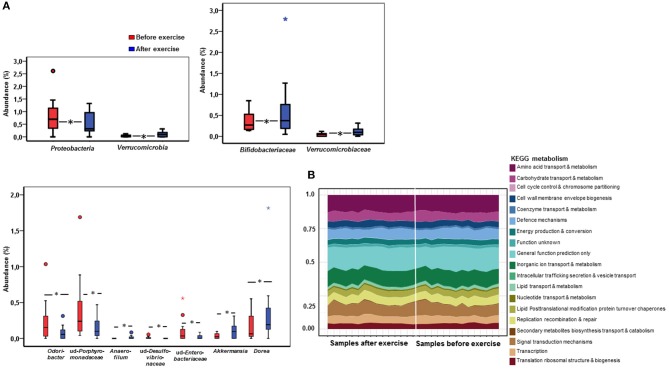
- Metagenomic analysis showed increased genus-level Jaccard β-diversity (0.449 to 0.465, p = 0.014), increased Verrucomicrobia (p = 0.038), Verrucomicrobiaceae (p = 0.038), Bifidobacteriaceae (p = 0.015), *Akkermansia* (p = 0.038), *Dorea* (p = 0.028), and *Anaerofilum* (p = 0.037), and decreased Proteobacteria (p = 0.039), unidentified Porphyromonadaceae (p = 0.016), *Odoribacter* (p = 0.033), unidentified Desulfovibrionaceae (p = 0.037), and unidentified Enterobacteriaceae (p = 0.036). Only Proteobacteria, Verrucomicrobia, Verrucomicrobiaceae, and *Akkermansia* changed independently of age, weight, fat %, android fat %, energy, sucrose, or fiber intake.
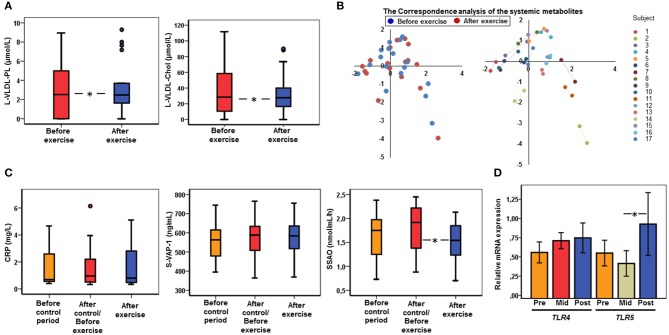
- No major KEGG pathway enrichment changes were detected; several individual genes decreased, including those related to fructose/mannose metabolism, amino acid metabolism, and B-vitamin synthesis. Systemic metabolomics showed only decreased phospholipids and cholesterol in large VLDL particles (p < 0.05 for both). VAP-1 enzymatic activity decreased (p = 0.011) without change in VAP-1 protein or CRP, and TLR5 mRNA increased (p = 0.029).
Methods
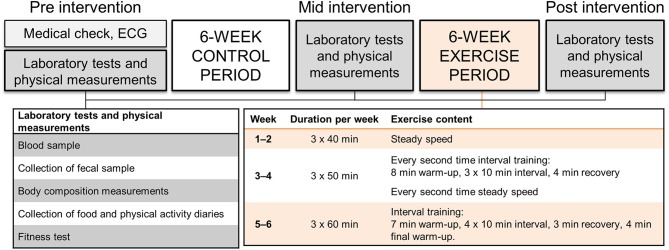
- Design: six-week supervised endurance cycling intervention in previously sedentary overweight women (BMI >27.5 kg/m²), with a preceding six-week non-training control period; subjects served as their own controls. Three sessions/week progressed from 40 to 60 min, with low-intensity and moderate-intensity interval cycling.
- Sample: 19 women underwent the intervention; 2 were excluded from final analyses due to antibiotic therapy, leaving n = 17 for physical performance, body composition, and clinical variables; n = 15 for metagenome analyses after 2 additional samples clustered differently; n = 14 completed food diaries at all time points.
- Measurements/analysis: 16S rRNA gene V4 amplicon sequencing and shotgun metagenomics; DXA for body composition; NMR metabolomics; KONELAB clinical assays; VAP-1 ELISA and amine oxidase activity; whole-blood TLR4/TLR5 qPCR. Statistics included repeated-measures ANOVA with Bonferroni post-hoc, Wilcoxon signed-rank tests with Benjamini-Hochberg correction, QIIME, Microbiome Analyst, Spearman correlations, and general linear models.
Limitations
- Stated: the cohort was small and the authors state that larger and longer exercise trials are needed; only approximately half of subjects’ microbiomes responded considerably to exercise, and inter-individual variation was large; food records are prone to under-reporting and social-desirability/social-approval bias; the mechanism by which exercise regulates VAP-1 activity without changing protein concentration could not be determined.
- Evident from the text: the study included only overweight women and only endurance exercise, so findings may not generalize to men, other BMI groups, or other exercise types; metagenome analyses were reduced to n = 15, and diet analyses to n = 14, further limiting power; the absence of major systemic metabolic changes may partly reflect heterogeneous individual responses rather than true lack of effect.
Model-written summary. Check it against the paper before relying on it.
Integrity signals
Registry
Cites
Statistics
Figures
Verification
Claims the paper makes
98 Own result · 54 Not checked yet · 22 Own interpretation · 15 Own method · 7 No basis given
A result the paper reports from its own data — it cites no other source for it, so there is none to check. The quote shows it is in the paper.
In the paper
“All clinical blood variables were within normal range, yet exercise slightly increased glucose and decreased LDL and HDL.”
§ Six-Week Endurance Exercise Alters Gut Metagenome That Is not Reflected in Systemic Metabolism in Over-weight Women > Abstract
plaindirect- Asserted: passes — The authors put it forward as true.
- Checkable: passes — It can be checked against evidence.
- Load-bearing: unclear — It is unclear whether the paper’s conclusions depend on it.
- Based: passes — The paper gives a reason why it holds.
A result the paper reports from its own data — it cites no other source for it, so there is none to check. The quote shows it is in the paper.
In the paper
“Metagenomic analysis revealed taxonomic shifts including an increase in Akkermansia and a decrease in Proteobacteria.”
§ Six-Week Endurance Exercise Alters Gut Metagenome That Is not Reflected in Systemic Metabolism in Over-weight Women > Abstract
plaindirectn = 19- Asserted: passes — The authors put it forward as true.
- Checkable: passes — It can be checked against evidence.
- Load-bearing: passes — The paper’s conclusions depend on it.
- Based: passes — The paper gives a reason why it holds.
A result the paper reports from its own data — it cites no other source for it, so there is none to check. The quote shows it is in the paper.
In the paper
“The exercise intervention was effective, as maximal power and maximum rate of oxygen consumption increased while android fat mass decreased.”
§ Six-Week Endurance Exercise Alters Gut Metagenome That Is not Reflected in Systemic Metabolism in Over-weight Women > Abstract
plaindirectn = 19- Asserted: passes — The authors put it forward as true.
- Checkable: passes — It can be checked against evidence.
- Load-bearing: passes — The paper’s conclusions depend on it.
- Based: passes — The paper gives a reason why it holds.
A result the paper reports from its own data — it cites no other source for it, so there is none to check. The quote shows it is in the paper.
In the paper
“These metagenomic changes, however, were not translated into major systemic metabolic changes as only two metabolites, phospholipids and cholesterol in large VLDL particles, decreased after exercise.”
§ Six-Week Endurance Exercise Alters Gut Metagenome That Is not Reflected in Systemic Metabolism in Over-weight Women > Abstract
plaindirect- Asserted: passes — The authors put it forward as true.
- Checkable: passes — It can be checked against evidence.
- Load-bearing: passes — The paper’s conclusions depend on it.
- Based: passes — The paper gives a reason why it holds.
A result the paper reports from its own data — it cites no other source for it, so there is none to check. The quote shows it is in the paper.
In the paper
“Training also decreased the amine oxidase activity of pro-inflammatory VAP-1, whereas no changes in CRP were detected.”
§ Six-Week Endurance Exercise Alters Gut Metagenome That Is not Reflected in Systemic Metabolism in Over-weight Women > Abstract
plaindirect- Asserted: passes — The authors put it forward as true.
- Checkable: passes — It can be checked against evidence.
- Load-bearing: unclear — It is unclear whether the paper’s conclusions depend on it.
- Based: passes — The paper gives a reason why it holds.
A result the paper reports from its own data — it cites no other source for it, so there is none to check. The quote shows it is in the paper.
In the paper
“The exercise intervention was effective, as maximal power and maximum rate of oxygen consumption increased while android fat mass decreased.”
§ Six-Week Endurance Exercise Alters Gut Metagenome That Is not Reflected in Systemic Metabolism in Over-weight Women > Abstract
plaindirectn = 19- Asserted: passes — The authors put it forward as true.
- Checkable: passes — It can be checked against evidence.
- Load-bearing: passes — The paper’s conclusions depend on it.
- Based: passes — The paper gives a reason why it holds.
A result the paper reports from its own data — it cites no other source for it, so there is none to check. The quote shows it is in the paper.
In the paper
“All clinical blood variables were within normal range, yet exercise slightly increased glucose and decreased LDL and HDL.”
§ Six-Week Endurance Exercise Alters Gut Metagenome That Is not Reflected in Systemic Metabolism in Over-weight Women > Abstract
plain- Asserted: passes — The authors put it forward as true.
- Checkable: passes — It can be checked against evidence.
- Load-bearing: unclear — It is unclear whether the paper’s conclusions depend on it.
- Based: passes — The paper gives a reason why it holds.
A result the paper reports from its own data — it cites no other source for it, so there is none to check. The quote shows it is in the paper.
In the paper
“All clinical blood variables were within normal range, yet exercise slightly increased glucose and decreased LDL and HDL.”
§ Six-Week Endurance Exercise Alters Gut Metagenome That Is not Reflected in Systemic Metabolism in Over-weight Women > Abstract
plaindirect- Asserted: passes — The authors put it forward as true.
- Checkable: passes — It can be checked against evidence.
- Load-bearing: unclear — It is unclear whether the paper’s conclusions depend on it.
- Based: passes — The paper gives a reason why it holds.
- Probably not a substantial claim. 67
- It may state two separate claims as one. 22
A result the paper reports from its own data — it cites no other source for it, so there is none to check. The quote shows it is in the paper.
In the paper
“However, the energy % derived from starch slightly increased after the exercise period (p = 0.033).”
§ Six-Week Endurance Exercise Alters Gut Metagenome That Is not Reflected in Systemic Metabolism in Over-weight Women > Results > No changes in total energy intake, intake of energy-yielding or gut microbiota-affecting nutrients were observed after the exercise period
plaindirectn = 14- Asserted: passes — The authors put it forward as true.
- Checkable: passes — It can be checked against evidence.
- Load-bearing: fails — The paper’s conclusions may not depend on it.
- Based: passes — The paper gives a reason why it holds.
Probably not a substantial claim. The paper’s conclusions may not depend on it.
A result the paper reports from its own data — it cites no other source for it, so there is none to check. The quote shows it is in the paper.
In the paper
“However, even with such study set up no effects of the intervention on gut microbiota were observed with lower sequencing depth, and modest changes were found with deeper metagenomic analysis.”
§ Six-Week Endurance Exercise Alters Gut Metagenome That Is not Reflected in Systemic Metabolism in Over-weight Women > Discussion
plain- Asserted: passes — The authors put it forward as true.
- Checkable: passes — It can be checked against evidence.
- Load-bearing: passes — The paper’s conclusions depend on it.
- Based: passes — The paper gives a reason why it holds.
It may state two separate claims as one.
A result the paper reports from its own data — it cites no other source for it, so there is none to check. The quote shows it is in the paper.
In the paper
“Free fatty acids decreased and triglycerides and insulin increased after the control period.”
§ Six-Week Endurance Exercise Alters Gut Metagenome That Is not Reflected in Systemic Metabolism in Over-weight Women > Results > Exercise slightly affected clinical variables
plaindirectn = 17- Asserted: passes — The authors put it forward as true.
- Checkable: passes — It can be checked against evidence.
- Load-bearing: fails — The paper’s conclusions may not depend on it.
- Based: passes — The paper gives a reason why it holds.
Probably not a substantial claim. The paper’s conclusions may not depend on it.
A result the paper reports from its own data — it cites no other source for it, so there is none to check. The quote shows it is in the paper.
In the paper
“However, the exercise intervention was successful as the maximal power and maximum rate of oxygen consumption increased.”
§ Six-Week Endurance Exercise Alters Gut Metagenome That Is not Reflected in Systemic Metabolism in Over-weight Women > Discussion
plaindirect- Asserted: passes — The authors put it forward as true.
- Checkable: passes — It can be checked against evidence.
- Load-bearing: passes — The paper’s conclusions depend on it.
- Based: passes — The paper gives a reason why it holds.
It may state two separate claims as one.
A result the paper reports from its own data — it cites no other source for it, so there is none to check. The quote shows it is in the paper.
In the paper
“In this study we showed that six-weeks endurance exercise intervention modestly modified the composition and functions of the gut microbiota without greatly affecting systemic metabolites or body composition.”
§ Six-Week Endurance Exercise Alters Gut Metagenome That Is not Reflected in Systemic Metabolism in Over-weight Women > Discussion
plain- Asserted: passes — The authors put it forward as true.
- Checkable: passes — It can be checked against evidence.
- Load-bearing: passes — The paper’s conclusions depend on it.
- Based: passes — The paper gives a reason why it holds.
It may state two separate claims as one.
A result the paper reports from its own data — it cites no other source for it, so there is none to check. The quote shows it is in the paper.
In the paper
“Since no evident changes in weight, body composition and diet occurred during the exercise training, it can be proposed that the effects on gut microbiota were related to the exercise training.”
§ Six-Week Endurance Exercise Alters Gut Metagenome That Is not Reflected in Systemic Metabolism in Over-weight Women > Discussion
plain- Asserted: passes — The authors put it forward as true.
- Checkable: passes — It can be checked against evidence.
- Load-bearing: passes — The paper’s conclusions depend on it.
- Based: passes — The paper gives a reason why it holds.
It may state two separate claims as one.
A result the paper reports from its own data — it cites no other source for it, so there is none to check. The quote shows it is in the paper.
In the paper
“Of the clinical variables the change in HDL, LDL and glucose remained significant while no other changes were detected.”
§ Six-Week Endurance Exercise Alters Gut Metagenome That Is not Reflected in Systemic Metabolism in Over-weight Women > Results > Microbiome analysis revealed that exercise training modified the composition and functions of the gut microbiota
plain- Asserted: passes — The authors put it forward as true.
- Checkable: passes — It can be checked against evidence.
- Load-bearing: unclear — It is unclear whether the paper’s conclusions depend on it.
- Based: passes — The paper gives a reason why it holds.
It may state two separate claims as one.
A result the paper reports from its own data — it cites no other source for it, so there is none to check. The quote shows it is in the paper.
In the paper
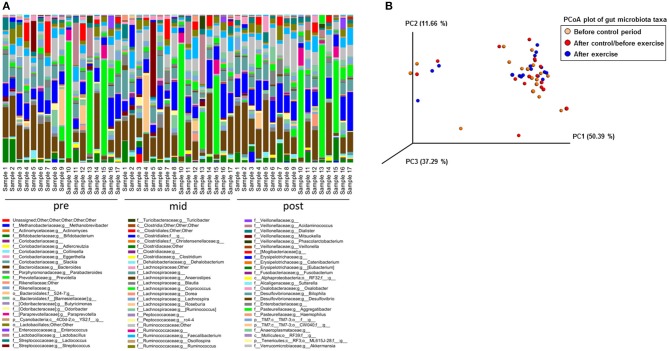
“The variation in the genus level composition of the gut microbiota between the subjects appears to be vast in all analyzed time points (Figure 2A).”
§ Six-Week Endurance Exercise Alters Gut Metagenome That Is not Reflected in Systemic Metabolism in Over-weight Women > Results > Microbiome analysis revealed that exercise training modified the composition and functions of the gut microbiota
hedged- Asserted: passes — The authors put it forward as true.
- Checkable: passes — It can be checked against evidence.
- Load-bearing: fails — The paper’s conclusions may not depend on it.
- Based: passes — The paper gives a reason why it holds.
Probably not a substantial claim. The paper’s conclusions may not depend on it.
The paper states this without a source or data behind it here, so there is nothing to check it against. The quote shows it is in the paper.
In the paper
“Similarly, the statistically non-signifcant decline in protein ingestion during the exercise period can contribute to the decrease of metagenomic functions related to amino acids metabolism.”
§ Six-Week Endurance Exercise Alters Gut Metagenome That Is not Reflected in Systemic Metabolism in Over-weight Women > Discussion
plain- Asserted: passes — The authors put it forward as true.
- Checkable: passes — It can be checked against evidence.
- Load-bearing: fails — The paper’s conclusions may not depend on it.
- Based: passes — The paper gives a reason why it holds.
Probably not a substantial claim. The paper’s conclusions may not depend on it.
A result the paper reports from its own data — it cites no other source for it, so there is none to check. The quote shows it is in the paper.
In the paper
“However, in our study, despite the favorable taxonomic shifts in butyrate-producing Akkermansia and Dorea, exercise training did not increase butyrate metabolism genes but reduced several metagenomic functions including those related to fructose, mannose, alanine and aromatic amino acids metabolism.”
§ Six-Week Endurance Exercise Alters Gut Metagenome That Is not Reflected in Systemic Metabolism in Over-weight Women > Discussion
plaindirect- Asserted: passes — The authors put it forward as true.
- Checkable: passes — It can be checked against evidence.
- Load-bearing: passes — The paper’s conclusions depend on it.
- Based: passes — The paper gives a reason why it holds.
It may state two separate claims as one.
In the paper
“Another study reported that combined eight-weeks aerobic and resistance exercise induced modest shifts in gut metagenomes despite no changes in the diversity of taxa or metabolic pathways (Cronin et al., 2018).”
§ Six-Week Endurance Exercise Alters Gut Metagenome That Is not Reflected in Systemic Metabolism in Over-weight Women > Introduction
What the sources say
- Not checked yetcites Cronin et al., 2018 source
plaindirect- Asserted: passes — The authors put it forward as true.
- Checkable: passes — It can be checked against evidence.
- Load-bearing: fails — The paper’s conclusions may not depend on it.
- Based: passes — The paper gives a reason why it holds.
Probably not a substantial claim. The paper’s conclusions may not depend on it. It may state two separate claims as one.
In the paper
“To date, one study showed that exercise induced compositional changes in the human gut microbiota that were more pronounced in lean than in obese (Allen et al., 2017).”
§ Six-Week Endurance Exercise Alters Gut Metagenome That Is not Reflected in Systemic Metabolism in Over-weight Women > Introduction
What the sources say
- Not checked yetcites Allen et al., 2017 source
plaindirect- Asserted: passes — The authors put it forward as true.
- Checkable: passes — It can be checked against evidence.
- Load-bearing: fails — The paper’s conclusions may not depend on it.
- Based: passes — The paper gives a reason why it holds.
Probably not a substantial claim. The paper’s conclusions may not depend on it.
In the paper
“Cross-sectional human studies have reported that professional rugby players diverge from body mass index (BMI)-matched non-athletes in several bacterial phyla (Clarke et al., 2014), and that normal weight active women differ from sedentary women in several taxa (Bressa et al., 2017).”
§ Six-Week Endurance Exercise Alters Gut Metagenome That Is not Reflected in Systemic Metabolism in Over-weight Women > Introduction
What the sources say
- Not checked yetcites Clarke et al., 2014 source
plaincorrelational- Asserted: passes — The authors put it forward as true.
- Checkable: passes — It can be checked against evidence.
- Load-bearing: fails — The paper’s conclusions may not depend on it.
- Based: passes — The paper gives a reason why it holds.
Probably not a substantial claim. The paper’s conclusions may not depend on it.
In the paper
“Both exercise and gut microbiota are known to induce inflammation (Clark and Mach, 2017), which may be mediated by bacterial molecules-recognizing Toll-like receptors (TLR) (McKenzie et al., 2017).”
§ Six-Week Endurance Exercise Alters Gut Metagenome That Is not Reflected in Systemic Metabolism in Over-weight Women > Introduction
What the sources say
- Not checked yetcites McKenzie et al., 2017 source
hedgedconditional- Asserted: passes — The authors put it forward as true.
- Checkable: passes — It can be checked against evidence.
- Load-bearing: passes — The paper’s conclusions depend on it.
- Based: passes — The paper gives a reason why it holds.
Probably not a substantial claim.
In the paper
“VAP-1 is a multifunctional protein with amine oxidase activity (Salmi and Jalkanen, 2017) that degrades primary amines and produces hydrogen peroxide, ammonium and aldehydes, which can modify the microenvironment to pro-inflammatory direction and cause detrimental effects on vasculature.”
§ Six-Week Endurance Exercise Alters Gut Metagenome That Is not Reflected in Systemic Metabolism in Over-weight Women > Introduction
What the sources say
- Not checked yetcites Salmi and Jalkanen, 2017
plaindirect- Asserted: passes — The authors put it forward as true.
- Checkable: passes — It can be checked against evidence.
- Load-bearing: passes — The paper’s conclusions depend on it.
- Based: passes — The paper gives a reason why it holds.
Probably not a substantial claim. It may state two separate claims as one.
In the paper
“Acute effects of exercise have also been studied using maximal bicycle ergometer test that showed an increase in the abundance of 7 out of 9 major taxa in patients with myalgic encephalomyelitis/chronic fatigue syndrome compared to 2 of 9 in healthy controls (Shukla et al., 2015).”
§ Six-Week Endurance Exercise Alters Gut Metagenome That Is not Reflected in Systemic Metabolism in Over-weight Women > Introduction
What the sources say
- Not checked yetcites Shukla et al., 2015 source
plaindirect- Asserted: passes — The authors put it forward as true.
- Checkable: passes — It can be checked against evidence.
- Load-bearing: fails — The paper’s conclusions may not depend on it.
- Based: passes — The paper gives a reason why it holds.
Probably not a substantial claim. The paper’s conclusions may not depend on it.
A conclusion the paper draws from its own results — it cites no other source for it, so there is none to check. The quote shows it is in the paper.
In the paper
“In conclusion, exercise training modified the gut microbiome without greatly affecting systemic metabolites or body composition.”
§ Six-Week Endurance Exercise Alters Gut Metagenome That Is not Reflected in Systemic Metabolism in Over-weight Women > Abstract
plaindirect- Asserted: passes — The authors put it forward as true.
- Checkable: passes — It can be checked against evidence.
- Load-bearing: passes — The paper’s conclusions depend on it.
- Based: passes — The paper gives a reason why it holds.
It may state two separate claims as one.
In the paper
“Cross-sectional human studies have reported that professional rugby players diverge from body mass index (BMI)-matched non-athletes in several bacterial phyla (Clarke et al., 2014), and that normal weight active women differ from sedentary women in several taxa (Bressa et al., 2017).”
§ Six-Week Endurance Exercise Alters Gut Metagenome That Is not Reflected in Systemic Metabolism in Over-weight Women > Introduction
What the sources say
- Not checked yetcites Bressa et al., 2017 source
plaincorrelational- Asserted: passes — The authors put it forward as true.
- Checkable: passes — It can be checked against evidence.
- Load-bearing: fails — The paper’s conclusions may not depend on it.
- Based: passes — The paper gives a reason why it holds.
Probably not a substantial claim. The paper’s conclusions may not depend on it.
In the paper
“VAP-1 is a multifunctional protein with amine oxidase activity (Salmi and Jalkanen, 2017) that degrades primary amines and produces hydrogen peroxide, ammonium and aldehydes, which can modify the microenvironment to pro-inflammatory direction and cause detrimental effects on vasculature.”
§ Six-Week Endurance Exercise Alters Gut Metagenome That Is not Reflected in Systemic Metabolism in Over-weight Women > Introduction
What the sources say
- Not checked yetcites Salmi and Jalkanen, 2017
plain- Asserted: passes — The authors put it forward as true.
- Checkable: passes — It can be checked against evidence.
- Load-bearing: passes — The paper’s conclusions depend on it.
- Based: passes — The paper gives a reason why it holds.
Probably not a substantial claim.
In the paper
“VAP-1 is a multifunctional protein with amine oxidase activity (Salmi and Jalkanen, 2017) that degrades primary amines and produces hydrogen peroxide, ammonium and aldehydes, which can modify the microenvironment to pro-inflammatory direction and cause detrimental effects on vasculature.”
§ Six-Week Endurance Exercise Alters Gut Metagenome That Is not Reflected in Systemic Metabolism in Over-weight Women > Introduction
What the sources say
- Not checked yetcites Salmi and Jalkanen, 2017
plaindirect- Asserted: passes — The authors put it forward as true.
- Checkable: passes — It can be checked against evidence.
- Load-bearing: passes — The paper’s conclusions depend on it.
- Based: passes — The paper gives a reason why it holds.
Probably not a substantial claim.
In the paper
“In addition, half marathon performed by amateurs was reported to affect gut microbiota composition, predicted functions and fecal metabolites (Zhao et al., 2018b).”
§ Six-Week Endurance Exercise Alters Gut Metagenome That Is not Reflected in Systemic Metabolism in Over-weight Women > Introduction
What the sources say
- Not checked yetcites Zhao et al., 2018b
plaindirect- Asserted: passes — The authors put it forward as true.
- Checkable: passes — It can be checked against evidence.
- Load-bearing: fails — The paper’s conclusions may not depend on it.
- Based: passes — The paper gives a reason why it holds.
Probably not a substantial claim. The paper’s conclusions may not depend on it. It may state two separate claims as one.
In the paper
“In addition, in the study of Bressa et al. the sedentary group had significantly higher body fat percentage and mass (Bressa et al., 2017), traits known to be highly associated with gut microbiota composition (Turnbaugh et al., 2009).”
§ Six-Week Endurance Exercise Alters Gut Metagenome That Is not Reflected in Systemic Metabolism in Over-weight Women > Introduction
What the sources say
- Not checked yetcites Turnbaugh et al., 2009 source
boostedcorrelational- Asserted: passes — The authors put it forward as true.
- Checkable: passes — It can be checked against evidence.
- Load-bearing: fails — The paper’s conclusions may not depend on it.
- Based: passes — The paper gives a reason why it holds.
Probably not a substantial claim. The paper’s conclusions may not depend on it.
In the paper
“Previously we have shown that the amine oxidase activity of Vascular Adhesion Protein 1 (VAP-1) is involved in a lipolysaccharide-induced inflammation model (Yu et al., 2006)”
§ Six-Week Endurance Exercise Alters Gut Metagenome That Is not Reflected in Systemic Metabolism in Over-weight Women > Introduction
What the sources say
- Not checked yetcites Yu et al., 2006
plaindirect- Asserted: passes — The authors put it forward as true.
- Checkable: passes — It can be checked against evidence.
- Load-bearing: passes — The paper’s conclusions depend on it.
- Based: passes — The paper gives a reason why it holds.
Probably not a substantial claim.
A conclusion the paper draws from its own results — it cites no other source for it, so there is none to check. The quote shows it is in the paper.
In the paper
“Based on our data and existing literature, we propose that especially Akkermansia and Proteobacteria are exercise-responsive taxa.”
§ Six-Week Endurance Exercise Alters Gut Metagenome That Is not Reflected in Systemic Metabolism in Over-weight Women > Abstract
hedgedcorrelational- Asserted: passes — The authors put it forward as true.
- Checkable: passes — It can be checked against evidence.
- Load-bearing: passes — The paper’s conclusions depend on it.
- Based: passes — The paper gives a reason why it holds.
It may state two separate claims as one.
In the paper
“Both exercise and gut microbiota are known to induce inflammation (Clark and Mach, 2017), which may be mediated by bacterial molecules-recognizing Toll-like receptors (TLR) (McKenzie et al., 2017).”
§ Six-Week Endurance Exercise Alters Gut Metagenome That Is not Reflected in Systemic Metabolism in Over-weight Women > Introduction
What the sources say
- Not checked yetcites Clark and Mach, 2017
boosteddirect- Asserted: passes — The authors put it forward as true.
- Checkable: passes — It can be checked against evidence.
- Load-bearing: passes — The paper’s conclusions depend on it.
- Based: passes — The paper gives a reason why it holds.
It may state two separate claims as one.
What the paper did — it cites no source for this, so there is none to check. The quote shows it is in the paper.
In the paper
“Fourteen subjects completed the food diaries in all time points and were included in the analyses.”
§ Six-Week Endurance Exercise Alters Gut Metagenome That Is not Reflected in Systemic Metabolism in Over-weight Women > Materials and methods > Food diaries
plainn = 14- Asserted: passes — The authors put it forward as true.
- Checkable: passes — It can be checked against evidence.
- Load-bearing: fails — The paper’s conclusions may not depend on it.
- Based: passes — The paper gives a reason why it holds.
Probably not a substantial claim. The paper’s conclusions may not depend on it. It may state two separate claims as one.
What the paper did — it cites no source for this, so there is none to check. The quote shows it is in the paper.
In the paper
“The subjects had not ingested antibiotics within 2 months prior to the sampling.”
§ Six-Week Endurance Exercise Alters Gut Metagenome That Is not Reflected in Systemic Metabolism in Over-weight Women > Materials and methods > Study subjects
plain- Asserted: passes — The authors put it forward as true.
- Checkable: passes — It can be checked against evidence.
- Load-bearing: passes — The paper’s conclusions depend on it.
- Based: passes — The paper gives a reason why it holds.
Probably not a substantial claim.
None of the sources cited for this claim have been checked yet.
In the paper
“Recently, animal models have shown that exercise impacts microbial abundance (Lambert et al., 2015; Welly et al., 2016)”
§ Six-Week Endurance Exercise Alters Gut Metagenome That Is not Reflected in Systemic Metabolism in Over-weight Women > Introduction
What the sources say
plaindirect- Asserted: passes — The authors put it forward as true.
- Checkable: passes — It can be checked against evidence.
- Load-bearing: fails — The paper’s conclusions may not depend on it.
- Based: passes — The paper gives a reason why it holds.
Probably not a substantial claim. The paper’s conclusions may not depend on it.
What the paper did — it cites no source for this, so there is none to check. The quote shows it is in the paper.
In the paper
“Each sample was analyzed in duplicate, and PCR cycle parameters were as follows: +95°C for 10 min, 40 cycles at +95°C for 10 s, at +56°C (TLR4) or +59°C (TLR5) or +60°C (GAPDH) for 30 s, and at +72°C for 30 s, followed finally by 5 s at +65°C.”
§ Six-Week Endurance Exercise Alters Gut Metagenome That Is not Reflected in Systemic Metabolism in Over-weight Women > Materials and methods > Real-time quantitative PCR from whole blood
plain- Asserted: passes — The authors put it forward as true.
- Checkable: passes — It can be checked against evidence.
- Load-bearing: fails — The paper’s conclusions may not depend on it.
- Based: passes — The paper gives a reason why it holds.
Probably not a substantial claim. The paper’s conclusions may not depend on it.
What the paper did — it cites no source for this, so there is none to check. The quote shows it is in the paper.
In the paper
“Fourteen subjects completed the food diaries in all time points.”
§ Six-Week Endurance Exercise Alters Gut Metagenome That Is not Reflected in Systemic Metabolism in Over-weight Women > Results > No changes in total energy intake, intake of energy-yielding or gut microbiota-affecting nutrients were observed after the exercise period
plainn = 14- Asserted: passes — The authors put it forward as true.
- Checkable: passes — It can be checked against evidence.
- Load-bearing: fails — The paper’s conclusions may not depend on it.
- Based: passes — The paper gives a reason why it holds.
Probably not a substantial claim. The paper’s conclusions may not depend on it.
What the paper did — it cites no source for this, so there is none to check. The quote shows it is in the paper.
In the paper
“Real-time PCR analyses were performed according to MIQE guidelines using in-house designed primers (Invitrogen, Carlsbad, CA, USA), iQ SYBR Supermix, and CFX96™ Real-time PCR Detection System (Bio-Rad Laboratories, Richmond, CA, USA).”
§ Six-Week Endurance Exercise Alters Gut Metagenome That Is not Reflected in Systemic Metabolism in Over-weight Women > Materials and methods > Real-time quantitative PCR from whole blood
plain- Asserted: passes — The authors put it forward as true.
- Checkable: passes — It can be checked against evidence.
- Load-bearing: fails — The paper’s conclusions may not depend on it.
- Based: passes — The paper gives a reason why it holds.
Probably not a substantial claim. The paper’s conclusions may not depend on it.
What the paper did — it cites no source for this, so there is none to check. The quote shows it is in the paper.
In the paper
“The gas analyzer was calibrated on each testing day.”
§ Six-Week Endurance Exercise Alters Gut Metagenome That Is not Reflected in Systemic Metabolism in Over-weight Women > Materials and methods > Endurance exercise test
plain- Asserted: passes — The authors put it forward as true.
- Checkable: passes — It can be checked against evidence.
- Load-bearing: fails — The paper’s conclusions may not depend on it.
- Based: passes — The paper gives a reason why it holds.
Probably not a substantial claim. The paper’s conclusions may not depend on it.
What the paper did — it cites no source for this, so there is none to check. The quote shows it is in the paper.
In the paper
“General linear model in SPSS was used to determine whether the changes in taxa occurred in response to exercise or whether they were dependent on age, weight, body fat %, android fat %, intake of total energy intake, sucrose or fiber.”
§ Six-Week Endurance Exercise Alters Gut Metagenome That Is not Reflected in Systemic Metabolism in Over-weight Women > Materials and methods > Statistics
plaincorrelational- Asserted: passes — The authors put it forward as true.
- Checkable: passes — It can be checked against evidence.
- Load-bearing: fails — The paper’s conclusions may not depend on it.
- Based: passes — The paper gives a reason why it holds.
Probably not a substantial claim. The paper’s conclusions may not depend on it.
What the paper did — it cites no source for this, so there is none to check. The quote shows it is in the paper.
In the paper
“The samples were always collected over 72 h after the last exercise bout.”
§ Six-Week Endurance Exercise Alters Gut Metagenome That Is not Reflected in Systemic Metabolism in Over-weight Women > Materials and methods > Fecal sample collection, 16s rRNA gene sequencing and metagenome analyses
plain- Asserted: passes — The authors put it forward as true.
- Checkable: passes — It can be checked against evidence.
- Load-bearing: fails — The paper’s conclusions may not depend on it.
- Based: passes — The paper gives a reason why it holds.
Probably not a substantial claim. The paper’s conclusions may not depend on it.
What the paper did — it cites no source for this, so there is none to check. The quote shows it is in the paper.
In the paper
“From the 16S rRNA gene amplicon sequencing and metagenome sequencing the group comparisons of gut microbiota were analyzed with non-parametric Wilcoxon matched-pair signed rank test and corrected for multiple comparison with Benjamini-Hochberg procedure.”
§ Six-Week Endurance Exercise Alters Gut Metagenome That Is not Reflected in Systemic Metabolism in Over-weight Women > Materials and methods > Statistics
plain- Asserted: passes — The authors put it forward as true.
- Checkable: passes — It can be checked against evidence.
- Load-bearing: passes — The paper’s conclusions depend on it.
- Based: passes — The paper gives a reason why it holds.
Probably not a substantial claim.
In the paper
“Due to that the gut microbiota composition is known to be highly associated with weight and body composition (Turnbaugh et al., 2009)”
§ Six-Week Endurance Exercise Alters Gut Metagenome That Is not Reflected in Systemic Metabolism in Over-weight Women > Results > Exercise training did not lead to a significant weight loss but decreased android fat mass
What the sources say
- Not checked yetcites Turnbaugh et al., 2009 source
boostedcorrelational- Asserted: passes — The authors put it forward as true.
- Checkable: passes — It can be checked against evidence.
- Load-bearing: passes — The paper’s conclusions depend on it.
- Based: passes — The paper gives a reason why it holds.
Probably not a substantial claim.
A conclusion the paper draws from its own results — it cites no other source for it, so there is none to check. The quote shows it is in the paper.
In the paper
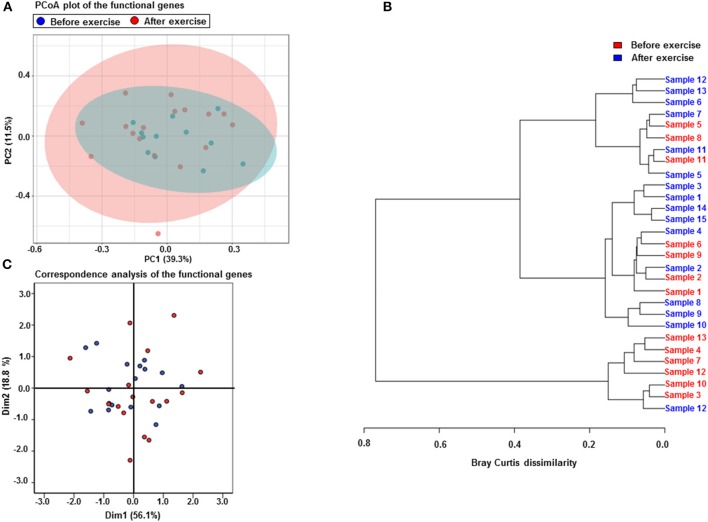
“In agreement, the Correspondence analysis shows that the samples before exercise are less variable (more close to the centroid) than the samples after exercise indicating that the exercise has caused shifts in COGs, which, nevertheless, are relatively heterogeneous (Figure 4C).”
§ Six-Week Endurance Exercise Alters Gut Metagenome That Is not Reflected in Systemic Metabolism in Over-weight Women > Results > Microbiome analysis revealed that exercise training modified the composition and functions of the gut microbiota
hedgeddirect- Asserted: passes — The authors put it forward as true.
- Checkable: passes — It can be checked against evidence.
- Load-bearing: unclear — It is unclear whether the paper’s conclusions depend on it.
- Based: passes — The paper gives a reason why it holds.
It may state two separate claims as one.
What the paper did — it cites no source for this, so there is none to check. The quote shows it is in the paper.
In the paper
“two were excluded of the final analyses due to antibiotic therapy during the intervention.”
§ Six-Week Endurance Exercise Alters Gut Metagenome That Is not Reflected in Systemic Metabolism in Over-weight Women > Results > Exercise training significantly increased maximal power and oxygen uptake capacity and decreased blood lactate
plainn = 2- Asserted: passes — The authors put it forward as true.
- Checkable: passes — It can be checked against evidence.
- Load-bearing: fails — The paper’s conclusions may not depend on it.
- Based: passes — The paper gives a reason why it holds.
Probably not a substantial claim. The paper’s conclusions may not depend on it.
What the paper did — it cites no source for this, so there is none to check. The quote shows it is in the paper.
In the paper
“When assessing the metagenome data the samples of two subjects clustered differently and were removed from the final analyses. Therefore, 15 subjects were included in the metagenome analyses.”
§ Six-Week Endurance Exercise Alters Gut Metagenome That Is not Reflected in Systemic Metabolism in Over-weight Women > Materials and methods > Fecal sample collection, 16s rRNA gene sequencing and metagenome analyses
plainn = 2- Asserted: passes — The authors put it forward as true.
- Checkable: passes — It can be checked against evidence.
- Load-bearing: fails — The paper’s conclusions may not depend on it.
- Based: passes — The paper gives a reason why it holds.
Probably not a substantial claim. The paper’s conclusions may not depend on it. It may state two separate claims as one.
What the paper did — it cites no source for this, so there is none to check. The quote shows it is in the paper.
In the paper
“Blood samples were taken after overnight fasting over 72 h after the last exercise bout.”
§ Six-Week Endurance Exercise Alters Gut Metagenome That Is not Reflected in Systemic Metabolism in Over-weight Women > Materials and methods > Blood samples, analysis of clinical variables and metabolomics
plain- Asserted: passes — The authors put it forward as true.
- Checkable: passes — It can be checked against evidence.
- Load-bearing: passes — The paper’s conclusions depend on it.
- Based: passes — The paper gives a reason why it holds.
Probably not a substantial claim.
What the paper did — it cites no source for this, so there is none to check. The quote shows it is in the paper.
In the paper
“They had no intestinal or other chronic diseases or medications that could have affected the gut microbiota.”
§ Six-Week Endurance Exercise Alters Gut Metagenome That Is not Reflected in Systemic Metabolism in Over-weight Women > Results > Exercise training significantly increased maximal power and oxygen uptake capacity and decreased blood lactate
plainn = 19- Asserted: passes — The authors put it forward as true.
- Checkable: passes — It can be checked against evidence.
- Load-bearing: passes — The paper’s conclusions depend on it.
- Based: passes — The paper gives a reason why it holds.
Probably not a substantial claim.
None of the sources cited for this claim have been checked yet.
In the paper
“In animal models exercise has boosted the abundance of Dorea (Allen et al., 2015; Denou et al., 2016)”
§ Six-Week Endurance Exercise Alters Gut Metagenome That Is not Reflected in Systemic Metabolism in Over-weight Women > Discussion
What the sources say
plaindirect- Asserted: passes — The authors put it forward as true.
- Checkable: passes — It can be checked against evidence.
- Load-bearing: fails — The paper’s conclusions may not depend on it.
- Based: passes — The paper gives a reason why it holds.
Probably not a substantial claim. The paper’s conclusions may not depend on it.
In the paper
“as well as between physically active and sedentary women (Bressa et al., 2017).”
§ Six-Week Endurance Exercise Alters Gut Metagenome That Is not Reflected in Systemic Metabolism in Over-weight Women > Discussion
What the sources say
- Not checked yetcites Bressa et al., 2017 source
plaincorrelational- Asserted: passes — The authors put it forward as true.
- Checkable: passes — It can be checked against evidence.
- Load-bearing: fails — The paper’s conclusions may not depend on it.
- Based: passes — The paper gives a reason why it holds.
Probably not a substantial claim. The paper’s conclusions may not depend on it. It may state two separate claims as one.
In the paper
“as fiber-rich diet seem to promote Akkermansia growth (Everard et al., 2014).”
§ Six-Week Endurance Exercise Alters Gut Metagenome That Is not Reflected in Systemic Metabolism in Over-weight Women > Discussion
What the sources say
- Not checked yetcites Everard et al., 2014 source
hedgedconditional- Asserted: passes — The authors put it forward as true.
- Checkable: passes — It can be checked against evidence.
- Load-bearing: fails — The paper’s conclusions may not depend on it.
- Based: passes — The paper gives a reason why it holds.
Probably not a substantial claim. The paper’s conclusions may not depend on it.
In the paper
“As exercise is known to increase absorption of fructose (Fujisawa et al., 1993)”
§ Six-Week Endurance Exercise Alters Gut Metagenome That Is not Reflected in Systemic Metabolism in Over-weight Women > Discussion
What the sources say
- Not checked yetcites Fujisawa et al., 1993 source
boosteddirect- Asserted: passes — The authors put it forward as true.
- Checkable: passes — It can be checked against evidence.
- Load-bearing: passes — The paper’s conclusions depend on it.
- Based: passes — The paper gives a reason why it holds.
Probably not a substantial claim.
In the paper
“An increased abundance of Enterobacteriaceae has been reported in obesity (Scheepers et al., 2015)”
§ Six-Week Endurance Exercise Alters Gut Metagenome That Is not Reflected in Systemic Metabolism in Over-weight Women > Discussion
What the sources say
- Not checked yetcites Scheepers et al., 2015 source
plaincorrelational- Asserted: passes — The authors put it forward as true.
- Checkable: passes — It can be checked against evidence.
- Load-bearing: fails — The paper’s conclusions may not depend on it.
- Based: passes — The paper gives a reason why it holds.
Probably not a substantial claim. The paper’s conclusions may not depend on it.
In the paper
“A similar concept of the so-called responder microbes was also raised in a diet intervention that attempted to ameliorate Type 2 diabetes by improving short chain fatty acid (SCFA) production from fibers (Zhao et al., 2018a).”
§ Six-Week Endurance Exercise Alters Gut Metagenome That Is not Reflected in Systemic Metabolism in Over-weight Women > Discussion
What the sources say
- Not checked yetcites Zhao et al., 2018a
plainn = 27- Asserted: passes — The authors put it forward as true.
- Checkable: passes — It can be checked against evidence.
- Load-bearing: fails — The paper’s conclusions may not depend on it.
- Based: passes — The paper gives a reason why it holds.
Probably not a substantial claim. The paper’s conclusions may not depend on it.
A conclusion the paper draws from its own results — it cites no other source for it, so there is none to check. The quote shows it is in the paper.
In the paper
“This could contribute to the reduction in fructose and mannose metabolism genes.”
§ Six-Week Endurance Exercise Alters Gut Metagenome That Is not Reflected in Systemic Metabolism in Over-weight Women > Discussion
hedgedconditional- Asserted: passes — The authors put it forward as true.
- Checkable: passes — It can be checked against evidence.
- Load-bearing: fails — The paper’s conclusions may not depend on it.
- Based: passes — The paper gives a reason why it holds.
Probably not a substantial claim. The paper’s conclusions may not depend on it.
- Rests on an assumption: Fructose absorption mainly occurs in the small intestine.
In the paper
“Akkermansia has been found to be lower in several conditions, such as during obesity, diabetes (Cani and de Vos, 2017)”
§ Six-Week Endurance Exercise Alters Gut Metagenome That Is not Reflected in Systemic Metabolism in Over-weight Women > Discussion
What the sources say
- Not checked yetcites Cani and de Vos, 2017
plaincorrelational- Asserted: passes — The authors put it forward as true.
- Checkable: passes — It can be checked against evidence.
- Load-bearing: passes — The paper’s conclusions depend on it.
- Based: passes — The paper gives a reason why it holds.
Probably not a substantial claim.
In the paper
“On the other hand, similar to our results, Allen and co-workers reported compositional and β-diversity changes of the microbiota in response to six-weeks endurance training that resembled the intervention of our study (Allen et al., 2017).”
§ Six-Week Endurance Exercise Alters Gut Metagenome That Is not Reflected in Systemic Metabolism in Over-weight Women > Discussion
What the sources say
- Not checked yetcites Allen et al., 2017 source
plaindirect- Asserted: passes — The authors put it forward as true.
- Checkable: passes — It can be checked against evidence.
- Load-bearing: fails — The paper’s conclusions may not depend on it.
- Based: passes — The paper gives a reason why it holds.
Probably not a substantial claim. The paper’s conclusions may not depend on it.
In the paper
“The authors concluded that the shifts were dependent on the obesity status and were reversed after cessation of the training.”
§ Six-Week Endurance Exercise Alters Gut Metagenome That Is not Reflected in Systemic Metabolism in Over-weight Women > Discussion
What the sources say
- Not checked yetcites Allen et al., 2017 source
plaindirect- Asserted: passes — The authors put it forward as true.
- Checkable: passes — It can be checked against evidence.
- Load-bearing: fails — The paper’s conclusions may not depend on it.
- Based: passes — The paper gives a reason why it holds.
Probably not a substantial claim. The paper’s conclusions may not depend on it. It may state two separate claims as one.
In the paper
“However, including both genders in the study may have hindered some of the discoveries, as gender differences in the gut microbiota are known to influence, for instance, metabolic outcomes and immunity (Fransen et al., 2017).”
§ Six-Week Endurance Exercise Alters Gut Metagenome That Is not Reflected in Systemic Metabolism in Over-weight Women > Discussion
What the sources say
- Not checked yetcites Fransen et al., 2017 source
hedgedconditional- Asserted: passes — The authors put it forward as true.
- Checkable: passes — It can be checked against evidence.
- Load-bearing: fails — The paper’s conclusions may not depend on it.
- Based: passes — The paper gives a reason why it holds.
Probably not a substantial claim. The paper’s conclusions may not depend on it.
In the paper
“First, athletes harbored more Akkermansia than sedentary controls (Clarke et al., 2014)”
§ Six-Week Endurance Exercise Alters Gut Metagenome That Is not Reflected in Systemic Metabolism in Over-weight Women > Discussion
What the sources say
- Not checked yetcites Clarke et al., 2014 source
plaincorrelational- Asserted: passes — The authors put it forward as true.
- Checkable: passes — It can be checked against evidence.
- Load-bearing: fails — The paper’s conclusions may not depend on it.
- Based: passes — The paper gives a reason why it holds.
Probably not a substantial claim. The paper’s conclusions may not depend on it.
In the paper
“In agreement with our findings, exercise decreased Proteobacteria in rats with high aerobic capacity (Liu et al., 2015).”
§ Six-Week Endurance Exercise Alters Gut Metagenome That Is not Reflected in Systemic Metabolism in Over-weight Women > Discussion
What the sources say
- Not checked yetcites Liu et al., 2015 source
plaindirect- Asserted: passes — The authors put it forward as true.
- Checkable: passes — It can be checked against evidence.
- Load-bearing: fails — The paper’s conclusions may not depend on it.
- Based: passes — The paper gives a reason why it holds.
Probably not a substantial claim. The paper’s conclusions may not depend on it.
In the paper
“In contrast to our study, after eight-weeks of non-guided, combined aerobic and resistance exercise, Cronin et al. failed to detect significant changes in the gut microbiota composition or functions.”
§ Six-Week Endurance Exercise Alters Gut Metagenome That Is not Reflected in Systemic Metabolism in Over-weight Women > Discussion
What the sources say
- Not checked yetcites Cronin et al., 2018 source
plain- Asserted: passes — The authors put it forward as true.
- Checkable: passes — It can be checked against evidence.
- Load-bearing: passes — The paper’s conclusions depend on it.
- Based: passes — The paper gives a reason why it holds.
Probably not a substantial claim.
A conclusion the paper draws from its own results — it cites no other source for it, so there is none to check. The quote shows it is in the paper.
In the paper
“Finally, exercise training decreased VAP-1 activity, which can have beneficial anti-inflammatory effects especially on vasculature, though the underlying mechanisms could not be determined in this study.”
§ Six-Week Endurance Exercise Alters Gut Metagenome That Is not Reflected in Systemic Metabolism in Over-weight Women > Discussion
plainconditional- Asserted: passes — The authors put it forward as true.
- Checkable: passes — It can be checked against evidence.
- Load-bearing: passes — The paper’s conclusions depend on it.
- Based: passes — The paper gives a reason why it holds.
Probably not a substantial claim.
In the paper
“while in a human study it increased after cessation of the training and not in response to exercise (Allen et al., 2017).”
§ Six-Week Endurance Exercise Alters Gut Metagenome That Is not Reflected in Systemic Metabolism in Over-weight Women > Discussion
What the sources say
- Not checked yetcites Allen et al., 2017 source
plaindirect- Asserted: passes — The authors put it forward as true.
- Checkable: passes — It can be checked against evidence.
- Load-bearing: unclear — It is unclear whether the paper’s conclusions depend on it.
- Based: passes — The paper gives a reason why it holds.
It may state two separate claims as one.
A conclusion the paper draws from its own results — it cites no other source for it, so there is none to check. The quote shows it is in the paper.
In the paper
“But Dorea, Odoribacter and a yet unidentified genus of Desulfovibrionaceae may be responders.”
§ Six-Week Endurance Exercise Alters Gut Metagenome That Is not Reflected in Systemic Metabolism in Over-weight Women > Discussion
hedgedconditional- Asserted: passes — The authors put it forward as true.
- Checkable: passes — It can be checked against evidence.
- Load-bearing: unclear — It is unclear whether the paper’s conclusions depend on it.
- Based: passes — The paper gives a reason why it holds.
It may state two separate claims as one.
In the paper
“Nevertheless, a prolonged protein supplementation did not affect the gut microbiome (Cronin et al., 2018) and therefore the real effect of reduced protein intake can be questioned.”
§ Six-Week Endurance Exercise Alters Gut Metagenome That Is not Reflected in Systemic Metabolism in Over-weight Women > Discussion
What the sources say
- Not checked yetcites Cronin et al., 2018 source
plain- Asserted: passes — The authors put it forward as true.
- Checkable: passes — It can be checked against evidence.
- Load-bearing: passes — The paper’s conclusions depend on it.
- Based: passes — The paper gives a reason why it holds.
Probably not a substantial claim.
In the paper
“and, that intrinsic aerobic capacity impacts the microbiota composition (Pekkala et al., 2017).”
§ Six-Week Endurance Exercise Alters Gut Metagenome That Is not Reflected in Systemic Metabolism in Over-weight Women > Discussion
What the sources say
- Not checked yetcites Pekkala et al., 2017 source
plaindirect- Asserted: passes — The authors put it forward as true.
- Checkable: passes — It can be checked against evidence.
- Load-bearing: fails — The paper’s conclusions may not depend on it.
- Based: passes — The paper gives a reason why it holds.
Probably not a substantial claim. The paper’s conclusions may not depend on it.
None of the sources cited for this claim have been checked yet.
In the paper
“In accordance, animal studies by us and others have reported that high-intensity endurance training modified the gut microbiota (Campbell et al., 2016; Denou et al., 2016)”
§ Six-Week Endurance Exercise Alters Gut Metagenome That Is not Reflected in Systemic Metabolism in Over-weight Women > Discussion
What the sources say
plaindirect- Asserted: passes — The authors put it forward as true.
- Checkable: passes — It can be checked against evidence.
- Load-bearing: fails — The paper’s conclusions may not depend on it.
- Based: passes — The paper gives a reason why it holds.
Probably not a substantial claim. The paper’s conclusions may not depend on it.
In the paper
“Akkermansia is suggested to be health-beneficial for its capacity to improve lipid oxidation in diet-induced obese mice (Everard et al., 2013).”
§ Six-Week Endurance Exercise Alters Gut Metagenome That Is not Reflected in Systemic Metabolism in Over-weight Women > Discussion
What the sources say
- Not checked yetcites Everard et al., 2013 source
hedgedconditional- Asserted: passes — The authors put it forward as true.
- Checkable: passes — It can be checked against evidence.
- Load-bearing: fails — The paper’s conclusions may not depend on it.
- Based: passes — The paper gives a reason why it holds.
Probably not a substantial claim. The paper’s conclusions may not depend on it.
In the paper
“It was recently demonstrated by targeted gene amplification, not metagenomics, that in addition to the influence on the gut microbiota composition, exercise training increased the gene encoding butyrate forming Butyryl CoA: Acetate CoA transferase (Allen et al., 2017)”
§ Six-Week Endurance Exercise Alters Gut Metagenome That Is not Reflected in Systemic Metabolism in Over-weight Women > Discussion
What the sources say
- Not checked yetcites Allen et al., 2017 source
boosteddirect- Asserted: fails — The authors may not put it forward as true.
- Checkable: passes — It can be checked against evidence.
- Load-bearing: fails — The paper’s conclusions may not depend on it.
- Based: passes — The paper gives a reason why it holds.
Probably not a substantial claim. The authors may not put it forward as true. The paper’s conclusions may not depend on it.
In the paper
“as did the active women compared to inactive (Bressa et al., 2017).”
§ Six-Week Endurance Exercise Alters Gut Metagenome That Is not Reflected in Systemic Metabolism in Over-weight Women > Discussion
What the sources say
- Not checked yetcites Bressa et al., 2017 source
plaincorrelational- Asserted: passes — The authors put it forward as true.
- Checkable: passes — It can be checked against evidence.
- Load-bearing: fails — The paper’s conclusions may not depend on it.
- Based: passes — The paper gives a reason why it holds.
Probably not a substantial claim. The paper’s conclusions may not depend on it.
In the paper
“where the majority of carbohydrate-metabolizing microbes reside (Krajmalnik-Brown et al., 2012).”
§ Six-Week Endurance Exercise Alters Gut Metagenome That Is not Reflected in Systemic Metabolism in Over-weight Women > Discussion
What the sources say
- Not checked yetcites Krajmalnik-Brown et al., 2012 source
plain- Asserted: passes — The authors put it forward as true.
- Checkable: passes — It can be checked against evidence.
- Load-bearing: passes — The paper’s conclusions depend on it.
- Based: passes — The paper gives a reason why it holds.
Probably not a substantial claim.
In the paper
“and in rats the latter decreased in response to voluntary exercise (Liu et al., 2015).”
§ Six-Week Endurance Exercise Alters Gut Metagenome That Is not Reflected in Systemic Metabolism in Over-weight Women > Discussion
What the sources say
- Not checked yetcites Liu et al., 2015 source
plaindirect- Asserted: passes — The authors put it forward as true.
- Checkable: passes — It can be checked against evidence.
- Load-bearing: fails — The paper’s conclusions may not depend on it.
- Based: passes — The paper gives a reason why it holds.
Probably not a substantial claim. The paper’s conclusions may not depend on it.
A conclusion the paper draws from its own results — it cites no other source for it, so there is none to check. The quote shows it is in the paper.
In the paper
“Similarly, the statistically non-signifcant decline in protein ingestion during the exercise period can contribute to the decrease of metagenomic functions related to amino acids metabolism.”
§ Six-Week Endurance Exercise Alters Gut Metagenome That Is not Reflected in Systemic Metabolism in Over-weight Women > Discussion
plainconditional- Asserted: passes — The authors put it forward as true.
- Checkable: passes — It can be checked against evidence.
- Load-bearing: fails — The paper’s conclusions may not depend on it.
- Based: passes — The paper gives a reason why it holds.
Probably not a substantial claim. The paper’s conclusions may not depend on it.
In the paper
“and non-alcoholic steatohepatosis (Zhu et al., 2013)”
§ Six-Week Endurance Exercise Alters Gut Metagenome That Is not Reflected in Systemic Metabolism in Over-weight Women > Discussion
What the sources say
- Not checked yetcites Zhu et al., 2013 source
plaincorrelational- Asserted: passes — The authors put it forward as true.
- Checkable: passes — It can be checked against evidence.
- Load-bearing: fails — The paper’s conclusions may not depend on it.
- Based: passes — The paper gives a reason why it holds.
Probably not a substantial claim. The paper’s conclusions may not depend on it.
In the paper
“Inter-individual variation in the gut microbiota composition and gene content is known to be vast (Lozupone et al., 2012).”
§ Six-Week Endurance Exercise Alters Gut Metagenome That Is not Reflected in Systemic Metabolism in Over-weight Women > Discussion
What the sources say
- Not checked yetcites Lozupone et al., 2012 source
boosted- Asserted: passes — The authors put it forward as true.
- Checkable: passes — It can be checked against evidence.
- Load-bearing: passes — The paper’s conclusions depend on it.
- Based: passes — The paper gives a reason why it holds.
Probably not a substantial claim.
In the paper
“Corroborating our findings Odoribacter and unidentified Desulfovibrionaceae were lower in active women than sedentary (Bressa et al., 2017)”
§ Six-Week Endurance Exercise Alters Gut Metagenome That Is not Reflected in Systemic Metabolism in Over-weight Women > Discussion
What the sources say
- Not checked yetcites Bressa et al., 2017 source
plaincorrelational- Asserted: passes — The authors put it forward as true.
- Checkable: passes — It can be checked against evidence.
- Load-bearing: unclear — It is unclear whether the paper’s conclusions depend on it.
- Based: passes — The paper gives a reason why it holds.
It may state two separate claims as one.
In the paper
“as gender differences in the gut microbiota are known to influence, for instance, metabolic outcomes and immunity (Fransen et al., 2017).”
§ Six-Week Endurance Exercise Alters Gut Metagenome That Is not Reflected in Systemic Metabolism in Over-weight Women > Discussion
What the sources say
- Not checked yetcites Fransen et al., 2017 source
boosteddirect- Asserted: passes — The authors put it forward as true.
- Checkable: passes — It can be checked against evidence.
- Load-bearing: passes — The paper’s conclusions depend on it.
- Based: passes — The paper gives a reason why it holds.
Probably not a substantial claim.
In the paper
“It seems that both compositional and functional differencies in the gut microbiota exist between professional athletes and their BMI-matched sedentary counterparts (Clarke et al., 2014)”
§ Six-Week Endurance Exercise Alters Gut Metagenome That Is not Reflected in Systemic Metabolism in Over-weight Women > Discussion
What the sources say
- Not checked yetcites Clarke et al., 2014 source
hedgedcorrelational- Asserted: passes — The authors put it forward as true.
- Checkable: passes — It can be checked against evidence.
- Load-bearing: fails — The paper’s conclusions may not depend on it.
- Based: passes — The paper gives a reason why it holds.
Probably not a substantial claim. The paper’s conclusions may not depend on it.
None of the sources cited for this claim have been checked yet.
In the paper
“But interestingly, contradictory findings from the human exercise interventions have been recently presented (Allen et al., 2017; Cronin et al., 2018).”
§ Six-Week Endurance Exercise Alters Gut Metagenome That Is not Reflected in Systemic Metabolism in Over-weight Women > Discussion
What the sources say
plain- Asserted: passes — The authors put it forward as true.
- Checkable: passes — It can be checked against evidence.
- Load-bearing: fails — The paper’s conclusions may not depend on it.
- Based: passes — The paper gives a reason why it holds.
Probably not a substantial claim. The paper’s conclusions may not depend on it.
In the paper
“Nevertheless, a prolonged protein supplementation did not affect the gut microbiome (Cronin et al., 2018)”
§ Six-Week Endurance Exercise Alters Gut Metagenome That Is not Reflected in Systemic Metabolism in Over-weight Women > Discussion
What the sources say
- Not checked yetcites Cronin et al., 2018 source
plain- Asserted: passes — The authors put it forward as true.
- Checkable: passes — It can be checked against evidence.
- Load-bearing: fails — The paper’s conclusions may not depend on it.
- Based: passes — The paper gives a reason why it holds.
Probably not a substantial claim. The paper’s conclusions may not depend on it.
What the paper did — it cites no source for this, so there is none to check. The quote shows it is in the paper.
In the paper
“However, it should be noted that although food records are considered as a reliable dietary assessment tool, they are prone to under-reporting, and social-desirability and social approval bias, which could e.g., result in lower assessed energy intake, and over-reporting of healthy foods and underreporting of unhealthy foods.”
§ Six-Week Endurance Exercise Alters Gut Metagenome That Is not Reflected in Systemic Metabolism in Over-weight Women > Discussion
hedged- Asserted: passes — The authors put it forward as true.
- Checkable: passes — It can be checked against evidence.
- Load-bearing: fails — The paper’s conclusions may not depend on it.
- Based: passes — The paper gives a reason why it holds.
Probably not a substantial claim. The paper’s conclusions may not depend on it. It may state two separate claims as one.
In the paper
“as VLDL transports lipids from liver to peripheral tissues and thus has detrimental cardiovascular effects (Ren et al., 2010).”
§ Six-Week Endurance Exercise Alters Gut Metagenome That Is not Reflected in Systemic Metabolism in Over-weight Women > Discussion
What the sources say
- Not checked yetcites Ren et al., 2010 source
plaindirect- Asserted: passes — The authors put it forward as true.
- Checkable: passes — It can be checked against evidence.
- Load-bearing: fails — The paper’s conclusions may not depend on it.
- Based: passes — The paper gives a reason why it holds.
Probably not a substantial claim. The paper’s conclusions may not depend on it. It may state two separate claims as one.
In the paper
“In addition, in mice, exhaustive exercise up-regulates flagellin-mediated inflammation by increasing TLR5 expression (Uchida et al., 2014).”
§ Six-Week Endurance Exercise Alters Gut Metagenome That Is not Reflected in Systemic Metabolism in Over-weight Women > Discussion
What the sources say
- Not checked yetcites Uchida et al., 2014 source
plaindirect- Asserted: passes — The authors put it forward as true.
- Checkable: passes — It can be checked against evidence.
- Load-bearing: fails — The paper’s conclusions may not depend on it.
- Based: passes — The paper gives a reason why it holds.
Probably not a substantial claim. The paper’s conclusions may not depend on it.
In the paper
“The VLDL particle reducing effect of exercise is supported by our own study showing that long-term leisure time physical activity was associated with lower cholesterol in VLDL (Kujala et al., 2013).”
§ Six-Week Endurance Exercise Alters Gut Metagenome That Is not Reflected in Systemic Metabolism in Over-weight Women > Discussion
What the sources say
- Not checked yetcites Kujala et al., 2013 source
plaincorrelational- Asserted: passes — The authors put it forward as true.
- Checkable: passes — It can be checked against evidence.
- Load-bearing: fails — The paper’s conclusions may not depend on it.
- Based: passes — The paper gives a reason why it holds.
Probably not a substantial claim. The paper’s conclusions may not depend on it.
In the paper
“Our finding is in agreement with the report showing that a prolonged bout of strenuous exercise increases the expression of TLRs (Gleeson, 2007).”
§ Six-Week Endurance Exercise Alters Gut Metagenome That Is not Reflected in Systemic Metabolism in Over-weight Women > Discussion
What the sources say
- Not checked yetcites Gleeson, 2007 source
plaindirect- Asserted: passes — The authors put it forward as true.
- Checkable: passes — It can be checked against evidence.
- Load-bearing: fails — The paper’s conclusions may not depend on it.
- Based: passes — The paper gives a reason why it holds.
Probably not a substantial claim. The paper’s conclusions may not depend on it.
What the paper did — it cites no source for this, so there is none to check. The quote shows it is in the paper.
In the paper
“though the underlying mechanisms could not be determined in this study.”
§ Six-Week Endurance Exercise Alters Gut Metagenome That Is not Reflected in Systemic Metabolism in Over-weight Women > Discussion
plain- Asserted: passes — The authors put it forward as true.
- Checkable: passes — It can be checked against evidence.
- Load-bearing: fails — The paper’s conclusions may not depend on it.
- Based: passes — The paper gives a reason why it holds.
Probably not a substantial claim. The paper’s conclusions may not depend on it.
The paper relies on this without support.
Dietary composition affects the gut microbiota.
“As dietary composition affects the gut microbiota, the total daily energy and the intake of energy-yielding nutrients, were analyzed from the 3-days food records.”
The paper relies on this without support.
Starch is broken down into glucose moieties.
“as starch is broken down into glucose moieties”
The paper relies on this without support.
Fructose absorption mainly occurs in the small intestine.
“that mainly occurs in the small intestine”
The paper relies on this without support.
No studies in humans have reported associations between Proteobacteria and exercise or physical fitness that would support the responsiveness of this taxon to exercise training.
“However, to our knowledge, no studies in humans have reported associations between Proteobacteria and exercise or physical fitness that would support the responsiveness of this taxon to exercise training.”
Claims other papers make about this one
Each is checked against this paper’s own text: does it say what the citing paper says it does?
In the citing paper
“Observational studies show exercise alters gut microbiome composition in mice14 and humans15–18.”
From Exercise-induced microbiota metabolite enhances CD8 T cell antitumor immunity promoting immunotherapy efficacy (2025) · cites this paper as [17]
Self-check
Percentages, sums and reported differences re-computed from the paper’s own numbers.
Each contradiction between two passages listed here was confirmed by an independent check.
Rated minor: it would not touch a result — a value no result rests on, a p-value that stays on the same side of the significance level, or a conflict that is clerical, resolved elsewhere in the paper, or outside its own findings.
In the paper
§ Six-Week Endurance Exercise Alters Gut Metagenome That Is not Reflected in Systemic Metabolism in Over-weight Women > Results > Exercise training did not lead to a significant weight loss but decreased android fat mass
“after exercise training 89.1 ± 15.2 kg.”
§ Six-Week Endurance Exercise Alters Gut Metagenome That Is not Reflected in Systemic Metabolism in Over-weight Women > Results > Exercise training did not lead to a significant weight loss but decreased android fat mass
“| Weight (kg) | 90.1 ± 15.7 | 89.9 ± 15.0 | 89.3 ± 15.6 |”
Rated minor: it would not touch a result — a value no result rests on, a p-value that stays on the same side of the significance level, or a conflict that is clerical, resolved elsewhere in the paper, or outside its own findings.
In the paper
§ Six-Week Endurance Exercise Alters Gut Metagenome That Is not Reflected in Systemic Metabolism in Over-weight Women > Results > Microbiome analysis revealed that exercise training modified the composition and functions of the gut microbiota
“The changes in Bifidobacteraceae, and unidentified Desulfovibrionaceae and Enterobacteriaceae were dependent on all variables except age.”
§ Six-Week Endurance Exercise Alters Gut Metagenome That Is not Reflected in Systemic Metabolism in Over-weight Women > Results > Microbiome analysis revealed that exercise training modified the composition and functions of the gut microbiota
“| Bifidobacteriaceae | 0.41 (0.27) | 1.18 (0.27) | 0.015 | 0.198 | 0.179b 0.199c |”
Rated minor: it would not touch a result — a value no result rests on, a p-value that stays on the same side of the significance level, or a conflict that is clerical, resolved elsewhere in the paper, or outside its own findings.
In the paper
§ Six-Week Endurance Exercise Alters Gut Metagenome That Is not Reflected in Systemic Metabolism in Over-weight Women > Results > Microbiome analysis revealed that exercise training modified the composition and functions of the gut microbiota
“no differences in gut microbiota α-diversity or the phylum level abundancies or the relationship of Bacteroidetes or Firmicutes were found (data not shown).”
§ Six-Week Endurance Exercise Alters Gut Metagenome That Is not Reflected in Systemic Metabolism in Over-weight Women > Results > Microbiome analysis revealed that exercise training modified the composition and functions of the gut microbiota
“exercise training resulted in a decrease of gram-negative Proteobacteria (p = 0.039, Figure 3A) and an increase in Verrucomicrobia (p = 0.038).”
Rated minor: it would not touch a result — a value no result rests on, a p-value that stays on the same side of the significance level, or a conflict that is clerical, resolved elsewhere in the paper, or outside its own findings.
In the paper
§ Six-Week Endurance Exercise Alters Gut Metagenome That Is not Reflected in Systemic Metabolism in Over-weight Women > Abstract
“No changes in diet were observed.”
§ Six-Week Endurance Exercise Alters Gut Metagenome That Is not Reflected in Systemic Metabolism in Over-weight Women > Results > No changes in total energy intake, intake of energy-yielding or gut microbiota-affecting nutrients were observed after the exercise period
“However, the energy % derived from starch slightly increased after the exercise period (p = 0.033).”
Rated minor: it would not touch a result — a value no result rests on, a p-value that stays on the same side of the significance level, or a conflict that is clerical, resolved elsewhere in the paper, or outside its own findings.
In the paper
§ Six-Week Endurance Exercise Alters Gut Metagenome That Is not Reflected in Systemic Metabolism in Over-weight Women > Results > Microbiome analysis revealed that exercise training modified the composition and functions of the gut microbiota
“The results suggest that only Proteobacteria, Verrucomibrobia, Verrucomicrobiaceae, and Akkermansia respond to exercise training independently of above-mentioned variables.”
§ Six-Week Endurance Exercise Alters Gut Metagenome That Is not Reflected in Systemic Metabolism in Over-weight Women > Results > Microbiome analysis revealed that exercise training modified the composition and functions of the gut microbiota
“| Proteobacteria | 1.05 (0.94) | 0.65 (0.63) | 0.039 | 0.031 | 0.033b 0.034c | 0.036b 0.032c | 0.031b 0.026c | 0.045b 0.078c | 0.038b 0.012c | 0.043b 0.073c |”
Rated minor: it would not touch a result — a value no result rests on, a p-value that stays on the same side of the significance level, or a conflict that is clerical, resolved elsewhere in the paper, or outside its own findings.
In the paper
§ Six-Week Endurance Exercise Alters Gut Metagenome That Is not Reflected in Systemic Metabolism in Over-weight Women > Results > The associations of gut microbiota with body composition disappear after the exercise period
“### The associations of gut microbiota with body composition disappear after the exercise period”
§ Six-Week Endurance Exercise Alters Gut Metagenome That Is not Reflected in Systemic Metabolism in Over-weight Women > Results > The associations of gut microbiota with body composition disappear after the exercise period
“After the exercise period, Bifidobacterium genus correlated with waist circumference (r = −0.580, p = 0.036), and Dorea with weight (r = 0.591, p = 0.033), android FM (r = 0.630, p = 0.021) and waist circumefrence (r = 0.674, p = 0.012).”
Rated minor: it would not touch a result — a value no result rests on, a p-value that stays on the same side of the significance level, or a conflict that is clerical, resolved elsewhere in the paper, or outside its own findings.
In the paper
§ Six-Week Endurance Exercise Alters Gut Metagenome That Is not Reflected in Systemic Metabolism in Over-weight Women > Results > Microbiome analysis revealed that exercise training modified the composition and functions of the gut microbiota
“only approximately half of the subject's microbiome had considerably responded to the exercise training, i.e., had Bray Curtis index close to 0.8 (Figure 4B).”
§ Six-Week Endurance Exercise Alters Gut Metagenome That Is not Reflected in Systemic Metabolism in Over-weight Women > Results > Microbiome analysis revealed that exercise training modified the composition and functions of the gut microbiota
“(C) The Bray Curtis dissimilarity analysis shows that only approximately half of the subjects microbiomes have considerably responded to the exercise training, i.e., have Bray Curtis index close to 0.8.”
Citations
Cites
Human gut microbes associated with obesity
Ley, R. E., Turnbaugh, P. J., Klein, S., & Gordon, J. I. (2006) · Nature · doi:10.1038/4441022a · Cited by 8,785
A core gut microbiome in obese and lean twins
Turnbaugh, P. J., Hamady, M., Yatsunenko, T., Cantarel, B. L., Duncan, A., Ley, R. E., Sogin, M. L., Jones, W. J., Roe, B. A., Affourtit, J. P., et al. (2009) · Nature · doi:10.1038/nature07540 · Cited by 7,823
Changes of Intestinal Functions in Liver Cirrhosis
Fukui, H., & Wiest, R. (2016) · Inflammatory Intestinal Diseases · doi:10.1159/000444436 · Cited by 6,820
Pruesse, E., Quast, C., Knittel, K., Fuchs, B. M., Ludwig, W., Peplies, J., & Glöckner, F. O. (2007) · Nucleic Acids Research · doi:10.1093/nar/gkm864 · Cited by 6,682
Metabolic Endotoxemia Initiates Obesity and Insulin Resistance
Cani, P. D., Amar, J., Iglesias, M. A., Poggi, M., Knauf, C., Bastelica, D., Neyrinck, A. M., Fava, F., Tuohy, K. M., Chabo, C., et al. (2007) · Diabetes · doi:10.2337/db06-1491 · Cited by 6,638
Diversity, stability and resilience of the human gut microbiota
Lozupone, C. A., Stombaugh, J. I., Gordon, J. I., Jansson, J. K., & Knight, R. (2012) · Nature · doi:10.1038/nature11550 · Cited by 5,533
Quality control and preprocessing of metagenomic datasets
Schmieder, R., & Edwards, R. A. (2011) · Bioinformatics · doi:10.1093/bioinformatics/btr026 · Cited by 5,119
Perceived exertion as an indicator of somatic stress
Borg, G. (1970) · Journal of Rehabilitation Medicine · doi:10.2340/1650197719702239298 · Cited by 4,723
Cross-talk between Akkermansia muciniphila and intestinal epithelium controls diet-induced obesity
Everard, A., Belzer, C., Geurts, L., Ouwerkerk, J. P., Druart, C., Bindels, L. B., Guiot, Y., Derrien, M., Muccioli, G. G., Delzenne, N. M., et al. (2013) · Proceedings of the National Academy of Sciences · doi:10.1073/pnas.1219451110 · Cited by 4,511
Gut microbiota in health and disease
Sekirov, I., Russell, S. L., Antunes, L. C. M., & Finlay, B. B. (2010) · Physiological Reviews · doi:10.1152/physrev.00045.2009 · Cited by 4,182
Cited by
Sorted by citations
Mailing, L. J., Allen, J. M., Buford, T. W., Fields, C. J., & Woods, J. A. (2019) · Exercise and Sport Sciences Reviews · doi:10.1249/jes.0000000000000183 · Cited by 521
Short-chain fatty acids as potential regulators of skeletal muscle metabolism and function
Frampton, J. E., Murphy, K. G., Frost, G. S., & Chambers, E. S. (2020) · Nature Metabolism · doi:10.1038/s42255-020-0188-7 · Cited by 552
Exercise Training Modulates Gut Microbiota Profile and Improves Endotoxemia
MOTIANI, K. K., COLLADO, M. C., ESKELINEN, J.-J., VIRTANEN, K. A., LÖYTTYNIEMI, E., SALMINEN, S., NUUTILA, P., KALLIOKOSKI, K. K., & HANNUKAINEN, J. C. (2020) · Medicine & Science in Sports & Exercise · doi:10.1249/mss.0000000000002112 · Cited by 333
Vallianou, N. G., Christodoulatos, G. S., Karampela, Ι., Tsilingiris, D., Magkos, F., Stratigou, T., Kounatidis, D. C., & Dalamaga, Μ. (2021) · Biomolecules · doi:10.3390/biom12010056 · Cited by 305
Interplay Between Exercise and Gut Microbiome in the Context of Human Health and Performance
Clauss, M., Gérard, P., Mosca, A., & Leclerc, M. (2021) · Frontiers in Nutrition · doi:10.3389/fnut.2021.637010 · Cited by 308
Zhang, Z., Tang, H., Chen, P., Xie, H., & Tao, Y. (2019) · Signal Transduction and Targeted Therapy · doi:10.1038/s41392-019-0074-5 · Cited by 263
Martinez, J. E., Kahana, D. D., Ghuman, S., Wilson, H. P., Wilson, J. B., Kim, S. C. J., Lagishetty, V., Jacobs, J. P., Sinha‐Hikim, A. P., & Friedman, T. C. (2021) · Frontiers in Endocrinology · doi:10.3389/fendo.2021.667066 · Cited by 243
Rangel-Huerta, Ó. D., Pastor‐Villaescusa, B., & Gil, Á. (2019) · Metabolomics · doi:10.1007/s11306-019-1553-y · Cited by 233
Quiroga, R., Nistal, E., Estébanez, B., Porras, D., Juárez‐Fernández, M., Martínez‐Flórez, S., García‐Mediavilla, M. V., Fernández, J. A. D. P., González‐Gallego, J., Sánchez‐Campos, S., et al. (2020) · Experimental & Molecular Medicine · doi:10.1038/s12276-020-0459-0 · Cited by 216
Gut bacterial nutrient preferences quantified in vivo
Zeng, X., Xing, X., Gupta, M., Keber, F. C., Lopez, J. G., Lee, Y.-C. J., Roichman, A., Wang, L., Neinast, M. D., Donia, M. S., et al. (2022) · Cell · doi:10.1016/j.cell.2022.07.020 · Cited by 208
Gut microbes and muscle function: can probiotics make our muscles stronger?
Giron, M., Thomas, M., Dardevet, D. P., Chassard, C., & Savary‐Auzeloux, I. (2022) · Journal of Cachexia Sarcopenia and Muscle · doi:10.1002/jcsm.12964 · Cited by 205
Gut Microbiota, Probiotics and Physical Performance in Athletes and Physically Active Individuals
Marttinen, M., Ala‐Jaakkola, R., Laitila, A., & Lehtinen, M. J. (2020) · Nutrients · doi:10.3390/nu12102936 · Cited by 187
Aya, V., Flórez, A., Perez, L., & Ramírez, J. D. (2021) · PLoS ONE · doi:10.1371/journal.pone.0247039 · Cited by 165
Varghese, S., Rao, S., Khattak, A., Zamir, F., & Chaari, A. (2024) · Nutrients · doi:10.3390/nu16213663 · Cited by 152
Exercise Induces Tissue-Specific Adaptations to Enhance Cardiometabolic Health
Ashcroft, S. P., Stocks, B., Egan, B., & Zierath, J. R. (2024) · Cell Metabolism · doi:10.1016/j.cmet.2023.12.008 · Cited by 149
Physical activity induced alterations of gut microbiota in humans: a systematic review
Dziewiecka, H., Buttar, H. S., Kasperska, A., Ostapiuk–Karolczuk, J., Domagalska, M., Cichoń-Woźniak, J., & Skarpańska-Stejnborn, A. (2022) · BMC Sports Science Medicine and Rehabilitation · doi:10.1186/s13102-022-00513-2 · Cited by 155
Influence of Exercise on the Human Gut Microbiota of Healthy Adults: A Systematic Review
Ortiz-Alvarez, L., Xu, H., & Martínez‐Téllez, B. (2020) · Clinical and Translational Gastroenterology · doi:10.14309/ctg.0000000000000126 · Cited by 154
Kern, T., Blond, M. B., Hansen, T. H., Rosenkilde, M., Quist, J. S., Gram, A. S., Ekstrøm, C. T., Hansen, T., & Stallknecht, B. (2020) · International Journal of Obesity · doi:10.1038/s41366-019-0440-y · Cited by 130
A Review of the Role of the Gut Microbiome in Personalized Sports Nutrition
Hughes, R. (2020) · Frontiers in Nutrition · doi:10.3389/fnut.2019.00191 · Cited by 143
Lifestyle and Metabolic Syndrome: Contribution of the Endocannabinoidome
Marzo, V. D., & Silvestri, C. (2019) · Nutrients · doi:10.3390/nu11081956 · Cited by 135
Obesity-related cognitive impairment: The role of endothelial dysfunction
Buie, J. N. J., Watson, L. S., Smith, C. J., & Sims‐Robinson, C. (2019) · Neurobiology of Disease · doi:10.1016/j.nbd.2019.104580 · Cited by 138
Mutual Interactions among Exercise, Sport Supplements and Microbiota
Zeppa, S. D., Agostini, D., Gervasi, M., Annibalini, G., Amatori, S., Ferrini, F., Sisti, D., Piccoli, G., Barbieri, E., Sestili, P., et al. (2019) · Nutrients · doi:10.3390/nu12010017 · Cited by 128
Exercise and intestinal permeability: another form of exercise-induced hormesis?
Keirns, B. H., Koemel, N. A., Sciarrillo, C. M., Anderson, K. L., & Emerson, S. R. (2020) · American Journal of Physiology-Gastrointestinal and Liver Physiology · doi:10.1152/ajpgi.00232.2020 · Cited by 121
The gut microbiota in osteoarthritis: where do we stand and what can we do?
Hao, X., Shang, X., Liu, J., Chi, R., Zhang, J., & Xu, T. (2021) · Arthritis Research & Therapy · doi:10.1186/s13075-021-02427-9 · Cited by 123
Impact of Different Exercise Modalities on the Human Gut Microbiome
Bycura, D. K., Santos, A. C., Shiffer, A., Kyman, S., Winfree, K. N., Sutliffe, J. T., Pearson, T., Sonderegger, D. L., Cope, E. K., & Caporaso, J. G. (2021) · Sports · doi:10.3390/sports9020014 · Cited by 111
Tabone, M., Bressa, C., García-Merino, J. A., Moreno‐Pérez, D., Chu‐Van, E., Castelli, F. A., Fenaille, F., & Larrosa, M. (2021) · Scientific Reports · doi:10.1038/s41598-021-82947-1 · Cited by 107
Effects of exercise on gut microbiota of adults: a systematic review and meta-analysis
Min, L., Ablitip, A., Wang, R., Luciana, T., Wei, M., & Ma, X. (2024) · Nutrients · doi:10.3390/nu16071070 · Cited by 98
Roles of the gut microbiome in weight management
Carmody, R. N., & Bisanz, J. E. (2023) · Nature Reviews Microbiology · doi:10.1038/s41579-023-00888-0 · Cited by 113
Schizophrenia: The new etiological synthesis
Rantala, M. J., Luoto, S., Borráz-León, J. I., & Krams, I. A. (2022) · Neuroscience & Biobehavioral Reviews · doi:10.1016/j.neubiorev.2022.104894 · Cited by 110
Improvement of non‐invasive markers of NAFLD from an individualised, web‐based exercise program
Huber, Y., Pfirrmann, D., Gebhardt, I., Labenz, C., Gehrke, N., Straub, B. K., Ruckes, C., Bantel, H., Belda, E., Clément, K., et al. (2019) · Alimentary Pharmacology & Therapeutics · doi:10.1111/apt.15427 · Cited by 94
Vijay, A., Kouraki, A., Gohir, S., Turnbull, J., Kelly, A., Chapman, V., Barrett, D. A., Bulsiewicz, W. J., & Valdes, A. M. (2021) · Gut Microbes · doi:10.1080/19490976.2021.1997559 · Cited by 93
Phelps, C. M., Willis, N. B., Duan, T., Lee, A. H., Zhang, Y., Rodriguez J, D. M., Pandey, S. P., Laughlin, C. R., Rosen, A. B. I., McPherson, A. C., et al. (2025) · Cell · doi:10.1016/j.cell.2025.06.018 · Cited by 91
Babu, A. F., Csader, S., Lok, J., Gómez-Gallego, C., Hanhineva, K., El-Nezami, H. S., & Schwab, U. (2021) · Nutrients · doi:10.3390/nu13093135 · Cited by 102
Effect of Intensity and Duration of Exercise on Gut Microbiota in Humans: A Systematic Review
Bonomini-Gnutzmann, R., Plaza‐Díaz, J., Jorquera-Aguilera, C., Rodríguez-Rodríguez, A., & Rodríguez‐Rodríguez, F. (2022) · International Journal of Environmental Research and Public Health · doi:10.3390/ijerph19159518 · Cited by 99
Interventions on Gut Microbiota for Healthy Aging
Zeppa, S. D., Agostini, D., Ferrini, F., Gervasi, M., Barbieri, E., Bartolacci, A., Piccoli, G., Saltarelli, R., Sestili, P., & Stocchi, V. (2022) · Cells · doi:10.3390/cells12010034 · Cited by 98
Mills, S., Lane, J. A., Smith, G. J., Grimaldi, K. A., Ross, R. P., & Stanton, C. (2019) · Nutrients · doi:10.3390/nu11071468 · Cited by 88
Gut-muscle crosstalk. A perspective on influence of microbes on muscle function
Chew, W., Lim, Y. P., Lim, W. S., Chambers, E. S., Frost, G. S., Wong, S. H., & Ali, Y. (2023) · Frontiers in Medicine · doi:10.3389/fmed.2022.1065365 · Cited by 84
Dupuit, M., RANCE, M., MOREL, C., BOUILLON, P., BOSCARO, A., MARTIN, V., VAZEILLE, E., BARNICH, N., Chassaing, B., & Boisseau, N. (2021) · Medicine & Science in Sports & Exercise · doi:10.1249/mss.0000000000002809 · Cited by 81
Ramos, C., Gibson, G. R., Walton, G., Magistro, D., Kinnear, W., & Hunter, K. A. (2022) · Nutrients · doi:10.3390/nu14030674 · Cited by 87
Effects of exercise frequency on the gut microbiota in elderly individuals
Zhu, Q., Jiang, S., & Du, G. (2020) · MicrobiologyOpen · doi:10.1002/mbo3.1053 · Cited by 84
Lieberman, D. E., Kistner, T. M., Richard, D. J., Lee, I.-M. M., & Baggish, A. L. (2021) · Proceedings of the National Academy of Sciences · doi:10.1073/pnas.2107621118 · Cited by 82
The gut microbiota and aging: interactions, implications, and interventions
Gyriki, D., Nikolaidis, C. G., Bezirtzoglou, E., Voidarou, C. C., Stavropoulou, E., & Tsigalou, C. (2025) · Frontiers in Aging · doi:10.3389/fragi.2025.1452917 · Cited by 80
Boytar, A. N., Skinner, T. L., Wallen, R. E., Jenkins, D. G., & Nitert, M. D. (2023) · Nutrients · doi:10.3390/nu15061534 · Cited by 75
The Gut Microbiome as a Therapeutic Target for Cognitive Impairment
Sun, Y., Baptista, L. C. P., Roberts, L. M., Jumbo-Lucioni, P., McMahon, L. L., Buford, T. W., & Carter, C. S. (2019) · The Journals of Gerontology Series A · doi:10.1093/gerona/glz281 · Cited by 73
Cataldi, S., Bonavolontà, V., Poli, L., Clemente, F. M., De Candia, M., Carvutto, R., Silva, A. F., Badicu, G., Greco, G., & Fischetti, F. (2022) · Biology · doi:10.3390/biology11030479 · Cited by 68
Effect of an 8-week Exercise Training on Gut Microbiota in Physically Inactive Older Women
Zhong, F., Xu, W., Yang, M., Lai, H., Momma, H., Cheng, L., Sun, X., Nagatomi, R., & Huang, C. X. (2020) · International Journal of Sports Medicine · doi:10.1055/a-1301-7011 · Cited by 71
McGing, J. J., Radford, S. J., Francis, S. T., Serres, S., Greenhaff, P. L., & Moran, G. W. (2021) · Alimentary Pharmacology & Therapeutics · doi:10.1111/apt.16465 · Cited by 60
Tacconi, E., Palma, G., Biase, D. D., Luciano, A., Barbieri, M., de Nigris, F., & Bruzzese, F. (2023) · Nutrients · doi:10.3390/nu15030563 · Cited by 62
Major Depressive Disorder and Gut Microbiota: Role of Physical Exercise
de Souza, P. B., Borba, L. A., de Jesus, L. C., Valverde, A. P., Gil‐Mohapel, J., & Rodrigues, A. L. S. (2023) · International Journal of Molecular Sciences · doi:10.3390/ijms242316870 · Cited by 68
Rettedal, E. A., Cree, J. M. E., Adams, S. E., MacRae, C. L., Skidmore, P. M. L., Cameron‐Smith, D., Gant, N., Blenkiron, C., & Merry, T. L. (2020) · Experimental Physiology · doi:10.1113/ep088744 · Cited by 67
Verheggen, R. J. H. M., Konstanti, P., Smidt, H., Hermus, A. R., Thijssen, D. H. J., & Hopman, M. T. E. (2021) · Obesity · doi:10.1002/oby.23252 · Cited by 56
Physical activity, sedentary behavior and microbiome: A systematic review and meta-analysis
Pérez‐Prieto, I., Plaza‐Florido, A., Ubago‐Guisado, E., Ortega, F. B., & Altmäe, S. (2024) · Journal of science and medicine in sport · doi:10.1016/j.jsams.2024.07.003 · Cited by 63
The Gut Microbiome and Ferroptosis in MAFLD
Ji, J., Wu, L., Wei, J., Wu, J., & Guo, C. (2022) · Journal of Clinical and Translational Hepatology · doi:10.14218/jcth.2022.00136 · Cited by 50
Wang, R., Cai, Y., Lu, W., Zhang, R., Shao, R., Yau, S., Stubbs, B., McIntyre, R. S., Su, K., Xu, G., et al. (2022) · Psychiatry Research · doi:10.1016/j.psychres.2022.115005 · Cited by 51
Bodywide ecological interventions on cancer
Kroemer, G., McQuade, J. L., Mérad, M., André, F., & Zitvogel, L. (2023) · Nature Medicine · doi:10.1038/s41591-022-02193-4 · Cited by 51
Temporal Associations Among Body Mass Index, Fasting Insulin, and Systemic Inflammation
Wiebe, N., Ye, F., Crumley, E. T., Bello, A. K., Stenvinkel, P., & Tonelli, M. A. (2021) · JAMA Network Open · doi:10.1001/jamanetworkopen.2021.1263 · Cited by 51
An exercise intervention alters stool microbiota and metabolites among older, sedentary adults
Erlandson, K. M., Liu, J., Johnson, R. L., Dillon, S. M., Jankowski, C. M., Kroehl, M., Robertson, C. E., Frank, D. N., Tunçil, Y. E., HIGGINS, J. A., et al. (2021) · Therapeutic Advances in Infectious Disease · doi:10.1177/20499361211027067 · Cited by 53
Cataldi, S., Poli, L., Şahin, F. N., Patti, A., Santacroce, L., Bianco, A., Greco, G., Ghinassi, B., Baldassarre, A. D., & Fischetti, F. (2022) · Nutrients · doi:10.3390/nu14163293 · Cited by 58
Hintikka, J. E., Ahtiainen, J. P., Permi, P., Jalkanen, S., Lehtonen, M., & Pekkala, S. (2023) · Scientific Reports · doi:10.1038/s41598-023-38357-6 · Cited by 50
Self-citationCella, V., Bimonte, V. M., Sabato, C., Paoli, A., Baldari, C., Campanella, M., Lenzi, A., Ferretti, E., & Migliaccio, S. (2021) · Foods · doi:10.3390/foods10123075 · Cited by 49
Mavropalias, G., Sim, M., Taaffe, D. R., Galvao, D. A., Spry, N. A., Kraemer, W. J., Häkkinen, K., & Newton, R. U. (2022) · Journal of Cancer Research and Clinical Oncology · doi:10.1007/s00432-022-03927-0 · Cited by 50
Huang, J., Liao, J., Yang, F., Deng, H., Yin, H., Shen, B. Q., & Hu, M. (2020) · Frontiers in Endocrinology · doi:10.3389/fendo.2020.569085 · Cited by 44
Resende, A. D. S., Leite, G. S., & Lancha, A. H. (2021) · Nutrients · doi:10.3390/nu13082839 · Cited by 44
Attributes of Physical Activity and Gut Microbiome in Adults: A Systematic Review
Tzemah-Shahar, R., Koren, O., Greenfeld, S. M., Shochat, T., Magzal, F., & Agmon, M. (2020) · International Journal of Sports Medicine · doi:10.1055/a-1157-9257 · Cited by 43
Aya, V., Jiménez, P., Muñoz, E., & Ramírez, J. D. (2023) · BMC Geriatrics · doi:10.1186/s12877-023-04066-y · Cited by 48
The early-life gut microbiome in common pediatric diseases: roles and therapeutic implications
Bankole, T., & Li, Y. (2025) · Frontiers in Nutrition · doi:10.3389/fnut.2025.1597206 · Cited by 49
Kraeuter, A.-K., Phillips, R., & Sarnyai, Z. (2020) · Frontiers in Psychiatry · doi:10.3389/fpsyt.2020.00799 · Cited by 43
Gut microbiota and physical exercise in obesity and diabetes – A systematic review
da Silva, J. S. C., Seguro, C. S., & Naves, M. M. V. (2022) · Nutrition Metabolism and Cardiovascular Diseases · doi:10.1016/j.numecd.2022.01.023 · Cited by 45
Xiao, L., Zuo, Z., & Zhao, F. (2023) · Genomics Proteomics & Bioinformatics · doi:10.1093/gpbjnl/qzad005 · Cited by 44
Wu, H., Chen, J., Guo, S., Deng, J., Zhou, Z., Zhang, X., Qi, T., Yu, F., & Yang, Q. L. (2025) · Gut Microbes · doi:10.1080/19490976.2025.2500099 · Cited by 42
Huang, L., Li, T., Zhou, M., Deng, M., Zhang, L., Yi, L., Zhu, J., Zhu, X., & Mi, M. (2022) · Frontiers in Microbiology · doi:10.3389/fmicb.2021.820691 · Cited by 42
Zhang, Y., Cao, M., Li, Y., Chen, X.-X., Yu, Q., & Rui, Y. (2022) · Journal of Translational Medicine · doi:10.1186/s12967-022-03700-4 · Cited by 40
Schlegel, P., Novotný, M., Klímová, B., & Vališ, M. (2019) · Journal of Alzheimer s Disease · doi:10.3233/jad-190460 · Cited by 39
Intrinsic and Extrinsic Contributors to the Cardiac Benefits of Exercise
Hastings, M. H., Castro, C., Freeman, R., Kadir, A. A., Lerchenmüller, C., Li, H., Rhee, J., Roh, J. D., Roh, K., Singh, A. P., et al. (2023) · JACC Basic to Translational Science · doi:10.1016/j.jacbts.2023.07.011 · Cited by 36
Dietary Patterns, Gut Microbiota and Sports Performance in Athletes: A Narrative Review
Chen, Y., Yang, K., Xu, M., Zhang, Y., Weng, X., Luo, J., Li, Y., & Mao, Y.-H. (2024) · Nutrients · doi:10.3390/nu16111634 · Cited by 46
Metabolic networks of the human gut microbiota
Selber‐Hnatiw, S., Sultana, T., Tse, W., Abdollahi, N., Abdullah, S., Rahbani, J. A., Alazar, D., Alrumhein, N. J., Aprikian, S., Arshad, R., et al. (2019) · Microbiology · doi:10.1099/mic.0.000853 · Cited by 38
Clark, J. S., Simpson, B. S., & Murphy, K. J. (2021) · British Journal Of Nutrition · doi:10.1017/s0007114521003251 · Cited by 34
Zeppa, S. D., Amatori, S., Sisti, D., Gervasi, M., Agostini, D., Piccoli, G., Pazienza, V., Gobbi, P., Rocchi, M., Sestili, P., et al. (2021) · Journal of the International Society of Sports Nutrition · doi:10.1186/s12970-021-00471-z · Cited by 35
Morella, I., Negro, M., Dossena, M., Brambilla, R., & D’Antona, G. (2023) · Neuropharmacology · doi:10.1016/j.neuropharm.2023.109718 · Cited by 36
Gerdes, V. E. A., Gueimonde, M., Pajunen, L., Nieuwdorp, M., & Laitinen, K. (2020) · Atherosclerosis · doi:10.1016/j.atherosclerosis.2020.08.028 · Cited by 34
McKenna, C. F., Salvador, A. F., Hughes, R., Scaroni, S. E., Alamilla, R. A., Askow, A. T., Paluska, S. A., Dilger, A. C., Holscher, H. D., Lisio, M. D., et al. (2021) · American Journal of Physiology-Endocrinology and Metabolism · doi:10.1152/ajpendo.00574.2020 · Cited by 38
Craven, J., Cox, A. J., Bellinger, P., Desbrow, B., Irwin, C. G., Buchan, J., McCartney, D., & Sabapathy, S. (2021) · European Journal of Sport Science · doi:10.1080/17461391.2021.1933199 · Cited by 33
Type, Intensity, and Duration of Exercise as Regulator of Gut Microbiome Profile
Suryani, D., Alfaqih, M. S., Gunadi, J. W., Sylviana, N., Goenawan, H., Megantara, I., & Lesmana, R. (2022) · Current Sports Medicine Reports · doi:10.1249/jsr.0000000000000940 · Cited by 34
Mach, N., Midoux, C., Leclercq, S., Pennarun, S., Moyec, L. L., Rué, O., Robert, C., Sallé, G., & Barrey, É. (2022) · Communications Biology · doi:10.1038/s42003-022-03977-7 · Cited by 38
Brooks, C. N., Wight, M. E., Azeez, O. E., Bleich, R. M., & Zwetsloot, K. A. (2023) · Frontiers in Sports and Active Living · doi:10.3389/fspor.2023.1168731 · Cited by 35
Alterations in intestinal microbiota in ultramarathon runners
Sato, M., & Suzuki, Y. (2022) · Scientific Reports · doi:10.1038/s41598-022-10791-y · Cited by 30
Exercise and physical activity in cirrhosis: opportunities or perils
Bellar, A., Welch, N., & Dasarathy, S. (2020) · Journal of Applied Physiology · doi:10.1152/japplphysiol.00798.2019 · Cited by 33
Gut Microbiota, Microbial Metabolites and Human Physical Performance
Lensu, S., & Pekkala, S. (2021) · Metabolites · doi:10.3390/metabo11110716 · Cited by 32
Self-citationThe role of the gut microbiome and exercise in non-alcoholic fatty liver disease
Houttu, V., Boulund, U., Grefhorst, A., Soeters, M. R., Pinto‐Sietsma, S., Nieuwdorp, M., & Holleboom, A. G. (2020) · Therapeutic Advances in Gastroenterology · doi:10.1177/1756284820941745 · Cited by 32
Plaza‐Díaz, J., Solis‐Urra, P., Aragón‐Vela, J., Rodríguez‐Rodríguez, F., Arancibia, J. E. O., & Álvarez‐Mercado, A. I. (2021) · Biomedicines · doi:10.3390/biomedicines9020145 · Cited by 31
Sampsell, K., Wang, W., Ohland, C., Mager, L. F., Pett, N., Lowry, D. E., Sales, K. M., McNeely, M. L., McCoy, K. D., Culos-Reed, S. N., et al. (2022) · Cancers · doi:10.3390/cancers14112722 · Cited by 29
Zhong, F., Xu, Y., Lai, H.-Y., Yang, M., Cheng, L., Liu, X., Sun, X., Yang, Y., Wang, J., Lv, W., et al. (2022) · Frontiers in Physiology · doi:10.3389/fphys.2022.1004863 · Cited by 26
From dysbiosis to longevity: a narrative review into the gut microbiome’s impact on aging
Tseng, C., & Wu, C. (2025) · Journal of Biomedical Science · doi:10.1186/s12929-025-01179-x · Cited by 31
Effects of Low-Carbohydrate Diet and Exercise Training on Gut Microbiota
Sun, S., Lei, O. K., Nie, J., Shi, Q., Xu, Y., & Kong, Z. (2022) · Frontiers in Nutrition · doi:10.3389/fnut.2022.884550 · Cited by 27
Warbeck, C. B., Dowd, A. J., Kronlund, L. J., Parmar, C., Daun, J. T., Wytsma-Fisher, K., Millet, G. Y., Schick, A., Reimer, R. A., Fung, T. S., et al. (2020) · Applied Physiology, Nutrition, and Metabolism · doi:10.1139/apnm-2020-0459 · Cited by 27
Koutouratsas, T., Philippou, Α., Kolios, G. C., Koutsilieris, M., & Gazouli, M. (2021) · World Journal of Gastroenterology · doi:10.3748/wjg.v27.i30.5037 · Cited by 26
Microbiota–gut–brain axis: the mediator of exercise and brain health
Kang, P., & Wang, A. (2024) · Psychoradiology · doi:10.1093/psyrad/kkae007 · Cited by 31
Akkermansia muciniphila and osteoporosis: emerging role of gut microbiota in skeletal homeostasis
Gong, Y., Ma, X., Huang, J., Zhang, P., Hai, Y., Song, Y., Song, M. S., Li, Y., Wen, H., & Dong, W. (2025) · Frontiers in Microbiology · doi:10.3389/fmicb.2025.1665101 · Cited by 26
Optimizing Microbiota Profiles for Athletes
Mancin, L., Rollo, I., Mota, J. F., Piccini, F., Carletti, M., Susto, G. A., Valle, G., & Paoli, A. (2020) · Exercise and Sport Sciences Reviews · doi:10.1249/jes.0000000000000236 · Cited by 26
Wei, J., Liu, Q., Yuen, H.-Y., Lam, A. C.-H., Jiang, Y., Yang, Y., Liu, Y., Zhao, X., & Xiao, L. (2025) · Journal of Orthopaedic Translation · doi:10.1016/j.jot.2024.11.003 · Cited by 28
Metadata
- Authors
- Munukka, E., Ahtiainen, J. P., Puigbó, P., Jalkanen, S., Pahkala, K., Keskitalo, A., Kujala, U. M., Pietilä, S., Hollmén, M., Elo, L., Huovinen, P., D'Auria, G., & Pekkala, S.
- Affiliations
- University of Turku (FI)
- University of Jyväskylä (FI)
- Corresponding author
- Pekkala, Satu
- ORCID
- Venue
- Frontiers in Microbiology
- Publisher
- Frontiers Media SA
- Published
- 2018-10-03
- Volume
- 9
- Pages
- 2323-2323
- ISSN
- 1664-302X (ISSN-L)
- PMC
- PMC6178902
- OpenAlex
- W2895626130
- Semantic Scholar
- 49f9b1b1c0362d8fb2a32100df80f53eb0f3b6bb
- Cited by
- 237
- References
- 55
- Citations by year
- 2026: 31 · 2025: 30 · 2024: 33 · 2023: 26 · 2022: 43 · 2021: 33 · 2020: 26 · 2019: 14
- FWCI
- 6.49
- Type
- journal article
- Language
- en
- Open access
- gold
- doi.org
- Locations
- Frontiers in Microbiology (publishedVersion, cc-by)
- Europe PMC (PubMed Central) (publishedVersion, cc-by)
- PubMed Central (publishedVersion, cc-by)
- PubMed (publishedVersion)
- Jyväskylä University Digital Archive (University of Jyväskylä) (submittedVersion, cc-by)
- UTUPub (University of Turku) (submittedVersion)
- UTUPub (University of Turku) (submittedVersion, cc-by)
- DOAJ (DOAJ: Directory of Open Access Journals) (submittedVersion, cc-by-sa)
- Funders
- Juho Vainion Säätiö
- Topics
- Life Sciences › Biochemistry, Genetics and Molecular Biology › Molecular Biology › Gut microbiota and health
- Health Sciences › Dentistry › Periodontics › Oral microbiology and periodontitis research
- Health Sciences › Medicine › Endocrinology, Diabetes and Metabolism › Adipokines, Inflammation, and Metabolic Diseases
- Keywords
- endurance exercise, gut microbiota, gut metagenome, overweight women, Akkermansia, Proteobacteria, serum metabolomics, VAP-1, amine oxidase activity, hydrogen peroxide, body composition, fat mass, fructose metabolism, amino acid metabolism, lipid metabolism, VLDL cholesterol, phospholipids
About these checks
Registry, retraction, Cites and statistics results are computed, not judged, with one exception: a printed reference that no index lists is read once by a model before it counts as a citation error. Claims are extracted by a model and kept only when their quote appears verbatim in the text; each cited source is then checked, with a model’s help, for whether it says what the claim relies on. Those verdicts can be wrong — read the claim’s quote and the cited source before relying on one.
A language model drew the claims from the paper on 2026-10-06, under version 3 of the claim definition (model deepseek-v4.1-flash, prompt extract-v3).
A second model labelled each claim on 2026-10-06 (model jev-1.13-20260917, definition revision gold-guideline-v0.2).
Statistics and arithmetic are recomputed, not judged.
Confidence bands are shown only for fields calibrated on our annotated test set. None is calibrated yet, so no band is shown.
What counts as a claim ›How we measure confidence ›How we check this ›
Are you an author, or do you see a problem with this page? Request a review
