

The DOI matches its Crossref record; 91 of the 92 references it cites were found in a registry or an index; none of the 104 sources its claims cite is checked for support yet.
What visual illusions teach us about schizophrenia
Open accessAbstract
Illusion, namely a mismatch between the objective and perceived properties of an object present in the environment, is a common feature of visual perception, both in normal and pathological conditions. This makes illusion a valuable tool with which to explore normal perception and its impairments. Although still debated, the hypothesis of a modified, and typically diminished, susceptibility to illusions in schizophrenia patients is supported by a growing number of studies. The current paper aimed to review how illusions have been used to explore and reveal the core features of visual perception in schizophrenia from a psychophysical, neurophysiological and functional point of view. We propose an integration of these findings into a common hierarchical Bayesian inference framework. The Bayesian formalism considers perception as the optimal combination between sensory evidence and prior knowledge, thereby highlighting the interweaving of perceptions and beliefs. Notably, it offers a holistic and convincing explanation for the perceptual changes observed in schizophrenia that might be ideally tested using illusory paradigms, as well as potential paths to explore neural mechanisms. Implications for psychopathology (in terms of positive symptoms, subjective experience or behavior disruptions) are critically discussed.
Overview
AI snapshot
Written from the paper’s full text.
TL;DR
This review argues that schizophrenia is often associated with diminished susceptibility to visual illusions, interpreted as an overweighting of sensory evidence relative to prior knowledge within a hierarchical Bayesian framework. It proposes circular inference as a unifying account linking altered visual perception to hallucinations and delusions.
Key findings
- A growing number of studies support reduced susceptibility to visual illusions in schizophrenia; Dakin et al. (2005) found the contrast-contrast effect was diminished in schizophrenia (n=15) compared with healthy and psychiatric controls (n=20), with patients more accurate in contrast discrimination. Replications and extensions include surround suppression, binocular depth inversion, apparent motion, and motion-induced blindness.
- Resistance to illusions has been linked to positive symptoms: Keane et al. (2013) found resistance to binocular depth inversion positively correlated with need for structured treatment and positive symptoms; Sanders et al. (2013) found apparent motion illusion strength inversely correlated with delusional belief conviction. However, other studies found no or only weak relationships.
- Neurophysiological evidence includes reduced visual cortex GABA in schizophrenia (Yoon et al., 2010), with lower GABA correlating with less biased contrast discrimination despite misleading context; Dima et al. (2009, 2010) reported reversed effective connectivity patterns (predominance of feedforward modulation) in patients during the hollow-mask illusion.
- Bayesian integration via predictive coding and circular inference models explains symptoms through imbalance between prior and sensory evidence; circular inference predicts either overweighting of sensory evidence (lower illusion susceptibility) or prior knowledge (higher illusion susceptibility) depending on impaired upward or downward loops. Visual hallucinations have a point prevalence of 27% in the psychosis spectrum (Waters et al., 2014), and schizophrenia affects approximately 1% of the general population (McGrath et al., 2008).
Methods
- Narrative review of published visual illusion experiments in schizophrenia and pro-psychotic states, with findings summarized in Table 2; no new empirical data or meta-analysis are reported.
- Reviewed paradigms include surround suppression, binocular depth inversion, apparent motion, motion-induced blindness, three-flash, contour detection, and spatial frame illusions, in patients with schizophrenia, first-episode psychosis, prodromal states, bipolar/major depression, substance or sleep-deprivation models, and controls.
- Main analysis is qualitative synthesis and theoretical integration into hierarchical Bayesian inference, including predictive coding and circular inference frameworks.
Limitations
- Stated: findings are heterogeneous; negative or nuanced results often involve surround-suppression illusions, which may be affected by methodological issues and covariates; lack of statistical power may explain some studies; the conflict between Bayesian hypotheses (over- vs under-weighted prediction errors) is unresolved, and neurophysiological causes remain unclear.
- Stated: the paper calls for more rigorous methodology, precise classifications, and conceptual definitions.
- Evident from text: as a narrative review, it does not describe a systematic search strategy, inclusion criteria, or formal quality appraisal; many cited studies have small samples (e.g., n=7–38 in several paradigms), and clinical correlations are inconsistent across studies.
Model-written summary. Check it against the paper before relying on it.
Integrity signals
Registry
Cites
Statistics
Figures
Verification
Claims the paper makes
71 Own interpretation · 65 Not checked yet · 8 No basis given · 1 Own method
A conclusion the paper draws from its own results — it cites no other source for it, so there is none to check. The quote shows it is in the paper.
In the paper
“However, these attempts led to apparent contradictions.”
§ What visual illusions teach us about schizophrenia > Visual illusions: a way to probe the integrity of visual processing in schizophrenia? > Discussing the limits of the structural approach
hedgeddirect- Asserted: passes — The authors put it forward as true.
- Checkable: passes — It can be checked against evidence.
- Load-bearing: passes — The paper’s conclusions depend on it.
- Based: passes — The paper gives a reason why it holds.
A conclusion the paper draws from its own results — it cites no other source for it, so there is none to check. The quote shows it is in the paper.
In the paper
“Rather than the classical cognitive deficit-model proposed in schizophrenia, these findings suggest a perceptual process different in nature compared to the one observed in the general population.”
§ What visual illusions teach us about schizophrenia > Visual illusions: a way to probe the integrity of visual processing in schizophrenia? > Discussing the limits of the structural approach
hedgedcorrelational- Asserted: passes — The authors put it forward as true.
- Checkable: passes — It can be checked against evidence.
- Load-bearing: passes — The paper’s conclusions depend on it.
- Based: passes — The paper gives a reason why it holds.
None of the sources cited for this claim have been checked yet.
In the paper
“Dakin's findings were notably replicated using the same type of context-based illusion paradigms (Uhlhaas et al., 2004; Tadin et al., 2006; Chen et al., 2008)”
§ What visual illusions teach us about schizophrenia > Visual illusions: a way to probe the integrity of visual processing in schizophrenia? > Discussing the limits of the structural approach
What the sources say
plain- Asserted: passes — The authors put it forward as true.
- Checkable: passes — It can be checked against evidence.
- Load-bearing: unclear — It is unclear whether the paper’s conclusions depend on it.
- Based: passes — The paper gives a reason why it holds.
In the paper
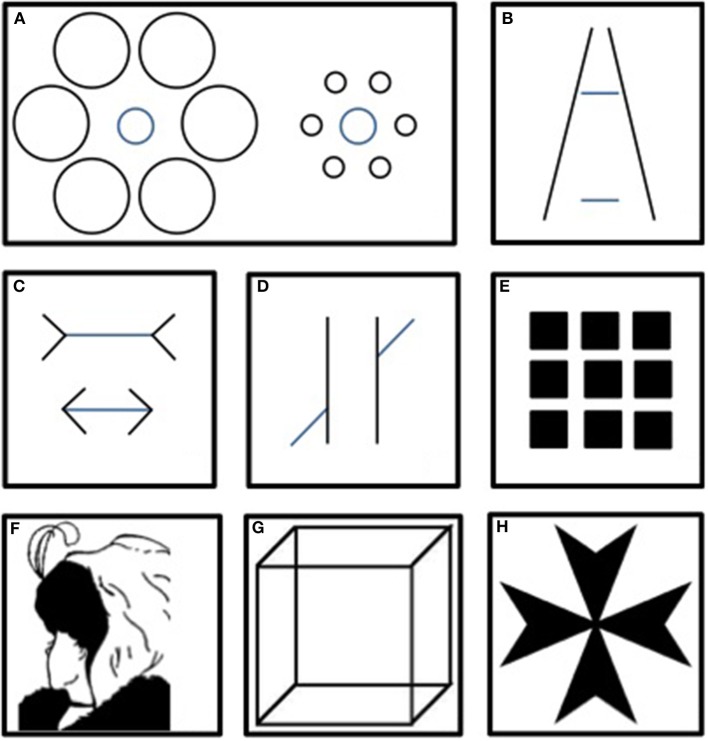
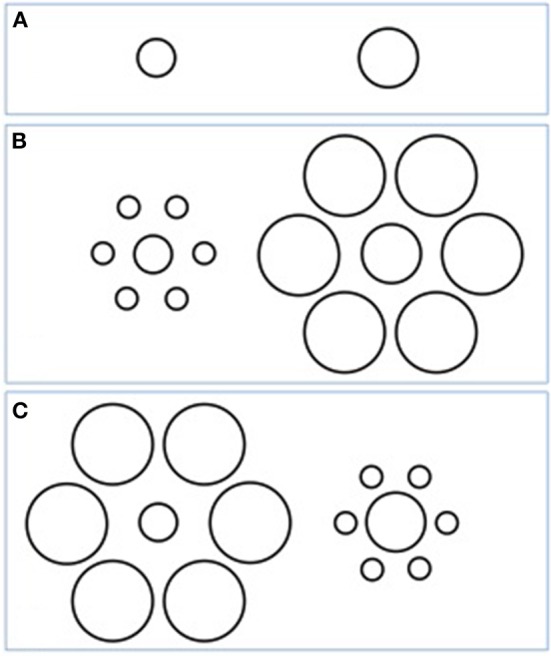
“By manipulating the reference-contrast, the authors noticed that the patients who suffered from schizophrenia were significantly less biased by the surroundings and were thus more accurate in contrast discrimination compared with the healthy and psychiatric controls.”
§ What visual illusions teach us about schizophrenia > Introduction
What the sources say
- Not checked yetcites Dakin et al., 2005 source
plain- Asserted: passes — The authors put it forward as true.
- Checkable: passes — It can be checked against evidence.
- Load-bearing: passes — The paper’s conclusions depend on it.
- Based: passes — The paper gives a reason why it holds.
In the paper
“The authors reported the illusion peaked to a longer inter-stimulus interval when presented to patients with schizophrenia compared with healthy controls.”
§ What visual illusions teach us about schizophrenia > Visual illusions: a way to probe the integrity of visual processing in schizophrenia? > Discussing the limits of the structural approach
What the sources say
- Not checked yetcites Norton et al., 2008 source
plaincorrelational- Asserted: passes — The authors put it forward as true.
- Checkable: passes — It can be checked against evidence.
- Load-bearing: passes — The paper’s conclusions depend on it.
- Based: passes — The paper gives a reason why it holds.
A conclusion the paper draws from its own results — it cites no other source for it, so there is none to check. The quote shows it is in the paper.
In the paper
“Interestingly, studying VIs provides crucial elements for understanding these two elementary mechanisms.”
§ What visual illusions teach us about schizophrenia > Visual illusions: a way to probe the integrity of visual processing in schizophrenia? > A window into the functional dimension of visual perception
plaindirect- Asserted: passes — The authors put it forward as true.
- Checkable: passes — It can be checked against evidence.
- Load-bearing: passes — The paper’s conclusions depend on it.
- Based: passes — The paper gives a reason why it holds.
A conclusion the paper draws from its own results — it cites no other source for it, so there is none to check. The quote shows it is in the paper.
In the paper
“Even if these data should still be interpreted with caution, the hypothesis of a diminished sensitivity to VIs in schizophrenia appears to be a most robust finding.”
§ What visual illusions teach us about schizophrenia > Visual illusions: a way to probe the integrity of visual processing in schizophrenia? > Discussing the limits of the structural approach
hedged- Asserted: passes — The authors put it forward as true.
- Checkable: passes — It can be checked against evidence.
- Load-bearing: passes — The paper’s conclusions depend on it.
- Based: passes — The paper gives a reason why it holds.
A conclusion the paper draws from its own results — it cites no other source for it, so there is none to check. The quote shows it is in the paper.
In the paper
“Despite the fact that the stimuli used in surround suppression VIs can easily be standardized, heterogeneous findings concerning schizophrenia have been reported in this sub-field (see Table 2).”
§ What visual illusions teach us about schizophrenia > Visual illusions: a way to probe the integrity of visual processing in schizophrenia? > A window into the functional dimension of visual perception
plain- Asserted: passes — The authors put it forward as true.
- Checkable: passes — It can be checked against evidence.
- Load-bearing: passes — The paper’s conclusions depend on it.
- Based: passes — The paper gives a reason why it holds.
A conclusion the paper draws from its own results — it cites no other source for it, so there is none to check. The quote shows it is in the paper.
In the paper
“Although still debated, the hypothesis of a modified, and typically diminished, susceptibility to illusions in schizophrenia patients is supported by a growing number of studies.”
§ What visual illusions teach us about schizophrenia > Abstract
hedged- Asserted: passes — The authors put it forward as true.
- Checkable: passes — It can be checked against evidence.
- Load-bearing: passes — The paper’s conclusions depend on it.
- Based: passes — The paper gives a reason why it holds.
A conclusion the paper draws from its own results — it cites no other source for it, so there is none to check. The quote shows it is in the paper.
In the paper
“Importantly, most of the negative or nuanced results referred to surround-suppression illusions.”
§ What visual illusions teach us about schizophrenia > Visual illusions: a way to probe the integrity of visual processing in schizophrenia? > Discussing the limits of the structural approach
plain- Asserted: passes — The authors put it forward as true.
- Checkable: passes — It can be checked against evidence.
- Load-bearing: passes — The paper’s conclusions depend on it.
- Based: passes — The paper gives a reason why it holds.
- Probably not a substantial claim. 31
- It may state two separate claims as one. 39
None of the sources cited for this claim have been checked yet.
In the paper
“Some authors have argued, in line with the findings that stem from the study of VIs, that the impairment of gain control is a robust and significant property of visual processing in schizophrenia, and may even consider it a core feature of the disorder (Robol et al., 2013; Tibber et al., 2013).”
§ What visual illusions teach us about schizophrenia > Visual illusions: a way to probe the integrity of visual processing in schizophrenia? > A window into the functional dimension of visual perception
What the sources say
hedgedcorrelational- Asserted: fails — The authors may not put it forward as true.
- Checkable: passes — It can be checked against evidence.
- Load-bearing: passes — The paper’s conclusions depend on it.
- Based: passes — The paper gives a reason why it holds.
Probably not a substantial claim. The authors may not put it forward as true. It may state two separate claims as one.
None of the sources cited for this claim have been checked yet.
In the paper
“Thus, these authors hypothesized that the pre-cortical stages of the visual system, in which luminance is supposed to be processed, were spared, thereby contradicting Norton's conclusions.”
§ What visual illusions teach us about schizophrenia > Visual illusions: a way to probe the integrity of visual processing in schizophrenia? > Discussing the limits of the structural approach
What the sources say
plain- Asserted: passes — The authors put it forward as true.
- Checkable: passes — It can be checked against evidence.
- Load-bearing: passes — The paper’s conclusions depend on it.
- Based: passes — The paper gives a reason why it holds.
Probably not a substantial claim. It may state two separate claims as one.
None of the sources cited for this claim have been checked yet.
In the paper
“Yang et al. (2012) and Tibber et al. (2013) found that luminance context processing was similar, whereas the strength of the illusions was inferior in patients for the other psychophysical parameters (e.g., contrast, orientation, size or motion).”
§ What visual illusions teach us about schizophrenia > Visual illusions: a way to probe the integrity of visual processing in schizophrenia? > Discussing the limits of the structural approach
What the sources say
plain- Asserted: passes — The authors put it forward as true.
- Checkable: passes — It can be checked against evidence.
- Load-bearing: passes — The paper’s conclusions depend on it.
- Based: passes — The paper gives a reason why it holds.
It may state two separate claims as one.
A conclusion the paper draws from its own results — it cites no other source for it, so there is none to check. The quote shows it is in the paper.
In the paper
“VIs, although polymorphic, pinpoint the limits of purely anatomoclinical or linear causal models and underline, in contrast, the complexity and specificity of visual perception in schizophrenia.”
§ What visual illusions teach us about schizophrenia > Visual illusions: a way to probe the integrity of visual processing in schizophrenia? > Discussing the limits of the structural approach
plaindirect- Asserted: passes — The authors put it forward as true.
- Checkable: unclear — It is unclear whether it could be checked against evidence.
- Load-bearing: passes — The paper’s conclusions depend on it.
- Based: passes — The paper gives a reason why it holds.
It may state two separate claims as one.
The paper states this without a source or data behind it here, so there is nothing to check it against. The quote shows it is in the paper.
In the paper
“Although not always labeled as such, many VIs refer to a basic perceptual phenomenon called the context or surround suppression effect, which can be conceptualized as a form of gain control.”
§ What visual illusions teach us about schizophrenia > Visual illusions: a way to probe the integrity of visual processing in schizophrenia? > A window into the functional dimension of visual perception
plain- Asserted: passes — The authors put it forward as true.
- Checkable: passes — It can be checked against evidence.
- Load-bearing: passes — The paper’s conclusions depend on it.
- Based: fails — The paper may give no reason why it holds.
Probably not a substantial claim. The paper may give no reason why it holds.
In the paper
“According to Butler et al. (2008) this phenomenon of perceptual organization can be viewed as relying on two main fundamental mechanisms: gain control and integration, both of which could be impaired in schizophrenia.”
§ What visual illusions teach us about schizophrenia > Visual illusions: a way to probe the integrity of visual processing in schizophrenia? > A window into the functional dimension of visual perception
What the sources say
- Not checked yetcites Butler et al., 2008 source
hedgedconditional- Asserted: passes — The authors put it forward as true.
- Checkable: passes — It can be checked against evidence.
- Load-bearing: passes — The paper’s conclusions depend on it.
- Based: passes — The paper gives a reason why it holds.
It may state two separate claims as one.
In the paper
“They argued that this temporal alteration may rely on a faulty sensory-integration within the very first stages of the visual stream.”
§ What visual illusions teach us about schizophrenia > Visual illusions: a way to probe the integrity of visual processing in schizophrenia? > Discussing the limits of the structural approach
What the sources say
- Not checked yetcites Norton et al., 2008 source
hedgedconditional- Asserted: passes — The authors put it forward as true.
- Checkable: passes — It can be checked against evidence.
- Load-bearing: fails — The paper’s conclusions may not depend on it.
- Based: passes — The paper gives a reason why it holds.
Probably not a substantial claim. The paper’s conclusions may not depend on it.
A conclusion the paper draws from its own results — it cites no other source for it, so there is none to check. The quote shows it is in the paper.
In the paper
“From a methodological point of view, increased performance in patients cannot be attributed to general task difficulty, a lack of attention or motivation or to a disease-related global deficit.”
§ What visual illusions teach us about schizophrenia > Visual illusions: a way to probe the integrity of visual processing in schizophrenia? > Discussing the limits of the structural approach
plain- Asserted: passes — The authors put it forward as true.
- Checkable: passes — It can be checked against evidence.
- Load-bearing: passes — The paper’s conclusions depend on it.
- Based: passes — The paper gives a reason why it holds.
It may state two separate claims as one.
A conclusion the paper draws from its own results — it cites no other source for it, so there is none to check. The quote shows it is in the paper.
In the paper
“This paradigm appears exposed to specific methodological issues and covariates that may be imputed in the results”
§ What visual illusions teach us about schizophrenia > Visual illusions: a way to probe the integrity of visual processing in schizophrenia? > Discussing the limits of the structural approach
hedgedconditional- Asserted: passes — The authors put it forward as true.
- Checkable: passes — It can be checked against evidence.
- Load-bearing: passes — The paper’s conclusions depend on it.
- Based: fails — The paper may give no reason why it holds.
Probably not a substantial claim. The paper may give no reason why it holds.
In the paper
“Artificially over-trusted, sensory signals become over-salient and unpredictable. They could be transmitted up the hierarchy, but no adjustments could fully resolve the aberrancy (Fletcher and Frith, 2008).”
§ What visual illusions teach us about schizophrenia > The computational point of view > Visual illusions, bayes and psychotic symptoms
What the sources say
- Not checked yetcites Fletcher and Frith, 2008 source
hedgeddirect- Asserted: passes — The authors put it forward as true.
- Checkable: passes — It can be checked against evidence.
- Load-bearing: passes — The paper’s conclusions depend on it.
- Based: passes — The paper gives a reason why it holds.
It may state two separate claims as one.
- The authors state this as an assumption: In Predictive Coding, the prior and the likelihood have a Gaussian distribution.
In the paper
“The authors proposed that context interaction impairment in schizophrenia may be better accounted for by alterations of surround inhibition rather than surround facilitation.”
§ What visual illusions teach us about schizophrenia > Visual illusions: a way to probe the integrity of visual processing in schizophrenia? > A window into the functional dimension of visual perception
What the sources say
- Not checked yetcites Chen et al., 2008 source
hedgedconditional- Asserted: passes — The authors put it forward as true.
- Checkable: passes — It can be checked against evidence.
- Load-bearing: passes — The paper’s conclusions depend on it.
- Based: passes — The paper gives a reason why it holds.
Probably not a substantial claim.
A conclusion the paper draws from its own results — it cites no other source for it, so there is none to check. The quote shows it is in the paper.
In the paper
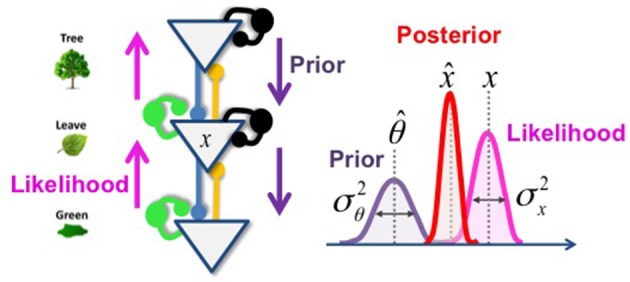
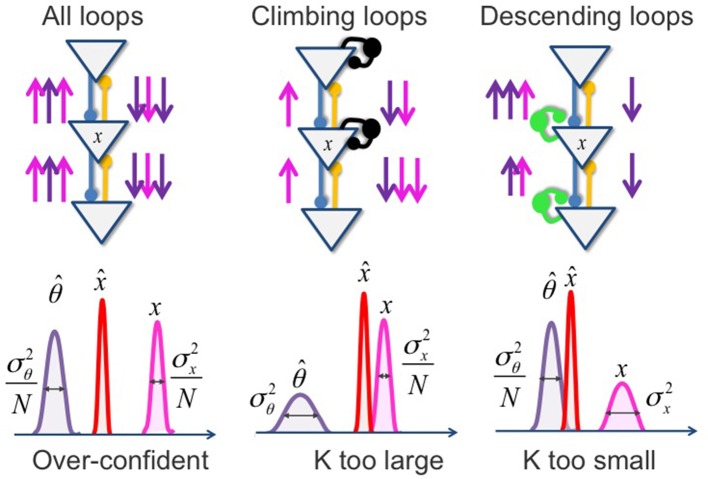
“If both descending and climbing loops are impaired (A), both sensory evidence and prior knowledge are reverberated and over counted (multiplication of the pink and violet arrows). In the Predictive coding framework, this results in an overconfident (narrowing of the posterior distribution) but not biased (unchanged K) inferred belief.”
§ What visual illusions teach us about schizophrenia > The computational point of view > Visual illusions, bayes and psychotic symptoms
plaindirect- Asserted: passes — The authors put it forward as true.
- Checkable: passes — It can be checked against evidence.
- Load-bearing: passes — The paper’s conclusions depend on it.
- Based: passes — The paper gives a reason why it holds.
It may state two separate claims as one.
- The authors state this as an assumption: In the brain's hierarchy, top-down and bottom-up beliefs should be propagated only once in each direction, and this requires equally strong inhibitory loops to cancel excitatory feedforward/feedback loops.
- Rests on an assumption: Long-range connections in the brain are overwhelmingly excitatory.
- The authors state this as an assumption: In Predictive Coding, the prior and the likelihood have a Gaussian distribution.
None of the sources cited for this claim have been checked yet.
In the paper
“several authors have defended the idea that visual perception plays an important role in the psychopathology of schizophrenia (Butler and Javitt, 2005), and constitutes a unique way to explore the underlying mechanisms of reality construction (Silverstein and Keane, 2011).”
§ What visual illusions teach us about schizophrenia > Introduction
What the sources say
- Not checked yetcites Butler and Javitt, 2005
- Not checked yetcites Silverstein and Keane, 2011
plaincorrelational- Asserted: passes — The authors put it forward as true.
- Checkable: passes — It can be checked against evidence.
- Load-bearing: passes — The paper’s conclusions depend on it.
- Based: passes — The paper gives a reason why it holds.
It may state two separate claims as one.
- The authors state this as an assumption: Perception is closely interwoven with other high-level functions such as belief genesis or reasoning.
The paper states this without a source or data behind it here, so there is nothing to check it against. The quote shows it is in the paper.
In the paper
“By relying on the Bayesian formalism, authors typically impute the positive symptoms of schizophrenia to an imbalance in the relative weight or precision attributed to the prior and sensory evidence, which, in turn, causes false inferences.”
§ What visual illusions teach us about schizophrenia > The computational point of view > Visual illusions, bayes and psychotic symptoms
plaindirect- Asserted: passes — The authors put it forward as true.
- Checkable: passes — It can be checked against evidence.
- Load-bearing: passes — The paper’s conclusions depend on it.
- Based: passes — The paper gives a reason why it holds.
Probably not a substantial claim.
- The authors state this as an assumption: Sensory inputs are inherently ambiguous.
In the paper
“According to this author, the internalized rules of perspective (i.e., prior knowledge) lead an individual to compute the line flanked with converging fins as if it were further away. Consequently, the line's shorter appearance conflicts with the actual identical size of the two lines.”
§ What visual illusions teach us about schizophrenia > The computational point of view > Visual illusions and the bayesian theory
What the sources say
- Not checked yetcites Gregory
plaindirect- Asserted: passes — The authors put it forward as true.
- Checkable: passes — It can be checked against evidence.
- Load-bearing: passes — The paper’s conclusions depend on it.
- Based: passes — The paper gives a reason why it holds.
Probably not a substantial claim.
The paper states this without a source or data behind it here, so there is nothing to check it against. The quote shows it is in the paper.
In the paper
“VIs are an illustration of the perceptual system's ability to bind and group visual elements into coherent patterns, which leads to a meaningful representation.”
§ What visual illusions teach us about schizophrenia > Visual illusions: a way to probe the integrity of visual processing in schizophrenia? > A window into the functional dimension of visual perception
plaindirect- Asserted: passes — The authors put it forward as true.
- Checkable: passes — It can be checked against evidence.
- Load-bearing: passes — The paper’s conclusions depend on it.
- Based: fails — The paper may give no reason why it holds.
Probably not a substantial claim. The paper may give no reason why it holds.
In the paper
“Importantly, despite conceptual differences, these frameworks are algorithmically similar and may essentially differ in the type of variables considered (e.g., binary vs. continuous, see Jardri and Deneve, 2013).”
§ What visual illusions teach us about schizophrenia > The computational point of view > Visual illusions and the bayesian theory
What the sources say
- Not checked yetcites Jardri and Deneve, 2013
hedgedcorrelational- Asserted: passes — The authors put it forward as true.
- Checkable: passes — It can be checked against evidence.
- Load-bearing: unclear — It is unclear whether the paper’s conclusions depend on it.
- Based: passes — The paper gives a reason why it holds.
It may state two separate claims as one.
The paper states this without a source or data behind it here, so there is nothing to check it against. The quote shows it is in the paper.
In the paper
“The physiological existence of VIs suggests that deceiving perception paradoxically requires the integrity of the different subcomponents of the visual system.”
§ What visual illusions teach us about schizophrenia > Visual illusions: a way to probe the integrity of visual processing in schizophrenia? > Discussing the limits of the structural approach
hedgeddirect- Asserted: passes — The authors put it forward as true.
- Checkable: passes — It can be checked against evidence.
- Load-bearing: passes — The paper’s conclusions depend on it.
- Based: fails — The paper may give no reason why it holds.
Probably not a substantial claim. The paper may give no reason why it holds.
In the paper
“Gain control of neural responses is achieved through a combination of intrinsic neuronal properties, lateral interactions and feedback modulations (Must et al., 2004).”
§ What visual illusions teach us about schizophrenia > Visual illusions: a way to probe the integrity of visual processing in schizophrenia? > A window into the functional dimension of visual perception
What the sources say
- Not checked yetcites Must et al., 2004 source
plaindirect- Asserted: passes — The authors put it forward as true.
- Checkable: passes — It can be checked against evidence.
- Load-bearing: fails — The paper’s conclusions may not depend on it.
- Based: passes — The paper gives a reason why it holds.
Probably not a substantial claim. The paper’s conclusions may not depend on it.
None of the sources cited for this claim have been checked yet.
In the paper
“Some evidence suggests that surround suppression and its impairment depends on several variables, such as the contrast (previously discussed) and the time of presentation (Calvert and Harris, 1988; Bressan and Kramer, 2013), which counters an absolute independent process.”
§ What visual illusions teach us about schizophrenia > Visual illusions: a way to probe the integrity of visual processing in schizophrenia? > A window into the functional dimension of visual perception
What the sources say
- Not checked yetcites Calvert and Harris, 1988
- Not checked yetcites Bressan and Kramer, 2013
hedgedconditional- Asserted: passes — The authors put it forward as true.
- Checkable: passes — It can be checked against evidence.
- Load-bearing: passes — The paper’s conclusions depend on it.
- Based: passes — The paper gives a reason why it holds.
It may state two separate claims as one.
A conclusion the paper draws from its own results — it cites no other source for it, so there is none to check. The quote shows it is in the paper.
In the paper
“However, rather than a perceptual error, this bias is better understood as the consequence of inferences that optimally combine bottom-up and top-down information (see Boxes 1, 3), which supports the best adaptation in a noisy environment.”
§ What visual illusions teach us about schizophrenia > The computational point of view > Visual illusions and the bayesian theory
plaindirect- Asserted: passes — The authors put it forward as true.
- Checkable: passes — It can be checked against evidence.
- Load-bearing: passes — The paper’s conclusions depend on it.
- Based: passes — The paper gives a reason why it holds.
It may state two separate claims as one.
A conclusion the paper draws from its own results — it cites no other source for it, so there is none to check. The quote shows it is in the paper.
In the paper
“This disturbance would result in aberrant concept formation, delusions, and hallucinations.”
§ What visual illusions teach us about schizophrenia > Introduction
hedgeddirect- Asserted: passes — The authors put it forward as true.
- Checkable: passes — It can be checked against evidence.
- Load-bearing: passes — The paper’s conclusions depend on it.
- Based: passes — The paper gives a reason why it holds.
It may state two separate claims as one.
In the paper
“even if a lack of statistical power is a major cause of concern in neuroscience and may be imputed for several studies (Button et al., 2013)”
§ What visual illusions teach us about schizophrenia > Visual illusions: a way to probe the integrity of visual processing in schizophrenia? > A window into the functional dimension of visual perception
What the sources say
- Not checked yetcites Button et al., 2013 source
hedgedconditional- Asserted: passes — The authors put it forward as true.
- Checkable: passes — It can be checked against evidence.
- Load-bearing: fails — The paper’s conclusions may not depend on it.
- Based: passes — The paper gives a reason why it holds.
Probably not a substantial claim. The paper’s conclusions may not depend on it.
None of the sources cited for this claim have been checked yet.
In the paper
“While a model that places connectivity modulation from the higher-level areas to the primary visual cortex (i.e., V1) better accounted for healthy control data, the DCM revealed a reverse pattern in schizophrenia patients (i.e., the predominance of the feedforward modulation).”
§ What visual illusions teach us about schizophrenia > The computational point of view > Visual illusions, bayes and psychotic symptoms
What the sources say
plaincorrelational- Asserted: passes — The authors put it forward as true.
- Checkable: passes — It can be checked against evidence.
- Load-bearing: passes — The paper’s conclusions depend on it.
- Based: passes — The paper gives a reason why it holds.
It may state two separate claims as one.
None of the sources cited for this claim have been checked yet.
In the paper
“However, in opposition to a theory of over salient sensory evidence, some authors have argued that excessively precise prior expectations, which correspond to a smaller-than-normal gain for prediction errors, better account for hallucinatory experiences.”
§ What visual illusions teach us about schizophrenia > The computational point of view > Visual illusions, bayes and psychotic symptoms
What the sources say
plaindirect- Asserted: fails — The authors may not put it forward as true.
- Checkable: passes — It can be checked against evidence.
- Load-bearing: passes — The paper’s conclusions depend on it.
- Based: passes — The paper gives a reason why it holds.
Probably not a substantial claim. The authors may not put it forward as true.
- The authors state this as an assumption: In Predictive Coding, the prior and the likelihood have a Gaussian distribution.
A conclusion the paper draws from its own results — it cites no other source for it, so there is none to check. The quote shows it is in the paper.
In the paper
“Depending on which loops are mostly impaired, the model predicts that either sensory information or priors will dominate the final percept.”
§ What visual illusions teach us about schizophrenia > The computational point of view > Visual illusions, bayes and psychotic symptoms
plaindirect- Asserted: passes — The authors put it forward as true.
- Checkable: passes — It can be checked against evidence.
- Load-bearing: passes — The paper’s conclusions depend on it.
- Based: fails — The paper may give no reason why it holds.
Probably not a substantial claim. The paper may give no reason why it holds.
- The authors state this as an assumption: In the brain's hierarchy, top-down and bottom-up beliefs should be propagated only once in each direction, and this requires equally strong inhibitory loops to cancel excitatory feedforward/feedback loops.
- Rests on an assumption: Long-range connections in the brain are overwhelmingly excitatory.
A conclusion the paper draws from its own results — it cites no other source for it, so there is none to check. The quote shows it is in the paper.
In the paper
“Note that the conflict between apparently contradictory hypotheses (gains of prediction errors larger than normal or smaller than normal, over-trusted prior or over-counted sensory evidence) has never been fully resolved, which renders the experimental testing of these theories extremely difficult.”
§ What visual illusions teach us about schizophrenia > The computational point of view > Visual illusions, bayes and psychotic symptoms
plaindirect- Asserted: passes — The authors put it forward as true.
- Checkable: fails — It may be too vague to check against evidence.
- Load-bearing: fails — The paper’s conclusions may not depend on it.
- Based: fails — The paper may give no reason why it holds.
Probably not a substantial claim. It may be too vague to check against evidence. The paper’s conclusions may not depend on it. The paper may give no reason why it holds.
A conclusion the paper draws from its own results — it cites no other source for it, so there is none to check. The quote shows it is in the paper.
In the paper
“Even when facing weak or non-existent sensory evidence, the circular propagation generates strong perceptual beliefs: hallucinations occur where nothing relevant should have been inferred.”
§ What visual illusions teach us about schizophrenia > The computational point of view > Visual illusions, bayes and psychotic symptoms
plaindirect- Asserted: passes — The authors put it forward as true.
- Checkable: passes — It can be checked against evidence.
- Load-bearing: passes — The paper’s conclusions depend on it.
- Based: unclear — It is unclear why the paper says it holds.
It may state two separate claims as one.
- The authors state this as an assumption: In the brain's hierarchy, top-down and bottom-up beliefs should be propagated only once in each direction, and this requires equally strong inhibitory loops to cancel excitatory feedforward/feedback loops.
- Rests on an assumption: Long-range connections in the brain are overwhelmingly excitatory.
A conclusion the paper draws from its own results — it cites no other source for it, so there is none to check. The quote shows it is in the paper.
In the paper
“In the same way, circular inference introduces spurious correlations between sensory (feedforward) and prior (feedback) messages that are non-existent in the real world. This leads to the learning and consolidation of “unshakable” (but false) causal relationships, resulting in delusional belief systems.”
§ What visual illusions teach us about schizophrenia > The computational point of view > Visual illusions, bayes and psychotic symptoms
plaindirect- Asserted: passes — The authors put it forward as true.
- Checkable: passes — It can be checked against evidence.
- Load-bearing: passes — The paper’s conclusions depend on it.
- Based: passes — The paper gives a reason why it holds.
It may state two separate claims as one.
- The authors state this as an assumption: In the brain's hierarchy, top-down and bottom-up beliefs should be propagated only once in each direction, and this requires equally strong inhibitory loops to cancel excitatory feedforward/feedback loops.
- Rests on an assumption: Long-range connections in the brain are overwhelmingly excitatory.
A conclusion the paper draws from its own results — it cites no other source for it, so there is none to check. The quote shows it is in the paper.
In the paper
“Vice-versa, a deficit in the control of downward loops (e.g., prior expectations that activate lower levels and are misinterpreted as sensory information when they are reverberated back up the hierarchy) would predict an over-confidence in the prior knowledge and a higher susceptibility to perceptual illusions.”
§ What visual illusions teach us about schizophrenia > The computational point of view > Visual illusions, bayes and psychotic symptoms
hedgeddirect- Asserted: passes — The authors put it forward as true.
- Checkable: passes — It can be checked against evidence.
- Load-bearing: passes — The paper’s conclusions depend on it.
- Based: passes — The paper gives a reason why it holds.
It may state two separate claims as one.
- The authors state this as an assumption: In the brain's hierarchy, top-down and bottom-up beliefs should be propagated only once in each direction, and this requires equally strong inhibitory loops to cancel excitatory feedforward/feedback loops.
- Rests on an assumption: Long-range connections in the brain are overwhelmingly excitatory.
In the paper
“In their model, Jardri and Denève showed how excitatory/inhibitory imbalance renders the system unable to avoid circular propagation of beliefs: bottom-up sensory evidence are reverberated back down as if they were prior information (upward loops), and thus combined with themselves until weak sensory inputs or meaningless coincidences are attributed to highly trusted high-level interpretations.”
§ What visual illusions teach us about schizophrenia > The computational point of view > Visual illusions, bayes and psychotic symptoms
What the sources say
- Not checked yetcites Jardri and Deneve, 2013
boosteddirect- Asserted: passes — The authors put it forward as true.
- Checkable: passes — It can be checked against evidence.
- Load-bearing: passes — The paper’s conclusions depend on it.
- Based: passes — The paper gives a reason why it holds.
It may state two separate claims as one.
- The authors state this as an assumption: In the brain's hierarchy, top-down and bottom-up beliefs should be propagated only once in each direction, and this requires equally strong inhibitory loops to cancel excitatory feedforward/feedback loops.
- Rests on an assumption: Long-range connections in the brain are overwhelmingly excitatory.
None of the sources cited for this claim have been checked yet.
In the paper
“Several authors have also related auditory hallucinations to an over-saliency of the inner speech (considered a covert motor action), which is misattributed to an alien source (McGuire et al., 1995; Allen et al., 2007; Moseley et al., 2013).”
§ What visual illusions teach us about schizophrenia > The computational point of view > Visual illusions, bayes and psychotic symptoms
What the sources say
plaindirect- Asserted: passes — The authors put it forward as true.
- Checkable: passes — It can be checked against evidence.
- Load-bearing: fails — The paper’s conclusions may not depend on it.
- Based: passes — The paper gives a reason why it holds.
Probably not a substantial claim. The paper’s conclusions may not depend on it.
- The authors state this as an assumption: In Predictive Coding, the prior and the likelihood have a Gaussian distribution.
A conclusion the paper draws from its own results — it cites no other source for it, so there is none to check. The quote shows it is in the paper.
In the paper
“Thus, asymmetrically impairing the inhibitory loops biases the inferential system in two opposite ways that both may generate the same aspecific perceptual phenomenon.”
§ What visual illusions teach us about schizophrenia > The computational point of view > Visual illusions, bayes and psychotic symptoms
hedgedconditional- Asserted: passes — The authors put it forward as true.
- Checkable: passes — It can be checked against evidence.
- Load-bearing: passes — The paper’s conclusions depend on it.
- Based: passes — The paper gives a reason why it holds.
It may state two separate claims as one.
- The authors state this as an assumption: In the brain's hierarchy, top-down and bottom-up beliefs should be propagated only once in each direction, and this requires equally strong inhibitory loops to cancel excitatory feedforward/feedback loops.
- Rests on an assumption: Long-range connections in the brain are overwhelmingly excitatory.
A conclusion the paper draws from its own results — it cites no other source for it, so there is none to check. The quote shows it is in the paper.
In the paper
“Indeed, a deficit in the control of upward loops (e.g., sensory evidence that reaches a high level representation and is then misinterpreted as prior knowledge when it is reverberated back down) would cause an over-confidence in sensory evidence and a lower susceptibility to perceptual illusions.”
§ What visual illusions teach us about schizophrenia > The computational point of view > Visual illusions, bayes and psychotic symptoms
hedgeddirect- Asserted: passes — The authors put it forward as true.
- Checkable: passes — It can be checked against evidence.
- Load-bearing: passes — The paper’s conclusions depend on it.
- Based: passes — The paper gives a reason why it holds.
It may state two separate claims as one.
- The authors state this as an assumption: In the brain's hierarchy, top-down and bottom-up beliefs should be propagated only once in each direction, and this requires equally strong inhibitory loops to cancel excitatory feedforward/feedback loops.
- Rests on an assumption: Long-range connections in the brain are overwhelmingly excitatory.
In the paper
“More importantly, the authors then experimentally confirmed these predictions by observing, after the systemic administration of a GABAA agonist (lorazepam), a lengthening of the percept durations and a decrease in the switch rates (Van Loon et al., 2013).”
§ What visual illusions teach us about schizophrenia > The computational point of view > Visual illusions, bayes and psychotic symptoms
What the sources say
- Not checked yetcites Van Loon et al., 2013 source
boosteddirect- Asserted: passes — The authors put it forward as true.
- Checkable: passes — It can be checked against evidence.
- Load-bearing: passes — The paper’s conclusions depend on it.
- Based: passes — The paper gives a reason why it holds.
It may state two separate claims as one.
A conclusion the paper draws from its own results — it cites no other source for it, so there is none to check. The quote shows it is in the paper.
In the paper
“Finally, the neurophysiological processes that cause this imbalance remain unclear.”
§ What visual illusions teach us about schizophrenia > The computational point of view > Visual illusions, bayes and psychotic symptoms
plain- Asserted: passes — The authors put it forward as true.
- Checkable: passes — It can be checked against evidence.
- Load-bearing: fails — The paper’s conclusions may not depend on it.
- Based: fails — The paper may give no reason why it holds.
Probably not a substantial claim. The paper’s conclusions may not depend on it. The paper may give no reason why it holds.
A conclusion the paper draws from its own results — it cites no other source for it, so there is none to check. The quote shows it is in the paper.
In the paper
“This would be aggravated by an asymmetric impairment predominantly affecting either the upward or downward loops.”
§ What visual illusions teach us about schizophrenia > The computational point of view > Visual illusions, bayes and psychotic symptoms
hedgeddirect- Asserted: passes — The authors put it forward as true.
- Checkable: passes — It can be checked against evidence.
- Load-bearing: passes — The paper’s conclusions depend on it.
- Based: fails — The paper may give no reason why it holds.
Probably not a substantial claim. The paper may give no reason why it holds.
- The authors state this as an assumption: In the brain's hierarchy, top-down and bottom-up beliefs should be propagated only once in each direction, and this requires equally strong inhibitory loops to cancel excitatory feedforward/feedback loops.
- Rests on an assumption: Long-range connections in the brain are overwhelmingly excitatory.
A conclusion the paper draws from its own results — it cites no other source for it, so there is none to check. The quote shows it is in the paper.
In the paper
“In contrast, when the impairment only affects climbing loops (B), sensory evidence, but not prior knowledge, is reverberated. The prediction error is emphasized (K is too large), and the inferred belief is biased toward sensory evidence.”
§ What visual illusions teach us about schizophrenia > The computational point of view > Visual illusions, bayes and psychotic symptoms
plaindirect- Asserted: passes — The authors put it forward as true.
- Checkable: passes — It can be checked against evidence.
- Load-bearing: passes — The paper’s conclusions depend on it.
- Based: passes — The paper gives a reason why it holds.
It may state two separate claims as one.
- The authors state this as an assumption: In the brain's hierarchy, top-down and bottom-up beliefs should be propagated only once in each direction, and this requires equally strong inhibitory loops to cancel excitatory feedforward/feedback loops.
- Rests on an assumption: Long-range connections in the brain are overwhelmingly excitatory.
- The authors state this as an assumption: In Predictive Coding, the prior and the likelihood have a Gaussian distribution.
In the paper
“Indeed such balance is tightly maintained in cortical networks, and appears to be affected in schizophrenia (O'Donnell, 2011).”
§ What visual illusions teach us about schizophrenia > The computational point of view > Visual illusions, bayes and psychotic symptoms
What the sources say
- Not checked yetcites O'Donnell, 2011 source
hedgedcorrelational- Asserted: passes — The authors put it forward as true.
- Checkable: passes — It can be checked against evidence.
- Load-bearing: passes — The paper’s conclusions depend on it.
- Based: passes — The paper gives a reason why it holds.
It may state two separate claims as one.
A conclusion the paper draws from its own results — it cites no other source for it, so there is none to check. The quote shows it is in the paper.
In the paper
“When facing a VI (i.e., a complex perceptual task), a tendency toward a top-down counter-balancing is observed in controls, whereas patients who suffer from schizophrenia exhibit a strengthening of the bottom-up processes that prevent them from perceiving the illusory effect.”
§ What visual illusions teach us about schizophrenia > The computational point of view > Visual illusions, bayes and psychotic symptoms
plaindirect- Asserted: passes — The authors put it forward as true.
- Checkable: passes — It can be checked against evidence.
- Load-bearing: passes — The paper’s conclusions depend on it.
- Based: passes — The paper gives a reason why it holds.
It may state two separate claims as one.
None of the sources cited for this claim have been checked yet.
In the paper
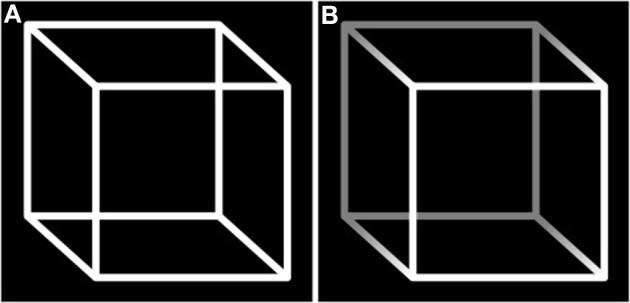
“The fact that patients with schizophrenia failed to correct for the inverted Hollow Mask to a more plausible (or predictable) interpretation can also be explained by an underweighting of prior knowledge during perceptual inferences (Schmeider et al., 1996; Schneider et al., 2002; Koethe et al., 2009).”
§ What visual illusions teach us about schizophrenia > The computational point of view > Visual illusions, bayes and psychotic symptoms
What the sources say
plaindirect- Asserted: passes — The authors put it forward as true.
- Checkable: passes — It can be checked against evidence.
- Load-bearing: passes — The paper’s conclusions depend on it.
- Based: passes — The paper gives a reason why it holds.
It may state two separate claims as one.
None of the sources cited for this claim have been checked yet.
In the paper
“According to this hypothesis, perception distances itself from the sensory stimuli and becomes dependent on prior knowledge of the world (Friston, 2005b; Chambon et al., 2011; Schmack et al., 2013); thus, one would only perceive what one is expecting to perceive.”
§ What visual illusions teach us about schizophrenia > The computational point of view > Visual illusions, bayes and psychotic symptoms
What the sources say
hedgeddirect- Asserted: fails — The authors may not put it forward as true.
- Checkable: passes — It can be checked against evidence.
- Load-bearing: passes — The paper’s conclusions depend on it.
- Based: passes — The paper gives a reason why it holds.
Probably not a substantial claim. The authors may not put it forward as true. It may state two separate claims as one.
- The authors state this as an assumption: In Predictive Coding, the prior and the likelihood have a Gaussian distribution.
A conclusion the paper draws from its own results — it cites no other source for it, so there is none to check. The quote shows it is in the paper.
In the paper
“If, in contrast, the inhibitory disequilibrium disfavors the descending loops (C), only the prior knowledge is over counted because of its reverberation. The prediction error is then minimized (K is too small), and the resulting posterior is biased toward expectations.”
§ What visual illusions teach us about schizophrenia > The computational point of view > Visual illusions, bayes and psychotic symptoms
plaindirect- Asserted: passes — The authors put it forward as true.
- Checkable: passes — It can be checked against evidence.
- Load-bearing: passes — The paper’s conclusions depend on it.
- Based: passes — The paper gives a reason why it holds.
It may state two separate claims as one.
- The authors state this as an assumption: In the brain's hierarchy, top-down and bottom-up beliefs should be propagated only once in each direction, and this requires equally strong inhibitory loops to cancel excitatory feedforward/feedback loops.
- Rests on an assumption: Long-range connections in the brain are overwhelmingly excitatory.
- The authors state this as an assumption: In Predictive Coding, the prior and the likelihood have a Gaussian distribution.
A conclusion the paper draws from its own results — it cites no other source for it, so there is none to check. The quote shows it is in the paper.
In the paper
“Conversely, a disrupted inferential system may fail to attenuate the sensory consequences of self-generated acts. Artificially overweighed, the resulting prediction error would then drive otherwise silent percepts to emerge into awareness. The only way to account for this unusual experience is then to misattribute it to an external agent.”
§ What visual illusions teach us about schizophrenia > The computational point of view > Visual illusions, bayes and psychotic symptoms
hedgedconditional- Asserted: passes — The authors put it forward as true.
- Checkable: passes — It can be checked against evidence.
- Load-bearing: passes — The paper’s conclusions depend on it.
- Based: passes — The paper gives a reason why it holds.
Probably not a substantial claim. It may state two separate claims as one.
- The authors state this as an assumption: In Predictive Coding, the prior and the likelihood have a Gaussian distribution.
A conclusion the paper draws from its own results — it cites no other source for it, so there is none to check. The quote shows it is in the paper.
In the paper
“Psychotic manifestations can be understood as resulting from such circular inferences, which cause overconfidence, surinterpretations of weak sensory data and dissociations between high-level and low-level representations.”
§ What visual illusions teach us about schizophrenia > The computational point of view > Visual illusions, bayes and psychotic symptoms
plaindirect- Asserted: passes — The authors put it forward as true.
- Checkable: passes — It can be checked against evidence.
- Load-bearing: passes — The paper’s conclusions depend on it.
- Based: unclear — It is unclear why the paper says it holds.
It may state two separate claims as one.
- The authors state this as an assumption: In the brain's hierarchy, top-down and bottom-up beliefs should be propagated only once in each direction, and this requires equally strong inhibitory loops to cancel excitatory feedforward/feedback loops.
- Rests on an assumption: Long-range connections in the brain are overwhelmingly excitatory.
What the paper did — it cites no source for this, so there is none to check. The quote shows it is in the paper.
In the paper
“Despite an abundant literature dealing with this matter, frequent methodological issues (e.g., inter-group comparability) have made the findings difficult to interpret.”
§ What visual illusions teach us about schizophrenia > Theoretical and clinical implications for schizophrenia research > What are the links with psychopathology?
plaincorrelational- Asserted: passes — The authors put it forward as true.
- Checkable: passes — It can be checked against evidence.
- Load-bearing: passes — The paper’s conclusions depend on it.
- Based: fails — The paper may give no reason why it holds.
Probably not a substantial claim. The paper may give no reason why it holds.
None of the sources cited for this claim have been checked yet.
In the paper
“Importantly, while VIs provide a privileged access to the visual hallucinatory modality, readers should note that adult patients who suffer from schizophrenia are more concerned by auditory compared with visual hallucinations (Mueser et al., 1990; Blom, 2010).”
§ What visual illusions teach us about schizophrenia > The computational point of view > Visual illusions, bayes and psychotic symptoms
What the sources say
plaincorrelational- Asserted: passes — The authors put it forward as true.
- Checkable: passes — It can be checked against evidence.
- Load-bearing: fails — The paper’s conclusions may not depend on it.
- Based: passes — The paper gives a reason why it holds.
Probably not a substantial claim. The paper’s conclusions may not depend on it.
A conclusion the paper draws from its own results — it cites no other source for it, so there is none to check. The quote shows it is in the paper.
In the paper
“asymmetric impairment in the excitatory-inhibitory balance (i.e., an overweighting of prior information relative to the sensory evidence, which is caused by an insufficient inhibitory control of downward loops). This impairment could explain the concomitant increase in hallucinations and illusions in Parkinson's disease (as could the Predictive Coding model).”
§ What visual illusions teach us about schizophrenia > The computational point of view > Visual illusions, bayes and psychotic symptoms
hedgedconditional- Asserted: passes — The authors put it forward as true.
- Checkable: passes — It can be checked against evidence.
- Load-bearing: passes — The paper’s conclusions depend on it.
- Based: fails — The paper may give no reason why it holds.
Probably not a substantial claim. The paper may give no reason why it holds.
A conclusion the paper draws from its own results — it cites no other source for it, so there is none to check. The quote shows it is in the paper.
In the paper
“Interestingly, the opposite profile of asymmetric circular belief propagation (selective impairment of upward loops) predicts opposite (increased) vulnerability to VIs but similar symptoms.”
§ What visual illusions teach us about schizophrenia > Theoretical and clinical implications for schizophrenia research > What are the links with psychopathology?
plaindirect- Asserted: passes — The authors put it forward as true.
- Checkable: passes — It can be checked against evidence.
- Load-bearing: passes — The paper’s conclusions depend on it.
- Based: unclear — It is unclear why the paper says it holds.
It may state two separate claims as one.
A conclusion the paper draws from its own results — it cites no other source for it, so there is none to check. The quote shows it is in the paper.
In the paper
“Thus, these converging clues prompt one to refute the idea that resistance to VIs is a specific perceptual property of schizophrenia and, hence, an endophenotypic marker for psychosis in general.”
§ What visual illusions teach us about schizophrenia > Theoretical and clinical implications for schizophrenia research > What are the links with psychopathology?
plain- Asserted: passes — The authors put it forward as true.
- Checkable: passes — It can be checked against evidence.
- Load-bearing: passes — The paper’s conclusions depend on it.
- Based: passes — The paper gives a reason why it holds.
It may state two separate claims as one.
A conclusion the paper draws from its own results — it cites no other source for it, so there is none to check. The quote shows it is in the paper.
In the paper
“Considering the Circular Inference model, aberrant experiences in schizophrenia may be understood as an immersion in a world dominated by sensory evidence, while top-down influences lose their organizing and structuring potential.”
§ What visual illusions teach us about schizophrenia > Theoretical and clinical implications for schizophrenia research > What are the relations with subjective experiences?
hedgedconditional- Asserted: passes — The authors put it forward as true.
- Checkable: passes — It can be checked against evidence.
- Load-bearing: passes — The paper’s conclusions depend on it.
- Based: passes — The paper gives a reason why it holds.
Probably not a substantial claim. It may state two separate claims as one.
None of the sources cited for this claim have been checked yet.
In the paper
“While some authors found no or only weak relationships between VIs and psychopathology (Koethe et al., 2006, 2009; Tibber et al., 2013; Yang et al., 2013)”
§ What visual illusions teach us about schizophrenia > Theoretical and clinical implications for schizophrenia research > What are the links with psychopathology?
What the sources say
plain- Asserted: passes — The authors put it forward as true.
- Checkable: passes — It can be checked against evidence.
- Load-bearing: fails — The paper’s conclusions may not depend on it.
- Based: passes — The paper gives a reason why it holds.
Probably not a substantial claim. The paper’s conclusions may not depend on it.
In the paper
“This tendency is noteworthy in the case of Parkinson's disease, in which one quarter of patients suffer from visual hallucinations and visual misperceptions (Diederich et al., 2009).”
§ What visual illusions teach us about schizophrenia > The computational point of view > Visual illusions, bayes and psychotic symptoms
What the sources say
- Not checked yetcites Diederich et al., 2009 source
plain- Asserted: passes — The authors put it forward as true.
- Checkable: passes — It can be checked against evidence.
- Load-bearing: fails — The paper’s conclusions may not depend on it.
- Based: passes — The paper gives a reason why it holds.
Probably not a substantial claim. The paper’s conclusions may not depend on it.
In the paper
“The authors reported visual hallucinations with a substantial point prevalence of 27% (Waters et al., 2014).”
§ What visual illusions teach us about schizophrenia > The computational point of view > Visual illusions, bayes and psychotic symptoms
What the sources say
- Not checked yetcites Waters et al., 2014 source
plain- Asserted: passes — The authors put it forward as true.
- Checkable: passes — It can be checked against evidence.
- Load-bearing: fails — The paper’s conclusions may not depend on it.
- Based: passes — The paper gives a reason why it holds.
Probably not a substantial claim. The paper’s conclusions may not depend on it.
A conclusion the paper draws from its own results — it cites no other source for it, so there is none to check. The quote shows it is in the paper.
In the paper
“According to this hypothesis, the more weight that is attributed to sensory evidence (because of a spontaneous or induced variable disequilibrium in the excitatory-to-inhibitory balance), the less prone the subject is to VIs, and the more vulnerable he will be to delusional beliefs and hallucinations.”
§ What visual illusions teach us about schizophrenia > Theoretical and clinical implications for schizophrenia research > What are the links with psychopathology?
plaindirect- Asserted: passes — The authors put it forward as true.
- Checkable: passes — It can be checked against evidence.
- Load-bearing: passes — The paper’s conclusions depend on it.
- Based: passes — The paper gives a reason why it holds.
Probably not a substantial claim. It may state two separate claims as one.
A conclusion the paper draws from its own results — it cites no other source for it, so there is none to check. The quote shows it is in the paper.
In the paper
“We effectively illustrated how an overweighting of sensory evidence may explain both hallucinations and the reduced susceptibility to VIs in schizophrenia.”
§ What visual illusions teach us about schizophrenia > The computational point of view > Visual illusions, bayes and psychotic symptoms
hedgedconditional- Asserted: passes — The authors put it forward as true.
- Checkable: passes — It can be checked against evidence.
- Load-bearing: passes — The paper’s conclusions depend on it.
- Based: passes — The paper gives a reason why it holds.
It may state two separate claims as one.
A conclusion the paper draws from its own results — it cites no other source for it, so there is none to check. The quote shows it is in the paper.
In the paper
“Hallucinations would only emerge when facing highly uncertain (and normally irrelevant) sensory information.”
§ What visual illusions teach us about schizophrenia > Theoretical and clinical implications for schizophrenia research > What are the relations with subjective experiences?
hedgeddirect- Asserted: passes — The authors put it forward as true.
- Checkable: passes — It can be checked against evidence.
- Load-bearing: passes — The paper’s conclusions depend on it.
- Based: fails — The paper may give no reason why it holds.
Probably not a substantial claim. The paper may give no reason why it holds.
- The authors state this as an assumption: During the vast majority of daily life situations, patients resolve the moderate ambiguity of environmental stimuli through strong and unambiguous percepts but with weakened links and coherence between perceptual elements.
None of the sources cited for this claim have been checked yet.
In the paper
“studies that directly compared patients who suffered from schizophrenia with patients who suffered from bipolar or major depressive disorders found that the latter two groups were normally sensitive to Binocular depth inversion (Schneider et al., 2002; Koethe et al., 2009; Wang et al., 2013) and Contrast modulation (Dakin et al., 2005; Yang et al., 2013), which was significantly different from the”
§ What visual illusions teach us about schizophrenia > Theoretical and clinical implications for schizophrenia research > What are the links with psychopathology?
What the sources say
plaincorrelational- Asserted: passes — The authors put it forward as true.
- Checkable: passes — It can be checked against evidence.
- Load-bearing: passes — The paper’s conclusions depend on it.
- Based: passes — The paper gives a reason why it holds.
It may state two separate claims as one.
A conclusion the paper draws from its own results — it cites no other source for it, so there is none to check. The quote shows it is in the paper.
In the paper
“This proposal may account for the gradual increase in susceptibility to VIs that accompanies the progressive emergence of misperceptions in some psychiatric or neurological conditions, such as Parkinson's disease (see also Section Visual Illusions, Bayes and Psychotic Symptoms).”
§ What visual illusions teach us about schizophrenia > Theoretical and clinical implications for schizophrenia research > What are the links with psychopathology?
hedgedconditional- Asserted: passes — The authors put it forward as true.
- Checkable: passes — It can be checked against evidence.
- Load-bearing: passes — The paper’s conclusions depend on it.
- Based: fails — The paper may give no reason why it holds.
Probably not a substantial claim. The paper may give no reason why it holds.
A conclusion the paper draws from its own results — it cites no other source for it, so there is none to check. The quote shows it is in the paper.
In the paper
“provide an heuristic value to the vulnerability to illusions, which can be considered an indirect but valuable access to the global neural processing in this disorder.”
§ What visual illusions teach us about schizophrenia > Theoretical and clinical implications for schizophrenia research > What are the links with action control and motor behavior?
plaincorrelational- Asserted: passes — The authors put it forward as true.
- Checkable: unclear — It is unclear whether it could be checked against evidence.
- Load-bearing: passes — The paper’s conclusions depend on it.
- Based: unclear — It is unclear why the paper says it holds.
It may state two separate claims as one.
A conclusion the paper draws from its own results — it cites no other source for it, so there is none to check. The quote shows it is in the paper.
In the paper
“This phenomenon can also be explained by the lack of prior influence on saliency.”
§ What visual illusions teach us about schizophrenia > Theoretical and clinical implications for schizophrenia research > What are the relations with subjective experiences?
plaindirect- Asserted: passes — The authors put it forward as true.
- Checkable: fails — It may be too vague to check against evidence.
- Load-bearing: passes — The paper’s conclusions depend on it.
- Based: fails — The paper may give no reason why it holds.
Probably not a substantial claim. It may be too vague to check against evidence. The paper may give no reason why it holds.
In the paper
“Using a probabilistic generative model, the authors predicted that a failure in attenuating sensory proprioceptive evidence led to the emergence of delusional ideas regarding agency (the ability to correctly identify oneself as the cause of one's own actions), as well as a decreased susceptibility to the Force-matching illusion.”
§ What visual illusions teach us about schizophrenia > Theoretical and clinical implications for schizophrenia research > What are the links with action control and motor behavior?
What the sources say
- Not checked yetcites Brown et al. (2013) source
plaindirect- Asserted: passes — The authors put it forward as true.
- Checkable: passes — It can be checked against evidence.
- Load-bearing: passes — The paper’s conclusions depend on it.
- Based: passes — The paper gives a reason why it holds.
It may state two separate claims as one.
A conclusion the paper draws from its own results — it cites no other source for it, so there is none to check. The quote shows it is in the paper.
In the paper
“These findings are in accordance with previous experimental reports of resistance to VIs in schizophrenia but extend this observation to multisensory perception.”
§ What visual illusions teach us about schizophrenia > Theoretical and clinical implications for schizophrenia research > What are the links with action control and motor behavior?
plaincorrelational- Asserted: passes — The authors put it forward as true.
- Checkable: passes — It can be checked against evidence.
- Load-bearing: passes — The paper’s conclusions depend on it.
- Based: passes — The paper gives a reason why it holds.
It may state two separate claims as one.
In the paper
“The authors indicated that patients who suffered from schizophrenia were more accurate compared with controls when matching the externally applied force, which revealed a failure in the normal sensory attenuation mechanism.”
§ What visual illusions teach us about schizophrenia > Theoretical and clinical implications for schizophrenia research > What are the links with action control and motor behavior?
What the sources say
- Not checked yetcites Shergill et al., 2005 source
hedgeddirect- Asserted: passes — The authors put it forward as true.
- Checkable: passes — It can be checked against evidence.
- Load-bearing: passes — The paper’s conclusions depend on it.
- Based: passes — The paper gives a reason why it holds.
It may state two separate claims as one.
The authors state this as an assumption.
Perception is closely interwoven with other high-level functions such as belief genesis or reasoning.
“In line with the assumption that perception is closely interwoven with other high-level functions (such as belief genesis or reasoning; Fletcher and Frith, 2008)”
The authors state this as an assumption.
The Bayesian formalism considers perception as the optimal combination between sensory evidence and prior knowledge.
“The Bayesian formalism considers perception as the optimal combination between sensory evidence and prior knowledge, thereby highlighting the interweaving of perceptions and beliefs.”
The authors state this as an assumption.
Sensory inputs are inherently ambiguous.
“Bayesian models set uncertainty and belief as the core features of perception by considering sensory inputs as inherently ambiguous.”
The authors state this as an assumption.
In the brain's hierarchy, top-down and bottom-up beliefs should be propagated only once in each direction, and this requires equally strong inhibitory loops to cancel excitatory feedforward/feedback loops.
“To properly compute the probability of perceptual variables, the prior and likelihood must be multiplied only once. In the brain's hierarchy, top-down and bottom-up beliefs should be propagated only once in each direction (see figure above). This can be achieved if equally strong inhibitory loops exist to cancel excitatory feedforward/feedback loops (green and black units).”
The paper relies on this without support.
Long-range connections in the brain are overwhelmingly excitatory.
“Since long-range connections in the brain are overwhelmingly excitatory, these two types of messages would be reverberated endlessly through feed-forward/feedback excitatory loops if they were not controlled, and kept in check, by the presence of equivalently strong inhibitory loops.”
The authors state this as an assumption.
In Predictive Coding, the prior and the likelihood have a Gaussian distribution.
“Predictive coding applies the Bayes rule while assuming that the prior and the likelihood have a Gaussian distribution.”
The authors state this as an assumption.
During the vast majority of daily life situations, patients resolve the moderate ambiguity of environmental stimuli through strong and unambiguous percepts but with weakened links and coherence between perceptual elements.
“Although the hypothesis requires further investigation, we can assume that during the vast majority of daily life situations, patients resolve the moderate ambiguity of the environmental stimuli through strong and unambiguous percepts but with weakened links and coherence between perceptual elements (links typically implicitly driven by prior knowledge).”
The paper relies on this without support.
The necessity to adapt to highly ambiguous situations is not permanent.
“Importantly, because the necessity to adapt to highly ambiguous situations is not permanent, this may also account for the intermittent nature of hallucinations (Jardri et al., 2013).”
The paper relies on this without support.
When ambiguity is particularly strong, visual illusions represent an extreme perceptual task.
“When the ambiguity is particularly strong, VIs represent an extreme perceptual task.”
Claims other papers make about this one
Each is checked against this paper’s own text: does it say what the citing paper says it does?
The source backs part of the claim, not all of it — or backs it for a different population, condition or comparison.
In the citing paper
“a decreased influence of stimulus predictability on brain responses (e.g. N400, P300, MMN; but see (62));”
From The Predictive Coding Account of Psychosis (2018) · cites this paper as [61]
Experimental — accuracy not yet measuredThe source backs part of the claim, not all of it — or backs it for a different population, condition or comparison.
In the citing paper
“and a loss of cortico-thalamic connectivity (for reviews see (59, 61)).”
From The Predictive Coding Account of Psychosis (2018) · cites this paper as [61]
Experimental — accuracy not yet measuredThe cited source says what the claim attributes to it.
In the citing paper
“One example of evidence for this model is that individuals with schizophrenia have been found to be less susceptible to visual illusions (Notredame, Pins, Deneve, & Jardri, 2014).”
From The role of sleep dysfunction in the occurrence of delusions and hallucinations: A systematic review (2015) · cites this paper as Notredame, Pins, Deneve, & Jardri, 2014
The cited source says what the claim attributes to it.
In the citing paper
“a failure to attenuate sensory consequences of self-generated actions;”
From The Predictive Coding Account of Psychosis (2018) · cites this paper as [61]
The cited source says what the claim attributes to it.
In the citing paper
“For example, psychosis has been associated with a greater resistance to visual illusions (which rely on prior beliefs for their effects);”
From The Predictive Coding Account of Psychosis (2018) · cites this paper as [61]
The cited source says what the claim attributes to it.
In the citing paper
“Psychosis has been related to a decreased precision of prior beliefs and/or increased precision of sensory data (13, 24, 58–61).”
From The Predictive Coding Account of Psychosis (2018) · cites this paper as [61]
The cited source says what the claim attributes to it.
In the citing paper
“It not only provides a plausible explanation for delusional mood and paranoid delusions, akin to the aberrant salience account (47, 48), but also for hallucinations (61, 63) and passivity phenomena (13, 59).”
From The Predictive Coding Account of Psychosis (2018) · cites this paper as [61]
The check wasn’t confident either way, so it gives no verdict — never disputed.
In the citing paper
“impaired smooth visual pursuit of a moving target – but improved tracking of unpredictable changes in target motion;”
From The Predictive Coding Account of Psychosis (2018) · cites this paper as [61]
Experimental — accuracy not yet measured
Self-check
Percentages, sums and reported differences re-computed from the paper’s own numbers.
Each contradiction between two passages listed here was confirmed by an independent check.
Rated major: it would touch a result — a value a result rests on, reported and recomputed p-values on opposite sides of the significance level, two passages that conflict with no sign which is right, or a cited work retracted before this paper was published.
In the paper
§ What visual illusions teach us about schizophrenia > Theoretical and clinical implications for schizophrenia research > What are the links with psychopathology?
“Contrast modulation (Dakin et al., 2005; Yang et al., 2013), which was significantly different from the patients with schizophrenia.”
§ What visual illusions teach us about schizophrenia > Visual illusions: a way to probe the integrity of visual processing in schizophrenia? > Discussing the limits of the structural approach
“There was no difference in the surround effect influence between BD, SCZ and CTL groups for any task”
Rated major: it would touch a result — a value a result rests on, reported and recomputed p-values on opposite sides of the significance level, two passages that conflict with no sign which is right, or a cited work retracted before this paper was published.
In the paper
§ What visual illusions teach us about schizophrenia > Theoretical and clinical implications for schizophrenia research > What are the links with psychopathology?
“other authors identified an inverse correlation with either positive (Norton et al., 2008; Keane et al., 2013; Silverstein et al., 2013) or negative (Tadin et al., 2006; Silverstein et al., 2013) symptom dimensions.”
§ What visual illusions teach us about schizophrenia > Visual illusions: a way to probe the integrity of visual processing in schizophrenia? > Discussing the limits of the structural approach
“Positive, depression and excitement symptoms were positively correlated with context sensitivity in the SCZ group”
Rated minor: it would not touch a result — a value no result rests on, a p-value that stays on the same side of the significance level, or a conflict that is clerical, resolved elsewhere in the paper, or outside its own findings.
In the paper
§ What visual illusions teach us about schizophrenia > Visual illusions: a way to probe the integrity of visual processing in schizophrenia? > Discussing the limits of the structural approach
“Dakin's findings were notably replicated using the same type of context-based illusion paradigms (Uhlhaas et al., 2004; Tadin et al., 2006; Chen et al., 2008)”
§ What visual illusions teach us about schizophrenia > Visual illusions: a way to probe the integrity of visual processing in schizophrenia? > Discussing the limits of the structural approach
“The surround-induced bias was greater in patients compared with CTL.”
Rated minor: it would not touch a result — a value no result rests on, a p-value that stays on the same side of the significance level, or a conflict that is clerical, resolved elsewhere in the paper, or outside its own findings.
In the paper
§ What visual illusions teach us about schizophrenia > Visual illusions: a way to probe the integrity of visual processing in schizophrenia? > Discussing the limits of the structural approach
“Yang et al. (2012) and Tibber et al. (2013) found that luminance context processing was similar, whereas the strength of the illusions was inferior in patients for the other psychophysical parameters (e.g., contrast, orientation, size or motion).”
§ What visual illusions teach us about schizophrenia > Visual illusions: a way to probe the integrity of visual processing in schizophrenia? > Discussing the limits of the structural approach
“However, the magnitude of the contextual modulation for luminance, size, orientation and motion was similar in both groups”
Rated minor: it would not touch a result — a value no result rests on, a p-value that stays on the same side of the significance level, or a conflict that is clerical, resolved elsewhere in the paper, or outside its own findings.
In the paper
§ What visual illusions teach us about schizophrenia > Theoretical and clinical implications for schizophrenia research > What are the links with psychopathology?
“selective impairment of upward loops) predicts opposite (increased) vulnerability to VIs but similar symptoms.”
§ What visual illusions teach us about schizophrenia > The computational point of view > Visual illusions, bayes and psychotic symptoms
“a deficit in the control of upward loops (e.g., sensory evidence that reaches a high level representation and is then misinterpreted as prior knowledge when it is reverberated back down) would cause an over-confidence in sensory evidence and a lower susceptibility to perceptual illusions.”
Citations
Cites
Power failure: why small sample size undermines the reliability of neuroscience
Button, K. S., Ioannidis, J. P. A., Mokrysz, C., Nosek, B. A., Flint, J., Robinson, E. S. J., & Munafò, M. R. (2013) · Nature Reviews Neuroscience · doi:10.1038/nrn3475 · Cited by 7,641
Schizophrenia: A Concise Overview of Incidence, Prevalence, and Mortality
McGrath, J., Saha, S., Chant, D., & Welham, J. (2008) · Epidemiologic Reviews · doi:10.1093/epirev/mxn001 · Cited by 2,280
Treatise on Physiological Optics
von Helmholtz, H., & Southall, P. C. (1962) · Medical Entomology and Zoology · Cited by 2,196
Perceiving is believing: a Bayesian approach to explaining the positive symptoms of schizophrenia
Fletcher, P. C., & Frith, C. D. (2009) · Nature Reviews Neuroscience · doi:10.1038/nrn2536 · Cited by 1,462
When the world becomes ‘too real’: a Bayesian explanation of autistic perception
Pellicano, E., & Burr, D. (2012) · Trends in Cognitive Sciences · doi:10.1016/j.tics.2012.08.009 · Cited by 1,156
Dysconnection in schizophrenia: from abnormal synaptic plasticity to failures of self-monitoring
Stephan, K. E., Friston, K. J., & Frith, C. D. (2009) · Schizophrenia Bulletin · doi:10.1093/schbul/sbn176 · Cited by 1,134
Motion illusions as optimal percepts
Weiss, Y., Simoncelli, E. P., & Adelson, E. H. (2002) · Nature Neuroscience · doi:10.1038/nn0602-858 · Cited by 1,076
Friston, K. J. (1998) · Schizophrenia Research · doi:10.1016/s0920-9964(97)00140-0 · Cited by 882
The Computational Anatomy of Psychosis
Adams, R. A., Stephan, K. E., Brown, H. R., Frith, C. D., & Friston, K. J. (2013) · Frontiers in Psychiatry · doi:10.3389/fpsyt.2013.00047 · Cited by 850 · cited 3×
“The perceptual world would then appear as fragmented and less meaningful (Adams et al., 2013).”
BackgroundMobile computation: Spatiotemporal integration of the properties of objects in motion
Cavanagh, P., Holcombe, A. O., & Chou, W. (2008) · Journal of Vision · doi:10.1167/8.12.1 · Cited by 715
Research works printed but not linked: 3
- Gregory, 1973, The confounded eye, 49
- Müller-Lyer, 1889, Optische urteilstäuschungen, Arch. Für Anat. Physiol. Physiol. Abt, 2, 263
- Ponzo, 1910, Intorno ad alcune illusioni nel campo delle sensazioni tattili, sull'illusione di Aristotele e fenomeni analoghi, Arch. Für Gesamte Psychol, 16, 307
Cited by
Sorted by citations
Items 101–177 of 177
Zeljic, K., Xiang, Q., Wang, Z., Pan, Y. L., Shi, Y., Zhou, Z., Wang, Z., & Liu, D. (2020) · Progress in Neuro-Psychopharmacology and Biological Psychiatry · doi:10.1016/j.pnpbp.2020.110055 · Cited by 7
Spontaneous Necker-cube reversals may not be that spontaneous
Wilson, M., Hecker, L., Joos, E., Aertsen, A., van Elst, L. T., & Kornmeier, J. (2023) · Frontiers in Human Neuroscience · doi:10.3389/fnhum.2023.1179081 · Cited by 8
Puzzled by dysfunctional breathing disorder(s)? Consider the Bayesian brain hypothesis!
Peiffer, C. (2023) · Frontiers in Neuroscience · doi:10.3389/fnins.2023.1270556 · Cited by 8
The Gaze of Schizophrenia Patients Captured by Bottom-up Saliency
Adámek, P., Grygarová, D., Jajcay, L., Bakštein, E., Fürstová, P., Juríčková, V., Jonáš, J., Langová, V., Neskoroďana, I., Kesner, L., et al. (2024) · Schizophrenia · doi:10.1038/s41537-024-00438-4 · Cited by 7
Diverse patterns of vulnerability to visual illusions in children with neurodevelopmental disorders
Makris, G., Pervanidou, P., Chouliaras, G. L., Stachtea, X., Valavani, E., Bastaki, D., Κορκολιάκου, Π., Bali, P., Poulaki, K., Chrousos, G. P., et al. (2021) · Cognitive Processing · doi:10.1007/s10339-021-01041-6 · Cited by 9
Intact and deficient contextual processing in schizophrenia patients
Choung, O.-H., Gordillo, D., Roinishvili, M., Brand, A., Herzog, M. H., & Chkonia, E. D. (2022) · Schizophrenia Research Cognition · doi:10.1016/j.scog.2022.100265 · Cited by 7
A neural model of modified excitation/inhibition and feedback levels in schizophrenia
Zhu, J., Zikopoulos, B., & Yazdanbakhsh, A. (2023) · Frontiers in Psychiatry · doi:10.3389/fpsyt.2023.1199690 · Cited by 8
Deodato, M., Ronconi, L., & Melcher, D. (2024) · Schizophrenia Research · doi:10.1016/j.schres.2024.04.028 · Cited by 6
Bases théoriques de la cognition incarnée («embodiment») et applications en psychiatrie
Tschacher, W., & Giersch, A. (2016) · Time to knit · doi:10.1016/s0246-1072(16)69582-2 · Cited by 7
Hierarchical Predictive Coding Models in a Deep-Learning FrameworkPreprint
Hosseini, M., & Maida, A. S. (2020) · arXiv (Cornell University) · doi:10.48550/arxiv.2005.03230 · Cited by 12
Fischman, L. G. (2024) · Frontiers in Psychology · doi:10.3389/fpsyg.2024.1413111 · Cited by 5
Faster bi-stable visual switching in psychosis
Killebrew, K. W., Moser, H. R., Grant, A., Marjańska, M., Sponheim, S. R., & Schallmo, M. (2024) · Translational Psychiatry · doi:10.1038/s41398-024-02913-z · Cited by 4
Araya, J. M., López‐Silva, P., & Rosen, C. (2024) · Phenomenology and the Cognitive Sciences · doi:10.1007/s11097-024-10032-9 · Cited by 4
Visceral theory of sleep and origins of mental disorders
Morchiladze, M. M., Silagadze, T. K., & Silagadze, Z. K. (2018) · Medical Hypotheses · doi:10.1016/j.mehy.2018.07.023 · Cited by 4
Seymour, K. J., & Kaliuzhna, M. (2022) · Schizophrenia Research Cognition · doi:10.1016/j.scog.2022.100256 · Cited by 4
Susceptibility to geometrical visual illusions in Parkinson’s disorder
Wincza, R., Hartley, C., Readman, M. R., Linkenauger, S. A., & Crawford, T. J. (2024) · Frontiers in Psychology · doi:10.3389/fpsyg.2023.1289160 · Cited by 4
Lányi, O., Kéri, S., Pálffy, Z., & Polner, B. (2024) · Schizophrenia Research · doi:10.1016/j.schres.2023.12.023 · Cited by 4
Anatomical constitution of sense organs as a marker of mental disorders
Güell, F., & Bernácer, J. (2015) · Frontiers in Behavioral Neuroscience · doi:10.3389/fnbeh.2015.00059 · Cited by 4
Coubard, O. A. (2015) · Frontiers in Integrative Neuroscience · doi:10.3389/fnint.2015.00047 · Cited by 4
A unifying theory explains seemingly contradicting biases in perceptual estimationPreprint
Hahn, M., & Wei, X.-X. (2022) · bioRxiv (Cold Spring Harbor Laboratory) · doi:10.1101/2022.12.12.519538 · Cited by 4
Giersch, A., & Laprévote, V. (2022) · Current topics in behavioral neurosciences · doi:10.1007/7854_2022_393 · Cited by 2
Tokimoto, T., TOKIMOTO, S., Fujii, K., Morita, S., & Yamamoto, H. (2019) · IEICE Transactions on Electronics · doi:10.1587/transele.2019dii0003 · Cited by 3
Pecunioso, A., Santacà, M., Petrazzini, M. E. M., & Agrillo, C. (2020) · Comparative Cognition & Behavior Reviews · doi:10.3819/ccbr.2020.150003 · Cited by 2
Fradkin, S. I., & Silverstein, S. M. (2022) · Biomarkers in Neuropsychiatry · doi:10.1016/j.bionps.2022.100050 · Cited by 3
Zouraraki, C., Kyriklaki, A., Economou, E., & Giakoumaki, S. G. (2022) · Scandinavian Journal of Psychology · doi:10.1111/sjop.12859 · Cited by 3
Aesthetic processing in neurodiverse populations
Buck, Z., Michalchyshyn, E., Nishat, A., Lisi, M., Huang, Y., Liu, H., Makarenka, A., Plyngam, C. P., Windle, A., Yang, Z., et al. (2024) · Neuroscience & Biobehavioral Reviews · doi:10.1016/j.neubiorev.2024.105878 · Cited by 3
Psychotic Disorders (“Schizophrenia”)
Schlagenhauf, F., & Sterzer, P. (2023) · Springer eBooks · doi:10.1007/978-3-662-65774-4_11 · Cited by 3
Nemati, F. (2017) · Archives of Neuroscience · doi:10.5812/archneurosci.33683 · Cited by 2
The Strasbourg Visual Scale: A Novel Method to Assess Visual Hallucinations
Giersch, A., Huard, T., Park, S., & Rosen, C. (2021) · Frontiers in Psychiatry · doi:10.3389/fpsyt.2021.685018 · Cited by 2
Predictive coding feedback results in perceived illusory contours in a recurrent neural networkPreprint
Pang, Z., O’May, C. B., Choksi, B., & Rufin Vanrullen, A. (2021) · arXiv (Cornell University) · doi:10.48550/arxiv.2102.01955 · Cited by 2
Predictive coding in the brain and deep neural networks
Pang, Z. (2022) · theses.fr (ABES) · doi:10.70675/5be60358z52c8z491az8255z94b8974e0118 · Cited by 2
Refining Quinean Naturalism: An Alternative to Kemp’s Stimulus Field Approach
Toy, T. (2025) · Dialogue · doi:10.1017/s0012217324000489 · Cited by 1
Schaub, A.-C., Eckert, A.-L., Nuiten, S. A., Weilnhammer, V. A., & Sterzer, P. (2025) · BMC Biology · doi:10.1186/s12915-025-02412-7 · Cited by 3
Center-Surround Processing in Psychosis
Montoya, S. A., Moser, H. R., Kamath, R. S., Chong, L. S., Grant, A., Marjańska, M., Sponheim, S. R., Engel, S. A., Olman, C. A., & Schallmo, M. (2026) · Biological Psychiatry Cognitive Neuroscience and Neuroimaging · doi:10.1016/j.bpsc.2026.03.016 · Cited by 2
Les neurosciences computationnelles en psychiatrie : peut-on modéliser les symptômes psychotiques ?
Gaillard, R., & Jardri, R. (2015) · Annales Médico-psychologiques revue psychiatrique · doi:10.1016/j.amp.2015.03.001 · Cited by 2
Self-citationNetwork simulations of optical illusions
Shinbrot, T., Lazo, M. V., & Siu, T. (2016) · International Journal of Modern Physics C · doi:10.1142/s0129183117500188 · Cited by 1
Predicting the Self: Lessons from Schizophrenia
Hardcastle, V. G. (2017) · Review of Philosophy and Psychology · doi:10.1007/s13164-017-0335-6 · Cited by 1
Schizophrenia and the Error-Prediction Model of Thought Insertion
López‐Silva, P., & Álvaro Cavieres, F. (2023) · Oxford University Press eBooks · doi:10.1093/med/9780192896162.003.0008 · Cited by 2
Reduced influence of perceptual context in mild traumatic brain injury is not an illusion
Sidhu, A., Uiga, L., Langley, B. C., & Masters, R. S. W. (2024) · Scientific Reports · doi:10.1038/s41598-024-56713-y · Cited by 1
Les décisions hâtives dans la schizophrénie sont fondées sur l’inférence circulaire
Jardri, R., & Denève, S. (2017) · médecine/sciences · doi:10.1051/medsci/20173311006 · Cited by 1
Self-citationA inversão visual da profundidade na esquizofrenia
Alves, A., Fukusima, S. S., Quaglia, M. A. C., & Silva, J. A. D. (2018) · Jornal Brasileiro de Psiquiatria · doi:10.1590/0047-2085000000183 · Cited by 1
The Sixth Sense Organs: The Hands
Saghazadeh, A., Mojtabavi, H., Khaksar, R., & Rezaei, N. (2019) · Springer eBooks · doi:10.1007/978-3-030-10620-1_25 · Cited by 1
Psychotische Erkrankungen („Schizophrenie“)
Schlagenhauf, F., & Sterzer, P. (2020) · Springer eBooks · doi:10.1007/978-3-662-59038-6_11 · Cited by 1
Art in the Cascade of Brain Areas
Adámek, P., & Grygarová, D. (2020) · e-Rhizome · doi:10.5507/rh.2020.004 · Cited by 1
Spontaneous Necker-Cube Reversals are not that SpontaneousPreprint
Wilson, M., Hecker, L., Joos, E., Aertsen, A., van Elst, L. T., & Kornmeier, J. (2023) · bioRxiv (Cold Spring Harbor Laboratory) · doi:10.1101/2023.03.06.531257 · Cited by 1
Approches computationnelles de la schizophrénie
Jardri, R. (2018) · Bulletin de l Académie Nationale de Médecine · doi:10.1016/s0001-4079(19)30344-9
Self-citationStructural and functional neuroimaging of schizophrenia
Diaconescu, A. O., Iglesias, S., & Stephan, K. E. (2020) · doi:10.1093/med/9780198713005.003.0060
The Sixth Sense Organs: The Eyes
Saghazadeh, A., Mojtabavi, H., Khaksar, R., & Rezaei, N. (2019) · Springer eBooks · doi:10.1007/978-3-030-10620-1_23
Особенности обработки социального контекста при обобщении у больных с шизотипическим расстройством
Чебакова, Ю., Паршуков, А., & Секова, О. (2018) · Психологические исследования · doi:10.54359/ps.v11i62.246
Kanani, M., Goodarzi, M. A., & Taghavi, M. R. (2022) · Psychiatry Research Communications · doi:10.1016/j.psycom.2022.100061
Nemati, F. (2023) · Phenomenology and the Cognitive Sciences · doi:10.1007/s11097-023-09935-w
Görsel İllüzyonların Nörotipik ve Patolojik Algı Hakkında Öğrettikleri
Dövencioğlu, D. N. (2023) · Ayna Klinik Psikoloji Dergisi · doi:10.31682/ayna.1346948
Intruders in the Mind: Contextualizing Thought Insertion
(2023) · Oxford University Press eBooks · doi:10.1093/med/9780192896162.002.0010
From falling keys to dreams—Dynamic reorganization
Northoff, G. (2024) · Elsevier eBooks · doi:10.1016/b978-0-12-821935-5.00009-0
From Salvador Dali to dreams—topographic reorganization model of dreams
Northoff, G. (2024) · Elsevier eBooks · doi:10.1016/b978-0-12-821935-5.00019-3
Erickson, M. A., Li, C., Bansal, S., Waltz, J. A., Corlett, P. R., & Gold, J. M. (2025) · Cognitive Neuropsychiatry · doi:10.1080/13546805.2025.2467974
The glare illusion in individuals with schizophrenia
Tamura, H., & Hoshino, A. (2025) · Schizophrenia Research Cognition · doi:10.1016/j.scog.2025.100366
Testing the Relationship between Phenomenological Control related to Illusion SensitivityPreprint
Makowski, D., & Neves, A. B. (2025) · PsyArXiv (OSF Preprints) · doi:10.31234/osf.io/873th_v3
WITHDRAWNPreprint
(2025) · PsyArXiv (OSF Preprints) · doi:10.31234/osf.io/873th_v2
Attentional biases, as measured by motion-induced blindness, are linked to schizophrenia traits
Paton, J., & van Boxtel, J. J. A. (2025) · PLoS ONE · doi:10.1371/journal.pone.0325609
Acute technostress, schizotypal traits, and visual illusion perception in the general population
Le, T. N., Chouinard, P. A., Abou-Sinna, A., Sperandio, I., & Unwin, K. L. (2026) · Experimental Brain Research · doi:10.1007/s00221-026-07246-5
Riemer, M., & Michael, L. (2026) · Acta Psychologica · doi:10.1016/j.actpsy.2026.106585
Differentiating bipolar disorder from schizophrenia: The role of the induced Roelofs illusion
Esposito, D., Bertolasi, J., Escelsior, A., Amadeo, M. B., Inuggi, A., Perucco, M., Alvano, A., Marcenaro, M., Zizzi, A., da Silva, B. P., et al. (2026) · i-Perception · doi:10.1177/20416695251394612
Time perception and time perspective dysfunctions in schizophrenia
Veronesi, D., Capizzi, M., Micillo, L., Leonardi, E., Santirocco, G., & Mioni, G. (2026) · Behavioural Brain Research · doi:10.1016/j.bbr.2026.116167
Leptourgos, P. (2018) · theses.fr (ABES) · doi:10.70675/dafacdb1z9072z4ec2z8cebz0ca09b93b7ce · Cited by 3
Trognon, A. (2022) · theses.fr (ABES) · doi:10.70675/a61baf2dz0493z4668z80b0za8538881eb16 · Cited by 1
Synaptic uncertainty for in-memory computing
Bonnet, D. (2024) · theses.fr (ABES) · doi:10.70675/5d34cb96z0f54z44b0zb3aez48f1fbf1e560
Perceptual multistability: a multifaceted window into brain dysfunctions.
Safavi, S., Rolland, D., Sterzer, P., Jardri, R., & Leptourgos, P. (2026) · Trends in Cognitive Sciences · doi:10.1016/j.tics.2026.02.008
Self-citationStereopsis deficits in schizophrenia: a systematic review with exploratory meta-analysis
Bhuvaneswaran, M. V., Karthikeyan, S., Ramamurthy, D., & Haridoss, M. (2026) · BMC Psychiatry · doi:10.1186/s12888-026-08218-3
Social expectations in early-stage psychosis: Less stereotypical facial expression predictions
Tomic, T., Ramos-Grille, I., Cortés-Velasco, E., Barrantes‐Vidal, N., & Chanes, L. (2026) · Schizophrenia Research Cognition · doi:10.1016/j.scog.2026.100451
Przedniczek, M., Janewicz, M., & Bednarek, H. (2026) · Journal of Cognitive Psychology · doi:10.1080/20445911.2026.2690577
Schütz, A. C., Bolat, O., Kori, K., Kircher, T. T. J., & Straube, B. (2026) · European Archives of Psychiatry and Clinical Neuroscience · doi:10.1007/s00406-026-02317-8
Preserved contextual modulation of eye movements in psychosis prone individuals
Schaub, A.-C., Goettker, A., Nuiten, S. A., Kanana, M., & Sterzer, P. (2026) · Journal of Vision · doi:10.1167/jov.26.7.16
Chinaia, A. A., & Colombo, M. (2026) · Mind & Language · doi:10.1111/mila.70059
Serotonin biology as a basis for explaining psychedelic drug action
Knox, C. A., Li-Wu, A., & Kwan, A. C. (2026) · Current Biology · doi:10.1016/j.cub.2026.08.045
Neurometabolic Differences in Psychosis Observed with 7 T Magnetic Resonance Spectroscopy
Schallmo, M., Demro, C., Killebrew, K. W., Sheldon, A. A., Olman, C. A., Sponheim, S. R., & Marjańska, M. (2026) · Schizophrenia Bulletin · doi:10.1093/schbul/sbag137
Metadata
- Authors
- Notredame, C.-E., Pins, D., Deneve, S., & Jardri, R.
- Affiliations
- Université Lille Nord de France (FR)
- Inserm (FR)
- Venue
- Frontiers in Integrative Neuroscience
- Publisher
- Frontiers Media SA
- Published
- 2014-08-12
- Volume
- 8
- Pages
- 63-63
- ISSN
- 1662-5145 (ISSN-L)
- PMC
- PMC4130106
- OpenAlex
- W2049841753
- Semantic Scholar
- 97e12e87097bdf638c7420c2118a03f0ae8acc83
- Cited by
- 177
- References
- 92
- Citations by year
- 2026: 15 · 2025: 8 · 2024: 17 · 2023: 17 · 2022: 16 · 2021: 10 · 2020: 17 · 2019: 11 · 2018: 17 · 2017: 19 · 2016: 13 · 2015: 14 · 2014: 3
- FWCI
- 2.26
- Type
- journal article
- Language
- en
- Open access
- gold
- doi.org
- Licence
- cc-by
- Locations
- Frontiers in Integrative Neuroscience (publishedVersion, cc-by)
- PubMed Central (publishedVersion, cc-by)
- PubMed (publishedVersion)
- HAL (submittedVersion, cc-by)
- DOAJ (DOAJ: Directory of Open Access Journals) (submittedVersion, cc-by-sa)
- Topics
- Health Sciences › Medicine › Psychiatry and Mental health › Schizophrenia research and treatment
- Life Sciences › Neuroscience › Cognitive Neuroscience › Visual perception and processing mechanisms
- Life Sciences › Neuroscience › Cognitive Neuroscience › Hallucinations in medical conditions
- Keywords
- optical illusions, schizophrenia, visual perception, Bayesian inference, perceptual priors, perceptual belief, positive symptoms, subjective experience, neural mechanisms of perception
About these checks
Registry, retraction, Cites and statistics results are computed, not judged, with one exception: a printed reference that no index lists is read once by a model before it counts as a citation error. Claims are extracted by a model and kept only when their quote appears verbatim in the text; each cited source is then checked, with a model’s help, for whether it says what the claim relies on. Those verdicts can be wrong — read the claim’s quote and the cited source before relying on one.
A language model drew the claims from the paper on 2026-10-10, under version 3 of the claim definition (model deepseek-v4.1-flash, prompt extract-v3).
A second model labelled each claim on 2026-10-10 (model jev-1.13-20260917, definition revision gold-guideline-v0.2).
Statistics and arithmetic are recomputed, not judged.
Confidence bands are shown only for fields calibrated on our annotated test set. None is calibrated yet, so no band is shown.
What counts as a claim ›How we measure confidence ›How we check this ›
Are you an author, or do you see a problem with this page? Request a review
