

The DOI matches its Crossref record; 95 of the 95 references it cites were found in a registry or an index; none of the 96 sources its claims cite is checked for support yet.
Conditioned Fear Associated Phenotypes as Robust, Translational Indices of Trauma-, Stressor-, and Anxiety-Related Behaviors
Open accessAbstract
Post-traumatic stress disorder (PTSD) is a heterogeneous disorder that affects individuals exposed to trauma (e.g., combat, interpersonal violence, and natural disasters). It is characterized by hyperarousal, intrusive reminders of the trauma, avoidance of trauma-related cues, and negative cognition and mood. This heterogeneity indicates the presence of multiple neurobiological mechanisms underlying the development and maintenance of PTSD. Fear conditioning is a robust, translational experimental paradigm that can be employed to elucidate these mechanisms by allowing for the study of fear-related dimensions of PTSD (e.g., fear extinction, fear inhibition, and generalization of fear) across multiple units of analysis. Fear conditioning experiments have identified varying trajectories of the dimensions described, highlighting exciting new avenues of targeted, focused study. Additionally, fear conditioning studies provide a translational platform to develop novel interventions. The current review highlights the versatility of fear conditioning paradigms, the implications for pharmacological and non-pharmacological treatments, the robustness of these paradigms to span an array of neuroscientific measures (e.g., genetic studies), and finally the need to understand the boundary conditions under which these paradigms are effective. Further understanding these paradigms will ultimately allow for optimization of fear conditioning paradigms, a necessary step towards the advancement of PTSD treatment methods.
Overview
AI snapshot
Written from the paper’s full text.
TL;DR
This review argues that fear conditioning paradigms provide robust, translational intermediate phenotypes for trauma-, stressor-, and anxiety-related disorders, especially PTSD. It synthesizes human and animal work on fear extinction, inhibition, generalization, and treatment development while emphasizing the need to define boundary conditions.
Key findings
- PTSD affects 8% of the general population and approximately 20% of Operation Iraqi Freedom/Operation Enduring Freedom veterans presented with PTSD symptoms upon return; Vietnam veterans can experience persistent symptoms for as long as 40 years.
- Fear conditioning can index dysregulated fear dimensions including fear extinction, fear inhibition, and stimulus generalization; PTSD patients have shown increased fear responses to cues they subjectively report as safe, impaired fear inhibition, altered stimulus generalization, and reduced extinction recall when tested 24 h after extinction learning.
- Divergent extinction trajectories are reported: “fear load” (over-expression of fear during early extinction) in traumatized civilians, “persistence of fear” with impaired within-session extinction in combat veterans, and impaired between-session extinction retention.
- Treatment targets include DCS, propranolol, morphine, antidepressants, endocannabinoid/FAAH agents, oxytocin, losartan, and retrieval + extinction; DCS effectiveness for PTSD is described as unclear due to mixed reports, though some studies show benefit under specific conditions such as virtual reality exposure.
Methods
- Narrative review of fear conditioning and fear-potentiated startle/skin conductance studies in humans and animal models, framed by RDoC and intermediate phenotypes.
- Discusses acquisition, extinction, fear inhibition (including AX+/BX−), generalization, and pharmacological/non-pharmacological treatment studies.
- No primary data collection, systematic search strategy, inclusion criteria, or meta-analysis is reported.
Limitations
- The paper states the need to understand boundary conditions under which fear conditioning paradigms, such as retrieval + extinction, are effective; these include the psychophysiological measure, reinforcement schedule, fear-relevancy of conditioned stimuli, strength of the fear memory, and presence of on-line expectancy or fear ratings.
- As a narrative review, it does not report a systematic search, risk-of-bias assessment, or quantitative synthesis; this is evident from the text.
- Many cited treatment findings are mixed or from preclinical/early human studies, and DCS effectiveness for PTSD is explicitly described as unclear due to mixed reports.
Model-written summary. Check it against the paper before relying on it.
Integrity signals
Registry
Cites
Statistics
Figures
Verification
Claims the paper makes
66 Not checked yet · 19 Own interpretation · 5 No basis given
None of the sources cited for this claim have been checked yet.
In the paper
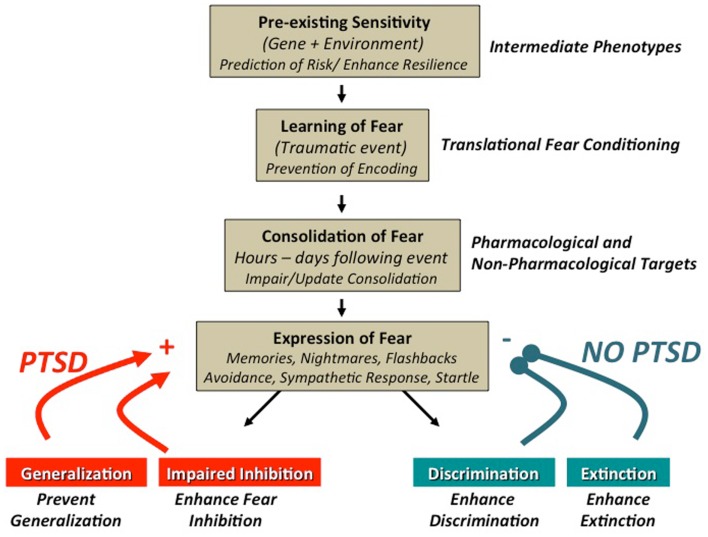
“Alterations in fear extinction, fear inhibition, and stimulus generalization have all been reported, using fear-potentiated startle methods, in populations with trauma- and stressor-related as well as anxiety disorders [see Figure 1; (16, 29–31)].”
§ Conditioned Fear Associated Phenotypes as Robust, Translational Indices of Trauma-, Stressor-, and Anxiety-Related Behaviors > Fear Conditioning
What the sources say
- Not checked yetcites [16] Lissek, 2009, Impaired discriminative fear-conditioning resulting from elevated fear responding to learned safety cues among individuals with panic disorder, Behav Res Ther source
- Not checked yetcites [29] Jovanovic, 2005, Fear potentiation and fear inhibition in a human fear-potentiated startle paradigm, Biol Psychiatry source
- Not checked yetcites [30] Norrholm, 2006, Conditioned fear extinction and reinstatement in a human fear-potentiated startle paradigm, Learn Mem source
- Not checked yetcites [31] Glenn, 2012, The development of fear learning and generalization in 8-13 year-olds, Dev Psychobiol source
plaincorrelational- Asserted: passes — The authors put it forward as true.
- Checkable: passes — It can be checked against evidence.
- Load-bearing: passes — The paper’s conclusions depend on it.
- Based: passes — The paper gives a reason why it holds.
None of the sources cited for this claim have been checked yet.
In the paper
“The high comorbidity of PTSD and depression highlights this problem; specifically, measures of PTSD and depression [as indexed by the Clinician Administered PTSD Scale (CAPS) and the Beck Depression Index (BDI), respectively) may reflect overlapping symptoms of negative affect (18, 19).”
§ Conditioned Fear Associated Phenotypes as Robust, Translational Indices of Trauma-, Stressor-, and Anxiety-Related Behaviors > Fear Conditioning
What the sources say
- Not checked yetcites [18] Brown, 1998, Structural relationships among dimensions of the DSM-IV anxiety and mood disorders and dimensions of negative affect, positive affect, and autonomic arousal, J Abnorm Psychol source
- Not checked yetcites [19] Bauer, 2013, Psychophysiological assessment of PTSD: a potential research domain criteria construct, Psychol Assess source
hedgedcorrelational- Asserted: passes — The authors put it forward as true.
- Checkable: passes — It can be checked against evidence.
- Load-bearing: passes — The paper’s conclusions depend on it.
- Based: passes — The paper gives a reason why it holds.
In the paper
“For example, PTSD patients have shown increased fear responses to cues that they subjectively report as safe (28).”
§ Conditioned Fear Associated Phenotypes as Robust, Translational Indices of Trauma-, Stressor-, and Anxiety-Related Behaviors > Fear Conditioning
What the sources say
- Not checked yetcites [28] Jovanovic, 2012, Impaired safety signal learning may be a biomarker of PTSD, Neuropharmacology source
plaincorrelational- Asserted: passes — The authors put it forward as true.
- Checkable: passes — It can be checked against evidence.
- Load-bearing: passes — The paper’s conclusions depend on it.
- Based: passes — The paper gives a reason why it holds.
The paper states this without a source or data behind it here, so there is nothing to check it against. The quote shows it is in the paper.
In the paper
“Translational studies have shown that fearful memories are initially labile and are consolidated to a more permanent state, hours to days, after the initial event.”
§ Conditioned Fear Associated Phenotypes as Robust, Translational Indices of Trauma-, Stressor-, and Anxiety-Related Behaviors > Fear Conditioning
boosteddirect- Asserted: passes — The authors put it forward as true.
- Checkable: passes — It can be checked against evidence.
- Load-bearing: passes — The paper’s conclusions depend on it.
- Based: unclear — It is unclear why the paper says it holds.
None of the sources cited for this claim have been checked yet.
In the paper
“Clinically, individuals with PTSD have been show to have alterations in stimulus generalization (16), fear inhibition (29), discrimination, and fear extinction (38).”
§ Conditioned Fear Associated Phenotypes as Robust, Translational Indices of Trauma-, Stressor-, and Anxiety-Related Behaviors > Fear Conditioning
What the sources say
- Not checked yetcites [16] Lissek, 2009, Impaired discriminative fear-conditioning resulting from elevated fear responding to learned safety cues among individuals with panic disorder, Behav Res Ther source
- Not checked yetcites [29] Jovanovic, 2005, Fear potentiation and fear inhibition in a human fear-potentiated startle paradigm, Biol Psychiatry source
- Not checked yetcites [38] Rothbaum, 2014, A randomized, double-blind evaluation of d-cycloserine or alprazolam combined with virtual reality exposure therapy for posttraumatic stress disorder in Iraq and Afghanistan War Veterans, Am J Psychiatry source
plaincorrelational- Asserted: passes — The authors put it forward as true.
- Checkable: passes — It can be checked against evidence.
- Load-bearing: passes — The paper’s conclusions depend on it.
- Based: passes — The paper gives a reason why it holds.
In the paper
“neural circuitry that includes the amygdaloid complex can be associated with at least 14 symptoms of PTSD and, as such, there remains compelling interest in developing and utilizing translational paradigms that index these circuits”
§ Conditioned Fear Associated Phenotypes as Robust, Translational Indices of Trauma-, Stressor-, and Anxiety-Related Behaviors > Introduction
What the sources say
- Not checked yetcites [13] Weston, 2014, Posttraumatic stress disorder: a theoretical model of the hyperarousal subtype, Front Psychiatry source
plaincorrelational- Asserted: passes — The authors put it forward as true.
- Checkable: passes — It can be checked against evidence.
- Load-bearing: passes — The paper’s conclusions depend on it.
- Based: passes — The paper gives a reason why it holds.
In the paper
“For example, our group showed heightened levels of fear during early extinction in a previously traumatized population with PTSD consisting of primarily African-American women living in a low-socioeconomic urban environment; we termed this pattern of extinction learning as being indicative of “fear load,” or the over-expression of fear during early extinction.”
§ Conditioned Fear Associated Phenotypes as Robust, Translational Indices of Trauma-, Stressor-, and Anxiety-Related Behaviors > Fear Conditioning
What the sources say
- Not checked yetcites [15] Norrholm, 2011, Fear extinction in traumatized civilians with posttraumatic stress disorder: relation to symptom severity, Biol Psychiatry source
plaincorrelational- Asserted: passes — The authors put it forward as true.
- Checkable: passes — It can be checked against evidence.
- Load-bearing: passes — The paper’s conclusions depend on it.
- Based: passes — The paper gives a reason why it holds.
In the paper
“Similarly, the symptom dimensions used for a diagnosis may reflect complex sequelae resulting from an overlap in symptom presentation of multiple disorders (20).”
§ Conditioned Fear Associated Phenotypes as Robust, Translational Indices of Trauma-, Stressor-, and Anxiety-Related Behaviors > Fear Conditioning
What the sources say
- Not checked yetcites [20] Franklin, 2001, Posttraumatic stress disorder and major depressive disorder: investigating the role of overlapping symptoms in diagnostic comorbidity, J Nerv Ment Dis source
hedgedconditional- Asserted: passes — The authors put it forward as true.
- Checkable: passes — It can be checked against evidence.
- Load-bearing: passes — The paper’s conclusions depend on it.
- Based: passes — The paper gives a reason why it holds.
In the paper
“With regard to over-expression of acquired fear, previous work from our lab (15) suggests that the early phase of within-session extinction learning involves persistent excitation, as it is predicted by the level of fear expression to the CS+ (i.e., the danger signal) at the end of acquisition.”
§ Conditioned Fear Associated Phenotypes as Robust, Translational Indices of Trauma-, Stressor-, and Anxiety-Related Behaviors > Fear Conditioning
What the sources say
- Not checked yetcites [15] Norrholm, 2011, Fear extinction in traumatized civilians with posttraumatic stress disorder: relation to symptom severity, Biol Psychiatry source
hedgedcorrelational- Asserted: passes — The authors put it forward as true.
- Checkable: passes — It can be checked against evidence.
- Load-bearing: unclear — It is unclear whether the paper’s conclusions depend on it.
- Based: passes — The paper gives a reason why it holds.
In the paper
“As an example, we previously showed that a predominately male population of combat veterans with PTSD did not show “fear load,” but rather impaired within-session extinction learning characterized by a “persistence of fear” (40).”
§ Conditioned Fear Associated Phenotypes as Robust, Translational Indices of Trauma-, Stressor-, and Anxiety-Related Behaviors > Fear Conditioning
What the sources say
- Not checked yetcites [40] Norrholm, 2011, Translational fear inhibition models as indices of trauma-related psychopathology, Curr Psychiatry Rev source
plain- Asserted: passes — The authors put it forward as true.
- Checkable: passes — It can be checked against evidence.
- Load-bearing: unclear — It is unclear whether the paper’s conclusions depend on it.
- Based: passes — The paper gives a reason why it holds.
- It may state two separate claims as one. 22
- Probably not a substantial claim. 16
In the paper
“trauma-, stressor-, and anxiety-related disorders have been shown to have a significant degree of heritability and more recently, it has become increasingly clear that genetic contributions include complex gene × environment interactions.”
§ Conditioned Fear Associated Phenotypes as Robust, Translational Indices of Trauma-, Stressor-, and Anxiety-Related Behaviors > Fear Conditioning
What the sources say
- Not checked yetcites [36] Norrholm, 2013, Differential genetic and epigenetic regulation of catechol-O-methyltransferase is associated with impaired fear inhibition in posttraumatic stress disorder, Front Behav Neurosci source
boostedcorrelational- Asserted: passes — The authors put it forward as true.
- Checkable: passes — It can be checked against evidence.
- Load-bearing: passes — The paper’s conclusions depend on it.
- Based: passes — The paper gives a reason why it holds.
It may state two separate claims as one.
In the paper
“High levels of conditioned fear remaining during late extinction are related to impaired inhibition, as it is best predicted by responses to the CS− (i.e., safety signal) at the end of acquisition (15).”
§ Conditioned Fear Associated Phenotypes as Robust, Translational Indices of Trauma-, Stressor-, and Anxiety-Related Behaviors > Fear Conditioning
What the sources say
- Not checked yetcites [15] Norrholm, 2011, Fear extinction in traumatized civilians with posttraumatic stress disorder: relation to symptom severity, Biol Psychiatry source
plaincorrelational- Asserted: passes — The authors put it forward as true.
- Checkable: passes — It can be checked against evidence.
- Load-bearing: passes — The paper’s conclusions depend on it.
- Based: passes — The paper gives a reason why it holds.
It may state two separate claims as one.
- The authors state this as an assumption: Extinction learning is a form of fear inhibition.
The paper states this without a source or data behind it here, so there is nothing to check it against. The quote shows it is in the paper.
In the paper
“Fear conditioning experiments have identified varying trajectories of the dimensions described, highlighting exciting new avenues of targeted, focused study.”
§ Conditioned Fear Associated Phenotypes as Robust, Translational Indices of Trauma-, Stressor-, and Anxiety-Related Behaviors > Abstract
plain- Asserted: passes — The authors put it forward as true.
- Checkable: passes — It can be checked against evidence.
- Load-bearing: passes — The paper’s conclusions depend on it.
- Based: passes — The paper gives a reason why it holds.
Probably not a substantial claim.
None of the sources cited for this claim have been checked yet.
In the paper
“Morphine has also been studied as a possible intervention of fear memory consolidation; however, it is not clear whether morphine's analgesic properties act to reduce the potency of the CS+ or are acting through a separate mechanism (61, 62).”
§ Conditioned Fear Associated Phenotypes as Robust, Translational Indices of Trauma-, Stressor-, and Anxiety-Related Behaviors > Treatment
What the sources say
plainconditional- Asserted: passes — The authors put it forward as true.
- Checkable: passes — It can be checked against evidence.
- Load-bearing: fails — The paper’s conclusions may not depend on it.
- Based: passes — The paper gives a reason why it holds.
Probably not a substantial claim. The paper’s conclusions may not depend on it. It may state two separate claims as one.
None of the sources cited for this claim have been checked yet.
In the paper
“Walker et al. (64) found that d-cycloserine (DCS), an NMDA receptor partial agonist, facilitated extinction learning in rats; a finding that was later replicated by several other groups employing multiple types of fear learning paradigms in rodents [e.g., Ref. (65)] but not replicated using skin conductance and expectancy ratings in humans (66).”
§ Conditioned Fear Associated Phenotypes as Robust, Translational Indices of Trauma-, Stressor-, and Anxiety-Related Behaviors > Treatment
What the sources say
- Not checked yetcites [64] Walker, 2002, Facilitation of conditioned fear extinction by systemic administration or intra-amygdala infusions of D-cycloserine as assessed with fear-potentiated startle in rats, J Neurosci source
- Not checked yetcites [65] Richardson, 2004, Facilitation of fear extinction by D-cycloserine: theoretical and clinical implications, Learn Mem source
- Not checked yetcites [66] Guastella, 2007, A randomized controlled trial of the effect of D-cycloserine on extinction and fear conditioning in humans, Behav Res Ther source
plaindirect- Asserted: passes — The authors put it forward as true.
- Checkable: passes — It can be checked against evidence.
- Load-bearing: passes — The paper’s conclusions depend on it.
- Based: passes — The paper gives a reason why it holds.
It may state two separate claims as one.
In the paper
“Both groups also discriminated between the CS+ and CS−; however, the auditory group exhibited discrimination on blocks 1, 2, and 3 of fear acquisition, while the visual CS+ group exhibited discrimination on blocks 2 and 3 of fear acquisition.”
§ Conditioned Fear Associated Phenotypes as Robust, Translational Indices of Trauma-, Stressor-, and Anxiety-Related Behaviors > Versatility
What the sources say
- Not checked yetcites [58] Norrholm, 2011, Versatility of fear-potentiated startle paradigms for assessing human conditioned fear extinction and return of fear, Front Behav Neurosci source
plain- Asserted: passes — The authors put it forward as true.
- Checkable: passes — It can be checked against evidence.
- Load-bearing: unclear — It is unclear whether the paper’s conclusions depend on it.
- Based: passes — The paper gives a reason why it holds.
It may state two separate claims as one.
In the paper
“Specifically, several candidate gene studies have identified genetic differences and specific gene pathways involved in PTSD [for a review, see (53)].”
§ Conditioned Fear Associated Phenotypes as Robust, Translational Indices of Trauma-, Stressor-, and Anxiety-Related Behaviors > Units of Analysis
What the sources say
- Not checked yetcites [53] Skelton, 2012, PTSD and gene variants: new pathways and new thinking, Neuropharmacology source
plaincorrelational- Asserted: passes — The authors put it forward as true.
- Checkable: passes — It can be checked against evidence.
- Load-bearing: fails — The paper’s conclusions may not depend on it.
- Based: passes — The paper gives a reason why it holds.
Probably not a substantial claim. The paper’s conclusions may not depend on it.
In the paper
“Twenty-four hours later an extinction test was performed. This test showed that spontaneous recovery occurred in both groups and US-expectancy ratings increased in both groups regardless of modality as well (58).”
§ Conditioned Fear Associated Phenotypes as Robust, Translational Indices of Trauma-, Stressor-, and Anxiety-Related Behaviors > Versatility
What the sources say
- Not checked yetcites [58] Norrholm, 2011, Versatility of fear-potentiated startle paradigms for assessing human conditioned fear extinction and return of fear, Front Behav Neurosci source
plain- Asserted: passes — The authors put it forward as true.
- Checkable: passes — It can be checked against evidence.
- Load-bearing: passes — The paper’s conclusions depend on it.
- Based: passes — The paper gives a reason why it holds.
It may state two separate claims as one.
The paper states this without a source or data behind it here, so there is nothing to check it against. The quote shows it is in the paper.
In the paper
“Several recent translational studies have explored both pharmacological as well as non-pharmacological means of enhancing extinction of fear and preventing its re-emergence.”
§ Conditioned Fear Associated Phenotypes as Robust, Translational Indices of Trauma-, Stressor-, and Anxiety-Related Behaviors > Treatment
plain- Asserted: passes — The authors put it forward as true.
- Checkable: passes — It can be checked against evidence.
- Load-bearing: fails — The paper’s conclusions may not depend on it.
- Based: passes — The paper gives a reason why it holds.
Probably not a substantial claim. The paper’s conclusions may not depend on it.
None of the sources cited for this claim have been checked yet.
In the paper
“Shortly thereafter, several groups reported that DCS administration before or after exposure therapy, a form of treatment based on the principles of fear extinction learning, was effective in alleviating the symptoms of acrophobia (67), panic disorder (68), social anxiety disorder (69, 70), and obsessive–compulsive disorder (71–73).”
§ Conditioned Fear Associated Phenotypes as Robust, Translational Indices of Trauma-, Stressor-, and Anxiety-Related Behaviors > Treatment
What the sources say
- Not checked yetcites [67] Ressler, 2004, Cognitive enhancers as adjuncts to psychotherapy: use of D-cycloserine in phobic individuals to facilitate extinction of fear, Arch Gen Psychiatry source
- Not checked yetcites [68] Otto, 2010, Efficacy of CBT for benzodiazepine discontinuation in patients with panic disorder: further evaluation, Behav Res Ther source
- Not checked yetcites [69] Hofmann, 2006, Augmentation of exposure therapy with D-cycloserine for social anxiety disorder, Arch Gen Psychiatry source
- Not checked yetcites [70] Hofmann, 2013, d-Cycloserine as an augmentation strategy with cognitive-behavioral therapy for social anxiety disorder, Am J Psychiatry source
plaindirect- Asserted: passes — The authors put it forward as true.
- Checkable: passes — It can be checked against evidence.
- Load-bearing: passes — The paper’s conclusions depend on it.
- Based: passes — The paper gives a reason why it holds.
It may state two separate claims as one.
- Rests on an assumption: Exposure therapy is a form of treatment based on the principles of fear extinction learning.
In the paper
“Ten minutes after this initial assessment, these groups were shown to also extinguish fear; however, the auditory group displayed a steeper slope of extinction, due in part to an initial increase in fear during extinction, than the visual group.”
§ Conditioned Fear Associated Phenotypes as Robust, Translational Indices of Trauma-, Stressor-, and Anxiety-Related Behaviors > Versatility
What the sources say
- Not checked yetcites [58] Norrholm, 2011, Versatility of fear-potentiated startle paradigms for assessing human conditioned fear extinction and return of fear, Front Behav Neurosci source
plaindirect- Asserted: passes — The authors put it forward as true.
- Checkable: passes — It can be checked against evidence.
- Load-bearing: unclear — It is unclear whether the paper’s conclusions depend on it.
- Based: passes — The paper gives a reason why it holds.
It may state two separate claims as one.
In the paper
“More recently, GWAS data, which is obtained when expression levels of the whole genome are analyzed in the context of PTSD, have been used to identify novel gene pathways involved in the mechanisms underlying complex disorders such as PTSD [see Ref. (54) for a review].”
§ Conditioned Fear Associated Phenotypes as Robust, Translational Indices of Trauma-, Stressor-, and Anxiety-Related Behaviors > Units of Analysis
What the sources say
- Not checked yetcites [54] Almli, 2014, Genetic approaches to understanding post-traumatic stress disorder, Int J Neuropsychopharmacol source
plaincorrelational- Asserted: passes — The authors put it forward as true.
- Checkable: passes — It can be checked against evidence.
- Load-bearing: fails — The paper’s conclusions may not depend on it.
- Based: passes — The paper gives a reason why it holds.
Probably not a substantial claim. The paper’s conclusions may not depend on it.
In the paper
“Specifically, when DCS was administered prior to virtual reality exposure therapy subjects showed earlier, enhanced symptom reduction and greater PTSD remission rates (78).”
§ Conditioned Fear Associated Phenotypes as Robust, Translational Indices of Trauma-, Stressor-, and Anxiety-Related Behaviors > Treatment
What the sources say
- Not checked yetcites [78] Difede, 2014, D-cycloserine augmentation of exposure therapy for post-traumatic stress disorder: a pilot randomized clinical trial, Neuropsychopharmacology source
plaindirect- Asserted: passes — The authors put it forward as true.
- Checkable: passes — It can be checked against evidence.
- Load-bearing: passes — The paper’s conclusions depend on it.
- Based: passes — The paper gives a reason why it holds.
It may state two separate claims as one.
In the paper
“Initial reports by Litz et al. (75) suggested that DCS + exposure therapy was not as effective as placebo + exposure in a population of combat veterans with PTSD (75)”
§ Conditioned Fear Associated Phenotypes as Robust, Translational Indices of Trauma-, Stressor-, and Anxiety-Related Behaviors > Treatment
What the sources say
- Not checked yetcites [75] Litz, 2012, A randomized placebo-controlled trial of D-cycloserine and exposure therapy for posttraumatic stress disorder, J Psychiatr Res source
hedged- Asserted: passes — The authors put it forward as true.
- Checkable: passes — It can be checked against evidence.
- Load-bearing: fails — The paper’s conclusions may not depend on it.
- Based: passes — The paper gives a reason why it holds.
Probably not a substantial claim. The paper’s conclusions may not depend on it.
In the paper
“Fear-potentiated startle is observed across species and is ideal for studying translational models of fear-related phenotypes (27).”
§ Conditioned Fear Associated Phenotypes as Robust, Translational Indices of Trauma-, Stressor-, and Anxiety-Related Behaviors > Fear Conditioning
What the sources say
- Not checked yetcites [27] Lissek, 2008, Generalization of conditioned fear-potentiated startle in humans: experimental validation and clinical relevance, Behav Res Ther source
plain- Asserted: passes — The authors put it forward as true.
- Checkable: passes — It can be checked against evidence.
- Load-bearing: passes — The paper’s conclusions depend on it.
- Based: passes — The paper gives a reason why it holds.
It may state two separate claims as one.
A conclusion the paper draws from its own results — it cites no other source for it, so there is none to check. The quote shows it is in the paper.
In the paper
“Fear extinction, as a translational tool, is an important area of study due to its relevance to the limbic neural circuitry believed to underlie fear psychopathology and also due to its role as an experimental homolog to exposure therapy, which is currently recognized as the most effective treatment for fear and anxiety.”
§ Conditioned Fear Associated Phenotypes as Robust, Translational Indices of Trauma-, Stressor-, and Anxiety-Related Behaviors > Fear Conditioning
plaincorrelational- Asserted: passes — The authors put it forward as true.
- Checkable: passes — It can be checked against evidence.
- Load-bearing: passes — The paper’s conclusions depend on it.
- Based: passes — The paper gives a reason why it holds.
It may state two separate claims as one.
A conclusion the paper draws from its own results — it cites no other source for it, so there is none to check. The quote shows it is in the paper.
In the paper
“Fear conditioning is a robust, translational experimental paradigm that can be employed to elucidate these mechanisms by allowing for the study of fear-related dimensions of PTSD (e.g., fear extinction, fear inhibition, and generalization of fear) across multiple units of analysis.”
§ Conditioned Fear Associated Phenotypes as Robust, Translational Indices of Trauma-, Stressor-, and Anxiety-Related Behaviors > Abstract
plaindirect- Asserted: passes — The authors put it forward as true.
- Checkable: passes — It can be checked against evidence.
- Load-bearing: passes — The paper’s conclusions depend on it.
- Based: passes — The paper gives a reason why it holds.
It may state two separate claims as one.
In the paper
“Post-traumatic stress disorder is a heterogeneous disorder in which symptoms span four primary symptom clusters according to the recent Diagnostic and Statistical Manual of Mental Disorders, 5th edition [DSM-5; (9)].”
§ Conditioned Fear Associated Phenotypes as Robust, Translational Indices of Trauma-, Stressor-, and Anxiety-Related Behaviors > Introduction
What the sources say
- Not checked yetcites [9] 2013
plaincorrelational- Asserted: passes — The authors put it forward as true.
- Checkable: passes — It can be checked against evidence.
- Load-bearing: fails — The paper’s conclusions may not depend on it.
- Based: passes — The paper gives a reason why it holds.
Probably not a substantial claim. The paper’s conclusions may not depend on it. It may state two separate claims as one.
A conclusion the paper draws from its own results — it cites no other source for it, so there is none to check. The quote shows it is in the paper.
In the paper
“The dysregulated fear learning commonly observed in anxious and traumatized populations can be modeled by fear-conditioning paradigms, which can provide a translational framework.”
§ Conditioned Fear Associated Phenotypes as Robust, Translational Indices of Trauma-, Stressor-, and Anxiety-Related Behaviors > Fear Conditioning
plaincorrelational- Asserted: passes — The authors put it forward as true.
- Checkable: passes — It can be checked against evidence.
- Load-bearing: passes — The paper’s conclusions depend on it.
- Based: passes — The paper gives a reason why it holds.
It may state two separate claims as one.
A conclusion the paper draws from its own results — it cites no other source for it, so there is none to check. The quote shows it is in the paper.
In the paper
“Using the RDoC approach, fear-conditioning studies can identify intermediate phenotypes, which represent specific components of a disorder and allow for a more direct examination of brain–behavior relationships.”
§ Conditioned Fear Associated Phenotypes as Robust, Translational Indices of Trauma-, Stressor-, and Anxiety-Related Behaviors > Units of Analysis
plaindirect- Asserted: passes — The authors put it forward as true.
- Checkable: passes — It can be checked against evidence.
- Load-bearing: passes — The paper’s conclusions depend on it.
- Based: passes — The paper gives a reason why it holds.
It may state two separate claims as one.
None of the sources cited for this claim have been checked yet.
In the paper
“The presence of divergent extinction trajectories as described above represents an exciting new avenue of study and has recently been introduced in the rodent literature (43), which may be analogous to heterogeneous responses to trauma in PTSD (44).”
§ Conditioned Fear Associated Phenotypes as Robust, Translational Indices of Trauma-, Stressor-, and Anxiety-Related Behaviors > Fear Conditioning
What the sources say
- Not checked yetcites [43] Galatzer-Levy, 2013, Heterogeneity in threat extinction learning: substantive and methodological considerations for identifying individual difference in response to stress, Front Behav Neurosci source
- Not checked yetcites [44] Galatzer-Levy, 2013, Early PTSD symptom trajectories: persistence, recovery, and response to treatment: results from the Jerusalem Trauma Outreach and Prevention Study (J-TOPS), PLoS One source
hedgedcorrelational- Asserted: passes — The authors put it forward as true.
- Checkable: passes — It can be checked against evidence.
- Load-bearing: passes — The paper’s conclusions depend on it.
- Based: passes — The paper gives a reason why it holds.
Probably not a substantial claim. It may state two separate claims as one.
In the paper
“While PTSD symptom clusters provide a useful set of diagnostic criteria and could be used to discern the most effective treatment [for a comprehensive review, see Ref. (10)], they represent broad categories of behavior and do not easily reflect common underlying mechanisms.”
§ Conditioned Fear Associated Phenotypes as Robust, Translational Indices of Trauma-, Stressor-, and Anxiety-Related Behaviors > Units of Analysis
What the sources say
- Not checked yetcites [10] Norrholm, 2010, Tailoring therapeutic strategies for treating posttraumatic stress disorder symptom clusters, Neuropsychiatr Dis Treat source
hedged- Asserted: passes — The authors put it forward as true.
- Checkable: passes — It can be checked against evidence.
- Load-bearing: passes — The paper’s conclusions depend on it.
- Based: passes — The paper gives a reason why it holds.
It may state two separate claims as one.
None of the sources cited for this claim have been checked yet.
In the paper
“Further, PTSD has long been associated with intrinsic [e.g., age and gender (48, 49)], environmental (e.g., exposure to trauma, rearing environment, degree of social support), and genetic factors (50–52).”
§ Conditioned Fear Associated Phenotypes as Robust, Translational Indices of Trauma-, Stressor-, and Anxiety-Related Behaviors > Units of Analysis
What the sources say
- Not checked yetcites [48] Bokszczanin, 2007, PTSD symptoms in children adolescents 28 months after a flood: age gender differences, J Trauma Stress source
- Not checked yetcites [49] Iwadare, 2014, Posttraumatic symptoms in elementary and junior high school children after the 2011 Japan earthquake and tsunami: symptom severity and recovery vary by age and sex, J Pediatr source
- Not checked yetcites [50] True, 1993, A twin study of genetic and environmental contributions to liability for posttraumatic stress symptoms, Arch Gen Psychiatry source
- Not checked yetcites [51] Binder, 2008, Association of FKBP5 polymorphisms and childhood abuse with risk of posttraumatic stress disorder symptoms in adults, JAMA source
- Not checked yetcites [52] Yehuda, 2008, Maternal, not paternal, PTSD is related to increased risk for PTSD in offspring of Holocaust survivors, J Psychiatr Res source
plaincorrelational- Asserted: passes — The authors put it forward as true.
- Checkable: passes — It can be checked against evidence.
- Load-bearing: fails — The paper’s conclusions may not depend on it.
- Based: passes — The paper gives a reason why it holds.
Probably not a substantial claim. The paper’s conclusions may not depend on it.
In the paper
“Fear-potentiated startle can be used in several mammalian species (57); however, in animal models the CSs are typically auditory, whereas visual CSs are used in human studies.”
§ Conditioned Fear Associated Phenotypes as Robust, Translational Indices of Trauma-, Stressor-, and Anxiety-Related Behaviors > Versatility
What the sources say
- Not checked yetcites [57] Myers, 2009, Measurement of fear inhibition in rats, monkeys, and humans with or without posttraumatic stress disorder, using the AX+, BX– paradigm
plain- Asserted: passes — The authors put it forward as true.
- Checkable: passes — It can be checked against evidence.
- Load-bearing: passes — The paper’s conclusions depend on it.
- Based: passes — The paper gives a reason why it holds.
It may state two separate claims as one.
The paper states this without a source or data behind it here, so there is nothing to check it against. The quote shows it is in the paper.
In the paper
“Not surprisingly, treatment approaches aimed at reducing the fear-related symptoms of PTSD (e.g., re-experiencing and intrusive memories) have focused on the disruption of fear memory consolidation/reconsolidation, facilitation of extinction learning, and the prevention of the return of fear.”
§ Conditioned Fear Associated Phenotypes as Robust, Translational Indices of Trauma-, Stressor-, and Anxiety-Related Behaviors > Treatment
plaindirect- Asserted: passes — The authors put it forward as true.
- Checkable: passes — It can be checked against evidence.
- Load-bearing: fails — The paper’s conclusions may not depend on it.
- Based: passes — The paper gives a reason why it holds.
Probably not a substantial claim. The paper’s conclusions may not depend on it.
A conclusion the paper draws from its own results — it cites no other source for it, so there is none to check. The quote shows it is in the paper.
In the paper
“The use of these intermediate phenotypes not only enhances the ability to identify complex gene interactions but also allows for these gene pathways to be more readily studied.”
§ Conditioned Fear Associated Phenotypes as Robust, Translational Indices of Trauma-, Stressor-, and Anxiety-Related Behaviors > Units of Analysis
plaindirect- Asserted: passes — The authors put it forward as true.
- Checkable: passes — It can be checked against evidence.
- Load-bearing: passes — The paper’s conclusions depend on it.
- Based: passes — The paper gives a reason why it holds.
It may state two separate claims as one.
A conclusion the paper draws from its own results — it cites no other source for it, so there is none to check. The quote shows it is in the paper.
In the paper
“The advantage of this versatility is that it can be used in patients with visual impairment with equivalent results and also lends itself to the use of “cross-over” longitudinal studies in which practice effects can be minimized.”
§ Conditioned Fear Associated Phenotypes as Robust, Translational Indices of Trauma-, Stressor-, and Anxiety-Related Behaviors > Versatility
plaindirect- Asserted: passes — The authors put it forward as true.
- Checkable: passes — It can be checked against evidence.
- Load-bearing: passes — The paper’s conclusions depend on it.
- Based: passes — The paper gives a reason why it holds.
It may state two separate claims as one.
None of the sources cited for this claim have been checked yet.
In the paper
“These conditions include, but are not limited to, the type of psychophysiological measure employed, the schedule of reinforcement used during acquisition, the fear-relevancy of the conditioned stimuli presented, the strength of the fear memory following acquisition, and the presence or absence of on-line measures of expectancy or fear ratings [see Ref. (37, 91–93)].”
§ Conditioned Fear Associated Phenotypes as Robust, Translational Indices of Trauma-, Stressor-, and Anxiety-Related Behaviors > Treatment
What the sources say
- Not checked yetcites [37] Warren, 2013, Human fear extinction and return of fear using reconsolidation update mechanisms: the contribution of on-line expectancy ratings, Neurobiol Learn Mem source
- Not checked yetcites [91] Golkar, 2012, Are fear memories erasable?-reconsolidation of learned fear with fear-relevant and fear-irrelevant stimuli, Front Behav Neurosci source
- Not checked yetcites [92] Oyarzun, 2012, Updating fearful memories with extinction training during reconsolidation: a human study using auditory aversive stimuli, PLoS One source
- Not checked yetcites [93] Kindt, 2013, Reconsolidation in a human fear conditioning study: a test of extinction as updating mechanism, Biol Psychol source
plainconditional- Asserted: passes — The authors put it forward as true.
- Checkable: passes — It can be checked against evidence.
- Load-bearing: passes — The paper’s conclusions depend on it.
- Based: passes — The paper gives a reason why it holds.
It may state two separate claims as one.
None of the sources cited for this claim have been checked yet.
In the paper
“For example, PTSD is known to affect women more commonly than men (1, 94), and fear-conditioning paradigms are useful for characterizing the sex differences underlying different neuronal, endocrine, and behavioral responses to trauma and other stressors.”
§ Conditioned Fear Associated Phenotypes as Robust, Translational Indices of Trauma-, Stressor-, and Anxiety-Related Behaviors > Conclusion
What the sources say
boostedcorrelational- Asserted: passes — The authors put it forward as true.
- Checkable: passes — It can be checked against evidence.
- Load-bearing: fails — The paper’s conclusions may not depend on it.
- Based: passes — The paper gives a reason why it holds.
Probably not a substantial claim. The paper’s conclusions may not depend on it.
None of the sources cited for this claim have been checked yet.
In the paper
“This work was furthered by Gunduz-Cinar et al. (84, 85) who showed that inhibition of fatty acid amide hydrolase (FAAH), the enzyme that catabolizes the endogenous cannabinoid anandamide, enhances extinction learning in rodents and could represent a risk variant for stressor-related psychiatric disorders (84, 85).”
§ Conditioned Fear Associated Phenotypes as Robust, Translational Indices of Trauma-, Stressor-, and Anxiety-Related Behaviors > Treatment
What the sources say
- Not checked yetcites [84] Gunduz-Cinar, 2013, Amygdala FAAH and anandamide: mediating protection and recovery from stress, Trends Pharmacol Sci source
- Not checked yetcites [85] Gunduz-Cinar, 2013, Convergent translational evidence of a role for anandamide in amygdala-mediated fear extinction, threat processing and stress-reactivity, Mol Psychiatry source
hedgedconditional- Asserted: passes — The authors put it forward as true.
- Checkable: passes — It can be checked against evidence.
- Load-bearing: fails — The paper’s conclusions may not depend on it.
- Based: passes — The paper gives a reason why it holds.
Probably not a substantial claim. The paper’s conclusions may not depend on it.
A conclusion the paper draws from its own results — it cites no other source for it, so there is none to check. The quote shows it is in the paper.
In the paper
“While the present review summarized the current progress of interfacing fear conditioning-related intermediate phenotypes and genetic (54), behavioral (47), symptomatic (15, 45), and clinical studies (78), further characterization of these intermediate phenotypes will enhance the utility of fear-conditioning studies.”
§ Conditioned Fear Associated Phenotypes as Robust, Translational Indices of Trauma-, Stressor-, and Anxiety-Related Behaviors > Conclusion
plainconditional- Asserted: passes — The authors put it forward as true.
- Checkable: fails — It may be too vague to check against evidence.
- Load-bearing: passes — The paper’s conclusions depend on it.
- Based: passes — The paper gives a reason why it holds.
Probably not a substantial claim. It may be too vague to check against evidence.
A conclusion the paper draws from its own results — it cites no other source for it, so there is none to check. The quote shows it is in the paper.
In the paper
“By identifying these intermediate phenotypes, we can create specific testable measures, which can then be used to examine the effectiveness of treatment interventions.”
§ Conditioned Fear Associated Phenotypes as Robust, Translational Indices of Trauma-, Stressor-, and Anxiety-Related Behaviors > Conclusion
plaindirect- Asserted: passes — The authors put it forward as true.
- Checkable: fails — It may be too vague to check against evidence.
- Load-bearing: passes — The paper’s conclusions depend on it.
- Based: fails — The paper may give no reason why it holds.
Probably not a substantial claim. It may be too vague to check against evidence. The paper may give no reason why it holds. It may state two separate claims as one.
A conclusion the paper draws from its own results — it cites no other source for it, so there is none to check. The quote shows it is in the paper.
In the paper
“Ultimately, potential breakthroughs will increase the utility of fear-conditioning studies as a translational platform for studying the intermediate phenotypes underlying dysregulated fear learning, a central tenant of trauma-, stressor-, and anxiety-related disorders.”
§ Conditioned Fear Associated Phenotypes as Robust, Translational Indices of Trauma-, Stressor-, and Anxiety-Related Behaviors > Conclusion
hedgedconditional- Asserted: passes — The authors put it forward as true.
- Checkable: fails — It may be too vague to check against evidence.
- Load-bearing: passes — The paper’s conclusions depend on it.
- Based: fails — The paper may give no reason why it holds.
Probably not a substantial claim. It may be too vague to check against evidence. The paper may give no reason why it holds.
- Rests on an assumption: Dysregulated fear learning is a central tenant of trauma-, stressor-, and anxiety-related disorders.
- Rests on an assumption: PTSD has high comorbidity with other disorders including depression and substance abuse.
A conclusion the paper draws from its own results — it cites no other source for it, so there is none to check. The quote shows it is in the paper.
In the paper
“Understanding these phenotypes (i.e., fear inhibition, high fear load, fear generalization, etc.) and the divergent manifestations of these responses in the context of a broader etiology (i.e., genetic, behavioral, symptomatic, and clinical studies) may lead to more effective treatment and preventative strategies for PTSD and other trauma-, stressor-, and anxiety-related disorders.”
§ Conditioned Fear Associated Phenotypes as Robust, Translational Indices of Trauma-, Stressor-, and Anxiety-Related Behaviors > Conclusion
hedgedconditional- Asserted: passes — The authors put it forward as true.
- Checkable: fails — It may be too vague to check against evidence.
- Load-bearing: passes — The paper’s conclusions depend on it.
- Based: passes — The paper gives a reason why it holds.
Probably not a substantial claim. It may be too vague to check against evidence.
The authors state this as an assumption.
Extinction learning is a form of fear inhibition.
“This is based on the notion that extinction learning is a form of fear inhibition.”
The paper relies on this without support.
Exposure therapy is a form of treatment based on the principles of fear extinction learning.
“DCS administration before or after exposure therapy, a form of treatment based on the principles of fear extinction learning, was effective in alleviating the symptoms of acrophobia”
The paper relies on this without support.
Dysregulated fear learning is a central tenant of trauma-, stressor-, and anxiety-related disorders.
“Ultimately, potential breakthroughs will increase the utility of fear-conditioning studies as a translational platform for studying the intermediate phenotypes underlying dysregulated fear learning, a central tenant of trauma-, stressor-, and anxiety-related disorders.”
The paper relies on this without support.
PTSD has high comorbidity with other disorders including depression and substance abuse.
“This is especially useful due to the high comorbidity of PTSD and other disorders including depression and substance abuse.”
Claims other papers make about this one
Each is checked against this paper’s own text: does it say what the citing paper says it does?
In the citing paper
“Fear extinction has been widely utilized as a translational animal model for the exposure therapies used for anxiety disorders (Briscione et al., 2014; Myers & Davis, 2006; Quirk & Mueller, 2007).”
From Nicotine addiction and psychiatric disorders (2015) · cites this paper as Briscione et al., 2014
Self-check
Percentages, sums and reported differences re-computed from the paper’s own numbers.
Each contradiction between two passages listed here was confirmed by an independent check.
Rated minor: it would not touch a result — a value no result rests on, a p-value that stays on the same side of the significance level, or a conflict that is clerical, resolved elsewhere in the paper, or outside its own findings.
In the paper
§ Conditioned Fear Associated Phenotypes as Robust, Translational Indices of Trauma-, Stressor-, and Anxiety-Related Behaviors > Introduction
“Operation Iraqi Freedom and Operation Enduring Freedom”
§ Conditioned Fear Associated Phenotypes as Robust, Translational Indices of Trauma-, Stressor-, and Anxiety-Related Behaviors > Introduction
“(OEF and OIF, respectively)”
Citations
Cites
Kessler, R. C., Berglund, P., Demler, O., Jin, R., Merikangas, K. R., & Walters, E. E. (2005) · Archives of General Psychiatry · doi:10.1001/archpsyc.62.6.593 · Cited by 20,391
Posttraumatic Stress Disorder in the National Comorbidity Survey
Kessler, R. C. (1995) · Archives of General Psychiatry · doi:10.1001/archpsyc.1995.03950240066012 · Cited by 10,379
Combat Duty in Iraq and Afghanistan, Mental Health Problems, and Barriers to Care
Hoge, C. W., Castro, C. A., Messer, S. C., McGurk, D., Cotting, D. I., & Koffman, R. L. (2004) · New England Journal of Medicine · doi:10.1056/nejmoa040603 · Cited by 4,778
The Neurocircuitry of Fear, Stress, and Anxiety Disorders
Shin, L. M., & Liberzon, I. (2010) · Neuropsychopharmacology · doi:10.1038/npp.2009.83 · Cited by 2,083 · cited 1×
“Interestingly, the DSM-5 no longer includes Criterion A2, or the presence of fear, helplessness, or horror in response to a traumatic event, in the diagnostic criteria that must be endorsed for a clinical diagnosis of PTSD; however, dysregulation of fear conditioning-related phenotypes remains a central feature of thi…”
Background(1990) · Choice Reviews Online · doi:10.5860/choice.27-6366 · Cited by 1,627
LeDoux, J., Iwata, J., Cicchetti, P., & Reis, D. (1988) · The Journal of Neuroscience · doi:10.1523/jneurosci.08-07-02517.1988 · Cited by 1,580
Brown, T. A., Chorpita, B. F., & Barlow, D. H. (1998) · Journal of Abnormal Psychology · doi:10.1037//0021-843x.107.2.179 · Cited by 1,400
Brown, T. A., Chorpita, B. F., & Barlow, D. H. (1998) · Journal of Abnormal Psychology · doi:10.1037/0021-843x.107.2.179 · Cited by 1,400
Binder, E. B. (2008) · JAMA · doi:10.1001/jama.299.11.1291 · Cited by 1,362
Neurobiological Basis of Failure to Recall Extinction Memory in Posttraumatic Stress Disorder
Milad, M. R., Pitman, R. K., Ellis, C. B., Gold, A. L., Shin, L. M., Lasko, N. B., Zeidan, M. A., Handwerger, K., Orr, S. P., & Rauch, S. L. (2009) · Biological Psychiatry · doi:10.1016/j.biopsych.2009.06.026 · Cited by 1,339
Research works printed but not linked: 2
- 2013, Diagnostic and Statistical Manual of Mental Disorders, Fifth Edition, DSM-5
- Myers, 2009, Measurement of fear inhibition in rats, monkeys, and humans with or without posttraumatic stress disorder, using the AX+, BX– paradigm, 61
Cited by
Sorted by citations
Items 101–105 of 105
Sim, K., & Park, S. (2024) · 신경정신의학 · doi:10.4306/jknpa.2024.63.1.68
Normative neural and physiological correlates of parent-child observational threat extinctionPreprint
Heyn, S. A., & Herringa, R. J. (2025) · bioRxiv (Cold Spring Harbor Laboratory) · doi:10.1101/2025.08.11.669679
Neural and physiological correlates of parent-child observational threat extinction
Heyn, S. A., & Herringa, R. J. (2025) · Scientific Reports · doi:10.1038/s41598-025-28498-1
Phasuk, S., Pairojana, T., Suresh, P., Yang, C.-H., Roytrakul, S., Huang, S.-P., Chen, C., Pakaprot, N., Chompoopong, S., Nudmamud‐Thanoi, S., et al. (2021) · Figshare · doi:10.6084/m9.figshare.14121482
Spezifisch Belastungs-assoziierte Störungen
Kapfhammer, H., Eberle, D. J., & Maercker, A. (2026) · Springer Reference Medizin · doi:10.1007/978-3-642-45028-0_71-2
Metadata
- Authors
- Briscione, M. A., Jovanovic, T., & Norrholm, S. D.
- Affiliations
- Emory University (US)
- Corresponding author
- Norrholm, Seth Davin
- ORCID
- Norrholm, Seth Davin
- Venue
- Frontiers in Psychiatry
- Publisher
- Frontiers Media SA
- Published
- 2014-07-21
- Volume
- 5
- Pages
- 88-88
- ISSN
- 1664-0640 (ISSN-L)
- PMC
- PMC4104832
- OpenAlex
- W1969678755
- Semantic Scholar
- 24e29ca8baee20676f53554bf85407077d1a7deb
- Cited by
- 105
- References
- 94
- Citations by year
- 2026: 4 · 2025: 7 · 2024: 6 · 2023: 11 · 2022: 5 · 2021: 12 · 2020: 7 · 2019: 8 · 2018: 8 · 2017: 8 · 2016: 10 · 2015: 15 · 2014: 3
- FWCI
- 14.16
- Type
- journal article
- Language
- en
- Open access
- gold
- doi.org
- Licence
- cc-by
- Locations
- Frontiers in Psychiatry (publishedVersion, cc-by)
- Europe PMC (PubMed Central) (publishedVersion, cc-by)
- PubMed Central (publishedVersion, cc-by)
- PubMed (publishedVersion)
- DOAJ (DOAJ: Directory of Open Access Journals) (submittedVersion, cc-by-sa)
- Funders
- U.S. Department of Defense
- National Alliance for Research on Schizophrenia and Depression
- National Institute of General Medical Sciences (T32GM008605)
- National Center for Research Resources (UL1RR025008)
- Congressionally Directed Medical Research Programs (W81XWH-08-2-0170)
- Topics
- Social Sciences › Psychology › Clinical Psychology › Posttraumatic Stress Disorder Research
- Life Sciences › Neuroscience › Cognitive Neuroscience › Memory and Neural Mechanisms
- Life Sciences › Neuroscience › Behavioral Neuroscience › Stress Responses and Cortisol
- Keywords
- post-traumatic stress disorder, fear conditioning, fear extinction, fear inhibition, fear generalization, hyperarousal, trauma exposure, anxiety-like behavior, translational model, PTSD treatment, genetic research, neurobiological mechanisms
About these checks
Registry, retraction, Cites and statistics results are computed, not judged, with one exception: a printed reference that no index lists is read once by a model before it counts as a citation error. Claims are extracted by a model and kept only when their quote appears verbatim in the text; each cited source is then checked, with a model’s help, for whether it says what the claim relies on. Those verdicts can be wrong — read the claim’s quote and the cited source before relying on one.
A language model drew the claims from the paper on 2026-10-10, under version 3 of the claim definition (model deepseek-v4.1-flash, prompt extract-v3).
A second model labelled each claim on 2026-10-10 (model jev-1.13-20260917, definition revision gold-guideline-v0.2).
Statistics and arithmetic are recomputed, not judged.
Confidence bands are shown only for fields calibrated on our annotated test set. None is calibrated yet, so no band is shown.
What counts as a claim ›How we measure confidence ›How we check this ›
Are you an author, or do you see a problem with this page? Request a review
