

Selection history: How reward modulates selectivity of visual attention.
Open accessThe DOI matches its Crossref record; 246 of the 251 references it cites were found in a registry or an index; 127 of the 241 sources its claims cite were checked for support.
Abstract
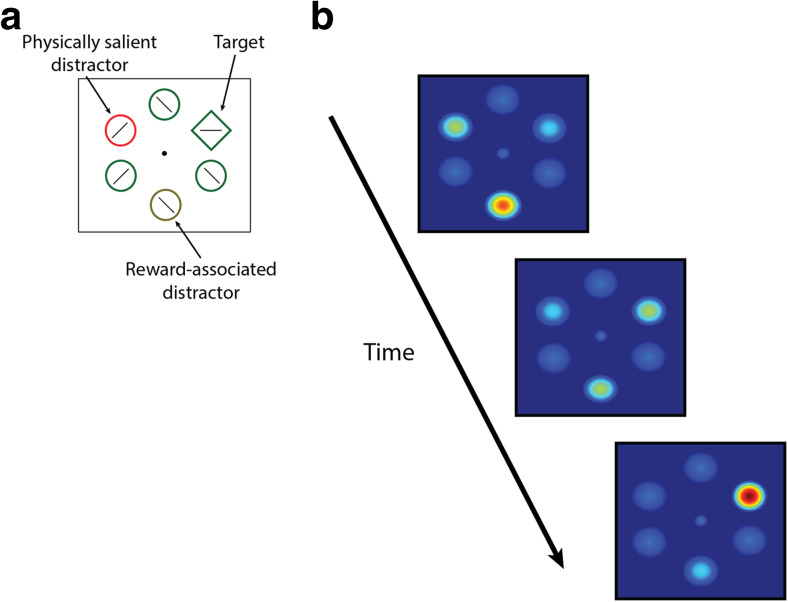
Visual attention enables us to selectively prioritize or suppress information in the environment. Prominent models concerned with the control of visual attention differentiate between goal-directed, top-down and stimulus-driven, bottom-up control, with the former determined by current selection goals and the latter determined by physical salience. In the current review, we discuss recent studies that demonstrate that attentional selection does not need to be the result of top-down or bottom-up processing but, instead, is often driven by lingering biases due to the "history" of former attention deployments. This review mainly focuses on reward-based history effects; yet other types of history effects such as (intertrial) priming, statistical learning and affective conditioning are also discussed. We argue that evidence from behavioral, eye-movement and neuroimaging studies supports the idea that selection history modulates the topographical landscape of spatial "priority" maps, such that attention is biased toward locations having the highest activation on this map.
Overview
CoChat Summary
TL;DR
This review argues that visual attention is shaped not only by top-down goals and bottom-up salience, but also by selection history—persistent biases from past attentional episodes. Reward is the main case reviewed, and the authors conclude that reward-associated stimuli can capture or be suppressed in ways that alter the priority map and influence both covert and overt attention.
Key findings
- The review argues that reward can bias attention beyond strategic control: previously reward-associated stimuli can disrupt performance even when they are non-salient, task-irrelevant, and when avoiding them would be better for reward.
- In intertrial reward priming, Hickey et al. (2010a) found that when participants received a high reward, they were quicker on the next trial if there was no swap between target- and distractor-associated colors, but slower if a swap occurred; with low reward, the pattern reversed.
- Della Libera & Chelazzi (2009) found that, in a training-test design separated by 5 days, distractor shapes associated with high reward as targets in training slowed later responses more than distractors associated with low reward as targets, while shapes associated with high reward as distractors sped later responses.
- The review notes neuroimaging evidence that reward history changes stimulus representation, including elevated activity in visual cortex and reward/attention areas such as basal ganglia, VMPFC, OSC, IPS, FEF, and SC; one cited fMRI study found that less suppression of a reward-associated distractor in OSC was linked to larger performance costs.
- The authors also report that reward can influence temporal attention: in Le Pelley et al. (2017), accuracy dropped significantly when an upright distractor signaled reward compared with when no reward was signaled or the distractor was absent.
Methods
- Narrative review of behavioral, eye-movement, electrophysiological, fMRI, PET, lesion, and pharmacological studies on attention, with emphasis on reward-based selection history and related history effects.
- The paper synthesizes studies using paradigms such as additional singleton search, spatial cueing, training-test designs, RSVP temporal attention, object-based cueing, and fear-conditioning/priming comparisons.
- Main analysis is qualitative/theoretical: the authors compare findings against top-down/bottom-up accounts and argue for a third category, selection history, integrated into a priority-map framework.
Limitations
- The paper explicitly says that several questions remain unresolved, including how reward-based selection history is reflected in the brain, how to model oculomotor effects, how suppression vs prioritization is determined, and how far effects generalize across contexts, tasks, and stimulus features.
- It also notes that many reward studies are hard to interpret because reward manipulations were often congruent with task demands, or because reward-associated stimuli were physically salient or otherwise not fully decoupled from top-down control; this is stated in the paper as a caveat.
- Evident from the text: this is a review, not a new empirical study, so its conclusions depend on the quality and comparability of the cited literature.
Model-written summary of a shortened version of the paper’s full text (it is longer than we read). Check it against the paper before relying on it.
Integrity signals
Registry
Cites
Statistics
Figures
Verification
Claims the paper makes
90 Valid · 7 Not valid · 60 Not checked · 111 Own results and interpretations
The cited sources support only part of this claim — read each source’s verdict below.
In the paper
“In particular, physical salience of a stimulus relative to its immediate surroundings determines how likely it is that this stimulus “grabs,” or captures, attention.”
§ Selection history: How reward modulates selectivity of visual attention > Top-down and bottom-up attentional control
What the sources say
- Not matchedcites Theeuwes, 1991a, 1992, 1994
A range of references, not one source.
- Supportedcites Itti & Koch, 2001 matched to “Computational modelling of visual attention” (2001) source
The Summary says a stimulus’s perceptual saliency depends critically on surrounding context. The opening discussion says conspicuous stimuli can attract attention automatically, and the Saliency section describes attention being drawn toward the most salient location. The paper also recognizes top-down influences, but the claim does not say physical salience is the only influence. (LLM, conf=0.92)
plainstates a cause- Asserted: passes — The authors put it forward as true.
- Checkable: passes — It can be checked against evidence.
- Load-bearing: unclear — It is unclear whether the paper’s conclusions depend on it.
- Based: passes — The paper gives a reason why it holds.
- Not matched
Every source the paper cites for this claim was checked and supports it.
In the paper
“The current review takes the previous paper of Awh et al. (2012) further and discusses recent findings of key behavioral, eye-movement, and neuroimaging studies that demonstrate effects that should be considered to be the result of selection history (i.e., lingering selection biases based on history).”
§ Selection history: How reward modulates selectivity of visual attention > Abstract
What the sources say
- Supportedcites Awh et al., 2012 matched to “Top-down versus bottom-up attentional control: a failed theoretical dichotomy” (2012) source
The citation identifies Awh et al. as the previous paper whose selection-history framework the citing review takes further. In the paper’s “Selection history” section, the authors argue that past selection can bias attention independently of current goals or physical salience. The citing authors’ description of the recent studies their own review discusses is not a finding attributed to Awh et al. (LLM, conf=0.91)
boostedstates a cause- Asserted: passes — The authors put it forward as true.
- Checkable: passes — It can be checked against evidence.
- Load-bearing: passes — The paper’s conclusions depend on it.
- Based: passes — The paper gives a reason why it holds.
- Supported
Every source the paper cites for this claim was checked and supports it.
In the paper
“More specifically, stronger task-set representations (measured as higher classification accuracy) in frontoparietal regions due to incentive reward predicted higher accuracy on the task (Etzel et al., 2015).”
§ Selection history: How reward modulates selectivity of visual attention > Attention and reward > Reward as a motivational incentive
What the sources say
- Supportedcites Etzel et al., 2015 matched to “Reward Motivation Enhances Task Coding in Frontoparietal Cortex” (2016) source
The Relationship with Behavioral Performance section reports that participants with larger incentive-related increases in frontoparietal task-classification accuracy also had larger increases in behavioral accuracy. Its mediation analysis found that the classification-accuracy difference significantly predicted the behavioral-performance difference. (LLM, conf=0.94)
plainstates an association- Asserted: passes — The authors put it forward as true.
- Checkable: passes — It can be checked against evidence.
- Load-bearing: passes — The paper’s conclusions depend on it.
- Based: passes — The paper gives a reason why it holds.
- Supported
Every source the paper cites for this claim was checked and supports it.
In the paper
“Importantly, electrophysiological recordings showed that the N2pc component was also modulated by reward magnitude. The N2pc was earlier and larger in response to high-reward targets compared to low-reward targets.”
§ Selection history: How reward modulates selectivity of visual attention > Attention and reward > Reward as a motivational incentive
What the sources say
- Supportedcites Kiss et al., 2009 matched to “Reward Priority of Visual Target Singletons Modulates Event-Related Potential Signatures of Attentional Selection” (2009) source
The Results (ERP data, N2pc section) report larger N2pc amplitudes for high- than low-reward targets and an earlier onset (187 versus 195 ms). The Results summary explicitly states that the N2pc emerged earlier and had a larger amplitude for high-reward targets. (LLM, conf=0.95)
plainstates an association- Asserted: passes — The authors put it forward as true.
- Checkable: passes — It can be checked against evidence.
- Load-bearing: passes — The paper’s conclusions depend on it.
- Based: passes — The paper gives a reason why it holds.
- Supported
The cited sources support only part of this claim — read each source’s verdict below.
In the paper
“Although initially only demonstrated when both sessions occurred on the same day, subsequent studies showed that such interference can be observed considerably longer—even up to 6 months after the training session (e.g., Anderson & Yantis, 2013).”
§ Selection history: How reward modulates selectivity of visual attention > Attention and reward > Reward history can counteract top-down processes
What the sources say
- Partly supportedcites Anderson & Yantis, 2013 matched to “Attentional bias for nondrug reward is magnified in addiction.” (2013) sourceExperimental — accuracy not yet measured
The Results > Test Phase reports attentional capture by previously reward-associated distractors, supporting the interference part of the claim. The Method > Attentional Capture Task describes training and test phases but does not report a six-month interval between them, so this source does not support the claimed duration. Page numbers are unavailable in our copy. (LLM, conf=0.83)
plainstates a cause- Asserted: passes — The authors put it forward as true.
- Checkable: passes — It can be checked against evidence.
- Load-bearing: passes — The paper’s conclusions depend on it.
- Based: passes — The paper gives a reason why it holds.
- Partly supported
159 more claims · 54 with their cited sources checked
Create a free account to see all 268 claims and to verify the 10 references still open.
- It may state two separate claims as one. 67
- Probably not a substantial claim. 44
- The quote only partly states this claim. 1
Citations
Cites
Items 201–246 of 246
Human ventromedial prefrontal lesions alter incentivisation by reward
Manohar, S. G., & Husain, M. (2016) · Cortex · doi:10.1016/j.cortex.2016.01.005 · Cited by 62 · cited 1×
“For example, Vaidya and Fellows (2015) found that while healthy controls and patients with a lesion in the lateral or the dorsomedial frontal lobe showed intertrial reward priming, patients with a lesion in the ventromedial frontal cortex (vmPFC) did not (but see Manohar & Husain, 2016).”
BackgroundShaping Attention With Reward: Effects of Reward on Space- and Object-Based Selection
Shomstein, S., & Johnson, J. (2013) · Psychological Science · doi:10.1177/0956797613490743 · Cited by 58
Failing, M., & Theeuwes, J. (2017) · Attention, Perception, & Psychophysics · doi:10.3758/s13414-017-1376-8 · Cited by 58 · cited 7×
“Indeed, capture also occurs for physically nonsalient and task-irrelevant stimuli when their reward-association is either made explicit or implicitly learned (Bucker & Theeuwes, 2017a; Failing et al., 2015; Failing & Theeuwes, 2017; Le Pelley et al., 2017).”
BackgroundInfluentialSelf-citationHow Attention Changes in Response to Incentives
Sawaki, R., Luck, S. J., & Raymond, J. E. (2015) · Journal of Cognitive Neuroscience · doi:10.1162/jocn_a_00847 · Cited by 57 · cited 3×
“…stimulus may have been attended because its physical salience was not carefully controlled (e.g., Öhman, Lundqvist, & Esteves, 2001; Schmidt et al., 2015a) or because it was not associated with any costs for task performance or any influence on the aversive experience (e.g., Schmidt et al., 2015b).”
BackgroundValue-Driven Attentional Capture in Adolescence
Roper, Z. J. J., Vecera, S. P., & Vaidya, J. G. (2014) · Psychological Science · doi:10.1177/0956797614545654 · Cited by 57
The Differential Effects of Reward on Space- and Object-Based Attentional Allocation
Lee, J., & Shomstein, S. (2013) · Journal of Neuroscience · doi:10.1523/jneurosci.5575-12.2013 · Cited by 56 · cited 1×
“And yet a series of studies has suggested that reward leads to the complete abolition of object-based attentional guidance (Lee & Shomstein, 2013; Shomstein & Johnson, 2013).”
BackgroundAnderson, B. A., Kuwabara, H., Wong, D. F., Roberts, J., Rahmim, A., Brašić, J. R., & Courtney, S. M. (2017) · NeuroImage · doi:10.1016/j.neuroimage.2017.05.062 · Cited by 55
Long-term Memories Bias Sensitivity and Target Selection in Complex Scenes
Patai, E. Z., Doallo, S., & Nobre, A. C. (2012) · Journal of Cognitive Neuroscience · doi:10.1162/jocn_a_00294 · Cited by 54
Frontiers in Cognitive Neuroscience
Albin, R. L. (1993) · Neurology · doi:10.1212/wnl.43.6.1273 · Cited by 52
Reward can modulate attentional capture, independent of top-down set
Munneke, J., Hoppenbrouwers, S. S., & Theeuwes, J. (2015) · Attention, Perception, & Psychophysics · doi:10.3758/s13414-015-0958-6 · Cited by 51
Self-citationReward breaks through center‐surround inhibition via anterior insula
Wang, L., Yu, H., Hu, J., Theeuwes, J., Gong, X., Xiang, Y., Jiang, C., & Zhou, X. (2015) · Human Brain Mapping · doi:10.1002/hbm.23004 · Cited by 50 · cited 1×
“However, recent studies showed that this is not the case for reward-signaling or previously reward-associated stimuli (e.g., MacLean, Diaz, & Giesbrecht, 2016; Munneke, Belopolsky, & Theeuwes, 2016; Munneke, Hoppenbrouwers, & Theeuwes, 2015; Wang et al., 2015).”
BackgroundSelf-citationRewarded visual items capture attention only in heterogeneous contexts
Feldmann‐Wüstefeld, T., Brandhofer, R., & Schubö, A. (2016) · Psychophysiology · doi:10.1111/psyp.12641 · Cited by 49
The effect of reward on orienting and reorienting in exogenous cuing
Bucker, B., & Theeuwes, J. (2014) · Cognitive, Affective, & Behavioral Neuroscience · doi:10.3758/s13415-014-0278-7 · Cited by 47 · cited 2×
“…informing participants about the stimulus–reward association seems to influence the likelihood of whether task-irrelevant and physically nonsalient stimuli that signal reward summon attention, it does not seem to be mandatory (Bucker & Theeuwes, 2014; see Experiment 6 in Failing & Theeuwes, 2017).”
BackgroundSelf-citationSawaguchi, T., & Matsumura, M. (1985) · Neuroscience Research · doi:10.1016/0168-0102(85)90004-5 · Cited by 45
Reward alters the perception of time
Failing, M., & Theeuwes, J. (2015) · Cognition · doi:10.1016/j.cognition.2015.12.005 · Cited by 44
Self-citationLe Pelley, M. E., Seabrooke, T., Kennedy, B. L., Pearson, D., & Most, S. B. (2017) · Attention, Perception, & Psychophysics · doi:10.3758/s13414-017-1346-1 · Cited by 44 · cited 1×
“Indeed, capture also occurs for physically nonsalient and task-irrelevant stimuli when their reward-association is either made explicit or implicitly learned (Bucker & Theeuwes, 2017a; Failing et al., 2015; Failing & Theeuwes, 2017; Le Pelley et al., 2017).”
BackgroundConditioned fear modulates visual selection.
Mulckhuyse, M., Crombez, G., & Van der Stigchel, S. (2013) · Emotion · doi:10.1037/a0031076 · Cited by 42
Common Priority Map for Selection History, Reward and Emotion in the Oculomotor System
Belopolsky, A. V. (2015) · Perception · doi:10.1177/0301006615596866 · Cited by 42 · cited 2×
“Alternatively, reward may give an independent boost to the saccade program to the distractor’s location without affecting the lateral inhibition of other stimuli (i.e., the target; Belopolsky, 2015).”
BackgroundStimulus-driven and goal-driven effects on Pavlovian associative reward learning
Bucker, B., & Theeuwes, J. (2017) · Visual Cognition · doi:10.1080/13506285.2017.1399948 · Cited by 41
Self-citationDistractors that signal reward attract the eyes
Bucker, B., Belopolsky, A. V., & Theeuwes, J. (2015) · Visual Cognition · doi:10.1080/13506285.2014.980483 · Cited by 40
Self-citationRewarding context accelerates implicit guidance in visual search
Tseng, Y., & Lleras, A. (2012) · Attention Perception & Psychophysics · doi:10.3758/s13414-012-0400-2 · Cited by 40 · cited 1×
“…& Theeuwes, 2014; but see Leber &Won, 2016;Won&Leber, 2016), modulates contextual cueing (Pollmann, Eštočinová, Sommer, Chelazzi, & Zinke, 2016; Tseng & Lleras, 2013), affects processes related to the processing of time (Failing & Theeuwes, 2016; Hickey & Los, 2015; Rajsic, Perera, & Pratt,…”
Auditory attentional selection is biased by reward cues
Asutay, E., & Västfjäll, D. (2016) · Scientific Reports · doi:10.1038/srep36989 · Cited by 40 · cited 1×
“…related to the processing of time (Failing & Theeuwes, 2016; Hickey & Los, 2015; Rajsic, Perera, & Pratt, 2016) as well as sound (Anderson, 2016c; Asutay & Västfjäll, 2016) and develops differently in distinct subpopulations (Anderson, Faulkner, Rilee, Yantis, & Marvel, 2013; Anderson, Kronemer,…”
Anderson, B. A., Chiu, M., DiBartolo, M. M., & Leal, S. L. (2017) · Psychonomic Bulletin & Review · doi:10.3758/s13423-017-1240-9 · Cited by 40
Dopamine and food reward: back to the elements
Wise, R. A. (2004) · American Journal of Physiology-Regulatory, Integrative and Comparative Physiology · doi:10.1152/ajpregu.00590.2003 · Cited by 39 · cited 1×
“Typically, when reward is expected (for instance, as an incentive for performing a specific task), animals (including humans) perform better than when no reward is expected (e.g., Wise, 2004).”
BackgroundReward, attention, and HIV-related risk in HIV+ individuals
Anderson, B. A., Kronemer, S. I., Rilee, J. J., Sacktor, N., & Marvel, C. L. (2016) · Neurobiology of Disease · doi:10.1016/j.nbd.2015.10.018 · Cited by 39
Distracted by danger: Temporal and spatial dynamics of visual selection in the presence of threat
Mulckhuyse, M., & Dalmaijer, E. S. (2016) · Cognitive, Affective, & Behavioral Neuroscience · doi:10.3758/s13415-015-0391-2 · Cited by 38 · cited 1×
“Corroborating evidence comes from fear-conditioning studies which show that fear-associated stimuli strongly bias spatial attention (Mulckhuyse & Dalmaijer, 2016; Wang, Yu, & Zhou, 2013).”
BackgroundVaidya, A. R., & Fellows, L. K. (2015) · The Journal of Neuroscience · doi:10.1523/jneurosci.1607-15.2015 · Cited by 37 · cited 2×
“…as the basal ganglia, more specifically, the rostral and caudal regions of the caudate nucleus in the striatum, and the VMPFC, which directly receives input from the basal ganglia (e.g., Anderson, Kuwabara, et al., 2016, 2017; Hickey & Peelen, 2015; Hikosaka et al., 2014; Vaidya & Fellows, 2015).”
BackgroundReward learning and negative emotion during rapid attentional competition
Yokoyama, T., Padmala, S., & Pessoa, L. (2015) · Frontiers in Psychology · doi:10.3389/fpsyg.2015.00269 · Cited by 34
Pollmann, S., Eštočinová, J., Sommer, S., Chelazzi, L., & Zinke, W. (2015) · NeuroImage · doi:10.1016/j.neuroimage.2015.09.040 · Cited by 31
Reward modulates oculomotor competition between differently valued stimuli
Bucker, B., Silvis, J. D., Donk, M., & Theeuwes, J. (2015) · Vision Research · doi:10.1016/j.visres.2015.01.020 · Cited by 31
Self-citationDistractors associated with reward break through the focus of attention
Munneke, J., Belopolsky, A. V., & Theeuwes, J. (2016) · Attention, Perception, & Psychophysics · doi:10.3758/s13414-016-1075-x · Cited by 28 · cited 1×
“For example, Munneke et al. (2016) found that abrupt onset distractors only broke through the focus of spatial attention when they were associated with reward.”
BackgroundSelf-citationSensitivity to value-driven attention is predicted by how we learn from value
Jahfari, S., & Theeuwes, J. (2017) · Psychonomic Bulletin & Review · doi:10.3758/s13423-016-1106-6 · Cited by 28 · cited 1×
“Some studies have shown, however, that learned associations keep affecting selection even when the training and test task are very different (e.g., Chelazzi et al., 2014; Jahfari & Theeuwes, 2016; Lee & Shomstein, 2014; Raymond & O’Brien, 2009).”
BackgroundSelf-citationIrrelevant learned reward associations disrupt voluntary spatial attention
MacLean, M. H., Diaz, G. K., & Giesbrecht, B. (2016) · Attention, Perception, & Psychophysics · doi:10.3758/s13414-016-1103-x · Cited by 27
How do magnitude and frequency of monetary reward guide visual search?
Won, B.-Y., & Leber, A. B. (2016) · Attention Perception & Psychophysics · doi:10.3758/s13414-016-1154-z · Cited by 27
Learned value and object perception: Accelerated perception or biased decisions?
Rajsic, J., Perera, H., & Pratt, J. (2016) · Attention Perception & Psychophysics · doi:10.3758/s13414-016-1242-0 · Cited by 22
Was that a threat? Attentional biases by signals of threat.
Preciado, D., Munneke, J., & Theeuwes, J. (2017) · Emotion · doi:10.1037/emo0000246 · Cited by 20 · cited 1×
“Other studies showed that after the association with an aversive event, initially neutral cues caused both facilitated attentional engagement (Koster, Crombez, van Damme, Verschuere, & de Houwer, 2004) and delayed disengagement (Preciado et al., 2017; van Damme, Crombez, & Notebaert, 2008).”
BackgroundSelf-citationThe attribution of value-based attentional priority in individuals with depressive symptoms
Anderson, B. A., Leal, S. L., Hall, M. G., Yassa, M. A., & Yantis, S. (2014) · Visual Cognition · doi:10.1080/13506285.2014.960666 · Cited by 19
Is it disgusting to be reminded that you are an animal?
Kollareth, D., & Russell, J. A. (2016) · Cognition & Emotion · doi:10.1080/02699931.2016.1221382 · Cited by 18
The modulation of reward priority by top-down knowledge
Stankevich, B. A., & Geng, J. J. (2015) · Visual Cognition · doi:10.1080/13506285.2014.981626 · Cited by 15 · cited 1×
“For instance, Stankevich and Geng (2015) used a cueing paradigm to investigate whether changes in top-down knowledge about reward-associations leads to immediate changes in attentional prioritization toward them.”
BackgroundReward priming of temporal preparation
Hickey, C., & Los, S. A. (2015) · Visual Cognition · doi:10.1080/13506285.2014.998325 · Cited by 14 · cited 1×
“…Eštočinová, Sommer, Chelazzi, & Zinke, 2016; Tseng & Lleras, 2013), affects processes related to the processing of time (Failing & Theeuwes, 2016; Hickey & Los, 2015; Rajsic, Perera, & Pratt, 2016) as well as sound (Anderson, 2016c; Asutay & Västfjäll, 2016) and develops differently in distinct…”
BackgroundOn the feature specificity of value-driven attention
Anderson, B. A. (2017) · PLoS ONE · doi:10.1371/journal.pone.0177491 · Cited by 12 · cited 2×
“However, there is also evidence that reward generalizes to similar features as the one that has been associated with reward (Failing & Theeuwes, 2015; Anderson, 2017).”
BackgroundSingle unit activity in the rat superior colliculus during reward magnitude task performance.
Weldon, D. A., Patterson, C. A., Colligan, E. A., Nemeth, C. L., & Rizio, A. A. (2008) · Behavioral Neuroscience · doi:10.1037/0735-7044.122.1.183 · Cited by 11
Della Libera, C., Calletti, R., Eštočinová, J., Chelazzi, L., & Santandrea, E. (2017) · Cognitive Neuroscience · doi:10.1080/17588928.2016.1213226 · Cited by 11
Cunningham, C., & Egeth, H. (2016) · Journal of Vision · doi:10.1167/16.12.1136 · Cited by 2 · cited 1×
“Studies that manipulated the state of individuals to observe reward effects (e.g., by depriving them of water: Seitz et al., 2009; or food: Cunningham & Egeth, 2016) suggest that state-dependent fluctuations within a single individual may also affect the 3 Several studies found an effect of reward…”
BackgroundSpatial reward guides choice, not visual search
Leber, A. B., & Won, B.-Y. (2016) · Journal of Vision · doi:10.1167/16.12.1139 · Cited by 1
Factor structure of the Barratt impulsiveness scale
Patton, J. H., Stanford, M. S., & Barratt, E. S. (1995) · Journal of Clinical Psychology · doi:10.1002/1097-4679(199511)51:6<768::aid-jclp2270510607>3.0.co;2-1
Cited by
Guided Search 6.0: an updated model of visual search
Wolfe, J. M. (2021) · Psychonomic Bulletin & Review · doi:10.3758/s13423-020-01859-9 · Cited by 703
Progress toward resolving the attentional capture debate
Luck, S. J., Gaspelin, N., Folk, C. L., Remington, R. W., & Theeuwes, J. (2021) · Visual Cognition · doi:10.1080/13506285.2020.1848949 · Cited by 388
Self-citationVisual Selection: Usually Fast and Automatic; Seldom Slow and Volitional
Theeuwes, J. (2018) · Journal of Cognition · doi:10.5334/joc.13 · Cited by 238
Self-citationGoal-driven, stimulus-driven, and history-driven selection
Theeuwes, J. (2019) · Current Opinion in Psychology · doi:10.1016/j.copsyc.2018.12.024 · Cited by 229
Self-citationVisual Search: How Do We Find What We Are Looking For?
Wolfe, J. M. (2020) · Annual Review of Vision Science · doi:10.1146/annurev-vision-091718-015048 · Cited by 229
“The roles of reward and value have been extensively reviewed by Failing & Theeuwes (2017).”
Background
Metadata
- Authors
- Failing, M., & Theeuwes, J.
- Affiliations
- Vrije Universiteit Amsterdam (NL)
- Corresponding author
- Failing, Michel
- Venue
- Psychonomic Bulletin & Review
- Published
- 2017-10-04
- Volume
- 25
- Issue
- 2
- Pages
- 514-538
- ISSN
- 1069-9384 (ISSN-L)
- 1531-5320
- PMC
- PMC5902518
- OpenAlex
- W2761527597
- Cited by
- 345
- References
- 251
- Citations by year
- 2026: 26 · 2025: 43 · 2024: 43 · 2023: 36 · 2022: 33 · 2021: 49 · 2020: 53 · 2019: 39 · 2018: 21 · 2017: 2
- FWCI
- 1.77
- Type
- journal article
- Language
- en
- Open access
- hybrid
- doi.org
- Licence
- cc-by
- creativecommons.org/licenses/by/4.0 (tdm)
- creativecommons.org/licenses/by/4.0 (vor)
- Locations
- Psychonomic Bulletin & Review (publishedVersion, cc-by)
- Europe PMC (PubMed Central) (publishedVersion, other-oa)
- PubMed Central (publishedVersion, cc-by)
- PubMed (publishedVersion)
- VU Research Portal (submittedVersion, other-oa)
- Data Archiving and Networked Services (DANS) (submittedVersion, other-oa)
- Funders
- H2020 European Research Council (ERC-2012-AdG-323413)
- Topics
- Physical Sciences › Computer Science › Computer Vision and Pattern Recognition › Visual Attention and Saliency Detection
- Life Sciences › Neuroscience › Cognitive Neuroscience › Visual perception and processing mechanisms
- Life Sciences › Neuroscience › Cognitive Neuroscience › Neural and Behavioral Psychology Studies
- Keywords
- visual attention, selective attention, selection history, reward, top-down control, bottom-up control, attentional bias, priority map, statistical learning, affective conditioning, eye movements
- MeSH terms
- Attention, Eye Movements, Humans, Learning, Motivation, Reward, Visual Perception, Neuroimaging
About these checks
Registry, retraction, Cites and statistics results are computed, not judged, with one exception: a printed reference that no index lists is read once by a model before it counts as a citation error. Claims are extracted by a model and kept only when their quote appears verbatim in the text; each cited source is then checked, with a model’s help, for whether it says what the claim relies on. Those verdicts can be wrong — read the claim’s quote and the cited source before relying on one.
The claim verdicts this report counts are experimental: their accuracy is not yet measured.
A language model drew the claims from the paper on 2026-10-11, under version 3 of the claim definition (model deepseek-v4.1-flash, prompt extract-v3).
A second model labelled each claim on 2026-10-11 (model jev-1.13-20260917, definition revision gold-guideline-v0.2).
Cited sources are checked with a language model’s help (gpt-6-sol).
Statistics and arithmetic are recomputed, not judged.
Confidence bands are shown only for fields calibrated on our annotated test set. None is calibrated yet, so no band is shown.
What counts as a claim ›How we measure confidence ›How we check this ›
Are you an author, or do you see a problem with this page? Request a review
Data sources
Bibliographic data: Semantic Scholar, OpenAlex, Crossref.
Contains information from the Semantic Scholar Academic Graph Datasets, made available under the ODC Attribution License (ODC-BY 1.0).
Semantic Scholar’s data is described in: Kinney, R., et al. (2023). The Semantic Scholar Open Data Platform. arXiv:2301.10140.
