

Advances in Surface/Interface Engineering of Under-Water Superaerophobic Electrodes for Hydrogen Evolution Reaction by Manipulating of Bubbles
Open accessThe DOI matches its Crossref record; 182 of the 182 references it cites were found in a registry or an index; 9 of the 56 sources its claims cite were checked for support.
Abstract
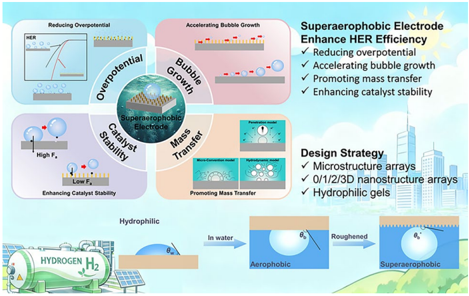
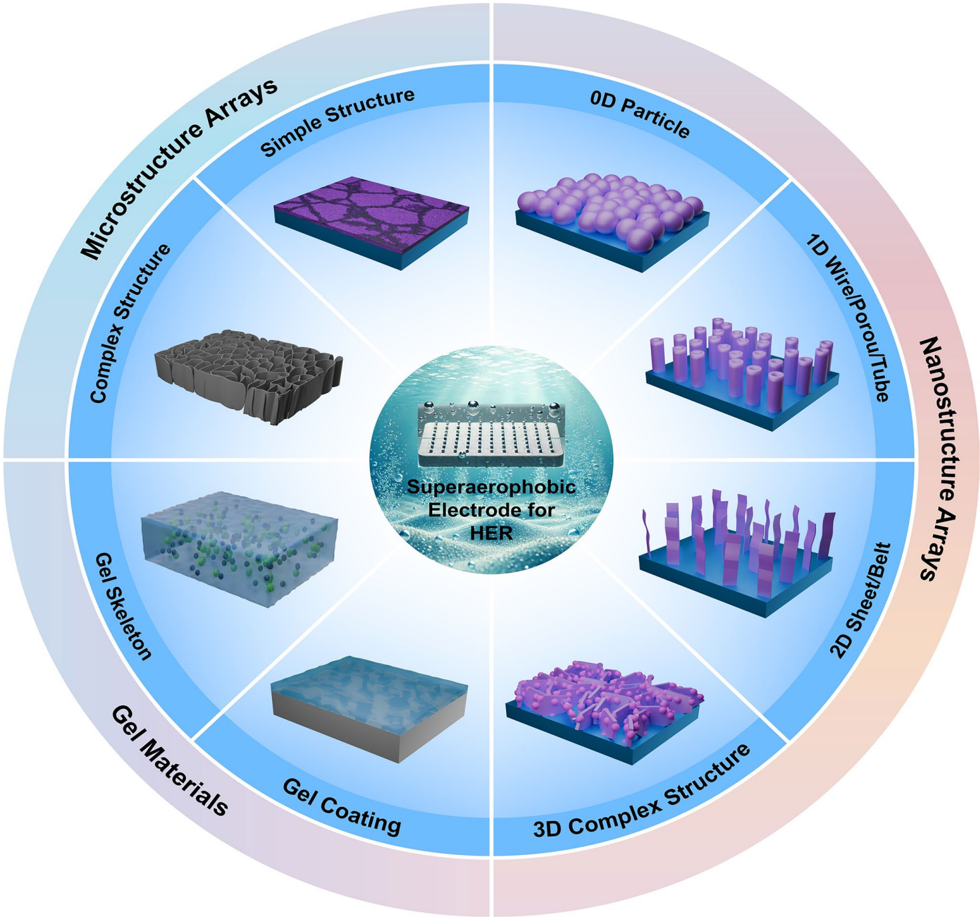
The ever-increasing consumption of fossil fuels has led to environmental crises, which accelerated the quest for sustainable hydrogen energy. Among various production routes, water electrolysis stands out as a promising approach. However, the efficiency of hydrogen evolution reaction is limited by the adhesion of gas bubbles on electrode surfaces, which blocks active sites, increases overpotential, and limits mass transfer. This review highlights the design of micro/nanostructured array electrodes to achieve underwater superaerophobicity, reducing bubble adhesion, facilitating the nucleation and rapid release of ultrasmall bubbles, thereby contributing to reduce in overpotential, faster bubble growth, enhanced mass transport, and improved catalyst stability. We summarize recent advances in fabrication strategies of such electrodes, focusing on micro/nanostructural designs, covering from 0 to 3-dimensional structures. Additionally, the role of hydrophilic gels in optimizing superaerophobicity is discussed. Finally, challenges and future directions are addressed, including bubble dynamics accurate modeling, development of high activity and stability catalysts, intelligent adaptive electrode structure and active bubble regulation, and the integration of artificial intelligence and deep learning for guided electrode design. This review aims to provide a comprehensive perspective on how superaerophobic electrode design address bottlenecks in gas-evolving electrodes, paving the way toward more efficient and economical hydrogen production.
Overview
CoChat Summary
TL;DR
This review synthesizes mechanisms and design strategies for underwater superaerophobic electrodes that manipulate H2 bubbles in the hydrogen evolution reaction (HER). It argues that micro/nanostructures and hydrophilic gels reduce bubble adhesion and coverage, lowering overpotential and improving mass transfer and catalyst stability.
Key findings
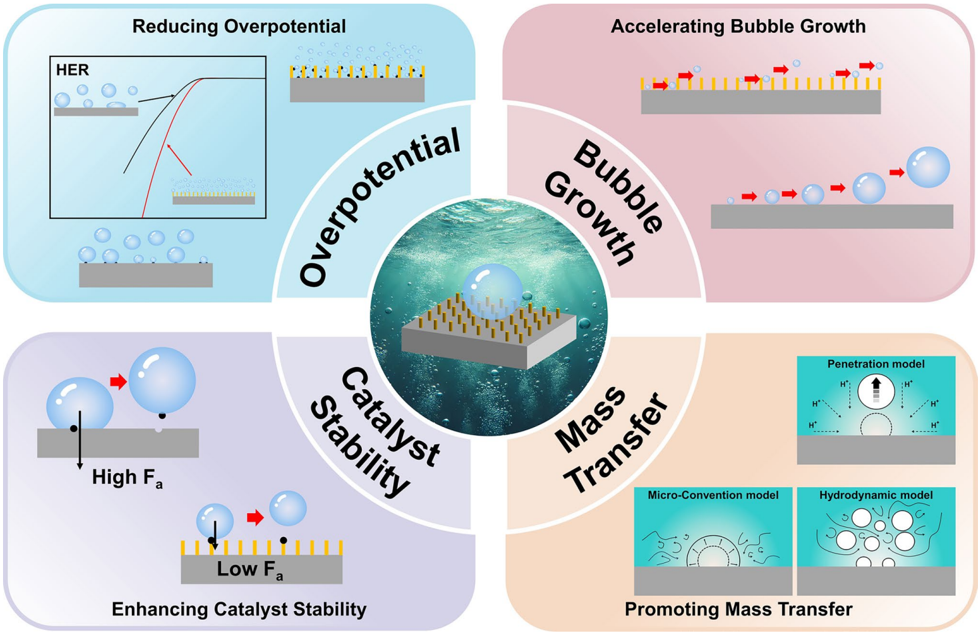
- Superaerophobic electrodes improve gas evolution by reducing overpotential, accelerating bubble growth, promoting mass transfer, and enhancing catalyst stability; the central mechanism is minimizing bubble adhesion/coverage on the electrode surface.
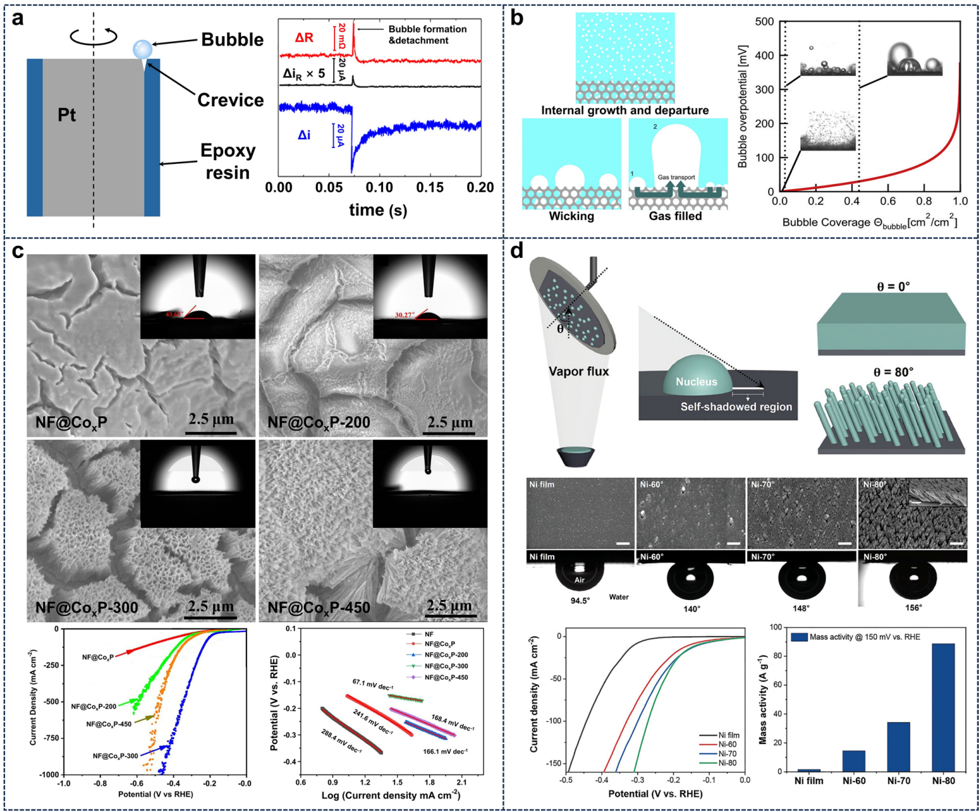
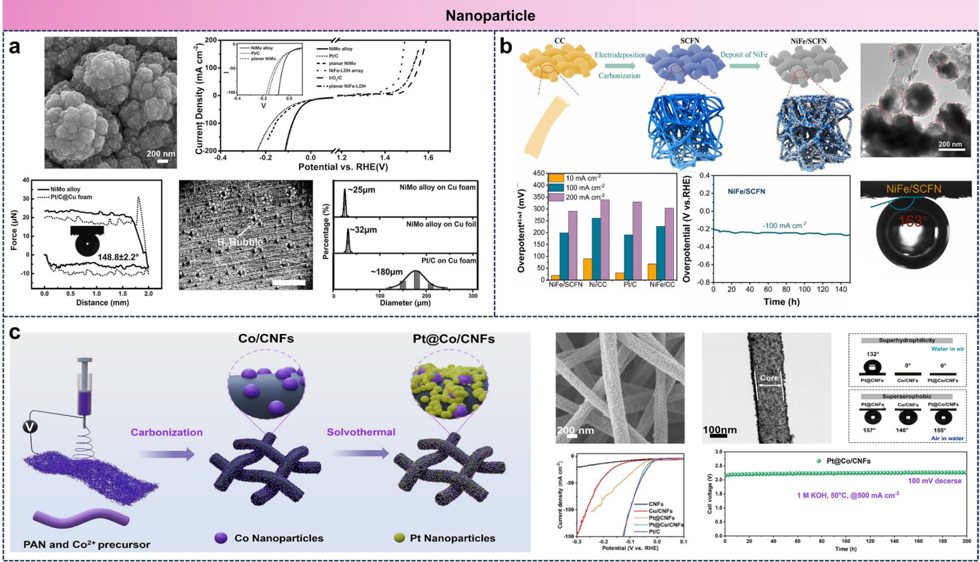
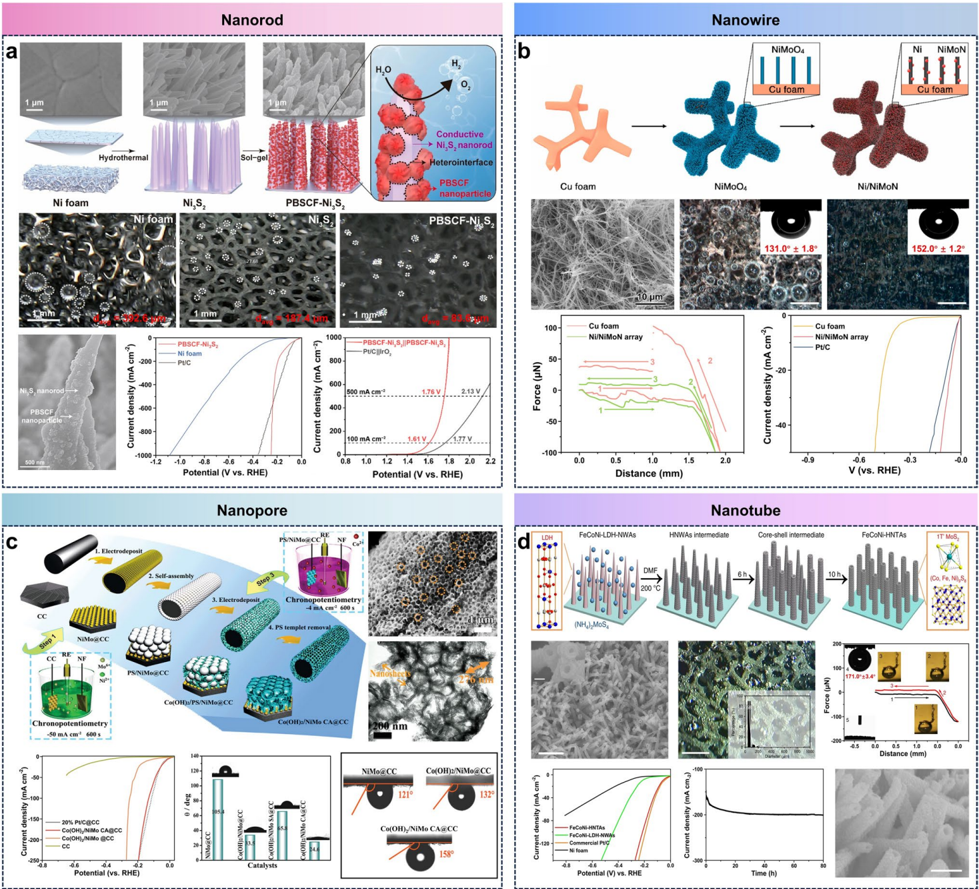
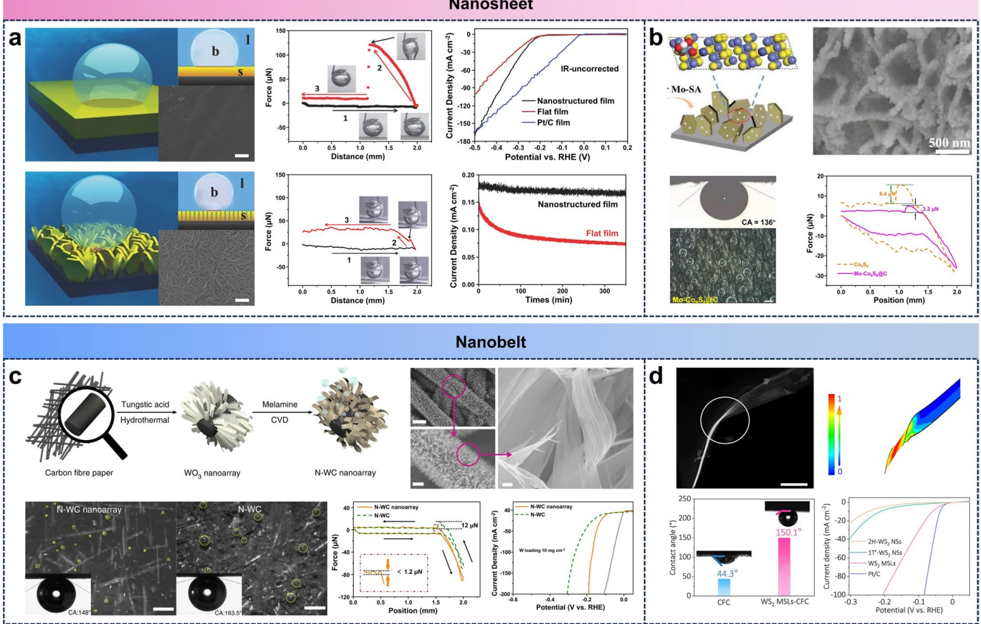
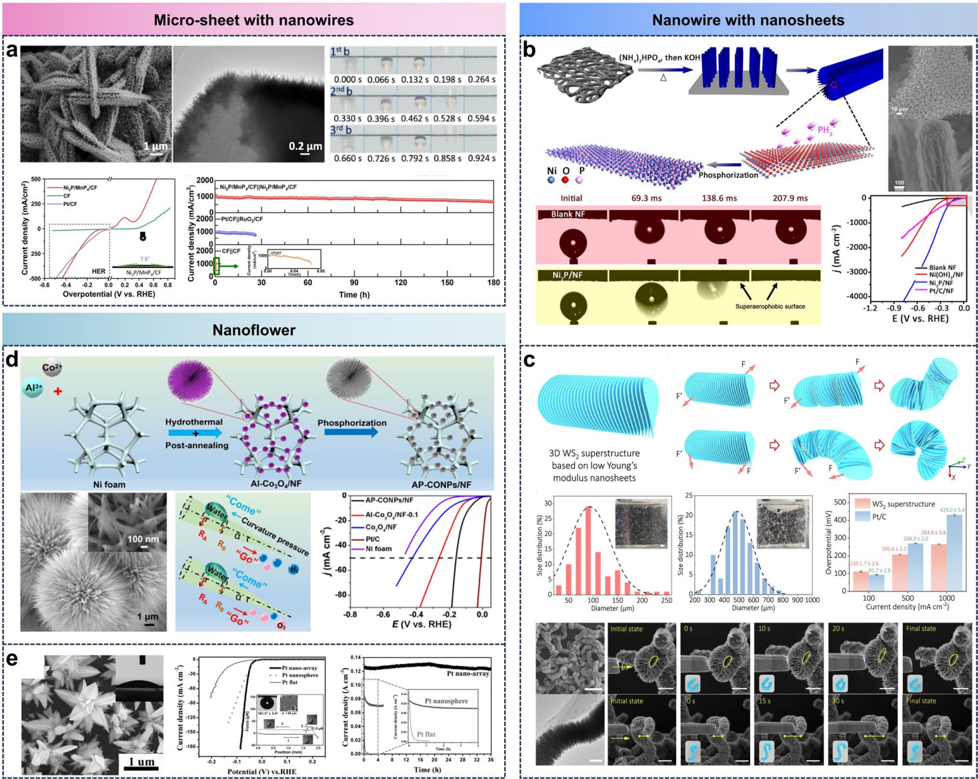
- Reported examples include NiMo nanoparticle electrodes that detach H2 bubbles at 25 μm; MoS2 nanosheets releasing most bubbles below 100 μm with adhesion of 10.8 ± 1.7 μN; Ni/NiMoN nanowire arrays with a bubble contact angle of 152.0° ± 1.2°; N-doped tungsten carbide nanobelts with a bubble contact angle of 163.5°, detached bubbles of 5.5 μm, and adhesion below 1.2 μN; and nanotube arrays with a bubble contact angle of 173.1° ± 3.4°, released bubbles below 100 μm, and no adhesion force.
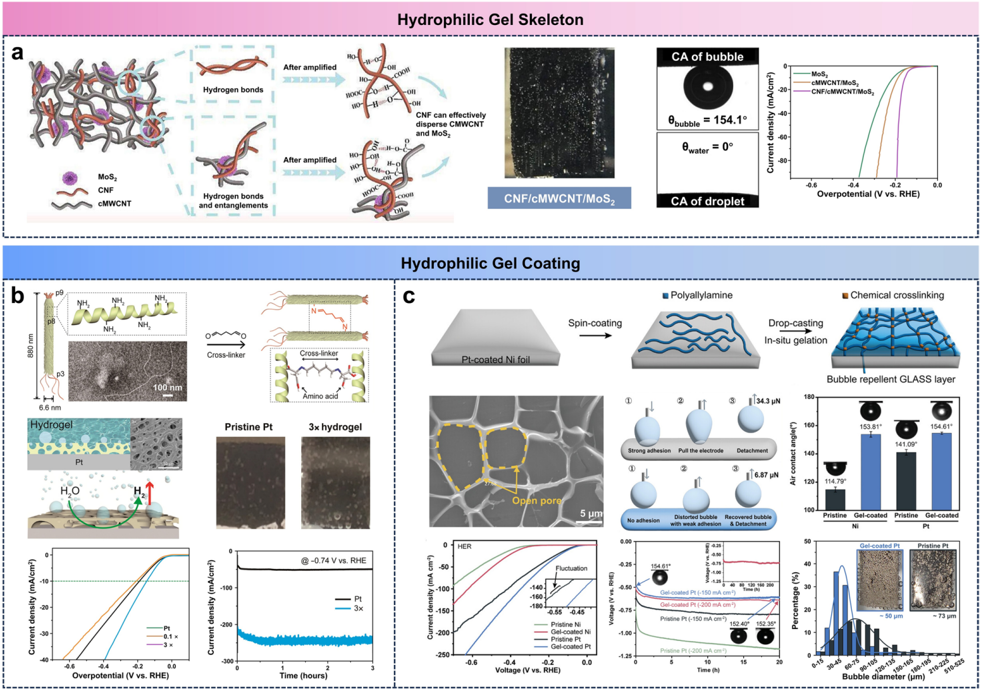
- Hydrophilic gel examples include a cellulose nanofiber/cMWCNT/MoS2 gel skeleton with a bubble contact angle of 154.1°; PAH hydrogel with bubble adhesion of 6.87 μN, contact angle of 154.61°, and detached bubble diameter of ~50 μm; and M13 bacteriophage-assembled hydrogel improving bubble detachment.
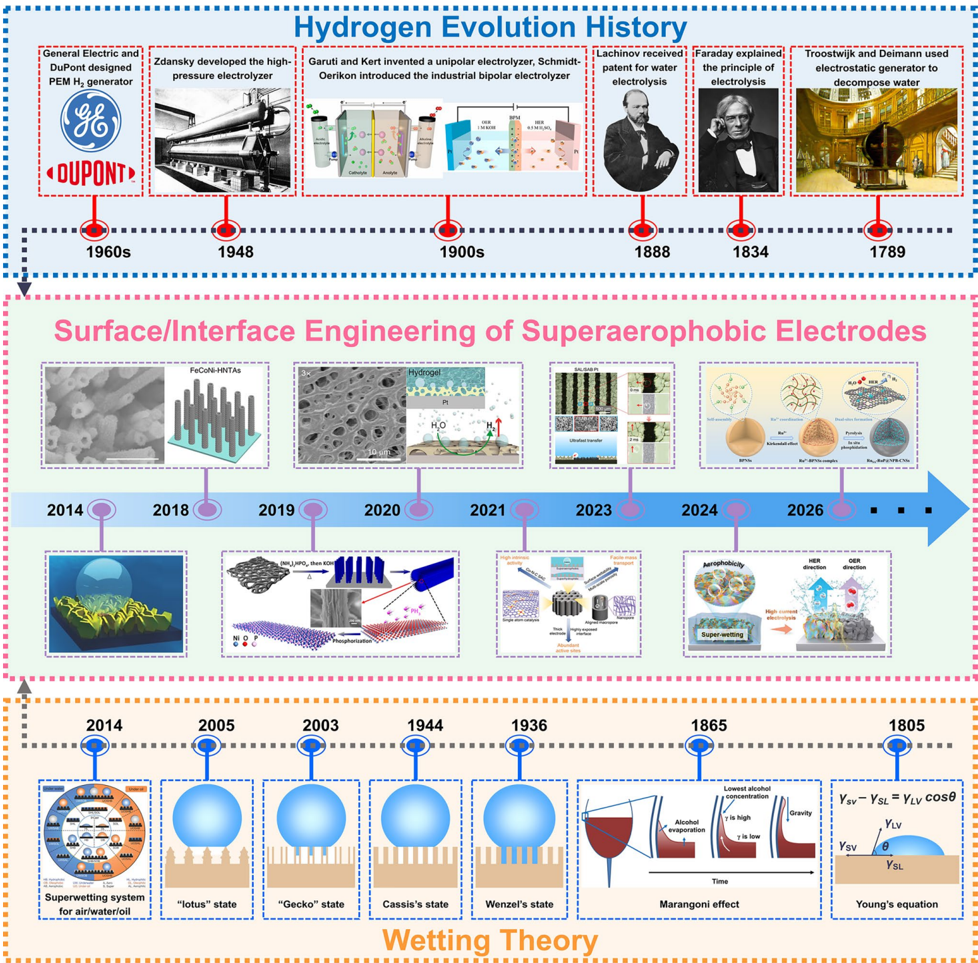
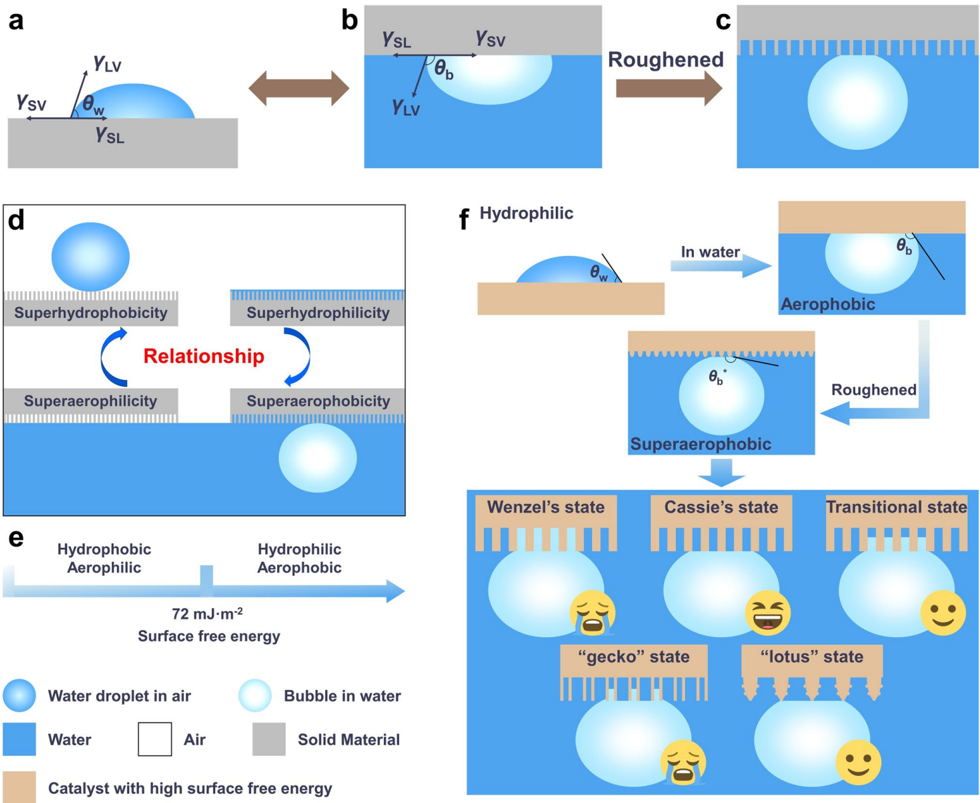
- Design principles: Cassie’s state is ideal for superaerophobic electrodes, while Wenzel’s and “gecko” states are not suitable; microstructures favor directional transport, nanostructures maximize active area and nucleation, and hydrophilic gels minimize interfacial adhesion. Hu et al. found dendrite tip diameters of 1–35 μm positively correlated with bubble adhesion and detachment radius, with minimum overpotential of 178 mV.
Methods
- This is a review article, not a primary experimental study; it synthesizes literature on HER mechanisms, bubble dynamics, interfacial wettability theory, superaerophobic electrode construction, characterization techniques, failure mechanisms, and challenges/outlook.
- Data are drawn from cited studies and Tables 1–3, which summarize catalytic performance of superaerophobic electrodes with microstructures, nanostructures, and hydrophilic gels.
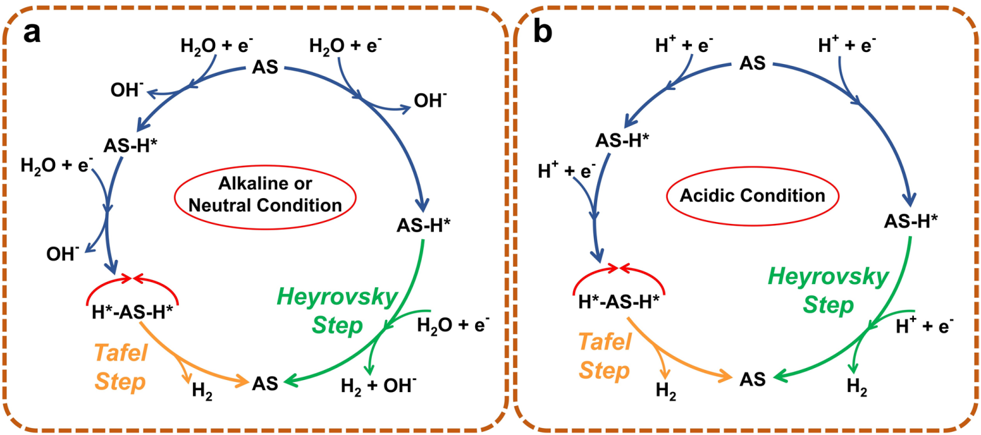
- Main analysis is thematic and mechanistic: it discusses Volmer–Heyrovsky/Tafel pathways, overpotential components, bubble growth modes, mass-transfer models, and Wenzel/Cassie-Baxter/gecko/lotus wetting states.
Limitations
- The paper states that long-term stability under actual operating conditions has not been fully addressed; failure pathways include mechanical damage from continuous bubble impact, catalyst poisoning/passivation in harsh electrolytes, and element loss/component degradation.
- The paper states remaining challenges: multiscale bubble dynamics theory and accurate modeling, new materials combining high conductivity and stability, intelligent adaptive electrode structures, active and precise bubble control, AI/deep learning-guided development, and large-scale production/industrial application; most progress remains at the laboratory stage.
- Evident from the provided text: as a review, it lacks primary experimental validation, and several equations/figures are referenced but not reproduced; some section text also appears fragmented or truncated.
Model-written summary. Check it against the paper before relying on it.
Integrity signals
Registry
Cites
Statistics
Figures
Verification
Claims the paper makes
8 Valid · 1 Not valid · 38 Not checked · 45 Own results and interpretations
The sources with a verdict support this claim; the rest weren’t checked yet, have no full text we could read, or their verdicts aren’t rated yet.
In the paper
“Furthermore, introducing aerophobic/aerophilic patterned designs [176, 177] can further modulate bubble migration trajectories.”
§ Advances in Surface/Interface Engineering of Under-Water Superaerophobic Electrodes for Hydrogen Evolution Reaction by Manipulating of Bubbles > Strategy of Preparing Superaerophobic Electrodes for HER > Nanostructure Arrays
What the sources say
- Supportedcites [176] C. Zhang, Z. Xu, N. Han, Y. Tian, T. Kallio et al., Superaerophilic/superaerophobic cooperative electrode for efficient hydrogen evolution reaction via enhanced mass transfer. Sci. Adv. 9 (3), eadd6978 (2023). 10.1126/sciadv.add6978 36652519 PMC9848275 source
The Results section (page unavailable) reports that adding superaerophilic stripes changes how H₂ bubbles move: bubbles on the electrode transfer to the stripes and are transported out of the reaction system. It also finds that stripe width affects whether and how quickly bubbles transfer, supporting the claim that the patterned design modulates bubble migration. (LLM, conf=0.91)
- Not checked — no full text of the sourcecites [177] Z. Long, Y. Zhao, C. Zhang, Y. Zhang, C. Yu et al., A multi-bioinspired dual-gradient electrode for microbubble manipulation toward controllable water splitting. Adv. Mater. 32 (17), 1908099 (2020). 10.1002/adma.201908099 32129552 source
plainstates a possible cause- Asserted: passes — The authors put it forward as true.
- Checkable: passes — It can be checked against evidence.
- Load-bearing: unclear — It is unclear whether the paper’s conclusions depend on it.
- Based: passes — The paper gives a reason why it holds.
- Supported
The cited sources support only part of this claim — read each source’s verdict below.
In the paper
“Secondly, nanostructures with high aspect ratios or weak substrate adhesion are prone to structural collapse, detachment, or morphological degradation during long-term gas evolution or under mechanical damage [175].”
§ Advances in Surface/Interface Engineering of Under-Water Superaerophobic Electrodes for Hydrogen Evolution Reaction by Manipulating of Bubbles > Strategy of Preparing Superaerophobic Electrodes for HER > Nanostructure Arrays
What the sources say
- Partly supportedcites [175] F. Wang, L. Xie, N. Sun, T. Zhi, M. Zhang et al., Deformable catalytic material derived from mechanical flexibility for hydrogen evolution reaction. Nano-Micro Lett. 16 (1), 32 (2023). 10.1007/s40820-023-01251-x PMC10673806 37999792 sourceExperimental — accuracy not yet measured
The Introduction (page unavailable) says that fluid flow and hydrogen bubbles can deform low-dimensional catalysts and that bubble forces can break rigid materials, degrading HER performance. The Bend-restoration Nanotubes section (page unavailable) also links bubble forces to poor stability. Neither passage identifies high aspect ratio or weak substrate adhesion as risk factors, or establishes substrate detachment during long-term gas evolution. (LLM, conf=0.84)
plainstates a cause- Asserted: passes — The authors put it forward as true.
- Checkable: passes — It can be checked against evidence.
- Load-bearing: passes — The paper’s conclusions depend on it.
- Based: passes — The paper gives a reason why it holds.
- Partly supported
A claim is checked only against the cited paper’s full text, never its abstract, and none is available for its sources.
In the paper
“Typically, roughening is applied to the hydrophilic/aerophobic catalyst which has a high surface free energy. By increasing the surface roughness, electrodes can effectively transition from aerophobic to superaerophobic states [53, 54].”
§ Advances in Surface/Interface Engineering of Under-Water Superaerophobic Electrodes for Hydrogen Evolution Reaction by Manipulating of Bubbles > Bubble Dynamics and Construction of Superaerophobic Electrodes > Construction of Superaerophobic Electrode
What the sources say
- Not checked — no full text of the sourcecites [53] M. Liu, S. Wang, L. Jiang, Nature-inspired superwettability systems. Nat. Rev. Mater. 2 (7), 17036 (2017). 10.1038/natrevmats.2017.36 source
- Not checked — no full text of the sourcecites [54] W. Xu, Z. Lu, X. Sun, L. Jiang, X. Duan, Superwetting electrodes for gas-involving electrocatalysis. Acc. Chem. Res. 51 (7), 1590–1598 (2018). 10.1021/acs.accounts.8b00070 29883085 source
plainstates a cause- Asserted: passes — The authors put it forward as true.
- Checkable: passes — It can be checked against evidence.
- Load-bearing: passes — The paper’s conclusions depend on it.
- Based: passes — The paper gives a reason why it holds.
A conclusion the paper draws from its own results — it cites no other source for it, so there is none to check. The quote shows it is in the paper.
In the paper
“This finding reinforces the advantages of micro/nanostructured electrodes for GERs.”
§ Advances in Surface/Interface Engineering of Under-Water Superaerophobic Electrodes for Hydrogen Evolution Reaction by Manipulating of Bubbles > Effect of Superaerophobic Electrodes on GER Efficiency > Accelerating Bubble Growth
plainstates an association- Asserted: passes — The authors put it forward as true.
- Checkable: passes — It can be checked against evidence.
- Load-bearing: passes — The paper’s conclusions depend on it.
- Based: passes — The paper gives a reason why it holds.
A conclusion the paper draws from its own results — it cites no other source for it, so there is none to check. The quote shows it is in the paper.
In the paper
“In this regard, superaerophobic electrodes with micro/nanostructures can effectively promote mass transfer.”
§ Advances in Surface/Interface Engineering of Under-Water Superaerophobic Electrodes for Hydrogen Evolution Reaction by Manipulating of Bubbles > Effect of Superaerophobic Electrodes on GER Efficiency > Promoting Mass Transfer
plainstates a cause- Asserted: passes — The authors put it forward as true.
- Checkable: passes — It can be checked against evidence.
- Load-bearing: passes — The paper’s conclusions depend on it.
- Based: passes — The paper gives a reason why it holds.
29 more claims
Create a free account to see all 92 claims and to verify the 3 references still open.
- It may state two separate claims as one. 56
- The quote only partly states this claim. 2
- Probably not a substantial claim. 5
Self-check
Percentages, sums and reported differences re-computed from the paper’s own numbers.
Each contradiction between two passages listed here was confirmed by an independent check.
Rated minor: it would not touch a result — a value no result rests on, a p-value that stays on the same side of the significance level, or a conflict that is clerical, resolved elsewhere in the paper, or outside its own findings.
In the paper
§ Advances in Surface/Interface Engineering of Under-Water Superaerophobic Electrodes for Hydrogen Evolution Reaction by Manipulating of Bubbles > Strategy of Preparing Superaerophobic Electrodes for HER > Microstructure Arrays
“electrochemically deposited Ni2P and Cu2P on Ni foam”
§ Advances in Surface/Interface Engineering of Under-Water Superaerophobic Electrodes for Hydrogen Evolution Reaction by Manipulating of Bubbles > Strategy of Preparing Superaerophobic Electrodes for HER > Microstructure Arrays
“micro-sphere graphene-CNTs–Ni2P–CuP2 catalyst on Ni foam”
Rated minor: it would not touch a result — a value no result rests on, a p-value that stays on the same side of the significance level, or a conflict that is clerical, resolved elsewhere in the paper, or outside its own findings.
In the paper
§ Advances in Surface/Interface Engineering of Under-Water Superaerophobic Electrodes for Hydrogen Evolution Reaction by Manipulating of Bubbles > Strategy of Preparing Superaerophobic Electrodes for HER > Nanostructure Arrays
“0D PrBa0.5Sr0.5Co1.5Fe0.5O5+δ (PBSCP) nanoparticles onto 1D Ni3S2 nanorods”
§ Advances in Surface/Interface Engineering of Under-Water Superaerophobic Electrodes for Hydrogen Evolution Reaction by Manipulating of Bubbles > Strategy of Preparing Superaerophobic Electrodes for HER > Nanostructure Arrays
“the PBSCF/Ni3S2 heterointerface”
Rated minor: it would not touch a result — a value no result rests on, a p-value that stays on the same side of the significance level, or a conflict that is clerical, resolved elsewhere in the paper, or outside its own findings.
In the paper
§ Advances in Surface/Interface Engineering of Under-Water Superaerophobic Electrodes for Hydrogen Evolution Reaction by Manipulating of Bubbles > Strategy of Preparing Superaerophobic Electrodes for HER > Microstructure Arrays
“significantly reduces the size of the generated bubbles (decrease from 65 to 125 μm)”
§ Advances in Surface/Interface Engineering of Under-Water Superaerophobic Electrodes for Hydrogen Evolution Reaction by Manipulating of Bubbles > Strategy of Preparing Superaerophobic Electrodes for HER > Microstructure Arrays
“decrease from 65 to 125 μm”
Citations
Cites
Wettability of porous surfaces
Cassie, A. B. D., & Baxter, S. (1944) · Transactions of the Faraday Society · doi:10.1039/tf9444000546 · Cited by 13,807 · cited 2×
“Subsequent theoretical advances including Wenzel’s roughness theory in 1936 [15], Cassie and Baxter’s 1944 composite wetting model provided a framework for understanding liquid behavior on rough and porous surfaces [16].”
RESISTANCE OF SOLID SURFACES TO WETTING BY WATER
Wenzel, R. N. (1936) · Industrial & Engineering Chemistry · doi:10.1021/ie50320a024 · Cited by 13,316 · cited 2×
“Subsequent theoretical advances including Wenzel’s roughness theory in 1936 [15], Cassie and Baxter’s 1944 composite wetting model provided a framework for understanding liquid behavior on rough and porous surfaces [16].”
Earth-abundant catalysts for electrochemical and photoelectrochemical water splitting
Roger, I., Shipman, M. A., & Symes, M. D. (2017) · Nature Reviews Chemistry · doi:10.1038/s41570-016-0003 · Cited by 3,503
Bioinspired Surfaces with Special Wettability
Sun, T., Feng, L., Gao, X., & Jiang, L. (2005) · Accounts of Chemical Research · doi:10.1021/ar040224c · Cited by 2,044
Nature-inspired superwettability systems
Liu, M., Wang, S., & Jiang, L. (2017) · Nature Reviews Materials · doi:10.1038/natrevmats.2017.36 · Cited by 1,726
Bioinspired Surfaces with Superwettability: New Insight on Theory, Design, and Applications
Wang, S., Liu, K., Yao, X., & Jiang, L. (2015) · Chemical Reviews · doi:10.1021/cr400083y · Cited by 1,646 · cited 1×
“The intermolecular forces between the solid, liquid, and gas phases will determine the final behavior of the water droplet, which is specifically expressed as the contact angle (CA) [50].”
High-Performance Electrocatalysis Using Metallic Cobalt Pyrite (CoS2) Micro- and Nanostructures
Faber, M. S., Dziedzic, R., Lukowski, M. A., Kaiser, N. S., Ding, Q., & Jin, S. (2014) · Journal of the American Chemical Society · doi:10.1021/ja504099w · Cited by 1,372 · cited 1×
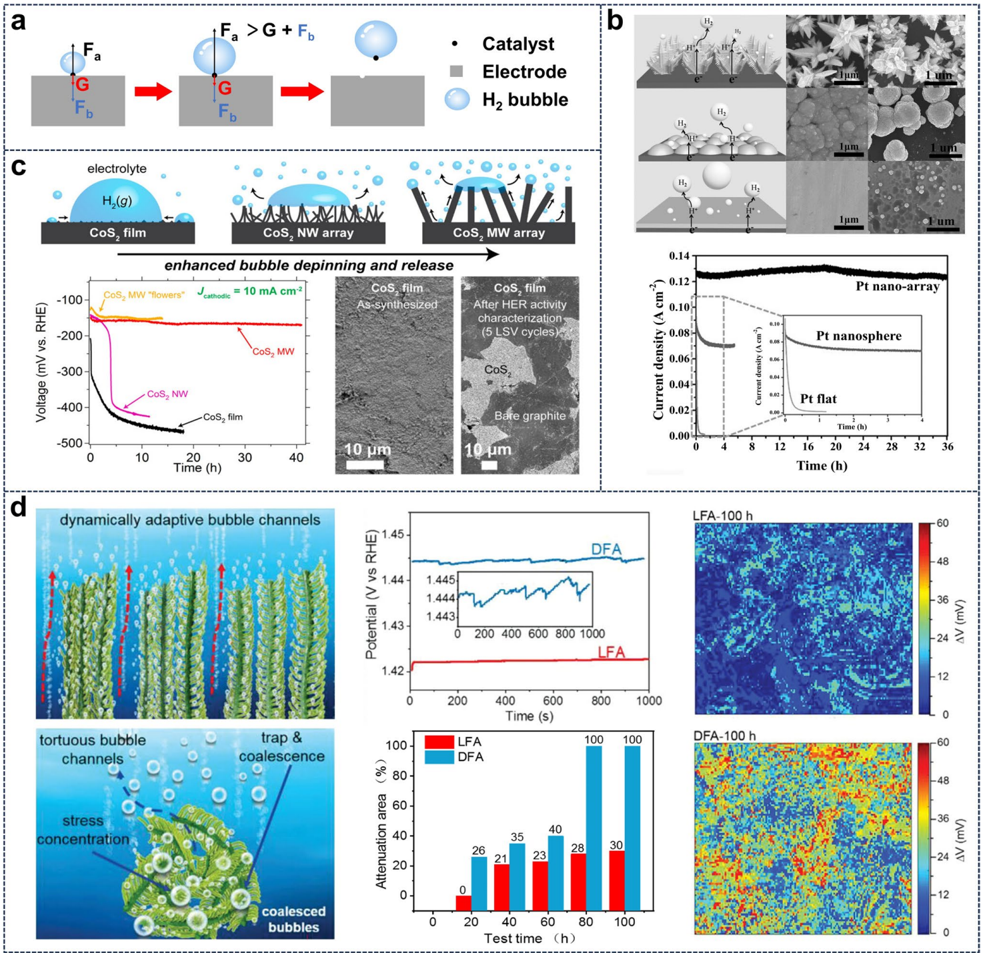
“Faber et al. [47] prepared CoS 2 films, nanowire arrays, and microwire arrays with progressively increasing aerophobicity and tested their stability.”
Bioinspired Interfaces with Superwettability: From Materials to Chemistry
Su, B., Tian, Y., & Jiang, L. (2016) · Journal of the American Chemical Society · doi:10.1021/jacs.5b12728 · Cited by 1,159
Lu, Z., Zhu, W., Yu, X., Zhang, H., Li, Y., Sun, X., Wang, X., Wang, H., Wang, J., Luo, J., et al. (2014) · Advanced Materials · doi:10.1002/adma.201304759 · Cited by 1,025 · cited 1×
“As the first team to construct superaerophobic structures for GER, Lu from Jiang’s team [120] prepare nanosheet-structured MoS 2 on the surface of Ti foil by hydrothermal method (Fig.”
Definition of Superhydrophobic States
Wang, S., & Jiang, L. (2007) · Advanced Materials · doi:10.1002/adma.200700934 · Cited by 969 · cited 1×
“Jiang’s team has summarized five typical wetting states: Wenzel’s state, Cassis’s state, transitional state, “Gecko” state, and “lotus” state [55–57].”
Influence of Bubbles on the Energy Conversion Efficiency of Electrochemical Reactors
Angulo, A., van der Linde, P., Gardeniers, H., Modestino, M., & Fernández Rivas, D. (2020) · Joule · doi:10.1016/j.joule.2020.01.005 · Cited by 958
Recent Advances in Design of Electrocatalysts for High‐Current‐Density Water Splitting
Luo, Y., Zhang, Z., Chhowalla, M., & Liu, B. (2022) · Advanced Materials · doi:10.1002/adma.202108133 · Cited by 854 · cited 1×
“Then the Heyrovsky step or the Tafel step occurs according to the coverage of AS-H * to produce H 2 [23].”
Han, N., Yang, K. R., Lu, Z., Li, Y., Xu, W., Gao, T., Cai, Z., Zhang, Y., Batista, V. S., Liu, W., et al. (2018) · Nature Communications · doi:10.1038/s41467-018-03429-z · Cited by 766
Self-citationHydrogen Evolution and Oxidation: Mechanistic Studies and Material Advances
Tian, X., Zhao, P., & Sheng, W. (2019) · Advanced Materials · doi:10.1002/adma.201808066 · Cited by 751
Superhydrophobic Aligned Polystyrene Nanotube Films with High Adhesive Force
Jin, M., Feng, X., Feng, L., Sun, T., Zhai, J., Li, T., & Jiang, L. (2005) · Advanced Materials · doi:10.1002/adma.200401726 · Cited by 719
Superwetting Electrodes for Gas-Involving Electrocatalysis
Xu, W., Lu, Z., Sun, X., Jiang, L., & Duan, X. (2018) · Accounts of Chemical Research · doi:10.1021/acs.accounts.8b00070 · Cited by 638 · cited 1×
“By increasing the surface roughness, electrodes can effectively transition from aerophobic to superaerophobic states [53, 54].”
Self-citationLi, H., Chen, S., Zhang, Y., Zhang, Q., Jia, X., Zhang, Q., Gu, L., Sun, X., Song, L., & Wang, X. (2018) · Nature Communications · doi:10.1038/s41467-018-04888-0 · Cited by 613 · cited 2×
“7d. Li and the co-workers [117] designed a hybrid nanotube array catalyst formed by Kirkendall cavitation of ternary Fe, Co, and Ni-based layered double hydroxide nanowire arrays, as shown in Fig.”
Yu, X., Yu, Z.-Y., Zhang, X.-L., Zheng, Y.-R., Duan, Y., Gao, Q., Wu, R., Sun, B., Gao, M.-R., Wang, G., et al. (2019) · Journal of the American Chemical Society · doi:10.1021/jacs.9b02527 · Cited by 568 · cited 1×
“Yu et al. [166] designed a nanowire structure composed of nanosheets as shown in Fig.”
Self-citationLi, Y., Zhang, H., Jiang, M., Zhang, Q., He, P., & Sun, X. (2017) · Advanced Functional Materials · doi:10.1002/adfm.201702513 · Cited by 556
Interfacial Material System Exhibiting Superwettability
Tian, Y., Su, B., & Jiang, L. (2014) · Advanced Materials · doi:10.1002/adma.201400883 · Cited by 519
Li, Y., Zhang, H., Xu, T., Lu, Z., Wu, X., Wan, P., Sun, X., & Jiang, L. (2015) · Advanced Functional Materials · doi:10.1002/adfm.201404250 · Cited by 515
Gas Bubbles in Electrochemical Gas Evolution Reactions
Zhao, X., Ren, H., & Luo, L. (2019) · Langmuir · doi:10.1021/acs.langmuir.9b00119 · Cited by 457 · cited 2×
“9 [27, 31]: where a and b are the Tafel slopes, respectively. a is related to the intrinsic catalytic activity of the electrode material, while b reflects the sensitivity of the overpotential to changes in current density. i is the applied macroscopic current, and A eff is effective active area.”
10,000-h-stable intermittent alkaline seawater electrolysis
Sha, Q., Wang, S., Yan, L., Feng, Y., Zhang, Z., Li, S., Guo, X., Li, T., Li, H., Zhuang, Z., et al. (2025) · Nature · doi:10.1038/s41586-025-08610-1 · Cited by 452
Shan, X., Liu, J., Mu, H., Xiao, Y., Mei, B., Liu, W., Lin, G., Jiang, Z., Wen, L., & Jiang, L. (2020) · Angewandte Chemie International Edition · doi:10.1002/anie.201911617 · Cited by 437
Bubble growth and departure modes on wettable/non-wettable porous foams in alkaline water splitting
Iwata, R., Zhang, L., Wilke, K. L., Gong, S., He, M., Gallant, B. M., & Wang, E. N. (2021) · Joule · doi:10.1016/j.joule.2021.02.015 · Cited by 408
Li, Y., Zhang, H., Jiang, M., Kuang, Y., Sun, X., & Duan, X. (2016) · Nano Research · doi:10.1007/s12274-016-1112-z · Cited by 376
Membrane electrolysis—History, current status and perspective
Paidar, M., Fateev, V., & Bouzek, K. (2016) · Electrochimica Acta · doi:10.1016/j.electacta.2016.05.209 · Cited by 357
Riyajuddin, S., Azmi, K., Pahuja, M., Kumar, S., Maruyama, T., Bera, C., & Ghosh, K. (2021) · ACS Nano · doi:10.1021/acsnano.1c00647 · Cited by 353 · cited 1×
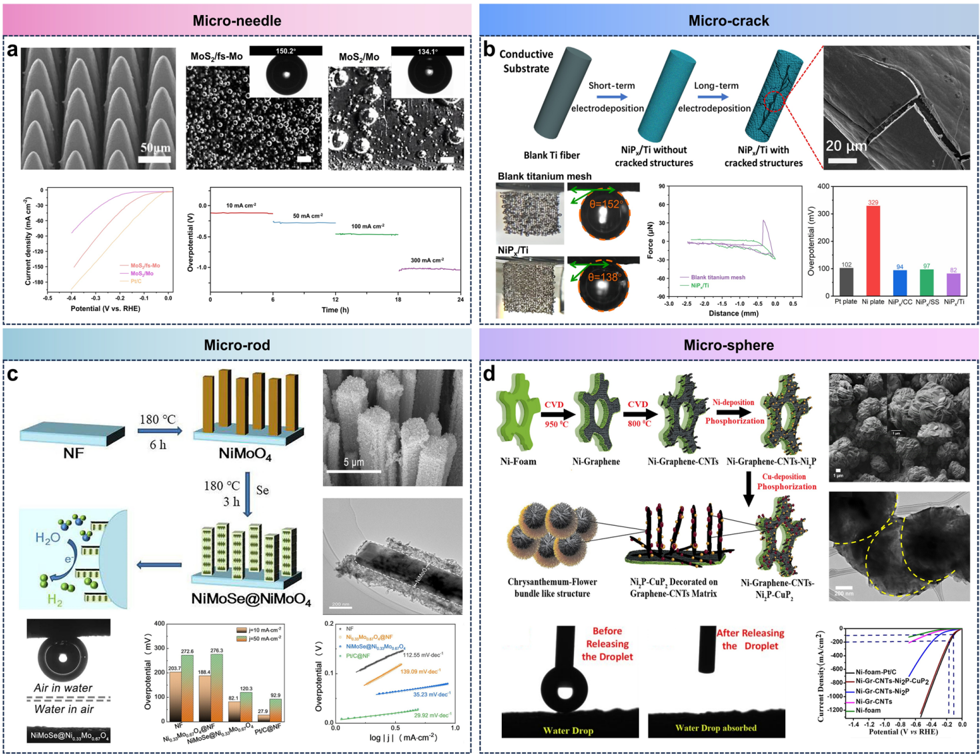
“Riyajuddin from Ghosh’s team [72] electrochemically deposited Ni 2 P and Cu 2 P on Ni foam with graphene and carbon nanotubes (CNTs) deposited by chemical vapor phase (CVD).”
Solutal Marangoni effect determines bubble dynamics during electrocatalytic hydrogen evolution
Park, S., Liu, L., Demirkır, Ç., van der Heijden, O., Lohse, D., Krug, D., & Koper, M. T. M. (2023) · Nature Chemistry · doi:10.1038/s41557-023-01294-y · Cited by 313
Rational Design of Transition Metal Phosphide‐Based Electrocatalysts for Hydrogen Evolution
Liu, D., Xu, G., Yang, H., Wang, H., & Xia, B. Y. (2023) · Advanced Functional Materials · doi:10.1002/adfm.202208358 · Cited by 302 · cited 1×
“4) [24, 25]: The schematic is shown in Fig.”
Gas Evolution in Water Electrolysis
Kempler, P. A., Coridan, R. H., & Luo, L. (2024) · Chemical Reviews · doi:10.1021/acs.chemrev.4c00211 · Cited by 289 · cited 1×
“Advanced meth-ods such as surface plasmon resonance microscopy (SPR) [62–64], and total internal reflection imaging enable high-resolution detection of the early stages of interfacial bubble formation.”
Bubble Engineering on Micro-/Nanostructured Electrodes for Water Splitting
Li, M., Xie, P., Yu, L., Luo, L., & Sun, X. (2023) · ACS Nano · doi:10.1021/acsnano.3c08831 · Cited by 286 · cited 1×
“In addition, by improving the interaction between bubbles and the electrode surface, superaerophobic electrodes achieve more efficient (2) gas generation and release, while also mitigating the adverse effects of bubbles or byproducts, thus enhancing catalyst stability [28], as we outline in Fig.”
Synthesis and application of transition metal phosphides as electrocatalyst for water splitting
Su, J., Zhou, J., Wang, L., Liu, C., & Chen, Y. (2017) · Science Bulletin · doi:10.1016/j.scib.2016.12.011 · Cited by 278
Liang, J., Cai, Z., Li, Z., Yao, Y., Luo, Y., Sun, S., Zheng, D., Liu, Q., Sun, X., & Tang, B. (2024) · Nature Communications · doi:10.1038/s41467-024-47121-x · Cited by 276
Kou, T., Wang, S., Shi, R., Zhang, T., Chiovoloni, S., Lu, J. Q., Chen, W., Worsley, M. A., Wood, B. C., Baker, S. E., et al. (2020) · Advanced Energy Materials · doi:10.1002/aenm.202002955 · Cited by 257
A comprehensive review of alkaline water electrolysis mathematical modeling
Hu, S., Guo, B., Ding, S., Yang, F., Dang, J., Liu, B., Gu, J., Ma, J., & Ouyang, M. (2022) · Applied Energy · doi:10.1016/j.apenergy.2022.120099 · Cited by 253
Zhang, Q., Li, P., Zhou, D., Chang, Z., Kuang, Y., & Sun, X. (2017) · Small · doi:10.1002/smll.201701648 · Cited by 245
WS2 moiré superlattices derived from mechanical flexibility for hydrogen evolution reaction
Xie, L., Wang, L., Zhao, W., Liu, S., Huang, W., & Zhao, Q. (2021) · Nature Communications · doi:10.1038/s41467-021-25381-1 · Cited by 240 · cited 1×
“Xie et al. [162] synthesized WS 2 nanosheets by hydrothermal method (Fig.”
Seawater electrocatalysis: activity and selectivity
Khatun, S., Hirani, H., & Roy, P. (2021) · Journal of Materials Chemistry A · doi:10.1039/d0ta08709b · Cited by 236 · cited 1×
“Hydrogen (H 2 ) has become an ideal energy carrier due to its small molecular weight, high energy density (142 MJ kg −1 for higher heating value [1], and ~ 120 MJ kg −1 for lower heating value [2]) and environmentally friendly products (only water) [3].”
Wang, L., Duan, X., Liu, X., Gu, J., Si, R., Qiu, Y., Qiu, Y., Shi, D., Chen, F., Sun, X., et al. (2020) · Advanced Energy Materials · doi:10.1002/aenm.201903137 · Cited by 236
Self-citationZhang, C., Xu, Z., Han, N., Tian, Y., Kallio, T., Yu, C., & Jiang, L. (2023) · Science Advances · doi:10.1126/sciadv.add6978 · Cited by 230 · cited 1×
“Furthermore, introducing aerophobic/aerophilic patterned designs [176, 177] can further modulate bubble migration trajectories.”
Shi, Y., Xu, Y., Zhuo, S., Zhang, J., & Zhang, B. (2015) · ACS Applied Materials & Interfaces · doi:10.1021/am5069547 · Cited by 226
Shang, L., Zhao, Y., Kong, X.-Y., Shi, R., Waterhouse, G. I. N., Wen, L., & Zhang, T. (2020) · Nano Energy · doi:10.1016/j.nanoen.2020.105375 · Cited by 224
Superwettability of Gas Bubbles and Its Application: From Bioinspiration to Advanced Materials
Yu, C., Zhang, P., Wang, J., & Jiang, L. (2017) · Advanced Materials · doi:10.1002/adma.201703053 · Cited by 210
de Levie, R. (1999) · Journal of Electroanalytical Chemistry · doi:10.1016/s0022-0728(99)00365-4 · Cited by 206
Growth kinetics of bubbles electrogenerated at microelectrodes
Brandon, N. P., & Kelsall, G. H. (1985) · Journal of Applied Electrochemistry · doi:10.1007/bf01059288 · Cited by 204
VI. Experimental researches in electricity.-Seventh Series
Faraday, M. (1834) · Philosophical Transactions of the Royal Society of London · doi:10.1098/rstl.1834.0008 · Cited by 190
Li, J., Li, Y., Wang, J., Zhang, C., Ma, H., Zhu, C., Fan, D., Guo, Z., Xu, M., Wang, Y., et al. (2022) · Advanced Functional Materials · doi:10.1002/adfm.202109439 · Cited by 173
Self-citationZhang, Q., Xiao, W., Guo, W. H., Yang, Y. X., Lei, J. L., Luo, H. Q., & Li, N. B. (2021) · Advanced Functional Materials · doi:10.1002/adfm.202102117 · Cited by 162 · cited 3×
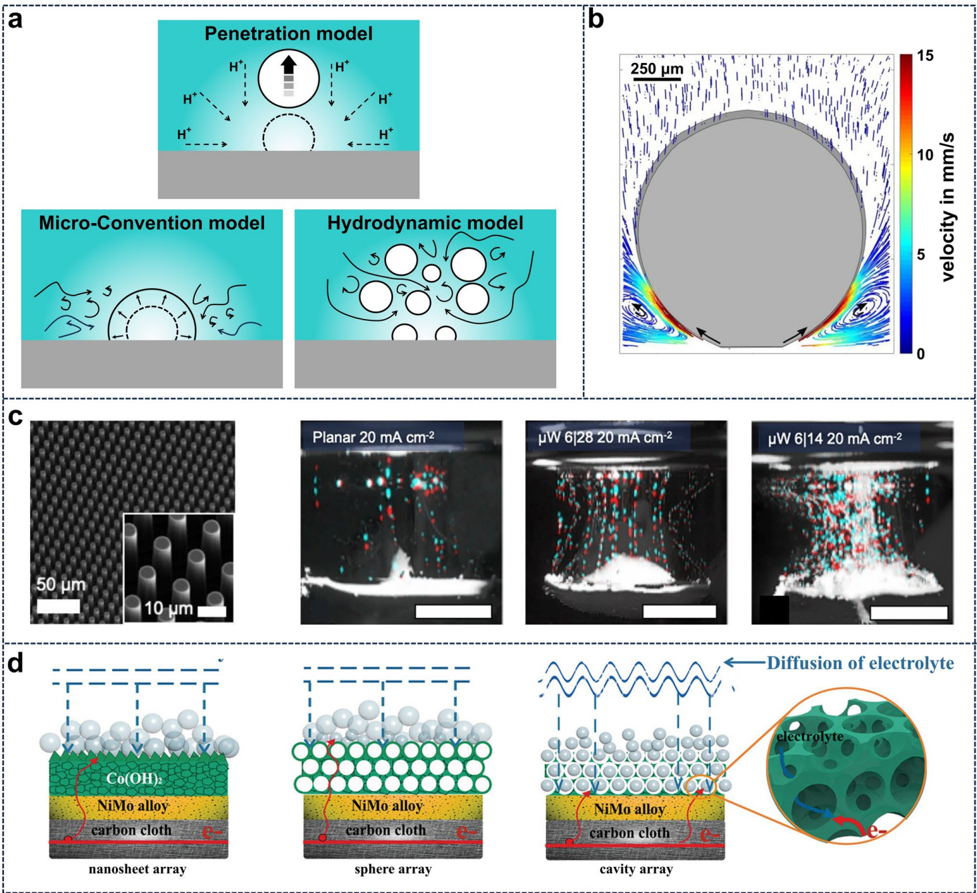
“Zhang et al. [45] proposed a strategy to prepare Co(OH) 2 cavity arrays-encapsulated NiMo alloy on carbon cloth (Fig.”
InfluentialUnlocking Efficiency: Minimizing Energy Loss in Electrocatalysts for Water Splitting
Li, W., Liu, Y., Azam, A., Liu, Y., Yang, J., Wang, D., Sorrell, C. C., Zhao, C., & Li, S. (2024) · Advanced Materials · doi:10.1002/adma.202404658 · Cited by 162
High-Performance Water Electrolysis System with Double Nanostructured Superaerophobic Electrodes
Xu, W., Lu, Z., Wan, P., Kuang, Y., & Sun, X. (2016) · Small · doi:10.1002/smll.201600189 · Cited by 156 · cited 1×
“For instance, Xu et al. [83] constructed a NiMo alloy superaerophobic electrode with a nanoparticle structure on the cathode surface for hydrogen evolution under alkaline conditions (Fig.”
Self-citationLong, Z., Zhao, Y., Zhang, C., Zhang, Y., Yu, C., Wu, Y., Ma, J., Cao, M., & Jiang, L. (2020) · Advanced Materials · doi:10.1002/adma.201908099 · Cited by 154 · cited 1×
“Furthermore, introducing aerophobic/aerophilic patterned designs [176, 177] can further modulate bubble migration trajectories.”
Liu, R., Gong, Z., Liu, J., Dong, J., Liao, J., Liu, H., Huang, H., Liu, J., Yan, M., Huang, K., et al. (2021) · Advanced Materials · doi:10.1002/adma.202103533 · Cited by 152
Fluctuations of concentration overpotential generated at gas-evolving electrodes
Gabrielli, C., Huet, F., & Nogueira, R. P. (2005) · Electrochimica Acta · doi:10.1016/j.electacta.2005.01.019 · Cited by 151
Marangoni convection at electrogenerated hydrogen bubbles
Yang, X., Baczyzmalski, D., Cierpka, C., Mutschke, G., & Eckert, K. (2018) · Physical Chemistry Chemical Physics · doi:10.1039/c8cp01050a · Cited by 151 · cited 1×
“Eckert et al. [42] used time-resolved particle tracking velocimetry to provide a new perspective for understanding local mass transfer near bubbles (Fig.”
Bae, M., Kang, Y., Lee, D. W., Jeon, D., & Ryu, J. (2022) · Advanced Energy Materials · doi:10.1002/aenm.202201452 · Cited by 146
Wang, B., Jiao, S., Wang, Z., Lu, M., Chen, D., Kang, Y., Pang, G., & Feng, S. (2020) · Journal of Materials Chemistry A · doi:10.1039/d0ta01966f · Cited by 142
Superaerophobic hydrogels for enhanced electrochemical and photoelectrochemical hydrogen production
Jeon, D., Park, J., Shin, C., Kim, H., Jang, J.-W., Lee, D. W., & Ryu, J. (2020) · Science Advances · doi:10.1126/sciadv.aaz3944 · Cited by 141
Jeong, S., Kim, U., Lee, S.-J., Zhang, Y., Son, E., Choi, K. J., Han, Y., Baik, J. M., & Park, H. (2024) · ACS Nano · doi:10.1021/acsnano.3c12533 · Cited by 141
Zhang, S., Wang, W., Hu, F., Mi, Y., Wang, S., Liu, Y., Ai, X., Fang, J., Li, H., & Zhai, T. (2020) · Nano-Micro Letters · doi:10.1007/s40820-020-00476-4 · Cited by 133
Hao, J., Yang, W., Huang, Z., & Zhang, C. (2016) · Advanced Materials Interfaces · doi:10.1002/admi.201600236 · Cited by 131
Potential drops due to an attached bubble on a gas-evolving electrode
Gabrielli, C., Huet, F., Keddam, M., Macias, A., & Sahar, A. (1989) · Journal of Applied Electrochemistry · doi:10.1007/bf01320636 · Cited by 131
Wang, B., Lu, M., Chen, D., Zhang, Q., Wang, W., Kang, Y., Fang, Z., Pang, G., & Feng, S. (2021) · Journal of Materials Chemistry A · doi:10.1039/d1ta01292d · Cited by 124
Wang, J., Liang, C., Ma, X., Liu, P., Pan, W., Zhu, H., Guo, Z., Sui, Y., Liu, H., Liu, L., et al. (2024) · Advanced Materials · doi:10.1002/adma.202307925 · Cited by 124 · cited 1×
“Wang et al. [48] prepared lamellar fern-like alloy aerogel (LFA) and disordered fern-like aerogels (DFA) electrode and found that the DFA electrode was extremely unstable at the initial potential of the stability test.”
Self-citationGuo, M., Qayum, A., Dong, S., Jiao, X., Chen, D., & Wang, T. (2020) · Journal of Materials Chemistry A · doi:10.1039/d0ta02337j · Cited by 119
Nanocone‐Modified Surface Facilitates Gas Bubble Detachment for High‐Rate Alkaline Water Splitting
Ren, Q., Feng, L., Ye, C., Xue, X., Lin, D., Eisenberg, S., Kou, T., Duoss, E. B., Zhu, C., & Li, Y. (2023) · Advanced Energy Materials · doi:10.1002/aenm.202302073 · Cited by 119
Kong, A., Mao, P., Gu, H., Zhao, S., Lv, Y., Liu, M., Sun, Y., Dai, S., Fu, Y., Zhang, J., et al. (2021) · Chemical Engineering Journal · doi:10.1016/j.cej.2021.131234 · Cited by 119
Stofftransport bei der Elektrolyse mit Gasrührung
Adam, E., Venczel, J., & Schalch, E. (1971) · Chemie Ingenieur Technik · doi:10.1002/cite.330430418 · Cited by 118
Monolithic Ni‐Mo‐B Bifunctional Electrode for Large Current Water Splitting
Liu, H., Li, X., Chen, L., Zhu, X., Dong, P., Chee, M. O. L., Ye, M., Guo, Y., & Shen, J. (2022) · Advanced Functional Materials · doi:10.1002/adfm.202107308 · Cited by 117 · cited 1×
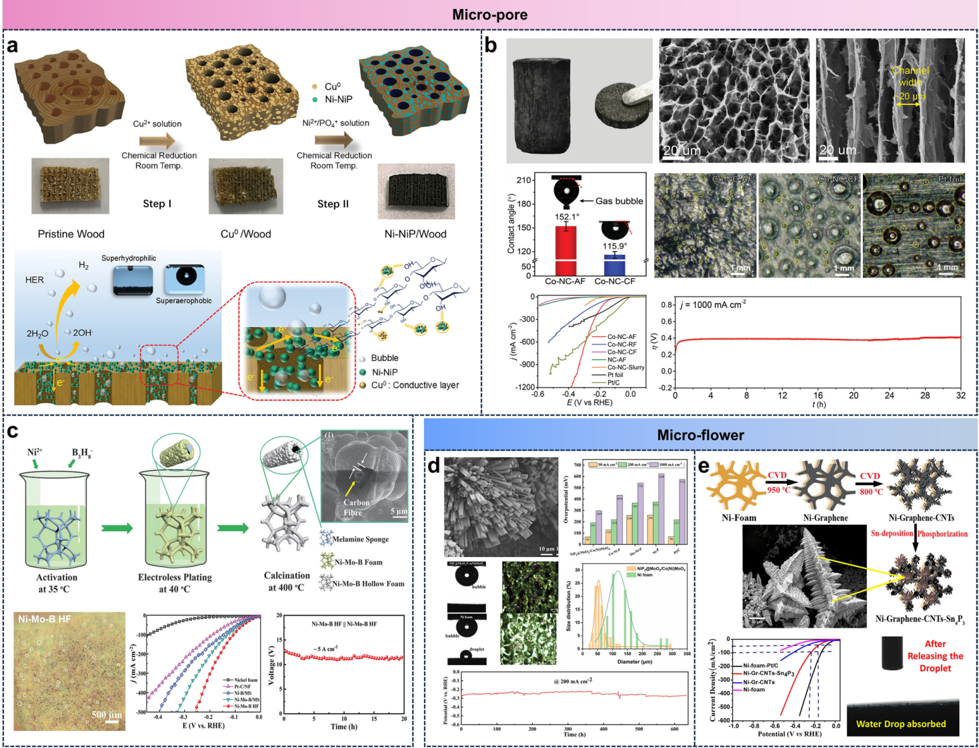
“Liu et al. [78] loaded the Ni–Mo–”
Li, L., Sun, C., Shang, B., Li, Q., Lei, J., Li, N., & Pan, F. (2019) · Journal of Materials Chemistry A · doi:10.1039/c9ta05578a · Cited by 112
Wu, W., Zhai, H., & Holubnyak, E. (2024) · Nature Communications · doi:10.1038/s41467-024-50090-w · Cited by 110
Xie, L., Wang, L., Liu, X., Chen, J., Wen, X., Zhao, W., Liu, S., & Zhao, Q. (2024) · Nature Communications · doi:10.1038/s41467-024-50117-2 · Cited by 109 · cited 1×
“15b. Compared with the blank Ni foam, the 3D nanostructured electrode exhibits superaerophobicity, the bubble can detach from the surface in just 207.9 ms. Unlike Yu’s parallel-axis nanosheets, Xie et al. [167] prepared nanowires composed of nanosheets perpendicular to the axis (Fig.”
InfluentialZhang, F., Zhao, R., Wang, Y., Han, L., Gu, J., Niu, Z., Yuan, Y., Qu, N., Meng, J., & Wang, D. (2022) · Chemical Engineering Journal · doi:10.1016/j.cej.2022.139513 · Cited by 105
Xing, M., Zhu, S., Zeng, X., Wang, S., Liu, Z., & Cao, D. (2023) · Advanced Energy Materials · doi:10.1002/aenm.202302376 · Cited by 105 · cited 1×
“These processes may form insulating precipitates or corrosive intermediate products on the electrode surface, blocking the catalytic sites, thereby reducing intrinsic activity and bubble release performance [65].”
Kim, J., Jung, S., Lee, N., Kim, K., Kim, Y., & Kim, J. K. (2023) · Advanced Materials · doi:10.1002/adma.202305844 · Cited by 103
A model for correlating mass transfer data at gas evolving electrodes
Stephan, K. D., & Vogt, H. (1979) · Electrochimica Acta · doi:10.1016/0013-4686(79)80033-x · Cited by 99
The history of water electrolysis from its beginnings to the present
Smolinka, T., Bergmann, H., Garche, J., & Kusnezoff, M. (2021) · Elsevier eBooks · doi:10.1016/b978-0-12-819424-9.00010-0 · Cited by 98
Riyajuddin, S., Pahuja, M., Sachdeva, P. K., Azmi, K., Kumar, S., Afshan, M., Ali, F., Sultana, J., Maruyama, T., Bera, C., et al. (2022) · ACS Nano · doi:10.1021/acsnano.2c00466 · Cited by 95 · cited 1×
“In addition to preparing micro-sphere graphene-CNTs–Ni 2 P–CuP 2 catalyst for overall water splitting, Riya-juddin et al. [82] further synthesized graphene-CNTs–Sn 3 P 4 Fig.”
Li, Y., Feng, A., Dai, L., Xi, B., An, X., Xiong, S., & An, C. (2024) · Advanced Functional Materials · doi:10.1002/adfm.202316296 · Cited by 91
Droplet and bubble wetting behaviors: The roles of surface wettability and roughness
Xiao, Y., Zheng, J., He, Y., & Wang, L. (2022) · Colloids and Surfaces A: Physicochemical and Engineering Aspects · doi:10.1016/j.colsurfa.2022.130008 · Cited by 90
Deng, R., & Zhang, Q. (2024) · Advanced Energy Materials · doi:10.1002/aenm.202401444 · Cited by 89
Xi, W., Yan, G., Tan, H., Xiao, L., Cheng, S., Khan, S. U., Wang, Y., & Li, Y. (2018) · Dalton Transactions · doi:10.1039/c8dt00765a · Cited by 88
Kempler, P. A., Coridan, R. H., & Lewis, N. S. (2020) · Energy & Environmental Science · doi:10.1039/d0ee00356e · Cited by 88
Increasing Gas Bubble Escape Rate for Water Splitting with Nonwoven Stainless Steel Fabrics
Wang, L., Huang, X., Jiang, S., Li, M., Zhang, K., Yan, Y., Zhang, H., & Xue, J. M. (2017) · ACS Applied Materials & Interfaces · doi:10.1021/acsami.7b12895 · Cited by 86
Liu, Y., Liu, G., Chen, X., Xue, C., Sun, M., Liu, Y., Kang, J., Sun, X., & Guo, L. (2024) · Nano-Micro Letters · doi:10.1007/s40820-024-01420-6 · Cited by 81
Mass transfer at gas evolving electrodes
Janssen, L. J. J. (1978) · Electrochimica Acta · doi:10.1016/0013-4686(78)80101-7 · Cited by 79
Jiang, J., Xu, G., Gong, B., Zhu, J., Wang, W., Zhao, T. K., Feng, Y., Wu, Q., Liu, S., & Zhang, L. (2024) · Advanced Functional Materials · doi:10.1002/adfm.202412685 · Cited by 79
Scalable Fabrication of Cu2S@NiS@Ni/NiMo Hybrid Cathode for High‐Performance Seawater Electrolysis
Xu, W., Ma, T., Chen, H., Pan, D., Wang, Z., Zhang, S., Zhang, P., Bao, S., Yang, Q., Zhou, L., et al. (2023) · Advanced Functional Materials · doi:10.1002/adfm.202302263 · Cited by 77
Self-citationDong, Y., Wang, H., Wang, X., Wang, H., Dong, Q., Wang, R., Wei, X., Ren, J., Liu, J., & Wang, R. (2024) · Chemical Engineering Journal · doi:10.1016/j.cej.2024.150953 · Cited by 76
Voltage Components at Gas Evolving Electrodes
Leistra, J. A., & Sides, P. J. (1987) · Journal of The Electrochemical Society · doi:10.1149/1.2100218 · Cited by 75
Superaerophobic Quaternary Ni–Co–S–P Nanoparticles for Efficient Overall Water-Splitting
Tian, Y., Lin, Z., Yu, J., Zhao, S., Liu, Q., Liu, J., Chen, R., Qi, Y., Zhang, H., Li, R., et al. (2019) · ACS Sustainable Chemistry & Engineering · doi:10.1021/acssuschemeng.9b02556 · Cited by 72
Guo, D., Zhao, Z., Zong, M.-Y., Fan, C.-Z., Zheng, W., & Wang, D. (2023) · ACS Sustainable Chemistry & Engineering · doi:10.1021/acssuschemeng.3c01554 · Cited by 72
Li, L., Laan, P. C. M., Yan, X., Cao, X., Mekkering, M. J., Zhao, K., Ke, L., Jiang, X., Wu, X., Li, L., et al. (2023) · Advanced Science · doi:10.1002/advs.202206180 · Cited by 71
The wettability of gas bubbles: from macro behavior to nano structures to applications
Huang, C., & Guo, Z. (2018) · Nanoscale · doi:10.1039/c8nr07315e · Cited by 70
Self-citationMaleki, M., Rouhaghdam, A. S., Darband, G. B., Han, D., & Shanmugam, S. (2022) · ACS Applied Energy Materials · doi:10.1021/acsaem.1c03625 · Cited by 70
Zhu, L., Liu, L., Huang, G., & Zhao, Q. (2020) · Applied Surface Science · doi:10.1016/j.apsusc.2019.144490 · Cited by 68
Bubble‐Guidance Breaking Gas Shield for Highly Efficient Overall Water Splitting
Li, Y., Li, K., Li, L., Gao, J., Wang, Z., Zou, W., Li, H., Zhang, Q., Li, Y., Zhang, X., et al. (2024) · Advanced Materials · doi:10.1002/adma.202405493 · Cited by 67
Self-citationFemtosecond laser micro-nano processing for boosting bubble releasing of gas evolution reactions
Zhang, S., Xu, L., Wu, J., Yang, Y., Zhang, C., Tao, H., Lin, J., Huang, L., Fang, W., Shi, K., et al. (2022) · Nano Research · doi:10.1007/s12274-021-3811-3 · Cited by 66
Yao, Y., He, J., Ma, L., Wang, J., Peng, L., Zhu, X., Li, K., & Qu, M. (2022) · Journal of Colloid and Interface Science · doi:10.1016/j.jcis.2022.02.071 · Cited by 65
Self-citationRen, J., Wu, X.-M., Liu, T., Chen, L., Hao, R., Song, Y.-J., Liu, Y., & Yuan, Z. (2022) · Applied Catalysis B: Environmental · doi:10.1016/j.apcatb.2022.121786 · Cited by 62
He, S., Wang, K., Li, B., Du, H., Du, Z., Wang, T., Li, S., Ai, W., & Huang, W. (2023) · Advanced Materials · doi:10.1002/adma.202307017 · Cited by 60
Chen, Y., Chen, J., Bai, K., Xiao, Z., & Fan, S. (2023) · Journal of Power Sources · doi:10.1016/j.jpowsour.2023.232733 · Cited by 59
Qin, J., Xie, T., Zhou, D., Luo, L., Zhang, Z., Shang, Z., Li, J., Mohapatra, L., Yu, J., Xu, H., et al. (2021) · Nano Research · doi:10.1007/s12274-020-3132-y · Cited by 58
Lu, M., Chen, D., Wang, B., Li, R., Cai, D., Tu, H.-R., Yang, H., Zhang, Y., & Han, W. (2020) · Journal of Materials Chemistry A · doi:10.1039/d0ta08347j · Cited by 58
Modulating Force of Nucleated Hydrogen Bubble Adhesion to Boost Electrochemical Water Splitting
Das, J., Mandal, S., Borbora, A., Rani, S., Tenjimbayashi, M., & Manna, U. (2024) · Advanced Functional Materials · doi:10.1002/adfm.202311648 · Cited by 55
3D porous Ni-Co-P nanosheets on carbon fiber cloth for efficient hydrogen evolution reaction
Tian, Y., Yu, J., Zhang, H., Wang, C., Zhang, M., Lin, Z., & Wang, J. (2019) · Electrochimica Acta · doi:10.1016/j.electacta.2019.01.101 · Cited by 55
Zhang, X., Zheng, R., Jin, M., Shi, R., Ai, Z., Amini, A., Lian, Q., Cheng, C., & Song, S. (2021) · ACS Applied Materials & Interfaces · doi:10.1021/acsami.1c07504 · Cited by 55
Self-citationTang, Y., Liu, F., Liu, W., Mo, S., Li, X., Yang, D., Liu, Y., & Bao, S. (2022) · Applied Catalysis B: Environmental · doi:10.1016/j.apcatb.2022.122081 · Cited by 55
Bioinspired Gas Manipulation for Regulating Multiphase Interactions in Electrochemistry
Long, Z., Yu, C., Cao, M., Ma, J., & Jiang, L. (2024) · Advanced Materials · doi:10.1002/adma.202312179 · Cited by 55 · cited 1×
“Therefore, it is of great significance in the hydrogen evolution industry and even the entire industrial sector to deeply exploring the dynamics of bubbles on solid surfaces and designing superaerophobic electrodes to achieve reliable control of bubbles [5, 6].”
Zhang, L., Li, M., Zou, A., Yu, S. H., Xiong, T., Wang, L., He, J., Fu, Q., Sun, K., Chua, D. H. C., et al. (2018) · ACS Applied Energy Materials · doi:10.1021/acsaem.8b01528 · Cited by 53
Self-citationAkbar, K., Hussain, S., Truong, L., Roy, S. B., Jeon, J. H., Jerng, S.-K., Kim, M., Yi, Y., Jung, J., & Chun, S.-H. (2017) · ACS Applied Materials & Interfaces · doi:10.1021/acsami.7b13918 · Cited by 53
Optical and electrochemical effects of H 2 and O 2 bubbles at upward-facing Si photoelectrodes
Kempler, P. A., Ifkovits, Z. P., Yu, W., Carim, A. I., & Lewis, N. S. (2020) · Energy & Environmental Science · doi:10.1039/d0ee02796k · Cited by 52
Li, S., Lee, J. K., Zhou, S., Pasta, M., & Warner, J. H. (2019) · Chemistry of Materials · doi:10.1021/acs.chemmater.8b03540 · Cited by 49
Jeung, Y., & Yong, K. (2019) · Chemical Engineering Journal · doi:10.1016/j.cej.2019.122734 · Cited by 49
Lv, X.-W., Liu, Y., Tian, W., Gao, L., & Yuan, Z.-Y. (2020) · Journal of Energy Chemistry · doi:10.1016/j.jechem.2020.02.055 · Cited by 49 · cited 1×
“Lv et al. [170] synthesized Al–”
Xing, M., Zhang, D., Liu, D., Song, C., & Wang, D. (2022) · Journal of Colloid and Interface Science · doi:10.1016/j.jcis.2022.09.091 · Cited by 48
Li, S., Zhou, S., Wang, X., Tang, P., Pasta, M., & Warner, J. H. (2019) · Materials Today Energy · doi:10.1016/j.mtener.2019.05.002 · Cited by 46
Versatile, Stable, and Scalable Gel‐Like Aerophobic Surface System (GLASS) for Hydrogen Production
Kang, Y., Lee, S., Han, S., Jeon, D., Bae, M., Choi, Y., Lee, D. W., & Ryu, J. (2024) · Advanced Functional Materials · doi:10.1002/adfm.202308827 · Cited by 45 · cited 2×
“Copyright 2020, American Association for the Advancement of Science. c Preparation schematic, surface morphologies, bubble adhesion, bubble contact angle, HER property, stability, and bubble size distribution of hydrophilic gel coated electrode [183].”
Liu, B., Wu, C., Chen, G., Chen, W., Peng, L., Yao, Y., Wei, Z., Zhu, H., Han, T., Tang, D., et al. (2019) · Journal of Power Sources · doi:10.1016/j.jpowsour.2019.04.119 · Cited by 42
Yan, G., Tan, H., Wang, Y., & Li, Y. (2019) · Applied Surface Science · doi:10.1016/j.apsusc.2019.05.254 · Cited by 42
Zhang, N., Huang, S., Chen, L., Li, Y., Tang, M., Pei, Q., & Liu, J. (2023) · Journal of Colloid and Interface Science · doi:10.1016/j.jcis.2023.08.087 · Cited by 41
Xu, Q., Wang, P., Wan, L., Xu, Z., Sultana, M. Z., & Wang, B. (2022) · ACS Applied Materials & Interfaces · doi:10.1021/acsami.2c01808 · Cited by 40 · cited 1×
“Xu et al. [81] synthesized NiP 2 @MoO 2 /Co(Ni)MoO 4 micro-flowers on Ni foam, which exhibits excellent catalytic activity and stability.”
Weakened hydrophobic interactions enhance bubble release in electrocatalytic water-splitting
Zhang, Z., Qiao, C., Li, J., Li, P., Zhang, H., Liu, Q., Zeng, H., & Li, G. (2025) · Applied Catalysis B: Environmental · doi:10.1016/j.apcatb.2025.125019 · Cited by 38
Chen, X., Sheng, L., Li, S., Cui, Y., Lin, T., Que, X., Du, Z., Zhang, Z., Peng, J., Ma, H.-L., et al. (2021) · Chemical Engineering Journal · doi:10.1016/j.cej.2021.131029 · Cited by 38
Wetting States and Departure Diameters of Bubbles on Micro-/Nanostructured Surfaces
Li, J., Gong, S., Zhang, L., Cheng, P., Ma, X., & Hong, F. (2022) · Langmuir · doi:10.1021/acs.langmuir.1c03212 · Cited by 36 · cited 1×
“Jiang’s team has summarized five typical wetting states: Wenzel’s state, Cassis’s state, transitional state, “Gecko” state, and “lotus” state [55–57].”
Deformable Catalytic Material Derived from Mechanical Flexibility for Hydrogen Evolution Reaction
Wang, F., Xie, L., Sun, N., Zhi, T., Zhang, M., Liu, Y., Luo, Z., Yi, L., Zhao, Q., & Wang, L. (2024) · Nano-Micro Letters · doi:10.1007/s40820-023-01251-x · Cited by 36
Shen, J., Li, B., Zheng, Y. F., Dai, Z., Li, J., Bao, X., Guo, J., Yu, X., Guo, Y. J., Ge, M., et al. (2021) · Chemical Engineering Journal · doi:10.1016/j.cej.2021.133517 · Cited by 35
Wang, Z., Song, L., Tao, H., He, Y., Yang, Y., Wang, T., Yu, H., Lin, J., & Dong, X. (2023) · Applied Surface Science · doi:10.1016/j.apsusc.2023.157179 · Cited by 35
Hao, M., Xu, Z., Liu, X., Ma, J., Wang, L., Li, C., & Wang, W. (2022) · International Journal of Hydrogen Energy · doi:10.1016/j.ijhydene.2022.09.254 · Cited by 34
Yang, S., Yuan, J., Xie, P., Li, B., Li, M., Zhou, D., Luo, L., & Sun, X. (2025) · Nature Communications · doi:10.1038/s41467-025-61131-3 · Cited by 34
Zhang, M., Chen, W.-Z., Liu, Z., He, J., & Wang, Y. (2023) · International Journal of Hydrogen Energy · doi:10.1016/j.ijhydene.2023.01.238 · Cited by 33
Self-citationDong, Y., Zhang, X., Wang, X., Liu, F., Ren, J., Wang, H., & Wang, R. (2023) · Journal of Colloid and Interface Science · doi:10.1016/j.jcis.2023.01.006 · Cited by 33
Self-citationYin, Y., Tan, Y. W., Wei, Q., Zhang, S., Wu, S., Huang, Q., Hu, F.-L., & Mi, Y. (2020) · Nano Research · doi:10.1007/s12274-020-3133-x · Cited by 32
On the dynamics of phase growth
Scriven, L. E. (1995) · Chemical Engineering Science · doi:10.1016/0009-2509(96)81820-3 · Cited by 31 · cited 1×
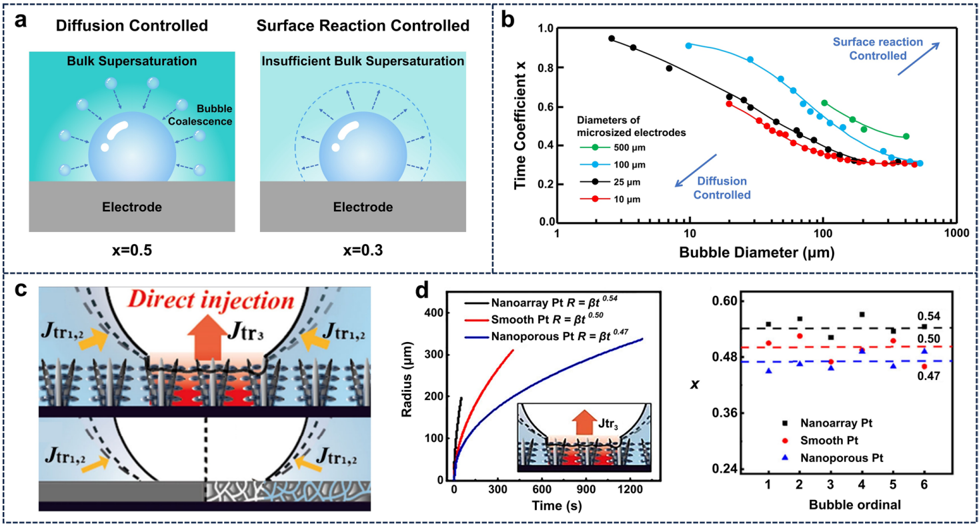
“10) [36]: where β represents the growth coefficient and x represents the time coefficient.”
Huang, T., Xu, G., Ding, H., Liu, X., & Zhang, L. (2024) · Separation and Purification Technology · doi:10.1016/j.seppur.2024.129094 · Cited by 31
Wu, J., Yang, X., Zhang, J., Guan, S., Han, J., Wang, J., Li, K., Zhang, G., & Guan, T. (2022) · Journal of Power Sources · doi:10.1016/j.jpowsour.2022.232065 · Cited by 28
Yan, R., Zou, X., Liang, Y., Liu, Y., Hu, F., & Mi, Y. (2024) · Journal of Colloid and Interface Science · doi:10.1016/j.jcis.2024.05.002 · Cited by 27 · cited 1×
“Yan [163] combined hydrothermal and phosphorization strategies to construct a micro-sheet with nanowires structure on carbon fiber (Fig.”
Rational engineering of superaerophobic CoMoSx electrocatalysts for overall water splitting
Mu, H., Lin, G., Zhang, Y., Xiao, Y., & Liu, J. (2021) · Colloids and Surfaces A Physicochemical and Engineering Aspects · doi:10.1016/j.colsurfa.2021.126734 · Cited by 26
Zhang, H., Guo, H., Zhang, Y., Zhao, J., Li, Y., Li, X., Ren, J., & Song, R. (2022) · ACS Sustainable Chemistry & Engineering · doi:10.1021/acssuschemeng.2c01124 · Cited by 25
Dong, Y., Wu, Y., Wang, X., Wang, H., Ren, J., Wang, P., Pan, L., Wang, G., & Wang, R. (2023) · Nanoscale · doi:10.1039/d2nr05911h · Cited by 24
Sun, Q., Hao, X., Zhang, D., Zhang, T., Zhao, Y., Huang, X., & Liu, X. (2024) · ENERGY & ENVIRONMENTAL MATERIALS · doi:10.1002/eem2.12726 · Cited by 24 · cited 1×
“Sun et al. [68] prepared the electrode for HER by loading phosphorus-doped nickel metal (NiP x ) onto a Ti mesh using electrophoretic deposition.”
Wang, H., Jiao, Y., Zhang, G., Zhang, Z., Ma, W., Sun, C., & Zong, X. (2024) · Chemical Engineering Journal · doi:10.1016/j.cej.2024.154776 · Cited by 23
Wang, X., Xia, X., Wang, H., Yang, Y., Yang, S., Zhang, A., Yuan, R., Zhu, H., Wang, B., Zhang, Y., et al. (2024) · Nano Energy · doi:10.1016/j.nanoen.2023.109185 · Cited by 22 · cited 2×
“8e) [26].”
Ma, J., Zhang, T., Li, J., Tian, Y., & Sun, C. (2024) · Journal of Colloid and Interface Science · doi:10.1016/j.jcis.2024.04.200 · Cited by 22
Lin, H.-H., Lin, C., & Luo, S. (2023) · ACS Applied Materials & Interfaces · doi:10.1021/acsami.3c05049 · Cited by 22
Yang, M., Shi, B., Tang, Y., Lu, H., Wang, G., Zhang, S., Sarwar, M. T., Tang, A., Fu, L., Wu, M., et al. (2023) · Inorganic Chemistry · doi:10.1021/acs.inorgchem.2c04181 · Cited by 22
Yan, K., Wu, B., Mu, Y., Luo, J., Tang, Z., Zhang, Q., Jiang, Y., Zhong, X., Limphirat, W., Yang, Y., et al. (2026) · Applied Catalysis B: Environmental · doi:10.1016/j.apcatb.2026.126457 · Cited by 21
Jiang, K. P., Li, Q., Lei, S., Zhai, M., Cheng, M., Xu, L., Deng, Y., Xu, H. F., & Bao, J. (2022) · Electrochimica Acta · doi:10.1016/j.electacta.2022.140947 · Cited by 21
Zhang, H., Feng, Z., Wang, L., Li, D., & Xing, P. (2020) · Nanotechnology · doi:10.1088/1361-6528/ab9396 · Cited by 20
Guan, J., Xiao, Y., Zhu, Y., Wang, L., Guo, B., Fu, Y., & Zhang, M. (2024) · Separation and Purification Technology · doi:10.1016/j.seppur.2024.127628 · Cited by 20 · cited 1×
“Guan et al. [87] prepared Co-loaded PAN-based carbon nanofibers as carriers of Pt nanoparticles.”
Chen, M., Deng, S., Qing, Y., Xu, H., Liao, Y., Li, L., Zhang, Z., Yan, N., Tian, C., Wu, Y., et al. (2022) · Carbohydrate Polymers · doi:10.1016/j.carbpol.2022.119754 · Cited by 20 · cited 2×
“Chen et al. [178] prepared the catalytic electrode with a gel skeleton using cellulose nanofibers (CNFs) as the gel skeleton, carboxylated multi-walled carbon nanotubes (cMWCNTs) as the conductive medium, and hydrothermally synthesized MoS 2 particles as the catalyst (Fig.”
Sun, C., Zhang, D., Zhao, Y., Song, C., & Wang, D. (2022) · Colloids and Surfaces A Physicochemical and Engineering Aspects · doi:10.1016/j.colsurfa.2022.129597 · Cited by 18
Fabrication of superaerophobic Ru-doped c-CoSe 2 for efficient hydrogen production
Wei, Y., Wang, J., Shang, Y., Lv, C., He, X., Wang, T., Chen, Z., Ji, L., & Wang, S. (2024) · Journal of Materials Chemistry A · doi:10.1039/d3ta07367j · Cited by 17
Self‐healable, Tolerant Superaerophobic Coating for Improving Electrochemical Hydrogen Production
Sarma, H., Mandal, S., Borbora, A., Das, J., Kumar, S., & Manna, U. (2024) · Small · doi:10.1002/smll.202309359 · Cited by 17
Xu, S., He, Y., Yan, S., He, T., Li, H., Guo, X., & Fan, Y. (2022) · Solid State Sciences · doi:10.1016/j.solidstatesciences.2022.107089 · Cited by 16
Li, J., Yuan, Z., Zhu, Y., Li, D., Han, W., Li, L., & Li, G. (2022) · Chemical Engineering Journal · doi:10.1016/j.cej.2022.138426 · Cited by 16
Zhang, M., Gao, Y., Li, J., Xia, Y., Yang, L., Jiang, C., Huang, X., Wang, T., & He, J. (2023) · Chemistry - A European Journal · doi:10.1002/chem.202301589 · Cited by 15
Self-citationHu, M., Tang, W., Xu, M., Lin, L., Lyu, S., & Mo, D.-C. (2025) · ACS Nano · doi:10.1021/acsnano.5c11662 · Cited by 14
Deng, R., Li, X., Wang, M., & Zhang, Q. (2023) · Applied Surface Science · doi:10.1016/j.apsusc.2023.156456 · Cited by 14
Ling, R., Lian, Q., Shan, L., Xiang, S., Peng, O., Li, D., Amini, A., Wang, N., Yang, H., & Cheng, C. (2024) · Small · doi:10.1002/smll.202404420 · Cited by 14 · cited 1×
“Ling et al. [74] innovatively used natural camphor pine wood with rich porous structure and abundant hydroxyl groups as the base electrode material, deposited copper directly on the wood surface, and then loaded Ni-NiP catalyst at room temperature.”
Mu, L., Wang, Y., Liu, Q., Li, J., Liu, H., Feng, P., Zhang, Y., Zhu, X., Yang, Z., He, J., et al. (2025) · Materials Today Energy · doi:10.1016/j.mtener.2025.102045 · Cited by 14
Self-citationJin, J., Xiao, T., Luo, R., Nie, X., Wang, Y., & Liu, Z. (2020) · ChemCatChem · doi:10.1002/cctc.202000979 · Cited by 14
Wang, X., Dai, J., Li, D., Wu, J., Fu, H., Xu, Y., Qi, X., Xue, Q., Shen, Y., Pan, X., et al. (2026) · Advanced Functional Materials · doi:10.1002/adfm.202529149 · Cited by 14
Self-citationDong, J., Chi, K., Zhao, Y. J., & Liu, Y. (2024) · Small · doi:10.1002/smll.202404808 · Cited by 14
He, T., He, Y., Li, H., Yin, X., Zhou, L., Shi, H., Ma, J., & Chen, L. (2022) · Journal of Electroanalytical Chemistry · doi:10.1016/j.jelechem.2021.115829 · Cited by 13 · cited 1×
“He et al. [69] synthesized superaerophobic NiMoSe@ NiMoO 4 micro-rods on Ni foam using a hydrothermal method and selenization, which exhibited good superaero-phobicity (with the bubble contact angle of 152.3°) and catalytic activity (Fig.”
InfluentialAlkaline electrolysis—status and prospects
(2021) · doi:10.1016/b978-0-12-819424-9.00004-5 · Cited by 13
Zhang, Y., Yu, W., Zhang, H., Shi, Y., Zhu, J., Wang, T., Sun, Y., Zhan, T., Lai, J., & Wang, L. (2023) · Small · doi:10.1002/smll.202308440 · Cited by 13
Wang, Z., Song, L., Tao, H., He, Y., Yang, Y., Wang, T., Yu, H., Lin, J., & Dong, X. (2024) · International Journal of Hydrogen Energy · doi:10.1016/j.ijhydene.2023.08.160 · Cited by 12 · cited 1×
“10a) [67].”
Huang, Y., Xu, H. J., Wang, Y., Xing, Z., Fang, R., Lai, H., Qian, M., Dong, M., Carraro, M., Skrydstrup, T., et al. (2024) · Inorganic Chemistry · doi:10.1021/acs.inorgchem.4c03400 · Cited by 12
Xu, S., He, Y., Yan, S., He, T., Li, H., Gao, Y., Chen, W., Yan, J., Wu, G., & Yuan, X. (2024) · Electrochimica Acta · doi:10.1016/j.electacta.2024.144273 · Cited by 11
Hao, X., Sun, Q., Hu, K., He, Y., Zhang, T., Zhang, D., Huang, X., & Liu, X. (2024) · Journal of Colloid and Interface Science · doi:10.1016/j.jcis.2024.06.085 · Cited by 11
Liu, L., Chen, Y., Chen, J., Tang, G., Xiao, Z., & Fan, S. (2023) · Industrial & Engineering Chemistry Research · doi:10.1021/acs.iecr.3c02144 · Cited by 10
Liu, B., Yan, S., He, Y., He, T., Yin, X., Song, R., Zhang, Z., Li, H., & Chen, L. B. (2022) · Colloids and Surfaces A Physicochemical and Engineering Aspects · doi:10.1016/j.colsurfa.2022.129972 · Cited by 9
Das, J., Phad, V., Saha, D., Dutta, S., Dhabal, D., & Manna, U. (2026) · Advanced Materials · doi:10.1002/adma.202515325 · Cited by 9 · cited 1×
“Therefore, it is of great significance in the hydrogen evolution industry and even the entire industrial sector to deeply exploring the dynamics of bubbles on solid surfaces and designing superaerophobic electrodes to achieve reliable control of bubbles [5, 6].”
Li, T., Chen, X. H., Fu, H. C., Zhang, Q., Yang, B., Luo, H. Q., & Li, N. B. (2024) · Journal of Colloid and Interface Science · doi:10.1016/j.jcis.2024.07.166 · Cited by 8
A “Superaerophobic” Se-Doped CoS2 Porous Nanowires Array for Cost-Saving Hydrogen Evolution
Tan, Y. W., Yin, Y., Yin, X., Lan, C., Wang, Y., Hu, F.-L., Huang, Q., & Mi, Y. (2021) · Catalysts · doi:10.3390/catal11020169 · Cited by 8
Zn-triggered synthesis of NiP/NiP microflower arrays for efficient alkaline overall water splitting
Zhao, Y., Huang, J., Li, X., Cao, L., Li, J., Chen, Q., Zhang, Y., Kajiyoshi, K., & Feng, L. (2023) · Molecular Catalysis · doi:10.1016/j.mcat.2023.113793 · Cited by 8
Zhang, L., Zeng, X., Cui, W., Liu, R., Wu, Y., Luo, L., Sun, X., Liu, L., Qiu, X., & Yu, D. (2025) · Chemical Engineering Journal · doi:10.1016/j.cej.2025.168287 · Cited by 7
Jiang, J., Zhu, J., Wang, L., Yang, Y., Wang, T., Wang, T., & Dong, X. (2022) · Materials Letters · doi:10.1016/j.matlet.2022.132790 · Cited by 7
Zheng, H., Guo, Y., Hao, X., Zhang, Y., Yu, J., Zhang, B., Guan, L., Li, X., Huang, X., & Wang, F. (2024) · Journal of Alloys and Compounds · doi:10.1016/j.jallcom.2024.173834 · Cited by 6 · cited 1×
“…coated with Pt/C film, the nanoparticle NiMo alloy has lower bubble adhesion, which allows the generated H 2 bubbles to detach from the electrode surface with an extremely small size Zheng et al. [84] prepared NiFe nanoparticles through electrodeposition on a submicron network carbon cloth.”
Hu, M., Tang, W., Lyu, S., & Mo, D.-C. (2026) · Nano Letters · doi:10.1021/acs.nanolett.5c04978 · Cited by 3
Research works printed but not linked: 1
- T. Young III., An essay on the cohesion of fluids. Phil. Trans. R. Soc. 95, 65–87 (1805). 10.1098/rstl.1805.000 · doi:10.1098/rstl.1805.000
Cited by
Shi, Y., Li, Z., Jiang, F., Zhu, X., & Jiao, S. (2026) · Separation and Purification Technology · doi:10.1016/j.seppur.2026.139200 · Cited by 1
Mu, L., Feng, P., Xie, C., He, J., Sun, C.-L., & Qu, M. (2026) · Materials Today Energy · doi:10.1016/j.mtener.2026.102423
Self-citationMu, L., Liu, H., Liu, Q., Li, J., Zhang, Y., Xie, C., He, J., & Qu, M. (2026) · Journal of environmental chemical engineering · doi:10.1016/j.jece.2026.125246
Self-citationBadea, G. E., Dziţac, S., Maior, I., Cojocaru, A., Hora, C., Bendea, C., & Pandelică, I. (2026) · Energies · doi:10.3390/en19133150 · Cited by 1
Metadata
- Authors
- He, A., Chen, F., He, J., Zhang, X., Xie, S., Yao, N., Guo, Z., & Xu, W.
- Affiliations
- Wuhan Textile University (CN)
- Hubei University (CN)
- Wuhan University of Technology (CN)
- Ministry of Education of the People's Republic of China (CN)
- Corresponding author
- Chen, Fengxiang
- Yao, Na
- Guo, Zhiguang
- Xu, Weilin
- Venue
- Nano-Micro Letters
- Published
- 2026-05-04
- Volume
- 18
- Issue
- 1
- ISSN
- 2150-5551 (ISSN-L)
- 2311-6706
- PMC
- PMC13136449
- OpenAlex
- W7160093091
- Semantic Scholar
- 62f4db06b6d97445445309f980d5935f1557dcff
- Cited by
- 5
- References
- 182
- Citations by year
- 2026: 5
- FWCI
- 1.72
- Type
- journal article
- Language
- en
- Open access
- gold
- doi.org
- Licence
- cc-by
- creativecommons.org/licenses/by/4.0 (tdm)
- creativecommons.org/licenses/by/4.0 (vor)
- Locations
- Nano-Micro Letters (publishedVersion, cc-by)
- PubMed (publishedVersion)
- PubMed Central (publishedVersion, cc-by)
- DOAJ (DOAJ: Directory of Open Access Journals) (submittedVersion, cc-by-sa)
- Topics
- Physical Sciences › Energy › Renewable Energy, Sustainability and the Environment › Electrocatalysts for Energy Conversion
- Physical Sciences › Materials Science › Surfaces, Coatings and Films › Surface Modification and Superhydrophobicity
- Physical Sciences › Chemical Engineering › Filtration and Separation › Minerals Flotation and Separation Techniques
- Keywords
- hydrogen evolution reaction, bubble adhesion, bubble dynamics, hydrophilic gels, water electrolysis, mass transfer, bubble nucleation, catalyst stability, electrode design
About these checks
Registry, retraction, Cites and statistics results are computed, not judged, with one exception: a printed reference that no index lists is read once by a model before it counts as a citation error. Claims are extracted by a model and kept only when their quote appears verbatim in the text; each cited source is then checked, with a model’s help, for whether it says what the claim relies on. Those verdicts can be wrong — read the claim’s quote and the cited source before relying on one.
The claim verdicts this report counts are experimental: their accuracy is not yet measured.
A language model drew the claims from the paper on 2026-10-11, under version 3 of the claim definition (model deepseek-v4.1-flash, prompt extract-v3).
A second model labelled each claim on 2026-10-11 (model jev-1.13-20260917, definition revision gold-guideline-v0.2).
Cited sources are checked with a language model’s help (gpt-6-sol).
Statistics and arithmetic are recomputed, not judged.
Confidence bands are shown only for fields calibrated on our annotated test set. None is calibrated yet, so no band is shown.
What counts as a claim ›How we measure confidence ›How we check this ›
Are you an author, or do you see a problem with this page? Request a review
Data sources
Bibliographic data: Semantic Scholar, OpenAlex, Crossref.
Contains information from the Semantic Scholar Academic Graph Datasets, made available under the ODC Attribution License (ODC-BY 1.0).
Semantic Scholar’s data is described in: Kinney, R., et al. (2023). The Semantic Scholar Open Data Platform. arXiv:2301.10140.
