

The DOI matches its Crossref record; 59 of the 59 references it cites were found in a registry or an index; 24 of the 104 sources its claims cite were checked for support.
Diet and acne: A systematic review
Open accessAbstract
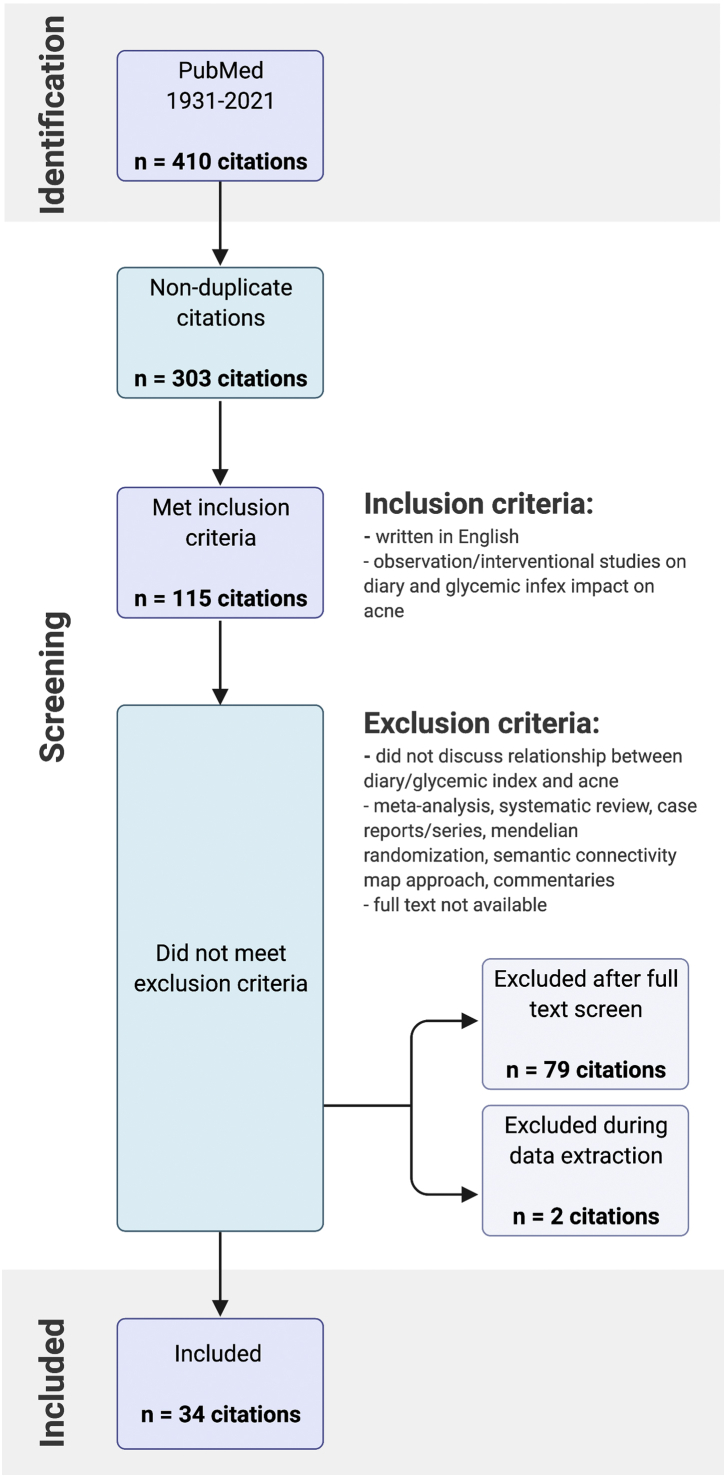
Background: Acne vulgaris is a common cutaneous disorder. Diet and metabolism, specifically glycemic content and dairy, influence hormones such as insulin, insulin-like growth factor 1, and androgens, which affect acnegenesis. Objective: To systematically review high-quality evidence regarding the association of dietary glycemic and dairy intake with acnegenesis. Methods: A comprehensive literature search, without timeline restriction, of MEDLINE (completed between October and November 2021) for English-language papers that examined the association between diet and acne was conducted. The evidence quality was assessed using the Ottawa quality assessment scale. Results: The literature search yielded 410 articles, of which 34 articles met the inclusion criteria. The literature on whether dairy product intake is associated with acnegenesis is mixed and may be dependent on sex, ethnicity, and cultural dietary habits. High glycemic index and increased daily glycemic load intake were positively associated with acnegenesis and acne severity, an observation supported by randomized controlled trials. Conclusion: High glycemic index, increased glycemic load, and carbohydrate intake have a modest yet significant proacnegenic effect. Increased dairy consumption may have been proacnegenic in select populations, such as those in which a Western diet is prevalent. The impact of diet on acnegenesis is likely dependent on sex and ethnicity. Further randomized trials are necessary to fully characterize the potential associations.
Overview
AI snapshot
Written from the paper’s full text.
TL;DR
This systematic review of 34 studies found that high glycemic index/load and carbohydrate intake have a modest but significant proacnegenic effect, while dairy’s association with acne is mixed and may be limited to Western-diet populations. It concludes that further randomized trials, especially on dairy and ethnicity, are needed.
Key findings
- The search yielded 410 articles, of which 34 met inclusion criteria: 28/34 (82.4%) were observational and 6/34 were interventional controlled trials; no interventional trials relating to dairy and acne were identified.
- Among 18 observational studies on GI/glycemic load, sweets, and carbohydrate intake, 77% (14/18) reported at least 1 item positively associated with acnegenesis or acne severity; positive studies had an average LOE score of 6.5 vs 5.5 for negative studies. RCTs supported low-GI diets, including total lesion count −22.0 ± 3.5 vs −10.9 ± 2.9 (P = .02), inflammatory lesion count −16.2 ± 2.9 vs −5.6 ± 2.5 (P = .01), and a 10-week trial showing a 70.9% decrease from baseline.
- Among dairy studies, 70% (16/23) linked at least 1 dairy food item with acnegenesis or acne severity; positive vs negative studies had similar average LOE scores (6.1 vs 6.4). Most negative studies were conducted outside the United States and Europe, leading the authors to conclude that increased dairy intake may exacerbate acne in Western-diet nations but is unlikely to do so among non-Western youths.
- One negative RCT found no significant association between a low-glycemic-load diet and acne severity, with all intervention and control participants showing acne reduction at 12 weeks.
Methods
- Systematic review conducted according to PRISMA 2020 guidelines, with a comprehensive MEDLINE search without timeline restriction, completed between October and November 2021, for English-language primary observational and interventional studies of participants with acne that assessed eating habits or dietary interventions and outcomes related to GI, glycemic load, and/or dairy.
- Two reviewers independently screened titles, abstracts, and full text; data extraction covered study design, participant characteristics, methods/intervention, outcome, and level of evidence. Observational study quality was assessed with the Newcastle-Ottawa scale (maximum 9; 8 for cross-sectional studies), with discrepancies averaged and rounded up.
- Studies were synthesized by dietary category, and a study was classified as “positive” if at least 1 relevant food item was significantly associated with acne.
Limitations
- Stated: dietary records and self-reporting are subject to substantial biases; strict dietary adherence in trials is difficult; many studies lacked power analyses and were underpowered for modest effect sizes; RCTs enrolled mostly men while observational studies included mostly women; the review focused on broad dairy and glycemic categories rather than specific foods; chocolate was strictly categorized as “glycemic-related,” an imperfect classification; and classifying a study as positive if a single food item was associated may overestimate associations.
- Stated: conclusions are limited mostly to teens and young adults; no dairy RCTs were identified, so dairy conclusions rely on observational studies with varied exposure assessment.
- Evident from the text: included studies were heterogeneous in design, exposure measurement (eg, Y/N questionnaires vs food diaries), population, and geographic setting, limiting comparability; several studies had low sample sizes, recruitment/exposure/outcome biases, or generalizability concerns as noted in the tables.
Model-written summary. Check it against the paper before relying on it.
Integrity signals
Registry
Cites
Statistics
Figures
Verification
Claims the paper makes
31 Sources not found · 24 Own result · 12 No full text of the sources · 12 Own interpretation · 8 Partly supported · 5 Own method · 4 No basis given · 2 Supported so far · 2 Not supported · 2 Couldn’t confirm · 1 Supported · 1 Mixed support · 1 Not checked yet · accuracy not yet measured
At least one cited source doesn’t support this claim or points to a different paper, and none confirmed it — see the verdicts below.
In the paper
“Notably, a 2-year randomized control trial (RCT) examining whey protein ingestion and bone health in postmenopausal women determined that high whey consumption resulted in higher serum IGF-1 levels, 7.3% at 1 year and 8% at 2 years.18”
§ Diet and acne: A systematic review > Introduction
What the sources say
- Disputedcites [18] Runchey, 2012, Glycemic load effect on fasting and post-prandial serum glucose, insulin, IGF-1 and IGFBP-3 in a randomized, controlled feeding study, Eur J Clin Nutr sourceExperimental — accuracy not yet measured
The Research Design section describes a crossover trial of high- and low-glycemic-load diets, with each diet consumed for 28 days—not a two-year whey-protein trial in postmenopausal women. The Results report 4% lower fasting IGF-1 after the low-glycemic-load diet, not increases of 7.3% and 8% at one and two years. Page numbers are unavailable in our copy. (LLM, conf=0.90)
Checked by a reasoning model — may be wrong.
plaindirect- Asserted: passes — The authors put it forward as true.
- Checkable: passes — It can be checked against evidence.
- Load-bearing: unclear — It is unclear whether the paper’s conclusions depend on it.
- Based: passes — The paper gives a reason why it holds.
- Disputed
At least one cited source doesn’t support this claim or points to a different paper, and none confirmed it — see the verdicts below.
In the paper
“Overall, 17.9% (5/28) of the observational studies exclusively assessed the association between GI/glycemic load and acne (Table I).19, 20, 21, 22, 23”
§ Diet and acne: A systematic review > Results > Summary of study demographics
What the sources say
- Not checked — no full text of the sourcecites [19] Kaymak, 2007, Dietary glycemic index and glucose, insulin, insulin-like growth factor-I, insulin-like growth factor binding protein 3, and leptin levels in patients with acne, J Am Acad Dermatol source
- Disputedcites [20] Bett, 1967, Sugar consumption in acne vulgaris and seborrhoeic dermatitis, Br Med J sourceExperimental — accuracy not yet measured
The Results (pp. 153–155) describe an observational comparison of sugar intake in patients with both acne and seborrhoeic dermatitis. This paper therefore is not an example of a study exclusively assessing glycemic index or glycemic load and acne. The 5/28 figure is the citing paper’s tally, not a figure reported by this source. (LLM, conf=0.87)
Checked by a reasoning model — may be wrong.
- Not checked — no full text of the sourcecites [21] Koku Aksu, 2012, Acne: prevalence and relationship with dietary habits in Eskisehir, Turkey, J Eur Acad Dermatol Venereol source
- Not checked — no full text of the sourcecites [22] Burris, 2017, Differences in dietary glycemic load and hormones in New York city adults with no and moderate/severe acne, J Acad Nutr Diet source
- Not checked — no full text of the sourcecites [23] Huang, 2019, Daily intake of soft drinks and moderate-to-severe acne vulgaris in Chinese adolescents, J Pediatr source
plain- Asserted: passes — The authors put it forward as true.
- Checkable: passes — It can be checked against evidence.
- Load-bearing: unclear — It is unclear whether the paper’s conclusions depend on it.
- Based: passes — The paper gives a reason why it holds.
Some cited sources support this claim and some don’t — read each source’s verdict below.
In the paper
“Overall, 35.7% (10/28) exclusively commented on the association between dairy and acne (Table II),24, 25, 26, 27, 28, 29, 30, 31, 32, 33”
§ Diet and acne: A systematic review > Results > Summary of study demographics
What the sources say
- Not checked — no full text of the sourcecites [24] Adebamowo, 2005, High school dietary dairy intake and teenage acne, J Am Acad Dermatol source
- Not checked — no full text of the sourcecites [25] Adebamowo, 2006, Milk consumption and acne in adolescent girls, Dermatol Online J source
- Supportedcites [26] Adebamowo, 2008, Milk consumption and acne in teenaged boys, J Am Acad Dermatol source
This citation identifies one of the studies the citing authors classified as focused on dairy and acne; it does not attribute the 10/28 count to this individual paper. The Abstract describes a prospective study examining dairy intake and acne in boys. The paper also reports findings for some other foods, so “exclusively” is best understood as the citing authors’ classification of its focus, not as a claim that it measured no other foods. (LLM, conf=0.88)
- Not checked — no full text of the sourcecites [27] Di Landro, 2012, Family history, body mass index, selected dietary factors, menstrual history, and risk of moderate to severe acne in adolescents and young adults, J Am Acad Dermatol source
- Partly supportedcites [28] Pontes, 2013, Incidence of acne vulgaris in young adult users of protein-calorie supplements in the city of Joao Pessoa-PB, An Bras Dermatol sourceExperimental — accuracy not yet measured
The Introduction identifies whey protein as derived from milk, and the Discussion links protein-calorie supplement use with acne. But the study did not exclusively examine dairy: the Results include participants using other protein supplements. The 35.7% (10/28) figure describes the citing paper’s collection of studies, not a finding attributed to this individual study. (LLM, conf=0.87)
- Partly supportedcites [29] Semedo, 2016, Adult acne: prevalence and portrayal in primary healthcare patients, in the Greater Porto Area, Portugal, Acta Med Port sourceExperimental — accuracy not yet measured
The Results section reports an association between milk consumption and acne, so this paper can be cited as a study addressing that association. It did not address dairy exclusively: the Results also examine smoking, and the Conclusion discusses calorie intake, hirsutism, and seborrhoea. The paper does not establish the citing document’s count of 10 out of 28 studies. (LLM, conf=0.87)
- Not checked — no full text of the sourcecites [30] Duquia, 2017, Epidemiology of acne vulgaris in 18-year-old male army conscripts in a South Brazilian city, Dermatology source
- Not checked — no full text of the sourcecites [31] Ulvestad, 2017, Acne and dairy products in adolescence: results from a Norwegian longitudinal study, J Eur Acad Dermatol Venereol source
- Not checked — no full text of the sourcecites [32] Heng, 2022, Epidemiological risk factors associated with acne vulgaris presentation, severity, and scarring in a Singapore Chinese population: a cross-sectional study, Dermatology source
- Disputedcites [33] Say, 2021, Modifiable and non-modifiable epidemiological risk factors for acne, acne severity and acne scarring among Malaysian Chinese: a cross-sectional study, BMC Public Health sourceExperimental — accuracy not yet measured
The Methods and Discussion describe a cross-sectional study of familial history, lifestyle, multiple dietary habits, acne severity, and scarring—not a study exclusively about dairy and acne. The paper does examine milk consumption, but its stated scope contradicts its inclusion as a dairy-only study. The 10/28 tally appears to be the citing authors’ own count, not a result reported by this source. (LLM, conf=0.86)
Checked by a reasoning model — may be wrong.
plain- Asserted: passes — The authors put it forward as true.
- Checkable: passes — It can be checked against evidence.
- Load-bearing: unclear — It is unclear whether the paper’s conclusions depend on it.
- Based: passes — The paper gives a reason why it holds.
The cited sources support only part of this claim — read each source’s verdict below.
In the paper
“and the ingestion of either whey or casein, protein dairy components, has been associated with increased levels of IGF-1 and insulin.14, 15, 16, 17”
§ Diet and acne: A systematic review > Introduction
What the sources say
- Not checked — no full text of the sourcecites [14] Dall'Oglio, 2021, Diet and acne: review of the evidence from 2009 to 2020, Int J Dermatol source
- Could not verifycites [15] Page, 2021, The PRISMA 2020 statement: An updated guideline for reporting systematic reviews, J Clin Epidemiol sourceExperimental — accuracy not yet measured
The cited paper discusses PRISMA reporting guidance (Box 2, p. 6; Article in Press, p. 9), not the effects of dairy proteins. Searches of our copy for whey, casein, IGF-1, and insulin found no passage addressing the claimed association. (LLM, conf=0.78)
- Partly supportedcites [16] Augustin, 2015, Glycemic index, glycemic load and glycemic response: an International Scientific Consensus Summit from the International Carbohydrate Quality Consortium (ICQC), Nutr Metab Cardiovasc Dis sourceExperimental — accuracy not yet measured
The section “GI as affected by the presence of proteins/amino acids” (p. 16) reports that whey stimulated an insulin response. It does not report increased IGF-1 levels or establish the claimed increase in insulin for casein. (LLM, conf=0.88)
- Could not verifycites [17] Silva, 2015, A high-glycemic index, low-fiber breakfast affects the postprandial plasma glucose, insulin, and ghrelin responses of patients with type 2 diabetes in a randomized clinical trial, J Nutr sourceExperimental — accuracy not yet measured
The Breakfast test composition section describes meals varied by glycemic index and fiber, and the Abstract reports differences in insulin responses between those meals. Searches for whey, casein, dairy protein, and IGF-1 found no passage linking ingestion of whey or casein to increased IGF-1 or insulin. Our copy therefore does not address the attributed claim. (LLM, conf=0.75)
plaincorrelational- Asserted: passes — The authors put it forward as true.
- Checkable: passes — It can be checked against evidence.
- Load-bearing: passes — The paper’s conclusions depend on it.
- Based: passes — The paper gives a reason why it holds.
The cited sources support only part of this claim — read each source’s verdict below.
In the paper
“Similarly, frequent dairy consumers have higher serum levels of IGF-1 and insulin compared with nondairy consumers,12,13”
§ Diet and acne: A systematic review > Introduction
What the sources say
- Not checked — no full text of the sourcecites [12] Steiner, 1946, Necropsies on Okinawans; anatomic and pathologic observations, Arch Pathol (Chic)
- Partly supportedcites [13] Conforti C, Agozzino M, Emendato G, et al. Acne and diet: a review. Preprint. Posted online August 22, 2021. Int J Dermatol. https://doi.org/10.1111/ijd.15862 sourceExperimental — accuracy not yet measured
The “Milk and acne” section (page unavailable) says milk can increase serum IGF-1. It does not report higher serum insulin in dairy consumers or compare frequent dairy consumers with nondairy consumers. (LLM, conf=0.85)
plaincorrelational- Asserted: passes — The authors put it forward as true.
- Checkable: passes — It can be checked against evidence.
- Load-bearing: passes — The paper’s conclusions depend on it.
- Based: passes — The paper gives a reason why it holds.
The sources with a verdict support this claim; the rest weren’t checked yet, have no full text we could read, or their verdicts aren’t rated yet.
In the paper
“All the interventional trials included examined the effect of GI/glycemic load on acne (Table IV).47, 48, 49, 50, 51, 52”
§ Diet and acne: A systematic review > Results > Summary of study demographics
What the sources say
- Not checked — no full text of the sourcecites [47] Smith, 2007, A low-glycemic-load diet improves symptoms in acne vulgaris patients: a randomized controlled trial, Am J Clin Nutr source
- Not checked — no full text of the sourcecites [48] Smith, 2007, The effect of a high-protein, low glycemic-load diet versus a conventional, high glycemic-load diet on biochemical parameters associated with acne vulgaris: a randomized, investigator-masked, controlled trial, J Am Acad Dermatol source
- Not checked — no full text of the sourcecites [49] Smith, 2008, A pilot study to determine the short-term effects of a low glycemic load diet on hormonal markers of acne: a nonrandomized, parallel, controlled feeding trial, Mol Nutr Food Res source
- Supportedcites [50] Reynolds, 2010, Effect of the glycemic index of carbohydrates on acne vulgaris, Nutrients source
The Methods (2.2, Study protocol) state that this intervention assigned participants to high- or low-GI diets to determine the effect of carbohydrate GI on acne. This paper therefore fits the citing sentence’s description of an included interventional trial; it does not need to establish what the other cited trials examined. (LLM, conf=0.93)
- Supportedcites [51] Kwon, 2012, Clinical and histological effect of a low glycaemic load diet in treatment of acne vulgaris in Korean patients: a randomized, controlled trial, Acta Derm Venereol source
The Materials and Methods (p. 1) describe this as a dietary intervention comparing a low-glycaemic-load diet with a control group and measuring acne lesions. It is therefore an example of an interventional trial examining glycaemic load and acne, as the citation is used here. (LLM, conf=0.93)
- Supportedcites [52] Pavithra, 2019, A randomized controlled trial of topical benzoyl peroxide 2.5% gel with a low glycemic load diet versus topical benzoyl peroxide 2.5% gel with a normal diet in acne (grades 1-3), Indian J Dermatol Venereol Leprol source
The Methods describe a randomized trial comparing a low-glycemic-load diet with no dietary intervention in patients with acne. The Results report acne counts in both groups, confirming that this cited trial examined the effect of glycemic load on acne; it need not establish what the other cited trials examined. (LLM, conf=0.93)
plain- Asserted: passes — The authors put it forward as true.
- Checkable: passes — It can be checked against evidence.
- Load-bearing: unclear — It is unclear whether the paper’s conclusions depend on it.
- Based: passes — The paper gives a reason why it holds.
The sources with a verdict support this claim; the rest weren’t checked yet, have no full text we could read, or their verdicts aren’t rated yet.
In the paper
“and 46.4% (13/28) described the associations of dairy products and GI/glycemic load with acne (Table III).34, 35, 36, 37, 38, 39, 40, 41, 42, 43, 44, 45, 46”
§ Diet and acne: A systematic review > Results > Summary of study demographics
What the sources say
- Supportedcites [34] Ismail, 2012, High glycemic load diet, milk and ice cream consumption are related to acne vulgaris in Malaysian young adults: a case control study, BMC Dermatol source
The cited paper is a case-control observational study of acne, dairy intake, and glycemic load. Its Discussion reports an association between milk and ice-cream intake and acne, and its Conclusions report an association with high glycemic load. It supports its inclusion among the studies described; the 13/28 tally is the citing paper’s count, not a result attributed to this individual study. (LLM, conf=0.91)
- Not checked — no full text of the sourcecites [35] Burris, 2014, Relationships of self-reported dietary factors and perceived acne severity in a cohort of New York young adults, J Acad Nutr Diet source
- Not checked — no full text of the sourcecites [36] Wolkenstein, 2015, Smoking and dietary factors associated with moderate-to-severe acne in French adolescents and young adults: results of a survey using a representative sample, Dermatology source
- Not checked — no full text of the sourcecites [37] LaRosa, 2016, Consumption of dairy in teenagers with and without acne, J Am Acad Dermatol source
- Not checked — no full text of the sourcecites [38] Çerman, 2016, Dietary glycemic factors, insulin resistance, and adiponectin levels in acne vulgaris, J Am Acad Dermatol source
- Not checked — no full text of the sourcecites [39] Okoro, 2016, Association of diet with acne vulgaris among adolescents in Ibadan, southwest Nigeria, Int J Dermatol source
- Not checked — no full text of the sourcecites [40] Suppiah, 2018, Acne vulgaris and its association with dietary intake: a Malaysian perspective, Asia Pac J Clin Nutr source
- Supportedcites [41] Aalemi, 2019, Dairy consumption and acne: a case control study in Kabul, Afghanistan, Clin Cosmet Investig Dermatol source
This citation identifies one of the observational studies in the citing paper’s group. The source’s Discussion reports an association between whole- and low-fat milk consumption and acne, so it fits the group of studies addressing dairy products and acne. The 13/28 count is the citing paper’s classification, not a result attributed to this individual study. (LLM, conf=0.88)
- Not checked — no full text of the sourcecites [42] Karadağ, 2019, The effect of personal, familial, and environmental characteristics on acne vulgaris: a prospective, multicenter, case controlled study, G Ital Dermatol Venereol source
- Not checked — no full text of the sourcecites [43] Akpinar Kara, 2020, Evaluation of food consumption in patients with acne vulgaris and its relationship with acne severity, J Cosmet Dermatol source
plaincorrelational- Asserted: passes — The authors put it forward as true.
- Checkable: passes — It can be checked against evidence.
- Load-bearing: unclear — It is unclear whether the paper’s conclusions depend on it.
- Based: passes — The paper gives a reason why it holds.
- Supported
The cited sources support only part of this claim — read each source’s verdict below.
In the paper
“In contrast, articles such as those by Bett et al20 and Adebamowo et al,24 which relied on participants’ recall of diet consumption/habit days, weeks, or even years after the fact, were likely subject to more substantially biases.”
§ Diet and acne: A systematic review > Discussion > Dairy and acne
What the sources say
- Partly supportedcites [20] Bett, 1967, Sugar consumption in acne vulgaris and seborrhoeic dermatitis, Br Med J sourceExperimental — accuracy not yet measured
The Summary says Bett et al. measured sugar intake with a short questionnaire, and the Dietary Questionary asks participants to picture an average day and report past changes in their habits. This supports the characterization as self-reported dietary recall, but the paper does not establish that consumption was recalled days, weeks, or years after specific events. The suggestion of greater bias is the citing authors’ inference, not a finding reported by Bett et al. (LLM, conf=0.82)
- Not checked — no full text of the sourcecites [24] Adebamowo, 2005, High school dietary dairy intake and teenage acne, J Am Acad Dermatol source
hedged- Asserted: passes — The authors put it forward as true.
- Checkable: passes — It can be checked against evidence.
- Load-bearing: unclear — It is unclear whether the paper’s conclusions depend on it.
- Based: passes — The paper gives a reason why it holds.
- Partly supported
The cited sources support only part of this claim — read each source’s verdict below.
In the paper
“but in the other, which was a 12-week trial of a low-glucose-load diet, no significant differences were found between the intervention and control.52”
§ Diet and acne: A systematic review > Results > Summary of study findings
What the sources say
- Partly supportedcites [52] Pavithra, 2019, A randomized controlled trial of topical benzoyl peroxide 2.5% gel with a low glycemic load diet versus topical benzoyl peroxide 2.5% gel with a normal diet in acne (grades 1-3), Indian J Dermatol Venereol Leprol sourceExperimental — accuracy not yet measured
The Results report no significant between-group difference in acne counts after 12 weeks (P = 0.931). But the unqualified claim overlooks significant between-group differences in body mass index and insulin resistance (both P = 0.0001). (LLM, conf=0.88)
plain- Asserted: passes — The authors put it forward as true.
- Checkable: passes — It can be checked against evidence.
- Load-bearing: unclear — It is unclear whether the paper’s conclusions depend on it.
- Based: passes — The paper gives a reason why it holds.
- Partly supported
The cited sources support only part of this claim — read each source’s verdict below.
In the paper
“Some of the reviewed studies, such as those by Burris et al59 and Ismail et al,34 both of which concluded that increased dairy and GI consumption exacerbate acne, hewed closer to this ideal through the use of food diaries and/or telephone interviews in their assessment of participants’ diets.”
§ Diet and acne: A systematic review > Discussion > Dairy and acne
What the sources say
- Not checked — no full text of the sourcecites [59] Burris, 2018, A low glycemic index and glycemic load diet decreases insulin-like growth factor-1 among adults with moderate and severe acne: a short-duration, 2-week randomized controlled trial, J Acad Nutr Diet source
- Partly supportedcites [34] Ismail, 2012, High glycemic load diet, milk and ice cream consumption are related to acne vulgaris in Malaysian young adults: a case control study, BMC Dermatol sourceExperimental — accuracy not yet measured
The Methods (Questionnaires) say participants kept three-day food diaries and were contacted by phone to clarify entries, supporting the dietary-assessment claim. But the Discussion says the case–control study could establish association, not cause and effect; it assessed glycemic load rather than concluding that increased GI and dairy consumption exacerbate acne. (LLM, conf=0.88)
plain- Asserted: passes — The authors put it forward as true.
- Checkable: passes — It can be checked against evidence.
- Load-bearing: unclear — It is unclear whether the paper’s conclusions depend on it.
- Based: passes — The paper gives a reason why it holds.
- Probably not a substantial claim. 14
- It may state two separate claims as one. 45
Every source the paper cites for this claim was checked and supports it.
In the paper
“We conducted a comprehensive literature search, without timeline restriction, of the MEDLINE database according to the 2020 Preferred Reporting Items for Systematic Reviews and Meta-Analyses guidelines.15”
§ Diet and acne: A systematic review > Methods
What the sources say
- Supportedcites [15] Page, 2021, The PRISMA 2020 statement: An updated guideline for reporting systematic reviews, J Clin Epidemiol source
The citation identifies the PRISMA 2020 reporting guideline, which this paper presents (Scope of the guideline, p. 4). The MEDLINE search and absence of a timeline restriction are the citing authors’ description of their own review, not claims attributed to PRISMA. (LLM, conf=0.91)
plain- Asserted: passes — The authors put it forward as true.
- Checkable: passes — It can be checked against evidence.
- Load-bearing: fails — The paper’s conclusions may not depend on it.
- Based: passes — The paper gives a reason why it holds.
Probably not a substantial claim. The paper’s conclusions may not depend on it. It may state two separate claims as one.
- Supported
The cited sources support only part of this claim — read each source’s verdict below.
In the paper
“One notable example is that Adebamowo et al26 found a significant association between skim milk and acne but not between total milk, whole milk, 2% milk, or low-fat milk and acne.”
§ Diet and acne: A systematic review > Discussion > Dairy and acne
What the sources say
- Partly supportedcites [26] Adebamowo, 2008, Milk consumption and acne in teenaged boys, J Am Acad Dermatol sourceExperimental — accuracy not yet measured
The Results and Table II (page not specified) show a significant trend for skim milk (P=.02), but not for total milk, whole/2% milk, or low-fat milk. The claim overstates the absence of an association for total milk: its highest-versus-lowest intake comparison has a 95% confidence interval of 1.01–1.34. The paper also groups whole and 2% milk rather than reporting separate associations for each. (LLM, conf=0.87)
plaincorrelational- Asserted: passes — The authors put it forward as true.
- Checkable: passes — It can be checked against evidence.
- Load-bearing: unclear — It is unclear whether the paper’s conclusions depend on it.
- Based: passes — The paper gives a reason why it holds.
It may state two separate claims as one.
- Partly supported
The cited sources support only part of this claim — read each source’s verdict below.
In the paper
“Pavithra et al,52 in their sole negative trial, did not show significant improvement with a low-GI diet, likely in part due to substantial improvement among all participants from baseline because of their participation in the trial and associated counseling.”
§ Diet and acne: A systematic review > Discussion > Glycemic content and acne
What the sources say
- Partly supportedcites [52] Pavithra, 2019, A randomized controlled trial of topical benzoyl peroxide 2.5% gel with a low glycemic load diet versus topical benzoyl peroxide 2.5% gel with a normal diet in acne (grades 1-3), Indian J Dermatol Venereol Leprol sourceExperimental — accuracy not yet measured
Split into 2 atoms — 0 confirmed, 2 partially supported, 0 disputed, 0 misattributed, 0 unverifiable. Expand the claim to see per-atom verdicts.
hedged- Asserted: passes — The authors put it forward as true.
- Checkable: passes — It can be checked against evidence.
- Load-bearing: passes — The paper’s conclusions depend on it.
- Based: passes — The paper gives a reason why it holds.
It may state two separate claims as one.
- Partly supported
The cited sources that could be checked couldn’t confirm or dispute this claim.
In the paper
“In contrast, an 8-week trial of a low-GI diet (GI of 51) conducted on 58 adolescent participants failed to demonstrate a significant improvement in facial acne severity compared with a control diet (GI, 61); however, there was a nonsignificant trend toward a greater benefit with the low-GI diet (acne severity score change: low GI mean ± SEM, n = 23, −0.65 ± 0.14 vs high GI mean ± SEM, n = 20, −0.”
§ Diet and acne: A systematic review > Results > Summary of study findings
What the sources say
- Could not verifycites [45] Penso, 2020, Association between adult acne and dietary behaviors: findings from the NutriNet-Santé Prospective Cohort Study, JAMA Dermatol sourceExperimental — accuracy not yet measured
Split into 2 atoms — 0 confirmed, 0 partially supported, 0 disputed, 0 misattributed, 2 unverifiable. Expand the claim to see per-atom verdicts.
plainn = 58- Asserted: passes — The authors put it forward as true.
- Checkable: passes — It can be checked against evidence.
- Load-bearing: unclear — It is unclear whether the paper’s conclusions depend on it.
- Based: passes — The paper gives a reason why it holds.
It may state two separate claims as one.
- Could not verify
The cited sources that could be checked couldn’t confirm or dispute this claim.
In the paper
“Importantly, a majority of the negative studies, including 1 notable study that reported that increased milk consumption decreased the risk of acne scarring,53,54 were conducted in countries outside the United States and Europe.”
§ Diet and acne: A systematic review > Discussion > Dairy and acne
What the sources say
- Could not verifycites [53] Danby, 2009, Acne, dairy and cancer: the 5alpha-P link, Dermatoendocrinology sourceExperimental — accuracy not yet measured
The Early Synthesis and Early Pieces of the Puzzle discuss dairy intake and acne, but do not identify a study finding that increased milk consumption reduced acne scarring. Searches for that finding and for the geographic distribution of negative studies found no passage addressing either point in our copy. (LLM, conf=0.72)
- Not checked — no full text of the sourcecites [54] Ma, 2001, Milk intake, circulating levels of insulin-like growth factor-I, and risk of colorectal cancer in men, J Natl Cancer Inst source
plain- Asserted: passes — The authors put it forward as true.
- Checkable: passes — It can be checked against evidence.
- Load-bearing: passes — The paper’s conclusions depend on it.
- Based: passes — The paper gives a reason why it holds.
It may state two separate claims as one.
- Could not verify
A result the paper reports from its own data — it cites no other source for it, so there is none to check. The quote shows it is in the paper.
In the paper
“Overall, 82.4% (28/34) of the included studies were observational, with the remainder being interventional controlled trials (6/34).”
§ Diet and acne: A systematic review > Results > Summary of study demographics
plain- Asserted: passes — The authors put it forward as true.
- Checkable: passes — It can be checked against evidence.
- Load-bearing: fails — The paper’s conclusions may not depend on it.
- Based: passes — The paper gives a reason why it holds.
Probably not a substantial claim. The paper’s conclusions may not depend on it. It may state two separate claims as one.
A result the paper reports from its own data — it cites no other source for it, so there is none to check. The quote shows it is in the paper.
In the paper
“Of the controlled trials, majority (5/6) were RCTs. One trial was nonrandomized.”
§ Diet and acne: A systematic review > Results > Summary of study demographics
plain- Asserted: passes — The authors put it forward as true.
- Checkable: passes — It can be checked against evidence.
- Load-bearing: fails — The paper’s conclusions may not depend on it.
- Based: passes — The paper gives a reason why it holds.
Probably not a substantial claim. The paper’s conclusions may not depend on it. It may state two separate claims as one.
A result the paper reports from its own data — it cites no other source for it, so there is none to check. The quote shows it is in the paper.
In the paper
“Among the observational studies, 42.9% (12/28) were case-control studies, 14.3% (4/28) were longitudinal cohort studies, and 42.9% (12/28) were cross-sectional studies.”
§ Diet and acne: A systematic review > Results > Summary of study demographics
plain- Asserted: passes — The authors put it forward as true.
- Checkable: passes — It can be checked against evidence.
- Load-bearing: fails — The paper’s conclusions may not depend on it.
- Based: passes — The paper gives a reason why it holds.
Probably not a substantial claim. The paper’s conclusions may not depend on it. It may state two separate claims as one.
In the paper
“Daily consumption of chocolate and sweets associated with acne (OR 2.38 [1.31-4.31]). Dairy and sugary drink consumption not associated.”
§ Diet and acne: A systematic review > Results > Summary of study demographics
What the sources say
- Not matchedcites Wolkenstein et al,36
Couldn’t be matched to a paper in Crossref, so it can’t be checked.
plaincorrelationaln = 1,375- Asserted: passes — The authors put it forward as true.
- Checkable: passes — It can be checked against evidence.
- Load-bearing: unclear — It is unclear whether the paper’s conclusions depend on it.
- Based: passes — The paper gives a reason why it holds.
It may state two separate claims as one.
- Not matched
In the paper
“High intake of full-fat dairy associated with acne (OR 1.56 [1.02-2.39]). Total milk intake in girls only associated with acne (OR 1.80 [1.02-3.16]).”
§ Diet and acne: A systematic review > Results > Summary of study demographics
What the sources say
- Not matchedcites Ulvestad et al,31
Couldn’t be matched to a paper in Crossref, so it can’t be checked.
plaincorrelational- Asserted: passes — The authors put it forward as true.
- Checkable: passes — It can be checked against evidence.
- Load-bearing: unclear — It is unclear whether the paper’s conclusions depend on it.
- Based: passes — The paper gives a reason why it holds.
It may state two separate claims as one.
- Not matched
In the paper
“Chocolate associated with acne (OR 1.48 [1.24-1.76]). Milk and cheese not associated (OR 1.13 [0.94-1.36]).”
§ Diet and acne: A systematic review > Results > Summary of study demographics
What the sources say
- Not matchedcites Karadağ et al,42
Couldn’t be matched to a paper in Crossref, so it can’t be checked.
plaincorrelationaln = 3,826- Asserted: passes — The authors put it forward as true.
- Checkable: passes — It can be checked against evidence.
- Load-bearing: unclear — It is unclear whether the paper’s conclusions depend on it.
- Based: passes — The paper gives a reason why it holds.
It may state two separate claims as one.
- Not matched
In the paper
“Frequent sugar intake (aOR, 1.3 [1.06-1.82]) and frequent sweet consumption (aOR 1.2 [1.16-1.43]) associated with acne.”
§ Diet and acne: A systematic review > Results > Summary of study demographics
What the sources say
- Not matchedcites Koku Aksu et al,21
Couldn’t be matched to a paper in Crossref, so it can’t be checked.
plaincorrelational- Asserted: passes — The authors put it forward as true.
- Checkable: passes — It can be checked against evidence.
- Load-bearing: unclear — It is unclear whether the paper’s conclusions depend on it.
- Based: passes — The paper gives a reason why it holds.
It may state two separate claims as one.
- Not matched
None of the sources cited for this claim have been checked yet.
In the paper
“High glycemic index and increased daily glycemic load intake were positively associated with acnegenesis and acne severity, an observation supported by randomized controlled trials.”
§ Diet and acne: A systematic review > Abstract > Results
plaincorrelational- Asserted: passes — The authors put it forward as true.
- Checkable: passes — It can be checked against evidence.
- Load-bearing: passes — The paper’s conclusions depend on it.
- Based: passes — The paper gives a reason why it holds.
It may state two separate claims as one.
In the paper
“GI (47.24 ± 6.6 for patients with acne and 44.52 ± 6.58 for controls) and GL increased in patients with acne. Milk consumption not associated.”
§ Diet and acne: A systematic review > Results > Summary of study demographics
What the sources say
- Not matchedcites Çerman et al,38
Couldn’t be matched to a paper in Crossref, so it can’t be checked.
plaincorrelationaln = 50- Asserted: passes — The authors put it forward as true.
- Checkable: passes — It can be checked against evidence.
- Load-bearing: unclear — It is unclear whether the paper’s conclusions depend on it.
- Based: passes — The paper gives a reason why it holds.
It may state two separate claims as one.
- Not matched
In the paper
“No association between the frequency of milk consumption and acne severity. Increased milk consumption associated with a lower risk of scarring.”
§ Diet and acne: A systematic review > Results > Summary of study demographics
What the sources say
- Not matchedcites Say et al,33
Couldn’t be matched to a paper in Crossref, so it can’t be checked.
plaincorrelationaln = 1,117- Asserted: passes — The authors put it forward as true.
- Checkable: passes — It can be checked against evidence.
- Load-bearing: unclear — It is unclear whether the paper’s conclusions depend on it.
- Based: passes — The paper gives a reason why it holds.
It may state two separate claims as one.
- Not matched
In the paper
“Skim milk associated with acne (PR 1.19 [1.01-1.40]). Total milk, whole milk, 2% milk, and low-fat milk not associated.”
§ Diet and acne: A systematic review > Results > Summary of study demographics
What the sources say
- Not matchedcites Adebamowo et al,26
Couldn’t be matched to a paper in Crossref, so it can’t be checked.
plaincorrelational- Asserted: passes — The authors put it forward as true.
- Checkable: passes — It can be checked against evidence.
- Load-bearing: unclear — It is unclear whether the paper’s conclusions depend on it.
- Based: passes — The paper gives a reason why it holds.
It may state two separate claims as one.
- Not matched
In the paper
“Daily milk consumption (72.6% cases vs 62.0% controls) and cake (77.8% cases vs 62.3% controls) associated with acne.”
§ Diet and acne: A systematic review > Results > Summary of study demographics
What the sources say
- Not matchedcites Okoro et al,39
Couldn’t be matched to a paper in Crossref, so it can’t be checked.
plaincorrelational- Asserted: passes — The authors put it forward as true.
- Checkable: passes — It can be checked against evidence.
- Load-bearing: unclear — It is unclear whether the paper’s conclusions depend on it.
- Based: passes — The paper gives a reason why it holds.
It may state two separate claims as one.
- Not matched
In the paper
“Milk (OR 2.19 [1.04-4.65]) and chocolate (OR 2.4 [1.08-5.33]) consumption associated with acne.”
§ Diet and acne: A systematic review > Results > Summary of study demographics
What the sources say
- Not matchedcites Suppiah et al,40
Couldn’t be matched to a paper in Crossref, so it can’t be checked.
plaincorrelationaln = 57- Asserted: passes — The authors put it forward as true.
- Checkable: passes — It can be checked against evidence.
- Load-bearing: unclear — It is unclear whether the paper’s conclusions depend on it.
- Based: passes — The paper gives a reason why it holds.
It may state two separate claims as one.
- Not matched
In the paper
“Higher GI (51.8 ± 3 vs 48.9 ± 4.6) and daily milk servings (0.7 ± 0.7 vs 0.3 ± 0.5) associated with acne severity.”
§ Diet and acne: A systematic review > Results > Summary of study demographics
What the sources say
- Not matchedcites Burris et al,35
Couldn’t be matched to a paper in Crossref, so it can’t be checked.
plaincorrelational- Asserted: passes — The authors put it forward as true.
- Checkable: passes — It can be checked against evidence.
- Load-bearing: unclear — It is unclear whether the paper’s conclusions depend on it.
- Based: passes — The paper gives a reason why it holds.
It may state two separate claims as one.
- Not matched
In the paper
“High glycemic load (175 ± 35 in patients with acne vs 122 ± 28 in controls), milk (OR 3.99 [1.39-11.43]), and ice cream (OR 4.47 [1.77-11.266]) consumption associated with acne.”
§ Diet and acne: A systematic review > Results > Summary of study demographics
What the sources say
- Not matchedcites Ismail et al,34
Couldn’t be matched to a paper in Crossref, so it can’t be checked.
plaincorrelationaln = 44- Asserted: passes — The authors put it forward as true.
- Checkable: passes — It can be checked against evidence.
- Load-bearing: unclear — It is unclear whether the paper’s conclusions depend on it.
- Based: passes — The paper gives a reason why it holds.
It may state two separate claims as one.
- Not matched
The paper states this without a source or data behind it here, so there is nothing to check it against. The quote shows it is in the paper.
In the paper
“The literature on whether dairy product intake is associated with acnegenesis is mixed and may be dependent on sex, ethnicity, and cultural dietary habits.”
§ Diet and acne: A systematic review > Abstract > Results
hedgedcorrelational- Asserted: passes — The authors put it forward as true.
- Checkable: passes — It can be checked against evidence.
- Load-bearing: passes — The paper’s conclusions depend on it.
- Based: passes — The paper gives a reason why it holds.
It may state two separate claims as one.
In the paper
“Increased servings of low-fat/skim milk (0.61 vs 0.41) in moderate acne cases compared with those in acne-free controls. Glycemic load not associated.”
§ Diet and acne: A systematic review > Results > Summary of study demographics
What the sources say
- Not matchedcites LaRosa et al,37
Couldn’t be matched to a paper in Crossref, so it can’t be checked.
plaincorrelationaln = 120- Asserted: passes — The authors put it forward as true.
- Checkable: passes — It can be checked against evidence.
- Load-bearing: unclear — It is unclear whether the paper’s conclusions depend on it.
- Based: passes — The paper gives a reason why it holds.
It may state two separate claims as one.
- Not matched
In the paper
“Whole milk (OR 2.36 [1.39-4.01]) and low-fat milk consumption (OR 1.95 [1.10-3.45]) associated with acne severity. Chocolate associated with acne.”
§ Diet and acne: A systematic review > Results > Summary of study demographics
What the sources say
- Not matchedcites Aalemi et al,41
Couldn’t be matched to a paper in Crossref, so it can’t be checked.
plaincorrelationaln = 279- Asserted: passes — The authors put it forward as true.
- Checkable: passes — It can be checked against evidence.
- Load-bearing: unclear — It is unclear whether the paper’s conclusions depend on it.
- Based: passes — The paper gives a reason why it holds.
It may state two separate claims as one.
- Not matched
In the paper
“Total milk (PR 1.22 [1.03-1.44]), skim milk (PR 1.44 [1.21-1.72]), and cottage cheese (PR 1.63 [1.22-2.20]) consumption associated with severe acne. Whole milk and low-fat milk not associated.”
§ Diet and acne: A systematic review > Results > Summary of study demographics
What the sources say
- Not matchedcites Adebamowo et al,24
Couldn’t be matched to a paper in Crossref, so it can’t be checked.
plaincorrelational- Asserted: passes — The authors put it forward as true.
- Checkable: passes — It can be checked against evidence.
- Load-bearing: unclear — It is unclear whether the paper’s conclusions depend on it.
- Based: passes — The paper gives a reason why it holds.
It may state two separate claims as one.
- Not matched
In the paper
“Dairy (OR 1.21 [1.1-1.35]), whey protein (OR 3.94 [3.29-4.71]), and high-GI food consumption associated with acne.”
§ Diet and acne: A systematic review > Results > Summary of study demographics
What the sources say
- Not matchedcites Dreno et al,44
Couldn’t be matched to a paper in Crossref, so it can’t be checked.
plaincorrelationaln = 2,826- Asserted: passes — The authors put it forward as true.
- Checkable: passes — It can be checked against evidence.
- Load-bearing: passes — The paper’s conclusions depend on it.
- Based: passes — The paper gives a reason why it holds.
It may state two separate claims as one.
- Not matched
A result the paper reports from its own data — it cites no other source for it, so there is none to check. The quote shows it is in the paper.
In the paper
“Overall, 50% (2/4) of studies were conducted in nations with a predominant Western diet (the United States and Europe).”
§ Diet and acne: A systematic review > Results > Summary of study findings
plain- Asserted: passes — The authors put it forward as true.
- Checkable: passes — It can be checked against evidence.
- Load-bearing: fails — The paper’s conclusions may not depend on it.
- Based: passes — The paper gives a reason why it holds.
Probably not a substantial claim. The paper’s conclusions may not depend on it.
The paper states this without a source or data behind it here, so there is nothing to check it against. The quote shows it is in the paper.
In the paper
“In addition, despite the majority of the participants in the observational studies being women, the RCTs described enrolled mostly men.”
§ Diet and acne: A systematic review > Discussion > Dairy and acne
plain- Asserted: passes — The authors put it forward as true.
- Checkable: passes — It can be checked against evidence.
- Load-bearing: passes — The paper’s conclusions depend on it.
- Based: passes — The paper gives a reason why it holds.
It may state two separate claims as one.
A result the paper reports from its own data — it cites no other source for it, so there is none to check. The quote shows it is in the paper.
In the paper
“Among articles that examined the association between dairy and acne, 70% (16/23) linked at least 1 dairy food item with acnegenesis or acne severity and had an average LOE score of 6.1 (Tables II and III).”
§ Diet and acne: A systematic review > Results > Summary of study findings
plaincorrelational- Asserted: passes — The authors put it forward as true.
- Checkable: passes — It can be checked against evidence.
- Load-bearing: passes — The paper’s conclusions depend on it.
- Based: passes — The paper gives a reason why it holds.
It may state two separate claims as one.
A result the paper reports from its own data — it cites no other source for it, so there is none to check. The quote shows it is in the paper.
In the paper
“Studies that linked glycemic content and acne had an average LOE score of 6.5 (Tables I and III). Articles that did not find an association had an average LOE score of 5.5 (Tables I and III).”
§ Diet and acne: A systematic review > Results > Summary of study findings
plaincorrelational- Asserted: passes — The authors put it forward as true.
- Checkable: passes — It can be checked against evidence.
- Load-bearing: unclear — It is unclear whether the paper’s conclusions depend on it.
- Based: passes — The paper gives a reason why it holds.
It may state two separate claims as one.
The paper states this without a source or data behind it here, so there is nothing to check it against. The quote shows it is in the paper.
In the paper
“These studies had a higher assigned strength of evidence (6.5 vs 5.5), and their conclusions were backed by numerous RCTs that demonstrated either significant improvement in acne with the adoption of a low-GI diet or a trend toward significance (Table I, Table II, Table III, Table IV).”
§ Diet and acne: A systematic review > Discussion > Glycemic content and acne
boostedconditional- Asserted: passes — The authors put it forward as true.
- Checkable: passes — It can be checked against evidence.
- Load-bearing: passes — The paper’s conclusions depend on it.
- Based: passes — The paper gives a reason why it holds.
It may state two separate claims as one.
In the paper
“Fatty and sugary products (aOR 1.54 [1.09-2.16]), sugary beverages (aOR 1.18; [1.01-1.38]), and milk products (aOR 1.12; [1.00-1.25]) associated with acne.”
§ Diet and acne: A systematic review > Results > Summary of study demographics
What the sources say
- Not matchedcites Penso et al,45
Couldn’t be matched to a paper in Crossref, so it can’t be checked.
plaincorrelational- Asserted: passes — The authors put it forward as true.
- Checkable: passes — It can be checked against evidence.
- Load-bearing: passes — The paper’s conclusions depend on it.
- Based: passes — The paper gives a reason why it holds.
It may state two separate claims as one.
- Not matched
A result the paper reports from its own data — it cites no other source for it, so there is none to check. The quote shows it is in the paper.
In the paper
“Among the observational studies, 67.9% (19/28) reported the participant age for the cases and controls as a continuous variable.”
§ Diet and acne: A systematic review > Results > Summary of patient characteristics
plain- Asserted: passes — The authors put it forward as true.
- Checkable: passes — It can be checked against evidence.
- Load-bearing: fails — The paper’s conclusions may not depend on it.
- Based: passes — The paper gives a reason why it holds.
Probably not a substantial claim. The paper’s conclusions may not depend on it.
In the paper
“Cheese associated with acne (P < .05). No association found with other dairy products. Increased carbohydrates correlated with acne severity (correlation coefficient 0.36; P < .01).”
§ Diet and acne: A systematic review > Results > Summary of study demographics
What the sources say
- Not matchedcites Akpinar Kara and Ozdemir,43
Couldn’t be matched to a paper in Crossref, so it can’t be checked.
plaincorrelationaln = 53 ·- Asserted: passes — The authors put it forward as true.
- Checkable: passes — It can be checked against evidence.
- Load-bearing: unclear — It is unclear whether the paper’s conclusions depend on it.
- Based: passes — The paper gives a reason why it holds.
It may state two separate claims as one.
- Not matched
A result the paper reports from its own data — it cites no other source for it, so there is none to check. The quote shows it is in the paper.
In the paper
“Articles that assessed the association between dairy and acne included 26,782 cases (36.1% men and 63.9% women, 63.2% from the United States and Europe) and 25,262 controls (34.3% men and 65.7% women, 83.2% from the United States and Europe) (Tables II and III).”
§ Diet and acne: A systematic review > Results > Summary of patient characteristics
plainn = 26,782- Asserted: passes — The authors put it forward as true.
- Checkable: passes — It can be checked against evidence.
- Load-bearing: unclear — It is unclear whether the paper’s conclusions depend on it.
- Based: passes — The paper gives a reason why it holds.
It may state two separate claims as one.
In the paper
“Milk consumption, cakes, sweets, and starchy foods not associated with acne presence, severity, or frequency.”
§ Diet and acne: A systematic review > Results > Summary of study demographics
What the sources say
- Not matchedcites Anaba et al,46
Couldn’t be matched to a paper in Crossref, so it can’t be checked.
plainn = 56- Asserted: passes — The authors put it forward as true.
- Checkable: passes — It can be checked against evidence.
- Load-bearing: unclear — It is unclear whether the paper’s conclusions depend on it.
- Based: passes — The paper gives a reason why it holds.
It may state two separate claims as one.
- Not matched
A result the paper reports from its own data — it cites no other source for it, so there is none to check. The quote shows it is in the paper.
In the paper
“Among the interventional studies, 4 trials were conducted in Australia. One was conducted in India and the other in Korea.”
§ Diet and acne: A systematic review > Results > Summary of study demographics
plain- Asserted: passes — The authors put it forward as true.
- Checkable: passes — It can be checked against evidence.
- Load-bearing: fails — The paper’s conclusions may not depend on it.
- Based: passes — The paper gives a reason why it holds.
Probably not a substantial claim. The paper’s conclusions may not depend on it. It may state two separate claims as one.
In the paper
“LGL diet decreased total lesion count (−22.0 ± 3.5 for LGL vs −10.9 ± 2.9 for control, P = .02) and inflammatory lesion count (−16.2 ± 2.9 for LGL vs −5.6 ± 2.5 for control, P = .01).”
§ Diet and acne: A systematic review > Results > Summary of study demographics
What the sources say
- Not matchedcites Smith et al,47
Couldn’t be matched to a paper in Crossref, so it can’t be checked.
plaindirectn = 43 ·- Asserted: passes — The authors put it forward as true.
- Checkable: passes — It can be checked against evidence.
- Load-bearing: passes — The paper’s conclusions depend on it.
- Based: passes — The paper gives a reason why it holds.
It may state two separate claims as one.
- Not matched
A result the paper reports from its own data — it cites no other source for it, so there is none to check. The quote shows it is in the paper.
In the paper
“In the observational studies, 46.4% (13/28) were conducted in Western countries (the United States, Europe, and Australia), with the remainder being conducted in East Asia (17.9%, 5/28), Western Asia (21.4%,6/28), South America (7.1%, 2/28), and Africa (7.1%, 2/28).”
§ Diet and acne: A systematic review > Results > Summary of study demographics
plain- Asserted: passes — The authors put it forward as true.
- Checkable: passes — It can be checked against evidence.
- Load-bearing: fails — The paper’s conclusions may not depend on it.
- Based: passes — The paper gives a reason why it holds.
Probably not a substantial claim. The paper’s conclusions may not depend on it. It may state two separate claims as one.
A result the paper reports from its own data — it cites no other source for it, so there is none to check. The quote shows it is in the paper.
In the paper
“Based on our search criteria, 6 trials relating GI to acne were identified.”
§ Diet and acne: A systematic review > Results > Summary of study findings
plain- Asserted: passes — The authors put it forward as true.
- Checkable: passes — It can be checked against evidence.
- Load-bearing: passes — The paper’s conclusions depend on it.
- Based: passes — The paper gives a reason why it holds.
Probably not a substantial claim.
A result the paper reports from its own data — it cites no other source for it, so there is none to check. The quote shows it is in the paper.
In the paper
“The observational studies examining GI/glycemic load and acne reported data from 22,671 cases (30.6% men and 69.4% women, 69.6% from the United States and Europe) and 27,951 controls (39.7% men and 60.3% women, 65.2% from the United States and Europe) (Tables I and III).”
§ Diet and acne: A systematic review > Results > Summary of patient characteristics
plainn = 22,671- Asserted: passes — The authors put it forward as true.
- Checkable: passes — It can be checked against evidence.
- Load-bearing: unclear — It is unclear whether the paper’s conclusions depend on it.
- Based: passes — The paper gives a reason why it holds.
It may state two separate claims as one.
A result the paper reports from its own data — it cites no other source for it, so there is none to check. The quote shows it is in the paper.
In the paper
“Studies from 18 countries were included in the data extracted.”
§ Diet and acne: A systematic review > Results > Summary of study demographics
plain- Asserted: passes — The authors put it forward as true.
- Checkable: passes — It can be checked against evidence.
- Load-bearing: fails — The paper’s conclusions may not depend on it.
- Based: passes — The paper gives a reason why it holds.
Probably not a substantial claim. The paper’s conclusions may not depend on it.
A claim is checked only against the cited paper’s full text, never its abstract, and none is available for its sources.
In the paper
“The exogenous ingestion of either androgens or growth hormone often causes acne.4,5”
§ Diet and acne: A systematic review > Introduction
What the sources say
- Not checked — no full text of the sourcecites [4] Smit, 2018, Outpatient clinic for users of anabolic androgenic steroids: an overview, Neth J Med
- Not checked — no full text of the sourcecites [5] Ben-Amitai, 2011, Effect of insulin-like growth factor-1 deficiency or administration on the occurrence of acne, J Eur Acad Dermatol Venereol source
plaindirect- Asserted: passes — The authors put it forward as true.
- Checkable: passes — It can be checked against evidence.
- Load-bearing: unclear — It is unclear whether the paper’s conclusions depend on it.
- Based: passes — The paper gives a reason why it holds.
It may state two separate claims as one.
In the paper
“Consistent with the association between acne and puberty, hormones influence both acne development and severity.3”
§ Diet and acne: A systematic review > Introduction
What the sources say
- Not checked — no full text of the sourcecites [3] Thiboutot, 2004, Acne: hormonal concepts and therapy, Clin Dermatol source
plaindirect- Asserted: passes — The authors put it forward as true.
- Checkable: passes — It can be checked against evidence.
- Load-bearing: unclear — It is unclear whether the paper’s conclusions depend on it.
- Based: passes — The paper gives a reason why it holds.
It may state two separate claims as one.
In the paper
“a small cohort study of patients with Laron syndrome, a recessive disease characterized by primary growth hormone insensitivity, found that the patients had a lower incidence of acne (1 case of mild acne out of 13 patients).5”
§ Diet and acne: A systematic review > Introduction
What the sources say
- Not checked — no full text of the sourcecites [5] Ben-Amitai, 2011, Effect of insulin-like growth factor-1 deficiency or administration on the occurrence of acne, J Eur Acad Dermatol Venereol source
plainSingle case- Asserted: passes — The authors put it forward as true.
- Checkable: passes — It can be checked against evidence.
- Load-bearing: fails — The paper’s conclusions may not depend on it.
- Based: passes — The paper gives a reason why it holds.
Probably not a substantial claim. The paper’s conclusions may not depend on it.
What the paper did — it cites no source for this, so there is none to check. The quote shows it is in the paper.
In the paper
“Two reviewers independently screened the titles, abstracts, and full text to determine whether they met the inclusion criteria detailed in Fig 1.”
§ Diet and acne: A systematic review > Methods
plain- Asserted: passes — The authors put it forward as true.
- Checkable: passes — It can be checked against evidence.
- Load-bearing: fails — The paper’s conclusions may not depend on it.
- Based: passes — The paper gives a reason why it holds.
Probably not a substantial claim. The paper’s conclusions may not depend on it.
A claim is checked only against the cited paper’s full text, never its abstract, and none is available for its sources.
In the paper
“In multiple clinical trials, high-GI diets (>55) have been associated with worse glycemic control, higher postprandial insulin levels,7,8 and elevated insulin-like growth factor 1 (IGF-1) levels,7”
§ Diet and acne: A systematic review > Introduction
What the sources say
- Not checked — no full text of the sourcecites [7] Ratnam, 1979, Skin diseases in Zambia, Br J Dermatol source
- Not checked — no full text of the sourcecites [8] Bechelli, 1981, Epidemiological survey of skin diseases in schoolchildren living in the Purus Valley (Acre State, Amazonia, Brazil), Dermatologica source
plaincorrelational- Asserted: passes — The authors put it forward as true.
- Checkable: passes — It can be checked against evidence.
- Load-bearing: passes — The paper’s conclusions depend on it.
- Based: passes — The paper gives a reason why it holds.
It may state two separate claims as one.
A claim is checked only against the cited paper’s full text, never its abstract, and none is available for its sources.
In the paper
“Interestingly, genetically similar Pacific Islanders and South American Indians who have adopted a more Westernized lifestyle have much higher incidences of acne. Similar trends were observed among other peoples, such as Okinawans and the Inuit, in whom the acne prevalence increased after the adoption of a Western lifestyle.9,12”
§ Diet and acne: A systematic review > Introduction
What the sources say
- Not checked — no full text of the sourcecites [9] Cordain, 2002, Acne vulgaris: a disease of Western civilization, Arch Dermatol source
- Not checked — no full text of the sourcecites [12] Steiner, 1946, Necropsies on Okinawans; anatomic and pathologic observations, Arch Pathol (Chic)
plaincorrelational- Asserted: passes — The authors put it forward as true.
- Checkable: passes — It can be checked against evidence.
- Load-bearing: passes — The paper’s conclusions depend on it.
- Based: passes — The paper gives a reason why it holds.
It may state two separate claims as one.
What the paper did — it cites no source for this, so there is none to check. The quote shows it is in the paper.
In the paper
“Discrepancies were discussed between 2 reviewers, and in the event of a disagreement, the scores were averaged and rounded up.”
§ Diet and acne: A systematic review > Methods
plain- Asserted: passes — The authors put it forward as true.
- Checkable: passes — It can be checked against evidence.
- Load-bearing: fails — The paper’s conclusions may not depend on it.
- Based: passes — The paper gives a reason why it holds.
Probably not a substantial claim. The paper’s conclusions may not depend on it. It may state two separate claims as one.
What the paper did — it cites no source for this, so there is none to check. The quote shows it is in the paper.
In the paper
“The LOEs for observational studies were independently assessed using the Newcastle-Ottawa quality assessment scale by J.M., C.R., and B.K.H.”
§ Diet and acne: A systematic review > Methods
plain- Asserted: passes — The authors put it forward as true.
- Checkable: passes — It can be checked against evidence.
- Load-bearing: fails — The paper’s conclusions may not depend on it.
- Based: passes — The paper gives a reason why it holds.
Probably not a substantial claim. The paper’s conclusions may not depend on it.
A conclusion the paper draws from its own results — it cites no other source for it, so there is none to check. The quote shows it is in the paper.
In the paper
“High glycemic index, increased glycemic load, and carbohydrate intake have a modest yet significant proacnegenic effect.”
§ Diet and acne: A systematic review > Abstract > Conclusion
plaindirect- Asserted: passes — The authors put it forward as true.
- Checkable: passes — It can be checked against evidence.
- Load-bearing: passes — The paper’s conclusions depend on it.
- Based: passes — The paper gives a reason why it holds.
It may state two separate claims as one.
What the paper did — it cites no source for this, so there is none to check. The quote shows it is in the paper.
In the paper
“Many did not include a prior justification of sample size based on power analyses and, upon a posthoc review, were determined to be underpowered to determine the modest effect sizes that associated diet with acne.”
§ Diet and acne: A systematic review > Discussion > Dairy and acne
plaincorrelational- Asserted: passes — The authors put it forward as true.
- Checkable: passes — It can be checked against evidence.
- Load-bearing: unclear — It is unclear whether the paper’s conclusions depend on it.
- Based: passes — The paper gives a reason why it holds.
It may state two separate claims as one.
A conclusion the paper draws from its own results — it cites no other source for it, so there is none to check. The quote shows it is in the paper.
In the paper
“Increased glycemic intake and high-GI diets promote acnegenesis and exacerbate acne severity, whereas increased dairy intake has been consistently shown to promote acnegenesis only among Western populations.”
§ Diet and acne: A systematic review > Conclusion
plaindirect- Asserted: passes — The authors put it forward as true.
- Checkable: passes — It can be checked against evidence.
- Load-bearing: passes — The paper’s conclusions depend on it.
- Based: passes — The paper gives a reason why it holds.
It may state two separate claims as one.
The paper relies on this without support.
Dietary records and self-reporting are subject to substantial biases.
“Dietary records and self-reporting are subject to substantial biases, and strict dietary adherence in interventional trials is difficult to achieve.”
The paper relies on this without support.
Strict dietary adherence in interventional trials is difficult to achieve.
“Dietary records and self-reporting are subject to substantial biases, and strict dietary adherence in interventional trials is difficult to achieve.”
The paper relies on this without support.
The observed geographic differences in dairy-acne association are attributable to differences in diet or ethnicity rather than other confounding factors.
“In contrast, dairy is unlikely to exacerbate acne among youths from non-Western countries.”
Self-check
Percentages, sums and reported differences re-computed from the paper’s own numbers.
Each contradiction between two passages listed here was confirmed by an independent check.
Rated major: it would touch a result — a value a result rests on, reported and recomputed p-values on opposite sides of the significance level, two passages that conflict with no sign which is right, or a cited work retracted before this paper was published.
In the paper
“Of these, 81 articles were excluded during the full-text screen because of their study type and inappropriate content, and 34 articles were included in the final data extracted and the LOE assessment.”
§ Diet and acne: A systematic review > Results > Summary of study demographics
Reported 34 · recomputed 32
Rated minor: it would not touch a result — a value no result rests on, a p-value that stays on the same side of the significance level, or a conflict that is clerical, resolved elsewhere in the paper, or outside its own findings.
In the paper
§ Diet and acne: A systematic review > Results > Summary of study demographics
“Smith et al,49 2008; Australia | Randomized control trial”
§ Diet and acne: A systematic review > References
“49. Smith R. Mann N. Mäkeläinen H. Roper J. Braue A. Varigos G. A pilot study to determine the short-term effects of a low glycemic load diet on hormonal markers of acne: a nonrandomized, parallel, controlled feeding trial”
Rated minor: it would not touch a result — a value no result rests on, a p-value that stays on the same side of the significance level, or a conflict that is clerical, resolved elsewhere in the paper, or outside its own findings.
In the paper
§ Diet and acne: A systematic review > Results > Summary of patient characteristics
“The study by Dreno et al44 was excluded from this analysis because they reported age as a discrete variable, notably, skewed, older age, with a mean age of 55.2 years for cases.”
§ Diet and acne: A systematic review > Results > Summary of study demographics
“Dreno et al,44 2020; France, Germany, Italy, Brazil, Canada, and Russia | Cross-sectional study; 2826 participants with acne and 3853 control patients. | 15-39 y olds recruited from the internet.”
Citations
Cites
The PRISMA 2020 statement: An updated guideline for reporting systematic reviews
Page, M. J., McKenzie, J. E., Bossuyt, P. M., Boutron, I., Hoffmann, T. C., Mulrow, C. D., Shamseer, L., Tetzlaff, J. M., Akl, E. A., Brennan, S. E., et al. (2021) · Journal of Clinical Epidemiology · doi:10.1016/j.jclinepi.2021.03.001 · Cited by 4,265
A global perspective on the epidemiology of acne
Tan, J. K. L., & Bhate, K. (2015) · British Journal of Dermatology · doi:10.1111/bjd.13462 · Cited by 844
Augustin, L. S. A., Kendall, C. W. C., Jenkins, D. J. A., Willett, W. C., Astrup, A., Barclay, A. W., Björck, I., Brand-Miller, J. C., Brighenti, F., Buyken, A. E., et al. (2015) · Nutrition, Metabolism and Cardiovascular Diseases · doi:10.1016/j.numecd.2015.05.005 · Cited by 707
The prevalence of acne in adults 20 years and older
Collier, C. N., Harper, J. C., Cantrell, W. C., Wang, W., Foster, K. W., & Elewski, B. E. (2007) · Journal of the American Academy of Dermatology · doi:10.1016/j.jaad.2007.06.045 · Cited by 570
Acne vulgaris: a disease of Western civilization
Cordain, L., Lindeberg, S., Hurtado, M., Hill, K., Eaton, S. B., & Brand-Miller, J. (2002) · Archives of Dermatology · doi:10.1001/archderm.138.12.1584 · Cited by 500
High school dietary dairy intake and teenage acne
Adebamowo, C. A., Spiegelman, D., Danby, F. W., Frazier, A. L., Willett, W. C., & Holmes, M. D. (2005) · Journal of the American Academy of Dermatology · doi:10.1016/j.jaad.2004.08.007 · Cited by 312
A low-glycemic-load diet improves symptoms in acne vulgaris patients: a randomized controlled trial
Smith, R. N., Mann, N. J., Braue, A., Mäkeläinen, H., & Varigos, G. A. (2007) · The American Journal of Clinical Nutrition · doi:10.1093/ajcn/86.1.107 · Cited by 303
Smith, R. N., Mann, N. J., Braue, A., Mäkeläinen, H., & Varigos, G. A. (2007) · Journal of the American Academy of Dermatology · doi:10.1016/j.jaad.2007.01.046 · Cited by 294
Milk consumption and acne in teenaged boys
Adebamowo, C. A., Spiegelman, D., Berkey, C. S., Danby, F. W., Rockett, H. H., Colditz, G. A., Willett, W. C., & Holmes, M. D. (2008) · Journal of the American Academy of Dermatology · doi:10.1016/j.jaad.2007.08.049 · Cited by 270
Di Landro, A., Cazzaniga, S., Parazzini, F., Ingordo, V., Cusano, F., Atzori, L., Cutrì, F. T., Musumeci, M. L., Zinetti, C., Pezzarossa, E., et al. (2012) · Journal of the American Academy of Dermatology · doi:10.1016/j.jaad.2012.02.018 · Cited by 255
Cited by
Sorted by citations
Items 101–107 of 107
Modulation of sebocyte function in acne: A pathway‐inclusive review
Zouboulis, C. C., Pappas, A., Martin, K., & Picardo, M. (2026) · Journal of the European Academy of Dermatology and Venereology · doi:10.1111/jdv.70752
Abeck, D. (2026) · Springer eBooks · doi:10.1007/978-3-662-72554-2_2
Prevalence of acne vulgaris among a sample of high school students in Erbil City
Yacub, B., & Saleh, A. M. (2026) · Zanco Journal of Medical Sciences · doi:10.15218/zjms.2026.053
СОВРЕМЕННЫЕ МЕТОДЫ НАРУЖНОЙ ТЕРАПИИ ПРИ УГРЕВОЙ БОЛЕЗНИ
К., К. Н. Х., Абидова, Ш. А., & Абидов, Х. А. (2024) · Eurasian Journal of Medical and Natural Sciences · doi:10.70413/ejmns-v04-i02-s9962
Roh, D. (2026) · American journal of student research. · doi:10.70251/hyjr2348.4513581366
Özturan-Şirin, A., & Yazıcı, A. (2026) · Journal of Cosmetic Dermatology · doi:10.1111/jocd.71256
Linh, B. V., & Võ, H. T. (2026) · Tạp chí Y Dược học Cần Thơ · doi:10.58490/ctjump.2026i103.5008
Metadata
- Authors
- Meixiong, J., Ricco, C., Vasavda, C., & Ho, B. K.
- Affiliations
- Johns Hopkins University (US)
- Rutgers, The State University of New Jersey (US)
- Corresponding author
- Ho, Byron K.
- Venue
- JAAD International
- Publisher
- Elsevier BV
- Published
- 2022-06
- Volume
- 7
- Pages
- 95-112
- ISSN
- 2666-3287 (ISSN-L)
- PMC
- PMC8971946
- OpenAlex
- W4220719225
- Semantic Scholar
- fd4e5d31f6ce4dfd877aac9aad517e7b079bd7f0
- Cited by
- 108
- References
- 59
- Citations by year
- 2026: 33 · 2025: 34 · 2024: 25 · 2023: 10 · 2022: 6
- FWCI
- 3.24
- Type
- journal article
- Language
- en
- Open access
- gold
- doi.org
- Licence
- Locations
- JAAD International (publishedVersion, cc-by-nc-nd)
- PubMed Central (publishedVersion, cc-by-nc-nd)
- PubMed (publishedVersion)
- DOAJ (DOAJ: Directory of Open Access Journals) (submittedVersion)
- Funders
- National Institutes of Health
- National Institute of General Medical Sciences (T32 GM136577)
- Topics
- Health Sciences › Medicine › Dermatology › Acne and Rosacea Treatments and Effects
- Health Sciences › Medicine › Dermatology › Dermatology and Skin Diseases
- Health Sciences › Medicine › Reproductive Medicine › Ovarian function and disorders
- Keywords
- acne, diet, glycemic index, glycemic load, dairy consumption, carbohydrate intake, insulin, insulin-like growth factor I, androgens, acne severity, sex differences, ethnicity, Western diet
About these checks
Registry, retraction, Cites and statistics results are computed, not judged, with one exception: a printed reference that no index lists is read once by a model before it counts as a citation error. Claims are extracted by a model and kept only when their quote appears verbatim in the text; each cited source is then checked, with a model’s help, for whether it says what the claim relies on. Those verdicts can be wrong — read the claim’s quote and the cited source before relying on one.
A language model drew the claims from the paper on 2026-11-05, under version 3 of the claim definition (model deepseek-v4.1-flash, prompt extract-v3).
A second model labelled each claim on 2026-11-05 (model jev-1.13-20260917, definition revision gold-guideline-v0.2).
Cited sources are checked with a language model’s help (gpt-6-sol).
Statistics and arithmetic are recomputed, not judged.
Confidence bands are shown only for fields calibrated on our annotated test set. None is calibrated yet, so no band is shown.
What counts as a claim ›How we measure confidence ›How we check this ›
Are you an author, or do you see a problem with this page? Request a review
