

Imagined speech can be decoded from low- and cross-frequency intracranial EEG features
Open accessThe DOI matches its Crossref record; 77 of the 77 references it cites were found in a registry or an index.
Abstract
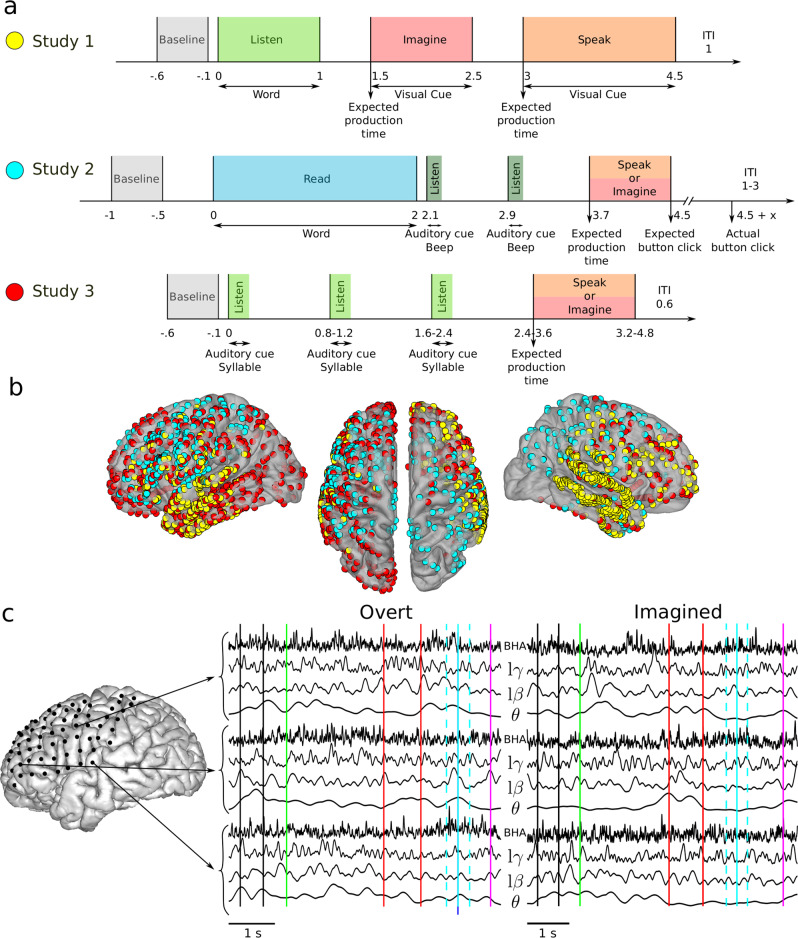
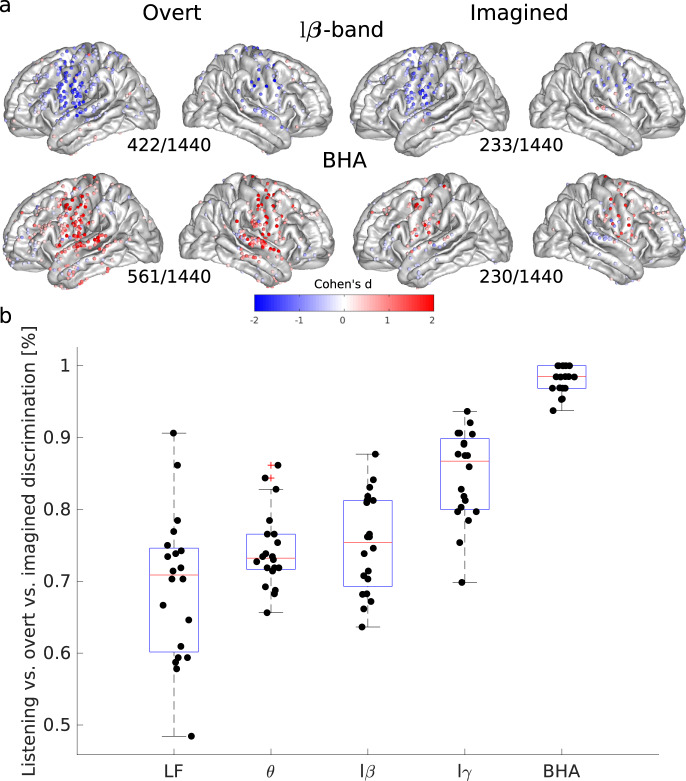
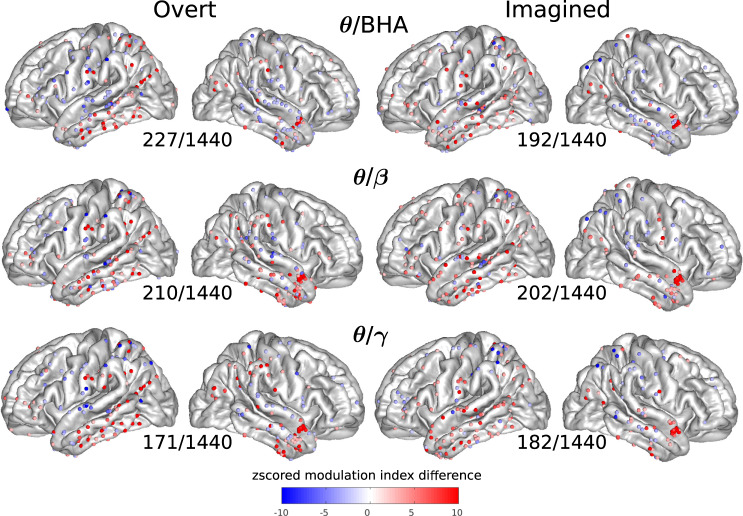
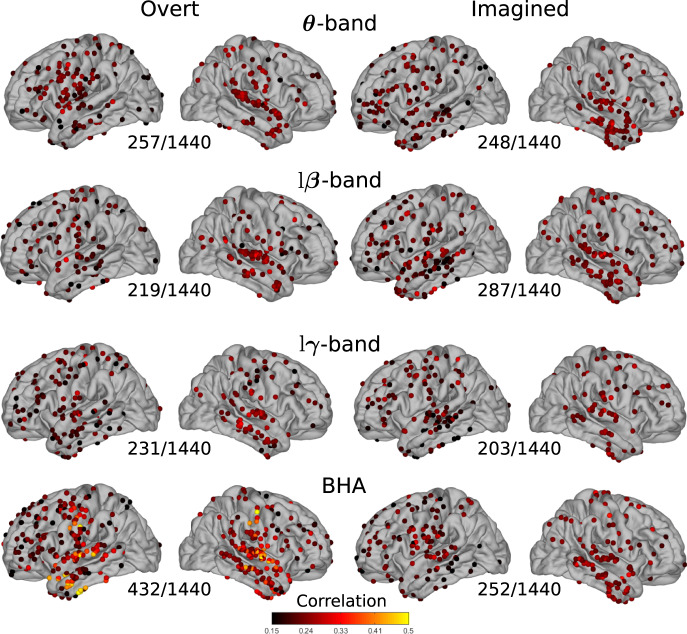
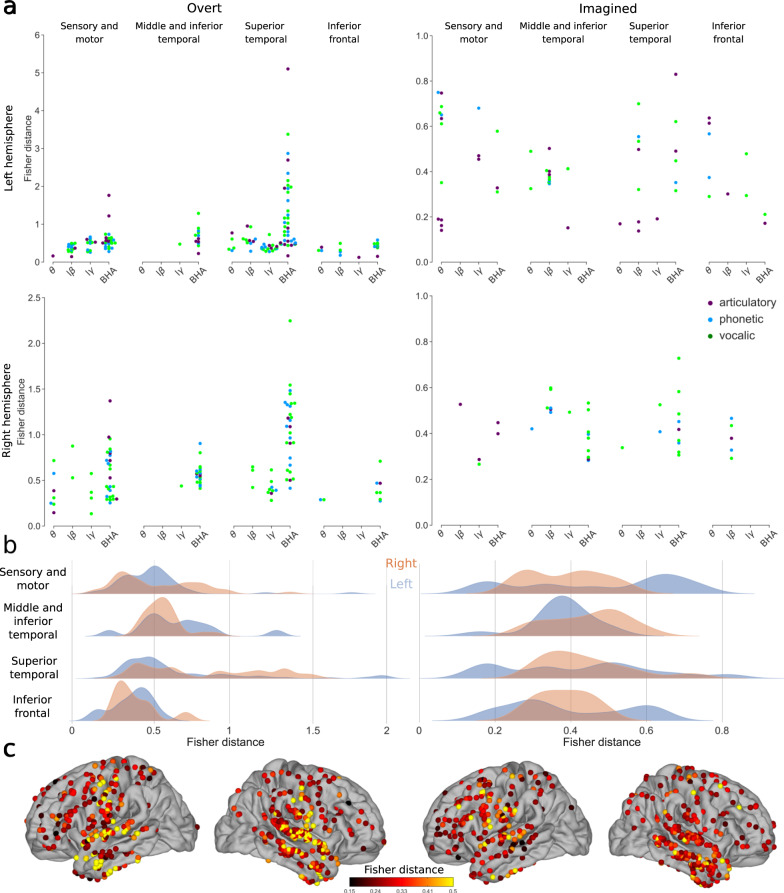
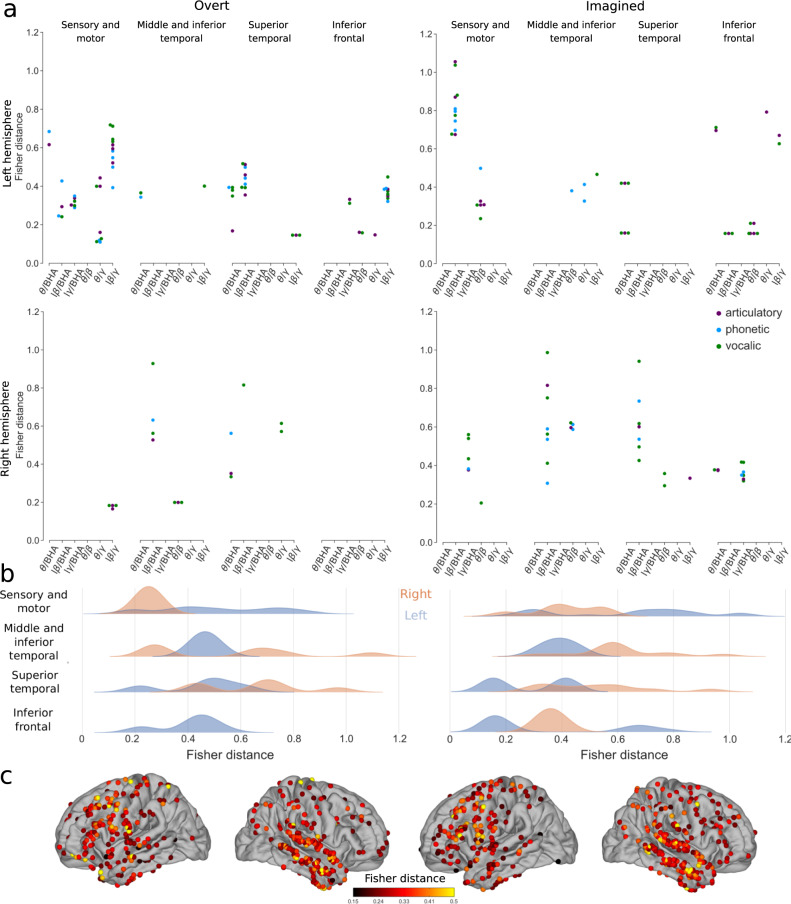
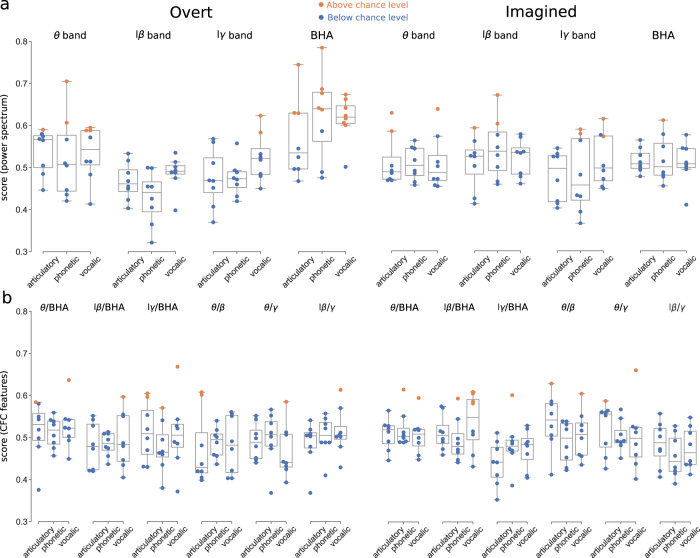
Reconstructing intended speech from neural activity using brain-computer interfaces holds great promises for people with severe speech production deficits. While decoding overt speech has progressed, decoding imagined speech has met limited success, mainly because the associated neural signals are weak and variable compared to overt speech, hence difficult to decode by learning algorithms. We obtained three electrocorticography datasets from 13 patients, with electrodes implanted for epilepsy evaluation, who performed overt and imagined speech production tasks. Based on recent theories of speech neural processing, we extracted consistent and specific neural features usable for future brain computer interfaces, and assessed their performance to discriminate speech items in articulatory, phonetic, and vocalic representation spaces. While high-frequency activity provided the best signal for overt speech, both low- and higher-frequency power and local cross-frequency contributed to imagined speech decoding, in particular in phonetic and vocalic, i.e. perceptual, spaces. These findings show that low-frequency power and cross-frequency dynamics contain key information for imagined speech decoding.
Overview
The claims and statistics of this paper haven’t been checked yet.
Free: it reads the open-access text and checks the first 5 claims that cite a source we can check. Create a free account to check every claim.
Integrity signals
Registry
Cites
Statistics
Figures
Verification
Claims the paper makes
The claims and statistics of this paper haven’t been checked yet.
Free: it reads the open-access text and checks the first 5 claims that cite a source we can check. Create a free account to check every claim.
Claims other papers make about this one
Each is checked against this paper’s own text: does it say what the citing paper says it does?
The source backs part of the claim, not all of it — or backs it for a different population, condition or comparison.
In the citing paper
“Along these lines, when able speakers are instructed to imagine speaking or hearing a word, neural activity in the STG can be used to decode those words with above-chance accuracy59–63.”
From The speech neuroprosthesis (2024) · cites this paper as [62]
Experimental — accuracy not yet measuredThe cited source says what the claim attributes to it.
In the citing paper
“Both neuroimaging and electrophysiological studies have shown that inner speech engages a similar (but not identical) cortical network as physically produced speech34–36”
From Inner speech in motor cortex and implications for speech neuroprostheses (2025) · cites this paper as [36]
Self-check
Percentages, sums and reported differences re-computed from the paper’s own numbers.
The self-check needs the paper’s full text.
Citations
Cites
Controlling the False Discovery Rate: A Practical and Powerful Approach to Multiple Testing
Benjamini, Y., & Hochberg, Y. (1995) · Journal of the Royal Statistical Society Series B: Statistical Methodology · doi:10.1111/j.2517-6161.1995.tb02031.x · Cited by 109,482
Fischl, B. (2012) · NeuroImage · doi:10.1016/j.neuroimage.2012.01.021 · Cited by 9,526
BCI2000: A General-Purpose Brain-Computer Interface (BCI) System
Schalk, G., McFarland, D. J., Hinterberger, T., Birbaumer, N., & Wolpaw, J. R. (2004) · IEEE Transactions on Biomedical Engineering · doi:10.1109/tbme.2004.827072 · Cited by 3,024
Reach and grasp by people with tetraplegia using a neurally controlled robotic arm
Hochberg, L. R., Bacher, D., Jarosiewicz, B., Masse, N. Y., Simeral, J. D., Vogel, J., Haddadin, S., Liu, J., Cash, S. S., van der Smagt, P., et al. (2012) · Nature · doi:10.1038/nature11076 · Cited by 2,719
The spatial and temporal signatures of word production components
Indefrey, P., & Levelt, W. J. M. (2004) · Cognition · doi:10.1016/j.cognition.2002.06.001 · Cited by 2,144
Cortical oscillations and speech processing: emerging computational principles and operations
Giraud, A.-L., & Poeppel, D. (2012) · Nature Neuroscience · doi:10.1038/nn.3063 · Cited by 1,917
Self-citationAn integrated theory of language production and comprehension
Pickering, M. J., & Garrod, S. (2013) · Behavioral and Brain Sciences · doi:10.1017/s0140525x12001495 · Cited by 1,569
Measuring Phase-Amplitude Coupling Between Neuronal Oscillations of Different Frequencies
Tort, A. B. L., Komorowski, R., Eichenbaum, H., & Kopell, N. (2010) · Journal of Neurophysiology · doi:10.1152/jn.00106.2010 · Cited by 1,363
Neuroscience Needs Behavior: Correcting a Reductionist Bias
Krakauer, J. W., Ghazanfar, A. A., Gomez-Marin, A., MacIver, M. A., & Poeppel, D. (2017) · Neuron · doi:10.1016/j.neuron.2016.12.041 · Cited by 1,358
Self-citationPulvermüller, F. (1999) · Behavioral and Brain Sciences · doi:10.1017/s0140525x9900182x · Cited by 1,284
A global averaging method for dynamic time warping, with applications to clustering
Petitjean, F., Ketterlin, A., & Gançarski, P. (2011) · Pattern Recognition · doi:10.1016/j.patcog.2010.09.013 · Cited by 1,138
Cortical oscillations and sensory predictions
Arnal, L. H., & Giraud, A.-L. (2012) · Trends in Cognitive Sciences · doi:10.1016/j.tics.2012.05.003 · Cited by 1,114
Self-citationDifferent Origins of Gamma Rhythm and High-Gamma Activity in Macaque Visual Cortex
Ray, S., & Maunsell, J. H. R. (2011) · PLoS Biology · doi:10.1371/journal.pbio.1000610 · Cited by 1,012
Phonetic Feature Encoding in Human Superior Temporal Gyrus
Mesgarani, N., Cheung, C., Johnson, K., & Chang, E. F. (2014) · Science · doi:10.1126/science.1245994 · Cited by 993
Huth, A. G., Nishimoto, S., Vu, A. T., & Gallant, J. L. (2012) · Neuron · doi:10.1016/j.neuron.2012.10.014 · Cited by 896
Speech synthesis from neural decoding of spoken sentences
Anumanchipalli, G. K., Chartier, J., & Chang, E. F. (2019) · Nature · doi:10.1038/s41586-019-1119-1 · Cited by 883
Inner Speech: Development, Cognitive Functions, Phenomenology, and Neurobiology
Alderson-Day, B., & Fernyhough, C. (2015) · Psychological Bulletin · doi:10.1037/bul0000021 · Cited by 864
Yarkoni, T. (2022) · Behavioral and Brain Sciences · doi:10.1017/s0140525x20001685 · Cited by 701
Functional organization of human sensorimotor cortex for speech articulation
Bouchard, K. E., Mesgarani, N., Johnson, K., & Chang, E. F. (2013) · Nature · doi:10.1038/nature11911 · Cited by 686
Speech rhythms and multiplexed oscillatory sensory coding in the human brain
Gross, J., Hoogenboom, N., Thut, G., Schyns, P., Panzeri, S., Belin, P., & Garrod, S. (2013) · PLoS Biology · doi:10.1371/journal.pbio.1001752 · Cited by 643
Cortical activity during motor execution, motor imagery, and imagery-based online feedback
Miller, K. J., Schalk, G., Fetz, E. E., den Nijs, M., Ojemann, J. G., & Rao, R. P. N. (2010) · Proceedings of the National Academy of Sciences · doi:10.1073/pnas.0913697107 · Cited by 622
Untangling cross-frequency coupling in neuroscience
Aru, J., Aru, J., Priesemann, V., Wibral, M., Lana, L., Pipa, G., Singer, W., & Vicente, R. (2015) · Current Opinion in Neurobiology · doi:10.1016/j.conb.2014.08.002 · Cited by 608
Combrisson, E., & Jerbi, K. (2015) · Journal of Neuroscience Methods · doi:10.1016/j.jneumeth.2015.01.010 · Cited by 599
Neuroprosthesis for Decoding Speech in a Paralyzed Person with Anarthria
Moses, D. A., Metzger, S. L., Liu, J. R., Anumanchipalli, G. K., Makin, J. G., Sun, P. F., Chartier, J., Dougherty, M. E., Liu, P. M., Abrams, G. M., et al. (2021) · New England Journal of Medicine · doi:10.1056/nejmoa2027540 · Cited by 582
Synchronous Oscillatory Neural Ensembles for Rules in the Prefrontal Cortex
Buschman, T. J., Denovellis, E. L., Diogo, C., Bullock, D., & Miller, E. K. (2012) · Neuron · doi:10.1016/j.neuron.2012.09.029 · Cited by 436
Toward a universal decoder of linguistic meaning from brain activation
Pereira, F., Lou, B., Pritchett, B., Ritter, S., Gershman, S. J., Kanwisher, N., Botvinick, M., & Fedorenko, E. (2018) · Nature Communications · doi:10.1038/s41467-018-03068-4 · Cited by 324
Machine translation of cortical activity to text with an encoder–decoder framework
Makin, J. G., Moses, D. A., & Chang, E. F. (2020) · Nature Neuroscience · doi:10.1038/s41593-020-0608-8 · Cited by 321
Perrone-Bertolotti, M., Rapin, L., Lachaux, J.-P., Baciu, M., & Lœvenbruck, H. (2014) · Behavioural Brain Research · doi:10.1016/j.bbr.2013.12.034 · Cited by 317
A Wireless Brain-Machine Interface for Real-Time Speech Synthesis
Guenther, F. H., Brumberg, J. S., Wright, E. J., Nieto-Castanon, A., Tourville, J. A., Panko, M., Law, R., Siebert, S. A., Bartels, J. L., Andreasen, D. S., et al. (2009) · PLoS ONE · doi:10.1371/journal.pone.0008218 · Cited by 306
Inferring imagined speech using EEG signals: a new approach using Riemannian manifold features
Nguyen, C. H., Karavas, G. K., & Artemiadis, P. (2018) · Journal of Neural Engineering · doi:10.1088/1741-2552/aa8235 · Cited by 289
Monitoring the Time Course of Phonological Encoding
Wheeldon, L. R., & Levelt, W. J. M. (1995) · Journal of Memory and Language · doi:10.1006/jmla.1995.1014 · Cited by 286
Fontolan, L., Morillon, B., Liegeois-Chauvel, C., & Giraud, A.-L. (2014) · Nature Communications · doi:10.1038/ncomms5694 · Cited by 276
Self-citationLayer and rhythm specificity for predictive routing
Bastos, A. M., Lundqvist, M., Waite, A. S., Kopell, N., & Miller, E. K. (2020) · Proceedings of the National Academy of Sciences · doi:10.1073/pnas.2014868117 · Cited by 268
Proactive Sensing of Periodic and Aperiodic Auditory Patterns
Rimmele, J. M., Morillon, B., Poeppel, D., & Arnal, L. H. (2018) · Trends in Cognitive Sciences · doi:10.1016/j.tics.2018.08.003 · Cited by 267
Self-citationMental imagery of speech and movement implicates the dynamics of internal forward models
Tian, X. (2010) · Frontiers in Psychology · doi:10.3389/fpsyg.2010.00166 · Cited by 259
Self-citationGroppe, D. M., Bickel, S., Dykstra, A. R., Wang, X., Mégevand, P., Mercier, M. R., Lado, F. A., Mehta, A. D., & Honey, C. J. (2017) · Journal of Neuroscience Methods · doi:10.1016/j.jneumeth.2017.01.022 · Cited by 245
Self-citationPei, X., Barbour, D. L., Leuthardt, E. C., & Schalk, G. (2011) · Journal of Neural Engineering · doi:10.1088/1741-2560/8/4/046028 · Cited by 237
A predictive coding framework for rapid neural dynamics during sentence-level language comprehension
Lewis, A. G., & Bastiaansen, M. (2015) · Cortex · doi:10.1016/j.cortex.2015.02.014 · Cited by 216
Encoding of Articulatory Kinematic Trajectories in Human Speech Sensorimotor Cortex
Chartier, J., Anumanchipalli, G. K., Johnson, K., & Chang, E. F. (2018) · Neuron · doi:10.1016/j.neuron.2018.04.031 · Cited by 208
Pei, X., Leuthardt, E. C., Gaona, C. M., Brunner, P., Wolpaw, J. R., & Schalk, G. (2011) · NeuroImage · doi:10.1016/j.neuroimage.2010.10.029 · Cited by 204
Decoding spectrotemporal features of overt and covert speech from the human cortex
Martin, S., Brunner, P., Holdgraf, C., Heinze, H.-J., Crone, N. E., Rieger, J., Schalk, G., Knight, R. T., & Pasley, B. N. (2014) · Frontiers in Neuroengineering · doi:10.3389/fneng.2014.00014 · Cited by 200
Self-citationDissociation of broadband high-frequency activity and neuronal firing in the neocortex
Leszczyński, M., Barczak, A., Kajikawa, Y., Ulbert, I., Falchier, A. Y., Tal, I., Haegens, S., Melloni, L., Knight, R. T., & Schroeder, C. E. (2020) · Science Advances · doi:10.1126/sciadv.abb0977 · Cited by 188
Self-citationMorillon, B., Arnal, L. H., Schroeder, C. E., & Keitel, A. (2019) · Neuroscience & Biobehavioral Reviews · doi:10.1016/j.neubiorev.2019.09.012 · Cited by 182
Self-citationMental imagery of speech implicates two mechanisms of perceptual reactivation.
Tian, X., Zarate, J. M., & Poeppel, D. (2016) · Cortex · doi:10.1016/j.cortex.2016.01.002 · Cited by 178
Self-citationThe neural correlates of inner speech defined by voxel-based lesion-symptom mapping
Geva, S., Jones, P. S., Crinion, J. T., Price, C. J., Baron, J.-C., & Warburton, E. A. (2011) · Brain · doi:10.1093/brain/awr232 · Cited by 173
Tian, X., & Poeppel, D. (2013) · Journal of Cognitive Neuroscience · doi:10.1162/jocn_a_00381 · Cited by 172
Self-citationWord pair classification during imagined speech using direct brain recordings
Martin, S., Brunner, P., Iturrate, I., Millán, J. D. R., Schalk, G., Knight, R. T., & Pasley, B. N. (2016) · Scientific Reports · doi:10.1038/srep25803 · Cited by 171
Self-citationDamage to Broca’s area does not contribute to long-term speech production outcome after stroke
Gajardo-Vidal, A., Lorca-Puls, D. L., team, P., Warner, H., Pshdary, B., Crinion, J. T., Leff, A. P., Hope, T. M. H., Geva, S., Seghier, M. L., et al. (2021) · Brain · doi:10.1093/brain/awaa460 · Cited by 150
Motor movement matters: The flexible abstractness of inner speech
Oppenheim, G. M., & Dell, G. S. (2010) · Memory & Cognition · doi:10.3758/mc.38.8.1147 · Cited by 145
Steinschneider, M., Fishman, Y. I., & Arezzo, J. C. (2008) · Cerebral Cortex · doi:10.1093/cercor/bhm094 · Cited by 132
A psychologically-based taxonomy of misdirection
Kuhn, G., Caffaratti, H. A., Teszka, R., & Rensink, R. A. (2014) · Frontiers in Psychology · doi:10.3389/fpsyg.2014.01392 · Cited by 126
Angrick, M., Ottenhoff, M. C., Diener, L., Ivucic, D., Ivucic, G., Goulis, S., Saal, J., Colon, A. J., Wagner, L., Krusienski, D. J., et al. (2021) · Communications Biology · doi:10.1038/s42003-021-02578-0 · Cited by 125
Decoding Imagined and Spoken Phrases From Non-invasive Neural (MEG) Signals
Dash, D., Ferrari, P., & Wang, J. (2020) · Frontiers in Neuroscience · doi:10.3389/fnins.2020.00290 · Cited by 124
Pefkou, M., Arnal, L. H., Fontolan, L., & Giraud, A. (2017) · Journal of Neuroscience · doi:10.1523/jneurosci.2882-16.2017 · Cited by 122
Self-citationMarchesotti, S., Nicolle, J., Merlet, I., Arnal, L. H., Donoghue, J. P., & Giraud, A. (2020) · PLoS Biology · doi:10.1371/journal.pbio.3000833 · Cited by 110
Self-citationNeurolinguistics Research Advancing Development of a Direct-Speech Brain-Computer Interface
Cooney, C., Folli, R., & Coyle, D. (2018) · iScience · doi:10.1016/j.isci.2018.09.016 · Cited by 106
Cooney, C., Korik, A., Folli, R., & Coyle, D. (2020) · Sensors · doi:10.3390/s20164629 · Cited by 106
Hovsepyan, S., Olasagasti, I., & Giraud, A. (2020) · Nature Communications · doi:10.1038/s41467-020-16956-5 · Cited by 105
Self-citationSpatiotemporal dynamics of information encoding revealed in orbitofrontal high-gamma
Rich, E. L., & Wallis, J. D. (2017) · Nature Communications · doi:10.1038/s41467-017-01253-5 · Cited by 104
Decoding spoken English from intracortical electrode arrays in dorsal precentral gyrus
Wilson, G. H., Stavisky, S. D., Willett, F. R., Avansino, D. T., Kelemen, J. N., Hochberg, L. R., Henderson, J. M., Druckmann, S., & Shenoy, K. V. (2020) · Journal of Neural Engineering · doi:10.1088/1741-2552/abbfef · Cited by 103
Time-series averaging using constrained dynamic time warping with tolerance
Morel, M., Achard, C., Kulpa, R., & Dubuisson, S. (2017) · Pattern Recognition · doi:10.1016/j.patcog.2017.08.015 · Cited by 79
Key considerations in designing a speech brain-computer interface
Bocquelet, F., Hueber, T., Girin, L., Chabardès, S., & Yvert, B. (2016) · Journal of Physiology-Paris · doi:10.1016/j.jphysparis.2017.07.002 · Cited by 73
Switchless Multiplexing of Graphene Active Sensor Arrays for Brain Mapping
Garcia-Cortadella, R., Schäfer, N., Cisneros-Fernandez, J., Ré, L., Illa, X., Schwesig, G., Moya, A., Santiago, S., Guirado, G., Villa, R., et al. (2020) · Nano Letters · doi:10.1021/acs.nanolett.0c00467 · Cited by 65
Rainey, S., Martin, S., Christen, A., Mégevand, P., & Fourneret, E. (2020) · Science and Engineering Ethics · doi:10.1007/s11948-020-00218-0 · Cited by 65
Self-citationInner speech captures the perception of external speech
Scott, M., Yeung, H. H., Gick, B., & Werker, J. F. (2013) · The Journal of the Acoustical Society of America · doi:10.1121/1.4794932 · Cited by 62
Livezey, J. A., Bouchard, K. E., & Chang, E. F. (2019) · PLOS Computational Biology · doi:10.1371/journal.pcbi.1007091 · Cited by 58
Misidentifications of specific forms of cross-frequency coupling: three warnings
Hyafil, A. (2015) · Frontiers in Neuroscience · doi:10.3389/fnins.2015.00370 · Cited by 53
Roussel, P., Godais, G. L., Bocquelet, F., Palma, M., Hongjie, J., Zhang, S., Giraud, A.-L., Mégevand, P., Miller, K., Gehrig, J., et al. (2020) · Journal of Neural Engineering · doi:10.1088/1741-2552/abb25e · Cited by 49
Self-citationDissociation of broadband high-frequency activity and neuronal firing in the neocortexPreprint
Leszczyński, M., Barczak, A., Kajikawa, Y., Ulbert, I., Falchier, A., Tal, I., Haegens, S., Melloni, L., Knight, R. T., & Schroeder, C. E. (2019) · bioRxiv (Cold Spring Harbor Laboratory) · doi:10.1101/531368 · Cited by 37
Self-citationMEG Sensor Selection for Neural Speech Decoding
Dash, D., Wisler, A., Ferrari, P., Davenport, E. M., Maldjian, J., & Wang, J. (2020) · IEEE Access · doi:10.1109/access.2020.3028831 · Cited by 37
Oscillations for all ¯\_(ツ)_/¯? A commentary on Meyer, Sun & Martin (2020)
Giraud, A. (2020) · Language Cognition and Neuroscience · doi:10.1080/23273798.2020.1764990 · Cited by 33
Self-citationBowers, A. L., Saltuklaroglu, T., Jenson, D. E., Harkrider, A. W., & Thornton, D. M. (2018) · Experimental Brain Research · doi:10.1007/s00221-018-5447-4 · Cited by 29
Low-Frequency Oscillations Code Speech during Verbal Working Memory
Gehrig, J., Michalareas, G., Forster, M.-T., Lei, J., Hok, P., Laufs, H., Senft, C., Seifert, V., Schoffelen, J., Hanslmayr, S., et al. (2019) · Journal of Neuroscience · doi:10.1523/jneurosci.0018-19.2019 · Cited by 28
Kühn, S., Fernyhough, C., Alderson-Day, B., & Hurlburt, R. T. (2014) · Frontiers in Psychology · doi:10.3389/fpsyg.2014.01393 · Cited by 27
Angrick, M., Ottenhoff, M. C., Diener, L., et al. (2020) · bioRxiv (Cold Spring Harbor Laboratory) · doi:10.1101/2020.12.11.421149 · Cited by 23
Mental operations in rhythm: Motor-to-sensory transformation mediates imagined singing
Li, Y., Luo, H., & Tian, X. (2020) · PLoS Biology · doi:10.1371/journal.pbio.3000504 · Cited by 22
Self-citationMarchesotti, S., Nicolle, J., Merlet, I., et al. (2020) · bioRxiv (Cold Spring Harbor Laboratory) · doi:10.1101/2020.04.15.042770 · Cited by 7
Research works printed but not linked: 1
- Rezazadeh Sereshkeh A Yousefi R Wong AT Rudzicz F Chau T Development of a ternary hybrid fNIRS-EEG brain–computer interface based on imagined speech. Brain-Comput Interfaces 2019 6 128 140
Cited by
Metzger, S. L., Liu, J. R., Moses, D. A., Dougherty, M. E., Seaton, M. P., Littlejohn, K. T., Chartier, J., Anumanchipalli, G. K., Tu-Chan, A., Ganguly, K., et al. (2022) · Nature Communications · doi:10.1038/s41467-022-33611-3 · Cited by 153
Kim, T., Shin, Y., Kang, K., Kim, K., Kim, G., Byeon, Y., Kim, H., Gao, Y., Lee, J. R., Son, G., et al. (2022) · Nature Communications · doi:10.1038/s41467-022-33457-9 · Cited by 157
Silva, A. B., Littlejohn, K. T., Liu, J. R., Moses, D. A., & Chang, E. F. (2024) · Nature Reviews Neuroscience · doi:10.1038/s41583-024-00819-9 · Cited by 103
Luo, S., Angrick, M., Coogan, C., Candrea, D. N., Wyse‐Sookoo, K., Shah, S., Rabbani, Q., Milsap, G. W., Weiss, A. R., Anderson, W. S., et al. (2023) · Advanced Science · doi:10.1002/advs.202304853 · Cited by 90
Tang, C., Xu, M., Yi, W., Zhang, Z., Occhipinti, E., Dong, C., Ravenscroft, D., Jung, S., Lee, S., Gao, S., et al. (2024) · npj Flexible Electronics · doi:10.1038/s41528-024-00315-1 · Cited by 112
Metadata
- Authors
- Proix, T., Delgado Saa, J., Christen, A., Martin, S., Pasley, B. N., Knight, R. T., Tian, X., Poeppel, D., Doyle, W. K., Devinsky, O., Arnal, L. H., Mégevand, P., & Giraud, A.-L.
- Affiliations
- University of Geneva (CH)
- University of California, Berkeley (US)
- New York University Shanghai (CN)
- Ernst Strüngmann Institute for Neuroscience (DE)
- New York University (US)
- Inserm (FR)
- Corresponding author
- Proix, Timothée
- Venue
- Nature Communications
- Published
- 2022-01-10
- Volume
- 13
- Issue
- 1
- Pages
- 48-48
- ISSN
- 2041-1723 (ISSN-L)
- PMC
- PMC8748882
- OpenAlex
- W4205549622
- Cited by
- 212
- References
- 74
- Citations by year
- 2026: 36 · 2025: 58 · 2024: 67 · 2023: 27 · 2022: 23
- FWCI
- 22.56
- Type
- journal article
- Language
- en
- Open access
- gold
- doi.org
- Licence
- cc-by
- creativecommons.org/licenses/by/4.0 (tdm)
- creativecommons.org/licenses/by/4.0 (vor)
- Locations
- Nature Communications (publishedVersion, cc-by)
- PubMed Central (publishedVersion, cc-by)
- PubMed (publishedVersion)
- Archive ouverte UNIGE (University of Geneva) (publishedVersion, other-oa)
- HAL (submittedVersion, cc-by)
- RePEc: Research Papers in Economics (submittedVersion)
- DOAJ (DOAJ: Directory of Open Access Journals) (submittedVersion, cc-by-sa)
- Archive ouverte UNIGE (University of Geneva) (submittedVersion, cc-by)
- Funders
- National Science Foundation
- Natural Science Foundation of Shanghai (20ZR1472100, B16018, 32071099)
- New York University Shanghai
- Fondation Pour l'Audition (RD-2020-10, FPA RD‐2020‐10)
- Schweizerischer Nationalfonds zur Förderung der Wissenschaftlichen Forschung (180888, 167836, 193542, 163040)
- National Natural Science Foundation of China (2020-10, 20ZR1472100, 32071099, B16018)
- National Institutes of Health (2r01ns021135-33)
- Project 211 (32071099, Base B16018, 20ZR1472100, B16018)
- National Institute of Neurological Disorders and Stroke (R01 NS-021135)
- Topics
- Life Sciences › Neuroscience › Cognitive Neuroscience › EEG and Brain-Computer Interfaces
- Life Sciences › Neuroscience › Cognitive Neuroscience › Neurobiology of Language and Bilingualism
- Life Sciences › Neuroscience › Cognitive Neuroscience › Neural dynamics and brain function
- Keywords
- imagined speech, speech decoding, intracranial EEG, electrocorticography, brain-computer interface, cross-frequency coupling, low-frequency power, overt speech, phonetic representation, articulatory representation, speech production deficits, epilepsy patients
- MeSH terms
- Electrocorticography, Adult, Brain, Brain Mapping, Electrodes, Female, Humans, Imagination, Language, Male, Middle Aged, Phonetics, Speech, Young Adult, Brain-Computer Interfaces
About these checks
Registry, retraction, Cites and statistics results are computed, not judged, with one exception: a printed reference that no index lists is read once by a model before it counts as a citation error. Claims are extracted by a model and kept only when their quote appears verbatim in the text; each cited source is then checked, with a model’s help, for whether it says what the claim relies on. Those verdicts can be wrong — read the claim’s quote and the cited source before relying on one.
Statistics and arithmetic are recomputed, not judged.
Confidence bands are shown only for fields calibrated on our annotated test set. None is calibrated yet, so no band is shown.
What counts as a claim ›How we measure confidence ›How we check this ›
Are you an author, or do you see a problem with this page? Request a review
Data sources
Bibliographic data: Semantic Scholar, OpenAlex, Crossref.
Contains information from the Semantic Scholar Academic Graph Datasets, made available under the ODC Attribution License (ODC-BY 1.0).
Semantic Scholar’s data is described in: Kinney, R., et al. (2023). The Semantic Scholar Open Data Platform. arXiv:2301.10140.
