

Key points for the development of antioxidant cocktails to prevent cellular stress and damage caused by reactive oxygen species (ROS) during manned space missions
Open accessThe DOI matches its Crossref record; 251 of the 260 references it cites were found in a registry or an index; 132 of the 231 sources its claims cite were checked for support.
Abstract
Exposure to microgravity and ionizing radiation during spaceflight missions causes excessive reactive oxygen species (ROS) production that contributes to cellular stress and damage in astronauts. Average spaceflight mission time is expected to lengthen as humanity aims to visit other planets. However, longer missions or spaceflights will undoubtedly lead to an increment in microgravity, ionizing radiation and ROS production. Strategies to minimize ROS damage are necessary to maintain the health of astronauts, future space colonists, and tourists during and after spaceflight missions. An antioxidant cocktail formulated to prevent or mitigate ROS damage during space exploration could help maintain the health of space explorers. We propose key points to consider when developing an antioxidant cocktail. We discuss how ROS damages our body and organs, the genetic predisposition of astronauts to its damage, characteristics and evidence of the effectiveness of antioxidants to combat excess ROS, differences in drug metabolism when on Earth and in space that could modify antioxidant effects, and the characteristics and efficacy of common antioxidants. Based on this information we propose a workflow for assessing astronaut resistance to ROS damage, infight monitoring of ROS production, and an antioxidant cocktail. Developing an antioxidant cocktail represents a big challenge to translate current medical practices from an Earth setting to space. The key points presented in this review could promote the development of different antioxidant formulations to maintain space explorers' health in the future.
Overview
CoChat Summary
## TL;DR
This perspective review argues that microgravity and ionizing radiation increase ROS in astronauts, contributing to cellular stress, aging, and organ damage, and that a personalized antioxidant cocktail could help mitigate these effects. The authors propose using genetic stratification plus inflight biomarker monitoring to tailor antioxidant supplementation for space missions.
## Key findings
- Spaceflight exposes astronauts to major ROS-related risks: the paper states astronauts are exposed to 100 times more ionizing radiation than the general population, and that microgravity plus radiation increase ROS-driven damage to cells, tissues, and organs.
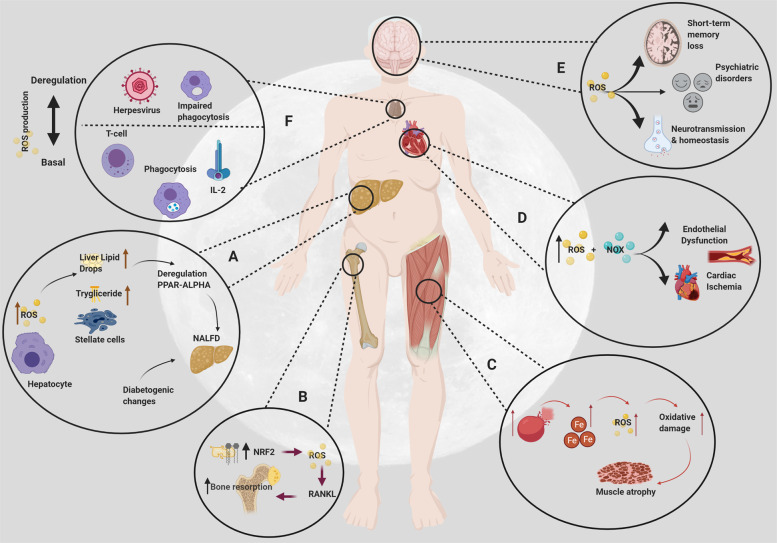
- The review links excess ROS to multiple systems, including musculoskeletal, cardiovascular, neurological, immunological, and hepatic damage; examples cited include 20% muscle mass loss after 2 weeks of spaceflight and up to 30% loss during 3–6 month missions.
- The paper reports evidence that spaceflight alters oxidative stress markers, including 32% higher urinary 8-hydroxy-2′-deoxyguanosine (8OHdG) upon landing, reduced red blood cell SOD, and decreased plasma γ-tocopherol by 50% after 4–6 months in space.
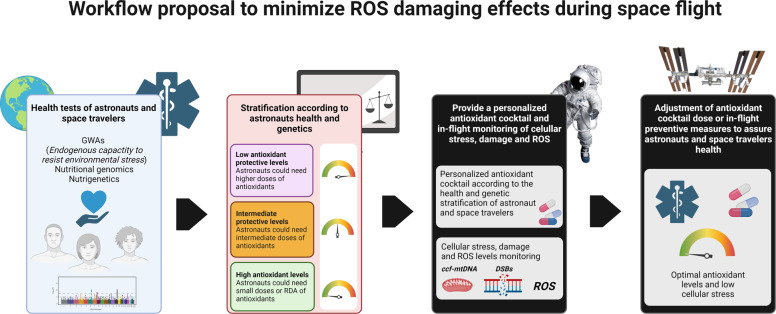
- The authors propose a personalized prevention framework: GWAS/nutrigenetics-based stratification, plus inflight monitoring of ROS and damage markers such as ccf-mtDNA, DSBs, 8OHdG, and antioxidant levels, to guide antioxidant dosing.
## Methods
- Design: Narrative perspective/review focused on developing antioxidant cocktails for manned space missions; not an empirical primary study.
- Data/source base: Synthesis of biomedical literature, including human spaceflight reports, animal studies, in vitro studies, and randomized clinical trials summarized in supplementary tables.
- Main analysis: The paper qualitatively reviews ROS biology, organ-specific spaceflight damage, antioxidant candidates, pharmacokinetic/pharmacodynamic issues in space, and proposes a workflow for individualized antioxidant supplementation and inflight biomarker monitoring.
## Limitations
- The paper explicitly notes that more research is needed to determine the best antioxidant doses for each scenario and that recommended doses in the article are only references.
- It states that few studies have assessed antioxidant levels in astronauts before missions, and that studies of antioxidant pharmacokinetics/pharmacodynamics in space have small sample sizes, inconsistent methodology, and limited parameter reporting.
- The text makes evident that this is not an experimental validation of the proposed cocktail or workflow: the paper proposes a strategy, but does not test it in astronauts.
Model-written summary. Check it against the paper before relying on it.
Integrity signals
Registry
Cites
Statistics
Figures
Verification
Claims the paper makes
101 Valid · 6 Not valid · 60 Not checked · 20 Own results and interpretations
At least one cited source doesn’t support this claim or points to a different paper, and none confirmed it — see the verdicts below.
In the paper
“An astronaut can lose anywhere between 1 and 2% of total muscle mass per month depending on the individuals’ physiology83.”
§ Key points for the development of antioxidant cocktails to prevent cellular stress and damage caused by reactive oxygen species (ROS) during manned space missions > Musculoskeletal damages and ROS
What the sources say
- Disputedcites [83] Williams D Kuipers A Mukai C Thirsk R Acclimation during space flight: effects on human physiology CMAJ 2009 180 1317 1323 10.1503/cmaj.090628 19509005 PMC2696527 sourceExperimental — accuracy not yet measured
The Muscle atrophy section reports muscle-mass losses of up to 20% after two weeks and 30% on missions lasting three to six months, not 1%–2% per month. The paper assigns the 1%–2% monthly figure to bone-density loss in weight-bearing bones, with variation between individuals and bone sites. (LLM, conf=0.88)
Checked by a reasoning model — may be wrong.
plain- Asserted: passes — The authors put it forward as true.
- Checkable: passes — It can be checked against evidence.
- Load-bearing: passes — The paper’s conclusions depend on it.
- Based: passes — The paper gives a reason why it holds.
- Disputed
Some cited sources support this claim and some don’t — read each source’s verdict below.
In the paper
“Numerous studies have shown that the intake of exogenous CoQ10 could help to prevent the progression of illness, such as heart failure, metabolic syndrome, NAFLD, diabetes mellitus, and several neurodegenerative diseases177,181–186.”
§ Key points for the development of antioxidant cocktails to prevent cellular stress and damage caused by reactive oxygen species (ROS) during manned space missions > Immunological damage and ROS > Coenzyme Q 10 (CoQ10)
What the sources say
- Not checked — no full text of the sourcecites [177] Yang Y-K Coenzyme Q10 treatment of cardiovascular disorders of ageing including heart failure, hypertension and endothelial dysfunction Clin. Chim. Acta 2015 450 83 89 10.1016/j.cca.2015.08.002 26254995 source
- Partly supportedcites [181] Casagrande D Waib PH Jordão Júnior AA Mechanisms of action and effects of the administration of Coenzyme Q10 on metabolic syndrome J. Nutr. Intermed. Metab. 2018 13 26 32 10.1016/j.jnim.2018.08.002 sourceExperimental — accuracy not yet measured
Section 2.10 of our copy reports trials of 100 mg/day CoQ10 supplementation improving biochemical markers in metabolic syndrome, type 2 diabetes and NAFLD (e.g. 'Recent studies have shown that CoQ10 supplementation may be an ally in the treatment of NAFLD'; Farhangi et al. and the Farsi/Mohammadshahi NAFLD trials), so three of the five disease categories in the claim are covered — though as adjunct treatment/marker improvement rather than demonstrated prevention of progression. Heart failure and neurodegenerative diseases are not discussed anywhere in the body text; they appear only as titles in the reference list ([25] Strey et al., chronic heart failure; [29] Santos et al., neurodegenerative diseases), so those parts of the claim have no support in our copy. The Conclusion (§3) further hedges the overall point: 'Supplementation with CoQ10 in the treatment of pathologies such as obesity, MS and NAFLD is still not clear', and §2.10 cites negative trials (Eriksson et al., Moazen et al.), which cuts against 'numerous studies have shown'. (LLM, conf=0.72)
- Not checked — no full text of the sourcecites [182] Young JM A randomized, double-blind, placebo-controlled crossover study of coenzyme Q10 therapy in hypertensive patients with the metabolic syndrome Am. J. Hypertens. 2012 25 261 270 10.1038/ajh.2011.209 22113168 source
- Partly supportedcites [183] Zhang S-Y Yang K-L Zeng L-T Wu X-H Huang H-Y Effectiveness of coenzyme Q10 supplementation for type 2 diabetes mellitus: a systematic review and meta-analysis Int. J. Endocrinol. 2018 2018 6484839 30305810 PMC6165589 sourceExperimental — accuracy not yet measured
The Discussion and Conclusion report that CoQ10 may improve glycemic control in patients with type 2 diabetes, but they do not establish that it prevents disease progression. This review does not support the sentence’s additional claims about heart failure, metabolic syndrome, NAFLD, or neurodegenerative diseases. (LLM, conf=0.88)
- Not checked — no full text of the sourcecites [184] Madmani, M. E. et al. Coenzyme Q10 for heart failure. Cochrane Database Syst. Rev. CD008684 (2014). 24049047 source
- Disputedcites [185] Orrell, R. W., Lane, R. J. M. & Ross, M. Antioxidant treatment for amyotrophic lateral sclerosis / motor neuron disease. Cochrane Database Syst. Rev. CD002829 (2007). PMC8985756 17253482 sourceExperimental — accuracy not yet measured
The Discussion (page unavailable) concludes that there is no significant evidence antioxidants benefit people with ALS, a neurodegenerative disease, contrary to presenting this review as evidence that CoQ10 helps prevent disease progression. The Background (page unavailable) describes CoQ10 as a suggested treatment, not an established one. The review does not assess heart failure, metabolic syndrome, NAFLD, or diabetes. (LLM, conf=0.84)
Checked by a reasoning model — may be wrong.
- Disputedcites [186] Kearney, M., Orrell, R. W., Fahey, M., Brassington, R. & Pandolfo, M. Pharmacological treatments for Friedreich ataxia. Cochrane Database Syst. Rev. CD007791 (2016). PMC6457808 27572719 sourceExperimental — accuracy not yet measured
Our copy of the Cochrane review never states that exogenous CoQ10 prevents progression of heart failure, metabolic syndrome, NAFLD or diabetes mellitus; its scope is pharmacological treatment of Friedreich ataxia, and CoQ10 appears only as a described antioxidant agent (Antioxidants section) tested in one included trial (Cooper 2008, high-dose vs very low-dose CoQ10 plus vitamin E). For the neurodegenerative disease it does cover, the review says the opposite of demonstrated benefit: Main results reports 'no significant difference between the antioxidant-treated and the placebo groups (mean difference 0.79 points, 95% CI -1.97 to 3.55 points; low-quality evidence)' on the ICARS, and the Authors' Conclusions state that low-quality evidence 'neither supported nor refuted an effect' of CoQ10/vitamin E on neurological status. The only suggestive cardiac finding it lists concerns idebenone (a synthetic CoQ10 analogue) and left ventricular hypertrophy, is mixed across studies (Agreements and disagreements; Why it is important to do this review), and is not a claim about CoQ10 halting disease progression. (LLM, conf=0.70)
Checked by a reasoning model — may be wrong.
hedgedstates a possible cause- Asserted: passes — The authors put it forward as true.
- Checkable: passes — It can be checked against evidence.
- Load-bearing: unclear — It is unclear whether the paper’s conclusions depend on it.
- Based: passes — The paper gives a reason why it holds.
At least one cited source doesn’t support this claim or points to a different paper, and none confirmed it — see the verdicts below.
In the paper
“However, as with all vitamins and nutrients, it is important to not surpass recommended doses, as high concentrations of vitamin E have been shown to be deleterious for health144.”
§ Key points for the development of antioxidant cocktails to prevent cellular stress and damage caused by reactive oxygen species (ROS) during manned space missions > Immunological damage and ROS > Vitamin E
What the sources say
- Disputedcites [144] Abner EL Schmitt FA Mendiondo MS Marcum JL Kryscio RJ Vitamin E and all-cause mortality: a meta-analysis Curr. Aging Sci. 2011 4 158 170 10.2174/1874609811104020158 21235492 PMC4030744 sourceExperimental — accuracy not yet measured
The Discussion (page unavailable) says this meta-analysis found no increased risk of all-cause mortality, including in its dose analyses. It reports an earlier finding of a small mortality increase above 400 IU, but also describes conflicting analyses; it does not establish that high concentrations are deleterious to health. (LLM, conf=0.86)
Checked by a reasoning model — may be wrong.
plainstates a cause- Asserted: passes — The authors put it forward as true.
- Checkable: passes — It can be checked against evidence.
- Load-bearing: passes — The paper’s conclusions depend on it.
- Based: passes — The paper gives a reason why it holds.
- Disputed
Some cited sources support this claim and some don’t — read each source’s verdict below.
In the paper
“The reactivation of HSV has been observed in missions from 10 to >180 days in shuttles and ISS, respectively.”
§ Key points for the development of antioxidant cocktails to prevent cellular stress and damage caused by reactive oxygen species (ROS) during manned space missions > Immunological damage and ROS > Workflow proposal for assessing astronaut’s resistance to ROS damage, infight monitoring of ROS production, cellular stress, and a personalized preventive and inflight ROS protection based on antioxidant cocktail supplementation
What the sources say
- Partly supportedcites [210] Rooney BV Crucian BE Pierson DL Laudenslager ML Mehta SK Herpes virus reactivation in astronauts during spaceflight and its application on earth Front. Microbiol. 2019 10 16 10.3389/fmicb.2019.00016 30792698 PMC6374706 sourceExperimental — accuracy not yet measured
The Abstract (page not provided) reports herpesvirus reactivation on shuttle flights of 10–16 days and ISS flights of at least 180 days, and lists HSV-1 among viruses shed by astronauts. The Introduction’s “Herpes Simplex Virus-1” section (page not provided) documents HSV-1 during a flight longer than 180 days, but does not specifically document HSV reactivation on a 10-day shuttle mission. (LLM, conf=0.82)
- Disputedcites [211] Mehta SK Latent virus reactivation in astronauts on the international space station NPJ Microgravity 2017 3 11 10.1038/s41526-017-0015-y 28649633 PMC5445581 sourceExperimental — accuracy not yet measured
The Abstract (page unavailable) reports no evidence of HSV-1 or HSV-2 reactivation in the astronauts studied; the viruses that reactivated were EBV, VZV, and CMV. It also describes ISS missions of up to 180 days, not more than 180 days. The paper therefore contradicts the claim that HSV reactivation was observed across the stated shuttle and ISS missions. (LLM, conf=0.92)
Checked by a reasoning model — may be wrong.
plain- Asserted: passes — The authors put it forward as true.
- Checkable: passes — It can be checked against evidence.
- Load-bearing: passes — The paper’s conclusions depend on it.
- Based: passes — The paper gives a reason why it holds.
- Partly supported
Every source the paper cites for this claim was checked and supports it.
In the paper
“While large amounts of ROS are harmful, the body does need a baseline level of ROS to aid in important cellular functions, such as cell signaling and redox regulation14.”
§ Key points for the development of antioxidant cocktails to prevent cellular stress and damage caused by reactive oxygen species (ROS) during manned space missions > Introduction > ROS and the importance of developing antioxidant cocktails
What the sources say
- Supportedcites [14] Poljsak B Šuput D Milisav I Achieving the balance between ROS and antioxidants: when to use the synthetic antioxidants Oxid. Med. Cell. Longev. 2013 2013 956792 10.1155/2013/956792 23738047 PMC3657405 source
Section 4 (“Importance of the Balance”) says antioxidant defenses should limit harmful ROS while permitting enough to remain for cell signaling and redox regulation. Section 5 also describes low levels of ROS as signaling molecules. (LLM, conf=0.95)
plainstates a cause- Asserted: passes — The authors put it forward as true.
- Checkable: passes — It can be checked against evidence.
- Load-bearing: passes — The paper’s conclusions depend on it.
- Based: passes — The paper gives a reason why it holds.
- Supported
109 more claims · 58 with their cited sources checked
Create a free account to see all 187 claims and to verify the 2 references still open.
- It may state two separate claims as one. 58
- Probably not a substantial claim. 19
Self-check
Percentages, sums and reported differences re-computed from the paper’s own numbers.
Self-check results appear here once an independent check has confirmed them.
Cited works that were retracted
Works this paper cites that were later retracted, from the retraction notices publishers deposit. Major when the notice came out before this paper was published.
Rated major: it would touch a result — a value a result rests on, reported and recomputed p-values on opposite sides of the significance level, two passages that conflict with no sign which is right, or a cited work retracted before this paper was published.
Cited work 10.1002/14651858.cd012808 · retracted 2019-11-05 · notice 10.1002/14651858.cd012808.pub2 · this paper published 2021-09-23
Citations
Cites
1 retracted
Zinc for preventing and treating the common cold
Hemilä, H., & Chalker, E. (2017) · Cochrane Database of Systematic Reviews · doi:10.1002/14651858.cd012808 · Cited by 32
Retracted(1992) · Applied Ergonomics · doi:10.1016/0003-6870(92)90338-v · Cited by 7,112
ROS function in redox signaling and oxidative stress
Schieber, M., & Chandel, N. S. (2014) · Current Biology · doi:10.1016/j.cub.2014.03.034 · Cited by 6,931
Reactive oxygen species (ROS) homeostasis and redox regulation in cellular signaling
Ray, P. D., Huang, B.-W., & Tsuji, Y. (2012) · Cellular Signalling · doi:10.1016/j.cellsig.2012.01.008 · Cited by 4,373
Rayman, M. P. (2012) · The Lancet · doi:10.1016/s0140-6736(11)61452-9 · Cited by 3,563
Inflammasomes: mechanism of action, role in disease, and therapeutics
Guo, H., Callaway, J. B., & Ting, J. P.-Y. (2015) · Nature Medicine · doi:10.1038/nm.3893 · Cited by 3,340
Physiological Roles of Mitochondrial Reactive Oxygen Species
Sena, L. A., & Chandel, N. S. (2012) · Molecular Cell · doi:10.1016/j.molcel.2012.09.025 · Cited by 2,632
Antioxidants and antioxidant methods: an updated overview
Gulcin, İ. (2020) · Archives of Toxicology · doi:10.1007/s00204-020-02689-3 · Cited by 2,205
Kurutas, E. B. (2015) · Nutrition Journal · doi:10.1186/s12937-016-0186-5 · Cited by 2,152
Antioxidants Maintain Cellular Redox Homeostasis by Elimination of Reactive Oxygen Species
He, L., He, T., Farrar, S., Ji, L., Liu, T., & Ma, X. (2017) · Cellular Physiology and Biochemistry · doi:10.1159/000485089 · Cited by 2,127
Research works printed but not linked: 8
- Jameson, J. L. et al. Harrison’s Principles Of Internal Medicine 20th edn, Vol. 1 & Vol. 2 (McGraw-Hill Education/Medical, 2018).
- Institute of Medicine (US) Committee on the Longitudinal Study of Astronaut Health. Review of NASA’s Longitudinal Study of Astronaut Health (National Academies Press, 2004). 25009858
- Carrillo Esper R Efectos fisiológicos en un ambiente de microgravedad Rev. Fac. Med. 2015 58 13 24
- Stress Challenges and Immunity in Space: From Mechanisms to Monitoring and Preventive Strategies (Springer International Publishing, 2020).
- National Research Council (US) Subcommittee on the Tenth Edition of the Recommended Dietary Allowances. Definition and Applications. Recommended Dietary Allowances 10th edn (National Academies Press, 1989). 25144070
- PubChem. Selenomethionine, C5H11NO2Se. https://pubchem.ncbi.nlm.nih.gov/compound/Selenomethionine (2021).
- Rodick TC Potential role of coenzyme Q10 in health and disease conditions Nutr. Diet. Suppl. 2018 ume 10 1 11
- Williamson, C. B. & Pizano, J. M. in Integrative and functional medical nutrition therapy: principles and practices (eds Noland, D., Drisko, J. A. & Wagner, L.) 235–268 (Springer International Publishing, 2020).
Cited by
The Future of Personalized Medicine in Space: From Observations to Countermeasures
Loriè, E. P., Baatout, S., Choukèr, A., Buchheim, J., Baselet, B., Russo, C. D., Wotring, V. E., Monici, M., Morbidelli, L., Gagliardi, D., et al. (2021) · Frontiers in Bioengineering and Biotechnology · doi:10.3389/fbioe.2021.739747 · Cited by 99
Zivari‐Ghader, T., Rashidi, M., & Mehrali, M. (2024) · International Journal of Biological Macromolecules · doi:10.1016/j.ijbiomac.2024.134578 · Cited by 72
Wei, F., Oms, K. F., Kinzel, M., Perotti, L. E., Asiatico, J. T., Omer, M., Hovell, C., Reumers, V., & Coathup, M. J. (2022) · Bone Research · doi:10.1038/s41413-022-00234-9 · Cited by 72
“Exposure to microgravity during spaceflight missions causes excessive ROS production that contributes to cellular stress and damage in astronauts.(184,185) Oxidative stress causes protein and DNA damage,(186) induces cell senescence,(187) triggers osteoblast and osteocyte apoptosis and cell death,(188) suppresses oste…”
BackgroundZeng, F.-S., Yao, Y.-F., Wang, L., & Li, W. (2023) · Biomedicine & Pharmacotherapy · doi:10.1016/j.biopha.2023.114221 · Cited by 65
Huang, S., Luo, Y., Wang, X., et al. (2022) · Atmospheric Environment · doi:10.1016/j.atmosenv.2022.119179 · Cited by 52
Mahnoor, M., Malik, K., Kazmi, A., Sultana, T., Raja, N. I., Bibi, Y., Abbas, M., Badruddin, I. A., Ali, M. M., & Bashir, M. N. (2025) · Heliyon · doi:10.1016/j.heliyon.2025.e41654 · Cited by 59
RetractedAmitrano, C., Paglialunga, G., Battistelli, A., Micco, V. D., Bianco, M. D., Liuzzi, G., Moscatello, S., Paradiso, R., Proietti, S., Rouphael, Y., et al. (2023) · Frontiers in Plant Science · doi:10.3389/fpls.2023.1190945 · Cited by 48
“, 2021) and could help counteract the detrimental effect of space environment (Gómez et al., 2021).”
BackgroundChallenges for the human immune system after leaving Earth
Marchal, S., Choukèr, A., Bereiter‐Hahn, J., Kraus, A., Grimm, D. G., & Krüger, M. (2024) · npj Microgravity · doi:10.1038/s41526-024-00446-9 · Cited by 59
“Astronauts in space have shown a dysregulation of CD8 + T cell in fi ltration in ganglions, permitting the reactivation and/or shedding of latent viruses 35,36 .”
To infinity and beyond: Strategies for fabricating medicines in outer space
Seoane‐Viaño, I., Ong, J. J., Basit, A. W., & Goyanes, Á. (2022) · International Journal of Pharmaceutics X · doi:10.1016/j.ijpx.2022.100121 · Cited by 53
Essential Oils as Antioxidants: Mechanistic Insights from Radical Scavenging to Redox Signaling
Huang, Y., Ebrahimi, H., Berselli, E., Foti, M. C., & Amorati, R. (2025) · Antioxidants · doi:10.3390/antiox15010037 · Cited by 60
“Because individual ROS differ markedly in reactivity, lifetime, and subcellular localisation, their accurate assessment requires probes with appropriate selectivity and compartmental resolution, and no single probe can adequately represent the overall cellular redox state [67].”
Waisberg, E., Ong, J., Paladugu, P., Kamran, S. A., Zaman, N., Tavakkoli, A., & Lee, A. G. (2023) · European Journal of Ophthalmology · doi:10.1177/11206721231221584 · Cited by 34
“52 Dietary supplementation of L-selenomethionine, 53 has also been shown to reduce levels of oxidative stress induced by space-like radiation.”
Richardson, R. B. (2022) · Experimental Eye Research · doi:10.1016/j.exer.2022.109192 · Cited by 27
Circadian regulation in aging: Implications for spaceflight and life on earth
Malhan, D., Schoenrock, B., Yalçın, M., Blottner, D., & Relógio, A. (2023) · Aging Cell · doi:10.1111/acel.13935 · Cited by 29
“ROS accumulation causes cell death, cell senescence, and cell repair failure and induces cellular pathways of inflammation (Gómez et al., 2021).”
Garbacki, N., Willems, J., Neutelings, T., Lambert, C. A., Deroanne, C., Adrian, A., Franz, M., Maurer, M., Gieter, P. D., Nusgens, B., et al. (2023) · npj Microgravity · doi:10.1038/s41526-023-00339-3 · Cited by 26
“Although the upstream cause cannot be identi fi ed here, our data therefore suggest that microgravity could lead to alterations of the iron transport and homeostasis, and be one of the cause of ROS production observed during space fl ight missions 52 .”
Verevkina, M. N., Goncharov, V. N., Nesmeyanov, E., Николаевна, К. О., Baklanov, I. S., Pokhilko, A. D., Nagapetova, A. G., & Мирошниченко, П. (2023) · Potravinarstvo Slovak Journal of Food Sciences · doi:10.5219/1871 · Cited by 23
“Overall antioxidant activity was determined as the main indicator of antioxidant protection [28].”
BackgroundImpacts of microgravity on amino acid metabolism during spaceflight
Dickerson, B. L., Sowinski, R. J., Kreider, R. B., & Wu, G. (2023) · Experimental Biology and Medicine · doi:10.1177/15353702221139189 · Cited by 21
Wang, M., Sun, X., Wang, Y., et al. (2022) · ACS Omega · doi:10.1021/acsomega.2c04975 · Cited by 19
The war against Alzheimer, the mitochondrion strikes back!
Zambrano, K., Barba, D., Castillo, K., Robayo, P., Argueta-Zamora, D., Sanon, S., Arizaga, E., Caicedo, A., & Gavilanes, A. W. D. (2022) · Mitochondrion · doi:10.1016/j.mito.2022.03.003 · Cited by 20
Self-citationMitochondrial stress in the spaceflight environment
Rudolf, A. M., & Hood, W. R. (2024) · Mitochondrion · doi:10.1016/j.mito.2024.101855 · Cited by 21
Conquering Space with Crops That Produce Ample Oxygen and Antioxidants
Polutchko, S. K., Adams, W. W., Escobar, C. M., & Demmig‐Adams, B. (2022) · Oxygen · doi:10.3390/oxygen2020016 · Cited by 22
Cao, X. (2022) · Open Astronomy · doi:10.1515/astro-2022-0038 · Cited by 17
Asgari, R., Mehran, Y. Z., Weber, H. M., Weber, M., Golestanha, S. A., Kazerouni, S. M. H., Panahi, F., Mohammadi, P., & Mansouri, K. (2024) · European Journal of Pharmaceutical Sciences · doi:10.1016/j.ejps.2024.106715 · Cited by 19
Huang, Q., Jing, Y., Xiong, L., Li, L., Feng, J., & Cheng, J. G. (2025) · Journal of Translational Medicine · doi:10.1186/s12967-025-06640-x · Cited by 20
“While oxidative stress can promote tumorigenesis, it can also activate antioxidant responses that counteract ROS and protect cells from damage [160, 161].”
Paglialunga, G., El‐Nakhel, C., Proietti, S., Moscatello, S., Battistelli, A., Formisano, L., Ciriello, M., Bianco, M. D., Pascale, S. D., & Rouphael, Y. (2023) · Frontiers in Sustainable Food Systems · doi:10.3389/fsufs.2023.1222914 · Cited by 21
Space-driven ROS in cells: a hidden danger to astronaut health and food safety
Mokhtari, M., Reinsch, S. S., Barcenilla, B. B., Ziyaei, K., & Barker, R. J. (2025) · npj Microgravity · doi:10.1038/s41526-025-00492-x · Cited by 17
“Consequently, the formulation of a nutritionally balanced diet for astronauts, enriched with antioxidants and other essential nutrients, is a critical priority for any space agency 28 .”
Amrati, F. E., Slighoua, M., Mssillou, I., Chebaibi, M., de Azevedo, R. G., Boukhira, S., Moslova, K., Kamaly, O. M. A., Saleh, A., de Oliveira, A. C., et al. (2023) · Separations · doi:10.3390/separations10030172 · Cited by 14
Ke, Q., Wang, H., Xiao, Y. P., Kou, X., Chen, F., Meng, Q., & Gao, W. (2024) · Foods · doi:10.3390/foods13050721 · Cited by 17
Phenolate-based bioactive compounds: Design, delivery and biomedical applications
Mandal, M. K., Gan, W., & Domb, A. J. (2025) · Coordination Chemistry Reviews · doi:10.1016/j.ccr.2025.216941 · Cited by 15
Izzo, L. G., El‐Nakhel, C., Rouphael, Y., Proietti, S., Paglialunga, G., Moscatello, S., Battistelli, A., Iovane, M., Romano, L. E., Pascale, S. D., et al. (2023) · Frontiers in Plant Science · doi:10.3389/fpls.2023.1210566 · Cited by 14
“As candidate crops for plant production system in Space, microgreens represent a source of vitamins, minerals and antioxidant which are often lacking in non-perishable or frozen food but fundamental to maintain a healthy status of the crew members and counteract negative effects due to the spaceflight environment (Góm…”
BackgroundCultivation of Vitamin C-Rich Vegetables for Space-Radiation Mitigation
Mortazavi, A., Yarbaksh, H., Zarandi, B. F. B. B., Yarbakhsh, R., Ghadimi-Moghaddam, F., Mortazavi, S. M. J., Haghani, M., Firoozi, D., & Sihver, L. (2024) · Radiation · doi:10.3390/radiation4010008 · Cited by 12
Zhang, Y., Jia, R., Wang, Y., Wang, Y., Zhang, Z., Li, Z., & Jiang, Y. (2024) · Environmental Pollution · doi:10.1016/j.envpol.2024.123843 · Cited by 9
Nitrosative Stress in Astronaut Skeletal Muscle in Spaceflight
Blottner, D., Moriggi, M., Trautmann, G., Furlan, S., Block, K., Gutsmann, M., Torretta, E., Barbacini, P., Capitanio, D., Rittweger, J., et al. (2024) · Antioxidants · doi:10.3390/antiox13040432 · Cited by 11
“To date, antioxidant/anti-inflammatory cocktails have been tested against disuse-induced muscle deconditioning in bed rest [12,42,85] based on nutritional genomics and nutrigenetics to minimize ROS damaging effects during manned spaceflight; such cocktails are currently being assessed for future…”
BackgroundMassa, S., Pagliarello, R., Cemmi, A., Sarcina, I. D., Bombarely, A., Demurtas, O. C., Diretto, G., Paolini, F., Petzold, H. E., Bliek, M., et al. (2022) · Frontiers in Plant Science · doi:10.3389/fpls.2022.830931 · Cited by 15
“Therefore, there is great interest in the development of natural antioxidants possibly produced by plants and introduced with the diet (Gómez et al., 2021).”
BackgroundPagliarello, R., Bennici, E., Sarcina, I. D., Villani, M. E., Desiderio, A., Nardi, L., Benvenuto, E., Cemmi, A., & Massa, S. (2023) · Frontiers in Plant Science · doi:10.3389/fpls.2023.1266199 · Cited by 14
Concas, A., Fais, G., Enna, M., Zucchelli, S., Caboni, P., Lai, N., Cincotti, A., & Cao, G. (2023) · Acta Astronautica · doi:10.1016/j.actaastro.2023.01.027 · Cited by 11
Zhang, Y., Du, X., Zhao, L., & Sun, Y. (2024) · International Journal of Radiation Biology · doi:10.1080/09553002.2024.2327393 · Cited by 10
“Exposure to microgravity and ionizing radiation during spaceflight missions causes excessive ROS production that contributes to cellular stress and damage in astronauts (Gómez et al. 2021).”
BackgroundBonanni, R., Cariati, I., Rinaldi, A. M., Marini, M. A., D’Arcangelo, G., Tarantino, U., & Tancredi, V. (2024) · PLoS ONE · doi:10.1371/journal.pone.0300888 · Cited by 9
Surendranaik, Y., Venkatesh, T., Ereshanaik, & Chethan (2024) · ChemistrySelect · doi:10.1002/slct.202402411 · Cited by 10
Zambrano, K., Castillo, K., Peñaherrera, S., Vásconez, H. C., Caicedo, A., & Gavilanes, A. W. D. (2024) · International Journal of General Medicine · doi:10.2147/ijgm.s499905 · Cited by 9
Self-citationComparative analysis of antioxidant potential in leaf, stem, and root of Paederia foetida L.
HUSNA, T., Mohi-Ud-Din, M., HASAN, M. M., Nazran, A., Khan, H. I., Hassan, J., Shovon, M. N. H., & Ghosh, T. K. (2023) · Acta agriculturae Slovenica · doi:10.14720/aas.2023.119.2.13320 · Cited by 6
“, antiblastic drugs) enhance the accumulation of ROS in the living cell which have harmful effects on important cellular constituents like proteins, lipids, and nucleic acids (Gómez et al., 2021).”
BackgroundNasr, G., Ali, D. M. E., Fawzy, M. A., Ali, F. E. M., & Fathy, M. (2025) · Food and Chemical Toxicology · doi:10.1016/j.fct.2025.115442 · Cited by 7
The physiology of survival: Space
Bailey, D. M., & Ombergen, A. V. (2025) · Experimental Physiology · doi:10.1113/ep093299 · Cited by 6
Antioxidant Activity and Phytochemical Screening in Acacia rigidula Benth. Leaves
Negrete, A. O., Rangel, R., Ynalvez, M. A., & Ynalvez, R. A. (2024) · Advances in Bioscience and Biotechnology · doi:10.4236/abb.2024.151002 · Cited by 6
Cholesterol: An Important Determinant of Muscle Atrophy in Astronauts
Le, H., Rai, V., & Agrawal, D. K. (2023) · Journal of Biotechnology and Biomedicine · doi:10.26502/jbb.2642-91280072 · Cited by 7
“[ 132 ].”
Rasheed, M., Tahir, R. A., Maazouzi, M., Wang, H., Li, Y., Chen, Z., & Deng, Y. (2024) · The FASEB Journal · doi:10.1096/fj.202400420rr · Cited by 5
“73–75 Subsequent assessment of miRNAs revealed up-regulated expression of miR- 16-5p, miR- 206-3p, miR- 455-3p, and miR- 132-3p in the cerebral cortex of SCSE-exposed rats.”
Krauze, M., Ognik, K., Mikulski, D., & Jankowski, J. (2022) · Animals · doi:10.3390/ani12121535 · Cited by 5
“[57], the deposition of amyloid-β in the central nervous system takes place in the neuronal axonal membranes, disturbing homeostasis in nerve cells and leading to abnormal APP metabolism and the overproduction of amyloidβ peptides [58].”
BackgroundDesigning a novel tomato ideotype for future cultivation in space manned missions
Pagliarello, R., Bennici, E., Cemmi, A., Sarcina, I. D., Spelt, C. E., Nardi, L., Fiore, A. D., Rossi, P. D., Paolini, F., Koes, R. E., et al. (2023) · Frontiers in Astronomy and Space Sciences · doi:10.3389/fspas.2022.1040633 · Cited by 9
“Anthocyanins have increasing applications in the food sector and there is growing interest in the design of food crops with improved levels and composition of these anti-oxidant nutraceuticals for “ agrospace ” applications (Gómez et al., 2021).”
InfluentialPrenatal Exposure to L-Citrulline Has Positive Effects on Reflexive Motor Behavior in Newborn Mice.
Haramipour, P., Hassanpour, S., & Rezaei, A. (2022) · PubMed Central · doi:10.22092/ari.2022.359827.2482 · Cited by 6
Upadhyay, P., Kalra, D., Nilakhe, A., Aggrawal, V., & Gupta, S. (2023) · Frontiers in Nutrition · doi:10.3389/fnut.2023.1217051 · Cited by 7
Generational Genetic Mechanism of Space Mutagenesis in Rice Based on Multi-Omics
Zeng, D., Cui, J., Yin, Y., Dai, C., Wencheng, Y., Haitian, Z., Shuanghong, G., Dayou, C., Yeqing, S., & Lu, W. (2025) · Rice Science · doi:10.1016/j.rsci.2025.03.001 · Cited by 7
Kumar, U., Jaiswal, S., Kumar, V. P., Kumari, P., & Upadhyay, R. S. (2026) · Indian Phytopathology · doi:10.1007/s42360-026-00969-z · Cited by 5
“Nota-bly, ROS generation did not coincide with destructive cellular processes, as evidenced by lipid peroxide levels (Gómez et al. 2021).”
Eawsakul, K., & Bunluepuech, K. (2024) · Advances in Pharmacological and Pharmaceutical Sciences · doi:10.1155/2024/8584015 · Cited by 14
“As shown in Figure 7(a), the cellular response to reactive oxygen species (ROS) was signifcantly enriched, indicating a strong antioxidant response to oxidative stress [47].”
BackgroundLouwies, T., Boever, P. D., Hasso, R., Tremblay, M. F., Xu, D. Z., Blaber, A. P., & Goswami, N. (2024) · npj Microgravity · doi:10.1038/s41526-024-00443-y · Cited by 4
“Several studieshave experimented withantioxidantcocktailstoreduce oxidative stress 19 .”
Babocs, D., Korrapati, K., Lytle, C., Gloviczki, M. L., Oderich, G. S., Melin, M. M., & Christiansen, R. (2025) · Journal of Vascular Surgery Venous and Lymphatic Disorders · doi:10.1016/j.jvsv.2025.102249 · Cited by 5
“101 This damage triggers stromal cell dysfunction, abnormal collagen deposition, and microvascular depletion, collectively hindering and delaying the wound-healing process.”
Ong, J., Mader, T. H., Gibson, C. R., Suh, A., Panzo, N., Memon, H., Lee, R. S., Soares, B., Waisberg, E., Sampige, R. R., et al. (2025) · Life Sciences in Space Research · doi:10.1016/j.lssr.2025.05.005 · Cited by 4
Profiling muscle transcriptome in mice exposed to microgravity using gene set enrichment analysis
Oommen, A. M., Stafford, P., & Joshi, L. (2024) · npj Microgravity · doi:10.1038/s41526-024-00434-z · Cited by 6
“Researchstudies aimed at tackling space fl ight associated muscle atrophy has resulted in the developmentofnutritionalandexercisecountermeasures 19 – 21 ,butwithlittle success.”
BackgroundLópez‐Pozo, M., Adams, W. W., McNamara, M., & Demmig‐Adams, B. (2024) · Future Foods · doi:10.1016/j.fufo.2024.100517 · Cited by 4
Casula, M., Fais, G., Sidorowicz, A., Caboni, P., Cao, G., & Concas, A. (2024) · Biotechnology and Bioprocess Engineering · doi:10.1007/s12257-024-00019-3 · Cited by 3
“The space factors as exposure to ionizing radiation and reduced gravity during deep space missions can result in the excessive generation of radical oxygen species (ROS) that could cause cellular stress and consequently damage in astronauts [44].”
Nutritional Fuelling for Microgravity Environment of Space Missions
Chopra, S., Singh, S. N., & Mathur, P. (2023) · Current Nutrition & Food Science · doi:10.2174/1573401319666230503162143 · Cited by 3
The cornea during spaceflight: a frontier in space medicine ophthalmology
Ong, J., Soares, B., Osteicoechea, D., Kadipasaoglu, C. M., Waisberg, E., Suh, A., Sampige, R. R., Nguyen, T. N., Masalkhi, M., Sarker, P., et al. (2024) · Eye · doi:10.1038/s41433-024-03267-y · Cited by 3
“The concepts of DNA damage and oxidative stress are also tightly linked, as space radiation has been associated with increased reactive oxygen species (ROS) generation within cells, leading to oxidative stress [19].”
Caicedo, A., Castañeda, V., Díaz, J., Haro-Vinueza, A., Park, J., Kim, J. K., Overbey, E. G., Salinas, I., Nardocci, G., Camera, A., et al. (2023) · Research Square · doi:10.21203/rs.3.rs-2819258/v1 · Cited by 4
Self-citationUnderstanding Spaceflight-Induced Oxidative Stress and the Critical Role of Diet and Microbiome
Kim, G., Park, Y., Lim, Y. K., Lee, J. W., Kang, D., Lee, D. H., Lee, J. H., Song, M. S., & Lee, B. H. (2026) · Antioxidants · doi:10.3390/antiox15050534 · Cited by 3
“…ROS-mediated cellular injury during crewed missions, a recent meta-analysis underscores that efficacy is highly dependent on compound selection, dosing, and timing-with pre-radiation administration showing the most significant protective effects against radiation-induced DNA damage [144,145].”
Moors, K. A., Ott, E., Weckwerth, W., & Milojević, T. (2021) · Life · doi:10.3390/life12010023 · Cited by 2
“Recent research has been aimed at mitigating these negative effects, and proposals for the development of antioxidant cocktails have been made [108].”
BackgroundImpact of Space Pharmaceuticals on Cardiovascular System
Sharma, R., Trivedi, M., & Trivedi, A. (2022) · Springer eBooks · doi:10.1007/978-3-030-05526-4_63 · Cited by 2
The past, present, and close future of mitochondria as a therapeutic agent
Maya, R., Valdivieso, A., Robayo, P., & Caicedo, A. (2024) · Elsevier eBooks · doi:10.1016/b978-0-443-18858-9.00025-1 · Cited by 2
Self-citationStefano, G. D., Fagliarone, C., Locato, V., Giacinti, V., Rigano, G., Gara, L. D., & Billi, D. (2025) · Algal Research · doi:10.1016/j.algal.2025.104287 · Cited by 1
Martínez‐Sánchez, C. E., Herman‐Lara, E., Fernández-López, V. M., et al. (2025) · Separations · doi:10.3390/separations12110292 · Cited by 1
Spaceflight alters the immune regulatory functions of neutrophil granulocytes on T lymphocytes
Tavukçuoğlu, E., Yanık, H., Güven, H. E., Yılmaz, K. B., & Esendağlı, G. (2025) · iScience · doi:10.1016/j.isci.2025.114380 · Cited by 1
“11,12 Particularly, our knowledge on the influence of spaceflight on neutrophil functions derives from a short-term (8–14 days) space mission study which demonstrated increased presence of band neutrophils in the peripheral blood of astronauts after landing.”
Radiation risk mitigation in human space exploration: a primer, a vision, and the state of the art
Narici, L., Baiocco, G., Cenci, G., Micco, V. D., Fraboni, B., Tessa, C. L., Ottolenghi, A., Vincenzo, P., Pugliese, M., Rea, G., et al. (2026) · The European Physical Journal Plus · doi:10.1140/epjp/s13360-025-07199-8 · Cited by 9
“Personalized medicine, nutrigenetics, and nutrigenomics are novel approaches for developing effective countermeasures for space radiation-induced damages [204].”
Protein nano-bioactives against microgravity-induced endothelial dysfunction
Kabir, A., Mukilarasi, B., Manohar, A., Gadani, M., Sinha, A. K., Sharma, P., Verma, A., Selvaraj, V., & Sudhakar, S. (2026) · npj Microgravity · doi:10.1038/s41526-025-00554-0 · Cited by 1
“Direct antioxidant administration, such as vitamins C and E, has also shown limited ef fi cacy due to poor bioavailability and inadequate targeting of mitochondrial ROS production 17 .”
MSC-derived exosomes for hemorrhagic stroke: preclinical evidence and translational challenges
Salinas, I., Vela, L., Santos, S., Moncayo, A., Moreno, K., Guaillas, A., Diaz, R. F., & Caicedo, A. (2026) · Frontiers in Neurology · doi:10.3389/fneur.2026.1711050 · Cited by 1
“The body defends itself against ROS through both enzymatic mechanisms, such as those involving superoxide dismutase and glutathione peroxidase, and non-enzymatic mechanisms, which include antioxidants like vitamin E, copper, vitamin C, selenium, and others (25, 26).”
Self-citationSekel, N. M., & Pasiakos, S. M. (2026) · Journal of Nutrition · doi:10.1016/j.tjnut.2026.101580 · Cited by 1
Impact of Space Pharmaceuticals on Cardiovascular System
Sharma, R., Trivedi, M., & Trivedi, A. (2022) · Springer eBooks · doi:10.1007/978-3-319-50909-9_63-1 · Cited by 1
Advances in the Scavenging Materials for Reactive Oxygen Species
Zhao, J., Zhang, Q., Wang, J., Zhang, Q., Li, H., & Du, Y. (2022) · 化学学报 · doi:10.6023/a21120586
Haramipour, P., Hassanpour, S., & Rezaei, A. (2022) · Avicenna Journal of Medical Biochemistry · doi:10.34172/ajmb.2022.2355
Upadhyay, P., Kalra, D., Nilakhe, A. S., et al. (2023) · Research Square · doi:10.21203/rs.3.rs-2628311/v1
Antioxidant System Interventions for Enhancing Spinal Health in Astronaut and Terrestrial Workers
(2023) · doi:10.47461/isoes.2023.bittner
“These include Vitamin C and other nutritional supplements already identified for addressing E-ROS respectively in both astronauts (Gómez et al. 2021), and terrestrial workers (Suzuki et al., 2015; Cao et al., 2022).”
BackgroundInfluentialJoshi, S., & Trivedi, D. (2024) · Wiley eBooks · doi:10.1002/9781394270576.ch5
M, O. M., & Walker, L. T. (2024) · World Journal of Biology Pharmacy and Health Sciences · doi:10.30574/wjbphs.2024.20.3.0735
Microfabricated Onsite Analyzer for Biomarkers (MOAB) for Automated Crew Health Monitoring
Estlack, Z., Pack, A., Golozar, M., et al. (2025) · ACS Sensors · doi:10.1021/acssensors.5c00371
Surveillance and Monitoring of Humoral Immune Responses
Jeyachandran, S., & Maran, B. A. V. (2025) · Springer eBooks · doi:10.1007/978-981-95-1549-3_3
Children’s health: insights from space medicine on metabolic health
Ferraro, S., Ghani, F., Tosi, M., Dave, A., Verduci, E., Mauri, A., Zuccotti, G., Mason, C. E., & Marcovina, S. (2025) · npj Microgravity · doi:10.1038/s41526-025-00533-5 · Cited by 1
“Exposure to microgravity and GCR trigger oxidative damage with increased production of ROS and reduced antioxidant defenses 35,58,59 .”
Laneuville, O. (2025) · Elsevier eBooks · doi:10.1016/b978-0-443-32904-3.00010-8
Ali, R. S., Shari, F. H., & Hameed, B. J. (2025) · INTERNATIONAL JOURNAL OF ENDOCRINOLOGY (Ukraine) · doi:10.22141/2224-0721.21.8.2025.1656
Interstellar Informatics: Visualizing Space Medicine Through Artificial Intelligence
Khan, H. (2026) · Biomedical visualization · doi:10.1007/978-3-032-06520-9_8
Exploring phytomedicine in space medicine: Addressing health challenges in microgravity
Alum, E. U. (2026) · Life Sciences in Space Research · doi:10.1016/j.lssr.2026.01.005 · Cited by 1
LeBlanc, D. P., Butterfield, B., Jimenez‐Chavez, L., Zwart, S. R., Smith, S., Mao, X. W., Macias, B. R., & Wu, H. (2026) · npj Microgravity · doi:10.1038/s41526-026-00565-5
“Gómez et al. propose a work fl ow that emphasizes early identi fi cation of ROS vulnerability, continuous in fl ight ROS monitoring, and personalized formulations 68 .”
Interaction of Strigolactones with Reactive Oxygen Species in Plants
Asghar, A., Kanwal, R., Tufail, U., Ahmad, F., Basharat, S., Hameed, M., Sufyan, M., Ahmad, M. S. A., Asghar, A., Shah, S. M. R., et al. (2026) · CABI eBooks · doi:10.1079/9781836990598.0004
Antioxidant Countermeasures for Oxidative Stress in Spaceflight and Terrestrial Environments
Suleiman, Z., Oko, O., Ademu, A., Mariya, A., Eneh, N. W., Usman, M., Abu, E., Shuaibu, M., & Ezeh, I. (2026) · American Journal of Life Sciences · doi:10.11648/j.ajls.20261404.11
Li, Y., & He, G.-J. (2026) · Shengming kexue · doi:10.3724/cbls.2026133
Leveraging bioinformatics approaches for drug repositioning in space radiation protection
Diaz, T. E., Kerrigan, J. A., Bowles, D. E., & Kidane, Y. H. (2026) · PLoS ONE · doi:10.1371/journal.pone.0357889
“There are few published studies exploring countermeasures for space radiation exposure, but a gap in knowledge still exists [6–11].”
Gypsophytes and the use of Martian Gypsum: A review of their potential for agriculture on Mars
de Luis, M., López‐Pujol, J., Poveda, J. F. M., Merlo, E., Álvarez-Jiménez, J., Aparicio, J. I., Esteban, C. B., Ormö, J., & Parro, L. M. (2025) · Life Sciences in Space Research · doi:10.1016/j.lssr.2025.09.009 · Cited by 2
Metadata
- Authors
- Gómez, X., Sanon, S., Zambrano, K., Asquel, S., Bassantes, M., Morales, J. E., Otáñez, G., Pomaquero, C., Villarroel, S., Zurita, A., Calvache, C., Celi, K., Contreras, T., Corrales, D., Naciph, M. B., Peña, J., & Caicedo, A.
- Affiliations
- Universidad San Francisco de Quito (EC)
- Cornell University (US)
- Maastricht University (NL)
- Corresponding author
- Caicedo, Andrés
- Venue
- npj Microgravity
- Published
- 2021-09-23
- Volume
- 7
- Issue
- 1
- Pages
- 35-35
- ISSN
- 2373-8065 (ISSN-L)
- PMC
- PMC8460669
- OpenAlex
- W3198940802
- Cited by
- 92
- References
- 260
- Citations by year
- 2026: 13 · 2025: 19 · 2024: 23 · 2023: 20 · 2022: 15 · 2021: 2
- FWCI
- 2.00
- Type
- journal article
- Language
- en
- Open access
- gold
- doi.org
- Licence
- cc-by
- creativecommons.org/licenses/by/4.0 (tdm)
- creativecommons.org/licenses/by/4.0 (vor)
- Locations
- npj Microgravity (publishedVersion, cc-by)
- Europe PMC (PubMed Central) (publishedVersion, other-oa)
- PubMed Central (publishedVersion, cc-by)
- PubMed (publishedVersion)
- Research Publications (Maastricht University) (publishedVersion, cc-by)
- DOAJ (DOAJ: Directory of Open Access Journals) (submittedVersion, cc-by-sa)
- Research Publications (Maastricht University) (submittedVersion, other-oa)
- Greater South Information System
- Funders
- Universidad San Francisco de Quito
- Topics
- Health Sciences › Medicine › Physiology (medical) › Spaceflight effects on biology
- Health Sciences › Medicine › Biochemistry (medical) › Antioxidant Activity and Oxidative Stress
- Health Sciences › Medicine › Radiology, Nuclear Medicine and Imaging › Effects of Radiation Exposure
- Keywords
- reactive oxygen species, oxidative stress, astronaut health, spaceflight, microgravity, ionizing radiation, space medicine, long-duration spaceflight
About these checks
Registry, retraction, Cites and statistics results are computed, not judged, with one exception: a printed reference that no index lists is read once by a model before it counts as a citation error. Claims are extracted by a model and kept only when their quote appears verbatim in the text; each cited source is then checked, with a model’s help, for whether it says what the claim relies on. Those verdicts can be wrong — read the claim’s quote and the cited source before relying on one.
The claim verdicts this report counts are experimental: their accuracy is not yet measured.
A language model drew the claims from the paper on 2026-10-10, under version 3 of the claim definition (model deepseek-v4.1-flash, prompt extract-v3).
A second model labelled each claim on 2026-10-10 (model jev-1.13-20260917, definition revision gold-guideline-v0.2).
Cited sources are checked with a language model’s help (gpt-6-sol and qwen3.8-omni-flash).
Statistics and arithmetic are recomputed, not judged.
Confidence bands are shown only for fields calibrated on our annotated test set. None is calibrated yet, so no band is shown.
What counts as a claim ›How we measure confidence ›How we check this ›
Are you an author, or do you see a problem with this page? Request a review
Data sources
Bibliographic data: Semantic Scholar, OpenAlex, Crossref.
Contains information from the Semantic Scholar Academic Graph Datasets, made available under the ODC Attribution License (ODC-BY 1.0).
Semantic Scholar’s data is described in: Kinney, R., et al. (2023). The Semantic Scholar Open Data Platform. arXiv:2301.10140.
