

Key points for the development of antioxidant cocktails to prevent cellular stress and damage caused by reactive oxygen species (ROS) during manned space missions
Open accessThe DOI matches its Crossref record; 251 of the 260 references it cites were found in a registry or an index; 131 of the 231 sources its claims cite were checked for support.
Abstract
Exposure to microgravity and ionizing radiation during spaceflight missions causes excessive reactive oxygen species (ROS) production that contributes to cellular stress and damage in astronauts. Average spaceflight mission time is expected to lengthen as humanity aims to visit other planets. However, longer missions or spaceflights will undoubtedly lead to an increment in microgravity, ionizing radiation and ROS production. Strategies to minimize ROS damage are necessary to maintain the health of astronauts, future space colonists, and tourists during and after spaceflight missions. An antioxidant cocktail formulated to prevent or mitigate ROS damage during space exploration could help maintain the health of space explorers. We propose key points to consider when developing an antioxidant cocktail. We discuss how ROS damages our body and organs, the genetic predisposition of astronauts to its damage, characteristics and evidence of the effectiveness of antioxidants to combat excess ROS, differences in drug metabolism when on Earth and in space that could modify antioxidant effects, and the characteristics and efficacy of common antioxidants. Based on this information we propose a workflow for assessing astronaut resistance to ROS damage, infight monitoring of ROS production, and an antioxidant cocktail. Developing an antioxidant cocktail represents a big challenge to translate current medical practices from an Earth setting to space. The key points presented in this review could promote the development of different antioxidant formulations to maintain space explorers' health in the future.
Overview
CoChat Summary
## TL;DR
This perspective review argues that microgravity and ionizing radiation increase ROS in astronauts, contributing to cellular stress, aging, and organ damage, and that a personalized antioxidant cocktail could help mitigate these effects. The authors propose using genetic stratification plus inflight biomarker monitoring to tailor antioxidant supplementation for space missions.
## Key findings
- Spaceflight exposes astronauts to major ROS-related risks: the paper states astronauts are exposed to 100 times more ionizing radiation than the general population, and that microgravity plus radiation increase ROS-driven damage to cells, tissues, and organs.
- The review links excess ROS to multiple systems, including musculoskeletal, cardiovascular, neurological, immunological, and hepatic damage; examples cited include 20% muscle mass loss after 2 weeks of spaceflight and up to 30% loss during 3–6 month missions.
- The paper reports evidence that spaceflight alters oxidative stress markers, including 32% higher urinary 8-hydroxy-2′-deoxyguanosine (8OHdG) upon landing, reduced red blood cell SOD, and decreased plasma γ-tocopherol by 50% after 4–6 months in space.
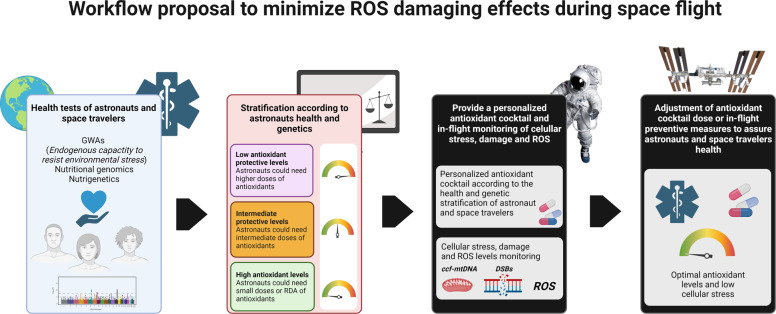
- The authors propose a personalized prevention framework: GWAS/nutrigenetics-based stratification, plus inflight monitoring of ROS and damage markers such as ccf-mtDNA, DSBs, 8OHdG, and antioxidant levels, to guide antioxidant dosing.
## Methods
- Design: Narrative perspective/review focused on developing antioxidant cocktails for manned space missions; not an empirical primary study.
- Data/source base: Synthesis of biomedical literature, including human spaceflight reports, animal studies, in vitro studies, and randomized clinical trials summarized in supplementary tables.
- Main analysis: The paper qualitatively reviews ROS biology, organ-specific spaceflight damage, antioxidant candidates, pharmacokinetic/pharmacodynamic issues in space, and proposes a workflow for individualized antioxidant supplementation and inflight biomarker monitoring.
## Limitations
- The paper explicitly notes that more research is needed to determine the best antioxidant doses for each scenario and that recommended doses in the article are only references.
- It states that few studies have assessed antioxidant levels in astronauts before missions, and that studies of antioxidant pharmacokinetics/pharmacodynamics in space have small sample sizes, inconsistent methodology, and limited parameter reporting.
- The text makes evident that this is not an experimental validation of the proposed cocktail or workflow: the paper proposes a strategy, but does not test it in astronauts.
Model-written summary. Check it against the paper before relying on it.
Integrity signals
Registry
Cites
Statistics
Figures
Verification
Claims the paper makes
101 Valid · 6 Not valid · 60 Not checked · 20 Own results and interpretations
At least one cited source doesn’t support this claim or points to a different paper, and none confirmed it — see the verdicts below.
In the paper
“An astronaut can lose anywhere between 1 and 2% of total muscle mass per month depending on the individuals’ physiology83.”
§ Key points for the development of antioxidant cocktails to prevent cellular stress and damage caused by reactive oxygen species (ROS) during manned space missions > Musculoskeletal damages and ROS
What the sources say
- Disputedcites [83] Williams D Kuipers A Mukai C Thirsk R Acclimation during space flight: effects on human physiology CMAJ 2009 180 1317 1323 10.1503/cmaj.090628 19509005 PMC2696527 sourceExperimental — accuracy not yet measured
The Muscle atrophy section reports muscle-mass losses of up to 20% after two weeks and 30% on missions lasting three to six months, not 1%–2% per month. The paper assigns the 1%–2% monthly figure to bone-density loss in weight-bearing bones, with variation between individuals and bone sites. (LLM, conf=0.88)
Checked by a reasoning model — may be wrong.
plain- Asserted: passes — The authors put it forward as true.
- Checkable: passes — It can be checked against evidence.
- Load-bearing: passes — The paper’s conclusions depend on it.
- Based: passes — The paper gives a reason why it holds.
- Disputed
Some cited sources support this claim and some don’t — read each source’s verdict below.
In the paper
“Numerous studies have shown that the intake of exogenous CoQ10 could help to prevent the progression of illness, such as heart failure, metabolic syndrome, NAFLD, diabetes mellitus, and several neurodegenerative diseases177,181–186.”
§ Key points for the development of antioxidant cocktails to prevent cellular stress and damage caused by reactive oxygen species (ROS) during manned space missions > Immunological damage and ROS > Coenzyme Q 10 (CoQ10)
What the sources say
- Not checked — no full text of the sourcecites [177] Yang Y-K Coenzyme Q10 treatment of cardiovascular disorders of ageing including heart failure, hypertension and endothelial dysfunction Clin. Chim. Acta 2015 450 83 89 10.1016/j.cca.2015.08.002 26254995 source
- Not checked yetcites [181] Casagrande D Waib PH Jordão Júnior AA Mechanisms of action and effects of the administration of Coenzyme Q10 on metabolic syndrome J. Nutr. Intermed. Metab. 2018 13 26 32 10.1016/j.jnim.2018.08.002 source
Checked before — its earlier verdict is held back until a new check runs.
- Not checked — no full text of the sourcecites [182] Young JM A randomized, double-blind, placebo-controlled crossover study of coenzyme Q10 therapy in hypertensive patients with the metabolic syndrome Am. J. Hypertens. 2012 25 261 270 10.1038/ajh.2011.209 22113168 source
- Partly supportedcites [183] Zhang S-Y Yang K-L Zeng L-T Wu X-H Huang H-Y Effectiveness of coenzyme Q10 supplementation for type 2 diabetes mellitus: a systematic review and meta-analysis Int. J. Endocrinol. 2018 2018 6484839 30305810 PMC6165589 sourceExperimental — accuracy not yet measured
The Discussion and Conclusion report that CoQ10 may improve glycemic control in patients with type 2 diabetes, but they do not establish that it prevents disease progression. This review does not support the sentence’s additional claims about heart failure, metabolic syndrome, NAFLD, or neurodegenerative diseases. (LLM, conf=0.88)
- Not checked — no full text of the sourcecites [184] Madmani, M. E. et al. Coenzyme Q10 for heart failure. Cochrane Database Syst. Rev. CD008684 (2014). 24049047 source
- Disputedcites [185] Orrell, R. W., Lane, R. J. M. & Ross, M. Antioxidant treatment for amyotrophic lateral sclerosis / motor neuron disease. Cochrane Database Syst. Rev. CD002829 (2007). PMC8985756 17253482 sourceExperimental — accuracy not yet measured
The Discussion (page unavailable) concludes that there is no significant evidence antioxidants benefit people with ALS, a neurodegenerative disease, contrary to presenting this review as evidence that CoQ10 helps prevent disease progression. The Background (page unavailable) describes CoQ10 as a suggested treatment, not an established one. The review does not assess heart failure, metabolic syndrome, NAFLD, or diabetes. (LLM, conf=0.84)
Checked by a reasoning model — may be wrong.
- Disputedcites [186] Kearney, M., Orrell, R. W., Fahey, M., Brassington, R. & Pandolfo, M. Pharmacological treatments for Friedreich ataxia. Cochrane Database Syst. Rev. CD007791 (2016). PMC6457808 27572719 sourceExperimental — accuracy not yet measured
Our copy of the Cochrane review never states that exogenous CoQ10 prevents progression of heart failure, metabolic syndrome, NAFLD or diabetes mellitus; its scope is pharmacological treatment of Friedreich ataxia, and CoQ10 appears only as a described antioxidant agent (Antioxidants section) tested in one included trial (Cooper 2008, high-dose vs very low-dose CoQ10 plus vitamin E). For the neurodegenerative disease it does cover, the review says the opposite of demonstrated benefit: Main results reports 'no significant difference between the antioxidant-treated and the placebo groups (mean difference 0.79 points, 95% CI -1.97 to 3.55 points; low-quality evidence)' on the ICARS, and the Authors' Conclusions state that low-quality evidence 'neither supported nor refuted an effect' of CoQ10/vitamin E on neurological status. The only suggestive cardiac finding it lists concerns idebenone (a synthetic CoQ10 analogue) and left ventricular hypertrophy, is mixed across studies (Agreements and disagreements; Why it is important to do this review), and is not a claim about CoQ10 halting disease progression. (LLM, conf=0.70)
Checked by a reasoning model — may be wrong.
hedgedstates a possible cause- Asserted: passes — The authors put it forward as true.
- Checkable: passes — It can be checked against evidence.
- Load-bearing: unclear — It is unclear whether the paper’s conclusions depend on it.
- Based: passes — The paper gives a reason why it holds.
At least one cited source doesn’t support this claim or points to a different paper, and none confirmed it — see the verdicts below.
In the paper
“However, as with all vitamins and nutrients, it is important to not surpass recommended doses, as high concentrations of vitamin E have been shown to be deleterious for health144.”
§ Key points for the development of antioxidant cocktails to prevent cellular stress and damage caused by reactive oxygen species (ROS) during manned space missions > Immunological damage and ROS > Vitamin E
What the sources say
- Disputedcites [144] Abner EL Schmitt FA Mendiondo MS Marcum JL Kryscio RJ Vitamin E and all-cause mortality: a meta-analysis Curr. Aging Sci. 2011 4 158 170 10.2174/1874609811104020158 21235492 PMC4030744 sourceExperimental — accuracy not yet measured
The Discussion (page unavailable) says this meta-analysis found no increased risk of all-cause mortality, including in its dose analyses. It reports an earlier finding of a small mortality increase above 400 IU, but also describes conflicting analyses; it does not establish that high concentrations are deleterious to health. (LLM, conf=0.86)
Checked by a reasoning model — may be wrong.
plainstates a cause- Asserted: passes — The authors put it forward as true.
- Checkable: passes — It can be checked against evidence.
- Load-bearing: passes — The paper’s conclusions depend on it.
- Based: passes — The paper gives a reason why it holds.
- Disputed
Some cited sources support this claim and some don’t — read each source’s verdict below.
In the paper
“The reactivation of HSV has been observed in missions from 10 to >180 days in shuttles and ISS, respectively.”
§ Key points for the development of antioxidant cocktails to prevent cellular stress and damage caused by reactive oxygen species (ROS) during manned space missions > Immunological damage and ROS > Workflow proposal for assessing astronaut’s resistance to ROS damage, infight monitoring of ROS production, cellular stress, and a personalized preventive and inflight ROS protection based on antioxidant cocktail supplementation
What the sources say
- Partly supportedcites [210] Rooney BV Crucian BE Pierson DL Laudenslager ML Mehta SK Herpes virus reactivation in astronauts during spaceflight and its application on earth Front. Microbiol. 2019 10 16 10.3389/fmicb.2019.00016 30792698 PMC6374706 sourceExperimental — accuracy not yet measured
The Abstract (page not provided) reports herpesvirus reactivation on shuttle flights of 10–16 days and ISS flights of at least 180 days, and lists HSV-1 among viruses shed by astronauts. The Introduction’s “Herpes Simplex Virus-1” section (page not provided) documents HSV-1 during a flight longer than 180 days, but does not specifically document HSV reactivation on a 10-day shuttle mission. (LLM, conf=0.82)
- Disputedcites [211] Mehta SK Latent virus reactivation in astronauts on the international space station NPJ Microgravity 2017 3 11 10.1038/s41526-017-0015-y 28649633 PMC5445581 sourceExperimental — accuracy not yet measured
The Abstract (page unavailable) reports no evidence of HSV-1 or HSV-2 reactivation in the astronauts studied; the viruses that reactivated were EBV, VZV, and CMV. It also describes ISS missions of up to 180 days, not more than 180 days. The paper therefore contradicts the claim that HSV reactivation was observed across the stated shuttle and ISS missions. (LLM, conf=0.92)
Checked by a reasoning model — may be wrong.
plain- Asserted: passes — The authors put it forward as true.
- Checkable: passes — It can be checked against evidence.
- Load-bearing: passes — The paper’s conclusions depend on it.
- Based: passes — The paper gives a reason why it holds.
- Partly supported
Every source the paper cites for this claim was checked and supports it.
In the paper
“While large amounts of ROS are harmful, the body does need a baseline level of ROS to aid in important cellular functions, such as cell signaling and redox regulation14.”
§ Key points for the development of antioxidant cocktails to prevent cellular stress and damage caused by reactive oxygen species (ROS) during manned space missions > Introduction > ROS and the importance of developing antioxidant cocktails
What the sources say
- Supportedcites [14] Poljsak B Šuput D Milisav I Achieving the balance between ROS and antioxidants: when to use the synthetic antioxidants Oxid. Med. Cell. Longev. 2013 2013 956792 10.1155/2013/956792 23738047 PMC3657405 source
Section 4 (“Importance of the Balance”) says antioxidant defenses should limit harmful ROS while permitting enough to remain for cell signaling and redox regulation. Section 5 also describes low levels of ROS as signaling molecules. (LLM, conf=0.95)
plainstates a cause- Asserted: passes — The authors put it forward as true.
- Checkable: passes — It can be checked against evidence.
- Load-bearing: passes — The paper’s conclusions depend on it.
- Based: passes — The paper gives a reason why it holds.
- Supported
109 more claims · 58 with their cited sources checked
Create a free account to see all 187 claims and to verify the 2 references still open.
- It may state two separate claims as one. 58
- Probably not a substantial claim. 19
Self-check
Percentages, sums and reported differences re-computed from the paper’s own numbers.
Self-check results appear here once an independent check has confirmed them.
Cited works that were retracted
Works this paper cites that were later retracted, from the retraction notices publishers deposit. Major when the notice came out before this paper was published.
Rated major: it would touch a result — a value a result rests on, reported and recomputed p-values on opposite sides of the significance level, two passages that conflict with no sign which is right, or a cited work retracted before this paper was published.
Cited work 10.1002/14651858.cd012808 · retracted 2019-11-05 · notice 10.1002/14651858.cd012808.pub2 · this paper published 2021-09-23
Citations
Cites
1 retracted
Zinc for preventing and treating the common cold
Hemilä, H., & Chalker, E. (2017) · Cochrane Database of Systematic Reviews · doi:10.1002/14651858.cd012808 · Cited by 32
Retracted(1992) · Applied Ergonomics · doi:10.1016/0003-6870(92)90338-v · Cited by 7,112
ROS function in redox signaling and oxidative stress
Schieber, M., & Chandel, N. S. (2014) · Current Biology · doi:10.1016/j.cub.2014.03.034 · Cited by 6,931
Reactive oxygen species (ROS) homeostasis and redox regulation in cellular signaling
Ray, P. D., Huang, B.-W., & Tsuji, Y. (2012) · Cellular Signalling · doi:10.1016/j.cellsig.2012.01.008 · Cited by 4,373
Rayman, M. P. (2012) · The Lancet · doi:10.1016/s0140-6736(11)61452-9 · Cited by 3,563
Inflammasomes: mechanism of action, role in disease, and therapeutics
Guo, H., Callaway, J. B., & Ting, J. P.-Y. (2015) · Nature Medicine · doi:10.1038/nm.3893 · Cited by 3,340
Physiological Roles of Mitochondrial Reactive Oxygen Species
Sena, L. A., & Chandel, N. S. (2012) · Molecular Cell · doi:10.1016/j.molcel.2012.09.025 · Cited by 2,632
Antioxidants and antioxidant methods: an updated overview
Gulcin, İ. (2020) · Archives of Toxicology · doi:10.1007/s00204-020-02689-3 · Cited by 2,205
Kurutas, E. B. (2015) · Nutrition Journal · doi:10.1186/s12937-016-0186-5 · Cited by 2,152
Antioxidants Maintain Cellular Redox Homeostasis by Elimination of Reactive Oxygen Species
He, L., He, T., Farrar, S., Ji, L., Liu, T., & Ma, X. (2017) · Cellular Physiology and Biochemistry · doi:10.1159/000485089 · Cited by 2,127
Carr, A., & Maggini, S. (2017) · Nutrients · doi:10.3390/nu9111211 · Cited by 2,035
Dietary Reference Intakes for Vitamin C, Vitamin E, Selenium, and Carotenoids
Compounds, P. O. D. A. A. R., Nutrients, S. O. U. R. L. O., Intakes, S. O. I. A. U. O. D. R., Standing Committee on the Scientific Evaluation of Dietary Reference Intakes, Food and Nutrition Board, & Institute of Medicine (2000) · doi:10.17226/9810 · Cited by 2,034
Vitamin C as an Antioxidant: Evaluation of Its Role in Disease Prevention
Padayatty, S. J., Katz, A., Wang, Y., Eck, P., Kwon, O., Lee, J.-H., Chen, S., Corpe, C., Dutta, A., Dutta, S. K., et al. (2003) · Journal of the American College of Nutrition · doi:10.1080/07315724.2003.10719272 · Cited by 1,949
Beyond oxidative stress: an immunologist's guide to reactive oxygen species
Nathan, C., & Cunningham-Bussel, A. (2013) · Nature Reviews Immunology · doi:10.1038/nri3423 · Cited by 1,619
Carotenoid actions and their relation to health and disease
Krinsky, N. I., & Johnson, E. J. (2005) · Molecular Aspects of Medicine · doi:10.1016/j.mam.2005.10.001 · Cited by 1,420
A Review of Micronutrients and the Immune System–Working in Harmony to Reduce the Risk of Infection
Gombart, A. F., Pierre, A., & Maggini, S. (2020) · Nutrients · doi:10.3390/nu12010236 · Cited by 1,358
Achieving the Balance between ROS and Antioxidants: When to Use the Synthetic Antioxidants
Poljsak, B., Šuput, D., & Milisav, I. (2013) · Oxidative Medicine and Cellular Longevity · doi:10.1155/2013/956792 · Cited by 1,301
Luteolin, a Flavonoid with Potential for Cancer Prevention and Therapy
Lin, Y., Shi, R., Wang, X., & Shen, H.-M. (2008) · Current Cancer Drug Targets · doi:10.2174/156800908786241050 · Cited by 1,169
Reactive oxygen species: from health to disease
Brieger, K., Schiavone, S., Miller Jr., F. J., & Krause, K.-H. (2012) · Swiss Medical Weekly · doi:10.4414/smw.2012.13659 · Cited by 1,133
The NASA Twins Study: A multidimensional analysis of a year-long human spaceflight
Garrett-Bakelman, F. E., Darshi, M., Green, S. J., Gur, R. C., Lin, L., Macias, B. R., McKenna, M. J., Meydan, C., Mishra, T., Nasrini, J., et al. (2019) · Science · doi:10.1126/science.aau8650 · Cited by 1,128
Bouayed, J., & Bohn, T. (2010) · Oxidative Medicine and Cellular Longevity · doi:10.4161/oxim.3.4.12858 · Cited by 1,095
Vitamins C and E: Beneficial effects from a mechanistic perspective
Traber, M. G., & Stevens, J. F. (2011) · Free Radical Biology and Medicine · doi:10.1016/j.freeradbiomed.2011.05.017 · Cited by 1,076
ROS, Cell Senescence, and Novel Molecular Mechanisms in Aging and Age‐Related Diseases
Davalli, P., Mitic, T., Caporali, A., Lauriola, A., & D’Arca, D. (2016) · Oxidative Medicine and Cellular Longevity · doi:10.1155/2016/3565127 · Cited by 1,059
Calder, P., Carr, A., Gombart, A., & Eggersdorfer, M. (2020) · Nutrients · doi:10.3390/nu12041181 · Cited by 972
Mitochondrial dysfunction and oxidative stress in heart disease
Peoples, J. N., Saraf, A., Ghazal, N., Pham, T. T., & Kwong, J. Q. (2019) · Experimental & Molecular Medicine · doi:10.1038/s12276-019-0355-7 · Cited by 950
Vitamin C for preventing and treating the common cold
Hemilä, H., & Chalker, E. (2013) · Cochrane Database of Systematic Reviews · doi:10.1002/14651858.cd000980.pub4 · Cited by 869
Role of ROS and Nutritional Antioxidants in Human Diseases
Liu, Z., Ren, Z., Zhang, J., Chuang, C.-C., Kandaswamy, E., Zhou, T., & Zuo, L. (2018) · Frontiers in Physiology · doi:10.3389/fphys.2018.00477 · Cited by 860
Measuring biological aging in humans: a quest
Ferrucci, L., Gonzalez‐Freire, M., Fabbri, E., Simonsick, E., Tanaka, T., Moore, Z., Salimi, S., Sierra, F., & de Cabo, R. (2020) · Aging Cell · doi:10.1111/acel.13080 · Cited by 781
Chen, J., Yang, J., Ma, L., Li, J., Shahzad, N., & Kim, C. K. (2020) · Scientific Reports · doi:10.1038/s41598-020-59451-z · Cited by 763
Oxidative stress in bone remodeling: role of antioxidants
Domazetovic, V (2017) · Clinical Cases in Mineral and Bone Metabolism · doi:10.11138/ccmbm/2017.14.1.209 · Cited by 758
Resveratrol regulates neuro-inflammation and induces adaptive immunity in Alzheimer’s disease
Moussa, C., Hebron, M., Huang, X., Ahn, J., Rissman, R. A., Aisen, P. S., & Turner, R. S. (2017) · Journal of Neuroinflammation · doi:10.1186/s12974-016-0779-0 · Cited by 705
Contribution of Selected Vitamins and Trace Elements to Immune Function
Wintergerst, E. S., Maggini, S., & Hornig, D. H. (2007) · Annals of Nutrition and Metabolism · doi:10.1159/000107673 · Cited by 692
The Role of Vitamin E in Human Health and Some Diseases
Rizvi, S., Raza, S. T., Ahmed, F., Ahmad, A., Abbas, S., & Mahdi, F. (2014) · Sultan Qaboos University Medical Journal · doi:10.18295/2075-0528.1566 · Cited by 624
Endogenous non-enzymatic antioxidants in the human body
Mirończuk-Chodakowska, I., Witkowska, A. M., & Zujko, M. E. (2018) · Advances in Medical Sciences · doi:10.1016/j.advms.2017.05.005 · Cited by 613
Selenium: its role as antioxidant in human health
Tinggi, U. (2008) · Environmental Health and Preventive Medicine · doi:10.1007/s12199-007-0019-4 · Cited by 607
β-Carotene Is an Important Vitamin A Source for Humans
Grune, T., Lietz, G., Palou, A., Ross, A. C., Stahl, W., Tang, G., Thurnham, D., Yin, S.-A., & Biesalski, H. K. (2010) · The Journal of Nutrition · doi:10.3945/jn.109.119024 · Cited by 587
Opportunities and Challenges in the Delivery of mRNA-Based Vaccines
Wadhwa, A., Aljabbari, A., Lokras, A., Foged, C., & Thakur, A. (2020) · Pharmaceutics · doi:10.3390/pharmaceutics12020102 · Cited by 584
Sun, H.-J., Wu, Z.-Y., Nie, X.-W., & Bian, J.-S. (2020) · Frontiers in Pharmacology · doi:10.3389/fphar.2019.01568 · Cited by 554
The antioxidant role of coenzyme Q
Bentinger, M., Brismar, K., & Dallner, G. (2007) · Mitochondrion · doi:10.1016/j.mito.2007.02.006 · Cited by 543
Isorhamnetin: A review of pharmacological effects
Gong, G., Guan, Y.-Y., Zhang, Z.-L., Rahman, K., Wang, S.-J., Zhou, S., Luan, X., & Zhang, H. (2020) · Biomedicine & Pharmacotherapy · doi:10.1016/j.biopha.2020.110301 · Cited by 526
Carotenoids and Their Isomers: Color Pigments in Fruits and Vegetables
Khoo, H.-E., Prasad, K. N., Kong, K.-W., Jiang, Y., & Ismail, A. (2011) · Molecules · doi:10.3390/molecules16021710 · Cited by 523
Biological Versus Chronological Aging
Hamczyk, M. R., Nevado, R. M., Barettino, A., Fuster, V., & Andrés, V. (2020) · Journal of the American College of Cardiology · doi:10.1016/j.jacc.2019.11.062 · Cited by 489
Central Role of Pparα–Dependent Hepatic Lipid Turnover in Dietary Steatohepatitis in Mice
Ip, E., Farrell, G. C., Robertson, G., Hall, P., Kirsch, R., & Leclercq, I. (2003) · Hepatology · doi:10.1053/jhep.2003.50307 · Cited by 476
Antioxidant response elements: Discovery, classes, regulation and potential applications
Raghunath, A., Sundarraj, K., Nagarajan, R., Arfuso, F., Bian, J., Kumar, A. P., Sethi, G., & Perumal, E. (2018) · Redox Biology · doi:10.1016/j.redox.2018.05.002 · Cited by 468
Fortmann, S. P., Burda, B. U., Senger, C. A., Lin, J. S., & Whitlock, E. P. (2013) · Annals of Internal Medicine · doi:10.7326/0003-4819-159-12-201312170-00729 · Cited by 442
Katerji, M., Filippova, M., & Duerksen-Hughes, P. (2019) · Oxidative Medicine and Cellular Longevity · doi:10.1155/2019/1279250 · Cited by 429
ROS and Brain Diseases: The Good, the Bad, and the Ugly
Popa-Wagner, A., Mitran, S., Sivanesan, S., Chang, E., & Buga, A.-M. (2013) · Oxidative Medicine and Cellular Longevity · doi:10.1155/2013/963520 · Cited by 427
Crucian, B. E., Choukèr, A., Simpson, R. J., Mehta, S., Marshall, G., Smith, S. M., Zwart, S. R., Heer, M., Ponomarev, S., Whitmire, A., et al. (2018) · Frontiers in Immunology · doi:10.3389/fimmu.2018.01437 · Cited by 421
Selenium and coronary heart disease: a meta-analysis
Flores-Mateo, G., Navas-Acien, A., Pastor-Barriuso, R., & Guallar, E. (2006) · The American Journal of Clinical Nutrition · doi:10.1093/ajcn/84.4.762 · Cited by 418
Unraveling the Truth About Antioxidants: Mitohormesis explains ROS-induced health benefits
Ristow, M. (2014) · Nature Medicine · doi:10.1038/nm.3624 · Cited by 417
Vitamin E for Alzheimer's dementia and mild cognitive impairment
Farina, N., Llewellyn, D., Isaac, M. G. E. K. N., & Tabet, N. (2017) · Cochrane Database of Systematic Reviews · doi:10.1002/14651858.cd002854.pub5 · Cited by 413
Role of Flavonoids in Oxidative Stress
Nicole Cotelle, B. S. P. (2001) · Current Topics in Medicinal Chemistry · doi:10.2174/1568026013394750 · Cited by 387
Acclimation during space flight: effects on human physiology
Williams, D., Kuipers, A., Mukai, C., & Thirsk, R. (2009) · Canadian Medical Association Journal · doi:10.1503/cmaj.090628 · Cited by 378
Mechanisms of disuse muscle atrophy: role of oxidative stress
Powers, S. K., Kavazis, A. N., & DeRuisseau, K. C. (2005) · American Journal of Physiology-Regulatory, Integrative and Comparative Physiology · doi:10.1152/ajpregu.00469.2004 · Cited by 368
Coenzyme Q10 Supplementation in Aging and Disease
Hernández-Camacho, J. D., Bernier, M., López-Lluch, G., & Navas, P. (2018) · Frontiers in Physiology · doi:10.3389/fphys.2018.00044 · Cited by 366
Human Pathophysiological Adaptations to the Space Environment
Demontis, G. C., Germani, M. M., Caiani, E. G., Barravecchia, I., Passino, C., & Angeloni, D. (2017) · Frontiers in Physiology · doi:10.3389/fphys.2017.00547 · Cited by 354
Reactive oxygen species mediate RANK signaling in osteoclasts
Ha, H., Bok Kwak, H., Woong Lee, S., Mi Jin, H., Kim, H.-M., Kim, H.-H., & Hee Lee, Z. (2004) · Experimental Cell Research · doi:10.1016/j.yexcr.2004.07.035 · Cited by 347
Caicedo, A., Fritz, V., Brondello, J.-M., Ayala, M., Dennemont, I., Abdellaoui, N., de Fraipont, F., Moisan, A., Prouteau, C. A., Boukhaddaoui, H., et al. (2015) · Scientific Reports · doi:10.1038/srep09073 · Cited by 345
Self-citationSupplying a pharmacy for NASA exploration spaceflight: challenges and current understanding
Blue, R. S., Bayuse, T. M., Daniels, V. R., Wotring, V. E., Suresh, R., Mulcahy, R. A., & Antonsen, E. L. (2019) · npj Microgravity · doi:10.1038/s41526-019-0075-2 · Cited by 344
Evans, J. R., & Lawrenson, J. G. (2017) · Cochrane Database of Systematic Reviews · doi:10.1002/14651858.cd000254.pub4 · Cited by 335
Reactive Oxygen Species Regulate T Cell Immune Response in the Tumor Microenvironment
Chen, X., Song, M., Zhang, B., & Zhang, Y. (2016) · Oxidative Medicine and Cellular Longevity · doi:10.1155/2016/1580967 · Cited by 326
Smith, S. M., Zwart, S. R., Block, G., Rice, B. L., & Davis-Street, J. E. (2005) · The Journal of Nutrition · doi:10.1093/jn/135.3.437 · Cited by 316
González‐Gualda, E., Pàez‐Ribes, M., Lozano‐Torres, B., Macias, D., Wilson, J. R., González‐López, C., Ou, H., Mirón‐Barroso, S., Zhang, Z., Lérida‐Viso, A., et al. (2020) · Aging Cell · doi:10.1111/acel.13142 · Cited by 303
Beckhauser, T. F., Francis-Oliveira, J., & De Pasquale, R. (2016) · Journal of Experimental Neuroscience · doi:10.4137/jen.s39887 · Cited by 301
Meydani, S. N., Leka, L. S., Fine, B. C., Dallal, G. E., Keusch, G. T., Singh, M. F., & Hamer, D. H. (2004) · JAMA · doi:10.1001/jama.292.7.828 · Cited by 290
A comprehensive review of the health perspectives of resveratrol
Rauf, A., Imran, M., Suleria, H. A. R., Ahmad, B., Peters, D. G., & Mubarak, M. S. (2017) · Food & Function · doi:10.1039/c7fo01300k · Cited by 286
Antioxidant and pro-oxidant activities of carotenoids and their oxidation products
Ribeiro, D., Freitas, M., Silva, A. M. S., Carvalho, F., & Fernandes, E. (2018) · Food and Chemical Toxicology · doi:10.1016/j.fct.2018.07.060 · Cited by 280
Antioxidative and prooxidative effects of quercetin on A549 cells
Robaszkiewicz, A., Balcerczyk, A., & Bartosz, G. (2007) · Cell Biology International · doi:10.1016/j.cellbi.2007.04.009 · Cited by 279
The Interaction of Dietary Carotenoids with Radical Species
Mortensen, A., Skibsted, L. H., & Truscott, T. G. (2001) · Archives of Biochemistry and Biophysics · doi:10.1006/abbi.2000.2172 · Cited by 278
PPARs and nonalcoholic fatty liver disease
Liss, K. H. H., & Finck, B. N. (2017) · Biochimie · doi:10.1016/j.biochi.2016.11.009 · Cited by 275
Khassaf, M., McArdle, A., Esanu, C., Vasilaki, A., McArdle, F., Griffiths, R. D., Brodie, D. A., & Jackson, M. J. (2003) · The Journal of Physiology · doi:10.1113/jphysiol.2003.040303 · Cited by 274
The impact of microgravity on bone in humans
Grimm, D., Grosse, J., Wehland, M., Mann, V., Reseland, J. E., Sundaresan, A., & Corydon, T. J. (2016) · Bone · doi:10.1016/j.bone.2015.12.057 · Cited by 272
Li, N., Venkatesan, M. I., Miguel, A., Kaplan, R., Gujuluva, C., Alam, J., & Nel, A. (2000) · The Journal of Immunology · doi:10.4049/jimmunol.165.6.3393 · Cited by 267
Plasma coenzyme Q10 response to oral ingestion of coenzyme Q10 formulations
Bhagavan, H. N., & Chopra, R. K. (2007) · Mitochondrion · doi:10.1016/j.mito.2007.03.003 · Cited by 243
Wätjen, W., Michels, G., Steffan, B., Niering, P., Chovolou, Y., Kampkötter, A., Tran-Thi, Q.-H., Proksch, P., & Kahl, R. (2005) · The Journal of Nutrition · doi:10.1093/jn/135.3.525 · Cited by 240
Antioxidant supplements and mortality
Bjelakovic, G., Nikolova, D., & Gluud, C. (2013) · Current Opinion in Clinical Nutrition and Metabolic Care · doi:10.1097/mco.0000000000000009 · Cited by 234
Zhang, L.-F., & Hargens, A. R. (2018) · Physiological Reviews · doi:10.1152/physrev.00017.2016 · Cited by 233
Randomized Trials of Vitamin E in the Treatment and Prevention of Cardiovascular Disease
Eidelman, R. S., Hollar, D., Hebert, P. R., Lamas, G. A., & Hennekens, C. H. (2004) · Archives of Internal Medicine · doi:10.1001/archinte.164.14.1552 · Cited by 231
Role of Nrf1 in antioxidant response element-mediated gene expression and beyond
Biswas, M., & Chan, J. Y. (2010) · Toxicology and Applied Pharmacology · doi:10.1016/j.taap.2009.07.034 · Cited by 229
Paving the Road for RNA Therapeutics
Dammes, N., & Peer, D. (2020) · Trends in Pharmacological Sciences · doi:10.1016/j.tips.2020.08.004 · Cited by 218
Dietary vitamin C in human health
Granger, M., & Eck, P. (2018) · Advances in food and nutrition research · doi:10.1016/bs.afnr.2017.11.006 · Cited by 217
The Role of Reactive Oxygen Species in Regulating T Cell-mediated Immunity and Disease
Yarosz, E. L., & Chang, C.-H. (2018) · Immune Network · doi:10.4110/in.2018.18.e14 · Cited by 214
Gervois, P., Kleemann, R., Pilon, A., Percevault, F., Koenig, W., Staels, B., & Kooistra, T. (2004) · Journal of Biological Chemistry · doi:10.1074/jbc.m400346200 · Cited by 212
Vitamin E and All-Cause Mortality: A Meta-Analysis
L. Abner, E., A. Schmitt, F., S. Mendiondo, M., L. Marcum, J., & J. Kryscio, R. (2011) · Current Aging Sciencee · doi:10.2174/1874609811104020158 · Cited by 209
Mitochondrial DNA damage and its consequences for mitochondrial gene expression
Cline, S. D. (2012) · Biochimica et Biophysica Acta (BBA) - Gene Regulatory Mechanisms · doi:10.1016/j.bbagrm.2012.06.002 · Cited by 203
Vitamin C for preventing and treating pneumonia
Hemilä, H., & Louhiala, P. (2013) · Cochrane Database of Systematic Reviews · doi:10.1002/14651858.cd005532.pub3 · Cited by 196
A genomic screen for activators of the antioxidant response element
Liu, Y., Kern, J. T., Walker, J. R., Johnson, J. A., Schultz, P. G., & Luesch, H. (2007) · Proceedings of the National Academy of Sciences · doi:10.1073/pnas.0700898104 · Cited by 196
Biological effects of space radiation and development of effective countermeasures
Kennedy, A. R. (2014) · Life Sciences in Space Research · doi:10.1016/j.lssr.2014.02.004 · Cited by 188
Latent virus reactivation in astronauts on the international space station
Mehta, S. K., Laudenslager, M. L., Stowe, R. P., Crucian, B. E., Feiveson, A. H., Sams, C. F., & Pierson, D. L. (2017) · npj Microgravity · doi:10.1038/s41526-017-0015-y · Cited by 188
Lindqvist, D., Wolkowitz, O. M., Picard, M., Ohlsson, L., Bersani, F. S., Fernström, J., Westrin, Å., Hough, C. M., Lin, J., Reus, V. I., et al. (2018) · Neuropsychopharmacology · doi:10.1038/s41386-017-0001-9 · Cited by 188
Vignais, M.-L., Caicedo, A., Brondello, J.-M., & Jorgensen, C. (2017) · Stem Cells International · doi:10.1155/2017/6917941 · Cited by 186
Self-citationEffect of coenzyme Q10 supplementation on heart failure: a meta-analysis
Fotino, A. D., Thompson-Paul, A. M., & Bazzano, L. A. (2013) · The American Journal of Clinical Nutrition · doi:10.3945/ajcn.112.040741 · Cited by 185
Momken, I., Stevens, L., Bergouignan, A., Desplanches, D., Rudwill, F., Chery, I., Zahariev, A., Zahn, S., Stein, T. P., Sebedio, J. L., et al. (2011) · The FASEB Journal · doi:10.1096/fj.10-177295 · Cited by 181
Clinical and immunological effects of mRNA vaccines in malignant diseases
Heine, A., Juranek, S., & Brossart, P. (2021) · Molecular Cancer · doi:10.1186/s12943-021-01339-1 · Cited by 181
Härtel, C., Strunk, T., Bucsky, P., & Schultz, C. (2004) · Cytokine · doi:10.1016/j.cyto.2004.02.004 · Cited by 175
Herpes Virus Reactivation in Astronauts During Spaceflight and Its Application on Earth
Rooney, B. V., Crucian, B. E., Pierson, D. L., Laudenslager, M. L., & Mehta, S. K. (2019) · Frontiers in Microbiology · doi:10.3389/fmicb.2019.00016 · Cited by 174
Chylack, L. T., Peterson, L. E., Feiveson, A. H., Wear, M. L., Manuel, F. K., Tung, W. H., Hardy, D. S., Marak, L. J., & Cucinotta, F. A. (2009) · Radiation Research · doi:10.1667/rr1580.1 · Cited by 168
Space Food for Thought: Challenges and Considerations for Food and Nutrition on Exploration Missions
Douglas, G. L., Zwart, S. R., & Smith, S. M. (2020) · Journal of Nutrition · doi:10.1093/jn/nxaa188 · Cited by 168
Identification of polymorphic antioxidant response elements in the human genome
Wang, X., Tomso, D. J., Chorley, B. N., Cho, H.-Y., Cheung, V. G., Kleeberger, S. R., & Bell, D. A. (2007) · Human Molecular Genetics · doi:10.1093/hmg/ddm066 · Cited by 165
Rutjes, A. W., Denton, D. A., Di Nisio, M., Chong, L.-Y., Abraham, R. P., Al-Assaf, A. S., Anderson, J. L., Malik, M. A., Vernooij, R. W., Martínez, G., et al. (2018) · Cochrane Database of Systematic Reviews · doi:10.1002/14651858.cd011906.pub2 · Cited by 164
Dual roles of NRF2 in tumor prevention and progression: Possible implications in cancer treatment
Moon, E. J., & Giaccia, A. (2015) · Free Radical Biology and Medicine · doi:10.1016/j.freeradbiomed.2014.11.009 · Cited by 160
The Role of PPARαActivation in Liver and Muscle
Burri, L., Thoresen, G. H., & Berge, R. K. (2010) · PPAR Research · doi:10.1155/2010/542359 · Cited by 159
Calder, P. C., Carr, A. C., Gombart, A. F., & Eggersdorfer, M. (2020) · Nutrients · doi:10.3390/nu12082326 · Cited by 158
Artificial Mitochondria Transfer: Current Challenges, Advances, and Future Applications
Caicedo, A., Aponte, P. M., Cabrera, F., Hidalgo, C., & Khoury, M. (2017) · Stem Cells International · doi:10.1155/2017/7610414 · Cited by 150
Self-citationThe uptake and distribution of coenzyme Q(10)
Miles, M. V. (2007) · Mitochondrion · doi:10.1016/j.mito.2007.02.012 · Cited by 149
Acute psychological stress increases serum circulating cell-free mitochondrial DNA
Trumpff, C., Marsland, A. L., Basualto-Alarcón, C., Martin, J. L., Carroll, J. E., Sturm, G., Vincent, A. E., Mosharov, E. V., Gu, Z., Kaufman, B. A., et al. (2019) · Psychoneuroendocrinology · doi:10.1016/j.psyneuen.2019.03.026 · Cited by 147
Yang, J. H., Shin, B. Y., Han, J. Y., Kim, M. G., Wi, J. E., Kim, Y. W., Cho, I. J., Kim, S. C., Shin, S. M., & Ki, S. H. (2013) · Toxicology and Applied Pharmacology · doi:10.1016/j.taap.2013.10.026 · Cited by 145
Post-exercise vitamin C supplementation and recovery from demanding exercise
Thompson, D., Williams, C., García-Rovés, P. M., McGregor, S., McArdle, F., & Jackson, M. J. (2003) · European Journal of Applied Physiology · doi:10.1007/s00421-003-0816-4 · Cited by 141
ccf-mtDNA as a Potential Link Between the Brain and Immune System in Neuro-Immunological Disorders
Gambardella, S., Limanaqi, F., Ferese, R., Biagioni, F., Campopiano, R., Centonze, D., & Fornai, F. (2019) · Frontiers in Immunology · doi:10.3389/fimmu.2019.01064 · Cited by 141
Forms of extracellular mitochondria and their impact in health
Miliotis, S., Nicolalde, B., Ortega, M., Yepez, J., & Caicedo, A. (2019) · Mitochondrion · doi:10.1016/j.mito.2019.02.002 · Cited by 138
Self-citationMathew, M. C., Ervin, A.-M., Tao, J., & Davis, R. M. (2012) · Cochrane Database of Systematic Reviews · doi:10.1002/14651858.cd004567.pub2 · Cited by 135
Versari, S., Longinotti, G., Barenghi, L., Maier, J. A. M., & Bradamante, S. (2013) · The FASEB Journal · doi:10.1096/fj.13-229195 · Cited by 133
How does spaceflight affect the acquired immune system?
Akiyama, T., Horie, K., Hinoi, E., Hiraiwa, M., Kato, A., Maekawa, Y., Takahashi, A., & Furukawa, S. (2020) · npj Microgravity · doi:10.1038/s41526-020-0104-1 · Cited by 132
Antioxidants and vitamins in clinical conditions
Zadák, Z., Hyšpler, R., Tichá, A., Hronek, M., Fikrová, P., Rathouska, J., Hrnčiariková, D., & Štětina, R. (2009) · Physiological Research · doi:10.33549/physiolres.931861 · Cited by 131
Young, T. A., Cunningham, C. C., & Bailey, S. M. (2002) · Archives of Biochemistry and Biophysics · doi:10.1016/s0003-9861(02)00338-7 · Cited by 128
Tian, G., Sawashita, J., Kubo, H., Nishio, S.-Y., Hashimoto, S., Suzuki, N., Yoshimura, H., Tsuruoka, M., Wang, Y., Liu, Y., et al. (2014) · Antioxidants & Redox Signaling · doi:10.1089/ars.2013.5406 · Cited by 123
Precision Redox: The Key for Antioxidant Pharmacology
Meng, J., Lv, Z., Zhang, Y., Wang, Y., Qiao, X., Sun, C., Chen, Y., Guo, M., Han, W., Ye, A., et al. (2021) · Antioxidants & Redox Signaling · doi:10.1089/ars.2020.8212 · Cited by 122
Medication use by U.S. Crewmembers on the international space station
Wotring, V. E. (2015) · The FASEB Journal · doi:10.1096/fj.14-264838 · Cited by 120
Xiong, J., Wang, K., Yuan, C., Xing, R., Ni, J., Hu, G., Chen, F., & Wang, X. (2017) · International Journal of Molecular Medicine · doi:10.3892/ijmm.2016.2809 · Cited by 120
Space Medicine in the Era of Civilian Spaceflight
Stepanek, J., Blue, R. S., & Parazynski, S. (2019) · New England Journal of Medicine · doi:10.1056/nejmra1609012 · Cited by 116
Chen, C.-Y., Peng, W., Wu, L.-C., Wu, C., & Hsu, S. (2010) · Journal of Agricultural and Food Chemistry · doi:10.1021/jf1031668 · Cited by 115
Drugs in space: Pharmacokinetics and pharmacodynamics in astronauts
Kast, J., Yu, Y., Seubert, C. N., Wotring, V. E., & Derendorf, H. (2017) · European Journal of Pharmaceutical Sciences · doi:10.1016/j.ejps.2017.05.025 · Cited by 115
The Alpha-Tocopherol, Beta-Carotene Cancer Prevention Study in Finland
Blumberg, J. (2009) · Nutrition Reviews · doi:10.1111/j.1753-4887.1994.tb01430.x · Cited by 114
(1999) · PubMed · Cited by 113
Physiological, Pharmacokinetic, and Pharmacodynamic Changes in Space
Graebe, A., Schuck, E. L., Lensing, P., Putcha, L., & Derendorf, H. (2004) · The Journal of Clinical Pharmacology · doi:10.1177/0091270004267193 · Cited by 113
Passerieux, E., Hayot, M., Jaussent, A., Carnac, G., Gouzi, F., Pillard, F., Picot, M.-C., Böcker, K., Hugon, G., Pincemail, J., et al. (2015) · Free Radical Biology and Medicine · doi:10.1016/j.freeradbiomed.2014.09.014 · Cited by 113
Disease model organism for Parkinson disease: Drosophila melanogaster
Aryal, B., & Lee, Y. (2019) · BMB Reports · doi:10.5483/bmbrep.2019.52.4.204 · Cited by 111
Mitochondria, Telomeres and Telomerase Subunits
Zheng, Q., Huang, J., & Wang, G. (2019) · Frontiers in Cell and Developmental Biology · doi:10.3389/fcell.2019.00274 · Cited by 111
Long-Term Multivitamin Supplementation and Cognitive Function in Men: A Randomized Trial
Grodstein, F., O’Brien, J., Kang, J. H., Dushkes, R., Cook, N. R., Okereke, O., Manson, J. E., Glynn, R. J., Buring, J. E., Gaziano, J. M., et al. (2013) · Annals of Internal Medicine · doi:10.7326/0003-4819-159-12-201312170-00006 · Cited by 110
Spaceflight Activates Lipotoxic Pathways in Mouse Liver
Jonscher, K. R., Alfonso-Garcia, A., Suhalim, J. L., Orlicky, D. J., Potma, E. O., Ferguson, V. L., Bouxsein, M. L., Bateman, T. A., Stodieck, L. S., Levi, M., et al. (2016) · PLOS ONE · doi:10.1371/journal.pone.0152877 · Cited by 108
Xu, Z., Huo, J., Ding, X., Yang, M., Li, L., Dai, J., Hosoe, K., Kubo, H., Mori, M., Higuchi, K., et al. (2017) · Scientific Reports · doi:10.1038/s41598-017-08899-7 · Cited by 108
Excessive Reactive Oxygen Species and Exotic DNA Lesions as an Exploitable Liability
AbdulSalam, S. F., Thowfeik, F. S., & Merino, E. J. (2016) · Biochemistry · doi:10.1021/acs.biochem.6b00703 · Cited by 102
Towards human exploration of space: The THESEUS review series on immunology research priorities
Frippiat, J.-P., Crucian, B. E., de Quervain, D. J.-F., Grimm, D., Montano, N., Praun, S., Roozendaal, B., Schelling, G., Thiel, M., Ullrich, O., et al. (2016) · npj Microgravity · doi:10.1038/npjmgrav.2016.40 · Cited by 100
Farhangi, M. A., Alipour, B., Jafarvand, E., & Khoshbaten, M. (2014) · Archives of Medical Research · doi:10.1016/j.arcmed.2014.11.001 · Cited by 99
Therapeutic potential of luteolin in transgenic Drosophila model of Alzheimer’s disease
Ali, F., Rahul, Jyoti, S., Naz, F., Ashafaq, M., Shahid, M., & Siddique, Y. H. (2019) · Neuroscience Letters · doi:10.1016/j.neulet.2018.10.053 · Cited by 99
Antioxidant treatment for amyotrophic lateral sclerosis or motor neuron disease
Orrell, R. W., Lane, R. J., & Ross, M. (2007) · Cochrane Database of Systematic Reviews · doi:10.1002/14651858.cd002829.pub4 · Cited by 98
Oxidative stress suppression by luteolin-induced heme oxygenase-1 expression
Sun, G., Sun, X., Wang, M., Ye, J., Si, J., Xu, H.-B., Meng, X.-B., Qin, M., Sun, J., Wang, H., et al. (2012) · Toxicology and Applied Pharmacology · doi:10.1016/j.taap.2012.10.002 · Cited by 96
Vitamin C supplementation for the primary prevention of cardiovascular disease
Al-Khudairy, L., Flowers, N., Wheelhouse, R., Ghannam, O., Hartley, L., Stranges, S., & Rees, K. (2017) · Cochrane Database of Systematic Reviews · doi:10.1002/14651858.cd011114.pub2 · Cited by 94
Coenzyme Q10 for heart failure
Madmani, M. E., Yusuf Solaiman, A., Tamr Agha, K., Madmani, Y., Shahrour, Y., Essali, A., & Kadro, W. (2014) · Cochrane Database of Systematic Reviews · doi:10.1002/14651858.cd008684.pub2 · Cited by 94
Chong, E., Chang, S.-L., Hsiao, Y.-W., Singhal, R., Liu, S.-H., Leha, T., Lin, W.-Y., Hsu, C.-P., Chen, Y.-C., Chen, Y.-J., et al. (2015) · Heart Rhythm · doi:10.1016/j.hrthm.2015.01.044 · Cited by 93
Seo, K., Yang, J. H., Kim, S. C., Ku, S. K., Ki, S. H., & Shin, S. M. (2014) · Inflammation · doi:10.1007/s10753-013-9789-6 · Cited by 90
Antioxidant Properties of Isolated Isorhamnetin from the Sea Buckthorn Marc
Liu, P., Tiansheng, D., Xiang-lin, H., & Wang, J. (2009) · Plant Foods for Human Nutrition · doi:10.1007/s11130-009-0116-1 · Cited by 90
Beheshti, A., Chakravarty, K., Fogle, H., Fazelinia, H., Silveira, W. A. D., Boyko, V., Polo, S.-H. L., Saravia-Butler, A. M., Hardiman, G., Taylor, D., et al. (2019) · Scientific Reports · doi:10.1038/s41598-019-55869-2 · Cited by 90
Ogunmekan, A. O., & Hwang, P. A. (1989) · Epilepsia · doi:10.1111/j.1528-1157.1989.tb05287.x · Cited by 89
Effect of short- and long-duration spaceflight on QTc intervals in healthy astronauts
D’Aunno, D. S., Dougherty, A. H., DeBlock, H. F., & Meck, J. V. (2003) · The American Journal of Cardiology · doi:10.1016/s0002-9149(02)03259-9 · Cited by 88
Mars Colonization: Beyond Getting There
Levchenko, I., Xu, S., Mazouffre, S., Keidar, M., & Bazaka, K. (2019) · Global Challenges · doi:10.1002/gch2.201800062 · Cited by 87
Silva, L. A., Pinho, C. A., Silveira, P. C. L., Tuon, T., De Souza, C. T., Dal-Pizzol, F., & Pinho, R. A. (2010) · The Journal of Physiological Sciences · doi:10.1007/s12576-009-0065-3 · Cited by 86
Antioxidants in Personalized Nutrition and Exercise
Margaritelis, N. V., Paschalis, V., Theodorou, A. A., Kyparos, A., & Nikolaidis, M. G. (2018) · Advances in Nutrition · doi:10.1093/advances/nmy052 · Cited by 84
The Impact of Oxidative Stress on the Bone System in Response to the Space Special Environment
Tian, Y., Ma, X., Yang, C., Su, P., Yin, C., & Qian, A.-R. (2017) · International Journal of Molecular Sciences · doi:10.3390/ijms18102132 · Cited by 80
Yang, Y.-K., Wang, L.-P., Chen, L., Yao, X.-P., Yang, K.-Q., Gao, L.-G., & Zhou, X.-L. (2015) · Clinica Chimica Acta · doi:10.1016/j.cca.2015.08.002 · Cited by 78
Yin, Y., Gao, L., Lin, H., Wu, Y., Han, X., Zhu, Y., & Li, J. (2016) · Biochemical and Biophysical Research Communications · doi:10.1016/j.bbrc.2016.11.101 · Cited by 78
HZE56Fe-Ion Irradiation Induces Endothelial Dysfunction in Rat Aorta: Role of Xanthine Oxidase
Soucy, K. G., Lim, H. K., Kim, J. H., Oh, Y., Attarzadeh, D. O., Sevinc, B., Kuo, M. M., Shoukas, A. A., Vazquez, M. E., & Berkowitz, D. E. (2011) · Radiation Research · doi:10.1667/rr2598.1 · Cited by 77
Changes in Total Body Water During Spaceflight
Leach, C. S., Inners, L. D., & Charles, J. B. (1991) · The Journal of Clinical Pharmacology · doi:10.1002/j.1552-4604.1991.tb03663.x · Cited by 77
Pharmacological treatments for Friedreich ataxia
Kearney, M., Orrell, R. W., Fahey, M., Brassington, R., & Pandolfo, M. (2016) · Cochrane Database of Systematic Reviews · doi:10.1002/14651858.cd007791.pub4 · Cited by 74
Resveratrol for adults with type 2 diabetes mellitus
Jeyaraman, M. M., Al-Yousif, N. S. H., Singh Mann, A., Dolinsky, V. W., Rabbani, R., Zarychanski, R., & Abou-Setta, A. M. (2020) · Cochrane Database of Systematic Reviews · doi:10.1002/14651858.cd011919.pub2 · Cited by 74
Randomised vitamin E supplementation and risk of chronic lung disease in the Women's Health Study
Agler, A. H., Kurth, T., Gaziano, J. M., Buring, J. E., & Cassano, P. A. (2011) · Thorax · doi:10.1136/thx.2010.155028 · Cited by 73
Vitamin C for asthma and exercise-induced bronchoconstriction
Milan, S. J., Hart, A., & Wilkinson, M. (2013) · Cochrane Database of Systematic Reviews · doi:10.1002/14651858.cd010391.pub2 · Cited by 72
Ascorbic acid for the treatment of Charcot-Marie-Tooth disease
Gess, B., Baets, J., Jonghe, P. D., Reilly, M. M., Pareyson, D., & Young, P. (2015) · Cochrane Database of Systematic Reviews · doi:10.1002/14651858.cd011952 · Cited by 72
Spaceflight Activates Autophagy Programs and the Proteasome in Mouse Liver
Blaber, E., Pecaut, M., & Jonscher, K. (2017) · International Journal of Molecular Sciences · doi:10.3390/ijms18102062 · Cited by 70
Reactive Oxygen Species (ROS) in Living Cells
(2018) · doi:10.5772/intechopen.69697 · Cited by 70
Mahalingam, D., Radhakrishnan, A. K., Amom, Z., Ibrahim, N., & Nesaretnam, K. (2010) · European Journal of Clinical Nutrition · doi:10.1038/ejcn.2010.184 · Cited by 69
Simulated microgravity promotes cellular senescence via oxidant stress in rat PC12 cells
Wang, J., Zhang, J., Bai, S., Wang, G., Mu, L., Sun, B., Wang, D., Kong, Q., Liu, Y., Yao, X., et al. (2009) · Neurochemistry International · doi:10.1016/j.neuint.2009.07.002 · Cited by 69
'International Space Station Medical Standards and Certification for Space Flight Participants'
Bogolomov VV, E. A. (2008) · Aviation Space and Environmental Medicine · doi:10.3357/asem.2175.2007 · Cited by 69
Effect of an antioxidant-rich multivitamin supplement in cystic fibrosis
Sagel, S. D., Sontag, M. K., Anthony, M., Emmett, P., & Papas, K. A. (2010) · Journal of Cystic Fibrosis · doi:10.1016/j.jcf.2010.09.005 · Cited by 68
Redox Biology in Neurological Function, Dysfunction, and Aging
Franco, R., & Vargas, M. R. (2018) · Antioxidants & Redox Signaling · doi:10.1089/ars.2018.7509 · Cited by 68
Selenomethionine protects against adverse biological effects induced by space radiation
Kennedy, A. R., Ware, J. H., Guan, J., Donahue, J. J., Biaglow, J. E., Zhou, Z., Stewart, J., Vazquez, M., & Wan, X. S. (2004) · Free Radical Biology and Medicine · doi:10.1016/j.freeradbiomed.2003.10.010 · Cited by 67
Insulin Resistance and Adiposity in Relation to Serum β-Carotene Levels
Canas, J. A., Damaso, L. C., Altomare, A., Killen, K., Hossain, J., & Balagopal, P. (2012) · The Journal of Pediatrics · doi:10.1016/j.jpeds.2012.01.030 · Cited by 66
Tauler, P., Aguiló, A., Fuentespina, E., Tur, J., & Pons, A. (2002) · Pflügers Archiv - European Journal of Physiology · doi:10.1007/s00424-001-0770-0 · Cited by 65
Effects of luteolin on treatment of psoriasis by repressing HSP90
Lv, J., Zhou, D., Wang, Y., Sun, W., Zhang, C., Xu, J., Yang, H., Zhou, T., & Li, P. (2020) · International Immunopharmacology · doi:10.1016/j.intimp.2019.106070 · Cited by 65
EFSA Panel on Nutrition, N. F. A. F. A. (., Turck, D., Bohn, T., Castenmiller, J. J. M., Henauw, S. D., Hirsch‐Ernst, K. I., Knutsen, H. K., Maciuk, A., Mangelsdorf, I., McArdle, H. J., et al. (2022) · EFSA Journal · doi:10.2903/j.efsa.2022.e200102 · Cited by 64
Cui, Y., Jing, C., & Pan, H. (2013) · American Journal of Clinical Nutrition · doi:10.3945/ajcn.112.053835 · Cited by 63
Palomera-Ávalos, V., Griñán-Ferré, C., Izquierdo, V., Camins, A., Sanfeliu, C., & Pallàs, M. (2017) · Rejuvenation Research · doi:10.1089/rej.2016.1885 · Cited by 62
Isanaka, S., Mugusi, F. M., Hawkins, C., Spiegelman, D. L., Okuma, J. O., Aboud, S., Guerino, C., & Fawzi, W. W. (2012) · JAMA · doi:10.1001/jama.2012.13083 · Cited by 61
Christen, W. G., Glynn, R. J., Gaziano, J. M., Darke, A. K., Crowley, J. J., Goodman, P. J., Lippman, S. M., Lad, T. E., Bearden, J. D., Goodman, G. E., et al. (2014) · JAMA Ophthalmology · doi:10.1001/jamaophthalmol.2014.3478 · Cited by 61
Joseph, L. C., Subramanyam, P., Radlicz, C., Trent, C. M., Iyer, V., Colecraft, H. M., & Morrow, J. P. (2016) · Heart Rhythm · doi:10.1016/j.hrthm.2016.05.002 · Cited by 60
Young, J. M., Florkowski, C. M., Molyneux, S. L., McEwan, R. G., Frampton, C. M., Nicholls, M. G., Scott, R. S., & George, P. M. (2012) · American Journal of Hypertension · doi:10.1038/ajh.2011.209 · Cited by 59
Arc-Chagnaud, C., Py, G., Fovet, T., Roumanille, R., Demangel, R., Pagano, A. F., Delobel, P., Blanc, S., Jasmin, B. J., Blottner, D., et al. (2020) · Frontiers in Physiology · doi:10.3389/fphys.2020.00071 · Cited by 59
Antioxidant supplementation for lung disease in cystic fibrosis
Ciofu, O., & Lykkesfeldt, J. (2014) · Cochrane Database of Systematic Reviews · doi:10.1002/14651858.cd007020.pub3 · Cited by 58
Medications in Space: In Search of a Pharmacologist’s Guide to the Galaxy
Eyal, S., & Derendorf, H. (2019) · Pharmaceutical Research · doi:10.1007/s11095-019-2679-3 · Cited by 58
Potential role of coenzyme Q10 in health and disease conditions
Rodick, T. C., Seibels, D. R., Babu, J. R., Huggins, K. W., Ren, G., & Mathews, S. T. (2018) · Nutrition and Dietary Supplements · doi:10.2147/nds.s112119 · Cited by 57
Rust, P., Eichler, I., Renner, S., & Elmadfa, I. (1998) · PubMed · Cited by 56
DNA Damage Baseline Predicts Resilience to Space Radiation and Radiotherapy
Pariset, E., Bertucci, A., Petay, M., Malkani, S., Lopez Macha, A., Paulino Lima, I. G., Gomez Gonzalez, V., Tin, A. S., Tang, J., Plante, I., et al. (2020) · Cell Reports · doi:10.1016/j.celrep.2020.108434 · Cited by 56
Factors Affecting Drug Bioavailability in Space
Tietze, K. J., & Putcha, L. (1994) · The Journal of Clinical Pharmacology · doi:10.1002/j.1552-4604.1994.tb02022.x · Cited by 55
Moreira, H., Szyjka, A., Paliszkiewicz, K., & Barg, E. (2019) · Oxidative Medicine and Cellular Longevity · doi:10.1155/2019/6793957 · Cited by 55
Kennedy, A. R., Zhou, Z., Donahue, J. J., & Ware, J. H. (2006) · Radiation Research · doi:10.1667/rr3599.1 · Cited by 54
Yang, J., Zhang, G., Dong, D., & Shang, P. (2018) · International Journal of Molecular Sciences · doi:10.3390/ijms19092608 · Cited by 54
Oxidative Stress and Space Biology: An Organ-Based Approach
Goodwin, T., & Christofidou-Solomidou, M. (2018) · International Journal of Molecular Sciences · doi:10.3390/ijms19040959 · Cited by 53
Oxidative Stress and the Kidney in the Space Environment
Pavlakou, P., Dounousi, E., Roumeliotis, S., Eleftheriadis, T., & Liakopoulos, V. (2018) · International Journal of Molecular Sciences · doi:10.3390/ijms19103176 · Cited by 52
Zhang, S.-Y., Yang, K.-L., Zeng, L.-T., Wu, X.-H., & Huang, H.-Y. (2018) · International Journal of Endocrinology · doi:10.1155/2018/6484839 · Cited by 51
Vitamin C supplementation for prevention and treatment of pneumonia
Padhani, Z. A., Moazzam, Z., Ashraf, A., Bilal, H., Salam, R. A., Das, J. K., & Bhutta, Z. A. (2020) · Cochrane Database of Systematic Reviews · doi:10.1002/14651858.cd013134.pub2 · Cited by 50
Wang, X., Campbell, M. R., Lacher, S. E., Cho, H.-Y., Wan, M., Crowl, C. L., Chorley, B. N., Bond, G. L., Kleeberger, S. R., Slattery, M., et al. (2016) · Cell Reports · doi:10.1016/j.celrep.2016.03.068 · Cited by 49
Antioxidant supplementation for lung disease in cystic fibrosis
Ciofu, O., Smith, S. J., & Lykkesfeldt, J. (2019) · Cochrane Database of Systematic Reviews · doi:10.1002/14651858.cd007020.pub4 · Cited by 49
Caicedo, A., Zambrano, K., Sanon, S., Luis Vélez, J., Montalvo, M., Jara, F., Moscoso, S. A., Vélez, P., Maldonado, A., & Velarde, G. (2021) · Mitochondrion · doi:10.1016/j.mito.2021.02.014 · Cited by 48
Self-citationRanganathan, L. N., & Ramaratnam, S. (2005) · Cochrane Database of Systematic Reviews · doi:10.1002/14651858.cd004304.pub2 · Cited by 47
Qu, L., Chen, H., Liu, X., Bi, L., Xiong, J., Mao, Z., & Li, Y. (2010) · Neurochemical Research · doi:10.1007/s11064-010-0205-4 · Cited by 47
Zhang, R., Bai, Y.-G., Lin, L.-J., Bao, J.-X., Zhang, Y.-Y., Tang, H., Cheng, J.-H., Jia, G.-L., Ren, X.-L., & Ma, J. (2009) · Journal of Applied Physiology · doi:10.1152/japplphysiol.01278.2007 · Cited by 47
Effect of Oxidative Stress on Cardiovascular System in Response to Gravity
Takahashi, K., Okumura, H., Guo, R., & Naruse, K. (2017) · International Journal of Molecular Sciences · doi:10.3390/ijms18071426 · Cited by 46
Zhang, B., Xu, L., Zhuo, N., & Shen, J. (2017) · Biochemical and Biophysical Research Communications · doi:10.1016/j.bbrc.2017.09.015 · Cited by 46
Anastasilakis, A. D., Toulis, K. A., Nisianakis, P., Goulis, D. G., Kampas, L., Valeri, R. M., Oikonomou, D., Tzellos, T., & Delaroudis, S. (2012) · International Journal of Clinical Practice · doi:10.1111/j.1742-1241.2011.02879.x · Cited by 45
Anti-aging effects of long-term space missions, estimated by heart rate variability
Otsuka, K., Cornelissen, G., Kubo, Y., Shibata, K., Mizuno, K., Ohshima, H., Furukawa, S., & Mukai, C. (2019) · Scientific Reports · doi:10.1038/s41598-019-45387-6 · Cited by 45
Research works printed but not linked: 8
- Jameson, J. L. et al. Harrison’s Principles Of Internal Medicine 20th edn, Vol. 1 & Vol. 2 (McGraw-Hill Education/Medical, 2018).
- Institute of Medicine (US) Committee on the Longitudinal Study of Astronaut Health. Review of NASA’s Longitudinal Study of Astronaut Health (National Academies Press, 2004). 25009858
- Carrillo Esper R Efectos fisiológicos en un ambiente de microgravedad Rev. Fac. Med. 2015 58 13 24
- Stress Challenges and Immunity in Space: From Mechanisms to Monitoring and Preventive Strategies (Springer International Publishing, 2020).
- National Research Council (US) Subcommittee on the Tenth Edition of the Recommended Dietary Allowances. Definition and Applications. Recommended Dietary Allowances 10th edn (National Academies Press, 1989). 25144070
- PubChem. Selenomethionine, C5H11NO2Se. https://pubchem.ncbi.nlm.nih.gov/compound/Selenomethionine (2021).
- Rodick TC Potential role of coenzyme Q10 in health and disease conditions Nutr. Diet. Suppl. 2018 ume 10 1 11
- Williamson, C. B. & Pizano, J. M. in Integrative and functional medical nutrition therapy: principles and practices (eds Noland, D., Drisko, J. A. & Wagner, L.) 235–268 (Springer International Publishing, 2020).
Cited by
The Future of Personalized Medicine in Space: From Observations to Countermeasures
Loriè, E. P., Baatout, S., Choukèr, A., Buchheim, J., Baselet, B., Russo, C. D., Wotring, V. E., Monici, M., Morbidelli, L., Gagliardi, D., et al. (2021) · Frontiers in Bioengineering and Biotechnology · doi:10.3389/fbioe.2021.739747 · Cited by 99
Zivari‐Ghader, T., Rashidi, M., & Mehrali, M. (2024) · International Journal of Biological Macromolecules · doi:10.1016/j.ijbiomac.2024.134578 · Cited by 72
Wei, F., Oms, K. F., Kinzel, M., Perotti, L. E., Asiatico, J. T., Omer, M., Hovell, C., Reumers, V., & Coathup, M. J. (2022) · Bone Research · doi:10.1038/s41413-022-00234-9 · Cited by 72
“Exposure to microgravity during spaceflight missions causes excessive ROS production that contributes to cellular stress and damage in astronauts.(184,185) Oxidative stress causes protein and DNA damage,(186) induces cell senescence,(187) triggers osteoblast and osteocyte apoptosis and cell death,(188) suppresses oste…”
BackgroundZeng, F.-S., Yao, Y.-F., Wang, L., & Li, W. (2023) · Biomedicine & Pharmacotherapy · doi:10.1016/j.biopha.2023.114221 · Cited by 65
Huang, S., Luo, Y., Wang, X., et al. (2022) · Atmospheric Environment · doi:10.1016/j.atmosenv.2022.119179 · Cited by 52
Metadata
- Authors
- Gómez, X., Sanon, S., Zambrano, K., Asquel, S., Bassantes, M., Morales, J. E., Otáñez, G., Pomaquero, C., Villarroel, S., Zurita, A., Calvache, C., Celi, K., Contreras, T., Corrales, D., Naciph, M. B., Peña, J., & Caicedo, A.
- Affiliations
- Universidad San Francisco de Quito (EC)
- Cornell University (US)
- Maastricht University (NL)
- Corresponding author
- Caicedo, Andrés
- Venue
- npj Microgravity
- Published
- 2021-09-23
- Volume
- 7
- Issue
- 1
- Pages
- 35-35
- ISSN
- 2373-8065 (ISSN-L)
- PMC
- PMC8460669
- OpenAlex
- W3198940802
- Cited by
- 92
- References
- 260
- Citations by year
- 2026: 13 · 2025: 19 · 2024: 23 · 2023: 20 · 2022: 15 · 2021: 2
- FWCI
- 2.00
- Type
- journal article
- Language
- en
- Open access
- gold
- doi.org
- Licence
- cc-by
- creativecommons.org/licenses/by/4.0 (tdm)
- creativecommons.org/licenses/by/4.0 (vor)
- Locations
- npj Microgravity (publishedVersion, cc-by)
- Europe PMC (PubMed Central) (publishedVersion, other-oa)
- PubMed Central (publishedVersion, cc-by)
- PubMed (publishedVersion)
- Research Publications (Maastricht University) (publishedVersion, cc-by)
- DOAJ (DOAJ: Directory of Open Access Journals) (submittedVersion, cc-by-sa)
- Research Publications (Maastricht University) (submittedVersion, other-oa)
- Greater South Information System
- Funders
- Universidad San Francisco de Quito
- Topics
- Health Sciences › Medicine › Physiology (medical) › Spaceflight effects on biology
- Health Sciences › Medicine › Biochemistry (medical) › Antioxidant Activity and Oxidative Stress
- Health Sciences › Medicine › Radiology, Nuclear Medicine and Imaging › Effects of Radiation Exposure
- Keywords
- reactive oxygen species, oxidative stress, astronaut health, spaceflight, microgravity, ionizing radiation, space medicine, long-duration spaceflight
About these checks
Registry, retraction, Cites and statistics results are computed, not judged, with one exception: a printed reference that no index lists is read once by a model before it counts as a citation error. Claims are extracted by a model and kept only when their quote appears verbatim in the text; each cited source is then checked, with a model’s help, for whether it says what the claim relies on. Those verdicts can be wrong — read the claim’s quote and the cited source before relying on one.
The claim verdicts this report counts are experimental: their accuracy is not yet measured.
A language model drew the claims from the paper on 2026-10-10, under version 3 of the claim definition (model deepseek-v4.1-flash, prompt extract-v3).
A second model labelled each claim on 2026-10-10 (model jev-1.13-20260917, definition revision gold-guideline-v0.2).
Cited sources are checked with a language model’s help (gpt-6-sol and qwen3.8-omni-flash).
Statistics and arithmetic are recomputed, not judged.
Confidence bands are shown only for fields calibrated on our annotated test set. None is calibrated yet, so no band is shown.
What counts as a claim ›How we measure confidence ›How we check this ›
Are you an author, or do you see a problem with this page? Request a review
Data sources
Bibliographic data: Semantic Scholar, OpenAlex, Crossref.
Contains information from the Semantic Scholar Academic Graph Datasets, made available under the ODC Attribution License (ODC-BY 1.0).
Semantic Scholar’s data is described in: Kinney, R., et al. (2023). The Semantic Scholar Open Data Platform. arXiv:2301.10140.
