

Key points for the development of antioxidant cocktails to prevent cellular stress and damage caused by reactive oxygen species (ROS) during manned space missions
Open accessThe DOI matches its Crossref record; 251 of the 260 references it cites were found in a registry or an index; 131 of the 231 sources its claims cite were checked for support.
Abstract
Exposure to microgravity and ionizing radiation during spaceflight missions causes excessive reactive oxygen species (ROS) production that contributes to cellular stress and damage in astronauts. Average spaceflight mission time is expected to lengthen as humanity aims to visit other planets. However, longer missions or spaceflights will undoubtedly lead to an increment in microgravity, ionizing radiation and ROS production. Strategies to minimize ROS damage are necessary to maintain the health of astronauts, future space colonists, and tourists during and after spaceflight missions. An antioxidant cocktail formulated to prevent or mitigate ROS damage during space exploration could help maintain the health of space explorers. We propose key points to consider when developing an antioxidant cocktail. We discuss how ROS damages our body and organs, the genetic predisposition of astronauts to its damage, characteristics and evidence of the effectiveness of antioxidants to combat excess ROS, differences in drug metabolism when on Earth and in space that could modify antioxidant effects, and the characteristics and efficacy of common antioxidants. Based on this information we propose a workflow for assessing astronaut resistance to ROS damage, infight monitoring of ROS production, and an antioxidant cocktail. Developing an antioxidant cocktail represents a big challenge to translate current medical practices from an Earth setting to space. The key points presented in this review could promote the development of different antioxidant formulations to maintain space explorers' health in the future.
Overview
CoChat Summary
## TL;DR
This perspective review argues that microgravity and ionizing radiation increase ROS in astronauts, contributing to cellular stress, aging, and organ damage, and that a personalized antioxidant cocktail could help mitigate these effects. The authors propose using genetic stratification plus inflight biomarker monitoring to tailor antioxidant supplementation for space missions.
## Key findings
- Spaceflight exposes astronauts to major ROS-related risks: the paper states astronauts are exposed to 100 times more ionizing radiation than the general population, and that microgravity plus radiation increase ROS-driven damage to cells, tissues, and organs.
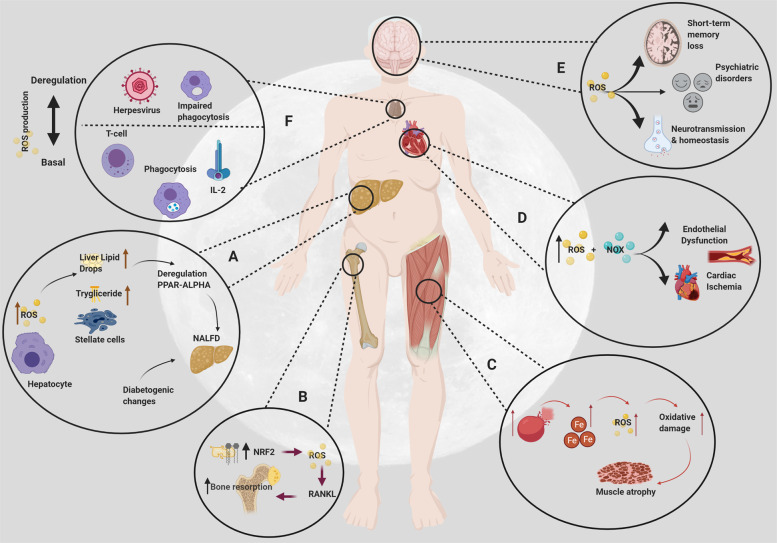
- The review links excess ROS to multiple systems, including musculoskeletal, cardiovascular, neurological, immunological, and hepatic damage; examples cited include 20% muscle mass loss after 2 weeks of spaceflight and up to 30% loss during 3–6 month missions.
- The paper reports evidence that spaceflight alters oxidative stress markers, including 32% higher urinary 8-hydroxy-2′-deoxyguanosine (8OHdG) upon landing, reduced red blood cell SOD, and decreased plasma γ-tocopherol by 50% after 4–6 months in space.
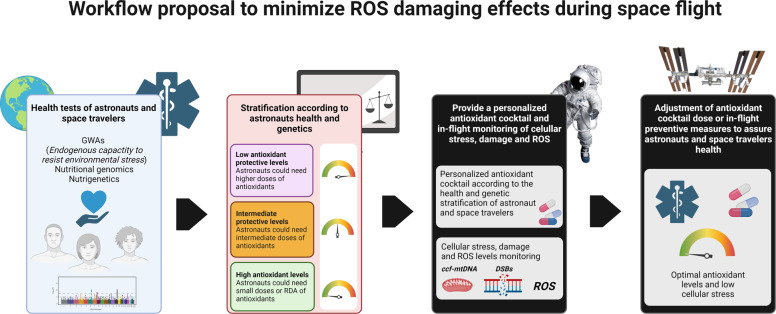
- The authors propose a personalized prevention framework: GWAS/nutrigenetics-based stratification, plus inflight monitoring of ROS and damage markers such as ccf-mtDNA, DSBs, 8OHdG, and antioxidant levels, to guide antioxidant dosing.
## Methods
- Design: Narrative perspective/review focused on developing antioxidant cocktails for manned space missions; not an empirical primary study.
- Data/source base: Synthesis of biomedical literature, including human spaceflight reports, animal studies, in vitro studies, and randomized clinical trials summarized in supplementary tables.
- Main analysis: The paper qualitatively reviews ROS biology, organ-specific spaceflight damage, antioxidant candidates, pharmacokinetic/pharmacodynamic issues in space, and proposes a workflow for individualized antioxidant supplementation and inflight biomarker monitoring.
## Limitations
- The paper explicitly notes that more research is needed to determine the best antioxidant doses for each scenario and that recommended doses in the article are only references.
- It states that few studies have assessed antioxidant levels in astronauts before missions, and that studies of antioxidant pharmacokinetics/pharmacodynamics in space have small sample sizes, inconsistent methodology, and limited parameter reporting.
- The text makes evident that this is not an experimental validation of the proposed cocktail or workflow: the paper proposes a strategy, but does not test it in astronauts.
Model-written summary. Check it against the paper before relying on it.
Integrity signals
Registry
Cites
Statistics
Figures
Verification
Claims the paper makes
101 Valid · 6 Not valid · 60 Not checked · 20 Own results and interpretations
At least one cited source doesn’t support this claim or points to a different paper, and none confirmed it — see the verdicts below.
In the paper
“An astronaut can lose anywhere between 1 and 2% of total muscle mass per month depending on the individuals’ physiology83.”
§ Key points for the development of antioxidant cocktails to prevent cellular stress and damage caused by reactive oxygen species (ROS) during manned space missions > Musculoskeletal damages and ROS
What the sources say
- Disputedcites [83] Williams D Kuipers A Mukai C Thirsk R Acclimation during space flight: effects on human physiology CMAJ 2009 180 1317 1323 10.1503/cmaj.090628 19509005 PMC2696527 sourceExperimental — accuracy not yet measured
The Muscle atrophy section reports muscle-mass losses of up to 20% after two weeks and 30% on missions lasting three to six months, not 1%–2% per month. The paper assigns the 1%–2% monthly figure to bone-density loss in weight-bearing bones, with variation between individuals and bone sites. (LLM, conf=0.88)
Checked by a reasoning model — may be wrong.
plain- Asserted: passes — The authors put it forward as true.
- Checkable: passes — It can be checked against evidence.
- Load-bearing: passes — The paper’s conclusions depend on it.
- Based: passes — The paper gives a reason why it holds.
- Disputed
Some cited sources support this claim and some don’t — read each source’s verdict below.
In the paper
“Numerous studies have shown that the intake of exogenous CoQ10 could help to prevent the progression of illness, such as heart failure, metabolic syndrome, NAFLD, diabetes mellitus, and several neurodegenerative diseases177,181–186.”
§ Key points for the development of antioxidant cocktails to prevent cellular stress and damage caused by reactive oxygen species (ROS) during manned space missions > Immunological damage and ROS > Coenzyme Q 10 (CoQ10)
What the sources say
- Not checked — no full text of the sourcecites [177] Yang Y-K Coenzyme Q10 treatment of cardiovascular disorders of ageing including heart failure, hypertension and endothelial dysfunction Clin. Chim. Acta 2015 450 83 89 10.1016/j.cca.2015.08.002 26254995 source
- Not checked yetcites [181] Casagrande D Waib PH Jordão Júnior AA Mechanisms of action and effects of the administration of Coenzyme Q10 on metabolic syndrome J. Nutr. Intermed. Metab. 2018 13 26 32 10.1016/j.jnim.2018.08.002 source
Checked before — its earlier verdict is held back until a new check runs.
- Not checked — no full text of the sourcecites [182] Young JM A randomized, double-blind, placebo-controlled crossover study of coenzyme Q10 therapy in hypertensive patients with the metabolic syndrome Am. J. Hypertens. 2012 25 261 270 10.1038/ajh.2011.209 22113168 source
- Partly supportedcites [183] Zhang S-Y Yang K-L Zeng L-T Wu X-H Huang H-Y Effectiveness of coenzyme Q10 supplementation for type 2 diabetes mellitus: a systematic review and meta-analysis Int. J. Endocrinol. 2018 2018 6484839 30305810 PMC6165589 sourceExperimental — accuracy not yet measured
The Discussion and Conclusion report that CoQ10 may improve glycemic control in patients with type 2 diabetes, but they do not establish that it prevents disease progression. This review does not support the sentence’s additional claims about heart failure, metabolic syndrome, NAFLD, or neurodegenerative diseases. (LLM, conf=0.88)
- Not checked — no full text of the sourcecites [184] Madmani, M. E. et al. Coenzyme Q10 for heart failure. Cochrane Database Syst. Rev. CD008684 (2014). 24049047 source
- Disputedcites [185] Orrell, R. W., Lane, R. J. M. & Ross, M. Antioxidant treatment for amyotrophic lateral sclerosis / motor neuron disease. Cochrane Database Syst. Rev. CD002829 (2007). PMC8985756 17253482 sourceExperimental — accuracy not yet measured
The Discussion (page unavailable) concludes that there is no significant evidence antioxidants benefit people with ALS, a neurodegenerative disease, contrary to presenting this review as evidence that CoQ10 helps prevent disease progression. The Background (page unavailable) describes CoQ10 as a suggested treatment, not an established one. The review does not assess heart failure, metabolic syndrome, NAFLD, or diabetes. (LLM, conf=0.84)
Checked by a reasoning model — may be wrong.
- Disputedcites [186] Kearney, M., Orrell, R. W., Fahey, M., Brassington, R. & Pandolfo, M. Pharmacological treatments for Friedreich ataxia. Cochrane Database Syst. Rev. CD007791 (2016). PMC6457808 27572719 sourceExperimental — accuracy not yet measured
Our copy of the Cochrane review never states that exogenous CoQ10 prevents progression of heart failure, metabolic syndrome, NAFLD or diabetes mellitus; its scope is pharmacological treatment of Friedreich ataxia, and CoQ10 appears only as a described antioxidant agent (Antioxidants section) tested in one included trial (Cooper 2008, high-dose vs very low-dose CoQ10 plus vitamin E). For the neurodegenerative disease it does cover, the review says the opposite of demonstrated benefit: Main results reports 'no significant difference between the antioxidant-treated and the placebo groups (mean difference 0.79 points, 95% CI -1.97 to 3.55 points; low-quality evidence)' on the ICARS, and the Authors' Conclusions state that low-quality evidence 'neither supported nor refuted an effect' of CoQ10/vitamin E on neurological status. The only suggestive cardiac finding it lists concerns idebenone (a synthetic CoQ10 analogue) and left ventricular hypertrophy, is mixed across studies (Agreements and disagreements; Why it is important to do this review), and is not a claim about CoQ10 halting disease progression. (LLM, conf=0.70)
Checked by a reasoning model — may be wrong.
hedgedstates a possible cause- Asserted: passes — The authors put it forward as true.
- Checkable: passes — It can be checked against evidence.
- Load-bearing: unclear — It is unclear whether the paper’s conclusions depend on it.
- Based: passes — The paper gives a reason why it holds.
At least one cited source doesn’t support this claim or points to a different paper, and none confirmed it — see the verdicts below.
In the paper
“However, as with all vitamins and nutrients, it is important to not surpass recommended doses, as high concentrations of vitamin E have been shown to be deleterious for health144.”
§ Key points for the development of antioxidant cocktails to prevent cellular stress and damage caused by reactive oxygen species (ROS) during manned space missions > Immunological damage and ROS > Vitamin E
What the sources say
- Disputedcites [144] Abner EL Schmitt FA Mendiondo MS Marcum JL Kryscio RJ Vitamin E and all-cause mortality: a meta-analysis Curr. Aging Sci. 2011 4 158 170 10.2174/1874609811104020158 21235492 PMC4030744 sourceExperimental — accuracy not yet measured
The Discussion (page unavailable) says this meta-analysis found no increased risk of all-cause mortality, including in its dose analyses. It reports an earlier finding of a small mortality increase above 400 IU, but also describes conflicting analyses; it does not establish that high concentrations are deleterious to health. (LLM, conf=0.86)
Checked by a reasoning model — may be wrong.
plainstates a cause- Asserted: passes — The authors put it forward as true.
- Checkable: passes — It can be checked against evidence.
- Load-bearing: passes — The paper’s conclusions depend on it.
- Based: passes — The paper gives a reason why it holds.
- Disputed
Some cited sources support this claim and some don’t — read each source’s verdict below.
In the paper
“The reactivation of HSV has been observed in missions from 10 to >180 days in shuttles and ISS, respectively.”
§ Key points for the development of antioxidant cocktails to prevent cellular stress and damage caused by reactive oxygen species (ROS) during manned space missions > Immunological damage and ROS > Workflow proposal for assessing astronaut’s resistance to ROS damage, infight monitoring of ROS production, cellular stress, and a personalized preventive and inflight ROS protection based on antioxidant cocktail supplementation
What the sources say
- Partly supportedcites [210] Rooney BV Crucian BE Pierson DL Laudenslager ML Mehta SK Herpes virus reactivation in astronauts during spaceflight and its application on earth Front. Microbiol. 2019 10 16 10.3389/fmicb.2019.00016 30792698 PMC6374706 sourceExperimental — accuracy not yet measured
The Abstract (page not provided) reports herpesvirus reactivation on shuttle flights of 10–16 days and ISS flights of at least 180 days, and lists HSV-1 among viruses shed by astronauts. The Introduction’s “Herpes Simplex Virus-1” section (page not provided) documents HSV-1 during a flight longer than 180 days, but does not specifically document HSV reactivation on a 10-day shuttle mission. (LLM, conf=0.82)
- Disputedcites [211] Mehta SK Latent virus reactivation in astronauts on the international space station NPJ Microgravity 2017 3 11 10.1038/s41526-017-0015-y 28649633 PMC5445581 sourceExperimental — accuracy not yet measured
The Abstract (page unavailable) reports no evidence of HSV-1 or HSV-2 reactivation in the astronauts studied; the viruses that reactivated were EBV, VZV, and CMV. It also describes ISS missions of up to 180 days, not more than 180 days. The paper therefore contradicts the claim that HSV reactivation was observed across the stated shuttle and ISS missions. (LLM, conf=0.92)
Checked by a reasoning model — may be wrong.
plain- Asserted: passes — The authors put it forward as true.
- Checkable: passes — It can be checked against evidence.
- Load-bearing: passes — The paper’s conclusions depend on it.
- Based: passes — The paper gives a reason why it holds.
- Partly supported
Every source the paper cites for this claim was checked and supports it.
In the paper
“While large amounts of ROS are harmful, the body does need a baseline level of ROS to aid in important cellular functions, such as cell signaling and redox regulation14.”
§ Key points for the development of antioxidant cocktails to prevent cellular stress and damage caused by reactive oxygen species (ROS) during manned space missions > Introduction > ROS and the importance of developing antioxidant cocktails
What the sources say
- Supportedcites [14] Poljsak B Šuput D Milisav I Achieving the balance between ROS and antioxidants: when to use the synthetic antioxidants Oxid. Med. Cell. Longev. 2013 2013 956792 10.1155/2013/956792 23738047 PMC3657405 source
Section 4 (“Importance of the Balance”) says antioxidant defenses should limit harmful ROS while permitting enough to remain for cell signaling and redox regulation. Section 5 also describes low levels of ROS as signaling molecules. (LLM, conf=0.95)
plainstates a cause- Asserted: passes — The authors put it forward as true.
- Checkable: passes — It can be checked against evidence.
- Load-bearing: passes — The paper’s conclusions depend on it.
- Based: passes — The paper gives a reason why it holds.
- Supported
109 more claims · 58 with their cited sources checked
Create a free account to see all 187 claims and to verify the 2 references still open.
- It may state two separate claims as one. 58
- Probably not a substantial claim. 19
Self-check
Percentages, sums and reported differences re-computed from the paper’s own numbers.
Self-check results appear here once an independent check has confirmed them.
Cited works that were retracted
Works this paper cites that were later retracted, from the retraction notices publishers deposit. Major when the notice came out before this paper was published.
Rated major: it would touch a result — a value a result rests on, reported and recomputed p-values on opposite sides of the significance level, two passages that conflict with no sign which is right, or a cited work retracted before this paper was published.
Cited work 10.1002/14651858.cd012808 · retracted 2019-11-05 · notice 10.1002/14651858.cd012808.pub2 · this paper published 2021-09-23
Citations
Cites
1 retracted
Items 201–251 of 251
Antioxidant supplementation, redox deficiencies and exercise performance: A falsification design
Margaritelis, N. V., Paschalis, V., Theodorou, A. A., Kyparos, A., & Nikolaidis, M. G. (2020) · Free Radical Biology and Medicine · doi:10.1016/j.freeradbiomed.2020.06.029 · Cited by 45
The effect of coenzyme Q10 supplementation on metabolic status of type 2 diabetic patients.
Kolahdouz‐Mohammadi, R., Hosseinzadeh‐Attar, M. J., Eshraghian, M. R., Nakhjavani, M., Khorami, E., & Esteghamati, A. (2013) · PubMed · Cited by 44
Mechanisms of action and effects of the administration of Coenzyme Q10 on metabolic syndrome
Casagrande, D., Waib, P. H., & Jordão Júnior, A. A. (2018) · Journal of Nutrition & Intermediary Metabolism · doi:10.1016/j.jnim.2018.08.002 · Cited by 44
The current state and future trends of space nutrition from a perspective of astronauts' physiology
Bychkov, A., Reshetnikova, P., Bychkova, E., Podgorbunskikh, E., & Koptev, V. (2021) · International Journal of Gastronomy and Food Science · doi:10.1016/j.ijgfs.2021.100324 · Cited by 44
Vitamin C for preventing and treating pneumonia
Hemilä, H., & Louhiala, P. (2007) · Cochrane Database of Systematic Reviews · doi:10.1002/14651858.cd005532.pub2 · Cited by 44
XIAP regulates intracellular ROS by enhancing antioxidant gene expression
Resch, U., Schichl, Y. M., Sattler, S., & de Martin, R. (2008) · Biochemical and Biophysical Research Communications · doi:10.1016/j.bbrc.2008.07.142 · Cited by 41
Horie, K., Kato, T., Kudo, T., Sasanuma, H., Miyauchi, M., Akiyama, N., Miyao, T., Seki, T., Ishikawa, T., Takakura, Y., et al. (2019) · Scientific Reports · doi:10.1038/s41598-019-56432-9 · Cited by 41
Antioxidants and micronutrient supplementation in trauma patients
Reddell, L., & Cotton, B. A. (2012) · Current Opinion in Clinical Nutrition and Metabolic Care · doi:10.1097/mco.0b013e32835076df · Cited by 40
Simulated microgravity potentiates generation of reactive oxygen species in cells
Ran, F., An, L., Fan, Y., Hang, H., & Wang, S. (2016) · Biophysics Reports · doi:10.1007/s41048-016-0029-0 · Cited by 40
Vitamin C for preventing and treating tetanus
Hemilä, H., & Koivula, T. (2013) · Cochrane Database of Systematic Reviews · doi:10.1002/14651858.cd006665.pub3 · Cited by 38
Tan, S., Pei, W., Huang, H., Zhou, G., & Hu, W. (2020) · npj Microgravity · doi:10.1038/s41526-020-00123-7 · Cited by 38
Vitamin E and Alzheimer’s Disease—Is It Time for Personalized Medicine?
Cervantes, B. R., & Ulatowski, L. M. (2017) · Antioxidants · doi:10.3390/antiox6030045 · Cited by 37
Circulating cell-free mitochondrial DNA levels correlate with body mass index and age
Padilla-Sánchez, S. D., Navarrete, D., Caicedo, A., & Teran, E. (2020) · Biochimica et Biophysica Acta (BBA) - Molecular Basis of Disease · doi:10.1016/j.bbadis.2020.165963 · Cited by 36
Self-citationNwanaji-Enwerem, J. C., Nwanaji-Enwerem, U., Van Der Laan, L., Galazka, J. M., Redeker, N. S., & Cardenas, A. (2020) · Cell Reports · doi:10.1016/j.celrep.2020.108406 · Cited by 36
Vitamin C and superoxide dismutase (SOD) for diabetic retinopathy
Lopes de Jesus, C. C., Atallah, Á. N., Valente, O., & Fernandes Moça Trevisani, V. (2008) · Cochrane Database of Systematic Reviews · doi:10.1002/14651858.cd006695.pub2 · Cited by 35
De Luca, C., Deeva, I., Mariani, S., Maiani, G., Stancato, A., & Korkina, L. (2009) · Toxicology and Industrial Health · doi:10.1177/0748233709103032 · Cited by 35
Caicedo, A., Zambrano, K., Sanon, S., & Gavilanes, A. W. D. (2021) · Mitochondrion · doi:10.1016/j.mito.2021.02.006 · Cited by 34
Self-citationExtracellular Mitochondria Signals in CNS Disorders
Park, J., & Hayakawa, K. (2021) · Frontiers in Cell and Developmental Biology · doi:10.3389/fcell.2021.642853 · Cited by 34
Xin, G., Du, J., WANG, Y.-T., & LIANG, T.-T. (2013) · Experimental and Therapeutic Medicine · doi:10.3892/etm.2013.1435 · Cited by 33
Miranda, C. L., Reed, R. L., Kuiper, H. C., Alber, S., & Stevens, J. F. (2009) · Chemical Research in Toxicology · doi:10.1021/tx900042u · Cited by 33
How do the pharmacokinetics of drugs change in astronauts in space?
Eyal, S. (2020) · Expert Opinion on Drug Metabolism & Toxicology · doi:10.1080/17425255.2020.1746763 · Cited by 33
Selenium supplementation in patients with peripartum cardiomyopathy: a proof-of-concept trial
Karaye, K. M., Saidu, H., Balarabe, S. A., Ishaq, N. A., Sanni, B., Abubakar, H., Mohammed, B. L., Abdulsalam, T., Tukur, J., & Mohammed, I. Y. (2020) · BMC Cardiovascular Disorders · doi:10.1186/s12872-020-01739-z · Cited by 33
NASA GeneLab Project: Bridging Space Radiation Omics with Ground Studies
Beheshti, A., Miller, J., Kidane, Y. H., Berrios, D. C., Gebre, S., & Costes, S. V. (2018) · Radiation Research · doi:10.1667/rr15062.1 · Cited by 32
Askari, G., Hajishafiee, M., Ghiasvand, R., Hariri, M., Darvishi, L., Ghassemi, S., Iraj, B., & Hovsepian, V. (2013) · PubMed Central · Cited by 30
Alwood, J. S., Ronca, A. E., Mains, R. C., Shelhamer, M. J., Smith, J. D., & Goodwin, T. J. (2017) · npj Microgravity · doi:10.1038/s41526-016-0002-8 · Cited by 29
Vitamins C and E for asthma and exercise-induced bronchoconstriction
Wilkinson, M., Hart, A., Milan, S. J., & Sugumar, K. (2014) · Cochrane Database of Systematic Reviews · doi:10.1002/14651858.cd010749.pub2 · Cited by 29
Protective effects of resveratrol on sepsis-induced DNA damage in the lymphocytes of rats
DİLSİZ, S. A., Bacanli, M. G., Taner, G., Şahin, T. T., Başaran, A., & Başaran, N. (2012) · Human & Experimental Toxicology · doi:10.1177/0960327112467047 · Cited by 28
Маркин, А. А., Popova, I. A., Vetrova, E. G., Zhuravleva, O. A., & Balashov, O. I. (1997) · PubMed · Cited by 28
Telomere length, sibling competition and development of antioxidant defense in wild house mice
Stauffer, J., Panda, B., & Ilmonen, P. (2017) · Mechanisms of Ageing and Development · doi:10.1016/j.mad.2017.10.002 · Cited by 28
A Moderate Daily Dose of Resveratrol Mitigates Muscle Deconditioning in a Martian Gravity Analog
Mortreux, M., Riveros, D., Bouxsein, M. L., & Rutkove, S. B. (2019) · Frontiers in Physiology · doi:10.3389/fphys.2019.00899 · Cited by 27
Han, W., Fessel, J. P., Sherrill, T. P., Kocurek, E. G., Yull, F. E., & Blackwell, T. S. (2020) · The Journal of Immunology · doi:10.4049/jimmunol.1900820 · Cited by 26
Vitamin C for asthma and exercise induced bronchoconstriction
Milan, S. J., Hart, A., & Wilkinson, M. (2013) · Cochrane Database of Systematic Reviews · doi:10.1002/14651858.cd010391 · Cited by 26
Kyrgios, I., Giza, S., Kotanidou, E. P., Kleisarchaki, A., Tsinopoulou, V. R., Papadopoulou, A., Markantonatou, A., Kanellidou, E., Giannakou, A., & Galli‐Τsinopoulou, A. (2018) · Journal of Clinical Pharmacy and Therapeutics · doi:10.1111/jcpt.12765 · Cited by 22
Post-mortem ventricular cerebrospinal fluid cell-free-mtDNA in neurodegenerative disease
Lowes, H., Kurzawa-Akanbi, M., Pyle, A., & Hudson, G. (2020) · Scientific Reports · doi:10.1038/s41598-020-72190-5 · Cited by 21
Маркин, А. А., & Zhuravleva, O. A. (1993) · PubMed · Cited by 19
Issues and challenges of space radiation risk assessment in manned deep space exploration missions
Zhao, L., Mi, D., & Sun, Y. (2018) · Chinese Science Bulletin (Chinese Version) · doi:10.1360/n972018-00071 · Cited by 18
de Brito, E., Teixeira, A. D. O., Righi, N. C., Paulitcth, F. D. S., da Silva, A. M. V., & Signori, L. U. (2020) · The Journal of Strength and Conditioning Research · doi:10.1519/jsc.0000000000003342 · Cited by 16
Protective effects of l-selenomethionine on space radiation induced changes in gene expression
Stewart, J., Ko, Y. H., & Kennedy, A. R. (2007) · Radiation and Environmental Biophysics · doi:10.1007/s00411-006-0089-5 · Cited by 14
Do we age faster in absence of gravity?
Giulio, C. D. (2013) · Frontiers in Physiology · doi:10.3389/fphys.2013.00134 · Cited by 13
Dai, Z., Lei, X., Yang, C., Zhao, L., Lu, L., & Li, Y. (2019) · Protein & Cell · doi:10.1007/s13238-019-0628-x · Cited by 10
Launius, R. D. (2012) · Nature · doi:10.1038/489368a · Cited by 8
Loff, S. (2015) · Cited by 7
Lulli, M., Cialdai, F., Vignali, L., Monici, M., Luzzi, S., Cicconi, A., Cacchione, S., Magi, A., Di Gesualdo, F., Balsamo, M., et al. (2018) · Microgravity Science and Technology · doi:10.1007/s12217-018-9652-3 · Cited by 6
Nuth, M., & Kennedy, A. R. (2013) · Oncology Letters · doi:10.3892/ol.2013.1362 · Cited by 5
Dunbar, B. H. (2018) · Cited by 5
Li, H.-L., Lee, J.-R., Hahn, M., Yang, J., Meng, F., Wu, J., & Park, Y. (2019) · Journal of Biomolecular Structure and Dynamics · doi:10.1080/07391102.2019.1648321 · Cited by 5
Vorland, C. J., Bohan Brown, M. M., Kyle, T. K., & Brown, A. W. (2020) · Nutrients · doi:10.3390/nu12092690 · Cited by 5
Mix, M. D., Jameson, M. B., Tills, M., et al. (2013) · International Journal of Radiation Oncology*Biology*Physics · doi:10.1016/j.ijrobp.2013.06.1234 · Cited by 4
Medical Examination Requirements (MER) for Former Astronauts
Lewis, R. J. (2017) · Cited by 4
Lulli, M., Cialdai, F., Vignali, L., Monici, M., Luzzi, S., Cicconi, A., Cacchione, S., Magi, A., Balsamo, M., Vukich, M., et al. (2018) · Frontiers in Physiology · doi:10.3389/conf.fphys.2018.26.00036 · Cited by 4
Space Exploration and Travel, Future Technologies for Inflight Monitoring and Diagnostics
Frippiat, J.-P. (2019) · Global Virology III: Virology in the 21st Century · doi:10.1007/978-3-030-29022-1_16 · Cited by 3
Research works printed but not linked: 8
- Jameson, J. L. et al. Harrison’s Principles Of Internal Medicine 20th edn, Vol. 1 & Vol. 2 (McGraw-Hill Education/Medical, 2018).
- Institute of Medicine (US) Committee on the Longitudinal Study of Astronaut Health. Review of NASA’s Longitudinal Study of Astronaut Health (National Academies Press, 2004). 25009858
- Carrillo Esper R Efectos fisiológicos en un ambiente de microgravedad Rev. Fac. Med. 2015 58 13 24
- Stress Challenges and Immunity in Space: From Mechanisms to Monitoring and Preventive Strategies (Springer International Publishing, 2020).
- National Research Council (US) Subcommittee on the Tenth Edition of the Recommended Dietary Allowances. Definition and Applications. Recommended Dietary Allowances 10th edn (National Academies Press, 1989). 25144070
- PubChem. Selenomethionine, C5H11NO2Se. https://pubchem.ncbi.nlm.nih.gov/compound/Selenomethionine (2021).
- Rodick TC Potential role of coenzyme Q10 in health and disease conditions Nutr. Diet. Suppl. 2018 ume 10 1 11
- Williamson, C. B. & Pizano, J. M. in Integrative and functional medical nutrition therapy: principles and practices (eds Noland, D., Drisko, J. A. & Wagner, L.) 235–268 (Springer International Publishing, 2020).
Cited by
The Future of Personalized Medicine in Space: From Observations to Countermeasures
Loriè, E. P., Baatout, S., Choukèr, A., Buchheim, J., Baselet, B., Russo, C. D., Wotring, V. E., Monici, M., Morbidelli, L., Gagliardi, D., et al. (2021) · Frontiers in Bioengineering and Biotechnology · doi:10.3389/fbioe.2021.739747 · Cited by 99
Zivari‐Ghader, T., Rashidi, M., & Mehrali, M. (2024) · International Journal of Biological Macromolecules · doi:10.1016/j.ijbiomac.2024.134578 · Cited by 72
Wei, F., Oms, K. F., Kinzel, M., Perotti, L. E., Asiatico, J. T., Omer, M., Hovell, C., Reumers, V., & Coathup, M. J. (2022) · Bone Research · doi:10.1038/s41413-022-00234-9 · Cited by 72
“Exposure to microgravity during spaceflight missions causes excessive ROS production that contributes to cellular stress and damage in astronauts.(184,185) Oxidative stress causes protein and DNA damage,(186) induces cell senescence,(187) triggers osteoblast and osteocyte apoptosis and cell death,(188) suppresses oste…”
BackgroundZeng, F.-S., Yao, Y.-F., Wang, L., & Li, W. (2023) · Biomedicine & Pharmacotherapy · doi:10.1016/j.biopha.2023.114221 · Cited by 65
Huang, S., Luo, Y., Wang, X., et al. (2022) · Atmospheric Environment · doi:10.1016/j.atmosenv.2022.119179 · Cited by 52
Metadata
- Authors
- Gómez, X., Sanon, S., Zambrano, K., Asquel, S., Bassantes, M., Morales, J. E., Otáñez, G., Pomaquero, C., Villarroel, S., Zurita, A., Calvache, C., Celi, K., Contreras, T., Corrales, D., Naciph, M. B., Peña, J., & Caicedo, A.
- Affiliations
- Universidad San Francisco de Quito (EC)
- Cornell University (US)
- Maastricht University (NL)
- Corresponding author
- Caicedo, Andrés
- Venue
- npj Microgravity
- Published
- 2021-09-23
- Volume
- 7
- Issue
- 1
- Pages
- 35-35
- ISSN
- 2373-8065 (ISSN-L)
- PMC
- PMC8460669
- OpenAlex
- W3198940802
- Cited by
- 92
- References
- 260
- Citations by year
- 2026: 13 · 2025: 19 · 2024: 23 · 2023: 20 · 2022: 15 · 2021: 2
- FWCI
- 2.00
- Type
- journal article
- Language
- en
- Open access
- gold
- doi.org
- Licence
- cc-by
- creativecommons.org/licenses/by/4.0 (tdm)
- creativecommons.org/licenses/by/4.0 (vor)
- Locations
- npj Microgravity (publishedVersion, cc-by)
- Europe PMC (PubMed Central) (publishedVersion, other-oa)
- PubMed Central (publishedVersion, cc-by)
- PubMed (publishedVersion)
- Research Publications (Maastricht University) (publishedVersion, cc-by)
- DOAJ (DOAJ: Directory of Open Access Journals) (submittedVersion, cc-by-sa)
- Research Publications (Maastricht University) (submittedVersion, other-oa)
- Greater South Information System
- Funders
- Universidad San Francisco de Quito
- Topics
- Health Sciences › Medicine › Physiology (medical) › Spaceflight effects on biology
- Health Sciences › Medicine › Biochemistry (medical) › Antioxidant Activity and Oxidative Stress
- Health Sciences › Medicine › Radiology, Nuclear Medicine and Imaging › Effects of Radiation Exposure
- Keywords
- reactive oxygen species, oxidative stress, astronaut health, spaceflight, microgravity, ionizing radiation, space medicine, long-duration spaceflight
About these checks
Registry, retraction, Cites and statistics results are computed, not judged, with one exception: a printed reference that no index lists is read once by a model before it counts as a citation error. Claims are extracted by a model and kept only when their quote appears verbatim in the text; each cited source is then checked, with a model’s help, for whether it says what the claim relies on. Those verdicts can be wrong — read the claim’s quote and the cited source before relying on one.
The claim verdicts this report counts are experimental: their accuracy is not yet measured.
A language model drew the claims from the paper on 2026-10-10, under version 3 of the claim definition (model deepseek-v4.1-flash, prompt extract-v3).
A second model labelled each claim on 2026-10-10 (model jev-1.13-20260917, definition revision gold-guideline-v0.2).
Cited sources are checked with a language model’s help (gpt-6-sol and qwen3.8-omni-flash).
Statistics and arithmetic are recomputed, not judged.
Confidence bands are shown only for fields calibrated on our annotated test set. None is calibrated yet, so no band is shown.
What counts as a claim ›How we measure confidence ›How we check this ›
Are you an author, or do you see a problem with this page? Request a review
Data sources
Bibliographic data: Semantic Scholar, OpenAlex, Crossref.
Contains information from the Semantic Scholar Academic Graph Datasets, made available under the ODC Attribution License (ODC-BY 1.0).
Semantic Scholar’s data is described in: Kinney, R., et al. (2023). The Semantic Scholar Open Data Platform. arXiv:2301.10140.
