

A national experiment reveals where a growth mindset improves achievement
Open accessThe DOI matches its Crossref record; 44 of the 44 references it cites were found in a registry or an index; 16 of the 56 sources its claims cite were checked for support.
Abstract
A short online growth mindset intervention improved grades among lower-achieving students and increased advanced mathematics enrollment in a nationally representative U.S. sample.
Overview
CoChat Summary
TL;DR
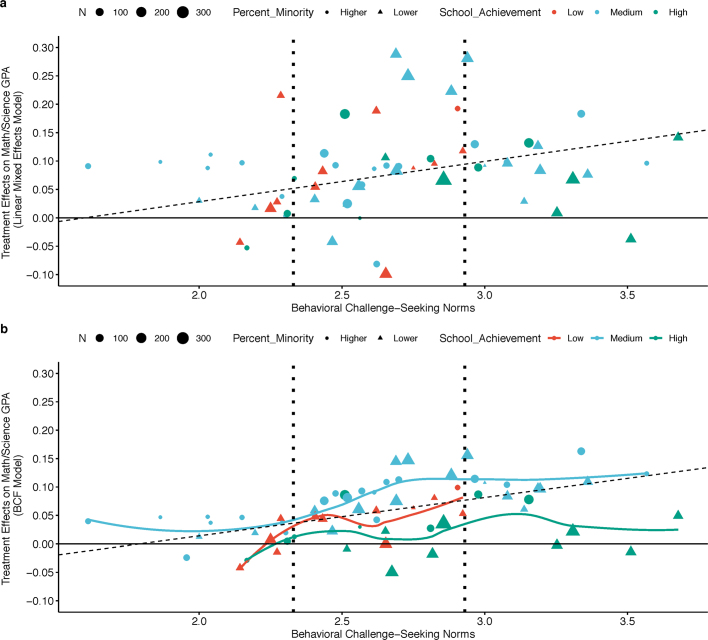
A short, online growth mindset intervention in a nationally representative sample of U.S. secondary students improved outcomes for lower-achieving students and increased advanced mathematics enrollment overall. Its grade effects were strongest in schools whose peer norms supported challenge-seeking, suggesting context matters for sustaining benefits.
Key findings
- Among lower-achieving adolescents, the intervention reduced fixed-mindset beliefs by B = −0.38 and had an effect size of 0.33 (n = 5,650 students, k = 65 schools, P < 0.001).
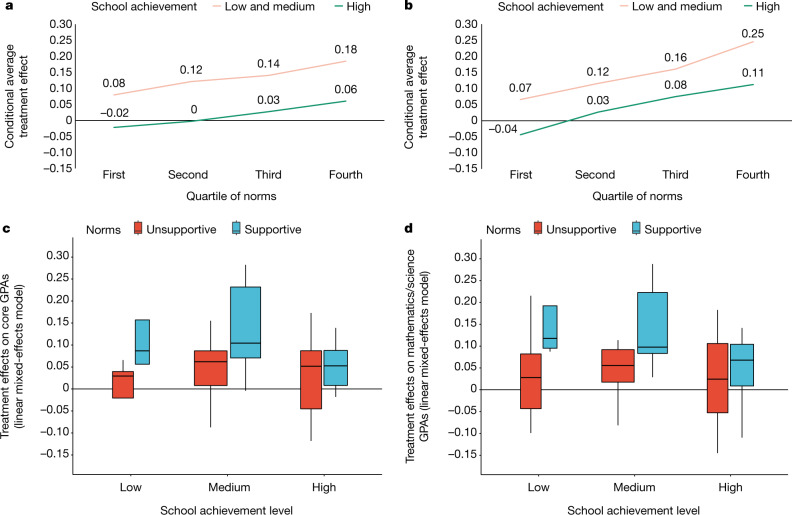
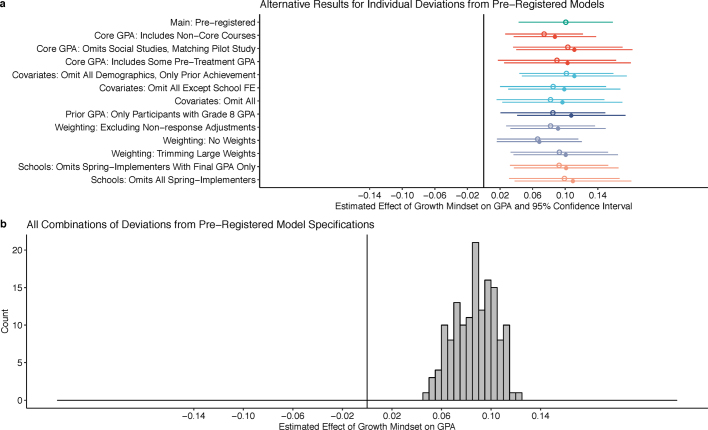
- Lower-achieving adolescents earned higher end-of-year core GPA when assigned to the intervention: B = 0.10 grade points, effect size 0.11, n = 6,320, k = 65, P = 0.001.
- The same GPA conclusion held for mathematics and science GPAs, with B = 0.10.
- Across the full cohort, the intervention increased tenth-grade advanced mathematics enrollment by 3 percentage points, from 33% to 36% (n = 6,690, k = 41, P = 0.001), and overall reduced the share of students below GPA 2.0 from 46% to 41%.
Methods
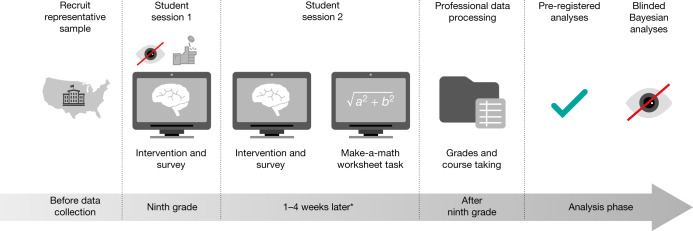
- Randomized, effectiveness-trial design: 12,490 ninth-grade adolescents in 65 regular public schools were individually randomized within schools in the National Study of Learning Mindsets.
- Intervention: two self-administered online sessions of about 25 minutes each, delivered roughly 20 days apart during school hours; control was a similar brain-functions program that did not address intelligence beliefs.
- Main analysis: intention-to-treat cluster-robust fixed-effects linear regression for average effects, mixed-effects models for cross-school heterogeneity, and a blinded Bayesian causal forest robustness analysis.
Limitations
- The paper states that the moderation results cannot support causal conclusions about school norms because norms were measured, not manipulated.
- Advanced mathematics enrollment analyses were exploratory because they were not pre-registered.
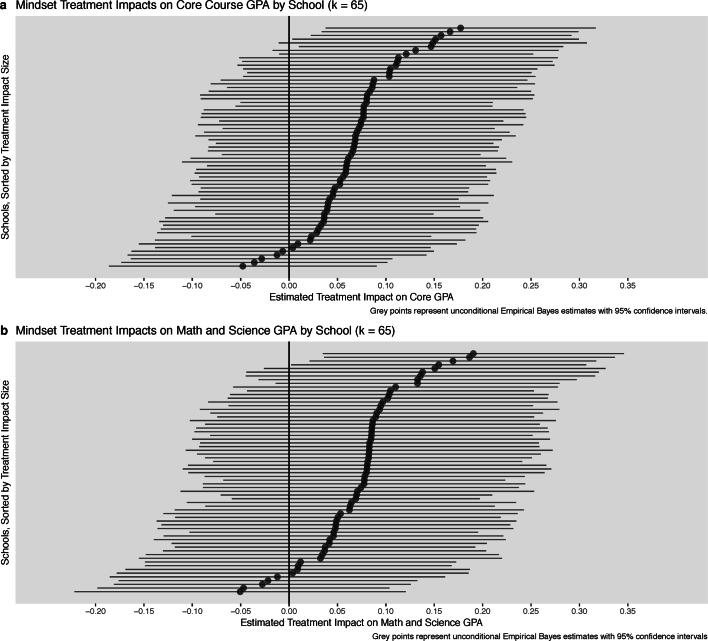
- Evident from the text: school-level heterogeneity analyses are limited by the observational nature of the moderators and by only 65 schools contributing to the main analyses.
Model-written summary. Check it against the paper before relying on it.
Integrity signals
Registry
Cites
Statistics
Figures
Verification
Claims the paper makes
15 Valid · 0 Not valid · 17 Not checked · 46 Own results and interpretations
The cited sources support only part of this claim — read each source’s verdict below.
In the paper
“When such students underperform in or opt out of rigorous coursework, they are far less likely to leave secondary school prepared for college or university or for advanced courses in college or university8,9.”
§ A national experiment reveals where a growth mindset improves achievement > Main
What the sources say
- Not checked — no full text of the sourcecites [8] Adelman, C. The Toolbox Revisited: Paths to Degree Completion from High School through College (US Department of Education, 2006).
- Partly supportedcites [9] Schiller KS Schmidt WH Muller C Houang R Hidden disparities: how courses and curricula shape opportunities in mathematics during high school Equity Excell. Educ. 2010 43 414 433 10.1080/10665684.2010.517062 23554547 PMC3612550 sourceExperimental — accuracy not yet measured
The ‘Course Enrollments as Opportunities to Learn’ section (page unavailable) says that mathematics course sequencing affects how far students progress in high school and that mathematics success has consequences for post-secondary schooling. The ‘Dimensions of Learning Opportunities’ section (page unavailable) also discusses undergraduates’ need for remedial courses. But the paper does not establish that students who underperform in or opt out of rigorous coursework are ‘far less likely’ to leave school prepared for college or advanced college courses. (LLM, conf=0.83)
plainstates an association- Asserted: passes — The authors put it forward as true.
- Checkable: passes — It can be checked against evidence.
- Load-bearing: passes — The paper’s conclusions depend on it.
- Based: passes — The paper gives a reason why it holds.
The cited sources support only part of this claim — read each source’s verdict below.
In the paper
“most interventions that are effective in initial efficacy trials go on to show weaker or no effects when they are scaled up in effectiveness trials that deliver treatments under everyday conditions to more heterogeneous samples21–23.”
§ A national experiment reveals where a growth mindset improves achievement > A focus on heterogeneity
What the sources say
- Not checked — no full text of the sourcecites [21] Greenberg MT Abenavoli R Universal interventions: fully exploring their impacts and potential to produce population-level impacts J. Res. Educ. Eff. 2017 10 40 67 source
- Not checked — no full text of the sourcecites [22] Allcott H Site selection bias in program evaluation Q. J. Econ. 2015 130 1117 1165 10.1093/qje/qjv015 source
- Partly supportedcites [23] Singal AG Higgins PDR Waljee AK A primer on effectiveness and efficacy trials Clin. Transl. Gastroenterol. 2014 5 e45 10.1038/ctg.2013.13 24384867 PMC3912314 sourceExperimental — accuracy not yet measured
The Introduction says efficacy trials can overestimate effects in clinical practice, and Study Design describes effectiveness trials as using more heterogeneous populations in routine settings, sometimes without a witnessed effect. The paper does not establish that *most* interventions with positive initial efficacy results subsequently show weaker or no effects in effectiveness trials. (LLM, conf=0.86)
plainstates a cause- Asserted: passes — The authors put it forward as true.
- Checkable: passes — It can be checked against evidence.
- Load-bearing: passes — The paper’s conclusions depend on it.
- Based: passes — The paper gives a reason why it holds.
The cited sources support only part of this claim — read each source’s verdict below.
In the paper
“Beliefs—and particularly beliefs that affect how students make sense of ongoing challenges—are important during high-stakes developmental turning points such as pubertal maturation43,44 or the transition to secondary school6.”
§ A national experiment reveals where a growth mindset improves achievement > Discussion
What the sources say
- Supportedcites [43] Yeager DS Dahl RE Dweck CS Why interventions to influence adolescent behavior often fail but could succeed Perspect. Psychol. Sci. 2018 13 101 122 10.1177/1745691617722620 29232535 PMC5758430 source
The Discussion (page unavailable) says adolescents’ beliefs about whether social traits can change shape how they interpret and cope with social adversity, using a new high school student as an example. The paper also links adolescents’ heightened sensitivity to status and respect to pubertal maturation and school transitions (Abstract, page unavailable). Together, these passages support the attributed point about the importance of beliefs during those developmental turning points. (LLM, conf=0.87)
- Partly supportedcites [44] Dahl RE Allen NB Wilbrecht L Suleiman AB Importance of investing in adolescence from a developmental science perspective Nature 2018 554 441 450 10.1038/nature25770 29469094 sourceExperimental — accuracy not yet measured
The Conclusion (p. 13) describes pubertal maturation as a dynamic period of learning and adaptation, and the Policy and intervention section (p. 10) identifies puberty as an important window for formative learning experiences. This supports the significance of the pubertal turning point, but the paper does not establish the claim about beliefs that shape how students interpret ongoing challenges. The transition to secondary school is attached to a different citation and is not assessed here. (LLM, conf=0.82)
- Not checked — no full text of the sourcecites [6] Crosnoe, R. Fitting In, Standing Out: Navigating the Social Challenges of high School to Get an Education (Cambridge Univ. Press, 2011). source
plainstates an association- Asserted: passes — The authors put it forward as true.
- Checkable: passes — It can be checked against evidence.
- Load-bearing: unclear — It is unclear whether the paper’s conclusions depend on it.
- Based: passes — The paper gives a reason why it holds.
- Supported
The cited sources support only part of this claim — read each source’s verdict below.
In the paper
“previously low-achieving students are the group that shows the steepest decline in grades during the transition to secondary school19”
§ A national experiment reveals where a growth mindset improves achievement > Main
What the sources say
- Partly supportedcites [19] Benner AD The transition to high school: current knowledge, future directions Educ. Psychol. Rev. 2011 23 299 328 10.1007/s10648-011-9152-0 21966178 PMC3182155 sourceExperimental — accuracy not yet measured
The Academic performance and engagement passage (page unavailable) reports that grades generally decline from middle to high school. The feeder-pattern passage (page unavailable) says low-performing students struggled more under a particular transition condition, but it does not establish that previously low-achieving students have the steepest grade decline of all groups. (LLM, conf=0.84)
plainstates an association- Asserted: passes — The authors put it forward as true.
- Checkable: passes — It can be checked against evidence.
- Load-bearing: passes — The paper’s conclusions depend on it.
- Based: passes — The paper gives a reason why it holds.
- Partly supported
The sources with a verdict support this claim; the rest weren’t checked yet, have no full text we could read, or their verdicts aren’t rated yet.
In the paper
“Nonetheless, previous randomized evaluations, including a pre-registered replication, found that online growth mindset interventions improved grades for the targeted group of students in secondary education who previously showed lower achievement13,16,18.”
§ A national experiment reveals where a growth mindset improves achievement > Main
What the sources say
- Supportedcites [13] Yeager DS Using design thinking to improve psychological interventions: the case of the growth mindset during the transition to high school J. Educ. Psychol. 2016 108 374 391 10.1037/edu0000098 27524832 PMC4981081 source
The Focus of the Present Investigation describes a prior randomized online evaluation in which lower-achieving high school students improved their GPA. The Study 2 Results report a pre-registered analysis showing a grade benefit for previously lower-achieving ninth graders, and the General Discussion calls it a rigorous replication. (LLM, conf=0.93)
- Not checked — no full text of the sourcecites [16] Paunesku D Mind-set interventions are a scalable treatment for academic underachievement Psychol. Sci. 2015 26 784 793 10.1177/0956797615571017 25862544 source
- Not checked — no full text of the sourcecites [18] Good C Aronson J Inzlicht M Improving adolescents’ standardized test performance: an intervention to reduce the effects of stereotype threat J. Appl. Dev. Psychol. 2003 24 645 662 10.1016/j.appdev.2003.09.002 source
plainstates a cause- Asserted: passes — The authors put it forward as true.
- Checkable: passes — It can be checked against evidence.
- Load-bearing: passes — The paper’s conclusions depend on it.
- Based: passes — The paper gives a reason why it holds.
- Supported
25 more claims · 2 with their cited sources checked
Create a free account to see all 78 claims and to verify the 6 references still open.
- Probably not a substantial claim. 38
- It may state two separate claims as one. 23
Claims other papers make about this one
Each is checked against this paper’s own text: does it say what the citing paper says it does?
The cited source doesn’t support the claim as written.
In the citing paper
“As another example, Yeager et al. (2019) only reported the results of the 50% of students performing below their school's median.They stated this was in part because lower-achieving students may have more academic difficulties and therefore may benefit more from a growth mindset intervention than higher-achieving students.Yet, they did not report a test of whether the treatment effect for lower-”
From Do growth mindset interventions impact students’ academic achievement? A systematic review and meta-analysis with recommendations for best practices. (2023) · cites this paper as Yeager et al. (2019)
Checked by a reasoning model — may be wrong.
Experimental — accuracy not yet measuredThe source backs part of the claim, not all of it — or backs it for a different population, condition or comparison.
In the citing paper
“For example, growth mindset interventions have been shown to help students alter their fixed mindset in a way that allows them to take a longer term perspective (Cassidy, 2015;Rhew et al., 2018;Yeager et al., 2019).”
From The impact of growth mindset training on entrepreneurial action among necessity entrepreneurs: Evidence from a randomized control trial (2023) · cites this paper as Yeager et al., 2019
Experimental — accuracy not yet measuredThe source backs part of the claim, not all of it — or backs it for a different population, condition or comparison.
In the citing paper
“The intervention offered greater benefits to lower achieving students if they attended schools whose students had an overall higher orientation towards growth mindset”
From Tackling Educational Inequalities with Social Psychology: Identities, Contexts, and Interventions (2021) · cites this paper as Yeager et al., 2019
Experimental — accuracy not yet measuredThe source backs part of the claim, not all of it — or backs it for a different population, condition or comparison.
In the citing paper
“Studies have shown that a growth mindset is associated with improved achievement; moreover, even short interventions can foster an increased growth mindset (Blackwell et al., 2007;Yeager et al., 2019).”
From Impacts of Standards-Based Grading on Students’ Mindset and Test Anxiety (2022) · cites this paper as Yeager et al., 2019
Experimental — accuracy not yet measuredThe source backs part of the claim, not all of it — or backs it for a different population, condition or comparison.
In the citing paper
“While scholars have examined growth mindset in both a poverty context (e.g., Burnette et al., 2018;Yeager et al., 2019) and an entrepreneurship context (e.g., Burnette et al., 2019), to the best of our knowledge none of these studies have examined both of these contexts together, nor have they been studied outside of the context of formal education settings.”
From The impact of growth mindset training on entrepreneurial action among necessity entrepreneurs: Evidence from a randomized control trial (2023) · cites this paper as Yeager et al., 2019
Experimental — accuracy not yet measured
5 more claims about this paper
Create a free account to see every claim other papers make about this one.
Statistics that don’t add up
Each reported p-value recomputed from its test statistic and degrees of freedom, each partial η² from its F, and each ratio, mean difference or B printed with a p checked against its own confidence interval.
Rated minor: it would not touch a result — a value no result rests on, a p-value that stays on the same side of the significance level, or a conflict that is clerical, resolved elsewhere in the paper, or outside its own findings.
In the paper
“B = −0.07 (95% confidence interval = 0.02, 0.13), s.e. = 0.03, z = −2.76, n = 6,320, k = 65, P = 0.006”
§ A national experiment reveals where a growth mindset improves achievement > Moderation by school achievement level
Statistics recomputed
Every reported test result, recomputed from its test statistic and degrees of freedom. A result shows as not adding up only once an independent check has confirmed it.
- Consistentz = 2.26reported p = .024 · recomputed p = .024
“z = 2.26, p = .024”
Self-check
Percentages, sums and reported differences re-computed from the paper’s own numbers.
Self-check results appear here once an independent check has confirmed them.
Citations
Cites
Our future: a Lancet commission on adolescent health and wellbeing
Patton, G. C., Sawyer, S. M., Santelli, J. S., Ross, D. A., Afifi, R., Allen, N. B., Arora, M., Azzopardi, P., Baldwin, W., Bonell, C., et al. (2016) · The Lancet · doi:10.1016/s0140-6736(16)00579-1 · Cited by 3,785
Blackwell, L. S., Trzesniewski, K. H., & Dweck, C. S. (2007) · Child Development · doi:10.1111/j.1467-8624.2007.00995.x · Cited by 3,784
Self-citationAronson, J., Fried, C. B., & Good, C. (2002) · Journal of Experimental Social Psychology · doi:10.1006/jesp.2001.1491 · Cited by 1,889
(2006) · US Department of Education · Cited by 1,586
Expectations of brilliance underlie gender distributions across academic disciplines
Leslie, S.-J., Cimpian, A., Meyer, M., & Freeland, E. (2015) · Science · doi:10.1126/science.1261375 · Cited by 1,516
Mind-sets matter: A meta-analytic review of implicit theories and self-regulation.
Burnette, J. L., O'Boyle, E. H., VanEpps, E. M., Pollack, J. M., & Finkel, E. J. (2013) · Psychological Bulletin · doi:10.1037/a0029531 · Cited by 1,367
Social-Psychological Interventions in Education: They’re Not Magic
Yeager, D. S., & Walton, G. M. (2011) · Review of Educational Research · doi:10.3102/0034654311405999 · Cited by 1,345
Self-citationMindsets: A View From Two Eras
Dweck, C. S., & Yeager, D. S. (2019) · Perspectives on Psychological Science · doi:10.1177/1745691618804166 · Cited by 1,259
Self-citationImportance of investing in adolescence from a developmental science perspective
Dahl, R. E., Allen, N. B., Wilbrecht, L., & Suleiman, A. B. (2018) · Nature · doi:10.1038/nature25770 · Cited by 1,196
Skills, education, and the rise of earnings inequality among the “other 99 percent”
Autor, D. H. (2014) · Science · doi:10.1126/science.1251868 · Cited by 1,160
Research works printed but not linked: 1
- Tipton, E., Yeager, D. S., Iachan, R. & Schneider, B. in Experimental Methods in Survey Research: Techniques that Combine Random Sampling with Random Assignment (ed. Lavrakas, P. J.) (Wiley, 2019).
Cited by
Items 901–1,000 of 1,523
Yulianti, M. D., Astawan, I. G., & Riastini, P. N. (2024) · Indonesian Values and Character Education Journal · doi:10.23887/ivcej.v7i1.76209 · Cited by 4
“A person's behavior is also motivated by their mindset (S. H. Pratiwi, 2021; Yeager et al., 2019; Zhao et al., 2018).”
BackgroundA collaborative approach to help future teachers plan their teaching: the Prep.AR tool
Colognesi, S., Wiertz, C., Stordeur, M.-F., Moncarey, C., Oliveri, S., Deschepper, C., Mosnenck, S. V., Bollen, P., Leroux, L., Poncelet, C., et al. (2024) · PRACTICE · doi:10.1080/25783858.2024.2372259 · Cited by 3
“These aspects are known to play a major role in student learning (e.g. Noddings 2005, Yeager et al .”
Putting Affect in Context: Meta-Affect, Beliefs, and Engineering Identity
Plagge, A., Treadway, E., Swenson, J. E. S., & Usinski, D. (2024) · ASEE Annual Conference & Exposition · doi:10.18260/1-2--47906 · Cited by 2
Lichand, G., Ash, E., Arold, B. W., Gudino, J., Dória, C. A., Trindade, A., Bettinger, E., & Yeager, D. S. (2024) · Journal of Research on Adolescence · doi:10.1111/jora.13008 · Cited by 2
Self-citationUnderstanding mindset theory in surgical education
Coppersmith, N. A., Coppersmith, J. V. G., Esposito, A. C., Flom, E. A., White, E. M., & Yoo, P. S. (2024) · Global Surgical Education - Journal of the Association for Surgical Education · doi:10.1007/s44186-024-00291-0 · Cited by 3
“In other contexts, a growth mindset has been associated with academic achievement and lower stress, and the fact that the majority of trainees endorse beliefs consistent with a growth mindset toward surgical skill should be encouraging for potential resident achievement and wellness [2, 19].”
Digital Attention Training: Improving the Mental Health and Well-Being of Adolescent Youth
Richelle, J., Dow, B. R., Pasch, A. M., Schooler, J. W., Mrazek, M. D., & Mrazek, A. J. (2024) · Creative Education · doi:10.4236/ce.2024.1510132 · Cited by 5
“A standardized mean difference effect size of 0.20 is often considered a large effect in real-world education settings, and brief interventions often have effect sizes of 0.10 s.d. or lower (Yeager et al., 2019).”
InfluentialSilva, N. D. (2024) · Journal of Library Administration · doi:10.1080/01930826.2024.2437963 · Cited by 3
“Yeager et al. (2019) led an intervention in a nationally representative sample of 12,000 students transitioning to high school.”
Industry–academia partnership in building materials science capacity in Africa
Hauwiller, M. R., Visheratina, A. K., Oeba, D. A., Ngom, B. D., Hernandez, S., Thuo, M., & Kotov, N. A. (2025) · MRS Communications · doi:10.1557/s43579-025-00692-2 · Cited by 4
“This low-risk environment should foster a growth mindset [15,16] because there are no grades or negative outcomes.”
Do growth mindsets reduce the big-fish-little-pond effect?
Stockus, C. A., & Zell, E. (2025) · Social Psychology of Education · doi:10.1007/s11218-025-10022-y · Cited by 4
“Activation of a growth mindset has been found to yield a host of beneficial effects in educational settings (Burnette et al., 2023a; Yeager et al., 2019), including the tendency to soften adverse affective and motivational reactions to poor performance (Park & Kim, 2015; Plaks & Stecher, 2007;…”
InfluentialHo, S. K., Zhang, L. R., & Chen, W. (2025) · Social Psychology of Education · doi:10.1007/s11218-024-09987-z · Cited by 3
“For example, short online growth mindset trainings programs have been shown to have positive effects on students’ beliefs about their effort and academic outcomes (Yeager et al., 2019).”
Age, T. J., & Machaba, M. F. (2025) · E-Journal of Humanities Arts and Social Sciences · doi:10.38159/ehass.2025644 · Cited by 3
Cao, M., Xu, X., Zeng, Y., Zhao, B., Xie, C., Wu, H., & Lou, J. (2025) · JMIR Human Factors · doi:10.2196/65519 · Cited by 3
“Many studies have shown that interventions fostering a growth mindset are beneficial to behavior change, such as improving performance in students [27-29]. mitigating weight gain resulting from dieting setbacks [30], controlling healthy eating and exercise in obese youth [31], and smoking cessation…”
InfluentialThe evolution of mindset research: Forging connections across individuals, situations, and cultures
Murphy, M. C., Emerson, K. T. U., Kroeper, K. M., & Green, D. J.-A. (2025) · Advances in experimental social psychology · doi:10.1016/bs.aesp.2025.04.001 · Cited by 3
Beliefs, Behaviors, and the Inferences That Bind Them: Scrutinizing the Mechanism of Action
Macnamara, B. N., & Burgoyne, A. P. (2025) · Psychological Inquiry · doi:10.1080/1047840x.2025.2482351 · Cited by 3
“Here, Yeager, Dweck, and colleagues (Yeager et al., 2019) suggest that growth mindset fosters an adaptive motivation (i.e., learning goal orientation), which leads to behaviors such as seeking out learning opportunities and persevering when struggling.”
Understanding the variability in implementation quality in the Resilient intervention
Halvorsen, J., Ertesvåg, S. K., Skage, I., & Roland, P. (2025) · Scandinavian Journal of Educational Research · doi:10.1080/00313831.2025.2506382 · Cited by 4
“There is a solid theoretical foundation guiding the treatment of these themes (Lazarus & Folkman, 1987; Collaborative for Academic, Social and Emotional Learning [CASEL], 2020; Grossman et al., 2004; Taylor et al., 2017; Yeager et al., 2019;)”
Linklater-Steele, A., Colthorpe, K. L., & Ainscough, L. (2025) · AJP Advances in Physiology Education · doi:10.1152/advan.00012.2025 · Cited by 2
Strategi Lulusan SMK Menjadi Wirausaha Otomotif
Ahmadi, R. D. (2022) · journal EVALUASI · doi:10.32478/evaluasi.v6i1.918 · Cited by 2
Spelke, E. S., & Shutts, K. (2022) · World Bank, Washington, DC eBooks · doi:10.1596/978-1-4648-1795-3_ch1 · Cited by 4
Design of a web-based system for the registration of grades in a school
Facultad de Ciencias e Ingeniería, U. D. C. Y. H., Sanchez-Condori, F., Andrade–Arenas, L., & Facultad de Ciencias e Ingeniería, U. D. C. Y. H. (2022) · Advances in Mobile Learning Educational Research · doi:10.25082/amler.2022.02.019 · Cited by 4
Donegan, R. E., Wanzek, J., Petscher, Y., & Otaiba, S. A. (2023) · The Elementary School Journal · doi:10.1086/723373 · Cited by 2
“For older students, there is some evidence that growth mindset interventions can improve students’ academic outcomes (e.g., Blackwell et al., 2007; Yeager et al., 2019).”
BackgroundSchnorr, K. G. D. (2022) · Psychology · doi:10.4236/psych.2022.137068 · Cited by 3
Does the size of rewards influence performance in cognitively demanding tasks?
Holst-Hansen, J. A., & Bergenholtz, C. (2020) · PLoS ONE · doi:10.1371/journal.pone.0240291 · Cited by 4
“, a study on growth mindset [28] one needs to continuously reinvest the higher reward to generate the effect.”
BackgroundGriffin, N. M. (2020) · Cited by 3
Masaki, F. (2021) · The Qualitative Report · doi:10.46743/2160-3715/2021.5046 · Cited by 4
“Following Dweck, many researchers conducted studies on mindset and suggested that when students believed their ability could grow with effort, their performance improved significantly (e.g., Yeager et al., 2019).”
A Reflection on Growth Mindset and Meritocracy
Petrik, R., Vega, J., & Vindas-Meléndez, A. R. (2022) · Journal of Humanistic Mathematics · doi:10.5642/jhummath.202201.31 · Cited by 3
“conducted a cross-institutional online intervention to increase growth mindset and found a uniform positive effect on math and science grade point averages [27].”
BackgroundPsychometric properties and factorial invariance of the Farsi version of the Stress Mindset Measure
Tedadi, Y., Daryani, Y., & Karsazi, H. (2022) · Frontiers in Psychology · doi:10.3389/fpsyg.2022.945673 · Cited by 5
“This notion is in line with the theory of mindsets, describing mindsets as individuals’ beliefs about fundamental attributes such as intelligence and personality- whether the person considers them to be fixed or malleable (Dweck et al., 1995; Dweck and Yeager, 2019).”
ResultTwo Routes to the Self-Regulation of Motivation and Goals
Gollwitzer, P. M., & Bargh, J. A. (2023) · Oxford University Press eBooks · doi:10.1093/oso/9780197662359.003.0031 · Cited by 2
Motivation Is the Interaction Between Dispositions and Context
Stipek, D. J. (2023) · Oxford University Press eBooks · doi:10.1093/oso/9780197662359.003.0005 · Cited by 7
Alexander, P. A. (2023) · Oxford University Press eBooks · doi:10.1093/oso/9780197662359.003.0050 · Cited by 2
The Good, the Bad, and the Ugly of Motivation
Ntoumanis, N. (2023) · Oxford University Press eBooks · doi:10.1093/oso/9780197662359.003.0020 · Cited by 4
The Most Fundamental Limitation in Motivation Theory and Research Is Our Theories
Anderman, E. M. (2023) · Oxford University Press eBooks · doi:10.1093/oso/9780197662359.003.0066 · Cited by 3
Most Motivation Research in Education Is Not Yet Useful for Teachers
Patrick, H. (2023) · Oxford University Press eBooks · doi:10.1093/oso/9780197662359.003.0064 · Cited by 6
Community-Engaged Research: The Next Frontier in Motivation Science
Gray, D. L., & Harris-Thomas, B. (2023) · Oxford University Press eBooks · doi:10.1093/oso/9780197662359.003.0076 · Cited by 3
Karnaze, M. M., Kious, B. M., Feuerman, L. Z., Classen, S. A., Robinson, J. O., Bloss, C. S., & McGuire, A. L. (2023) · Frontiers in Psychology · doi:10.3389/fpsyg.2023.1016337 · Cited by 3
“In January 2022, we assessed the prevalence of self-reported symptoms of anxiety, depression, and burnout among 1,323 United States adults and examined whether three hypothesized modifiable protective factors were associated with fewer depressive and anxiety symptoms and less frequent burnout.”
BackgroundInfluentialCompetition Can Enhance Motivation—But Typically Undermines It
Reeve, J. (2023) · Oxford University Press eBooks · doi:10.1093/oso/9780197662359.003.0028 · Cited by 7
Matthes, B., & Stoeger, H. (2023) · Social Psychology of Education · doi:10.1007/s11218-023-09769-z · Cited by 2
“…predictive power of learners’ ITs for their academic achievement is not particularly strong (Sisk et al., 2018; but see Yeager & Dweck 2020, for a reply), interventions that target students’ ITs have been shown to improve the academic achievement of low-performing students (Yeager et al., 2019).”
BackgroundInfluentialLessons from a cross-institutional online professional development pilot
Hughes, J. A., Martin, T. S., Gladwell, T. D., et al. (2023) · Currents in Pharmacy Teaching and Learning · doi:10.1016/j.cptl.2023.05.004 · Cited by 2
Who’s Got Talent and How They Got it: How Culture and Media Might Shape (Creative) Mindsets
Lebuda, I., & Karwowski, M. (2023) · Palgrave studies in creativity and culture · doi:10.1007/978-3-031-28206-5_9 · Cited by 2
Applications of Self-Fulfilling Prophecies to School Education
Fei, W., & Abdullah, H. B. (2023) · Advances in educational marketing, administration, and leadership book series · doi:10.4018/978-1-6684-8837-9.ch005 · Cited by 3
Savi, A. O., van Klaveren, C., & Cornelisz, I. (2023) · Computers & Education · doi:10.1016/j.compedu.2023.104908 · Cited by 6
The Effects of Implicit Theories on Body Weight Information Avoidance
Hagerman, C. J., Stock, M. L., Post, S. M., Macura, Z., Moore, P. J., Dodge, T. L., & Wirtz, P. W. (2023) · Experimental Psychology (formerly Zeitschrift für Experimentelle Psychologie) · doi:10.1027/1618-3169/a000585 · Cited by 2
Regaining the Student Mindset of Patient Care
Grant, A. A. (2023) · Annals of Vascular Surgery · doi:10.1016/j.avsg.2023.12.009 · Cited by 2
Designing a Course for Lifelong, Self-Directed Character Growth
Erbe, R. G., Konheim‐Kalkstein, Y. L., Fredrick, R. N., Dykhuis, E. M., & Meindl, P. (2024) · Journal of Character and Leadership Development · doi:10.58315/jcld.v11.286 · Cited by 2
Applying Design Thinking to Support Education for Sustainable Development in Higher Education
Schmidberger, I., & Wippermann, S. (2024) · International Conference on Higher Education Advances (HEAd) · doi:10.4995/head24.2024.17073 · Cited by 2
Hurtado, I. L. (2020) · University of Minnesota Digital Conservancy (University of Minnesota) · Cited by 6
Domingue, B. W., Kanopka, K., Trejo, S., Rhemtulla, M., & Tucker–Drob, E. M. (2021) · PsyArXiv (OSF Preprints) · doi:10.31234/osf.io/932fm · Cited by 4
Socio-Emotional Skills and the Socioeconomic Achievement GapPreprint
Gruijters, R. J., Raabe, I. J., & Hübner, N. (2021) · doi:10.31235/osf.io/vutrm · Cited by 2
Price, M. A., Weisz, J. R., McKetta, S. C., Hollinsaid, N. L., Lattanner, M. R., Reid, A. E., & Hatzenbuehler, M. L. (2020) · OSF Preprints (OSF Preprints) · doi:10.31219/osf.io/szu7v · Cited by 2
Implicit Theories of Intelligence
Hall, L. (2005) · Sage eBooks · doi:10.4135/9781452204437.n110 · Cited by 1
Combette, L. T., rotge, Darnon, C., et al. (2022) · doi:10.31234/osf.io/bp4x8 · Cited by 2
The Impact of Working Memory Training on Children's Cognitive and Noncognitive SkillsPreprint
Berger, E., Fehr, E., Hermes, H., Schunk, D., & Winkel, K. (2024) · SSRN Electronic Journal · doi:10.2139/ssrn.4772583 · Cited by 2
A Prosocial Fake News Intervention with Durable EffectsPreprint
Orosz, G., Paskuj, B., Faragó, L., et al. (2022) · doi:10.31219/osf.io/9utyg · Cited by 2
Making Entrepreneurs: The Return to Training Youth in Hard versus Soft Business Skills
Chioda, L., Contreras-Loya, D., Gertler, P., & Carney, D. R. (2023) · doi:10.51744/crpp11 · Cited by 2
“Programs targeting the development of youth’s socio-emotional skills have led to improvements in education outcomes (Yeager et al., 2019; Alan and Ertac, 2018; Alan et al., 2019) and have shown promise as effective prevention strategies against crime and antisocial behavior (Blattman et al., 2017;…”
BackgroundChildren perpetuate competence-based inequality when they help peersPreprint
Sierksma, J. (2023) · doi:10.31234/osf.io/9k8he · Cited by 2
Learning motivation and engagement
Wang, M., Scanlon, C. L., & Henry, D. A. (2023) · Elsevier eBooks · doi:10.1016/b978-0-323-96023-6.00010-5 · Cited by 3
Carneiro, P., Cruz-Aguayo, Y., Salvati, F., & Schady, N. (2023) · doi:10.18235/0005149 · Cited by 5
An implicit measure of growth mindset uniquely predicts post-failure learning behaviorPreprint
Sik, K., Cummins, J. D., & Job, V. (2023) · Research Square · doi:10.21203/rs.3.rs-3407717/v1 · Cited by 2
Can Grit be Taught? Learning from a field experiment with middle school students in FYR Macedonia
Boudet, A. M. M., Duckworth, A. L., Carneiro, P., Santos, I. V., Arias, O. S., Krekel, C., & Eskreis-Winkler, L. (2017) · AEA Randomized Controlled Trials · doi:10.1257/rct.2094-1.1 · Cited by 2
Self-citationPeople Accurately Predict the Shape of Skill Learning CurvesPreprint
Zhang, X., McDougle, S. D., & Leonard, J. (2024) · SSRN Electronic Journal · doi:10.31234/osf.io/rwuc9 · Cited by 3
Generalizability of Choice Architecture InterventionsPreprint
Szászi, B., Goldstein, D. G., Soman, D., & Michie, S. (2024) · PsyArXiv (OSF Preprints) · doi:10.31234/osf.io/8p4vq · Cited by 2
A Meta-Analysis on Teachers’ Growth MindsetPreprint
Bardach, L., Bostwick, K. C. P., Fütterer, T., Kopatz, M., Hobbi, D. M., Klassen, R. M., & Pietschnig, J. (2024) · doi:10.31219/osf.io/b6cxa · Cited by 2
The Influence of Economic Uncertainty and Social Media Use on Religious Belief: Evidence from ChinaPreprint
Gao, S., Xu, X., Tan, M., & Yang, Y. (2024) · Preprints.org · doi:10.20944/preprints202407.0031.v1 · Cited by 1
Self-Confidence and Motivated Memory Loss: Evidence From SchoolsPreprint
Roy-Chowdhury, V. (2024) · SSRN Electronic Journal · doi:10.2139/ssrn.4986405 · Cited by 2
How Frames Can Promote Agency: Response to Flusberg et al. (2024)
Walsh, J. (2024) · Gothic.net · doi:10.1177/15291006241296035 · Cited by 2
“In one study, Yeager et al. (2019) evaluated the effectiveness of a growth-mindset intervention through a large-scale, preregistered, and blinded randomized controlled trial with a nationally representative sample of ninth-grade students entering U.S. public high schools.”
Calvete, E., Orue, I., Prieto-Fidalgo, Á., Gómez-Odriozola, J., Mueller, S. C., Royuela-Colomer, E., Morea, A., Ruiz-Alonso, E., Larrucea‐Iruretagoyena, M., Little, T. D., et al. (2022) · Current Psychology · doi:10.1007/s12144-021-02681-9 · Cited by 2
“Several wise interventions have focused on mindsets or implicit theories about the malleability of personal qualities such as intelligence (Yeager et al., 2019), stress (Crum et al.”
BackgroundUsing Push Technology for Maintaining Proficiency and Promoting a Growth Mindset in a STEM Course
van de Sande, C., & Reiser, M. (2021) · Journal of Higher Education Theory and Practice · doi:10.33423/jhetp.v21i11.4678 · Cited by 1
The Effects of Accelerated Mathematics on Self-Efficacy and Growth Mindset
Bi, S. Z., Buontempo, J., & DiSalvo, R. (2022) · Economics of Education Review · doi:10.1016/j.econedurev.2022.102288 · Cited by 5
Self-citationTo whom do students believe a growth mindset applies?
Malespina, A., Schunn, C. D., & Singh, C. (2022) · Physics Education Research Conference (PERC) · doi:10.1119/perc.2022.pr.malespina · Cited by 4
“…students into various learning contexts (i.e., have some stability over time and context), they can be malleable through strategic (and relatively brief) interventions with positive results for students’ learning outcomes [11, 12], especially if students are at a high risk of failing a class [20].”
BackgroundRollwagen‐Bollens, G., Kibota, T. T., & Crosby, C. (2022) · Journal of Microbiology and Biology Education · doi:10.1128/jmbe.00102-22 · Cited by 2
Is There a Need for Psychological Needs in Theories of Achievement Motivation?
Wigfield, A., & Koenka, A. C. (2023) · Oxford University Press eBooks · doi:10.1093/oso/9780197662359.003.0046 · Cited by 1
Big-Fish-Little-Pond Effect: Universality of Psychological Comparison Processes
Marsh, H. W., & Basarkod, G. (2023) · Oxford University Press eBooks · doi:10.1093/oso/9780197662359.003.0017 · Cited by 4
Eurboonyanun, C., PETRUSA, E. R., Eurboonyanun, K., McKinley, S. K., Phanphruk, W., Gee, D. W., & Phitayakorn, R. (2023) · Global Surgical Education - Journal of the Association for Surgical Education · doi:10.1007/s44186-023-00115-7 · Cited by 1
“Carol Dweck in 2006 and described as a set of working self-assumptions that a learner has about their own learning [6].”
Nurenberg, D., & Tuller, L. (2023) · Teachers College Record The Voice of Scholarship in Education · doi:10.1177/01614681231198637 · Cited by 2
“Some research has demonstrated that students who instead ascribe to the growth mindset actually learn more in the long term (Dweck, 2008; Yeager et al., 2019).”
BackgroundJones, E. (2023) · Advances in educational technologies and instructional design book series · doi:10.4018/978-1-6684-8646-7 · Cited by 8
Cho, H., Lee, H., & Kim, T. (2023) · Frontiers in Psychology · doi:10.3389/fpsyg.2023.1169221 · Cited by 7
“…critical role of a growth mindset in individuals’ behavioral outcomes, studies on growth mindset were conducted across various fields, including education (Dweck, 2015; Brougham and Kashubeck-West, 2017; Yeager et al., 2019), organizational psychology (Visser, 2013), and tourism (Lee et al., 2018).”
BackgroundGoldhorn, L., Wilhelm, T. E., & Spatz, V. (2023) · International Journal of Innovation in Science and Mathematics Education · doi:10.30722/ijisme.31.04.002 · Cited by 4
“In a very condensed 25-minute self-administered course, over 6000 students participated in a representative study - the National Study of Learning Mindsets (Yeager et al., 2019) - and the researchers could report small but significant effects on academic performances for low-achieving students.”
نصحى, ش. م. (2024) · دراسات فى التعلیم الجامعى · doi:10.21608/deu.2024.337261 · Cited by 1
Kim, J. S., Hong, S., & Na, J. (2024) · Personality and Individual Differences · doi:10.1016/j.paid.2024.112723 · Cited by 1
Jia, J., Ng, J. Y. Y., Wang, M. H., & Ha, A. S. C. (2024) · Leisure Sciences · doi:10.1080/01490400.2024.2383369 · Cited by 2
“Previous research conducted among parents to improve their children’s skills (Andersen & Nielsen, 2016), and among adolescents to improve their academic outcomes (Yeager et al., 2019) supported the effectiveness of growth mindset intervention.”
Executive functions contributions to copying and text production in elementary school children
Juric, L. C., Trudo, R. G., Zamora, E. V., Galli, J. I., Abusamra, V., & Tabullo, Á. (2024) · Applied Neuropsychology Child · doi:10.1080/21622965.2024.2440929 · Cited by 5
Rutten, L. D., & Muenks, K. M. (2025) · Social Psychology of Education · doi:10.1007/s11218-024-10002-8 · Cited by 2
“Several interventions aimed at changing students’ own mindsets have shown positive effects on a variety of student outcomes including interest, persistence, and grades (Blackwell et al., 2007; Burnette et al., 2020; O’Rourke et al., 2014; Yeager et al., 2019).”
Fostering Belonging: The Impact of a Wise Intervention on Diverse Engineering Students
Plessis, A. D., Viljoen, C., Blaine, D. C., Tadie, M., & Wolff, K. E. (2024) · World Engineering Education Forum - Global Engineering Deans Council (WEEF-GEDC) · doi:10.1109/weef-gedc63419.2024.10854938 · Cited by 1
“Research has shown that interventions promoting a growth mindset can lead to improved academic performance, particularly for students facing challenges or setbacks [15].”
Similarities in mindset between adolescents’ friends and cooperation partners
Benneker, I. M. B., Lee, N. C., de Swart, F., & van Atteveldt, N. (2025) · Social Psychology of Education · doi:10.1007/s11218-025-10028-6 · Cited by 1
“A similar result was found by Yeager et al. (2019) in their intervention study.”
Can a Short-Term Intervention Promote Growth Among Parents of Children with ASD?
Baransi, N., & Scharf, M. (2025) · Journal of Autism and Developmental Disorders · doi:10.1007/s10803-025-06744-9 · Cited by 4
“In these interventions, participants learn about brain plasticity and how abilities can develop over time by embracing challenges, employing effective strategies, and seeking guidance from others (Dweck & Yeager, 2019; Yeager et al., 2019).”
InfluentialMotivation and Academic Performance: Evidence from Two Senior High Schools in Ghana
Dabie, P. K. (2025) · Open Journal of Social Sciences · doi:10.4236/jss.2025.133034 · Cited by 7
Mathuva, D. M., Ndunge, A., & Njiraini, N. (2025) · Pastoral Psychology · doi:10.1007/s11089-025-01216-4 · Cited by 3
Baelen, R. N., Galla, B. M., & Maynard, R. A. (2025) · Social and Emotional Learning Research Practice and Policy · doi:10.1016/j.sel.2025.100113 · Cited by 5
Neuroscience Exposure as a Predictor of Teaching Self-Efficacy
Ribeiro, A. J., Mulle, R. L. D., & Padovan‐Neto, F. E. (2025) · European Journal of Investigation in Health Psychology and Education · doi:10.3390/ejihpe15050086 · Cited by 1
“…can also provide important perspectives on psychological factors that influence learning, including students’ motivation, beliefs in academic success, goal-setting behaviors, and academic persistence (Blackwell et al., 2007; Schroder et al., 2014; Yeager & Dweck, 2012; Yeager et al., 2019).”
Kwek, M. J. C., Lee, N. K. L., Wang, J. L., & Lim, K. B. L. (2025) · Discover Public Health · doi:10.1186/s12982-025-00680-w · Cited by 1
“Since past studies have proved that interventions to promote a growth mindset are feasible and advantageous [2, 4, 5], we can potentially improve the patients’ HRQoL during treatment by identifying patients with a fixed mindset to deliver targeted teachings.”
Personalized Persuasion by Shaping Beliefs About the Multidimensional Features of Objects
Terada, K., Noma, Y., & Hattori, M. (2025) · IEEE Access · doi:10.1109/access.2025.3575369 · Cited by 2
“Growth mindset interventions [57] and self-efficacy frameworks [58] highlight the role of belief structures in sustaining academic engagement.”
Navigating academic setbacks with intention and self-efficacy for decentering and self-compassion
Rigaud, K., Török, L., Takács, Z. K., Salamon, J., Tóth‐Király, I., Bőthe, B., & Orosz, G. (2025) · Personality and Individual Differences · doi:10.1016/j.paid.2025.113360 · Cited by 2
Peng, L., Chen, H., Liang, W., Shi, Z., & Li, Q. (2025) · Frontiers in Psychology · doi:10.3389/fpsyg.2025.1595422 · Cited by 10
“This lack of concrete success experiences makes it difficult for students to translate their belief in malleable ability into effective action, ultimately trapping them in the “helplessness trap” (Dweck and Yeager, 2019; Zhang et al., 2021).”
Wang, Y.-Y., Xi, A., Wong, S. S.-K., Leung, J. T. Y., Chow, E., Yam, K., & Zhu, S. (2025) · Journal of Evidence-Based Social Work · doi:10.1080/26408066.2025.2542452 · Cited by 1
Rad, H. S. (2025) · The Educational and Developmental Psychologist · doi:10.1080/20590776.2025.2545255 · Cited by 1
“In other words, while a GM can contribute positively to high achievement levels, it is not necessarily a standalone predictor or guarantee of success (Tynan et al., 2020), with its impact often amplified under optimal conditions (Yeager et al., 2019).”
Understanding Entrepreneurship in Relationship to Gender-role Orientation in South Africa
Urban, B., & Moloi, J. (2025) · Global Business Review · doi:10.1177/09721509251363411 · Cited by 1
Lee, Y. A., Li, G., Nakamura, J. S., Guo, Y., & Chen, F. S. (2025) · Journal of Personality · doi:10.1111/jopy.70015 · Cited by 1
Imamura, J. L., Mau, T. L., Wildy, E. L., Povich, J., de Haan, P. J., Hazlehurst, J. A., Herrlinger, T. J., & Winters, J. M. (2025) · Journal of Microbiology and Biology Education · doi:10.1128/jmbe.00015-25 · Cited by 4
The Effect of Growth Mindset Interventions on Students’ Self-Regulated Use of Retrieval Practice
Xiao, J., Baars, M., Xu, M. K., & PAAS, F. G. W. C. (2025) · Education Sciences · doi:10.3390/educsci15101267 · Cited by 3
Benneker, I. M. B., de Swart, F., Lee, N. C., & van Atteveldt, N. (2025) · European Journal of Psychology of Education · doi:10.1007/s10212-025-01009-6 · Cited by 2
“Ado-lescents who believe that their abilities are malleable, i.e., have a growth mindset, typically demonstrate higher achievement and more motivation for learning (Benneker et al., 2023; Burnette et al., 2018; Yeager et al., 2019).”
From Hindrance to Opportunity: Understanding Situational Constraints Through Cognitive Appraisal
Zhang, L., Yu, X., & Gao, J. (2025) · SAGE Open · doi:10.1177/21582440251386707 · Cited by 1
“These findings are consistent with research in education, which indicates that the benefits of a growth mindset are not uniform across all individuals and are more pronounced for those with lower abilities (Yeager et al., 2019).”
Metadata
- Authors
- Yeager, D. S., Hanselman, P., Walton, G. M., Murray, J. S., Crosnoe, R., Muller, C., Tipton, E., Schneider, B., Hulleman, C. S., Hinojosa, C. P., Paunesku, D., Romero, C., Flint, K., Roberts, A., Trott, J., Iachan, R., Buontempo, J., Yang, S. M., Carvalho, C. M., Hahn, P. R., Gopalan, M., Mhatre, P., Ferguson, R., Duckworth, A. L., & Dweck, C. S.
- Affiliations
- The University of Texas at Austin (US)
- University of California, Irvine (US)
- Stanford University (US)
- Northwestern University (US)
- Michigan State University (US)
- University of Virginia (US)
- University of Chicago (US)
- ICF International (United States) (US)
- Arizona State University (US)
- Pennsylvania State University (US)
- Harvard University (US)
- University of Pennsylvania (US)
- Corresponding author
- Yeager, David S.
- Hanselman, Paul
- ORCID
- Yeager, David S.
- Hanselman, Paul
- Walton, Gregory M.
- Murray, Jared S.
- Crosnoe, Robert
- Muller, Chandra
- Tipton, Elizabeth
- Schneider, Barbara
- Hulleman, Chris S.
- Hinojosa, Cintia P.
- Paunesku, David
- Roberts, Alice
- Iachan, Ronaldo
- Buontempo, Jenny
- Carvalho, Carlos M.
- Gopalan, Maithreyi
- Mhatre, Pratik
- Duckworth, Angela L.
- Dweck, Carol S.
- Venue
- Nature
- Published
- 2019-08-07
- Volume
- 573
- Issue
- 7774
- Pages
- 364-369
- ISSN
- 0028-0836 (ISSN-L)
- 1476-4687
- PMC
- PMC6786290
- OpenAlex
- W2964722401
- Semantic Scholar
- f9fb223742fce060785d7f59861d0341d149cb04
- Cited by
- 1,513
- References
- 43
- Citations by year
- 2026: 203 · 2025: 211 · 2024: 219 · 2023: 325 · 2022: 202 · 2021: 200 · 2020: 131 · 2019: 20
- FWCI
- 163.13
- Type
- journal article
- Language
- en
- Open access
- hybrid
- doi.org
- Licence
- cc-by
- creativecommons.org/licenses/by/4.0 (tdm)
- creativecommons.org/licenses/by/4.0 (vor)
- Locations
- Nature (publishedVersion, cc-by)
- PubMed Central (publishedVersion, cc-by)
- PubMed (publishedVersion)
- RePEc: Research Papers in Economics (submittedVersion)
- eScholarship (California Digital Library) (submittedVersion, cc-by)
- Funders
- National Science Foundation (1761179)
- William T. Grant Foundation
- Houston Endowment
- Spencer Foundation
- University of Texas at Austin
- Raikes Foundation
- National Institutes of Health
- Center for Advanced Study in the Behavioral Sciences, Stanford University
- National Institute of Child Health and Human Development (10.13039/100000071, HD042849)
- Center for Advanced Study, University of Illinois at Urbana-Champaign
- Eunice Kennedy Shriver National Institute of Child Health and Human Development (R24HD042849, R01HD084772, P2CHD042849)
- Topics
- Social Sciences › Psychology › Developmental and Educational Psychology › Education, Achievement, and Giftedness
- Social Sciences › Psychology › Social Psychology › Grit, Self-Efficacy, and Motivation
- Social Sciences › Education › School Choice and Performance
- Keywords
- growth mindset, academic performance, adolescents, online intervention, peer norms, secondary education, school context, scalable interventions, preregistration, Bayesian analysis
- MeSH terms
- Psychosocial Support Systems, Academic Success, Adolescent, United Kingdom, Humans, Students
About these checks
Registry, retraction, Cites and statistics results are computed, not judged, with one exception: a printed reference that no index lists is read once by a model before it counts as a citation error. Claims are extracted by a model and kept only when their quote appears verbatim in the text; each cited source is then checked, with a model’s help, for whether it says what the claim relies on. Those verdicts can be wrong — read the claim’s quote and the cited source before relying on one.
The claim verdicts this report counts are experimental: their accuracy is not yet measured.
A language model drew the claims from the paper on 2026-09-28, under version 3 of the claim definition (model deepseek-v4.1-flash, prompt extract-v3).
A second model labelled each claim on 2026-09-28 (model jev-1.13-20260917, definition revision gold-guideline-v0.2).
Cited sources are checked with a language model’s help (gpt-6-sol).
Statistics and arithmetic are recomputed, not judged.
Confidence bands are shown only for fields calibrated on our annotated test set. None is calibrated yet, so no band is shown.
What counts as a claim ›How we measure confidence ›How we check this ›
Are you an author, or do you see a problem with this page? Request a review
Data sources
Bibliographic data: Semantic Scholar, OpenAlex, Crossref.
Contains information from the Semantic Scholar Academic Graph Datasets, made available under the ODC Attribution License (ODC-BY 1.0).
Semantic Scholar’s data is described in: Kinney, R., et al. (2023). The Semantic Scholar Open Data Platform. arXiv:2301.10140.
