

A national experiment reveals where a growth mindset improves achievement
Open accessThe DOI matches its Crossref record; 44 of the 44 references it cites were found in a registry or an index; 16 of the 56 sources its claims cite were checked for support.
Abstract
A short online growth mindset intervention improved grades among lower-achieving students and increased advanced mathematics enrollment in a nationally representative U.S. sample.
Overview
CoChat Summary
TL;DR
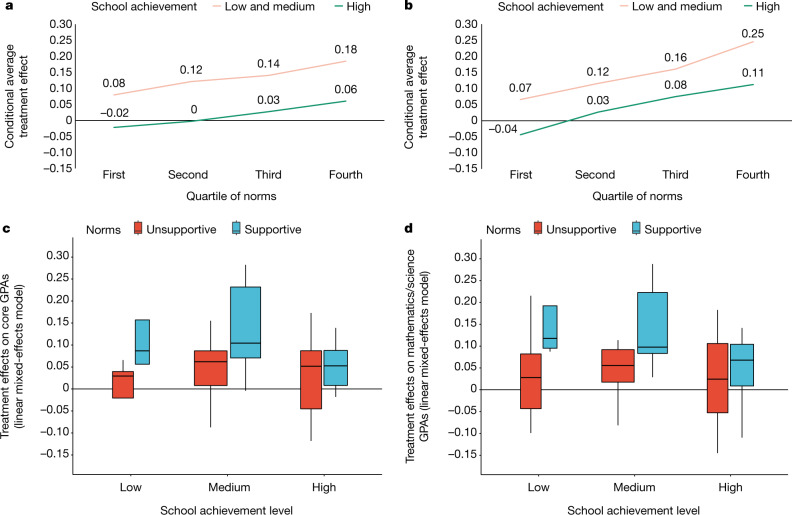
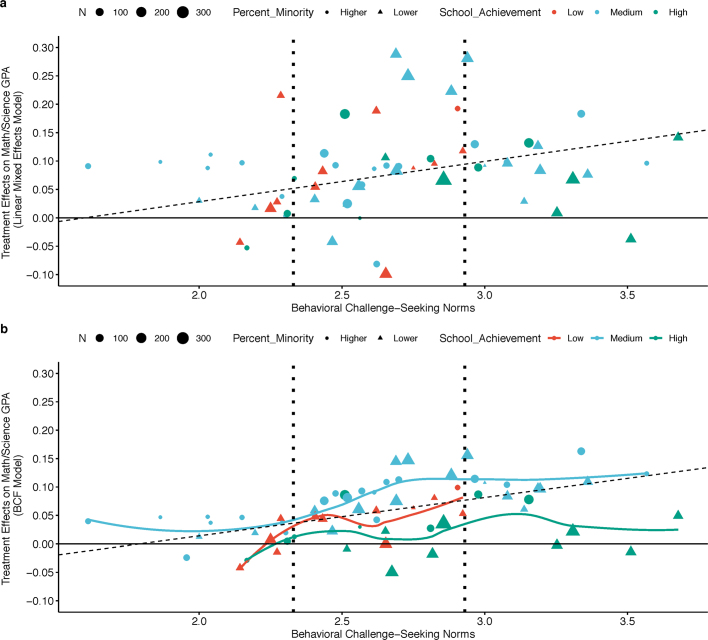
A short, online growth mindset intervention in a nationally representative sample of U.S. secondary students improved outcomes for lower-achieving students and increased advanced mathematics enrollment overall. Its grade effects were strongest in schools whose peer norms supported challenge-seeking, suggesting context matters for sustaining benefits.
Key findings
- Among lower-achieving adolescents, the intervention reduced fixed-mindset beliefs by B = −0.38 and had an effect size of 0.33 (n = 5,650 students, k = 65 schools, P < 0.001).
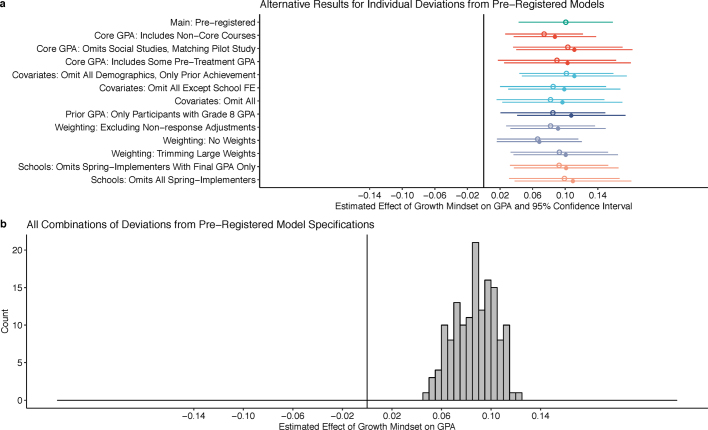
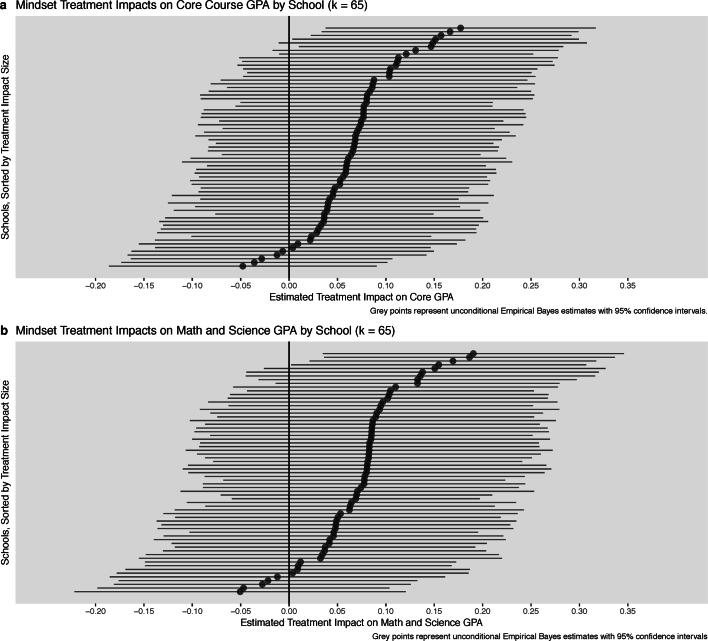
- Lower-achieving adolescents earned higher end-of-year core GPA when assigned to the intervention: B = 0.10 grade points, effect size 0.11, n = 6,320, k = 65, P = 0.001.
- The same GPA conclusion held for mathematics and science GPAs, with B = 0.10.
- Across the full cohort, the intervention increased tenth-grade advanced mathematics enrollment by 3 percentage points, from 33% to 36% (n = 6,690, k = 41, P = 0.001), and overall reduced the share of students below GPA 2.0 from 46% to 41%.
Methods
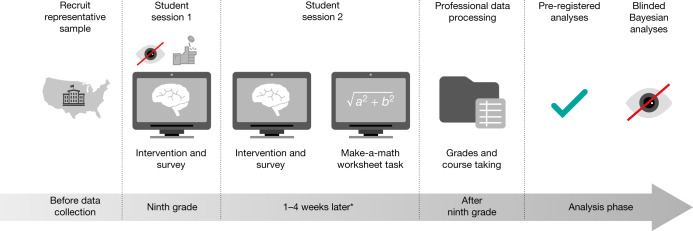
- Randomized, effectiveness-trial design: 12,490 ninth-grade adolescents in 65 regular public schools were individually randomized within schools in the National Study of Learning Mindsets.
- Intervention: two self-administered online sessions of about 25 minutes each, delivered roughly 20 days apart during school hours; control was a similar brain-functions program that did not address intelligence beliefs.
- Main analysis: intention-to-treat cluster-robust fixed-effects linear regression for average effects, mixed-effects models for cross-school heterogeneity, and a blinded Bayesian causal forest robustness analysis.
Limitations
- The paper states that the moderation results cannot support causal conclusions about school norms because norms were measured, not manipulated.
- Advanced mathematics enrollment analyses were exploratory because they were not pre-registered.
- Evident from the text: school-level heterogeneity analyses are limited by the observational nature of the moderators and by only 65 schools contributing to the main analyses.
Model-written summary. Check it against the paper before relying on it.
Integrity signals
Registry
Cites
Statistics
Figures
Verification
Claims the paper makes
15 Valid · 0 Not valid · 17 Not checked · 46 Own results and interpretations
The cited sources support only part of this claim — read each source’s verdict below.
In the paper
“When such students underperform in or opt out of rigorous coursework, they are far less likely to leave secondary school prepared for college or university or for advanced courses in college or university8,9.”
§ A national experiment reveals where a growth mindset improves achievement > Main
What the sources say
- Not checked — no full text of the sourcecites [8] Adelman, C. The Toolbox Revisited: Paths to Degree Completion from High School through College (US Department of Education, 2006).
- Partly supportedcites [9] Schiller KS Schmidt WH Muller C Houang R Hidden disparities: how courses and curricula shape opportunities in mathematics during high school Equity Excell. Educ. 2010 43 414 433 10.1080/10665684.2010.517062 23554547 PMC3612550 sourceExperimental — accuracy not yet measured
The ‘Course Enrollments as Opportunities to Learn’ section (page unavailable) says that mathematics course sequencing affects how far students progress in high school and that mathematics success has consequences for post-secondary schooling. The ‘Dimensions of Learning Opportunities’ section (page unavailable) also discusses undergraduates’ need for remedial courses. But the paper does not establish that students who underperform in or opt out of rigorous coursework are ‘far less likely’ to leave school prepared for college or advanced college courses. (LLM, conf=0.83)
plainstates an association- Asserted: passes — The authors put it forward as true.
- Checkable: passes — It can be checked against evidence.
- Load-bearing: passes — The paper’s conclusions depend on it.
- Based: passes — The paper gives a reason why it holds.
The cited sources support only part of this claim — read each source’s verdict below.
In the paper
“most interventions that are effective in initial efficacy trials go on to show weaker or no effects when they are scaled up in effectiveness trials that deliver treatments under everyday conditions to more heterogeneous samples21–23.”
§ A national experiment reveals where a growth mindset improves achievement > A focus on heterogeneity
What the sources say
- Not checked — no full text of the sourcecites [21] Greenberg MT Abenavoli R Universal interventions: fully exploring their impacts and potential to produce population-level impacts J. Res. Educ. Eff. 2017 10 40 67 source
- Not checked — no full text of the sourcecites [22] Allcott H Site selection bias in program evaluation Q. J. Econ. 2015 130 1117 1165 10.1093/qje/qjv015 source
- Partly supportedcites [23] Singal AG Higgins PDR Waljee AK A primer on effectiveness and efficacy trials Clin. Transl. Gastroenterol. 2014 5 e45 10.1038/ctg.2013.13 24384867 PMC3912314 sourceExperimental — accuracy not yet measured
The Introduction says efficacy trials can overestimate effects in clinical practice, and Study Design describes effectiveness trials as using more heterogeneous populations in routine settings, sometimes without a witnessed effect. The paper does not establish that *most* interventions with positive initial efficacy results subsequently show weaker or no effects in effectiveness trials. (LLM, conf=0.86)
plainstates a cause- Asserted: passes — The authors put it forward as true.
- Checkable: passes — It can be checked against evidence.
- Load-bearing: passes — The paper’s conclusions depend on it.
- Based: passes — The paper gives a reason why it holds.
The cited sources support only part of this claim — read each source’s verdict below.
In the paper
“Beliefs—and particularly beliefs that affect how students make sense of ongoing challenges—are important during high-stakes developmental turning points such as pubertal maturation43,44 or the transition to secondary school6.”
§ A national experiment reveals where a growth mindset improves achievement > Discussion
What the sources say
- Supportedcites [43] Yeager DS Dahl RE Dweck CS Why interventions to influence adolescent behavior often fail but could succeed Perspect. Psychol. Sci. 2018 13 101 122 10.1177/1745691617722620 29232535 PMC5758430 source
The Discussion (page unavailable) says adolescents’ beliefs about whether social traits can change shape how they interpret and cope with social adversity, using a new high school student as an example. The paper also links adolescents’ heightened sensitivity to status and respect to pubertal maturation and school transitions (Abstract, page unavailable). Together, these passages support the attributed point about the importance of beliefs during those developmental turning points. (LLM, conf=0.87)
- Partly supportedcites [44] Dahl RE Allen NB Wilbrecht L Suleiman AB Importance of investing in adolescence from a developmental science perspective Nature 2018 554 441 450 10.1038/nature25770 29469094 sourceExperimental — accuracy not yet measured
The Conclusion (p. 13) describes pubertal maturation as a dynamic period of learning and adaptation, and the Policy and intervention section (p. 10) identifies puberty as an important window for formative learning experiences. This supports the significance of the pubertal turning point, but the paper does not establish the claim about beliefs that shape how students interpret ongoing challenges. The transition to secondary school is attached to a different citation and is not assessed here. (LLM, conf=0.82)
- Not checked — no full text of the sourcecites [6] Crosnoe, R. Fitting In, Standing Out: Navigating the Social Challenges of high School to Get an Education (Cambridge Univ. Press, 2011). source
plainstates an association- Asserted: passes — The authors put it forward as true.
- Checkable: passes — It can be checked against evidence.
- Load-bearing: unclear — It is unclear whether the paper’s conclusions depend on it.
- Based: passes — The paper gives a reason why it holds.
- Supported
The cited sources support only part of this claim — read each source’s verdict below.
In the paper
“previously low-achieving students are the group that shows the steepest decline in grades during the transition to secondary school19”
§ A national experiment reveals where a growth mindset improves achievement > Main
What the sources say
- Partly supportedcites [19] Benner AD The transition to high school: current knowledge, future directions Educ. Psychol. Rev. 2011 23 299 328 10.1007/s10648-011-9152-0 21966178 PMC3182155 sourceExperimental — accuracy not yet measured
The Academic performance and engagement passage (page unavailable) reports that grades generally decline from middle to high school. The feeder-pattern passage (page unavailable) says low-performing students struggled more under a particular transition condition, but it does not establish that previously low-achieving students have the steepest grade decline of all groups. (LLM, conf=0.84)
plainstates an association- Asserted: passes — The authors put it forward as true.
- Checkable: passes — It can be checked against evidence.
- Load-bearing: passes — The paper’s conclusions depend on it.
- Based: passes — The paper gives a reason why it holds.
- Partly supported
The sources with a verdict support this claim; the rest weren’t checked yet, have no full text we could read, or their verdicts aren’t rated yet.
In the paper
“Nonetheless, previous randomized evaluations, including a pre-registered replication, found that online growth mindset interventions improved grades for the targeted group of students in secondary education who previously showed lower achievement13,16,18.”
§ A national experiment reveals where a growth mindset improves achievement > Main
What the sources say
- Supportedcites [13] Yeager DS Using design thinking to improve psychological interventions: the case of the growth mindset during the transition to high school J. Educ. Psychol. 2016 108 374 391 10.1037/edu0000098 27524832 PMC4981081 source
The Focus of the Present Investigation describes a prior randomized online evaluation in which lower-achieving high school students improved their GPA. The Study 2 Results report a pre-registered analysis showing a grade benefit for previously lower-achieving ninth graders, and the General Discussion calls it a rigorous replication. (LLM, conf=0.93)
- Not checked — no full text of the sourcecites [16] Paunesku D Mind-set interventions are a scalable treatment for academic underachievement Psychol. Sci. 2015 26 784 793 10.1177/0956797615571017 25862544 source
- Not checked — no full text of the sourcecites [18] Good C Aronson J Inzlicht M Improving adolescents’ standardized test performance: an intervention to reduce the effects of stereotype threat J. Appl. Dev. Psychol. 2003 24 645 662 10.1016/j.appdev.2003.09.002 source
plainstates a cause- Asserted: passes — The authors put it forward as true.
- Checkable: passes — It can be checked against evidence.
- Load-bearing: passes — The paper’s conclusions depend on it.
- Based: passes — The paper gives a reason why it holds.
- Supported
25 more claims · 2 with their cited sources checked
Create a free account to see all 78 claims and to verify the 6 references still open.
- Probably not a substantial claim. 38
- It may state two separate claims as one. 23
Claims other papers make about this one
Each is checked against this paper’s own text: does it say what the citing paper says it does?
The cited source doesn’t support the claim as written.
In the citing paper
“As another example, Yeager et al. (2019) only reported the results of the 50% of students performing below their school's median.They stated this was in part because lower-achieving students may have more academic difficulties and therefore may benefit more from a growth mindset intervention than higher-achieving students.Yet, they did not report a test of whether the treatment effect for lower-”
From Do growth mindset interventions impact students’ academic achievement? A systematic review and meta-analysis with recommendations for best practices. (2023) · cites this paper as Yeager et al. (2019)
Checked by a reasoning model — may be wrong.
Experimental — accuracy not yet measuredThe source backs part of the claim, not all of it — or backs it for a different population, condition or comparison.
In the citing paper
“For example, growth mindset interventions have been shown to help students alter their fixed mindset in a way that allows them to take a longer term perspective (Cassidy, 2015;Rhew et al., 2018;Yeager et al., 2019).”
From The impact of growth mindset training on entrepreneurial action among necessity entrepreneurs: Evidence from a randomized control trial (2023) · cites this paper as Yeager et al., 2019
Experimental — accuracy not yet measuredThe source backs part of the claim, not all of it — or backs it for a different population, condition or comparison.
In the citing paper
“The intervention offered greater benefits to lower achieving students if they attended schools whose students had an overall higher orientation towards growth mindset”
From Tackling Educational Inequalities with Social Psychology: Identities, Contexts, and Interventions (2021) · cites this paper as Yeager et al., 2019
Experimental — accuracy not yet measuredThe source backs part of the claim, not all of it — or backs it for a different population, condition or comparison.
In the citing paper
“Studies have shown that a growth mindset is associated with improved achievement; moreover, even short interventions can foster an increased growth mindset (Blackwell et al., 2007;Yeager et al., 2019).”
From Impacts of Standards-Based Grading on Students’ Mindset and Test Anxiety (2022) · cites this paper as Yeager et al., 2019
Experimental — accuracy not yet measuredThe source backs part of the claim, not all of it — or backs it for a different population, condition or comparison.
In the citing paper
“While scholars have examined growth mindset in both a poverty context (e.g., Burnette et al., 2018;Yeager et al., 2019) and an entrepreneurship context (e.g., Burnette et al., 2019), to the best of our knowledge none of these studies have examined both of these contexts together, nor have they been studied outside of the context of formal education settings.”
From The impact of growth mindset training on entrepreneurial action among necessity entrepreneurs: Evidence from a randomized control trial (2023) · cites this paper as Yeager et al., 2019
Experimental — accuracy not yet measured
5 more claims about this paper
Create a free account to see every claim other papers make about this one.
Statistics that don’t add up
Each reported p-value recomputed from its test statistic and degrees of freedom, each partial η² from its F, and each ratio, mean difference or B printed with a p checked against its own confidence interval.
Rated minor: it would not touch a result — a value no result rests on, a p-value that stays on the same side of the significance level, or a conflict that is clerical, resolved elsewhere in the paper, or outside its own findings.
In the paper
“B = −0.07 (95% confidence interval = 0.02, 0.13), s.e. = 0.03, z = −2.76, n = 6,320, k = 65, P = 0.006”
§ A national experiment reveals where a growth mindset improves achievement > Moderation by school achievement level
Statistics recomputed
Every reported test result, recomputed from its test statistic and degrees of freedom. A result shows as not adding up only once an independent check has confirmed it.
- Consistentz = 2.26reported p = .024 · recomputed p = .024
“z = 2.26, p = .024”
Self-check
Percentages, sums and reported differences re-computed from the paper’s own numbers.
Self-check results appear here once an independent check has confirmed them.
Citations
Cites
Our future: a Lancet commission on adolescent health and wellbeing
Patton, G. C., Sawyer, S. M., Santelli, J. S., Ross, D. A., Afifi, R., Allen, N. B., Arora, M., Azzopardi, P., Baldwin, W., Bonell, C., et al. (2016) · The Lancet · doi:10.1016/s0140-6736(16)00579-1 · Cited by 3,785
Blackwell, L. S., Trzesniewski, K. H., & Dweck, C. S. (2007) · Child Development · doi:10.1111/j.1467-8624.2007.00995.x · Cited by 3,784
Self-citationAronson, J., Fried, C. B., & Good, C. (2002) · Journal of Experimental Social Psychology · doi:10.1006/jesp.2001.1491 · Cited by 1,889
(2006) · US Department of Education · Cited by 1,586
Expectations of brilliance underlie gender distributions across academic disciplines
Leslie, S.-J., Cimpian, A., Meyer, M., & Freeland, E. (2015) · Science · doi:10.1126/science.1261375 · Cited by 1,516
Mind-sets matter: A meta-analytic review of implicit theories and self-regulation.
Burnette, J. L., O'Boyle, E. H., VanEpps, E. M., Pollack, J. M., & Finkel, E. J. (2013) · Psychological Bulletin · doi:10.1037/a0029531 · Cited by 1,367
Social-Psychological Interventions in Education: They’re Not Magic
Yeager, D. S., & Walton, G. M. (2011) · Review of Educational Research · doi:10.3102/0034654311405999 · Cited by 1,345
Self-citationMindsets: A View From Two Eras
Dweck, C. S., & Yeager, D. S. (2019) · Perspectives on Psychological Science · doi:10.1177/1745691618804166 · Cited by 1,259
Self-citationImportance of investing in adolescence from a developmental science perspective
Dahl, R. E., Allen, N. B., Wilbrecht, L., & Suleiman, A. B. (2018) · Nature · doi:10.1038/nature25770 · Cited by 1,196
Skills, education, and the rise of earnings inequality among the “other 99 percent”
Autor, D. H. (2014) · Science · doi:10.1126/science.1251868 · Cited by 1,160
Research works printed but not linked: 1
- Tipton, E., Yeager, D. S., Iachan, R. & Schneider, B. in Experimental Methods in Survey Research: Techniques that Combine Random Sampling with Random Assignment (ed. Lavrakas, P. J.) (Wiley, 2019).
Cited by
Items 701–800 of 1,523
The effect of non-cognitive skills on academic performance: does it vary by socio-economic status?
Avanesian, G., & Rozhkova, K. V. (2025) · International Journal of Educational Research · doi:10.1016/j.ijer.2025.102680 · Cited by 7
Unlocking creative potential: The role of creative mindset on creativity
Han, H., & Park, D. (2025) · Thinking Skills and Creativity · doi:10.1016/j.tsc.2025.101953 · Cited by 5
Liu, H., & Wang, X. (2025) · IRAL - International Review of Applied Linguistics in Language Teaching · doi:10.1515/iral-2025-0010 · Cited by 13
“In addition to students ’ achievement level, social resources are also believed to be one of the most crucial reasons leading to the inconsistent e ff ects of growth mindsets (e.g., Jia et al. 2021; King and Trinidad 2021; Yeager et al. 2019).”
InfluentialDamrongpanit, S. (2020) · Universal Journal of Educational Research · doi:10.13189/ujer.2020.081285 · Cited by 6
Effect of a mindset training intervention on Bachelor of Science nursing students
Lewis, L. S., Williams, C. A., & Dawson, S. D. (2021) · Collegian Journal of the Royal College of Nursing Australia · doi:10.1016/j.colegn.2021.10.016 · Cited by 7
Exploring implicit theories of shame: developing a new scale assessing shame-related beliefs
Li, Y., Tao, V. Y. K., & Wu, A. M. S. (2023) · Motivation and Emotion · doi:10.1007/s11031-023-10008-3 · Cited by 5
“Based on previous intervention studies on implicit theories of intelligence (Yeager et al., 2019), emotions (Kneeland et al.”
BackgroundChan, H., Chiu, C., Lee, S.-L., Tong, Y., Leung, I., & Chan, A. H. T. (2023) · Journal of Pacific Rim Psychology · doi:10.1177/18344909231166964 · Cited by 6
“Research scientists and practitioners are excited about this construct because of its demonstrated bene fi cial effects on learning motivation, performance, achievement, relationship, resilience, and psychological well-being (Dweck, 1999; Gouëdard, 2021; Hong et al., 1999; Yeager et al., 2019).”
BackgroundResult“This is hard!” Children’s and parents’ talk about difficulty during dyadic interactions.
Bennett-Pierre, G., Weinraub, M., Newcombe, N. S., & Gunderson, E. A. (2023) · Developmental Psychology · doi:10.1037/dev0001555 · Cited by 3
Show us what you got! A cross-cultural comparison of mindset presentation in “…Got Talent!” TV shows
Lebuda, I., Ceh, S. M., & Benedek, M. (2023) · Thinking Skills and Creativity · doi:10.1016/j.tsc.2023.101353 · Cited by 6
Stăneiu, R.-M. (2023) · Proceedings of the ... International Conference on Business Excellence · doi:10.2478/picbe-2023-0113 · Cited by 7
Watts, T. W., Li, C., Pan, X. S., Gandhi, J., McCoy, D. C., & Raver, C. C. (2023) · Developmental Psychology · doi:10.1037/dev0001561 · Cited by 12
Fixed intelligence mindsets predict system legitimization in educational contexts
Brady, L., Eason, A. E., & Fryberg, S. A. (2023) · Social Psychology of Education · doi:10.1007/s11218-023-09872-1 · Cited by 5
“…mindsets shape students’ interpretation of their own academic experiences, but they also shape how teachers evaluate and respond to students (e.g., Can-ning et al., 2019; Paunesku et al., 2015; Rattan, Good, et al., 2012; Rattan, Savani, et al., 2012; Yeager & Dweck, 2012; Yeager et al., 2019).”
Bahrami, P., Blanco, D. M. C., Thetford, H., Ye, L., & Chan, J. Y. K. (2023) · The journal of college science teaching · doi:10.1080/0047231x.2023.12315861 · Cited by 6
“…using more resources • Integrated an online module to teach effective learning strategies 2021; Simons, 2011; Vonderwell & Boboc, 2013; Waller, 2018; Yeager et al., 2019; Zak et al., 2021) and implemented in either one or both of the fully remote chemistry courses taught by the two instructors in…”
BackgroundGraczyk, T., Wingen, T., Wingen, S., & Dohle, S. (2024) · European Journal of Social Psychology · doi:10.1002/ejsp.3039 · Cited by 5
Neglecting students’ socio-emotional skills magnified learning losses during the pandemic
Lichand, G., Christen, J., & van Egeraat, E. (2024) · npj Science of Learning · doi:10.1038/s41539-024-00235-9 · Cited by 19
“…intelligence is not a fi xed trait, and that performance can be improved trough effort) correlates with math and science GPA of high-school students in the United States – and, most importantly, an intervention that causally promotes a growth mindset signi fi cantly improves learning outcomes 12 ).”
Zhu, S., Hu, Y., Wang, R., Qi, D., Lee, P. H., Ngai, S. W., Cheng, Q., & Wong, P. W. C. (2024) · JMIR Research Protocols · doi:10.2196/63220 · Cited by 8
“Existing interventions have focused on growth mindsets for intelligence [19,23], personality [14,24], and emotion [22] to promote school performance and resilience and to reduce mental health symptoms.”
BackgroundInfluentialThe College Mathematics Beliefs and Belonging Survey: Instrument Development and Validation
Sidney, P. G., Braun, B., Jong, C., Hanely, D., Kim, M. H., Brown, K. G. I., Vega, J., Schmidt, J., Shirah, J. F., Wawrzyniak, C. U., et al. (2024) · International Journal of Research in Undergraduate Mathematics Education · doi:10.1007/s40753-024-00247-1 · Cited by 5
“…thinking, in particular proceptual thinking (Gray & Tall, 1994; Tall, 2013); the four pillars framework for inquiry-based mathematics education (Laursen & Rasmussen, 2019); the theory of growth and fixed mindsets (Yeager et al., 2019); and situated expectancy value theory (Eccles & Wigfield, 2020).”
Physical health mindsets and information avoidance
O'Brien, A. G., Foust, J. L., & Taber, J. M. (2024) · Journal of Behavioral Medicine · doi:10.1007/s10865-024-00514-1 · Cited by 4
“Originally developed in the domain of academic achievement (Dweck et al., 1995a) and assessed with respect to intelligence (Blackwell et al., 2007; Yeager et al., 2019), mindsets are moderate this association.”
BackgroundTechnology-minded climate delegates support less stringent climate policies
Burger, M. N., Mahabadi, D., & Vollan, B. (2024) · Nature Sustainability · doi:10.1038/s41893-024-01434-3 · Cited by 5
“https://doi.org/10.1038/s41893-024-01434-3 tend to have a technology-oriented mindset (Supplementary Table 13).”
InfluentialGrowth mindset enhancement for new nursing students
Carter, A. N., Evans, J., Seibert, S. A., & Weir, S. (2024) · Teaching and learning in nursing · doi:10.1016/j.teln.2024.10.023 · Cited by 4
Liu, X., Garner, P. W., & Halberstadt, A. G. (2025) · Social Psychology of Education · doi:10.1007/s11218-024-09967-3 · Cited by 5
“Third, teachers who adopt a growth mindset may be better able to adopt classroom practices that motivate all learners to persist in the face of academic and social-emotional challenges (e.g., Gutshall, 2016; Nadelson et al., 2019; Yeager et al., 2019).”
Previous neuroscience exposure predicts self-efficacy among undergraduate students
Ribeiro, A. J., Ruggiero, R. N., & Padovan‐Neto, F. E. (2025) · Trends in Neuroscience and Education · doi:10.1016/j.tine.2025.100251 · Cited by 8
The Role of Mindset in Education: A Large-Scale Field Experiment in Disadvantaged Schools
Huillery, É., Bouguen, A., Charpentier, A., Algan, Y., & Chevallier, C. (2025) · The Economic Journal · doi:10.1093/ej/ueaf015 · Cited by 28
Children’s ability concepts: Their development, content, and consequences
Muradoglu, M., Dweck, C. S., & Cimpian, A. (2025) · Advances in child development and behavior · doi:10.1016/bs.acdb.2025.07.001 · Cited by 5
Self-citationMakhluf, H. A. (2019) · Advances in mobile and distance learning book series · doi:10.4018/978-1-7998-1622-5.ch009 · Cited by 4
Motivation and self-enhancement as antecedents of implicit theories in youth sport
Warburton, V. E., Spray, C. M., Bishop, K. C. M., & Maloney, C. M. C. (2021) · Personality and Individual Differences · doi:10.1016/j.paid.2021.111026 · Cited by 5
Struktur subjektiver Theorien über Musikalität und Validierung eines Messinstruments
Eisinger, M. (2021) · Jahrbuch der Deutschen Gesellschaft für Musikpsychologie/Jahrbuch Musikpsychologie · doi:10.5964/jbdgm.93 · Cited by 7
“…zu den Subjektiven Theorien über Intelligenz wurden in den letzten Jahren Interventionen entwickelt, die in großen empirischen Studien überprüft wurden und die eine positive Wirkung von einer hohen dynamischen Subjektiven Theorie auf schulische Leistungen nachweisen konnten (Yeager et al., 2019).”
BackgroundConnecting the Dots from Professional Development to Student Learning
Ellingson, C., Edwards, K., Roehrig, G., Höelscher, M., Haroldson, R., & Dubinsky, J. M. (2021) · CBE—Life Sciences Education · doi:10.1187/cbe.21-02-0035 · Cited by 9
“The districts were interested in the demonstrated potential of neuroscience instruction to impact student learning and in providing deep content knowledge to their teachers in a rapidly changing field (Blackwell et al., 2007; Yeager et al., 2019).”
BackgroundGamification of Computer Programming Tasks to Promote the Growth Mind-Set in a Disadvantaged School
Gorman, G., McKelvey, N., & Dowling, T. C. (2021) · International Journal of Game-Based Learning · doi:10.4018/ijgbl.287827 · Cited by 8
How Can We Teach Genetics for Social Justice?
Reiss, M. J. (2021) · Contributions from biology education research · doi:10.1007/978-3-030-86051-6_3 · Cited by 4
“Yeager et al. (2019) found that an online growth mindset intervention that took just under one hour and taught that intellectual abilities can be developed improved grades among lower-achieving students and increased overall enrolment in advanced mathematics courses in students in school education…”
Campbell, I., & Green, R. (2022) · Educational Psychology in Practice · doi:10.1080/02667363.2022.2042207 · Cited by 9
“Although research evidence in this area continues to evolve and be challenged (Yeager & Dweck, 2020), the overall picture is that: 1) young people’s mindsets can be altered through carefully designed direct-tostudent psychological interventions (Dweck & Yeager, 2019a); 2) when young people hold more of a growth mindse…”
BackgroundInfluentialIndividual differences and influences on learning
Williamson, B., Jasinka, K., Allen, K., Bull, A., Harden, K. P., Hart, S. A., Kraftl, P., Martschenko, D. O., Noble, K. G., Nxumalo, F., et al. (2022) · UNESCO MGIEP eBooks · doi:10.56383/keud7932 · Cited by 4
Teaching Factory Management in the Industrial Era 4.0 in Indonesia
Perwiranegara, A. A. (2022) · International Journal of Science and Society · doi:10.54783/ijsoc.v4i3.508 · Cited by 7
“From the opinions above, it can be concluded that evaluation is an activity to collect information from a program and see the level of success, then it is used to improve things that are still not good and maintain things that are considered good (Yeager et al., 2019).”
BackgroundVitamins for Psychological Growth: A Universal Foundation for Motivating Others
Soenens, B., & Vansteenkiste, M. (2023) · Oxford University Press eBooks · doi:10.1093/oso/9780197662359.003.0016 · Cited by 4
Motivation Resides Only in Our Language, Not in Our Mental Processes
Murayama, K. (2023) · Oxford University Press eBooks · doi:10.1093/oso/9780197662359.003.0011 · Cited by 11
How to Foster Motivation? The Need-Based Motivating Compass as a Source of Inspiration
Vansteenkiste, M., & Soenens, B. (2023) · Oxford University Press eBooks · doi:10.1093/oso/9780197662359.003.0056 · Cited by 4
The Unconscious Sources of Motivation and Goals
Bargh, J. A., & Gollwitzer, P. M. (2023) · Oxford University Press eBooks · doi:10.1093/oso/9780197662359.003.0030 · Cited by 6
More Than Just a Game: Teachers’ Experiences of the PAX Good Behavior Game
Holmdahl, A., Schad, E., Nilsson, G., & Kaldo, V. (2023) · European Journal of Psychology and Educational Research · doi:10.12973/ejper.6.1.55 · Cited by 9
Cultivating a Classroom Culture of Growth: Nurture the Power of a Growth Mindset
Kutasi, R. (2023) · Acta Marisiensis Philologia · doi:10.2478/amph-2023-0090 · Cited by 8
Wang, L., Chen, Y., Li, Z., Zhou, Y., Li, J., Lv, X., Yu, Z., & Xuemei, G. (2024) · Journal of Pediatric Health Care · doi:10.1016/j.pedhc.2024.02.002 · Cited by 5
Bakchich, J., Claes, N., Carré, A., & Smeding, A. (2024) · Social Psychology of Education · doi:10.1007/s11218-024-09900-8 · Cited by 9
“…discrepancy across studies concerns 1 3 Examining the effects of socioeconomic status indicators… intervention outcomes, which is subject to a fierce debate (Brez et al., 2020; Li & Bates, 2019; Macnamara, 2018; McCabe & Fleeson, 2016; Moreau, 2022; Yeager & Dweck, 2020; Yeager et al., 2019, 2022).”
Implementation and Evaluation of Equitable Practices in an Introductory CS Course
Najjar, N. A., & Basu, D. (2024) · ACM Technical Symposium on Computer Science Education (SIGCSE) · doi:10.1145/3626253.3635590 · Cited by 4
“Such settings encourage students to utilize resources available to them and enhance their success [9].”
BackgroundWarren, J. M., & Goins, C. L. (2019) · Journal of Educational Research and Practice · doi:10.5590/jerap.2019.09.1.27 · Cited by 8
“Given the rigor of advanced-level high school courses, learning how to manage stress, persevere, and overcome obstacles are invaluable skills for students that can have a direct impact on GPA (Yeager et al., 2019).”
BackgroundBurgasser, A. J. (2019) · Nature Astronomy · doi:10.1038/s41550-019-0940-7 · Cited by 4
Metaphors we teach by: Uncovering the structure of metaphorical lay theories of teaching
Hard, B. M., Liang, N., Wong, M., & Flusberg, S. J. (2021) · Metaphor and the Social World · doi:10.1075/msw.19021.har · Cited by 15
“However, interventions aimed at changing these lay theories to improve student performance have generated inconsistent results (e.g., Sisk et al., 2018; Yeager et al., 2019).”
BackgroundMolina, D. C., Porter, T., Oberle, C., Haghighat, M. D., Fredericks, A., Budd, K., Roberts, S., Blackwell, L. S., & Trzesniewski, K. H. (2022) · Journal of Research on Educational Effectiveness · doi:10.1080/19345747.2022.2054481 · Cited by 9
“This explanation is in line with previous research showing that online-delivered growth mindset interventions consistently change students’ mindsets (e.g., Yeager et al., 2019).”
ResultUtility value interventions: Why and how instructors should use them in college psychology courses.Preprint
Soicher, R. N., & Becker‐Blease, K. A. (2020) · doi:10.31234/osf.io/qwmzj · Cited by 4
Δημητρίου, Α., Spanoudis, G. C., Christou, C., et al. (2022) · doi:10.31234/osf.io/f9sd2 · Cited by 4
Growth mindset in Chinese societies: Introduction to the special issue
Chiu, C., Chan, H., Lee, S.-L., Huang, Z., & Tong, Y. (2024) · Journal of Pacific Rim Psychology · doi:10.1177/18344909241269006 · Cited by 5
“Positive effects of growth mindset interventions (e.g., improved psychological well-being and academic performance) have been widely reported (Yeager et al., 2019), and these effects are particularly pronounced in environments with strong normative support for the growth mindset (Yeager et al.,…”
Changing Classroom Ecology to Support Continued Engineering Enrollment
Bahnson, M., McChesney, E., DeAngelo, L., & Godwin, A. (2024) · Trends in Higher Education · doi:10.3390/higheredu3020025 · Cited by 3
“Other research has demonstrated that growth mindset interventions may result in similar types of outcomes [87].”
BackgroundJohnson, J. A., Kelly, K. O., & Olczak, W. (2024) · Contemporary Accounting Research · doi:10.1111/1911-3846.13005 · Cited by 8
Avila-Bront, L. G. (2025) · Journal of Chemical Education · doi:10.1021/acs.jchemed.4c00656 · Cited by 4
Estimating Heterogeneous Causal Mediation Effects with Bayesian Decision Tree Ensembles
Ting, A., & Linero, A. R. (2025) · Journal of the American Statistical Association · doi:10.1080/01621459.2025.2491155 · Cited by 15
“Estimation of heterogeneous causal effects from observational data is a topic of fundamental importance, with applications in personalized medicine (Obermeyer and Emanuel 2016), policy recommendation (Athey 2017), and social science (Yeager et al. 2019).”
Xing, H., Liu, L., & Jiang, A. L. (2025) · SAGE Open · doi:10.1177/21582440251346683 · Cited by 6
“This dual approach fostered a growth-mindset that balanced responsiveness to immediate contexts with a forward-looking vision for educational innovation (Yeager et al., 2019).”
Guo, J., Sun, X., & Tang, X. (2025) · Social Psychology of Education · doi:10.1007/s11218-025-10125-6 · Cited by 9
“Assessment of mindsets, including those about intelligence, has predominantly relied on self-reported survey measures, and thus is susceptible to several methodological biases (Yeager et al., 2019).”
Cha, W., Kim, S., Lee, H. J., & Anderman, E. M. (2025) · Contemporary Educational Psychology · doi:10.1016/j.cedpsych.2025.102415 · Cited by 4
Teachers as facilitators and innovators in 21st-century STEM education
Gavrilas, L., & Kotsis, K. Τ. (2025) · Contemporary Mathematics and Science Education · doi:10.30935/conmaths/17245 · Cited by 9
“…improved learning when it is specific and actionable (Hattie & Timperley, 2007; Shute, 2008; Wisniewski et al., 2020), and large-scale experimental work shows that framing mistakes as part of learning through growth mindset messaging can yield benefits in particular contexts (Yeager et al., 2019).”
Bustamante, V. P., & Frey, R. F. (2026) · Chemistry Education Research and Practice · doi:10.1039/d5rp00295h · Cited by 4
DeVries, J. M., Orona, G. A., & Arum, R. (2025) · Assessment & Evaluation in Higher Education · doi:10.1080/02602938.2025.2571223 · Cited by 7
“Growth mindsets in teachers are an important predictor of students’ growth mindsets (Yeager et al. 2022) and student learning (Yeager et al. 2019).”
Park, S., Callahan, C. M., & Ryoo, J. H. (2025) · Humanities and Social Sciences Communications · doi:10.1057/s41599-025-06132-9 · Cited by 8
“Several scholars have demonstrated the positive effects of mindset intervention online and to scale (Paunesku et al., 2015; Yeager et al., 2016), including in two preregistered replications (Yeager, Hanselman, et al., 2019; Yeager, et al., 2016).”
Wang, Y., Khadra, L., & Sun, X. (2026) · Child Development · doi:10.1093/chidev/aacaf016 · Cited by 4
Lai, K. K., & Ng, T. K. (2026) · Current Psychology · doi:10.1007/s12144-025-09013-1 · Cited by 7
“GMI interventions have exhibited effectiveness in enhancing mental health and academic achievement (Burnette et al., 2023; Yeager et al., 2019).”
Meylani, R. (2026) · Sustainability · doi:10.3390/su18031466 · Cited by 3
Both individual and peer growth mindsets matter for academic resilience
King, R. B., Li, J., & Wang, Y. (2026) · npj Science of Learning · doi:10.1038/s41539-026-00403-z · Cited by 10
“For example, a nationwide intervention study conducted by Yeager et al. 67 illustrated that the effectiveness of the growth mindset intervention was most pronounced when students were surrounded by peers who also endorsed a growth mindset.”
Cai, W., Yu, X., & Meng, X. (2026) · International Journal of Contemporary Hospitality Management · doi:10.1108/ijchm-01-2025-0050 · Cited by 4
Closing the gender STEM interest gap — A randomized-controlled trial in elementary schools
Grosch, K., Haeckl, S., & Kocher, M. G. (2026) · European Economic Review · doi:10.1016/j.euroecorev.2026.105300 · Cited by 4
Maska, L., Vlachopanou, P., Kalamaras, D., & Tsameti, A. (2026) · PLoS ONE · doi:10.1371/journal.pone.0341134 · Cited by 6
“For example, brief mindset interventions and relevance-framing activities have shown durable benefits for motivation and achievement in higher education contexts [59,60,61].”
Huang, L., & Luo, W. (2026) · Behavioral Sciences · doi:10.3390/bs16061002 · Cited by 4
“This avoidance-oriented regulation reduces participation in challenging, uncertain learning activities and iterative trial-and-error exploration (Sisk et al., 2018; Yeager et al., 2019).”
Identitätsbezogene Interventionen in der Schule zum Umgang mit Stereotypen und Diskriminierung
Grießig, R., Schachner, M. K., Lokhande, M., Juang, L. P., Pevec, S., Schwarzenthal, M., & Müller, T. (2022) · Springer eBooks · doi:10.1007/978-3-658-37262-0_5 · Cited by 5
A Control-Value Approach to Affective Growth
Pekrun, R. H. (2023) · Oxford University Press eBooks · doi:10.1093/oso/9780197662359.003.0055 · Cited by 6
Stanley, C. T., Heo, J., Petscher, Y., Otaiba, S. A., & Wanzek, J. (2023) · Frontiers in Education · doi:10.3389/feduc.2023.1301957 · Cited by 6
An exploratory study of the relation between teachers’ implicit theories and teacher noticing
Bates, M. S., Cimpian, J. R., Beilstein, S. O., Moran, C. G., Curry, K., Jay, V., Henricks, G. M., & Perry, M. (2024) · Journal of Mathematics Teacher Education · doi:10.1007/s10857-023-09617-z · Cited by 6
“An abundance of research (Yeager et al., 2019) has linked implicit theories to educational outcomes, and it is from that framework that we proceed to explain our interest in them for this study.”
InfluentialGrowth Mindset as a Student Support Tool during a Pandemic
Khandelwal, N. S., Mulualem, M. F., & Theisen, K. E. (2024) · Journal of Chemical Education · doi:10.1021/acs.jchemed.3c00854 · Cited by 3
The structure of psychosocial factors in academic success: A gaussian graphical model approach
Li, M., Johnson, T., & Ayodeji, A. S. (2024) · Social Psychology of Education · doi:10.1007/s11218-024-09917-z · Cited by 3
“…Yeager et al., 2019) and the sociocultural climate of the classroom(e.g., Binning et al., 2020; Walton et al., 2015) were effective in improving learning out - comes, especially for disadvantaged and under-performing students (e.g., Binning et al., 2020; Broda et al., 2018; Yeager et al., 2019).”
Navigating Financial Performance in the Culinary Industry: Does Web 2.0 Matter?
Patwary, A. K., Parvez, M. O., Awang, Z., & Bidin, M. F. (2024) · Journal of Culinary Science & Technology · doi:10.1080/15428052.2024.2361693 · Cited by 7
“Strictly speaking, the more favorable their mentalities are, the more likely they will spend money on IT (Yeager et al., 2019).”
Pathways to Need-Supportive Teaching: Teaching Mindsets and Motivation to Teach
Cilalı, B., Michou, A., & Daumiller, M. H. (2024) · The Asia-Pacific Education Researcher · doi:10.1007/s40299-024-00885-8 · Cited by 11
“Growth teaching mindsets can be induced through direct interventions like those designed for students (e.g., Yeager et al., 2019).”
Sarwar, M. N., Javed, Z., Farooq, M. S., Nazar, M. F., Wasti, S. H., Butt, I. H., Ansari, G. J., Basri, R., Kulsoom, S., & Ullah, Z. (2024) · Societies · doi:10.3390/soc14080133 · Cited by 9
“The novelty and interactive nature that the digital element brings will most likely raise engagement and sustain attention accordingly [28].”
BackgroundA Test of the Growth Mindset Compensatory Message in the Context of Youth Mental Health
Lipsey, N. P., Burnette, J. L., Becker, W., Baker, L. R., & Widman, L. M. (2024) · International Journal of Applied Positive Psychology · doi:10.1007/s41042-024-00183-0 · Cited by 4
“As the heterogeneity revolu - tion makes clear, it is important to understand under what conditions and for whom interventions are most effective (Bryan et al., 2021; Yeager et al., 2019).”
InfluentialFormed in context: A mixed‐methods study of medical students' mindsets in an Eastern culture
Tan, J., Li, H., Zhang, P., & Hirsh, D. A. (2024) · Medical Education · doi:10.1111/medu.15491 · Cited by 5
Xu, J., & Xu, W. (2024) · Frontiers in Psychology · doi:10.3389/fpsyg.2024.1349820 · Cited by 7
“Dweck and Yeager combined animal learning theory with the emerging theory of individual attribution, exploring whether individuals would interpret uncontrollable and unpredictable events differently and how these interpretations shape their behavior (Dweck and Yeager, 2019).”
BackgroundResultInfluentialZyberaj, J. (2024) · Human Resource Development Quarterly · doi:10.1002/hrdq.21553 · Cited by 5
Zhu, S., & Qi, D. (2024) · JMIR Serious Games · doi:10.2196/59441 · Cited by 5
“In another study, a brief growth mindset of intelligence intervention was shown to improve secondary school students’ academic achievement and increase their enrollment in advanced courses [38].”
Context matters: Diagnosing and targeting local barriers to success at school
Hadden, I. R., Harris, P. R., & Easterbrook, M. J. (2024) · Journal of School Psychology · doi:10.1016/j.jsp.2024.101401 · Cited by 6
Diederich, M., & Spatz, V. (2024) · Challenges in physics education · doi:10.1007/978-3-031-72541-8_8 · Cited by 5
Wang, M., Wang, S., Zhang, Y., Shen, S., & Feng, S. (2024) · Thinking Skills and Creativity · doi:10.1016/j.tsc.2024.101743 · Cited by 4
Dagorn, E., Masclet, D., & Pénard, T. (2025) · Education Economics · doi:10.1080/09645292.2025.2450424 · Cited by 6
“Interventions promoting a growth mindset – encouraging students to believe that intellectual abilities can be developed – have been proven to enhance academic outcomes (Yeager et al. 2019).”
Laurell, J., Puusepp, I., Hakkarainen, K., & Tirri, K. A. (2025) · Frontiers in Psychology · doi:10.3389/fpsyg.2025.1514879 · Cited by 10
Motivating support for workplace diversity policies: A mindsets framework
Ozgumus, E., & Rattan, A. (2025) · Current Opinion in Psychology · doi:10.1016/j.copsyc.2025.101999 · Cited by 3
Grit and self-regulated learning: evaluating achievement goals as mediators
Won, S., Wolters, C. A., Brady, A. C., & Hensley, L. C. (2025) · Social Psychology of Education · doi:10.1007/s11218-024-09993-1 · Cited by 7
“Recent studies have shown that brief interventions can effectively improve students’ growth mindset (e.g., Yeager et al., 2019).”
Growth mindset of socioeconomic status boosts academic-related outcomes
Zhao, S., Du, H., King, R. B., Lin, D., & Chi, P. (2025) · Social Psychology of Education · doi:10.1007/s11218-024-09972-6 · Cited by 6
“Implicit theories (also known as mindsets) have received much attention from psychologists and educators for their important role in shaping academic-related outcomes (Dweck, 2006; Yeager et al., 2019).”
People accurately predict the shape but not the parameters of skill learning curves
Zhang, X., McDougle, S. D., & Leonard, J. (2025) · Cognition · doi:10.1016/j.cognition.2025.106083 · Cited by 3
The Political Psychology of Economic Inequality
Connolly, D. J., Chater, N., & Loewenstein, G. F. (2025) · Psychological Science in the Public Interest · doi:10.1177/15291006261431555 · Cited by 4
Engaging a Belief in Learning Styles to Encourage a Growth Mindset
Pearson, J. (2020) · Performance Improvement Journal · doi:10.1002/pfi.21927 · Cited by 3
Ruiz-Mejías, M., Pérez, N., & Carrió, M. (2021) · Journal of Neuroeducation · doi:10.1344/joned.v1i2.33035 · Cited by 10
Implizite Theorien: Messinstrumente in verschiedenen Kontexten
Reschke, K., & Jude, N. (2022) · Zeitschrift für Pädagogische Psychologie · doi:10.1024/1010-0652/a000341 · Cited by 3
Construction for Health; Reversing the Impacts
Shahnoori, S., & Mohammadi, M. (2022) · Buildings · doi:10.3390/buildings12081133 · Cited by 5
Changing the C-suite: opportunities and threats for leadership diversity and equality
Whysall, Z., & Bruce, A. (2022) · Management Decision · doi:10.1108/md-07-2021-0875 · Cited by 4
Interplay of motivational beliefs and self-regulation with achievement across economic risk
Townley-Flores, C., Sulik, M. J., Bardack, S., & Obradović, J. (2022) · Journal of Applied Developmental Psychology · doi:10.1016/j.appdev.2022.101442 · Cited by 4
Finnish and Estonian teachers’ views on the nature of intelligence
Ronkainen, R., Kuusisto, E., Eisenschmidt, E., & Tirri, K. A. (2022) · Frontiers in Education · doi:10.3389/feduc.2022.959215 · Cited by 5
“Even though mindsets have been found to be relatively stable, they are still alterable, and even brief interventions have exerted a long-lasting influence on students’ motivation and school achievements (Blackwell et al., 2007; Yeager et al., 2019).”
BackgroundLifelong learning-centred community-based leadership development in higher education.
Watson, K. (2022) · International Journal for Leadership in Learning · doi:10.29173/ijll25 · Cited by 5
“Applied to HE, this mindset impacts the role learning experiences play in an individual’s learning process, compartmentalizing the individual’s value of a learning experience (Yeager et al., 2019).”
Background
Metadata
- Authors
- Yeager, D. S., Hanselman, P., Walton, G. M., Murray, J. S., Crosnoe, R., Muller, C., Tipton, E., Schneider, B., Hulleman, C. S., Hinojosa, C. P., Paunesku, D., Romero, C., Flint, K., Roberts, A., Trott, J., Iachan, R., Buontempo, J., Yang, S. M., Carvalho, C. M., Hahn, P. R., Gopalan, M., Mhatre, P., Ferguson, R., Duckworth, A. L., & Dweck, C. S.
- Affiliations
- The University of Texas at Austin (US)
- University of California, Irvine (US)
- Stanford University (US)
- Northwestern University (US)
- Michigan State University (US)
- University of Virginia (US)
- University of Chicago (US)
- ICF International (United States) (US)
- Arizona State University (US)
- Pennsylvania State University (US)
- Harvard University (US)
- University of Pennsylvania (US)
- Corresponding author
- Yeager, David S.
- Hanselman, Paul
- ORCID
- Yeager, David S.
- Hanselman, Paul
- Walton, Gregory M.
- Murray, Jared S.
- Crosnoe, Robert
- Muller, Chandra
- Tipton, Elizabeth
- Schneider, Barbara
- Hulleman, Chris S.
- Hinojosa, Cintia P.
- Paunesku, David
- Roberts, Alice
- Iachan, Ronaldo
- Buontempo, Jenny
- Carvalho, Carlos M.
- Gopalan, Maithreyi
- Mhatre, Pratik
- Duckworth, Angela L.
- Dweck, Carol S.
- Venue
- Nature
- Published
- 2019-08-07
- Volume
- 573
- Issue
- 7774
- Pages
- 364-369
- ISSN
- 0028-0836 (ISSN-L)
- 1476-4687
- PMC
- PMC6786290
- OpenAlex
- W2964722401
- Semantic Scholar
- f9fb223742fce060785d7f59861d0341d149cb04
- Cited by
- 1,513
- References
- 43
- Citations by year
- 2026: 203 · 2025: 211 · 2024: 219 · 2023: 325 · 2022: 202 · 2021: 200 · 2020: 131 · 2019: 20
- FWCI
- 163.13
- Type
- journal article
- Language
- en
- Open access
- hybrid
- doi.org
- Licence
- cc-by
- creativecommons.org/licenses/by/4.0 (tdm)
- creativecommons.org/licenses/by/4.0 (vor)
- Locations
- Nature (publishedVersion, cc-by)
- PubMed Central (publishedVersion, cc-by)
- PubMed (publishedVersion)
- RePEc: Research Papers in Economics (submittedVersion)
- eScholarship (California Digital Library) (submittedVersion, cc-by)
- Funders
- National Science Foundation (1761179)
- William T. Grant Foundation
- Houston Endowment
- Spencer Foundation
- University of Texas at Austin
- Raikes Foundation
- National Institutes of Health
- Center for Advanced Study in the Behavioral Sciences, Stanford University
- National Institute of Child Health and Human Development (10.13039/100000071, HD042849)
- Center for Advanced Study, University of Illinois at Urbana-Champaign
- Eunice Kennedy Shriver National Institute of Child Health and Human Development (R24HD042849, R01HD084772, P2CHD042849)
- Topics
- Social Sciences › Psychology › Developmental and Educational Psychology › Education, Achievement, and Giftedness
- Social Sciences › Psychology › Social Psychology › Grit, Self-Efficacy, and Motivation
- Social Sciences › Education › School Choice and Performance
- Keywords
- growth mindset, academic performance, adolescents, online intervention, peer norms, secondary education, school context, scalable interventions, preregistration, Bayesian analysis
- MeSH terms
- Psychosocial Support Systems, Academic Success, Adolescent, United Kingdom, Humans, Students
About these checks
Registry, retraction, Cites and statistics results are computed, not judged, with one exception: a printed reference that no index lists is read once by a model before it counts as a citation error. Claims are extracted by a model and kept only when their quote appears verbatim in the text; each cited source is then checked, with a model’s help, for whether it says what the claim relies on. Those verdicts can be wrong — read the claim’s quote and the cited source before relying on one.
The claim verdicts this report counts are experimental: their accuracy is not yet measured.
A language model drew the claims from the paper on 2026-09-28, under version 3 of the claim definition (model deepseek-v4.1-flash, prompt extract-v3).
A second model labelled each claim on 2026-09-28 (model jev-1.13-20260917, definition revision gold-guideline-v0.2).
Cited sources are checked with a language model’s help (gpt-6-sol).
Statistics and arithmetic are recomputed, not judged.
Confidence bands are shown only for fields calibrated on our annotated test set. None is calibrated yet, so no band is shown.
What counts as a claim ›How we measure confidence ›How we check this ›
Are you an author, or do you see a problem with this page? Request a review
Data sources
Bibliographic data: Semantic Scholar, OpenAlex, Crossref.
Contains information from the Semantic Scholar Academic Graph Datasets, made available under the ODC Attribution License (ODC-BY 1.0).
Semantic Scholar’s data is described in: Kinney, R., et al. (2023). The Semantic Scholar Open Data Platform. arXiv:2301.10140.
