

A national experiment reveals where a growth mindset improves achievement
Open accessThe DOI matches its Crossref record; 44 of the 44 references it cites were found in a registry or an index; 16 of the 56 sources its claims cite were checked for support.
Abstract
A short online growth mindset intervention improved grades among lower-achieving students and increased advanced mathematics enrollment in a nationally representative U.S. sample.
Overview
CoChat Summary
TL;DR
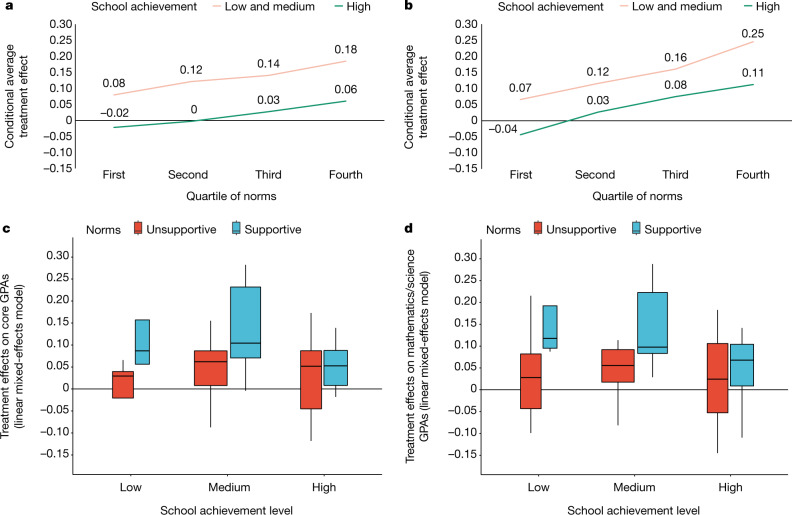
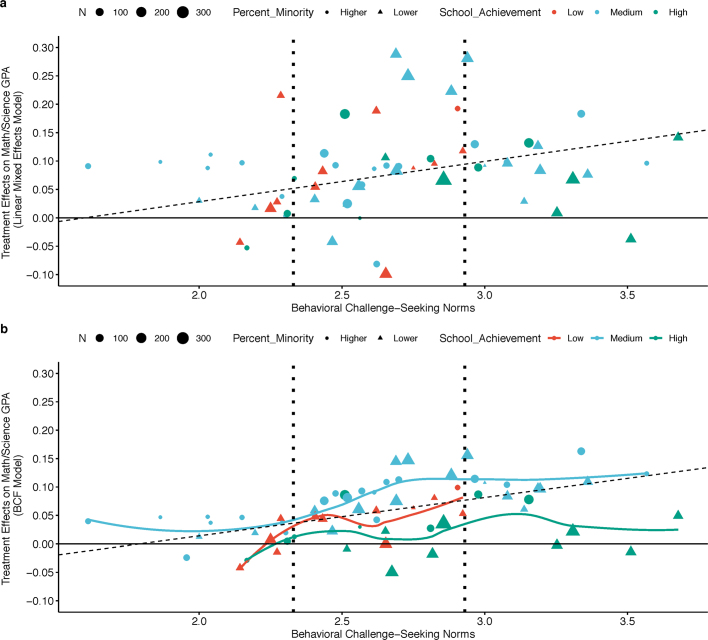
A short, online growth mindset intervention in a nationally representative sample of U.S. secondary students improved outcomes for lower-achieving students and increased advanced mathematics enrollment overall. Its grade effects were strongest in schools whose peer norms supported challenge-seeking, suggesting context matters for sustaining benefits.
Key findings
- Among lower-achieving adolescents, the intervention reduced fixed-mindset beliefs by B = −0.38 and had an effect size of 0.33 (n = 5,650 students, k = 65 schools, P < 0.001).
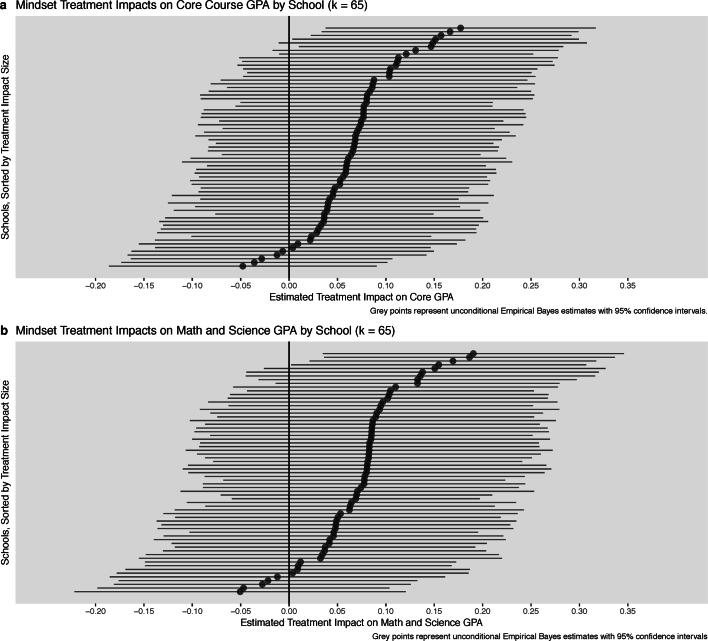
- Lower-achieving adolescents earned higher end-of-year core GPA when assigned to the intervention: B = 0.10 grade points, effect size 0.11, n = 6,320, k = 65, P = 0.001.
- The same GPA conclusion held for mathematics and science GPAs, with B = 0.10.
- Across the full cohort, the intervention increased tenth-grade advanced mathematics enrollment by 3 percentage points, from 33% to 36% (n = 6,690, k = 41, P = 0.001), and overall reduced the share of students below GPA 2.0 from 46% to 41%.
Methods
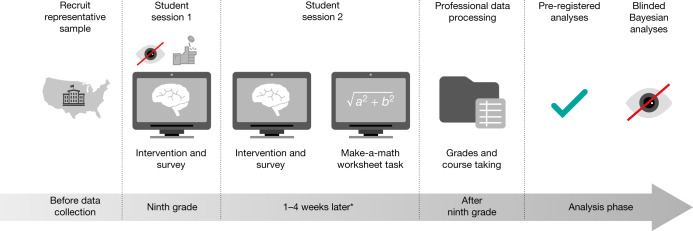
- Randomized, effectiveness-trial design: 12,490 ninth-grade adolescents in 65 regular public schools were individually randomized within schools in the National Study of Learning Mindsets.
- Intervention: two self-administered online sessions of about 25 minutes each, delivered roughly 20 days apart during school hours; control was a similar brain-functions program that did not address intelligence beliefs.
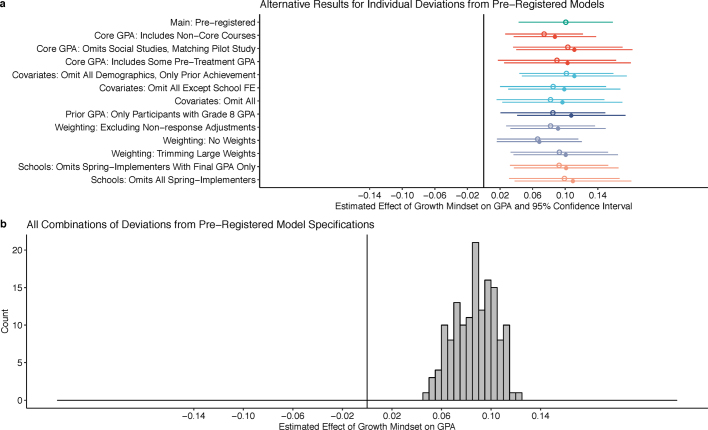
- Main analysis: intention-to-treat cluster-robust fixed-effects linear regression for average effects, mixed-effects models for cross-school heterogeneity, and a blinded Bayesian causal forest robustness analysis.
Limitations
- The paper states that the moderation results cannot support causal conclusions about school norms because norms were measured, not manipulated.
- Advanced mathematics enrollment analyses were exploratory because they were not pre-registered.
- Evident from the text: school-level heterogeneity analyses are limited by the observational nature of the moderators and by only 65 schools contributing to the main analyses.
Model-written summary. Check it against the paper before relying on it.
Integrity signals
Registry
Cites
Statistics
Figures
Verification
Claims the paper makes
15 Valid · 0 Not valid · 17 Not checked · 46 Own results and interpretations
The cited sources support only part of this claim — read each source’s verdict below.
In the paper
“When such students underperform in or opt out of rigorous coursework, they are far less likely to leave secondary school prepared for college or university or for advanced courses in college or university8,9.”
§ A national experiment reveals where a growth mindset improves achievement > Main
What the sources say
- Not checked — no full text of the sourcecites [8] Adelman, C. The Toolbox Revisited: Paths to Degree Completion from High School through College (US Department of Education, 2006).
- Partly supportedcites [9] Schiller KS Schmidt WH Muller C Houang R Hidden disparities: how courses and curricula shape opportunities in mathematics during high school Equity Excell. Educ. 2010 43 414 433 10.1080/10665684.2010.517062 23554547 PMC3612550 sourceExperimental — accuracy not yet measured
The ‘Course Enrollments as Opportunities to Learn’ section (page unavailable) says that mathematics course sequencing affects how far students progress in high school and that mathematics success has consequences for post-secondary schooling. The ‘Dimensions of Learning Opportunities’ section (page unavailable) also discusses undergraduates’ need for remedial courses. But the paper does not establish that students who underperform in or opt out of rigorous coursework are ‘far less likely’ to leave school prepared for college or advanced college courses. (LLM, conf=0.83)
plainstates an association- Asserted: passes — The authors put it forward as true.
- Checkable: passes — It can be checked against evidence.
- Load-bearing: passes — The paper’s conclusions depend on it.
- Based: passes — The paper gives a reason why it holds.
The cited sources support only part of this claim — read each source’s verdict below.
In the paper
“most interventions that are effective in initial efficacy trials go on to show weaker or no effects when they are scaled up in effectiveness trials that deliver treatments under everyday conditions to more heterogeneous samples21–23.”
§ A national experiment reveals where a growth mindset improves achievement > A focus on heterogeneity
What the sources say
- Not checked — no full text of the sourcecites [21] Greenberg MT Abenavoli R Universal interventions: fully exploring their impacts and potential to produce population-level impacts J. Res. Educ. Eff. 2017 10 40 67 source
- Not checked — no full text of the sourcecites [22] Allcott H Site selection bias in program evaluation Q. J. Econ. 2015 130 1117 1165 10.1093/qje/qjv015 source
- Partly supportedcites [23] Singal AG Higgins PDR Waljee AK A primer on effectiveness and efficacy trials Clin. Transl. Gastroenterol. 2014 5 e45 10.1038/ctg.2013.13 24384867 PMC3912314 sourceExperimental — accuracy not yet measured
The Introduction says efficacy trials can overestimate effects in clinical practice, and Study Design describes effectiveness trials as using more heterogeneous populations in routine settings, sometimes without a witnessed effect. The paper does not establish that *most* interventions with positive initial efficacy results subsequently show weaker or no effects in effectiveness trials. (LLM, conf=0.86)
plainstates a cause- Asserted: passes — The authors put it forward as true.
- Checkable: passes — It can be checked against evidence.
- Load-bearing: passes — The paper’s conclusions depend on it.
- Based: passes — The paper gives a reason why it holds.
The cited sources support only part of this claim — read each source’s verdict below.
In the paper
“Beliefs—and particularly beliefs that affect how students make sense of ongoing challenges—are important during high-stakes developmental turning points such as pubertal maturation43,44 or the transition to secondary school6.”
§ A national experiment reveals where a growth mindset improves achievement > Discussion
What the sources say
- Supportedcites [43] Yeager DS Dahl RE Dweck CS Why interventions to influence adolescent behavior often fail but could succeed Perspect. Psychol. Sci. 2018 13 101 122 10.1177/1745691617722620 29232535 PMC5758430 source
The Discussion (page unavailable) says adolescents’ beliefs about whether social traits can change shape how they interpret and cope with social adversity, using a new high school student as an example. The paper also links adolescents’ heightened sensitivity to status and respect to pubertal maturation and school transitions (Abstract, page unavailable). Together, these passages support the attributed point about the importance of beliefs during those developmental turning points. (LLM, conf=0.87)
- Partly supportedcites [44] Dahl RE Allen NB Wilbrecht L Suleiman AB Importance of investing in adolescence from a developmental science perspective Nature 2018 554 441 450 10.1038/nature25770 29469094 sourceExperimental — accuracy not yet measured
The Conclusion (p. 13) describes pubertal maturation as a dynamic period of learning and adaptation, and the Policy and intervention section (p. 10) identifies puberty as an important window for formative learning experiences. This supports the significance of the pubertal turning point, but the paper does not establish the claim about beliefs that shape how students interpret ongoing challenges. The transition to secondary school is attached to a different citation and is not assessed here. (LLM, conf=0.82)
- Not checked — no full text of the sourcecites [6] Crosnoe, R. Fitting In, Standing Out: Navigating the Social Challenges of high School to Get an Education (Cambridge Univ. Press, 2011). source
plainstates an association- Asserted: passes — The authors put it forward as true.
- Checkable: passes — It can be checked against evidence.
- Load-bearing: unclear — It is unclear whether the paper’s conclusions depend on it.
- Based: passes — The paper gives a reason why it holds.
- Supported
The cited sources support only part of this claim — read each source’s verdict below.
In the paper
“previously low-achieving students are the group that shows the steepest decline in grades during the transition to secondary school19”
§ A national experiment reveals where a growth mindset improves achievement > Main
What the sources say
- Partly supportedcites [19] Benner AD The transition to high school: current knowledge, future directions Educ. Psychol. Rev. 2011 23 299 328 10.1007/s10648-011-9152-0 21966178 PMC3182155 sourceExperimental — accuracy not yet measured
The Academic performance and engagement passage (page unavailable) reports that grades generally decline from middle to high school. The feeder-pattern passage (page unavailable) says low-performing students struggled more under a particular transition condition, but it does not establish that previously low-achieving students have the steepest grade decline of all groups. (LLM, conf=0.84)
plainstates an association- Asserted: passes — The authors put it forward as true.
- Checkable: passes — It can be checked against evidence.
- Load-bearing: passes — The paper’s conclusions depend on it.
- Based: passes — The paper gives a reason why it holds.
- Partly supported
The sources with a verdict support this claim; the rest weren’t checked yet, have no full text we could read, or their verdicts aren’t rated yet.
In the paper
“Nonetheless, previous randomized evaluations, including a pre-registered replication, found that online growth mindset interventions improved grades for the targeted group of students in secondary education who previously showed lower achievement13,16,18.”
§ A national experiment reveals where a growth mindset improves achievement > Main
What the sources say
- Supportedcites [13] Yeager DS Using design thinking to improve psychological interventions: the case of the growth mindset during the transition to high school J. Educ. Psychol. 2016 108 374 391 10.1037/edu0000098 27524832 PMC4981081 source
The Focus of the Present Investigation describes a prior randomized online evaluation in which lower-achieving high school students improved their GPA. The Study 2 Results report a pre-registered analysis showing a grade benefit for previously lower-achieving ninth graders, and the General Discussion calls it a rigorous replication. (LLM, conf=0.93)
- Not checked — no full text of the sourcecites [16] Paunesku D Mind-set interventions are a scalable treatment for academic underachievement Psychol. Sci. 2015 26 784 793 10.1177/0956797615571017 25862544 source
- Not checked — no full text of the sourcecites [18] Good C Aronson J Inzlicht M Improving adolescents’ standardized test performance: an intervention to reduce the effects of stereotype threat J. Appl. Dev. Psychol. 2003 24 645 662 10.1016/j.appdev.2003.09.002 source
plainstates a cause- Asserted: passes — The authors put it forward as true.
- Checkable: passes — It can be checked against evidence.
- Load-bearing: passes — The paper’s conclusions depend on it.
- Based: passes — The paper gives a reason why it holds.
- Supported
25 more claims · 2 with their cited sources checked
Create a free account to see all 78 claims and to verify the 6 references still open.
- Probably not a substantial claim. 38
- It may state two separate claims as one. 23
Claims other papers make about this one
Each is checked against this paper’s own text: does it say what the citing paper says it does?
The cited source doesn’t support the claim as written.
In the citing paper
“As another example, Yeager et al. (2019) only reported the results of the 50% of students performing below their school's median.They stated this was in part because lower-achieving students may have more academic difficulties and therefore may benefit more from a growth mindset intervention than higher-achieving students.Yet, they did not report a test of whether the treatment effect for lower-”
From Do growth mindset interventions impact students’ academic achievement? A systematic review and meta-analysis with recommendations for best practices. (2023) · cites this paper as Yeager et al. (2019)
Checked by a reasoning model — may be wrong.
Experimental — accuracy not yet measuredThe source backs part of the claim, not all of it — or backs it for a different population, condition or comparison.
In the citing paper
“For example, growth mindset interventions have been shown to help students alter their fixed mindset in a way that allows them to take a longer term perspective (Cassidy, 2015;Rhew et al., 2018;Yeager et al., 2019).”
From The impact of growth mindset training on entrepreneurial action among necessity entrepreneurs: Evidence from a randomized control trial (2023) · cites this paper as Yeager et al., 2019
Experimental — accuracy not yet measuredThe source backs part of the claim, not all of it — or backs it for a different population, condition or comparison.
In the citing paper
“The intervention offered greater benefits to lower achieving students if they attended schools whose students had an overall higher orientation towards growth mindset”
From Tackling Educational Inequalities with Social Psychology: Identities, Contexts, and Interventions (2021) · cites this paper as Yeager et al., 2019
Experimental — accuracy not yet measuredThe source backs part of the claim, not all of it — or backs it for a different population, condition or comparison.
In the citing paper
“Studies have shown that a growth mindset is associated with improved achievement; moreover, even short interventions can foster an increased growth mindset (Blackwell et al., 2007;Yeager et al., 2019).”
From Impacts of Standards-Based Grading on Students’ Mindset and Test Anxiety (2022) · cites this paper as Yeager et al., 2019
Experimental — accuracy not yet measuredThe source backs part of the claim, not all of it — or backs it for a different population, condition or comparison.
In the citing paper
“While scholars have examined growth mindset in both a poverty context (e.g., Burnette et al., 2018;Yeager et al., 2019) and an entrepreneurship context (e.g., Burnette et al., 2019), to the best of our knowledge none of these studies have examined both of these contexts together, nor have they been studied outside of the context of formal education settings.”
From The impact of growth mindset training on entrepreneurial action among necessity entrepreneurs: Evidence from a randomized control trial (2023) · cites this paper as Yeager et al., 2019
Experimental — accuracy not yet measured
5 more claims about this paper
Create a free account to see every claim other papers make about this one.
Statistics that don’t add up
Each reported p-value recomputed from its test statistic and degrees of freedom, each partial η² from its F, and each ratio, mean difference or B printed with a p checked against its own confidence interval.
Rated minor: it would not touch a result — a value no result rests on, a p-value that stays on the same side of the significance level, or a conflict that is clerical, resolved elsewhere in the paper, or outside its own findings.
In the paper
“B = −0.07 (95% confidence interval = 0.02, 0.13), s.e. = 0.03, z = −2.76, n = 6,320, k = 65, P = 0.006”
§ A national experiment reveals where a growth mindset improves achievement > Moderation by school achievement level
Statistics recomputed
Every reported test result, recomputed from its test statistic and degrees of freedom. A result shows as not adding up only once an independent check has confirmed it.
- Consistentz = 2.26reported p = .024 · recomputed p = .024
“z = 2.26, p = .024”
Self-check
Percentages, sums and reported differences re-computed from the paper’s own numbers.
Self-check results appear here once an independent check has confirmed them.
Citations
Cites
Our future: a Lancet commission on adolescent health and wellbeing
Patton, G. C., Sawyer, S. M., Santelli, J. S., Ross, D. A., Afifi, R., Allen, N. B., Arora, M., Azzopardi, P., Baldwin, W., Bonell, C., et al. (2016) · The Lancet · doi:10.1016/s0140-6736(16)00579-1 · Cited by 3,785
Blackwell, L. S., Trzesniewski, K. H., & Dweck, C. S. (2007) · Child Development · doi:10.1111/j.1467-8624.2007.00995.x · Cited by 3,784
Self-citationAronson, J., Fried, C. B., & Good, C. (2002) · Journal of Experimental Social Psychology · doi:10.1006/jesp.2001.1491 · Cited by 1,889
(2006) · US Department of Education · Cited by 1,586
Expectations of brilliance underlie gender distributions across academic disciplines
Leslie, S.-J., Cimpian, A., Meyer, M., & Freeland, E. (2015) · Science · doi:10.1126/science.1261375 · Cited by 1,516
Mind-sets matter: A meta-analytic review of implicit theories and self-regulation.
Burnette, J. L., O'Boyle, E. H., VanEpps, E. M., Pollack, J. M., & Finkel, E. J. (2013) · Psychological Bulletin · doi:10.1037/a0029531 · Cited by 1,367
Social-Psychological Interventions in Education: They’re Not Magic
Yeager, D. S., & Walton, G. M. (2011) · Review of Educational Research · doi:10.3102/0034654311405999 · Cited by 1,345
Self-citationMindsets: A View From Two Eras
Dweck, C. S., & Yeager, D. S. (2019) · Perspectives on Psychological Science · doi:10.1177/1745691618804166 · Cited by 1,259
Self-citationImportance of investing in adolescence from a developmental science perspective
Dahl, R. E., Allen, N. B., Wilbrecht, L., & Suleiman, A. B. (2018) · Nature · doi:10.1038/nature25770 · Cited by 1,196
Skills, education, and the rise of earnings inequality among the “other 99 percent”
Autor, D. H. (2014) · Science · doi:10.1126/science.1251868 · Cited by 1,160
Research works printed but not linked: 1
- Tipton, E., Yeager, D. S., Iachan, R. & Schneider, B. in Experimental Methods in Survey Research: Techniques that Combine Random Sampling with Random Assignment (ed. Lavrakas, P. J.) (Wiley, 2019).
Cited by
Items 501–600 of 1,523
Hiu, S. K. W., & Rabinovich, A. (2020) · Journal of Applied Social Psychology · doi:10.1111/jasp.12725 · Cited by 12
Liu, Y., Gao, R., Lan, X.-X., Zhou, X., Huang, S., Wu, D., Li, Q.-Q., Zhou, Y., Luo, N., Zuo, H., et al. (2022) · Sustainability · doi:10.3390/su14105788 · Cited by 9
A Flexible Formative/Summative Grading System for Large Courses
Lionelle, A., Ghosh, S., Moraes, M. C., Winick, T., & Nielsen, L. (2023) · ACM Technical Symposium on Computer Science Education (SIGCSE) · doi:10.1145/3545945.3569810 · Cited by 12
“If we believe that students utilizing a growth mindset towards learning and computer science can develop mastery [6, 11, 16, 18, 26, 38], we must ask if the grading system supports learning from mistakes, redoing assignments, and overcoming challenges.”
BackgroundWells, N. M., Cosco, N., Hales, D. P., Monsur, M., & Moore, R. C. (2023) · International Journal of Environmental Research and Public Health · doi:10.3390/ijerph20115939 · Cited by 12
“This effect refers to an intervention’s amplification of preexisting advantages [63] and has been documented across varied domains, including reading [64], academic achievement [65], medicine [63], and PA interventions [66–68].”
BackgroundLee, A., Datu, J. A. D., Chung, K. K. H., Fung, W. K., & Cheung, R. Y. M. (2024) · Family Process · doi:10.1111/famp.12979 · Cited by 9
Ozturk, E., Zhao, M., Joy, A., Marlow, C. S., Law, F., Deutsch, A. R., Mathews, C. J., Hoffman, A. J., McGuire, L., Winterbottom, M., et al. (2024) · PLoS ONE · doi:10.1371/journal.pone.0294276 · Cited by 16
“A growth mindset can improve students’ motivation and persistence through challenge seeking and willingness to persist in difficult learning experiences [56].”
BackgroundPeng, H., Shih, Y., & Chang, L. (2020) · International Journal of Psychological Studies · doi:10.5539/ijps.v12n2p1 · Cited by 9
Montagna, M., Marksteiner, T., & Dickhäuser, O. (2021) · Frontiers in Education · doi:10.3389/feduc.2021.634684 · Cited by 13
“The tested intervention thus responds to the demand for more economic and practical mindset interventions that can ef fi ciently be applied on a grander scale (Dweck and Yeager, 2019).”
BackgroundInfluentialHow Finnish and Portuguese Parents’ Implicit Beliefs About Learning Actualize at Home
Levinthal, C., Kuusisto, E., & Tirri, K. (2021) · Frontiers in Education · doi:10.3389/feduc.2021.635203 · Cited by 9
“Within the framework of implicit theories (Dweck and Leggett, 1988; Dweck, 2000) is a substantial number of studies on the impact of a growth or a fixed mindset on people themselves and on those around them (Blackwell et al., 2007; Zhang et al., 2017).”
BackgroundWoody, S., Carvalho, C. M., Hahn, P. R., & Murray, J. S. (2020) · arXiv (Cornell University) · doi:10.48550/arxiv.2007.09845 · Cited by 24
“, 2017), education and other public policy fields (Yeager et al., 2019; Finucane et al., 2015), and targeted advertising (Gaines and Kuklinski, 2011).”
BackgroundSelf-citationHow malleable are cognitive abilities? A critical perspective on popular brief interventions.Preprint
Moreau, D. (2021) · American Psychologist · doi:10.31234/osf.io/sxwah · Cited by 37
Alinsunurin, J. (2021) · SSRN Electronic Journal · doi:10.2139/ssrn.3867956 · Cited by 36
Barnett, M. K., & Macnamara, B. N. (2023) · Journal of Intelligence · doi:10.3390/jintelligence11060104 · Cited by 9
Growth Mind-Set and Healthy Behaviors In Older Adults
Fabio, R. A., Chiatto, L. M., & Colombo, B. (2023) · Activities Adaptation & Aging · doi:10.1080/01924788.2023.2252249 · Cited by 11
“…might aim at implementing specific approaches targeting the mind-set of older individuals with the main aim of promoting growth mind-sets, which could have an indirect positive effect on adherence to healthy behaviors, similar to previous studies of younger populations (Yeager et al., 2019).”
Gu, J., & Wang, J. (2023) · Current Psychology · doi:10.1007/s12144-023-05321-6 · Cited by 10
“Growth mindset interventions have been widely used in educational settings, and it has been shown to be effective in enhancing academic performance (Claro et al., 2016 ; Yeager et al., 2019).”
Combette, L. T., Rotgé, J., Darnon, C., & Schmidt, L. (2023) · Social Psychology of Education · doi:10.1007/s11218-023-09870-3 · Cited by 22
“For example, a recent study conducted in the United States highlighted the moderating impact of peer norms (Yeager et al., 2019) and the mindset of teachers (Yeager et al., 2021).”
Role Models in Action Through YouTube Videos for Engineering Community College Students
Lee, H. R., Rutherford, T. A., Hanselman, P., Rodriguez, F., Ramirez, K., & Eccles, J. S. (2024) · Research in Higher Education · doi:10.1007/s11162-023-09772-5 · Cited by 15
“Despite motivation interventions typically using static materials in an online setting (e.g., McCarthy et al., 2017; Yeager et al., 2016, 2019), which is useful for scaling up to a larger population, our study began to allow for trans-formative interactions that are facilitated by social media…”
Self-citationMaintaining a Sustainable Work–Life Balance: An Interdisciplinary Path to a Better Future
Kruyen, P., Andre, S., & HEIJDEN, B. I. J. M. V. D. (2024) · Edward Elgar Publishing eBooks · doi:10.4337/9781803922348 · Cited by 17
Yuan, R., Peng, W., & Jiang, J. (2024) · Psychology Research and Behavior Management · doi:10.2147/prbm.s468490 · Cited by 14
“…achievement—as evidenced by a short (less than one hour) online growth mindset intervention that improved grades among lower-achieving students 56 —but also contribute to better mental health, as individuals learn to navigate stress, anxiety, and adversity with greater optimism and…”
BackgroundTran, K., Nguyen, N., Nguyen, N. T., Quan, T., & Nguyen, T. (2024) · Entrepreneurship Education · doi:10.1007/s41959-024-00130-9 · Cited by 10
“GM, grit, passion, and curiosity of students positively impact their academic efficacy (Li et al., 2021; Yeager et al., 2019).”
Feng, C. Q., Liu, J., Wang, J., Ding, Y., & Ji, W. (2024) · Education and Information Technologies · doi:10.1007/s10639-024-13085-0 · Cited by 10
“SAP can undertake growth mindset treatments (Yeager et al., 2019), deliver high-quality, tailored education to each student (Connor, 2019), and identify at-risk pupils early on depending on their academic performance (Grayson et al., 1998).”
Yuan, M., Li, Y., Wang, Y., Wang, L., & Yuan, W. (2024) · Personality and Individual Differences · doi:10.1016/j.paid.2024.112997 · Cited by 8
An Emerging Theory of School-Based Participatory Science
Smith, P. S., Goforth, C. L., Carrier, S., Hayes, M. L., & Safley, S. E. (2025) · Citizen Science Theory and Practice · doi:10.5334/cstp.755 · Cited by 12
Guo, M. (2025) · Journal of Adolescence · doi:10.1002/jad.12493 · Cited by 13
Socio-Emotional Skills and the Future of Education
Algan, Y., & Huillery, É. (2025) · Annual Review of Economics · doi:10.1146/annurev-economics-081624-080702 · Cited by 23
Employing illness perceptions and mindsets in health contexts: towards an integrative framework
Yielder, R., Crum, A. J., Weinman, J. A., & Petrie, K. J. (2025) · Health Psychology Review · doi:10.1080/17437199.2025.2552244 · Cited by 18
“Perhaps the strongest evidence for the validity and utility of mindset interventions comes from the National Study of Learning Mindsets (Yeager et al., 2019), a large, preregistered randomised controlled trial conducted with over 12,000 students across more than 60 schools in the United States.”
Oluwaseun, O., Famaye, T., Bello, L., & Ikechukwu, E. C. (2020) · American Journal of Educational Research · doi:10.12691/education-8-11-4 · Cited by 9
“Closer attention should be paid to learners cognitive abilities because one way to improve academic success across the transition to secondary school is through social-psychological interventions, which change how adolescents think or feel about themselves and their schoolwork and thereby encourage students to take ad…”
BackgroundWhen to grit and when to quit: (How) should grit be taught in K-12 classrooms?
Audley, S., & Donaldson, M. (2022) · Theory Into Practice · doi:10.1080/00405841.2022.2096377 · Cited by 12
“The ability to persevere is related to academic achievement and helping students develop growth mind-sets (Yeager et al., 2019) develops self-efficacy (the belief that they can do it) and also helps them adjust their strategy when they get stuck.”
BackgroundGaspard, H., Parrisius, C., Nagengast, B., & Trautwein, U. (2022) · ZDM · doi:10.1007/s11858-022-01446-3 · Cited by 22
Ibrahim, A., Sulaiman, N., & Ali, I. (2022) · Proceedings of the National Academy of Sciences · doi:10.1073/pnas.2108666119 · Cited by 10
“Positive attitude and supportive instructors (which active learning can induce as part of its activities) have been shown to induce higher academic achievements from low-performing students and to narrow the performance gap (48, 49).”
BackgroundNagy, T., Sik, K., Török, L., Bőthe, B., Takács, Z. K., & Orosz, G. (2023) · Collabra Psychology · doi:10.1525/collabra.74253 · Cited by 14
Zeeb, H., Ibach, A., Voss, T., & Renkl, A. (2023) · Teaching and Teacher Education · doi:10.1016/j.tate.2023.104170 · Cited by 15
The Role of Student Beliefs in Dual-Enrollment Courses
Giani, M., Krawietz, C. E., & Whittaker, T. A. (2023) · Research in Higher Education · doi:10.1007/s11162-023-09740-z · Cited by 16
“Interventions that promote dual-enrollment students’ growth mindset may be effective at promoting their academic achievement, as has been shown for students making the transition into high school (Yeager et al., 2019).”
BackgroundTerracotta: A tool for conducting experimental research on student learning
Motz, B. A., Üner, Ö., Jankowski, H. E., Christie, M. A., Burgas, K., Orobitg, D. D. B., & McDaniel, M. A. (2023) · Behavior Research Methods · doi:10.3758/s13428-023-02164-8 · Cited by 17
“Furthermore, assignments are increasingly used to administer social and motivational interventions in education settings (Harackie-wicz & Priniski, 2018; Yeager et al., 2019).”
BackgroundAng, W. H. D., Shorey, S., Zheng, Z. J., Ng, W. H. D., Chen, E. C., Shah, L., Chew, H. S. J., & Lau, Y. (2024) · Stress and Health · doi:10.1002/smi.3367 · Cited by 18
Chan, V. H. S., Chiu, C., Lee, S.-L., Leung, I., & Tong, Y. (2020) · Frontiers in Psychology · doi:10.3389/fpsyg.2020.00934 · Cited by 10
Bauer, C. A., & Hannover, B. (2021) · Frontiers in Psychology · doi:10.3389/fpsyg.2021.631142 · Cited by 12
Spatz, V., & Goldhorn, L. (2021) · European Journal of Science and Mathematics Education · doi:10.30935/scimath/10948 · Cited by 19
“In fact, the intervention proved to be especially effective in schools where growth mindset facilitating norms had already been prevalent (Yeager et al., 2019).”
BackgroundDohle, S., Schreiber, M., Wingen, T., & Baumann, M. (2021) · Journal of Applied Social Psychology · doi:10.1111/jasp.12844 · Cited by 12
Components of engagement in saying-is-believing exercises
Lee, H. R., Santana, L. M., McPartlan, P., & Eccles, J. S. (2022) · Current Psychology · doi:10.1007/s12144-022-02782-z · Cited by 12
“However, less is known about for whom the intervention is most effective, a topic that has received much attention as debates over wise interventions have sought to move from replicability (“does it work?”) to generalizability (“for whom does it work and why?”) (McPartlan et al, 2020; Tipton, 2019; Walton & Yeager, 20…”
BackgroundExpanding the social psychological study of educators through humanizing principles
Destin, M., Silverman, D. M., & Rogers, L. O. (2022) · Social and Personality Psychology Compass · doi:10.1111/spc3.12668 · Cited by 12
Instructional Practices That Support Adaptive Motivation, Engagement, and Learning
Patall, E. A., Linnenbrink‐Garcia, L., Liu, P. P., Zambrano, J., & Yates, N. (2022) · Oxford University Press eBooks · doi:10.1093/oxfordhb/9780199841332.013.36 · Cited by 14
Examining mindset and grit in concurrent and future reading comprehension: A twin study.
Martinez, K. M., Holden, L. R., Hart, S. A., & Taylor, J. E. (2022) · Developmental Psychology · doi:10.1037/dev0001425 · Cited by 7
Zsila, Á., Aruguete, M. S., Shabahang, R., & Orosz, G. (2022) · Personality and Individual Differences · doi:10.1016/j.paid.2022.111996 · Cited by 11
Regional Gray Matter Volume Is Associated with Growth Mindset: A Voxel-Based Morphometry Study
Jia, X., Hao, L., He, L., Li, P., Liu, M., Zhang, Y., & Qiu, J. (2022) · Neuroscience · doi:10.1016/j.neuroscience.2022.11.020 · Cited by 10
Orosz, G., Evans, K. M., Török, L., Bőthe, B., Tóth‐Király, I., Sik, K., & Gál, É. (2023) · Mindfulness · doi:10.1007/s12671-023-02117-4 · Cited by 14
Allan, D. D., Vonasch, A. J., & Bartneck, C. (2022) · International Journal of Social Robotics · doi:10.1007/s12369-021-00848-9 · Cited by 10
“Finally, many of the consequences of one’s implicit self-theory appear to operate outside of one’s awareness [99].”
BackgroundPoor Expectations: Experimental Evidence on Teachers' Stereotypes and Student Assessment
Farfan, G., Holla, A., & Vakis, R. (2021) · World Bank, Washington, DC eBooks · doi:10.1596/1813-9450-9593 · Cited by 10
Shifting Minds: A Quantitative Reappraisal of Cognitive Intervention ResearchPreprint
Moreau, D. (2020) · PsyArXiv (OSF Preprints) · doi:10.31234/osf.io/ns7fh · Cited by 7
Assessment of interpersonal and intrapersonal skills
Kyllonen, P. C. (2022) · Elsevier eBooks · doi:10.1016/b978-0-12-818630-5.10061-2 · Cited by 10
The effect of writing script on efficiency and metacognitive monitoring in inferential word learning
Polyanskaya, L., El‐Dakhs, D. A. S., Ming, T., Chu, F., & Ordin, M. (2024) · Metacognition and Learning · doi:10.1007/s11409-024-09380-3 · Cited by 8
“(1) Metacognition can be affected by a variety of factors including genetics (Greven et al., 2009), educational practices (de Jager et al., 2005; Yeager et al., 2019), and short-term mental states (Nicholson et al., 2019; Rouault et al., 2018).”
A Bifactor Exploratory Structural Equation Model of Students’ Growth-Focused Motivation
Bostwick, K. C. P., Burns, E. C., Martin, A. J., Collie, R. J., & Durksen, T. L. (2024) · The Journal of Experimental Education · doi:10.1080/00220973.2024.2329105 · Cited by 7
“Overall, positive associations have been found between growth components and objective (e.g. Bostwick et al., 2019; Burns et al., 2018; Bong, 2009; Yeager et al., 2019) and classroom-based measures of achievement (e.g. De Castella & Byrne, 2015; Diseth et al., 2014).”
Growth mindset in high school mathematics: A review of the literature since 2007
Stohlmann, M. S., & Yang, Y. (2024) · Journal of Pedagogical Research · doi:10.33902/jpr.202424437 · Cited by 17
“…the intervention for Norwegian and U.S. students including increased growth mindset orientation, (Yeager et al., 2019), higher GPAs in core classes (Yeager et al., 2019), taking and passing more advanced mathematics courses (Rege et al., 2021), and increased willingness to take on challenging work…”
InfluentialAgents of change: integration of neuropedagogy in pre-service teacher education
Shvarts-Serebro, I., Ben‐Yehudah, G., Elgavi-Hershler, O., Grobgeld, E., Katzoff, A., Luzzatto, E., Shalom, M., & Harel, T. Z. (2024) · Frontiers in Education · doi:10.3389/feduc.2024.1369394 · Cited by 21
Exploring the association between growth mindsets and climate action with young people
Rissanen, I., Kuusisto, E., Aarnio‐Linnanvuori, E., Portus, R., Williams, S., Laggan, S., Reilly, K., & Vainikainen, M. (2024) · Social Psychology of Education · doi:10.1007/s11218-024-09937-9 · Cited by 9
Gao, Y., & Ali, F. (2024) · Education Sciences · doi:10.3390/educsci14111203 · Cited by 12
Nob, R. M., Bernardo, A. B. I., Manguiat, G. C., & Arenillo, A. P. D. C. (2025) · Social Psychology of Education · doi:10.1007/s11218-024-09994-0 · Cited by 19
“But more importantly, the positive effects of growth mindset interventions are stronger in learning environments or schools where the students’ peers also hold strong growth mindset beliefs (Scheffler & Cheung, 2020; Yeager et al., 2019).”
Limeri, L. B. (2025) · CBE—Life Sciences Education · doi:10.1187/cbe.24-09-0229 · Cited by 15
Adaptive metacognitive prompting in young learners and the role of prior performance
Pape, R., & Thomas, J. (2025) · International Journal of Child-Computer Interaction · doi:10.1016/j.ijcci.2025.100740 · Cited by 13
Yan, Z., & Mendoza, N. B. (2025) · Assessment in Education Principles Policy and Practice · doi:10.1080/0969594x.2025.2534134 · Cited by 11
“…due to its positive associations with various educational outcomes, including academic achievement, SRL, and psychological well-being (Burnette et al., 2022; Claro et al., 2016; Costa & Faria, 2018; Mendoza & Yan, 2023, 2025; Schleider et al., 2015; Sisk et al., 2018; Yeager et al., 2019).”
Zsila, Á., Orosz, G., & Demetrovics, Z. (2025) · Computers in Human Behavior · doi:10.1016/j.chb.2025.108827 · Cited by 9
A Practical Introduction to Growth Mindsets in Surgical Training
Mitchell, M., Gray, S. T., & Chen, J. (2023) · JAMA Otolaryngology–Head & Neck Surgery · doi:10.1001/jamaoto.2023.0982 · Cited by 7
Nieberding, M. N., & Heckler, A. F. (2023) · Physical Review Physics Education Research · doi:10.1103/physrevphyseducres.19.020111 · Cited by 9
I think I can, I think I can’t: Design principles for fostering a growth mindset in the early years
Boylan, F., Barblett, L., & Knaus, M. J. (2023) · Journal of Early Childhood Teacher Education · doi:10.1080/10901027.2023.2251924 · Cited by 16
“A scalable intervention trialed by Yeager et al. (2019) in secondary education in the United States, reported improved grades among lower-achieving students and increased overall enrollment in advanced mathematics courses.”
BackgroundBauer, C. A., & Job, V. (2023) · Learning and Instruction · doi:10.1016/j.learninstruc.2023.101865 · Cited by 9
Language model-guided student performance prediction with multimodal auxiliary information
Oh, C., Park, M., Lim, S., & Song, K. (2024) · Expert Systems with Applications · doi:10.1016/j.eswa.2024.123960 · Cited by 8
von Stumm, S. (2024) · Psychological Science · doi:10.1177/09567976241242105 · Cited by 8
“…confounding would advocate investing in trials for yet-to-be developed interventions that target children’s chaos-related perceptions, akin to interventions that teach children that their intellectual abilities can be developed to improve their school outcomes (e.g., Yeager et al., 2019).”
Yuberti, Y., Susilowati, N. E., Velina, Y., & Latifah, S. (2024) · Jurnal Pendidikan IPA Indonesia · doi:10.15294/jpii.v13i1.47091 · Cited by 15
“For high school students, confidence in making decisions is very important for growth (Scherrer & Preckel, 2019; Yeager et al., 2019).”
BackgroundThe Value of Variation: Embracing Heterogeneity in Intervention Research
Conaway, C., Tipton, E., & Artiles, A. J. (2024) · Teachers College Record The Voice of Scholarship in Education · doi:10.1177/01614681241276956 · Cited by 11
“A team of experts in psychology, sociology, economics, education, and statistics led the National Study of Learning Mindsets, a randomized evaluation of a growth mindset intervention (Yeager et al., 2019).”
Self-citationHopkins, S. R., Rae, V. I., Smith, S. E., & Tallentire, V. R. (2024) · BMC Medical Education · doi:10.1186/s12909-024-06211-6 · Cited by 15
“SRH included an introduction to the Implicit Theory of Mindset and summarised the vast amount of research identifying the benefits to learners [20–28].”
BackgroundMethodConcordance and discordance in implicit beliefs about intelligence and giftedness
Snyder, K. E., Makel, M. C., Adelson, J. L., Crawford, B. F., & Barger, M. M. (2021) · Learning and Individual Differences · doi:10.1016/j.lindif.2021.101971 · Cited by 8
Fixed Intelligence Mindset Prospectively Predicts Students’ Self-Esteem
Gál, É., & Szamosközi, I. (2021) · Journal of Individual Differences · doi:10.1027/1614-0001/a000344 · Cited by 8
‘Intelligence is not just good grades’: re-examining the mindset revolution in Indian classrooms
Sarkar, T. (2021) · Compare A Journal of Comparative and International Education · doi:10.1080/03057925.2021.1965467 · Cited by 8
“Further, existing evidence that mindset interventions may not be as effective in low-and middle-income countries as in the United States (Ganimian 2020; Chao et al. 2017) raises important questions about the cross-cultural adoption of a theory-based intervention that rests on assumptions of CONTACT Tanushree Sarkar ta…”
BackgroundInfluentialZihniyet Kuramı ve Öğrenme Motivasyonu
Bayrakçeken, S., Samancı, O., & Gökbulut, N. (2021) · Sinerji Uluslararası Alan Eğitimi Araştırmaları Dergisi · doi:10.54971/synergy.986217 · Cited by 7
Chen, Q., Gao, Y., & Zhang, Y. (2022) · School Psychology International · doi:10.1177/01430343221104228 · Cited by 7
“…career exploration can facilitate LS. Future LS programs may benefit from intervention components that aim to increase adolescents’ incremental ITI (Yeager et al., 2019); and promote adolescents’ career explorations by helping them explore their career path and goal, and understand the…”
BackgroundSchool-led mindset messaging: understanding elementary students’ meaning and emotions
Daniels, L. M., Goegan, L. D., Tulloch, S. L. P., Lou, N. M., & Noels, K. A. (2022) · Educational Psychology in Practice · doi:10.1080/02667363.2022.2090904 · Cited by 8
“Yeager and Dweck explain that successful interventions argue “that ability itself has the potential to be developed . . . without making any claim or promise about the magnitude or ease of that change” (Yeager et al., 2019, p. 9; see also, 2016; Walton & Yeager, 2020).”
BackgroundDweck’s Mindset Theory Applied to Addictions: a Scoping Review
Parada, S., Legrand, E., Taschini, E., Laqueille, X., & Verlhiac, J. (2022) · Current Addiction Reports · doi:10.1007/s40429-022-00427-6 · Cited by 11
Bennett-Pierre, G., & Gunderson, E. A. (2022) · Sex Roles · doi:10.1007/s11199-022-01340-y · Cited by 12
“Liben and Coyle ( 2014 ) pro - vide a useful framework for summarizing these intervention approaches: (1) interventions that attempt to improve girls’ effective for lower-achieving students (standardized mean difference effect size = 0.11, Yeager et al., 2019 ).”
BackgroundInfluentialDissecting the Elephant: Cognition, Emotion, and Motivation as Distinct but Intertwined Entities
Pekrun, R. H. (2023) · Oxford University Press eBooks · doi:10.1093/oso/9780197662359.003.0038 · Cited by 16
Vanacore, K., Gurung, A., Mcreynolds, A. A., Liu, A. S., Shaw, S. T., & Heffernan, N. T. (2023) · International Conference on Learning Analytics and Knowledge (LAK) · doi:10.1145/3576050.3576073 · Cited by 10
“Similarly, a large-scale randomized controlled trial investigating the effect of a short online mindset intervention on lower-achieving 9 grade students also found positive impacts on students’ math GPA and enrollment in advanced math classes [69].”
BackgroundLay Definitions of Intelligence, Knowledge, and Memory: Inter- and Independence of Constructs
Coane, J. H., Cipollini, J., Barrett, T. E., Kavaler, J., & Umanath, S. (2023) · Journal of Intelligence · doi:10.3390/jintelligence11050084 · Cited by 11
Flory, J., Leibbrandt, A., Rott, C., & Stoddard, O. B. (2021) · Management Science · doi:10.1287/mnsc.2023.4909 · Cited by 12
From safety net to trampoline: elevating learning with growth mindset in healthcare simulation
Hopkins, S. R., Rae, V. I., Smith, S. E., Meldrum, S., & Tallentire, V. R. (2023) · Advances in Simulation · doi:10.1186/s41077-023-00264-1 · Cited by 8
“Many healthcare professionals have never heard of a growth mindset because most education on growth mindset provided to learners is in the primary and secondary school setting in the Euro-American world [15, 30].”
BackgroundExploring a Gaming-Based Intervention for Unemployed Young Adults: Thematic Analysis
Straand, I. J., Følstad, A., & Bjørnestad, J. R. (2024) · JMIR Human Factors · doi:10.2196/44423 · Cited by 9
“If a simple web-based PPI can influence high schoolers’mindsets in ways that lead to positive academic outcomes [15,16,18-20], then it could also likely be beneficial to the young unemployed, leading to changes in how they engage with their contexts.”
BackgroundInfluentialOn the Actionability of Outcome Prediction
Liu, L. T., Barocas, S., Kleinberg, J. M., & Levy, K. E. C. (2024) · Proceedings of the AAAI Conference on Artificial Intelligence · doi:10.1609/aaai.v38i20.30229 · Cited by 27
Spann, C. A., Yu, A., Galla, B. M., Duckworth, A. L., & D’Mello, S. K. (2020) · Learning and Individual Differences · doi:10.1016/j.lindif.2020.101870 · Cited by 8
Self-citationMarquet, M., Plaks, J. E., Balasubramaniam, L., Brunet, S., & Chasteen, A. L. (2020) · Archives of Gerontology and Geriatrics · doi:10.1016/j.archger.2020.104291 · Cited by 8
Measuring the Quality of MoRA's Education Services
Masood, E., Gauthier, B., Afkar, R., & Yarrow, N. (2020) · World Bank, Jakarta eBooks · doi:10.1596/34808 · Cited by 7
Implizite Fähigkeitstheorien, akademisches Selbstkonzept und schulisches Wohlbefinden
Lüftenegger, M., Holzer, J., & Schober, B. (2021) · Unterrichtswissenschaft · doi:10.1007/s42010-021-00130-x · Cited by 10
“Diese Impliziten Theorien (Dweck und Leggett 1988), in neuerer Forschung auch als Mindsets bezeichnet (Dweck 2006; Dweck und Yeager 2019), beinhalten fundamentale Überzeugungen über die Veränderbarkeit (Inkrementalität) und Stabilität (Entität) von menschlichen Eigenschaf- K ten wie Intelligenz,…”
BackgroundMatthes, B., & Stöger, H. (2022) · Unterrichtswissenschaft · doi:10.1007/s42010-022-00157-8 · Cited by 9
An experimental manipulation of the value of effortPreprint
Lin, H., Westbrook, A., Fan, F., & Inzlicht, M. (2021) · doi:10.31234/osf.io/gnk4m · Cited by 7
Enhancing Auditors’ Reliance on Data Analytics under Inspection Risk Using Fixed and Growth MindsetsPreprint
Cao, T., Duh, R., Tan, H., et al. (2021) · SSRN Electronic Journal · doi:10.2139/ssrn.3850527 · Cited by 7
How understanding and strengthening brain networks can contribute to elementary education
Posner, M. I., & Rothbart, M. K. (2023) · Frontiers in Public Health · doi:10.3389/fpubh.2023.1199571 · Cited by 8
“High level achievers showed reduced variability in their already strong grades (38).”
BackgroundCampbell, M. R., Kennedy, K. R., Miller, A., & Bräuer, M. (2024) · Personality and Social Psychology Bulletin · doi:10.1177/01461672241279082 · Cited by 9
“…recent studies highlighting the importance of identifying contextual factors that moderate a given effect (Bryan et al., 2021; Walton et al., 2023; Yeager et al., 2019), additional research is necessary to examine the extent to which the effects of messages used in the intervention depend on…”
Finnish teachers’ mindsets and conceptions of neuroplasticity
Jääskö-Santala, K., Laine, S., & Tirri, K. A. (2025) · Social Psychology of Education · doi:10.1007/s11218-025-10025-9 · Cited by 13
“Although relatively stable in nature, mind - sets can be changed in educational interventions (Dweck & Yeager, 2019 ; Yeager et al., 2019).”
Deng, J., Wang, Z., Chen, H., & Song, B. (2025) · Frontiers in Psychology · doi:10.3389/fpsyg.2025.1576649 · Cited by 14
Wang, G., Wu, Z., & Lu, C. (2025) · International Journal of Information Management · doi:10.1016/j.ijinfomgt.2025.102930 · Cited by 11
Generalizability of choice architecture interventions
Szászi, B., Goldstein, D. G., Soman, D., & Michie, S. (2025) · Nature Reviews Psychology · doi:10.1038/s44159-025-00471-9 · Cited by 22
“This strategy, also known as radical randomization 135 , can include varying elements such as the stimulus 91,94,136 , the modality 97 or other specifics of design 88 , including features relating to the setting 130 or the population 86,137,138 .”
Edelsbrunner, P. A., Tetzlaff, L., Bach, K. M., Dumas, D., Hofer, S. I., Köhler, C., Kozlova, Z., Moeller, J., Reinhold, F., Roberts, G. J., et al. (2025) · Learning and Individual Differences · doi:10.1016/j.lindif.2025.102812 · Cited by 13
Barber, J. D. (2023) · International Journal on Social and Education Sciences · doi:10.46328/ijonses.591 · Cited by 10
“Similarly, a rich body of CM literature has shown conclusively that CM interventions are effective (Paunesku et al., 2015; Yeager & Dweck, 2012; Yeager et al., 2016, 2019).”
Background
Metadata
- Authors
- Yeager, D. S., Hanselman, P., Walton, G. M., Murray, J. S., Crosnoe, R., Muller, C., Tipton, E., Schneider, B., Hulleman, C. S., Hinojosa, C. P., Paunesku, D., Romero, C., Flint, K., Roberts, A., Trott, J., Iachan, R., Buontempo, J., Yang, S. M., Carvalho, C. M., Hahn, P. R., Gopalan, M., Mhatre, P., Ferguson, R., Duckworth, A. L., & Dweck, C. S.
- Affiliations
- The University of Texas at Austin (US)
- University of California, Irvine (US)
- Stanford University (US)
- Northwestern University (US)
- Michigan State University (US)
- University of Virginia (US)
- University of Chicago (US)
- ICF International (United States) (US)
- Arizona State University (US)
- Pennsylvania State University (US)
- Harvard University (US)
- University of Pennsylvania (US)
- Corresponding author
- Yeager, David S.
- Hanselman, Paul
- ORCID
- Yeager, David S.
- Hanselman, Paul
- Walton, Gregory M.
- Murray, Jared S.
- Crosnoe, Robert
- Muller, Chandra
- Tipton, Elizabeth
- Schneider, Barbara
- Hulleman, Chris S.
- Hinojosa, Cintia P.
- Paunesku, David
- Roberts, Alice
- Iachan, Ronaldo
- Buontempo, Jenny
- Carvalho, Carlos M.
- Gopalan, Maithreyi
- Mhatre, Pratik
- Duckworth, Angela L.
- Dweck, Carol S.
- Venue
- Nature
- Published
- 2019-08-07
- Volume
- 573
- Issue
- 7774
- Pages
- 364-369
- ISSN
- 0028-0836 (ISSN-L)
- 1476-4687
- PMC
- PMC6786290
- OpenAlex
- W2964722401
- Semantic Scholar
- f9fb223742fce060785d7f59861d0341d149cb04
- Cited by
- 1,513
- References
- 43
- Citations by year
- 2026: 203 · 2025: 211 · 2024: 219 · 2023: 325 · 2022: 202 · 2021: 200 · 2020: 131 · 2019: 20
- FWCI
- 163.13
- Type
- journal article
- Language
- en
- Open access
- hybrid
- doi.org
- Licence
- cc-by
- creativecommons.org/licenses/by/4.0 (tdm)
- creativecommons.org/licenses/by/4.0 (vor)
- Locations
- Nature (publishedVersion, cc-by)
- PubMed Central (publishedVersion, cc-by)
- PubMed (publishedVersion)
- RePEc: Research Papers in Economics (submittedVersion)
- eScholarship (California Digital Library) (submittedVersion, cc-by)
- Funders
- National Science Foundation (1761179)
- William T. Grant Foundation
- Houston Endowment
- Spencer Foundation
- University of Texas at Austin
- Raikes Foundation
- National Institutes of Health
- Center for Advanced Study in the Behavioral Sciences, Stanford University
- National Institute of Child Health and Human Development (10.13039/100000071, HD042849)
- Center for Advanced Study, University of Illinois at Urbana-Champaign
- Eunice Kennedy Shriver National Institute of Child Health and Human Development (R24HD042849, R01HD084772, P2CHD042849)
- Topics
- Social Sciences › Psychology › Developmental and Educational Psychology › Education, Achievement, and Giftedness
- Social Sciences › Psychology › Social Psychology › Grit, Self-Efficacy, and Motivation
- Social Sciences › Education › School Choice and Performance
- Keywords
- growth mindset, academic performance, adolescents, online intervention, peer norms, secondary education, school context, scalable interventions, preregistration, Bayesian analysis
- MeSH terms
- Psychosocial Support Systems, Academic Success, Adolescent, United Kingdom, Humans, Students
About these checks
Registry, retraction, Cites and statistics results are computed, not judged, with one exception: a printed reference that no index lists is read once by a model before it counts as a citation error. Claims are extracted by a model and kept only when their quote appears verbatim in the text; each cited source is then checked, with a model’s help, for whether it says what the claim relies on. Those verdicts can be wrong — read the claim’s quote and the cited source before relying on one.
The claim verdicts this report counts are experimental: their accuracy is not yet measured.
A language model drew the claims from the paper on 2026-09-28, under version 3 of the claim definition (model deepseek-v4.1-flash, prompt extract-v3).
A second model labelled each claim on 2026-09-28 (model jev-1.13-20260917, definition revision gold-guideline-v0.2).
Cited sources are checked with a language model’s help (gpt-6-sol).
Statistics and arithmetic are recomputed, not judged.
Confidence bands are shown only for fields calibrated on our annotated test set. None is calibrated yet, so no band is shown.
What counts as a claim ›How we measure confidence ›How we check this ›
Are you an author, or do you see a problem with this page? Request a review
Data sources
Bibliographic data: Semantic Scholar, OpenAlex, Crossref.
Contains information from the Semantic Scholar Academic Graph Datasets, made available under the ODC Attribution License (ODC-BY 1.0).
Semantic Scholar’s data is described in: Kinney, R., et al. (2023). The Semantic Scholar Open Data Platform. arXiv:2301.10140.
